Totally Useless Skills

uselessskills

Totally Useless Skills by Rick Davis, 1994.

The name of this book is intentionally deceptive, but only partly.  What I mean by that is that the little tricks and stunts in the book may not have much of a practical application except for just having fun and amusing your friends, but the techniques for learning them can be applied to learning just about anything.

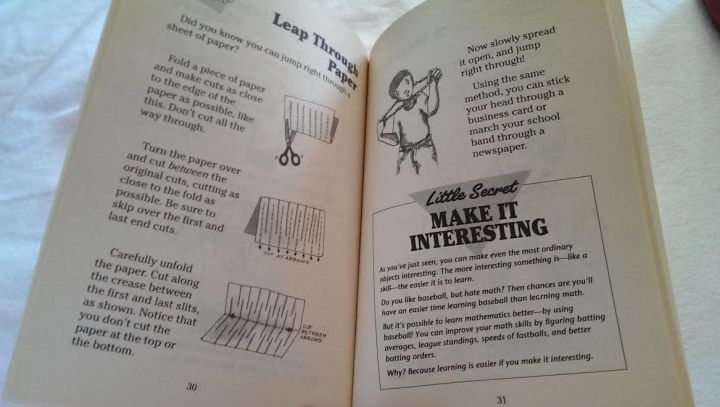
This book describes how to do fun tricks that don’t require any special equipment and are mostly based upon knowing things work, like the blind spot in the human eye (such as using the blind spot in your eye to make it look like your teacher’s head has vanished) and where your center of balance is (used in the trick showing how a girl can pick up a chair when a boy can’t). The tricks include making it look like your arms are lengthening or shrinking, making it look like you’ve broken your nose, how to hang a spoon from your nose, how to jump through a single sheet of paper, how to make a pencil float, how to make your leg disappear, and how to pronounce the longest word in the English language.

uselessskillspic1

Kids will enjoy learning these little tricks to entertain their friends. However, the book also contains useful tips for learning these skills that can be used to learn anything you want to learn. The author emphasizes the importance of trying new things, practicing what you’ve learned, going slowly and dividing big tasks into smaller ones when trying to master something difficult, and making tasks interesting so they will be easier to learn. Aside from the fun of learning these little tricks, the book’s main purpose seems to be helping kids to develop self-confidence and new learning skills.

The book is currently available online through Internet Archive.

uselessskillspic2

A Wizard’s Dozen

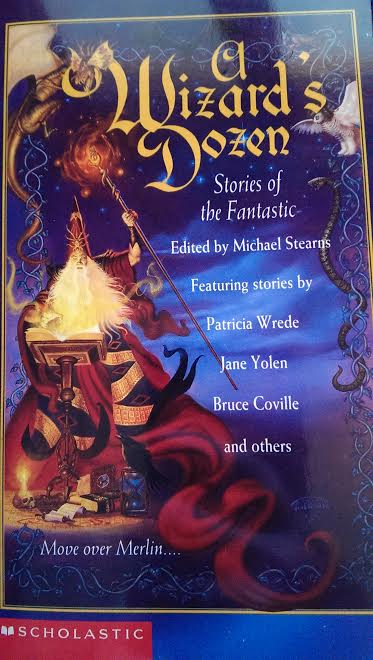
WizardsDozenA Wizard’s Dozen: Stories of the Fantastic edited by Michael Stearns, 1993.

This is a collection of fantasy stories (roughly middle school level) by different authors.  The tone of the stories varies from light and humorous to dark and serious.  The stories in this collection are:

The Sixty-two Curses of Caliph Arenschadd by Patricia C. Wrede

Caliph Arenschadd has a temper, but unlike other rulers, who have been known to cut off people’s head when they’re angry, Arenschadd is also a wizard.  Because he likes to show off his magic, he has thought of something more creative than executing people: a list of curses to inflict on those who anger him.  As people get him angry, he progresses through the curses in the order that he thought of them, each one worse than the last.  Worse still, he also inflicts the curses on the families of people who annoy him, which is how Imani, the young daughter of the caliph’s vizier has experienced so many at her young age.  However, the caliph has made a serious miscalculation in his latest curse.  This time, he has turned the vizier and his family into werewolves without being able to remove the curse.  As far as anyone knows, it’s impossible to cure lycanthropy.  As the vizier and his family find themselves becoming a threat to those around them, can Imani and her friend Tumpkin find a way to break the curse?

Fairy Dust by Charles De Lint

When Marina’s friend Jason manages to catch a real, live fairy in a jar, she tries to convince him to let it go, but he refuses.  He wants to keep it, just overnight.  But, the fairy ends up dying, and suddenly, Jason himself is severely ill.  Marina is sure that Jason is suffering from a fairy’s curse, but is there anything she can do to save him?

This experience touches on Marina’s absent father, an impractical dreamer, although it does turn out that he has taught Marina an important lesson, and she learns for herself that when she sees someone doing something that she knows is wrong, it is also wrong for her to keep silent.

The Princess Who Kicked Butt by Will Shetterly

In a mystical kingdom, people’s names tell everyone something about their destiny and character.  When a new princess is born in the kingdom, the Fairy Who Was Good With Names comes to bestow a new name on her.  However, the fairy sneezes and no one clearly hears the name that the fairy gave her.  Thinking that the fairy said the princess was “the Princess Who Read Books,” the king and queen make sure that she has plenty of reading material while she’s growing up and don’t give it much more thought.  Later, when the Evil Enchanter tries to force the princess to marry him and her parents to hand over the kingdom, the princess’s true name and her real skills become known.

The Sea Giants by Betty Levin

A great-grandmother translates whale songs for her family to tell them an ancient story: There was once a family that was barely surviving on small fish, small prey, and the little berries that they were able to forage for themselves.  The father wished that he were bigger, stronger, and more powerful so that he could catch bigger prey for his family.  One day, the father and mother paddled out to sea in search of food, and they met a group of giants in their own canoe.   The giants took them back to their own village and gave them food, but although the food they were offered was much larger than anything they could catch themselves, next to the giants, it was about as small as the small prey that the people ate back home.  After while, the couple returned home to their children, guided by a strange gray dog which turns out to be a porpoise.  From then on, the family’s luck begins to change, and they do become more prosperous.  However, the father is unable to forget about the giants, and he feels called to join them again.

Efrum’s Marbles by Joy Oestreicher

Efrum is a giant, but he’s no ordinary giant.  Although Efrum is big (being a giant), he hasn’t grown at all since the age of six.  He is over 30 years old, and he is still a child, which is weird, even for a giant child.  He spends his days playing with other giant children, and his favorite game is marbles.  In fact, he has a favorite marble.  No one knows quite what this marble is made of because no one has ever seen another like it.  It’s strange, and it kind of looks like . . . an eye?  Then, a young giant girl named Brinda plays marbles with Efrum, and for the first time ever, Efrum is tempted to let someone else win his precious, mysterious marble, which clever Brinda realizes may be the first step in helping Efrum to grow up.

“Come Hither” by Tappan King

Meg hates being the middle child in her family.  Her older sister is praised for being responsible, and her younger sister is pampered.  Meg feels like getting into trouble is the only way that she can get attention.  When she gets into trouble and is grounded from her older sister’s birthday party, she decides to amuse herself by messing with her sister’s computer.  She makes a mistake while typing and ends up receiving an invitation from a mysterious elf to join her for a party in his land.  Has Meg just made a serious mistake?

With His Head Tucked Underneath His Arm by Bruce Coville

In a kingdom constantly at war, few young men survive to become old.  Young Brion escapes for a time by pretending to be crippled, but one day, his pretense is exposed, and he is executed for refusing to fight.  However, Brion’s death doesn’t prevent him from returning to end the suffering of his land and hopefully save more people from his fate.

The Queen’s Mirror by Debra Doyle and James D. MacDonald

This is a re-telling of the story of Snow White.  An older servant tells the young princess about the history of the magic mirror, which belonged to the princess’s grandmother, who ordered her own daughter’s death because she feared and resented her beauty.  There are no dwarves in this version, and it’s a slightly different take on the story.  There are hints that the events in the story repeat with the generations.

The Breath of Princes by Alan P. Smale

When Stephanie is kidnapped from her town by a dragon, the dragon tries to convince her that being a dragon’s prisoner is a much better fate than the one that awaits her in small-town life: drudgery, boring marriage, children, etc.  Of course, he plans to eat her eventually, when he gets tired of her.  Young men try to rescue her, but in a way, Stephanie fears that one of them will succeed.  If they do, she will no doubt be obligated to marry the rescuer, and considering what some of them are like, it might even be worse than being eaten by a dragon.  The man she has always dreamed about is a prince she was lucky enough to meet once, but no prince has come to save her.  There may be a way for Stephanie to save herself from either fate, but she has to sacrifice her innocence in the process.

Harlyn’s Fairy by Jane Yolen

Harlyn lives with her Aunt Marilyn, and when she spots a fairy in the garden one day, her aunt begins to worry about her.  Harlyn’s mother is mentally unstable and prone to paranoid delusions, so Aunt Marilyn keeps a close eye on Harlyn.  She discourages her from reading fantasy stories (although Harlyn loves them) for fear of the effect they might have on her mind.  But, Harlyn really did see a fairy.  The question is, what is she going to do about it?

Lost Soul by Vivian Vande Velde

A young man meets a beautiful, mysterious woman by a stream.  She charms him so much that he no longer loves the woman he was going to marry.  In fact, he is so obsessed with her that he can think of nothing else.  What will he do when he realizes that she doesn’t feel the same?  Is she even . . . human?

The Way of Prophets by Dan Bennett

The royal family of the Stuard Isles has a tradition.  At the age of seventeen, each of them must make a journey alone along an old road known as The Way of Prophets.  The things that they see and the things that happen to them along their journey tell them what their destinies are.  They learn what really matters to them and find a focus for their time as rulers.  So many centuries have passed that no one can be quite sure where the original Way of Prophets was, so mostly, the journey takes on a kind of symbolic meaning, but there are stories that say that, every once in awhile, a young ruler finds their way to the true Way of Prophets, and the kingdom changes in some important way.  When Prince Ransom sets out, he hopes to find the true path himself.  However, when he does, it doesn’t turn out to be quite what he imagined, and it makes him question what he really wants most from his destiny.

I love this story for what the prince’s father told him, “When I am gone, when you take the throne, you will be powerful.  That is guaranteed.  Your knights and armies will make sure of it.  And you will be loved and respected.  That, too, is guaranteed.  No matter what you say and do, there will always be those ready to smother you with love and respect, if you let them, simply because you wear the crown.  Because of who you are, Ransom — because of who you will become when I am gone — you need never be hungry or alone.  But there is no guarantee that you will matter.”  If what Prince Ransom wants most is to matter, can the Way of Prophets make it happen?

Faith by Sherwood Smith

Faith tells her friends fantastic stories all the time.  She comes from a poor family with a lot of problems, so most people assume that she just makes up stories to try to make her life sound better than it really is and avoid thinking about the problems.  Usually, her two best friends don’t mind much, but lately, Melissa has been getting tired of hearing Faith talk about how her dog can talk or how her radio can tune in to Middle Earth.  She’s growing up and losing patience with fantasy stories.  Even the girls’ other friend wishes that Faith would stop asking them to believe these wild stories.  Then, after a visit to the trailer where Faith lives, she begins to change her mind.

The book is currently available online through Internet Archive.

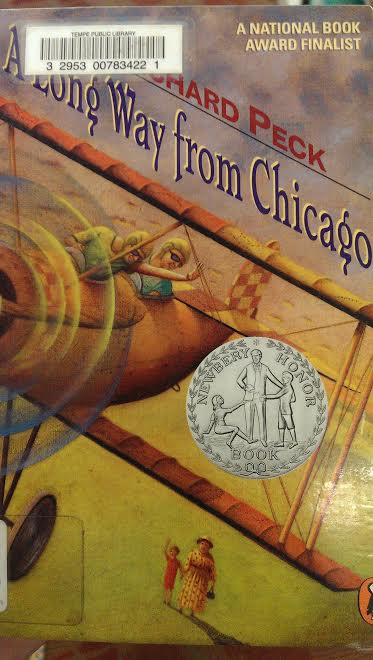
A Long Way from Chicago

LongWayChicagoA Long Way from Chicago by Richard Peck, 1998.

Joey and Mary Alice live in Chicago during the Great Depression, but every summer, they go to stay with their grandmother in a small town in Illinois. At first, the kids think that staying with their grandmother will be boring, but they soon find out that Grandma is anything but. She’s an eccentric woman who doesn’t let anyone boss her around and doesn’t have much respect for any rules but her own. Although she’s pretty tough, Joe and Mary Alice learn that, deep down, Grandma really does care about other people and tries to help them, even though she often gets into a lot of trouble in the process. Each chapter is a short story from each of the summers that the kids spend with their grandmother, from 1929 to 1935:

Shotgun Cheatham’s Last Night Above Ground (1929): When a reporter comes looking for information about a recently deceased local character, Grandma volunteers to hold a wake for him in order to teach everyone a lesson about truth and gossip.

The Mouse in the Milk (1930): When a group of local pranksters needs to be punished, Grandma decides to play a little trick of her own to get even.

A One-Woman Crime Wave (1931): Grandma turns to trespassing and illegal fishing in her quest to feed the hungry.

The Day of Judgment (1932): Grandma enters a baking contest at the county fair for the glory of her home town and a chance to ride in an airplane.

The Phantom Brakeman (1933): Mary Alice tries to help a young woman escape from her abusive mother, and Grandma brings a ghost story to life for the sake of young love.

Things with Wings (1934): Effie Wilcox, a neighbor of Grandma’s, loses her house to the bank, but Grandma comes to the rescue by demonstrating the power of rumors.

Centennial Summer (1935): As Grandma’s town celebrates its centennial, Grandma decides that uppity Mrs. Weidenbach, the banker’s wife, needs to be taught a lesson.

The Troop Train (1942): Joe, now much older, has enlisted in the Army Air Corps during World War II. As the train taking him to his basic training passes Grandma’s town, she’s there to wave to him.

During the course of the stories, the author includes details about how Prohibition and the Great Depression affected people and other details about life in the early 1930s. This book is a Newbery Honor Book.  There are multiple copies available online through Internet Archive.
Cadet Kirk

Star Trek: Starfleet Academy

STACadetKirk

#3 Cadet Kirk by Diane Carey, 1996.

McCoy and Spock meet again when they are both on their way to the Starfleet Academy Science Conference at Colony Cambria. However, the small ship that is supposed to take them there is piloted by Cadet Kirk, who is disappointed because he was originally supposed to be the pilot for Dr. Richard Daytrom, a famous scientist who will be speaking at the conference. McCoy isn’t happy about the situation either, remembering that Kirk got him in trouble the last time they met and caused him to miss his holiday.

Kirk seems entirely too self-assured and constantly quotes rules and regulations. As they pass the Atlantis Outpost, an automated research station, the ship is caught by a tractor beam and forced to the ground. A group of mercenaries hired by Klingons believed that Dr. Daystrom was on board the ship, and they want to kidnap him. Kirk does his best to follow regulations, but it only results in getting them all captured. Kirk is discouraged and worried about what will happen when Daystrom’s ship finally arrives.

The book is currently available online through Internet Archive.

STACadetKirkPic

Aftershock

Star Trek: Starfleet Academy

STAAftershock

#2 Aftershock by John Vornholt, 1996.

Leonard McCoy is a medical student at Starfleet Academy. Shortly before the Christmas holidays, McCoy is tired from studying and looking forward to spending some time at home. However, he takes a break from his studies to play a game of football with the other students and ends up in trouble. A younger student, Cadet James Kirk, tackles him, and they end up crashing into a security fence and setting off an alarm. As punishment, Kirk is given kitchen duty, but McCoy is asked to sign up for the Disaster Relief service club.

The club has its training course during the holidays, so McCoy will not be able to go home after all. As disappointing as that is for McCoy, the situation soon becomes much worse. The training course is barely over when the club is called away on a mission. The planet Playamar has been ravaged by earthquakes, and the club will be called upon to deliver supplies, treat the wounded, and rescue survivors. The club is organized into groups, and McCoy finds himself in a group with pretty Lisa Donald and the serious Vulcan, Spock. McCoy feels overwhelmed by the experience and questions whether he really has what it takes to become a Starfleet doctor.

When Spock says that he knows what is causing the earthquakes and how to stop it, will McCoy be willing to take the risks necessary to save the planet?

STAAftershockPic

Crisis on Vulcan

Star Trek: Starfleet Academy

STAVulcan

#1 Crisis on Vulcan by Brad and Barbara Strickland, 1996.

This is the first book in a series about characters from the original Star Trek series when they were young.

Young Spock accompanies his father, Sarek, on a diplomatic mission while he negotiates a peace treaty among different factions of the Marathan system. The different factions have been fighting for years, but now they must resolve their differences because they wish to join the Federation. Spock and his father journey home on the Enterprise, which is captained by Robert April. April’s first officer, Christopher Pike, takes a liking to Spock and shows him around the ship. Spock is surprised at the mix of different races aboard the Enterprise, how well they work together, and how easily they accept him.

Then, a group of Marathans attacks the Enterprise with the intention of capturing Sarek. They claim that Sarek betrayed them, although they do not explain why they think so. Spock helps the crew of the Enterprise to escape from the Marathans, and out of appreciation, Captain April offers to sponsor him for Starfleet Academy. Spock has already been accepted to the Vulcan Science Academy, so he does not accept the offer. The Vulcan Science Academy is the one of the best places for a young scientist to study, but they have extremely strict standards.

STAVulcanPicAll Vulcans believe in logic and reason and the suppression of emotions. Spock is half human, and Sarek is concerned that his control over his emotions will not be sufficient to allow him to cope with life at the Vulcan Science Academy. Sarek could tell that Spock was pleased with the praise that the crew of the Enterprise gave him when he was able to help them, and he urges him to keep a tighter rein on his feelings. To help Spock adjust to life at the Vulcan Science Academy, Sarek arranges for him to stay there over the summer, before the next semester’s classes begin.

As Sarek suspected, Spock is heavily scrutinized by his teachers and the other students. They are suspicious of him because they know that his mother is human, and they suspect that his ideas are not as logical as theirs. Although Spock excels in his studies, none of the others will give him the respect that he deserves. Then, Spock’s father calls him home because there has been an attack on his mother. Someone is out to harm Sarek’s family, and it looks like it is the same Marathans that attacked the Enterprise, possibly including a young Marathan Spock befriended earlier. What to do they want, and why are they so angry over a treaty that they had already agreed to sign?

The book is currently available online through Internet Archive.
The Ghost in the Tokaido Inn

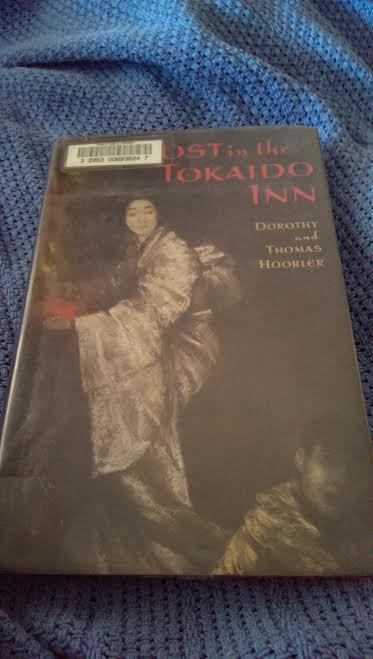
ghosttokaidoinnThe Ghost in the Tokaido Inn by Dorothy and Thomas Hoobler, 1999.

In feudal Japan, more specifically in 1735, the family you were born into determined what you were meant to be in life.  Samurai were born into families of samurai, and merchants were born into merchant families.

This is a terrible disappointment to Seikei, the fourteen-year-old son of a tea merchant, who would love nothing more than to be able to become a samurai.  He has studied the samurais and their ideals and greatly admires their bravery.  He even loves to write poetry, as the samurais do.

One day, Seikei accompanies his father on a business trip from their home in Osaka to Edo (the old name for Tokyo).  On their way, they stay overnight at an inn.  There, Seikei makes friends with the daughter of a paper merchant, and she entertains him with a ghost story.  During the night, Seikei sees a strange figure that attempts to enter his room, which he fears might be an evil spirit (like the one in the ghost story), but he is unable to get a good look at it before it disappears.

The next morning, Lord Hakuseki, a daimyo (lord, nobleman) also staying at the inn, says that a jewel was stolen from him during the night.  The famous Judge Ooka comes to the inn to investigate the crime.  The paper merchant and his daughter are accused of the theft because the jewel is found among their belongings.  Seikei recognizes the jewel as one that Lord Hakuseki showed to both him and the girl the night before when they each went to show him their fathers’ wares, and he also realizes that he saw the “evil spirit” holding it.

When Seikei tells Judge Ooka all of this, his father is angry, saying that Seikei must have imagined the whole thing.  However, Judge Ooka believes him.  He points out that the silent figure was no doubt the thief, who merely looked like an evil spirit to the boy who had just been startled awake, with a ghost story still on his mind.  Judge Ooka is also impressed with Seikei’s bravery when Seikei describes how he got up to try to get a better look at the figure, even though he believed that it was an evil spirit at the time.

Judge Ooka recruits Seikei to help him further investigate the crime, and they realize that the theft is only part of a much larger and more serious plot of revenge.  Judge Ooka, himself of the samurai class, also understands Seikei’s feelings better than his father does.  In the end, he offers Seikei a way of living the kind of life that he’s always dreamed.

This book is the first in a series.  Judge Ooka was a real, historical figure, although Seikei, his adopted son, is fictional.  Because the story contains violence and some religious oppression, I recommend it for middle school level readers.  The book is currently available online through Internet Archive.

The Vandemark Mummy

The Vandemark MummyThe Vandemark Mummy by Cynthia Voigt, 1991.
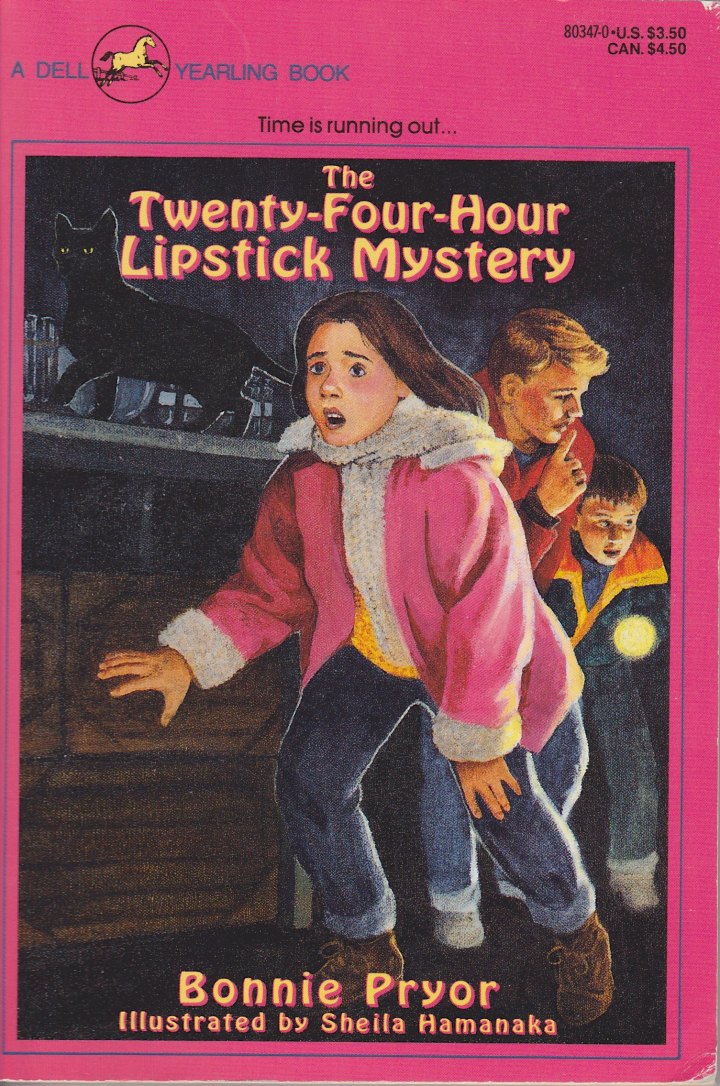
The Vandemark Mummy is an exciting mystery with believable characters. The story includes a bit of history about Ancient Egypt and side plots about the complications of family life, the role of women in society, and the nature of ambition.

Twelve-year-old Phineas Hall and his fifteen-year-old sister, Althea, have recently moved to Maine with their father, Professor Hall, because he got a job working at the small Vandemark College. Moving and starting over in a new place is never easy, but the move is more difficult for the kids because their mother didn’t come with them. Their mother is an ambitious, career-oriented feminist, and when she was offered an important job working for a congressman in Oregon, she could not bring herself to turn it down in order to go to Maine with the rest of the family.

Although the entire family talked the situation over, and everyone agreed to the current arrangements, no one is really happy about it. Althea particularly feels hurt. Even though she has shared her mother’s feminist ideals, she’s hurt by her mother’s apparent selfishness and the seeming ease with which she abandoned the family. Althea believes that her mother should have compromised on her career this time because her husband has made compromises for her in the past. To make herself feel better, Althea spends her time studying one of the oldest feminists, the Greek poet Sappho. Phineas, on the other hand, is just trying to be a normal kid and fight off boredom while waiting for the summer to end and school to start. But, boredom is the last thing on Phineas’s mind when the mummy arrives at the college.

The wealthy patriarch of the Vandemark family dies and leaves his collection of Egyptian antiquities (one of many collections he had) to the college, including a real mummy. The Vandemark family is a little disappointed because they had hoped that the collection might go to a much more prestigious institution, even though Vandemark College is named for their family. To the joy of the Hall family, Professor Hall is put in charge of the collection, which will be put on display in a new addition to the college library. Professor Hall lets Phineas and Althea go through the collection with him and another professor, Ken Simard. Although at first the collection does not seem to be particularly valuable, except for the unusually good condition of the mummy and the funeral wreath, it seems to be a lot more valuable to someone. After a failed attempt to break into the collection, someone later manages to steal the mummy. Then, Althea suddenly disappears. The adults suspect that Althea might have run away because of the troubles in their family, but Phineas knows better and begins a desperate hunt to find his sister.

One of the best things about the book is that it really takes both kids to unravel the entire mystery: Phineas for his persistence and decisive action and Althea for her more mature understanding of the thief’s motives. Although, even at the end, their family’s situation isn’t completely resolved, the kids’ experiences give them a new perspective on things. It would be a great book for middle schoolers.

The book is available to borrow and read for free online through Internet Archive (multiple copies).

Themes and Spoilers

I debated about saying more because I didn’t want to spoil the story too much, but after thinking it over, I can’t give my full opinion of it in this review without talking a little more about what Althea and Phineas learned from their situation.  If you’d rather not know more detail, you can skip the rest of this.

On the one hand, I was a little disappointed at the lack of complete resolution to the family’s troubles because, by the end of the book, I really cared about the characters and wanted to know what would happen to them, but I think the author purposely left the story open at the end so readers could imagine for themselves what the characters are going to do next.  However, there is one thing that is pretty well established at the end of the story: whatever happens to their parents, whether their separation is temporary, as they’d originally planned, or whether they end up divorcing, Althea and Phineas are going to be okay because they still have each other, their father, and their new friends in their new town.

In the beginning, their mother’s absence is worrying because they will now have to cope without her, and they don’t know what is going to happen to their family in the long run.  But, part of the children’s self-sufficiency actually does come from their mother and things that she taught them, whether she is with them or not.  The book does mention little things they learned from their mother.  It’s subtle, but she’s still with them because of the influence she’s had in their lives.  The kids also develop more of an appreciation for their own resources and abilities, which makes them less fearful.  One of Althea’s early characteristics was a long-standing fear of the dark.  After her ordeals, her father and brother expected her fear to be worse, but she tells them that she is actually less afraid now than she was before because she has learned something about circumstances she can control and ones she can’t.  She says, “I think, there’s a difference between being scared and not knowing how you’ll do, and being scared but knowing you’ll do okay.”  As she notes, if she goes to bed at home with the lights off and decides that she really can’t stand it, she can always get up and turn them on again.  She has realized that she has control in her daily life and actions she can take to make things better, which she didn’t have during parts of their adventure.  It gives her confidence.

The kids also learn lessons about the nature of ambition and about their own feelings.  In the beginning, Althea is more vocal about how she feels about her parents’ separation.  She feels betrayed because, although she learned her sense of idealism from her mother and thought that they shared the same views, her mother has now done something which she views as a selfish act, rejecting her family and her family’s needs solely in the name of her personal ambitions.  Phineas, on the other hand, doesn’t seem to know what to feel or is afraid to show his true feelings at first, just trying to keep busy so he doesn’t have to think about it too much because he thinks that his parents’ marriage is only their business.

At the end, the two alter their positions somewhat, coming a little more into agreement with each other.  Althea has the chance to contrast her parents’ marriage and ambitions with that of the villain’s (without naming names), and she sees the difference in the way each of them responds to the same pressures.  Although her father may have been hurt by his wife’s reluctance to make sacrifices in her ambitions for the sake of his and her preference for separation over compromise, he still genuinely cares about her and understands her ideals and what she really wants to achieve.  The fact that it’s only a separation, not a divorce, is a sign that the parents still care about each other and respect each other and hope that they will be able to reconcile eventually.  The villain doesn’t have those feelings, and unlike either of Althea and Phineas’s parents, really is motivated solely by selfish ambition.

Ambitions often require sacrifice in order to achieve them.  Revealing exactly what the villain sacrificed would say too much, but this person does end up losing pretty much everything in the end.  For the sake of her ambitions, Althea’s mother sacrificed her place in the family.  Although she thought that it would only be temporary, the hurt she caused her family members will probably have longer-lasting effects. When she calls them to find out what’s been happening, she learns what she’s been missing and the ordeals her children have faced without her, which leave her feeling both worried and left out, feelings that her husband understands and explains to the children (“One of the things she knew, without knowing how it would feel, is that we’d be able to get along fine without her.”), which shows that he is still in tune with his wife’s feelings.  Toward the end of the story, she is upset and seems hurt that Althea is too tired and busy talking to the police to talk to her much other than to briefly reassure her that she is now safe.  At that point, Althea needs her mother’s comfort less than her mother needs reassurance from her.  Althea feels a little bad about not being able to soothe her mother’s feelings because she is no longer as hurt and angry with her as she was before, but Phineas tells her not to worry if their mother’s feelings are hurt right now because she owes her daughter some hurt feelings.  In other words, Phineas has finally learned that it’s okay for him to have feelings and an opinion about the things happening in his family and to show them.  He recognizes how hurt and confused his sister was at their mother’s apparent betrayal, and he has decided that it’s okay for their mother to see that hurt and feel a little of it herself so that she will understand what’s really happening and what her children are really going through. They have coped without her, but the fact remains that she wasn’t there for her family during their time of crisis.

You’ve probably noticed that I’ve been focusing more on the mother’s ambitions and questioning her motives more than the father’s in the story.  That’s partly because that is the focus of the story.  The children do not see their father as abandoning the family for the sake of ambition because he didn’t.  They make it clear that he has supported his wife’s ambitions in the past, often at the expense of his own.  He mentions that the attraction of this new position that he has accepted is that it’s “the first job in fifteen years that I’m not over-qualified for, and I plan to enjoy it . . .”  He is primarily a scholar and has felt under-challenged intellectually.  Because he’s an academic, his schedule is more in sync with the children’s school schedule, which is why both of the children chose to go with him rather than with their mother.  He also makes time for his children and even involves them in his work when possible, supporting Althea’s interests in history and philosophy, which he shares.

At one point, Althea says to her father, “You and Mom don’t have exactly the same set of values, you know.”  The mother of the family is more concerned with money, climbing the occupational ladder, and achieving higher positions, higher salaries, and more influence.  She sees these things as ways of furthering the cause of feminism, and often works long hours away from her family for her jobs. In the past, she has used the fact that she earns higher salaries than her husband to convince him and the rest for the family to make accommodations for the sake of her jobs.  Althea says that her mother’s arguments aren’t honest and that her lack of support for her husband’s career as well as her own are a betrayal of the “equality” that she supposedly believes in.  It isn’t that Althea is completely opposed to her mother’s ambitions so much as she disapproves of the way her mother goes about achieving them. Her mother is apparently more concerned with status than the intellectualism that her daughter and husband crave.  Much of the conflict in their values comes down to what they think they need to feel fulfilled in their lives.  Because the characters seem to need different things, they are having trouble living a shared family life.  That’s the situation for the Hall family, as the book describes it.

In the end, this book is bound to spark a lot of opinions and discussions about the characters and their views and much speculation about what will happen next for the Hall family.  Will one or both of the parents change their view of the situation, just as Althea and Phineas have?  Will the mother, who admits that the job she took wasn’t what she had expected it to be, decide to quit and rejoin her family?  If she does, what will her role in the family be now that Althea and Phineas have become more independent than they once were?  Another character, who I haven’t mentioned before, is a female reporter in their new town who befriends the family and helps them through their ordeals in the mother’s absence.  In some ways, her values seem more in tune with the father’s than the mother’s are.  Is it possible that she could be the children’s eventual stepmother if the parents separate permanently?  Or will she only ever be just a supportive family friend?  Families in real life experience changes like these as children grow older and begin to forge their own identities and values in the face of changes in their lives, reevaluating their parents’ decisions and making ones for themselves.

The Twenty-Four Hour Lipstick Mystery

24hrlipstickmysThe Twenty-Four-Hour Lipstick Mystery by Bonnie Pryor, 1989.
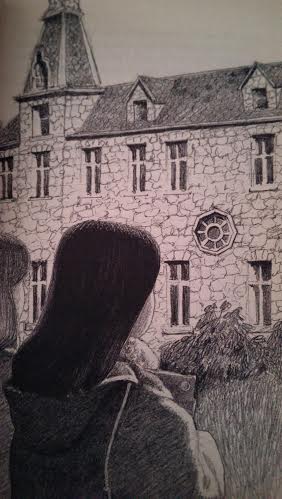
Cassie Adams, who is eleven years old, has never been happy with her looks, and now that her friends are starting to shave their legs and get interested in boys, she feels plainer than ever. One day, she sees an ad for Mrs. DuPrey’s School of Beauty and Charm and thinks that it might help her improve her appearance and develop confidence. The only problem is that she doesn’t have the money for it, and her parents won’t give her any. She decides that she needs to look for odd jobs in the neighborhood to help raise the money that she needs.

By coincidence, old Mr. Murdock’s granddaughter has recently moved into the old family house, which is huge and reputed to be haunted. In spite of the creepiness of the old place, Cassie finds a job there, helping Miss Murdock with cleaning and unpacking. Miss Murdock’s father made his money in cosmetics, and Miss Murdock employs a secretary named Victoria Presser, who used to be a model. Cassie admires Vicky for her beauty and elegance and looks forward to picking up some beauty tips from her. She also makes friends with Jason, a new boy in town, who also works for Miss Murdock, helping the gardener fix up the grounds. However, it isn’t long before Cassie, Jason, and Cassie’s younger brother, Danny, begin noticing that there is something odd about the old Murdock house.

lipstickmysterypicDanny is the first to notice that there is an octagonal window in the wall of the house, but none of the rooms has a window in that shape. Sometimes, lights can be seen through this window at night. Also, Cassie finds what looks like lab equipment among Miss Murdock’s boxes. Is Miss Murdock involved in something illegal? Does it have something to do with the burglaries that have been occurring around town? Why is the grumpy old gardener sneaking around? Just what is in that hidden room?

The book is currently available online through Internet Archive.

My Reaction

This is a good mystery for tween and early teen girls, who can identify with Cassie’s worries about being beautiful and popular. The moral of the story is that appearances are deceiving, and in the end, Cassie reconsiders what beauty really is and develops more confidence by appreciating the good qualities she already has and developing new interests.  While some of the other girls try to show how grown-up they are by looking grown-up, Cassie really grows up by taking responsibility for her life and the direction she wants it to go, making decisions about what she wants and who her real friends are.

Valentine Blues

valentinebluesValentine Blues by Jeanne Betancourt, 1990.

This book is part of the Aviva Granger Stories series.  (It’s the only one I have in the series right now.)

In the last book, Aviva’s best friend, Josh, came to live with her, her mother, and her step-father.  Josh was living in an orphanage before that, and since he and Aviva were close, her mother and stepfather thought that it would be natural to invite him to be part of the family.  At the time, Aviva thought that it was a good idea, but being friends with someone doesn’t mean that it will be easy living with them, and Aviva’s family life is already complicated!

Aviva’s parents are divorced, and both her mother and father are already in new relationships.  Her mother has remarried, and Aviva not only has a stepfather but a half-sister (college age) and half-brother (baby) living in the same house.  Aviva’s father has a girlfriend, Miriam, and Aviva doesn’t get along well with her.  Miriam would like it if she and Aviva’s father had a child of their own.

When Josh comes to live with Aviva’s mother and her family, Aviva realizes that sharing a family and house with him makes things even more complicated.  He takes too long in the bathroom and makes her late to school.  He’s one more person for her mother to pay attention to, so Aviva gets less attention.  Even her dog seems to like Josh better now!

Then, shortly after Valentine’s Day, Aviva overhears Josh and his friend Ronnie Cioffi talking about girls and giving them ratings based on their looks.  Out of 10 points, Cioffi rates Aviva as a 2, and Josh agrees.  Josh has a crush on Louise, a girl they know from school, and she has a much better figure.

It isn’t that Aviva is in love with Josh, who she sees more as a friend/brother, but it hurts that he seems to be taking her place in the family and doesn’t even really appreciate her, joining in with his friend in making fun of her body.  With her time divided between two households, two parents who hardly seem to have time for her these days, and Josh moving in and taking over, Aviva worries that maybe she doesn’t really belong anywhere or to anybody.

It takes a night when Aviva sleeps out in the barn without telling anyone where she is to make the people closest to her realize how much she needs them.  A sleepover at Louise’s house (where the girls candidly discuss their own ratings for the boys they know) and Aviva’s anonymous question in sex ed class also help to put the rating system into perspective for all the kids.

The book has some Christian themes because the children go to a Catholic school, although this book mostly focuses on family life and girls’ and boys’ perceptions of each other.  The kids are eighth graders, and there is also some talk about sex ed.