The Power Twins

Fritz (real name Richard) and Helen Price are twins, and their mother runs a seaside guesthouse. Their younger cousin Jonathan, called Tubs (a nickname that annoys him), comes to visit during the summer, although the twins find him annoying. It isn’t really Tubs’s fault; it’s just that he’s three years younger than they are, and they find him childish. Then, one day, Tubs tells them that Uncle Grigorian is coming to visit.

Fritz and Helen say that they’ve never heard of Uncle Grigorian before, and they ask their mother about him. She says that Uncle Grigorian hasn’t come to see them since the twins’ father died in a car crash, and Uncle Grigorian came to the funeral. The twins’ father originally came from Poland as “more or less an orphan”, and his family was split apart during “the war.” Even he wasn’t sure exactly how many brothers he had, and he never heard from the rest of his family after he arrived in Britain.

(The implication is that he was probably one of the children brought to Britain by the Kindertransport, which transported refugee children from Nazi Germany and Germany-occupied territories, including Poland, to Britain between 1938 and 1940 and placed them with foster families or in temporary homes. The Kindertransport prioritized particularly vulnerable children, especially Jewish children whose parents were already in concentration camps or who were homeless, living in poverty, or were already orphans. The hope was that many of these children would be reunited with their parents after the war, but many of them never saw their families again and continued living with their foster families because their parents were likely killed during the Holocaust. The father in this story was likely very young at this time or even an infant and so didn’t understand his family’s full situation, didn’t have many memories of them, and never learned their ultimate fate. None of this is stated explicitly in the story, but it fits with the father’s apparent age, the time period, and Poland during “the war.”)

Uncle Grigorian was living in Germany at the time the father died about 10 years earlier, but he said that he happened to be on a business trip in England at the time the father died and saw the notice in the newspaper, so he came to pay his respects and check on the family. Now, Uncle Grigorian has bought a farm in Wales, and since he will be living in Britain, he would like to spend more time with the children and get to know them better. Although Tubs is related to the twins on their mother’s side rather than their fathers and isn’t a blood relation to Uncle Grigorian, Uncle Grigorian invites all three children to visit him on his farm. The children’s mother admits that the guesthouse is very busy at this time of year, and a family has shown up with more children than they originally said they would bring, so it would be helpful if the children went on a visit, and the children are excited about seeing the farm.
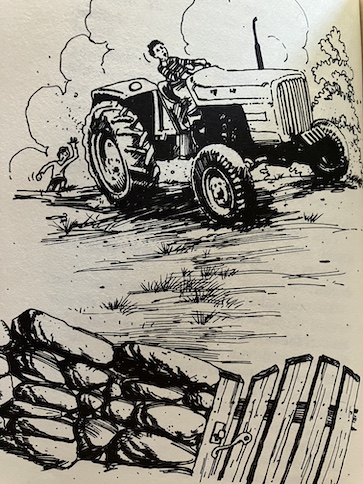
At first, this seems like just a fun farm visit. Uncle Grigorian is indulgent with the children, letting them eat as many chocolate cookies as they want, teaching the boys how to drive a tractor, and letting Helen play with the lambs. A man named Mr. Rhys manages the farm, and Mrs. Rhys is his cook and housekeeper, making them all a big, traditional, full English breakfast. Things get complicated when Tubs asks Uncle Grigorian what he does while Mr. Rhys manages the farm.

Uncle Grigorian shows the children his office in the farmhouse. At first, it just seems like an ordinary office. Then, Uncle Grigorian opens the filing cabinet, which contains dials and switches instead of files. The room changes so the ceiling and walls become transparent, and the children have a view of Earth from space. Tubs says that it looks like they’re on the moon. Fritz thinks that it’s just a trick with projectors, but Uncle Grigorian says that Tubs is actually correct, and they are on the moon. At first, Fritz doesn’t believe him, so Uncle Grigorian changes their location again, taking them to Trafalgar Square in London. Since they’re on Earth now, he invites Fritz to step outside and check their location. He does, and to his astonishment, they really are in Trafalgar Square. He buys a newspaper, and it has the current date on it.

Uncle Grigorian explains to the astonished children that the office actually contains his spaceship, which is about the same size as the room itself. He can travel through space easily, but traveling around Earth is more tricky because he can’t risk colliding with other objects. He has to know the exact coordinates for where to land, so it’s best for him to go to rooms that he has already rented as office space, where he will know the exact coordinates and knows that the room will be the right size for the spaceship.

At this point, Fritz begins to suspect that Uncle Grigorian, whose oddly-positioned thumbs were already a source of curiosity for them, might not actually be human. Tubs had earlier joked about those thumbs meaning that he’s from outer space, and once again, Tubs is more right than anyone else suspected. Uncle Grigorian admits to the children that they’re not actually related at all. Uncle Grigorian is a kind of sociologist from a planet called Klipst, and he’s also a kind of secret agent for the Galactic Empire. He studies societies on different planets and keeps an eye on planets that are just starting to discover space travel. He latched onto the children’s family as a cover for his identity and activities, specifically because their father had been a war orphan who didn’t know much about his family or what happened to them. Most people would be suspicious about an unknown relative suddenly turning up, but with their family, it would be entirely plausible for them to have an uncle they knew nothing about. He says that Earth is getting close to discovering hyperdrive travel, and when it does, the Galactic Empire will need to decide whether or not to admit Earth to the community of planets.

The reason why Uncle Grigorian is telling them all of this is that he needs the children’s help. There is a dispute that needs to be settled between planets, and he asks the children to be arbiters in the dispute. The planets involved specifically want the arbiters to come from outside the Empire, and they don’t want politicians, who would probably be motivated by biases and self-interest. They have decided that they want child arbiters to hear the dispute because children have a great sense of fairness, and adults are often hardened to the unfairness of life in general. Children would be completely unbiased in this situation and not have a jaded point of view. Uncle Grigorian tells the children that it’s up to them whether they would be willing to accept this mission or not. Tubs is eager to accept and go to outer space, but the twins are more hesitant. They’re not sure if they know enough or would be able to be arbiters in an intergalactic dispute. Uncle Grigorian tells them that, if they accept the mission, he will give them something that will change that, and they decide to accept.

Uncle Grigorian says that he will give them “the Powers”, which is a special mental weapon that’s only been recently developed. It works a little different for everyone, but it enhances people’s mental abilities. Anything that a person has as talent will be enhanced so they become a natural expert in it. To gain these powers, the children have to sleep for the night in Uncle Grigorian’s spaceship while wearing special earpieces.

In the morning, he checks on them and asks them if they notice anything different about themselves. Helen can tell right away that Fritz isn’t telling the truth when he says no because she has acquired the ability to read people’s emotions and body-language like an expert. Uncle Grigorian calls her a Reader because of her ability to read people. Further, Helen can tell that the reason why he denied noticing anything was because he wanted to hear what the others would say first. Fritz admits that this is true. He says that what he has noticed is that he went to sleep trying to figure out how the ship can travel such long distances so quickly, and when he woke up, the answers just came to him. Uncle Grigorian calls him a Synthesist, someone who can put together pieces of information quickly, seeing how things relate to each other and how they work.

At first, Tubs can’t figure out if anything about him has changed or not, but Uncle Grigorian tries giving him a small, round, fuzzy creature called a Petball. (Sort of like one of the Tribbles from Star Trek.) Tubs loves it immediately. It also seems to like him, and Tubs gives it the name Glob. Uncle Gregorian says that his attachment to the creature is a sign that he’s a Maverick. Petballs are strange creatures, and they don’t like everyone, but they do like Mavericks. Maverick Powers are difficult to understand because people who have them have an odd way of saying or doing unusual things that turn out to be the right decision or reaching conclusions that turn out to be unexpectedly correct. It’s hard to say exactly when or how Tubs will use his Power, other than getting along well with Glob, but Uncle Gregorian says that it will be there at the right time for him to use it.

Tubs’s Power begins to show after they arrive at Palassan, the capital of the Galactic Empire. A strange girl comes up to them soon after their arrival and tries to offer a flower to Helen. Without him being able to explain exactly why, Tubs automatically reaches out and knocks the flower to the ground. When it hits the ground, it breaks, and they realize that is it really an electronic device that was supposed to transmit a subliminal message to Helen. Someone is already trying to influence the children as arbiters in the dispute. Soon after that, Fritz begins to notice how closely they’re being guarded, but are the guards there for their safety or because they’re now prisoners?
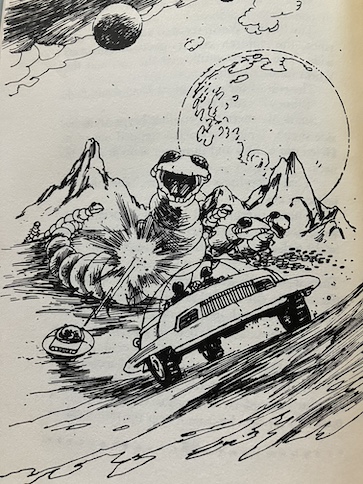
When the kids begin hearing about the dispute, they are told that a new planet has been discovered in a place where there has not been any planet before. It is not near any star, and there doesn’t seem to be any explanation of how it got there. An expedition to the planet discovered that what looks like “clouds” is actually some kind of vegetation that emits light, and there are worm-like creatures living on the surface. The problem is that these large Worms spin a substance called Unilon, which is very valuable. Since the Worm World was discovered, people have flocked to the planet to harvest it for selling. Some of them have captured Worms and forced them to spin continually until they die. The League of Life says that it is concerned about the welfare of these creatures, and the Unilon Harvesters Association says that it’s concerned about jobs. With her Power, Helen can tell that neither side in this dispute is telling the truth. Fritz does some research and uncovers some ulterior motives and hidden sides to both sides of the dispute. He decides that finding a solution means going to the Worm World itself, but learning the secrets of the mysterious world will put them all in danger.

The book is available to borrow and read for free online through Internet Archive.

I thought that the premise of this story was interesting, a mysterious “uncle” who is actually an alien in disguise who gives the kids a mission in space and special powers. The secret of the Worm World is also intriguing. It turns out (spoiler) that the world itself is alive, and they have to find a way to communicate with it. It’s a plot that sounds a little like some of the early Star Trek episodes or maybe inspired by them.

Most of the emphasis of the story is on the twins, even though there are three kids involved. Tubs helps in the story, but I was expecting that he would be more central to the solution of the problem or that the solution would be more of a cooperative effort than it was. I was a little disappointed at how quickly the story ended.

One thing I’d like to point out that, even with their enhanced “Powers”, the kids aren’t perfect at them. Fritz puts information together pretty easily, but he still has to do research and observe things directly to get the information he needs. Even when he has it, he doesn’t necessarily understand its full significance right away. His comment about how it looks like they’re being held prisoner rather than being simply guarded for their protection turns out to be more accurate than I thought it might be at first, but he doesn’t seem to have fully realized the reason why or who they can’t trust. Even Helen, with her ability to read people’s emotions and body-language doesn’t realize at first that their guard isn’t trustworthy. She could tell that he was uneasy, but she attributed his uneasiness to the wrong reason.

Actually, I think the part about Helen not being perfect at reading people is a good callback to the argument between the children about Tubs’ nickname at the beginning of the story. Helen argues that Tubs shouldn’t mind his nickname because Fritz never complains about his, but Helen hasn’t accurately read even her own twin’s feelings about his nickname. The truth is that Fritz doesn’t like his nickname any more than Tubs likes his, but the book says that he’s old enough to have figured out that, if he makes a fuss about not liking it, people will use it even more. I know that people can be like that, but being even older than Fritz is, I’m old to have figured out that this rule only holds true as long as the people involved decide it does. This isn’t something everyone does naturally or all the time; it’s a thing that some people do habitually because they’re pushy and like provoking reactions from people. When they get a negative reaction from someone, they just push harder to get more reactions rather than realize that they’re getting on that person’s nerves and cutting it out. What I’m saying is that Fritz seems to have correctly realized that Helen is that type of pushy person, which is why he doesn’t complain to her about how much he hates his nickname, while Helen has totally missed both Fritz’s real feelings and the fact that he’s figured her out. We’re supposed to accept that Helen already had a natural ability to read people even before getting her enhanced “Powers”, but the whole nickname incident had me rolling my eyes about Helen’s ability to read even her own family members and wishing that she would get a clue.

I expected that the characters would eventually revisit this situation with Tubs’ nickname before the end of the book and that Tubs would do something to help the situation that would earn his cousins’ respect. However, neither of those things happened. Fritz is the one who mainly solves the problem, and he does so rather quickly toward the end of the book. I was surprised at how quickly the book ended. Because the kids all keep their powers and Tubs is able to keep Glob at the end of the story, I wondered if maybe the book was originally intended to be the first in a series, with further adventures and more character development in later books, but if that was the case, I can’t seem to find anything about it.

I found the issue of language in the story interesting. People in the Galactic Empire speak a common language that Uncle Gregorian describes as being sort of like Esperanto, no matter what planet they come from. The treatment that gave the children their powers also gave them the ability to speak and understand this language, even when they’re not fully aware that they’re doing it. I liked the idea of a common language that’s a kind of conglomerate of other languages with Esperanto as the inspiration. Because the characters aren’t fully aware of that they’re hearing or speaking this language, we don’t have any hints of what it would be like, but I just thought the concept was interesting.
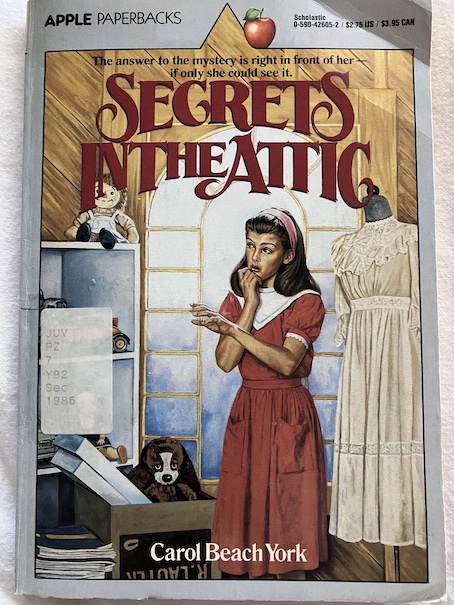
Secrets in the Attic

Following the death of Jodie and Peter’s father in a car accident, Jodie’s mother decides that she want to move to a new town and have a fresh start. For some reason, people have been gossiping about the family, particularly Jodie’s Aunt Claire. Jodie doesn’t really want to leave her old home, but she does make a new best friend in her new school. However, they don’t return to their home town of East Hill until Great Aunt Winifred invites them to visit for Christmas.

Jodie loves Aunt Winifred and her big, old-fashioned house with the old toys in the attic. She has fond memories of her whole family getting together for Christmas there, and she thinks that if they visit for Christmas, things will be like they used to be. Jodie’s mother knows differently. Things are not like they used to be with Jodie’s father gone and the gossip still hanging over the family, although Jodie doesn’t understand why. Her mother refuses to return to East Hill, but she says that Jodie can visit Aunt Winifred if she wants. Jodie doesn’t want to be away from her mother and little brother on Christmas itself, so they decide that Jodie can visit Aunt Winifred the week after Christmas, between Christmas and New Year’s.

Jodie still can’t understand why her mother doesn’t want to see Aunt Winifred, but it’s really Aunt Claire that she doesn’t want to see. Jodie’s mother explains that, around the time that Jodie’s father died in the car accident, some money was stolen from Mr. Carrington. Jodie’s father was a lawyer, and Mr. Carrington was once of his clients, and the theft was discovered after Mr. Carrington himself died of a heart attack. Aunt Claire accused of Jodie’s father of stealing the money, but since he was killed in the accident, he never had a chance to defend himself against the accusation. Uncle Phillip, Claire’s husband and vice-president of the bank where Mr. Carrington kept his safe deposit box, never believed that Jodie’s father took the money, but it was bad publicity for the bank when it was stolen. He was trying to get to the bottom of the situation, but he had been in the car with Jodie’s father during the car accident and was also killed. That may have been why Aunt Claire started making public accusations against Jodie’s father – to deflect any blame or suspicion of Phillip because of his role in the bank and maybe also because she blamed Jodie’s father for getting him killed in the car accident when they skidded on a snowy road.

In spite of everything that’s happened, and even because of it, Jodie feels like she has to return to East Hill to see Aunt Winifred and face Aunt Claire. She’s not sure how, but she thinks that if she goes back to East Hill, she might find something that will clear up the situation. There had been another suspect in the theft, a nephew of Mr. Carrington, who was known to be in debt, but nobody could figure out how he could have stolen the money. When it comes down to it, Aunt Claire herself spends more money than she should.

When she gets to East Hill, she realizes that her mother was correct that East Hill doesn’t feel like it used to. Jodie no longer feels like East Hill is her home. She likes her new town and misses her best friend. Her older cousin, Lisa, who is Aunt Claire’s daughter, used to get on her nerves sometimes because she was always the “perfect” child. She is very pretty and talented on the piano, always seems to look great and do everything right, and is also kind of a snob. When Lisa is at the train station with Aunt Winifred to meet Jodie on her arrival, Jodie realizes that Lisa bothers her even more than she used did before.

Lisa is still fussy and snobby and impatient with Aunt Winifred, who sleeps more because she’s getting old. One thing that interests Lisa about Aunt Winifred is that she’s heard that Aunt Winifred is making a new will, and she openly speculates about who is going to get the most out of it. Jodie is disgusted by this talk and asks her why anybody has to get more than anyone else, and Lisa matter-of-factly tells her that there is always a favorite and that the favorite always gets the most. (I can guess that her mother probably told her this.) From the way Lisa talks, Jodie can tell that she thinks of herself as the “perfect” favorite and, therefore, already entitled to receive the most. It disturbs Jodie that Lisa doesn’t seem to care that Aunt Winifred would have to die for her to get anything at all. One day, she overhears Aunt Claire lecturing Lisa that she needs to practice her piano music more while visiting Aunt Winifred because she wants Aunt Winifred to pay for Lisa to study music in Europe. Aunt Winifred seems to want it even more than Lisa does.

While Lisa busies herself with practicing at the piano and calling her friends on the phone, Jodie goes up to the attic to see the old toys they used to play with. When she looks in the attic, she is surprised that her feelings about the attic have also changed. There is something about the attic that now bothers her, but she can’t quite think what it is. She feels like something in the attic has changed or that she wants to change something there, but she’s not sure why. When she looks for a log cabin toy with little pioneer and Indian (Native American) figurines that her father always loved, she is surprised that it is missing. Aunt Claire doesn’t think much of it, suggesting that Aunt Winifred might have just thrown it away, not knowing that it was Jodie’s father’s old favorite toy. However, Jodie knows that can’t be it. Aunt Winifred never had any children of her own, and she loved her two nephews as if they were her sons. She was very sentimental about the toys that they loved, and Jodie doubts that she would just suddenly decide to get rid of one of them.

When Jodie finally figures out what happened to the log cabin toy, the whole truth about the theft comes out.

The book is available to borrow and read for free online through Internet Archive.

I liked the setting of the story. Big old houses like Aunt Winifred’s aren’t very common anymore, and I always wanted to live in a house with an attic that had a solid floor to it, like the one in the story. Jodie’s memories of playing with the old toys and dress-up clothes there sound fun. Although Jodie doesn’t spend Christmas itself at the house, she is still there during the Christmas season, so the Christmas tree with its unique, old ornaments is still there, and the family enjoys Christmas treats, like chocolates and mince pies.

I had theories about the mystery right from the start. I hoped that Mr. Carrington’s nephew, who we never met, wouldn’t be the thief because that felt too much like bringing in an outsider as the culprit. When Jodie meets a boy named Kenny and becomes friends with him, I thought his family might have something to do with the theft, but they don’t. He’s just a boy who likes Jodie and has fun with her, doing things that Lisa thinks she’s too grown-up to do anymore, like throwing snowballs and making a snowman.

I really suspected Aunt Claire as the thief from the beginning. She definitely has expensive tastes, and when she appears in the story, her clothes and hairstyle sound much more expensive than I would expect from a widow raising a daughter in a fairly small town. The way she and her daughter talk about getting their hands on Aunt Winifred’s money emphasizes how callous and money-grubbing she is. Even Lisa admits that she doesn’t really want to go to Europe to study music. Her mother is the one who wants to go to Europe, and she’s using Lisa as the excuse to get money so both of them can go there. Lisa doesn’t like her mother’s plans because she wants to stay at her school with her friends. It occurred to me that Claire’s accusations about Jodie’s father taking Mr. Carrington’s money could have been to cover up for herself doing it. Since her husband worked at the bank, she could have used his position to get access to the money herself. That’s not exactly what happened, though.

Claire is not the thief. In a way, she was the motive for the crime, so when the truth comes out, it’s still going to hurt. When Jodie discovers what really happened, she even feels sorry for her aunt because she knows that the truth will be hard for her to hear and will affect her reputation in this town in the same way that the suspicions about her father affected her mother. Jodie also feels sorry for Lisa, which I felt was more justified than sympathy for Claire. However, the story ends with Jodie finding out the truth for herself, and we aren’t shown the moment when she reveals it to everyone. We don’t get to see everyone’s reactions, and if it changes any of Aunt Winifred’s thoughts about her will, we don’t see that happen. We don’t know what arrangements Aunt Winifred made originally, so that doesn’t matter too much. The talk about the will is really to establish the moral characters of Aunt Claire and Lisa.

I suspected that Aunt Claire was set up as being so awful and unlikable that readers wouldn’t be sorry if she turned out to be the thief, kind of like how the people who get murdered in old episodes of Murder She Wrote are usually the people who are the most nasty to everyone during the first ten minutes of the show, so viewers are not too sad about them dying and can get on with the puzzle of figuring out who did it. Aunt Claire makes a great villain because I disliked her so much that I wouldn’t have cared no matter what she was guilty of or what happened to her. She’s the snotty kind of woman who says awful things about other people, both behind their backs and to their faces. She criticizes people she sees for being fat and offers unsolicited critiques of their clothes, like she’s the fashion police. She’s extremely manipulative of other people and their emotions for the sake of getting what she wants and making herself feel good, and this even extends to her own daughter. Basically, she’s one of those middle school mean girls who never grew up beyond that point. That she’s good at being awful to other people and getting things she wants is enough justification to her that she sees nothing wrong with being the way she is. I’ve known so many other horrible adults exactly like that in real life that I knew I would cheer to see her shoved under the proverbial bus.

I was expecting that her greediness and high maintenance lifestyle were her motives and that her nastiness was a set-up so readers could focus on the puzzle of how she gets caught. I even thought that the story might take a dark twist with her tampering with Aunt Winifred’s medicine to slowly poison her for the inheritance she expected, since Aunt Winifred said that her medicine was making her unusually sleepy. However, Aunt Claire isn’t an attempted murderer any more than she’s a thief. She’s just an awful person who uses people, and her high maintenance lifestyle was the motive for the real thief, who was probably also manipulated by Claire and her expensive tastes.

Lisa’s character softens a little during the course of the story. She’s still fussy and a little spoiled because of the way her mother is, but Jodie realizes that Lisa isn’t very happy with the way her mother is. Lisa likes music, but her mother is manipulating her as much as anyone else to further her lifestyle. Lisa knows what she wants for herself, and hopefully, even though the truth about the theft is going to hurt her, it might actually change things for Lisa’s benefit in the long term.

I also wondered whether the car accident had anything to do with the theft, but apparently, it doesn’t. It doesn’t seem to have been caused deliberately or by anything directly related to the theft. It was just an accident that took place at an unfortunate time.

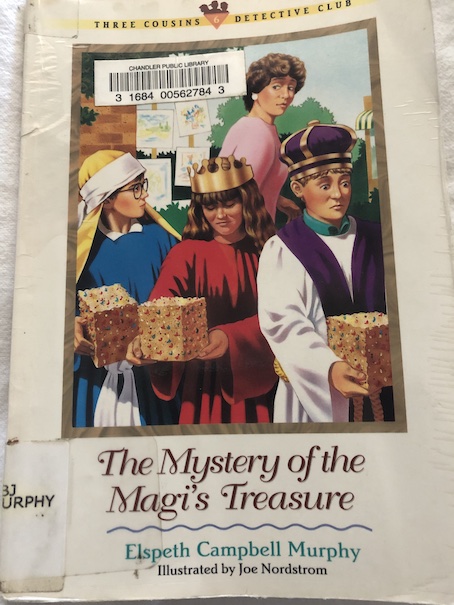
The Mystery of the Magi’s Treasure

Three Cousins Detective Club

#6 The Mystery of the Magi’s Treasure by Elspeth Campbell Murphy, 1995.

Timothy, Titus, and Sarah-Jane go to visit their grandparents in the resort town where they live over the summer. Their grandfather is the pastor of a church, and in their Sunday school class, there are three boys, all named Kevin, who are close friends and have a reputation for being troublemakers and goofs. The three cousins have little to do with the three Kevins, but it’s because of the three Kevins that they are recruited to help with the community’s Christmas in July art fair.

The community holds an art fair every summer, and this year, they’ve chosen Christmas in July as their theme. Some of the local churches are holding a special concert of Christmas music as part of the event, and someone through it would be a fun idea to have children dressed in costumes from the Nativity play, like shepherds and angels, to hand out flyers for the concert. The three Kevins get the roles of the Three Wise Men, but it becomes obvious pretty quickly that this arrangement isn’t going to work because they’re more like the Three Stooges than stately wise men. The choir director says that they need more reliable children to be the Three Wise Men, so naturally, he gives the roles to the three cousins. After all, their grandfather is the pastor, and their grandmother is always bragging about how well-behaved they are.

As soon as they put on the wise men costumes, Timothy realizes that there’s method to the Kevins’ madness. If you get a reputation for being reliable and doing good work, people give you more work. If you get a reputation for not doing anything right, nobody will even let you do certain jobs. The job of being wise men in July is anything but fun. The robes are too heavy and hot for summer. They can’t even complain because everyone says they look adorable, which is humiliating, and their grandmother keeps telling everyone how proud she is of them. It’s almost like they’re being punished for being good, and they can’t say a thing about it without disappointing Grandma.

Then, something really strange happens while they’re passing out flyers. A woman they’ve never seen before runs up to them and gives them three boxes. She says that they’re supposed to be part of their costumes, the gifts for Baby Jesus. She seems a little flustered and has trouble remembering exactly what the gifts are supposed to be, forgetting the words “frankincense” and “myrrh.” She tells the kids that she’s in charge of the props and that they have to take good care of these boxes and only return them to her. Then, she rushes off again.

The kids think that it’s an inconvenience to have to carry around the boxes as well as pass out flyers, but the woman’s manner struck them as strange. When they look more closely at the boxes, the workmanship also seems unusually good for objects used only for a Nativity play.

Then, the kids overhear a couple of artists talking about some artwork stolen from a fellow artist. Suddenly, they have an uncomfortable feeling that they know what was stolen, who took it, and where it is now. The big problem is that the thief is watching them.

Theme of the Story: Goodness.

The book is available to borrow and read for free online through Internet Archive.

My Reaction and Spoilers

After the kids hear about an artist’s work getting stolen, it doesn’t take them long to realize that the boxes they were give were probably the stolen artwork and that the “prop” lady who didn’t seem to know what she was doing was the thief. She was just looking for a convenient place to leave her stolen goods so she wouldn’t be caught walking around with them, and she happened to spot the children in their wise men costumes. Three fancy boxes look like what people would expect the gifts of the Three Wise Men to look like, so the thief could essentially hide the stolen goods in plain sight. The artists talking about the theft were uncertain exactly what type of art was stolen, so most people at the fair also wouldn’t know what to look for and would just assume that the boxes were props.

The Kevins got them into this mess in the first place, and they turn out to be the way out of it, too. The thief was counting on the kids being easy for her to watch because they stand out in their costumes but almost invisible to bystanders because everyone else just disregards them as being in costume and doesn’t look closer. What the kids realize is that maybe she also hasn’t looked closely enough to really recognize them and is only following the costumes, no matter who happens to be wearing them. Once the cousins explain to the Kevins what’s happening, it’s exciting enough for the Kevins to be more than happy to participate. They finally put their playacting and thrill-seeking to a good purpose!

Weirdly, the thief also unintentionally did a good deed for the artist. The artist has been doubting herself and the quality of her work. While stealing from her was a bad thing to do, the thief unintentionally confirmed that her work was so good that she was willing to steal it! It reminded me of a funny line from an old episode of Remington Steele with an artist whose work was stolen: “I’ve finally hit the big time! I’ve been stolen!”

The theme of “goodness” sounds somewhat generic, but the story is really about turning something bad into something good. The kids didn’t really like getting the roles of the Three Wise Men, but if they hadn’t taken them, they wouldn’t have found this mystery and saved the stolen artwork. Instead of goofing off and messing up like usual, the Kevins came through when it was really important. The woman who tried to take something that didn’t belong to her proved that it was something with value. The boxes themselves were made from pieces of junk, but they’re beautiful. It doesn’t mean that stealing becomes right if it unintentionally accomplishes something good, but the kids come to realize that even things that don’t seem like they’re worth anything can have unexpected good sides. Even Baby Jesus was born in a humble stable.

The Mystery in the Snow

The Boxcar Children

Boxcar Children Mystery in the Snow cover

The Mystery in the Snow by Gertrude Chandler Warner, 1992.

Boxcar Children Mystery in the Snow  arrival

The Alden children are disappointed because there is still no snow this winter, and they’ve really been looking forward to snow. Their grandfather tells them not to worry because, soon, they’ll have all the snow they want. A friend of his, Mr. Mercer, owns a ski lodge and has been urging him to visit and bring his grandchildren. There’s going to be a winter carnival there. The children are eager to go and have fun in the snow!

Boxcar Children Mystery in the Snow choosing teams

At the ski lodge, the Alden children meet a boy named Jimmy. Jimmy is a regular visitor to the lodge, but for some reason, he says that his parents never stay. There is also a girl called Freddie, which is short for Fredrica. Her parents aren’t at the hotel, either, because they’re visiting her sister, but she says that they will come later. Freddie could have gone to visit her sister, too, but she didn’t want to miss the fun at the ski lodge. She and Jimmy are both team captains for the winter games, which include skiing, skating, sledding, snow sculpting, and ice carving. Strangely, when the team captains get the box where kids are supposed to submit their names to join the teams, they can’t find the keys. The loss of the keys is worrying because, if they can’t find them, they won’t be able to get into the equipment shop for the equipment they need for the games. They still manage to put together the teams, and the Alden children also join.

Boxcar Children Mystery in the Snow  skates

Then, Mr. Mercer discovers that all four of the tires on his truck are flat. Grandfather Alden offers to drive him into town to get a pump for the tires and to talk to a locksmith about getting into the equipment shop.

While the adults tend to that, the kids talk about the try-outs for different events. The Aldens are all excited about different events. Violet notices that one girl, Nan, isn’t enthusiastic about the events at all and doesn’t want to try out for anything. Violet asks her why, and Nan says that joining in the games was her parents’ idea, not hers. They say it will be fun, but she never really enjoys herself at these things. She doesn’t think there are any events she can do, and she’d hate to be the one to lose an event for her team. To encourage her and build up her confidence, Violet suggests that they both sign up for the ice carving event, which doesn’t require a try out. Violet says that she doesn’t know how to do ice carving, and Violet says that’s fine because she doesn’t, either. She says that it would just be fun to try it out together. Nan points out that they would be competing against each other because they’re on opposite teams, but Violet says that doesn’t matter because they’re both equals, neither one of them knowing what they’re doing. Nan is cheered by Violet’s friendliness and signs up for ice carving.

Boxcar Children Mystery in the Snow  Watch the dog

Nan isn’t the only unhappy child involved in the games, and the Aldens begin to feel that the focus on competition instead of simply having fun in the snow is partly to blame. A boy named Pete is upset that he didn’t get selected for any of the events he tried out for, and he says he doesn’t want to be the time team’s time keeper, which is the default position. Pete says he no longer wants to be involved in any of it. Freddie is angry because she and Jimmy drew names for their team members at random, and she thinks that Jimmy ended up with most of the really good team members. She wants a way to even things out. When the Aldens ask Jimmy if his parents will come to the awards dinner at the end of the games, he seems upset and doesn’t want to talk about it much. They’re not sure if Jimmy is more upset about his parents not being there than he pretends or if he’s worried about the awards ceremony in general.

Boxcar Children Mystery in the Snow  smashed sculpture and footprints

It soon becomes apparent that someone is intentionally trying to sabotage the winter games. Someone smashes the snow sculptures that the Aldens made for their team. Then, someone steals a skier’s skis and ruins the ice sculpture made by the other team. The entire skating event has to be postponed when someone ruins the ice.

Who is doing these things and why? It could be someone who’s trying to make their team win the competition, but the sabotage has been aimed at both teams and at the event in general. Is it a kid who is unhappy with the contest or their position on their team? Jimmy seems eager to cancel events every time something goes wrong. Can the Boxcar Children figure out who is responsible?

The book is available to borrow and read for free online through Internet Archive (multiple copies).

My Reaction

Boxcar Children Mystery in the Snow  skis

There are themes in the story about competition and family. The Aldens aren’t accustomed to thinking competitively about other people because they’re used to doing things with each other cooperatively, as a team. Because they’re accustomed to thinking cooperatively, they are friendly with people on the other teams, like Nan, and they’re more focused on the fun of the events than on winning. That makes them different from some of the other kids, who are concerned about winning, but there are other issues in the book besides competition that matter more.

Boxcar Children Mystery in the Snow  knocking on the door

There are indications in the story that the parents of the children in the competition don’t always want the same things that their children want. Nan, for instance, didn’t even want to join contest, but her parents urged her to do it. Also, some of the children aren’t as good at others at conveying to their parents what they really want. When the most troubled child in the group finally manages to say what they really want, many things get straightened out.

I feel like there are many stories where the conflicts revolve around people who don’t really communicate with each other. In this story, there’s a character who blames others for not understanding how they feel, but even they have to acknowledge that they haven’t actually explained their feelings. They’ve just been expecting everyone else to know what they’ve been feeling. Some honest communication straightens out the problem, and that’s a good life lesson for kids and families.

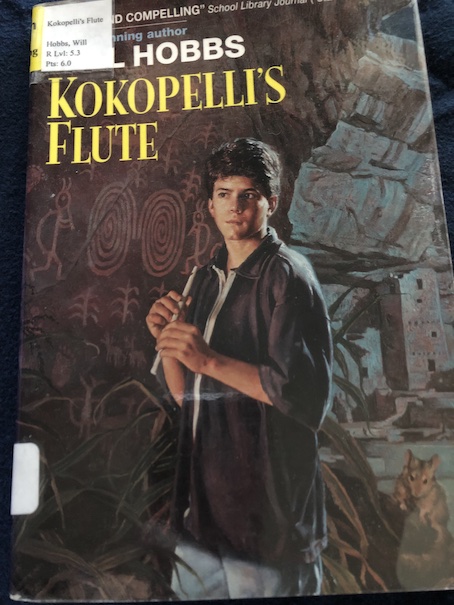
Kokopelli’s Flute

Kokopelli’s Flute by Will Hobbs, 1995.

Tepary Jones, called Tep for short, has always been fascinated by the ancient cliff dwelling known as Picture House. One night, he goes there with his dog, Dusty, because he think it would be a great place to watch a lunar eclipse. However, he and Dusty aren’t there alone. Tep witnesses a couple of looters illegally digging for valuable artifacts. The looters uncover the burial of a medicine man and begin taking some of the things he had buried with him. They damage the site before they leave, but Tep discovers that they have left behind an unusual artifact, a small flute made of polished bone. When Tep picks up the flute, he feels compelled to play it. Not wanting to leave the flute behind in case the looters return, Tep takes it home with him.

That night, Tep has a strange dream that he turned into a packrat, like one of the literal packrats he saw up at Picture House. However, he soon realizes that this was not just a dream. Ever since he played the flute, he finds himself turning into the animal he saw the first time he did so. Tep returns the flute to the body of the medicine man and reports the looting to the authorities, hoping that, once the body is respectfully reburied, whatever magic or curse is afflicting him will end. Unfortunately, it doesn’t.

Tep still finds himself turning to the packrat at night, having uncontrollable urges to go out and explore and find food, and it’s dangerous because animal predators and even his own parents are after him. Rodents in the house are a serious concern because they can carry hantavirus, which causes dangerous respiratory infections in humans. After his mother catches sight of him in packrat form, Tep’s parents start setting out traps. His dog, Dusty, seems to know him even when he’s a rodent and helps to protect him, but Tep knows that he’s going to have to stop this transformation somehow, before either his parents catch him or a predator eats him!

Tep’s parents are academics and researchers who study ancient agriculture and cultivate varieties of seeds on their farm that require little water to grow. To buy himself time from his parents’ efforts to catch the packrat, Tep makes the argument that the packrat is a part of the ecosystem and that it might be performing an important role in the environment, like birds that help propagate seeds by eating them and then depositing them in new places. Tep brings up the fact that there are some seeds that really need to be processed in a bird’s digestive system before they can grow. It’s a thoughtful argument, but the looming threat of hantavirus in their community still means concern about the presence of rodents. Hantavirus is serious, even fatal, and people in their community have already fallen victim to it.

Tep returns to Picture House to try to find the flute again to break whatever spell is affecting him, but he can’t find it. He only hears what he thinks is the sound of someone playing the flute, and he’s not sure if he really hears it or if he’s imagining it. Then, a stranger comes to the farm, a man who appears to be a humpbacked Native American or possibly someone from Mexico or Central America. He calls himself Cricket, and Tep’s family thinks that he’s probably just another migrant worker. Tep shows Cricket around the farm and explains the different types of seeds they cultivate and how they can be used to keep particular varieties of plants alive for their drought-resistant or pest-resistant qualities. Cricket doesn’t say much, but he seems to approve of the idea of cultivating more varieties of seeds. When he helps Tepary to plant seeds, Tep notices that he uses a planting stick, like Native Americans traditionally did.

Of course, Cricket is no ordinary farm worker. Tepary notices his unusual ability with plants and animals, and one night, Cricket speaks with Tepary while he’s in his packrat form. Cricket knows more of what’s been happening than anyone because he is one of the legendary figures from Native American folklore known as Kokopelli. Kokopelli was a legendary humpbacked flute player known for bringing seeds to people, and Cricket says that he still visits people like Tep’s family, who are interested in the past, who cultivate the land, and who keep seeds alive. Tep appeals to him for help with his transformations, and Cricket says he will help, if he can, although he notes that Tep seems to have been managing well. Cricket says that Tep can use the flute to reverse his condition, but only if he knows the right notes to play on it. If he plays the wrong notes, he could change into something else and make his condition worse. The clues to the notes are contained in the pictures on the walls of Picture House.

Tep manages to use his animal form to play a trick on Coyote in the tradition of old trickster tales and to rescue his dog from the looters. Then, Tep’s mother contracts hantavirus. Cricket says that ancient people also suffered from the disease, and they used an herb to cure it. Nobody grows that particular herb anymore, but there should still be some contained in the medicine bundle buried with the old medicine man at Picture House. To save his mother and break the spell on him, Tep must return there to find the medicine man’s bundle and the flute.

The book is available to borrow and read for free online through Internet Archive (multiple copies).

My Reaction

I vaguely remember having read this book when I was a kid, around the time when it was first published in the 1990s. It stuck in my mind because it takes place in the Southwestern United States, where I grew up, and it was also the first time that I had heard about hantavirus, which is a serious concern in real life. I couldn’t remember exactly how the book ended, though.

Reading it as an adult, I understand more about the parents’ work and the commentary about interrelated aspects of the ecosystem than I did as a kid. I understood some aspects of environmentalism and ecosystems as a kid because those were topics that we discussed in science classes at school in the 1990s, but admittedly, science wasn’t my best subject, and I’ve had more time to grasp certain concepts since then.

There are agricultural researchers in real life who do what Tep’s parents are doing, trying to cultivate seeds for drought-resistant crops, which are important in places like the area where I live, that are very dry for much of the year, and are becoming even more important due to climate change. That type of research takes time to cultivate generations of plants and to propagate seeds with desirable qualities. Modern researchers also take information and inspiration from past agricultural practices to enhance modern techniques (paleoethnobotany or archaeobotany). When Tep is talking to Cricket, he explains why it’s important to keep growing a different varieties of crops because some varieties are more resistant to different types of problems that others, like drought-resistant crops or pest-resistant crops. One of the dangers of huge, corporate farms is that they produce too few varieties of particular types of crops, focusing on the most popular ones, leaving them vulnerable to being almost completely wiped out by particular disasters. People need to keep growing older and less popular varieties of crops to keep the plant varieties alive and keep producing seeds for new generations so agriculture as a whole will have those varieties to draw on for the plant qualities they need to cope with changes in the environment and/or particular plant diseases.

One of the reasons why I liked this book is that it references the legend of Kokopelli. Because I grew up in the Southwestern United States, I grew up seeing images of Kokopelli along with other Southwestern Native American symbols. Kokopelli is often used as a decorative image in Southwestern art, although not everyone who has or uses the decoration knows the legends behind it. Kokopelli is described in somewhat different ways in different stories, but he is generally a fertility figure who travels from village to village, bringing changes to the seasons and promoting good harvests. He is also a trickster figure and represents human fertility. In some stories, human women get pregnant everywhere he visits, including by Kokopelli himself, an aspect of the character that does not appear in this particular book because it’s not kid-friendly. There is a theory that the legends might be based on traveling Aztec merchants who arrived seasonally, carrying sacks of seeds and other goods to trade on their backs, giving them that hunched appearance.

The book frequently uses the word “Indian” instead of Native American. It seems to be meant in an informal way rather than a disrespectful one, although I found it irritating because it can be a bit confusing. When Tep uses it in relation to the Native American ruins nearby, context tells readers that he means “Native American”, but when he uses it when he talks about places around the world that use the seeds his family produces, it becomes more confusing. At one point, he uses the word “Indian” and then talks about an order his parents have received from Pakistan, so did Tep mean Native Americans or people from India the country in that context? I heard the word “Indian” used a lot in relation to Native Americans when I was growing up, and sometimes, I even have the urge to use it out of old habits, but I don’t really like using that word anymore. It’s not so bad if you say “American Indian”, but just saying “Indian” by itself is often confusing. I generally agree with the modern convention of saying “Native American” or using the name of a specific tribe, if you know the name to use, both because it sounds more respectful and because it really makes a difference in the clarity of the sentence. It’s just not as effective if someone immediately has to ask, “Wait a minute, do you mean ‘American Indian’ or ‘Indian from India’?”, and when it’s in writing, there isn’t even a live person there to ask.

Revenge of the Mummy

Clue

This book is a collection of short solve-it-yourself mini-mysteries based on the Clue board game. Each book in the series contains short mysteries that the reader is urged to attempt to solve before the characters do. The solutions to the mysteries come after each chapter.

Most of the mysteries involve a crime of some kind, but not all. Sometimes, characters try to steal things from each other, but there’s also a scavenger hunt, an ice cream tasting party, and a hot air balloon race.

In the final chapter of the book, it seems like Boddy, our host, has been murdered, and the reader has to solve his murder, just like in a game of Clue. However, Mr. Boddy doesn’t actually die. It’s a pattern in the series that he seems to have been killed in each book, but he always survives somehow to reappear in other books in the series.

At the end of the previous book of solve-it-yourself mini-mysteries, it looked like Mr. Boddy had been murdered, but at the beginning of this book, he explains how he survived. All of the books in the series follow this pattern. There’s generally a humorous twist to how he survives and explains the situation.

The book is available to borrow and read for free online through Internet Archive.

The Lion Ring – Mr. Boddy has obtained a new treasure for his collection: an ancient and valuable ring with a lion on it that once belonged to an African king. Naturally, his sticky-fingered guests all want it for themselves.

Full of Hot Air – Mr. Boddy and his guests are having a hot-air balloon race. Who will be the winner?

Urge to Earn an Urn – Mr. Boddy stops Mrs. White and Mrs. Peacock from arranging flowers in an old urn they found in the basement. It turns out that it’s a valuable Greek urn, and when the other guests realize it, someone plots to steal it.

Please Don’t Sneeze – Miss Scarlet is coming down with a cold and spreading it among the other guests. Mr. Boddy introduces them to his grandmother’s secret cold remedy.

For Goodness’ Snakes! – Mr. Boddy’s guests are frightened of his new pet boa constrictor, but when they try to catch the snake, the snake catches one of them.

The Inky Trail – Mr. Boddy has discovered that someone attempted to forge his signature on a $250,000 bond. Fortunately, the forger tried to use the pen that explodes ink if anyone other than Mr. Boddy uses it. Mr. Boddy thinks that it’s going to be easy to track down the ink-stained guest, but it’s more complicated than he thinks.

The Scavenger Hunt – Mr. Boddy’s guests are bored one evening, so he starts a scavenger hunt with them.

Screaming for Ice Cream – Mr. Boddy has an ice cream tasting party with his guests to determine the best flavor. However, not everyone is willing to eat certain flavors of ice cream. Readers have to determine who is the only person who tried every flavor.

Caught Bare-Handed – Someone attempts a daring but unsuccessful theft of Mr. Boddy’s priceless chandelier, which sends it crashing. Who was the attempted thief?

Revenge of the Mummy – Mr. Boddy shows his guests the mummy case that he has recently acquired. The guests are a little too fascinated after someone mentions that mummies were buried with their valuables. Mr. Boddy warns the guests that the mummy may get angry and seek revenge, but they don’t believe it … until someone has an encounter with the mummy.

The Screaming Skeleton

Clue

This book is a collection of short solve-it-yourself mini-mysteries based on the Clue board game. Each book in the series contains short mysteries that the reader is urged to attempt to solve before the characters do. The solutions to the mysteries come after each chapter.

Most of the mysteries involve a crime of some kind, but not all. Sometimes, characters try to steal things from each other, but there’s also an apple-bobbing contest at a Halloween party, a snowball fight, and a pie-eating contest.

In the final chapter of the book, it seems like Boddy, our host, has been murdered, and the reader has to solve his murder, just like in a game of Clue. However, Mr. Boddy doesn’t actually die. It’s a pattern in the series that he seems to have been killed in each book, but he always survives somehow to reappear in other books in the series.

At the end of the previous book of solve-it-yourself mini-mysteries, it looked like Mr. Boddy had been murdered, but at the beginning of this book, he explains how he survived. All of the books in the series follow this pattern. There’s generally a humorous twist to how he survives and explains the situation.

The book is available to borrow and read for free online through Internet Archive.

Murder in the Cockpit – Mr. Boddy wants to take his guests for a flight on his private jet, but a fight breaks out over seating arrangements.

Baby Booty – Mr. Boddy has to watch his young nephew for a while, and he bribes his guests into helping him. Various guests take turns trying to make baby Frank happy, and readers are asked to figure out who has Frank.

Dance Until You Drop – Mr. Boddy and his guests were planning to have a croquet tournament, but they had to cancel it due to rain. To cheer everyone up, Mr. Boddy starts a dance party, but a couple of his guests take advantage of the situation and steal Miss Scarlet’s necklace.

The Halloween Costume Caper – Mr. Boddy is having a Halloween party for his friends, and he wants everyone to come in costume. When the guests arrive, no one is sure who is wearing which costume, but their identities are gradually revealed during a highly competitive game of bobbing for apples, where the guests are trying to find the apple that contains a “gold nugget.”

The Snowball Effect – It’s snowing, and the guests are getting on each other’s nerves because they’re cooped up inside. To change the mood, Mr. Boddy enlists everyone in a snowball fight. It’s up to the readers to determine who won from the information given.

The Case is All Sewed Up – Mr. Boddy is having an heirloom quilt restored, but the guests become interested when he says that one his ancestors hid the family treasures in the quilt during WWI. What are the Boddy family treasures, and who gets their hands on them?

Pie in Your Eye – Mr. Boddy is holding a pie-eating contest with his friends that unfortunately ends in a food fight. But, who is the winner?

Pea is for Pretender – The guests are talking about fairy tales when Miss Scarlet says that, like the Princess and the Pea, she would bruise if she tried to sleep on top of a single pea. The guests decide to put her claim to the test, and Mr. Boddy promises her a crown if she really bruises from sleeping on a pea. However, Miss Scarlet enlists the help of another guest to fake the results of the test. Who is her confederate?

The Thanksgiving Murder – Thanksgiving starts off peacefully enough with various guests volunteering to help Mrs. White prepare the meal and set the table … at least until Miss Scarlet realizes that Mrs. Peacock has removed her valuable jade ring and set it aside while helping. After Miss Scarlet swipes the ring, it changes hands several more times as others notice and take it for themselves. It’s up to the readers to figure out who finally ends up with it.

The Screaming Skeleton – Mr. Boddy unveils his latest acquisition – a skeleton made entirely of platinum. He’s planning to sell it to a museum, but of course, his guests plot to either steal the skeleton (or parts of it) or intercept the money from the museum. But, knowing his guests as he does, Mr. Boddy has also installed a security device on the skeleton that screams when someone tries to touch it.

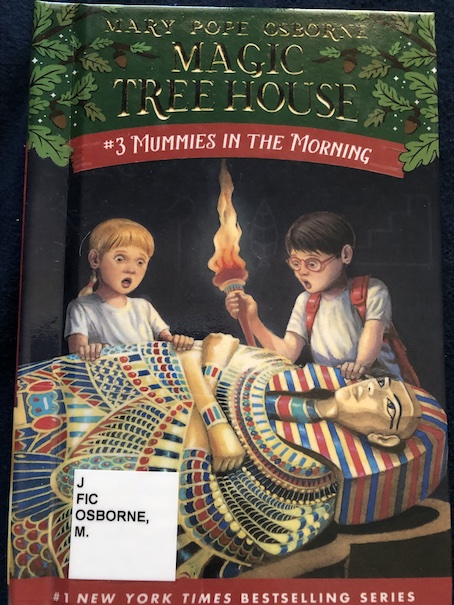
Mummies in the Morning

Magic Tree House

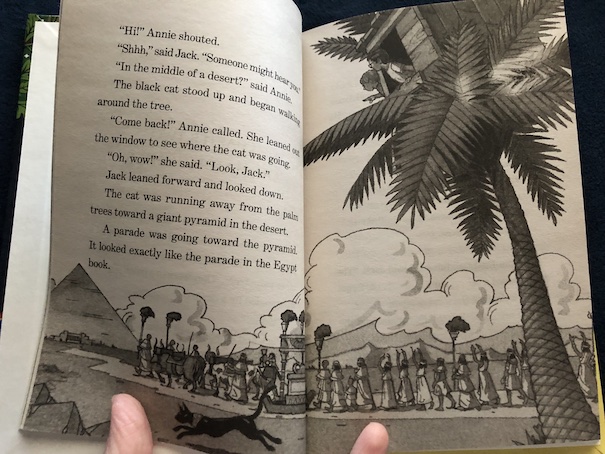
This time, Jack and Annie use a book in the magic tree house to travel back in time to Ancient Egypt. Jack has a fascination for mummies and pyramids, and Annie can’t wait to see them up close. When the children arrive, they witness what appears to be a royal funeral procession, but the people seem to vanish awfully quickly. Annie wonders if they could have been ghosts, although Jack thinks that’s nonsense. He thinks it was probably just a mirage, although he has reason to rethink that later.

The children follow a mysterious black cat into a pyramid. Annie is eager to see a mummy, but the children are startled when they see what appears to be a walking mummy that drops a scepter. Jack realizes that what they saw wasn’t a real mummy but probably a tomb robber in disguise. He reads in their book about Ancient Egypt about the problem of tomb robbers.

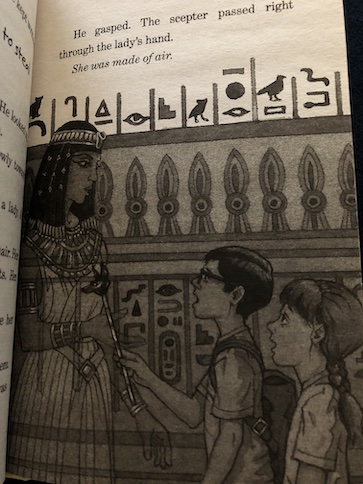
Then, the children encounter a real ghost! She is see-through, and objects pass through her. Fortunately, the ghost is nice instead of scary, and she explains to the children that she needs their help. She is the ghost of an Ancient Egyptian queen, and she has been unable to progress to the afterlife because she cannot find her copy of the Book of the Dead, which is supposed to guide her through the obstacles on the way to the afterlife. She knows that her brother, who designed her tomb, hid the book to protect it from tomb robbers and left clues for her in the symbols carved on the walls of her tomb. However, her brother apparently forgot that her vision was always bad, and she can’t read the symbols. (Apparently, poor vision doesn’t improve after death.) Jack would be willing to loan her his glasses, but since she’s incorporeal (not a word used in the book, but basically, she no longer has a physical presence and can’t use physical objects), the glasses wouldn’t stay on her face.

Instead, she asks the children to describe the symbols on the wall to her so she can interpret them. Together, the children and the ghost use the clues to find the scroll containing the Book of the Dead. After that, Jack and Annie have one more task: escaping the maze-like tomb!

The ghost in the story is a non-scary ghost, but there’s enough mild creepiness and mystery to satisfy kids who enjoy a little creepiness in their stories. Toward the end, they have to put the scroll in the sarcophagus with the queen’s mummy, which both grosses out and fascinates the children.

The historical information was good, although translating Egyptian hieroglyphics is much more complicated than the book indicates. In the book, the symbols are meant to literally depict specific objects, which some hieroglyphics can, but others are used to represent sounds to spell out words or names. I think the story just kept things simple for kids.

I liked the part where the kids get lost in the pyramid because pyramids were build with false hallways and dead ends to confuse tomb robbers. Everything work out fine in the end!

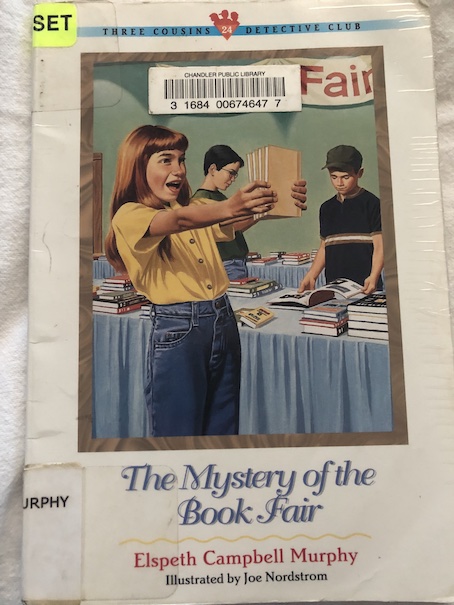
The Mystery of the Book Fair

Three Cousins Detective Club

#24 The Mystery of the Book Fair by Elspeth Campbell Murphy, 1999.

Sarah-Jane is excited about the book fair being held in the public library. She helped to collect donations of books for the sale, and she wants to be first in line so that she can buy a set of old Winnie-the-Pooh books that she’s had her eye on.

But from the moment that she claims the books, people keep coming up to her and trying to get her to let them have them or buy them from her. Another volunteer at the sale, who is also a book dealer, looks over the books and tells Sarah-Jane that they are rare first editions that are worth a lot of money.

Even though Sarah-Jane bought the books in good faith from the library, she and her cousins feel that they ought to try to find the original owner to make sure that he really meant to donate them. The trouble is that Sarah-Jane remembers that the donor of the books behaved rather strangely and seemed very nervous. When he gave them the books, he even called them by the wrong name, “Winkie-the-Pooh.” What kind of book collector wouldn’t know the value of his own collection or even the correct name of the books? Did the books even really belong to him at all? Then, more than one person shows up at the library, claiming to own the books. Who is the original owner?

The theme of the story is Proverbs 3:3, “Don’t ever stop being kind and truthful. Let kindness and truth show in all you do. Write them down in your mind as if on a tablet.”

The book is available to borrow and read for free online through Internet Archive.

My Reaction and Spoilers

Sarah-Jane wanted the books not only because she likes Winnie-the-Pooh but because she likes old things, and she found the old copies of the books charming. Although she did not originally collect old books, these particular books inspire her to start an old book collection. Many people have discovered their love of collecting old books thanks to the popularity of recent aesethics, like Cottagecore and Dark Academia.

However, as the book dealer in the story explains, most old books are not the rare collectors’ items that these first edition copies are. The dealer explains that the value of an old book depends on many factors, like the condition of the book, its rarity, and the number of people who would be interested in acquiring it. I’ve encountered this myself in collecting old children’s books. Many of the books that I cover on this site would be worth very little to other collectors because they are not rare, first edition classics, but they’re worth something to me because there are elements of the stories that I find interesting. I don’t have the funds to buy most of the really rare books, although I’ve occasionally managed to buy books that would ordinarily be out of my price range at used book sales or as library discards or as damaged books. I think the most expensive books I have are ones that would be worth perhaps $100 or $200 if they were in pristine condition, which none of my books are. I’ve never encountered anything that would be worth thousands of dollar, like the Winnie-the-Pooh books in the story. The Winnie-the-Pooh books are worth that much because they are not only first editions but they are in near mint condition and they are extremely popular classic books.
One of the adults who tries to pressure Sarah-Jane into selling the books to her is a woman who tries to make Sarah-Jane feel bad for buying books that are for younger kids. The woman says that she wants to buy them for a young child, but the nice dealer recognizes her as a fellow book dealer and knows that she’s trying to cheat Sarah-Jane because she has recognized the books for what they are and knows their value. The woman wasn’t being honest in anything she said. She wasn’t really interested in the books just for their own sake, as a book lover or as a present for a real child, but only for their monetary value. That makes her different from Sarah-Jane, who fell in love with the books for their own sake. I’m not the only one who collects old books, even old children’s books, just because I appreciate them for what they are. It’s a feeling that doesn’t know any particular age. The real owner of the bookss turns out to be an elderly man who was born the year that the first Winnie-the-Pooh book was published and who has had the books since they were new. He loves them not just because they’re collectors’ items but because of their sentimental value.

The books were stolen from the house of the book collector along with some other things. One of the thieves donated the books to the library because he thought they were worthless. His partner in crime knew that they were worth a lot of money and came to the sale to try to get them back. He runs away when the real owner of the books shows up looking for them. Sarah-Jane calls the police and tells them what happened. The books are returned to their rightful owner, and as a reward, he buys another rare book of fairy tales that was donated to the sale (on purpose, by the owner) and gives it to Sarah-Jane.

The Weird Science Mystery

The Bobbsey Twins

#20 The Weird Science Mystery by Laura Lee Hope (Stratemeyer Syndicate), 1990.

Before I begin, I’d like to acknowledge Sean Hagins, for supplying me with photos of this book! Usually, I take pictures of books myself, but I just couldn’t find a physical copy of this one. Sean is a big fan of the Bobbsey Twins, particularly the New Bobbsey Twins mysteries, and you can see some of his video reviews as well as videos about his photography work on his YouTube channel, SJHFoto. Thanks, Sean!

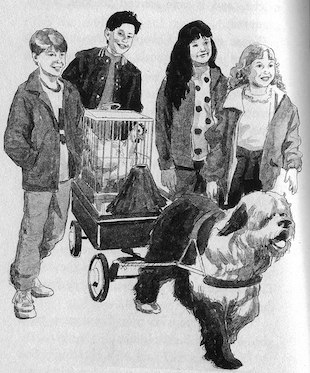
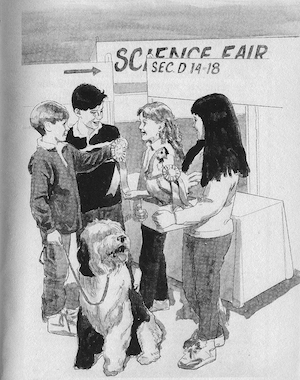
The Bobbsey Twins are all getting ready for their school’s science fair. Bert’s project is about dog behavior with the family’s dog as his subject. His twin, Nan, is also studying animal behavior, but with a chicken named Zelda. Because the science fair is open to both middle school and elementary school kids, the younger twins, Freddie and Flossie, can also enter. Freddie is entering with a large baking soda volcano.

When the kids arrive to drop off their projects, Nan and Bert notice another boy from their class, Martin Crane. Martin is a science whiz, but he isn’t very nice. He’s not really a bully, like Danny Rugg, but he makes fun of the Bobbseys’ science projects. They don’t know what Martin’s project is because he’s bringing it in boxes labeled “Top Secret”, but he swears that it’s going to win first prize.

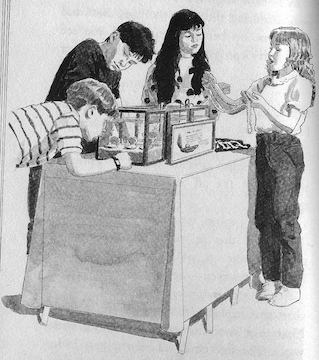
When Freddie sees the other students’ projects, he starts to doubt that he has any chance of winning a prize himself. There’s a boy who has an impressive star chart display, and Danny Rugg has a display of spiders. There’s a girl named Ellen with an exhibit showing how pearls are made, including real pearls! Ellen says that her uncle is in the jewelry business and loaned her the pearls. Ellen’s younger sister, Melissa, says that Ellen’s project is unfair, although she doesn’t say why she thinks so. Melissa says that she didn’t do a project herself because she thinks the science fair is dumb.

Mr. Newman, Nan and Bert’s science teacher from an earlier book in the series, is one of the judges of the science fair. He’s going around the fair, taking pictures of the projects, but Martin refuses to unpack his project, saying that he will reveal it tomorrow. Then, Melissa screams that Danny’s poisonous spiders have escaped, and people start panicking and running! Mr. Newman says that Danny’s spiders are definitely not the poisonous kind, and he makes Danny apologize for telling people they were. The Bobbseys wonder if Danny could have let the spiders loose on purpose as one of his pranks. Then, suddenly, Ellen screams that her pearls are gone!

While the teachers are looking for the pearls and trying to encourage the thief to come forward, other accidents happen to other science fair projects. Freddie’s volcano suddenly erupts even though he didn’t set it up to do that yet. Someone cuts the leash on their dog, so he gets loose, and release’s Nan’s chicken from her cage. Ellen said that the pearls in her collection were valuable, so the teachers call the police. But, were the pearls stolen because they were valuable or because someone wants to sabotage the science fair? Was the theft of the pearls related to the sabotage of the other projects, or are these two separate acts? Also, what does Martin have in those boxes labeled “Top Secret”?

The book is available to borrow and read for free online through Internet Archive.

My Reaction

Sean and I were talking earlier about how later books in the New Bobbsey Twins series focused more on the younger set of twins, Freddie and Flossie, and seemed to involve lower stakes in the mysteries. I reviewed this book shortly after The Clue in the Classroom, so I could compare two science-based mysteries that took place at the kids’ school, one earlier in the series and one later.

The other science-based mystery in the series involved an invention and industrial espionage, while this one involves the school science fair. However, I thought the mystery was well-done. When the Bobbseys arrive at the science fair, the story establishes multiples suspects. Danny Rugg is a repeat suspect because he’s the school bully and general nemesis, and he could have set his spiders loose as a distraction while he took the pearls and set up other things to go wrong. Then again, Melissa seemed upset about her sister’s project, so she might have had a reason to sabotage it. Martin is being mysterious about his science fair project, but what if he doesn’t actually have one in those boxes of his? Maybe he couldn’t think of anything or ran out of time to do his project, so he’s sabotaging everyone else’s project to provide a reason for why his project will suddenly disappear or turn out not to work. I even had a theory that each of those people might have done something since multiple disasters happened at the same time or almost at the same time. From the beginning, there are multiple possibilities that seem about equally likely, which is good for making readers wonder, and the kids are active investigators in the story, investigating suspects individually, not just waiting for chance to give them the answers. Those are the ingredients for a good mystery.

Although the story takes place at a kids’ science fair, there are a couple of factors involved that add some excitement and higher stakes to the story. The value of the pearls has the adults worried about getting them back. (Personally, I wondered about just how valuable the pearls were. Since they didn’t seem to have any form of security to protect them, like a locked display case, and since Danny Rugg lied to everyone about his spiders being poisonous, it occurred to me that Ellen might have lied to everyone about the value of the pearls to make her project seem more exciting, although that is never clarified during the story.) I also appreciated the thief’s motive for stealing the pearls because it wasn’t just about the pearls’ value. It was one of the ideas that I can for a possible motive, but I’ll leave it a secret about which of my theories was right.