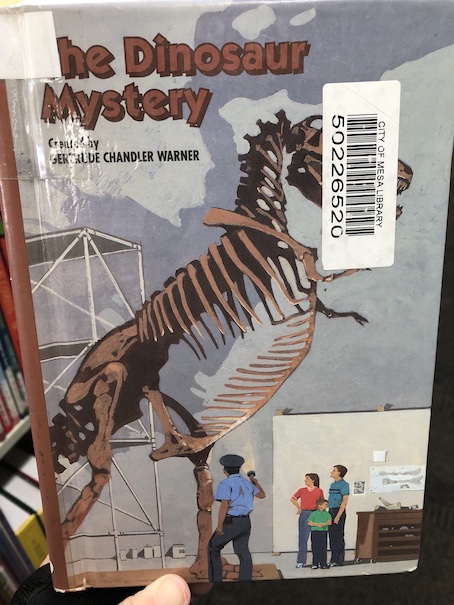
The Dinosaur Mystery

Boxcar Children

The Dinosaur Mystery by Gertrude Chandler Warner, 1995.
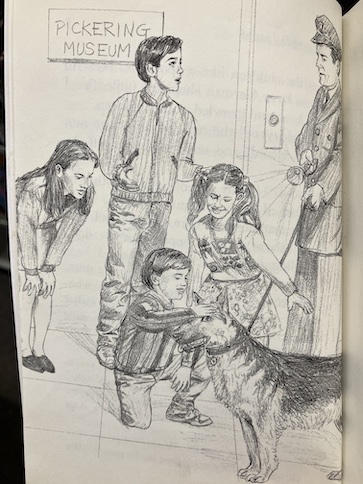
The Alden children and their cousin Soo Lee are visiting the Pickering Natural History Museum to help Mr. and Mrs Diggs, who are on the museum’s board of directors, to set up a new dinosaur exhibit. They will be staying in the Diggs’s apartment, which is connected to the museum by a tunnel. The children love the rooms where they will be staying because they’re decorated with spare exhibits from the museum!

However, very quickly, they notice that strange things are happening at the museum. The alarms seem to go off sometimes for no reason. The night watchman, Pete, is new at the museum and acts oddly. He seems to like having fun with the exhibits more than paying attention to security. On their first night there, Jessie sees a light in the museum windows, in the dinosaur room, where nobody is supposed to be, and she thinks that she sees the shadow of the dinosaur skeleton moving.

The next day, the Aldens meet the other staff at the museum. Dr. Eve Skyler operates the planetarium, and she’s very protective of it. She’s been upset because renovations at the museum have messed up the planetarium. When the Diggs tell her that the Alden children are there to help clean up, Dr. Skyler is dubious and worries that the children will damage the equipment, but the Diggs tell them that the children have worked in museums before.

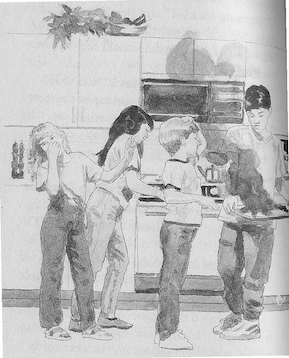
After the children clear the planetarium and take a lunch break, they catch Dr. Sklyer moving some things that they had thrown out back into the planetarium! When they confront her about what she’s doing, she denies everything, and it ends up taking the children almost twice as long to finish the task. The children don’t know what Dr. Skyler’s problem is and why she would want to sabotage their cleaning of the planetarium when she had badly wanted it cleaned.

When Dr. Titus Pettibone, who is the fossil expert in charge of the dinosaur room, returns from a trip, he discovers that bones are missing from the tyrannosaurus skeleton! Benny and Soo Lee are sure that Dr. Pettibone was the man they saw sneaking around the museum the night before. Dr. Pettibone avoids their questions about sneaking around the museum and is every bit as opposed to the children working on the new dinosaur exhibit as Dr. Skyler is about the children helping to clean the planetarium.

Then, someone removes all the posters that the children put up about the new dinosaur exhibit. Mrs. Diggs knows that someone removed them on purpose because, when she asks people at the places where the children put them up, they say that a woman took them, saying that she wanted them as souvenirs. In spite of that, everyone in town knows about the new exhibit because word about the missing dinosaur bones has spread. Is someone trying to drive people away from the new exhibit, or are things that have been happening part of a publicity stunt? The children known that someone is sneaking around the museum, especially at night, and both Dr. Skyler and Dr. Pettibone seem to have something to hide.

The book is available to borrow and read for free online through Internet Archive.

My Reaction

One of the first things that I noticed about the book is that many of the characters have pun names – Mr. and Mrs. Diggs, who operate the natural history museum; Dr. Sklyer, who is in charge of the planetarium; and Pettibone, who is the fossil expert.

The book does a good job of making everyone look equally guilty. From the beginning, I suspected that was because there are multiple people doing multiple things for different reasons, and it helps to make the mystery more complicated and involved, keeping readers guessing.

This is another instance of the Alden children having the opportunity to do something unusual and build work experience because of their grandfather’s connections. Their grandfather knows Mr. and Mrs. Diggs and arranges for the children to stay with them, and their previous experiences with museums, like in one of the later books, The Mystery of the Mummy’s Curse, were also due to Mr. Alden’s connections. Although the children’s grandfather allows the children to have independent adventures without him, he is usually the one who sets them up in the stories. Most real children never get opportunities like this and may not be allowed to do some of the things the Alden children do because of rules regarding volunteers, especially juvenile volunteers, due to insurance liabilities. I would have loved to work in a museum when I was a kid, but my family never had the connections that the Aldens do.
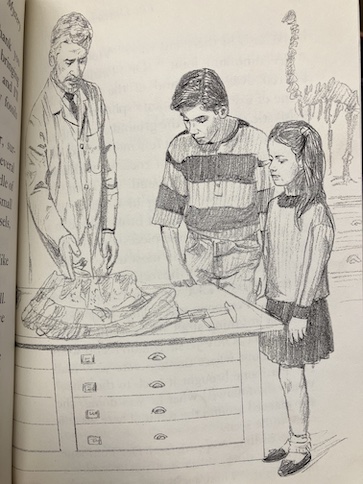
I can understand why children aren’t allowed to do certain jobs. Dr. Pettibone is correct that there are certain tasks that require specialized knowledge and delicacy. After he warms up to the kids more, he begins showing the children some of the details of his work and what his equipment does. He lets Violet do some of the delicate work after he shows her what to do because she does artwork and plays the violin, so she is accustomed to fine, detailed work. In real life, though, I don’t think that a 10-year-old child would be allowed to do this kind of work as quickly or as well as Violet does in the story. The Aldens have to learn to do things quickly in the interest of time in their stories, and they rarely make the kinds of mistakes that beginners do at anything they try.
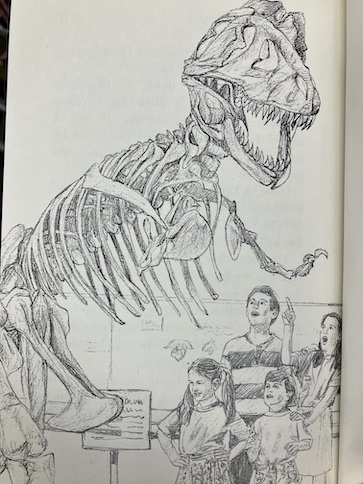
I have done volunteer work in museums as an adult, and one thing that they don’t tell you in this book is that, when you see an assembled dinosaur skeleton in a museum, it’s probably all or partly a plaster model of the bones rather than the real bones. That’s because fossilized bones are no longer actual bone. They are petrified, so they are as heavy as other stones. When you have stones the size of large dinosaur bones, it’s extremely difficult to mount them so that they stand up, like the dinosaur would in real life. Sometimes, plaster models also fill in for bones that are missing from an incomplete skeleton. Complete skeletons are very, very rare. There were only two places where there were real dinosaur bones on exhibit in the last museum where I volunteered. One was a dinosaur thigh bone that visitors were allowed to touch to learn what fossilized bone feels like. The other was a collection of pterosaur wing bones mounted on a wall, where no one could touch them, and it wasn’t a complete wing. Some museums have exhibits marked so you know which bones are models and which are real fossils.

I also liked the art style in this book. Boxcar Children books vary in art style because they were produced over multiple decades, but my favorite illustrations are the ones that look the most realistic. I think realistic illustration styles are best for this book in particular because they show the details of the dinosaur skeleton realistically.
The Mystery of the Purple Pool

The Boxcar Children

The Boxcar Children are all bored, especially Benny. Grandfather Alden tells them that he has to go to New York City on business, and the children can come with him and see the city. That sounds like just the kind of excitement the kids need! Their grandfather calls the hotel where he’ll be staying and reserves a suite of room for all of them. Then, he tells the children to look through some guidebooks for the city and decide what they want to see there. He says that, during the time when he’ll be working, the two oldest children, Henry and Jessie, will be in charge. The children start looking through the guidebooks and talking about things they want to see in New York.

When they arrive at the Plymouth Hotel in New York, the children’s grandfather notices right away that the service isn’t how it usually is at this hotel. For some reason, their reservation was canceled, although they are still able to get rooms. Then, there are no bellhops to be found to carry their bags, and even the hotel management doesn’t know where they are. As they go to their room, they hear another guest complaining that his room wasn’t cleaned, even though the maid said that she’d cleaned it.

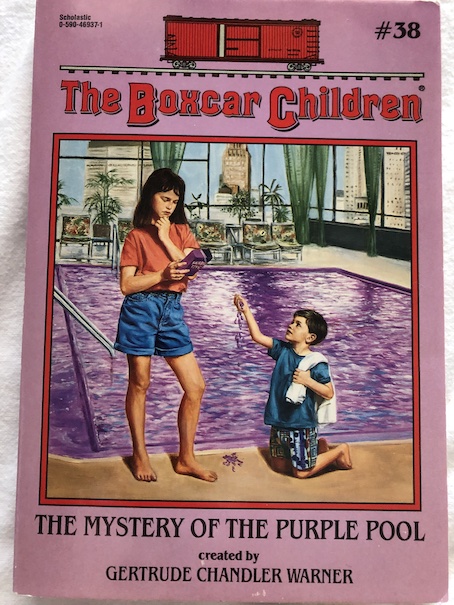
All of these things could be mistakes or signs of bad hotel management, but it soon becomes apparent that someone is deliberately trying to sabotage the hotel. When the children try to swim in the hotel pool, they find out that someone dyed the pool purple! Then, someone switches the sugar and salt in the hotel restaurant, ruining everyone’s breakfast. When the kids come back from sight-seeing, they see a crowd of people in the lobby, all complaining about various things missing from their rooms, like pillows and shower curtains. Then, the children get stuck in the hotel elevator when someone turns it off and have to call for help.

The Alden children have another mystery on their hands! Who could be the mysterious saboteur, and what would they want to harm the hotel? There’s a mysterious man who seems to be lurking around when bad things happen. There’s also a maid who is angry about her brother being fired from the hotel. The hotel manager isn’t always on hand to deal with things when they go wrong. There’s also an unfriendly woman who doesn’t like kids (named Karen before that name started to be used as a slang word for a disagreeable, complaining woman) and is always scribbling in her notebook, never letting anybody see what she’s writing. Any of them could be the culprit, or it could be someone they haven’t even thought to suspect.

The book is available to borrow and read for free online through Internet Archive (multiple copies).

I remember reading this book and liking it when I was a kid. One of the hallmarks of The Boxcar Children series is that the children are always allowed their independence in their adventures. Their grandfather lets them explore the city completely on their own, even though the oldest child in the family is only 14 years old. Few people would let their children roam around New York City completely on their own these days, and they didn’t when I was a kid in the 1990s, either. Another guest at the hotel even lets his young son go sight-seeing with the Alden children when they haven’t known each other very long.

The kids have fun exploring the amenities at the hotel, too. The book draws attention to various aspects of staying at hotel, like suites with kitchenettes, hotel restaurants, pools and exercise rooms, and the snacks and toiletries you might find in your hotel room. I thought it was interesting how the book explains how you can call for help in an elevator if it gets stuck. Its a useful thing for kids to know.

One thing that occurred to me when I revisited this story was that it doesn’t mention the World Trade Center. They characters could have visited the original World Trade Center in the story because the book was published 7 years before it was destroyed in the September 11, 2001 terrorist attack, but the World Trade Center was not one of the sights that the children went to see. If it had been, it would have dated the story, but I can’t think of anything the children saw or did in the book that really dates it. The things they mention still exist in New York, and this story could still be set in the early 21st century.

The Boxcar Children Cookbook

The Boxcar Children

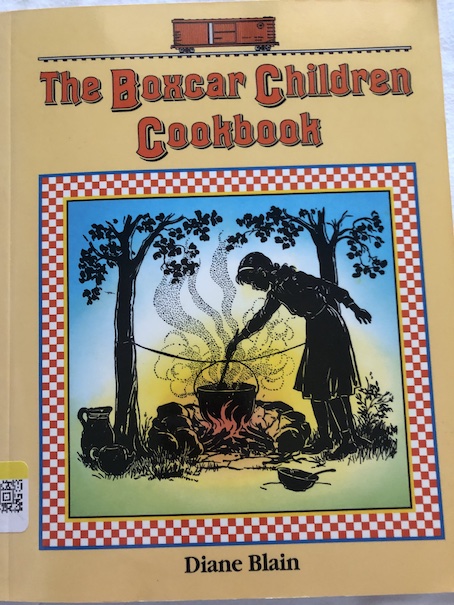
The Boxcar Children Cookbook by Diane Blain, 1991.

This book is a companion to The Boxcar Children series, written years after the original series by a different author. Most of these recipes weren’t included with the original books in the series, but the books often mention food. The children in the stories are often eating foods they like or demonstrating that they can prepare their own food. In particular, the youngest of the children, Benny, likes to eat.

The first part of the book discusses kitchen equipment, measurements, and safety rules. The recipes in the book are organized by types of dishes. There is even a section about cooking over a campfire because the children camp out in multiple books. Each of the recipes explains which story in the series mentioned that type of food. The books that the cookbook references are all part of the original 19 Boxcar Children books written by Gertrude Chandler Warner, not the later ones written by ghost writers under her name.

None of the recipes are very difficult because they’re meant for children, but they’re not overly easy, either.

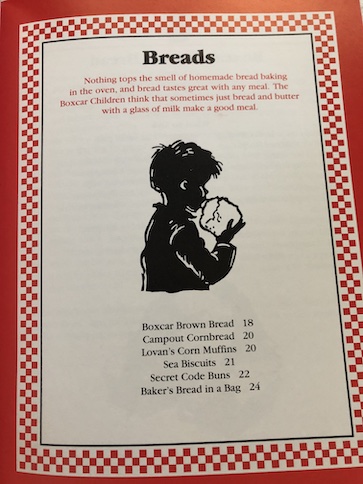
The section about beverages includes recipes for hot chocolate mix, strawberry milkshakes, lemonade, eggnog, and an orange drink. The breads section includes a recipe based on one that appeared in The Snowbound Mystery, which was a secret recipe for buns. However, the recipe in this book includes a shortcut using prepared sweet roll dough from the grocery store.

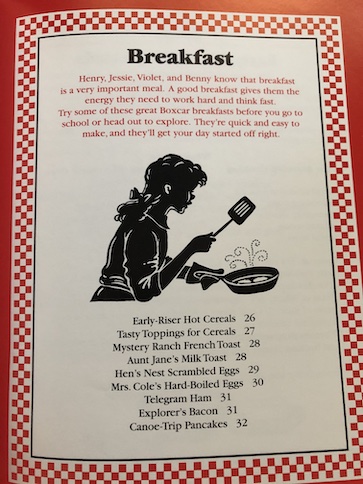
The breakfast section includes recipes for pancakes, French toast, and different types of eggs. I thought it was interesting that the page about hot cereals not only included recipes for oatmeal and cream of wheat, which are common ones but grits, hasty pudding, and cream of rice, which I had never heard of before.

There are sections for sandwiches and main dishes. There is also a section about salads and vegetables for side dishes.

The section about campfire cooking includes instructions for building a campfire and safety rules. There are also grill instructions.

Finally, there are sections for cookies, cakes and desserts. I think the cookbook is a fun way to add activities to accompany the stories. Cooking is a valuable learning experience, and many people like to experience foods similar to the ones that characters in their favorite stories enjoy.

The illustrations in the book are in silhouette form, like the illustrations from the very first Boxcar Children book, but they’re not exactly the same. Some of them have been changed to fit the recipes in the book, with characters holding foods that they weren’t holding in the original illustrations.

The book is available to borrow and read for free online through Internet Archive.

The Super-Duper Cookie Caper

The Bobbsey Twins

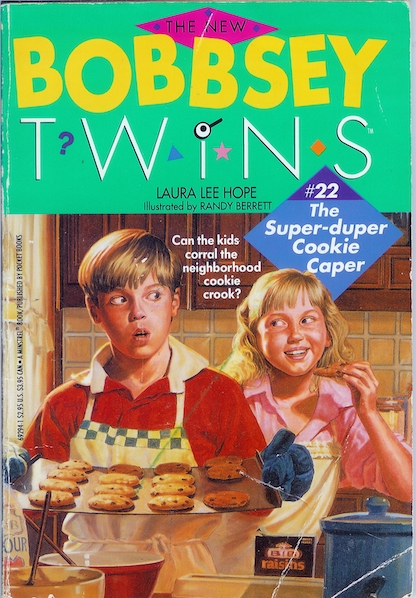
Bobbsey Twins Super-Duper Cookie Caper coverr

#22 The Super-Duper Cookie Caper by Laura Lee Hope (Stratemeyer Syndicate), 1991.

Before I begin, I’d like to acknowledge Sean Hagins, for supplying me with photos of this book! Usually, I take pictures of books myself, but I just couldn’t find a physical copy of this one. Sean is a big fan of the Bobbsey Twins, particularly the New Bobbsey Twins mysteries, and you can see some of his video reviews as well as videos about his photography work on his YouTube channel, SJHFoto. Thanks, Sean!

Freddie decides that he wants to get a new bike, and inspired by the school bake sale, he decides that he’ll make and sell cookies to raise the money. His grandmother makes really delicious oatmeal chocolate chip cookies that everybody loves, so he plans to make and sell them. He persuades his twin, Flossie, to help him by promising her part of the money from the cookie sales. Their parents approve of the plan, and their mother offers to help them because neither of them has much experience with cooking.

When Freddie and Flossie go to sell the cookies in the park, they’re pretty popular. Everyone loves the cookies, and Freddie boasts about his grandmother’s secret recipe. Their last customer is a man who gives them a dollar with some kind of white powder on it, and he doesn’t seem to think much of the cookies. Freddie doesn’t care because everyone else likes them, and they’re making money.

There are some complications to selling cookies. First, Flossie has a sweet tooth, and Freddie has to keep stopping her from eating their stock herself. Then, a boy at school, Brian, announces that he’s going to set up a rival business in the park, selling brownies. Freddie gets the idea of offering broken cookies as free samples and selling orders of cookies door-to-door.

Nan and Bert start helping with the cookie-baking, but things don’t always go well in the kitchen. There are times when they forget ingredients or let the cookies burn. Then, the children realize that the card with the recipe on it is missing! They search the kitchen and realize that there is a chocolate smudge on the kitchen window. It looks like someone reached through the window and stole the recipe!

There are a few logical suspects. It could be Brian, hoping to cash in on the success of the cookie-selling. It could be their old nemesis, local bully Danny Rugg, who stole their free samples earlier and generally likes to mess things up for the Bobbseys. Then again, there is the mysterious man who keeps showing up at the park. The Bobbsey Twins find out that he owns his own bakery. To find out who the recipe thief is, Freddie decides to invent a trap. He tells everyone that his grandmother has given him her other secret recipe for super-duper cookies that’s even better than the first one. Who will take the bait?

The book is available to borrow and read for free online through Internet Archive.

My Reaction

Sean and I were discussing earlier how later books in the New Bobbsey Twins series tended to focus more on the younger set of twins than the older Bobbsey twins and seem to involve lower-stakes mysteries. Earlier books in the series involved definite crimes, police matters, and strange phenomena. A stolen cookie recipe feels like much lower stakes. However, I thought this one was well-done for what it was. There are some definite suspects, enough to sow some doubt about who the recipe thief is. The actual thief is someone I suspected but not necessarily the most obvious suspect, and the thief’s motives do make logical sense, although I’m not sure (spoiler) any real adult would seriously consider that kind of business model. It sounds more like something a kid might do, and that’s partly what allows readers to doubt whether it’s a child or adult who took the recipe.

There is also a punchline to the story. There was one thing that I had guessed early on about the grandmother’s “secret recipe.” It’s not as “secret” as the kids think it is. I guessed that because, when I was a kid, one of my grandmothers always baked chocolate chip cookies. Those cookies were one of the highlights of going to her house. When we were little, my brother and I liked them so much that we guessed that she must have been a baker before she retired. When we were older, we found out that she’d actually been a bookkeeper and that her cookie recipe was just the Toll House recipe from the chocolate chip package. She made two versions, with and without nuts from the pecan tree in her backyard, but it was still the Toll House recipe. It’s a similar situation with the Bobbsey Twins’ grandmother’s secret recipe. The only thing the grandmother changed was the cooking time. Everyone just thought that the cookies were special because her grandchildren thought they were, and they convinced other people. Few things are as special as homemade cookies from your grandmother!

The Secret at Sleepaway Camp

The Bobbsey Twins

The Secret at Sleepaway Camp by Laura Lee Hope (Stratemeyer Syndicate), 1990.

Before I begin, I’d like to acknowledge Sean Hagins, for supplying me with photos of this book! Usually, I take pictures of books myself, but I just couldn’t find a physical copy of this one. Sean is a big fan of the Bobbsey Twins, particularly the New Bobbsey Twins mysteries, and you can see some of his video reviews as well as videos about his photography work on his YouTube channel, SJHFoto. Thanks, Sean!

The Bobbsey Twins are headed to Camp Evergreen this summer! Before they leave for camp, their mother, who is a part-time reporter for the local newspaper tells them that she was just covering a story about a baby polar bear who disappeared from the local zoo. Flossie is upset about it because she’s fond of the polar bear, Snowflake, and likes to see her when she goes to the zoo. Nobody knows exactly how Snowflake got out of her enclosure. All they know is that the gate was found open, and Snowflake was gone. Mrs. Bobbsey recommends that the kids forget about it for now and concentrate on having fun at camp.

Nan and Bert are going to be counselors’ helpers at camp, and all the kids are looking forward to activities like swimming, horseback riding, and archery. The only downside is that Danny Rugg, local bully and troublemaker, will also be there as a counselors’ helper. (Danny is a long-standing nemesis in the Bobbsey Twins series, from the original incarnation of the series. See The Bobbsey Twins of Lakeport.)

Strange things start happening at camp right from the moment that the Bobbsey Twins arrive. Tanya, the head counselor, tells them that, for some reason, all of the camp’s rowboats are leaking. When the kids investigate, they discover that someone has deliberately drilled holes in all of the boats.

The first thought that the Bobbsey Twins have is that Danny is responsible because he has a history of playing mean pranks, although he denies it. Danny does say that he doesn’t see why everyone else at camp should have fun while he’s miserable. His job as a counselors’ helper is working in the kitchen, and he hates it because it’s hot in there, and he thinks the cook is weird.

When Freddie goes to unpack in his cabin, he meets another boy named Ian. Ian is from the city and has never been to the countryside before. He’s a little nervous and homesick, and he says that the camp’s cook has told him that the camp is haunted. Freddie says that he’s sure there’s nothing to worry about and that they’ll have fun at camp.

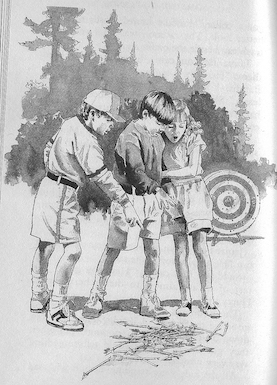
Arts and crafts goes fine, and the kids enjoy meeting the camp’s mascot, a tame raccoon named Bandit. Tanya explains that they found Bandit when he was just a baby and that the kids should never try to play with wild raccoons. However, when the kids arrive at the archery range, they discover that someone has snapped all the arrows in half! Because of the stories the camp cook has been telling everyone, some of the campers think that it’s the work of the camp’s ghost. The Bobbsey Twins still suspect Danny, and they offer their services to Tanya, to investigate and find out who’s really causing all the trouble at camp.

Danny isn’t the only suspect. Nan overhears the cook, Sal, telling the kids about a hungry, child-eating bear in the woods who is supposedly friends with the camp ghost. Does he just like scary stories, or does he have a special reason for wanting to frighten the kids at camp? Even Tanya seems to have something to hide, getting mysterious notes and meeting someone in secret.

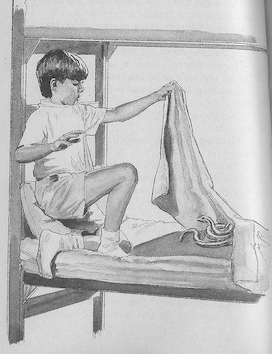
Soon, other strange things happen at camp. Someone puts a snake in Freddie’s bed, and the kids see strange lights in the woods at night. Then, someone steals all the ponies out of the corral and smashes the kids’ clay art projects. Some of the kids think that it’s the work of the ghost Sal has been talking about, but the Bobbsey Twins are sure that someone only wants them to think that. What are all the pranks and sabotage really about?

The book is available to borrow and read for free online through Internet Archive.

My Reaction

I was pretty sure I knew right away who was behind the camp sabotage, but this is one of those stories where there’s more than one person doing things that are unrelated. Danny eventually admits to playing some of the pranks, like the snake in Freddie’s bed, but not all of them. I was also wrong about who the main villain was. The missing polar bear at the beginning does figure into the mystery of the things happening at camp. I figured it would be important, but I didn’t guess how and why.

One of the clues the kids find is a lucky rabbit’s foot keychain. The kids comment that those used to be popular good luck charms, but not many people have them anymore. I have to admit that I had a pink one when I was a kid that I got from a novelty shop. I don’t think I realized at first that it was a real rabbit’s foot. I think I assumed that it was fake because I bought it in a place that sold magic tricks and costume props, so I figured it was imitation, like everything else. I figured it out eventually, and then, I didn’t feel quite so lucky about it. I’m sure that those keychains fell out of popularity because other people felt the same way I did about them, and they were concerned about animal cruelty. I believe it’s still possible to buy real and faux rabbit’s foot keychains, but it’s been a long time since I last saw them displayed at a store, so I think the kids were probably right about them not being as popular as they once were.

Little Miss Curious

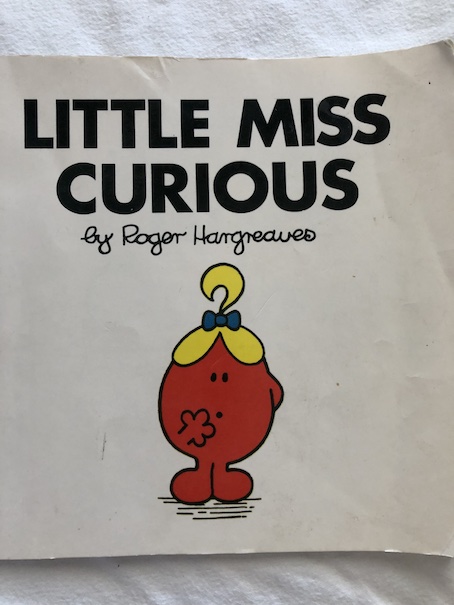
Little Miss Curious by Roger Hargreaves, 1990.

Little Miss Curious is a very curious person. She is curious about everything.

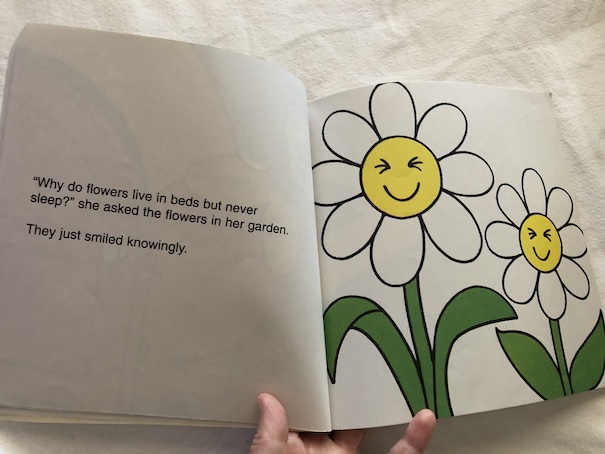
She wonders about all kinds of things and constantly asks questions. Most of the questions she has are silly nonsense, but Little Miss Curious can’t stop wondering things like why flowers are in beds but don’t sleep or why sandwiches don’t contain sand.

She finds out that sandwiches do have sand when Mr. Nonsense makes them, but this is the only question she gets answered in the book.

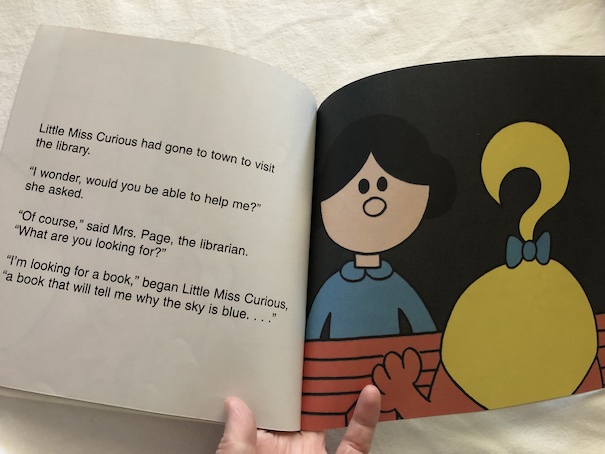
Little Miss Curious has so many questions that she decides to go to the library in town and find books that can answer all of her questions. It’s a sensible thing to do, but because books in this series are mainly nonsense, her library visit doesn’t go as planned.

Little Miss Curious takes so much time peppering the librarian with all of her questions that the other patrons get annoyed, and Little Miss Curious gets thrown out of the library.

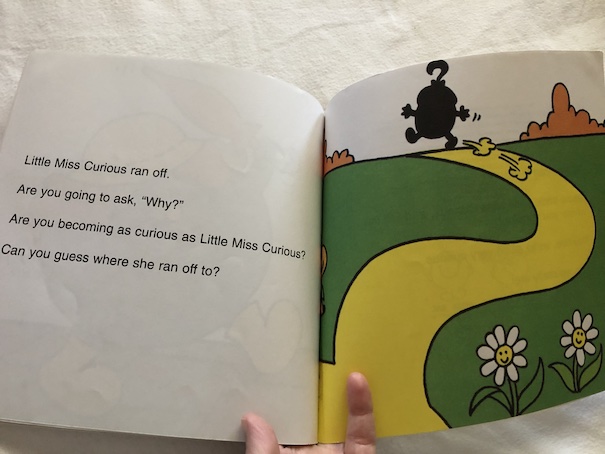
Little Miss Curious can’t understand why that happened or why people are giving her strange looks. The book ends with her running off down the road, and it invites curious readers to wonder why and where she’s going.

This book is part of the Little Miss series. It’s available to borrow and read for free online through Internet Archive (multiple copies).

My Reaction

Sometimes, books in this series emphasize morals by showing positive traits and negative ones, but even more often, the traits of the characters are played for humor, and that’s the case with this book. No morals are taught, and no lessons are learned. Miss Curious faces some consequences for wasting people’s time with ridiculous questions, but she doesn’t seem to understand the way people react to her. There is no change to her character, and the story has an open end, where readers are invited to be curious about where Little Miss Curious is going and what she’s going to do next.

Although Little Miss Curious’s curiosity goes overboard, curiosity is inevitable, and the reader can be as curious as anyone. In a nonsense book, that’s about as close to a moral as I can draw. Mainly, the book is for fun and humor. Readers can chuckle at the silly things Little Miss Curious ponders and indulge in a little curiosity of their own.

Eyewitness Train

Eyewitness Books

Eyewitness Train by John Coiley, 1992, 2009.

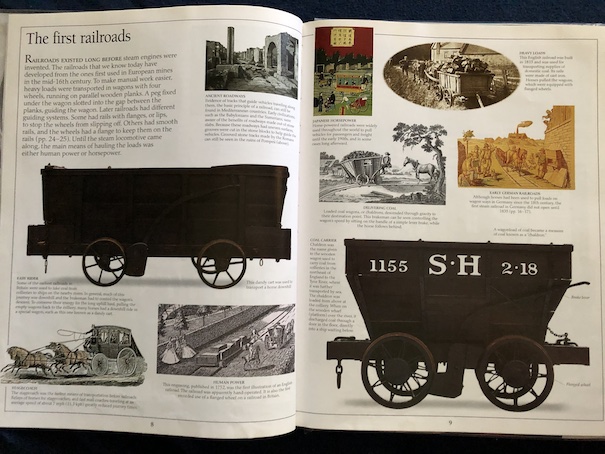
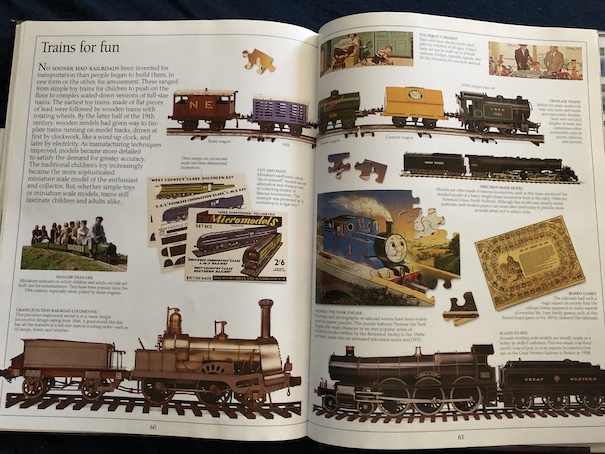
I love Eyewitness Books for their collections of pictures! I always say that nonfiction books for adults need more pictures because pictures are worth a thousand words, and I love how this particular book uses pictures to explain the details of different kinds of train cars and how railroads work.

It begins with an explanation of what trains are and the history of the first railroads. Trains, which are series of linked wheeled vehicles, are older than the first steam engines and developed from chains of wagons used in European mines during the 1500s. Steam engines were developed in the 1700s, although it wasn’t until the 1800s that railroads as we know them developed and became popular modes of transporting people and goods.

The book explains how steam engines work, using pictures of model train engines with cutaway designs. Then, it explains about railroads around the world and how railways are built.

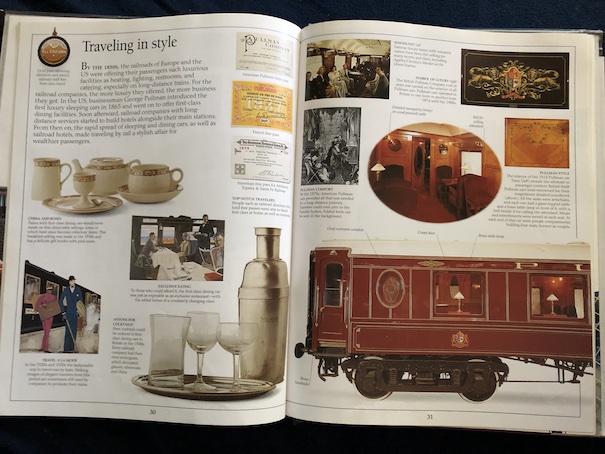
From there, the book explains about both freight trains and passenger trains. The part about mail trains reminds me of the kids’ book Mailing May. When it discusses passenger trains, it explains the differences between first, second, and third class sections on historic passenger trains. There is also a page about George Pullman, who developed luxury sleeping and dining cars catering to wealthy travelers. The level of luxury on trains could be quite impressive, and the book mentions that this is the level of luxury the passengers experienced in Agatha Christie’s Murder on the Orient Express, a classic mystery story that many people think of when they hear about luxury train travel.

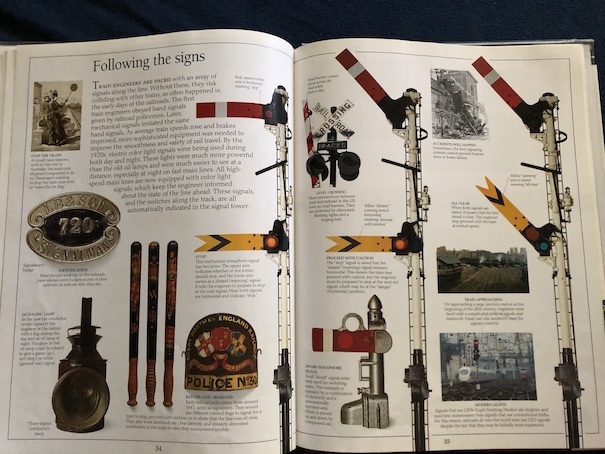
When I was a kid, the sections about passenger trains and sleeper cars would have appealed to me the most because that is the stuff of stories, and I’ve always been a big mystery fan. However, I also find the parts about how railroads function interesting. They explain about the purpose of the signal tower and how train signal and track controls have changed since the 1800s. Earlier, I covered a different train book that showed the old, manual signals they would use, but this book covers modern methods of signaling and controlling trains as well. It also explains the evolution of train stations.

The book covers the differences between steam, electric, and diesel trains, and there are also sections about elevated trains and underground trains. There is also a section about new technology for trains and what the future of trains might be.

I also enjoyed the section about toy trains and model railroads!

The book ends with a map showing famous railways around the world, a timeline of the development of trains, a glossary of terms, and a section with sources of additional information, a list of railway museums, and recommendations for movies that include trains, including the movie versions of Harry Potter, The Polar Express, and The Railway Children.

My copy of this book included a poster about trains and a CD with train clip-art, but not all copies of this book might include the same extra items, especially if you buy a used copy. I lucked out with mine. The book is available to borrow and read for free online through Internet Archive.

Maniac Magee

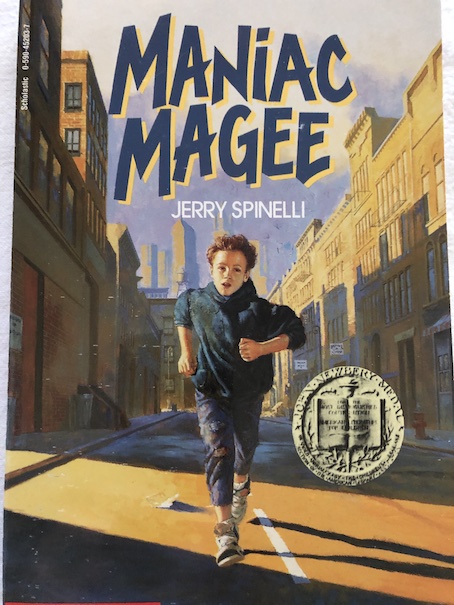
Maniac Magee by Jerry Spinelli, 1990.

When the character of Maniac Magee is introduced, he is described as a legend or a tall tale. Even though he is a young boy, his origins are unusual, and people have built up stories around him. The story even admits that his personal story is part fact and part legend.

The truth is that “Maniac” is an orphan. His real name is Jeffrey Lionel Magee, and he was born a normal boy with normal parents, but his parents were killed in a trolley accident when he was only three years old. After that, he went to live with his aunt and uncle in Pennsylvania. However, his aunt and uncle had an extremely dysfunctional marriage. They didn’t believe in divorce, so they stayed married, but they lived a strange, separated life in their house. They divided their home in half so they could effectively live apart, avoiding each other most of the time. They shared Jeffrey by taking turns eating meals with him, but they never ate together as a whole family. Eventually, Jeffrey couldn’t take this weird life anymore, where his aunt and uncle never talked to each other. One day, he blew up at them at a program at his school, and he ran away.
For the next year, Jeffrey seems to have wandered around by himself. Nobody is sure exactly where he was during that year, but he eventually turned up in another town about 200 miles from where he started. He wore ragged clothes and worn-out shoes, but he greeted people with a cheery, “Hi.” One of the first people he meets is a black girl named Amanda with a suitcase, and he asks her if she’s running away. Amanda tells him that she’s not running away, just going to school. Her suitcase is full of books. Jeffrey is fascinated by the books, and he offers to carry her suitcase. Amanda thinks it’s strange that a white boy like him is in an area of town that is almost entirely black, and she asks him who he is and where he lives. Jeffrey doesn’t quite know how to answer her at first because he doesn’t really live anywhere.
He asks her why she carries so many books to school, and she explains that she has younger siblings who color all over everything and a dog who chews everything, so she feels like she has to carry her whole personal library around with her to protect it. Jeffrey begs Amanda to loan him a book. At first, she refuses because she doesn’t know if he’ll give it back, but he swears he will. After they argue about it, Amanda tosses him a book because she has to hurry off to school and can’t take time to argue anymore.

Jeffrey continues to wander around the town for several days. People begin to notice him, how he runs everywhere goes, how he’s always carrying a book, and how he shows off his sports prowess by bunting a frog during a baseball game he joins. He lives in the deer shed at the zoo and eats some of the food for the animals, although he also joins a large family at dinner one night because they’re always taking in people or inviting people to dinner, so one extra person doesn’t attract too much attention. Nobody knows what to call him, so they start thinking of him as that “maniac” and start calling him Maniac.

The bully who threw the frog at him in the baseball game gets angry because Maniac’s bunt ruined his perfect record of strikeouts, so he decides to beat up Maniac in revenge. When he and his friends chase after Maniac, Maniac runs in the direction of the invisible line that divides the town in half, into the white portion and black portion of town. Maniac doesn’t understand the division between the parts of the town, but the other kids do, and they won’t follow him across the line between their part of town and the other part of town. Maniac’s disregard of the racial separations in this town is one of the things that sets him apart from other people and accentuates his oddness. He’s not afraid to share food with a black kid, even eating over the same place where the other kid bit.

When one of the black kids fights with Maniac, trying to get the book away from him, a page is torn. Fortunately, Amanda knows immediately which of them ripped the book. Jeffrey/Maniac reassures her that they can fix the torn page, so Amanda invites Jeffrey home with her. He spends the rest of the day with Amanda and her family. In the evening, Amanda’s father offers to take him home, but Jeffrey doesn’t know how to explain that he lives the deer shed at the zoo. In the car with Amanda’s father, Jeffrey tries to pretend that he lives in a house a few blocks down the street, but Amanda’s father knows immediately that it can’t be true. Jeffrey still doesn’t understand the division in the neighborhoods in town, and the house he picked for his pretend house is in the black area of town. When Amanda’s father presses Jeffrey for an explanation, Jeffrey admits that he doesn’t have a home and explains about his past. Amanda’s father immediately takes Jeffrey back to his family’s house, and Amanda’s mother insists that Jeffrey stay with them.

For the first time in about a year, Jeffrey has a home! Jeffrey gets along well with the family and is good with Amanda’s little brother and sister. He likes reading Lyle, Lyle Crocodile to them. He doesn’t even mind taking baths with the little kids or untying their knotted shoelaces.

Maniac starts feeling at home in the black neighborhood, although he’s still regarded as an oddity. His new family calls him Jeffrey, but everyone else calls him Maniac. He is a strange kid, who turns out to be allergic to pizza and breaks out in a pepperoni-shaped rash when he eats it. He’s a very fast runner and good at sports, and he seems to have a special talent for untying knots. Because of his time spent living in a dysfunctional house where people didn’t talk to each other and his time living alone on the streets, there are many things that Jeffrey doesn’t understand about other people. He doesn’t understand social dynamics and racial issues, and it takes him some time to understand how other people look at him as well as at each other.

One day, when he’s playing with the other kids in the street, an older black man calls him “whitey” and tells him to go home, back to his “own kind.” He doesn’t believe that Maniac lives in the neighborhood. His new siblings tell the old man to go away, and the old man keeps ranting about people belonging with their “own kind” until a woman leads him away. The incident disturbs Maniac. Amanda says that the old man is a “nutty old coot” and that Jeffrey should ignore him, but the incident makes Jeffrey realize that there are some people in the neighborhood who don’t want him there. Jeffrey wants to stay with his new family, and they want him to stay, but Maniac worries that his presence is creating a problem for them. Can he find a way to truly become part of this new family he so desperately needs?

This book is a Newbery Medal winner. It’s available to borrow and read for free online through Internet Archive (multiple copies), and there is also a Literature Circle Guide for book groups and classrooms.

My Reaction and Spoilers

I remember reading this book in class when I was in elementary school. The story is interesting because it’s framed as a tall tale but about a contemporary boy. “Maniac” Magee is described as being a legendary child because of his unusual ability for untying knots and his strange allergy to pizza. No real human being can actually be allergic to pizza because pizza isn’t a single food. There are many different ways of making pizza using various combinations of common ingredients. People can be allergic to some of the ingredients in a pizza, but if they were, that wouldn’t be an allergy to pizza itself, and those people would also be allergic to other types of food containing those same ingredients. That’s not Maniac’s problem, though. He seems to be particularly allergic to just pizza by itself. Maniac does things that are impossible and inherently beyond the normal child in everything he is, even in his defects, a classic tall tale character. One of his famous feats, untying an infamous knot in the neighborhood, is like the legendary Gordian Knot. The story is dressed with humor and tall tale elements, but it has themes that are very serious and even heart-rending.

Tall tale elements aside, this is a story about racial issues and a lonely, neglected child who desperately needs a family and a place to belong. Because the story focuses on Maniac as a tall tale character, the racial issues in the story aren’t immediately obvious, although they begin entering the story as soon as Maniac finds his way to his new town and encounters the girl who will be his new sister. The one thing that Maniac really needs is a stable and loving home. He is an orphan, and he ran away from his aunt and uncle’s home because they were too dysfunctional. As a runaway, he wanders for a time, looking for a better home and people who really care about him. He eventually finds that loving home with a family of a different race. Some people might find it strange that he feels a sense of belonging with people who, on the surface, seem quite different from him, but a sense of family goes much deeper than surface appearances. Maniac himself, on the surface, is a very unusual boy compared to most boys in the world, but deep down, he’s still a kid who needs love, attention, a family, and a place to call home. His new family offers him all these things, regardless of how unusual he is, and what they look like doesn’t matter.

The opposition of some parts of the community messes up this loving home for Maniac partway through the story, and he runs away and spends time on his own again. For a time, he lives in the locker room of a baseball stadium, looked after by a groundskeeper who is an elderly, washed-up baseball player. The groundskeeper, Grayson, passes away during the course of the story, but their friendship helps Maniac to understand some things about people. Grayson was also a neglected child. His parents were drunks, and unlike Maniac, he never learned to read because his teachers never tried to teach him. He was placed in a class with kids who were considered unable to learn because they were troubled or had learned problems. Because his teachers never had any faith in his ability to learn, he never really tried. Maniac is like a grandson to him and opens his eyes to many things before his death.

After Grayson dies, Maniac returns to wandering again, believing that he is jinxed to lose any home he has and anybody he cares about. However, Maniac still cares about other people, and he discovers that other people also care about him. When he tries to introduce a tough black boy to some white boys he’s staying with, hoping to make a connection, it goes wrong, and Maniac starts to think it’s all hopeless. However, when Maniac is unable to help one of the white boys when he’s in trouble and the black boy saves him, the white boys come to see the black boy in a different light, grateful to him for saving one of them and taking care of them. The black boy also comes to look at Maniac differently. When he confronts Maniac about why he couldn’t rescue the boy, Maniac admits for the first time that he’s still haunted by the memory of how his parents died, and the situation reminded him too much of it, so he was unable to handle it. The black boy softens at seeing this human side to Maniac and the other white boys. He’s the one who brings Amanda to Maniac, and Amanda insists that he come home with her. Maniac hesitates at first because he thinks he’s jinxed, but Amanda won’t put up with any nonsense from him, and Maniac comes to realize that they really are a family and that he is really going home.

As a side note, I also remember my elementary school librarian reading Lyle, Lyle Crocodile to my class when I was in first grade. In fact, she said it was one of her favorite books, and she also read others in the series to us. I had forgotten that the book was mentioned in this story, which was published the year after I first heard Lyle, Lyle Crocodile, but it did bring back some nostalgia for me. When Maniac teaches Grayson to read because Grayson never learned when he was a kid, they find well-known picture books on the sale rack at the library, including The Story of Babar, Mike Mulligan’s Steam Shovel, and The Little Engine That Could.

The Story of Ruby Bridges

The Story of Ruby Bridges by Robert Coles, illustrated by George Ford, 1995.

This is a beautifully illustrated picture book about Ruby Bridges, one of the first black children to attend a school that was formerly all-white during the desegregation of schools that took place during the Civil Rights Movement. The story is told in the form of the memories of Ruby and other people, looking back on their experiences, rather than as a first-person account.

When the book begins, it introduces Ruby as the child of a poor family who moved to the city after her father lost his job picking crops when farmers began using mechanical pickers instead. After her family moved to New Orleans in 1957, her father worked as a janitor, and her mother became a cleaner at a bank.

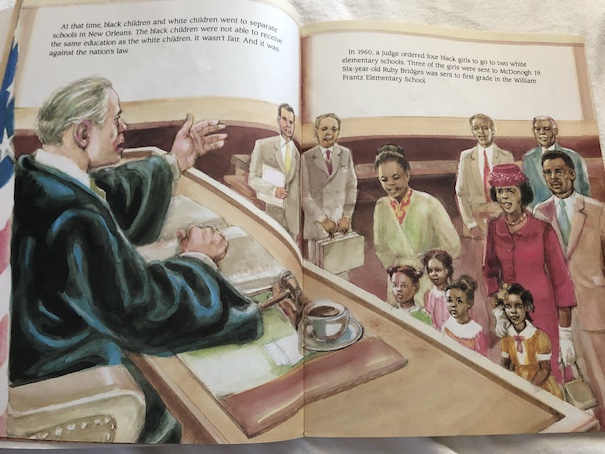
The book explains briefly that schools were segregated at the time, and that black children were not given an education that was equal to what was offered in white schools. Because the book is for children, it doesn’t go deep into detail about the Civil Rights Movement and desegregation or exactly how Ruby Bridges’s family became involved. (Ruby was selected as one of the children because she passed a test for academic aptitude, showing that she could keep up with a class of white children, who had better early education.) It simply says that, in 1960, a judge decided that four young black girls would be sent to schools that had been for just white children and that six-year-old Ruby Bridges was one of them.

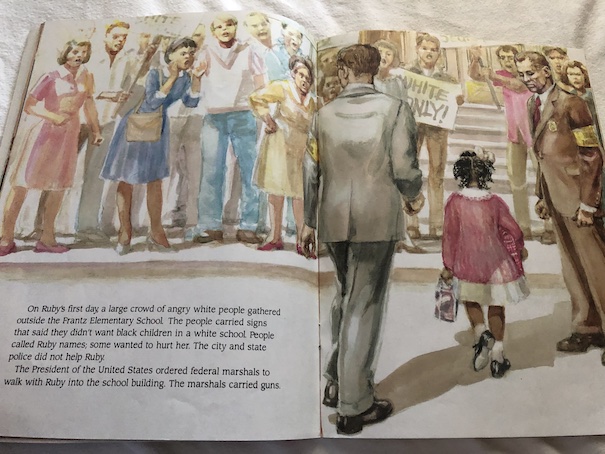
It was a harrowing experience for young Ruby. There were protesters outside the school, yelling angrily and threatening the little girl. For her safety, she had to be escorted by armed federal marshals.

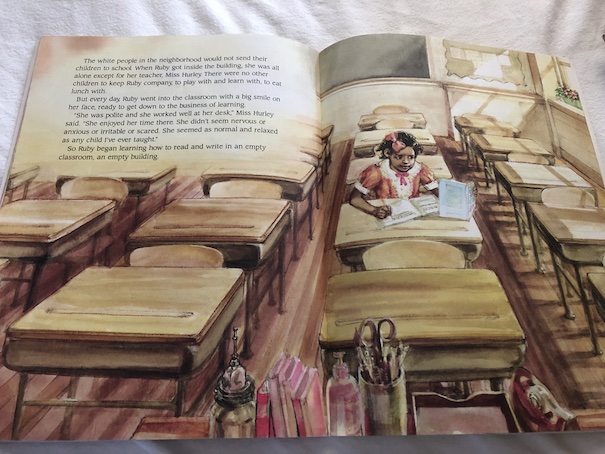
Parents in the area refused to send their children to school so they wouldn’t be in the same classroom with a black child, so Ruby Bridges was literally in a class all by herself. Her teacher, Miss Hurley taught Ruby in an otherwise empty classroom. Miss Hurley was surprised at how Ruby was able to keep a good attitude in spite of the angry protestors and the lack of other children.

One day, Miss Hurley was looking out the window as Ruby approached the school, and she thought she saw Ruby saying something to the angry crowd before coming inside. When Miss Hurley asked Ruby what she said to them, Ruby said that she was talking to them; she was praying for them. Miss Hurley hadn’t realized it before, but Ruby had a ritual of praying for the people who were angry and hated her every day before school. This was just the first time that Miss Hurley had seen her doing it.

Ruby also said the same prayer after school. This prayer was part of what helped her get through those difficult days of hostility and loneliness.

The book ends by explaining that the parents soon began to send their children to school again and let them join Ruby’s class because they realized that life had to continue and that keeping their children from their education was hurting them. The angry protestors gradually gave up. Ruby continued going to school and eventually graduated from high school. She later married a building contractor and had four sons of her own. She founded the Ruby Bridges Educational Foundation to help parents become more involved with their children’s education and to promote equality in education.

The book is available to borrow and read for free online through Internet Archive (multiple copies).

My Reaction

I’ve heard the story before of Ruby Bridges praying for the people threatening her and protesting against her. This particular rendition is very good, although there is one thing that confuses me. According to this book, her teacher’s name is Miss Hurley, but I understood her name was Barbara Henry. I thought perhaps Hurley was her maiden name and that she later got married, but I haven’t been able to find anything to confirm that. I haven’t found anything to explain where the name Hurley came from at all. I’m not the only reviewer who questions the name confusion.

Ruby Bridges wrote books herself about her experiences, at different reading levels, and they’re also available on Internet Archive.

Princess Sonora and the Long Sleep

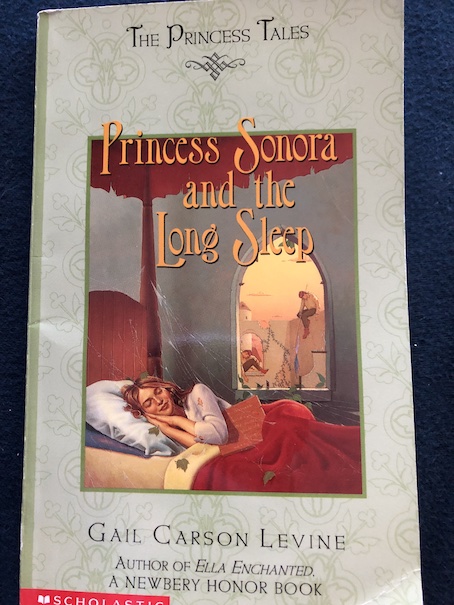
Princess Sonora and the Long Sleep by Gail Carson Levine, 1999.

This story is a retelling of the classic fairy tale, Sleeping Beauty. It’s part of a series of other retellings and re-imaginings of classic fairy tales called The Princess Tales.

When Princess Sonora was born, her parents invited the usual fairies to give her gifts. They do this because it can be dangerous to anger fairies, although fairies’ gifts are a risky proposition at the best of times. Unfortunately, there are two complications with the fairies who give Princess Sonora gifts. First, one of the fairies decides to top a previous fairy’s gift of intelligence by making Princess Sonora ten times as intelligent as any other human on earth. As a result, Princess Sonora is an unnaturally intelligent baby who begins to talk almost immediately and is smart enough to understand the second problem that arises.

Her parents neglected to invite a particular fairy because they’d heard a rumor that she was dead. Of course, the fairy shows up anyway, angry at the lack of invitation, and immediately curses Princess Sonora. As in the original Sleeping Beauty story, the curse is that, someday, Princess Sonora will prick her finger and die. Also, as in the original story, the last fairy who hadn’t yet given a gift uses her gift to soften the curse so that, instead of dying, Princess Sonora and everyone else in and around her castle will fall asleep for 100 years. She can’t completely remove another fairy’s spell because that might provoke a fairy war, but this change to the curse gives the family hope. She promises that Princess Sonora will meet an eligible prince when she wakes up. Princess Sonora, being an unnaturally intelligent baby who can talk, also gives her own feedback and suggestions on the situation, to her parents’ amazement. Her parents decide to try to prevent the curse from coming true by hiding anything that can prick Princess Sonora, but baby Princess Sonora has already realized that this will be impossible. She knows that the curse will come true someday, and as she lies in her cradle, she begins to make plans to prick herself on purpose, someday when she can choose just the right moment.

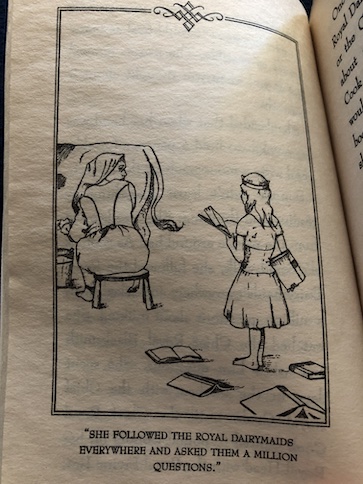
Being smart is generally a good thing, but Princess Sonora’s unnatural intelligence makes her a very peculiar girl in a number of ways. For one thing, she loves books and is always reading, even as a baby. She grows up to be a very studious girl. That’s not so bad, but Princess Sonora carries it to extremes. She also refuses to sleep. It’s partly because she knows that, at some point, she’s going to spend 100 years sleeping, so there’s no point in wasting more time asleep. She’s also afraid of sleep because she doesn’t know where her mind will go when she sleeps, and with her massive intelligence, she loves her mind and doesn’t want it to go away. Instead of sleeping, she just reads all night or thinks about things. Because of her intelligence, curiosity, and constant reading, Princess Sonora knows the answers to many questions, but people often find it irritating because they don’t want to hear her long explanations or all the ways she knows for people to do their jobs better. People start saying to each other, “Princess Sonora knows, but don’t ask her.” Princess Sonora wishes that other people would be more interested in what she has to say, but she knows better than to force the issue.

When Princess Sonora turns 14 years old, her parents begin looking for a prince she can marry, assuming that she doesn’t prick herself and fall asleep for 100 years first. They choose Prince Melvin, from a large and wealthy kingdom nearby. It seems like a smart match, but Princess Sonora knows it isn’t a good one. Prince Melvin has also received gifts from the fairies, and while they include positive qualities, like honesty and bravery, they don’t include intelligence. Prince Melvin isn’t very smart and wouldn’t appreciate any of the things Sonora knows or has to say. He would marry her anyway because he’s Honest and Traditional, but Sonora knows that she wouldn’t be happy. When she meets him, he’s very dull. The fairies made him a Man of Action, not of thought. He’s decided that thinking gets in the way, so he has few ideas and certainly no interesting ones. Sonora begins to think that the right time for pricking her finger might be coming soon. Pricking her finger doesn’t quite go as she had planned, but the curse works.

When Princess Sonora and everyone in the castle is put to sleep for 100 years, they are half-forgotten. Princess Sonora becomes a kind of legend, and the saying “Princess Sonora knows, but don’t ask her” becomes a common saying when someone doesn’t know the answer to something, with few people knowing who Sonora really is or why you’re not supposed to ask her what she knows. That is, until a prince with curiosity and a thirst for knowledge, someone who really needs Sonora’s knowledge to solve a problem, seeks her out for the answers he really needs. When Sonora wakes, she finally meets a prince needs a princess like her and is truly happy to hear what she has to say!

My Reaction

I liked this story when I first read it as part of a collection of other stories in the same series. Gail Carson Levine, who is also the author of Ella Enchanted, often writes stories themed on fairy tales but with her own twists. Princess Sonora’s extreme intelligence and fear of sleep weren’t part of the original fairy tale, although they fit this story nicely. I found the scene with the fairies giving Sonora gifts a little disturbing. When one of the fairies gives her the gift of beauty, the baby physically changes, and it is described as being painful. It is a theme in other stories by Gail Carson Levine that the magical gifts fairies give often have unfortunate side effects. Some of them really turn out almost like curses, but in this case, it turns out to be just what Sonora really needs and leads her to the person who really needs her. Even after people stop getting gifts from fairies when they’re babies, they still have quirks, and Sonora’s quirks fit with Prince Christopher’s quirk for curiosity!