Frindle

Frindle by Andrew Clements, 1996.

Nick is a creative boy in elementary school who is known for pulling elaborate stunts, like turning his classroom into a tropical paradise with fake trees and real sand. When he gets to fifth grade, he has Mrs. Granger as his language arts teacher. Mrs. Granger has a sense of humor about some things, but she also has some strict rules and is all business when it comes to her specialist subject. Her vocabulary lists for her students are extensive, and her favorite thing is the unabridged dictionary. Nick likes words and enjoys reading, but he finds the dictionary to be boring. When he sees a word he doesn’t know, he would rather ask someone else what it means than look it up in the dictionary.

In most classes, Nick is good at asking teachers questions to sidetrack them from assigning homework. The other kids know he does this, so they aren’t surprised when he asks Mrs. Granger about her big unabridged dictionary and where all the words in it come from. Unfortunately, for Nick, Mrs. Granger is also onto his trick, and rather than answering the question herself, she assigns Nick to look up the answer and tell the rest of the class what he’s learned the next day in addition to his usual homework assignment. Nick is upset because he usually doesn’t have much homework at all, and now, he has to do more.

When Nick gets home, he reads about dictionaries in his encyclopedia, but he’s not sure that he understand everything he’s read, and it all sounds terribly dull. Then, Nick gets one of his creative ideas that he thinks will make this boring assignment more fun. When it’s time for Nick to give his report, even he is surprised at how much he has to say about the dictionary. Mrs. Granger loves his report, although even she tries to cut Nick short when he goes on for too long. Although the other kids were initially bored, they begin to enjoy Nick’s report when they realize that he is actually using it to waste an entire class period. Eventually, Mrs. Granger tells Nick that he’s at a good stopping place in his report, and she praises him for all of his work. Nick, annoyed that she’s making him look like a teacher’s pet, decides to ask one more question. He says that he still doesn’t understands who decides what the meanings of words are, like who decided that the word “dog” refers to a dog. Mrs. Granger tells him that everyone who speaks English does. Words mean whatever the people who use them agree that they mean. People who speak other languages use different words to refer to the same animal, but those words are valid to them because they all agree on the meaning of the words.

Then, Mrs. Granger says something that really starts Nick thinking. She says that if everyone in their classroom decided that they wanted to call a dog by some other word, and they got other English-speaking people to agree on it, that word would come to mean “dog.” If enough people agreed to use their new word and agreed on its definition, the new word would be put into the dictionary. To answer Nick’s original question, people who speak a language determine the words of that language and whether they are included in the dictionary. Mrs. Granger adds that the dictionary is the work of many experts over many years, and there are good reasons why each of the words included in the dictionary are there. The dictionary contains the laws of the English language, and while those laws can change, it takes time.

Later, when Nick is walking home with his friend Janet, Janet finds a fancy pen. Nick thinks about what Mrs. Granger said about how people like him, who use a language everyday, decide what words mean. It reminds him how, when he was little, he used to use a baby word that his family understood meant “music.” He had to give up using that word when he went to preschool because nobody outside of his family understood that word, but Nick understands how the word had meaning in his family because they all understood what Nick meant when he used it. While he’s thinking about it, he bumps into Janet, who drops the pen. On impulse, when Nick gives the pen back to her, he decides to give the pen a new name. He calls it a “frindle.”

At first, Janet is confused about what Nick means by “frindle.” It’s the beginning of a new experiment for Nick. Out of curiosity, Nick tries to see if he can teach a saleslady at a local store that the word “frindle” means “pen.” He goes to the store and asks for a frindle, pointing to the pens. Then, he gets some of his friends to do the same thing. After several kids all ask the same lady for a “frindle”, she begins to respond to it by automatically reaching for a pen. Nick is excited because he has just created a new word. “Frindle” now means pen because he decided that it did, and he got other people to agree on the meaning. Nick is making language history!

To make sure his word becomes part of language, Nick gets his friends to use the word “frindle” instead of “pen” at school … in Mrs. Granger’s class. Mrs. Granger isn’t amused by the class’s excessive use of the word “frindle” for pen because she knows that this is another of Nick’s stunts, and it’s a distraction from school lessons. She tries to discourage Nick from promoting it at school, and Nick points out that he’s only doing what she said about how words are made. Mrs. Granger explains how words in language evolved from other words that also have meaning, but “frindle” doesn’t have that kind of evolution because Nick just made it up, based on nothing. Nick insists that “frindle” means something to him and his friends, and they’ve already sworn an oath to each other to keep using it.

To Nick’s surprise, Mrs. Granger responds by showing him a sealed envelope. She tells him that it’s a letter for him, but she doesn’t want him to read it now. The letter is for him after the question of “frindle” is resolved. For now, she just wants Nick to sign the envelope and date it so that he’ll know what she hasn’t switched envelopes or tampered with the letter in any way. Nick is confused, but he does sign the envelope, and Mrs. Granger mysteriously says, “And may the best word win.” It seems like Mrs. Granger is declaring a war of words, pen vs frindle, but are Nick and Mrs. Granger really on opposite sides?

The book is available to borrow and read for free online through Internet Archive (multiple copies).

My Reaction and Spoilers

This is a fun and humorous story that does a great job of showing how languages evolve and the purpose and meaning of language. Nick and his friends unwittingly give themselves an education during the course of their stunt. The reason why Nick had to sign and date the envelope is that Mrs. Granger is also enjoying their experiment, and she has made a prediction about how it will all turn out. Anyone who has ever had to deal with a small child who has learned a bad word can guess what Mrs. Granger has realized and how her own actions are calculated to make sure she gets the result she really wants.

Something that not even Nick fully reckons with until his experiment is well underway is that, now that all of the kids at school know about “frindle”, he can’t stop them all from using the word, even if he wants to. Although Nick originally created the word, words in a language belong to everyone who uses them. This is both a thought-provoking book about the nature of words and language and a good story for stopping periodically and having kids make their own predictions about what will happen next.

Even kids have power because they are also language-users, and they have the ability to influence the language and understanding of everyone around them by the words they choose! Nick is very much an idea person, but after “frindle” starts getting so much national media attention, he starts to get intimidated by the level of power he has. He has become more conscious of the consequences of his ideas and how they can affect large numbers of people. For a time, he becomes more shy because of that realization, but Mrs. Granger gives him some encouragement. She tells him that he has many good ideas and that she’s sure he will go on to do great things with them. Nick regains his confidence and realizes that he can use his powers for good, supporting good causes.

Stepping on the Cracks

Stepping on the Cracks by Mary Downing Hahn, 1991.

This is the first book in the Gordy Smith series, although the book really focuses on a girl named Margaret. Gordy Smith is the neighborhood bully and her nemesis. The series shifts to focus more on Gordy after the full story behind his awful behavior is revealed. This story begins in August 1944 because, although they don’t mention the year, the characters talk about seeing the story about the Liberation of Paris in Life Magazine.

Eleven-year-old Margaret and her best friend, Elizabeth, both have brothers who are fighting in World War II. Margaret’s brother is in the army in Europe, and Elizabeth’s brother is in the navy in the Pacific. The two girls have their own special ritual of stepping on the cracks in the sidewalk to “break Hitler’s back”, in a twist on the old stepping on a crack childhood superstition. Margaret knows that the war is Hitler’s fault, and she blames him personally for her brother, Jimmy, having to go away and fight and for the changes in her household since then. Since the war started and her brother went away, Margaret’s father has been very grim, and she knows that her mother sometimes cries when she thinks that Margaret can’t hear her. Her parents are happiest when they imagine what life will be like when the war finally ends. Margaret keeps a scrapbook of letters Jimmy has written to her and war-related news clippings and cartoons that she’s saved that remind her of things her brother has told her about his time in the army. Margaret hates Hitler and the Nazis with a vengeance.

At the same time, Margaret thinks about how odd it is that the war doesn’t seem entirely real. She knows that people in her community have already been killed in the war overseas, and her parents are worried about Jimmy. However, apart from the missing people in the community, like Jimmy, and the stars in people’s windows to signify people who are in the armed forces or who have been killed in battle, there are few outward signs that there is a war happening. They hear about battles, but their own town of College Hill, Maryland, is peaceful. There are some shortages of things because of war rationing, but otherwise, Margaret’s life has been continuing very much as before. She’s seen pictures of starving children in war zones, and she sometimes wonders why they suffer so much, and she doesn’t.

A neighborhood bully, Gordy Smith, gives the girls trouble, and Margaret thinks of him has being like a Nazi because he’s so mean. He calls Margaret and Elizabeth “Baby Magpie” and “Lizard”, pulls their hair, and gets his friends to gang up on them. At one point, he tries to force Elizabeth to kiss him. (One of those weirdos who are clearly interested in girls but have no idea how to be charming to girls.) Gordy brags about his brother in the army, saying that his brother has killed more Nazis than the girls’ brothers and that he’s going to join the army and kill Hitler when he’s older.

Margaret tells her mother about Gordy and says that she hates his guts. However, her mother tells her that young ladies shouldn’t say words like “guts” and that she should have some sympathy for Gordy because of the kind of family he lives in and what his father is like. (Personally, I don’t think sympathy alone is what’s called for to fix Gordy’s problems, but more about that later.) Elizabeth’s father is a policeman and has arrested Gordy’s father more than once for being drunk and disorderly. People in the community think of the Smith family as being “poor white trash” and wish they would move away. The other kids in the family are as nasty and troublesome as Gordy. Margaret doesn’t think Gordy’s family circumstances should excuse his awful behavior and still hates him.

One day in late summer, before school starts, Gordy and his two friends chase the girls out of the treehouse they built. They steal the comic books they like from the girls and rip up the ones they don’t like, tossing them from the top on the tree on top of the girls. Then, they start ripping up the boards from the platform in the tree so they can use them themselves, saying that girls can’t build anything well. It takes much less time and effort for them to destroy what the girls built than it did for the girls to build it. (This is always true of any kind of destruction, so that doesn’t mean anything complimentary about the destroyers, especially if they aren’t smart enough to realize that and think they’ve got some kind of special talent that’s better than building abilities – just saying because it’s true. All this stuff from the boys is just bluster and gaslighting to intimidate the girls into letting them have what they want by implying that they never deserved the things they actually owned and built themselves.) Margaret yells for help from her mother, but her mother doesn’t hear her. Elizabeth tells the boys that their act of sabotage makes them traitors and worse than Nazis, but they laugh it off.

Elizabeth tells Margaret that they’ll get even with Gordy and the other boys for this, but Margaret can’t imagine what they could do. She would rather stay away from Gordy. That’s easier said than done because Gordy steals the next set of boards the girls try to use to rebuild their tree house, too. One day, the girls see the boys going into the woods. They know that the boys have built a hut to use as a clubhouse with the boards they’ve stolen from the girls, and Elizabeth suggests that they follow the boys to find out where their hut is. Elizabeth thinks that it would be great revenge to find their hut, take it apart, and reclaim the stolen boards. After all, they have a right to their own boards. Margaret is more hesitant because they’re not supposed to cross the train tracks into the woods, and the woods are lonely. The boys have air rifles, and if the boys caught the girls trying to take back the boards, they could do all sorts of horrible things to them with no one around to save them. However, Elizabeth impulsively dashes off into the woods, and Margaret feels like she has no choice but to go with her.

The boys catch the girls spying on them at their hideout when Margaret accidentally sneezes. At first, Margaret is sure that the boys are going to kill them when they catch them. Instead, Gordy tries to scare the girls with a story about how he and his friends have actually saved the girls from the crazy man who lives in the woods. There’s an experimental farm near the woods used by the agricultural department at the local university, and Gordy spins a story about how the army was using the farm for an experiment on soldiers, using chemicals to try to make them stronger and braver. Gordy insists that the man they used in the experiment went crazy and broke out of the farm and has been hiding in the woods ever since, ready to attack anybody who finds him. Elizabeth says the story is a fake because she never heard anyone else say that, but Gordy insists that he saw the crazy man standing behind the girls with a knife. Gordy tells the girls that they better stay out of the woods or the crazy man might get them next time.

Elizabeth knows that Gordy must be lying, but Margaret is sure that the story must be true when she sees a wild-looking man with shaggy hair behind the boys in the woods. Margaret screams and runs for home with Elizabeth behind her. Unfortunately, Elizabeth didn’t see the wild-looking man herself. She thinks that Margaret was just being a chicken, falling for Gordy’s story and imagining that she saw something, and she teases Margaret about it. Margaret asks her mother about the experimental farm and Gordy’s story, without admitting that she was in the woods, and her mother says that it’s nonsense, that the farm is only used for agriculture. Her mother thinks that, if there is a strange man in the woods, it’s probably just some old tramp.

It does seem like a logical explanation, that maybe there was just some old tramp hanging around the woods who didn’t know that Gordy was going to tell some wild story about a murderous crazy man and just happened to wander by at the right moment to look scary. However, Margaret just can’t convince herself that’s all there is to it.

When the girls finally get up the nerve to go back to the boys’ hut, there are unmistakable signs that someone has been living there. There is also a knife, like the one Gordy said the crazy man had. Who is staying in the boys’ hut, and what are the boys really hiding?

My Reaction and Spoilers

I mostly think of Mary Downing Hahn for her ghost stories, like Wait Till Helen Comes and The Doll in the Garden, but this was actually the first book that I ever read by this author. I think I read it when I was in elementary or middle school. Because of some of the serious subjects of the book and some of the language used, this isn’t a book for young kids. It’s probably best for middle school.

America in the 1940s

This book is a realistic portrayal of life on the American home front during the war. I enjoyed the mentions of little things that were common in 1940s America, like the popular radio programs that people liked to listen to (like the Lone Ranger, the mystery horror show Inner Sanctum, and the children’s program Let’s Pretend), comic books and newspaper cartoons, magazines like Life and The Saturday Evening Post, and “Kilroy was here” graffiti. Sometimes, characters mention 1940s celebrities. After Gordy tries to make Elizabeth kiss him, she tells Margaret that a star like Joan Crawford would slap any guy who got “fresh” with her. Later, the girls overhear the boys talking about which pin-up girls they think are the most sexy, mentioning Betty Grable and Rita Hayworth.

Note: The boys’ “sexy” talk is at a realistically juvenile level, laughing over pictures of pin-up girls with big breasts and using the word “hubba-hubba.” An adult hearing a conversation like this knows that the boys probably feel grown-up for secretly smoking cigarettes at their hideout while talking about sexy women, but at the same time, they plainly sound like little boys who use words like “hubba-hubba” because that’s as sophisticated as they know how to be. They have nothing else to say on this subject. As Elizabeth and Margaret could attest, these boys have never successfully kissed a girl at this point in their lives because they’ve been making themselves unappealing to the girls in their vicinity by the mean and obnoxious ways they act. When the girls later go inside the boys’ hut, they see that the boys have defaced their pin-up pictures by giving all the girls beards and blackened teeth. They are definitely not young Casanovas.

This was the first book that introduced me to the concept of putting banners with stars in the window as a sign that someone in the family is in the armed forces. A blue star indicated (and still indicates) a living service member or veteran. A gold star means that the service member died in action. That’s important to the story because, even at the beginning of the book, Margaret knows what the blue stars and gold stars mean, and she already knows people in her community who were killed in the war. One of the people in the community who has died in the war was a young man called Butch who was killed only months after he got married. His widow, Barbara, gave birth to their son after his death, so Butch never saw him. Margaret is sad when she thinks about Butch and his family because she can remember when Butch was a local hero as quarterback on the high school football team. Later, Margaret’s brother, Jimmy, is also killed in the war, and the family replaces his blue star with a gold one, while Elizabeth’s family still has a blue star because Elizabeth’s brother, Joe, is still alive.

Danger and Safety

There are a lot of themes about safety and danger in the story, both real and perceived. When Margaret thinks about the crazy man Gordy says is living in the woods, she thinks that she would feel safer if Jimmy was home because Jimmy would protect her. Yet, when she thinks about Butch getting killed, Margaret realizes that, when big, strong, young men can be suddenly killed, nobody is ever really safe. Even the strongest men she knows are not completely invulnerable, and there are big, frightening, unpredictable things happening in the world.

At one point in the story, the girls talk about what they would do if girls were sent away to war like their brothers. Elizabeth brags about how brave she would be, but Margaret freely admits that she’s a coward and everyone knows it. Margaret imagines that, if she were out on a battlefield, she would probably drop to the ground and play dead until it was all over.

Later, when the girls learn the truth about Gordy, it brings the full realities of the war home to them and challenges everything that Elizabeth thinks about bravery and cowardice. The truth is that Gordy built the hut to hide his brother, Stuart. While one of Gordy’s brothers really did become a soldier and Gordy brags about him, Stuart became an army deserter. When Elizabeth finds out, she’s furious because her brother and Margaret’s are risking their lives, and she thinks that Stuart is a coward, letting others die for him and their country because he’s too afraid to fight. However, when the girls confront Stuart, Gordy, and the other boys about the situation, they learn that it’s more complicated than that. It takes Elizabeth longer to see how complicated the situation really is, but Margaret understands when Stuart describes his feelings.

Stuart is a pacifist. He’s not a coward or a Nazi sympathizer, as Elizabeth first accuses him. His logic is that two wrongs don’t make a right. While Hitler might want to take over the world and send people out to kill others, Stuart knows that the men who get sent away to be soldiers mostly don’t want to be soldiers at all and have no real desire to kill anyone else. If they had their choice, they would just be living their own lives and minding their own business at home. His speech makes Margaret really think for the first time about the war from the point of view of the soldiers on the ground. When her brother was drafted, Margaret never asked him how he felt about going away to war, just assuming that he’d want to defend his country and beat the Nazis. Now, she regrets not asking him about his feelings and wonders if he was scared or if he went reluctantly. For the first time, she also has to confront the reality that her brother has been actively killing or helping to kill other people. Stuart deserted because he simply couldn’t face the prospect of killing someone. He shows the girls a letter he got from their other brother, Donald, the one who became a soldier, telling him how horrible the war is and how they’ve sometimes killed civilians and even allies because of mistakes they’ve made. Stuart also introduces the girls to the poem The Man He Killed by Thomas Hardy. Margaret wonders how Jimmy felt about the idea of killing other people and if it’s really sane to be okay with the idea of killing. Margaret has always looked up to her older brother, seeing him as a protector, never thinking of him as a killer, but yet, he is actively engaging in killing. He doesn’t tell Margaret that part of things in his letters to her, but she realizes that’s what actually happening in Europe.

Finding out about Stuart creates a real problem for the girls. Because army desertion is illegal, the girls know they should tell someone about Stuart, but Gordy tells them that the hard reality is that deserters either get arrested or shot. If they report Stuart, they could be sending him to his death. Elizabeth, being the more brash and hard-hearted one, says that she doesn’t care because it would be no more than what he deserves (although she later takes that back). Instead, she settles for blackmailing Gordy and his friends into stopping their bullying of the girls and helping them rebuild their tree house.

However, the kids soon realize that Stuart can’t stay their secret forever. Stuart has gotten sick, and if he doesn’t get help, he could just die in the woods. Stuart was hoping that the war might just end, and people would stop caring about whether he’d joined the army or deserted, but nobody in 1944 knows when that’s going to happen. From their perspective, it could be months (close to the reality) or years. The war has been going on for years already. Stuart won’t survive in the woods for that long.

The kids also confront the reality that, while two wrongs don’t make a right when it comes to fighting, just standing back and doing nothing while other people are doing wrong is also wrong. Elizabeth is the first of the children to point out that the entire reason why desertion is illegal is that, if everyone just decided to opt out of fighting, people like Hitler would run overrun everyone because no one would put up a resistance. Leaving aside what the characters decide to do about Stuart for the moment, that brings me to the problems with Gordy and the people who should be responsible for him and aren’t.

Gordy’s Problems

I’m frequently the first to say, as Margaret does in the story, that just coming from a bad background shouldn’t allow a person to get a free pass on being a bully themselves. Two wrongs really don’t make a right, and to my way of thinking, people who bully others because they’ve been bullied themselves are bad because they’re doing to completely innocent people what they already know they hate being done to themselves. However, unlike what Margaret’s mother said earlier about how she wishes Margaret would have more sympathy for Gordy, I quickly realized that, first, sympathy is insufficient in situations like this, and second, Margaret’s mother is not really motivated by sympathy for Gordy. She has other, less admirable reasons for looking the other way, even when she knows exactly what’s going on in Gordy’s family and that he is actively abusing her own daughter.

Gordy frequently gets away with his bullying because people are afraid of both him and his father. On the way to school, when Gordy rips up Elizabeth’s homework and stomps on her school supplies to break them, and the crossing guards see it happen. However, even though it’s part of their duty to report things like this, they don’t want to do it. When Elizabeth asks them if they’re going to report it to their teacher, they make excuses about how that might be tattling and make their teacher mad and how it would be just their word against Gordy’s (ignoring the evidence of the ripped papers and broken school supplies). The reality is that they’re afraid of Gordy doing something to them in revenge. Elizabeth asks them if that means that she’s just going to have to suffer what Gordy does to her while Gordy gets away with it because they’re too afraid to said anything. The crossing guards are further afraid to give her a straight answer because everyone involved knows that the answer is, yes, that’s exactly what’s going to happen, and that’s exactly the reason why it’s going to happen. The crossing guards know that Gordy is going to continue being an abusive bully, and they know they’re going to let him do it without saying a word, and they know the reason why they’re going to do that is because they are scared. They’re not willing to put themselves on the line to protect Elizabeth even though that is a part of their job. Elizabeth, knowing all of this, tells them they’re cowards, and it’s the truth. Unfortunately, there are times when apparent cowardice can also be necessary self-preservation from a greater insanity, and much as I hate to admit it, this might be one of those situations.

There is the underlying problem in this community, and that’s the behavior of the adults. Part of the reason why the young crossing guards are so cowardly about the class bully is that they know darn well that no adult in their community is likely to act on anything they tell them about Gordy. Even if their teacher punishes Gordy temporarily by suspending him from school, Gordy will come back, mean and horrible as ever, with revenge on his mind. No adult is going to get to the real root of Gordy’s problems and solve them, so Gordy will continue to be a problem. It appears to be common knowledge in the community that Gordy’s father is an abusive drunk. Elizabeth and Margaret know it, and I think his teacher probably knows it, too. Gordy comes to school with a black eye. Barbara talks about it with the girls, saying that Stuart used to help protect Gordy from the worst of his father’s abuse and that Gordy needs someone to take care of him. Nobody can avoid knowing that the Smiths are an extremely troubled family. After Margaret and Elizabeth go to Gordy’s house to find him and witness Gordy’s father’s behavior for themselves, Margaret tries to talk to her mother about it, and her mother just says that what people do in their own houses is their business and they can’t interfere. That, right there, is part of the root of Gordy’s problems. The first root is his father’s drunken abuse, the second root is knowing that the adults in his community are aware of the situation and are deliberately looking the other way, and the third root are his own choices that prevent other people from getting close enough to help.

For the moment, I’d like to focus on Margaret’s mother and her non-interference policy when it comes to child abuse. A major part of the reason why Gordy continues to be abused by his father and why Gordy is able continue bullying and abusing other kids is exactly this policy of looking the other way. I think all of the adults in this community feel similarly, and I think a major part of the reason they do it is because the adults are scared of Gordy’s father and what he might do to them. Letting him beat his wife and children probably doesn’t feel great, but these adults excuse themselves for allowing that to repeatedly happen with their full knowledge by saying out loud that it’s none of their business while quietly thinking that letting a kid be beaten is better than being beaten or killed by this crazy man themselves. Apart from occasionally arresting Mr. Smith for getting publicly drunk and disorderly, after which he is released when he sobers up, nobody in the community, not even Elizabeth’s police officer father, does anything. The kids are the most active characters in the story, and the adults, like Margaret’s mother, want to shut them down from talking about it so they won’t have to feel like they should be doing something when they’re not. It doesn’t make the problem go away, but it does allow the adults to lie to themselves and pretend like it’s not a problem that they will have to deal with eventually, which is almost the same in the adults’ minds.

It is fitting that this is a World War II story because the situation with Gordy has parallels within the war itself. The United States initially didn’t want to become involved with the war because they saw what Hitler was doing as a European matter. People in the US didn’t want to become involved in the war because they knew it would mean risking their lives, and it wasn’t something they wanted to do if it wasn’t their problem and if it could be resolved without them. Self-preservation is a sign of sanity, but the problem with that mindset is that it doesn’t take into account the larger picture and the full, hard realities of the situations. Sometimes, even when you don’t go looking for trouble, trouble can come looking for you. The US wasn’t officially involved in the war effort except as a supplier until Pearl Harbor. That attack on the US naval fleet brought it home to the American public that it didn’t matter whether they wanted to be involved or not if another country decided to actively involve them.

It’s a similar situation with Gordy. Nobody wants Gordy to bully them, but he does it anyway. It doesn’t matter if the girls are in their own tree house in Margaret’s front yard, minding their own business; Gordy comes after them to destroy the tree house and steal the boards. Margaret’s parents know what happened, but they do nothing. All through the book, Margaret has times when she feels unsafe, but her parents don’t protect her from the closest and most obvious dangers, even when she tells her mother about them. Margaret’s parents don’t protect her because they are scared themselves and don’t want to get involved, even though they are already involved because it’s their daughter being abused … not unlike a deserter who flees the army to avoid fighting when his country is attacked.

Margaret would be the first to admit that she’s not the bravest person around, but yet, she is braver than many others around her because she can and will take action even when she’s scared. For most of the book, Margaret only gets into scrapes when she’s goaded into them by Elizabeth, but even Elizabeth observes that Margaret follows through once she starts something or sees that something needs to be done. The adults in the community can’t say the same. The abuse going on in the Smith household hasn’t stayed privately in the Smith household at all. It’s gone out into the community through Gordy and the other Smith children. It’s a public matter because Mr. Smith is repeatedly drunk and disorderly and intimidating to every adult in the community. It’s everyone’s business because everyone is suffering the results. However, the adults find it easier to keep telling themselves that they don’t need to do anything about it because they can’t deal with the discomfort that would come from a professional community intervention (or tell themselves they can’t deal with it, which isn’t quite the same thing), which is the one and only thing that could probably save the Smith family at this point, and by extension, everyone who’s been suffering from the second-hand bullying and abuse delivered by Gordy. While one person alone would genuinely be in danger from standing up to Gordy’s father, a concerted community effort including the police, local medical professionals, and the principal and teachers from the school showing a united front would be a safer and saner option. There is safety in numbers, provided that the “numbers” can get up the nerve to join the numbers.

I think Gordy should be held accountable for the things he’s done, and I think some reasonable adult should also point out to him that he’s been a fool to cultivate enemies instead of allies. Although Margaret and Elizabeth eventually become his allies for this adventure, sympathetic to the abuse that Gordy has suffered and to Stuart’s situation, if he had been nicer to them from the beginning, he would have gotten help for himself and his brother much sooner. Gordy is bitter toward other people in the community because he’s fully aware that they all refer to him and his family as “white trash”, although I think he should also be aware that it’s their behavior that causes people to look at them that way. Gordy himself has partly caused and perpetuated that image because of everything he does on a daily basis. While Gordy can’t help that his father is an abusive drunk, he can help being a bully himself, and as long as he acts like that, people will treat him as the bully he is and try to avoid him rather than give him the help he really needs. His father is his worst enemy, the adults in this town are largely useless, and Gordy is not only hurting others but sabotaging himself. Even when the girls try to help Gordy, they find it hard because he’s still mean to them and fights them every step of the way.

One final note I have is to point out that, while I’ve heard many kinds of insults and racial slurs in my life, the term “white trash” is possibly the only term I know that’s both an insulting slur to the people it’s used against and to an entire group of people who aren’t explicitly mention in the slur at the exact same time. That didn’t occur to me when I was a kid, but as an adult, I realize now the reason why the modifier “white” is added to the insult. The modifier implies a comparison. The implication is that the person using the term thinks that non-white people are “trash”, and they’re telling another white person that they’re also a kind of “trash” like that, as bad or maybe worse because, as a white person, they should be able to help their situation but aren’t helping themselves because they’re somehow inferior. It’s true that Gordy and others in his family haven’t been helping matters because they make it difficult for other people to help them, but it’s still a very weird dual insult.

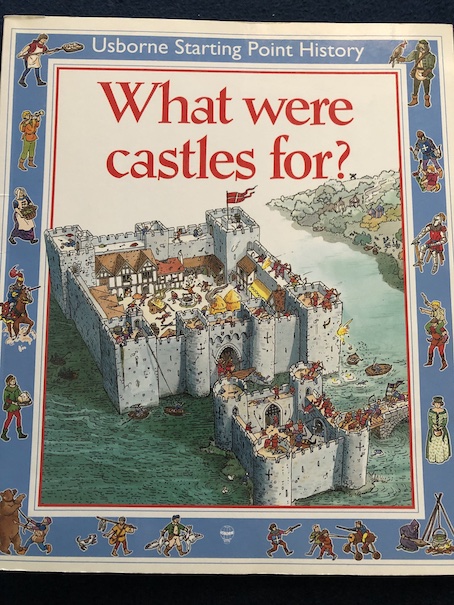
What Were Castles For?

What Were Castles For? by Phil Roxbee Cox, illustrated by Sue Stitt and Annabel Spenceley, 1994.

This nonfiction picture book for kids is part of the Usborne Starting Point History series, originally published in Britain.

I love books about daily life in the past, and this book explains the lives of people who lived in castles during the Middle Ages by answering questions about what castles were for and what people in castles did. Each page of the book is organized around sections answering specific questions.

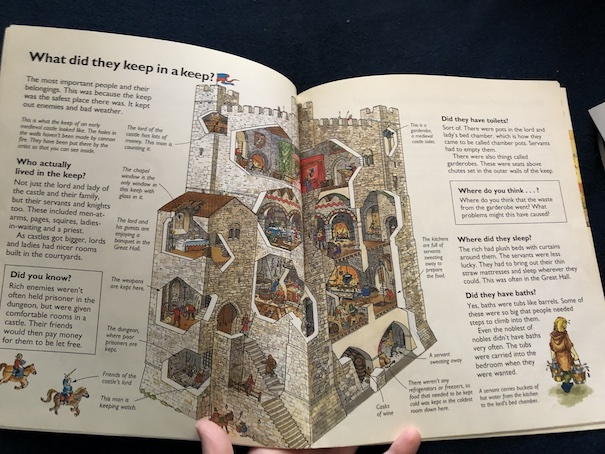
First, the book describes the basic purpose of castles and different types of castles that have existed and how they were built. The, it shows different parts of a castle and what people did in different parts. One of my favorite parts is where they show what is in a castle’s keep, which is where the lord of the castle and his family lived. The book uses cutaway pictures to show what is inside buildings, and the detailed pictures show the different activities of the people.
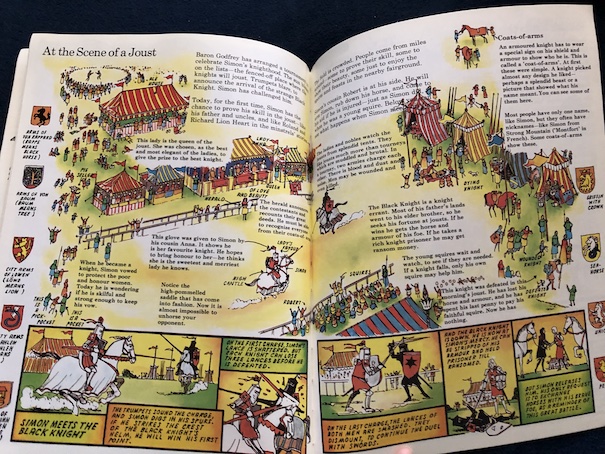
Among the activities of the nobles who lived in castles, the book explains how they would hunt and hold feasts and jousts.

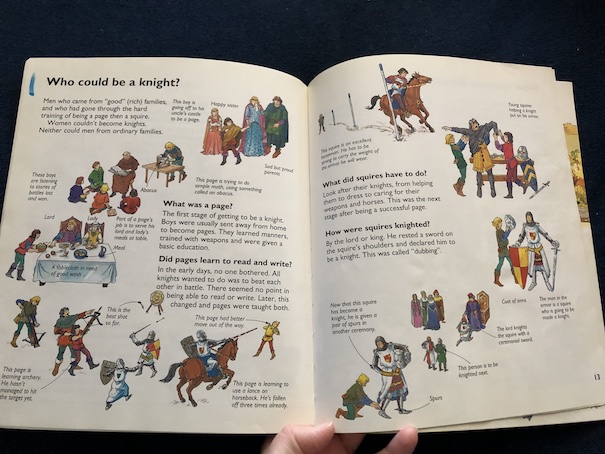
Knights and warfare were central to the purpose of a castle, which was to provide a defensible fortress for the noble families who lived in them and their supporters. The book explains how boys from noble families were raised and educated to be knights. There are also pages showing weapons and the siege of a castle.

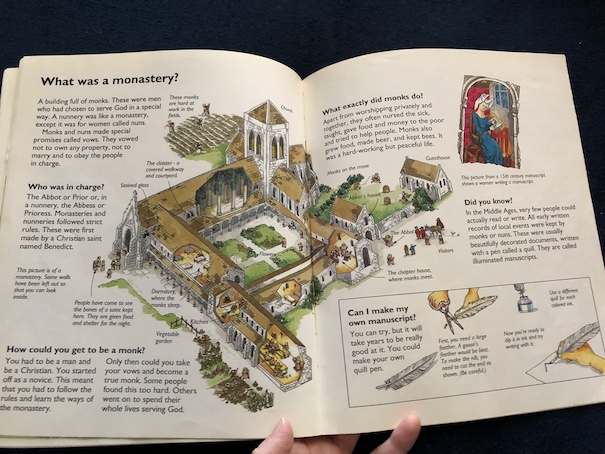
One of the things I liked about this book is that, while it is mainly about castles and the people who lived in them, it also shows how people lived outside of castles in small villages, towns, and monasteries. While castles are iconic of the Middle Ages, seeing how people lived in these other places gives a more expanded view of life in Medieval times.

The pictures really make the book! Every picture from the cutaway castle views to the scenes of villages and towns or jousts and hunts, show many people and small details. There are little descriptions labeling the people and details, most giving extra historical information, but some just for fun so readers can notice humorous details, like the monk being chased by bees at the monastery, the chicken escaping along the castle wall, the sister who is happy that her brother is going off to learn to be a knight, and the page who is learning archery but hasn’t made the target yet (his last failed shot falls short of the target, but it’s labeled as the best he’s done so far).

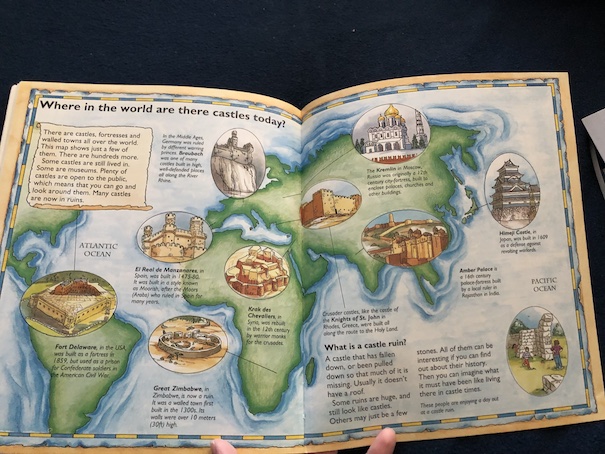
In the back of the book, there is a section with the legend of Richard the Lionheart and his minstrel and a map marked with famous castles around the world.

The book is available to borrow and read for free online through Internet Archive (multiple copies, including one in French).

Knights & Castles

The Usborne Time Traveller Book of Knights and Castles by Judy Hindley, illustrated by Toni Goffe, 1976, 1993.

This nonfiction picture book for kids is part of the Usborne Time Traveller Books series, originally published in Britain.

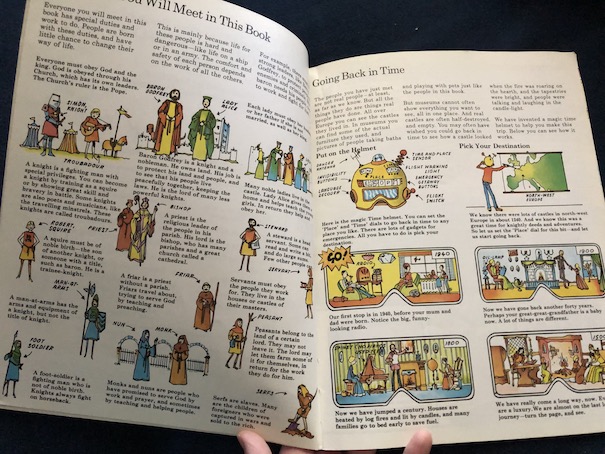
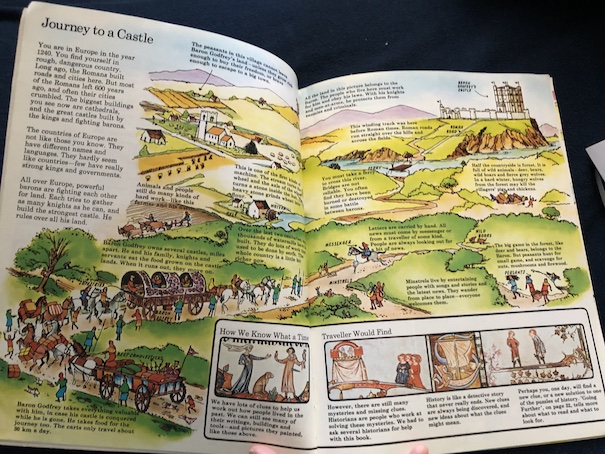
The contents are framed as a time back in time to the Middle Ages, specifically 1240 AD, to see how people would have lived in Medieval times and what castles were like when people actually lived in them. Readers follow a specific set of Medieval characters as they go about their lives.

Our trip back in time begins with a road journey to a castle. Readers see how people in the Middle Ages traveled. The journey page also explains how the Romans built the roads Medieval people used centuries earlier, which is a good historical segue because the period that we call the “Middle Ages” begins with the fall of the Roman Empire and the withdrawal of Roman forces from the furthest parts of its empire. On some pages of the book, there are extra panels at the bottom of the page with additional information, and the first set explains how we know what people would find if they were able to travel back in time to the Middle Ages, explaining how historians have gleaned information from Medieval writings and pictures and from studying physical objects, like buildings and tools.

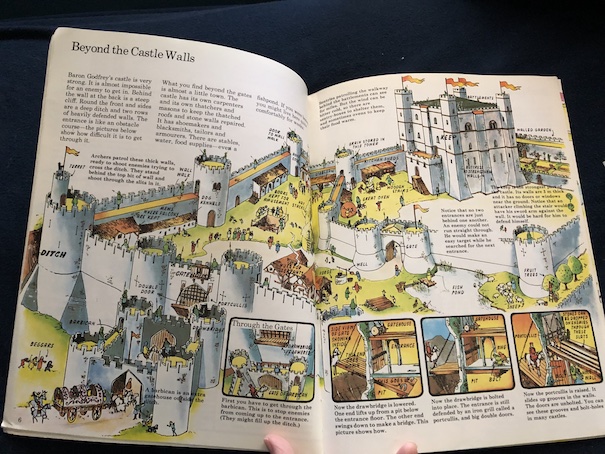
When readers arrive at the castle, the book explains different parts of the castle and how they were used for defense.

I particular like the cutaway pictures of the interior of the keep because I enjoy the details of people’s living quarters and daily life in the past. There is a page that shows the morning routine of the castle and how people would get dressed for the day. There are also pages about hunts, feasts, a visit to a building site, and a trip to town.

There are a couple pages about knights and how a boy would train to be a knight. There are also pages about jousts, the Crusades, and attacking and defending a castle.

The pictures are cartoon-like, but they are busy and full of details for readers to study, accompanied by notes that offer more information and historical background.

At the end of the book, there is a map showing locations of famous European castles.

The book is available to borrow and read for free online through Internet Archive (multiple copies).

The Midwife’s Apprentice

The Midwife’s Apprentice by Karen Cushman, 1995.

The story focuses on a young girl in Medieval England. She is about twelve or thirteen years old, but she doesn’t know her age or even her real name. Everyone just calls her Brat. For as long as she remembers, she’s always been alone, a homeless orphan traveling and begging from town to town. When a midwife finds her sleeping in a dung heap, she takes the girl on as a servant and apprentice. It isn’t as a kindness. The midwife just realizes that she can get some cheap labor out of the girl as long as she feeds her. Also, because the girl isn’t very bright or experienced, she is no professional competition for the midwife. People begin calling the girl Beetle because she was in the dung heap like dung beetle.

The midwife, Jane, became a midwife because she had six children of her own, although none of them survived. Beetle wonders if she could be a witch because of her strange mixtures, but really, she’s just a midwife. Whenever a woman in the area gives birth, Beetle goes to help carry things for Jane. Beetle is not allowed to watch the births herself, just stand by to fetch and carry. Beetle realizes that part of the reason she is not allowed to watch the births is so Jane can keep her professional secrets, although Beetle soon begins learning about plants and how to make medicines from them and she sometimes spies on births when she can to learn more.

People in town aren’t nice to Beetle. Jane is stingy and never helps anyone who can’t pay her fee. The local people don’t like her, but they tolerate her because they have need of her skills. Beetle often has to deal with the anger that people are afraid to show to Jane. Beetle’s best friend is a cat who was nearly killed by some mean local boys. She talks to the cat. Both of them are abused by locals, especially the mean boys.

Then, Beetle begins to notice that Jane keeps slipping away on mysterious errands, giving excuses for her absence that make no sense. Beetle begins to follow Jane to find out what she is doing. What Beetle learns is that Jane is having a love affair with a married baker.

One day, the miller comes looking for the midwife, but she isn’t home. Desperate for help with his wife’s birth, the miller makes Beetle come with him. Beetle doesn’t know what to do, and the miller’s wife angrily throws things at her until Jane comes to take over. Jane insults and abuses Beetle, too.

It seems like taking abuse is Beetle’s lot in life and that she has to take it or be thrown out into the street again. Her life starts to change when a kind merchant at a fair compliments her curls and gives her a wooden come with a cat carved on it. Then, another man mistakes her for a girl named Alice who can read. Beetle begins to look at herself in a new light. She realizes that at least some people see her as a person who can be pretty and smart, and maybe, she really can be pretty and smart. Liking the name Alice, Beetle decides that she will take the name for herself so she can gave a proper name.

When she returns to the midwife and the midwife abuses and insults her again, Beetle confidently tells her that her name isn’t dung beetle or brat but Alice. The midwife isn’t impressed and even people in town laugh at her for it, but Alice retains her new sense of confidence. She gives the cat a name, too, calling him Purr.

Without Jane realizing just how much Alice has been learning, Alice gradually begins helping people on her own. After saving the life of one of the local bullies, who almost drowned while chasing her, the boy starts treating Alice better. When his cow is having a difficult birth, the boy gets Alice to help him tend to the cow, increasing her knowledge of births.

Then, during one very difficult human birth, Jane leaves Alice to tend to the woman alone while she goes to tend to the lady of the manor, who is also giving birth. Alice protests that she doesn’t know what to do and can’t manage on her own, but Jane tells her she doesn’t have to do anything because this baby is likely to die. Jane just wants Alice to stay to cover for her so she can go earn another, even better fee. However, to everyone’s surprise, Alice saves the baby in Jane’s absence by applying what she has learned so far. The grateful mother names the baby after Alice, and the father refuses to let Jane take credit for Alice’s work. Jane is angry and jealous, especially when another mother insists that she wants Alice and not Jane to tend to her during her birth. Jane throws a fit and accuses Alice of stealing her customers.

Unfortunately, that birth doesn’t go well, and Jane has to step in to help and save the baby. In despair at what she sees as her failure, Alice runs away, convinced that she is just a nobody and too stupid to be anything, even a midwife’s apprentice.

At first, she wants to give up and die, but with the company of Purr the cat, she finds her way to an inn where she finds work. It’s enough to keep her alive, but Alice finds it difficult to shake her feeling that she is nothing and will never be anything. Alice really misses her work with the midwife, although not really the midwife herself, but she has trouble getting over the sense that she is just a failure. It takes a few lessons in reading from a scholar staying at the inn, the realization that she has been a help to someone else in a difficult situation, the encouragement of the boy who was one of her former bullies, and even some surprising comments from Jane the midwife herself to help Alice realize what she needs to do.

The book is available to borrow and read for free online through Internet Archive (multiple copies).

My Reaction

I found this story stressful because there were so many mean people in it. I hated the casual cruelty of the local boys and how they almost killed the cat. I hated Jane, who used and abused a vulnerable orphan girl. I also hated the townspeople in general because this seems to be entirely a town of people who are looking to use and abuse anybody they can and who will also allow other people to abuse the vulnerable, both human and animal, if they can use the abuser for their purposes. For much of the book, I looked for a character other than our heroine with some redeeming quality of some kind and didn’t find one.

The first character I actually liked was the kind merchant who gave Beetle/Alice the comb, but I still felt like the town is the town of the damned because nobody there was really nice. Almost every interaction Alice has with anybody there is unpleasant to some degree until she does something to buy their goodwill or at least civility. The innkeepers are nicer to Alice, although she knows that they’re not entirely honest in the way they run the inn. The scholar was one of my favorite characters because he sees Alice’s potential and gives her lessons in reading by first explaining things to her cat to get her interested. His kindness didn’t need to be bought with anything. The scholar is also the first person who cares about what Alice wants out of life and gets her to consider what she really wants, which builds her confidence and her feeling that she is a real person with wants that matter.

William became nicer after Alice saved his life, which is a kind of cliche in stories about bullies and is still a form of being bought. He’s still not completely nice after that, although he does teach Alice a couple of useful lessons, and he tells Alice that he doesn’t think that she’s a failure as a midwife just because she didn’t know everything and still needed some help. Even better, he points out that Jane doesn’t really know everything, either; she just acts like she does.

I never grew to like Jane. When Alice overhears Jane talking about her, Jane actually says that Alice is bright, which is a surprising compliment, given all of the insults and abuse she constantly heaped on her and her fear and resentment that Alice might steal her customers. Jane doesn’t regard Alice as a failure for not being able to handle a birth on her own, but she says that Alice gives up too easily. She wants an apprentice who is willing to take everything she heaps on her and won’t give up, no matter what. While persistence is an important quality, I was angry with this character for trying to wrap up her own abuse nicely like it was all part of some important, intentional lesson. Jane never had any notion of turning Alice into a fully-trained midwife. She more wanted a cheap drudge than an honest apprentice to learn her craft. In fact, she actively tried to avoid telling Alice much because she was always afraid of training a competitor. Jane wasn’t trying to teach Alice to persevere at any point before she said that. She wasn’t trying to teach her any more of anything than she absolutely had to in order to get the cheap labor she wanted! Her attempt to wrap this whole mess up neatly like a PSA just didn’t work for me because she’s nothing but an abusive employer who screams and throws pots and doesn’t actually want her “apprentice” to progress enough to do as well or better than she does. While Alice does return to be her apprentice because she knows that she really does want to be a midwife and that there are still things she can learn from Jane, including the value of persistence, I still hope that Alice will eventually leave Jane and find a better community to exercise her skills and employers and clients who are better behaved, more appreciative, and generally less toxic and abusive.

Because of the content of this book, it is not for young children. It would be best for tweens and teens.

Catherine Called Birdy

Catherine, Called Birdy by Karen Cushman, 1994.

Catherine is a 14-year-old girl living in Medieval England in 1290. The entire book is written in the form of diary entries, but after the first few extremely short and unenthusiastic entries, Catherine reveals that she is not writing these entries of her own free will. Keeping a diary was her brother Edward’s idea. She explains that Edward, who is studying to be a monk, thinks that keeping a diary will help Catherine become “less childish and more learned.” At first, Catherine declares that she won’t continue writing and that Edward can write the diary himself if he wants it so badly, but she changes her mind when her mother releases her from the even more boring chore of spinning so that she can have more time to write. Although she can’t think of much of interest to write about her daily life at first, she would rather continue to try writing than spin.

From there, Catherine describes her life and family in detail. The diary continues for a full year, from September 1290 to September 1291. Catherine lives with her parents, but she isn’t fond of her father, who often hits her. Her father is a country knight, but not a particularly wealthy one. They have some servants but not enough that Catherine doesn’t need to help with household chores. She would much rather be out, running around the fields and playing than doing chores and sewing with the other ladies of the household. Catherine’s mother has suffered several miscarriages since her birth, and she still mourns for the children she has lost. Catherine is her youngest child, and she is the only one who still lives with her. Catherine has three older brothers, and none of them live at home anymore. Two of her brothers are away in the king’s service, and Edward is at his abbey. Catherine’s first diary entries are mostly about chores, avoiding chores, and pulling some admittedly childish pranks and stunts.

However, her diary entries soon note that a major change seems to be starting. She notices that her father is suddenly taking an unusual amount of interest in her. Usually, he pays little attention to her, except to give her a slap or smack, but suddenly, he starts asking her probing questions about herself and her health habits. It’s strange behavior for him, but Catherine soon realizes the reason why. Her father is planning to marry her off, or sell her off, as Catherine thinks of it. Catherine’s assessment is pretty accurate because the man is wealthy and has promised her father a handsome sum if Catherine marries him. Catherine’s father’s main interest in her and her future marriage is how it can benefit him.

Catherine doesn’t consider herself a great beauty, a very accomplished young lady, or a real prize, so she can’t imagine why this man might want her and even be willing to pay for the privilege. It turns out that her prospective suitor is a wool merchant whose ambition is to become mayor. Catherine’s family is nobility, although not very high-ranking or important nobility, but having a wife of noble blood would be to the merchant’s political advantage.

Catherine has already decided that she doesn’t want him. When Catherine learns that her prospective suitor will be coming to see her, she decides that she will act stupid and unappealing so he will give up the idea of marrying her. However, even though she scares away the first suitor, she is at the age when noble girls start to consider marriage, and there are soon other suitors. Catherine doesn’t want any of them! She doesn’t even want to be a noble young lady at all. The story of Catherine’s attempts to get rid of her unwanted suitors and to figure out what she really wants out of life are lively and humorous and sometimes touching.

The book is available to borrow and read for free through Internet Archive (multiple copies).

My Reaction

I enjoyed the details of everyday life that Catherine describes. She finds the typical chores that young ladies of her social class do boring, and she often dreams that she could do something more exciting or outdoors, whether it’s traveling on a Crusade or even just ploughing a field. Still, she describes her activities in detail, including the ingredients that she uses to make different types of medicines. One of the duties of a Medieval housewife was to tend to the health of members of the household, so like other Medieval young ladies, Catherine has been learning how to make various home remedies, with varying results.

Modern day anti-Semitism has roots in Medieval times, and this book also addresses that when Catherine’s mother allows a party of traveling Jews to stay the night. At this point in history, the king is ordering Jews to leave England because he thinks they are evil. These travelers are poor refugees on their way to live in Flanders (a region in modern Belgium). Catherine notes that her mother is not afraid of Jewish people, even though other members of their household are. Catherine herself is curious about them. She has heard stories that Jewish people secretly have horns and tails, like the devil, and she excitedly spies on them to see if it’s true. She is actually disappointed to find out that it’s not true and that these poor people are just poor people in ragged clothes. One of the women allows Catherine to listen while she tells stories to entertain the children in the group, and Catherine finds the stories charming. It occurs to her that there are different types of stories in the world, ones that are true and ones that aren’t, and that the stories people have told her about wicked Jewish people aren’t true. She even starts to think that it would be exciting if she were to join the Jewish group and go abroad with them to seek her fortune.

She does temporarily disguise herself as a boy to go with them, but when she explains to dissatisfaction with her life to the woman in the group, the woman discourages her from running away. The woman says to her that, in the end, nobody is going to ask her why she wasn’t like one of the boys or men but why she didn’t spend her life simply being Catherine. In one of her stories the night before, the woman had emphasized knowing who you are and where you are and what you are to orient yourself in the world. Although Catherine doesn’t fully understand it at first, the key to finding her happiness isn’t about running away from the things she doesn’t like in her life, whether it’s chores that she finds boring or a suitor she doesn’t like, but how to make choices that give her life a purpose that suits her and that lead her to better options.

Catherine daydreams about more exciting options in life, but none of them are really right for her because there are things that she doesn’t know about the realities of these other positions. She loves the beautiful illuminated manuscripts that monks like her brother make, and she wonders if she could disguise herself as a boy and become a monk so she can spend her days making beautiful paintings. Her brother laughs at the idea because he says that her figure is too feminine for her to be a boy, and there is no point in her becoming a nun because nuns spend most of their time sewing, one of the chores that Catherine doesn’t like. When she asks her Uncle George about being a Crusader, he tells her that war is more like hell than the heavenly adventure she is imagining. Although Catherine thinks than men’s work and war sound exciting, her brother and uncle realize that Catherine knows little of the reality behind them, and she would not be happy with the reality if she knew. Early in the book, she also laments about never having been allowed to see a public hanging, but when she learns more about them, she realizes that she doesn’t like them. This book reminds me a little of the picture book Hester the Jester, where another Medieval girl tries different professions before deciding that she’d rather be herself.

None of this is to say that there are only separate roles for men and women in life and that Catherine, as a young woman, would be incapable of doing anything other than typical women’s work. It’s really more that, while there are relatively limited possible occupations for a girl of Catherine’s time and social level, it’s the woman who makes the occupation rather than the occupation that makes the woman. Catherine can still be happy in her position as a young noblewoman of her time if she can learn to shape her position in life to suit her, learning and adjusting her life as she goes. That’s the best way for a girl in Catherine’s position to become her own woman.

An older noblewoman, who correctly guesses Catherine’s nickname of Birdy, talks to her about the lives of noblewomen. Although she is of a much higher rank than Catherine, she tells Catherine that her position also comes with duties and obligations, not the freedom and adventure that Catherine imagines. However, the older woman says that, just because she doesn’t spend all her time flapping her wings, doesn’t mean that she can’t fly, meaning that although she can’t control everything about her life and obligations, she is not powerless. She tells Catherine that she picks her battles and that Catherine should consider what she says and do the same. Catherine doesn’t understand her full meaning at first, but the older woman means that, rather than chafing over the position in life that she was born to and the things she can’t change, Catherine can focus on the parts that she can control and change. When Catherine gains a greater understanding of who she is and how she can remain herself in whatever circumstances she finds herself in life, she is ready to move forward in her life.

For a girl of Catherine’s social class, marriage is expected, unless she becomes a nun, which Catherine has already rejected as an option. Catherine doesn’t like the idea of marriage because she thinks that she knows what a marriage is like, based on her parents’ marriage, but Catherine’s mother tells her that a marriage is what you make it. Catherine’s father is a brutish man who drinks too much, but he treats his wife very differently from the way he treats everyone else, which is why she still loves him. Catherine observes that people can have layers and that sometimes, people are different when they’re in the company of different people. Even her brother Robert, who is frequently odious, surprises her with a great kindness when she needs it. It helps Catherine to realize that marriage might not be so bad if it can be with a person who is kind and agreeable in the ways that matter to her.

A major part of Catherine’s problem is that her choice of who to marry largely depends on what her father arranges, and her father is an uncaring, brutish man who sees Catherine more as an asset to be used than a person whose own future needs to be nurtured. Although Catherine doesn’t like the men her father would pick to be her suitor, mostly because they would benefit him more than Catherine, circumstances eventually allow Catherine to marry a man who would suit her instead. Like Catherine, her new intended husband is known to be a man who values learning and was criticized by his brutish father about it, so the two of them may understand each other and share similar ideals in life. Being a married woman who is married to a man who suits her, rather than trapping Catherine in an unwanted position in life, will allow her to run her own household in her own fashion and give her a way to escape from her father and his abusive and self-serving treatment.

I particularly liked some of interesting the Medieval superstitions that Catherine believes. When her mother gives birth to her little sister at the end of the book, Catherine unties all of the knots in the house, which I’ve heard of before as a superstition to help ease births.

Because of some of the content of the book, like the description of the difficult birth of Catherine’s sister, I think this story would be best for tweens and teens.

Klutz Kids Travel

Kids Travel: A Backseat Survival Kit from Klutz Press, 1994.

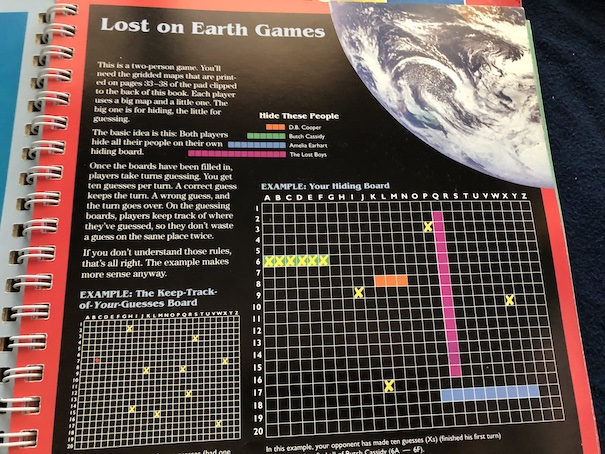
This was one of the Klutz Press activity books that I had as a kid! I used to take it on the long road trips we would take across the country during the summer. The reason why this book is called a “kit” is that it came with a pouch with some extra equipment that could be used for the activities in the book and a special activity pad on a clipboard in the back. I don’t have my activity pad anymore, but it had pencil and paper games and puzzles, like mazes, connect-the-dots pictures, and grids for a Battleship style game that they called Lost on Earth, where you would attempt to find famous missing people or things instead of finding your opponent’s battleships.

The Lost on Earth games are especially funny when you know the references for who the missing people or what the missing things are, like who Amelia Earhart or D.B. Cooper is/was. When I was a kid, I didn’t know about D.B. Cooper (this YouTube video from Buzzfeed Unsolved explains), but I think one of the missing people on the activity pad grids was Jimmy Hoffa, and I knew that name (Buzzfeed Unsolved also covered that). The great thing about these references is that, if you’re playing this game with a kid who hasn’t heard of some of these people or things, just explaining who or what they are is activity by itself.

The pouch contained a set of markers for drawing and doing the activities on the activity pad, embroidery thread in different colors for making friendship bracelets and hair wraps, a loop of colorful string for making string figures, a small sheet for the Grown Up Pop Quiz, and some gummy playing pieces and dice for playing Parchesi (a board was included on one of the pages in the book). The gummy pieces would stick to the page, but not so tight that you couldn’t get them off. I think I saw a later edition of this book that used a different style of playing pieces, but I’m not sure now. The gummy pieces do gradually lose their ability to stick over time.

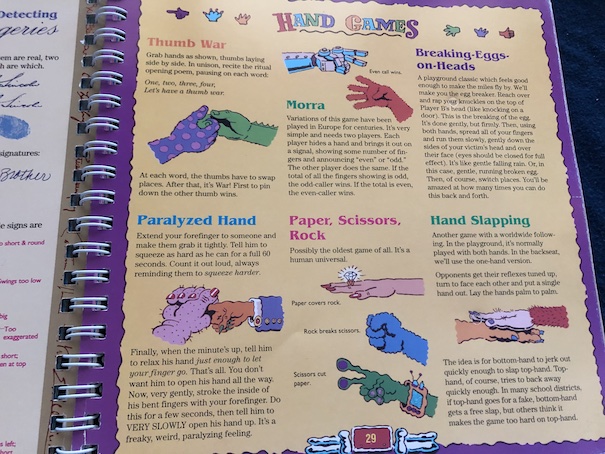
The activities in the book are meant to be done in a car. In the front of the book, there’s a section where you can record which license plates you’ve seen from different states in the US. (A common car activity on US road trips because there are 50 states, and they all have different styles of license plates. In theory, you could see examples of plates from all 50 states in a single, long car trip, but I never did. I’ve seen most of the states during a single trip, but I’ve never been table to check off all of them during a single trip.) There are also rules for playing many classic car games, mostly games that involve talking or hand motions or can be played on paper, like Twenty Questions, Paper, Rock, Scissors, and Hangman. It also describes popular car trip rituals, like holding your breath while passing a graveyard, lifting your feet while going over a bridge, or ducking your head while going under a bridge.

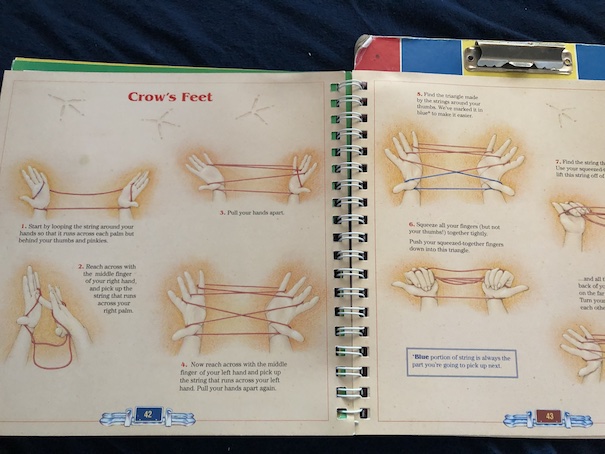
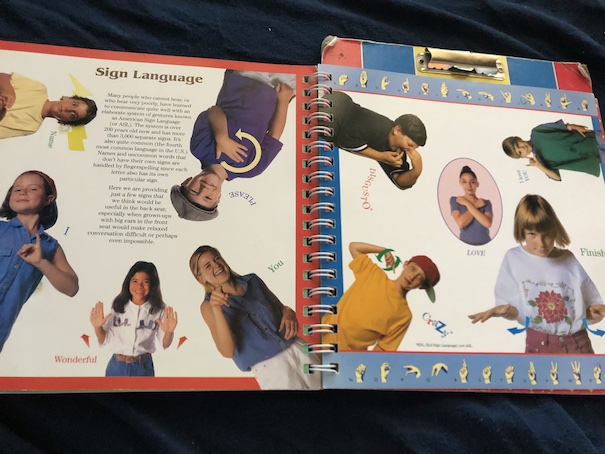
However, even though most of the activities are meant for car trips, many of them would be good for airplane trips as well. When I was a kid, airplanes were quieter, and it was much easier to talk to the person in the seat next to yours than it is now, so the talking games are still better for car trips. However, making friendship bracelets are ok for planes and trains as well as in a car. There are also activities for folding a dollar bill and making a paper fortune teller, making string figures, drawing superheroes, writing things in secret codes, reading palms, and learning some basic sign language.

What I’ve always liked best about this book is the variety of activities. There’s something for everyone in this book, and I’m still amused by some of the games and activities. If there’s an activity that the reader doesn’t like or that won’t work for the current location, there are plenty of others to move on to. Many of the activities in the book are either mentioned in other Klutz books or have entire Klutz books dedicated to them. Also, every part of this book is meant to be used for something. There is a finger maze around the title and copyright page, and when you remove the activity pad in the back, there is a board behind it to use for a game called Penny Hoops, which involves flicking pennies onto target areas on the board to earn points.

Sadly, I don’t think this book and activity kit are being sold new anymore, although there are some copies being sold used (I think most of the used books don’t come with the extra items in the original kit), and the book is available to borrow and read for free online through Internet Archive.

The Cartoon Book

The Cartoon Book by James Kemsley, 1990.

I remember buying this book at a Scholastic book fair back in the early 1990s. I didn’t draw a lot of cartoons, but I found the tips in this book to be helpful for drawing in general. The book begins with the useful advice:

“I believe that anyone can draw cartoons. All they need are a few hints to set them on the right track, self-confidence and heaps of PRACTICE, PRACTICE, PRACTICE!”

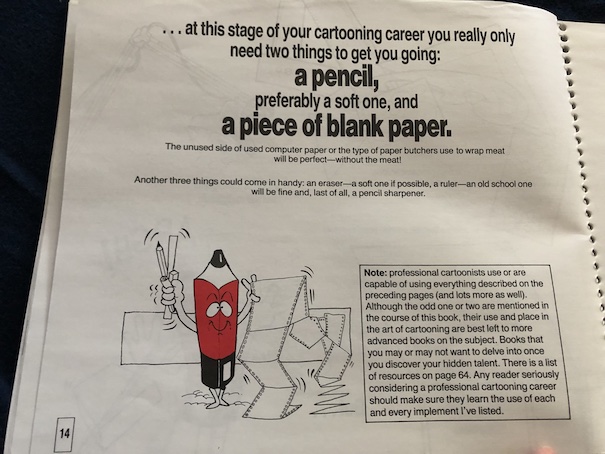
The book aims to make cartooning accessible and unintimidating to even the most basic beginners. There is a section where the author explains about the types of pens, pencils, markers, and other materials that a budding cartoonist can use, which seems overwhelming, but it ends by saying that all you really need is a pencil and a blank piece of paper. Our host is shown as a friendly cartoon pencil throughout the book.

The drawing tips begin with advice for creating character expressions, starting by focusing on the lines and shapes of the eyes. Then, it shows how to add those expressive eyes to heads. What I always liked about this book is that it says the heads can be any size or shape you want them to be. It doesn’t matter if they’re misshapen and lumpy because it’s a cartoon. It’s supposed to be fun and expressive, not perfect, which is very liberating. Even bodies can be different shapes, and they don’t have to be perfect!

Just draw a roundish shape on top of a body, give it expressive eyes, and add an expressive mouth that works with the eyes to show the character’s mood, and there you go!

From there, the book gives brief tips about adding clothes to the body and drawing hands, arms, and legs to show motion. It also briefly shows how to draw animals and animals that are like humans and how to add expressions to inanimate objects and make them characters.

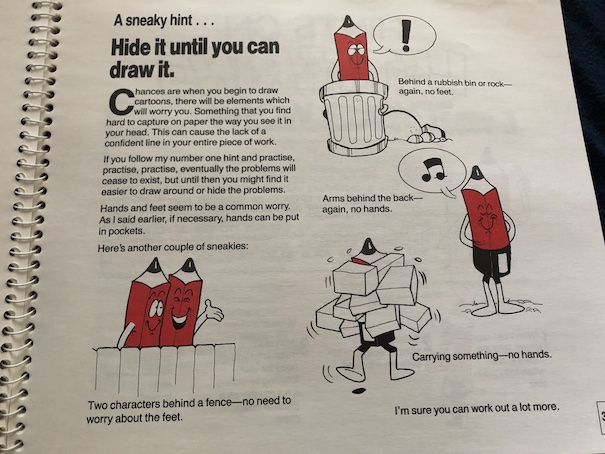
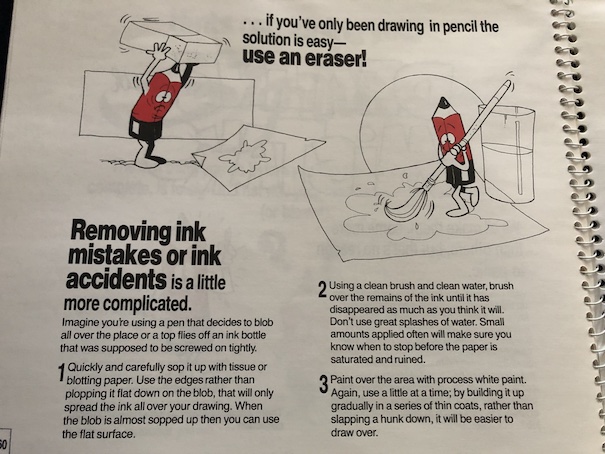
One of the tips that I’ve appreciated is the advice that it’s okay to hide things that you can’t draw well until you’ve learned to draw them better. For example, if you don’t draw hands well, you can just have characters hold their hands behind their backs. There are also tips for fixing mistakes along the way.

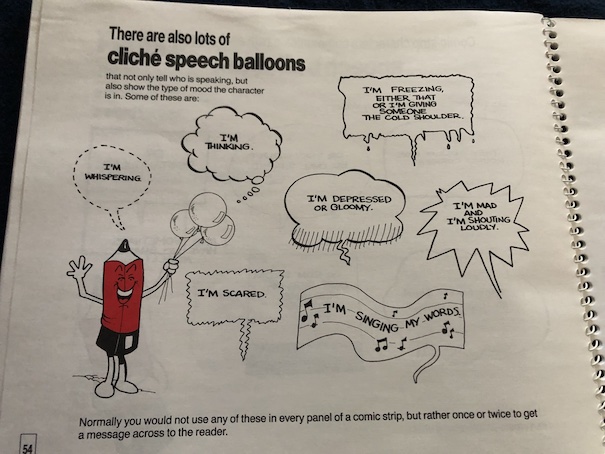
The book also explains how to plan and plot a comic strip. It discusses considering your audience, choosing the types of characters you want to use and giving them personalities, and developing your presentation style with different types of panel borders and speech balloons. It also explains the cliches that cartoonists use, certain common visual signals that cartoonists use to express certain types of speech or events or show movement. The light bulbs over a character’s head when they have an idea is an example of a cartoonist cliche.

The author of this book, James Kemsley, was an Australian cartoonist particularly known for his work on the long-running Ginger Meggs comic strip. I wasn’t familiar with Ginger Meggs when I was a kid because it didn’t appear in newspapers in my area, but I found it interesting to read about when I was looking into the background of this book’s author.

Secrets Your Handwriting Reveals

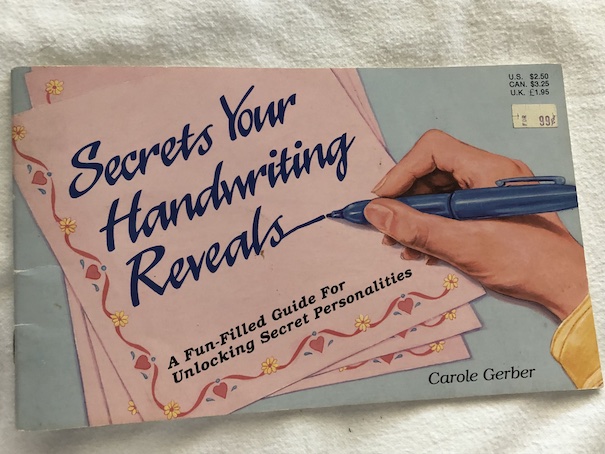
Secrets Your Handwriting Reveals by Carole Gerber, 1991.

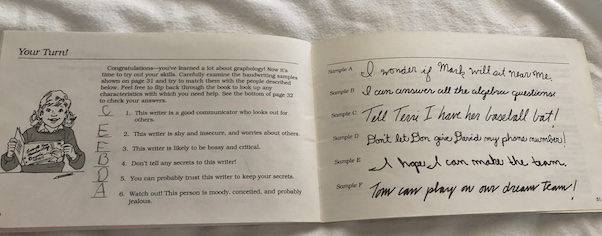
I brought this little book at a book fair when I was a kid, and trying to analyze other people’s handwriting made me feel like a detective! As an adult, I know that graphology is considered a pseudoscience because the techniques used and the results are subjective. (Forensic handwriting analysis is different.) I don’t know how much faith I’d put in any of the tips in this book for reading someone’s personality, but as a summer activity for kids playing detective, it’s not bad.

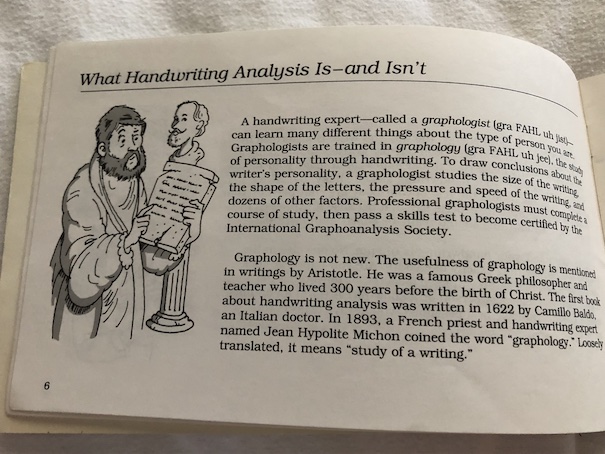
The book begins with an explanation of what graphology is and its history. Graphology has its origins in Ancient Greece, although the term “graphology” wasn’t coined until the late 1800s. The book discusses how graphology has been used in forensic situations, such as determining whether someone’s signature was forged, and how businesses sometimes using handwriting analysis as an indicator of which applicant would be the best for a job. I’m not sure how much stock I put in the second application, although the first one seems useful. The book also mentions that certain types of health problems can make a person’s handwriting shaky. I think that could be true since stable handwriting requires good muscle control, and muscle control can be weakened by disease. The book does say that a graphologist can’t diagnose disease from a person’s handwriting, but they can point out when a person seems to be weakened by a health problem.

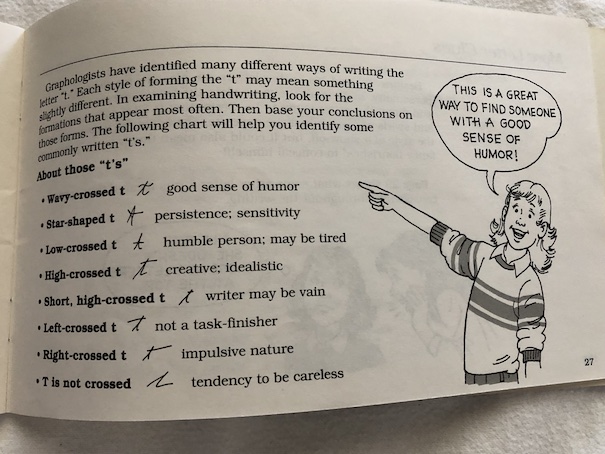
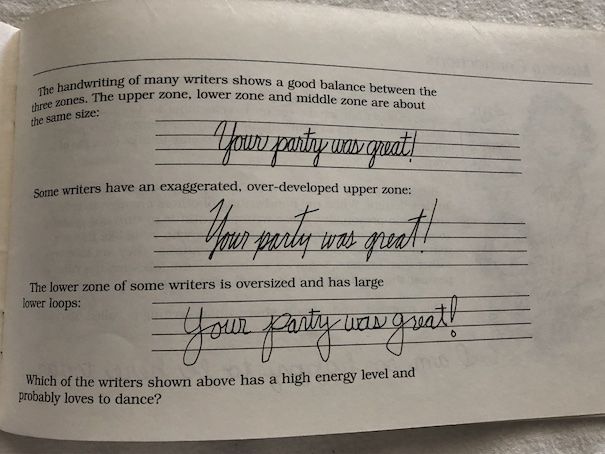
From there, the book explains features of a person’s handwriting to watch in order to identify different personality traits, from the way the writing tilts to how consistent the connections between letters are, to the different ways that letters can be shaped.

Some of what they say about different people’s handwriting makes sense, even from just a cursory glance. It would make sense to say that writing that is neat and even (not to mention showing proper spelling and grammar) is a sign of a well-organized individual, compared to writing that is sloppy and full of errors and scratch-outs.

I did notice (even as a child, I think), that some of the personality traits they point out in their sample handwriting analysis comparisons could be just as easily deduced from what the person says as what their handwriting looks like. I think that’s because the author knew what personality traits she wanted to point out and made sure that the samples were written in character.

The book ends with a short quiz where readers are expected to match up handwriting samples with personality traits.

There is also a brief section at the very end that suggests that consciously changing your handwriting can help change your character. Personally, I doubt whether writing in a slightly different style by itself can help break bad habits, although I suppose if you want to be very conscious of a personal trait that you want to change, anything you do that helps keep it at the front of your mind can remind you to be more careful of your personal behavior and act differently than you might if you just weren’t thinking.

The Fourth Question

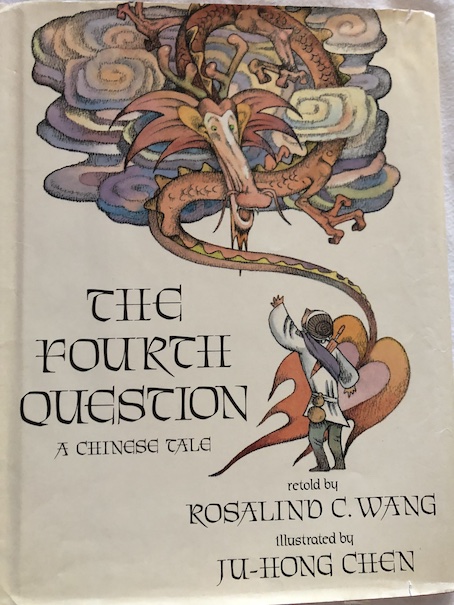
The Fourth Question retold by Rosalind C. Wang, illustrated by Ju-Hong Chen, 1991.

This is a retelling of a Chinese folktale.

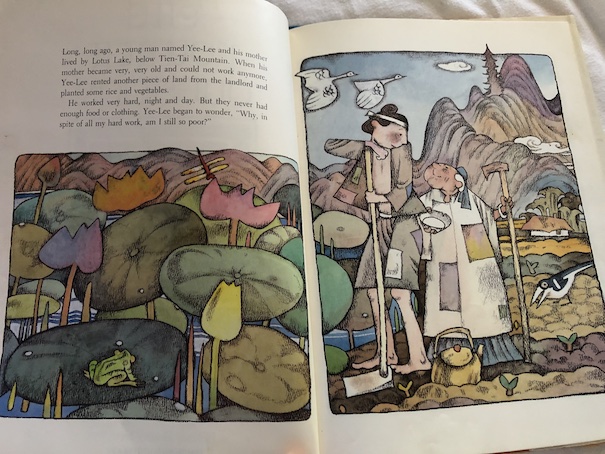
There was once a poor young man, Yee-Lee who lived with his mother. Even though Yee-Lee works very hard, he can barely make enough money to keep him and his mother alive. He wonders why he has so little money even though he works so hard and decides to go to the Wise Man of Kun-lun Mountain to seek the answer and his advice so he and his mother can have a better life.

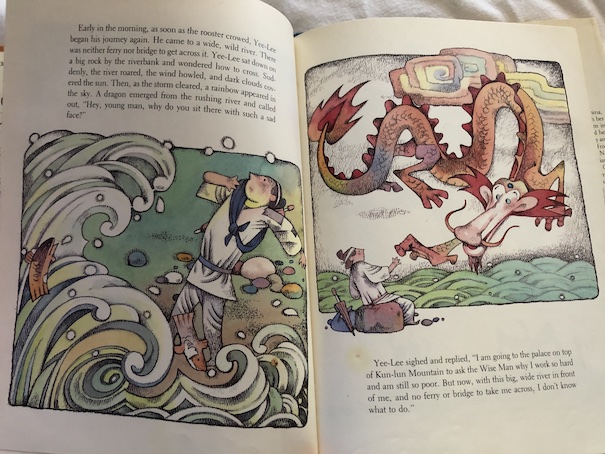
It’s a long way to reach the Wise Men, and along the way, he encounters other people who also needed help. A kind old woman who gives Yee-Lee some water and food has a daughter who is unable to speak and wants to know how to help her. An old man has a tree in his orchard that won’t bear fruit, and he can’t figure out why. A dragon who helps Yee-Lee to reach the mountain cannot manage to fly to heaven even though he has lived a good life. Yee-Lee has sympathy for all of these people and the dragon and appreciates the help they give him, so he promises that when he reaches the Wise Man, he will seek the answers to their problems as well.

However, when Yee-Lee finally reaches the Wise Man, he is told that he is only allowed to ask three questions during his visit. It’s a problem because Yee-Lee now has four questions to ask, the three that he promised to ask for others plus the original question that he wanted to ask for himself. He has to decide which of the questions will go unanswered.

Yee-Lee’s question is important to him, but when he thinks about the other people who are now depending on him to come back with answers for him, he reluctantly decides to forget his own question and answer theirs. However, in solving the problems of others, Yee-Lee finds the solution to his own problem. Like the heroes of other folktales, Yee-Lee is rewarded for his good deeds!

The book is available to borrow and read for free online through Internet Archive.