Voices After Midnight

Voices After Midnight by Richard Peck, 1989.

Three children, Heidi, Chad, and Luke, are traveling from their home in California to spend a couple of weeks in New York during the summer because their father has to do some work for his advertising firm there.  Heidi, the oldest child, didn’t want to go on the trip.  She would rather have stayed at home with her best friend, but her parents insisted that she go because she borrowed her mother’s car without permission and took it out driving without an adult in the car even though she only had a learner’s permit, not a real driver’s license, and barely even knew where the car’s controls were (she took her younger brothers along just so they could tell her about the controls, which shows her level of driving skill).  The resulting accident she had took out a flower bed.  Although her parents didn’t find out about the accident, she decided that perhaps it would be a good idea to get out of town for awhile while the whole incident blows over.

Chad is the narrator of the story, and he explains that his father’s company has rented a house for them to live in while they’re in New York, or rather, part of an old house.  It’s a very old house, and it’s five stories tall.  There is an old cage elevator that has been repurposed as a telephone nook.  It’s a nice place, but there’s something strange about it.  Even before they arrive in New York, both Chad and Luke begin dreaming about snow.  Then, on their first night in the house in New York, Chad hears voices in the house after midnight.  It sounds like a man and a woman.  They are trapped somewhere, and they are cold.  Even the family’s dog, Victoria Alexandrina (Al for short) is frightened in the house.

Luke loves old houses and places with history, and he seems to have an odd ability to sense the past, even being able to describe what places looked like in the past without doing any research to find out.  Luke tries to tell Chad that he has the same ability to get in touch with the past, but Chad doesn’t believe it at first.  Luke thinks that they have a special mission in New York, to resolve some kind of unfinished business, although he’s not sure what. 

Then, Luke admits to Chad that he’s been hearing the voices in the house, too.  The two of them sneak up to the upper floors of the house, the part that they haven’t rented, and they see that the rooms are all empty and in bad repair.  When they look out of the windows, they see the landscape as it was years ago, with buildings being constructed that are already old in modern times.  Heidi finds them up there and becomes fascinated by a dress that they find in an old trunk.

The boys’ abilities to see the past keep getting stronger, and more strange things happen in the house.  A bouquet of flowers suddenly appears in Heidi’s room with a message from a mysterious admirer, and then almost as suddenly, the flowers wilt and the card with the message fades, as if they had aged suddenly.  The boys keep seeing people and things from the past all over town as they explore New York City.

At night, Chad and Luke find themselves going back in time in the house’s history.  Chad is frightened, but Luke knows that they’re looking for an event in the house’s history, something that must be changed.

Back in the late 1800s, the Dunlap family lived in the house, with two teenage children, Emily and her older brother, Tyler.  Their family is fairly well-off, but not as wealthy as the family of the girl Tyler has a crush on.  One night, Chad and Luke witness a conversation between Emily and her mother about Tyler’s marriage prospects.  Emily thinks that Tyler is making the wrong choice, pursuing the wrong girl in his romantic life.  It doesn’t seem like an earth-shattering tragedy, but events are moving closer to an even greater tragedy.  It is Emily and Tyler’s voices that the boys have been hearing after midnight in the house.

Chad finds their trips into the past unnerving and he fears that he and Luke might accidentally become stuck in the past.  He wants to stop, but Luke insists that they keep going.  The situation becomes more urgent because Heidi has also found her way into the past and is falling in love with Tyler!  When Chad and Luke go into the past, they are invisible to the people there, but Tyler not only sees Heidi but dances with her at a New Year’s ball.  From then on, Heidi is also involved in the adventure.  Like Luke, she has a sense that there is something that they need to do in that house, in the past.

Something bad is going to happen to Emily and Tyler.  Somehow, they are going to die.  Cold.  Trapped.  During the Great Blizzard of 1888.  The kids are not sure quite what exactly is going to happen until almost the end, but they can feel it coming.  It has already happened in the distant past, but they need to find the right moment in time to stop it from happening again!

All three of the children, Chad, Heidi, and Luke, have psychic abilities and are able to see and travel through time, although Chad and Heidi have mostly worked to ignore it in their lives, trying to just be normal kids.  When they succeed in saving Tyler and Emily Dunlap, they not only change the past but the present, eventually meeting some of Tyler’s descendants (who he marries is a bit of a surprise, although it’s not either of the girls that Emily had expected it to be).  There is a kind of odd time loop, though.  At the end of the story, they learn about their own, special, previously unknown connection to the Dunlap family and the possible reason why they are gifted with their time-traveling abilities.  In saving Tyler and Emily, they are also saving themselves, which oddly, begs the question of how real they were before . . . but, maybe they were always fated to succeed.  In the end, the house in New York is still “haunted”, but the final joke (unknown to the current owners) is that Heidi becomes the beautiful but mysterious “ghost” who appeared at the right time and then suddenly disappeared and whose story has been passed down through the generations.

The book is available to borrow for free online through Internet Archive.

Kate Greenaway’s Book of Games

Kate Greenaway’s Book of Games by Kate Greenaway, 1889.

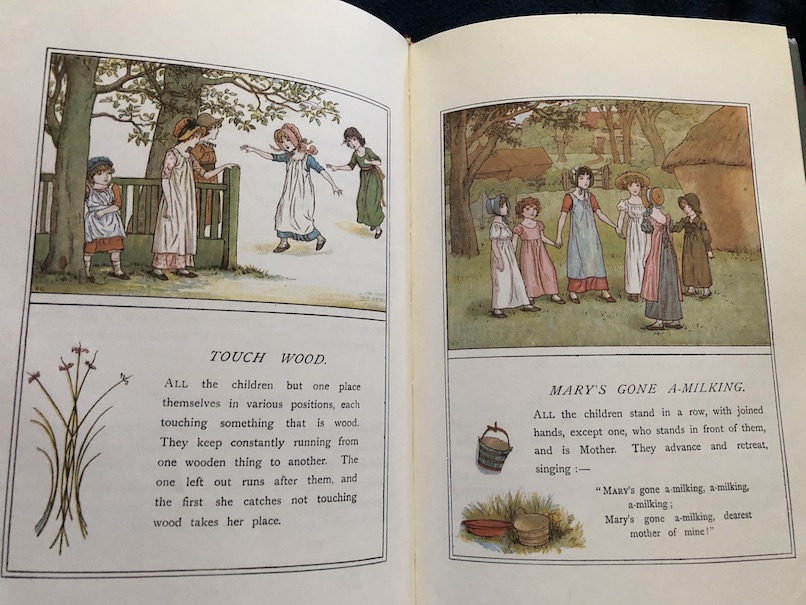
A book about children’s games with rules and general pastimes. The book doesn’t distinguish between the two, but I do because, to me, games have specific rules whereas more general pastimes and toys do not.

Many of the games and pastimes would be familiar to people in modern times and are still popular. Some games are like playground games (some of them are even still played on playgrounds today) that require running and motions, and others are more talking games (some of those have become classic road trip games, played in the car). Pastimes include making soap bubbles, flying kites, and using swings.

The book includes games like I Love my Love with an “A”, Blind Man’s Buff, Frog in the Middle, Russian Scandal (This is an old name for the Game of Telephone, before the invention of the telephone became really popular. I’ve also heard it as Russian Gossip, although I don’t know why it’s specifically “Russian.”), French and English (which is basically Capture the Flag), Oranges and Lemons (which is played like London Bridge is Falling Down, only with a different rhyme), and Twenty Questions. Some of the less familiar ones, especially to young Americans today, might be Puss in the Corner (a game that involves players running and changing places with each other and the person who is left without a place being “it” or the “puss”), Mary’s Gone A-Milking (a chase game with a song), What Is My Thought Like? (a talking/guessing game that involves creativity), and The Old Soldier and Judge and Jury (which are both talking games with words that are forbidden to say).

One of the interesting things about this book, besides noticing which games are still played and which are more obscure now, is that the children in the pictures are actually wearing clothes that are from an earlier part of the 19th century from when the book was written. This is a classic feature of Kate Greenaway’s illustrations, also seen in her other books. Modern people who are less familiar with the evolution of 19th century clothing might not notice that detail.

This book is still in print in modern times. It also available to borrow for free online through Internet Archive (multiple copies).

For more information about Victorian games in general, see the Victorian Games section of my Historical Games site. History and games are both hobbies of mine.

Mairelon the Magician

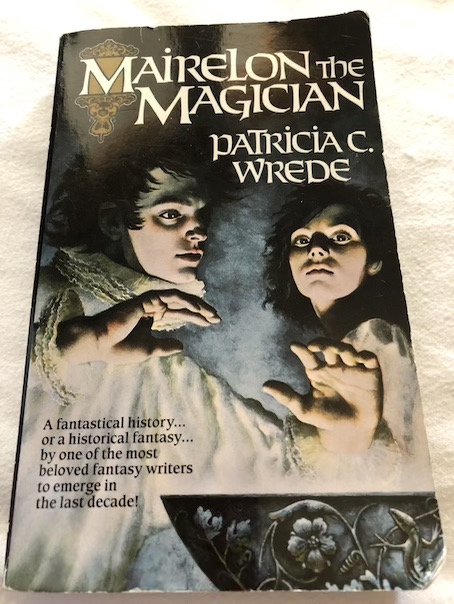
Mairelon the Magician by Patricia C. Wrede, 1991.

This young adult book takes place in an alternate history version of Regency England.  In this world, magic is a normal and accepted part of society.  “Wizard” is an accepted profession, and there is even a Royal College of Wizards dedicated to magic.  Not everyone can be a wizard because not everyone has the ability to use magic.  It is a skill that people are either born with or born without, similar to people who have an innate talent for art or music, compared to people who are born tone-deaf or color-blind.

In this early 19th century world, there is a teenage girl, Kim, who lives on the streets and survives by her own wits, taking whatever jobs she can and committing a little petty thievery whenever she needs to.  She has spent most of her life dressing like a boy and pretending that she is one because life on the streets is even more precarious for a girl.  For a time, she was part of a gang of child thieves run by a woman call Mother Tibb.  As far back as Kim can remember, Mother Tibb was the only one who took care of her as a child.  Kim has no memory of her parents or any knowledge about what happened to them.  She doesn’t even have a last name.  However, before the story begins, Mother Tibb was caught and hanged for her crimes.  Some of the other child thieves were apprehended and put in prison or exiled to Australia, but Kim managed to escape.  Since then, she has been on her own.  So far, she has managed to avoid being pressured in to joining up with other gangs or turning to prostitution to survive, but the fear of that haunts her. Her future is uncertain.

At the beginning of the book, Kim is hired to sneak into the wagon of a traveling magician who is performing in the market and to see what he keeps among his belongings.  The man who hired her doesn’t want her to take anything, but he is particularly eager to see if the magician has a particular silver bowl in possession.  It’s a strange request, but the money that the man offers Kim is too good to pass up.

However, the magician, who calls himself Mairelon, isn’t quite what he seems.  He is not just an ordinary traveling entertainer using some sleight of hand to amuse people in the market.  Kim discovers that he can do real magic as she searches his wagon and is knocked unconscious by a real magical spell that Mairelon uses to protect his belongings.

When Kim wakes up, Mairelon and his servant, called Hunch, have tied her up.  Unlike Hunch, Mairelon has also realized that Kim is actually a girl, not a boy.  The two of them question Kim about why she sneaked into the wagon, and she tells them the truth about being hired to do it.  When she describes the man who hired her, it seems that Mairelon recognizes the description.  The part about the silver bowl also unnerves him.

Surprisingly, Mairelon makes Kim an offer to come with him and Hunch when they leave London.  He is fascinated by Kim’s skills in picking locks, even the lock on the booby-trapped trunk that knocked her unconscious, and he thinks that Kim might be useful to him and Hunch, perhaps helping with the magic act.  In return, he offers to teach Kim some of his magic tricks.  Hunch is dubious about Kim because she has obviously been a thief, and Kim also isn’t sure what to make of Mairelon.  She knows that he’s hiding something, but she isn’t sure what.  No one with real magical abilities like him would ordinarily be making a living with simple magic tricks in the market. 

However, Kim does accept the offer because she’s been worried about one of the major criminals in the area, Dan Laverham, who has been showing too much interest in recruiting her. He is heavily involved with a number of criminal activities, and he knows that Kim is a skilled lock pick.  If he found out that she was a girl, he would probably also press her into prostitution. Dan Laverham would be a good reason to get out of London for a while.  Also, Kim realizes that if she learns a few magic tricks from Mairelon, she might be able to set herself up as an entertainer and make an honest living, safe no matter who finds out that she’s female.  Besides, Kim realizes that if she’s not satisfied with the situation, she could always run away later.

Before leaving London with Mairelon, she returns to the man who hired her, at Mairelon’s suggestion, and tells him that she didn’t see a silver bowl in Mairelon’s wagon (which is true because she was knocked unconscious and didn’t see anything in the trunk).  The man is angry, but Mairelon, who followed her in disguise, helps to create a distraction so that she can get away from the man.  They leave London in the middle of the night because Mairelon says that he was spotted by someone who recognized him when he went out to get magic ingredients.

On the journey, Kim gradually gets to know Mairelon and his situation.  The silver bowl, which Mairelon does have, is actually part of a set of magical objects which, when used together, can compel people to tell the truth without interfering with their ability to answer questions intelligently.  Mairelon’s real name is Richard Merrill, and he is, or was, part of the Royal College of Wizards.  Years earlier, the Royal College of Wizards was analyzing this particular set of magical objects and the unique spell that they control, when they were suddenly stolen, and Merrill was framed for the theft.  At the time, Merrill was unable to prove his innocence (at least not without sounding as if he had done something inappropriate with a lady, which he also did not do – they were just together at the time of the theft because she was helping him and another friend with a magical experiment), but he was also recruited by his friend in the government to be a spy against the French, so the story of his supposed theft gave him a plausible reason for wanting to leave the country.  In the time since then, he and his friend have continued to look into the matter of the theft, and they have made some progress in tracking down the other pieces of the magical set.  At the time that Kim met him, he was on his way to the next piece of the set, a silver platter.

To their surprise, however, they soon discover that someone has been making copies of the platter.  The copies are not magical, but they do confuse the issue.  Who is making the copies and why would they want copies, since they do not have the powers that the original has?  As Kim and Mairelon investigate, they crash a house party at a lavish country estate and spy on a meeting of a rather inept society of druids.  All the while, they are getting closer and closer to finding the original thief.

I loved the combination of mystery, fantasy, history, and humor in this book!  It’s one of my all-time favorites.  It has a happy ending with Mairelon’s name cleared and the thief caught.  They also discover that Kim has the ability to use magic, and Mairelon offers to take her on as his apprentice, saving her from the streets forever.  There is a sequel to this book called Magician’s Ward, about Kim’s life and adventures as Mairelon’s student.  The hints of romance in this book are also much stronger in the next one.  There are only two books in this series, which is disappointing because the characters are so much fun, and I think that there is a lot more room for their development.  By the end of the next book, Kim’s future is looking more certain, but her past is still murky.  Originally, I had expected that there would be secrets revealed about Kim’s past because of her ability to use magic, possibly something that was passed on to her by her parents.  However, by the end of the second book, Kim still doesn’t know who her parents were/are, and it doesn’t look like there’s any chance that she will ever know.  Perhaps it doesn’t really matter. Sometimes, secrets are more tantalizing when you imagine the answers than when you actually find out.

The book is currently available online through Internet Archive.

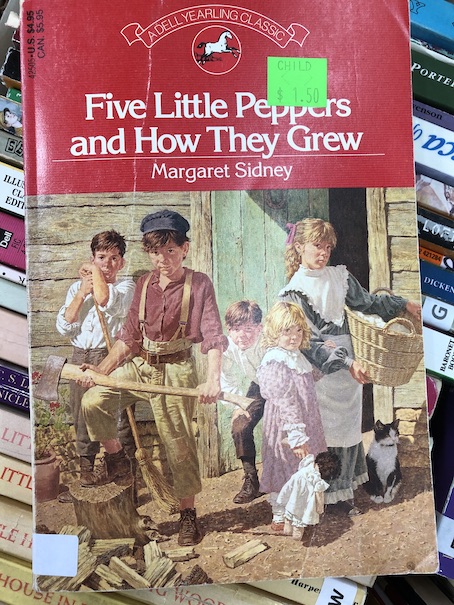
Five Little Peppers and How They Grew

FiveLittlePeppers

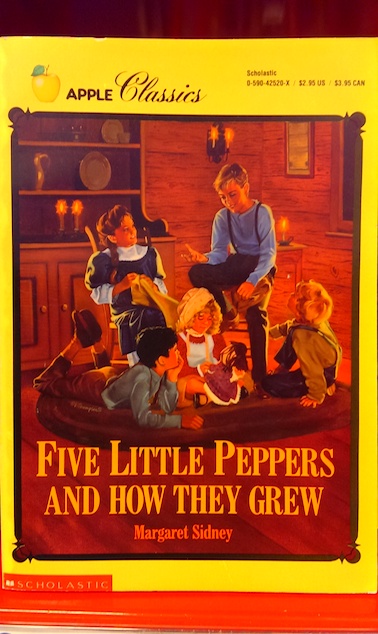
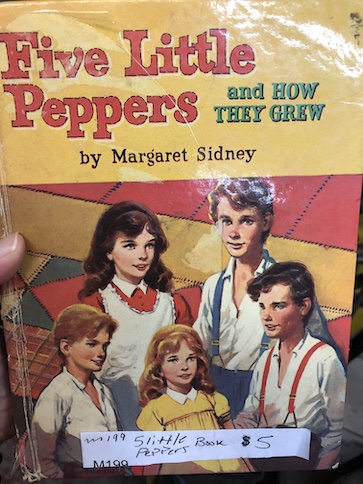
Five Little Peppers and How They Grew by Margaret Sidney, 1881.

Mrs. Pepper is a widow who lives with her five children in a little brown house.  Since her husband died when their youngest was a baby, she has supported the family by sewing.  The children try to help, but they are still very young.  The oldest, Ben, is eleven years old, and Polly, the next oldest is ten.  Their mother worries about providing them with an education, but they are barely scraping by as it is.

The family manages to get by, helping each other through crises, such as the time when everyone was catching measles.  Sometimes, they also get help from friends.

One day, when Phronsie (short for Sophronia), the youngest Pepper, about four years old, wanders off by herself, she is found by a boy named Jasper King and his dog, Prince.  They look after her until her brother, Ben, comes to take her home.  Jasper enjoys meeting the Pepper family.  He doesn’t have any siblings himself, and he thinks that it must be fun to live in a family of five.  Jasper and his father are spending the summer at a hotel in nearby Hingham, and Jasper thinks that it’s dull.  The Pepper children invite him to come visit again, saying that they will teach him how to bake like Polly does.

Jasper isn’t able to return to their house right away because he gets a cold, and Jasper’s father has been ill.  Phronsie thinks that it would be nice to make him a gingerbread man.  Together, the children make up a little basket of goodies for Jasper and his father.  The Kings are charmed by the gift, and Mr. King decides that he would also like to visit the Pepper family.  Unfortunately, due to Mr. King’s poor health and some business he has in “the city”, their visit to the area is cut short.  The Pepper children are sad that Jasper will be leaving so soon, but they invite him to return next summer.

Jasper continues to write letters to the family while he’s in the city, studying with the private tutor he shares with his cousins.  He remembers the Pepper children telling him that they don’t really celebrate Thanksgiving or Christmas because they never have enough money to buy a feast or Christmas presents.  However, he urges them to try to celebrate Christmas this year, even if it’s only in a small way.  The Pepper children make small presents for each other, like paper dolls, doll clothes, toy windmills, and whistles, and put some greenery around for decoration.  Jasper also sends the family some surprise presents.

However, Jasper’s father says that he doesn’t want to visit Hingham again because he doesn’t think that the climate there is good for him.  Instead, Jasper persuades his family to let him invite Polly for a visit.  It takes some persuasion for the Peppers to agree because Mrs. Pepper is hesitant to accept favors and Polly worries about homesickness, but they are persuaded when Jasper says that he has been unwell and that Polly’s visit would cheer him up.  In the city, Polly gets her first taste of formal education, even having a music teacher.  However, she does get homesick, so the King family sends for little Phronsie to cheer her up.  The King family is charmed by both of the girls, and Mr. King gives Phronsie many dolls to play with.

One day, when Polly realizes that she has forgotten to write a letter to their mother because she was so busy with her lessons, Phronsie decides that she will write one herself and mail it.  She doesn’t really know how to write, but she scribbles something as best she can and slips out of the house to find the post office.  She is almost run over in the street, but fortunately, Mr. King finds her and brings her home.  She isn’t hurt, but the incident worries Mr. King.

After some thought, Mr. King decides to invite the rest of the Pepper family for a visit.  The day that the rest of the Peppers arrive, Phronsie surprises a pair of thieves in the house.  The thieves get away, and the excitement from the incident makes the Peppers’ arrival less exciting than it should have been.

The Peppers fit so well into the household that Mr. King invites the family to live with them permanently.  He offers Mrs. Pepper a job as housekeeper and says that he will help the children with their education.  Mrs. Pepper accepts, and it leads to the surprising revelation that Mrs. Pepper and John Mason Whitney, the father of Jasper’s cousins, are actually cousins, making them all cousins of the King family as well.

This book is mentioned in the book Cheaper By the Dozen as a book that Mrs. Gilbreth liked to read to her children.

The book is currently available online through Internet Archive. It is part of a series.

Toby Tyler

TobyTylerToby Tyler; Or, Ten Weeks with a Circus by James Otis, 1881.

Toby Tyler is an orphan who lives with a church deacon he calls “Uncle Daniel.” Uncle Daniel isn’t really his uncle, but he raised Toby after he was abandoned as a baby. Toby doesn’t know anything about his parents. Uncle Daniel is stern with him and says that Toby eats more than he earns, making it a hardship to care for him. Toby is cared for, but life with Uncle Daniel isn’t exactly happy.

Toby has a fascination for the circus, although Uncle Daniel says that the show isn’t any good, and it’s all a waste of time and money. The circus is certainly cheap, as Toby can see from the first. When he tries to buy some peanuts, he only gets six for the penny he gives, and all or most seem to be bad. The lemonade is basically water with lemon peel in it. But, to Toby’s surprise, the man who sells the snacks at the circus, Mr. Lord, offers him a job. He says that people who work for the circus get to see the show as often as they like, and he could use a boy to help him as an assistant.

TobyTylerPicToby think that it sounds like an exciting offer, and Mr. Lord persuades Toby that the best way would be for him to sneak away at night because his Uncle Daniel might disapprove and stop him from taking the job. Not taking that as a warning, Toby agrees. Toby feels a little guilty about running away and surprisingly homesick, but he decides to stand by the agreement he made with Mr. Lord and see what possibilities life with the circus might have for him.

Life with the circus turns out to be very different from what Toby is used to and what he expects. It’s noisy and dirty, and no one seems to particularly care about Toby or his welfare. Mr. Lord also turns out to be even sterner than Uncle Daniel, not even telling Toby what he expects him to do, just expecting him to do it. Toby works hard, and Mr. Lord acknowledges that he’s better than the other boys who have helped him, but he’s still a temperamental man and hard to please. Like Uncle Daniel, he fusses about how much Toby eats. Toby also has to sell snacks inside the big top under the watchful eyes of Mr. Jacobs, who threatens him with violence if he doesn’t make sales or if people try to cheat him.

However, Toby does succeed in making a few friends in the circus. The first friend he makes is a monkey that he calls Mr. Stubbs. Mr. Treat, who plays the part of the Living Skeleton in the circus sideshow, and his wife, who is the Fat Lady, have seen Mr. Lord mistreating other boys, and they intervene to make sure that Toby is all right, giving him food when Mr. Lord doesn’t. Unlike everyone else Toby has known, Mrs. Treat lets him eat as much as he wants without worrying, saying that some people just need more food than others. Like her husband, Toby seems to have the ability to eat a lot while still being small and skinny.  Mrs. Treat herself maintains an enormous size while hardly eating anything. She says that’s just how some people are.

When Mr. Castle teaches Toby to do trick riding, his status goes up in the circus, and he is no longer under Mr. Lord’s thumb. As far as the Treats are concerned, Toby could stay with them forever. However, life in the circus isn’t what Toby had once thought it was, and Toby can’t get rid of the thought that he’s made a terrible mistake by running away from Uncle Daniel. He wants to go home and make things right with him.

In the Disney movie, Toby stays with the circus, doing well with his trick riding act and having happy adventures with his monkey friend. Unfortunately, in the book, Mr. Stubbs is accidentally shot by a hunter and dies. The book was meant to teach moral lessons about responsibility, whereas the movie was just about fun and adventure.

In the end of the movie, Toby stays with the circus even while being reunited with the people who raised him and missed him when he ran away, giving an all-around happy ending. In the book, Toby feels terrible about the death of Mr. Stubbs (although it wasn’t really his fault), and the hunter who shot him is very sorry because he hadn’t realized that he had shot someone’s pet. To make up for it, he helps Toby to get back to Uncle Daniel. At first, Toby is unsure that Uncle Daniel will want him back, but he misses his old home so much that he says he doesn’t care if Uncle Daniel whips him for running away. However, Uncle Daniel has also missed Toby since he disappeared. As stern and harsh as he could be before, Uncle Daniel genuinely cares about Toby and welcomes him back with open arms.  The ending implies that Toby’s future with Uncle Daniel will be happier than the past because they have much greater appreciation for each other now.

The book is now in the public domain and is available on Project Gutenberg.

The Court of the Stone Children

The Court of the Stone Children by Eleanor Cameron, 1973.

Nina and her parents have recently moved to San Francisco from Nevada.  Nina doesn’t like living in the city, but the move was necessary because her father has been ill and in need of a job.  Still, Nina misses her friends, and her parents don’t understand how difficult Nina has found it to make friends in their new home.

One of the most popular girls, Marion Charles, nicknamed Marnychuck, and her friends like to tease Nina at every opportunity. Nina doesn’t think that she even wants to try to be friends with them because hanging out at Marnychuck’s house would mean always having to be on her guard about every little thing she says, knowing that they would twist every innocent comment she makes into some sort of joke so they could laugh at her.  They could never be friends because there would be no way that Nina could ever open up to them about anything.  (Sadly, I know the type all too well.)  For example, one day, while the girls are walking home from school, they start talking about things they want to be when they grow up.  Nina says that she wants to be “something in a museum,” momentarily forgetting the word “curator”, until a boy nearby helpfully supplies the word. Of course, Marnychuck and her friends ignore the helpful word and just laugh about “something in a museum” as they walk away.

However, the boy who was listening turns out to be genuinely curious about why Nina wants to work in a museum, saying that it sounds like an unusual ambition.  Nina tells him that, until she had come to San Francisco, she’d never been in a big museum before, and she describes how the one in the park impressed her.  She used to work in a small one in her home town. The boy understands the way she feels and shares her love of the past.  He tells her about Mam’zelle Henry, a local woman who owns a private museum called the French Museum.

Nina visits the French Museum and loves the rooms with old-fashioned furniture.  They give her a strange feeling of timelessness, and before she knows it, she finds herself in a room with another young girl who says, “I knew you’d come.”  Nina isn’t sure who this mysterious girl is, but she asks her to come back another time.

When Nina returns to the museum the next day to return an umbrella that she borrowed from Mrs. Staynes, the registrar at the museum, she speaks to the girl again in the museum courtyard.  The courtyard is full of stone statues of children, and the girl tells Nina that when she was young, she used to wish that they would come to life.  The girl’s name is Dominique, although she says that people usually call her Domi. The two girls begin talking about their lives, although Domi oddly talks about her past in the present tense. Domi tells Nina about her emotionally-distant grandmother and her loving father, who was imprisoned and shot.  The news of Domi’s father being shot comes as a shock to Nina.  Domi tells Nina that, after her father was (“is”) imprisoned and shot, she had a dream about Nina in which her father said that Nina would help them.  Domi also says that the rooms at the museum are from her home in France, which was taken apart to be “modernized”and some of the pieces were sent to the museum. Nina finds Domi’s story confusing, but Domi says that they will talk more later.

Nina meets up with the boy who introduced her to the museum, whose name is Gil, at the cottage of Auguste, who lives on the museum property.  As she talks with the two of them and Mrs. Staynes, Mrs. Staynes brings up the subject of the ring that Nina saw Domi wearing and which also appears in a painting in the museum.  Earlier, Mrs. Staynes had told Nina that she couldn’t possibly have seen anyone wearing that ring, and Mrs. Staynes now explains that the reason why is that she owns the ring herself.  At first, Nina thinks that she must own a ring which is similar to Domi’s, since the two of them couldn’t have the same ring,but then, it turns out that the cat that Domi said was hers also belongs to Auguste.

The answer, as Nina discovers the next time she meets Dominique, is that Domi is a ghost.  Mrs. Staynes does own Domi’s ring now because Domi died a long time ago. Nina faints when Domi’s hand goes right through hers.  When Nina recovers, Domi is gone, and Mam’zelle Henry gives her a ride home.  The two of them bond as they discuss Nina’s ambition to become a curator.

Mam’zelle lets Nina borrow a journal that she found in the garden that belonged to Odile Chrysostome in 1802.  Odile was one of the names of the stone statues in the courtyard, according to Dominique, and Nina learns that the others are also named after members of the Chrysostome family.  The people at the museum say that they don’t know which of the statues is supposed to have which name, but thanks to Dominique, Nina does.

Gil becomes Nina’s first friend her own age, and he’s been working on a project involving time.  Someday, he wants to write a book about the concept of time. Time is important because Domi needs Nina’s help to resolve problems that occurred in the past.

Domi was young during the time of Napoleon.  Her mother had died in childbirth along with Domi’s younger sibling.  After her mother died, her grandmother moved into the house to oversee things and help care for Domi.  However, Domi’s father had protested some of Napoleon’s policies of conquest, and it led to his downfall.  One day, Domi discovered her father’s valet,Maurice, murdered in her father’s bedroom. She had thought that her father was there the night before, having returned from being away for a time, but he was nowhere to be found.  A short time later, her father was charged with conspiring against Napoleon and executed. Domi knows that her father was innocent of the charges, and she suspects that Maurice was killed because he knew something important, but she needs Nina’s help to find the missing pieces.  Domi knows that Mrs. Staynes is working on a book about her father’s life, and she doesn’t want the false accusations against him to be printed.

This book is available to borrow and read for free online through Internet Archive.

My Reaction and Spoilers

I thought that the book started out a little slowly.  It takes quite a while before Nina discovers that the boy’s name is Gil or learns anything about him, and it’s about halfway through the book before Nina learns that Domi is a ghost, although there are hints before it.  I knew that Domi was from the past, although I thought at first that she might be a time traveler of some kind.  Even after Nina learns that Domi is a ghost, it takes a while before Domi tells Nina her full story and what she really needs her to do.  The first part of the book dragged a little for me, and I was a little confused at first about why Odile’s diary was so important, but it turns out to contain the vital clues that Domi needs.  Domi’s father was with the Chrysostome family at the time that he supposedly murdered his valet and was conspiring against Napoleon. There is a piece of physical evidence that proves it, and finding it convinces Mrs. Staynes to change her book. 

One of Nina’s strengths is her power of imagination, and she helps Mrs. Staynes not only to see the truth about Domi’s father but to see him as a living, breathing person.  Before, Mrs. Staynes’ book was mostly facts with little sense of the feelings of the living people behind it, but Nina’s discoveries and imagination help breathe life into the work.  At the end of the book, the past remains unchanged (Domi’s life and that of her father are what they were before), but having the truth known gives Domi peace. Nina also makes peace with her new life in San Francisco, having discovered new opportunities and friends there as well as a nicer apartment for her family to live in.

If Your Name Was Changed at Ellis Island

NameChangedEllisIsland

If Your Name Was Changed at Ellis Island by Ellen Levine, 1993.

Like other books in this series, this book explains about a part of American history using a series of questions and answers.  Each section of the book starts with a different question about what it was like to come to America as an immigrant in the past and what happened when they reached Ellis Island, one of the main ports of entry into the United States around the turn of the 20th century, just off the coast of New York City, such as, “Would everyone in your family come together?”, “What did people bring with them?”, and “What did the legal inspectors do?”  Then, the book answers each of the questions.

The questions and answers start by describing what the journey to America was like from the late 1800s through the early 1900s.  Typically, families would come to the United States in stages: the father of a family (or perhaps one of the older children) would make the trip first, find a job in the United States and start saving money to prepare for rest of the family to come.  Depending on the family’s individual circumstances, it might be years before all the members completed the immigration process and reunited in America.

People traveled by ship in those days, and an often-forgotten part of their journey was even reaching the port the ship to America would be leaving from.  Depending on the starting point of the journey and the travel arrangements each family was able to make, getting to the port might involve crossing borders between other countries, adding another layer of legal difficulties to the journey.

There was also the knowledge that they might be turned away once they arrived at Ellis Island.  One of the chief concerns at the time was illness.  The inspectors at Ellis Island checked immigrants for signs of infectious diseases, and the ship companies knew that if their passengers were turned away because of the fear of disease, they would be required to pay for the return voyage themselves.  To help ensure that their passengers would not arrive with a disease, they would conduct their own health checks before the ship ever left port, looking for signs of illness, giving the passengers vaccines, and disinfecting things.  They were particularly afraid of passengers with lice because lice can spread typhus, which is deadly.  They would often cut the passengers’ hair or comb it very carefully.

The treatment passengers on ships received depended largely on their class of passage.  First and second-class passengers received the best rooms and the best food, and when they arrived in New York (assuming that was their destination), they didn’t even have to go to Ellis Island at all; the immigration inspectors would inspect first and second-class passengers on board the ship.  Only steerage passengers (“third class”, the cheapest possible method of travel, used by the poorest people, the largest group) would have to get off the ship for processing at Ellis Island.

EllisIslandComplex

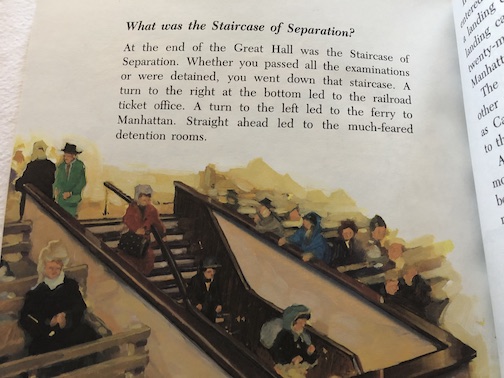
The processing center at Ellis Island wasn’t just a building; it was an entire complex.  The Great Hall alone was large enough to contain hundreds of people at a time, and when it was full of immigrants there were so many languages being spoken at once (sometimes as many as 30 different languages) that some people described it as sounding like the Tower of Babel.  There were also dormitories that could house more than a thousand people, a hospital for the sick, a post office, banks where people could change their cash for American money, a restaurant to feed everyone (with two kitchens, one kosher and one regular), a railroad ticket office where immigrants who would be moving on from New York could make their travel arrangements, and much more.  Some people called Ellis Island the “Island of Tears” because the arrival there after a long journey was an emotional experience and many immigrants were worried that they might be sent back if they couldn’t answer the inspectors’ questions to their satisfaction.  At the end of the Great Hall, there was a large staircase that came to be known as the Staircase of Separation.  Everyone had to go down this staircase after their examination by the inspectors.  At the bottom, they would go their separate ways, depending on their travel plans or whether they had passed inspection.  People who turned to the right were heading to the railroad ticket office.  People turning to the left were heading to the Manhattan ferry.  People who went straight were heading to the detention rooms because they hadn’t passed the inspection.

EllisIslandStaircase

As I mentioned before, the inspectors were very concerned about people who showed signs of serious diseases.  One of the first things that would happen during inspection was a brief examination by the Ellis Island doctors.  Because of the massive amount of people who had to be processed, this examination lasted only a few minutes, during which the doctor would quickly check for very specific symptoms and signs of possible illness.  If they didn’t see anything obviously wrong, such as red eyes (possible sign of eye infection, although for some, it was just because they’d been crying), difficulty in breathing, or lice, they would let the people pass.  If the doctors thought that they saw something that might be sign of illness, they would write a letter in chalk on the person’s clothes and send them on to be examined more thoroughly by another doctor.  Getting one of these letters didn’t always mean rejection.  If the other doctor decided that the first doctor was mistaken or that the person’s symptoms weren’t serious, they would still be allowed into the country.  Sometimes, if a person was ill but had a curable disease, they would be kept in the hospital on Ellis Island until they were better.  If the doctors weren’t quite sure if a person was ill or not, they might keep the person in the dormitories for a few days and then check them again after they had a chance to rest.  The people who were sent back on the ship were ones who had diseases that were incurable or seriously contagious.  (It sounds heartless, but they were trying to head off deadly epidemics.  During the 1800s, large cities like New York sometimes suffered serious epidemics of deadly diseases because of the sudden influx of new people who were living in overly-crowded conditions with relatively poor sanitation.  By preventing people with signs of serious diseases from joining the rest of the population, they were hoping to head off new epidemics and save lives.)

One of the more controversial parts of the examination was when they tested people for possible mental problems.  They wanted to make sure that they were mentally fit enough to find work, but the problem was that the tests designed by people who didn’t take cultural differences into account when they designed them.  The parts where they asked people to do simple arithmetic problems or to demonstrate that they could read, count backwards, or match up sets of similar drawings were pretty straight-forward.  However, sometimes they were shown a picture and asked to describe what was happening in the picture, and the immigrants gave the inspectors some surprising interpretations because it turns out that some experiences aren’t quite as universal as some people think.  For example, one picture was of some children digging a hole with a dead rabbit lying nearby.  It was supposed to depict children burying a dead pet.  But, some people view rabbits more as food than pets, and some immigrants said that the children were doing their chores because why shouldn’t the children work in the garden (the digging) after hunting a rabbit for dinner?  Fiorello La Guardia, himself from an immigrant family, an interpreter on Ellis Island and later, mayor of New York, particularly despised tests like these because the people who designed them and administered them were trying to test the minds of others without any real idea about what their lives had been like or how their minds actually worked.

EllisIslandGreatHall

The inspectors’ examinations in general weren’t always reliable because they were often hurried (dealing with so many people in a limited amount of time) and because the interpreters weren’t always accurate, which brings us to the question of why people’s names were sometimes changed at Ellis Island.  Sometimes, it was intentional.  Some immigrants thought that they would be more likely to be accepted by the inspectors if they had short, easy-to-pronounce names, so they would purposely give them shorter versions of their names.  There was some basis for this belief because, if an inspector didn’t understand a long, unfamiliar name, they wouldn’t have much time to figure it out and so would either take their best guess at the what the name should be, shorten it when they wrote it down, or give up altogether and write a much shorter name instead.  For example, when they processed Jewish people from Russia, the inspectors often ran into difficulties in understanding their last names and would sometimes just write down “Cohen” or “Levine”, no matter what the original name really was.  Sometimes, name changes were just an honest mistake because the inspector didn’t know how a name was really spelled (I can speak from personal experience because my family’s last name wasn’t always spelled like it is now, and when they found out that it had been changed, it was just too much trouble to fix it) or because they had misinterpreted something that the immigrant said.  One of my favorite examples of this was a young man who tried to explain to the inspector that he was an orphan (“yosem” in Yiddish). The inspector dutifully wrote his last name as Josem.

EllisIslandPlayground

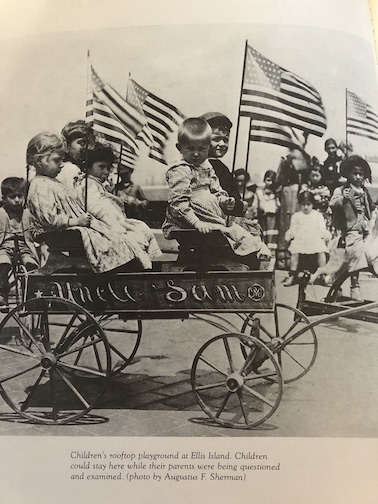
The pictures in the book are paintings based on original photographs of immigrants and Ellis Island.  (See Immigrant Kids to compare some of the pictures.)

The book also contains some further information about the lives of immigrants once they arrived in America (Immigrant Kids goes into a lot more detail), the attitudes of Americans toward immigrants at the time (varied but with strong strains of anti-Catholic, anti-Irish, and general anti-immigrant attitudes during the 1800s), and the contributions of immigrants to American society.  I actually bought this book as a souvenir on a visit to Ellis Island years ago.

The book is currently available online through Internet Archive.

Immigrant Kids

ImmigrantKids

Immigrant Kids by Russell Freedman, 1980.

ImmigrantKidsEllisIsland

One of the best parts about this book is the pictures.  The preface of the book specifically talks about photography at the turn of the 20th century, how cameras were still fairly new technology but growing in popularity.  Cameras that were small enough to be held in a person’s hands were an 1880s innovation, and the book mentions that small cameras like that were known as “detective cameras” because they were small enough that they could be used to take pictures without the subjects noticing.  Over time, it became easier for amateurs to learn to use cameras, and it became more common for people to take pictures of their ordinary, everyday lives.  Pictures like these open up a window on the past.  The pictures in this book are of children whose families had only recently arrived in America from countries around the world.  The photographer for many of these pictures was Jacob A. Riis, a journalist in New York City who wanted to document the living conditions of poor immigrants.  He published a book called How the Other Half Lives in 1890, in which you can see more of his work.  Other pictures in this book are by Lewis Hine, who is known for his photographs of child laborers.  They are not the only photographers whose work appears in this book, but they are the most famous.

The book is divided into sections, covering different aspects of the lives of immigrant children.  In the chapter called Coming Over, the author describes what the journey to America was like.  One of the primary motivations for people to come to America around the turn of the century was money and employment opportunities.  If a family had little money and little or no chance of getting better jobs in their home country, they would decide to try their luck somewhere else.  Because most of the immigrant families were poor, it was common for families to immigrate gradually.  Often, the father of the family would come first, find a job, start establishing a life and home for his family, and eventually send for his wife and children when he’d saved enough money.  The actual journey was by ship, often in “steerage,” the cheapest form of passage available, in cramped rooms in the ship’s hold.

ImmigrantKidsFamilyQuestions

Although the journey could be harrowing, one of the most nerve-wracking parts was the immigrant processing that took place at immigrant ports like Ellis Island.  There were routine questions that immigrants were expected to answer and exams for them to take, and if the questioners weren’t satisfied, the immigrants could be sent back to the country they came from.  Doctors would examine the immigrants to evaluate their health and look for signs of possible mental defects.  They were particularly concerned about signs of infectious diseases.  Sometimes, it was difficult for immigrants to answer all the questions because of language barriers and the immigrants’ own nerves at being interrogated.  If an immigrant seemed too agitated, the examiners would typically let them rest for a while before trying again.

ImmigrantKidsTenement

The other chapters in the book are At Home, At School, At Work, and At Play, which give more details about the lives of immigrant children as their families settled in America.  They often settled in large cities because those were where the most employment opportunities were to be found.  Because they didn’t speak much English and needed help learning how things worked in America, such as how to find jobs and places to live and how laws worked, they tended to settle in neighborhoods with others from similar backgrounds who could help them.  That is why, even to this day, there are certain areas of large cities, such as New York, Boston, or Chicago, which are known for people of a particular nationality (like the Irish neighborhood, the Jewish neighborhood, Chinatowns, etc.).  New arrivals often joined friends or relatives who had already been living in the US for a while, seeking help in getting themselves established.  These ethnic neighborhoods were located in poor parts of town because the people there didn’t have much money.  People lived in small, crowded apartments called tenements, sharing water and toilet facilities with other families because the apartments were not provided with individual facilities.  However, once these groups of immigrant families became established, they remained established for a long time, and they gave these neighborhoods their own distinctive style.

ImmigrantKidsSchool

School was often difficult for new arrivals because the children had to learn English before they could study other subjects.  There were some special English language learning classes for them at larger schools with enough demand for them.  At smaller schools which didn’t have these classes, they often had help from other children who had arrived in America earlier and could act as translators.  They were also frequently put into classes for children who were younger than they were, studying easy subjects, until they had learned enough English to move up to classes with children their own age.

Typically, immigrant children aimed to stay in school until they were fourteen years old because that was the age when they could officially get full-time work.  However, because their families were poor, the children might have to leave school early to find jobs and help their families make ends meet.  The book describes how rules were frequently bent or broken because the laws were not well-enforced, and children often worked at younger ages, even under harsh conditions.  For immigrant children, the most important education was that which taught practical, vocational skills that would help them find jobs quickly.  Some agencies, like the Children’s Aid Society (known for the Orphan Trains), would help them with vocational training.

ImmigrantKidsBaseball

However, immigrant children still like to play.  Boys and girls usually played separately.  Boys frequently played games like baseball in the street, or stickball, which was a variant that could be played in smaller spaces.  In stickball, the “bat” was a stick or the handle of an old broom, and the ball was rubber and allowed to bounce before it was hit.  Girls would play other games, like “potsy,” which was a version of hopscotch.

Because of the lessons they were taught in schools and because the immigrant children mixed with children outside of their immigrant groups in school, the children absorbed the local culture and became Americanized faster than their parents.  Many of them experienced the feelings of being torn between their parents’ traditions and wanting to fit in with society around them.

In each of the chapters in the book, there are anecdotes from people who had arrived in the US as children around the turn of the century, telling stories about different aspects of their lives.

The book is currently available online through Internet Archive.

Lyddie

Lyddie

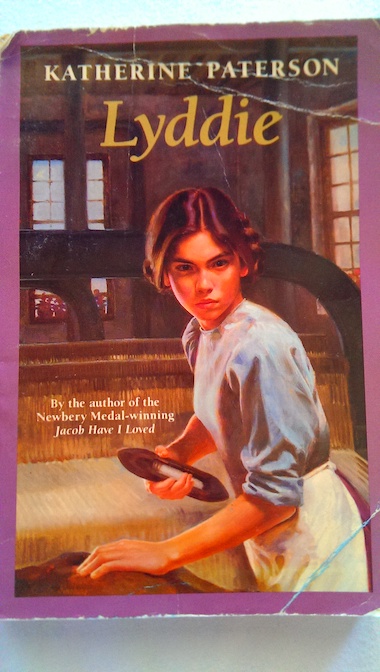
Lyddie by Katherine Paterson, 1991.

The year is 1843. Thirteen-year-old Lyddie’s father left home to go West and seek his fortune, and he hasn’t been heard of since. Lyddie helps her mother to take care of their farm in Vermont and the younger children, but they are very poor, and her mother has given up hope of their father returning home. The children’s aunt and uncle, Clarissa and Judah live nearby, but they are of little help, full of fire-and-brimstone talk. Lyddie and her brother Charlie, who is ten, more often turn to their Quaker neighbors, the Stevenses, for help. They are kinder than their aunt and uncle, although their mother disapproves of them for being abolitionists and, in her mind, heathens. Lyddie and Charlie are just grateful for their help. Because of their mother’s depression at the loss of their father, she pays little attention to the things that her children do to keep the farm going and the family together.

However, when a bear enters their house and eats the oatmeal that Lyddie was preparing, their mother, primed by Clarissa’s and Judah’s talk of signs of the end times and such, goes into a panic and sure that the world is going to end. Lyddie and Charlie let her go with their younger sisters to stay with Aunt Clarissa and Uncle Judah while they continue managing the farm as best they can. However, even though their mother sees that the world doesn’t end, she decides that she’s going to hire Lyddie out as a maid at the Cutlers’ tavern and Charlie to work at the mill because the family has too many debts and they will have to rent out their fields and animals.

Luke Stevens, the youngest of the Stevens sons, although much older than Lyddie and Charlie, gives them a ride to their new homes and employment at the mill and the tavern and promises to keep an eye on their house while they’re away. Lyddie is lonely and unhappy working at the tavern, badly missing the family farm and her siblings, especially Charlie. Then, one day, a woman visiting the tavern mentions that she’s one of the factory girls from Lowell, Massachusetts. The woman tells Lyddie that she seems like a good worker and that she could earn a good wage in the factories herself. At first, Lyddie doesn’t believe what the woman says that girls can earn there.

When Lyddie is allowed a brief visit home to her family’s farm, she discovers that Luke Stevens has been allowing a runaway slave to hide there. Lyddie isn’t sure what she thinks of it at first. Ezekial, the fugitive, frightens her because she has never met a black man before, and she knows that if she were to turn him in, there would be a handsome reward that could solve her family’s money problems. However, Ezekial seems to understand the situation that her family is in without her father. Although Lyddie and Charlie are not technically slaves, they have become a kind of indentured servant because of their family’s debts. Ezekial is a father himself, hoping to send for his family when he has found a safe place for them. Lyddie still wonders if her own father is alive, perhaps hoping to send for his family when he can. Having come to a better understanding of Ezekial, she knows that she can’t turn him in, even for the reward money.

Her talks with Ezekial make Lyddie understand that working in the tavern won’t solve her problems, though. As a maid there, she basically works all day for her room and board and has nothing else to show for it. Mrs. Cutler just sends a little money to her mother now and then and even then, she doesn’t always bother, and her mother is in little position to insist on proper wages, making Lyddie little better than a slave. Mrs. Cutler cares nothing about Lyddie or her family’s welfare, just trying to get as much labor out of her for as little as she can. Lyddie finally makes up her mind to seek factory employment in Lowell, Massachusetts, seeing it as her only chance to earn some real wages.

Life in Lowell turns out not to be as glamorous as the woman she met at the tavern made it sound, although the wages are definitely better. The company that owns the fiber mill where Lyddie gets a job has all sorts of rules and regulations for the girls who work there, even ones that intrude on their personal lives outside of work. Anxious to give the impression that all of their workers are of good moral disposition, they insist that the girls attend church on Sundays. Lyddie never had the money to pay pew fees back home, so she is unaccustomed to going to church, but finds that other girls in her position tend to go to Methodist churches, where there are no pew fees, saving their precious wages. Lyddie, who never had much time for schooling when she and her brother were trying to keep the farm going, has trouble understanding all of the terms of the employment contract that she signs but signs it anyway. Her employment turns out to be an education that changes Lyddie’s life, although not in all the ways that she had hoped.

Like Mrs. Cutler, the bosses at the factory have little real care for their workers, trying to get as much work out of them as they can for the least amount of pay they have to give them. The work is hard and the hours are long, but Lyddie keeps at it because the pay is the best she’s ever had and she is starting to save up for her family’s future. The poor working conditions contribute to health problems among the girls, and some of them petition for better working hours, but Lyddie is reluctant to do so because girls who are dismissed “dishonorably” from the factory are blacklisted all over town, and she fears not only risking the loss of her job but the potential to find a new one.

Through her interactions with the other girls and young women at the factory, Lyddie also develops into a young woman. She had previously wished that she’d been born a boy instead because a boy would have a better chance of running her family’s farm, but she comes to realize that there are opportunities out in the world for young women who are willing and able to go out and seek them. In Lowell, Lyddie gets a taste for literature through the books that her friend Betsy reads to her and acquires more lady-like behavior by watching the lady-like Amelia. Neither of them plan on working at the factory forever, and their ambitions, to get married or continue their education, cause Lyddie to consider what she really wants for her own future. Through the difficulties she encounters and everything she learns while facing them, Lyddie really becomes her own woman.

In the end, Lyddie is unable to save her family’s farm and reunite their family there. Her mother dies, and her father’s whereabouts are still unknown, so her uncle sells the farm to pay the debts. However, Charlie and her younger sister Rachel are provided for, the Stevenses decide that they will purchase the farm themselves, and Lyddie becomes reconciled to the loss of the farm through her new vision of the future. She is unfairly discharged from the factory after she catches an overseer molesting another girl and stops him because he blackens her name in retaliation. But, by then, Lyddie has acquired some money and new confidence in herself, and she begins making other plans for her future, which may include both further education and the possibility of marriage. One thing that she knows for certain is that, whatever she does with her life, she wants to move forward as her own, independent person.

The book is currently available online through Internet Archive (multiple copies).

The Traitor’s Gate

TraitorsGate

The Traitor’s Gate by Avi, 2007.

The story is set in London, in 1849. Fourteen-year-old John Huffam lives with his parents and sister and their servant, Brigit and attends a school taught by a former military man who acts like he is still in the army and teaches them little beyond discipline and what army life would be like.

Then, one day, John is called home suddenly because of a family emergency. His family has fallen on hard times, and his father is in debt, so the family’s belongings are being confiscated. His father is summoned to appear in court, and if he cannot find the money to pay his debt, he will have to go to debtors’ prison. John’s father is shocked because he doesn’t actually owe any money to the man who is trying to call in the debt, Finnegan O’Doul.

TraitorsGateConfiscation

In spite of this, John and the rest of the Huffam family must spend the night in the bailiff’s sponging house, the Halfmoon Inn. There, John’s father again promises John that there is no debt between himself and Mr. O’Doul. He even says that he doesn’t really know O’Doul, although John doubts him. It seems like his father has had dealings of some kind with the man that he wants to keep secret.

John’s father, Wesley Huffam, was originally from a fairly well-off family, but all the family’s money ended up going to a great-aunt instead of to him (possibly because it became obvious to his relatives that he had little skill at handling money in the first place). John’s father is resentful toward the great-aunt, Euphemia Huffam, for inheriting when he thinks that, as a man, he should have been first in line for the family’s money. However, with this enormous (although possibly false) debt hanging over his head, he may be forced to appeal to Great-Aunt Euphemia for help. He persuades John to go and visit Great-Aunt Euphemia on his behalf, since he is not allowed to leave the sponging house for now and the past quarrels between him and his aunt would make it unlikely that his aunt would want to see him. John is beginning to realize that there are pieces of his father’s life and their family’s past that have been kept from him, and he doesn’t like the idea that his father has been deceiving him, but with their family in such a desperate situation, he agrees to visit Great-Aunt Euphemia.

TraitorsGateSary

The bailiff, John’s mother, and Brigid all agree that John is going to have to be instrumental in solving their family’s problems. Of all the people in his family, he is the most practical, in spite of his young age. His father is an impractical man, stuck in a vision of his family’s former glory (and his aunt’s current money, which he does not share in) that doesn’t fit their current circumstances. John’s mother thinks that her husband’s job as a clerk for the Naval Ordinance Office doesn’t provide enough money for the family to live on, even though he earns more than twice what typical London tradesmen of the time do. The real problem is that the family doesn’t live within its means (it is eventually revealed that Wesley Huffam has been withholding money from his family that he uses for gambling), and John’s father’s snobbish attitude because he thinks of his family as being more grand than the commoners around them alienates people who might otherwise be friends and help them. John knows that he’s young, and he’s not completely sure what he can do to help his family, but he knows that there is no other option but to try. In the process, he learns quite a lot about life, himself, the people in his family, and the wider issues in the world around him, including some political intrigue that hits uncomfortably close to home.

Great-Aunt Euphemia agrees to see John when he comes to her house, but their first meeting doesn’t go very well. Great-Aunt Euphemia is ill (or says she is), and she bluntly tells John that his father was always bad with money. She is not at all surprised that he is in debt and needs her help. John gets upset at the bad things that Euphemia tells him about his father, and she gets angry when John tells her the amount of the debt. At first, John is sure that she will refuse to help them completely, but Euphemia tells him not to assume anything but that he should come back the next day.  Her eventual contribution to helping John’s family in their troubles comes in the form of a job for John.

TraitorsGateRookery

As John moves around the city, he gets the feeling that he is being followed, and he is. One of the people following him turns out to be Inspector Copperfield (or so he calls himself) from Scotland Yard. When John confronts him, the inspector seems to have a pretty good idea of the difficulty that his family is in and what John himself has been doing. John asks him why he cares, and the inspector says that John’s father is suspected of a crime and that John had better learn more about what his father has been doing and share that information with him. John doesn’t believe that his father could be a criminal, but the accusation is worrying because he knows that his father is hiding something (his gambling addiction isn’t the only secret he has).

The other person following John is a young girl in ragged clothes. The girl, who calls herself Sary the Sneak, approaches John herself, freely admitting that she’s been following him. In spite of her young age, Sarah (or Sary, as she is frequently called) lives on her own and must support herself because her mother is dead and her father was transported to Australia. People don’t often notice a young girl on the street, so sometimes people will pay her to follow someone and provide information about them. The reason why she tells John about it is because she isn’t above playing both sides of the street; sometimes, she gets the people she’s been following to pay her to provide them with information about the people who hired her to spy on them. She considers it even-handed. However, John has no money to pay her for information and finds her spying distasteful, so he doesn’t want to take her up on the offer at first.

However, John does a little spying of his own when his father sneaks away from the Halfmoon Inn, which he is not supposed to do. He follows his father to a pub called the Red Lion, where he witnesses his father gambling with money that he had claimed not to have. More than that, he sees his father arguing with a man who turns out to be O’Doul, another gambler. To John’s surprise, his teacher also shows up and seems to know O’Doul. When John later confronts his father with what he saw at the Red Lion, all his father will say is that he is carrying a fortune around in his head. Later, John overhears the bailiff speaking with someone else, an Inspector Ratchet from Scotland, saying that it appears that Wesley Huffam may be a traitor involved with spies and that the Inspector Copperfield who spoke to John earlier was an imposter, probably also a spy.

Could it be true? Is John’s father really a traitor, selling naval secrets from his job? If so, who can John trust?  Conspirators seem to be around every corner, and John has the feeling that the people who are closest to him may be the biggest threats.

The book is currently available online through Internet Archive.