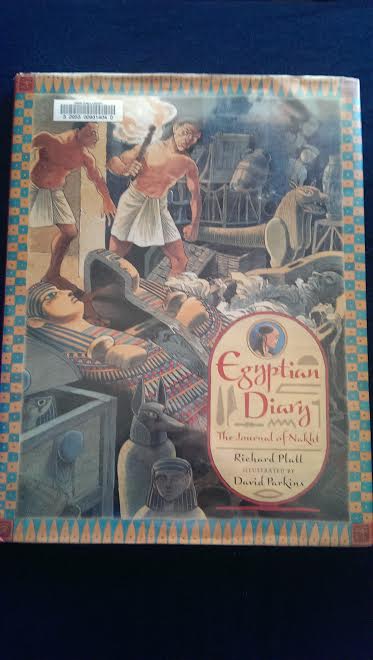
Egyptian Diary

EgyptianDiary

Egyptian Diary: The Journal of Nakht by Richard Platt, 2005.

A young boy in Ancient Egypt, Nakht, is excited because his family will soon move to Memphis because a distant relative has offered his father a job working as a scribe.  Memphis is a large, important city, with more opportunities than Esna, where the family currently lives.  Nakht is also training to be a scribe, so he begins writing an account of his family’s journey to Memphis and what they encounter when they arrive.
EgyptianDiaryPic1

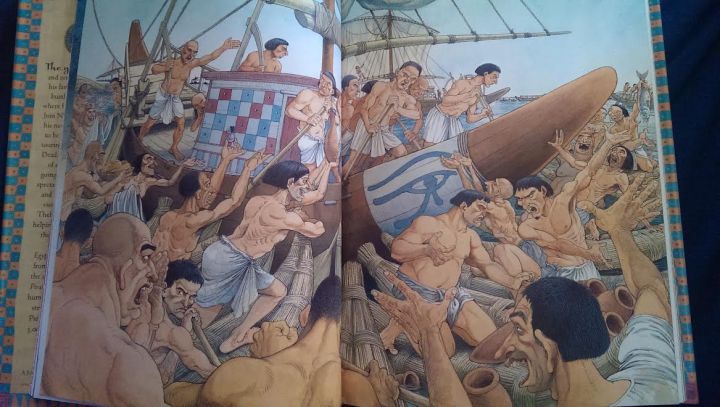
The journey to Memphis includes a boat trip down the Nile, past the City of the Dead near Thebes, where pharaohs are buried.  When they arrive in Memphis, they make themselves at home in their new house, which is bigger than their old one.  For the first time, Nakht has a private bedroom of his own, and the wall is decorated with a hunting scene.  Nakht also has a bed to sleep in, although he is still more accustomed to sleeping on a mat on the floor, as he did back in Esna.

In Esna, Nakht’s father had taught him his lessons as a scribe, but in Memphis, Nakht begins attending a school with other boys.  There, he practices his writing as always, although he must also learn the older, more formal hieroglyphic form of writing used on the walls of temples and for public inscriptions as well as the less formal writing used more commonly.  Nakht also receives lessons in building and engineering, which includes calculating the weight of the building stones, how many people it would take to move them, and how much food and drink the workers would need during their time of service).  Sometimes, their teacher also takes the students places for lessons, like taking them to the fields near the river so they can see how to build canals and how farmers water their fields.

There are many exciting things going on in Memphis.  Ships come and go from many places.  When the Nile floods, Nakht describes how the Controller of Granaries sets the taxes on grain for the following year by measuring the highest height of the Nile during the flooding time, which is an indicator of how good the next year’s grain harvest will be.  Nakht and his sister Tamyt witness the funeral procession of a scribe, complete with dancers, paid mourners, and a procession of servants carrying all of the furniture and supplies to be loaded into the man’s tomb for him to use in the afterlife.
EgyptDiaryPic2

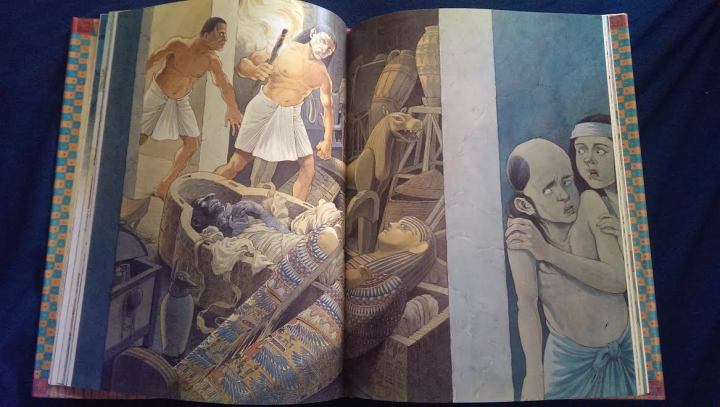
Then, Nakht learns that his father and other scribes are investigating tomb robberies in Saqqara.  Nakht and Tamyt have never seen the tombs before, but their father refuses to let them come with him.  Instead, the two of them sneak over by themselves to have a look.  While they are there, they witness the robbing of a tomb!  They get a good look at an unusual ring on the finger of one of the robbers and are shocked to later see an identical ring on the finger of a very important person!

EgyptDiaryPic3

At the end of the story, when Nakht and Tamyt are rewarded for their role in catching the thieves, it is revealed that the current king of Egypt is Hatshepsut, who is actually a woman.

EgyptDiaryPic4

Among the other things that Nakht explains about his life are how the doctor treated him when he broke his arm, how grain is harvested, how different types of craftsman work, and how houses are built.  Nakht also undergoes a special hair-cutting ceremony as a coming-of-age ritual.

There is a section in the back that explains more about Ancient Egyptian history and society.  It also explains Egyptian writing, religion, mummies, and tombs.

The book is part of a series of historical picture books.  It is currently available online through Internet Archive.

Pirate Diary

PirateDiary

Pirate Diary: The Journal of Jake Carpenter by Richard Platt, 2001.

Young Jake Carpenter lives with his father in North Carolina in 1716.  His mother is dead, and his father is a medical doctor.  His father wants him to become a doctor as well, but he has decided that it’s important to the boy’s education that he see something of the world first, so he is allowing Jake to go to sea with his uncle, Will, who is a sailor.  Jake is excited about the prospect, and Will has told him many stories about the sea.

PirateDiaryPic1

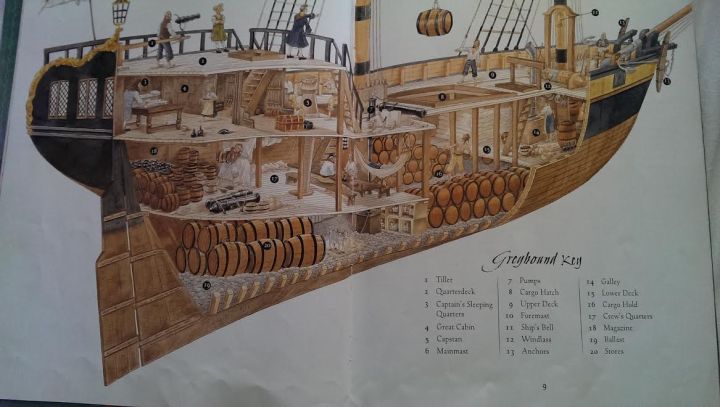
Jake isn’t allowed to bring much with him because there is limited space on board the ship for personal belongings, and there are many things that Jake has to get used to, like sleeping in a hammock, the names for all the different parts of the ship, seasickness, the poor quality of food on the ship, and using the horn lanterns which are safer for candles on board ship but don’t cast much light.  Jake makes friends with Abraham, the cook’s boy, who promises him extra food in exchange for teaching him to read.  Jake’s main job on the ship is to help the carpenter, so he begins learning his trade.

When the ship is underway, Jake and his uncle learn that the captain is running from debts and that the ship is carrying contraband.  Jake doesn’t think that smuggling is a very serious crime because the main purpose is to avoid paying extra taxes on certain types of goods, and other members of the crew say that it isn’t fair for Americans to continue paying taxes to England when the king doesn’t really care about them or what they want.  The ship sails the Caribbean, but crew members say that they try to avoid docking at English-controlled ports, like the ones in Jamaica, so they won’t have to pay the customs fees. Abraham says that even if they were caught with their contraband, the authorities would likely look the other way if they offer them a share.  Will tells Jake that the captain of the ship will most likely hold back their wages in order to keep them with the ship for as long as possible, like he does with other sailors.

Discipline on board the ship is harsh and arbitrary, according to the captain’s whims.  When Will speaks up to save Jake from a harsh flogging, he himself is flogged and abandoned in a small boat.  Jake believes that his uncle will die because they left him at sea with no provisions!

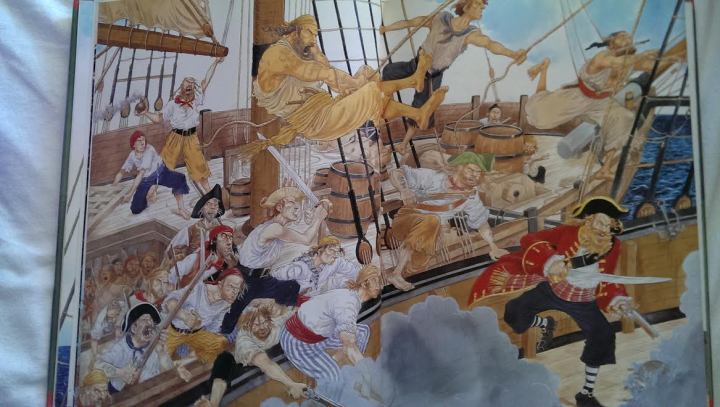
Then, the ship is captured by pirates!

PirateDiaryPic2

Far from making things worse, Jake’s situation and that of the rest of the crew actually improves because of the pirate attack.  With the captain captured, his cruel punishments are over, and members of his crew eagerly join the pirates in the capture.  The pirates ask the crew about the treatment their captain has given them, saying that it will help them to decide what to do with him, and crew members explain the cruelties they have suffered, including what the captain did to Will.  They end up marooning the captain and his equally-cruel second mate on an island with drinking water.

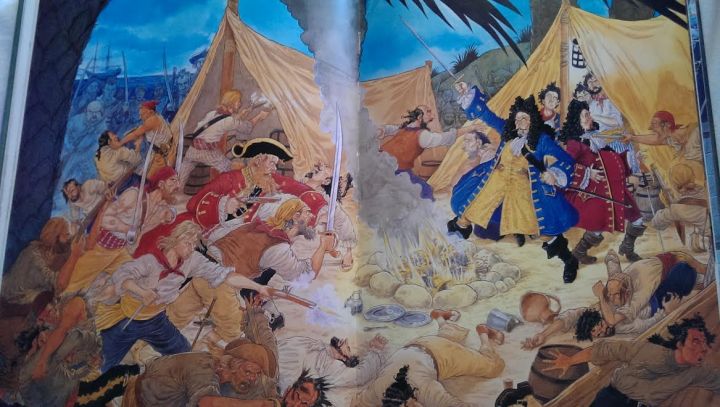
As Jake’s father predicted, Jake gets to see a lot and learn a lot about life and death during his time at sea, perhaps even more than expected while under the command of the pirates.  He gets some experience in dealing with injuries as he has to help the ship’s carpenter saw off the leg of a man whose wound was too infected to treat in any other way, although the man later died anyway.  Later, the pirates join up with other pirate ships, and Jake participates in a raid on a Spanish treasure fleet!

PirateDiaryPic3

It’s not all excitement, and Jake spends some time talking about the routine chores that sailors did and how they would pass the time on board ship when nothing else was going on.  He does get to see St. Elmo’s Fire on the upper rigging of the ship, and the crew spots a “mermaid” once on a misty day.

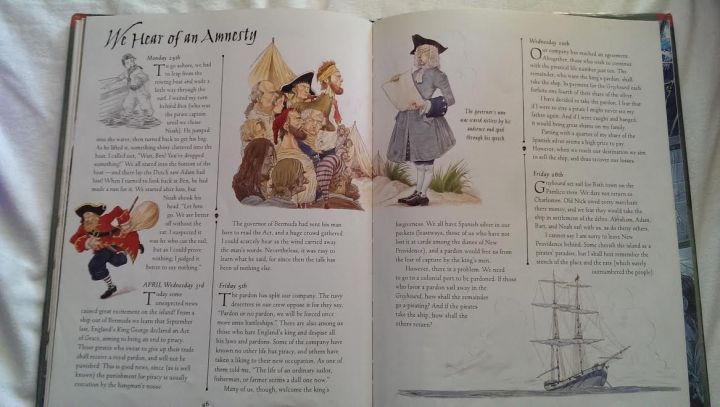
An offer of amnesty for those willing to give up pirating allows Jake and other members of the crew to return home where he learns that his uncle has managed to survive after all!

PirateDiaryPic4

In the back of the book is a section with historical information.  It explains the history and geography of the American Colonies, where Jake lived and the history of piracy from the first known pirates to the privateers and buccaneers that led to the golden age of piracy in the 18th century.  Jake is a fictional character, but some of the pirates that Jake met in the story were real people, and the section in the back explains more about them.  The book is part of a series of historical picture books.

A Year Down Yonder

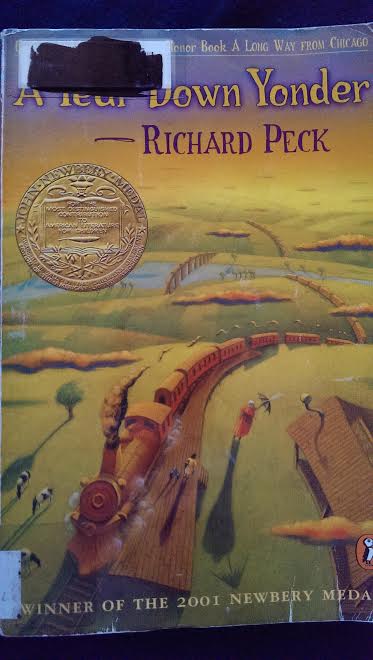
YearDownYonderA Year Down Yonder by Richard Peck, 2000.

This is the sequel to A Long Way from Chicago. The story takes place shortly after the Great Depression, in 1937.

Times are still hard, and a recession has left a lot of people out of work again. Mary Alice’s father is out of work, and her brother Joey is out west working for the Civilian Conservation Corps. Because her family has to move to a smaller apartment, fifteen-year-old Mary Alice leaves Chicago to stay with her Grandma in the country for the year. Times are hard in Grandma’s small town as well, but Mary Alice’s Grandma is as wily and eccentric as ever.

Like the first book, this book is really a series of short stories about Mary Alice’s adventures with her Grandma during their year together. The stories generally have a hilarious turn as Grandma gets the better of everyone, often in the name justice or a good cause.  (Although, Grandma’s sense of justice is debatable since it involves “borrowing” pumpkins from the neighbors in the dead of night and other questionable activities.)

These stories present a detailed picture of rural life during the 1930s, from pranks played on Halloween to how Armistice Day was celebrated in the years following World War I, when people were still alive who had strong memories of that war. The stories also capture some of the personalities and politics of life in a small town, from a disreputable family of outcasts to the local elite, who have more money than the others and brag about having ancestors who fought in the Revolutionary War (which may or may not be so).

Rich Chicago Girl: Mary Alice arrives in Grandma’s small town and is enrolled in the local school.  She meets the class bully, and Grandma helps her to deal with her.

Vittles and Vengeance: At Halloween, Grandma gets revenge against a group of pranksters and raids her neighbors for ingredients to make the school Halloween party better.

A Minute in the Morning: Armistice Day, November 11, has more meaning for people who have actual memories of The Great War (World War I).  Grandma makes sure that those who can afford it pay what they owe to the veterans of that war and shows Mary Alice the price that some soldiers paid for supporting their country.

Away in a Manger: Mary Alice is picked to play Mary in the school’s Christmas Nativity play.  The baby Jesus turns out to be a surprise for the whole town, and Grandma arranges a special surprise for Mary Alice.

Hearts and Flour: The head of the local branch of the DAR pushes Grandma to make cherry tarts for their annual tea in honor of George Washington’s birthday.  Since she will neither allow Grandma to join the DAR (because Grandma doesn’t have the proper lineage) nor pay Grandma for her work (she thinks Grandma should ‘volunteer’ her services as part of her patriotic duty), Grandma insists that if she bakes, she must host the tea as well . . . with a couple of special surprise guests.  Meanwhile, a handsome new boy named Royce joins Mary Alice’s class at school.

A Dangerous Man: An artist working for the WPA rents a room from Grandma, treating Mary Alice and Royce to a scandalous but hilarious sight when his subject matter gets out of hand.

Gone with the Wind: A tornado sweeps through the town, and Grandma and Mary Alice go to check on residents who live alone.  Mary Alice also prepares to return home to her parents in Chicago.

Ever After: The final story in the book is about Mary Alice’s wedding, years later, toward the end of World War II.

This book is a Newbery Award winner.  There are multiple copies currently available online through Internet Archive.
Ghosts in the Gallery

ghostsgalleryGhosts in the Gallery by Barbara Brooks Wallace, 2000.

Eleven-year-old Jenny was raised in China by her mother and stepfather, who ran a dance studio. She has no memory of her real father, who died when she was a baby. When her stepfather dies and her mother becomes deathly ill, her mother writes a letter to her real father’s father, a grandfather that Jenny never even knew existed before. In the letter, her mother explains that she is dying and that she will be sending Jenny to live with her grandfather. Then, Jenny starts the long journey from China to the East coast of the United States alone.

Leaving her dying mother to head to a strange country to live with her previously unknown relations is frightening enough, but there is still worse to come. When Jenny arrives at her wealthy grandfather’s home, no one is expecting her or knows who she is. Her uncle, Winston Graymark, insists that her mother’s letter never arrived. Worse still, he believes that Jenny is an imposter, and that her mother merely made up the story about his long-lost brother being her father.

At first, he angrily threatens to send Jenny back to China, but Madame Dupray, a servant who cares for Jenny’s ill grandfather, suggests that she be taken on as a household servant. Jenny is given a dreary little room in the cellar and embarks on the drudgery of household chores. Could the Graymarks really be her relatives? If so, what happened to the letter that Jenny’s mother sent? Something sinister is happening in Graymark House, and Jenny will have to face suspicious servants and attempted murder before she finds the truth.

The “ghosts” in the title are the portraits of Jenny’s ancestors, which hang in the gallery. They appear grim and frightening at first, but when Jenny begins to recognize them as her relatives, they no longer frighten her.  Like many of Wallace’s books, this book contains sinister characters with hidden motives, but ends happily.  The story takes place at some point during the Victorian era.