Isabel’s House of Butterflies

The story begins by explaining that the forests of Michoacan, Mexico are a sanctuary for monarch butterflies, but that sanctuary is in danger because of logging activities. The large-scale industry is a major threat, but sometimes poor people living in the area also chop down trees because they need to sell the wood. The author notes that there have been efforts to preserve these trees, but it’s difficult to enforce laws protecting them, and no one is sure what will happen to the monarch butterflies if the trees disappear.

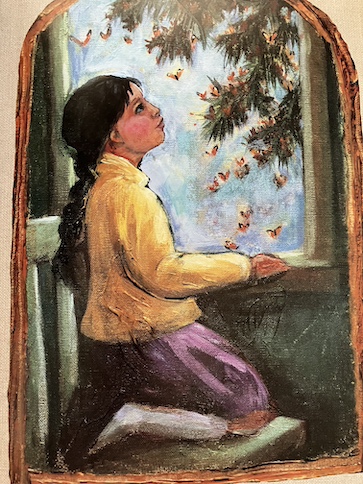
Isabel is an eight-year-old girl living with her family on a small farm, and the tree outside their house attracts butterflies on their migration route. She calls it, “La casa de las mariposas,” which means “The House of Butterflies.” Her family is poor, but they can’t bring themselves to chop down their special butterfly tree, like other families in the area have done. They love it that the butterflies appear there every autumn, and they think it’s a beautiful miracle to see them return every year. Sometimes, tourists come to the area to see the butterflies, and that brings the family a little extra money.

However, one year, there is very little rain, and they have a very bad harvest. The family sells their pigs and continues on as best they can, but their money is running low. They don’t have many resources left for money, and Isabel’s father is reluctantly considering cutting down their butterfly tree. He doesn’t want to do it, but he doesn’t know what else to do.

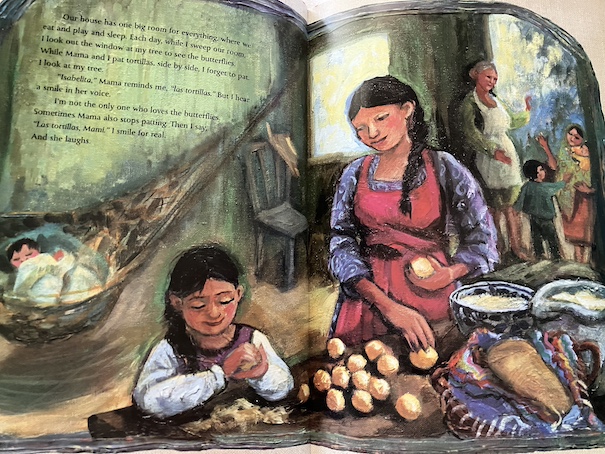
Isabel is distressed at the loss of the tree and the butterflies, so she suggests another plan to her parents. She often helps her mother to make tortillas, so she tells her mother that maybe they can set up a stand selling tortillas to the tourists who come to see the butterflies. The family decides to give Isabel’s plan a try.

The book is available to borrow and read for free online through Internet Archive.

The story ends on a somewhat hopeful note, but it bothered me a little because it’s not definite that Isabel’s plan is going to work. Isabel is hoping that they’ll be able to make enough money that they won’t need to cut down the tree, but we only see them getting set up, so we don’t know if they’re successful or not. I would have preferred to see them succeeding so we would know that things are going to get better, but the story just ends at that point, and it’s left up to the minds of the readers whether they were successful or not.

I think that hopeful but slightly worrying note at the end of the story is meant to reflect how people trying to preserve natural resources often feel – they have ideas and plans to help preserve natural areas and resources, but nobody knows for sure what will work or how well their plans will work. It’s realistic, if a little bit of a let-down. However, while nothing is guaranteed to be successful and life has its uncertainties, there is hope in the people who are willing to try different approaches to problems rather than simply giving up. The book does speak to the concerns that modern people, even children, have about the environment and the search for systems that work better than the ones that we already have.

The pictures in this book are soft, colorful, and lovely. Although the family is poor, they appreciate the small pleasures in their lives, like making the tortillas and the yearly appearance of the beautiful butterflies. I did also feel a little sorry for the butterflies the pigs ate, but the story doesn’t dwell on that part too much.

This book was published by Sierra Club Books for Children, and there is a small note with the publishing information about the origins of the Sierra Club, which is dedicated to protecting scenic and ecological resources.

Princess Hyacinth

Princess Hyacinth by Florence Parry Heide, illustrated by Lane Smith, 2009.

For reasons nobody understands, Princess Hyacinth is not affected by gravity, and she floats upward anytime she is not restrained or weighted down.

It’s a real problem because, while it’s difficult enough when she floats up to the ceiling of the palace, if she were allowed out of the palace without something weighing her down, she would simply float away.

Princess Hyacinth’s parents go to great lengths to make sure that she is always secured to something or weighed down with special weighted clothes and a very heavy crown.

Of course, being weighted down all of the time makes life difficult for Princess Hyacinth, too. She wishes that she could go outside and play and swim with the other children, but she can’t because she can’t be outside without the weights. There is one boy in particular who comes by her window with a kite with a crown on it and says hello to her, but it would be difficult for her to go out and play with him.

Then, one day, when Princess Hyacinth is particularly bored and tired of being weighted down, she persuades a balloon man to tie a string to her and let her float among his balloons. At first, it’s fun, floating along as the balloon man walks through the park, but then, the balloon man is startled by a dog and accidentally lets go of her!

As Princess Hyacinth floats upward into the sky, she is thrilled because she has never felt so free in her life, but where will it end? How high can she go, and is there any way for her to get back? Fortunately, there is a way for her to get home, with the help of a friend!

The book is available to borrow and read for free online through Internet Archive (multiple copies).

My Reaction

This story reminded me of a much-older story from the 19th century, The Light Princess, but this picture book is much, much less serious than that book. In The Light Princess, the princess is cursed, and the story is about breaking this curse that has afflicted her all of life. In this book, there is never any explanation about why Princess Hyacinth isn’t affected by gravity, and she is never cured. Instead, she makes a friend who helps her find a way to live with her condition and enjoy it.

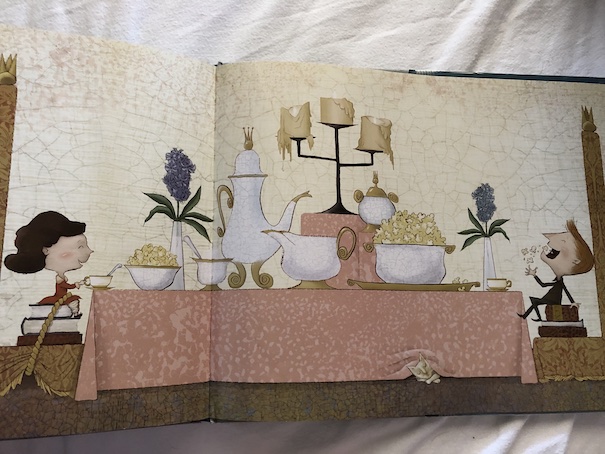
I liked the art style in this book. I found it amusing that the king, queen, and palace guards are drawn in the style of the face cards in a deck of playing cards. Princess Hyacinth is a cute little girl, and when she’s wearing her heavy princess gear, you can almost feel the weight of it on her. In the end, there are still times when she has to be tied down, but she seems more normal, less weighted down, because she has found someone to help her deal with her condition.

Hanukkah at Valley Forge

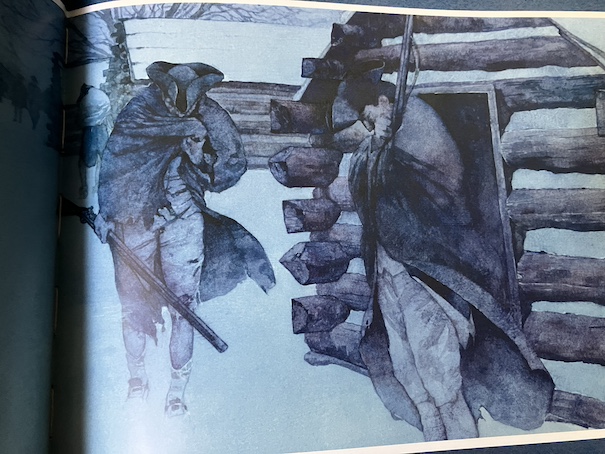
It’s a cruel winter at Valley Forge, during the American Revolution, and George Washington is worried about the welfare and morale of his soldiers.

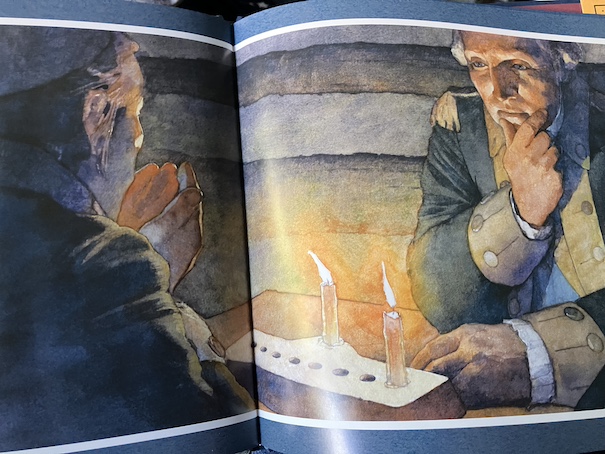
As Washington walks through the camp, he sees a young soldier lighting a candle and reciting something softly to himself.

Curious about what he’s doing, Washington stops to talk to him, casually remarking on how cold the night is. The young soldier says that he saw colder nights when he was young in Poland, and he is lighting candles for Hanukkah. Washington asks him what that means, and the soldier explains the meaning of the holiday.

The soldier recounts the story of how Israel was conquered by the Ancient Greeks, who forced Jewish people to worship Greek gods and tried to replace Jewish customs with Greek ones. Washington also says that he understands what it’s like to feel like you’re under the thumb of a king who lives far away and the desire for liberty. The Jewish soldier says his family left Poland for similar reasons, because they were not being allowed to practice their beliefs there.

Returning to the story of the ancient Israelites, the soldier explains that a priest named Mattathias refused the Greeks’ orders to bow to idols, and he fought back against the Greeks. Mattathias and his five sons, who were called the Maccabees, led a rebellion against the Greeks. They were a small group, and the odds were against them, but they were determined to continue the fight against their oppressors. Washington says that he understands the feeling because his army is in a similar position.

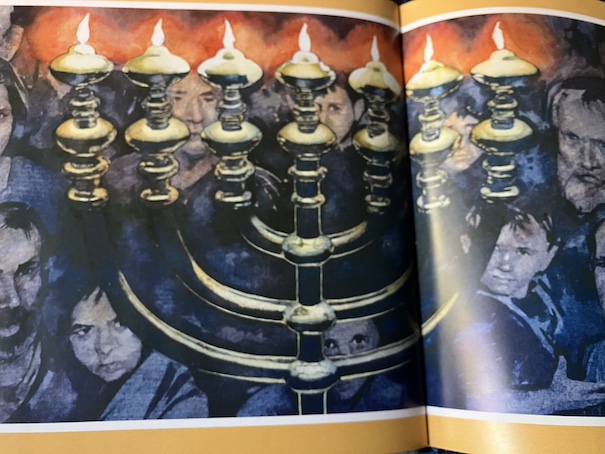
Continuing the story, the soldier recounts how Mattathias’s son, Judah, inspired their troops by reminding them that God was on their side, leading them to victory. When they finally managed to overthrow their Greek rulers, they took back their Temple and lit the Temple menorah. The menorah was supposed to be kept lit constantly, and they were worried because there was very little oil left. They only had enough to keep it burning for one day, and they weren’t sure when they could get more oil. However, they lit the menorah anyway, trusting that God would somehow provide them with more soon. It took them eight days to find more oil for the menorah, but to their surprise, the menorah continued to stay lit all the time they were searching, lasting eight times longer than they thought it would with the amount of oil they had. Hanukkah became the commemoration of this miracle.

George Washington contemplates the story that the soldier told him, and he finds it inspiring. It reminds him that, even though their current situation in Valley Forge may seem bleak, there have been others before them who have also faced steep odds in their struggles and who still managed to succeed. He begins to think that, if they persevere, they may also be gifted with a miracle of their own.

There is an author’s note at the end of the book that explains the inspiration behind the story. As the characters in the story do, the author draws parallels between the American Revolutionary War and the historical battle that began the tradition of Hanukkah. The author learned that George Washington may have learn about Hanukkah during the Revolutionary War, although there are no entries in his diary to confirm it, so he used excerpts from George Washington’s other writings to explain his sentiments. The author also offers commentary on bullies and the importance of standing up to oppressors, both in the context of war and in daily life.

This book won the Sydney Taylor award from the Association of Jewish Libraries.

I love books that include little-known or lesser-known events. Whether this one happened or happened in the way the author tells it is difficult to verify, and it seems likely that it’s more of a folk tale than an historical account. George Washington was a real, historical person, but so many legends have grown up around his life that it’s sometimes difficult to tell whether certain stories about him actually happened. As the author says, Washington’s own diary doesn’t offer any verification about this particular incident. Other reviewers of this book, including J. L. Bell, who specializes in Revolutionary War history in the Boston area, have attempted to trace the origins of this particular story about Washington learning about Hanukkah during the Revolutionary War. In his blog, J. L. Bell explains the known sources for this story, which vary in their description of exactly when the encounter between Washington and the Jewish soldier took place and what the soldier’s name was. The soldiers who have been credited with having this encounter with George Washington were real people, but there’s nothing that definitively proves that the discussion about Hanukkah actually happened with any of them. The story is probably more folklore than history, and Bell believes that it started to circulate during the 20th century, when there were more immigrants arriving from Poland with stories and experiences like the one the Polish soldier in the story tells about not being allowed to practice their religion openly. Even so, the parallels the story draws between the ancient rebellion of the Maccabees and the American Revolution are fascinating.

There are certain feelings that are universal among humans, and the author’s point that nobody likes being oppressed by a bully, whether that bully is another person or a government or an army, is true. No matter what you’re up against in life, perseverance in the face of hardship is important, and miracles can come to those who continue to stand up for themselves and what they believe in. It is also true that people who come from different sets of circumstances can help to inspire each other by sharing common feelings about their struggles.

Noel

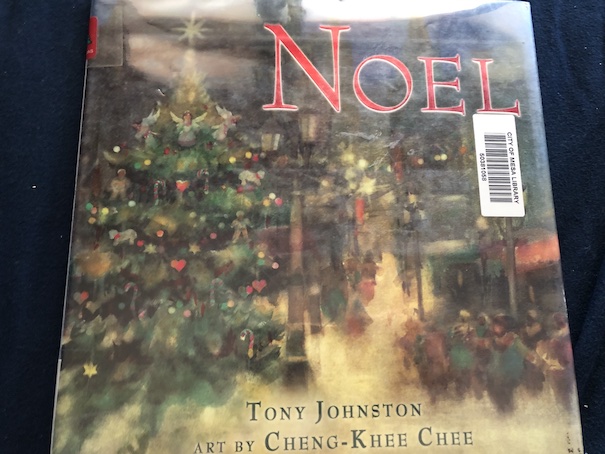
Noel by Tony Johnston, art by Cheng-Khee Chee, 2005.

This lovely Christmas picture book reads like a Christmas carol!

There is no story in the book. The text is poetry that celebrates the atmosphere of Christmas, the feelings in nature as anticipation builds and in cities as people gather to celebrate.

“Noel” is described as the sound of Christmas, like a bell, that people and animals all listen to hear.

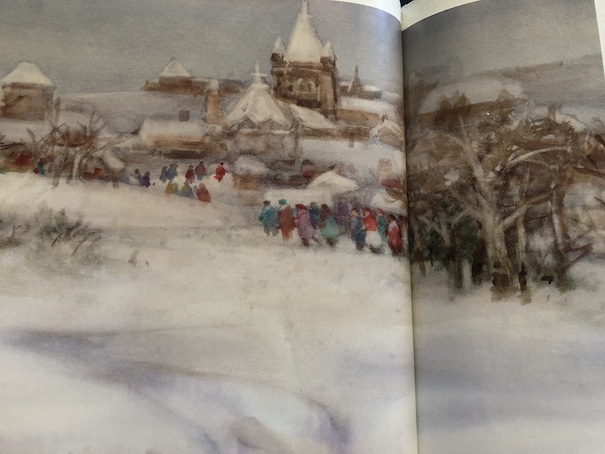
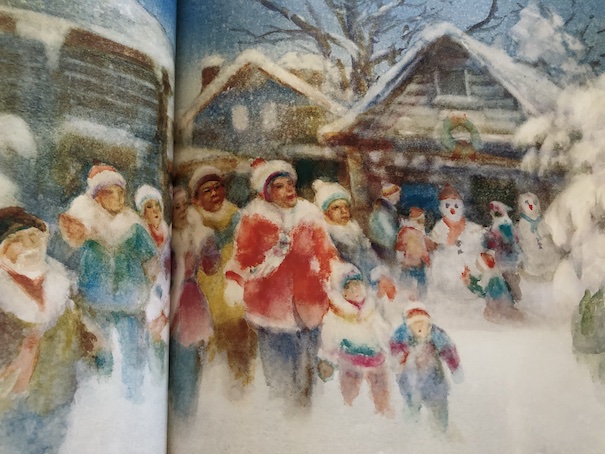
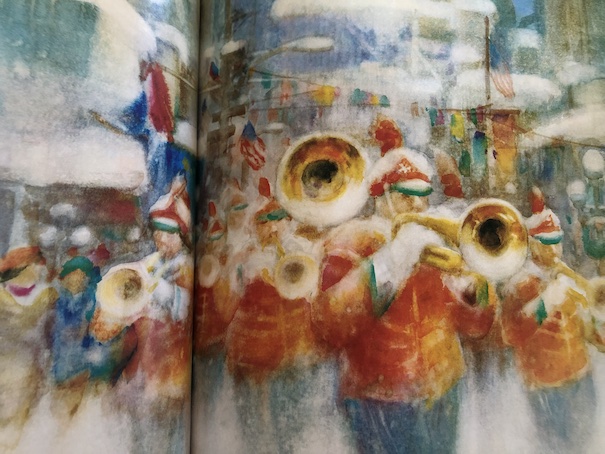
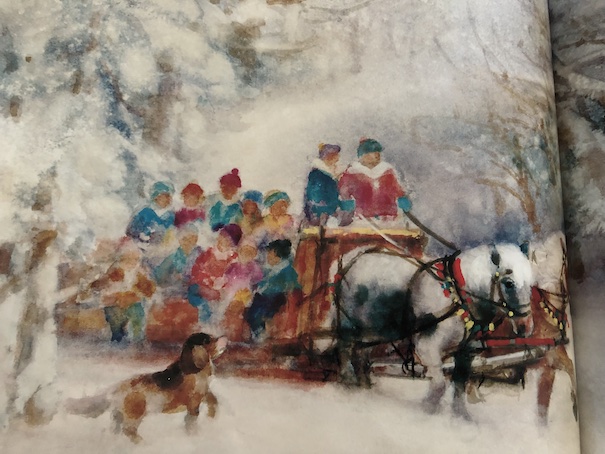
The artwork is beautiful, and there are scenes of people participating in classic Christmas celebrations, with a Christmas parade, snowmen, a public Christmas tree, and a sleigh ride.

The pictures really make the book beautiful and dreamlike. In the back of the book, there is a section that explains the art style. The artist used watercolors and a technique called “saturated wet-paper technique.” This technique is what gives the illustrations their fuzzy, dreamlike quality

The book is available to borrow and read for free online through Internet Archive.

The Little Fir Tree

A little fir tree feels lonely among the large trees in the forest, but something happens that changes his life forever – he is chosen to be a living Christmas tree for a little boy!

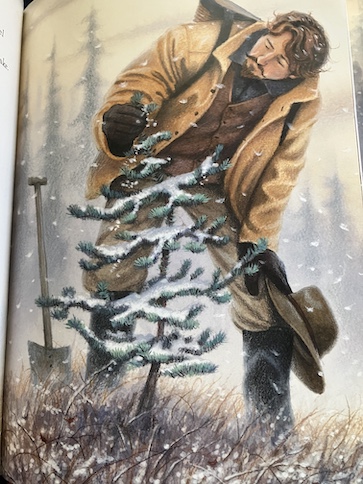
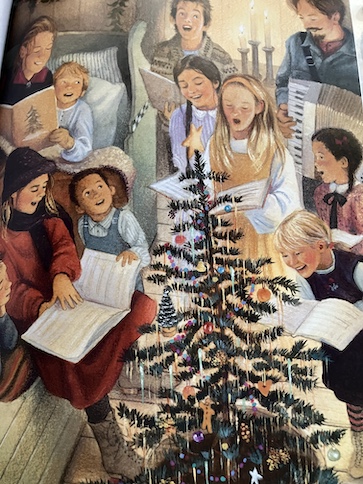
One winter, the boy’s father carefully digs up the tree and brings it home to his young son, who cannot walk because of a lame leg. The boy has been wanting to see the trees in the forest, but since he can’t go to the forest himself, his father has brought a free to him. The little fir tree loves being decorated, and the next evening, guests come and gather around him, singing Christmas carols.

In the springtime, the boy’s father takes the tree back to the forest, where he found it, and he plants the tree again so it will continue to grow. However, the following winter, the boy’s father returns to dig up the tree again and take it back to the boy for Christmas.

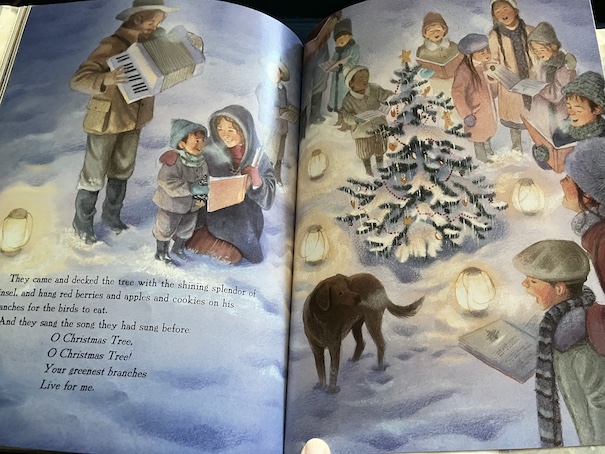
The little fir tree loves this ritual of visiting the boy and his family and being their Christmas tree every winter, but the next winter after that, the man doesn’t come to dig him up. The little tree is disappointed and lonely, but he is in for a surprise. This winter, the boy and his family come to see him in the forest!

The book is available to borrow and read for free online through Internet Archive, although that copy has different illustrations.

I mainly know Margaret Wise Brown for Goodnight Moon and The Runaway Bunny, but I found this Christmas story charming. I don’t like Christmas stories from the point of view of trees that are cut down, like the Hans Christian Andersen story, The Fir-Tree, which has a really depressing ending. I like it that this family in this book keeps the tree alive, returning it to the forest every year to continue growing. Things change for both the boy and the tree over the years, as they both continue to grow, but they change for the better, and they continue to be fond of each other and a source of inspiration for each other.

When I was a kid, our elementary school had a large tree on a hill on the kindergarten playground, and the story behind it was that it was once a living Christmas tree from the very first kindergarten class at the school. That tree is still there and alive today, about 50 years after it was first planted there and more than 30 years after I used to play under it. I like to imagine that it will be true of the little fir tree, too, that it will continue growing over the years.

Earlier versions of this book had different illustrations, but personally, I love the illustrations in this printing because they’re detailed and realistic. The version on Internet Archive has illustrations by Barbara Cooney, who is known for Roxaboxen and Miss Rumphius. Cooney’s illustrations are also good, but not as realistic as Larmarche’s, and they’re in a limited color range.

One other difference between versions of the book is that the earlier version also included the musical notes for the carols that the children sing and additional songs that aren’t included in the later version of the book. I enjoy books that include actual music and lyrics, like books that include recipes, because they are fun extras and add an extra dimension to the story by providing an accompanying activity. Although I like the more detailed and realistic illustrations of newer edition of this book, I do prefer the actual music and wider range of songs from the older version.

Yetsa’s Sweater

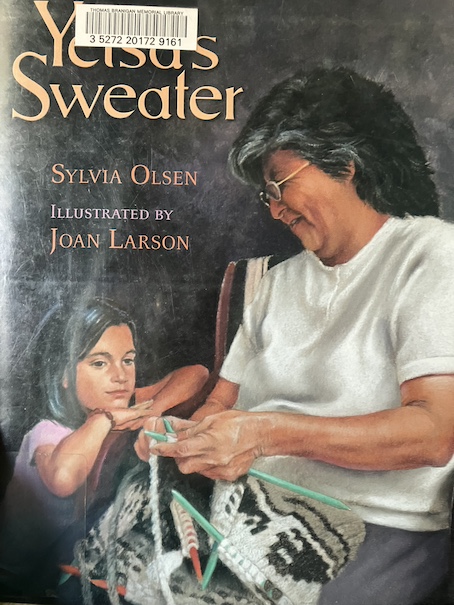
Yetsa and her mother go to her grandmother’s house to help her prepare wool for making a sweater. Yetsa is getting too big for the sweater she’s wearing, but she still loves it because her grandmother knitted designs in it that have personal significance to her and her family.

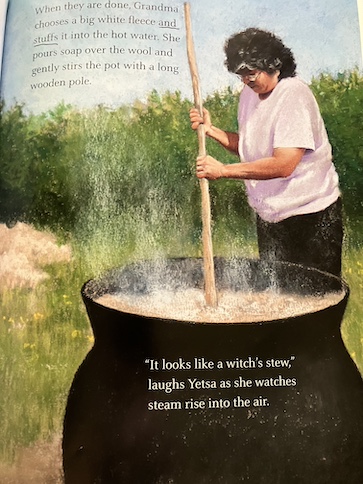
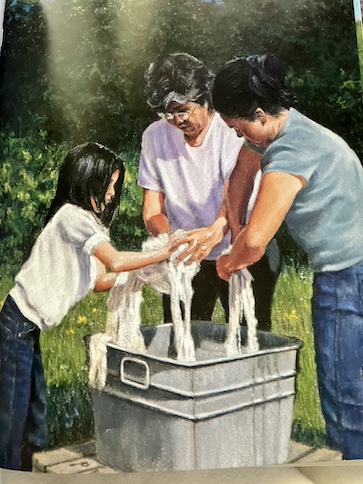
Yetsa’s grandmother builds a fire and brings a large pot for the wool. They have to sort through the fleeces they received from Farmer McNutt and remove any little twigs or hay or anything that doesn’t belong. Yetsa yells when she finds some sheep poop stuck in the fleece. After they’ve removed the debris as best they can, they wash the fleece in hot water over the fire. Then, they rinse it in cool water and wring it out.

While the wool dries on the clothesline, they take a break and have some bread and blackberry jam.

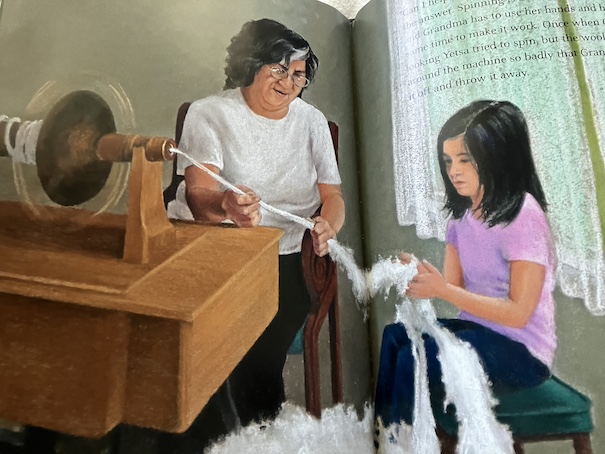
The following week, they begin pulling apart the fibers of the wool, making it fluffier, a process called “teasing.” Then, Yetsa’s grandmother runs the wool through a carding machine, and they begin spinning it into yarn with a spinning machine.

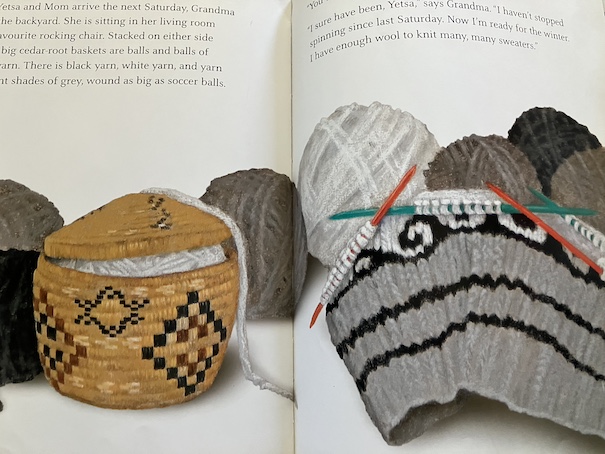
When the spinning is finished, Yetsa’s grandmother has enough wool to make many sweaters.

In the back of the book, the author explains that Yetsa is her own granddaughter and that knitting is a traditional skill for Coast Salish women. They learned knitting from Scottish settlers who came to British Columbia, and the sweaters they made came to be called Cowichan sweaters, after the largest tribe in the region. Children like Yetsa begin learning how to prepare wool and knit at a fairly young age.

The book is available to borrow and read for free online through Internet Archive.

I love books that show people making traditional crafts, and I enjoying following this one from beginning to end! Readers get to see each step in the process of making the sweater, starting with the wool and ending with the finished sweater. I’ve been knitting from a young age, but I’ve never tried spinning my own wool, and I liked seeing the intricate patterns of the sweater.

When I was a kid, I often ignored authors’ explanations because my focus was on the story, but as an adult, I like the added details of author’s explanations. This is a family story because Yetsa in the story is based on the author’s own granddaughter.

The Case of the Bicycle Bandit

A Jigsaw Jones Mystery

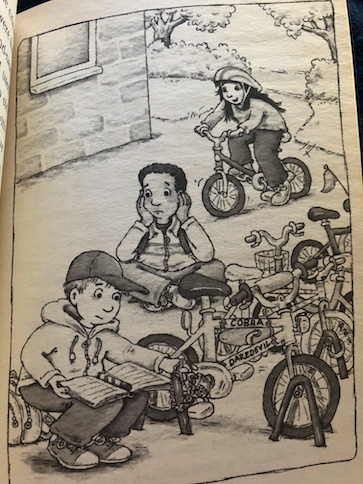
Jigsaw Jones and his friend, Ralphie, have to go to the library to get books for a book report at school. While they are at the library, somebody steals Ralphie’s bike!

First, it’s strange that Ralphie’s bike was stolen because Ralphie is sure that he locked it up using the same chain that he used to also lock up Jigsaw’s bike. How could someone take a bike that was chained up, and since the two bikes were chained together, why is Jigsaw’s bike still chained up, as if the lock was never opened?

Second, if someone could get the chain open to take one of the bikes, why did the thief take Ralphie’s bike? Jigsaw’s bike is new and in good condition, while Ralphie’s bike, which he calls “Old Rusty”, is old, beat-up, and always breaking in some way. Ralphie is fond of “Old Rusty”, which was a hand-me-down from his older brother, but if some stranger had a choice of stealing one of two bikes, wouldn’t it make more sense to take the one that’s in better condition?

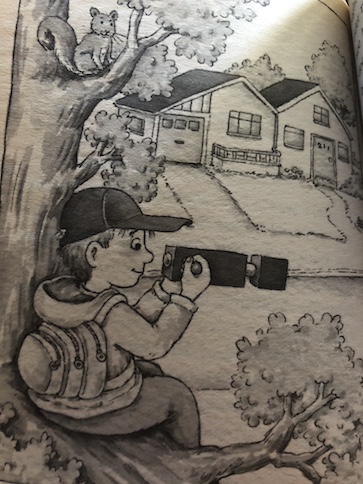
Jigsaw Jones calls his friend, Mila, to help him investigate and find Ralphie’s missing bike, and they get some help from a classmate who is good at drawing portraits to interview witnesses and do sketches of suspects. Their most likely suspect is a skateboarder whose face nobody saw clearly. But, how did the skateboarder know how to open the lock on the bike chain, and why did he take only the old bike and lock up the newer one again?

The book is available to borrow and read for free online through Internet Archive (multiple copies).

Books in this series are easy, beginning chapter books with pictures that accompany the story. The mystery in this book is pretty simple, although it might seem more difficult to younger readers. I liked the way the characters reasoned it out, logically confronting the problem of how the thief opened the bike chain and why the thief took the older bike instead of the new one. I also enjoyed their use of an amateur sketch artist to find one of their suspects.

Even after Jigsaw does a stakeout and realizes who is responsible for taking the bike, he doesn’t seem to quite understand the motive until the thief explains it, although the motive was what I figured it was. Revealing the culprit in this book also includes a spoiler for an earlier book in the series.

I was amused when Jigsaw said that he charges a dollar a day for his detective services. At first, I thought that shows the inflation that’s happened since Encyclopedia Brown charged his clients a quarter. Then, Jigsaw checks out an Encyclopedia Brown book from the library, showing that Jigsaw is familiar with the books and also giving kind of a nod to an earlier boy detective who may have somewhat inspired this series. I always appreciate children’s books that reference other books.

The Puzzling World of Winston Breen

Twelve-year-old Winston Breen loves puzzles! He looks for puzzles to solve everywhere, and he also loves to make to give puzzles to other people to solve. Usually, on his sister’s birthday, he likes to set up some kind of puzzle or treasure hunt to lead her to her present. However, the year his sister Katie turns ten years old, Winston almost forgot about her upcoming birthday party, so he didn’t have anything planned. In fact, he was lucky to find a nice present in time for the party, buying a pretty box that he saw in a curio shop at the last minute.

When Katie opens his present at the party and sees an empty box, she’s sure that the empty box must be another of his puzzle tricks. Winston tries to explain to her that it’s just a nice box, and there’s no puzzle this time, but to his surprise, Katie finds a puzzle in the box that Winston didn’t make or put there. It turns out that there’s a secret compartment in the box that contains thin strips of wood with letters on them. It looks like the kind of puzzle Winston loves and one he might have made if he had planned better this year, but as Winston explains to everyone, this isn’t his work. So, whose puzzle is it, and what does it mean?

Everyone at the party tries to guess what the puzzle means, and Winston has to reassure everyone multiple times that it’s really not one of his puzzles. In the end, they all decide to let Winston try to solve the puzzle and tell them the answer. However, Winston can’t seem to solve the puzzle! When he’s unable to solve it, his relatives really begin to believe him that he didn’t make it. Winston’s cousin, Henry, questions him about who had access to the box and where he got it in the first place. When Winston says that it got it at the curio shop, Henry points out that the curio shop owner also likes puzzles and has shared puzzles with Winston before. It seems logical that he’s the original source of this particular puzzle.

When Winston talks to the owner of the curio shop, he says that he had no idea that there was a puzzle in the box that Winston bought. The box was part of a larger set of items that came from the estate of a woman who died recently. The lady was one of the daughters of a wealthy inventor who was one of the founding members of their town, Walter Fredericks. One of Winston’s friends is doing a report about Walter Fredericks for school. The owner of the curio shop says that the last living member of the deceased lady’s family is her sister, who is the town’s librarian, and that maybe Winston should ask her about the puzzle. Winston’s friend needs some information about the inventor for his report anyway, so they decide to go to the library and talk to the librarian. However, when the boys try to talk to the librarian, she suddenly becomes upset when she sees Winston holding the pieces of the puzzle. She starts to cry, asks why “you people” can’t leave her alone, and yells at them to leave the library!

The boys have no idea what made the librarian react like that. Later, they are approached by a strange man who introduces himself as David North. He says that he saw what happened in the library, and he thinks that he can help. He calls himself a treasure hunter and explains that the reason why Winston hasn’t been able to solve the puzzle is that he’s missing some of the pieces. David North shows the boys that he has more of the pieces to the puzzle, and he suggests that they become partners, sharing their pieces with each other to solve the puzzle.

Before talking to Mr. North, the boys didn’t even know that the puzzle was the key to a treasure. They don’t know exactly what this treasure is or how Mr. North knew about it, and they’re not sure that they can trust him. Soon after meeting Mr. North, they are also approached by a man who calls himself Mickey Glowacka. This man explains that he’s also looking for the treasure. The boys ask him what treasure that is, and Glowacka says that the inventor hid a large sum of money. Glowacka also has a set of puzzle pieces, and he says that there is also a fourth set, the set that belongs to the local librarian.

Although Glowacka is more forthcoming than North was, Winston isn’t sure that he’s trustworthy, either. Then, the town librarian comes to see Winston to apologize for her fit at the library, and she explains the rest of the situation to Winston and his family. Walter Fredericks had four children. Except for the librarian, Mrs. Lewis, who was the youngest of his children, the others are all deceased. Their father was a fun-loving man who enjoyed games and puzzles, but the siblings never got along with each other. Mrs. Lewis says that her entire childhood was full of petty squabbles that she and her siblings never knew how to resolve with each other, so they just increased over the years. Before their wealthy father even died, she and her siblings argued over their eventual inheritance. There was one item in particular that all four of them wanted: a valuable ring that was given to their father by a prince to thank him for one of his inventions. After their father died, the four siblings went to claim their shares of the estate, but the lawyer informed them that the ring was not included with the rest of the estate. Instead, their father arranged one last puzzle for his four children to solve together. Each of his four children received a set of puzzle pieces, and they were told that they would have to work together to solve the puzzle and claim the ring. Mrs. Lewis realizes that her father was making one last effort to get his children to stop arguing and join forces, but a single puzzle would never be enough to resolve years of arguments and fighting. Instead, the siblings turned their backs on each other and on the puzzle, so it has gone unsolved for more than 20 years, and the ring is still hidden somewhere.

Since her other siblings died, one by one, their shares of the puzzle pieces have been purchased by other people as their estates have been sold off. That is how North and Glowacka acquired their sets of puzzle pieces from the estates of Mrs. Lewis’s brothers, similar to the way Winston accidentally bought the set that once belonged to Mrs. Lewis’s sister, Livia. Since Livia’s death, someone has become desperate to get as many of the remaining puzzle pieces as possible. Someone broke into Livia’s house soon after her death, before items from her estate were auctioned off, but this person was unable to find Livia’s set of puzzle pieces because they were hidden in the secret compartment in her box. Someone has also broken into Mrs. Lewis’s house to find her set of pieces, leaving her a threatening message. She has also received threatening phone calls and demands for her puzzle pieces, which is why she was so upset when she saw Winston approaching her with puzzle pieces. It seems logical that either North or Glowacka could be the one breaking into houses and threatening Mrs. Lewis, or it could even be both of them.

Mrs. Lewis has decided that the most sensible way to resolve this situation is to do what she and her siblings should have done years ago with each other: arrange for all the interested parties to work together to solve the puzzle and find the ring, then sell the ring and split the money. Winston’s father points out that doing this would mean including whoever it was who’s been threatening her for a share in the treasure, and it doesn’t seem right to reward that person. Mrs. Lewis decides that she’s willing to do that just to settle the matter and remove the reason for the person to keep harassing her. To keep everyone in line and ensure that everyone plays fair with each other, she has recruited a friend of hers who is a retired police officer to act as her representative and a referee for this game. North and Glowacka grudgingly agree to abide by the rules of the game.

Winston’s sister, Katie, declares that the puzzle pieces that were in the box are hers since they were part of her birthday present, and Winston reluctantly agrees, even though he’s the main puzzle person in the family and feels a little possessive of the puzzle because he’s driven to solve it. Of course, he is included in the game, both as his younger sister’s chaperon at group meetings and the family puzzle expert. At first, Katie is reluctant to split her share of the treasure with Winston because of his participation, but their father points out that she will be relying on his help in this game. As the owner of the puzzle pieces, she has the right to decide what Winston’s help is worth to her, so she will control how much of her share Winston will receive, but it’s only right that she let him have something in exchange for his help.

The book is available to borrow and read for free online through Internet Archive (multiple copies).

I enjoyed this book both for the mystery story and for the puzzles that appear throughout the book. Because Winston loves puzzles so much, he creates little puzzles and brain teasers for readers to solve throughout the book, and some people also give him puzzles and brain teasers of their own. Readers have the opportunity to solve these puzzles themselves, and the answers are in the back of the book.

The main mystery of this book was good. It has a particular set of suspects, everyone who is participating in the search for the ring and the solution to the puzzles. They must work together at the same time as they look at each other suspiciously. However, there is a twist to this story because there are more people involved with this series of puzzles than the obvious ones. There are people who are on the scene and have access to at least some of the clues who are not immediately obvious suspects, and I admit that I didn’t suspect these people at first.

There is a point where Winston himself becomes a suspect for a break-in at Mrs. Lewis’s house. I think the author meant this accusation against Winston to ramp up the suspense in the story, but it just irritated me because Winston is still a kid. He’s not old enough to have a driver’s license, and he’s still in that age where his movements are still limited and monitored by parents. It would have been more credible if he had been a teenager, with more ability to get around on his own, unsupervised and with less accountability.
Lady Margaret’s Ghost

Felicity, An American Girl

This book is one of the mystery stories published to accompany the American Girl series of historical books. The main character of this book, Felicity Merriman, lives in Colonial era Williamsburg, Virginia, around the beginning of the American Revolution.

Felicity’s mother is going on a trip to visit a relative, along with Felicity’s younger siblings. As the oldest girl in the family, Felicity will be in charge of the household while her mother is gone and her father and his apprentice, Ben, are working in the store her father owns. It’s a big responsibility and an honor that Felicity’s mother considers her capable of managing the household, but because Felicity is still young and some household tasks involve heavy work that is difficult for her to do alone, her mother has hired a temporary cook, Mrs. Hewitt, to help her. Because Felicity is known as a daydreamer who doesn’t always pay attention to what she should be doing, her mother reminds her to focus on the task at hand while she’s minding the house, although she has faith in Felicity and is sure that she will do a good job.

Soon after her mother leaves, a crate arrives at the house for Felicity’s father, along with a letter. The letter explains that a cousin of Felicity’s father has died and that the crate contains some family heirlooms that his cousin left to him. These heirlooms once belonged to a common ancestor of theirs, Sir Edward Merriman, a wealthy nobleman and the first member of their family to live in the colonies, more than 100 years earlier. Felicity’s father didn’t know his cousin well because they never lived very close, and his cousin was much older, but he does know the history of the heirlooms. The heirlooms include a lady’s silver vanity set and a silver cup and rattle for baby. The story is that Sir Edward’s wife, Lady Margaret, owned the vanity set, and the rattle and cup were for their infant son. Unfortunately, the baby was stillborn, and Lady Margaret died shortly after the birth. After her death, her husband and the household servants believed that she still haunted the house. The haunting may have been part of the reason why Sir Edward decided to leave his home in England and go to America, but even though he later remarried and had other children, he could never bring himself to part from the things that belonged to his first wife and child. Even before Felicity’s father tells her about the ghost story, Felicity gets a strange feeling from the vanity set, and she wonders if the objects could be haunted.

However, Felicity soon has to turn her attention to household issues. Mrs. Hewitt, the temporary cook arrives, and she is a brusque and unpleasant woman. She is rude and condescending to Felicity when they are working in the kitchen together. Because Mrs. Hewitt is so rude, Felicity is nervous and makes mistakes, making her look like more of a fool to Mrs. Hewitt. They can’t easily replace her because cooks are in demand right now because this is Publick Times in Williamsburg, and there are many visitors to the city. Everyone is busy tending to them. Mrs. Hewitt was the best they could find available. Felicity’s father does speak to her about her rudeness to Felicity. After that, Mrs. Hewitt is sullen and resentful, and she is even more pleased whenever she sees Felicity doing something wrong.
There is also an exciting event taking place. Felicity has entered her horse, Penny, in a horse race at the fair in town! Ben, her father’s apprentice, will ride her. The day of the race, Penny seems to be doing well, but then, she suddenly develops a problem during the race. When Felicity and Ben check her out to see what was wrong, they discover that someone put burrs under Penny’s saddle! Worse still, the wounds caused by the burrs become infected. Felicity is very upset and worried about Penny, and she wonders who would have hurt her horse. There were a couple of men looking at her before the race. There was also a boy named Dawson and a girl called Anne.

Dawson turns out to be a runaway, but he also has some knowledge of horses. Although Felicity is a little suspicious of him at first, Dawson helps to heal Penny’s wounds. He also says that he saw Anne gathering burrs, but it was probably on behalf of someone else.

When Felicity realizes that her treasured coral necklace, which her mother also wore as a girl, has disappeared, Felicity questions whether she carelessly lost it or if someone has stolen it. Felicity has been doubting herself and her ability to manage the household because of all the mistakes she has made since her mother left, and the clasp of the necklace was a little loose. This could just be another disastrous mistake, but it is suspicious that Anne seemed so friendly to her at the race and then ran away from her later. Anne also literally bumped into Felicity at the race. Could she have taken the necklace? Dawson seems to think so, but then again, can Felicity really trust everything he says?

Felicity still gets an odd feeling from Lady Margaret’s heirlooms, and she thinks that she sees something white moving around at night. At first, she thinks that it could be Lady Margaret’s ghost, but then, strange things begin happening around the house. Things disappear, and Felicity worries that maybe she carelessly mislaid them. Then, her necklace unexpectedly turns up, and Lady Margaret’s vanity set vanishes! Are these strange things part of the haunting of Lady Margaret or the work of a thief? If it’s a human thief, is it the work of the runaway Dawson, mysterious Anne, unpleasant Mrs. Hewitt, or the mysterious person who arranged for Penny to be hurt?

The book ends with a section of historical information about Colonial era Williamsburg. The story is set during Publick Times, which was when court was in session in Williamsburg. People would gather in Williamsburg during Publick Times to see the trials in court and attend a public fair in Market Square. The fair offered various kinds of entertainment, games, and races, like the horse race in the story.
The story leaves it a little ambiguous at the end about whether Lady Margaret’s ghost exists, but if she does, she is not harmful and has nothing to do with the thefts in the story or what happened to Penny at the horse race. As the section of historical information explains, there are many new visitors in Williamsburg during Publick Times. This was a good setting for the story because there are many strangers to the city with unknown pasts and motives, and crowds at the fair might harbor thieves.
Part of the story and part of the section of historical information in the back focuses on the subject of orphans. Both Dawson and Anne are orphans, and neither of them is really being cared for. Dawson admits that he used to steal to support himself after his father died, but he is seriously looking for work. Anne technically has a guardian, but her guardian is abusive and uses her as a servant rather than taking care of her.

When the thefts occur and mysterious things start happening around the Merriman house, both Dawson and Anne look like the best suspects, but there are also possible adult suspects. Even after Felicity realizes Anne’s situation, she isn’t entirely sure which of the men at the fair that day is Anne’s guardian. Mrs. Hewitt also looks suspicious because she is so unpleasant and seems to be trying to make trouble for Felicity. I though the book did a good job of supplying an array of suspects to consider. The solution to the mystery was one of the possibilities I thought was most likely, but there were enough other possibilities to make the story interesting.

The Pinhoe Egg

The Pinhoe Egg by Diana Wynne Jones, 2006.

This is the sixth and final book in the Chrestomanci series.  In this series, there are many different dimensions, and in each of those different dimensions, there is a copy of every person.  Different versions of our world can differ dramatically in their history across the dimensions, and individual people’s lives can differ dramatically between the dimensions. There is one person in each generation who has no duplicates in any of the other dimensions.  This person is called the Chrestomanci.  All of the talents, abilities, and lives that would have been spread across the other dimensions are now centered on that one person, giving that person, literally, nine lives.  The Chrestomanci fills an important role, being better able than anyone else to travel across the dimensions, and he acts to keep a balance between them and make sure that the different worlds keep their proper course.

Marianne Pinhoe and her brother, Joseph, are used to Gammer (their grandmother) telling them and everyone else in their family what to do. Gammer is the matriarch of the magical Pinhoe family, and Marianne, as the only girl born into the family in the last two generations, is expected to eventually succeed her. Joseph has magical abilities, too, but he often pretends that he can’t do things so the rest of his family won’t force him into their magical businesses. He really has a fascination for machines and would rather work with them than do magic, so he does his best to convince the rest of his family that he’s a “disappointment” to them (something that other family members appear to have done when they had interests outside the family). However, Gammer still rules the roost and she has plans in mind for both Marianne and Joseph.

One day, she calls Marianne and Joseph to her house and tells Joseph that she’s got him a job as boot boy at Chrestomanci Castle over the school break. Joseph is angry because he had other plans for the school break and doesn’t want to be a boot boy. Gammer tells him that it’s important for him to go to Chrestomanci Castle because she wants him to act as a spy there. The Pinhoe clan doesn’t live too far from the castle, and for generations, they have been careful to conceal their identities as witches from whichever Chrestomanci happens to be in charge at the time. Gammer says that if Chrestomanci (whom they carefully refer to as the “Big Man” because saying his title aloud calls him) ever found out about them, he and his crew of enchanters would (gasp!) force them to obey rules and regulations and not just use their magic any way they like whenever they feel like it. (If you’ve read all the of previous books in the series, you can see that people like the Pinhoes are part of the reason why rules exist in the first place and why just letting them do whatever they want could be a complete disaster that could tear apart the worlds someday, but oh noes, not rules and regulations and being told not to do insane things that would lead to the destruction of the worlds! We’re not talking petty micromanagement here. Basically, this is a huge red flag, right up front, that the Pinhoes are up to seriously shady stuff that may lead to people dying and/or already have involved people dying.) Gammer wants Joseph to be at the castle to find out if the Big Man has caught on to them or looks like he might be going to. (At this point, we don’t know exactly what activities they’re afraid he’s going to catch onto, but that will become more clear later.) Joseph is still angry and tells Gammer that she can’t make him do it, but something happens that changes everything.

While Marianne and Joseph are still at Gammer’s house, the Farley family comes calling, and they’re angry with Gammer, too. They say that she has somehow betrayed them, particularly Dorothea Farley. After an argument with them, suddenly Gammer seems to lose all of her reason! When she speaks, she doesn’t seem to make any sense, as if she’s completely lost her mind. Marianne thinks that the Farleys cast a spell on Gammer, but she can’t prove it. The rest of the family thinks that the strain of the argument with the Farleys just sent Gammer over the edge because she’s so old. They’re unsure whether or not Gammer is going to recover from this incident or not and how long that might take. They temporarily hire nurses to look after her, but Gammer drives them away by using her magical powers to throw things at them like a poltergeist.

The family members all argue about what to do with Gammer, and in the end, they decide that she must go live with Dinah and her husband because gentle Dinah seems like she’s the only one who can handle her. Some of the relatives argue about who will get Gammer’s house since she will no longer be living there, and Marianne’s father reveals that the house actually belongs to him and that he was just letting Gammer live there. He thinks that the house is too large for his family and that the sensible thing to do is to sell the house and use the money for Gammer’s care and other practical uses. Moving Gammer to Dinah’s house is difficult because she uses her magic to resist it, but they eventually accomplish it. In the meantime, Joseph still has to go to Chrestomanci Castle because all of the arrangements are already made and the rest of the family insists that he do it.

While all this is happening, The Chant family is just returning from their holiday in the south of France (which was in Mixed Magics), and they have no knowledge of what’s been happening with the Farleys and the Pinhoes. Julia and Janet have been reading a horse story for girls and have become obsessed with horses and the idea of owning horses of their own. Chrestomanci asks them if they wouldn’t prefer to have bicycles (Roger says he would and Chrestomanci immediately agrees he can have one), but the girls insist that they must have horses. Millie is sympathetic because she wanted a horse of her own when she was young, and they do have stables at Chrestomanci Castle. Chrestomanci reluctantly agrees and purchases a horse for the girls, with the understanding that they will learn to take care of it properly.

However, when the horse arrives, it turns out that Janet is terrified of horses when she actually meets one, and the horse only likes Eric “Cat” Chant. Initially, Cat thought that all of the horse talk was boring, but he feels a strange kinship for Syracuse the horse, and if he doesn’t take care of him, Chrestomanci might follow through on his threat to have Syracuse turned into dog food. (Chrestomanci is also secretly afraid of horses.) Cat finds riding difficult at first, but he enjoys it and becomes fond of Syracuse. Julia and Janet swear off horses in fear and disappointment and get bicycles, like Roger, so Cat becomes Syracuse’s owner.

One day, while riding Syracuse, Cat has a disturbing encounter with Mr. Farley, the gamekeeper. Mr. Farley has placed spells in the territory around his family’s property to keep people away so their magical activities won’t be noticed by anyone, especially the people at Chrestomanci Castle. Since Cat has been riding around the countryside on his horse, Mr. Farley has become paranoid about Cat snooping around. The Pinhoes have some similar worries.

Then, Jason, one of Chrestomanci’s associates, returns to the castle after having been away for years. Jason brings his new wife, Irene Pinhoe, with him. Jason is a plant expert, and he also has some plant samples. Janet and Julia are both heart-broken that Jason is married because they both had enormous crushes on him, and they are sure that Irene is going to be perfectly awful and that they won’t be able to stand her. However, when Cat meets Irene, he thinks that she seems rather nice. She’s an artist and designer, and Cat can tell that she’s using magic in her drawings. Irene admits that her father was some kind of enchanter, and she may have inherited some of his ability, although she seems oddly embarrassed about it and says that she doesn’t know much about her father’s work. Jason and Irene invite Cat to accompany them while they have a look at a house that they’re planning to buy in the area.

Gammer is still not in her right mind, and at Gammer’s request, Marianne has to look after her cat, Nutcase. This is difficult because Nutcase is hard to control, and he somehow manages to get around the spells that Marianne tries to use to control him. After Nutcase kills a bunch of baby chicks belonging to Dinah, Dinah’s husband threatens to kill Nutcase if he comes near their chickens again. Marianne tries, mostly unsuccessfully, to keep track of Nutcase and keep him out of trouble.

One day, while trying to find Nutcase, she shows up at the house that Jason and Irene are trying to buy while they are there with Cat. It happens to be the old Pinhoe house, the one Marianne’s family is selling, and the Pinhoe family would prefer a Pinhoe to buy it. It helps that Irene is a Pinhoe, and Marianne thinks that she is just like the princess that she imagined in a story that she’s writing. Jason is fascinated by the variety of magical herbs in the Pinhoes’ neglected garden, and he’s sure that he really wants the house, too.

Cat is intrigued by Marianne when they first meet because he can tell that she has powerful magical abilities. Marianne asks Cat to help her find Nutcase, and he agrees. While they’re looking for Nutcase, Cat comments to Marianne how powerful her magic is and that she should trust it more. Cat is surprised at himself for being so bold, and Marianne is surprised at how well Cat has read her.

While they look for Nutcase in the attic, Cat senses that there is something important and magical hidden there, protected by spells, and he feels compelled to figure out what it is. As they investigate further, they find a strange, large egg. Marianne says that she doesn’t really know what kind of egg it is but that Gammer told her that it was a silly joke of her grandfather’s because he claimed it was an elephant’s egg. Cat senses that it’s very important, and he asks Marianne if he can have it. Marianne decides it’s okay if Cat keeps it because nobody else ever really seemed to care about it, and the house needs to be cleaned out when they sell it.

During the night, Cat gets a visit from a large, winged creature that says it’s the egg’s mother. The mother says that a spell prevents her from reclaiming her egg, but she sensed that the egg was moved, so she came to see that it was safe. When the egg hatches, it turns out that it’s a griffin. Cat needs Millie, Crestomanci’s wife, to help with the hatching and caring for the griffin. Crestomanci questions Cat about how he got the egg, and Cat explains that it came from the Pinhoes’ old house, which seems to intrigue Crestomanci.

When Marianne’s uncles learn that Marianne gave the egg to Cat and that it’s hatched, they’re furious with her. They had put the egg in the attic themselves and placed spells on it to prevent it from hatching, although they had never told Marianne about it before.

In the mean time, Marianne has been learning that this isn’t the only secret that her family has been hiding and that things in her family are not what she’s always believed they were. Strange things are happening in the nearby village. First, someone places a bad luck spell on all the Pinhoes. Every member of the Pinhoe family falls victim to various accidents until they find the source of the spell buried in the garden of the old Pinhoe house and destroy it. Then, there’s a plague of frogs and a sudden epidemic of whooping cough that affects everyone in the county.

What Marianne comes to realize is that these curses are being cast by Gammer, who still seems to not be in her right mind. What the other relatives have been taking to be harmless, nonsense mutterings and odd little things that she does to entertain herself have actually been magic spells. The curses have been mostly directed at the Farley family, although because Gammer isn’t really in her right mind, some of them have gone astray and affected other people in the area, including the Pinhoes.

However, when Marianne tries to tell her family what Gammer is doing, nobody believes her. Marianne comes to realize that the Pinhoes themselves have also been under one of Gammer’s spells for their whole lives that cause them to view Gammer with reverence and to make excuses for bad things she does. For some reason, this spell no longer seems to be working on Marianne, even though the other members of her family are still affected. Whe’s beginning to see that Gammer has done some pretty awful things and that her own father has been taking more care of the Pinhoe family than Gammer ever has, even though Gammer has been taking the credit as the family’s leader. Because of Gammer’s spells, none of the rest of the family will listen to anything Marianne tries to say about what Gammer has been doing, and they think that it’s just malicious slander. Worse still, Marianne is in disgrace with them because she gave the griffin egg to Cat.

What is the true story behind the griffin egg, and why are the elder Pinhoes so worried about it? Marianne knows that there is a griffin and a unicorn on the family’s coat of arms. What kind of feud does Gammer have with the Farley family, and are the Farleys really responsible for her present condition? With Gammer’s spells on everyone, how can Marianne get anyone to believe her enough to help her get the answers she needs? Her family has tried hard to avoid getting the attention of Chrestomanci or anyone at Chrestomanci Castle, but they may be the very people Marianne needs now.

My Reaction and Spoilers

I love the Chrestomanci series, and I enjoyed reading this book, although the ending seemed a little confusing and fell a little flat to me. I’m starting out with some minor spoilers, including some for previous books in the series. The major spoilers are at the end. The premise of a magical family with secrets is intriguing and fits well with the rest of the series. At first, Marianne believes everything that her family says and accepts that she will probably be the one to eventually take over Gammer’s position as head of the family. However, Marianne comes to realize that members of her family aren’t what she always thought they were, and some of them are hiding dark secrets. This is also a theme in the Chrestomanci series. Other characters in the series have also discovered that members of their families were hiding dark secrets and have been been betrayed by them. In previous books, the current Chrestomanci was used and betrayed by his uncle when he was young, and Cat’s own sister used him and tried to have him killed.

When Marianne allows Cat to take the griffin egg from their family’s old house, and she begins investigating strange things happening to people in the area, she realizes that her grandmother, who seems like she isn’t in her right mind, is the cause of at least some of it. Her family is unable to accept the truth about Gammer and turns against Marianne. It turns out that even her own father has been hiding secrets from her mother and his children and that, years ago, he was involved in a terrible crime against his own father. When the terrible secrets of the Pinhoe family are finally revealed, some of the Pinhoe marriages break up because the Pinhoe wives realize that their husbands have done some terrible things and have lied to them for years about it. Although Marianne’s parents stay together, Marianne’s mother has to come to terms with the truth about her husband’s past and his lies, and she also realizes that she should improve her children’s education and her own education.

In the end, someone else takes over as the leader and adviser of the Pinhoe family, rather than Marianne, but Marianne doesn’t mind because she’s really too young for the role, and she also realizes that her talents lie elsewhere. Like other young characters in the series, she and her brother are invited to continue their magical education at Chrestomanci Castle with the Chant family children. Marianne’s father is against his children studying with the posh people at the castle because he thinks that they’re trying to be too good for their own family, and Chrestomanci tells him that the only way they’ll be too good for their family is if he decides they are and keeps telling them they are. If that’s the message their father feeds them, then someday, they’ll probably believe it and think that their family has rejected them for being better than they are. Marianne’s father grudgingly allows the children to study at the castle because he can’t stop them and also because he and his brothers have lost face in the community because their past wickedness to their own father has been revealed.

Chrestomanci puts a stop to the feud between the Pinhoes and the Farleys by revealing some of their secrets and by having his assistant take away the Farley family’s magic. He does not take away the Pinhoes’ magic, but he wants to study their unique magic style because it has to do with the life force of living things, and Cat also seems to have a talent for it. This unique style of practicing magic is one of the secrets that the Pinhoes have been trying to keep to themselves, but there are also deeper and darker secrets they’ve been hiding, some of which didn’t really make sense to me.

What is eventually revealed is that Marianne’s grandfather, who supposedly died years before, is still alive. He was imprisoned in an area that contains and hides various mythological creatures, and his own sons were the ones who imprisoned him there in an injured state, while they told the whole community and even their own spouses that he was dead. They did it because Gammer, the grandfather’s wife, and Mr. Farley told them to kill their father. They couldn’t bring themselves to actually murder him, so they just crippled and imprisoned him. The reason why they did it was because he was studying the mythological creatures and brought the griffin egg out of the hidden territory. For generations, the family has believed that it was their duty to keep the mythological creatures imprisoned and secret, so they panicked and tried to stop the grandfather when it looked like he was going to expose everything. This is the major secret of the Pinhoes that they were always afraid someone would discover.

Chrestomanci and his people reveal that the family has a hidden history where they were supposed to be the caretakers of the mythological creatures but their mission got corrupted under the influenced of a particularly fanatic religious group, which convinced past generations that the mythological creatures were “abominations” and that they needed to hide their magical abilities. This doesn’t entirely make sense because, in past books, and even in this one, the local clergy knows and accepts magic. Chrestomanci and his family regularly attend church.

The explanation that readers are given is that the past group of religious fanatics was eventually driven out by other groups that came in later, but there’s not much of an explanation of how that works. We don’t know who these fanatics were supposed to be, and the chain of events is only vaguely explained. The Pinhoes aren’t entirely convinced that any of it is true, and because there aren’t a lot of details provided and not much groundwork was laid for this revelation, I wasn’t really impressed with it, either. It also bothered me that the Pinhoes and their mission to hide mythological creatures are very local, just in the village near Chrestomanci Castle, but for reasons that are also never explained, it seems like there aren’t any other mythological creatures, like griffins and unicorns, anywhere else in England or in any other countries. Were all these mythological creatures, their entire populations, only located in this one, particular village or did this one particular village hide all of them from everywhere in the world just in their little, hidden region? Real life animal populations are generally wide-ranging, so if we accept the idea that unicorns and griffins are real and once lived out in the open, I find it hard to believe that these local families were hiding all of them just in their little woods and that nobody, anywhere else, had a clue about it before or any populations of the same creatures elsewhere. Even if all of the other mythological creatures that once existed everywhere else in the world were wiped out by “fanatics” or other causes, it seems like there should still be evidence of it somewhere, like historical accounts or archaeological evidence. If there are plant experts who study magical plants in this series, it would make sense if there were also animal experts who studied magical animals.

There are just too many plot holes here, and all of this is just kind of dumped on the readers at the end without much build-up. It would have made more sense if the children had some kind of historical lessons that included the history of these “fanatics” or the apparent destruction of mythological creatures or something to set this up before the final revelation, but we didn’t really get that. It felt more like a sudden info dump at the end.

The situation with the Pinhoe family in the book seems meant to illustrate how family stories with a very narrow focus and no outside fact checking can lead to serious misconceptions and how militantly clinging to particular ideas simply because it’s “what we’ve always done” is toxic because it can lead to a warped view of history and the places of individuals in it. The Pinhoes have not just been trying to hide their activities from the authorities, but they’ve also been shielding themselves (both intentionally and unintentionally) from anyone or anything that might put a new perspective on their activities. They’ve been worried about the authorities trying to stop them or interfere with their activities, but at no point did they consider that there might be some sound reasons why the things they’ve been doing are pretty strange and out of bounds.

In a way, I think that the message of the story does have some relevance in the real world. Misconceptions about history and historical propaganda can lead people to do some inappropriate and toxic things. I’m pretty sure that I’ve mentioned somewhere before that I resent the United Daughters of the Confederacy for their textbooks, which were largely propaganda for their personal familial pride. When you have an organization based entirely around the concept of being part of certain families involved in a particular event on a particular side, and the nature of that involvement would seem dubious to people not on that particular side because it implies either support for and/or active participation in an unsavory activity (in this case, owning slaves), you have a group of people with a vested interest in telling a version of the story that puts themselves in a positive light and possibly others in a more negative light to make themselves look better by comparison, regardless of the historical accuracy (much of which, in their case, can be easily debunked by primary sources). “Their” traditional version of the story, the one from the textbooks they produced in past decades, puts Northerners into the role of aggressors, frames the concept of slavery as some kind of noble social service project. Ever heard someone ask if the slaves were grateful that they were given jobs or heard slavery described as a kind of unpaid “job training”? People do, and the propaganda of the United Daughters of the Confederacy is a major reason why. One of their tactics was to make slavery sound like a form of indentured servitude that people to pay off a debt and that could work their way out of once they learned job skills, but in real life, slavery never ends and the people in it never had a debt to pay to the people who owned them. Their works have portrayed black people as varying degrees of incompetent and aggressive, needing to be looked after and controlled. As someone with an interest in children’s literature and a degree in history, I seriously resent this organization, its written works, and the “Catechism” based on their historical fan fiction (my term – the more scholarly one is “pseudohistorical narrative“) that they still make children recite in the 21st century (still touted on their website).

The reason why I’m going on this tangent about United Daughters of the Confederacy and their textbooks is that it’s a real life example of a similar situation to the one that the Pinhoes have during the story. For one thing, there is a generational disconnect because, while the older generations in the Pinhoe family cling to their family’s lore about what their mission is and the secrets the family keeps, they haven’t entirely passed on that legacy to the younger generation yet. There is an enchantment over members of the family that makes them obedient to Gammer, makes them look at her in glowing terms, and makes them disregard bad things Gammer does. However, for reasons that are also not fully explained, Marianne has somehow been exempt from this spell. (I think it might be because, initially, it was assumed that she would be taking over the role of Gammer someday, but it just isn’t really explained.) The older members of the family also cannot fully explain certain things to the children in the family because that would mean revealing what they did to Marianne’s grandfather. Because the direct chain of the narrative was broken, Marianne and her brother don’t look at the family and the things they do in the same way as their elders do. Marianne gave away the griffin egg because the adults tried to act like it was unimportant, to deflect interest from it, giving Marianne the impression that the egg really didn’t matter. Because Marianne has been exempt from her family’s stories about what they consider their mission to be and isn’t under the spell that controls how family members feel about Gammer, she is more open to investigating the situation and seeing the flaws in the things that her family has been saying and doing.

It’s a little like how generations who grew up reading the “textbooks” produced by the United Daughters of the Confederacy have a very different view of history from younger generations or even older people who grew up reading anything else. It sometimes leads to generational conflict as older generations cling to old family stories and the “textbooks” they read in school, and younger generations have more exposure to other ideas through a different set of textbooks and other people’s very different family stories through the Internet and other, modern forms of mass media. The issue of what Americans think about the Civil War isn’t the only time we’ve had this sort of disconnect between how professional historians explain things and how amateurs writers explain them. There was also a panic in the 1920s about how the American Revolution was explained in school textbooks and whether they were sufficiently patriotic. I have some training as an historian because I have a bachelor’s degree in history, but I admit that I didn’t go on for a masters or PhD, so I have some respect for people who are more expert in particular branches of history than I am and are responsible in citing their sources. I have no patience for people who do not reference primary sources or are deliberately misleading. I don’t expect perfection, but honesty and the highest degree of accuracy possible are important when other people depend on you for information.

In the book, Marianne’s father views her different understanding of the family and their situation as being malicious and rejecting her family, thinking herself “better” than they are for thinking that they’re wrong in their understanding of the past. Marianne comes to understand that they’ve done wrong things in defense of that historical understanding, including the way they’ve treated any family members who have disagreed with them in the past. They have been downright cruel, even to their own family members, to protect what their family has always believed and what they’ve always done, and they deliberately shut out any outside influences and interference because, on some level, they are aware that other people would stop them if they knew everything they’ve been doing. They try to keep their activities secret to avoid any interference and consequences from the authorities, and they deride younger generations for getting information or perspective from any outside sources that could offer reality checks. There are people in real life who get defensive about their understanding of history, although the Pinhoes are both a magical and extreme version of that phenomenon, and I still think that their story was explained a little clumsily toward the end of the book. I think more could have been done to build up to that ending, with more hints earlier in the story and some better, more detailed explanations toward the end. Still, I think I get the point that the author was trying to make.

I’m not saying that the author meant this book to be about the United Daughters of the Confederacy. That’s just one of my associations of this type of phenomenon of skewed historical perspective and a toxic level of attachment to family lore as a way of justifying otherwise unacceptable behavior. There are other groups of people who have done similar things, and I think it was the general behavior that the author wanted to examine in a magical setting, removed from any particular real-life group. In fact, I think that’s part of the reason why I was left with the impression that the history of the Pinhoes and their area was poorly-explained and lacked details about which group of fanatics set them on this path generations ago. I think the author didn’t want to involve real history or seem too accusing of any real groups, which would provoke emotional reactions from readers, based on their own understanding of history. (Admittedly, I’m pretty accusing of the United Daughters of the Confederacy, and I know that may rub some people the wrong way, but I’m far from the only person who has issues with their “mint julep textbooks“, the issues with the books and their version of history still exist, and I still stand by my criticism.) It occurred to me that the fanatics who dictated that magic and magical creatures were “abominations” might be early Christian missionaries or Catholics before the Protestant Reformation, but the timing of events in the explanation seemed a little vague to me, so I think, as readers, we are not supposed to care about who they were, specifically, but to see the results of what they did, which lasted for generations. From there, we can reflect on what this type of phenomenon might look like in our own societies and the need to accept some outside input for fact-checking purposes.