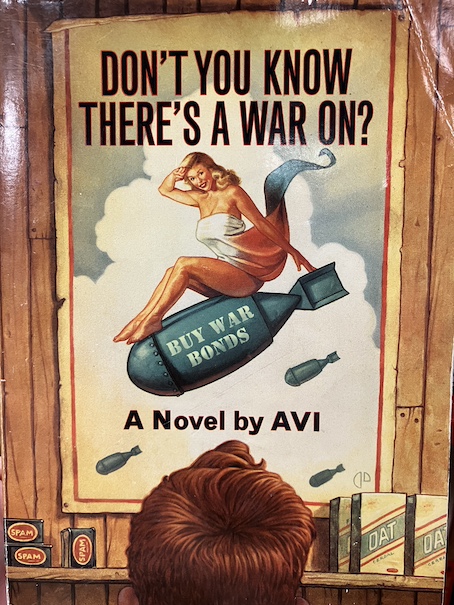
Don’t You Know There’s a War On?

In 1943, 11-year-old Howie Crispers lives in Brooklyn and goes to public school. Although he’s still a kid in school, every part of his life and every part of the lives of people he knows, like his best friend, Denny, has been impacted by WWII. Howie’s father is in the Merchant Marines, which means that he’s away most of the time, taking supplies overseas. Howie never knows exactly where his father goes because people aren’t supposed to talk too much about the movement of people and supplies for the war. The phrase “Loose lips sink ships” has special meaning for Howie. When letters from his father arrive, they arrive censored, with pieces of important information cut out of them, so Howie’s father can’t accidentally give away information that might potentially be important to an enemy if the letter was intercepted or if his family mentioned things that they shouldn’t from his letters.

Denny’s father is in the army somewhere in North Africa, and other classmates have fathers or brothers overseas or family members involved in war work in some way within the United States. The kids also participate in volunteer activities related to the war effort, like gathering useful scrap materials that can be made into supplies. Many things are rationed, and people can’t always get what they want. Sometimes, there are blackouts and air raid drills. Whenever someone has to make do with things as they are or put up with abnormal situations, they tend to shrug it off and say, “Don’t you know there’s a war on?” Howie’s noticed that phrase seems to be an excuse for a lot of things.

Howie and Denny, like other kids, love listening to plays on the radio, and popular entertainment also frequently focuses on the war. Howie and Denny are especially fascinated by stories of spies, and they start wondering if there could be spies around them even now. Their primary suspect for being a spy is their school principal, Dr. Lowminster. With most of the men they know away fighting or working in some capacity related to the war, they wonder why he isn’t also in the armed forces or doing some kind of war work. Dr. Lowminster is a strict man, and when Howie spots him leaving the school one morning just as classes are about to start, he realizes that this is something out of character for him and his usual routine.

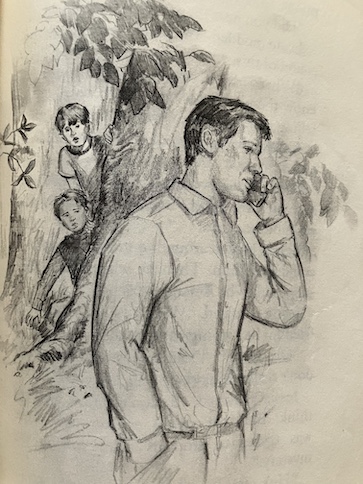
Skipping class himself, Howie follows Dr. Lowminster and overhears a conversation between him and an unknown woman about firing Howie’s teacher, Miss Gossem! Howie likes Miss Gossem and even has a secret crush on her, and he’s appalled that Dr. Lowminster wanted to get rid of her. He doesn’t give an exact reason for firing her during the discussion Howie overhears, only saying something vague about Miss Gossem not maintaining the correct moral standards. Howie doesn’t know what that means, but he’s sure that sweet, pretty Miss Gossem couldn’t have done anything bad enough to get fired.

Since he’s already suspected Dr. Lowminster of being a spy, he also starts thinking of him like the villains in radio show or movie serials, who do cruel things to get revenge on pretty women who refuse to marry them, and he considers that this could be a similar situation. Maybe Dr. Lowminster is just mad at Miss Gossem because she doesn’t love him or something. In such cases, in movies or on the radio, a hero steps in and saves the lady from the villain, so Howie decides that he’s going to be Miss Gossem’s hero!

Later, when he can talk to Miss Gossem in private, Howie confides in her that he knows that she’s being fired and that he wants to help her. Miss Gossem, who has only just learned about it herself is surprised how Howie knew, and he’s forced to confess the embarrassing details about how he spied on the school principal because he thought he was a spy. Miss Gossem says that she doesn’t think the principal or anyone else at the school is a spy and that the woman the principal was talking to was Mrs. Walsh, who is the acting school superintendent and the principal’s boss. Howie asks Miss Gossem if there’s anything he can do that would help her, but Miss Gossem says that this is something that she’ll have to work out for herself. She only asks that he not tell the rest of the class about it yet. Howie agrees, although he’s already told Denny.

He and Denny talk it over, and Denny’s still convinced that the matter might have to do with spies or something related to the war. One evening, when Howie is caught outside during an air raid drill near Miss Gossem’s apartment, a policeman tells him to get off the street, so he asks Miss Gossem if he can come in. She lets him in, and she asks him how he knew she lived there. Howie admits that he’s spied on her, too. Miss Gossem tells him that he shouldn’t be spying on her. When he sees a picture of a young man in an Air Force uniform on her table, he asks her who it is, and Miss Gossem admits that it’s her husband. She still goes by her maiden name because not many people knew that she got married. They got married rather suddenly before he went overseas, and now, she’s worried because she hasn’t heard from him and doesn’t know where he is. She worries that he might be dead. Howie confides in her that he worries about his father, too, and how he sometimes has nightmares about horrible things happening to his father.

As teacher and student confide their worries to each other, Howie asks Miss Gossem again about why she was fired and learns some things about her situation. Miss Gossem asks him not to tell the rest of the class what he knows, but he does anyway because he thinks they can help prevent Miss Gossem from being fired. Miss Gossem is upset with Howie for revealing her secrets, and she worries that, if the principal finds out, it will make her situation worse. Miss Gossem insists that she is an adult and has to deal with things herself. Howie is upset because he was only trying to help.

Howie doesn’t know what else to do, but his little sister, Gloria, who listens to romantic soap operas instead of hero stories, offers him another perspective and some suggestions that help to change the situation. Dr. Lowminster is a man, but the nature of Miss Gossem’s problems might get more sympathy from adult women … like their mother and Dr. Lowminster’s boss, Mrs. Walsh.

This story contrasts with another by the same author, Who Was That Masked Man, Anyway?, which is also about a boy growing up in the United States during WWII, coming to terms with the effects of the war on daily life and the people around him, and indulging in a little fantasy and adventure based on radio plays and popular entertainment of the time. The difference between these two stories is that the boy in Who Was That Masked Man, Anyway? lives far more in the world of fantasy and his own imagination than Howie is in this story. Both boys are inspired by radio play adventures, but the boy in Who Was That Masked Man, Anyway? has some serious problems coping with the mundane and hard realities around him and frequently acts and speaks as though he’s living in a radio play.

In this story, Howie is much more accepting of the realities of situations around him, once he understands what the realities are. He is genuinely worried about his teacher’s problems and the effects that they are having on her life. At one point, he sees Miss Gossem looking out over a cliff and worries that she might be contemplating suicide because of her despair at her situation. Fortunately, she isn’t, and although she finds Howie’s efforts to help her somewhat embarrassing, he and his friends and sister are able to get some help for Miss Gossem, at least enough that she is able to finish working until the end of the school year.

However, while Who Was That Masked Man, Anyway? had a somewhat idealized ending in spite of the characters’ troubles and the chaos around them, Don’t You Know There’s a War On? ends on a more realistic and imperfect note. The characters in Don’t You Know There’s a War On? can’t solve all of the problems around them in the end. At the end of the story, the war ends, and the characters’ lives change yet again, as they shift into a new mode where they they can’t keep saying, “Don’t you know there’s a war on?” We don’t fully get the end of everyone’s story because Miss Gossem and Denny both move away, but we know that they have to go on with their lives as they are now, changed because of the war. It’s not exactly a happy ending although it’s not completely unhappy, either, because the characters’ lives will go on. It’s somewhere in the middle between happy and unhappy with an element of uncertainty about exactly what’s going to happen and how things will ultimately end up, which is very realistic.

Because Don’t You Know There’s a War On? was written after Who Was That Masked Man, Anyway?, I had the feeling that the author wanted to revisit that time and a similar setting in a more realistic way than he did in the previous book. Both books are enjoyable, but reading each of them is a different experience. That’s not unlike real life, too. Different people can experience the same situation in different ways. There are common threads between the two stories because the boys are experiencing some shared events and elements of popular culture in their time, but because their situations aren’t exactly the same, and they have very different personalities, their stories take different directions.
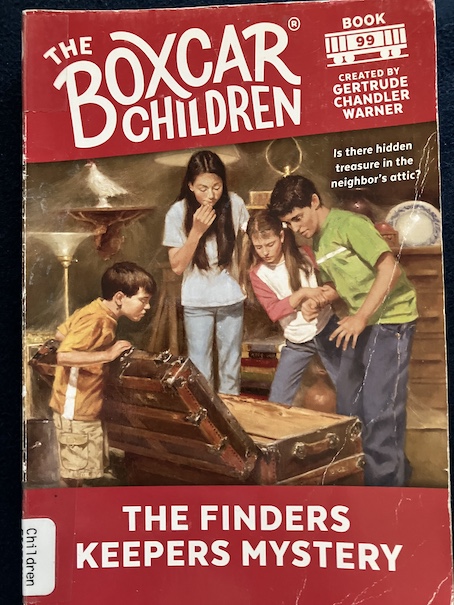
The Finders Keepers Mystery

Boxcar Children

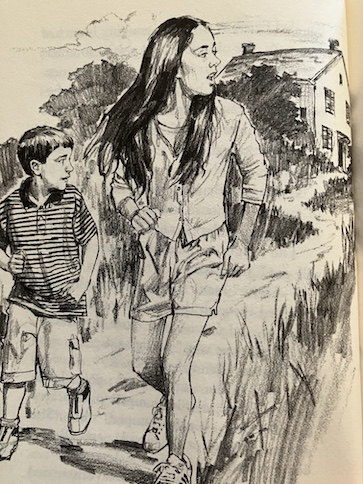
Jessie and Benny are returning from a trip to the post office when Jessie insists on taking a shortcut by the old Bidwell house, where no one has lived for a long time. Benny doesn’t want to take the shortcut at first because there are rumors that the old house is haunted. However, Jessie is eager to get home to dinner, so they take the shortcut anyway. Technically, they’re trespassing, but that’s how they find out that the house is no longer empty.

When someone bangs open one of the shutters of the house, the kids are frightened, thinking that maybe there really is a ghost in the house. However, they also notice that there’s now a broom on the porch. Thinking about it later, at home, they realize that a ghost wouldn’t be interested in sweeping. The next day, all of the Alden children go to look at the old house, and they notice a van in the driveway and that new flowers have been planted in the pots. The new owner of the house, Lina Diaz, introduces herself to the Aldens.

Lina recently inherited the house from a cousin. She’s an architect, and she’s looking forward to renovating the house. It used to belong to a great-great-aunt, Hope Bidwell, which is how the house got its name. The house is filled with antiques and family heirlooms, so Lina is going through things to decide what she wants to keep and what she might want to sell. She’s thinking of having a yard sale. The Aldens offer to help with cleaning and sorting items and setting up the sale, and Lina happily accepts the offer.

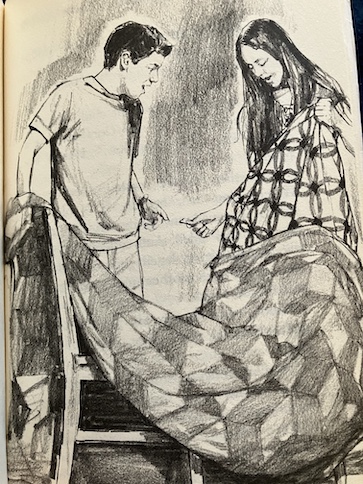
While they’re looking through things in the attic, they find a trunk with some beautiful old quilts. Lina says that they were probably made by Hope during the mid-1800s because she had a reputation for making beautiful old quilts. There is also a rumor that Hope left a treasure hidden somewhere in the house, although Lina doesn’t know what kind of treasure that’s supposed to be. She considers the quilts a kind of treasure because they’re beautiful and because of their family connection.

Lina tells the Aldens more about Hope. She was supposed to be married to a man named Robert, but sadly, Robert died of a sudden illness before their wedding. Hope supposedly made a beautiful wedding ring pattern quilt for her marriage, but nobody knows what happened to it since the marriage didn’t take place, and it doesn’t seem to be among the other quilts in the trunk. Each of them has a different quilt pattern, except for one that’s a plain gray and doesn’t seem to fit with the others, although it’s well-worn, showing that it was used a lot. A set of letters hidden in the lining of the trunk confirm the story about Hope and Robert and the existence of the wedding ring quilt Hope was making.

Almost from the moment they find those quilts, other people are interested in buying them from Lina, but Lina is reluctant to sell them because of the beautiful workmanship and sentimental value. She invites Edward Muncie from the state history museum to see the quilts because he’s an expert on quilts, he tries to persuade her to donate them to the museum. He thinks that they would make a wonderful exhibit, and he worries that they might get damaged if they’re simply left in the attic. If she isn’t willing to donate them, he says maybe he can persuade the museum to purchase them from her. Lina says that she’ll think about it, but she doesn’t really want to accept the offer.

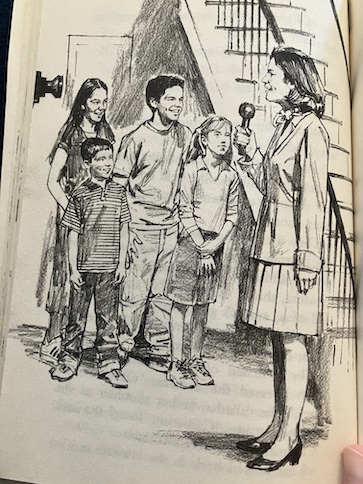
Although they tell Mr. Muncie not to discuss the quilts with anybody, it seems that he has told other people about them. Someone tries to break into Lina’s house during the night. Then, a reporter named Regina shows up at Lina’s house, insisting on interviewing her about hidden treasure and rare quilts in the house. They suppose that she heard about it from Mr. Muncie. Regina Lott does a news story about the quilts and Regina’s yard sale that gets collectors and antique dealers pounding on Lina’s door to be first to see what she has to offer … especially the quilts, although Lina still says they’re not for sale. One man who comes to the yard sale even tries to sneak into the house and look around, but the kids catch him.

A woman named Coral Weaver is the last to leave the sale. She’s interested in old clothes and cloth scraps. She explains that she owns a quilting store. She’s also interested in the antique quilts and the stories behind them. Lina doesn’t want to show her the quilts, but Coral invites her and the Aldens to come to her shop sometime so they can talk about quilts. Coral is the one who tells them that the man who tried to sneak into the house during the sale is Dirk Gray. He used to work for the state history museum, and he owns an antique store.

There is an obvious motive for many people to want the quilts because they have value as collector’s items. Collectors want them, and other people might want to sell them for the money. However, is it possible that the quilts are the key to the treasure that Hope supposedly left behind?

The book is available to borrow and read for free online through Internet Archive.

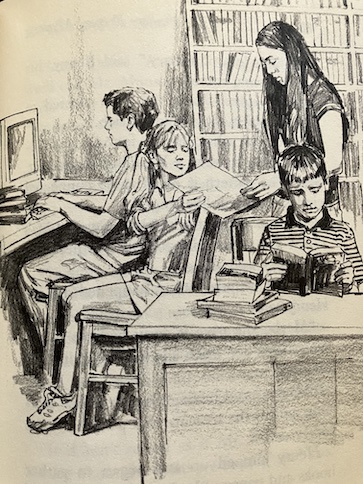
The mystery includes some interesting facts about quilts. At one point, the children go to the library and do some research about quilts to understand more about the quilts they found and why someone would want them so badly. The book explains that quilts can become collector’s items and that they can be worth a great deal of money.

The part I liked the best, though, was when they explained that quilts have different patterns, some more rare or intricate than others. Besides the wedding ring pattern quilt, the book also mentions patterns like flying geese and log cabin. The names of the patterns are based on what they resemble. Each of the patterns is a series of geometric shapes, but the shapes can resemble other things, sort of like the way basic shapes form pictures in tangrams.

The Mystery of the Orphan Train

Boxcar Children

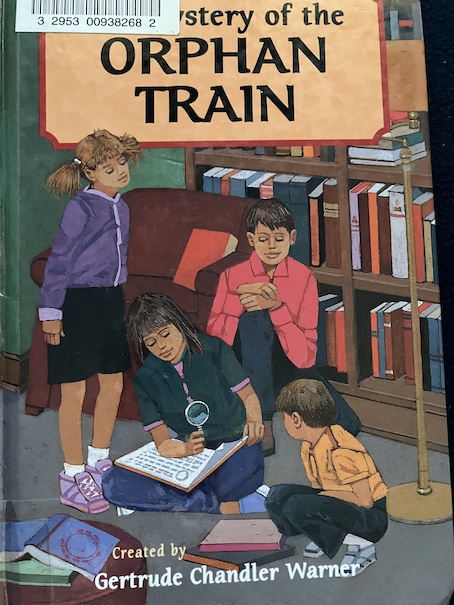
Grandfather Alden is going on a business trip to Kansas, and he’s taking his grandchildren with him. They’re going to be staying at an old Victorian house that a friend of grandfather’s, Kate, has turned into a bed and breakfast. The house has been in their family for years, and one of its claims to fame is that a famous photographer, Ethan Cape, once stayed there and photographed her grandmother, Sally Crawford. Ethan Cape was known for his photographs of famous people, like royalty and movie stars, and nobody knew why he made it a point to visit this house in Kansas and photograph a woman he supposedly never met before, who wasn’t famous at all. People have offered to buy the photograph from Kate, but she refuses to sell it.

The Aldens find the old Victorian house charming, but Kate also tells them that there’s a mystery surrounding her grandmother. Not only does nobody know why Ethan Cape came to see her and photograph her, but Sally said before she died that she had a secret to share with her family. Unfortunately, she passed away before she could tell them what it was. It might have been the reason why she knew Ethan Cape and why he came to see her, but Kate thinks they’ll probably never find out.

A woman who’s staying at the bed and breakfast at the same time as the Aldens is fascinated by the bluebird necklace that Kate wears. The necklace used to belong to Sally, although nobody knows exactly how or when she got it or how old it really is. The woman recognizes it as an antique and tries to pressure Kate to sell it to her, but Kate refuses. Even a professor who is also staying at the bed and breakfast suggests to Kate that she might want to sell something for some extra money.

Far from wanting to sell anything, Kate has been trying to find some old family antiques that were sold years before when her grandfather needed money, repurchase them, and use them to furniture the bed and breakfast. She shows the Aldens one of the pieces that she’s managed to track down and buy, an old desk. It’s a bit of a mess, so the Aldens offer to help clean it up. While they’re cleaning, Henry finds a hidden compartment in the desk with a strange message for Sally signed “Thane Pace.”

When they show the note to Kate, she’s astonished, but she recognizes the name. Thane Pace was a boy who saved Sally’s life when she was a young child. Sally had been skating one day when she fell through the ice, and Thane Pace saved her. Thane Pace himself is a bit of mystery because he didn’t live in Sally’s town. He told everyone that he had come in search of his missing sister. They had both been sent out west on the orphan train as young children, but they were adopted by different families. However, nobody knows what happened to Thane Pace because, even though he saved Sally’s life, Sally’s father soon chased him away, accusing him of theft!

Was Thane really a thief? What does his message to Sally really mean? When Kate’s bluebird necklace suddenly disappears, the Boxcar Children investigate the mysteries of Sally’s past and consider if they’re related to the mystery of the missing necklace.

I loved this story, and it’s a new favorite of mine in this series! I love how the children have to look into the past and solve a kind of treasure hunt to learn the secrets of a pair of orphans from the past and the real identity of the famous photographer who once visited the house and his connection to it. Part of the mystery might seem obvious to adults and older readers who enjoy word games, even from my description, but I enjoyed the treasure hunt and riddles that lead the Aldens to the full story of what happened all those years ago.

I enjoy books with historical references, and the story explains a little about the history of the orphan trains, which ran from the mid-1800s to the 1920s. It was an early form of organized foster care in the United States, carrying orphans, homeless/abandoned children, or children whose parents were unable to care for them away from crowded orphanages in cities on the east coast of the United States to communities in the Midwest, where children were in demand as extra helpers on farms or in houses or just as family members for people who were unable to have children of their own. The orphan trains were later replaced with more modern forms of foster care, and there are rules now regarding the transporting, placement, or adoption of foster children across state borders. These rules exist to provide greater oversight for the protection of the children, the suitability of their new placements, and their continued welfare.

One of the criticisms of the orphan trains was that they provided too little oversight over the quality of the foster parents and their treatment of the children. The way the trains worked was that they had scheduled stops, and interested members of the communities could come to view the children from the train and select one or more to take home with them. There was little other qualification for a potential foster parent to take a child than for them to simply show up and little follow-up on the treatment of the children once they were placed with a new family, especially with the early orphan trains. They were known for placing most of their trust in “the kindness of strangers” will little verification. The result was that some orphans were lucky and were raised by families who loved them, treated them well, and educated them, while others were used as little more than slave labor.

Orphan trains were also known for their disregard for the relationships between siblings. They were focused on getting the children placed in homes as quickly and efficiently as possible, and if that meant splitting up siblings because a potential foster family only wanted one child, they would do that, which is the basis for the history behind this story. Potential foster families often had in mind the age of the child they wanted before they ever met any of the children, and they were eager to get exactly the type of child they had in mind. Some families specifically wanted boys who were old enough to help with farm work immediately, and they weren’t interested in infants, who would need extra care before they would be old enough to be useful. Other families specifically wanted infants so they could raise them as members of their own families without the influence of the children’s birth families, their memories of the past, or any bad habits they may have acquired hanging over them. These differing priorities among the foster parents are the reasons why siblings like Thane and his sister were separated from each other. However, Thane never forgot his sister, and he wanted to make sure that she knew the truth about their past in the end.

The disappearance of the necklace isn’t directly related to the secrets of the past, but the necklace is important as a family heirloom and the shared connection between Thane and his sister. It’s a separate puzzle from the treasure hunt to learn the truth about Thane, but it’s still fun and interesting.

The Copycat Mystery

Boxcar Children

Aunt Jane invites the Alden Children to come visit her while her husband is out of town on a business trip, cryptically promising them “a trip back in time.” The Alden children wonder what that means, but it turns out that Aunt Jane is taking them to visit a Victorian farmhouse that’s been turned into a museum. Tour guides dress up in Victorian costumes and explain what life what like in the past.

The farmhouse museum has only opened recently, but it’s gotten off to a rocky start, and odd things are happening, and it makes the owner, Carl Mason, and the manager, Gwen, worry. When the Aldens arrive, the sign for the farmhouse is missing, and Benny finds it hidden by the old barn. Nobody seems to know who removed the sign and hid it, but Mr. Mason is angry because potential visitors would be unable to find the museum.

There also seems to be some hard feelings and tension among the people working at the museum and other members of the community. The groundskeeper, Draper Mills, who takes care of the farm doesn’t like the idea of the farmhouse being turned into a museum because he thinks visitors are going to trample the ground. Miss Penning, who lives nearby, is upset because Mr. Mason removed her great-great-grandfather’s portrait from the farmhouse. Her great-great-grandfather, Horace Wagner, used to own the farm, but Mr. Mason doesn’t want anybody to talk about him because Horace had a reputation as a practical joker. Miss Penning thinks it’s disrespectful not to acknowledge Horace’s role in the house’s past, but Mr. Mason doesn’t like the idea of practical jokes. He wants the museum to be more dignified and focused on educating people about life in the past. He think if they talk about Horace on the tours, it will make the house and museum seem more like a joke. Mr. Mason even removed Horace’s picture from the farmhouse so no one would see it. Meanwhile, Gwen is worried because the museum is short-handed over the summer. Gwen’s younger sister, Sharon, is helping out, but even so, they could use more help. Sharon seems to be quarreling with Gwen, too, although the Aldens aren’t sure why at first.

The Aldens like getting involved in projects, so they volunteer to help with the museum themselves. Dressing in Victorian clothes and leading tours sounds like fun! However, more odd things begin happening. An antique birdcage disappears and is found in an odd place with a live canary inside, and someone turns all the pictures in the house around and shortens the legs on Henry and Benny’s costumes. Odder still, Miss Penning says that each of the pranks is a copy of something that Horace did when he was alive. It’s like someone is duplicating all of Horace’s old practical jokes. The only difference is that Horace’s pranks were always in a good cause, like surprising someone with a special gift, helping someone feel better, or just being mildly silly and amusing. It seems like these copycat pranks are meant to disrupt the museum and cause trouble.

Miss Penning thinks that it’s the ghost of Horace doing these pranks, reminding people that he’s still a part of the house and that he wants acknowledgement. However, the Aldens think that it’s more likely to be a living person. Perhaps Miss Penning is doing these pranks herself to call attention to Horace’s memory. On the other hand, it could be Jake, the student reporter who is doing a story about the museum and who thinks the place seems too dull. Could he be trying to liven up his story? The Aldens also learn that Gwen has been Sharon’s guardian since their parents died, but the sisters have been quarreling because teenage Sharon wants to take part in a fashion show, and Gwen doesn’t approve. Could Sharon be staging the pranks to get even with Gwen? Mr. Mason is getting upset about all of these pranks, and if someone doesn’t put a stop to them soon, he might fire Gwen for not managing the museum well.

The book is available to borrow and read for free online through Internet Archive.

One of the themes of this story is about the differences between people’s perceptions of the past and the reality. People often think that people in the Victorian era were always “prim and proper” and joyless, but Horace Wagner was exactly the opposite. He had a quirky sense of humor and liked to display it.

Violet explains that people get the idea that Victorians were always stern and serious because they aren’t shown smiling in most old photographs, but that’s only because photographs in the Victorian era required everyone to sit perfectly still, and the subjects had to be extra careful not to move. When Horace had his picture taken, he also sat still and unsmiling, but he put the flower from his buttonhole behind his ear for the photo. Horace could never be completely serious, which is why Mr. Mason doesn’t think he fits in the Victorian museum, even though that museum was Horace’s old home. It’s ironic because the more serious view of the past that Mr. Mason likes to convey is actually a departure from the reality of the situation. Miss Penning is correct that removing Horace from the museum and never mentioning him is actually doing a disservice to the past, essentially hiding someone important to his time and the location because he didn’t fit the expected mold. The Aldens also realize that the stories about Horace are endearing to visitors and add an interesting dimension to the museum.

The solution to the mystery causes everyone to rethink a few things and to resolve conflicts they have with each other. Besides recognizing the difference between the perceptions of the past and the reality, some of the characters admit that they’ve been narrow-minded in their approaches and interpretations of other things. Gwen and Sharon reconcile when Gwen decides to allow Sharon to participate in the fashion shows. More importantly, Mr. Mason realizes that his approach to the museum was wrong and that Horace does belong in the story of the house and that it’s okay to present the less serious side of the past along with the more serious side.

I enjoyed this light-hearted mystery. I’m not a big fan of pranks in real life because they can easily go too far, and I don’t like practical jokes that seriously embarrass people or might hurt them. However, Horace was a more altruistic practical joker. His practical jokes were often meant to help people rather then hurt them. For example, when he was young, Horace’s brother was small for his age and worried that he would never grow, so Horace started shortening his brother’s pants secretly at night to make him think that he was growing, so he wouldn’t feel so bad. As the characters describe it, Horace’s pranks were generally pleasant. Only one, which he played on a local club that excluded a friend of his, was meant to cause some embarrassment to make a point about what it feels like to be excluded. Although the club members were embarrassed, his joke was pretty mild and served a higher purpose. As a character who drives the story without actually being present, I liked Horace. He was silly but basically good-hearted with his humor. By contrast, the modern practical joker copying his pranks is more self-centered and thoughtless about the consequences, although revealing this person does cause other people to consider the ways in which they’ve been thoughtless and make changes for the better.

The book ends with the characters enjoying “April Fool Pie”, which is a mock apple pie. They don’t provide an exact recipe, but they explain the ingredients.

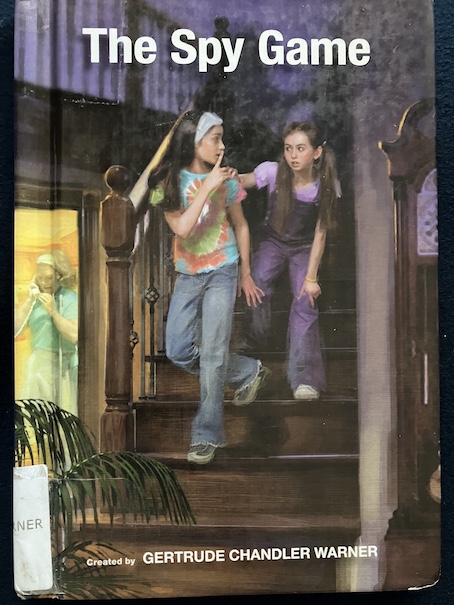
The Spy Game

Boxcar Children

Mrs. Dawson, a friend of Mrs. McGregor, the Aldens’ housekeeper, stops by one day for a visit. Mrs. Dawson is also a housekeeper, working for Amanda Penner. She has been with the Penner family for years, although her ambition is to own a book store some day. Mrs. Dawson says that Amanda has injured her ankle falling over some loose stones in a walkway at the house she inherited from her grandfather. The Alden children are sympathetic, and they offer to help fix the walkway so nobody else will get hurt. Mrs. Dawson says that she’s sure Amanda would be grateful for the help, although they notice that she’s oddly evasive when Mrs. McGregor asks her if Amanda still likes writing.

When the Aldens go to see Amanda Penner, she tells them more about the house and her family. The house is over 100 years old, and she says that it was built by an ancestor of hers for his young bride, Pandora, who was called Dora. Amanda has many fond memories of the house because, even though she didn’t grow up there, she used to visit her grandfather there every summer.

When the children start fixing the stone walkway, they notice that there are letters engraved into the stones. They wonder if the stones are meant to spell something, and when they investigate, they find it leads to a riddle. They show it to Amanda, and she says that it looks like they’ve stumbled on her grandfather’s “Spy Game.” Her grandfather was a big fan of mysteries and used to play a kind of treasure hunt game with her. The game always started with a hint in the form of “I spy with my little eye …”, which is why she started calling it the “Spy Game.” Amanda says that, when her grandfather died, he left her one last “Spy Game” that supposedly leads to something gold, but she hasn’t been able to solve it. Naturally, the Aldens offer to help her find the hidden treasure!

However, they might not be the only ones looking for the hidden treasure. Amanda’s friend, Steve, is renting the room over the garage for the summer, and they overhear him talking on the phone about getting a “treasure.” They also hear Mrs. Dawson talking about opening “Pandora’s Box.” Are Steve and Mrs. Dawson also looking for the gold that Amanda’s grandfather left for her? All is not what it seems in this tale of treasure hunts and riddles!

The book is available to borrow and read for free online through Internet Archive.

There is a fun twist to this story that I don’t want to spoil! It’s hinted at throughout the book that the story behind the treasure hunt doesn’t quite add up, but the true purpose behind the treasure hunt makes a fun surprise! Actually, there’s kind of a double surprise, but I don’t want to spoil either one.

The setting of the story is charming, an old house where a grandfather used to play treasure hunt games with his granddaughter. I always loved treasure hunt stories as a kid, and this is the kind of book I would have loved back then. I liked how the clues in the story could have multiple meanings, like the clue about a tree and a “hollow” could refer to a tree in a place called a “hollow” or to a hollow tree. Readers are given enough information that they can try to figure out the clues along with the Aldens, but I thought that the room for interpretation in the clues made it an interesting challenge.

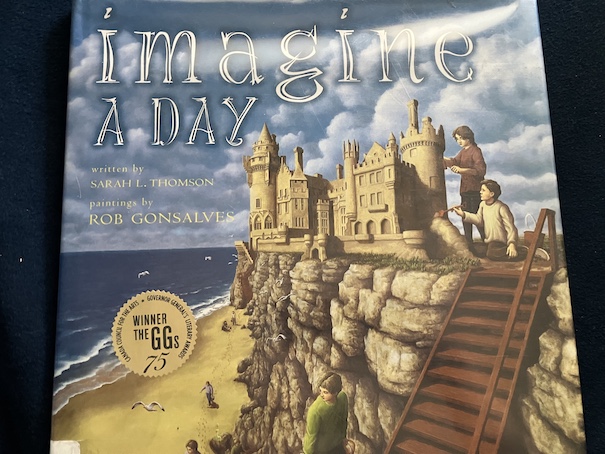
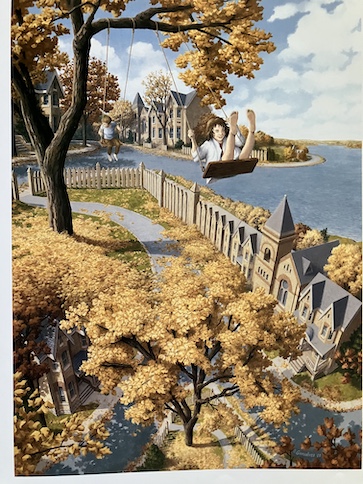
Imagine a Day

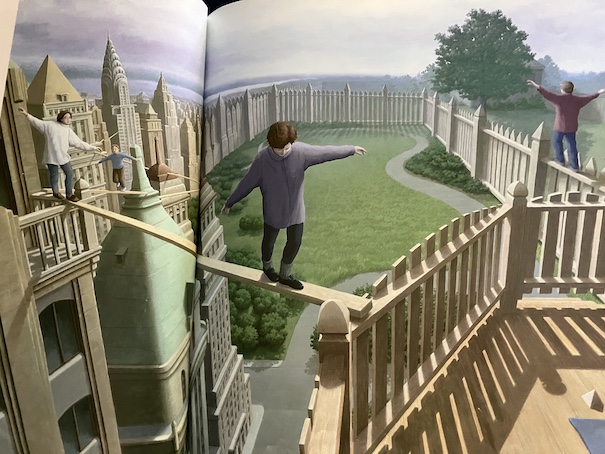
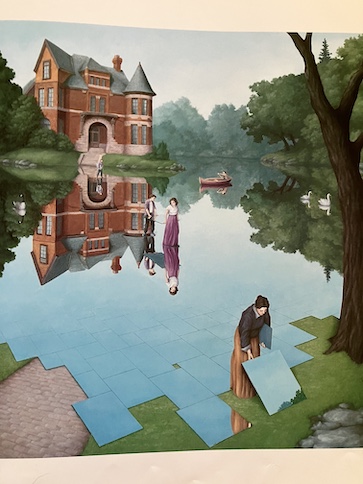
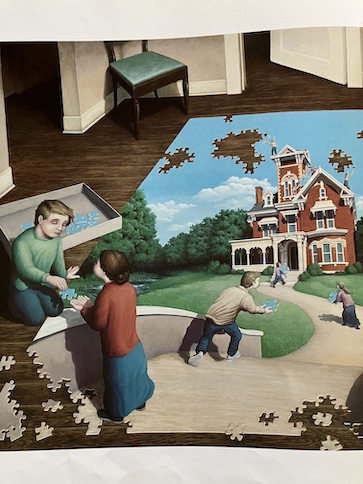
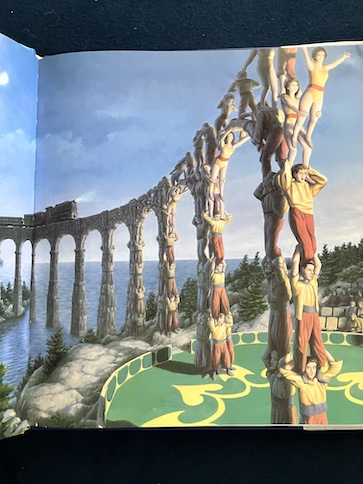
This book celebrates the power of imagination and invites readers to use their imaginations, envisioning things that are impossible but amazing!

There isn’t exactly a story to the book. Each page poses something for readers to imagine with an accompanying picture where the shifts from the real world to the imaginary or impossible one are shown.

Each of the illustrations is surreal, with perspective changes from the real to the unreal.

The book invites readers to imagine powerful and amazing things, like “when grace and daring are all we need to build a bridge”, “when you forget how to fall”, “when we build a moat not to keep strangers out, but to welcome them in”, “when everything you build touches the sky”, “when you build the world around you piece by piece”, or “when the edge of the map is only the beginning of what we can explore.” All of this amazing things are things that could happen on a wonderful day! Just imagine a day like that!

The best part of the book is the end when we “Imagine a day … when a book swings open on silent hinges, and a play you’ve never seen before welcomes you home. Imagine … today.” Books are a key that unlocks a person’s imagination!

The pictures are amazing, and they really make the book! The pictures use perspective to shift the characters and their actions from the ordinary world to the extraordinary! Fence posts or toy blocks gradually morph into buildings. Streets become rivers, and rivers become trees. People on swings or bikes start off on the ground and end up above the trees! I’ve shown a number of pictures from this book to show you what they’re like, but there are many more to enjoy!

The pictures are fascinating to look at, and each of them seems like it could represent the beginning of a story. In that way, the book reminds me a little of The Mysteries of Harris Burdick. The things the book invites readers to imagine are positive, inspiring, and uplifting, and I think this book would be good to use for a story-writing prompts. Even adults can find this enchanting book inspirational for their creative powers!

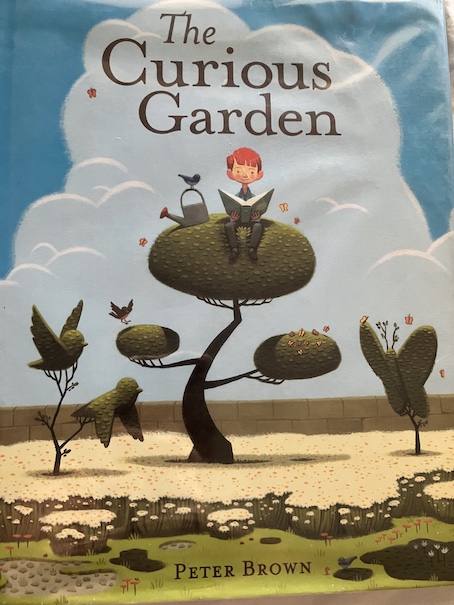
The Curious Garden

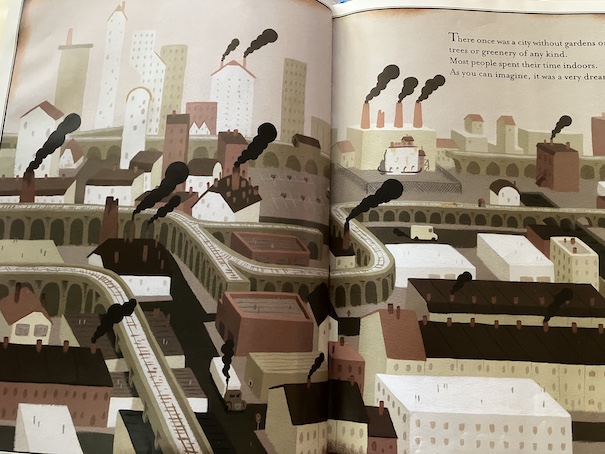
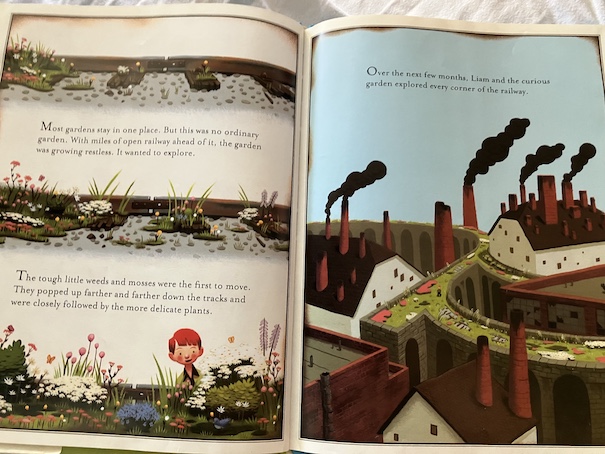
A boy named Liam lives in a dreary city where there aren’t any gardens or green spaces. Most people in the city spend most of their time inside. However, Liam likes to explore outside.

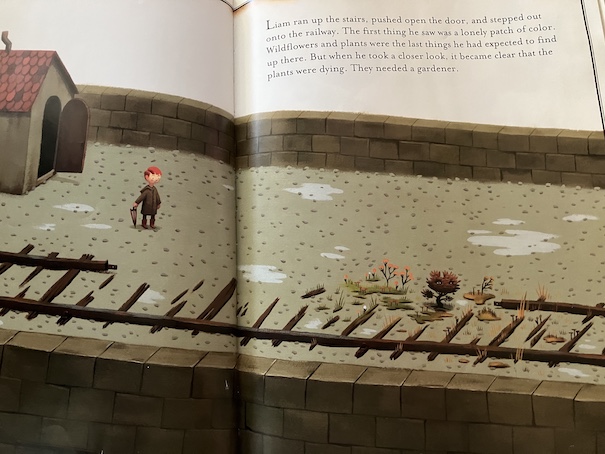
One day, while exploring some disused train tracks, he finds a few plants struggling to survive. Liam doesn’t know much about plants, but he decides to help them by giving them water. Gradually, he begins to learn more about what will help the plants, and they begin to grow and spread into a small garden.

As Liam helps the plants, they begin to spread all along the old railroad tracks. During the winter, the plants are covered in snow, and many of them are killed or have suffered badly from the cold. However, because Liam spent the winter studying about plants and gathering some gardening tools, he is able to restart the garden.

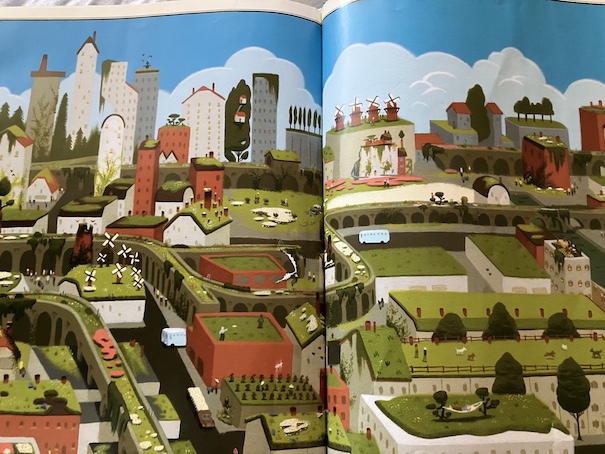
As the garden spreads through the city, other people begin to notice, and they start joining Liam in tending the garden. Greenery begins taking over places and things that are disuses and abandoned, and people encourage the plants to grow where they can enjoy them. Because of their efforts, the city is transformed!

There is an author’s note in the back of the book about the inspiration for the story. There was an elevated train in Manhattan that was shut down in 1980, and plants took over the abandoned tracks. The author, Peter Brown, considered what it would be like if the phenomenon took over an entire city.

The pictures in the book are great, and some pages are full pictures with no text, just showing how the garden grows and spreads through abandoned places in the city. I love how this story was inspired by the way plants take over abandoned places in real life. Plants can grow in some unlikely places, when nothing interferes with them, and in the story, the boy discovers that they can spread further with a little help.

By the end of the story, his entire city is completely transformed into a greener, more eco-friendly place. It’s not just that there are more plants and green spaces in his city, but the factories that we see in early scenes are no longer putting out all that smoke by the end, and we see windmills in the pictures as alternative forms of energy production. We aren’t told exactly why some things are changed about this city, but it seems like the increasing presence of the green spaces has caused people to change aspects of their lives and businesses to accommodate and preserve them. It’s an idyllic solution that doesn’t show a lot of the conflict that occurs in real life, when some people are ready for a change and others just don’t want to change. Still, I like this mage of a hopeful future because it comes as an antidote to the dystopian quality that we see in many forms of modern entertainment.

What To Do About Alice?

Theodore Roosevelt had done many things in his life, from herding cattle to hunting grizzly bears, but one thing he could never seem to do was manage his daughter, Alice. From early childhood, Alice was a lively girl, always having things she wanted to do and places to go. She called it, “eating up the world.”

Alice’s mother died when she was a baby, only two days after she was born. The loss was very difficult for her father, and people felt sorry for Alice. However, since Alice had no memories of her mother, she didn’t feel the loss so much, and she didn’t want people to pity her. Eventually, her father remarried, and Alice had half-siblings. Because of her father’s political career, the family traveled between New York and Washington, DC. Alice enjoyed this lifestyle and the experiences she had in different places where they lived.

For the most part, Alice’s childhood busy and full of fascinating experiences, but she did have problems as well. She went through a period where she had to wear braces on her legs because they weren’t growing properly. (The book doesn’t explain why she had this condition, partly because the exact cause is unknown. The common belief was that she might have had a mild form of polio, but that isn’t definite.) The braces worked, and eventually, she no longer had to wear them. Her father encouraged her to engage in physical activities and learn to ride a bicycle because he didn’t want her previous condition to make her overly cautious.

It turned out that there was little need to worry about that. Alice was a wild child! She would run off to explore the cities where she lived, and she once joined an all-boys club, sneaking them in disguised as girls! Concerned that Alice was getting too wild and becoming a bit of a “tomboy” (a girl who acts like a boy and likes things boys like – I don’t think this term is used as much anymore because the modern view is more that people shouldn’t allow themselves to confine their interests based on gender stereotypes).

Theodore Roosevelt considered sending Alice to boarding school to give her some discipline and teach her more ladylike habits, but the idea upset Alice so much that he eventually decided to let her continue her education at home. Alice used the books in her father’s library to study seriously. She read books by famous authors and studied subjects like Greek, geology, and astronomy, discussing them with her father.

When Alice was seventeen years old, Theodore Roosevelt was elected President of the United States. Alice and her half-siblings thrilled people with their wild behavior and exotic pets. (The book mentions Alice’s pet snake, Emily Spinach.) However, Alice also developed a serious interest in politics. She became a goodwill ambassador and took part in public projects, like the Buffalo Exposition. Her antics often became the subject of newspaper reports and society gossip. It earned her some criticism, but because she was such a personable young woman, she was also a social success. She gained the nickname of “Princess Alice.”

Eventually, Alice married a congressman named Nicholas Longworth. She continued to act as an advisor to her father and take part in diplomatic events. The entire time, she was known as an irrepressible personality!

I enjoyed the book for its fun look at a colorful character from American history, although it was on the cartoonish side. In multiple pictures, she is shown holding a giant spoon. It confused me a little at first, and then, I realized that it was a reference to her saying about “eating up the world.”

The Roosevelts were a colorful family in general. Teddy Roosevelt encouraged his children (and nieces and nephews, as explained in the book about Alice’s cousin, Eleanor) to be brave and daring, and Alice and her half-siblings were known for their wild stunts and the small zoo of bizarre animals that members of the family kept as pets. The book shows Alice and her half-siblings sliding down the stairs in the White House on serving trays, something that they did in real life, although it doesn’t explain in the text that’s what they were doing.

Alice was both a scandalous figure and an admired person in her time, and I thought the book did a good job showing that. She was an eccentric person who often trampled on social conventions, but she was also a highly social person and pleasant to be around, so she tended to shine in social and diplomatic situations.

Her life wasn’t always as happy and cheerful as the story shows. She had tensions with both her father and stepmother while she was growing up, and her marriage wasn’t especially happy. There were times when she opposed her husband politically, and she is also known to have had affairs with other men. Her daughter was probably the result of one of these affairs. Of course, these darker subjects aren’t exactly suitable for a children’s picture book. The book gives enough of an indication of tensions within her family by showing her father’s reactions to her various antics and the way she threw fits to convince her father not to send her to a traditional school. Overall, the book is a fun introduction to the life of a fascinating but complex person.

Bamboo

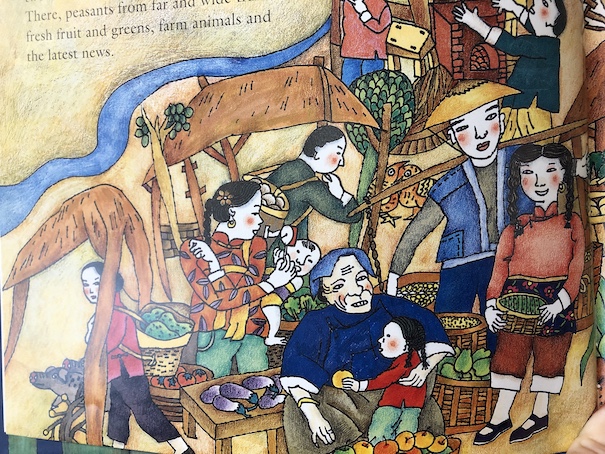
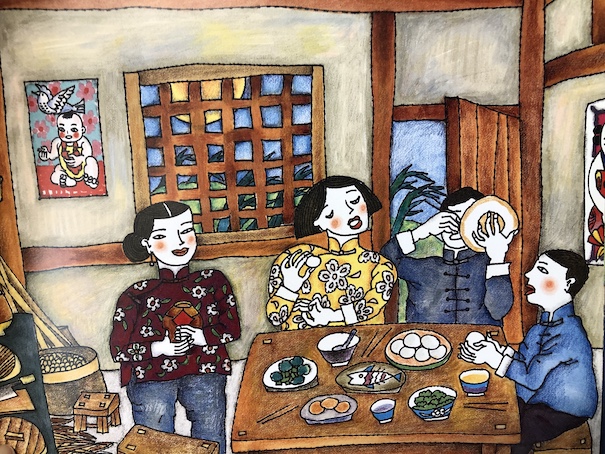
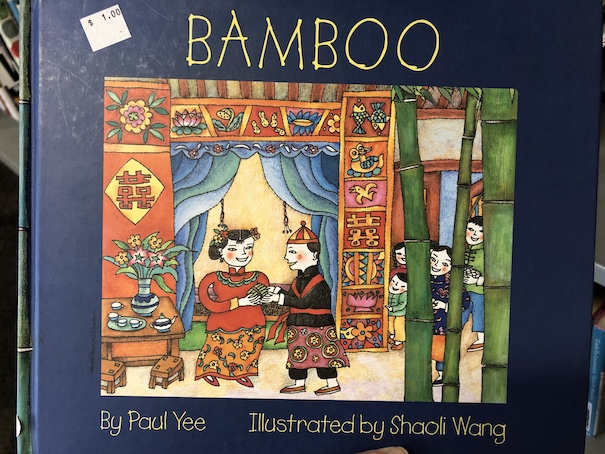
Bamboo is a young farmer. He falls in love with a girl called Ming and marries her. His brother, Banyan, approves of the marriage, but Banyan’s wife, Jin, doesn’t like Ming. When Bamboo and Ming marry, Ming gives Bamboo some bamboo seedlings, and they plant a bamboo grove.

The two couples, Bamboo and his wife and Banyan and his wife, tend the farm together, although Jin complains frequently about the farm work. Then, Jin gives birth to a son, and Bamboo thinks that their growing family can use more land. He decides to go to the New World to earn more money to buy land.

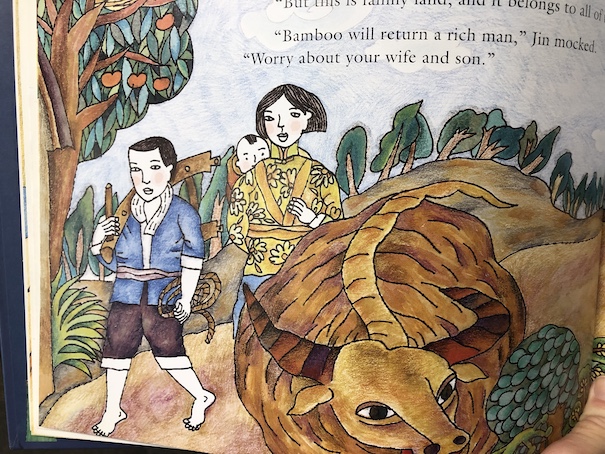
Although the two brother have shared the farmland between them, Jin convinces Banyan to claim the best parts of the farm for them while Bamboo is gone. Her argument is that Bamboo will likely return rich, and Banyan needs to provide for his family. They leave very little for Ming to use to support herself in Bamboo’s absence.

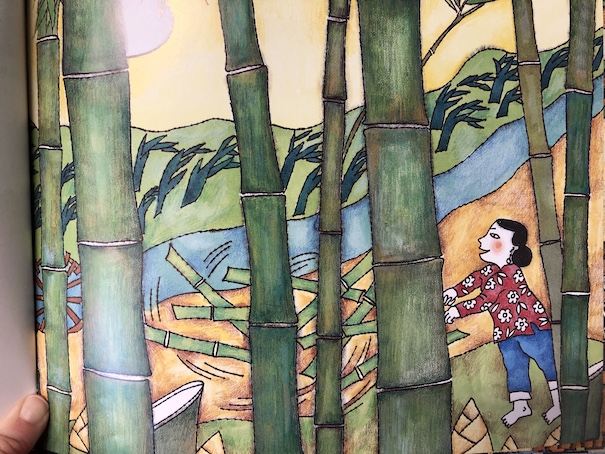
However, the bamboo that Bamboo and Ming planted is magical, and it tills the soil for Ming. When Jin discovers that, she tries to steal the bamboo poles, but they hit her instead. In retaliation, she gets Banyan to throw the poles in the river. Ming cuts a new pole, and it helps her by carrying water. Angrily, Jin gets Banyan to destroy all the bamboo, but Ming’s field still grows rice, and the bamboo grows back.

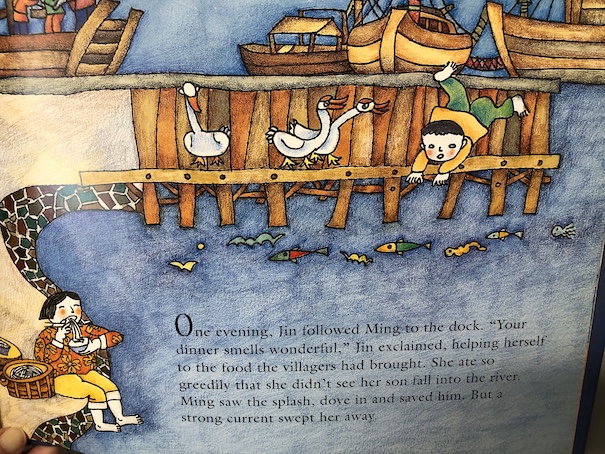
Bamboo writes to Ming that he is returning with gold, but then, she gets word that his ship has sunk. Still holding onto hope that he will return, she keeps going to the dock to wait for him. The kind villagers bring her food while she waits, but Jin eats it. While Jin is eating, her young son falls in the water, and Ming jumps in to help him. She saves the boy, but she is swept away by the current.

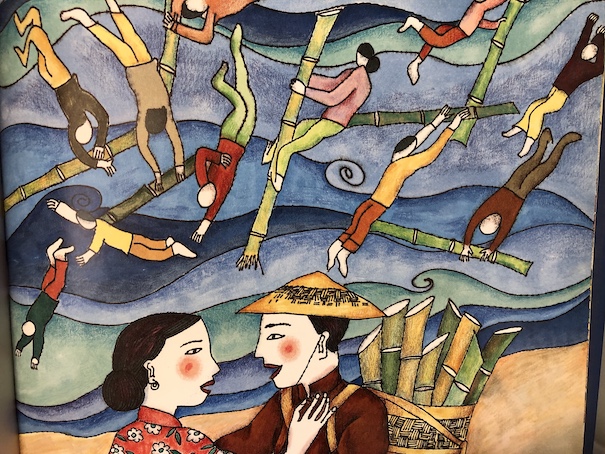
However, Bamboo saves her, and Ming discovers that Bamboo and the others on his ship were rescued by the bamboo poles that Banyan threw in the river.

The book is available to borrow and read for free online through Internet Archive.

This story is written in the style of a folk tale or fairy tale, although I don’t think it is a folk tale. The book didn’t mention that it was based on a folk tale or a retelling of an old story. It does have some similarities to fairy tales, with the cruel, greedy, and jealous relative; the kind and patient woman who is mistreated; and magical objects that help the good woman with her problems.

The trip to the “New World” and finding gold sounds a little more modern than most folk tales and fairy tales, like something that might have happened in the 19th century, but the idea of the husband being away on a long journey sets up the situation for what happens to his wife while he’s away. Like in fairy tales, everything works out for the best in the end. The bamboo poles that Banyan threw in the river save his life when they reach him, and when Ming saves her young nephew’s life, Jin apologizes for the way she’s been treating her. The story’s familiar themes are comforting. Readers can be confident that there will be a happy ending, and I liked it that the very act of throwing the bamboo poles in the river, which was meant to be a punishing act, is what saves the day.

The Christmas Doll

Young Lucy and Glory Wolcott are orphans in London during the Victorian era, 1848. Their parents died during a disease epidemic, and the penniless girls now live in a work house for orphans. They’ve been living there for 5 years, doing sewing for their support, although they are kept in terrible conditions there, with bad food. Then, another girl who lives in the work house dies of an illness, and people worry about the disease infecting others, as it did during the epidemic. Soon, other girls in the work house get sick. Lucy worries about her little sister, who is only 6 years old and already too thin from the bad food, will get sick and die, too. People begin saying that it may be safer living on the streets than being cooped up with the sickness.

The only comfort that Lucy and Glory have in their lives is each other and the story that Lucy tells Glory of her memories of Christmas with their parents. Glory was too young when their parents died to remember their parents or what life was like when their parents were alive, when they had someone to take care of them and actually had proper food. Glory loves the story that Lucy tells about the doll named Morning Glory that their mother gave her for Christmas but which was left behind when the girls were sent to the alms house and then to the work house when their parents died. Glory dreams that, someday, they’ll find that doll again. Lucy tells Glory that, when she finds her doll again, she’ll recognize her.
As more children at the work house die, Lucy increasingly fears that her sister will get sick and die. She thinks about running away from the work house with her sister, but she’s afraid of what they would do on their own. They don’t receive much food or care in the work house, and they’re subject to beatings and abuse, but what would they do on the streets, and how would they survive?

When Glory develops a cough, Lucy is sent to the sick ward at the work house, and Lucy is terrified that she will never come back. Both Lucy and Glory know that none of the girls who are sent to the sick ward with this cough have come back. Terrified, Lucy thinks that the only way to save Glory is to rescue her from the sick ward and get her out of the work house.

The two girls successfully run away, but once they’re on the streets, they have nowhere to go and don’t know what to do. They have nowhere to stay, and they have to sleep in the cold. Without food or money, Lucy trades a small pair of scissors that she brought from the work house for a couple of crumpets from a muffin seller, although a boy later tells her that the scissors were worth much more than that and that the seller took advantage of her. Lucy worries that they have no way to survive on their own because they don’t know what to do and have nothing else that they can sell or trade.

A kind washerwoman suggests to the girls that they go down to the river to join the mudlarks, who spend their days hunting for things to scavenge and sell in the mud at the river’s edge. Sometimes, she say, they find truly amazing things. With nothing else to do, the girls try it. The mud is smelly and disgusting, and at first, all they find are some old bones and bent nails. They’re about to give up when they find something that is truly amazing – a doll!

The doll is worn out, but its head is still good, and immediately, Glory declares that this is Morning Glory, the lost doll that has come back to them, just like the stories that Lucy has told her. With a heavy heart, Lucy realizes that they’re not going to be able to keep the doll. They have nothing else they can sell for money, and if they don’t sell the doll, they will have nothing to buy food and shelter.

At the suggestion of a rag and bone dealer, who is kind enough to let little Glory sleep by her fire for a time, Lucy takes the doll to a dollmaker. She hates having to do it and knows that it will break little Glory’s heart, but they are starving, and their lives are at stake. The doll is in such bad condition that only the head is worth something, and the dollmaker is prepared to offer Lucy a penny for it. That’s not much, but it’s more than Lucy was expecting. Then, something happens that changes everything for the better for Lucy and Glory.

The dollmaker notices the little morning glory flower embroidered on the apron Lucy is wearing. It’s actually Glory’s apron, and Lucy embroidered the flower for her because Glory was named after the morning glory flowers, just like her doll. The dollmaker asks Lucy who did the embroidery, and Lucy timidly admits that she did. At first, she worries that she shouldn’t confess that because she used thread from the work house to do it, and she would surely be punished for stealing if anybody knew. However, the dollmaker is impressed with Lucy’s sewing skills.

Then, before Lucy can leave the shop, the dollmaker gets word that Mary, the girl who sews the hearts on the dolls has been taken seriously ill and isn’t expected to survive. The disease that afflicted the girls in the work house is everywhere. The dollmaker worries because this particular doll shop is known for the signature hearts that are sewn onto their dolls, and the tradition is that only a girl can sew them, not an adult. Losing the girl who sews the hearts isn’t just sad but also serious for the doll shop because it’s only two weeks to Christmas, and they have a lot of orders to fill. If they can’t find another girl who can sew or break the tradition of the doll hearts, they won’t be able to complete their orders and will lose their shop’s reputation. Of course, it doesn’t take the the dollmaker long to realize that the solution to the problem is literally standing right in front of them.

Lucy is stunned when the dollmaker, Miss Thimbleby offers her the job of sewing the hearts on the dolls. It would only be through Christmas, but it would be regular work, something Lucy definitely needs. However, Lucy worries about what she will do with Glory. There doesn’t seem to be a place for her in the shop. Miss Thimbleby will let Lucy stay overnight in the shop to tend the fire, but Lucy isn’t supposed to let anyone else in after the shop is closed. Could she persuade Miss Thimbleby to let Glory in with her, or could Lucy find a place for Glory to be?

When Lucy returns to the rag and bone shop to talk to Glory, she discovers that the husband of the kind lady is much less charitable and has turned Glory out into the streets. In a panic, Lucy searches for her, losing their only penny out of her pocket. Eventually, she finds Glory with the boy who had told her that she was cheated over the matter of the scissors, Nick. Glory has told him about their escape from the work house, and Lucy sadly confesses her sale of the doll to Glory. Fortunately, Nick sees how Lucy’s new job at the doll shop can help them all.

Since the job requires Lucy to spend every night in the doll shop, tending the fire and keeping warm, Nick points out that Lucy can sneak him and Glory in after hours. In return for being allowed to sleep in the warm doll shop with the girls, Nick says that he will look after Glory during the day and that she can help him to make a little money that will help support them all. Nick is also a homeless orphan, and he get money catching rats and doing acrobatics on the streets. Glory doesn’t like the idea of the rats much, but Nick has her passing the hat while he performs on the streets. Her pitiful cough will help them get more charity.

It’s not an ideal situation, but Lucy agrees that this is the best way to manage things. Lucy continues to worry about her little sister, running around in the cold with Nick during the day, although they do have a warm place to sleep now. At night, Lucy lets Glory hold the doll Morning Glory, although she reminds Glory that the doll now belongs to the shop.

While working at the shop, Lucy notices that Miss Thimbleby also has a favorite doll, one that is never for sale. She calls this doll Charlotte and talks to it when she thinks nobody can hear here. The other women who work in the doll shop explain to Lucy that Charlotte, the real Charlotte, was Miss Thimbleby’s little sister. The sisters were orphans, like Lucy and Glory. Charlotte was much younger than Miss Thimbleby, and Miss Thimbleby raised her. Charlotte was the original hearts girl of the shop, the one who always sewed the signature hearts on the dolls and started the tradition. Sadly, Charlotte died young of an illness. The doll Charlotte was the very last one that the girl Charlotte gave a heart to before she died, and that’s why Miss Thimbleby refuses to sell it and sometimes talks to it, like she’s talking to her sister.

As Christmas approaches and Glory’s illness becomes worse, Lucy increasingly fears for her life. Glory’s illness is particularly bad on Christmas Eve. Miss Thimbleby has promised Lucy that, as part of the tradition of the hearts girl, Lucy may choose any unsold doll in the shop for herself on Christmas Eve. Lucy has her sights set on Morning Glory so she can return her to Glory, but a series of unexpected events and a generous, good-hearted decision from Glory lead to marvelous changes for the girls.

The book is available to borrow and read for free online through Internet Archive (multiple copies).

This story, set in a Dickensian London in the mid-19th century is touching and sometimes a bit tear-jerky, but it’s full of old-fashioned Christmas spirit! The book doesn’t minimize the risks to the children’s lives. The lives of poor people in this period were harsh, and children were vulnerable to being orphaned or even dying young of disease. The story even talks about children being taken advantage of by unscrupulous and uncaring adults, whether it’s being cheated out in a trade for food or the talk of children on the streets being kidnapped and forced into servitude as chimney sweeps. Parentless children on the streets wouldn’t know which adults to trust, and those realities are shown in the story. The children’s worries and hardships make the happy ending of the story touching.

Some readers might guess at the likely, most happy ending for the girls because there is one adult in the story who would have sympathy for a pair of orphaned sisters. The eventual fate of Morning Glory and whether her loss or gain would help Glory hangs in the balance for most of the story. The role Morning Glory plays in the ending of the story is important, and it’s Glory’s decision about Morning Glory that helps determine the girls’ fate and also touches two other lives. Don’t worry about the doll, though. The story works out well for the doll, being with someone who truly needs and appreciates her. The lives of all three children are changed for the better in the end, too.