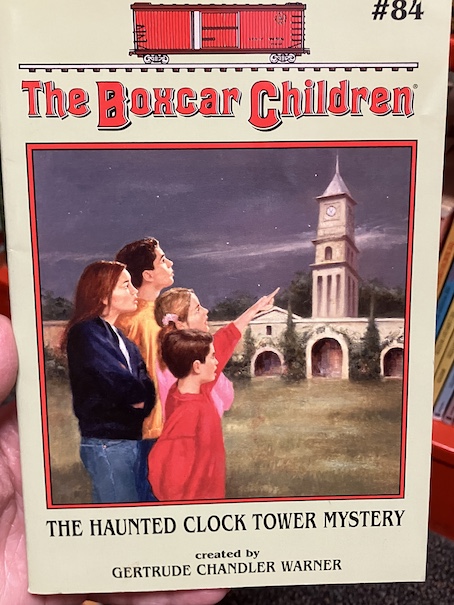
#84 The Haunted Clock Tower Mystery by Gertrude Chandler Warner, 2001.
Grandfather Alden is attending a reunion at his old college, Goldwin University, and he brings his grandchildren with him so he can show them where he went to school. The children are fascinated with the beautiful campus, especially with its clock tower. Their grandfather and Ezra Stewart, who works at the college and is responsible for maintaining the clock tower and playing its carillon bells. Ezra demonstrates to the Aldens how the carillon bells work, and he also shows them the smaller training keyboard, where he has trained his assistants. Ezra plays concerts for the campus on the carillon bells, but he gets irritated with his new assistant, Andrea Barton, because she never puts his music back where it belongs.
The Aldens run into Grandfather Alden’s old college roommate, Joel Dixon, who is also there for the reunion. Joel brought his son Don with him because Don has business in the area, and he’s been interested in the college since he started reading a book about it. At dinner, they also meet Grandfather Alden’s old history professor, Julia Meyer, who says that she’s working on a special project, but is mysterious about it.
That night, Benny sees a light in the clock tower. Ezra insists that nobody goes into the clock tower at night, and Benny wonders if it could be a ghost! Then, someone sabotages the carillon. Was it the mysterious night visitor, and if so, who could it be and why?
When the children look at the book Don has been reading, they learn that there may be a secret hidden treasure on the campus that dates from the Civil War. Is their mysterious “ghost”, looking for it, too? Is Don the one searching for the treasure, or is could it be the history professor or maybe Ezra’s new assistant?
The book is available to borrow and read for free online through Internet Archive.
My Reaction
I always like treasure hunt stories, and I enjoyed seeing the Aldens figuring out the clues to find the hidden treasure! They know that someone else is looking for the treasure, too, and I thought at least one person was a really obvious suspect. What I like about this book, though, it’s that it’s one of those stories where each of the potential suspects has something to hide. There isn’t just one person who’s been sneaking around the clock tower at night. Different people have been there for different reasons, not all of which have anything to do with the treasure. Part of the mystery involves figuring out who is doing what in the clock tower and why.
The addition of the carillon to the story is a fascinating and unique feature. I’ve seen carillon bells before, but I enjoyed hearing Ezra describe how they use the training keyboard for practice. I think, for most kids in the target audience for this book, this story be their first introduction to the idea of a carillon.
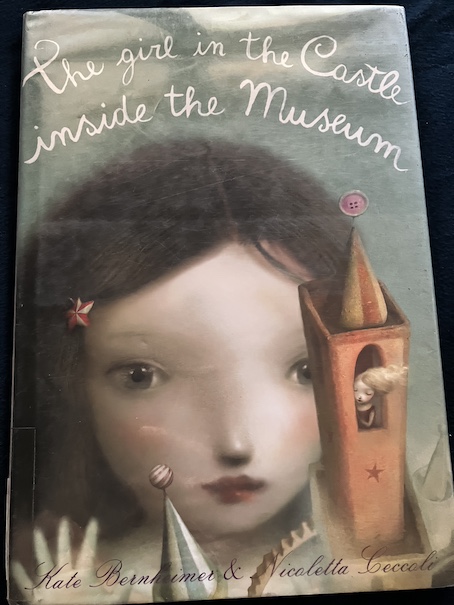
The Girl in the Castle Inside the Museum by Kate Bernheimer, pictures by Nicoletta Ceccoli, 2008.
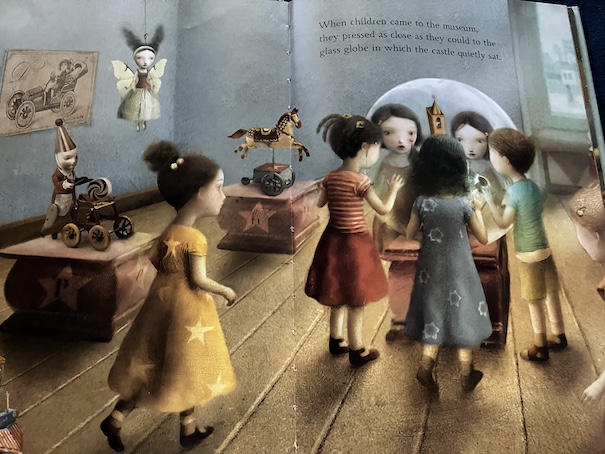
In this story, there is a little girl who lives in a castle in a museum, inside a big, glass globe.
Children love to come to the museum and look at her in her castle. The girl also likes it when the children come to see her.
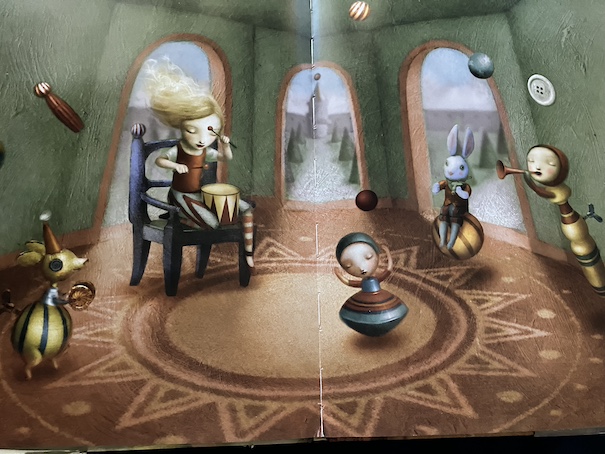
Although the girl in the castle has other creatures to play with and things she likes to do, like making music, she sometimes gets lonely when the museum closes, and all the children go home.
When the girl in the castle dreams, she dreams of the children who come to visit her at the museum, imagining their journeys to come see her.
When the children are visiting or when she’s dreaming about them, the girl isn’t lonely, but when she wakes up from a dream and there aren’t any children, she gets lonely again.
However, the girl gets an idea. If you, the reader, want to be her friend, you can give her your picture. When she looks at your picture, she won’t be lonely anymore!
My Reaction
I love the surreal, fantasy pictures in this book! We don’t know exactly what the girl is or why this tiny girl lives in a miniature castle in a museum. The book says that people claim “she’s lived there forever.” She is alive and has feelings, but she seems to be surrounded by fantasy creatures as companions in her castle rather than other people. She doesn’t seem to have parents or family. My theory is that she is a magical, living toy because the museum seems to be filled with other toys, the fantasy creatures in her castle seem to be toys with little wind-up keys in their backs, and the castle itself incorporates little toys and odd-and-ends, like buttons and marbles. However, the girl’s backstory is left up to the imagination of the readers.
This book breaks the fourth wall of the book, with the girl inviting readers to put their own pictures into the book and saying that the girl can see them through the book when they read it. Readers looking at the book keep the tiny girl company when she doesn’t have visitors to her museum. It’s not the first book that I’ve seen that uses the concept of readers keeping a book character company through their books. There is a book from the 1930s called The Tale of Corally Crothers, where a lonely girl with no brothers and sisters goes in search of a friend and finds you, the reader. (I haven’t found a copy of it myself, but you can see some pictures of this book on this site.) Books that involve the reader and invite the reader into their world are charming, and I found the fantasy elements of this particular book delightful!
Whose Garden Is It? by Mary Ann Hoberman, illustrated by Jane Dyer, 2001.
This is a cute picture book, told in rhyme, about who is the real owner of a garden.
One day, Mrs. McGee goes for a walk and passes a beautiful garden. She wonders aloud whose garden it is. Of course, the owner of the garden, who is tending the plants speaks up, but he’s not the only one.
A small rabbit also tells Mrs. McGee that the garden belongs to him because he’s lived there his whole life, and he eats the vegetables. Then, a woodchuck says that’s nothing because he eats everything that grows in the garden. A bird chimes in, saying he eats the worms from the garden. Then, a worm says that worms are there to make the soil in the garden better, so he’s the real owner of the garden.
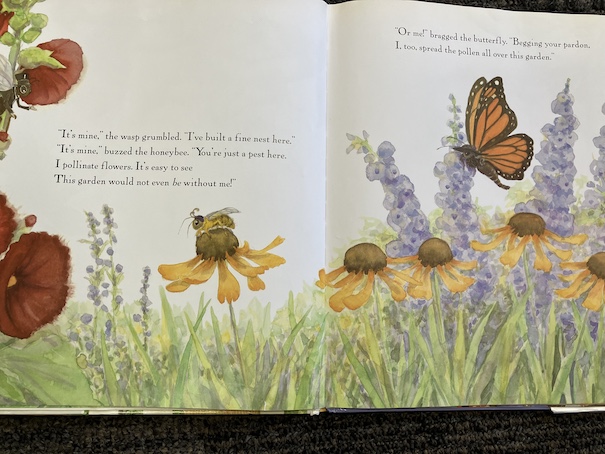
Various other creatures, big and small speak up, each of them pointing out that they live in the garden, what they’ve done for the garden, and what the garden has done for them. The bees and butterflies pollinate the flowers.
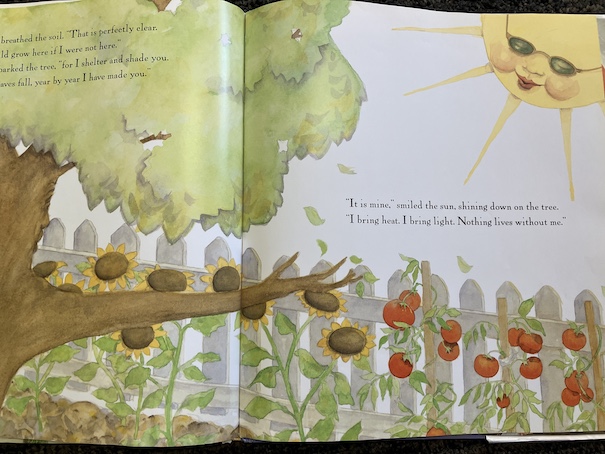
But what about the plants in the garden? They have a strong argument that they are what makes the garden a garden. Then again, the soil is where the plants grow, and the plants need the sun and rain to grow. Also, all plants grow from seeds, so the garden exists for the seeds that will be the future plants.
It seems that the answer to Mrs. McGee’s question isn’t as easy as she might have thought.
My Reaction
This is a charming story about how various plants, animals, creatures, and forces of nature are interconnected. The book doesn’t use the word “ecosystem“, but that’s the concept being described here. The garden’s ownership and the reason for its existence is much more than the gardener who owns the land and planted and tended the garden; it’s everything that’s growing in it, everything that contributes to its growth, and everything that depends on the garden. Without all of these creatures and natural forces put together, the garden wouldn’t be what it is.
The book doesn’t attempt to get scientific about the details of this garden ecosystem, and the animals wear clothes and talk, so the story isn’t meant to be entirely realistic. However, it is thought-provoking about how many different parts of nature affect each other. It could be a good book for introducing the topic to young children before teaching them about the science of ecosystems later. The rhyme scheme makes the story fun to read.
Isabel’s House of Butterflies by Tony Johnston, illustrated by Susan Guevara, 2003.
The story begins by explaining that the forests of Michoacan, Mexico are a sanctuary for monarch butterflies, but that sanctuary is in danger because of logging activities. The large-scale industry is a major threat, but sometimes poor people living in the area also chop down trees because they need to sell the wood. The author notes that there have been efforts to preserve these trees, but it’s difficult to enforce laws protecting them, and no one is sure what will happen to the monarch butterflies if the trees disappear.
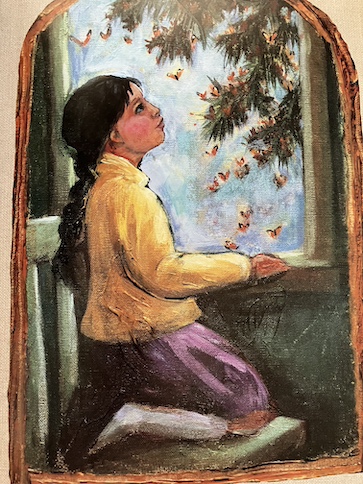
Isabel is an eight-year-old girl living with her family on a small farm, and the tree outside their house attracts butterflies on their migration route. She calls it, “La casa de las mariposas,” which means “The House of Butterflies.” Her family is poor, but they can’t bring themselves to chop down their special butterfly tree, like other families in the area have done. They love it that the butterflies appear there every autumn, and they think it’s a beautiful miracle to see them return every year. Sometimes, tourists come to the area to see the butterflies, and that brings the family a little extra money.
However, one year, there is very little rain, and they have a very bad harvest. The family sells their pigs and continues on as best they can, but their money is running low. They don’t have many resources left for money, and Isabel’s father is reluctantly considering cutting down their butterfly tree. He doesn’t want to do it, but he doesn’t know what else to do.
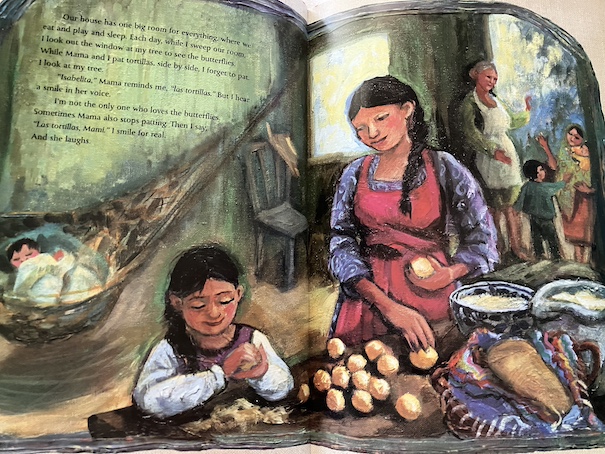
Isabel is distressed at the loss of the tree and the butterflies, so she suggests another plan to her parents. She often helps her mother to make tortillas, so she tells her mother that maybe they can set up a stand selling tortillas to the tourists who come to see the butterflies. The family decides to give Isabel’s plan a try.
The book is available to borrow and read for free online through Internet Archive.
My Reaction
The story ends on a somewhat hopeful note, but it bothered me a little because it’s not definite that Isabel’s plan is going to work. Isabel is hoping that they’ll be able to make enough money that they won’t need to cut down the tree, but we only see them getting set up, so we don’t know if they’re successful or not. I would have preferred to see them succeeding so we would know that things are going to get better, but the story just ends at that point, and it’s left up to the minds of the readers whether they were successful or not.
I think that hopeful but slightly worrying note at the end of the story is meant to reflect how people trying to preserve natural resources often feel – they have ideas and plans to help preserve natural areas and resources, but nobody knows for sure what will work or how well their plans will work. It’s realistic, if a little bit of a let-down. However, while nothing is guaranteed to be successful and life has its uncertainties, there is hope in the people who are willing to try different approaches to problems rather than simply giving up. The book does speak to the concerns that modern people, even children, have about the environment and the search for systems that work better than the ones that we already have.
The pictures in this book are soft, colorful, and lovely. Although the family is poor, they appreciate the small pleasures in their lives, like making the tortillas and the yearly appearance of the beautiful butterflies. I did also feel a little sorry for the butterflies the pigs ate, but the story doesn’t dwell on that part too much.
This book was published by Sierra Club Books for Children, and there is a small note with the publishing information about the origins of the Sierra Club, which is dedicated to protecting scenic and ecological resources.
Princess Hyacinth by Florence Parry Heide, illustrated by Lane Smith, 2009.
For reasons nobody understands, Princess Hyacinth is not affected by gravity, and she floats upward anytime she is not restrained or weighted down.
It’s a real problem because, while it’s difficult enough when she floats up to the ceiling of the palace, if she were allowed out of the palace without something weighing her down, she would simply float away.
Princess Hyacinth’s parents go to great lengths to make sure that she is always secured to something or weighed down with special weighted clothes and a very heavy crown.
Of course, being weighted down all of the time makes life difficult for Princess Hyacinth, too. She wishes that she could go outside and play and swim with the other children, but she can’t because she can’t be outside without the weights. There is one boy in particular who comes by her window with a kite with a crown on it and says hello to her, but it would be difficult for her to go out and play with him.
Then, one day, when Princess Hyacinth is particularly bored and tired of being weighted down, she persuades a balloon man to tie a string to her and let her float among his balloons. At first, it’s fun, floating along as the balloon man walks through the park, but then, the balloon man is startled by a dog and accidentally lets go of her!
As Princess Hyacinth floats upward into the sky, she is thrilled because she has never felt so free in her life, but where will it end? How high can she go, and is there any way for her to get back? Fortunately, there is a way for her to get home, with the help of a friend!
The book is available to borrow and read for free online through Internet Archive (multiple copies).
My Reaction
This story reminded me of a much-older story from the 19th century, The Light Princess, but this picture book is much, much less serious than that book. In The Light Princess, the princess is cursed, and the story is about breaking this curse that has afflicted her all of life. In this book, there is never any explanation about why Princess Hyacinth isn’t affected by gravity, and she is never cured. Instead, she makes a friend who helps her find a way to live with her condition and enjoy it.
I liked the art style in this book. I found it amusing that the king, queen, and palace guards are drawn in the style of the face cards in a deck of playing cards. Princess Hyacinth is a cute little girl, and when she’s wearing her heavy princess gear, you can almost feel the weight of it on her. In the end, there are still times when she has to be tied down, but she seems more normal, less weighted down, because she has found someone to help her deal with her condition.
Hanukkah at Valley Forge by Stephen Krensky, illustrated by Greg Harlin, 2006.
It’s a cruel winter at Valley Forge, during the American Revolution, and George Washington is worried about the welfare and morale of his soldiers.
As Washington walks through the camp, he sees a young soldier lighting a candle and reciting something softly to himself.
Curious about what he’s doing, Washington stops to talk to him, casually remarking on how cold the night is. The young soldier says that he saw colder nights when he was young in Poland, and he is lighting candles for Hanukkah. Washington asks him what that means, and the soldier explains the meaning of the holiday.
The soldier recounts the story of how Israel was conquered by the Ancient Greeks, who forced Jewish people to worship Greek gods and tried to replace Jewish customs with Greek ones. Washington also says that he understands what it’s like to feel like you’re under the thumb of a king who lives far away and the desire for liberty. The Jewish soldier says his family left Poland for similar reasons, because they were not being allowed to practice their beliefs there.
Returning to the story of the ancient Israelites, the soldier explains that a priest named Mattathias refused the Greeks’ orders to bow to idols, and he fought back against the Greeks. Mattathias and his five sons, who were called the Maccabees, led a rebellion against the Greeks. They were a small group, and the odds were against them, but they were determined to continue the fight against their oppressors. Washington says that he understands the feeling because his army is in a similar position.
Continuing the story, the soldier recounts how Mattathias’s son, Judah, inspired their troops by reminding them that God was on their side, leading them to victory. When they finally managed to overthrow their Greek rulers, they took back their Temple and lit the Temple menorah. The menorah was supposed to be kept lit constantly, and they were worried because there was very little oil left. They only had enough to keep it burning for one day, and they weren’t sure when they could get more oil. However, they lit the menorah anyway, trusting that God would somehow provide them with more soon. It took them eight days to find more oil for the menorah, but to their surprise, the menorah continued to stay lit all the time they were searching, lasting eight times longer than they thought it would with the amount of oil they had. Hanukkah became the commemoration of this miracle.
George Washington contemplates the story that the soldier told him, and he finds it inspiring. It reminds him that, even though their current situation in Valley Forge may seem bleak, there have been others before them who have also faced steep odds in their struggles and who still managed to succeed. He begins to think that, if they persevere, they may also be gifted with a miracle of their own.
There is an author’s note at the end of the book that explains the inspiration behind the story. As the characters in the story do, the author draws parallels between the American Revolutionary War and the historical battle that began the tradition of Hanukkah. The author learned that George Washington may have learn about Hanukkah during the Revolutionary War, although there are no entries in his diary to confirm it, so he used excerpts from George Washington’s other writings to explain his sentiments. The author also offers commentary on bullies and the importance of standing up to oppressors, both in the context of war and in daily life.
This book won the Sydney Taylor award from the Association of Jewish Libraries.
My Reaction
I love books that include little-known or lesser-known events. Whether this one happened or happened in the way the author tells it is difficult to verify, and it seems likely that it’s more of a folk tale than an historical account. George Washington was a real, historical person, but so many legends have grown up around his life that it’s sometimes difficult to tell whether certain stories about him actually happened. As the author says, Washington’s own diary doesn’t offer any verification about this particular incident. Other reviewers of this book, including J. L. Bell, who specializes in Revolutionary War history in the Boston area, have attempted to trace the origins of this particular story about Washington learning about Hanukkah during the Revolutionary War. In his blog, J. L. Bell explains the known sources for this story, which vary in their description of exactly when the encounter between Washington and the Jewish soldier took place and what the soldier’s name was. The soldiers who have been credited with having this encounter with George Washington were real people, but there’s nothing that definitively proves that the discussion about Hanukkah actually happened with any of them. The story is probably more folklore than history, and Bell believes that it started to circulate during the 20th century, when there were more immigrants arriving from Poland with stories and experiences like the one the Polish soldier in the story tells about not being allowed to practice their religion openly. Even so, the parallels the story draws between the ancient rebellion of the Maccabees and the American Revolution are fascinating.
There are certain feelings that are universal among humans, and the author’s point that nobody likes being oppressed by a bully, whether that bully is another person or a government or an army, is true. No matter what you’re up against in life, perseverance in the face of hardship is important, and miracles can come to those who continue to stand up for themselves and what they believe in. It is also true that people who come from different sets of circumstances can help to inspire each other by sharing common feelings about their struggles.
Noel by Tony Johnston, art by Cheng-Khee Chee, 2005.
This lovely Christmas picture book reads like a Christmas carol!
There is no story in the book. The text is poetry that celebrates the atmosphere of Christmas, the feelings in nature as anticipation builds and in cities as people gather to celebrate.
“Noel” is described as the sound of Christmas, like a bell, that people and animals all listen to hear.
The artwork is beautiful, and there are scenes of people participating in classic Christmas celebrations, with a Christmas parade, snowmen, a public Christmas tree, and a sleigh ride.
The pictures really make the book beautiful and dreamlike. In the back of the book, there is a section that explains the art style. The artist used watercolors and a technique called “saturated wet-paper technique.” This technique is what gives the illustrations their fuzzy, dreamlike quality
The book is available to borrow and read for free online through Internet Archive.
The Little Fir Tree by Margaret Wise Brown, pictures by Jim Lamarche, 1954, 2005.
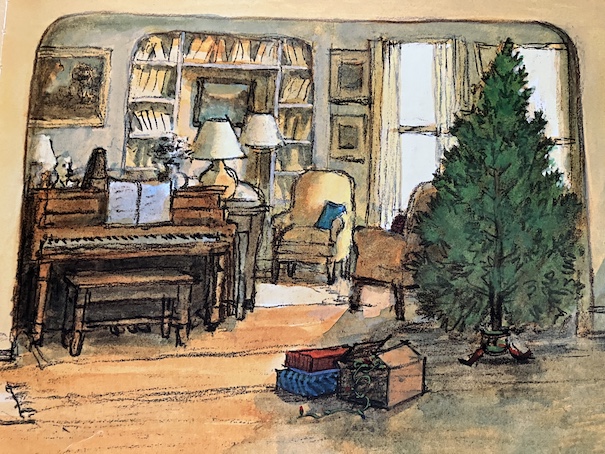
A little fir tree feels lonely among the large trees in the forest, but something happens that changes his life forever – he is chosen to be a living Christmas tree for a little boy!
One winter, the boy’s father carefully digs up the tree and brings it home to his young son, who cannot walk because of a lame leg. The boy has been wanting to see the trees in the forest, but since he can’t go to the forest himself, his father has brought a free to him. The little fir tree loves being decorated, and the next evening, guests come and gather around him, singing Christmas carols.
In the springtime, the boy’s father takes the tree back to the forest, where he found it, and he plants the tree again so it will continue to grow. However, the following winter, the boy’s father returns to dig up the tree again and take it back to the boy for Christmas.
The little fir tree loves this ritual of visiting the boy and his family and being their Christmas tree every winter, but the next winter after that, the man doesn’t come to dig him up. The little tree is disappointed and lonely, but he is in for a surprise. This winter, the boy and his family come to see him in the forest!
The book is available to borrow and read for free online through Internet Archive, although that copy has different illustrations.
My Reaction
I mainly know Margaret Wise Brown for Goodnight Moon and The Runaway Bunny, but I found this Christmas story charming. I don’t like Christmas stories from the point of view of trees that are cut down, like the Hans Christian Andersen story, The Fir-Tree, which has a really depressing ending. I like it that this family in this book keeps the tree alive, returning it to the forest every year to continue growing. Things change for both the boy and the tree over the years, as they both continue to grow, but they change for the better, and they continue to be fond of each other and a source of inspiration for each other.
When I was a kid, our elementary school had a large tree on a hill on the kindergarten playground, and the story behind it was that it was once a living Christmas tree from the very first kindergarten class at the school. That tree is still there and alive today, about 50 years after it was first planted there and more than 30 years after I used to play under it. I like to imagine that it will be true of the little fir tree, too, that it will continue growing over the years.
Earlier versions of this book had different illustrations, but personally, I love the illustrations in this printing because they’re detailed and realistic. The version on Internet Archive has illustrations by Barbara Cooney, who is known for Roxaboxen and Miss Rumphius. Cooney’s illustrations are also good, but not as realistic as Larmarche’s, and they’re in a limited color range.
One other difference between versions of the book is that the earlier version also included the musical notes for the carols that the children sing and additional songs that aren’t included in the later version of the book. I enjoy books that include actual music and lyrics, like books that include recipes, because they are fun extras and add an extra dimension to the story by providing an accompanying activity. Although I like the more detailed and realistic illustrations of newer edition of this book, I do prefer the actual music and wider range of songs from the older version.
Yetsa’s Sweater by Sylvia Olsen, illustrated by Joan Larson, 2006.
Yetsa and her mother go to her grandmother’s house to help her prepare wool for making a sweater. Yetsa is getting too big for the sweater she’s wearing, but she still loves it because her grandmother knitted designs in it that have personal significance to her and her family.
Yetsa’s grandmother builds a fire and brings a large pot for the wool. They have to sort through the fleeces they received from Farmer McNutt and remove any little twigs or hay or anything that doesn’t belong. Yetsa yells when she finds some sheep poop stuck in the fleece. After they’ve removed the debris as best they can, they wash the fleece in hot water over the fire. Then, they rinse it in cool water and wring it out.
While the wool dries on the clothesline, they take a break and have some bread and blackberry jam.
The following week, they begin pulling apart the fibers of the wool, making it fluffier, a process called “teasing.” Then, Yetsa’s grandmother runs the wool through a carding machine, and they begin spinning it into yarn with a spinning machine.
When the spinning is finished, Yetsa’s grandmother has enough wool to make many sweaters.
In the back of the book, the author explains that Yetsa is her own granddaughter and that knitting is a traditional skill for Coast Salish women. They learned knitting from Scottish settlers who came to British Columbia, and the sweaters they made came to be called Cowichan sweaters, after the largest tribe in the region. Children like Yetsa begin learning how to prepare wool and knit at a fairly young age.
The book is available to borrow and read for free online through Internet Archive.
My Reaction
I love books that show people making traditional crafts, and I enjoying following this one from beginning to end! Readers get to see each step in the process of making the sweater, starting with the wool and ending with the finished sweater. I’ve been knitting from a young age, but I’ve never tried spinning my own wool, and I liked seeing the intricate patterns of the sweater.
When I was a kid, I often ignored authors’ explanations because my focus was on the story, but as an adult, I like the added details of author’s explanations. This is a family story because Yetsa in the story is based on the author’s own granddaughter.
The Case of the Bicycle Bandit by James Preller, 2001.
Jigsaw Jones and his friend, Ralphie, have to go to the library to get books for a book report at school. While they are at the library, somebody steals Ralphie’s bike!
First, it’s strange that Ralphie’s bike was stolen because Ralphie is sure that he locked it up using the same chain that he used to also lock up Jigsaw’s bike. How could someone take a bike that was chained up, and since the two bikes were chained together, why is Jigsaw’s bike still chained up, as if the lock was never opened?
Second, if someone could get the chain open to take one of the bikes, why did the thief take Ralphie’s bike? Jigsaw’s bike is new and in good condition, while Ralphie’s bike, which he calls “Old Rusty”, is old, beat-up, and always breaking in some way. Ralphie is fond of “Old Rusty”, which was a hand-me-down from his older brother, but if some stranger had a choice of stealing one of two bikes, wouldn’t it make more sense to take the one that’s in better condition?
Jigsaw Jones calls his friend, Mila, to help him investigate and find Ralphie’s missing bike, and they get some help from a classmate who is good at drawing portraits to interview witnesses and do sketches of suspects. Their most likely suspect is a skateboarder whose face nobody saw clearly. But, how did the skateboarder know how to open the lock on the bike chain, and why did he take only the old bike and lock up the newer one again?
The book is available to borrow and read for free online through Internet Archive (multiple copies).
My Reaction
Books in this series are easy, beginning chapter books with pictures that accompany the story. The mystery in this book is pretty simple, although it might seem more difficult to younger readers. I liked the way the characters reasoned it out, logically confronting the problem of how the thief opened the bike chain and why the thief took the older bike instead of the new one. I also enjoyed their use of an amateur sketch artist to find one of their suspects.
Even after Jigsaw does a stakeout and realizes who is responsible for taking the bike, he doesn’t seem to quite understand the motive until the thief explains it, although the motive was what I figured it was. Revealing the culprit in this book also includes a spoiler for an earlier book in the series.
I was amused when Jigsaw said that he charges a dollar a day for his detective services. At first, I thought that shows the inflation that’s happened since Encyclopedia Brown charged his clients a quarter. Then, Jigsaw checks out an Encyclopedia Brown book from the library, showing that Jigsaw is familiar with the books and also giving kind of a nod to an earlier boy detective who may have somewhat inspired this series. I always appreciate children’s books that reference other books.