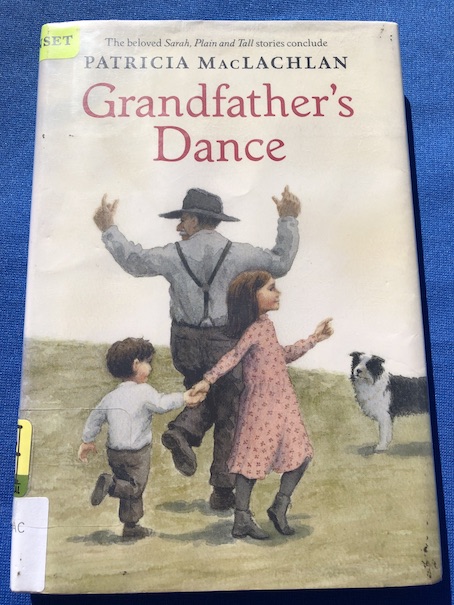
Grandfather’s Dance

Grandfather’s Dance by Patricia MachLachlan, 2006.

This is the final book in the Sarah, Plain and Tall series.

Cassie is now in the fourth grade, and things are changing in her family. Cassie has come to love her little brother, John, called Jack, who is now a young child who likes to follow their grandfather around and imitate him. Caleb has gone away to school, and Anna is getting married, which is the major event of the story. Through the planning and anticipation that precedes the wedding, Cassie still keeps her journal, with its occasional flights of fancy.

Anna’s wedding brings new excitement to the family farm and thoughts of both the future and the past. Cassie, unlike her older half-siblings, has never been to Maine or met her relatives there, but Sarah’s brother and aunts are coming to the farm for Anna’s wedding. The others remember the last time they saw these relatives, and Cassie looks forward to seeing them.

Cassie wonders about why people get married, and she can’t imagine anyone she loves enough to marry and spend her life with, except maybe her dog. She tries to picture her own future wedding, with a dog as the groom, but it bothers her that she can’t picture her grandfather at her wedding. At first, she can’t quite figure out why she’s having trouble picturing him in the future, but the more she thinks about it, the more she realizes how old her grandfather is. He even comments on his age, saying that he’s getting older every day. Her grandfather seems to be increasingly feeling his age and his heart condition. Before Anna’s wedding, Cassie and her grandfather talk about her future wedding, and her grandfather tells her that he might not be there when she is married. Cassie tries to convince him that he will be, but he says, just in case he can’t, maybe they should have a wedding for Cassie now. He has Cassie put on the nice dress that she will wear to Anna’s wedding, and they stage a mock wedding for Cassie and their dog, Nick, so her grandfather can say that he was at Cassie’s wedding, too.

Anna’s wedding is beautiful, and Cassie and the others enjoy having Sarah’s brother and aunts visit. After the wedding, they have a picture taken of the whole family together. Sadly, it is the only picture of all of them together. Soon after, Cassie’s grandfather dies. All of the wedding guests are still visiting, so they attend the funeral. Jack is still a little boy and upset and confused by their grandfather’s death, but Cassie assures him that their grandfather loved them and that they won’t forget him. The title of the book comes from a little dance that their grandfather did for Jack earlier in the story, which Jack later imitates after his death.

In the back of the book, the author explains how her family was the inspiration for the family in the book. The grandfather in the story was based on the author’s father, and part of the dedication is to him. The author’s father died two years before this book was published. The farm and landscape around it are kind of a combination of the places where her family has lived in North Dakota, Kansas, and Wyoming, which is probably why the books in the series never specify which state they’re in.

The book is available to borrow and read for free online through Internet Archive (multiple copies).

More Perfect Than the Moon

More Perfect Than the Moon by Patricia MacLachlan, 2004.

This is the first book in the Sarah, Plain and Tall Series that is narrated by Cassie, the younger daughter in the family. 

By this time, Cassie is about eight years old, and her grandfather, who rejoined the family in the previous book, has been living with them for a few years.  Caleb has also found a girlfriend (Violet, Maggie and Matthew’s daughter).  When Cassie writes entries in the family’s journal (started by Anna in the first book), they are partly fantasy, like when she thinks that Caleb and his girlfriend will someday marry and go to live in Borneo, where they will eat wild fruit.  When Caleb tells her that the things she’s writing aren’t the truth, she says, “It is my truth.”  (Oh, criminy!  I hate it when people say that.  Well, she doesn’t really mean it in the sense that I’m sick of hearing it.  I like games of pretend, but only those where the people playing them realize that it’s both a game and pretend.)  Fortunately, it’s just that Cassie is an imaginative child, and most of what she imagines is wishful thinking about things she would like to see happen.  With Cassie, the journal becomes not just a documentary of family events but of her feelings about them and what she imagines.

As Cassie grows more observant because of her writing, she notices that her mother’s behavior is changing.  Sarah is sleeping a little more, and she doesn’t always want to eat. Cassie worries that she’s sick.  Then, one day, Sarah faints.  Jacob takes Sarah to the doctor, and in the journal, Cassie writes about how her mother is well and will bring home a perfect present for her, “More Perfect than the moon,” in the hopes that it will come true.

When Sarah comes home and Cassie tells her what she wrote, Sarah says that it is true because she is pregnant.  Her perfect present will be a new baby.  Cassie doesn’t think that a baby sounds like a perfect gift.  She doesn’t want the baby because she doesn’t want things to change.  She is determined not to love the new baby.  Anna (who is now engaged to her boyfriend, Justin) tells Cassie that she didn’t love her at first, either, but she came to love her.  When Cassie asks Anna what made her love her as a baby, she says that she couldn’t help it and that she’ll understand when the new baby arrives.  All the same, Cassie can’t help but wish her mother would give birth to a cute little lamb instead.

Then, Cassie hears Sarah telling her friend, Maggie, that she thinks she’s too old to have a baby.  Cassie knows that Anna and Caleb’s mother died giving birth to Caleb, and she worries that the same thing could happen to her mother.  She thinks that the “terrible baby” is putting her mother’s life in danger.  Sarah tells her that’s not really the case, that she just thinks that it will be difficult to run after a young child again.  Still, Cassie worries and tries to keep an eye on her mother.  Sarah tells her that it isn’t necessary and that she will let her know when she needs her, like when the baby is going to be born.

As everyone guessed, Cassie’s feelings about the baby change once he arrives and she sees him for the first time.  At one point, Cassie admits to Sarah that some of the things she writes in her journal are nasty, but Sarah understands and says that one of the reasons to keep a journal is “To put down feelings. That way they don’t clutter up your head.”  Sarah knows that Cassie has a lot of worries about the new baby and the changes that will come in their family, and she knows that the journal is a way for Cassie to sort out her feelings. Once Cassie gets her worries and bad feelings out of the way, she is better able to move on to better things. Journals can be therapeutic.

The book is available to borrow and read for free online through Internet Archive (multiple copies).

Caleb’s Story

Caleb’s Story by Patricia MacLachlan, 2001.

This book is part of the Sarah, Plain and Tall Series, but while the first two books are narrated by Anna, this book is narrated by her brother, Caleb.

When the book begins, Caleb says that Anna is now going to live in town, finishing school and working for the local doctor.  Her boyfriend, Justin, is the doctor’s son, and he has gone to Europe to fight in World War I.  Sarah worries about Anna because of the influenza epidemic.  Anna has given him a journal in order to write about the things happening on the farm while she’s away.  Caleb isn’t as much of a writer as Anna, and he can’t imagine what he’ll find to write about, but Anna assures him that he’ll find something.

While Caleb is play hide and seek with his little half-sister, Cassie (who is now four and a half years old), Cassie says that she saw a man behind their barn who asked her about their father.  At first, Caleb thinks that Cassie imagined the whole thing, but she insists that she didn’t.  However, Caleb later finds the man in the barn, suffering from cold.  The family brings him inside to warm up, and he says that his name is John.  They try to ask John about who he is and where he came from, but he is evasive at first.  He says that he used to be a farmer, and he starts to help a little with farm chores.

The truth about John comes out when Jacob returns from taking Anna to town.  John is actually John Witting, Jacob’s father.  For years, Jacob believed that his father was dead.  It comes as a terrible shock to see him suddenly, after all this time.  Jacob is angry that John apparently abandoned his family and left him to believe that he was dead.

The children have many questions about their grandfather and where he’s been all these years, but John remains evasive for some time.  Sarah tries to encourage Jacob to talk to his father and learn what he needs to know about him, but Jacob resists because he’s too angry.  Caleb notices his grandfather taking pills, and Sarah discovers that it’s heart medicine.

The imagery in the story is pretty bleak, compared to the other books, even the drought descriptions from Skylark.  It’s winter, and people are dying during the influenza epidemic.  People have black wreaths on their doors, some because of influenza deaths and some because they have relatives who died fighting in World War I.  At one point, they see a bonfire in the cemetery because the ground is frozen, and they need to thaw it enough to dig a new grave.  When they get closer, they see that it’s a baby’s coffin, which upsets Sarah.

When Jacob finally demands that his father explain himself and his presence there, John says that he wanted to see how things turned out.  The two men argue and push each other, and Jacob accidentally falls over a plow and breaks his leg.  John sets the broken leg, saying that he’s done it before, but Jacob is still angry with him.

Eventually, John talks to Caleb about his past, admitting that he was wrong to leave years ago and saying that he can’t really blame Jacob for how he feels about it because his bad decision has affected Jacob’s whole life.  John quarreled with his wife years ago, and he felt like the two of them couldn’t live together anymore. (I have to admit that, after John had earlier tried to tell Jacob that things weren’t the way he thought they were, I was really disappointed because this explanation is exactly the way I figured it was.)  Jacob keeps saying that John could have at least written, but the truth is that John can’t read or write until Caleb begins teaching him. (If this is what John meant by things not being the way Jacob thought they were, it’s a little less disappointing.)  When Sarah is accidentally lost in a snow storm outside, and John helps Jacob save her, the father and son finally make peace with each other.

The movie version of this book is called Winter’s End, and it is the last of the series to be made into a movie. Actually, I think that the movie may have actually been made before the book (I’m a little confused by the movie’s date, but it looks like it was first). The movie and the book are pretty close to each other. The book is available to borrow and read for free online through Internet Archive.

The Ravenmaster’s Secret

The Ravenmaster’s Secret by Elvira Woodruff, 2003.

Forrest Harper is the son of the Ravenmaster of the Tower of London in 1735.  The story begins by explaining the tradition of keeping ravens at the Tower of London because of the superstition that the Tower would be conquered by its enemies if the ravens ever abandoned it.  This superstition led to the creation of the job of Ravenmaster, who looks after a flock of ravens that live at the Tower with wings clipped so that they can’t fly away.

Forrest Harper lives at the Tower with his parents and sisters, training to become a Ravenmaster, like his father.  He likes the ravens, and they like him.  He is pretty good at caring for ravens, but there is something that bothers him: he thinks that he isn’t brave enough and that others think that he is a coward, too.  He is smaller than the other boys and is often teased.  He has trouble cutting up the squirrels that the rat catcher’s boy (his only real friend, although his mother doesn’t approve of him) brings to him to feed to the ravens.  Even though it’s necessary, Forrest doesn’t like the sight of blood and feels kind of sorry for the squirrels.  Worse still, when Forrest’s family attends the public hangings (which were treated as a kind of festival day with music and entertainment in Forrest’s time), Forrest is unable to look at the criminals who are being hanged.  The one time he does try it, he throws up, and again, the other boys tease him mercilessly for it.  Forrest’s problem, as readers will see, isn’t so much that he’s a coward as he has more empathy than the other boys, both for animals and people, and that isn’t really as much of a problem as he believes.  His father tells him to ignore the bullies because they are foolish, and their foolishness will show in time.

Forrest sometimes dreams of going out into the wider world, beyond the Tower, where he could do something brave that would impress everyone.  The rat catcher’s boy, whose real name is Ned although most people just call him Rat, also dreams of running away because he is an orphan, treated harshly by his master and always in danger of being turned over to the chimney sweep to be used as a climbing boy.  He doesn’t think that Forrest has a real problem because his life at the Tower is pretty good, living comfortably at the Tower with his parents, whatever the local bullies say.  Still, the two boys often imagine what it would be like to go to sea together and have adventures.  When there is an announcement that a new prisoner will be arriving at the Tower, a Scottish Jacobite rebel, Forrest thinks that helping to guard a dangerous rebel will make the Tower bullies respect him.

To Forrest’s surprise and embarrassment, this rebel actually turns out to be a girl.  She is the daughter of the rebel Owen Stewart, who is being held in a different tower at the Tower of London (the Tower of London is actually a fortress with multiple towers – she is imprisoned in Bloody Tower and her father is in Bell Tower).  She has been charged with treason, along with her father and uncle.  Forrest isn’t happy about being given the task of taking food to a girl prisoner. 

However, Madeline McKay Stewart, the girl prisoner, is pretty tough in her own right.  Although Maddy’s been separated from her father and uncle and all three of them are likely to be executed, she is being pretty brave about it.  She talks to Rat and Forrest.  She is interested in Forrest’s pet raven, Tuck, and tells him about how she used to feed baby owls back home.  She talks about her life and family in Scotland, and Forrest realizes that he’s starting to think of her as a friend instead of an enemy to be guarded.

While Forrest is used to hearing English people criticize the Scots for being “savage,” he is astonished and a bit offended when Maddy talks about English people being “evil.”  For the first time, it makes him think of the situation from the other side.  He knows that not all English people are evil and realizes, having seen that Maddy actually has refined manners, that Scottish people aren’t “savage.”  One day, at Maddy’s request, he takes a message to her father in exchange for her ring, which he plans to sell in order to buy Ned back from the chimney sweep after the rat catcher loses his term of indenture to the chimney sweep in a game of cards, sparing him from the horrible life and health problems that the young climbing boys suffer.  Then, Owen Stewart gives Forrest a message to take back to Maddy.  Without really meaning to, Forrest realizes that he has suddenly become a go-between for the rebels and could be considered a conspirator under English law.

As Forrest considers the fate that lies ahead for Maddy and the nature of war between England and the Scottish rebels, it occurs to him that the adults in his life have often done the opposite of the things that they have always taught him were important.  His father always emphasized fairness, yet the war and Maddy’s possible execution are unfair.  Maddy shares Forrest’s feeling that the world might be a better place if people didn’t become adults and abandon their values.

Then, Maddy’s father and uncle are shot while attempting to escape, and Maddy is left completely alone.  Forrest feels badly for Maddy.  Soon after, he is unexpectedly approached by a carpenter who seems to know that he has become friends with Maddy.  The carpenter, who is a stranger to Forrest, tells him that Maddy will soon be executed by beheading but that he has a way to save her life.  Forrest has to decide if he is willing to trust the stranger and save Maddy, knowing that doing so would make him a traitor himself.

One of the parts of this story that interested me was how Forrest noted the hypocrisy in the adults around him as he was trying to decide what he should do.  Qualities that adults often praise and try to instill in their children are often ignored in the way that the adults live and even in how they treat other children, like Ned and Maddy.  Abandoning values, even the ones that they really want their children to have, isn’t something that adults have to do as they grow older, but it is something that some adults do if they think they must in order to live as they want to live or accomplish something that they want to accomplish.  The adults who think that Maddy should be beheaded would probably say that they were doing it for the greater good in promoting their cause against the rebels.  However, treating Ned as a piece of disposable property is something that they mostly do because they can and because they know that there is nothing that Ned can do to stop them.  Ned actually tries to repay his indenture legally with money that Forrest gives him, but although the sweep accepts the money, he refuses to let him go, saying that no one will take Ned’s word over his and that he could always use the money to make sure that Ned is hung as a thief if he tries to make trouble.  It is this type of attitude and situation that make the children realize that they are on their own to solve their problems and that working within the law is not going to be an option for them because the law is not just and it is not on their side.  It’s a frustrating situation, and I often feel frustrated when I encounter this type of thing in books, but fortunately, things do turn out well in the end.

This is one of those coming-of-age stories where a boy must decide what he stands for and where he really belongs.  Through Maddy and the inscription on her ring, which means “Face Your Destiny,” Forrest comes to understand the destiny that is right for him as he helps both Maddy and Ned escape to a better life elsewhere. 

The book also includes some interesting historical information. There’s a map of the Tower of London in the front of the book, and in the back, a short history of the Tower with information about famous prisoners and escapes. There is also a glossary of English and Scottish words that modern children (especially American children) might not know, such as breeches, wench, loch, and tattie-bogle (scarecrow).


The book is currently available online through Internet Archive.  (To borrow a book through Internet Archive, you have to sign up for an account, but it’s free, and then you read the book in your browser window.)
Spoiler: In the last chapter of the book, it explains what happened to the characters after the story ends.  Forrest does become the Ravenmaster after his father, realizing that it is the right kind of life for him and that he no longer desires to have adventures outside the Tower.  He has a wife and daughter, and years later, he receives a message from Ned, who says that he has become a captain in the Royal Navy and that Maddy has gone to live in the colonies with other Stewarts (something that my own Jacobite ancestors did, which is how I got to where I am now).

The Puppeteer’s Apprentice

The Puppeteer’s Apprentice by D. Anne Love, 2003.

Poor Mouse works as a scullery maid in a castle in Medieval England.  She has lived there all her life, since someone abandoned her at the castle as a baby.  She has no idea who her parents are, when her real birthday is, or exactly how old she is (the cook once said she was about eleven, but he wasn’t sure).  She doesn’t even have a real name; Mouse was simply the name given to her by the cook, who makes her work hard and beats her if she makes a mistake.  Mouse’s life is hard, but then one day, she makes a big mistake, and the cook gets in a rage and attacks her with a meat hook.  Mouse escapes from him and flees the castle.  She knows that she cannot go back, but she doesn’t know where to go. 

For the first time in her life, Mouse’s fate is in her own inexperienced hands.  For a time, she joins up with a group of travelers, who take her to the city of York.  However, none of them can adopt Mouse, and she must struggle to make a life for herself.  In York, Mouse sees a puppeteer performing, and she is inspired to learn to be a puppeteer herself.  Through a mixture of trickery and pleading, Mouse convinces the puppeteer to take her on as an apprentice. 

Although Mouse makes many mistakes at first, and the puppeteer gets angry and threatens to leave her behind, the two eventually learn to get along with each other.  Mouse gains skill at making and manipulating the puppets, and her confidence grows.  However, danger still lurks in the future, for the puppeteer also has a dark past and dark secrets which pursue the two of them in their travels.

The book is currently available online through Internet Archive.

My Reaction and Spoilers

Stories with abused and neglected children are always sad. Mouse is failed by various adults who are mainly focused on their own lives and securing their own positions in life before she finally becomes independent. We don’t know why Mouse was abandoned as a baby, although it was probably because her parents were poor and maybe unmarried, which would have been a stigma at the time. We can be pretty sure that, whatever happened, Mouse’s parents’ position in life was too precarious to take care of her themselves. The castle cook she lives with is mainly worried about his own job and is more of an unwilling employer to Mouse than a parent. In fact, employment is more of a theme in Mouse’s precarious life than family. Even the puppeteer is more of an employer to Mouse than a parent. Mouse learns from the puppeteer, but it’s as an employee, and Mouse is well aware that she can be abandoned at any time if she fails to please her employer. In the end, Mouse gains an independence that pleases her, but I still found it a little sad because it seems like the one and only person who can’t abandon Mouse is Mouse herself and that there is little or no security in trusting or relying on others. The eventual goal turns out to be employing herself so she doesn’t haven’t to rely on someone who can dump her. I suppose that can be true in real life, too, but it’s one of hard, dark sides of life.

Although, the adult characters’ focus on securing their own lives and positions first is also a testament to the nature of the time when the story is set. Opportunities are limited by social level, and there are few sources of support for those who suffer unfortunate circumstances. Although it seems like the adults in the story are cruel and neglectful, there’s also a desperation to their own situations. The one person in the story who is willing and able to offer more generosity to Mouse than other characters is able to do so because of his privileged position in life. Even the puppeteer, while seeming more free than other characters, is living under danger and threat, and there is genuine risk to sharing in her life that Mouse doesn’t come to understand until later.

The puppeteer always dresses in loose-fitting clothes to cover up the fact that she is a woman.  Although there is no reason why women cannot be puppeteers, she finds it necessary to disguise herself because she is pursued by an enemy from years ago.  Once, her father, who was a master puppeteer, saved the life of a young Duke who was attacked by a man named Ordin.  Ordin was trying to steal some of the duke’s lands.  The old puppeteer and his daughter stood witness against him, and he was thrown into prison.  Later, when he got out of prison, he attacked the party on the road, killing the old puppeteer and his companions.  Only the daughter escaped alive, and she became a puppeteer to support herself.  Ordin escaped, and she was forced to disguise herself to protect herself.  She even refuses to tell Mouse or anyone else what her real name is through most of the book. 

However, Ordin recognizes her one day while she and Mouse are giving a performance.  He and another highwayman follow them on the road and attack them.  The puppeteer kills the other highwayman but is gravely wounded herself.  Mouse fights back against Ordin, knocking him into the fire, and he burns to death.  They are not far from the duke’s castle, so the puppeteer sends Mouse there to get help.  Mouse tells the duke what happened to the puppeteer, and he has her brought to his castle.  The puppeteer, realizing that she will not recover from her wounds, finally tells Mouse her story and offers her name if Mouse wants it for herself.  The duke offers to let Mouse stay at his castle.  Mouse stays the winter, but in the spring, she decides to leave.  She has come to love life on the road, and she promised the puppeteer that she would take care of the puppets.  Mouse decides to take the puppeteer’s name, Sabine, as her own and sets off on a journey to find a place to perform her new puppet play, one telling the puppeteer’s story.

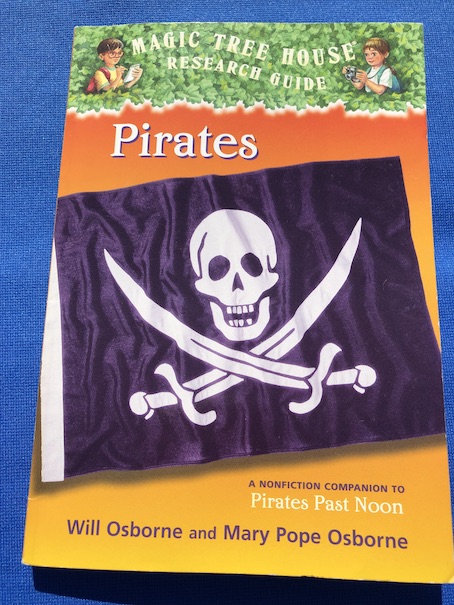
Pirates

Magic Tree House Research Guide

Pirates by Will Osborne and Mary Pope Osborne, 2001.

This book is the nonfiction companion book to Pirates Past Noon, part of the Magic Tree House Series. While the Magic Tree House Series is a fantasy series that involves time travel, there are companion books to some of the novels with nonfiction information related to the stories. The fantasy series is meant to introduce children to different historical periods and encourage an interest in reading, but the companion research guides take children further into certain subjects.

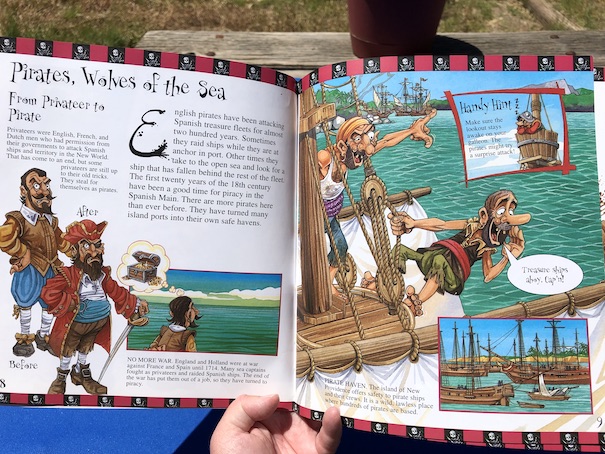
This book focuses on pirates throughout history, explaining how pirates functioned from the time of Ancient Greece and Rome, into the Middle Ages with Vikings, and beyond. It explains that, while legends and adventure stories make the lives of pirates seem fun and exciting, the realities of their lives were more harsh. Throughout the book, Jack and Annie, the characters from the main series, appear in illustrations and side notes to define certain terms or tell the readers fun trivia.

There is a chapter about New World pirates that explains the buccaneers and privateers that preyed on Spanish treasure ships in the Caribbean. The Golden Age of Piracy was in the late 17th and early 18th centuries. It was a period of intense pirating activity as governments recruited privateers to attack the ships of enemy nations. Pirates also attacked ships that traded with American colonies as they increased in size and number. The Golden Age of Piracy ended in the 1720s, when governments began instituting harsher punishments for pirates and sending more warships to confront the pirates. The book includes a Gallery of Pirates where it gives brief biographies of famous pirates, like Henry Morgan, Sir Francis Drake, Blackbeard, and “Calico Jack” Rackham with Anne Bonny and Mary Read.

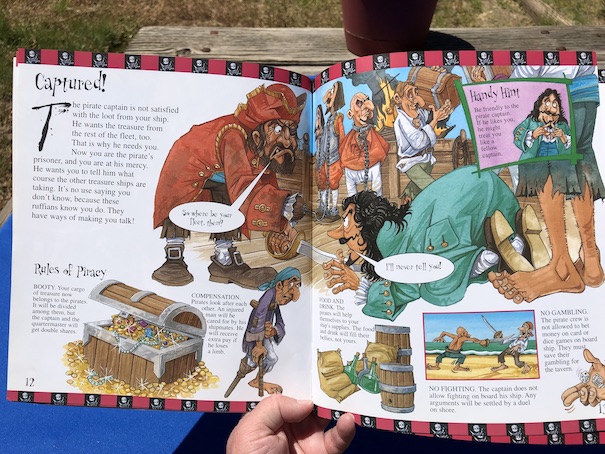
There are chapters that describe the lives that pirates lived on their ships. One chapter talks about the types of ships that pirates used, how to distinguish between different types, and the trade-offs between size and speed. For example, sloops could move faster, but schooners were larger and could carry more. Although pirates operated outside of the law, they had rules for themselves to establish order and resolve conflicts on their ships, and there were punishments for people who broke the rules. People also had different jobs on pirate ships.

Part of the book also talks about legends of buried treasure and sunken ships. There is some truth to the legends, although mostly, pirates tended to spend their loot shortly after getting it instead of hiding it for later.

At the end of the book, there is a guide for doing further research which suggests research tips, other books to read and documentaries to see, and websites to visit. Of the websites listed in the book, only one still exists as of this writing: Maritime Pirate History. Another one, Treasure Island, pops up thanks to the Wayback Machine. It might be possible to find the others through the Wayback Machine by actually searching the Wayback Machine for them, but with so many other new sites and books that are probably equally as good, it might not be worth the time.


You Wouldn’t Want to Be a Pirate’s Prisoner

You Wouldn’t Want to Be a Pirate’s Prisoner by John Malam, 2002.

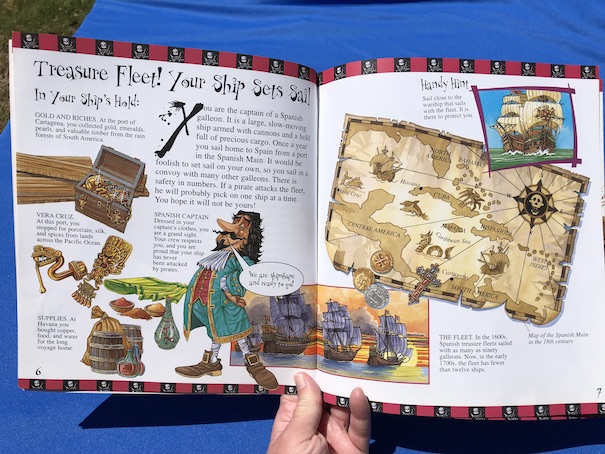
This picture book, which is part of a series, explains what it would have been like to be a pirate’s prisoner in the 18th century.  It sets the stage by casting the reader in the role of a Spanish ship captain in 1716.

The reason why the reader is cast as a Spanish captain, captured by English pirates, is because England and Holland had been at war with Spain until 1714.  During the war, the government of England (as well as Holland and France) authorized some ship captains to act as privateers, conducting raids on Spanish ships and outposts.  When the war ended and the privateers were dismissed from service, some of them continued to act as independent pirates.

The book explains the geography of the “Spanish Main,” the area between the southern coast of North America and the northern coast of South America – basically, the Caribbean Sea and its islands and the Gulf of Mexico.  Spanish galleons in the 18th century carried gold and treasures from the Americas to Spain as well as timber from the rainforests and goods that were transported to the Americas across the Pacific Ocean, such as spices and silk.  All of these goods made Spanish treasure ships tempting targets for English pirates.

As a Spanish ship’s captain, there were a few precautions that you could take against pirate attack.  One of the most basic was traveling as part of a convoy because pirates would be more likely to attack a lone ship than one that was part of a group.  A fleet of ships would have a warship traveling with them for protection, and the closer your ship sailed to the warship, the less likely a pirate ship would try to separate you from the group and attack.

If the worst situation happened and the ship was taken by pirates, a captain could try to dress like other members of the crew to disguise his rank, but that didn’t always work.  The captain of the ship was in danger of being taken captive because he might have information that the pirates would find useful, like the exact route of other ships in a convoy.

The gruesome part of this book (and the source of the title, because this series basically focuses on the gruesome parts of history) is the part where they describe different forms of torture that pirates might use on a ship’s captain to convince him to tell them what they wanted to know.  Besides the direct physical abuse, pirates could also keep a captive in squalid conditions to make him weaker, more vulnerable, and exposed to disease.  In the end, they might simply decide to maroon the captive somewhere, even if they got the information they were after.

However, pirates could also face gruesome fates if they were caught. They could be hung and their bodies displayed publicly, as a warning to others.

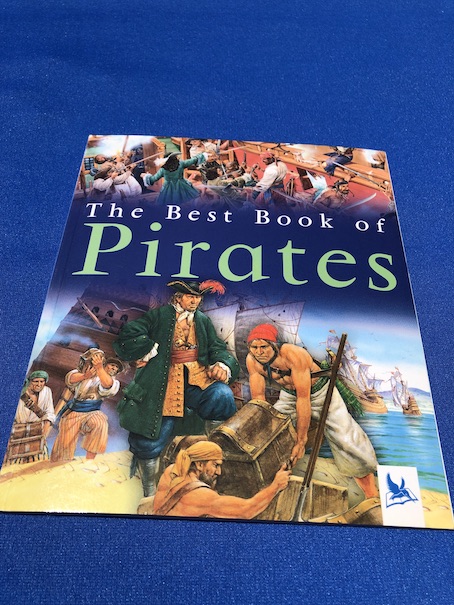
The Best Book of Pirates

The Best Book of Pirates by Barnaby Howard, 2002, 2006.

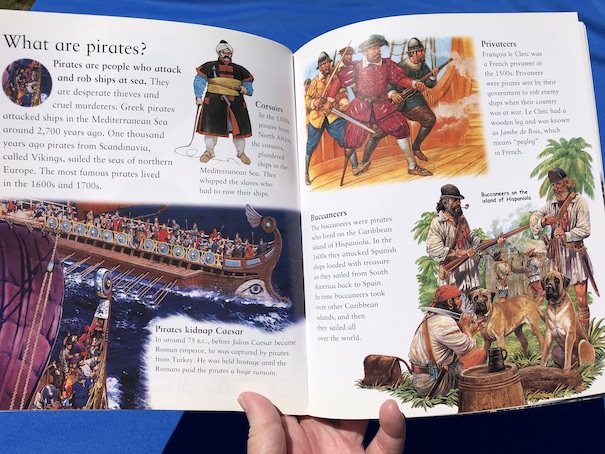
This is an easy and informative non-fiction picture book about pirates.  Rather than focusing on any particular time period or geographic area, the book gives a broad overview.  In the beginning, it explains a little about different groups of pirates through history, including Vikings, Corsairs, Buccaneers, and Privateers.  There is also a brief explanation of the Pirate Round, a sea route often taken by pirates during the late 17th century and into the 18th century.  The route led from North America and the Caribbean to Africa, circling the coast of South Africa to Madagascar and on to the Middle East and India.  (If you’ve seen the movie Cutthroat Island, the crew will basically be taking this route when the movie ends, heading from the Caribbean to Madagascar.)

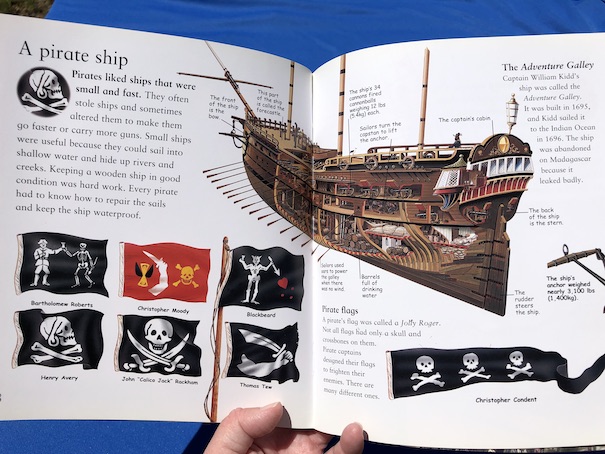
There is a diagram of a pirate ship from the late 17th century, showing what it would have looked like on the inside, and there are also examples of Jolly Roger flags, which were designed by individual pirates as personal identification, typically including skulls and skeletons to frighten their victims.  There is also some general information about what life would be like on board a pirate ship and the types of weapons they might have.

Then, the book begins to focus more on groups of pirates that operated in specific geographical areas and some of the more famous pirates from history.  The Barbary pirates (also called Barbary corsairs) were Muslims who raided Christian ships along the coast of North Africa and the Mediterranean during the 1500s.  Among the most famous Barbary pirates were a pair of brothers called Barbarossa (“Red Beard”).  Sometimes, European and American pirate ships that went to Africa to find gold and ivory also entered the slave trade.

In the section about the Spanish Main, it explains how privateers and pirates raided Spanish ships taking Aztec treasures from Mexico to Spain.  Buccaneers were specifically pirates who raided ships in the Caribbean.  Their name came from the type of fires they used when cooking meat (boucan or buccan).

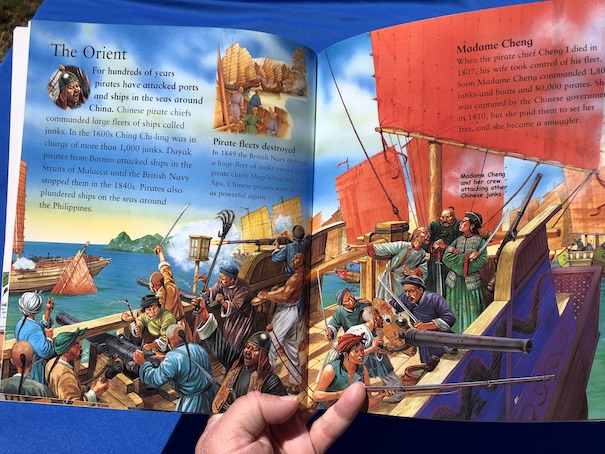
There were also Asian pirates who raided the coasts of China and the Philippines and areas around the Indian Ocean.  Chinese pirates and Dayak pirates from Borneo were powerful in the region until the 1840s, when the British Navy destroyed many of their ships.

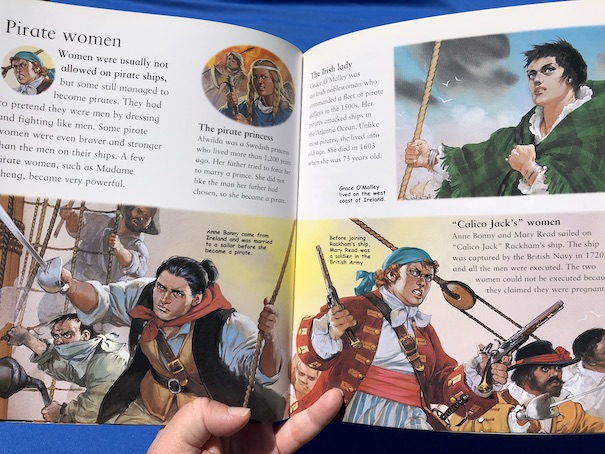
There is a section in the book specifically about female pirates.  Mary Read and Anne Bonny, who sailed with “Calico Jack” Rackham, were famous.  Grace O’Malley was a famous Irish pirate who was also an Irish noblewoman.  Madame Cheng was a Chinese pirate who took over her husband’s fleet after his death (but because this is a children’s book, it doesn’t mention her previous career).  Alwilda was a Medieval Swedish princess who turned pirate after her father tried to make her marry a man she did not want to marry (although her story may only be legend).

The book also talks about the famous stories of pirates burying treasure, although it says that pirates would usually spend their money quickly, sell items for money they could spend, or gamble it all away.

At the end of the book, there is a short section about modern pirates and how their goals and tools of the trade have changed.

The book isn’t very long, but I think that it provides a good, general overview of the subject of pirates throughout history, and the pictures are fascinating and detailed.

The book is currently available online through Internet Archive.

Diary of a Wombat

Diary of a Wombat by Jackie French, illustrated by Bruce Whatley, 2002.

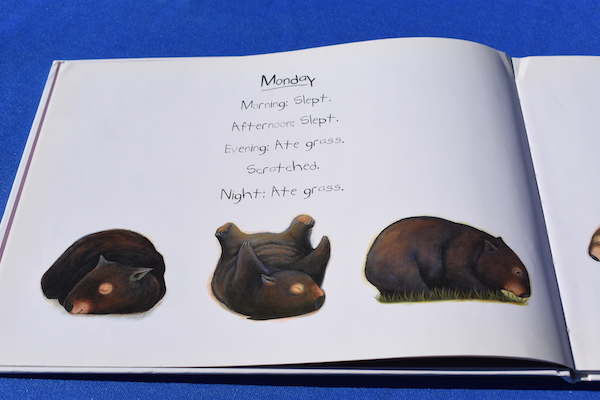
This cute picture book is written in the form of a diary written by a wombat.  The early entries are mostly eating and sleeping, typical for an animal. 

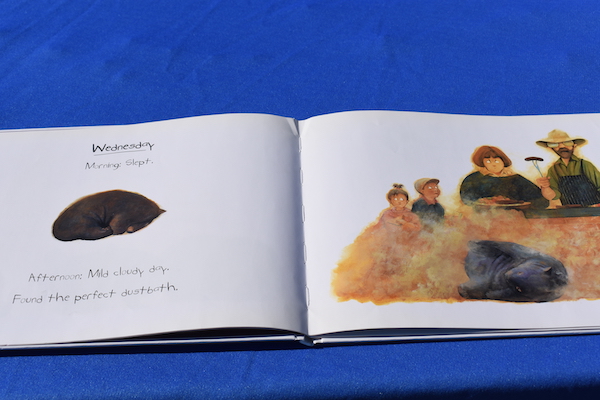
It gets funnier when the wombat makes herself at home in someone’s yard.

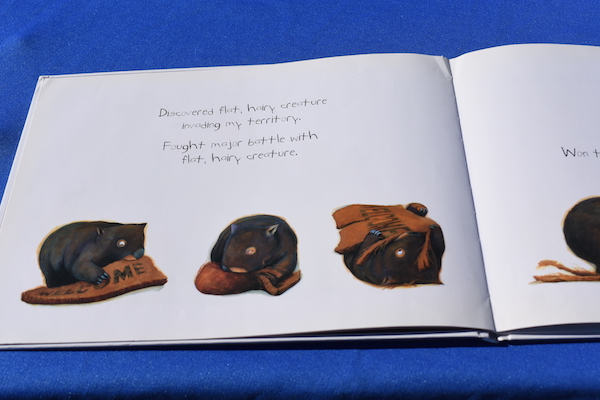
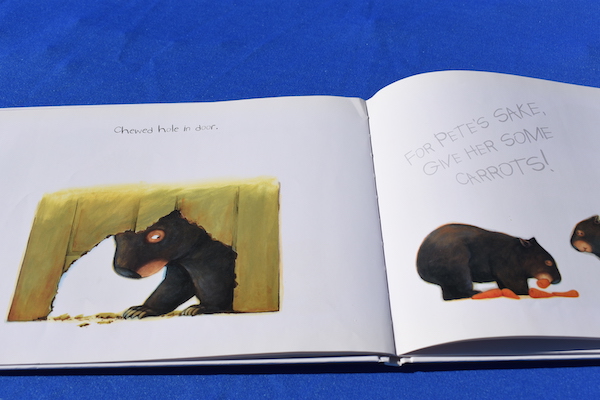
The wombat wins a fight with their doormat and demands food from the humans. They give the wombat a carrot. Big mistake.

Once you feed a wild animal, it comes back for more, and it doesn’t want to take “no” for an answer.

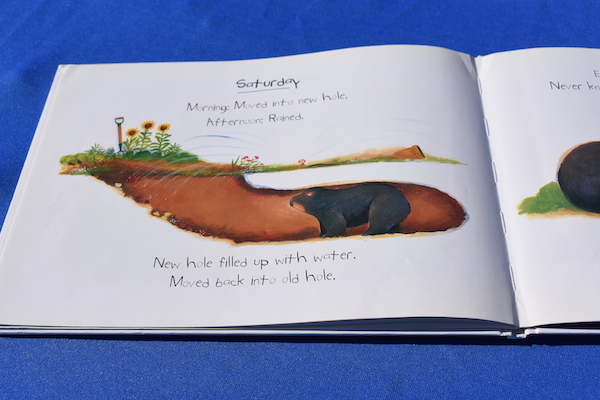
The wombat makes a hole in the humans’ yard but moves out when she doesn’t like their sprinkler.

She also gets tired of the carrots they’ve been feeding her and demands oats instead.

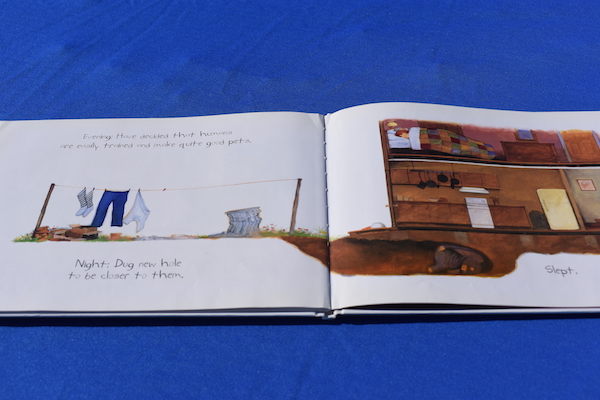
You could say that the humans now have a pet wombat, but the wombat looks at it the other way around.  The wombat is probably right.

This is one of those books where the pictures really make the story.  It’s also a good warning against feeding wild animals! Yet, the wombat is pretty cute . . .

Under Copp’s Hill

UnderCoppsHill

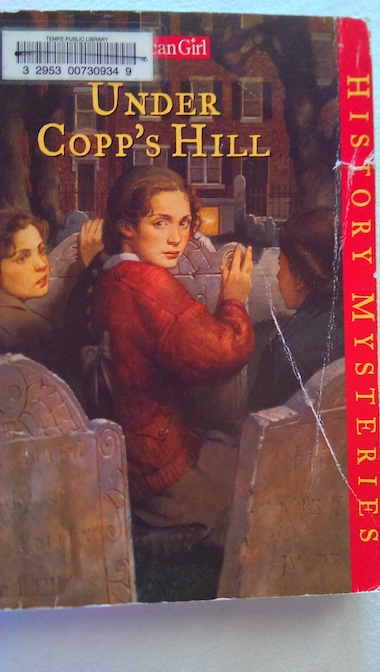
Under Copp’s Hill by Katherine Ayres, 2000.

This book is part of the American Girl History Mysteries series.

The year is 1908, and eleven-year-old Innocenza Moretti lives with her relatives in Boston.  They are immigrants from Italy.  Innie, as her family calls her, is an orphan.  According to the story that her grandmother told her, she was the only one of her parents’ children to survive infancy, her siblings being born prematurely and dying shortly after birth.  Innie’s mother was so grateful that Innie survived that she promised her to the Holy Mother at her baptism.  Then, Innie’s parents died in a fire in their tenement building when she was about two years old.  Innie and her grandmother, Nonna, survived the fire only because little Innie had started crying in the night, and she took her outside to walk her around so that she wouldn’t wake her parents.  Because of that experience, Nonna is deathly afraid of fire and also has become convinced that the Holy Mother must have spared Innie (as well as herself).  She thinks that Innie is destined to become a nun and has continued to promise her to the Holy Mother in prayer, repeating the promise regularly.  Although Nonna thinks that the miracles surrounding Innie’s life are signs of a future life in the Church for Innie, her grandmother’s promises in prayer terrify Innie.

Innie feels trapped by her grandmother’s expectations for her, expectations that the rest of her family don’t even know about.  She doesn’t want to be a nun, but her grandmother is sure that she will be.  Because of her fears that her grandmother may force her to become a nun when she grows up, Innie is never on her best behavior.  She thinks that if she gets a reputation as a trouble-maker, the Church will decide that she is unsuited for a religious life.  Unfortunately, Innie’s long-practiced habit of ignoring rules and her problem child reputation lead her to be suspected of something worse than just minor misbehaving.

Innie’s family owns a boardinghouse where they provide food and lodging for young immigrant men.  Innie and Nonna live on the ground floor, and Innie’s aunt, uncle, and cousins live above them.  Innie spends a lot of time with her cousins, especially Teresa, who is about her age.  Her older cousin, Carmela, persuades both Teresa and Innie to join a library club at a new settlement house with her.  The settlement house helps girls and young women from immigrant families by teaching them work skills and aspects of American culture that they can use as they become American citizens in exchange for some of the work that the girls do on behalf of the settlement house.  Carmela has taken a new job as a pottery painter there and tells her parents that it will be good for Teresa and Innie to go there as well because they will receive help with their schoolwork and they will also have classes to teach them skills like sewing, knitting, and pottery, that they can use to make money later.  However, the real attraction of the club for the girls is that they get to listen to music, have dancing lessons, read books, and socialize with other girls about their age.  The prospect of sewing classes isn’t appealing for Innie, but she loves books and looks forward to borrowing some from the settlement house library.

At the settlement house, Innie meets a variety of girls from other immigrant families, not just Italian ones.  In particular, Innie makes friends with a girl named Matela, who is a Jewish girl from Russia.  As the girls talk about a recent, large fire in town, Matela talks about the czar’s soldiers burning things back in Russia and how she misses her grandfather, who is still there.  Innie understands Matela’s feelings because she knows what it’s like to miss someone.  She doesn’t really remember her parents, but she feels the lack of them in her life.  Teresa also becomes friends with Matela, but the three girls agree to keep their friendship secret because each of their families prefers them to associate with girls from backgrounds similar to their own.  Innie’s uncle wants the girls to spend time with other Italians, and Matela admits that her father prefers her to spend time with other Jewish girls.  The adults don’t really understand the cultural mix at the settlement house.

However, from the very first day that the girls begin going to events at the house, strange things start happening.  Things disappear or are oddly moved about.  Food disappears.  A silver teapot belonging to the ladies who run the settlement house is stolen.  Then, someone steals some pottery and a shawl.

To Innie’s horror, she ends up becoming the prime suspect for the thefts because she was caught snooping in an area of the house where she didn’t belong and because she accidentally broke one of the pieces of pottery that the others girls made and tried to sweep it up without telling anyone.  When she and her friends snoop around and try to find the missing objects, Innie discovers one of the missing pottery pieces.  However, instead of being happy for the clue, the ladies who run the house just think that Innie must have broken more of the pottery and tried to cover it up, like she did before, by hiding the rest of the set.  After all, if she was doing some things she shouldn’t have been doing, it’s plausible that she could be a thief, too.

If Innie is going to remain a member of the library club (and continue to have access to books that she can read), she’s going to have to prove her innocence.  In fact, proving her innocence may also be important for Carmela, who is supposed to have a citizenship hearing soon.  If Innie’s bad reputation causes problems for her at work, she may lose her job and be denied American citizenship!

Matela thinks that the thief could be a ghost from the nearby Copp’s Hill graveyard, but Innie is sure that it must be a human being.  There are secrets at the settlement house that even the ladies who run it are unaware of and someone who desperately needs help and can’t ask for it.

Teresa and Matela continue to help Innie, and in the process, Innie confesses to Matela her fears about becoming a nun.  It is Matela who helps Innie to find the solution to her problem, urging her to step outside of the small community of Italian immigrants that her family clings to and to seek advice from a priest in the Irish area of the city.  As a priest, he has the knowledge that Innie needs to understand her faith, and because he doesn’t know Innie’s family personally, he has the objectivity to help Innie to see her grandmother’s promise in a new light and to understand that her future destiny is still in her own hands.  No one can speak for another person or make important promises on their behalf.  A religious vocation is a serious decision that only a mature adult can make for herself, or not make, as the case may be.  The priest tells her that, as young as she is, Innie should focus on learning to be a good person, and then she will see what direction life leads her.  With that knowledge, of course, Innie realizes that she will have to put more effort into behaving herself, but it’s a relief to her to realize that she doesn’t need to purposely misbehave in order to control her life.

Eventually, Innie’s aunt also learns about the grandmother’s promise and Innie’s worries and reassures her that, although her grandmother can be an intimidating woman with what she wants, Innie’s family loves her and that she shouldn’t be afraid to come to them with her questions and concerns. Innie has thought of herself as parentless, at the mercy of her grandmother’s wishes and expectations, but her aunt says that she loves Innie like she does her own daughters and that Innie is as much a part of their family as they are.  If Innie has problems, her aunt will be there for her, helping her find whatever answers she needs.

There is also a subplot about how girls in immigrant families (at least, in ones like Innie’s family) aren’t as highly-regarded as boys.  When the family is discussing important matters, Innie often tries to comment on what she thinks, but her grandmother keeps telling her to be quiet because it isn’t a girl’s place to comment on business that men should handle and her male cousins sneer at her because they don’t think she knows anything.  However, when Innie’s uncle is worried about the legal papers he has to sign in order to open his new grocery business because his English still isn’t good enough to understand them, Innie points out that Carmela’s English is the best of the family because of all the books she had to read and the paperwork she had to complete when she was applying for citizenship and that she would be the best person to study the paperwork.  At first, her grandmother makes her try to be quiet and her male cousins laugh, but Carmela speaks up and says that she can help her father, if he wants her to, and her father agrees, on the condition that she act as translator and adviser and let him make the final decisions about the business.  Carmela is happy because the arrangement allows her to use her skills without taking her away from the pottery painting that she loves.  The point of this part of the story is about acknowledging the talents that people possess and not disregarding them because they are outside of the usual roles and expectations.  It fits in with the subplot about the grandmother’s expectations for Innie’s future, which are not really in keeping with either her talents or character.  The young people in the story are growing up under different circumstances than their parents, and they will have to learn to find their own way in life, using the abilities they have and the education they can find.

In the back of the book, there is a section with historical information about Boston in 1908.  The fire that happens around the time that the story takes place was a real event.  The settlement house with its library club was also real, and the ladies who run the settlement house, Miss Brown and Miss Guerrier, were also real people.  The book explains more about what life was like for immigrant families like Innie’s and about what the future held for girls like her.  Many of the girls who attended the library clubs later became librarians and teachers themselves, which may be Innie’s eventual destiny when she grows up.  The book also mentions that the area of Boston where Innie’s family lived still has many Italian restaurants and groceries that were started by immigrant families like Innie’s, so we can imagine that the grocery store that Innie’s uncle wants to open will be successful.

The book is currently available online through Internet Archive.