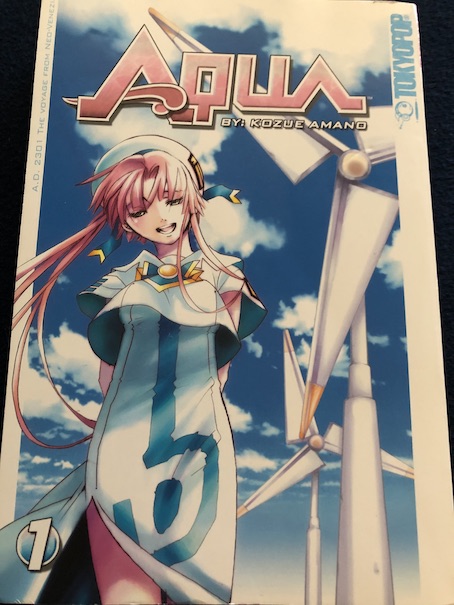
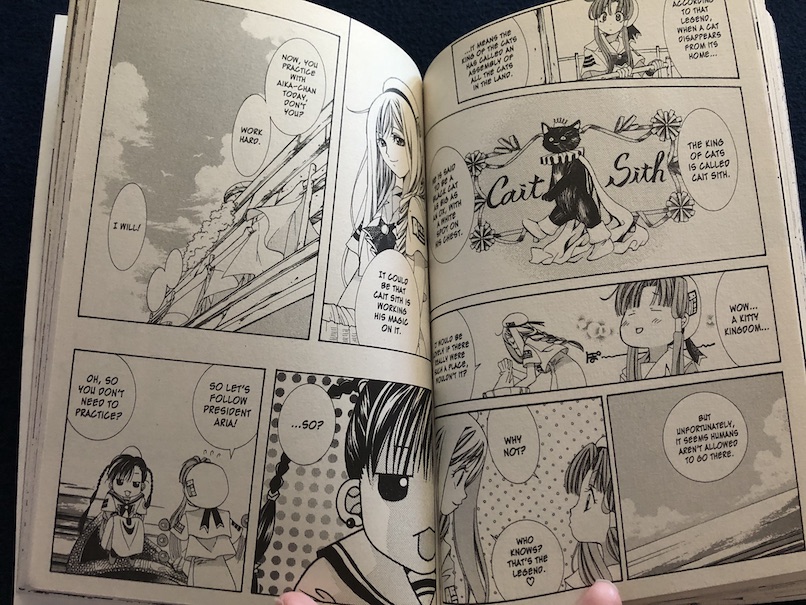
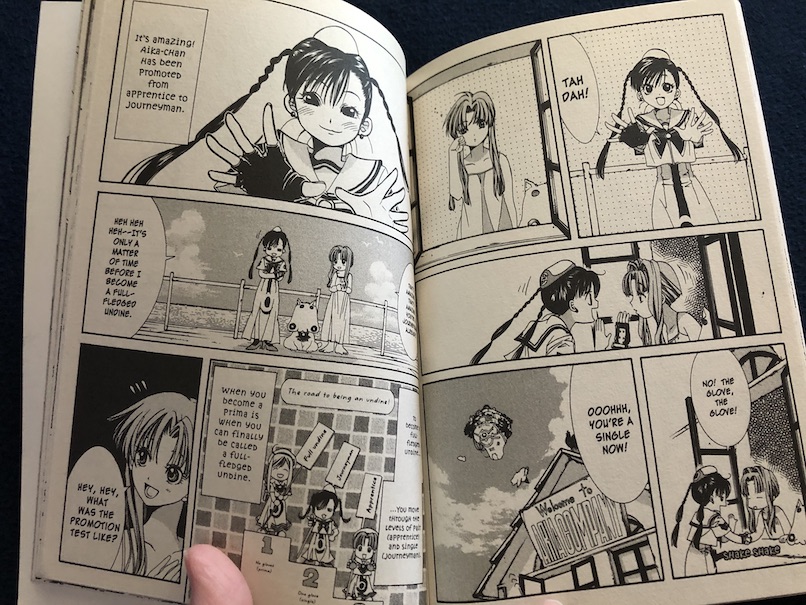
Aqua Volume 1 by Kozue Amano, 2003, English Edition 2007.
I debated at first about whether or not I wanted to include any Japanese manga or light novels in this blog. When I was in high school and college, I knew a lot of people who were really into anime and manga, and I know that there are teens who still are, and my overview of children’s literature in different decades wouldn’t be complete if I didn’t mention that. However, the variety is pretty extensive, some of the series run very long, and it’s impossible to just skip around in some series because the story-telling is very linear, and I didn’t want them to take over the blog. Also, I tend to like the less popular ones, so I’d be bound to get some grumbling from manga fans about why I chose these when there are so many others that are more exciting or more iconic. Notice that I didn’t say “better.” “Better” is subjective, and I like what I like. I decided to go ahead and make an exception in this case because this is one of my favorite manga series and because I think this is something that people could really use right now. The stories are very calming, and they’re good to read during stressful times.
This book is the first volume of a series. I don’t have them all because they haven’t all been published in English yet, but know how it ends, and it’s a really good series with a happy ending. If you’re not familiar with manga, they’re basically graphic novels from Japan. I can’t read Japanese, so I rely on the English translations. However, manga like this typically follow the Japanese format of reading from right to left instead of left to right, like in English, so the books open and the pages flow in the opposite direction. When you look at the panels on a page, remember to look at them in right to left order.
The Aqua and Aria series is unusual because it combines elements of science fiction and fantasy, but most of the stories themselves aren’t really either science fiction or fantasy. That’s just the setting for the stories. The stories themselves are more slice-of-life, about daily events or small adventures in the lives of the characters and sometimes lessons they learn from them. There is a lot of emphasis on slowing down and enjoying the simple pleasures in life.
The series takes place in the future, when Mars has been terraformed and renamed Aqua (because of all the water on its surface). The human colonies on Aqua are designed to resemble cities on Earth (called Manhome here). The people of Aqua prefer a much slower pace of life than people on Manhome, and aspects of life on Aqua more closely resemble Earth’s past.
A young girl, Akari Mizunashi, comes to Aqua to learn to become a gondolier in the city of Neo Venezia, which resembles Venice. Female gondoliers, called Undines, give tours of the city, giving Akari plenty of time to admire the beauty of her new home and meet interesting people.
There are two parts to this series, called Aqua and Aria. The two Aqua books are the prequel to the main series, Aria. Aqua is only two volumes long, and it covers Akari’s arrival on the planet, her introduction to life on Aqua, and the people who will be her friends. In the Aria books, Akari progresses in her training as an Undine. All of the books in both series contain several short stories.
This book, the first one in the Aqua series, focuses on Akari’s arrival on Aqua and her friendship with Aika, the first fellow Undine trainee she meets.
The stories included in this first volume are:
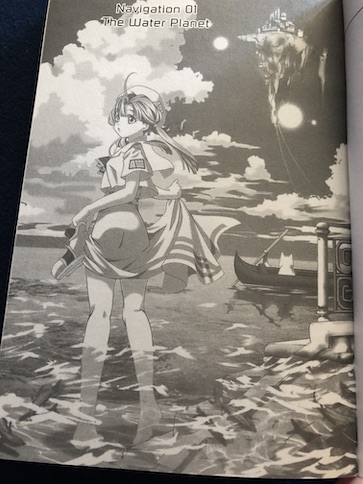
The Water Planet
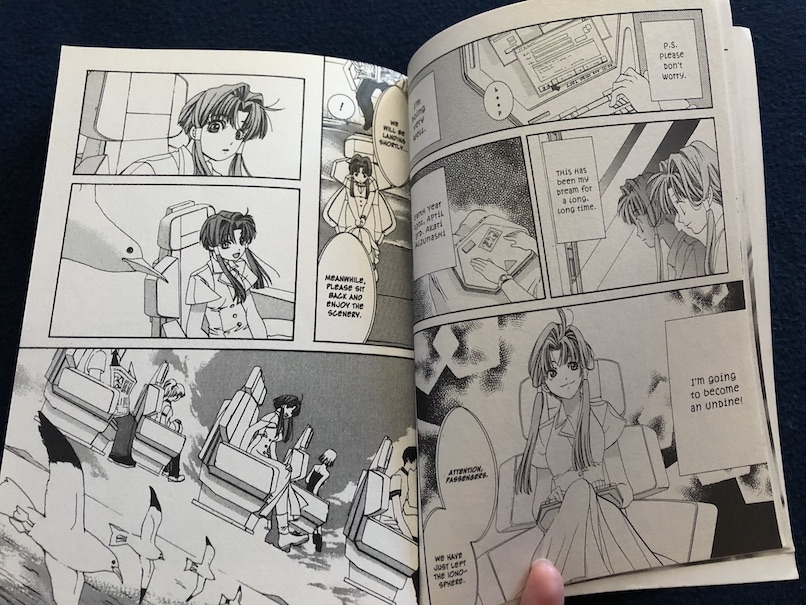
The series begins with Akari Mizunashi on the shuttle carrying her from Manhome to Aqua. She is typing a message to someone on her computer, but there is nothing to indicate who she is writing to. This is a running theme throughout the series, but the identity of Akari’s pen pal isn’t revealed until the very end of the series, and it wouldn’t make sense if I told you who it is right now. Akari explains a little about the history of Mars/Aqua, and how the melting of Mars’s polar ice caps during the terraforming of Mars 150 years earlier has turned it into a water planet, earning it the name Aqua. Currently, the year is 2301.
One of the nice things about the Aqua/Aria series is the imagery. As Akari’s shuttle arrives at Mars/Aqua, the walls of the shuttle turn transparent, so the travelers can feel like they’re flying in with the seagulls.
On Earth/Manhome, Akari lived in Tokyo, Japan. The modern cities of Manhome are very tidy and convenient, with people able to work and shop from home. Still, Akari has felt like something is missing from her life in all the convenience and tidiness. In Neo Venezia on Aqua, people rely on boats constantly to help them get around town, which is inconvenient, but Akari finds it calming and peaceful, which is why she wants to become an Undine, one of the female gondoliers who act as tour guides and help travelers to navigate Neo Venezia. Overall, life on Aqua and in Neo Venezia has a much slower pace than that on Manhome.
Akari arrives on Aqua and meets a friendly mailman and the only two employees of the gondola company she will work for: her mentor, Alicia, and the company’s president, a Martian cat named Aria. All gondola companies on Aqua have a Martian cat as their mascot/president. Alicia explains that Martian cats are as intelligent as humans, even though they can’t talk, but in many ways, President Aria still acts like a very large kitty.
The Guide on the Water
Akari wakes up on her first morning at the gondola company Aria, and she meets Aika, who is a trainee at Himeya, another gondola company. She catches sight of Aika hanging around, watching Alicia, and Aika witnesses Akari’s first time practicing in a gondola under Alicia’s watch.
Akari is embarrassed to learn that when she practiced rowing on Manhome, she was doing it backwards, standing in the front of the boat, which would block the view of her passengers. Because Akari practiced the wrong way on Manhome, she can row very fast the wrong way, but is clumsier when she tries to row the correct way.
However, Aika tells Akari that Alicia is the best of the Undines, and Akari is reassured that under Alicia’s guidance, she will do better. Aika hero-worships Alicia (for reasons that are explained further in later books), and she agrees to become Akari’s friend partly so that she can see more of Alicia. Aika and Akari become best friends through the course of the books, sharing their training and adventures.
The City Submerged
Akari wakes up one morning and is shocked to find that the lower floor of Aria company has flooded, but Alicia explains to her that this is a natural phenomenon in Neo Venezia in Spring.
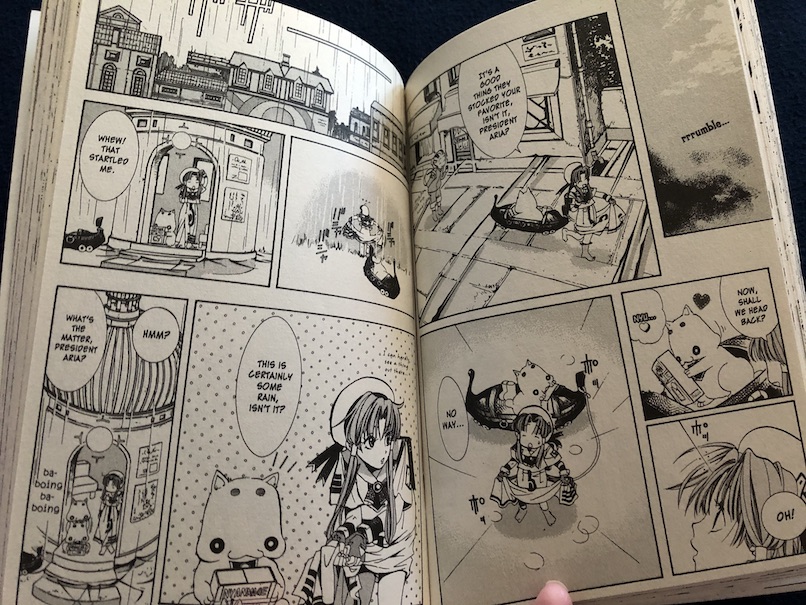
Much of the city is flooded during this high tide, causing many of the businesses in town to close temporarily and making it unsafe to go out in gondolas. However, when President Aria needs more of his favorite food, Akari decides to venture into the city on foot.
On the way home, Akari and Aria are stranded when it starts to rain and travel become more dangerous, but Aika sees them and invites them to spend the night at Himeya Company with her. Himeya Company is a much larger gondola company than Aria Company, with many more employees living there.
Aika and Akari have a sleepover in Aika’s room, and Aika asks Akari who she’s always writing to, but Akari tells her that it’s a secret. When the rain stops, Akari admires the view of the water by moonlight. (There are two moons in the sky because this is Mars.)
The Kingdom of Cats
President Aria sometimes ventures off alone, and Alicia tells Akari the story of Cait Sith and the mythical kingdom of cats.
When Akari and Aika practice their rowing together, Akari convinces Aika to help her follow President Aira to see if there’s any truth to Alicia’s story perhaps get a look at the kitty kingdom ruled by the legendary king of the cats, Cait Sith.
However, the trip is stranger than they bargained for. The girls find themselves on a strange waterway through apparently abandoned buildings, going around in circles until President Aria points the way out. Akari only gets a glimpse of the cats before they leave.
The Hill of Hope
Aika shows up at Aria company one morning to brag about how she has been promoted to single (the next step up in gondola training, as shown by the gloves that the girls wear – as the trainee Undines learn the techniques to row their boats more skillfully, they get fewer callouses and need their gloves less, removing them one at a time as they are promoted to new levels).
Akari tries to ask Aika what the promotion test is like, but Aika refuses to tell her. The Undines traditionally keep the test a secret from their trainees until they pass the test. When Alicia hears about Aika’s promotion, she decides to take Akari on a special picnic, giving her the opportunity to prove her skills and introducing her to the concept of aquatic elevators, or canal locks. There is a special surprise for Akari at the end of the journey.
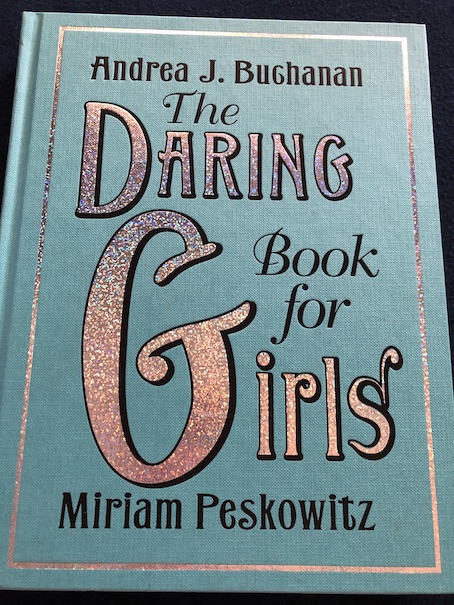
The Daring Book forGirls by Andrea J. Buchanan and Miriam Peskowitz, 2007.
This is an activity/hobby book for children, especially for girls, but really, full of activities that boys could enjoy, too. It’s often sold in sets with a companion book, The Dangerous Book for Boys. These books follow in the tradition of earlier activity/hobby books like The American Boy’s Handy Book and The American Girl’s Handy Book by the Beard siblings. Some of the activities in these modern books are similar to ones included in historical children’s activity/hobby books, but there are some notable differences. Although The Daring Book for Girls includes sports and outdoor activities, it has more scientific and academic information than The American Girl’s Handy Book.
The differences between these books show changes that have taken place in society, the activities that adults want to promote for children, and the types of activities that children can actually use in the 120 years between the times when the two books were published. For example, 19th century how-to books for girls tended to include instructions for making several different types of decorative embroidery stitches. In this book, there is just one paragraph dedicated to sewing stitches, tacked into the end of the section about different types of knots, and the stitches they show are very simple stitches that can be used for basic repairs to ripped clothing. The authors of the 19th century activity books for girls seemed to be trying to introduce girls to genteel and practical pastimes and healthy physical activities. The authors of The Daring Book for Girls explain in their introduction that they wanted to introduce 21st century girls to more nostalgic pastimes that don’t involve today’s technology, like cell phones, video games, and the Internet because they feel like modern childhoods are too high-pressure and push kids to grow up too fast.
I like to explain the contents of books so that people will know whether they would like to read them in more detail. It’s difficult to describe the contents of The Daring Book for Girls succinctly because the contents are extensive, and they are not grouped into convenient categories. Like in The Dangerous Book for Boys, it’s more like reading a very long magazine with isolated articles, although some of the articles are related to each other. It did strike me that more of an effort was made in this book to put some related topics next to each other. For example, Building a Campfire is immediately followed by Campfire Songs, and Reading Tide Charts is immediately followed by Making a Seine Net for fishing.
Because it would be difficult for me to explain everything in this book without basically copying the entire table of contents, which would take quite a lot of space to do, I’ll just hit some of the highlights by describing them in sections that the book doesn’t have but which explain the types of activities and information covered in this book. All of the types of activities that I describe below are included in the book, but there is also more in the book than I could take the time and space to describe in detail.
Useful Skills and Knowledge
There are instructions for different types of knots and stitches, tips for assembling a useful toolbox that can be used to building things or making repairs, how to change a tire, how to write a letter, and basic first aid.
There are two sections with phrases, idioms, and terms of endearment in French and Spanish. These sections are more for fun and getting girls interested in learning languages than a functional guide to speaking a language. However, there are other sections with information that will be useful in school, like the sections of Math Tricks, Greek and Latin Root Words, and Books That Will Change Your Life.
As expected in a book for girls, there are tips and information related to clothes and hair styles, like How to Tie a Sari and Chiton, Putting Your Hair Up With a Pencil, Tying a Bandana, and Japanese T-Shirt Folding. However, I disagree with the advice in the section called The Daring Girls Guide to Danger about high heels. Most of that section is about doing things that are a little scary but can lead to greater confidence, like standing up for yourself or someone else, riding a roller coaster, or seeing a scary movie, but I don’t like the advice to wear high heels. Their logic is that it gets easier with practice, which may be true for most people, but I have to say that I’m in my 30s, and the only type of heels I’ve ever been able to wear without turning an ankle are low and thick. Otherwise, I have to wear flats, and I’m not the only woman who says that. Wearing high heels for extended periods is hard on the feet and can lead to foot problems later in life, so I favor being practical. In my opinion, some things just aren’t worth getting used to, and girls would be better off in the future for not starting that now.
In spite of the authors’ assertion that they don’t want girls to grow up too fast, there are some tips and information that are focused on gaining grown-up skills and preparing for a career, like public speaking, learning Roberts Rules of Order to conduct meetings, learning how to negotiate a salary, and understanding financial information like stocks, bonds, and interest. The section about how to have a lemonade stand not only contains recipes for the lemonade and other treats to sell but how to calculate profits.
There is also advice for girls about how to talk to boys. Some of it is the kind of advice that I wish that boys would be given about talking to girl. For example, the book says, “Some girls are told that boys are different” and that girls need to be into things that boys like in order for boys to like them. I think that, sometimes, boys and girls are taught too much to think of each other as homogeneous groups, that all boys like certain things like sports and all girls like certain things like dolls and romantic movies, and that they each need to do certain things, talk about certain things, or not talk about certain things in order to get people to like them. I think kids should be taught to think of each other more as individuals with individual personalities and interests, whether they’re boys or girls, and not to try to do things that they think are pleasing to all boys or all girls. Nobody really needs to please everyone anyway. No girl needs to get all boys to like her, and no boy needs to get all girls to like him. It’s enough to learn how to bond with people you like. If you want someone to like you, ask them about the things they personally like and tell them about the things you personally like. That’s how you find people who are compatible with you. As the book says:
“Many things are said of boys: Boys like sports, boys are messy, boys don’t have any feelings, boys like trucks, boys don’t like girly things, boys like to run around and eat gross food. Whatever the specific generalization, the point of these notions about boys is to set them apart from girls as being entirely different.
Similar statements are made about girls: Girls like pink, girls like flowers, girls are neat and clean, girls are frivolous, girls are emotional. Are any of these things true about all girls? Of course not. But, it’s easier to think about boys and girls as being entirely different than it is to think about boys and girls as having lots of common ground.”
The book says that, depending on how a girl feels about boys, she could ignore them, be friends with them, or even consider romance with them, but “Wherever you are on the spectrum of how you feel about boys, do treat all of your friends, boys and girls, with kindness. This has gone out of fashion, and that’s a sad mistake. Overall, the truth is that there’s no great mystery about boys. Boys are people, and like all people, they are complicated. And that’s what makes being friends with other people interesting: you get to learn about how other people think and act, and, in the process, learn a little bit more about yourself.”
One of the stereotypes about boys is that they aren’t as good with relationships as girls are, but I think that this is partly due to the advice that they’re given about relationships. After comparing the advice about girls given in The Dangerous Book for Boys and the advice about boys in The Daring Book for Girls, I think that both boys and girls should take the advice in The Daring Book for Girls.
Games
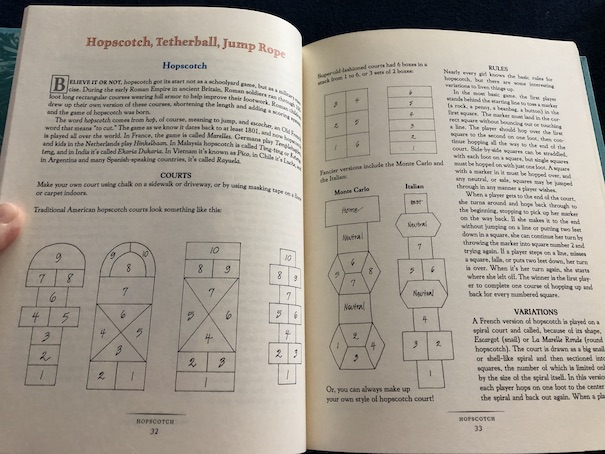
The book provides rules and tips for outdoor games, including Four Square, fourteen variations of Tag, Hopscotch, Tetherball, and Jump Rope (which includes jump rope rhymes, and there are separate sections for Double Dutch and Chinese Jump Rope). There are card games, like Hearts and Gin. There are also rules for playing Jacks, Darts, and Hand Clap Games.
There is a special section about slumber party games, which includes the classic Truth or Dare and a couple of games of the spooky variety, Bloody Mary and Light as a Feather, Stiff as a Board. Young girls often like to do spooky things to scare each other when they’re staying up late at night. Boys don’t usually do this stuff, but girls often do when they’re unsupervised at sleepovers or summer camp. The spooky types of “games” are really psychological tricks, and they seem much less mysterious and scary when you know how they work (Bloody Mary makes use of the “Strange Face Illusion“, which is admittedly still an eerie sensation when you’re an adult who knows what to expect and that it’s all a trick of the mind), so they tend to be at their maximum popularity when girls are in their tween and early teen years, old enough to get a little thrill from doing something a bit scary but not yet old enough to have learned why they work and have the mystery taken out of them. The book explains a little about the concept of levitation and the superstitions surrounding it for Light as a Feather, Stiff as a Board, and it ends by calling the effect a “magic trick, a phenomenon based in real-world explanations and techniques”, but it doesn’t go into details about the real-world explanation behind it, so it doesn’t ruin the sense of mystery for the girls who want to try it. There is also a section of advice for telling ghost stories that is separate from the slumber party section, but good for sleep-overs and camp-outs.
Sports and Exercise
The book provides rules for basketball, netball, softball, and bowling.
It also explains five basic karate moves, some basic yoga, and how to do cartwheels and back walk-overs.
Outdoor Activities
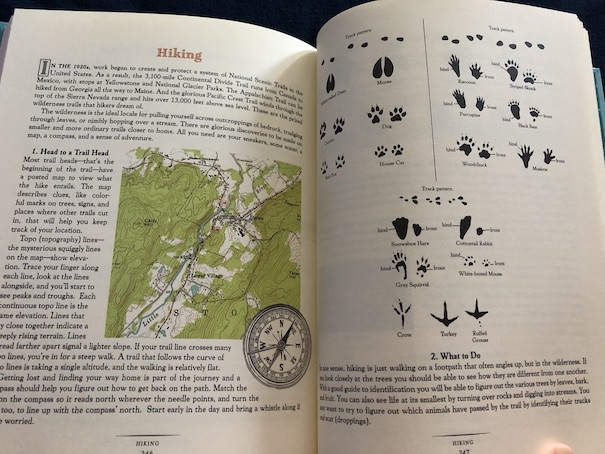
There are sections with activities related to camping out, like Sleep Outs, how to build a campfire, campfire songs, two ways to make a sit-upon, how to paddle a canoe, and how to go hiking, climbing, and bird watching. As I mentioned above, the book also explains how to read a tide chart and how to make and fish with a seine net.
There are also instructions for making clubhouses and forts, setting up a tree swing, rollerskating, and how to make traditional daisy chains and ivy crowns.
Science and Technology
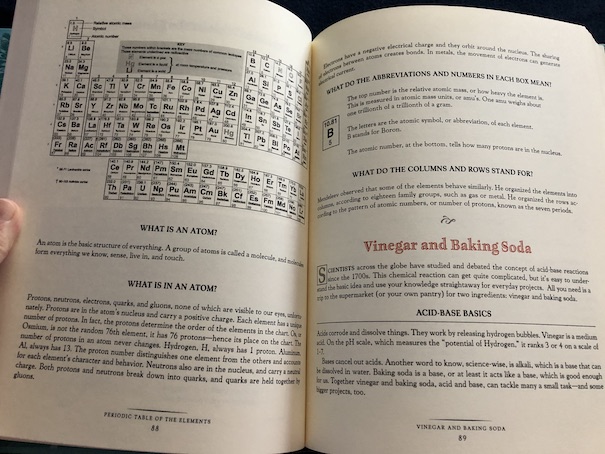
The book explains some natural and scientific concepts, such as weather and the Periodic Table of Elements.
There are instructions for creating projects of the type that would be good for a science fair, like a Lemon-Powered Clock, things to do with Vinegar and Baking Soda, how to demonstrate capillary action with paper flowers, and how to make a lamp, lantern, or flashlight with batteries.
History and Geography
The book covers the Bill of Rights and the 50 states of the United States and also has some information about Canada. There are also sections about the countries of Africa and the South Sea Islands.
All of the historical people or interesting people from around the world described in the book are women. The section about pirates describes famous female pirates from history. There is a section about female scientists and inventors and one about famous female Olympic athletes, and there are several sections about famous Queens of the Ancient World. There is a section about Modern Women Leaders from around the world and one section about what modern princesses are like and what they do, giving girls a more realistic reference for what princesses are beyond the usual fairy tale images. There are also stories and mini biographies about interesting and inspirational historical women, like Joan of Arc, and others that are related to other topics that the book covers. For instance, the section about first aid is followed by short biographies about Clara Barton and Florence Nightingale.
Spies and Secret Codes
The book discusses female spies from history, and there is some information about secret codes, but much of the sections about spies discusses assembling a spy team, the types of roles required for a team, and the skills that the members should have. There is also a section about “Spy Lingo”, terms and code words that spies use.
Arts and Crafts
The book has information and instructions for writing in italics, making a quill pen, painting with watercolors (even doing it “on the go”), pressing flowers, making friendship bracelets, making a cloth-covered book, making your own paper, making paper airplanes, making cootie-catchers (origami fortune tellers), and making God’s-Eyes.
There are some projects that involve wood working, like making a peg game, a willow whistle, and a scooter.
Stunts and Random Skills
The book explains how to read palms (this could go with slumber party ideas, although they’re not grouped together in the book, because young girls often like to speculate about the future, especially their future love lives, or do spooky things to scare each other when they’re staying up late at night) and how to pull Three Silly Pranks of the kind that are common at summer camps (like short-sheeting a bed).
Dangerous Book for Girls Badges
This is the final part of the book. Since many of the activities in the book are the kind done at summer camps or in scout troops, the book offers suggested “badges” you can award yourself and your friends for doing the activities. Even though the activities in the book are not sorted into specific categories, there are six categories of badges offered: Sports and Games, Girl Lore, Adventure, World Knowledge, Life Skills, and Arts and Literature. The book doesn’t specify what activities you should master to award yourself these badges, leaving that up to the reader. My copy says that if you go to their website, you can print out these badges, but that website no longer exists. I don’t know if later printings say something different.
If you’re looking for something to do with the kids during coronavirus lock-downs (I first published this post in May 2020) and/or over summer vacation, this book has plenty of ideas, and you can even make up your own “badges”, using their ideas, my category suggestions, or anything else you would like to do yourself.
If you would like some suggestions to get you started or give you some goals to aim for, I think I would award badges like this (of course, these are just my suggestions):
Sports and Games – Learn the rules to at least two games and/or sports from the ones in the book. They can be any two games you like, indoor or outdoor or one of each. I don’t think winning at the games is necessary. It’s more important that kids know how to play games and how to teach other people to play so they can use the games with their friends.
Girl Lore – This is a good category for the sleepover-related activities. To earn this badge, someone could either try each of the sleepover games or activities or practice story-telling skills with a camp-out or sleepover type story or by telling a story about one of the famous women described in the book.
Adventure – This badge has a lot of possibilities, but I would suggest either using it for practicing outdoor or camping skills or for doing activities that are new and challenging. If you don’t want to go on a hiking, bird-watching, or camping trip, you can challenge yourself or your group to do three things you’ve never done before, in the spirit of adventure. They can be activities in this book (like the spy activities), suggestions from the section called The Daring Girls Guide to Danger (like watching a scary movie or riding a roller coaster or trying a new food), or going to a place you’ve never been before, etc.
World Knowledge – Study one of the sections in the book about countries of the world or historical events or people and tell someone else what you’ve learned.
Life Skills – Pick a skill to study and demonstrate to someone else, like knots and stitches or the clothing and hair tips, or assemble a first aid kit or tool kit and discuss the purpose of each of the items included. Alternatively, study and discuss the sections about job skills and how you can use them in your life.
Arts and Literature – Try at least one of the arts and crafts activities from the book and/or read at least one of the books from the list of Books That Will Change Your Life. Show off what you create and talk about the book you read.
As a bonus suggestion, if you’re doing these activities with a group or over an extended period of time, like the entire summer, you can award badges multiple times for different levels of achievement. Completing one of the activities related to a badge theme could be Level 1, and doing another would be Level 2, etc. That way, if someone doesn’t like a particular activity category, like the outdoor or camping activities, they can put their focus into achieving more in a category they like better. At the end of the summer, you could offer recognition to members of the group who achieved the highest levels for each category and/or people who found particularly creative ways to use their skills. You could even include an extra Overachiever award for people who tried everything!
The purpose of badges and awards like this is really to encourage kids to try new things, to set personal goals, and to persevere, so whatever you do with the badges should keep these purposes in mind. If you use the badges, keep the badges fun and celebratory of achievements or at least attempts at trying new things! As long as it’s fun, like a game, kids will want to continue.
The book is available to borrow and read for free online through Internet Archive. There is also a sequel to this book called The Double-Daring Book for Girls which contains similar types of activities and is also available through Internet Archive. There are no badges with the sequel book, but if you like that format for marking achievements, you can either reuse the badges from this book or make up some of your own.
The Dangerous Book for Boys by Conn Iggulden and Hal Iggulden, 2006, 2007.
This is an activity/hobby book for children, especially for boys, but really, full of activities that girls could enjoy, too. It’s often sold in sets with a companion book, The Daring Book for Girls. These books follow in the tradition of earlier activity/hobby books like The American Boy’s Handy Book and The American Girl’s Handy Book by the Beard siblings. Some of the activities in these modern books are similar to ones included in historical children’s activity/hobby books, but there are some notable differences. Although The Dangerous Book for Boys includes sports and outdoor activities, it has more scientific and academic information than The American Boy’s Handy Book.
The differences between these books show changes that have taken place in society, the activities that adults want to promote for children, and the types of activities that children can actually use in the 125 years between the times when the two books were published. The motives of the authors of these books were similar, all of them wanting to produce the type of activity/hobby book that they would have liked to have when they were young and didn’t have, not because other hobby books didn’t exist exist when they were young but because they were looking for something that they hadn’t found in the hobby books of their youth. In the 1880s, Daniel Beard set out to write a hobby book for American boys because many of the hobby books of his youth were poorly written and/or came from England, using words that were not used in American English or recommendations for London shops where boys could buy equipment, which were of no use to an American boy. His book, The American Boy’s Handy Book, promoted do-it-yourself hobbies, particularly ones related to outdoor activities and suitable for children who lived near woods and lakes or rivers where they could do things like go fishing, sail boats that they made themselves, or build log cabin playhouses. However, 21st century society is much more urban/suburban, and it can be difficult or impossible for modern children to do something the things that Daniel Beard recommended. The Dangerous Book for Boys was written for 21st century children, who might need a bit of nudging to get off their computers and video game systems now and then and maybe a little academic help or something to ignite an interest in history or science, but are no less interested in learning something new and interesting or something fun to do with their friends. One thing that I hope readers come to understand from these books is that the world is full of things to do. There is more to do in life than anyone will have time to do in a single lifetime, and far, far more than can be contained in any one book. The Dangerous Book for Boys (published first in the UK and later in the US) contains things that 19th century Daniel Beard might have found very interesting but didn’t exist during his time, so they never even occurred to him as possibilities, and there are bound to be more things coming in the future that people either haven’t thought of yet or are quietly working on right now, planning the books and activities of the future. There’s always something to do. People just need time to do things and the willingness to get started.
I like to explain the contents of books so that people will know whether they would like to read them in more detail. It’s difficult to describe the contents of The Dangerous Book for Boys succinctly because the contents are extensive and they are not grouped into convenient categories. It’s more like reading a very long magazine with isolated articles, although some of the articles are related to each other. It’s just that related topics are not put next to each other. For example, the information about reading star maps comes much later in the book than the introduction to astronomy, and information about the solar system comes even later, with many other sections in between. There are also some sections of trivia/interesting information, history, or academic topics which were purposely split into different numbered sections and distributed throughout the book, like Questions About the World (explaining natural phenomena like the seasons, the tides, and why the sky is blue), Famous Battles (divided into sections starting with ancient battles and then more modern ones), Extraordinary Stories (about the lives and accomplishments of famous men, including the Wright Brothers and Robert the Bruce), and Understanding Grammar (a more academic section).
Because it would be difficult for me to explain everything in this book without basically copying the entire table of contents, which would take quite a lot of space to do, I’ll just hit some of the highlights by describing them in sections that the book doesn’t have but which explain the types of activities covered in this book. All of the types of activities that I describe below are included in the book, but there is also more in the book than I could take the time and space to describe in detail.
Useful Skills and Knowledge
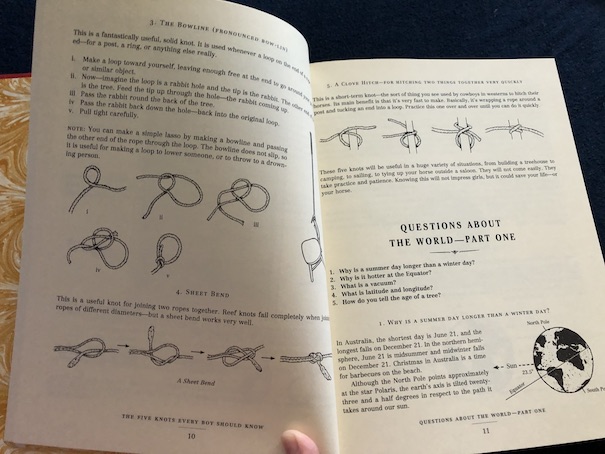
The book has sections explaining how to do first aid, how to tie different types of knots, how to wrap a package with brown paper and string, and how to make cloth fireproof.
I was somewhat amused by the section about how to talk to girls. Most of it is good advice, like maintaining a clean appearance and not being vulgar or overdoing it with jokes. Lesson #1 is “It is important to listen.”, which is always true. The part that I thought was funny was in the introduction: “You may already have noticed that girls are quite different from you. By this, we do not mean the physical differences, more the fact that they remain unimpressed by your mastery of a game involving wizards, or your understanding of Morse Code.” To that, I say, “Are you kidding?!” I used to have Morse Code memorized from playing the Nancy Drew computer games by Her Interactive, and I know from my fascination with activity books like this that the reason why Morse Code looks the way it does is that Morse wisely decided to make the letters of the alphabet used the most often the shortest to form. I used to play World of Warcraft, and I played every one of the available factions, but then I got more interested in physical board games and board game history. My female friends continued much longer, although they ended up switching to Final Fantasy. I’ve played both D&D and Call of Cthulu and liked them both. The more wizards, the better, as far as I’m concerned!
I always think that advice about what girls like often fails to take into account that girls are individuals with different interests and hobbies, no matter what their age. Not all woman like to wear high heels (which are stupid, annoying shoes that are bad for your feet, especially those with the dumb, skinny heels that always make me turn my ankle), and some either never wear makeup or consider it an annoying hassle that they feel obligated to do to because other people expect it. Some girls wear their hair long because they like the feminine look or like to experiment with different types of artistic braids and hairstyles, and some girls chop their hair short because they’d rather just quickly run a comb through it and forget about it. Some women, like me and my friends are geeks, who love books, play video games and role-playing games, know various types of computer programming or maker hobbies, study history, and would gladly do most of the activities in books like this. Some girls are into sports and working out. There are even some girls who are into things like hunting and even taxidermy and wished that they could have joined the Boy Scouts instead of learning to sew and bake cupcakes in Brownies. People in general can have many and varied interests. Even though this book was written for boys of the 21st century, I don’t think that the authors are really in touch with women and girls of the 21st century and understand the range of topics that many of them find interesting. Although, I think that the authors’ attitudes about girls’ interests aren’t just due to them growing up in the 20th century themselves. Guys have often tried to figure out what women like and what women want, and they frequently get it wrong because they approach the question from the wrong angle. Chaucer tackled the problem of what women want way back in the Middle Ages, and he figured it out. What women like most is often what men like most: having things their own way. What that means varies from person to person because of our different interests, but in some form or other, that’s what we all want. So, don’t try to figure out what “girls” like; just ask a particular girl what she likes. Guys don’t need to try to please all the girls in the world at once, just the one they’re with. Most people will tell you who they are and what they’re interested in, given the chance (or maybe a Facebook or Instagram page), and when a boy finds a girl who likes things that he also likes or is willing to do things that he likes to do, he’s found a good one.
Aside from random, useful life skills, there is also academic information in the book that would be useful to school, like standard and metric measurements, the sections about how grammar works, the origins of words, Latin phrases, quotes from Shakespeare, the Ten Commandments, and poems that boys should know and books that boys should read.
Games
I count games differently from sports because sports tend to be outdoor activities and require a certain level of physical skill, and games tend to be more general, require less physical skill, and can be played indoors. This book includes some pen-and-paper games, marbles, chess, role-playing games, poker, and table football.
Sports
The book has the rules for soccer and stickball. It also discusses famous baseball players and rugby.
Outdoor Activities
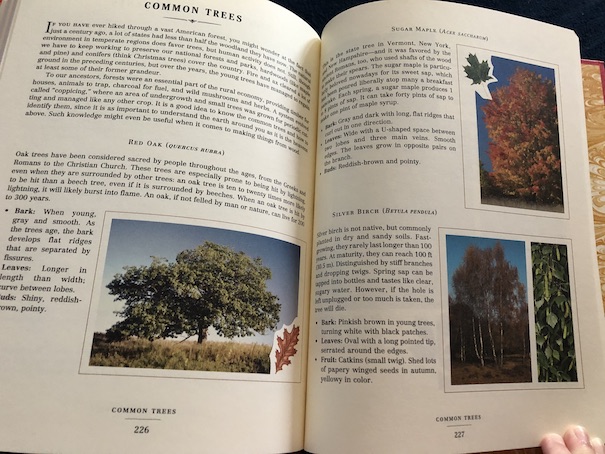
These are activities to do that are related to the outdoors and nature and things to make related that are related to outdoor activities, including fishing, building a treehouse, making a bow and arrow, how to hunt and cook a rabbit, how to tan an animal skin, making a go-cart, and learning various methods of navigation and different types of trees.
Science and Technology
The book describes various topics related to science, like astronomy, insects and spiders, cloud formations, and fossils and dinosaurs. There are also instructions for making projects that would probably make good science fair projects, like a battery, an electromagnet, a periscope, a pinhole projector, and crystals.
History and Geography
There are sections about US geography (I don’t know if the original UK version had this or if it focused on the geography of the UK), Early American History, the Declaration of Independence, the Golden Age of Piracy, descriptions of the Seven Wonders of the World (both ancient and modern), the sections about Famous Battles from history, and a Brief History of Artillery.
Spies and Secret Codes
There are sections about the codes and ciphers that spies use, the Navajo Code Talkers’ Dictionary from World War II, the US Naval Flag Codes, and how to make secret inks.
Crafts
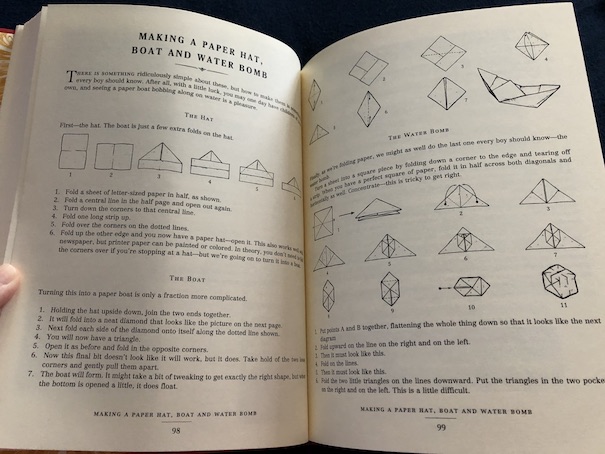
The book explains how to build a workbench, how to grind an italic nib for italic writing, and how to make marbled paper, making paper airplanes and paper hats, boats, and water bombs (these are little origami boxes that you fill with water and splat when you throw them at something – I’ve made them before).
Stunts and Random Skills
These are just random things that are fun to know how to do, like juggling, skipping stones, coin tricks. There is also a section about teaching tricks to dogs.
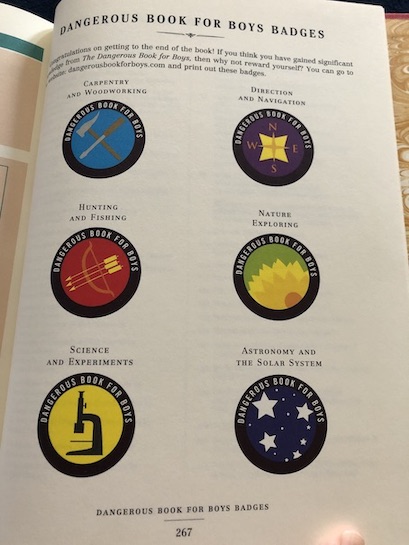
Dangerous Book for Boys Badges
This is the final part of the book. Since many of the activities in the book are the kind done at summer camps or in scout troops, the book overs suggested “badges” you can award yourself and your friends for doing the activities. Even though the activities in the book are not sorted into specific categories, there are six categories of badges offered:
Carpentry and Woodworking
Direction and Navigation
Hunting and Fishing
Nature Exploring
Science and Experiments
Astronomy and the Solar System.
The book doesn’t specify what activities you should master to award yourself these badges, leaving that up to the reader. My copy says that if you go to their website, you can print out these badges, but that website no longer exists. I don’t know if later printings say something different.
If you’re looking for something to do with the kids during coronavirus lock-downs and/or over summer vacation, this book has plenty of ideas, and you can even make up your own “badges”, using their ideas, my category suggestions, or anything else you would like to do yourself.
The book is available to borrow and read for free online through Internet Archive. I’ve also learned that the book has inspired a tv series, which is available through Amazon Prime. You can see the trailer on YouTube.
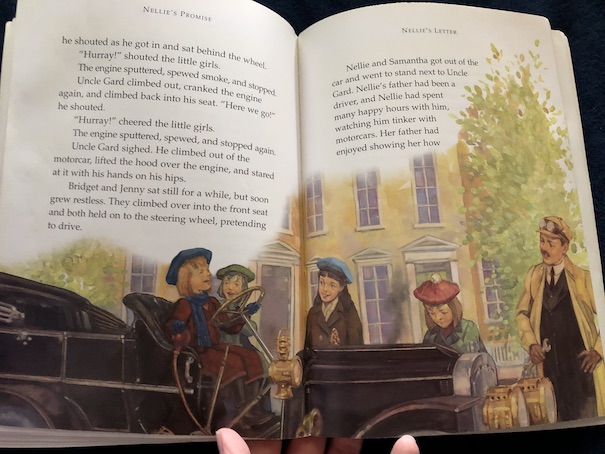
This book is a companion book to the Samantha, An American Girl series, focusing on Samantha’s best friend, Nellie. Personally, I don’t like the companion books to the main American Girls books as well as the original books, but this book does follow up on the events to the main series. At the end of Samantha’s series, Samantha’s aunt and uncle took in Nellie and her sisters, Bridget and Jenny, after their parents died. Nellie and her sisters were from a poor family and had to start working from a young age before their parents died. After their parents died, their disreputable uncle abandoned them, and they were sent to an orphanage before Samantha discovered where they were. Samantha’s aunt and uncle are wealthy, and the girls’ lives have improved considerably.
Nellie’s happiness is threatened by the sudden reappearance of her Uncle Mike. Uncle Mike sees Nellie walking down the street in her nice new clothes and wants to know what rich family the girls are living with. Nellie runs away from him, but he threatens to find out where she’s living and to take her and her sisters back, saying that it’s his right as her uncle. He says that he means to put the girls to work earning money for him. Nellie is afraid that he might be able to reclaim them from Uncle Gard and Aunt Cornelia because he is a blood relative.
At first, Nellie is afraid to tell anyone that she’s seen her uncle and that he threatened to take her and her sisters back. Before her parents died, her mother made her promise to look after her younger sisters, so Nellie makes up her mind that’s what she’s going to do.
Nellie worries about the future for her and her sisters. She feels like she doesn’t fit in with the wealthy girls at Samantha’s school, who have had very different lives from hers, and the lessons they learn are the type of lessons for fine young ladies who will marry rich men and spend most of their time raising families, overseeing a house with servants, and entertaining friends and their husbands’ business associates, not preparing for practical professions outside the home. Nellie thinks that it’s important that she have some kind of job skills because the future can be very uncertain, and she wants to know that she can provide for her sisters, no matter what happens.
Samantha senses that Nellie is unhappy, and she asks her if she likes living with Uncle Gard and Aunt Cornelia. Nellie tells her that she does, but she hesitates to explain what’s really worrying her. Instead, she lets Samantha think that she just wants to feel like she’s doing something useful for the family. Before her parents died, Nellie used to get sewing lessons at a settlement house (a place where immigrant families could go to learn English, new job skills, and other skills they would need in their new lives in the United States) run by Miss Brennan. Aunt Cornelia is involved with many good causes, and she wants to visit a settlement house and get an introduction to Miss Brennan. Because Nellie knows Miss Brennan, she can help arrange that. It’s in a rough part of town, but Nellie is more accustomed to navigating rough neighborhoods than Samantha or her aunt. It also occurs to Nellie that she could ask Miss Brennan what to do about Uncle Mike.
Miss Brennan is glad to see Nellie, and she lets her show Aunt Cornelia and Samantha around the settlement house. They have many different types of classes for children as well as adults. Nellie says that she likes the practical classes that she used to have there, and even the types of dances that they do seem more practical than the more purely artistic ones that they do at the school she now attends with Samantha. Aunt Cornelia is pleased with the classes that they offer for women, and because she is interested in women’s education, decides that she wants to help out at the settlement house. However, the visit to the settlement house leaves Samantha irritated for reasons that Nellie doesn’t fully understand.
As Nellie begins spending more time with Aunt Cornelia at the settlement house, Samantha begins spending more time with Bridget and Jenny, and Nellie becomes jealous of how Samantha seems more like their older sister than she is. However, the others still don’t know about Uncle Mike’s reappearance, and Nellie is still fearful of what he might do and what will happen to her and her sisters if Uncle Mike tries to take them away. She feels like her only option is to try to prepare herself for a better job than that of factory worker.
When Nellie finally gets the courage to tell Miss Brennan about her worries, Miss Brennan tells her that she needs to discuss the situation with Uncle Gard. Uncle Gard is a good man, but he’s also a lawyer, and he will know how to legally stop Uncle Mike from trying to take custody of the girls. However, Miss Brennan adds that, whatever else happens, Nellie will still need to make some decisions about her future and what she wants to do with her life and education. The more Nellie thinks about it, the more certain she is about what she wants to do. She wants to become a teacher, like Miss Brennan.
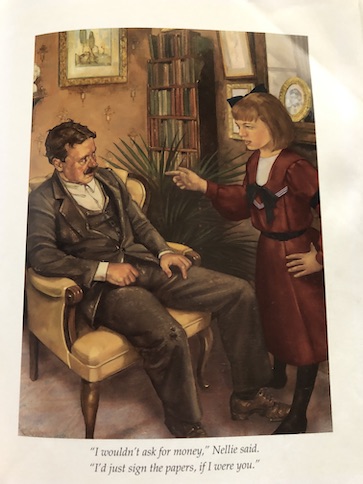
Nellie provokes more drama by applying to the boarding school in Boston where Miss Brennan said that she trained to be a teacher without talking to Aunt Cornelia, Uncle Gard, or Samantha about her decision or about her uncle. However, when the truth comes out about Uncle Mike, everyone understands that she was trying to hide and protect her sisters from him. It turns out that Uncle Gard has actually been looking for Uncle Mike because he already has the documents that he needs to legally adopt Nellie, Bridget, and Jenny, and he just needs Uncle Mike to legally release them into his custody. At first, Uncle Mike tries to extort money from Uncle Gard for the girls, but Nellie gets up the courage to tell him off, promising that if he doesn’t sign the papers and leave, she’ll tell everyone about how he stole all of their money and abandoned them to freeze the last time they were in his custody. The book ends happily, with Aunt Cornelia and Uncle Gard adopting the girls and understanding Nellie’s ambition to be a teacher. They enroll Nellie in a school in New York that teaches the skills she really wants so that she can continue living with them and not go to Boston. It also turns out that Samantha was mostly uncomfortable at the settlement house because she felt so sorry for the young children there and that spending time taking care of Bridget and Jenny was part of her way of trying to help Nellie by leaving her more free to do some of the things that she felt like she had to do. With everything out in the open, Nellie and her sisters are able to more fully become part of the family.
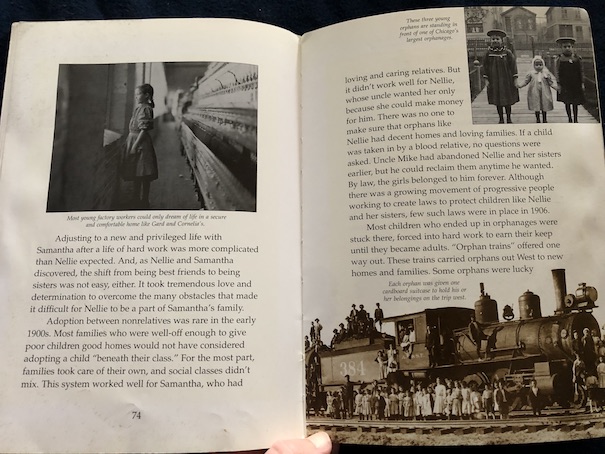
In the back of the book, there is a section with historical information about orphans and adoption in the early 1900s. There were not many laws and regulations governing care of orphans. Usually, orphans would be taken in by relatives, like Samantha was when her parents died. If a child didn’t have any relatives who were willing and able to take them, the child might be sent to an orphanage and possibly sent west on an orphan train as Nellie almost was at the end of the Samantha series. Families didn’t usually adopt children from different levels of society.
Settlement houses were important resources for poor immigrant families, and the education they received allowed immigrants to enter higher professions than servant or factory worker, which had been the primary source of income for many of them. It was common for settlement houses to help train young women to become teachers. There are still similar institutions and organizations in operation in 21st century America.
The book is available to borrow for free online through Internet Archive.
My Reaction and Further Historical Information
Part of the reason why I don’t like the companion books as much as the original American Girls series is that they tend to get more dramatic than the original books, and sometimes, I feel like the attitudes of the characters are less realistic for their time periods than they were in the original books. I think what made the original books more realistic was the restraint of the stories – they had their share of excitement and sometimes drama, but they never went overboard. The return of Nellie’s disreputable uncle struck me as both unlikely and unnecessary to Nellie’s and Samantha’s larger stories.
The historical details in this book are good. What they say about orphans of the time is basically true, although they note in the historical information section in the back of the book that Nellie’s experience of being adopted by a wealthier family was not typical of the time, and I think that’s part of what bothers me. Adoptions in general during the early 1900s were less formal than they are in modern times, and the idea of Uncle Gard hiring a private detective to find Uncle Mike and get him to sign legal documents doesn’t seem entirely realistic. I think it would have been more realistic to me the way that the last Samantha book ended, with Uncle Mike leaving and the assumption that none of the characters would see him again.
The reason why Nellie and her sisters were sent to the orphanage and why the orphanage was considering sending Nellie west on the orphan train was that no one expected that Uncle Mike would ever want to see the girls again. He’d already taken everything he could from them and left with them with no concern for what would happen to them. In the time that has passed since then, I would have expected that Uncle Mike would already have gotten into trouble that would keep him busy and out of their lives, maybe ended up in prison for being drunk and disorderly or hopping from job to job or begging for money as their little money ran out. Even if Uncle Mike had some thought of finding the girls, I don’t think it’s likely that he would have succeeded or even gotten close on his own because he is not that bright and he is not the kind of person who makes friends in places where he’s been before. I doubt that his former neighbor who took his nieces to the orphanage would have told him much if he had shown up again, looking for them. She knew that he was a drunk who abandoned the girls, and she made it clear that she didn’t like him. The people at the orphanage would have probably sent him away with no information because they would probably view the situation as closed since the girls are already placed out and Mike may not even have any proof of his identity and relationship to the girls. There is no such thing as a driver’s license during this period and many people did not even have birth certificates, so it’s possible that the people at the orphanage could simply choose to disbelieve this disreputable character and send him away. When I was watching a documentary about the orphan trains, former orphan train riders said that the orphanages that sent them west deliberately took notes from them that had their living parents’ addresses and otherwise cut off contact with living parents because they wanted the children to sever their ties to their difficult pasts and devote their attention to their new families, not maintain contact with the parents who were unable to care for them financially, so I wouldn’t expect that anyone at the orphanage in these books would go out of their way to reunite the orphaned girls with a rather shady uncle when they knew that the girls were already placed with a wealthy family and no longer their responsibility. Without help, which would be unlikely to be forthcoming, it doesn’t seem likely that Uncle Mike would be able to stumble on the girls by accident. As mentioned in Changes for Samantha, New York is a big city, people can be difficult to find if you don’t have a hint of where to look, and the wealthier part of the city where Nellie and her sisters live now is not a part of town where a guy like Uncle Mike would be likely to hang out. They could all easily live in New York City for years without meeting each other.
I feel like the situations in the story were a little contrived. By now, I would have thought that Nellie would know that Uncle Gard is a lawyer and would be the best person to ask about the laws. I don’t recall the earlier books saying what Uncle Gard did for a living, but Nellie lives with him now, and I would think that someone would have mentioned Uncle Gard’s profession by now. In the book, it oddly seems like as much of a surprise to Nellie as it is to the readers. I could believe that Nellie would go to the settlement house and do volunteer work there with Aunt Cornelia because it was already established in the previous books that Aunt Cornelia supports good causes, and although women of her level of society didn’t usually work for living, supporting good causes and charitable works would have been acceptable. Nellie’s level of knowledge seems a little odd, considering that she needed extra tutoring in basic subjects, like reading, in Samantha Learns a Lesson. In that book, Nellie never mentioned settlement house lessons, which she would have done if it hadn’t been a sudden decision to insert that this in book. Here, Nellie talks about classes that she had at the settlement house, where I would have expected to have more lessons to improve her reading, and it seems like she learned more there than she seemed to know before, even knowing a few words of foreign languages. In Samantha Learns a Lesson, one of Nellie’s skills was her ability to do math quickly handle money because she used to do the shopping for her mother, and in this book, she mentions that she helped to teach immigrants about American money, which she never mentioned before. These things are necessarily contradictory, but it all just seems a little off because they don’t quite fit into Nellie’s established character and history, and it implies that Nellie has had more education and training than she seemed to have before. It’s not necessarily impossible for a girl of Nellie’s time to know some of these things, but it’s the departure from what was already established about Nellie and her situation in life than kind of grates on me.
I think it could be reasonable for Nellie to develop the ambition to be a teacher. Even Samantha has previously some interest in that direction, having helped to tutor Nellie before. Not all women of this time went on to higher education, but those who did might attend a normal school, which is basically a college that focuses on training teachers. By contrast, the daughters of wealthy, high society families would be more likely attend a finishing school that emphasized social skills and entertaining more than academics. Both Samantha and Nellie are about twelve years old during this story and would be a little young for either of these options, but Samantha’s school seems to be more inclined toward preparing the girls for a finishing school. Given Aunt Cornelia’s interest in education and social causes and Uncle Gard’s support of it, I would expect that Samantha would be more likely to attend a women’s liberal arts college when she gets older, preparing her to marry a well-educated and culturally aware man as well as a wealthy one and probably engage in some form of social work and/or the arts in her spare time, but that’s just a guess. (I discussed some of this already in my review of Happy Birthday, Samantha. See also the book Daddy-Long-Legs for a description of what that might have been like for a girl of Samantha’s and Nellie’s time. The book was written a little later in than the time period of this book, but it’s set at about the right time for Samantha and Nellie to be old enough for college and includes characters of approximately their social backgrounds.) This book doesn’t really go into the subject, but if that’s the case, Samantha’s future might not be as different from Nellie’s as it first seems, and there might be a kind of middle path that both of them could choose. The Finch College in Manhattan, which was a fairly new preparatory school in Samantha’s and Nellie’s time, seems like it would have been a good option for both Samantha and Nellie, catering to upper-class girls while focusing on a more practical liberal arts education than the less academic finishing schools. Its founder, Jessica Finch, was a women’s rights activist and may have moved in similar circles to Aunt Cornelia. Her attempts to balance theoretical and practical knowledge sound like they would have appealed to the characters in the story. I’m not an expert on the Finch College, only having heard a little about it, but I think a school like that would present an intriguing possibility for the girls’ futures.
Prosper and Bo (short for Boniface) are orphans, running away from their caregiver. They were living with their aunt, a wealthy woman who likes little Bo and treats him like a little doll but doesn’t like Prosper because he is too old to treat like a toy. When the aunt starts considering sending Prosper away to boarding school, they run away to Venice to hide. There, they meet up with a band of orphans who live in an old movie theater. The other orphans/homeless children are Riccio, Mosca, and Hornet. Each of them is running from something in their past, and lacking adults to take care of them, has made their home in the theater, stealing and picking pockets to survive. The Thief Lord, the leader of this group, is the mysterious Scipio, a boy with his own secrets.
Many of the adults in this book are varying degrees of unhelpful and threatening as the children struggle to take care of themselves and their own lives. The boys’ aunt hires a detective to find them, and he does eventually figure out where they are living. Scipio turns out to be the son of the wealthy man who actually owns the disused theater. However, in spite of his father’s wealth, he does not have a happy home life. His father ignores and neglects him because he is too obsessed with his business concerns. At one point, the boy’s beloved cat is very sick, and Scipio fears that she might die, but his father brusquely tells him that he has no time to take it to a vet, and he’ll just buy him another one. (Don’t worry, the cat gets saved.)
One of the thefts that Scipio has the children attempt is the theft of a lion’s wing owned by a woman named Ida Spavento. A man known as the Conte, a customer of the man who buys the band’s stolen goods, specifically requested this item, although the children do not initially know why. Ida catches them in the act and tells them that the wing was once part of a magical merry-go-round that can change the ages of the people who ride it, making older people younger and younger people older. When Ida learns that the children received a request to steal the lion’s wing, she allows them to have it on the condition that she is allowed to come with them to see who hired them.
The Conte and his sister have discovered the merry-go-round and need the missing wing to complete it. Once the wing is restored, the merry-go-round turns them into young children. When Scipio sees that the merry-go-round really changes a person’s age, he insists on riding it himself. After a ride on the merry-go-round, Scipio becomes a young adult, able to live independently from his hard-hearted father and take care of his beloved cat. Barbarossa, the man who fences their stolen goods, also rides the merry-go-round and becomes a little boy again, far more adorable than the man he used to be. However, he accidentally breaks the merry-go-round so that the magic no longer works.
With the exception of Ida and the detective, Victor, the other adults in the story are irresponsible and self-centered, really more like children than the children. When the merry-go-round changes the ages of some of the characters, the changes end up suiting their personalities. Scipio was always more mature, and his new status as an adult reflects that. He ends up becoming an assistant to the detective in his agency, who understands the whole situation. Ida adopts Prosper, Bo, and Hornet and takes care of them. Prosper and Bo’s aunt is charmed by the now adorable Barbarossa and takes him in. Barbarossa, who is as shifty as a child as he was as an adult, is more than happy to let the aunt pamper him and fuss over him because he knows that he’ll get to enjoy her money in the process. The end does reveal that the aunt catches Barbarossa stealing from her and sends him to boarding school for some discipline, but he bullies and dominates the other boys into doing his bidding and even stealing for him, becoming the new Thief Lord.
The book is available to borrow for free online through Internet Archive.
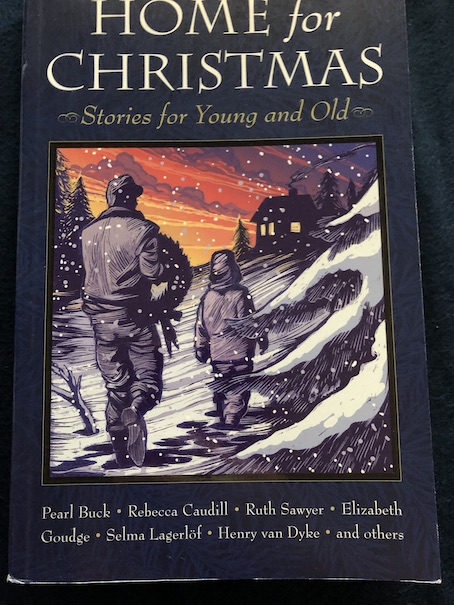
Home for Christmas: Stories for Young and Old compiled by Miriam LeBlanc, 2002.
Disclosure:Plough Publishing House sent a copy of this book to me for review purposes, but the opinions in the review are my own.
This is a collection of short Christmas stories written by famous authors from around the world. One of the things that I found interesting about the selection of authors in the book is that many of them are better known for writing on very different themes. Among the authors in this book are Madeleine L’Engle, who is known for writing science fiction, such as A Wrinkle in Time; Elizabeth Goudge, who wrote the mid-20th century classic children’s fantasy story The Little White Horse (later made into the film called The Secret of Moonacre); Katherine Paterson, known for her children’s novels, including Bridge to Terabithia, Jacob Have I Loved, and historical novels set in Asia, such as The Master Puppeteer; and Pearl S. Buck, author of The Good Earth.
Although the book is intended for children and families and many of the authors are known for writing for children and young adults, I think that many of the stories wouldn’t particularly appeal to children, especially younger children, because children wouldn’t be likely to understand them or they have darker themes, like bitterness that must be overcome and grief at the death of a child. The stories generally end well, but for young children, something simpler and lighter in subject matter, like the short stories in Merry Christmas from Eddie, would be more appealing. Really, I think this book would be best for adults, although I noted some of the more child-friendly stories.
One thing that I wished the book included is sections of information that explain a little more about the stories behind the stories. I recognized the historical references behind some of the stories, but other readers, particular children, might require a little more explanation to fully appreciate them. I think that’s another good reason why the stories might appeal more to adults.
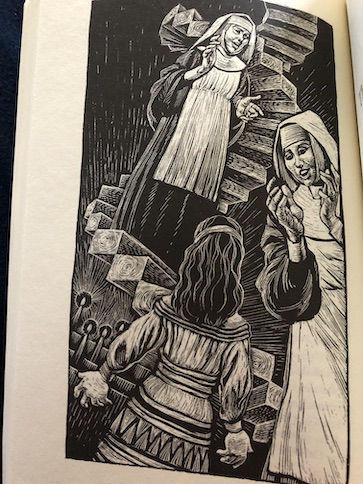
There are 20 stories contained in the book. Each of the stories in the book has one black-and-white picture in an old-fashioned woodcut style.
I don’t think that there are any copies of this book available to read for free online, but this book is available for purchase through Plough Publishing House.
The stories contained in this book are:
Brother Robber by Helene Christaller
A young monk sends three robbers away without food before Christmas because they are violent criminals, but an older monk convinces him to have compassion and to find them and give them the food they have asked for.
The compassionate brother, Brother Francis, is St. Francis of Assisi, although it is not explicitly explained in the story, and the younger brother, Brother Angelo, is the main character. The story of St. Francis, Brother Angelo, and the robbers is an old one that has been told before in other forms, but this is a good rendition.
Three Young Kings by George Summer Albee
Three boys at a school in Cuba are given the role of playing the Three Kings in their school play as well as delivering presents to the rest of the children in their community, giving them presents that their parents have already bought for them. However, their task proves harder than they thought when they see how upset the poor children are that they pass their houses and leave nothing because their parents couldn’t afford presents. What can they do?
This is a good book for talking about making choices. In the end, the community is satisfied with the boys’ choice, but a good topic for discussion after this story would be what the community will choose to do next year, when new boys become the Three Kings.
Transfiguration by Madeleine L’Engle
A nun in New York City struggles to answer a poor man’s questions about why Christmas should be so “merry” when there are so many poor people and bad things happening in the world. The real answer comes to her after the man tries to rob her.
The Cribmaker’s Trip to Heaven by Reimmichl
Willibald Krautmann spends his life making manger scenes for Christmas, and he is sure that his work will earn him a place in Heaven. Unfortunately, when he dies, he is not received in Heaven as he thought and, confronted with the history of his faults that prevents him from entering, he must seek an advocate to help him plead his case. However, it’s not too late for him to mend his ways, and the reader is left to imagine how much was real and how much was dream.
The Guest by Nikolai S. Lesskov
Timofai was a bitter young man, an orphan defrauded of his inheritance by his uncle. After a violent fight with his uncle, he is sent into exile in Siberia. Even after his life improves and he marries and has a family of his own, he still finds himself bitter about the injustice that was done to him. Is there anything that his friend and brother-in-law can say that will help him? When he finally meets his uncle again, after many years, will they both get the closure they really need?
Christmas Day in the Morning by Pearl S. Buck
An older man and his wife decide how to spend Christmas now that their children are grown and living their own lives, separately. As the man reflects on Christmases past, he realizes that love is what makes Christmas special and what you do to show other people how much you love them.
This is one of those stories that I think adults would understand more than children, although it’s a good thought to explain to older children.
The Other Wise Man by Henry van Dyke
The story of a wise man who set out to follow the star at Christmas, like the others, but didn’t arrive at Bethlehem with them because he stopped to help someone. Although he arrives too late to see the Christ Child, he is in the right places to help people because he set out on the journey. At the end of his life, this wise man does actually see Jesus at his crucifixion.
In Santa Fe, New Mexico, in 1878, an unusual carpenter promises that he can build a staircase to a church choir loft, even though the original architect didn’t leave space for stairs. Even though other carpenters had failed to find a solution to the problem, the mysterious stranger solves it. But, who was that mysterious carpenter, and how did he do it?
This is actually based on a true story! I’ve been to the church in Santa Fe, the Loretto Chapel, and I’ve seen this staircase myself! The short story ends with a few details about the history of the event.
No Room in the Inn by Katherine Paterson
When an eighteen-year-old boy’s parents leave him alone at the family’s inn, which is closed for Christmas while they visit his sister’s family, he’s a little sad at spending Christmas alone but also looking forward to some freedom to relax. However, a mysterious stranger who needs a place for the night changes his plans.
The Chess Player by Ger Koopman
The Christ Child must help an old man to forgive his estranged daughter on Christmas. Can the Christ Child soften a hardened heart over a game of chess?
The Christmas Lie by Dorothy Thomas
A poor young girl from a large family invents a story that some friends have invited the whole family to join them for Christmas dinner when, in fact, no invitation has been made. It had really been more of an impulsive wish that they had been invited, but when her family believes her and begins preparing for the event, can the girl find the courage to admit the truth? What will happen when everyone realizes that she lied?
This is one of the better child-centered stories in the book.
The Riders of St. Nicholas by Jack Schaefer
A group of cowboys have to decide which of them are going into town to celebrate Christmas and which of them will be staying on the ranch. The ones who get left behind plan a small feast for themselves as consolation for being left out of the fun. However, their plans change when they rescue a neighbor who got drunk and almost froze in a snowstorm.
Grandfather’s Stories by Ernst Wiechert
An old coachman tells stories that his grandfather told him. One Christmas Eve, his grandfather’s grandfather was driving a coach and saw a strange, smiling boy who seemed to be asking for something. Although his employer wanted him to drive on, the coachman gave the boy a ride, and it turns out to be the beginning of a miracle. In another story, a cruel master is changed for the better when he sees that the victim of his cruelty is Christ.
The Vexation of Barney Hatch by B.J. Chute
A panhandler gets recruited as a store Santa and helps a poor boy who only wants a harmonica.
The Empty Cup by Opal Menius
King Herod, knowing of a prophecy that a new king would be born, attempted to kill the new king to preserve his own power. Unable to tell which baby would be the prophesied king, Jesus, he ordered all of the boy babies in the area to be killed.
This story focuses on a man whose only child was killed. His wife seems unable to get over the shock and grief of their son’s death until another little boy teaches her how to get over a loss.
The Well of the Star by Elizabeth Goudge
The Well of the Star is a well where legend has it that the Wise Men stopped on their way to see Jesus. David is a poor shepherd boy who is left behind when the other shepherds go to see the baby Jesus. He is visited by the archangel Michael, who sends him to join the others, meeting the Wise Men on the way.
This is one of the better child-centered stories in the book.
A Certain Small Shepherd by Rebecca Caudill
Jamie’s mother died shortly after his birth, and for much of his young life, Jamie is unable to talk. When he begins going to school, he does well, except that he can’t answer questions out loud in class and not at all if he doesn’t know how to spell the word that he wants. It’s frustrating. However, when his teacher makes him a shepherd in the school Christmas play and his family has some unexpected visitors in a snowstorm, things change.
This is one of the better child-centered stories in the book.
The Carpenter’s Christmas by Peter K. Rosegger
The carpenter’s wife thinks that he isn’t be pious enough on Christmas, but he has an important job to do for someone less fortunate.
What the Kings Brought by Ruth Sawyer
In Spain, the tradition is that the Three Kings bring presents to children on Twelfth Night. A traveler in Spain shortly before Twelfth Night meets a poor young boy who is desperately trying to raise money to buy a new burro to help his father on his farm. The traveler and his friend come up with an idea to help the boy without it seeming like charity.
This is one of the better child-centered stories in the book.
The Christmas Rose by Selma Lagerlof
A Robber Mother trespasses on monastery ground and angers the monks when she tells them that their beautiful herb garden cannot compare to the way the forest looks on Christmas Eve. Abbot Hans decides to pay the Robber family a visit on Christmas, although it ends up being his last.
The year is 1925, and what 14-year-old Ida Bidson wants most is to graduate from her community’s small, one-room schoolhouse so that she can go to high school in a nearby city. She dreams of becoming a teacher when she grows up, and she knows that she can’t do that without more education. The problem is that, in her rural community in Colorado, not everyone thinks that higher education is important, especially for girls.
When their teacher’s mother becomes ill toward the end of the school year and the teacher has to leave, the man in charge of the local school board, Mr. Jordan, doesn’t want to bother to hire a new teacher to finish off the year. In fact, it seems a little dubious about whether they’ll even get a new teacher in the fall. Ida is crushed because, without a teacher, she can’t graduate this year as planned, and she had just about persuaded her parents to let her attend high school in the fall. Her friend, Tom, is in a similar position. More than anything, he wants to work with radio, the latest technological development of their time, and he also needs to attend high school. (So far, he’s just been teaching himself by reading Popular Mechanics – the magazine started in 1902 and is still in circulation today.) However, Tom comes up with a plan that could help everyone: What if Ida becomes their teacher?
Ida
knows that there’s no way that Mr. Jordan would actually hire her as the new
teacher. Everyone knows that he’s a
miser and that a large part of the reason they’re not getting a new teacher is
that he doesn’t want to have to pay for one.
Besides, what school board would hire a 14-year-old girl who hasn’t yet
graduated? After discussing it with the other
children, they make the decision to keep their school open secretly with Ida as
their secret teacher. Although Ida
confesses the truth about what they’re doing to her parents, most of the others
don’t, figuring that they’ll wait to tell them when the school year officially ends
in another month.
Although
it’s a daunting challenge, going from student to teacher while still continuing
her own studies, Ida sees it as the only way to get what she wants. She does her best to act out the part of
teacher, telling her friends to call her “Miss Bidson” when she’s teaching
instead of “Ida”, giving them their assignments to study, and checking their
work.
Most of
the other children agree to her terms as their new, secret teacher, although
one boy, Herbert, deliberately gives her a hard time. Herbert’s future ambitions don’t include
higher education, and he was originally looking forward to having an early
summer break. At first, he delights in
trying to push Ida, to see how she’ll deal with him as a discipline problem. Ida partly earns his cooperation by pointing out
with him that their secret school is voluntary, that no one is making him come,
that they had all voted to make her the teacher, and that if he makes problems
for the other students, they can also vote him out of the school. The thought of being rejected by his friends
for making problems keeps him more or less in line.
Then, a
woman from the County Education Office, Miss Sedgewick, comes to the school and
finds Ida teaching there. She is the one
who administers tests to graduating students, and she has come to ask how many
students will be tested this year. Ida
is forced to admit her circumstances to Miss Sedgewick. Miss Sedgewick is surprised to discover that
Ida is both teacher and student and says that she isn’t quite sure if she can
give the exams if the local school board has officially closed the school. She leaves, promising to look into the matter. What she eventually tells them is that they
can keep the school open with Ida as the teacher, but in order for the children
to get credit for their work, they will all have to take exams at the end of
the year, not just Tom and Ida.
As the
end of the school year approaches, Ida does her best to prepare the other
children for the exams and thinks about how her relationships with them have
changed. Tom, her best friend, has become
more her student and less her friend, which feels uncomfortable to her. She also has her own studying to do if she
hopes to pass the exams herself, which is difficult both with her teaching work
and the work that she must do on her family’s sheep farm.
Then,
Herbert’s father, who doesn’t value education at all and just wants Herbert
home to work their farm, finds out what they’re doing and gets Mr. Jordan to
shut the school down for good. Ida feels
like all her dreams and hard work have been for nothing. However, a talk with Herbert changes her
mind. Herbert knows that his father
fears his education. Herbert’s father is
afraid that Herbert will look down on him for not having as much education or
that Herbert will want to leave him.
Herbert admits that he’s been very unhappy at home because his father is
a bitter, angry man who doesn’t treat him much better than he does other
people. Herbert has actually learned
more than he pretends at school and really does have plans to leave home. Herbert also tells Ida that his father and
Mr. Jordan are planning a secret meeting to close the local school permanently,
purposely telling only people they know will agree about it, not local people
who value education.
Knowing about the secret meeting gives Ida’s parents, as well as other parents in the community who support their children’s education, to show their support for their children’s hard work. Faced with their opposition, Mr. Jordan agrees to let the school remain open while the children take their final exams. Ida not only does better on the final exam than she had feared, but she finds an ally in Miss Sedgewick, who will help her fulfill her wish to attend high school and become a real teacher.
The book is available to borrow for free online through Internet Archive (multiple copies).
Cassie is now in the fourth grade, and things are changing in her family. Cassie has come to love her little brother, John, called Jack, who is now a young child who likes to follow their grandfather around and imitate him. Caleb has gone away to school, and Anna is getting married, which is the major event of the story. Through the planning and anticipation that precedes the wedding, Cassie still keeps her journal, with its occasional flights of fancy.
Anna’s wedding brings new excitement to the family farm and thoughts of both the future and the past. Cassie, unlike her older half-siblings, has never been to Maine or met her relatives there, but Sarah’s brother and aunts are coming to the farm for Anna’s wedding. The others remember the last time they saw these relatives, and Cassie looks forward to seeing them.
Cassie wonders about why people get married, and she can’t imagine anyone she loves enough to marry and spend her life with, except maybe her dog. She tries to picture her own future wedding, with a dog as the groom, but it bothers her that she can’t picture her grandfather at her wedding. At first, she can’t quite figure out why she’s having trouble picturing him in the future, but the more she thinks about it, the more she realizes how old her grandfather is. He even comments on his age, saying that he’s getting older every day. Her grandfather seems to be increasingly feeling his age and his heart condition. Before Anna’s wedding, Cassie and her grandfather talk about her future wedding, and her grandfather tells her that he might not be there when she is married. Cassie tries to convince him that he will be, but he says, just in case he can’t, maybe they should have a wedding for Cassie now. He has Cassie put on the nice dress that she will wear to Anna’s wedding, and they stage a mock wedding for Cassie and their dog, Nick, so her grandfather can say that he was at Cassie’s wedding, too.
Anna’s wedding is beautiful, and Cassie and the others enjoy having Sarah’s brother and aunts visit. After the wedding, they have a picture taken of the whole family together. Sadly, it is the only picture of all of them together. Soon after, Cassie’s grandfather dies. All of the wedding guests are still visiting, so they attend the funeral. Jack is still a little boy and upset and confused by their grandfather’s death, but Cassie assures him that their grandfather loved them and that they won’t forget him. The title of the book comes from a little dance that their grandfather did for Jack earlier in the story, which Jack later imitates after his death.
In the back of the book, the author explains how her family was the inspiration for the family in the book. The grandfather in the story was based on the author’s father, and part of the dedication is to him. The author’s father died two years before this book was published. The farm and landscape around it are kind of a combination of the places where her family has lived in North Dakota, Kansas, and Wyoming, which is probably why the books in the series never specify which state they’re in.
More Perfect Than the Moon by Patricia MacLachlan, 2004.
This is the first book in the Sarah, Plain and Tall Series that is narrated by Cassie, the younger daughter in the family.
By this time, Cassie is about eight years old, and her grandfather, who rejoined the family in the previous book, has been living with them for a few years. Caleb has also found a girlfriend (Violet, Maggie and Matthew’s daughter). When Cassie writes entries in the family’s journal (started by Anna in the first book), they are partly fantasy, like when she thinks that Caleb and his girlfriend will someday marry and go to live in Borneo, where they will eat wild fruit. When Caleb tells her that the things she’s writing aren’t the truth, she says, “It is my truth.” (Oh, criminy! I hate it when people say that. Well, she doesn’t really mean it in the sense that I’m sick of hearing it. I like games of pretend, but only those where the people playing them realize that it’s both a game and pretend.) Fortunately, it’s just that Cassie is an imaginative child, and most of what she imagines is wishful thinking about things she would like to see happen. With Cassie, the journal becomes not just a documentary of family events but of her feelings about them and what she imagines.
As
Cassie grows more observant because of her writing, she notices that her mother’s
behavior is changing. Sarah is sleeping
a little more, and she doesn’t always want to eat. Cassie worries that she’s
sick. Then, one day, Sarah faints. Jacob takes Sarah to the doctor, and in the
journal, Cassie writes about how her mother is well and will bring home a perfect
present for her, “More Perfect than the moon,” in the hopes that it will come
true.
When
Sarah comes home and Cassie tells her what she wrote, Sarah says that it is
true because she is pregnant. Her
perfect present will be a new baby.
Cassie doesn’t think that a baby sounds like a perfect gift. She doesn’t want the baby because she doesn’t
want things to change. She is determined
not to love the new baby. Anna (who is
now engaged to her boyfriend, Justin) tells Cassie that she didn’t love her at
first, either, but she came to love her.
When Cassie asks Anna what made her love her as a baby, she says that
she couldn’t help it and that she’ll understand when the new baby arrives. All the same, Cassie can’t help but wish her
mother would give birth to a cute little lamb instead.
Then,
Cassie hears Sarah telling her friend, Maggie, that she thinks she’s too old to
have a baby. Cassie knows that Anna and
Caleb’s mother died giving birth to Caleb, and she worries that the same thing
could happen to her mother. She thinks
that the “terrible baby” is putting her mother’s life in danger. Sarah tells her that’s not really the case,
that she just thinks that it will be difficult to run after a young child again. Still, Cassie worries and tries to keep an
eye on her mother. Sarah tells her that
it isn’t necessary and that she will let her know when she needs her, like when
the baby is going to be born.
As everyone guessed, Cassie’s feelings about the baby change once he arrives and she sees him for the first time. At one point, Cassie admits to Sarah that some of the things she writes in her journal are nasty, but Sarah understands and says that one of the reasons to keep a journal is “To put down feelings. That way they don’t clutter up your head.” Sarah knows that Cassie has a lot of worries about the new baby and the changes that will come in their family, and she knows that the journal is a way for Cassie to sort out her feelings. Once Cassie gets her worries and bad feelings out of the way, she is better able to move on to better things. Journals can be therapeutic.
This book is part of the Sarah, Plain and Tall Series, but while the first two books are narrated by Anna, this book is narrated by her brother, Caleb.
When
the book begins, Caleb says that Anna is now going to live in town, finishing
school and working for the local doctor.
Her boyfriend, Justin, is the doctor’s son, and he has gone to Europe to
fight in World War I. Sarah worries
about Anna because of the influenza epidemic. Anna has given him a journal in order to write
about the things happening on the farm while she’s away. Caleb isn’t as much of a writer as Anna, and
he can’t imagine what he’ll find to write about, but Anna assures him that he’ll
find something.
While
Caleb is play hide and seek with his little half-sister, Cassie (who is now
four and a half years old), Cassie says that she saw a man behind their barn
who asked her about their father. At
first, Caleb thinks that Cassie imagined the whole thing, but she insists that
she didn’t. However, Caleb later finds
the man in the barn, suffering from cold.
The family brings him inside to warm up, and he says that his name is
John. They try to ask John about who he
is and where he came from, but he is evasive at first. He says that he used to be a farmer, and he
starts to help a little with farm chores.
The
truth about John comes out when Jacob returns from taking Anna to town. John is actually John Witting, Jacob’s
father. For years, Jacob believed that
his father was dead. It comes as a terrible
shock to see him suddenly, after all this time. Jacob is angry that John apparently abandoned
his family and left him to believe that he was dead.
The
children have many questions about their grandfather and where he’s been all
these years, but John remains evasive for some time. Sarah tries to encourage Jacob to talk to his
father and learn what he needs to know about him, but Jacob resists because he’s
too angry. Caleb notices his grandfather
taking pills, and Sarah discovers that it’s heart medicine.
The
imagery in the story is pretty bleak, compared to the other books, even the
drought descriptions from Skylark. It’s
winter, and people are dying during the influenza epidemic. People have black wreaths on their doors,
some because of influenza deaths and some because they have relatives who died
fighting in World War I. At one point,
they see a bonfire in the cemetery because the ground is frozen, and they need
to thaw it enough to dig a new grave.
When they get closer, they see that it’s a baby’s coffin, which upsets
Sarah.
When
Jacob finally demands that his father explain himself and his presence there,
John says that he wanted to see how things turned out. The two men argue and push each other, and
Jacob accidentally falls over a plow and breaks his leg. John sets the broken leg, saying that he’s
done it before, but Jacob is still angry with him.
Eventually, John talks to Caleb about his past, admitting that he was wrong to leave years ago and saying that he can’t really blame Jacob for how he feels about it because his bad decision has affected Jacob’s whole life. John quarreled with his wife years ago, and he felt like the two of them couldn’t live together anymore. (I have to admit that, after John had earlier tried to tell Jacob that things weren’t the way he thought they were, I was really disappointed because this explanation is exactly the way I figured it was.) Jacob keeps saying that John could have at least written, but the truth is that John can’t read or write until Caleb begins teaching him. (If this is what John meant by things not being the way Jacob thought they were, it’s a little less disappointing.) When Sarah is accidentally lost in a snow storm outside, and John helps Jacob save her, the father and son finally make peace with each other.
The movie version of this book is called Winter’s End, and it is the last of the series to be made into a movie. Actually, I think that the movie may have actually been made before the book (I’m a little confused by the movie’s date, but it looks like it was first). The movie and the book are pretty close to each other. The book is available to borrow and read for free online through Internet Archive.