The Traitor’s Gate

TraitorsGate

The Traitor’s Gate by Avi, 2007.

The story is set in London, in 1849. Fourteen-year-old John Huffam lives with his parents and sister and their servant, Brigit and attends a school taught by a former military man who acts like he is still in the army and teaches them little beyond discipline and what army life would be like.

Then, one day, John is called home suddenly because of a family emergency. His family has fallen on hard times, and his father is in debt, so the family’s belongings are being confiscated. His father is summoned to appear in court, and if he cannot find the money to pay his debt, he will have to go to debtors’ prison. John’s father is shocked because he doesn’t actually owe any money to the man who is trying to call in the debt, Finnegan O’Doul.
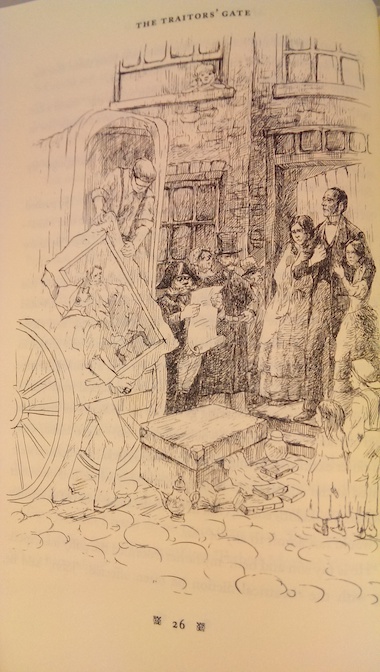
TraitorsGateConfiscation

In spite of this, John and the rest of the Huffam family must spend the night in the bailiff’s sponging house, the Halfmoon Inn. There, John’s father again promises John that there is no debt between himself and Mr. O’Doul. He even says that he doesn’t really know O’Doul, although John doubts him. It seems like his father has had dealings of some kind with the man that he wants to keep secret.

John’s father, Wesley Huffam, was originally from a fairly well-off family, but all the family’s money ended up going to a great-aunt instead of to him (possibly because it became obvious to his relatives that he had little skill at handling money in the first place). John’s father is resentful toward the great-aunt, Euphemia Huffam, for inheriting when he thinks that, as a man, he should have been first in line for the family’s money. However, with this enormous (although possibly false) debt hanging over his head, he may be forced to appeal to Great-Aunt Euphemia for help. He persuades John to go and visit Great-Aunt Euphemia on his behalf, since he is not allowed to leave the sponging house for now and the past quarrels between him and his aunt would make it unlikely that his aunt would want to see him. John is beginning to realize that there are pieces of his father’s life and their family’s past that have been kept from him, and he doesn’t like the idea that his father has been deceiving him, but with their family in such a desperate situation, he agrees to visit Great-Aunt Euphemia.

TraitorsGateSary

The bailiff, John’s mother, and Brigid all agree that John is going to have to be instrumental in solving their family’s problems. Of all the people in his family, he is the most practical, in spite of his young age. His father is an impractical man, stuck in a vision of his family’s former glory (and his aunt’s current money, which he does not share in) that doesn’t fit their current circumstances. John’s mother thinks that her husband’s job as a clerk for the Naval Ordinance Office doesn’t provide enough money for the family to live on, even though he earns more than twice what typical London tradesmen of the time do. The real problem is that the family doesn’t live within its means (it is eventually revealed that Wesley Huffam has been withholding money from his family that he uses for gambling), and John’s father’s snobbish attitude because he thinks of his family as being more grand than the commoners around them alienates people who might otherwise be friends and help them. John knows that he’s young, and he’s not completely sure what he can do to help his family, but he knows that there is no other option but to try. In the process, he learns quite a lot about life, himself, the people in his family, and the wider issues in the world around him, including some political intrigue that hits uncomfortably close to home.

Great-Aunt Euphemia agrees to see John when he comes to her house, but their first meeting doesn’t go very well. Great-Aunt Euphemia is ill (or says she is), and she bluntly tells John that his father was always bad with money. She is not at all surprised that he is in debt and needs her help. John gets upset at the bad things that Euphemia tells him about his father, and she gets angry when John tells her the amount of the debt. At first, John is sure that she will refuse to help them completely, but Euphemia tells him not to assume anything but that he should come back the next day.  Her eventual contribution to helping John’s family in their troubles comes in the form of a job for John.

TraitorsGateRookery

As John moves around the city, he gets the feeling that he is being followed, and he is. One of the people following him turns out to be Inspector Copperfield (or so he calls himself) from Scotland Yard. When John confronts him, the inspector seems to have a pretty good idea of the difficulty that his family is in and what John himself has been doing. John asks him why he cares, and the inspector says that John’s father is suspected of a crime and that John had better learn more about what his father has been doing and share that information with him. John doesn’t believe that his father could be a criminal, but the accusation is worrying because he knows that his father is hiding something (his gambling addiction isn’t the only secret he has).

The other person following John is a young girl in ragged clothes. The girl, who calls herself Sary the Sneak, approaches John herself, freely admitting that she’s been following him. In spite of her young age, Sarah (or Sary, as she is frequently called) lives on her own and must support herself because her mother is dead and her father was transported to Australia. People don’t often notice a young girl on the street, so sometimes people will pay her to follow someone and provide information about them. The reason why she tells John about it is because she isn’t above playing both sides of the street; sometimes, she gets the people she’s been following to pay her to provide them with information about the people who hired her to spy on them. She considers it even-handed. However, John has no money to pay her for information and finds her spying distasteful, so he doesn’t want to take her up on the offer at first.

However, John does a little spying of his own when his father sneaks away from the Halfmoon Inn, which he is not supposed to do. He follows his father to a pub called the Red Lion, where he witnesses his father gambling with money that he had claimed not to have. More than that, he sees his father arguing with a man who turns out to be O’Doul, another gambler. To John’s surprise, his teacher also shows up and seems to know O’Doul. When John later confronts his father with what he saw at the Red Lion, all his father will say is that he is carrying a fortune around in his head. Later, John overhears the bailiff speaking with someone else, an Inspector Ratchet from Scotland, saying that it appears that Wesley Huffam may be a traitor involved with spies and that the Inspector Copperfield who spoke to John earlier was an imposter, probably also a spy.

Could it be true? Is John’s father really a traitor, selling naval secrets from his job? If so, who can John trust?  Conspirators seem to be around every corner, and John has the feeling that the people who are closest to him may be the biggest threats.

The book is currently available online through Internet Archive.
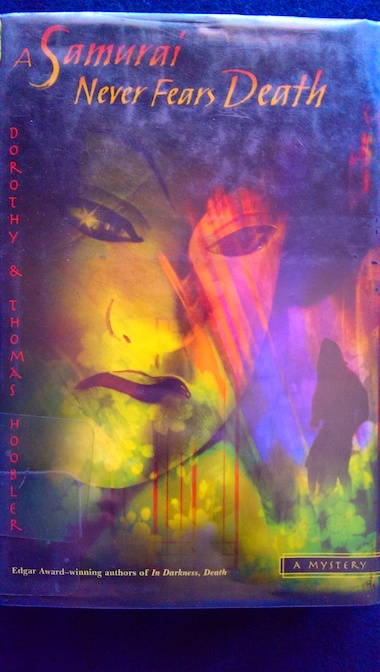
A Samurai Never Fears Death

SamuraiNeverFearsDeath

A Samurai Never Fears Death by Dorothy and Thomas Hoobler, 2007.

This book is part of the The Samurai Detective Series.

Sixteen-year-old Seikei returns home to visit his birth family in Osaka while Judge Ooka investigates reports of smugglers in the city.  Seikei is a little nervous about seeing his birth family because he hasn’t gone to see them since he was adopted by Judge Ooka about two years before.  All he knows is that his younger brother, Denzaburo, is helping his father to run the family’s tea business, which is probably a relief to Seikei’s father because Denzaburo was always more interested in the business than Seikei was.

However, things have changed in Seikei’s family since he left Osaka, and his homecoming isn’t quite what he imagined it would be.  Seikei had expected that his older sister, Asako, might be married by now, but she says that Denzaburo is keeping her from her dowry because he needs her to help run the family business.  Although Denzaburo enjoys business and the life of a merchant, it turns out that Asako has a better mind for it than he has.  The two of them have been running the family’s tea shop by themselves because their father is ill.  Also, although the family no longer lives above their shop, having bought a new house for themselves, Denzaburo says that he sometimes stays at the shop overnight to receive deliveries of goods.  Seikei knows that can’t be true because no one ever delivers goods at night in Osaka.  Denzaburo brushes off Seikei’s questions by suggesting that the three of them visit the puppet theater together to celebrate Seikei’s visit.

At the puppet theater, Seikei learns that Asako is in love with a young man who is an apprentice there, Ojoji.  Because Ojoji is only an apprentice, the two of them cannot afford to get married, something that Denzaburo laughs about.  However, before Seikei can give the matter more thought, they discover that one of the narrators of the plays has been murdered, strangled.

They summon an official from Osaka to investigate the scene, Judge Izumo, but Seikei isn’t satisfied with his investigation because it seems like Judge Izumo is quick to jump to conclusions.  Then, suspicion falls on Ojoji.  Asako doesn’t believe that the man she loves could commit murder and wants Seikei to ask Judge Ooka to intercede on Ojoji’s behalf, so Seikei begins to search for evidence that will help to prove Ojoji’s innocence.

The mysterious happenings and murders (there is another death before the book is over) at the puppet theater are connected to the smuggling case that Judge Ooka is investigating, and for Seikei, part of the solution hits uncomfortably close to home.  However, I’d like to assure readers that Asako and her beloved get a happy ending.

During part of the story, Seikei struggles to understand how the villains, a group of bandits, seem to get so much support and admiration from other people in the community, including his brother.  It is Asako who explains it to him.  It’s partly about profit because the outlaws’ activities benefit others monetarily, but that’s only part of it.  In Japan’s society, birth typically determines people’s roles in life, and each role in society comes with its own expectations about behavior, as Seikei himself well knows.  Seikei is fortunate that circumstances allowed him to choose a different path when he didn’t feel comfortable in the role that his birth seemed to choose for him; he never really wanted to be a merchant in spite of being born into a merchant family.  Others similarly do not feel completely comfortable with the standards that society has set for them, and their fascination with the outlaws is that the outlaws do not seem to care what society or anyone else thinks of them.  The outlaws do exactly what they want, when they want to do it, dressing any way they please, acting any way they please, and taking anything they want to use for their own profit.  Denzaburo, who was always willing to cut corners when it profited him, sees nothing wrong with this, and he envies the outlaws for taking this idea to greater lengths that he would ever dare to do himself.

The idea of throwing off all rules and living in complete freedom without having to consider anyone else, their ideas, their wants, their needs, can be appealing.  Asako understands because, although she is better at business than either of her younger brothers, she cannot inherit the family’s tea business because she is a girl.  She thinks that, because the system of society doesn’t look out for her interests, she has to look out for herself, and what does no harm and makes people happy (in the sense of giving them lots of money) shouldn’t be illegal.  At first, Asako sees their activities as victimless crimes. Although she doesn’t use that term to describe it, it seems to be her attitude.  However, do victimless crimes really exist?  Seikei has a problem with this attitude because what the outlaws are doing has already caused harm in form of two deaths and the risk to Ojoji, who may take the blame for the deaths even though he is innocent.  Asako might not care very much about the others at the puppet theater, but she does care about Ojoji.

It’s true that Seikei has defied the usual rules of society by becoming something other than what he was intended to be, and for a time, he struggles with the idea, comparing himself to the outlaws, who were also unhappy with their roles and wanted something different.  However, the means that Seikei used to get what he wanted in life are different from the means that the outlaws use, and Seikei also realizes that his aspirations are very different from theirs.  While Seikei had always admired the samurai for their ideals and sense of honor and order, the outlaws throw off the ideals of their society in the name of doing whatever they want.  Although the outlaws do benefit some of the poorer members of society, paying money for goods that the makers might otherwise have to give to the upper classes as taxes and tribute and trying to stand up for abused children when they can because their leader was also abused as a child, their main focus is still on themselves and what they and their well-paying friends want.  Seikei is concerned with justice and truth, which are among his highest ideals.  Even though he learns early on that, as a samurai, he could claim responsibility for the deaths at the theater himself because, in their society, a samurai would have the legal authority to kill someone for an insult.  Claiming responsibility for the killings would allow Ojoji to go free, and it would be one way to solve the problem quickly and make Asako happy, but Seikei cares too much about finding the truth behind the murders and bringing the real murderer to justice to take the easy way out.  It is this difference in ideals and priorities between Seikei and others around him which set them on different paths in life.

One thought that seemed particularly poignant to me in the story is when Seikei reflects that we don’t always understand the importance of the choices we make in life at the time when we have to make them because we don’t fully understand all the ways in which a single choice can affect our lives.  He thinks this when the leader of the outlaws offers to let a boy who was abused come with them and join their group after they intervene in a beating that the boy’s father was giving him.  They tell him that joining their group would mean that he could do whatever he wants from now on.  The boy, not being sure who they are or what joining their group would really mean for him, chooses to stay with his father.  Seikei wonders then whether the boy will later regret his decision or not.  His father obviously doesn’t treat him well and may not truly appreciate his show of loyalty by remaining, although joining the outlaws comes with its own risks.  It’s difficult to say exactly which two fates the boy was really choosing between in the long run and which would be likely to give him a longer, happier life, which is probably why the boy chose to stick with what he already knew.

There is quite a lot in this story that can cause debates about the nature of law and order, society’s expectations, and the effects of crime on society and innocent bystanders.  I also found Seikei’s thoughts about what makes different people choose different paths in life fascinating.  I’ve often thought that what choices a person makes in life  are determined about half and half between a person’s basic nature and the circumstances in which people find themselves, but how much you think that or whether you give more weight to a person’s character vs. a person’s circumstances may also make a difference.

The story also explains what fugu is, and there is kind of a side plot in which Judge Ooka wants to try some.  A lot of the characters think that the risk involved in eating the stuff isn’t worth it, but well, a samurai never fears death, right?

There is a section in the back with historical information, explaining more about 18th century Japan and the style of puppet theaters called ningyo joruri, where unlike with marionettes or hand puppets, the puppeteers are on stage with the puppets themselves, wearing black garments with hoods so that the audience will disregard their presence (except for very well-known puppeteers, who might reveal their faces).  For another book that also involves this style of puppetry, see The Master Puppeteer.

In Darkness, Death

InDarknessDeath

In Darkness, Death by Dorothy and Thomas Hoobler, 2004.

This book is part of The Samurai Detective Series.

One night, after a party, Lord Inaba is killed in his room by a mysterious intruder. The only clue to the intruder’s identity is a red origami butterfly left at the scene. Lord Inaba’s death is an embarrassment to the shogun because Lord Inaba was in Edo under his protection.

It doesn’t take Judge Ooka long to decide that the murderer was a ninja. Ninjas are hired assassins known for their stealth and great skill with weapons. The butterfly left at the scene was to purify the spirit of the dead man and keep it from coming after his killer.

However, Judge Ooka says that it is not enough to know that that the murderer was a ninja; what they have to find out is who hired the ninja. He assigns Seikei the task of finding the source of the butterfly and learning who Lord Inaba’s enemies were. Judge Ooka finds a ninja he knows, Tatsuno, and convinces him to accompany Seikei on a journey through Lord Inaba’s territory and to teach him what ninjas are like. Although Seikei is not sure that he trusts Tatsuno, he learns to be grateful to him for his help and for saving him from the real danger, which comes from a surprising source.

While many children’s movies glorify the ninja, in real life, they were mercenaries, assassins for hire.  They used clever tricks in order to gain access to their victims and to get away without being caught, which ended up giving rise to a number of legends about them, attributing an almost supernatural quality to their skills.  While searching for the assassin and the person who hired him, Seikei learns a number of the tricks that ninjas used and the security measures that people would take to try to guard against them, such as nightingale floors (here is a video of a nightingale floor in a Japanese castle and another where you can hear the floor even better).

The book is currently available online through Internet Archive.

The Demon in the Teahouse

DemonTeahouse

The Demon in the Teahouse by Dorothy and Thomas Hoobler, 2001.

This is the second book in the Samurai Detective series.  Like other books in this series, it is not a book for young children!

Seikei is trying hard to learn all the things he must know as a samurai and Judge Ooka’s adopted son. One evening, while the judge is in Edo (now called Tokyo), he sends a message that Seikei and the other samurai must come immediately. Edo is in a state of emergency because of a series of fires that have been deliberately set in shops around the city. Although Judge Ooka helped to design a system of watch towers and fire brigades to help the city in case of fire, the threat of fire is still very serious because most of the buildings in Edo are made of wood.

The only clue they have to the person setting the fires is a geisha who was in one of the shops before it burned. Judge Ooka and Seikei go to the city’s pleasure district, Yoshiwara, where there are theaters and teahouses where geishas provide entertainment. While they are there, they learn that geishas have been dying under mysterious circumstances, and the people of Yoshiwara are afraid.

Judge Ooka has Seikei take a job as a servant at a teahouse in order to learn more. He soon discovers that the dead girls were all friends of Umae, one of the most popular geishas. Then, one of Umae’s many admirers brings her a present, and she is horrified to discover that it is the kimono that one of the dead girls was wearing. Who brought her the kimono, and what connection does she have to the fires?

The nature of the villain and the villain’s motives is rather dark for a middle school level book (although some middle school level books do get fairly dark).  Although the reading level of the book would be fine for someone aged twelve to fourteen, the subject matter might make the story more appropriate for someone a little older.  I recommend parental discretion on this one.  (Remember, it takes place in the “pleasure district” of Edo.)  It’s an exciting story, and it contains an interesting picture of feudal Japan, but it’s definitely not for young children!

The part about Judge Ooka organizing watch towers and fire brigades is something that the real, historical Judge Ooka actually did.

The book is currently available online through Internet Archive.

The Ninth Jewel of the Mughal Crown

BirbalTales

The Ninth Jewel of the Mughal Crown: The Birbal Tales by James Moseley, 2001.

BirbalTalesRealBirbalThe characters in the stories, Emperor Akbar and his friend and advisor Birbal (birth name Mahesh Das) were real people who lived in India during the late 16th century. Over the years, stories and legends have grown up around them, although the truth is pretty incredible by itself.

This book, which is a collection of some of the stories about Akbar and Birbal, begins by explaining a little about their history, and there is another section in the back that explains more about their lives.  The book’s introduction says that Akbar’s father died when he was young and that Akbar’s reign was considered a Golden Age in India’s history, although it mostly focuses on his “Nine Jewels.”  The section in the back gives a little more context.

To begin with, Akbar was one of the Mughal Emperors.  The book doesn’t explain much about what that means, but understanding it helps to set the stage for the stories.  The Mughal Empire consisted not only of modern day India but also some of the surrounding countries.  The empire was first established by Akbar’s grandfather, Babur, through conquest.  Babur was born in the region that we now call Uzbekistan, although his family’s origins were Mongolian.  They were distantly descended from Genghis Khan.  They were also descended from Tamir (sometimes called Tamerlane), giving them Turkic and Persian connections.  The early years of the Mughal Empire were unstable, but when Akbar’s father died and Akbar became emperor at a young age, his regent helped him to stabilize the empire and expand it through a mixture of further conquest and diplomacy.  The reputation of wealth and power in the Mughal Empire eventually led to the adoption of the word “mogul” in English to describe a wealthy and powerful person, especially one who has high standing in a particular field of expertise (something which, as you’ll see, was of particular importance to Akbar).  Using the riches and resources gained through his territorial expansion, Akbar worked to develop the economy of his empire and to support the arts and learning.

BirbalTalesRealAkbarAkbar had a great love of learning, but unfortunately, was dyslexic at a time when people didn’t understand the condition very well.  (To put it into context, Akbar was a contemporary of Elizabeth I of England.)  Even though, like the European Emperor Charlemagne (who lived much earlier but was also apparently dyslexic), he wanted to learn to read, he struggled with it throughout his life because of his condition.  Akbar didn’t want his reading difficulties to interfere with his learning or his love of the arts, so he found another way around the problem.  In a way, it’s similar to what Charlemagne did, surrounding himself with learned advisors who would read to him and discuss important topics with him, verbally teaching him whatever he wanted to know.  Akbar chose his advisors very carefully, seeking out people who had demonstrated excellence in subjects that were important to him. Akbar’s advisors became famous for their fascinating and unusual skills and personalities.  He had nine special advisors who were close to him, which is why they were called, “The Nine Jewels of the Mughal Crown.”  Legends grew up around these men and their abilities:

Tansen – An expert in music, whose singing voice was said to be so amazing that he could make candles burst into flame with a song.

Daswant – A master painter.

Todar Mal – An expert in finance.

Abul Fazl – A great historian.

Faizi – Brother of Abul Fazl, a famous poet.

Abud us-Samad – A master at calligraphy, he also designed the imperial coins.

Man Singh – A great military general.

Mir Fathullah Shirazi – A man of many skills, including the fields of medicine, astronomy, philosophy, and finances.

Birbal – Akbar’s Minister or Raja, who had a reputation for cleverness, quick wit, and the service of justice.  He was the “Ninth Jewel”, and his stories are the focus of this book.

BirbalTalesMeetingThere are many more stories about Birbal than the ones included in this book, but they are all about how Birbal uses his wits to serve Akbar and aid the cause of justice.  Like all good legends, the stories are partly based in fact, but have grown with each retelling to the point where it can be difficult to say where the real people leave off and the legends begin.

In the first story in the book, Akbar meets Birbal when he is still a child.  Fascinated by the boy’s combination of courtesy and boldness and his unusual wit, he gives the boy a ring and tells him that when he is grown, he should come to his palace at Fatehpur Sikri.  Years later, Birbal does go there, but when he shows the ring with the emperor’s seal on it to the guard on duty, the guard refuses to let him in until he promises to give him half of whatever the emperor gives him.  When Akbar sees Birbal, he is pleased to meet him again but stunned when Birbal asks him to give him 100 lashes.  When Birbal explains the reason for his bizarre request, it not only gets the laughter of the court, but the approval of Akbar, who appreciates this bold approach to the problem of bribery.

BirbalTalesPortraitFrom then on, Birbal gains a reputation for his ability to mediate disputes and find unusual solutions to problems.  His favored position at court gives him some jealous enemies, but he handles them with the same cleverness that he uses to solve every problem.

In one of my favorite stories, one of the noblemen at court attempts to cheat Daswant out of his rightful fee for painting his portrait by changing his appearance (shaving his beard, shaving his mustache, etc.) after each portrait sitting and then claiming that the portraits Daswant paints do not really look like him.  When Daswant explains the situation to Birbal, he gets the nobleman to promise to pay for an “exact likeness” of himself in the presence of Akbar.  Then, Birbal shows him a mirror, which Akbar agrees contains an exact likeness of the nobleman and deserves payment.

BirbalTalesCoinPurseIn another of my favorite stories, Birbal determines who is the true owner of a coin purse when a flour merchant and an oil merchant each claim that it belongs to them.  He pours the coins into a pot of boiling water and notes the oil that bubbles to the surface.  Because the coins are covered in oil, they obviously belong to the oil merchant.  If they had belonged to the flour merchant, they would have been covered in flour.

One of the interesting aspects of Akbar’s friendship with Birbal was their religious differences.  Akbar, like the rest of his family, was Muslim, and Birbal was from a family of Hindu Brahmins. The Mughal Empire was a multi-cultural society, and Akbar was aware of it.   At one point, he attempted to develop a new religious movement that combined aspects of Islam and Hinduism in order to further unite his subjects, but it never caught on as a mainstream religion, possibly because Akbar’s own strong personality as its leader was one of the most attractive features.  Akbar did seem to genuinely believe in religious tolerance and promoted widespread education among his subjects.

Birbal, the historical person, was eventually killed in battle, and Akbar greatly mourned his loss.  The Mughal Empire continued for generations beyond Akbar, although it eventually collapsed through a combination of military, administrative, and economic decline; the decentralization of power in the empire; internal discord; and interference from outsiders that paved the way for the British colonization of India.  That’s kind of a simplistic description of a long, complicated period of history, but the end of the Mughal Empire was marked by the beginning of British rule in India.  In 1858, the British East India Company deposed the last of the Mughal emperors, sending him into exile, around 300 years after the reign of Akbar began.

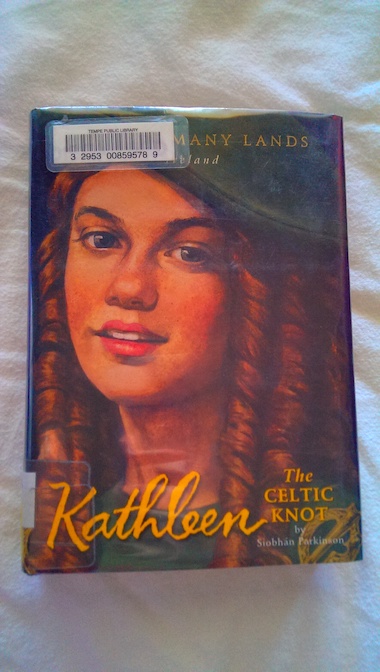
Kathleen: The Celtic Knot

KathleenKathleen: The Celtic Knot by Siobhan Parkinson, 2003.

Twelve-year-old Kathleen lives with her family in Dublin, Ireland in 1937. Like the rest of the world, Ireland is suffering under the Great Depression, and Kathleen’s father has been having trouble finding work. Her mother helps to support the family by working as a midwife.

One day, when Kathleen’s mother is off delivering a baby, Kathleen accidentally burns the porridge at breakfast, making her and her sisters late for school. Although they should have been marked as being on time, they are considered one minute late because the nun’s watch was fast. Discipline is harsh at the Catholic school they attend, and after a harsh lecture to Kathleen, the headmistress, Mother Rosario, calls for a conference with her mother. Kathleen is very upset about it, but Mother Rosario softens somewhat and says that she merely wants to see that everything is alright with Kathleen’s family because a nice girl like her shouldn’t be acting up.  Kathleen still worries because she knows that the nuns look down on poor families like theirs and consider their authority higher than the parents of the children they teach.  They are often unaware of the circumstances that families live in.

However, Kathleen’s mother isn’t fazed by the nuns’ attitude and is blunt with the Mother Rosario, telling it like it is. The headmistress does show that she has some compassion and is somewhat aware of their circumstances because she says that Kathleen’s lateness was only part of the reason she wanted this meeting. She has guessed that Kathleen’s father is looking for work, and there is a position for an assistant gardener open at the school. It doesn’t pay much, and it’s not as good as her father’s old job was before the factory where he worked closed, but he agrees to take it because it’s better than nothing.

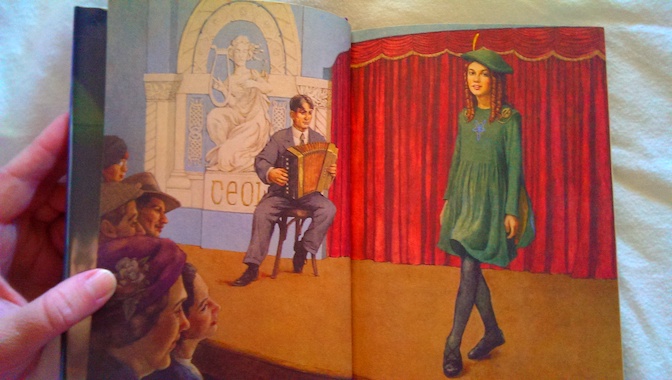
The headmistress also says that she has noticed that Kathleen is musically-talented. She likes to sing and has a good voice. Mother Rosario thinks it would be a good idea for her to take piano or dance lessons. The family doesn’t have a piano, so the headmistress suggest that Kathleen join the Irish dancing lessons because it’s a wholesome activity that reflects her heritage and that would keep her out of trouble. Kathleen’s mother isn’t big on heritage, but she agrees that dancing might be a good activity for Kathleen.

Kathleen isn’t happy about the dance lessons at first because the other girls who are involved are snobs. But, once she tries it, she realizes that she actually loves dancing. The problem is that the lessons aren’t free, like the other girls told her. At first, Kathleen feels cheated, finding out that she loves something that she can’t have after all, but her teacher says that she’s talented, so she offers Kathleen some free lessons anyway. She’s been looking for new talent so that her dancers can do well in the next dancing competition, and she doesn’t want to let a promising dancer like Kathleen slip through her fingers.

The snobby girls in class are all the more irritated when Kathleen is among those chosen to enter the next competition, but everyone also knows that there is one more obstacle for Kathleen: she doesn’t have a proper dancing costume or any money to buy one. She prays for one, even promising God that she’d become a nun if he gives her the costume she wants. Her mother has her eye on some beautiful cloth that she hopes to buy as a remnant, but the cloth gets snapped up by some of the wealthier, snobby girls, and her mother comes down with a serious illness shortly before the competition.

Kathleen begins to think that she was wicked for being so concerned about dancing and costumes when there are much more serious things in life. However, her aunt, Polly, understands how she feels and comes up with a plan to make the needed costume for Kathleen, using her favorite book, Gone With the Wind, as inspiration. Remember what Scarlett O’Hara did when she needed a new dress and couldn’t afford one?

KathleenDancing

One of the themes that runs through the story is questions and answers. Kathleen has a lot of questions about life. She knows that her mother deliveries babies for money, but she doesn’t really understand much about it, and her mother doesn’t answer the questions she asks. In fact, Kathleen notices that most of the adults she knows (with the exception of her father) brush aside her questions about the way the way the world works or the things people do because they simply don’t want to be bothered with them. They have too many concerns of their own, and they don’t really know most of the answers themselves. It kind of contrasts with the answers that Mother Rosario demands from Kathleen and immediately dismisses upon getting. Most of the time, she doesn’t really want to bother with answering questions or even dealing with the answers to questions she’s just asked. Only once does she answer a question that Kathleen had asked about St. Patrick, and Kathleen is astonished at getting an answer about something.

I have to admit that the attitudes about questions and answers from most of the adults in the story really irritated me, especially the way Mother Rosario demanded answers from Kathleen about her lateness and then dismissed everything that Kathleen said, angry that she had “answers.”  I’ve met people like that before in real life, and they’re just as illogical and crazy-making as this headmistress. I’m not talking about teachers who refuse to listen to flimsy excuses like “the dog ate my homework,” but people who get angry at others who have real explanations just because they have real explanations. People who demand to know the reasons why things happen and then immediately reject any explanation offered without a real reason for doing so are obnoxious. I’ve encountered people like that before, and it’s hard to have anything resembling a meaningful conversation with them.   They don’t want to talk to you; they just want to yell or lecture at you.  They don’t really care what the answers or explanations are for anything, and no answer would make any difference to them because what they really want is for the other person to just feel bad. It’s an unethical one-upmanship tactic, and it loses my respect the moment I hear someone use it because I recognize what they’re attempting to do. It’s so obvious, but frustrating at the same time (Kathleen in the story wonders why Mother Rosario is trying to torture her in this way) because there’s nothing you can say to stop the other person once they start (at least, I haven’t figured it out). Kathleen’s approach was probably the most effective.  She just stopped talking and prepared herself for the headmistress to hit her, which caused the headmistress to wake up a bit to the fact that the message that she was sending to Kathleen was that her only intentions were to hurt her.  Fortunately, those were not her only intentions, but I have to admit that I never really had any respect for Mother Rosario after that, in spite of what she did to help Kathleen’s family.  You can tell this is one of my pet peeves.  One-upmanship really bothers me in all of its forms, and I have even less time for that kind of nonsense than these characters do for answering a twelve-year-old’s questions.  At least you can talk to a twelve-year-old. Getting back to that, part of Kathleen’s trouble with some of her questions is that her elders often underestimate her, thinking that she’s really too young to understand anything, but the fact that she’s asking questions says that she’s really not. In fact, she might even be putting more thought into some issues than the people who have decided that some things aren’t worth thinking about in the first place.

Another theme of the story is growing up and changing goals in life. By discovering her talent as a dancer, Kathleen has found something that she would like to dedicate her life to, and if she becomes a dance teacher herself, it would give her a job to do in her future that could make her life better. Her aunt, Polly, who is twenty years old, also changes her mind about what she wants in life. As a single young woman, she likes to go out and have fun with her small earnings, hoping to meet a man as elegant as Rhett Butler.   However, when her latest young man turns out to be a cad, she accepts a proposal from the very shy but much nicer young man who she had previous thought wasn’t handsome enough. Polly’s experiences make her realize that handsomeness by itself isn’t much, and she and her new husband have plans for building a life together. At first, Kathleen is disappointed because she and Polly had talked about leading a carefree life together as single ladies when Kathleen was grown, but Polly explains to her that things will be better this way and that grown-ups have to build real lives for themselves, not live on dreams alone. Kathleen is still in the process of discovering the possibilities that life might hold for her and the talents that she can use to build her life.

I also found the parts about Irish history and politics during 1930s interesting.  One of the reasons why Kathleen’s family isn’t big on the Irish heritage movement is because her grandfather fought during World War I and wasn’t treated well as a veteran when he returned. During the meeting with Mother Rosario, Kathleen’s mother is blunt about her views on things, and Mother Rosario is surprised how much she understands of politics, showing that she looks down on poor people (possibly the source of her general rudeness and bullying tactics, even when she’s trying to be helpful – she’s decided that she’s superior and will remain so, whether she’s right or wrong), thinking that they aren’t smart enough to understand what’s going on around them.  The story makes it clear that the nuns at school are often out of touch with what ordinary families go through in their daily lives.  They underestimate what people know or read about, they have trouble understanding their daily struggles with money and how they are barely able to keep food on the table, and they seem unable to grasp what it’s like to be part of a family where any family member’s actions can affect all of the others.  For me, they were far more aggravating than the snobby little girl characters because I usually expect adults of a certain age to have grown out of some of these behaviors.

While reading the story, I was kind of comparing Kathleen’s circumstances in Ireland in the 1930s to life in America during the Great Depression, and many of their struggles were the same.  I was also kind of fascinated by Polly’s fascination with Gone With the Wind because it shows how pieces of culture and entertainment could become popular in other countries during this time.

This book is part of a series by the same publishers of the American Girls Books.  There is a section in the back of the book with historical information about the period.

KathleenHistorical

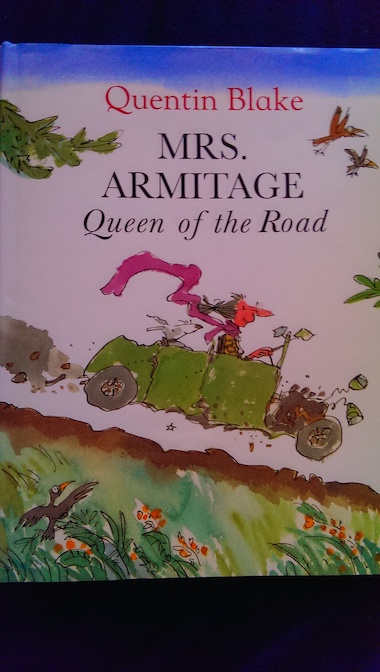
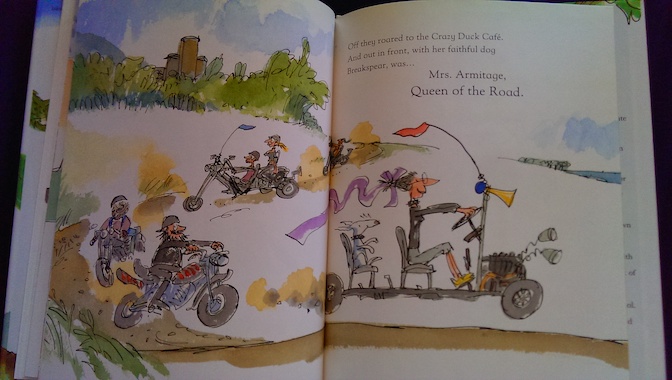
Mrs. Armitage, Queen of the Road

ArmitageRoad

Mrs. Armitage, Queen of the Road by Quentin Blake, 2003.

When Mrs. Armitage‘s Uncle Cosmo decides to get a new motorcycle, he lets her have his old car.  However, it isn’t in very good condition.

ArmitageRoadCar

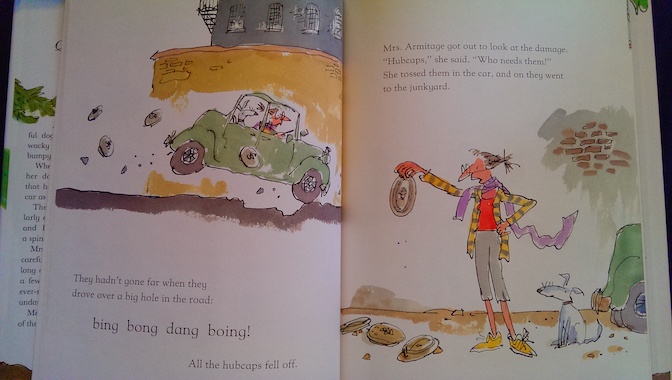
Mrs. Armitage and Breakspear decide to try it out, but as they drive along, pieces of the car fall off.  Some of it is because the car is in bad repair, and some is due to accidents Mrs. Armitage has.  First, the hubcabs, then the fenders fall off.  Mrs. Armitage shrugs it off , saying, “Who needs them?”

ArmitageRoadHubcaps

Eventually, the car goes almost entirely to pieces, but who needs it all?

ArmitageRoadWreck

When Uncle Cosmo shows up with his friends and their motorcycles, they help her fix up what’s left of the car into one amazing machine!

The book is available to borrow and read for free online through Internet Archive (multiple copies, including one in Spanish).

ArmitageRoadMachine

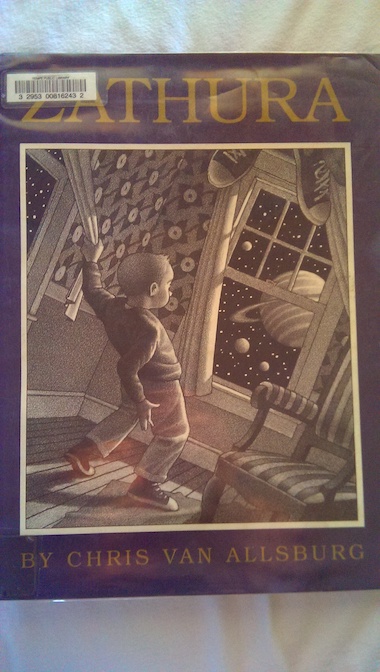
Zathura

Zathura

Zathura by Chris Van Allsburg, 2002.

This book begins where Jumanji ends. It’s not completely a sequel because it has a different set of children and a new game, but it’s connected because the two children from Jumanji left the board game in the park again after they finished it, and they saw two boys that they know pick it up and take it home.

ZathuraBrothersWrestling

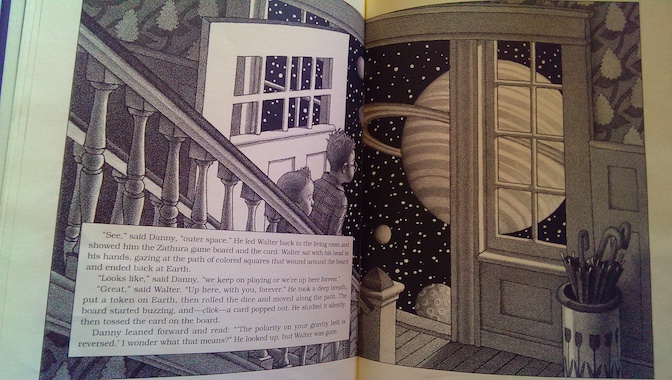
However, the two boys, Danny and Walter, don’t end up playing the same jungle board game, Jumanji, that was in the previous book. They find a second board game in the Jumanji box called Zathura and decide to try it instead. Zathura is a space-themed game where players travel a path from Earth to the planet Zathura. Like in Jumanji, elements from the board game come to life as the boys play, and someone must reach the end in order to end the game.

ZathuraStartingGame

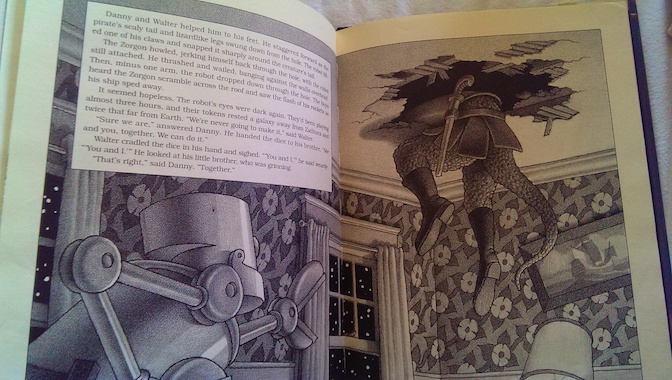
Danny and Walter, a pair of brothers, fight a lot. Walter hates doing things with Danny. However, when Danny starts playing the game, sending their house into outer space, Walter must join in and play with his brother in order to bring the game to an end so they can go home. The two of them learn teamwork as they help each other face the dangers of the game while trying to reach Zathura.

ZathuraOuterSpace

There is a movie version of this book, but there are major differences between the original book and the movie. The conflicts between the two boys are similar in the book and the movie, but the movie added a subplot about the boys’ parents being divorced (they weren’t in the original book), an older sister for the boys (it was just the two of them originally), and a kind of alternate reality where the older boy was trapped in the game by himself for years because he wished his brother away before finishing the game until his alternate self realized that he cared about his brother and wanted to cooperate with him.  In the original book, nobody was trapped in the game.

ZathuraAlienRobot

Chris Van Allsburg illustrations are always good, although I have to admit that I preferred the illustrations in Jumanji to the ones in Zathura.  It just seems to me that the pictures in Jumanji were more detailed and realistic.

The book is currently available online through Internet Archive.

ZathuraGoingHome

Giving Thanks

GivingThanks

Giving Thanks by Kate Waters, 2001.

This book describes the feast of 1621 that we think of as “the first Thanksgiving” from the point of view of two boys: Resolved White (a six-year-old English colonist) and Dancing Moccasins (a fourteen-year-old Wampanoag).  The book explains that the reality of this feast is somewhat different from the way many people think of it.  For one thing, the exact date is unknown, and it wasn’t really a single meal but a kind of harvest celebration that took place over several days.  The events of that celebration were re-created using reenactors from the Plimoth Plantation living history museum.

In the beginning of the book, Dancing Moccasins explains that his family has been harvesting their crops and preparing to move to the place where they live in the winter. Wampanoag lived in different places depending on the time of year, moving between them when the seasons changed.  At their winter home, they would continue hunting and fishing, returning to the place where they planted their crops at the end of winter.

GivingThanksBeginning

Similarly, Resolved’s family has finished harvesting their crops and have stored up food for the winter.  Now that most of the hard work is over, they have time to relax and celebrate.  The community is planning a feast.  Resolved and his friend, Bartle, follow some of the men, who are going out hunting and target-shooting.

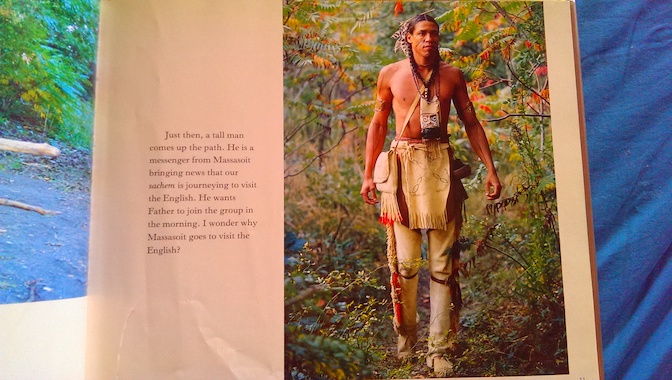
The colonists meet up with some of the Wampanoag, which is how Dancing Moccasins and Resolved first see each other.  Dancing Moccasins returns home and tells his father what he has seen.  Then, a messenger arrives from their chief, Massasoit, saying that he will be visiting the colonists soon, and Dancing Moccasins’s father is invited to come.

GivingThanksMessenger

Just as Dancing Moccasins is wondering about the purpose of this visit, Resolved is wondering the same thing because word has reached the colonists that they will soon be visited by the chief and representatives of the tribe.  (The book explains in the back that the exact reasons for the Wampanoag visit to the colonists are unknown today, only that it happened at the same time that the colonists were planning their harvest feast.) The two boys meet again when Dancing Moccasins accompanies his father on the visit to the colonists’ village.

GivingThanksGovernorDinner

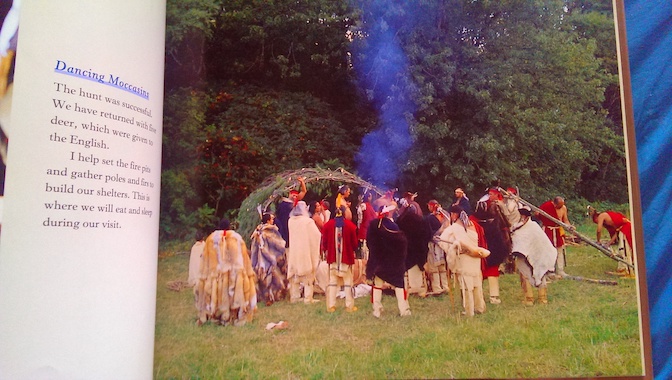
When the Wampanoag arrive at the village, they are treated as honored guests, and some of the Wampanoag go deer-hunting to provide a present for their hosts.  The chief dines with the governor of the colonists.  The Wampanoag build shelters for themselves, where they will stay during their visit.

GivingThanksShelters

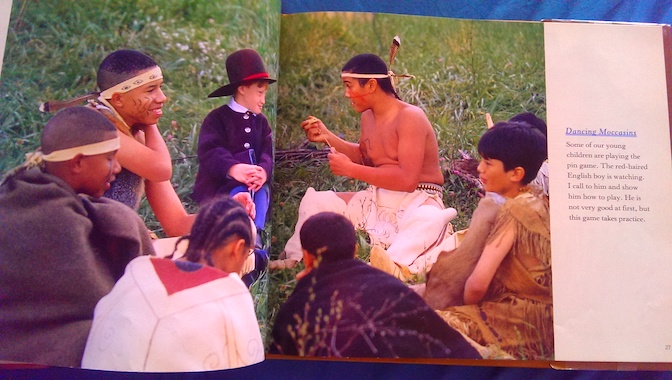
Eventually, Dancing Moccassins invites Resolved to play a game with him and some other Wampanoag boys when he sees him watching them.  Some of the Wampanoag men also join in the games that the English men play, like competing to see who can throw a log the farthest.

GivingThanksGames

At the end of the day, Dancing Moccassins and Resolved each eat with their own families, but there is plenty for everyone.

There is a section in the back with historical information about the harvest feast, traditions about giving thanks among both the colonists and the Wampanoag, and how Thanksgiving eventually became a national holiday in the United States.  There is also information about food and clothing in the time of the story and a recipe for samp (a kind of corn pottage eaten by the Wampanoag and later adopted by the English colonists).  The book also has some information about the Plimoth Plantation living history museum and the reeanctors.  It is part of a series of books by the same author about the lives of children in Colonial America.

The book is available to borrow and read for free online through Internet Archive.

The Best Halloween Ever

BestHalloweenEverThe Best Halloween Ever by Barbara Robinson, 2004.

Every year on Halloween, the Herdmans, who are the wildest, most awful kids in town, run amuck, vandalizing things, stealing, and bullying other kids out of their Halloween candy.  This year, the mayor has decided that he’s had enough of the chaos they cause, so he’s just going to cancel Halloween all together.  Although he doesn’t specifically name the Herdmans as the source of all the Halloween destruction, everyone in town knows that they are.  So, to the shock and dismay of all the other kids, there will be no trick-or-treating this year.

Instead, there will a safe, well-supervised (boring), school Halloween party.  The principal, who always hated Halloween anyway, isn’t happy about it, but admits that it would be better to have a party for the kids at school, with their parents present and helping out, than having them run wild in the streets with the Herdmans on the loose.  But, as every kid knows, running wild in the streets is really the heart of Halloween.  They long for the freedom of roaming the streets without adult supervision, for collecting candy to sort and trade (and, admittedly, lose to the Herdmans eventually), for staying up late, and for the surprises and magic of a real Halloween.

There isn’t going to be anything surprising or magical or even really scary about Halloween at the school.  All the kids already know that the monsters are just their parents and teachers in costume.  The only real benefit that they see to the event is that the Herdmans won’t be there because they say it sounds too boring.  But, with the Herdmans, nothing is ever what anyone would expect, and they not only show up but find a way to turn the event into something that brings back some of the surprises and real Halloween spirit that were missing from a party that was too well-organized and predictable.

Although the Herdmans are a large part of the reason why Halloween is difficult for everyone and the adults try so hard to control it, they manage to redeem themselves a little in the eyes of the other children by taking the events of the night out of the adults’ hands.  Before the other kids know it, strange things start happening at the party with a cat on the loose, worms in the witches’ brew, and children starting to disappear.  As the kids puzzle about these things and wonder where some of the other kids went, things start getting scarier (like they should on Halloween), and they find themselves following mysterious figures through the school in the middle of a black-out with a special surprise waiting for them . . .

I don’t think that this book was quite as good as the others in the series, but it was still fun.  Beth, the narrator, is correct in saying that the well-supervised Halloween party was really more for the adults than the kids.  To the adults, Halloween is kind of a bother, and sometimes, they act like all the kids, not just the Herdmans, get in their way even as they plan the school Halloween party.  At one point, Beth’s mother reminds Alice’s mother that the whole idea of the party is to do something for the children, not the adults.

The adults are so worried about keeping things orderly, safe, and convenient that they become too controlling.  Even on normal Halloweens, some of them have a tendency to overrule the kids on what they want to wear as costumes, with parents often insisting on costumes that are the least amount of bother for them to help with.  Louella’s mother insists that Louella be a pilgrim year after year just because she won a free costume once, even though Louella hates it. Really, what most of the kids like about Halloween is that it is usually a night for them, not the adults.  The kids chafe as the adults insist that they go to their orderly Halloween party and like it.  In real life, most adults know that forced fun isn’t really fun at all.

In the end, the Herdmans return all the candy that they had taken from the other kids over the last Halloweens.  Although the other kids find the Herdmans’ secret candy stash a treasure trove, much of the candy is stale.  They can eat some of it (which grosses me out, considering how old it probably is), and they have fun sorting and counting the rest.  But, the best treat for the kids was adding a sense of unpredictability and suspense to the night to bring back the real Halloween feeling.

The book is currently available online through Internet Archive.