Something Upstairs

Something Upstairs cover

Something Upstairs by Avi, 1988.

This story begins with a famous quote:

Those who cannot remember the past are condemned to relive it.

Santayana

It’s an appropriate quote for the story, which is about memory and a repeated wrong that has led to a seemingly endless cycle of violence. The story is framed as having been told to the author by the boy who actually had this frightening adventure.

Kenny Huldorf is unhappy when his parents decide to move the family from California to Rhode Island. Kenny was happy in California, the weather was much better there, and the streets and buildings in Rhode Island all seem small and old. The house they move into is called the Daniel Stillwell House, and it was built in 1789. Right from the beginning, the house gives Kenny a strange feeling, like there’s something or someone there when there shouldn’t be anyone or anything.

Kenny starts to feel better when his parents give him the big, renovated room with the private bathroom in the attic of the house. He likes that room, but there are two smaller rooms off the attic that haven’t been renovated, and they give Kenny a strange feeling. His parents think they were probably old servants’ quarters. One of them has a stain on the floor that makes Kenny think of death, and even more frightening, Kenny gets an odd sense that, somehow, it’s a death he may be responsible for. For a time, Kenny tries to tell himself that it’s nothing but an old stain and occupies himself with unpacking and getting settled. Since school hasn’t started yet, Kenny gets bored and does some exploring of the area. He starts wondering about the history of the town and the house.

Then, one night, Kenny hears a strange sound from the room with the stain. When he goes to investigate, he sees a pair of ghostly, glowing hands reaching up out of the stain on the floor. The hands pull the rest of the ghostly person out of the floor, and Kenny can see that it’s the figure of a boy. When the boy tries to reach out to him, Kenny reacts defensively, and the ghost boy seems frightened and vanishes. The next day, Kenny asks his parents if they believe in ghosts. His father says he doesn’t but that Providence is a very old town and a lot of things have happened there over the years. His mother later says that she doesn’t really believe in ghosts either, but she believes that places have memories. Kenny’s parents conclusions seem to be that Kenny is sensing the general history of the town, but Kenny feels that it’s something more specific than that, that the ghost he saw is a specific person from a specific incident in the history of the house.

The family was given a scrapbook with a list of former owners of their historic home, so Kenny decides to do some research about the past owners and see if he can learn more about where the ghost came from and who it is. When he arrives at the local Historical Library, Kenny is surprised to find out that someone there is expecting him. He is directed to the office of an historian named Pardon Willinghast. Willinghast tells Kenny that he keeps track of the owners of historic homes, which is how he and others at the library recognized his last name, and he expected that someone from the Huldorf family might come to ask about the house. Kenny gives him the list of past owners and asks what Willinghast can tell him about them. Willinghast looks at the list of names and says that there probably won’t be much about them in the library but that he’ll do some research and see what he can find. Kenny also gets the idea to have the local pharmacy test a sample of wood from the stained floor to find out what the stain is.

The next time Kenny sees the ghost, he tries to talk to the ghost boy and ask him who he is. The ghost has trouble talking but manages to communicate one word: “slave.” The pharmacy tells Kenny that the stain on the wood is human blood. They can tell that the stain is more than 100 years old, which is why they haven’t reported it to the police, like they’d have to with a recent blood stain. When Kenny talks to Willinghast again, he wants to know about people who lived in his house over 100 years ago who might have owned slaves, which limits the scope of his investigation to the first three families who owned the house. Willinghast is oddly vague in his reply, and when the subject of abolitionists comes up, he makes vague references to “agitators” and people who want to “rush history.” When Kenny tries to ask him about a murder that may have occurred in the house, Willinghast becomes agitated himself and tries to discourage Kenny from inquiring further. He says that if a slave was murdered, it probably wouldn’t even have been reported in a newspaper because it wouldn’t have been considered important.

However, now that Kenny understands that a young slave was murdered in his house and is still haunting it, he can’t leave the situation alone. He continues trying to communicate with the ghost boy, and the ghost gradually finds it easier to talk to him. He says that his name is Caleb and indicates that he is tied to the stain on the floor. He can’t seem to move very far from it. He says that he’s a memory of what happened there. He is aware that he was murdered, but he doesn’t know who did it because he was killed in his sleep. He senses that he was killed by someone who wanted to keep him a slave because he and other black people were trying to free themselves from slavery. Kenny asks Caleb if there’s anything he can do to help him, and Caleb asks him to find his murderer. Kenny asks how he can do that when the murder happened so long ago.

Then, the attic changes, and Kenny finds himself back in the past, in Caleb’s time. Kenny looks out the window and sees a strange man in a black cape watching the house. As he explores the town, he witnesses a public argument about slavery and someone asks him to deliver a note. The next morning, Kenny is back in his own bed, in his own time. When Kenny talks to the ghost again, he describes what he saw in the past, and Caleb recognizes these events and people as being part of the circumstances that led to his death. He has trouble believing that Kenny really cares about what happened to him so long ago. He says that white people have broken their promises to him before, but Kenny insists that he does care and that he wants to not only solve his murder but prevent it so Caleb can finally be free from haunting that room.

However, that’s going to be even more difficult than Kenny thinks. On his next trip into the past, he discovers who their true enemy is: Pardon Willinghast. Willinghast isn’t just an historian. Almost like Caleb, Willinghast is memory, a piece of the past that keeps coming back to haunt the people who live in Caleb’s old house and who have tried to help Caleb before. Willinghast has figured out that if someone from the future comes to the past and they lose something they’ve carried with them or if they get hurt or change themselves in some way, they can get stuck in the past, seeming like ghosts to the people there. (Or, so he says.) He has used this knowledge before against other people who have tried to help Caleb, blackmailing them into helping him instead. Now, he has the lucky key chain that Kenny always carries with him. Until Kenny gets this key chain back, he’s stuck in the past, and Willinghast won’t return it until Kenny does what he wants. In fact, he implies that Kenny is already doing what he wants, leaving Kenny to wonder if he’s accidentally leading Caleb into a trap while trying to help him escape from one.

Kenny set out to help Caleb, but he’s in danger of becoming a part of the same cycle of murder that has been repeated over and over for almost 200 years. As Kenny tries to help Caleb, he knows he’s being manipulated by Willinghast into playing a role in a very old story, but since he doesn’t have a copy of the script, he struggles to figure out what has to change to break the cycle. Can he find a way to break cycle and escape without either himself or Caleb losing their lives?

Th book is available to borrow and read for free online through Internet Archive (multiple copies).

My Reaction and Spoilers

This is a book that I remembered from when I was a kid, but strangely, I’m sure that I never heard the end of it back then. I’m having trouble remembering exactly why I never heard the end. I think it might have been one that a teacher was reading aloud, and maybe I was absent the day she finished it. Either that, or I started reading it myself and chickened out before the end because I was spooked.

This book poses a kind of “gun-to-your-head” type of decision, forcing both Kenny and the readers to consider what they would do if they were forced to make a choice between two horrible options. In this case, Kenny is put into the position of being pressured into committing a murder or being trapped forever in the past. Willinghast committed the original murder, and he tells Kenny that the only way he’ll return his keychain to him and let him go home is if he shoots Caleb himself this time. Willinghast is confident that he can force Kenny to do what he wants because he’s done the same to others before him. Other past owners of the house have tried to help Caleb before, but Willinghast has manipulated each of them into betraying Caleb and shooting him instead. These are the betrayals that Caleb referred to earlier. Willinghast claims that each of these people has lost their memory of what they’ve done when they return to their own time, so Kenny won’t have to worry about feeling guilty about killing Caleb. But, if Kenny gives in, he knows that Caleb will remain a ghost, and someday, someone else will also be in Kenny’s position, another pawn in Willinghast’s sick game of endlessly repeated murder. As long as Willinghast gets his way, not only is Caleb going to be his perpetual murder victim, but every person who tries to help will continue to be victimized and forced to participate in his bloody crime.

There is also a deeper theme to this story. Violence begets violence, and hate begins hate. Murder, revenge, hatred, and yes, also slavery and racism, are part of violent cycles that draw other people into them long after the original deed was done. People are haunted by the past in many ways … especially those who feel like they’ve got something to prove about it. It’s a theme that’s been very much on people’s minds in the early 21st century, and there are many, like Kenny, who are unwilling to be pulled into going along with violence, murder, racism, and everything that goes with it just to save some past people’s public images or some modern people’s egos.

Willinghast has correctly realized that the reason why he’s able to come back is because he’s a part of Caleb’s memory as his original murderer. Every time Caleb’s ghost tries to solve his murder and change the past, Willinghast gets reawakened to interfere. In his role posing as the historian, he rewrites the accounts of Caleb’s death in the archives to trick the people trying to help him. He’s not about truth but manipulation, much like the pseudo-historians who resurface to tell “their truth” when certain controversial topics come up. He has a vested interest in lying to cover up his own shameful deed and to force others into helping him get things his way. Willinghast does not care either about accurate history or about the welfare of future generations; he only uses them to cover up his own misdeeds. He’s used other people to repeat his dirty work before, and he’ll do it again, blaming Caleb each time for bringing it on himself by trying to survive instead of just accepting his own murder and staying dead … unless things are different this time around. The violence ends when someone finally says no and refuses to play along. So, what Kenny is really looking for, in this situation where he seems to be given a choice between two horrible options, is a third option that allows both him and Caleb to escape.

Because the story is framed as one being told by Kenny to the author later, readers know from the beginning that Kenny finds another solution to the problem that doesn’t include murdering Caleb or being trapped in the past as a ghost. The suspense comes from the readers wondering how he’s going to do that. Kenny’s solution isn’t entirely peaceful (spoiler) because he ends up shooting Willinghast, but that could be seen as an act of self-defense, not only saving himself but also Caleb and all of Willinghast’s future victims. It seems like eliminating Willinghast was the only way to end the cycle of murder because it wasn’t really Caleb’s attempts to save himself or bring his murderer to justice but Willinghast’s attempts to cover up his crime that kept the cycle going. Willinghast blames Caleb for trying to avoid being murdered, but the truth is that it’s his original act of murder that created this situation from the beginning and his continual cover-up and recruitment of unwilling abettors that has kept the cycle going. Readers can debate whether there was another way to solve the problem, but once Willinghast is gone, the cycle is broken.

Some might also point out that the reason why Willinghast targeted Caleb in the first place was that Caleb shot one of Willinghast’s associates first, but the reason why Caleb did that was that Willinghast’s associates were violently targeting a black neighborhood, and Caleb was trying to hold them off. Once again, violence begets violence until someone decides not to participate. In the end, Kenny commits a violent act, but the cycle ends because he gets the one person who was at the center of all of the other violence from the beginning. Kenny also remembers everything that happened when he returns to his own time, which brings up a point that I’ve already mentioned but I’d like to explain in more detail: Willinghast is a liar.

The only reason why Kenny knows, or thinks he knows, that Willinghast has power over him and can prevent him from returning to his own time as long as he holds one of his belongings is because Willinghast says so. Nobody else in the story says that, and frankly, Willinghast is a known liar. He was never a real historian. He’s only another ghost from the past masquerading as one to trick people into doing his bidding. He fakes historical records to manipulate people. He is an admitted murderer. He said that Kenny wouldn’t remember what happened in the past when he returns to his own time, so he wouldn’t have to feel guilty about shooting someone, but Kenny remembers everything. This didn’t occur to me when I first encountered this story as a kid, but looking at it now, I can’t help but think, why the heck should Kenny believe anything that Willinghast says about how the time travel works?

At the point in the story where Willinghast tells Kenny that he’s trapped in the past as long as he has his key chain, Kenny already been to the past once and returned from it without either Willinghast’s help or interference. Kenny did not get to the past by Willinghast’s power, but through Caleb’s memories. Willinghast was counting on Kenny to be frightened and confused so that he would rely on his word for what’s going to happen to him in the past and feel like he had something real to lose for not going along with his plans, but even as I read the story, I doubted him. I think what he said about Kenny needing his key chain to return home might have just been another of Willinghast’s lies. I don’t recall seeing anything in the story that proved that Willinghast was right, and it seems that none of his other victim/accomplices put his lies to the test to find out. There is no one else trapped in the past as a ghost because we never see any such people in the story. So, if that hasn’t actually happened to anyone before, how would Willinghast or anyone else know that such a thing was even a possibility?

The fact that Kenny remembers shooting Willinghast also suggests that everything Willinghast said may have been a lie. He claimed that none of the other time travelers retained their memories, so Kenny wouldn’t remember if he shot Caleb. If Kenny wouldn’t remember shooting Caleb, how would he be able to remember shooting Willinghast? Unless Willinghast needs to be alive after Caleb’s death to rewrite people’s memories, it sounds like the idea that Kenny wouldn’t remember what happened in the past was a lie. We never see or hear from the other people Willinghast manipulated, so we don’t know for sure that they had no memories or guilt over what happened. That could be another subject for debate among readers, but from what I saw in the story, I’m thinking that Willinghast should be considered a liar on everything he said. I think the real trap wasn’t that Willinghast was holding Kenny in the past so much as Willinghast was making Kenny believe that he was. Although he tried to make Kenny believe that he only had two choices, Kenny himself found a third one. Perhaps there were other possible choices, but we know that there was at least one more option than Willinghast led Kenny to believe he had.

Because there are violent themes in this story, it isn’t for very young kids, but it does combine some historical details with excitement for kids who enjoy scary stories. There is also some use of the n-word on the part of the villains in the story, so be warned. The story is thought-provoking on the subjects of history and personal choices.

In the end, after Kenny has finished telling his story to the author, he says that he knows that Caleb survived the room where he was murdered before and no longer haunts it. Caleb ran away after Willinghast was dead, but Kenny doesn’t know where he went after that or what happened to him. He finds himself worrying that the violence caught up with him again somewhere else and that maybe he’s just haunting a different house now because the memory of all that was done to him will never end. This is the final question the story leaves readers. Is that how it really is? Is there an end to the wrong, or are Caleb and others like him still ghosts who haunt us all?

This story reminds me somewhat of a YouTube video made by Kaz Rowe in 2022 about the history of ghost hunting. While talking about the history of belief in ghosts and our society’s fascination with ghosts and ghost stories, Kaz Rowe points out that many of our historical American ghost stories focus on moments when our society failed and innocent or vulnerable people suffered. The ghosts that haunt our society often represent unresolved situations – unpunished crimes, unacknowledged injustices, perpetuated wrongs, and tragedies that can’t be undone. There is a feeling that there was more that our society could have done and should have done to prevent needless death and suffering, and that’s probably true. Perhaps some of these problems were the result of people who thought (or convinced others) that they only had one option or just one choice between two bad options – black-and-white thinking, if you will – so they made terrible choices, never considering or choosing to acknowledge that there might be other ways. One of the difficult parts of studying history is considering the choices not made and the things people of the past left undone. It does create an unsettling a sense of the unresolved, that the past is still with us and haunting us today. What Kaz Rowe was talking about is that part of the interest in communicating with ghosts is that sense of the unresolved. There were people in the past who needed help and didn’t get it, people whose voices weren’t heard when they needed someone to listen, and people who suffered when no one seemed to care. When people reach out to ghosts, they seem to be saying that, even if no one heard them or cared about them in their time, someone does care now and wants to hear what they have to say. We don’t have the ability to go back and change the past, like the character in the story, but there may be the hope that caring and listening can, in some way, offer peace to the ghosts of the past because someone finally understands what they went through and how they felt.

Do I think Caleb and others are still haunting us? Yes, after a fashion, I think so. There is the haunting feeling of a past that can’t be changed or entirely made right. Caleb isn’t haunting Kenny’s house anymore, but he is haunting Kenny’s mind because of the shared trauma of what they went through and Kenny’s lingering fears about Caleb’s life after the events.

In that sense, I would say that maybe the ghost hunters have it right. Maybe the best thing to do with the ghosts of the past is not to be afraid of them but to pay attention to them and see them and their situations for exactly what they were. The haunting in the back of our minds comes from our inability or unwillingness to see what we can sense is there and is begging to be seen. That feeling comes from the human impulse to investigate and understand. It’s the unknowables and uncertainties in life that are the most frightening. When you know, even when you know the worst, you stop worrying so much about it. There are no more unanswered questions and things that just don’t add up, the questioning little voices in your head fall quiet, and the ghosts have nothing more to say because they’ve been heard and seen.

The Dark-Thirty

The Dark-Thirty: Southern Tales of the Supernatural by Patricia C. McKissack, 1992.

There are ten short, scary stories in this book, not thirty. The author explains in the beginning that the name of the book comes from an expression kids used when she was young. The “dark-thirty” was the last half hour of light before it became truly dark outside, when the kids had to hurry home so they wouldn’t be out after dark, when the monsters came out. The author was African American, and the stories in this book have African American themes. They were based on stories that the author heard from her grandmother when she was young.

This is a book that I remember a school librarian introducing to us when I was in elementary school, probably around age 10 or 11. My memories of it are a little vague. I had forgotten most of what the stories were about, although the title stuck with me, and I remembered thinking that I should read it again someday. I have to admit that most of the emotions that I experience while reading this book as an adult were anger and frustration. The sad truth is that those are the emotions that permeate much of African American history, from the harsh conditions of slavery to the injustices of racism, and those are the aspects of the stories that stand out to me most as an adult. As I recall, I did think more about the ghost parts of the stories when I was a kid, but I didn’t have as deep an understanding of the background of the stories then. Maybe part of the lesson here is that human monsters are more terrifying than anything supernatural, partly because it’s the people who are or should be closest to you in a shared humanity are the ones who have the most opportunity to cause harm, if that’s what they’ve decided to do. That’s a rather dark thought, but these are dark stories with dark themes.

On a lighter note, I found the stories that introduced pieces of folklore fascinating. I’ve had an interest in folklore since I was a kid, which is part of why this book stuck in my mind for so many years.

I wouldn’t recommend this book for kids younger than 10 years old because of the dark themes. There is also derogatory racial language in the stories (including the n-word), particularly used by the villains, which helps show why they’re villains. I think, before kids are ready for this book, they need to have some background information on the subjects of racism and slavery to understand what’s going on, and they should also know that there are certain words they shouldn’t use themselves, even if other people do.

The book is a Newbery Honor Book. It’s available to borrow and read for free online through Internet Archive.

Stories in the Book:

The Legend of Pin Oak

The story is set during slave days. Harper McAvoy, a plantation owner, has resented one of his slaves, Henri, since they were both young. Harper was neglected by his father after his mother died giving birth to him, and years later, when his father finally returned to their estate, called Pin Oak, he learned that his other had another son with a free black woman, Henri. Their father had hoped that the two boys might be friends and that Henri would help Harper run the estate one day, but Harper always resented Henri for being more like their father than he was and for receiving the attention that his father never showed him. After their father died, Harper thought that he could sell Henri and be rid of him forever, but Henri has actually been a free person all along because his mother was free.

When the slavers try to take Henri anyway, he and his wife run away with their baby. They apparently die jumping to their deaths at a waterfall, although some say that they actually turned into birds and flew away while Harper is killed pursuing them. Others think that Henri and his family may have survived by jumping into a cave behind the waterfall, although there is evidence that Henri didn’t know there was a cave there. Their fate is left ambiguous.

We Organized

As part of the government’s effort to get people back to work during the Great Depression, the Library of Congress employed writers to record the stories of people who had been slaves. This chapter is a poem based on one of those stories.

Justice

This story is about the Ku Klux Klan. A wealthy and influential man called Riley Holt is murdered. The identity of the murderer is unknown, but local people are so shocked and angry at the crime that they are determined to get “justice” … one way or another. A bitter and suspicious local man called Hoop Granger blames a young black man named Alvin Tinsley. However, Alvin has an alibi, and the chief of police, knowing that Hoop is a bully and a liar and has a history of pushing Alvin to take responsibility for things he’s done himself, asks Hoop if he has an alibi, too. He says that he was working at his service station and his friends will vouch for him, but Chief Brown doesn’t think much of any of them as witnesses.

Hoop is a member of the KKK, and to throw suspicion for the murder from himself, he convinces his fellow KKK members that Alvin is guilty and needs to be punished. They capture Alvin and lynch him, but before Alvin dies, he promises to come back and prove his innocence. Hoop and his friends tell everyone that Alvin hanged himself after confessing to Holt’s murder. Not everyone in town believes the story, but they have no way of proving it’s a lie, and the authorities seem satisfied with the explanation (mainly because the mayor’s son was also part of lynch mob, and the mayor is forcing everyone to cover for him). However, Hoop can’t forget what Alvin said about coming back to prove his innocence. He seems haunted by Alvin’s words. Soon, he starts seeing things and becomes convinced that Alvin is coming back for him. Is it really a restless spirit or Hoop’s own guilty conscience?

The 11:59

This story is about train travel and the Brotherhood of Sleeping Car Porters. The Brotherhood of Sleeping Car Porters had stories that they liked to tell each other, like this story about a phantom train called the Death Train or the 11:59.

A retired porter enjoys telling the younger porters stories about how the Brotherhood was formed and the truly great men among the porters. Many of his stories are tall-tales. One of his stories is about the 11:59. When a porter hears the whistle of this phantom train, he only has 24 hours left to live, and nobody can escape it. Not even old Lester.

The Sight

There’s an old superstition that babies who are born with a caul over their heads will have psychic abilities and could be able to see the future or spirits. A boy named Esau gets “the sight” and is able to tell the future from a young age. However, people with “the sight” have to be careful who knows they have that power because some people will try to use them for unethical purposes, which might cause them to lose their gift, and Esau’s father is a con man. Esau knows that his father can’t be trusted, but when he feels compelled to warn his father of danger, his father learns what Esau can do. His father forces him to help him win at gambling with his gift until the gift finally fades. Then, his father deserts him and his mother. Esau’s mother says maybe it’s just as well to lose the sight, and Esau agrees, not liking it when he sees that bad things are about to happen.

Years go by, Esau grows up, and he eventually becomes a soldier in WWII. He manages to make it home safely, but he is surprised by the sudden return of his gift just in time to save his family.

The Woman in the Snow

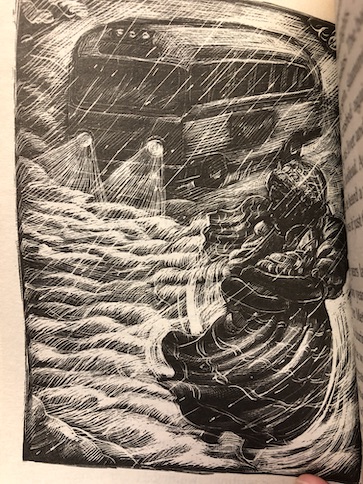
This story involves the bus boycott in Montgomery, Alabama in the 1950s.

Grady Bishop, a white man with a bad history and a chip on his shoulder, has recently started working as a bus driver, although he’s never happy when he has to take the less prestigious route through the city, where a lot of black people catch the bus. Driving makes him feel powerful, but he considers this route beneath him.

One day, during a bad snow storm, a poor woman with a sick baby begs him for a ride although she doesn’t have money to pay. She’s afraid if she can’t get the baby to the hospital, she’ll die. Grady refuses to give her a free ride, convinced that she’s making too much out of nothing and just trying to get a free ride. Later, he hears that the woman and baby froze to death in the storm. A year after that, he sees the same woman again on the same route. Startled, Grady crashes his bus and is killed.

Years later, a black bus driver has that route, and other drivers tell him about the ghost lady with the baby that they see whenever it starts snowing. He becomes the last person to see the ghost lady … because he’s the first to give her a ride.

The Conjure Brother

This story explains that “conjure women” were women who sold herbal cures and practiced folk magic to help people change their luck.

A girl named Josie is tired of being an only child and wants a brother. However, her mother shows no signs of being pregnant, even though Josie keeps asking her for a brother. When she hears a couple of women talking about the local conjure woman, Josie decides to go see her and ask if she can help her get a brother. The conjure woman gives her a set of instructions to follow, but Josie performs the ritual too early at night. Instead of getting a baby brother, Josie gets an older brother, called Adam. Her parents act like Adam has always been their oldest child. Adam is bossy, and some of the things that used to belong to Josie now belong to Adam. Josie starts to think of Adam as a pest and returns to the conjure woman to ask her to do something about Adam, but instead, she learns an important lesson about sharing her life and house with a sibling.

Boo Mama

This chapter talks about the tumultuous times of the late 1960s and the assassinations of Martin Luther King, Jr. and Robert Kennedy. Some people felt so overwhelmed by everything that was going on that they just wanted to “drop out” of society and ignore the chaos around them.

Leddy has been a social activist since she was in her teens, but then, her husband is killed in the war in Vietnam, leaving her with a young child. After the deaths of Martin Luther King, Jr. and Robert Kennedy soon after her husband’s death, Leddy feels completely overwhelmed. She’s been putting forth all of the effort she has for a long time, and the deaths of the man she loved and the people who inspired her feel like too much. She has a breakdown and starts questioning whether everything she and her friends have done has really accomplished anything. Deciding that she needs a change of scene for her and her son, she moves to a rural community in Tennessee.

At first, her young son seems to do better in the countryside, and Leddy finds the change of pace relaxing, but then, her young son disappears. He wanders away while his mother is hanging out the laundry. The locals put together a search party. They search for days, but all they can find is the boy’s teddy bear. Everyone is convinced that he’s dead, but Leddy can’t give up hope that her son is still alive. Her son does turn up, but he is strangely different. Where has he been, and what has happened to him?

The Gingi

There is an old superstition that “Evil needs an invitation.” Among the Yoruba people of West Africa, there is a belief that evil spirits need someone to welcome them into a house before they can enter, so they will try to trick unsuspecting people into giving them an invitation. They use special talismans called gingi to guard against evil.

A woman named Laura is fascinated by a strange statue that she sees in a shop window. However, when she tries to buy it, the shopkeeper says that she’s never seen it before and warns Laura that evil spirits sometimes disguise themselves to trick people into taking them into their homes. Laura thinks this is just superstition and insists that she wants the statue. The shopkeeper charges her a price that’s too high to discourage her from buying the statue, and it almost works, but for some reason, Laura feels compelled to buy it and pays for it anyway. Seeing that she can’t prevent Laura from taking the statue, the shopkeeper insists that she take a small complementary talisman and keep it with her. The talisman is a small doll, and she gives it to her young daughter to play with.

The Chicken-Coop Monster

The final story in the book is semi-autobiographical, inspired by the author’s feelings when her parents got divorced when she was a child.

A young girl named Melissa is upset about her parents’ divorce. Her parents send her to stay with her grandparents in Tennessee while they’re sorting things out, but she becomes convinced that there’s a monster living in the chicken coop on her grandparents’ property. She and her friends are part of a group called the Monster Watchers of America. Melissa’s grandmother doesn’t believe in the monster, but her grandfather teaches her an important lesson about facing up to life’s monsters.

Famous American Negros

Famous American Negroes by Langston Hughes, 1954.

I sought out an electronic copy of this book because I don’t own a physical one, and after I found out that it existed, I knew that I had to cover it at some point! The book is part of a series of biographies for children that I covered earlier, but what caught my attention was the author of the book, Langston Hughes, the famous poet of the Harlem Renaissance of the 1920s and 1930s. I mostly knew Langston Hughes for his poetry, and I wasn’t aware that he had written any children’s books until I found out that he had written several biography books for this series. When I found out that he specifically wrote books about African Americans and other notable black people from history, it occurred to me that he might have even written biographies of people he knew personally because of the circles he traveled in.

This book focuses on prominent African Americans through history. It contains a series of short biographies and profiles, beginning in the Colonial times and continuing into the mid-20th century, when the book was written. Some were contemporaries of Langston Hughes, but since the biographies are brief and focus only on providing an overview of the subjects’ lives, there is no indication whether Hughes ever met any of them himself. I was a little disappointed about that because I would have enjoyed hearing a personal perspective, but the personalities covered are still fascinating. I also enjoyed how some of the earliest biographies in the book relate to some of the later ones because of the influence some of the earlier people had on the lives of others.

If you’re wondering why he uses the term “Negro” instead of “African American”, it’s because that term was one of the more polite and acceptable terms during his youth and around the time when he wrote this book. (That’s why the UNCF, or United Negro College Fund uses it as well. It was one of the polite terms in use at the time of its founding.) It sounds a bit out of date to people of the 21st century because, around the time of the Civil Rights Movement, which began around the time this book was written, people began advocating for a shift in the words used to describe black people. They wanted to distance themselves from old attitudes about race by using newer terms that didn’t have as much emotional baggage attached to them. This is when terms like “colored” and “Negro” feel out of use and were replaced by “African American” as the correct, formal term to specifically describe an American with African ancestry and “black” (considered somewhat impolite a century earlier, as I understand it, see the Rainbow and Lucky series for an example – I discussed it in the historical description of the 1830s) as the generic term to describe a person with dark skin and African ancestry, regardless of their nationality.

Because this book was written in the mid-1950s, some of the information included is long out of date. People who were alive when Langston Hughes wrote the book are obviously not alive now, almost 70 years later. There are more recent books that cover the same topic and include information about late 20th century and early 21st century musicians Langston Hughes wouldn’t have known about. However, this vintage book is still interesting because of its famous author and because it was written at a turning point in American history, when society was changing and racial issues were being challenged.

The book is available to borrow and read for free online through Internet Archive.

The biographies included in the book are:

Introduction

The book begins with a brief history of black people in America. Langston Hughes points out that histories of African Americans often begin with slavery, but there were people of African ancestry who came to the Americas before that, not as slaves. Some traveled with explorers from Europe as members of their crews and expeditions.

After the slave trade began, slavery affected the lives of black people throughout the American Colonies and, later, the United States. Some slaves managed to find ways to take their fate into their own hands by running away, and of those, some helped others to escape to freedom. Some slaves were able to hire themselves out for wages on the side and saved up enough money to purchase themselves and gain freedom in that way. Some slaves were even freed by the the people who owned them, although others simply lived and died in slavery.

After the end of the Civil War and the end of slavery, former slaves were free to pursue their own destiny, but they were in a precarious position because they had no resources from which to start building their independent lives. Slaves had work experience, but much of their experience was in unskilled labor, which brought low wages. Most slaves had no education. (In many places, it was illegal to teach slaves to read. There were a few exceptions, and some people skirted the law, but this was a major problem for many formerslaves once they were granted their freedom, lacking an essential skill.) They had no money or land of their own. Getting established in their new lives meant building something from nothing or almost nothing, and it was a long, uphill struggle.

Even generations later, racial discrimination added obstacles to the lives of African Americans. The biographies in this book are about people who triumphed over the obstacles in their lives to leave a lasting mark on society.

Phillis Wheatley (c. 1753-1784) – Whose Poetry George Washington Praised

Phillis Wheatley was brought to the American colonies from Senegal as a slave when she was only a small child (approximately age 6 or 7 because she was still losing baby teeth when she arrived). Phillis was not her original name, but it is unknown what her original name was, exactly when she was born, how she became a slave, or what happened to her parents. She was purchased by a tailor named John Wheatley in Boston to be a servant for his family, and the Wheatley family gave her the name Phillis. When she first arrived in Boston, Phillis could not speak England and no one could speak Senegalese, so it was some time before anybody could truly communicate with her, which is part of why we know so little about her earliest years.

Fortunately, the Wheatley family was kind and even nurturing toward Phillis. Even though they purchased her to work for them, they cared about educating her. They taught her read and write, even though it was discouraged to teach slaves those skills and even illegal in some areas. When Phillis learned English and was able to read and write, it soon became apparent that she had a talent for poetry. The Wheatleys supported her poetry, and the granted Phillis her freedom in 1772. By the time she was about 21 years old, her poetry had been printed all over the colonies and in England. Although her poetry was successful, Phillis’s life took an unfortunate turn when she married a ne’er-do-well, and she died in poverty.

Richard Allen (c. 1760-1831)- Founder of the African Methodist Episcopal Church

Sometimes, slave owners used Christianity as an excuse for slavery, claiming that they were saving the souls of heathens. However, even though they converted slaves from Africa to Christianity, they didn’t provide much opportunity for their slaves to have religious worship. Richard Allen was born into a slave family in Philadelphia, and he was a child when he was sold to a farmer in Delaware. When he grew up, he became a Methodist preacher, and his owner let him perform religious services for the other slaves. He also became a wagon driver during the Revolutionary War and earned enough money to buy his freedom.

Once he was free, he returned to Philadelphia as a preacher. There was no Methodist congregation that was only for black people at that time, so he sometimes preached for a mixed congregation. However, some of the white members of the congregation protested to his presence as a black preacher, and some also objected to the presence of the other black parishioners as well. When Allen and a couple of friends were interrupted while praying one Sunday and told to leave the church, Allen realized that the only way any of them would be able to worship in peace would be to form their own group. The society he and his friends formed was the Free African Society, and that group went on to found the Bethel Methodist Episcopal Church. They were among those who helped to tend the sick and bury the dead during the yellow fever epidemic that struck the city in the 1790s.

Ira Aldridge (1807-1867) – A Star Who Never Came Home

Ira Aldridge was the son of a Presbyterian minister in New York. Aldridge started acting at a young age and became part of a black theater troupe, performing in a theater close to the African Free School he attended and the famous Fraunces’ Tavern (mentioned earlier in Phoebe the Spy, this book says that it was owned by a black family but other accounts say that the Fraunces family was mixed race – it has never been firmly established which is more accurate). His father wanted him to further his education, so he sent him to the University of Glasgow in Scotland, which accepted black students. It is unknown whether Ira Aldridge ever completed his degree there, but from there, he went to London to continue his acting career and won acclaim for his portrayal of Othello at the Royalty Theater. Ira Aldridge toured Europe and gathered a prominent following, even winning awards from some of the royal families of Europe. The reason why he never returned home was that he remained in Europe for the rest of his life, still touring as a successful actor up until his death at age 60.

Frederick Douglass (c. 1817-1895) – Fighter for Freedom

Frederick Douglass was born into slavery, originally with the last name of Bailey. In most cases, we know very little about the early lives of individual slaves because few slaves could read and write and their owners didn’t think it was important to even record their birth dates. Frederick Douglass is an exception because he learned to read and write and later wrote his famous autobiography. (The autobiography is now public domain, and you can read it for free online in many places, including Documenting the American South, Project Gutenberg, and Internet Archive (multiple copies). The reading level isn’t difficult, although parts are emotionally wrenching.) His autobiography contains many details of his early life (although even he never knew his own birth date, which is why we can only estimate). The description that follows is a brief summary of both the chapter in this book and the contents of his autobiography:

Frederick’s mother was a slave, but his father was a white man (or in some sources I’ve seen, possibly mixed race). (The book doesn’t identify his father, and his identity has never been definitely established, although there are theories. According to the Library of Congress, Frederick’s “Mother is a slave, Harriet Bailey, and father is a white man, rumored to be his master, Aaron Anthony.”) Because his mother had to work in the fields all the time, he rarely saw her when he was a child. (This book doesn’t mention it, but Frederick’s mother died while he was still young.) He was raised by his grandmother during his earliest years and later by a woman who abused and neglected her young charges. Then, young Frederick was sent to live with and work for another part of the family who owned him in Baltimore. At first, the mother of family was nice to Frederick and gave him his first reading lessons, but her husband put a stop to that, telling his wife in Frederick’s presence that if a slave learns to read and write, they’ll probably run away. Frederick managed to continue his reading lessons in secret with the help of some of the white children in the neighborhood. His new skills did help him to learn more about human rights and what freedom meant, and he also learned about the existence of abolitionists. Newspapers in Baltimore called abolitionists anarchists and accused them of being in the service of the devil, but young Frederick began to see them as possible allies.

As a teenager, Frederick was sent to live with a different branch of the same family in a smaller town. This family became suspicious of him when they found out that he could read and write and that he had joined a Sunday school that was run by a free black man. They decided to send Frederick to a man named Covey who was a “Negro breaker“, which was someone who would “tame” slaves by “breaking” them physically, mentally, and spiritually. In his autobiography, Frederick states that Covey did break him and very nearly killed him, but after a particularly vicious beating at Covey’s hands, Frederick realized both that he couldn’t take anymore and that he wasn’t going to take any more. He fought back. That’s when he began planning to run away. Somehow, plans of his escape leaked out, and he was sent away to work in the shipyards in Baltimore. There, he disguised himself as a sailor, borrowed some papers belonging to a sailor, and sneaked onto a train headed for New York.

When he arrived in New York, he was free, but he wasn’t quite sure where to go or what to at first. He had no place to stay and didn’t know anybody he could trust. Fortunately, a real sailor gave him a place to stay and helped him to connect with a society that helped escaped slaves. He found a job on the wharves and gave himself the name surname Douglass.

What truly makes Frederick Douglass famous is not just that he escaped from slavery, but once he did so, he wanted to help others gain their freedom. He became an abolitionist and gave public talks about slavery alongside many other famous abolitionists. When he met with violence, he moved his family to Canada, but he returned when the Civil War broke out to meet with President Lincoln. His sons became Union soldiers, and after the war, Frederick Douglass held various government offices, including US Marshall, Recorder of Deeds for the District of Columbia, and US Minister to the Republic of Haiti.

Harriet Tubman (c. 1823-1913) – The Moses of Her People

Like Frederick Douglass, Harriet Tubman was born as a slave in Maryland, but unlike Frederick Douglass, she had no early education. From an early age, she had a willful and rebellious personality, which was part of the reason why she was assigned to work in the fields instead of the house. One day, another young slave had gone to a local store without permission, and the overseer decided to whip him. He told Harriet help him to tie up the young slave first. When she refused to do it, the young slave ran away. I’m not completely clear on whether what happened next was deliberately aimed at Harriet or whether she was just in the way when the overseer tried to vent his wrath, but what is known is that the overseer picked up an iron weight and threw it. The weight struck Harriet in the head, cracking her skull. Harriet almost died of the injury and spent days lying unconscious. She eventually recovered, but she never recovered completely. Throughout the whole rest of her life, she bore a scar from the injury and would suffer from periodic seizures and sudden loss of consciousness. Her owner thought that the head injury had left her with diminished intelligence, which wasn’t true, but Harriet realized that it was useful to let him think that.

A few years later, her owner died, and she found out that she and two of her brothers were going to be sold to someone else. At first, they planned to run away together, but her brothers backed out of the plan, and Harriet left by herself. She managed to make her way to Philadelphia, found a job there, and established a new life. However, she didn’t stay in Philadelphia. She returned many times to help other people escape as one of the “conductors” on the Underground Railroad. Her own parents were among the people she rescued, and she never lost any of her “passengers” (partly because if anybody started to panic or turn back, she’d threaten to shoot them, but it worked without her actually shooting anyone). When the Civil War began, she became a Union nurse. She lived a long life, and although her exact age was unknown, she was probably somewhere in her 90s when she passed away.

Booker T. Washington (c. 1858 -1915) – Founder of Tuskegee

Booker T. Washington was also born as a slave to a black mother and a white father. (His mother was a cook called Jane. The identity of his father is still unknown, although the popular belief was that his father was a plantation owner. His mother later married a man named Washington Ferguson, who became Booker’s stepfather.) During the Civil War, Booker’s stepfather was with the Union army, and after the war ended, he rejoined the family and took them to Malden, West Virginia, where he worked in the salt mines. Although Booker was still a child, he also had to work, tending a salt furnace, because his family was poor and needed the money. Both he and his mother wanted to learn to read, but they had to struggle to learn by themselves at first because there was no school for them. When a black man who was able to read moved to the community, the others in town paid him to open a school to teach them. Booker began to take lessons after work, and the school was where he gave himself his last name. In his early life, he had only been known by one name – Booker, but when all the students at the school introduced themselves, he realized that most had two names. Wanting a second name for himself, he called himself Booker Washington.

Wanting a better life than working in the salt mines, Booker decided to pursue an education. He had heard that there was a school in Virginia he could attend called Hampton and decided to go there. It was a difficult journey, and he had to work along the way for money, but he finally made it. When he arrived at Hampton, he was dirty, looked somewhat disreputable, and didn’t have much money, so the head teacher initially had some doubts about admitting him, but he was willing to work at the school as a janitor to pay for his education, so she accepted him. Booker made the most of the opportunity and eventually graduated with honors in 1875. After he graduated, he returned to Malden, West Virginia, as a teacher. Since the previous teacher had left, Booker T. Washington was the only teacher in town. He encouraged his students, including his own brother, to go on to Hampton for higher education, like he had. The founder of Hampton was so impressed with Booker’s students that he offered Booker a job as a teacher at Hampton and house father for a dormitory of Native American students. Booker accepted the job and did well. Then, he received a new offer to establish a school in Tuskegee, Alabama.

Establishing a school for black children in Tuskegee was no easy task. Between limited funds, poor facilities, and threats of violence from the Ku Klux Klan, it was an uphill struggle all the way. However, Booker persevered, and his school became the Tuskegee Institute. One of the innovations that of the Tuskegee Institute that I particularly found interesting was that they had a “movable school”, meaning that they carried books and teachers to rural areas where people could not come to school, bringing school to them. It’s not quite the same as the bookmobiles I grew up with because these were more mobile schools than mobile libraries, but it seems like a kind of precursor. The Tuskegee Institute eventually became Tuskegee University, which still exists.

Daniel Hale Williams (1858-1931) – Great Physician

Daniel Hale Williams‘ early life was more peaceful than many black people of his time because his family was free, not slaves. His earliest years were spent in Pennsylvania, but after his father died, his mother moved the family to Wisconsin. Williams loved to read and received an education in his youth. At first, he thought that he might like to be a lawyer, but he soon learned that he didn’t like the constant arguing in presenting law cases. Instead, he developed an interest in medicine. He found a job working for the Surgeon General of the State and attended Northwestern University in Illinois. After obtaining his medical degree, he became a surgeon in Chicago. He helped other young black people who wanted to study medicine and were having difficulty finding training schools that would accept them and hospitals that would accept them as interns. Dr. Williams became famous for a successful operation on a man who had been stabbed in the heart, the first successful operation of its kind.

Henry Ossawa Tanner (1859-1937) – Who Painting Hangs in the Luxembourg

Henry Ossawa Tanner was the son of a bishop of the African Methodist Episcopal Church and was raised in Pennsylvania. When he was still a child, he saw a man painting a picture in a park, and it inspired him to become an artist himself. His father thought that his artistic ambitions were impractical, but Tanner began experimenting with different types of media, including paint and clay, and he attended the Pennsylvania Academy of Fine Arts. He began selling his paintings professionally while he was still a student. After he graduated, he found a job teaching art at Clark University. He continued to paint and opened a photography studio on the side. A generous churchman gave Tanner some money so he could study art in Europe, so Tanner lived and painted in Paris for several years. He found the artistic life of the city inspiring, and he did a series of paintings with religious themes. In particular, he is known for his painting of The Resurrection of Lazarus, which he painted in 1896. The French government purchased this painting to hang in the Luxembourg, a famous art gallery. Tanner did return to the United States for a time, but finding life in Europe easier because Europe did not practice racial segregation like the United States did at that time, he decided to return to Paris, where he lived the rest of his life.

George Washington Carver (c. 1864-1943) – Agricultural Chemist

George Washington Carver was born a slave, and his father died in an accident while he was still an infant (or shortly before his birth, according to other sources – since he was a slave and slave birthdays were not recorded, that might explain the differing accounts). In fact, while he was still an infant, he and his mother were abducted from the farm where they lived in Missouri by Night Riders, a gang of criminals who kidnapped slaves to sell to different owners in other states. The fate of his mother is unknown (according to the book, although other sources say that she and George’s sister, who was also abducted, were sold to someone in Kentucky), but little George was found because he was ill with whooping cough, so the Night Riders simply abandoned him by the road. George was returned to the people who owned him and his mother, the Carvers, who had offered a reward for his return. The Carvers had no other slaves beyond George and his family. George also had an older brother who managed to avoid being captured by the Night Riders and remained with the Carvers. The Carvers ended up raising George and his brother like adopted children after the loss of their parents and the end of slavery.

During his childhood, George liked to play in the woods and fields near the Carvers’ farm, and he developed a fascination for plants. He often brought samples of different plants to Mrs. Carver to ask her what they were. The Carvers didn’t have much education, but they told him what they knew and gave him his first lessons in reading. Later, George attended a school for black children in another town, Neosha, living with a black woman named Mariah Watkins. From there, he became an itinerant worker, finding jobs and continuing his education wherever he could. Eventually, he attended Iowa State College, studying agriculture. He graduated at the top of his class and wrote a thesis called “Plants as Modified by Man.” He stayed on at the college to get his Masters degree, working as an assistant botany instructor. After he got his MA, Booker T. Washington invited him to teach at Tuskegee as the head of the agriculture department. Carver’s work at Tuskegee made him famous. He ran experiments to determine new uses for agricultural products, devoting the rest of his life to agricultural research.

Robert S. Abbott (1870-1940) – A Crusading Journalist

Robert Sengstacke Abbott was the son of a minister in Georgia. He loved books since childhood and found a job as an apprentice printer after graduating from Hampton. Because his opportunities for advancement were limited in the South, he moved to Chicago, but he still met with discrimination and found it difficult to get work in the printing industry. Discouraged, he studied and practiced law for a time, but he missed his printing work. Instead, he decided to buy his own printing press and start his own newspaper. He knew that African Americans and their concerns weren’t being represented in existing newspapers, so he wanted to become their voice. The newspaper he started was called the Chicago Defender, which became a national newspaper (and which still exists in an online format), although some Southern communities outright banned the newspaper and even made it a crime for a black person to simply possess a copy under the claim that it would incite black people to riot.

Paul Laurence Dunbar (1872-1906) – The Robert Burns of Negro Poetry

Paul Laurence Dunbar‘s father escape from slavery in his youth, returning to fight on the side of the Union during the Civil War. Paul was born after the war, and his father died when he was only twelve years old. His mother didn’t have much education, but she wanted him to be educated and worked hard to make it possible. Paul enjoyed writing poems since he was a child, and when he was in high school, he became the editor of the school paper. One of his English teachers was so impressed by his poetry that she arranged for him to write a poem and read it before a meeting of the Western Association of Writers. When Paul had enough poems to make a book, he had them published with the help of a publisher who loaned him money to cover the publishing costs. He sold enough copies of the book to cover the loan and make a nice profit.

After a stint working for Frederick Douglass at the World’s Columbian Exposition in Chicago, Paul wrote a second book of poetry that made him nationally famous. He received many orders for copies of the book, and he was invited to give public readings of his poems. He even went to London to give readings during Queen Victoria’s Diamond Jubilee. When he returned to the US, he got a job at the Library of Congress and got married, but unfortunately, his life was cut short by tuberculosis.

W. C. Handy (1873-(later D. 1958)) – Father of the Blues

W. C. Handy is mentioned in a later book by Langston Hughes in the same biography series, Famous Negro Music Makers, but his biography doesn’t appear in that book although he made his living in music.

William Christopher Handy was born in Alabama. When he started school, his favorite subject was music. His teacher was a graduate of Fisk University (an African American college with a strong musical tradition, which is also described in Famous Negro Music Makers), and he introduced his students to a variety of musical styles. Handy’s father was a Methodist minister, and he didn’t believe in music outside of church and school. Musicians had a bad reputation, so he didn’t support his son’s musical interests and wouldn’t let him have an instrument of his own. Handy often improvised instruments, and he was inspired by traveling musicians who came to town. In spite of his father’s opposition, Handy joined up with musical groups.

Handy’s father wanted him to follow in his footsteps and be a minister, but Handy told his father that he’d rather be a teacher. When he found out how bad teachers’ salaries were, he found a job in a foundry instead. In his free time, he continued to play music in his church and started an orchestra and brass band. When he lost his job at the foundry due to an economic depression, he formed a quartet with some other young men, and they headed off to the World’s Fair in Chicago. They sang for their food and transportation along the way, only to learn that the World’s Fair was postponed. Instead, they decided to go to St. Louis, but still unable to find singing jobs, the group broke up.

Handy was too proud to go home to his father and admit defeat, so he continued to travel around and pick up whatever odd jobs he could find. Eventually, he joined up with a minstrel group, and he began to make a career in music. He traveled all over the country, giving performances, but when he became a father, he decided that it was time to settle somewhere to give his child a stable life. He took a job teaching music and English in Alabama, but he didn’t like the job because he wasn’t allowed to teach popular music, only hymns and classics. He returned to playing minstrel shows and became the bandmaster for a Knights of Pythias band in Mississippi. He composed music, writing The Memphis Blues and The St. Louis Blues. These songs were big hits, and The St. Louis Blues made Handy a great deal of money. Handy became a music publisher on Broadway, and his company was the largest African American owned publishing company in the US.

Charles C. Spaulding (1874-1952) – Executive of World’s Largest Negro Business

In the years immediately following the end of the Civil War and the Emancipation of the slaves, things were very difficult for black people. The newly-freed slaves had no money or assets to help them establish their new lives or even to take care of their sick or bury their dead. To help each other, they banded together and formed benevolent societies and fraternal organizations to share the resources they had and support each other. Some organizations of this type already existed, but Emancipation led to the expansion of such groups and the formation of new ones.

Charles C. Spaulding was the first manager and later president of the North Carolina Mutual Life Insurance Company. He had grown up poor and only had an eighth grade education. He worked at various jobs until he was approached by the owner of a series of barber shops who was interested in starting an insurance company. Spaulding’s uncle was also interested in the venture, and they hired Spaulding to be the manager of this small company. At first, Spaulding didn’t know much about insurance, and he had to wear a lot of hats in the business, starting out as bookkeeper and janitor of the business as well as its manager. In fact, he was originally the only employee of the company. The very first customer of the insurance company died only a few days into his policy, putting the company into debt immediately, but the owners of the company dutifully paid what they owed to the man’s widow, giving the company a reputation for reliability and earning them more customers. As the business grew, the company also supported public projects of interest to the African Americans in their community, such as the formation of a new library and a new hospital. Spaulding inherited the company after his uncle’s death, and he continued supporting civic projects.

A. Philip Randolph (1889-(Later D. 1979)) – Distinguished Labor Leader

Asa Philip Randolph was born in Florida. His father was a Methodist preacher, and he grew up reading his father’s books of sermons and Shakespeare. After he graduated from high school, he decided to go to New York to look for work. He worked at various jobs, and he became interested in improving working conditions for black people. Randolph gave public talks on the subject in Harlem and helped to start a magazine called The Messenger to advocate for the rights of African Americans. He began to travel to other cities to give talks and fiery speeches, and at one point, he was called “the most dangerous Negro in America” because some people feared what he might stir up in discontented African Americans faced with discrimination and bad working conditions.

Randolph was invited to speak to the Pullman Porters Athletic Association about the importance of trade unions because the porters had unsuccessfully tried to unionize before. Their working conditions were harsh, their pay was low, and the porters hadn’t made any real progress toward improvement. Randolph hadn’t worked as a porter, but he was interested in unions and labor organizations. The porters in New York asked him to help them organize, and they formed the Brotherhood of Sleeping Car Porters in 1925. Some porters were reluctant to join at first because they were afraid of being fired, but Randolph continued to travel and speak about the importance of unions, recruiting new members. The Great Depression was hard on the porters, but the union managed to negotiate for better working conditions and pay.

Ralph Bunche (1903- (later D. 1971)) – Statesman and Political Scientist

This particular biography begins with a brief history of Israel and Palestine and the conflict between the two because of the aftermath of WWII, a conflict that has continued into the 21st century.

Ralph Bunche was the son of a barber in Detroit, Michigan. While he was still young, his parents suffered health problems and were advised to go to a drier climate, so the entire family moved to New Mexico. Ralph enjoyed living in the Southwest, but unfortunately, his parents died, leaving him and his sister with their grandmother. Ralph’s grandmother insisted on him continuing his education, and he also worked part time. After he graduated from high school, his grandmother insisted that he go on to college. He got a scholarship for the University of California, and from there, he got another scholarship to attend Harvard. At Harvard, Ralph studied political science, and after he graduated, he accepted a job from Howard University in Washington DC which wanted to set up a political science department of its own. Washington DC was more segregated than other places Ralph had lived, and he turned his attention to seriously studying racial relations. In 1936, he became one of the co-directors of the Institute of Race Relations at Swarthmore College.

During WWII, Dr. Bunche could not serve in the armed forces because he was deaf in one ear. However, he served the Office of Strategic Services, researching cultural and political attitudes in Africa where the US had strategic interests and wanted to establish military bases. Because he performed this job well, he was chosen to be the Associate Chief of the Division of Dependent Territories in the State Department, making him the first black person to be in charge of a State Department office. After the war, he became one of the consultants in the drafting of the charter of the United Nations, which is how he became involved with the conflict in Israel. Dr. Bunche attended session of the UN, and in 1947, he became part of a UN Special Committee sent to Palestine to negotiate peace. It was a dangerous mission, and other members of the committee were actually assassinated. While the situation in Israel and Palestine has yet to be completely resolved, Dr. Bunche made more progress than the rest of the committee in the 1940s, getting the two sides to agree to an armistice. At the end of the tense negotiations, he had the respect of both sides, and his work earned him a Nobel Peace Prize is 1950.

Marian Anderson (1897-(Later D. 1993)) – Famous Concert Singer

Marian Anderson was a famous singer who became the first black person to sing for the Metropolitan Opera Company the year after this book was written. A later book by Langston Hughes in the same biography series, Famous Negro Music Makers, describes this achievement and other details of her life and work.

Jackie Robinson (1919-(Later D. 1972)) – First Negro in Big League Baseball

Jackie Robinson was the youngest of a family of five children. His father died when he was still an infant, and his mother moved the family from Georgia to California to live with her half brother and find non-segregated schools for the children. Jackie was young during the Great Depression, and times were hard for his family. He sometimes had little to eat. However, he excelled at athletics in school, which helped him to get into Pasadena Junior College and the University of California. He played football for UCLA, but he left college in his final year to find a job and help his family financially. He got a job as an athletic director for a Civilian Conservation Corp camp. When the US joined WWII, Jackie Robinson joined the army, but he was honorably discharged before the end of the war due to an old football injury that began troubling him again. After that, he took a job as an athletic director at a small college, and then, he joined a baseball team called the Kansas City Monarchs.

During the 1940s, black people were barred from joining major league teams, so at first, Jackie Robinson didn’t take it seriously when he was approached by a scout for the Brooklyn Dodgers. However, WWII had brought about changes in racial attitudes and new opportunities for black people. After a stint with the Montreal Royals, Jackie Robinson did join the Dodgers and became famous as a baseball player.

Famous Negro Music Makers

Famous Biographies for Young People

Famous Negro Music Makers by Langston Hughes, 1955.

I sought out an electronic copy of this book because I don’t own a physical one, and after I found out that it existed, I knew that I had to cover it at some point! The book is part of a series of biographies for children that I covered earlier, but what caught my attention was the author of the book, Langston Hughes, the famous poet of the Harlem Renaissance of the 1920s and 1930s. I mostly knew Langston Hughes for his poetry, and I wasn’t aware that he had written any children’s books until I found out that he had written several biography books for this children’s biography series. When I found out that he specifically wrote books about African Americans and other notable black people from history, it occurred to me that he might have even written biographies of people he knew personally because of the circles he traveled in.

This book focuses on prominent African American musicians. It contains a series of short biographies and profiles, beginning with musicians from the 19th century and continuing into the mid-20th century. Most of the musicians described in the book were contemporaries of Langston Hughes, but since the biographies are brief and focus only on providing an overview of the subjects’ lives, there is no indication whether Hughes ever met any of them himself. I was a little disappointed about that because I would have enjoyed hearing a personal perspective, but the personalities covered are still fascinating.

If you’re wondering why he uses the term “Negro” instead of “African American”, it’s because that term was one of the more polite and acceptable terms during his youth and around the time when he wrote this book. (That’s why the UNCF, or United Negro College Fund uses it as well. It was one of the polite terms in use at the time of its founding.) It sounds a bit out of date to people of the 21st century because, around the time of the Civil Rights Movement, which began around the time this book was written, people began advocating for a shift in the words used to describe black people. They wanted to distance themselves from old attitudes about race by using newer terms that didn’t have as much emotional baggage attached to them. This is when terms like “colored” and “Negro” feel out of use and were replaced by “African American” as the correct, formal term to specifically describe an American with African ancestry and “black” (considered somewhat impolite a century earlier, as I understand it, see the Rainbow and Lucky series for an example – I discussed it in the historical description of the 1830s) as the generic term to describe a person with dark skin and African ancestry, regardless of their nationality.

I enjoyed the range of different styles of music covered in the book. Recognized some of the most famous singers in the book by name alone, before I even started reading, but this book also introduced me to some musicians I hadn’t known about before. I knew about Duke Ellington, Louis Armstrong, Bessie Smith, and Marian Anderson, but I hadn’t heard of Lena Horne or Roland Hayes and some of the others. I’m sure that modern children would also be unfamiliar with some of the musicians included in the book. The biographies begin with musicians from the 19th century and end with musicians who were contemporaries of Langston Hughes in the 1950s.

Because this book was written in the mid-1950s, some of the information included is long out of date. People who were alive when Langston Hughes wrote the book are obviously not alive now, almost 70 years later. There are more recent books that cover the same topic and include information about late 20th century and early 21st century musicians Langston Hughes wouldn’t have known about. However, this vintage book is still interesting because of its famous author and because it was written at a turning point in American history, when society was changing and racial issues were being challenged.

The book is available to borrow and read for free online through Internet Archive.

The biographies included in the book are:

The Fisk Jubilee Singers, The Story of the Spirituals

This musical group began touring and singing spirituals in 1871. Some of the first members of this group had been born in slavery. After the end of the Civil War, the American Missionary Association of the Congregational Church established the Fisk School in abandoned army barracks in Nashville to teach black children at the high school level. However, it attracted a much larger student body than high school students. Many of the students had grown up in slavery and never learned to read, so that was the first skill they had to master. In addition to children of all ages, the school attracted older adults who wanted to learn enough to read Bible stories before they died. There was local opposition to a school for black people, and a lack of funding endangered the school’s existence. The school’s treasurer came up with the idea of holding musical performances to raise money. At first, the performers weren’t sure they wanted to sing their spirituals in front of white audiences, but they turned out to be very successful. They even did a European tour and sang before Queen Victoria. The Fisk School continued to grow and later became Fisk University, which still exists in Nashville and is considered one of the top historically black colleges in the US.

James A. Bland (1854-1911), Minstrel Composer

This section begins with an explanation of the creation of the banjo as an American instrument by slaves. People have negative associations with the term “minstrel show” in modern times, but the book explains that the first minstrel shows were performed by black slaves who had a talent for music. They were allowed to travel between plantations to perform their musical shows. Later, white actors and musicians adopted the style of these performances and started wearing blackface to perform their own minstrel shows.

However, James Bland fell in love with banjo music and the style of minstrel performances from a young age. Although minstrel music had a poor reputation, and his parents disapproved of his interest in this style of music, Bland earned extra money by giving street performances while he was in college. Although most theaters only wanted to book all-white minstrel groups in blackface as opposed to all-black minstrel groups, Bland managed to join an all-black group and make a name for himself as both a performer and composer.

Bert Williams (1875-1922), Artist of Comedy Song

In his youth, Bert Williams helped earn money for his family by singing in the street. Later, he formed a partnership with George Walker, and the two of them developed a musical comedy act. Bert Williams became famous for his act, but it also troubled him because he weirdly had to use blackface, even as a black person, because that’s what audiences expected, and he also had to act dumb when he was actually very smart. He wanted to move on to more serious roles as an actor, but people didn’t think he could play anything other than comedic roles. Also, in spite of his fame, he was treated as a second-class citizen everywhere outside of the theater because of Jim Crow laws. He was quoted describing the situation, “It is no disgrace to be a Negro, but it is very inconvenient.”

Bill Robinson (1878-1949), Music with His Feet

Bill Robinson was a famous tap dancer, often credited under his nickname, Bojangles. He was orphaned at a young age and partially raised by his grandmother, who was a former slave. He left school at the age of eight and got a job in a riding stable because he loved horses. He also earned extra money by dancing on street corners and ended up joining a traveling show. He became famous for his dancing and had dancing roles in movies. He is particularly remembered for his appearances in Shirley Temple movies in the 1930s.

(Note: He and Shirley Temple are regarded as the first interracial dance team in movies. While people of the time might have been scandalized by an interracial adult dancing team, it was acceptable for little Shirley Temple to dance with Bill Robinson because of her youth and innocence. Basically, because she was a young child, and he was in his 50s, it was obvious that there could be no romantic relationship between the two of them. Segregationists of the early 20th century feared interracial marriages and created laws to prevent them, which is why they feared any suggestion of romance between a black person and a white person. Shirley Temple was a safe person for Robinson to dance with because she was just a cute little girl dancing with her “Uncle Billy”, not a potential romantic partner.)

Leadbelly (1880s-1949), The Essence of Folk Song

His original name was Huddie Leadbetter, and he had a wild youth. He was a rough fighter who was even charged with murder and assault and sent to prison and escaped multiple times. (The book notes that he may not have actually killed anybody. The book explains that he was involved in brawls with other local people at Saturday night dances, where he was in demand as a musician. During one of these fights, in which a large number of people were involved, a man was killed, and Leadbelly, as he came to be called, was the one who was apprehended and charged for his death. However, in this type of free-for-all fight, it’s difficult to tell who did what, so it isn’t definite that he was responsible for the man’s death. I’m not completely sure whether the description of the fight in the book is fully accurate, though, because I saw it described differently elsewhere. It’s enough for readers to know that he had a rough youth, that he got in trouble for a fight in which someone was killed, and that he was in and out of prison for a time.) However, he had a natural talent for music and a love of folk songs that helped him to build a better life. His performances and recordings are credited for preserving songs that might otherwise have been lost to time.

Jelly Roll Morton (1885-1941), From Ragtime to Jazz

His original name was Ferdinand Joseph Le Menthe, and he grew up in a mixed race family in New Orleans. New Orleans was an exciting city with many different types of music, and Morton (as he later called himself) discovered his love of music early in life. He worked a variety of jobs in his youth, but through it all, he continued to play his music. He traveled the country, learning and playing ragtime and jazz music, eventually composing his own songs.

Roland Hayes (1887-(later D. 1977)), Famous Concert Artist

Roland Hayes was a student at Fisk University (whose origins were described in the first chapter of this book) in his youth. However, while the Fisk Jubilee Singers had popularized Negro spirituals and helped make it acceptable for theaters to book black people to sing these songs, Hayes was in love with classical music from Europe, the style of Beethoven and Brahms and classical opera, and theaters would not book a black performer to perform that style of music. Still, Hayes was determined to find a way to perform the music he loved. Strangely, motion pictures helped him to get his start. Because movies were silent then, all music had to be provided by live musicians in the theater. Hayes got his start singing behind the screens of movie theaters, where no one could tell that the performer was a black man. He also toured with the Fisk Jubilee Singers and made a name for himself in London, where he even sang before King George V.

William Grant Still (1895-(later D. 1978)), Distinguished Composer

In his day, William Grant Still was considered “the most prolific of American Negro composers.” He was raised to have a love of learning and music, although his mother and stepfather thought that music would be an unreliable career, unless he was teaching. For a while, he studied science at Wilberforce University, but he later attended Oberlin College to learn musical composition. He also worked for W. C. Handy’s music publishing company. He later moved to California and composed and arranged music for movies in Hollywood. However, his work extended beyond movies, and he is mainly remembered as a symphony composer.

Bessie Smith (1896-1937), “The Empress of the Blues”

Bessie Smith is described as being a large and tall woman with a powerful voice. She was a blues singer who mainly performed before black vaudeville audiences. The blues style of music had its roots in folk music, and it was considered lowbrow in the early 1900s. Gradually, it began to enter the wider culture and helped to form the style of popular jazz, but at the time, Bessie Smith’s style wasn’t taken seriously by Broadway. Bessie Smith was well-loved in her performances and may have gone on to be a bigger star, but unfortunately, she died from injuries in a car accident. According to the book,she might have survived, but the nearest hospital was for white people only and refused to take her. She died on the way to a hospital that would accept black people. This was just one of the harsh realities of life and death in the segregated South. However, the story about the whites-only hospital appears to have been discredited since this book was written. It seems that she did reach a hospital that accepted black people and lived to have her badly-damaged arm amputated, but she was too badly injured to survive.

Duke Ellington (1899-(later D. 1974)), Composer and Band Leader

Duke Ellington‘s birth name was Edward Kennedy Ellington. His father worked for the Navy Department of the Government, and he was born in Washington, DC. His early interests in life were art and baseball, but his mother had him take piano lessons. In high school, he and some friends started a ragtime band. The band was successful, and they moved to New York. After a few years, they began recording for Columbia Records and other recording companies. He composed music throughout his career, jazz and symphony orchestra.

Ethel Waters was born into a poor family in Pennsylvania and had a hard childhood. She started working as a hotel maid in her early teenage years, and she worked her way up through adversity in the theatrical world. She became a vaudeville singer and actress, eventually going on to make Hollywood movies.

Louis Armstrong (1900-(later D. 1971)), King of the Trumpet Players

Louis Armstrong began his musical education in a very odd way. When he was twelve years old, he was apprehend on the streets of New Orleans for firing a gun in the air on New Year’s Eve. Firing a gun in the air is a dangerous thing to do (people are sometimes killed by celebratory fire), and the authorities decided that he was he was a young hoodlum for running around, firing a gun in the streets. The sent him to the Colored Waif’s Home, which was being used as a youth reformatory as well as an orphanage. As a younger child, he had played music on street corners with some of his friends and had admired musicians who played horns, but he had never had a horn of his own. At the reform school, he was given a coronet and music lessons. Louis loved it, and he loved playing in the reform school’s band when it marched in local parades. He was disappointed when he didn’t get to keep the coronet when he left the reform school. However, his talent had become known. The owner of a local restaurant bought him a horn from a pawnshop so he could play in some of the local bands. At first, he had trouble adjusting to playing again because it had been so long since he had played regularly at the school, and his lip got sore. When that happened, he would fill in the trumpet part by singing in his gravelly voice. It was such a unique sound that word of it spread, and soon, he was getting attention from audiences and other musicians. Early on, he found it difficult to read music, so he learned to play by ear, and he had a talent for adding his own embellishments and variations to songs. He became famous for his scat singing.

Marian Anderson (early 1900s-(later D. 1993)), Metropolitan Opera Star

Marian Anderson began singing in the church choir as a child, and she was so talented that her church raised money to pay for her musical education. Later, she was also sponsored by the Philadelphia Choral Society. In 1925, she entered the New York Philharmonic Competitions and won first place. She did a singing tour of Europe, where she made a name for herself, and when she returned to the US, she became an acclaimed concert artist. In January 1955, she became the first black performer to sing for the Metropolitan Opera Company. (That was the year this book was written, and it discusses this event as a landmark for black musicians.)

Bennie Benjamin (1907-(later D. 1989)), Broadway Song Writer

I couldn’t remember having heard of Bennie Benjamin before, but I had heard of one of his songs, I Don’t Want to Set the World On Fire. It was his first big success, and he became a famous Broadway song writer. Something that made his music different from other black song writers of his day was that his music wasn’t inspired by spirituals, blues, or jazz. He was originally from the West Indies, and he moved to New York as a young man, so he was always more interested in Broadway styles of music than Southern music. At the time this book was written, he was still alive and writing songs.

Mahalia Jackson (1911-(later D. 1972)), Singer of Gospel Songs

As a child in New Orleans, Mahalia Jackson listened to Bessie Smith’s records and was inspired by her singing style. Mahalia’s specialty was gospel music. She never wanted to perform secular songs, but her music wasn’t the same as spirituals. Gospel music is different from spirituals because spirituals evolved from folk music with no known composer, and gospel music is more modern with known professional composers.

Dean Dixon (1915-(later D. 1976)), Symphony Conductor

Dean Dixon‘s mother was a music lover, and when he was a young child, she would take him to symphonies at Carnegie Hall. She had him learn to play the violin, and he played in his high school orchestra. He developed an interest in orchestration, and he formed a small chamber orchestra at the local YMCA, where he acted as the conductor. After high school, he attended the Julliard School of Music and did graduate work at Columbia University. While he was studying, he also led a mixed race symphony of children and adults in Harlem. He went on to become the first black person to conduct the New York Philharmonic Symphony.

Lena Horne (1917-(later D. 2010)), Singing Star of Hollywood

Lena Horne was an actress and singer. In 1942, she became the first black female singer to appear in a Hollywood move as a featured star in a film with white actors. At that time, typical movie roles for black people were minor comedic parts and servants. Even though black people in American society were educated and held professions like doctor or lawyer, movies typically showed them in more menial jobs, like chauffeur or maid. Lena Horne’s role in the movie Panama Hattie, in which she played a singer, helped to set a new precedent. During WWII she toured with the USO. After she became famous, she was known to turn down singing engagements in places that practiced segregation.

Famous Jazz Musicians (1800-1955), Congo Square to Carnegie Hall

This chapter explains the history and evolution of jazz music and discusses some prominent musicians from the early to mid-20th century who have not been discussed earlier in the book. Toward the end of the chapter, the author discusses a particularly interesting point that the National Association of Music Therapy was researching therapeutic uses for jazz music in the 1950s. Langston Hughes was also pleased that jazz could be used to encourage people to take an interest in other aspects of African American culture, like poetry, and how this style of music has spread all over the world.

Tools of Native Americans

Tools of Native Americans by Kim Kavin, 2006.

This nonfiction book is part of a series recommended for kids ages 9 to 12. It provides insights into the daily lives of Native Americans of the past by explaining their tools and inventions. I was intrigued by the idea immediately because I love books that give insights into history through the lives of ordinary people.

The book is divided into time periods and geographic areas of North America. At the beginning of the book, there is a timeline of important events in the history of North America and Native American culture, beginning c. 20,000 to 8000 BCE, when the ancestors of Native Americans are believed to have migrated to the continent and ending in 2006, the year the book was published. There is also a map showing major geographic regions of North America and the Native American tribes that live there. The chapters of the book are mostly grouped by region, except for the first two, which are about the First Americans and Archaic and Formative Periods.

The first chapter, called The First Americans, discusses theories about how the ancestors of Native Americans first arrived on the continent from Asia. The exact circumstances of their arrival are unknown, but there are some possible migration paths that they could have taken. The chapter discusses the Ice Age that existed when this migration took place, how people found food, and Clovis culture, one of the earliest known civilizations in the Americas. One of the activities from this section is about archaeology, which is what we use to learn more about ancient civilizations that did not leave written records, and how to create an archaeological site of your own.

The next chapter is about the Archaic and Formative Periods, which were characterized by climate change as the Ice Age came to an end and many plants and animals that had thrived in the colder climate died off. The changes in the environment cause Native American groups to make changes in their own lifestyles. Rather than relying on herds of large animals for food, they began cultivating crops. They made pottery and developed new cooking techniques. They still hunted, using a device called an atlatl to throw their spears further and with more power. Civilizations like the Maya flourished.

After the second chapter, the other chapters discuss tribes by region:

The Northeast Woodland and Great Lakes Tribes – The Algonquian and Iroquois

This chapter discusses Native American tribes from the East Coast to the Midwest, around the Great Lakes, who primarily lived in woodland areas. The Iroquois and the Algonquian were both collections confederated tribes. There is information about the Algonquian language, which contributed some words to English, including moccasin, succotash, hominy, hickory, and moose. There is also an activity about creating Algonquian style pictographs and petroglyphs.

The Southeast Tribes – The Cherokee, Catawba, Creeks, and Seminoles

The tribes in this chapter lived in and around the Appalachian Mountains. It explains about Sequoyah, who developed a system of writing for the Cherokee language.

The Great Plains Tribes – The Cheyenne, Lakota Sioux, and Comanche

The tribes of the Great Plains were migratory, following herds of buffalo, which were a primary source of food. Because they moved often, everything they owned, from the tepees where they lived to the tools and other objects they used, had to be easily portable. The Comanche were particularly known for being expert horsemen. This chapter also discusses the Lewis and Clark Expedition and Sacagawea, who was part of the Shoshone tribe from the Rocky Mountains. She had been abducted when she was young, and when she joined the Expedition, she was able to guide Lewis and Clark and their men back to the territory she had known when she was a child and to the Pacific Ocean. Activities for this chapter include making a rattle of the kind children used as toys, making a miniature bullboat, and making a war bonnet (using pieces of poster board instead of feathers).

The Southwest and Mesoamerican Tribes – The Hohokam, Mogollon, Anasazi, Maya, Aztec, Hopi, Apache, and Navajo

I know this area because this is where I grew up. Much of it is desert, and the book is correct that there can be sharp differences in temperature between day and night. In modern Southwestern cities, buildings and pavement can hold in heat even at night, but there isn’t much to hold in heat in the open countryside, not even much humidity in the air to hold heat once the sun goes down. There is an abundance of clay in the soil in this region which local tribes used to make pottery and adobe homes.

Among the civilizations discussed in this section are the Hohokam, whose name means “Vanished Ones” (I’ve seen different versions of the translation of that name, but they’re all words to that effect – that they are gone, vanished, disappeared, etc.) because, for unknown reasons, they seem to have suddenly abandoned the area where they had previously lived and farmed for generations. They don’t seem to have died off, at least not all of them. It’s believed that they were the ancestors of the Pima and Tohono O’odham tribes, and the book discusses that a little further on in the chapter. There is a Pima story about a fierce rainstorm and a massive flood that killed many people, but The Hohokam were the ones who built the original irrigation canals for watering their crops. Later, when settlers came from the Eastern United States, they found these abandoned canals, dug them out, and started using them again. The canals are still in use today, and one of the activities in this chapter of the book is about irrigation.

This section of the book also covers the Maya and the Aztecs, who lived in what is now Mexico and Guatemala. There is an activity about creating hieroglyphs, like the kind that the Maya once used.

In the part that describes the Navajo, there are activities for sand painting and Navajo-style jewelry.

The Pacific Northwest Tribes – The Nootkas, Makahs, and Tlingits

Much of this chapter discusses hunting and fishing and the preservation of food. Because food-related work mostly took place during a single season due to the severity of the winters, there were periods of time when the members of the Pacific Northwest Tribes had time for social and artistic pursuits. The book explains the meaning of totem poles, and there is an activity for readers to create their own.

The Arctic Tribes – The Inuit

The lives of the Inuit were shaped by learning to live in a very cold environment. The book explains how they built igloos out of packed snow and ice, but really, igloos were temporary shelters. The houses they lived in long term where made of sod and were partially built underground for insulation. There are activities for building a snow cave called a quinzy (this requires that you live in a place with snow) and for playing a game called Nugluktaq.

The last chapter in the book is called New Immigrants, Manifest Destiny, and the Trail of Tears. It’s about how European settlers arrived in the Americas, the westward expansion of the United States, and the confinement of Native American tribes to reservations.

The book ends with an Appendix with further information about Native American Sites and Museums State by State. There is also a glossary, index, and bibliography.

Ben and Me

Ben and Me by Robert Lawson, 1939, 1967.

I remember reading this book in elementary school. It’s about Benjamin Franklin’s friendship with a talking mouse (fictional, of course), and how his mouse friend helped inspire him in his work.

The book begins with the author saying that this manuscript, supposedly written by Amos the mouse, was found in a small compartment in a room in an old house that was being renovated. The little compartment was furnished with miniature pieces of Colonial style furniture. The author goes on to say further that the manuscript has been authenticated as being early American and that the National Museum of Natural History has confirmed that the handwriting of the manuscript was done by a mouse. (I’d love to see comparisons of different animals’ handwriting and hear their explanation of how the handwriting of a mouse differs from the handwriting of other members of the rodent family, but trust us, kids, this is all very scientific.) The author says that this account of Benjamin Franklin’s life differs from the stories told by later scholars, but he trusts the descriptions of this mouse who was so close to Benjamin Franklin. (Yeah, sure, why not?)

In the “manuscript”, Amos says that he’s writing not long after the death of his friend, Benjamin Franklin, and some people have attempted to write about the life of Benjamin Franklin, but Amos isn’t satisfied with their accounts of his life and wants to write the truth himself. (Benjamin Franklin also wrote a famous autobiography, but they don’t mention that. I know that this is a story about a talking, writing mouse, but I’m just saying.) Amos says that, much as he liked Ben Franklin, Franklin was kind of stupid at times and that, as Franklin’s secret adviser, he was actually the source of many of Franklin’s greatest ideas.

Amos says that he was born into a large family of poor church mice. Then, during the winter of 1745, food grew scarce, and as the oldest of his siblings, Amos decided to set out to seek his fortune and maybe a way to help provide for the rest of his family. It’s a cold night, and lured by the smell of cheese, Amos finds his way into the house where Ben Franklin lives. He finds Franklin sitting and sneezing in a chilly room near a small fireplace. Ben is trying to write, but because of the sneezing, he’s not making much progress. Amos, cold and tired, climbs up on Ben and curls up in his fur cap and goes to sleep.

When Amos wakes up in the morning, the fur cap is hanging on the bedpost, and the room is still cold. Amos talks to Ben, recommending that he put more wood on the fire. Ben doesn’t question why a mouse is talking to him and just retorts, “Waste not, want not.” Amos points out that there will be plenty of waste and extra expenses if the cold makes him sick. Ben agrees with that and decides to use more wood on the fire. Then, Amos points out to him that the fireplace would be more effective at heating if it was in the middle of the room, explaining how his family used to gather around a hot chestnut to warm themselves. Ben is intrigued by the idea, and they discuss how a fireplace could be located in the middle of the room and how to handle the smoke from the fire. Ben excited sets to work building the stove according to Amos’s suggestions. His first attempt is a bit crude, but the stove works much better at heating the room than the fireplace did, and Ben is pleased. He shares some bread and cheese with Amos, and the two of them become friends.

Ben begins writing about the design of the stove as if he had created it all by himself, but Amos points out that Ben had acknowledged his contribution. Amos doesn’t care about getting fame or public credit for his contribution, but he needs food and has a large family to help provide for, so he and Ben work out an agreement: in exchange for Amos’s companionship and help, Ben agrees to leave regular supplies of food at the church for Amos’s family and to provide Amos and any descendants he may have food and a home in his fur cap. Ben sews some special compartments in the fur cap so that Amos has secure places to sleep and store a little food. There’s also a little compartment near Ben’s ear where Amos can quietly whisper suggestions to Ben.

Life with Ben isn’t easy. Amos hates it when Ben goes swimming and leaves his cap on the ground. One day, a dog steals the cap (along with Amos), and Ben has to chase the dog in order to get the cap and Amos back. Ben promises not to take the cap off his head ever again.

Amos also doesn’t like Poor Richard’s Almanack and doesn’t consider the facts or maxims it offers to be worth much. Ben points out that people do use his paper and its predictions of sunrise, sunset, and high and low tide, and the money the paper makes helps support them both. It also seems weird to Amos that Ben attributes everything to do “Poor Richard” when there is no such person. Amos starts substituting his own name for “Poor Richard” in the paper, and he also changes some of the predictions of times for the tides. It turns out that this is one area where Ben knows better than Amos because Amos predicts the wrong time for high tide and some ships are stranded. Confronted by the angry men from the ships, Ben points out that the paper with the wrong time says “Amos” instead of “Poor Richard”, so it can’t be his work. The angry people realize that Ben is right, and Amos realizes that he shouldn’t interfere with the paper.

Amos also hates it when Ben starts to experiment with electricity and Ben shocks him. He tells Ben to leave him out of his electrical experiments. However, Ben continues his experiments with a group of other interested people, disappointed that Amos doesn’t seem to understand what he’s trying to accomplish. Amos finally reads Ben’s writings about electricity and his experiment, and when a boy Ben got to assist him at one of his meetings uses Ben’s electrical device to shock the governor, Amos urgently whispers to Ben to stop the boy. Ben doesn’t consider the experiment to be a failure because it very effectively demonstrated how electricity affects human beings, although some people, including the governor, start avoiding Ben after the experience.

Then, Ben starts wondering if lightning and electricity are the same thing. Amos says he doesn’t care because both to those things should be avoided, whether they’re the same or not, and Ben says that he has “no vision.” Ben’s first experiment with lightning rods is frightening, even terrifying Ben to the point where he modestly refuses to take credit for the invention. In spite of that scare, Ben continues to wonder about the nature of lightning. He starts taking Amos with him while he flies kites for fun, and he rigs up a little car on the kite string for Amos so Amos can ride on the kite and come down when he wants to. Ben suggests that Amos that he could get a better view of lightning and describe it to him if he stays on the kite during a storm, and Amos refuses to consider it, but one day, Ben tricks him into doing it anyway. Amos is angry at Ben for making him suffer through the storm while he took shelter in a shed and refuses to discuss what he experienced with him. Burned with electrical shocks from the storm, Amos returns to his family at the church, where they dress his wounds, and he rests.

Ben comes to see Amos about their earlier agreement. Amos tells him that the electrical experiments were never part of the agreement and he will never return to him while he is doing these things. Ben agrees to stop all of the electrical experiments, and he and Amos write a new agreement with each other.

At this time, troubles are arising between England and the Colonies, and Ben is concerned. He tells Amos that he needs his skills for gathering information and asks him to accompany him to England to present the Colonies’ case before the King and Parliament. Amos initially agrees to go, but he backs out of the voyage when he sees that Ben has attached lightning rods to the ship. Pointing out to Ben that the lightning rods are a violation of their agreement, he returns to the church and lets Ben go to England alone.

While Ben is gone, Amos hears the people of Philadelphia talking about current events, like the stamp taxes, and how they feel about them. Amos finds himself siding with the colonists and wanting to do something to help, and he realizes that Ben is his best chance for helping to accomplish something. When Ben returns from England, Amos rejoins him, and he goes with Ben to the committee meetings he attends, including the one for writing the Declaration of Independence. Amos helps Ben by gathering information from other people. Amos meets another mouse named Red, who comes to Philadelphia with Thomas Jefferson and starts preaching revolution to the mice in town. Amos borrows some of the pieces of writing from Red’s Manifesto and tells them to Ben, who in turn, tells them to other members of his committee so they get included in the Declaration of Independence.

Then, George Washington says that the Colonies could really use some help and support from another country. Amos persuades Ben to suggest France. George Washington accepts the suggestion, and Amos accompanies Ben to France to ask for help from the French government. Ben enjoys the attention he gets from the ladies in France, frequently dining with his admirers. Amos is afraid of the ladies’ pet dogs and cats, though, so he persuades Ben to put most of his attention on a woman who doesn’t have cats. It turns out that this lady also has a mouse who lives with her named Sophia. Sophia is actually married, but her husband has been exiled to the United States, and her children are being held in the palace of Versailles. Amos wants to help Sophia, but he’s not sure how until after the Revolutionary War ends and Red arrives in France with Thomas Jefferson. Amos explains the situation to Red, and Red is more than eager to help assemble a force to stand up to the oppressive aristocratic French mice.

The mouse battle that follows terrifies the human French court, but the mice successfully rescue Sophia’s children. Ben suddenly finds himself a social outcast for bringing mice to the royal court, so he’s ready to return home, bringing Sophia and her children with them. Ben is welcomed home as a hero by the humans. Sophia is reunited with her husband, and Amos remains a friend of the family. Three of Sophia’s oldest children marry Amos’s three youngest siblings, tying their families together.

The story ends with the mice giving Ben a nice, new hat for his birthday. Ben keeps the old one just as a house for Amos to live in, but Amos is mostly retired, his time occupied by teaching his young nieces and nephews.

The book is available to borrow and read for free online through Internet Archive (multiple copies). There is also a Disney film based on the book that is also on Internet Archive (about 21 minutes long).

My Reaction

I remembered liking this story when I was a kid, but I’m not as fond of it now. I don’t like books with intentionally stupid characters, and in this case, the intentionally stupid character is a real, historical person, which doesn’t seem fair. I know it’s supposed to seem humorous, but it just doesn’t seem to hold up after all these years.

I also hated the part where Ben intentionally kept the poor mouse up in a kite for half an hour during a terrifying storm. It’s just so cruel, even though it’s supposed to humorous. What can I say? I have a soft spot for cute, fuzzy animals, and I just don’t like to think of any little animal suffering, even if it’s in blatantly ridiculous circumstances.

I had forgotten about the Disney cartoon, although I think I remember seeing that when I was a kid, too.

Mystery of the Empty House

Mystery of the Empty House by Dorothy Sterling, 1960.

Patricia Harrison’s family has recently moved from their apartment in New York to a house in Haven. Her father used to live in Haven when he was a boy. His mother still lives in town, and he still knows some of the other people who live there. Patricia, called Pat, is still unpacking her belongings when a boy from across the street, Jim Gray, calls to invite her to play ball with him and some of his friends in the field behind her house because his mother used to know his father when they were kids. Pat isn’t very used to playing with boys because she went to an all-girls school when she was in New York, but she agrees to go play ball with the boys.

When she goes to meet the boys, some of the other boys, the Paine brothers, don’t want her to play with them. When Jim said they were meeting “Pat”, they assumed that “Pat” was another boy. Jim says he doesn’t care if Pat is a girl or not because they could really use another player. Pat thinks they’re rude, and since they don’t seem to want her, she starts to leave, but Jim stops her and persuades her to stay. Even though Pat is usually good at baseball at school, she finds herself making clumsy mistakes when she plays with the boys, probably because she feels uncomfortable with them. Finally, she hits a home run, which is great, but there’s a problem. She accidentally hit the ball into the window of an old, abandoned house nearby that looks haunted.

The boys are mad because it’s the only baseball they have. Pat says they could just go get the ball, but the boys say they can’t. When she asks them if they’re scared, they say that’s not the problem; they’ve just promised that they won’t go near the old house. Pat says that, since she didn’t promise, she can just go get the ball, but Jim stops her from going into the house. He tells her that they can just buy a new ball. When Pat asks him why he doesn’t want her to go in, Jim says that it’s a secret having to do with the Paines. Pat says that she’s sick of the Paines and insists on going into the old house.

The old house is dark and spooky. When she climbs in through the window, Pat is startled when she runs into another person inside. At first, she can’t see the other person too clearly because it’s dark, but when she asks the girl who she is, the girl tells her that she’s Patricia Harrison. Pat is shocked and tells her that she can’t be Patricia Harrison because that’s her name. The girl finally laughs and admits that her real name is Barbara Thomas. Barbara lives next door to Pat’s grandmother and decided to stop by and meet her. When she saw Pat playing with the boys, she decided to go explore the old house instead.

Barbara is the one who explains the history of the house and the Paines’ attitude to Pat. The Paine family used to live in the old house. It’s the oldest house in town, dating back to the Colonial era. Nat Paine, the oldest of the Paine boys, was always proud of his family’s old home and used to brag about how George Washington and Lafayette visited the house during the Revolutionary War. It was even occupied by British soldiers at one time. Unfortunately, the father of the Paine boys was killed during the Korean War several years earlier (dating this story to the late 1950s or 1960, the year it was published). Since then, the family has fallen on hard times, and they’ve been unable to pay the taxes on the house. Now, because of the unpaid taxes, the town council is threatening to sell the old house to pay the unpaid taxes. The Paines have been forced to move out of the house and into a much smaller place, and Nat is very upset about it. Plus, he’s been going through this phase where he’s decided that he hates girls because he’s just getting into middle school, where all the boys either start developing crushes or decide that they hate girls. His younger brothers are being pests because they’re following his lead.

Barbara says that her father felt bad about what happened to the family and tried to convince other people in town to help the Paines pay the taxes on the old place. They could have helped, but they’ve made it plain that they just don’t want to. As Barbara’s father put it, “people in Haven are a bunch of rock-ribbed, rugged individualists who wouldn’t help their own grandmas.” (I have strong feelings about that, and I’ll explain them in the reaction section.) Barbara reveals right away that the secret Jim is keeping for the Paine brothers is that Nat made his brothers take a vow with him that they wouldn’t enter that house again “until it was rightfully theirs.” Barbara says that Nat’s sense of pride talking, and “You know how boys are.” She thinks Nat’s being overly dramatic, although she sympathizes with the family’s plight. When Pat suggests that maybe they shouldn’t be in the house, either, Barbara says that she comes there all the time to explore. Barbara thinks the old house is fascinating and that there might be a secret passage somewhere. She invites Pat to help her look for it sometime.

At dinner that night, Pat finds out that her parents already know about the death of the boys’ father and the trouble that the family is having over their old house. Pat’s mother says that the old house is a good example of the saltbox style of house that was popular in Colonial New England. (I remember my old high school history teacher explaining how the slope of the roof was meant to help snow slide off during the winter, but the uneven slope also allows more living space to be added onto an existing house.) However, Pat’s mother says that there probably aren’t any secret passages in the house because houses from that time were built pretty simply and didn’t even have closets or bathrooms. She doesn’t think that there’s any place in the old house to conceal a secret passage.

Now that Pat knows the issues with the Paine family, she begins to feel better about them, and they start being nicer to her. As Pat begins settling in, she becomes better friends with Barbara and is happy that she has another girl as a friend. They ride their bikes downtown together, and Barbara sleeps over at Pat’s house. As the girls are getting ready for bed, Pat looks out the window and sees a light in the old Paine house when no one is supposed to be there. Barbara says that whoever’s in the house is probably looking for the secret passage and the treasure. When Pat asks what she means by “treasure”, Barbara says that there’s a rumor that there’s treasure hidden in the house from Revolutionary times. The family used to be rich, but after the American Revolution, when the children of the family returned to the house after their parents were killed, the family fortune had vanished. People think that the ancestors of the Paines hid their fortune somewhere during the war and that it’s still waiting to be found. (I already had some misgivings about the people of Haven and their intentions in kicking the Paines out of their house, and now, suddenly, my suspicions are even worse.)

Barbara says that they can’t just let this mystery sneak steal what should rightfully belong to the Paines and ruin the only chance they have left of regaining their house. The girls sneak over to the house to spy on the intruder, and they end up frightening him away. The girls tell the boys about what they witnessed the next day, and they persuade the Paine brothers to come into the house with them in spite of their “vow” to look around and see what the intruder was searching for. As they inspect the kitchen fireplace, where the man was searching, and look at the flashlight he dropped, the man shows up again. It turns out that he’s a college student doing research on the Paine family.

Back in Revolutionary times, the family that lived in the house was the Woodruff family. (A Paine ancestor married into the Woodruff family, changing the family name, but the Woodruffs are also ancestors of the current Paines. It’s the same family.) The college student, Robert Popham, found some old papers that indicate that the head of the Woodruff family, the first Nathaniel Woodruff, was a Tory. Nat, who was named for this ancestor (full name Nathaniel Woodruff Paine IV), angrily denies it, saying that his family was known to associate with George Washington and Lafayette, hosting them at their house. Robert explains more about the papers he found, but he also says that the last letter Nathaniel Woodruff wrote to his wife before he was killed indicates that he feared for his life and left something hidden in an old post box to pass on to his young son. However, as Nat points out, the date on this final letter was shortly after Nathaniel Woodruff’s wife was murdered by unknown assailants. (She was found scalped, so people blamed her death on American Indians, but it’s also possible that she was killed by someone else who just wanted to make it look that way to cover up the real reason for her murder.) Nathaniel Woodruff didn’t know his wife was already dead, and since she never got the letter and he was also killed soon after, the box is probably still hidden somewhere. Robert thinks that what Nathaniel hid was proof that he was actually a spy for the Patriots and that he feared for his life because he suspected that the British knew he was a spy. He says that he wants to find this hidden box and the information it holds because it would make a fantastic historical research paper.

The kids are completely on board with the search for the hidden box, both because the Paines want to preserve the reputation of their ancestors and because there may be valuables hidden in the box that will help the Paines pay their taxes and keep their home. However, they only have until August 15, the date that the town council has set for selling the Paine house. They only have until the end of summer to figure it out!

The book is available to borrow and read for free online through Internet Archive. The book is also known by the title Secret of the Old Post Box.

My Reaction and Spoilers

To begin with, I didn’t like the people of Haven right from Barbara’s description of them as “rugged individuals who wouldn’t help their own grandmas.” It is pretty cold to turn out a war widow who is working as an underpaid nurse in the community and her children after their father was killed serving his country. I completely agreed with Barbara’s father’s assessment of the townspeople’s levels of generosity from the first. I suppose at least some of the townspeople of Haven probably thought they were actually being kind, giving Mrs. Paine several years after her husband’s death to come up with the mounting tax money, while doing nothing to help her and not actually paying her enough to manage and letting her family sink deeper into the hole until there was no way for them to escape, but in realistic terms, that’s not really kind at all.

We don’t actually hear the townspeople express their own feelings because the children don’t talk to the adults about their search and discoveries until they’re sure of what they found. When Barbara explained how her father felt about the townspeople’s unwillingness to help the Paines, I was also a little suspicious of their motives, and when Barbara mentioned that there’s been a popular rumor about hidden treasure in the Paine household for years and everyone has heard of it, I got really suspicious. Basically, I started looking for thieves among the townspeople. I immediately suspected that the “rugged individuals”, or at least some influential ones in the community, wanted to steal some historical treasure from a veteran’s widow and orphans because people who would would kick the widow and orphans out of their home might as well be out to steal their legacy, too.

If that was part of their plan, they weren’t very good at it, and they never even show up in the story. Perhaps I’m judging them a bit harshly, although in a way, I’m a little disappointed because that kind of Machiavellian plot would have made the story much more exciting. From the way the story goes, the townspeople might just not believe that there’s any treasure to be found because that rumor has been going around for so long and nothing has come of it. Still, I was suspicious of them for a good part of the book because it looked like the author was setting them up to be suspicious.

I was also annoyed by the townspeople because I found them ineffectual and uncreative in their approach to a community problem. They miss opportunities, and worse, they deny opportunities to others because they’re apparently stuck in their “rugged individual” mindset and won’t even entertain ideas that might help themselves as well as others when people like Barbara Thomas’s father suggest them. I often think that high-and-mighty rugged individualistic attitude cuts out so many genuinely fun, creative, and amazing possibilities that can make a community rich in character as well as money. It’s maddening to a person who thrives on creativity and likes to consider possibilities.

When I started getting really irritated at the townspeople, I guessed that, before the end of the story, they would do something to redeem themselves that would simultaneously leave me unsatisfied. I figured that the point where the townspeople finally come together would probably result in something that I thought they should have been working on from the beginning, and then, they’d act like it was such an amazing idea that they’d never thought of before and I’d be really irritated with them all over again because I thought of something like it very early in the story. Actually, that’s not how the story goes, and it’s still irritating to me.

So, what would I want them to do in this situation? Basically, the community wants its tax money, and the family wants to keep their house with a living wage that can support them. Fine. So, I asked myself, why not make this historic house, which is known to be the oldest house in town, into a community project which would actually contribute to the common good of the community (I don’t think “common good” is a dirty word, although I’m aware that some “rugged individualists” think so) and provide the Paine family with an additional source of income? If the town council invested in fixing up the house, which is also known to contain some very interesting Colonial antiques as well as fascinating architectural details and a unique history, the house could be turned into either a museum or a period bed-and-breakfast to encourage local tourism. (Sleep where George Washington and Lafayette slept!) Since it does have original furnishings and actual bedrooms, it probably wouldn’t take a lot to make the conversion for either of those projects.

The town and its business owners would benefit from the tourism, giving them an actual monetary return on their investment, and the Paine family could stay on with the house as its caretakers, receiving additional wages from visitors. People couldn’t say that the Paines simply received a handout because they would be doing valuable community work to support the town’s image and industry. It would satisfy Nat Paine’s family pride because he could talk to tour groups on the weekends and during the summer about his family’s great legacy to the history of his town. The whole community could even expand on the idea to further attract visitors, setting up a sort of local living history center, where people can learn Colonial crafts and recipes (something like what the Townsends demo on their YouTube channel), and schools from neighboring towns and cities could book field trips. Local business owners could support it with a themed restaurant and shops selling Colonial-era replicas and memorabilia and books about the time period. The town could hold special celebrations a few times a year to draw in more visitors, like a big Fourth of July parade or a Colonial Christmas celebration (although I known not all of the American colonies actually celebrated Christmas) or a re-creation of old harvest parties (more historically accurate) with plays by the local theater group (if they don’t have one, they could form one) or dramatic readings from Washington Irving at the local library or a themed fair with people selling local artisan crafts. They wouldn’t have to do all of this at once, but they could start with the matter of the house and build up from there. It’s an idea that has the potential for future expansion. This story is even set pre-Bicentenniel, so imagine what the town could do if they already had everything up and running by July 4th, 1776! Doesn’t anybody plan ahead? That’s creative use of resources. That’s community action. That’s job creation. Even if it’s not as big as Plimoth Plantation (now called Plimoth Patuxet to better incorporate the Native Americans) or Colonial Williamsburg (which both already existed by the time this story was written and could have provided inspiration), it’s still a money-making industry that is inherently built into the town’s very nature and won’t disappear tomorrow because some outside business decides to move or close a job-providing factory or something. Even if they didn’t get national or international attention, they would probably still be a destination for people from around their state and neighboring ones, and there’s potential for continued development. The project just need to be supported and promoted by the community.

Unfortunately, that’s not what they do. My griping aside, I guess if the solution was really that simple and the townspeople were more thoughtful and pro-active, we would lose the source of tension and the obstacle that our heroes have to overcome. The August 15th deadline is what pressures the kids to hurry up and find the treasure, so as irritating as it is to me, I have to put up with it.

The treasure hunt part is a lot of fun, and I liked the children’s logical, methodical approach to their search. When the children eventually find the hidden box, the story isn’t over. There are coded messages in the box that they have to decode to learn the full truth about Nathaniel Woodruff. Part of the story explains how they figure out how to decode the substitution code and the book code that compose parts of the message. The story they learn about Nathaniel Woodruff is better than anything the Paines had originally thought.

So, did they save the old house and do anything cool, like start a unique museum? Yes, and no. Although they don’t find any jewels, gold, or traditional sort of treasure, the letters that they find in the box are worth quite a bit. They sell them to a wealthy local business owner, and he donates them to a local university library. (So, you know, the wealthy business owner who never makes an actual appearance in this story and who wouldn’t have helped a war widow and her orphans for their sake can buy their family legacy and present it as his magnanimous gift to the university. I can’t say that he’s terrible for doing this because it does help, but I still think my idea was better.) The Paine family has enough money to keep their house and fix it up. It’s a pretty good ending, but I still prefer my vision. The story points out that it’s not a matter of everyone living happily ever after because they’re all their imperfect selves and still have some problems, but one lesson that they all learned from this experience is how to create their own book code to use for passing notes in class. It’s not profound, but codes are fun.

The Hidden Message

Adventures in the Northwoods

The Hidden Message by Lois Walfrid Johnson, 1990.

The story, like the others in its series, is set on a farm in Wisconsin during the early 20th century.

One night, Kate McConnell wakes up to hear her mother and stepfather talking. The family needs money for the new planting season, so Papa Nordstrom has decided to take a job in a lumber camp over the winter. It will keep him away from home for a couple of months. He doesn’t really want to leave his family, but there’s a new baby on the way, and they really need the money. His absence on the farm means that the children will have to take on extra chores to help out. Kate also worries because conditions in lumber camps can be dangerous. Her birth father was killed in an accident in a similar camp, and she doesn’t want the same thing to happen to Papa Nordstrom.

Before Papa Nordstrom leaves for the lumber camp, he butchers a pig so his family will have meat while he’s gone. With winter setting in, it’s important to make sure that food supplies are secure. That’s why Kate knows it’s serious when her friend Josie tells her at school that someone stole her family’s steer, the one they were planning to butcher for meat this winter. Her family has no other source of meat, and they might go hungry if they can’t find the steer. Josie asks Kate for help because she and Anders solved a mystery involving a mysterious stranger who took things before.

One of the possible suspects is an older boy who has recently returned to school, who the others call Stretch. Kate has never met Stretch before because he’s been gone from school, doing farm work, since before she arrived in the community. Anders knows him, though, and he tells Kate that Stretch is trouble. Part of the reason they call him “Stretch” is that he has a habit of stretching the truth. Kate finds Stretch handsome at first, but Anders warns her not to get involved with him. Kate thinks Anders is exaggerating about Stretch because other people at school seem to like him. Anders says that if Kate wants to like someone, she should like Erik instead. Kate has a kind of rivalry going with Erik since he dipped her braid in his inkwell, and it permanently stained her dress. Anders says that Erik didn’t really mean to ruin her dress, but Kate is still unhappy about the incident. So, although Kate can tell that Erik is more responsible in other ways and is a bright and dedicated student, and they go to the same church, she has reservations about liking him.

However, Kate soon comes to realize just how dangerous Stretch is. Their teacher warns them all away from the frozen lake because the springs in the lake make the ice unpredictable. While the others play on the playground, Stretch talks Kate into walking by the lake with him. He says that he knows it’s safe because he was out on the lake earlier that morning, although Kate has her doubts about it. Then, Kate spots Anders’s dog out on the ice. Worried about the dog, Kate tries to call to him, but the dog doesn’t come to her like he usually does. Kate steps onto the ice to get the dog, and the ice breaks. Kate nearly drowns in the icy water, but Erik saves her. Kate realizes that, when she was in danger because of Stretch, Stretch actually abandoned her to drown. Later, he won’t even admit that he was the reason why Kate went down to the lake in the first place. When Kate is warmer and able to think better, she also begins to realize that the reason why Anders’s dog wouldn’t come to her when she called was because she was with Stretch, and the dog is afraid of Stretch, indicating that Stretch has been cruel to the dog in the past.

Kate’s brush with death opens her eyes to what Stretch is really like. It also creates a problem because the teacher writes a letter to Kate’s mother about the incident, letting her know that Kate did something very dangerous. Kate doesn’t want her mother to know what happened because it would upset her, especially with Papa Nordstrom being away and the children supposed to be behaving responsibly to help her on the farm. Kate wants to hide the teacher’s letter and not tell her mother, although Anders and Lars try to persuade her to be honest about what’s happened. They argue about it, and Kate accuses them of wanting to tattle on her, threatening to tell on them if they do something wrong. She feels sorry for upsetting them, especially young Lars, but she’s afraid of how her mother might react when she finds out what happened. Anders warns her that her mother might still find out what happened from someone else and that by being dishonest and fighting with Lars, she’s starting something that she’s going to regret. But, Kate can’t even bring herself to confide in anyone that Stretch was the reason she went down to the lake. Even though he almost got her killed and didn’t even try to help her, she can’t bring herself to tattle on him. (That’s dumb, on several levels. I’ll explain why below.)

After the incident with Kate falling through the ice, Stretch avoids going to school for awhile. Then, one day, Kate sees him stealing candy at the general store. Even though Kate knows what she saw, she still can’t bring herself to tell on him, and she even begins making excuses for him in her mind to make him seem less bad. When he offers her a ride home, she’s a little hesitant, but she decides to accept to avoid the long walk home. On the way, she asks him why he didn’t help her when she fell through the ice, but he never answers her. She also notices that his hand is oddly blue, and when she asks about that, he says that he must have just worked that hand too hard when he was cutting wood. However, he doesn’t have wood in the back of his wagon. He’s hauling boxes of something. This time, she decides to tell Anders about Stretch stealing, but she doesn’t mention the boxes in the back of Stretch’s wagon because she still doesn’t know what to think about them.

The secret about the ice incident comes out when Kate’s step-siblings, feeling uncomfortable about her deception, play a prank on her to get her to tell on herself. Knowing how afraid of mice Kate is, they put a dead one in a box with the label, “Pretty on the outside, like this on the inside,” on top. When Kate opens it, she screams, and her mother comes running. Knowing why they played this prank on her, Kate explains the truth to her mother. Her mother gives her a punishment for lying to her before, and Kate sees how upset she is that Kate didn’t tell her the truth earlier.

However, Kate hasn’t quite learned her lesson about lying. She sneaks out when she’s supposed to be grounded in her room by climbing down the tree outside the window. While she’s outside without permission, she spots a loose cow belonging to Josie’s family and guides it back to them. It’s a good deed, but she was still out without permission, and Tina spots her. Kate is angry and accuses Tina of “spying” on her and tries to persuade her not to tell. Kate can tell that Tina is upset and worries about lying to her mother and making her mad. Kate feels badly, but she can’t seem to stop herself from doing these things. She still continues to sneak out during her period of being grounded. When little Tina tries to imitate her by climbing down the tree herself and gets stuck, Kate has to rescue her. Her mother spots them once they’re down on the ground, and Kate confesses everything.

Kate feels like an awful person because Tina could have been badly hurt or even killed by following her example. Her mother says that everyone is awful in the sense that humans are all imperfect, and that’s why they commit sins. That is why God sent His son to redeem human sins. It’s good to be sorry when you’ve done something wrong and ask for forgiveness because forgiveness will be granted, and if you accept Jesus as your Savior, he will take away your sins. (I’ve heard this before, the part about everyone being “awful”, or words to that effect. This is kind of a Protestant way to phrase this. When I’ve heard it before, it usually seems to be from Protestants with a more Evangelical outlook, although that might vary. I don’t disagree with the principles, but Catholics would say it differently, and I may include a little more about it in my reaction.)

Meanwhile, there are still more thefts occurring in the community. Someone robs Erik’s family of all of the vegetables and fruit they’ve canned for the winter. Having food stores stolen at the onset of winter puts the family in a precarious position, and everyone else in the community worries about their foods stores, too.

One day, when Erik is at Windy Hill, Anders starts teasing Kate about her organ playing. He takes it too far, and both Kate and Erik tell him to stop. To Kate’s surprise, Erik hits Anders when he refuses to stop when asked, and the boys start to fight. Kate’s mother comes in, stops the fight, and makes the boys clean the room as punishment, which leads to several revelations. Kate comes to realize that Anders is a major reason why Erik has been teasing her. Anders has been urging Erik to tease her and also using Erik as an excuse for his own teasing. Now, Erik is getting as tired of it as she is. Erik confides in Kate that he knows that Stretch was the reason she went down to the lake when she fell in, and the only reason he hasn’t told anyone else is that he can’t prove that Stretch was there or that he abandoned Kate when she got into trouble.

As the kids move Kate’s organ back into position from the cleaning, Anders almost drops his end, and he accidentally opens a secret hiding place in the organ, knocking a hidden book onto the floor. The book contains church hymns in Swedish, but there’s also a torn part of a note in English. Unfortunately, they don’t have enough of the note to really understand what it means. (This is the “hidden message” of the title, and it doesn’t enter the story until about the final third of the book. I suspected it was a Biblical quotation, but I couldn’t place it from the fragment.) The note fragment contains the word “fear”, which makes the children worry that someone might be in trouble and asking for help. Erik asks them when and where they got the organ, but Kate explains that they bought it a few months ago at a fair in Grantsburg, and she doesn’t even know the name of the man who sold it. Papa Nordstrom might know, but since he’s away, they can’t ask him.

Stretch still seems like the likely suspect for the food thefts. Kate has seen him do some suspicious things, and he’s been telling some obvious lies, but she and Anders have difficulty finding any positive proof to get the authorities to intervene. Then, the thief takes the pig that Papa Nordstrom left for his family and the lid from their stove, rendering the stove useless until it’s replaced. With the stakes that much higher, Kate knows that they have to catch the thief, fast!

Kate also manages to figure out who originally owned the organ and who left the book and the message in the secret hiding place. The original owner is someone Kate already knows who used to play the organ. As I guessed, the message is actually part of a Biblical quotation (Psalm 118, Verse 6). The message is part of the theme of the story, but it doesn’t have anything to do with the theft directly. However, some strange things that the former owner of the organ has observed help to provide Kate and Anders with the proof they need to get back everything that was stolen. The story ends at Christmas.

The book is available to borrow and read for free online through Internet Archive.

Themes and My Reaction

In some ways, I was disappointed in this book. The identity of the thief isn’t really a surprise. Most of the mystery concerns how to prove it. Also, even though the title of the book refers to the hidden message, the mystery doesn’t center around the hidden message, and the hidden message doesn’t contribute directly to the solving of the mystery. Its main contribution to the story is to provide a theme: “The Lord is on my side; I will not fear. What can man do to me?” This quotation does give Kate the courage she needs to confront the thief.

Honesty in Relationships

I don’t blame Kate for having reservations about liking Erik at first. I know that things end up improving between them as the series goes along and even during this book, but he really did do something dumb and started off on the wrong foot with her. He’s not the first to do it, and frankly, it’s become a rather sad cliche. (It’s not unlike Gilbert in Anne of Green Gables and the way he started off wrong with Anne by making those “carrots” comments about her hair.) I’ve heard people say that boys will do mean things like that because they like girls and just don’t know how to say it, but you can’t just let people keep causing problems without some feedback about it because it doesn’t lead to good relationships. You don’t want to give someone the impression that you’re okay with teasing or rough play when you’re not because, if they don’t know it bothers you, they’ll never stop doing it, and it will drive you crazy. We all teach people how to treat us through the feedback we give. If Erik really cares about Kate, he’ll learn to give her the kind of attention she wants instead of the kind she doesn’t.

I started feeling better about Erik when he started standing up to Anders because Anders was going to far and wouldn’t stop even after both Erik and Kate telling him to stop. I appreciated that, while Erik may have initially felt compelled to join Anders in teasing Kate, Erik seems to have developed a sense of when to stop teasing and is willing to draw a hard line when necessary, even standing up to a friend and telling him “no.” Toward the end of the story, Anders finally has an honest talk with Kate, asking her why she didn’t tell him that Stretch was with her at the lake and abandoned her when she got in trouble. The answer is that Anders teases Kate all the time about everything. His constant teasing prevents her from confiding in him about things that they really should discuss. His teasing shuts down conversations before they even start. Anders finally tells Kate that he is her brother and wants to help her when she needs it, and he says that he wouldn’t tease her about anything really important. That attitude sounds promising. Unfortunately, he still insists that he’ll be the judge of what’s important, so I think that relationship still needs some work.

I’ll never understand people who say that teasing helps build relationships. Never. I’ve never seen it work that way in real life, not for building relationships of any depth, at least not unless the relationship has already been established on another basis first. It usually goes the other way, preventing relationships from developing or getting deeper than being shallow because relentless teasing does tend to shut down conversations and prevent people from opening up to each other. Why should someone tell you anything at all if they know that’s the reaction they’re going to get from you and that you don’t care that they don’t like it? The only times when teasing seems tolerable in real life is when the people involved already have built solid relationships with each other based on other qualities, really know each other well, and trust each other. Relationships are frequently based on trust, and you simply can’t trust someone who’s not really listening to what you say so much as trying to figure out how to use any and every little thing you say as a punchline for a dumb and hurtful joke for their own amusement or so they can score a few points off someone else and feel clever about it. I see it more as using other people than building a relationship with them. I just don’t feel endeared to anyone who only seems to be using me to score points to impress some third party onlookers. You can’t build a relationship based on teasing by itself. At least, I know I can’t. It just doesn’t work. What I’m trying to say is that Anders has not built a relationship with Kate and is both oblivious or resistant to feedback. He does not know when to take a hint and shut up even when people tell him plainly and not even when someone physically tackles him to the ground over it. So far, Kate has been doing all the heavy lifting in her relationship with Anders, trying to win him over, and he’s not really giving her much in return, although he’s slowly starting to show some signs of being helpful.

The characters in the story also alternately worry about being thought of as tattle-tales or criticize others for “tattling.” I’ve always thought all that “tattling” stigma was dumb. I know sometimes “tattling” means complaining about really petty things to one-up someone else, which is truly annoying (as I think all forms of one-upmanship are). However, people also use that word to try to shame people for talking about problems that really do need to be discussed. The way I look at it, if you’re going to be either mean or an idiot in a way that hurts other people, you forfeit your rights to complain about those other people talking about your meanness or idiocy. It’s not like the person talking about you made you do what you did, they didn’t ask to hurt by you, and if you did what you did in public, where other people could see it, it already counts as public knowledge anyway.

In 1906, when the story takes place, the Kate’s biggest worry is that her mother will hear about things she’s done from a neighbor at church because that’s their biggest opportunity for seeing and talking to other people. Every kid at school knows that she almost drowned, and since that was the big event of the day, they all no doubt told all of their parents about it. It’s common knowledge, not tattling. In the early 21st century, news of Kate’s brush with death at the lake would be all over social media before the end of the day because an entire classroom of people is aware of what happened and will be excited to talk about it. Even in cases where something happened that wasn’t serious enough for the school to immediately call the parent and tell them directly, any usual incident at school will get around fast. Usually what irritates people about “tattling” is that it can be pointless, petty nitpicking. However, the lake incident in this book was a matter of life and death, so I think complaining about anybody “tattling” is pretty dang petty itself. I think there needs to be a distinction between petty complaining and serious discussion. I think the anti-tattling attitudes people have teach bad morals, including dishonesty, self-delusion, and excuse-making, all issues that Kate has to confront in herself during the course of the story.

By choosing not to “tattle” on Stretch, which actually wouldn’t be “tattling” so much as just giving an honest answer to questions people were directly and specifically asking Kate about how she happened to be out on the frozen lake, Kate has also left Stretch open to doing similar things in the future to other innocent victims. She isn’t helping herself or the next person who could use some honest warnings. She didn’t initially trust Anders’s warnings about Stretch because he wouldn’t answer her questions about Stretch in specific terms (perhaps for fear of being thought a tattler), but Kate is now in a position to describe Stretch’s behavior in very specific terms herself, from first-hand knowledge. Anders was trying to be honest with Kate in his warnings, but he wasn’t fully honest and is already known for being an annoying teaser, which is why he didn’t seem believable. For all Kate knew, it just might have been another of his dumb jokes to embarrass her. (Another problem with too much teasing – no one knows when you’re actually trying to be honest and sincere about something, and few people are prepared to believe it because those are not a teaser’s default modes. If the teaser has already built a relationship based on qualities other than teasing alone, I suppose those close to him might be able to tell the difference, but no one else will, and Anders hasn’t built that kind of relationship with Kate yet.) If Anders had simply said why he didn’t trust Stretch, maybe Kate would have believed him and been more careful in the first place. Kate had to learn the hard way that Anders was telling her the truth about Stretch, and now, she’s going to have to learn the hard way that she also needs to drop her “tattling” hang-ups and be fully honest with herself and other people. Again, we teach others how to treat us, and Stretch could use some fully honest lessons from various people in his life. Don’t worry; he does get some help at the end of the book.

I was interested in what Anders said at the part of the story where he and Kate are talking about whether it’s better for her to like Stretch or Erik. Anders says that Papa Nordstrom has said that liking people is a choice, and people can make good choices or bad choices about who to like, which leads me to a few comments I have about the religious themes in the stories.

Sin and Forgiveness

I’ve explained before that I came from a family of mixed religions, although I was raised Catholic, and my religious education has also been somewhat mixed from childhood, although mainly Catholic. The only reason why I mention it is because, although Catholics and Protestants have similar ideas about the flawed nature of humanity, the causes of sin, and the role of Jesus in redeeming humanity, they have different ways of phrasing these concepts, which can sometimes give people wrong impressions and make it seem like their views are more different from each other than they actually are. When I see it, the differences are partly on where each puts the emphasis and the words they use.

A friend of mine (Mormon) was taking a college religious studies course and she was irritated by the way the teacher talked about original sin and about human beings as being “awful.” I can’t remember the exact phrasing she said that the teacher used, but it was something similar to what the mother says in this book about everyone being “awful.” My friend told me about it because she knows I’m Catholic and don’t mind discussing these things, and she thought her teacher was Catholic. I said that didn’t sound like a Catholic speaking. I looked it up, and it turns out that the teacher was specifically speaking from an Evangelical viewpoint, which is what I expected would be the case because, as I said, I’ve heard this before. I get the concept, but I don’t like that phrasing. It seems like it implies that all humans are inherently “bad” (which is what got on my friends’ nerves), but that’s not really the concept, not in real life or in this book.

The article that I linked in the first paragraph of this section explains it very well, but as a quick overview, the real issue is not that humans are inherently “bad” or “awful.” Not completely. (That’s what some people call the doctrine of “total depravity“, although even some of its adherents say that’s still a misunderstanding of the concept of “total depravity.”) It’s just that human beings are not perfectly good. Humans are inherently imperfect, which is different from just being flat-out “awful.” We’re not completely good or completely bad, just imperfectly between the two. Since we have elements of each in us, neither side can be ignored to get the full picture, and we can make choices about which of our sides we favor and try to maximize. Because we are imperfect as humans, we all sometimes have impulses, desires, and lapses in judgement that lead us to sin. That’s a part of who we are, but at the same time, we also have other desires for relationships with God and our fellow human beings that lead us to self-improvement and a desire to do good for others.

As Papa Nordstrom observed, we all have the ability to make choices. (This is part of the concept of “free will.” Catholics believe strongly in the concept of free will and reject any concept that original sin renders people unable to use their free will to make good decisions and consciously reject flawed impulses. I think that helps make “original sin” seem less of a tragedy because, while there’s always a struggle, knowing that there are still things you can do about it helps. Nobody’s doomed just for being human.) People can make good choices or bad choices. They can choose to give in to their worst impulses or practice mindfulness and self-discipline to resist them and strive for improvement. Understand that there are times when anyone could potentially do the wrong thing or have the impulse to do it. It happens to everyone from time to time, in varying degrees, throughout their lives. But, having the impulse to do something doesn’t mean you have to give in to it every time. Because human beings are imperfect, we often need some help and support to make the right choices when we’re struggling, and that’s the help that Christians look for when they turn to Jesus, accepting Him as their Savior, the example of what to do when they’re not sure how to control their feelings and impulses. People just need to make the choice to seek out that help when they’re struggling with bad habits or a crisis of conscience because there is help available, both spiritual help and help from other human beings. People can choose to say they’re sorry for bad decisions they’ve made and ask for forgiveness and guidance for making better choices, both from God and their fellow humans. (Kate should have been honest with her mother because she’s there to help and guide her and needs to know when something serious happens.) I prefer that description to saying that “we are all awful.” We’re not “awful.” We’re imperfect, and even if we’ll never be perfect in our human state, we can improve. That doesn’t sound as bad, does it?

The part where Kate rescues Tina from the dangerous situation she was in because of Kate’s bad example sort of reminds me of the end of Disney’s Freaky Friday from 1976, when the mother and daughter are talking about what they’ve done and what they’ve learned from being each other for a day:

“I am so much smarter than I thought. And so much dumber.”
“Oh, my darling, aren’t we all?

Other Interesting Topics

I thought the part of the story where Kate was talking to her organ teacher, Mr. Peters, about the difference between playing by ear and learning the notes was interesting. Mr. Peters points out that Kate is in the habit of playing songs by ear but she hasn’t really learned to read music. He tells her that she’ll learn more if she gets in the habit of reading the music for herself instead of depending on someone else playing a song for her to learn it. She later uses her new knowledge of reading music to learn to play one of the songs in the Swedish book of hymns. Musical notes are the same even if the songs are written in other languages.

Dancing with the Indians

Dancing with the Indians by Angela Shelf Medearis, illustrated by Samuel Byrd, 1991.

I love books with historical background, and this is a fascinating picture book that is based on the history of the author’s family. Like the author’s earlier book, Picking Peas for a Penny, it is told in rhyme, from the point of view of the author’s mother as a child in Oklahoma during the 1930s.

The girl and her brother are going with their parents to visit the Seminole American Indians. As they travel in their wagon, the parents explain to the children the history of their family. Many years before, the girl’s grandfather (the author’s great-grandfather) escaped from slavery and ran away to Oklahoma, where he was accepted by the Seminole tribe. Ever since, his descendants have continued to visit the tribe and join in Seminole celebrations and ceremonies as part of their extended family.

The night is an exciting celebration with dancing, drumming, and songs and stories of past triumphs.

They all dance and celebrate through the entire night, until morning. As the family returns home to tend to their farm, the father promises them that they’ll return to dance with the Indians again.

I liked this book because it explains an aspect of American history that I don’t remember being discussed much when I was in school. In fact, I think that the first time I saw anything that explained that escaping slaves sometimes headed west instead of north before the Civil War was in a Disney Adventures magazine, where they were talking about cowboy, specifically mentioning black cowboys. However, another option was for escaped slaves to join up with Native American tribes. The Seminole tribe of Florida and Oklahoma was one group that was known to accept escaped slaves and adopt them into the tribe, starting in the early 1700s continuing into the 1850s. Some of the escaped slaves married into the tribe. The African Americans who joined the Seminoles and their descendants came to be called Black Seminoles. Parts of the two cultures intermingled. Black Seminoles adopted Seminole traditions, and they also introduced Seminoles to aspects of their traditions. The relationship has had complications as well, and even in modern times, there are debates about how much Black Seminoles count as part of the tribe and how much they should be entitled to certain benefits

This is a Reading Rainbow Book. The book is available to borrow and read for free online through Internet Archive (multiple copies).

Picking Peas for a Penny

Picking Peas for a Penny by Angela Shelf Medearis, drawings by Charles Shaw, 1990.

This picture book is based on stories from the author’s family and is told from the point of view of her mother, when she was a child in Oklahoma in the 1930s. The story is told in rhyme with a kind of sing-song counting from one to ten as they pick peas and put them in their baskets.

The 1930s was the time of the Great Depression. Many people were out of work, but this African American family has a farm and makes money by growing and harvesting crops. It doesn’t pay much, and everyone needs to help, but because times are hard, they are glad that they are able to do the work and earn the money.

It’s hard work that takes all day in the hot sun, but the girl telling the story says that she and her brother have a little fun while they’re doing it, too. Their grandmother tells them not to goof off because they work to finish. The grandfather of the family offers the children a penny for every pound of peas they pick and says that he’ll take them into town to spend it, so the children start a pea-picking race with each other.

After the work is done, they visit the general store in town, and the children have the opportunity to buy treats for themselves. They only have pennies, but it’s enough to buy some penny candy and soda pop. After the hard work they’ve done, it feels like a rich reward.

In the back of the book, there’s a picture of the author’s family. Although the story itself doesn’t mention it, the name of the girl in the story is Angeline.

The book is available to borrow and read for free online through Internet Archive.