The Cabin Faced West

The Cabin Faced West by Jean Fritz, 1958.

Ten-year-old Ann Hamilton hasn’t been very happy since her family decided to move West.  Her family lives in 18th century Pennsylvania, and moving West means homesteading in an area where there are few other families, none of which have girls Ann’s age.  Her father and brothers love the adventure of starting over in a new place on the western frontier (what is considered the frontier for their era), but Ann is lonely, surrounded by boys, and missing their old home.  When her father built their cabin, he purposely placed it so that the door faces to the west because he says that’s where their future lies.  Ann’s brothers, Daniel and David, also make up a rule that no one can complain about the west (partly because Ann had already been doing a lot of complaining), saying that anyone who does so will get a bucket of water poured over their head, and they make a game out of trying to catch each other complaining about something.  So, there is nothing Ann can do but suffer in silence and write in her diary, a present from her cousin Margaret when the family left Gettysburg.

There’s a boy close to her age who lives nearby, Andy McPhale, but Ann doesn’t think much of him.  He makes jokes about her being “eddicated” because she can read and write.  Sometimes, he seems like he wants to play with her, but she’s a girl, and he doesn’t want to play girl games.

Andy McPhale also worries about his mother.  His father believes in hunting and trapping more than planting.  Rather than grow some of their food, Andy’s father goes off for days at a time on hunting expeditions, leaving his family with very little while he’s gone.  Ann’s family thinks that this is a sign of poor planning for the future and don’t think highly of Andy’s father for it.

Later, they meet a young man named Arthur Scott who has just arrived in the area and is looking for land to settle on.  When Mr. Scott first arrives, he meets Ann on the road.  Ann has allowed the hearth fire to go out, and she is on her way to her aunt and uncle’s house to borrow some from them because she doesn’t know how to start a fire by herself.  Understanding her problem, Mr. Scott gives Ann a ride home on his horse and helps her to restart the fire, promising not to tell her parents.  They invite him to stay for lunch, and he talks about his time at Valley Forge with Washington’s soldiers when he was only 13 years old.  He was too young to fight, but he volunteered to drive an ammunition wagon.  Ann thinks of George Washington as a hero, and she finds it thrilling that Mr. Scott served with him.

Arthur Scott becomes a friend of the Hamilton family, and Andy McPhale seems jealous of him and the attention that Ann pays to him.  Then, Andy tells her that his family has decided to go back to town for the winter.  In the spring, they will return to the area and try farming, persuaded by their experiences working with the Hamiltons.  To Ann’s surprise, Andy offers for Ann to come with them.  She could visit Gettysburg and stay with her cousin Margaret again.  Ann has been lonely, being the only girl in the area, and it’s a tempting offer.  However, Ann feels like she must stay for her family’s sake and so she won’t feel like a deserter.  When a storm destroys a good part of her family’s crop, she feels terrible and wonders if it’s all really worth it.

In the end, there is a great surprise coming for Ann: she gets to meet her hero, George Washington, when he comes to see some land that he has purchased nearby.

The book is currently available online through Internet Archive (multiple copies).

My Reaction and Addition Information

I first read this book when I was a kid in elementary school. As the cover of the book says, the author won the Laura Ingalls Wilder Medal, which honors authors and illustrators for children who have made long-term contributions to children’s literature. Laura Ingalls Wilder was the author of the semi-autobiographical Little House on the Prairie books, but because those books contain uncomfortable racial language and situations, her name were removed from the award in 2018. The award still exists, but it’s now called the Children’s Literature Legacy Award, which is more descriptive of its purpose.

I liked this book as a kid, although I had forgotten many of the details before I reread it as an adult, and I’m not sure if I fully understood the history behind the story when I was a kid. I think stories actually become more interesting when you know the background, so I’d like to discuss the history a little.

The story is based on the real life of Ann Hamilton, the great-great-grandmother of the author of this book, who did get to meet George Washington in 1784. The author is essentially retelling an old family story. The real Ann Hamilton married Arthur Scott when she grew up.  The place where they lived, called Hamilton Hill in the story, is now called Ginger Hill. In fact, it seems that a member of the Hamilton family caused the name change, although that story isn’t really one for children.

One of the parts of the story that I always remembered from when I read it in school as a kid was the part where Ann talks about “mother’s fried wonders”, basically describing a fried donut. People in the 18th century did make various types of fried pastries, varying in style and name depending on where they lived. For an example of early American donuts, see this video by Townsends about 18th century doughnuts, where they make doughnuts and talk about the history and evolution of American “dough nuts” (they talk about the name and how it seems to come from the original shape – nut-shaped pieces of dough).

Changes for Felicity

American Girls

FelicityChanges

Changes for Felicity by Valerie Tripp, 1992.

FelicityChangesPennyThis is part of the Felicity, An American Girl series.

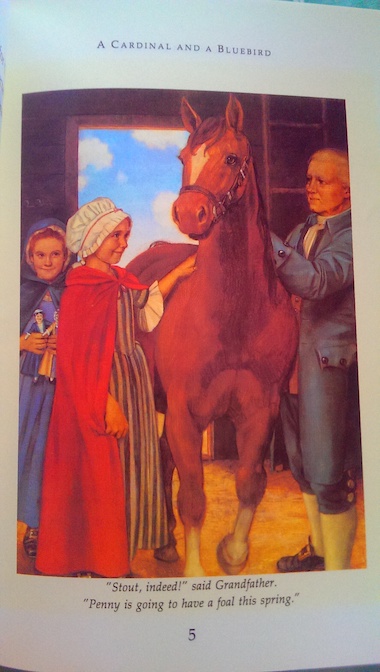
Everything is changing for Felicity. To begin with, her horse, Penny, is expecting a foal. Penny has been happy and healthy since she came to live with the Merrimans, but Felicity worries about what will happen when Jiggy Nye, her abusive former owner, gets out of prison. He has been in jail for not paying his debts. Felicity learns that he was once a respected member of the community and an expert with animals, but he became an alcoholic after his wife’s death. However, Felicity can’t bring herself to feel sorry for Nye after the way he’s behaved, even when she learns that he is sick. Felicity’s friend, Elizabeth, convinces her that they should send him some medicine and other supplies in prison, partly to have pity on him and partly so that he will feel grateful to Felicity when he gets out and not make trouble for her.

FelicityChangesGrandfatherSickUnfortunately, Elizabeth’s father also soon ends up in prison. Tensions between Patriots and Loyalists are high. The former governor has fled Williamsburg, and Patriots are arresting Loyalists. That Mr. Cole is a Loyalist has been well-known for some time. Felicity fears for Elizabeth and wonders what will happen to their friendship.

Then, Felicity’s grandfather also becomes ill. He soon dies of his illness, devastating her family, but before his death, he takes steps to make things better for Elizabeth’s family, Jiggy Nye, and his own family, especially Felicity. In return for Felicity’s charitable gift and her grandfather’s honorable payment for the horse, Jiggy Nye also helps Felicity and Penny when they need him the most, redeeming himself in everyone’s eyes.

FelicityChangesMotherWith the war everyone has dreaded finally becoming reality, there are still more changes yet to come. Elizabeth’s father must leave Williamsburg, Felicity’s father decides how he will support the war effort, and Felicity begins to play more of a role in the running of her father’s shop, as she had wished to do before.
In the midst of Felicity’s grief over her grandfather’s death and worries about the coming changes in all of their lives, her mother has some poignant thoughts about the nature of death and change. While Felicity wishes that it were summer again, back when her grandfather was alive and they were all happy, her mother says that not all changes are bad ones. As she points out to Felicity, even though it might be tempting for her to wish that she were a child again herself, when both of her parents were still alive, to go back to that time would mean giving up her life with her husband and her children. She loves her children and enjoys seeing them grow up and change.  The ability to witness those happy changes is worth dealing with the less happy changes in life as well.  Death, like change, is just another part of life, and Felicity’s mother points out that love still connects us to those we’ve lost.  Like everyone else, the only way Felicity can move in her life is forward, and that’s a good thing. Felicity still has growing up to do and happier changes yet to come.

In the back of the book, there is a section of historical information about the Revolutionary War.

The book is currently available online through Internet Archive.

Felicity’s Surprise

American Girls

FelicityChristmas

Felicity’s Surprise by Valerie Tripp, 1991.

FelicityChristmasBenProtestThis is part of the Felicity, An American Girl series.

Christmas is coming, and Felicity is excited. She and Miss Manderly’s other students, Elizabeth Cole and her older sister, Annabelle, have all been invited to the Christmas party at the Governor’s palace! Miss Manderly is a friend of the dancing master who has been giving the governor’s children dancing lessons, so she was able to get invitations for her students. There will be a special dance lesson for all the children who come. With food, music, and dancing at the party, Felicity and Elizabeth are looking forward to dressing up like grown-up ladies going to a ball.

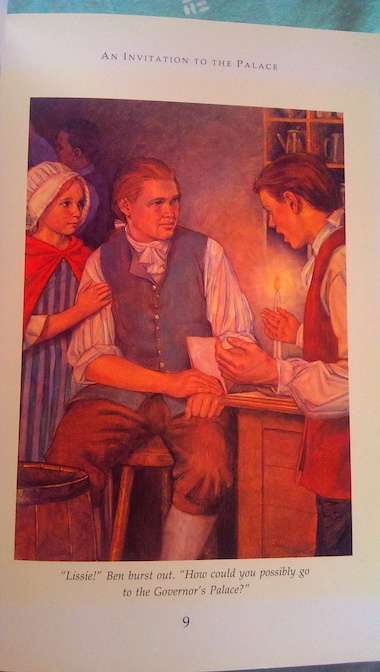
However, Ben, her father’s apprentice is against the idea of Felicity going because the Governor sides with the King and the Loyalists against the Patriots. He can’t understand why Felicity would want to attend a party with people who have treated the colonists so badly and have even boycotted her father’s store because he refuses to sell the taxed tea. However, Felicity’s father understands that the invitation was meant kindly and that it would be a special event for Felicity, so he tells her that she can go if she likes. Christmas should be a time for peace and enjoyment.

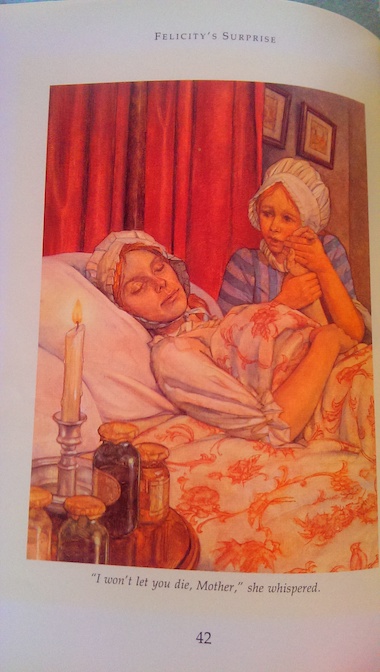
FelicityChristmasMotherIllAt Miss Manderly’s the girls start having dancing lessons, and Felicity wishes for a new gown, like the one on the elegant doll at the milliner’s shop. Since Felicity is usually not very interested in clothes, her mother decides to grant her wish.

When Felicity’s mother falls ill, not only do Felicity’s Christmas dreams seem dashed, but she worries about whether her mother will recover from her illness. Everything that Felicity was concerned about before, the dress, the dancing, the party, all suddenly seems unimportant and silly in the face of something more serious. However, miracles come to those who work for them, and Felicity receives some unexpected help from friends.

There is a section in the back with historical information about how Christmas was celebrated in Colonial America.

The book is currently available online through Internet Archive.

Happy Birthday, Felicity!

American Girls

FelicityBirthday

Happy Birthday, Felicity! by Valerie Tripp, 1992.

FelicityBirthdayGuitarThis is part of the Felicity, An American Girl series.

It’s Felicity’s birthday, and her grandfather has given her a very special present: a guitar that once belonged to her grandmother, who is now dead. Felicity’s grandfather has heard Felicity singing and thinks that she shares her grandmother’s gift for music. He also thinks that Felicity is old enough to take proper care of the instrument, stressing the need for her to be responsible with it. Her mother tells her that she should keep the guitar safely in the parlor since she isn’t quite old enough for proper music lessons, like the ones Miss Manderly is giving Elizabeth’s older sister, Annabelle. Annabelle has been getting on Elizabeth and Felicity’s nerves by bragging about how they are still to young to even hold her guitar, although Annabelle really has no musical talent and struggles in her lessons.

Although Felicity knows that she should leave the guitar at home, she can’t resist taking it to Miss Manderly’s so that Miss Manderly can tune it for her and so that she can show it off to Elizabeth and Annabelle. Miss Manderly does tune the guitar for her and compliments her on owning such a fine instrument.

FelicityBirthdayGunpowderHowever, on the way home, something frightening happens. Felicity sees Elizabeth’s father, a known Loyalist, talking to a British soldier. She ducks into a bush so they won’t see her, and she hears them talking about the governor removing the gunpowder from the Williamsburg arsenal so the colonists can’t use it in the rebellion that has been threatening to come for some time.
Felicity hurries home to tell her family what she has heard, but when her mother and grandfather see that she has taken the guitar out of the house and gotten it wet and dirty while she was hiding, they refuse to listen to her. Her grandfather, also a Loyalist, particularly thinks that she’s making up stories to cover her irresponsibility about the guitar.

But, Felicity knows what she heard, and the situation is serious. What can she do to prove it to everyone?

In the back of the book, there is a section with historical information about how children were raised in Colonial America.  Another good book on the same topic is Going to School in 1776.

The book is currently available online through Internet Archive.

Felicity Saves the Day

American Girls

FelicitySummer

Felicity Saves the Day by Valerie Tripp, 1992.

This is part of the Felicity, An American Girl series.

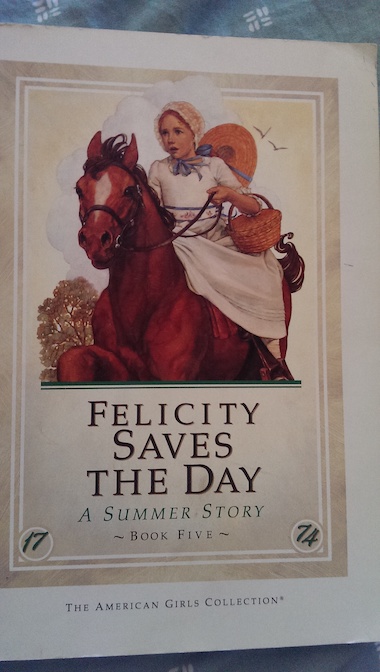
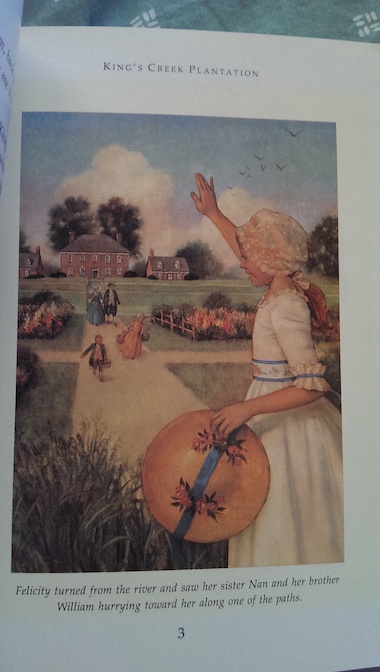
FelicitySummerPlantationFelicity’s grandfather is a wealthy man who owns the Kings Cross Plantation.  Every summer, Felicity and her family go to visit him there, and Felicity loves it.  Her grandfather teaches her a lot of things, like which plants can be used for food and medicine, and takes her for horse rides around his estate.

This year, while Felicity’s father and his apprentice Ben are minding the store at home,  Felicity has a special surprise.  As her grandfather inspects a group of horses that a friend wants to sell him, Felicity is stunned to recognize Penny, the horse she freed from an abusive owner in the first book of the series.  Penny is a little thin and dirty but otherwise well, to Felicity’s relief!  Her grandfather purchases Penny for Felicity and promises to keep her safely at his plantation so that Felicity can visit her and ride her regularly.

Felicity is happier than she’s been in a long time and writes an enthusiastic letter home to tell her father and Ben, but soon, she learns that Ben is not at home with her father.  Felicity and her siblings have set up a bird bottle, a special bottle that acts like a bird house for birds to nest in, and she checks it daily to see if there are any birds to show to her little brother.  One day, she finds a message in the bottle from Ben, pleading for help, along with a map to a place in the woods and Ben’s whistle.  When Felicity goes to the spot in the woods and blows the whistle, Ben comes out of hiding.

FelicitySummerBountyHuntersBen tells Felicity that he ran away from his apprenticeship to join the revolutionary army.  He wants badly to fight for the colonies’ freedom from England, but he had a bad fall while traveling and hurt his leg.  Felicity tries to convince Ben to let her get help for him and to return to her father to finish his apprenticeship, but Ben doesn’t want Felicity’s grandfather to find out that he’s there or why he ran away because he knows that he disapproves of the revolutionaries.  Because Ben kept her secret when she used to sneak out to see Penny, Felicity reluctantly agrees to keep Ben’s presence a secret for awhile, sneaking him some food and supplies.  She tells Ben that, while she thinks that standing up for what he believes is good, he’s going about it in the wrong way because breaking his apprenticeship was dishonest.

Then, Felicity learns that her father has placed an advertisement in the newspaper with a reward for anyone who can find Ben, and some rough-looking bounty hunters show up at the plantation to inquire about it.  Felicity knows that she must try to convince Ben to return on his own before he gets hurt worse than he already has!

A large part of the Felicity books is about taking responsibility and whether or not it’s right to break rules in the name of a good cause.  Felicity herself broke the rules to befriend Penny and later free her from a master who would probably have killed her.  This story raises the question of whether Ben’s form of rule-breaking is similar to what Felicity did or not.  Their situations and the reasons for their rule-breaking are different.  In her situation, Felicity had tried to behave as lawfully as she could until it became apparent that the only way to save Penny’s life was through rule-breaking.  In Ben’s situation, although he wants to help what he sees as a good cause, his rule-breaking isn’t strictly necessary, and he never tried to discuss his feelings with Felicity’s father and to work out an arrangement before running away because he thought that he already knew what Mr. Merriman would say.  Felicity points these things out to Ben, along with the fact that Ben is not in any real position to help the cause that he supports because he is injured, wanted, and in hiding.  He started on this venture ill-prepared and inconsiderate of the other people who depend on him back home and his own future, and while his belief in the revolutionary cause is genuine, he is also afraid of admitting his mistakes and needs to be urged to make things right.

In the back of the book, there is a section that talks about what people in Colonial America would do during summertime.  The weather in Virginia is hot and humid during the summer, and not everyone would get a chance to travel to the countryside, like Felicity’s family did.  The book talks about various ways colonists would use to cope with heat (keeping the kitchen with its fire separate from the house, eating in an open breezeway in the house, wearing lighter clothes, boys would go swimming although girls didn’t, etc.).  It also talks about life on Virginia plantations, including slavery.

Felicity Learns a Lesson

American Girls

FelicityLesson

Felicity Learns a Lesson by Valerie Tripp, 1991.

FelicityLessonGirlsThis is the second book in the Felicity, An American Girl series.

So far, Felicity has mainly been taught at home, learning to read and write and take care of basic household tasks, like cooking and sewing, from her mother.  However, Felicity’s parents have decided that it’s time for her to begin furthering her education.  Felicity fantasizes about studying Greek, Latin, and geography, like boys do in college, but girls of her time do not receive that kind of education.  Some girls take on apprenticeships, learning professions such as seamstress, which Felicity thinks might be exciting, but her father is a wealthy merchant, which means that Felicity will be educated as a gentlewoman, not as a girl preparing herself for a trade.  A gentlewoman’s education involves lessons in penmanship, fine stitchery, dancing, manners, and hostess skills.  Felicity doesn’t find that prospect as exciting.

Felicity starts taking lessons from Miss Manderly, a respected gentlewoman, in manners and the practical arts that girls from well-off families of her era were expected to know. Two other girls, a pair of sisters who have recently arrived from England, are also taking lessons from Miss Manderly, and at first, Felicity worries that they will know more than she does.  However, they are also young and have lessons of their own to learn.  The younger of the sisters, Elizabeth, becomes Felicity’s best friend.  However, Annabelle, the older girl, is disapproving.  She misses her old life in England and doesn’t think that anything in the colonies is good.

FelicityLessonAnnabelleThen, Felicity’s father declares that because of the tax on tea, he will no longer carry it in his shop. It leaves Felicity feeling conflicted about Miss Manderly’s lessons, which include the proper way to serve tea. She has started enjoying the lessons and doesn’t want to lose Elizabeth’s friendship, but she wants to support her father, too. Then, Annabelle criticizes Felicity for what her father said at one of the lessons, prompting Felicity to storm out angrily. She is doubly angry and hurt that Elizabeth didn’t try to defend her, making her doubt Elizabeth’s friendship.

At first, Felicity thinks that there is no way she can return to the lessons, but her mother convinces her that if there’s something that she really cares about (the lessons, Elizabeth’s friendship, supporting her father, etc.) she will find a way to work through the conflict rather than give up on it.  She also points out that some people aren’t as brave as others and find it more difficult to speak their minds and that Felicity should give Elizabeth another chance at friendship.  In the end, Felicity works out a compromise for her lessons using what Miss Manderly has already taught her, and Elizabeth finally finds the courage to tell Annabelle how she really feels about her behavior and the way she treats both herself and Felicity.

Each of the girls in the American Girls stories has her own personality, including strengths and weaknesses. Felicity is a spirited girl, but at first, she has a tendency to be too impatient and impulsive. Part of what she learns is the need take responsibility for her choices and to think things through before she acts.  Elizabeth, who is shy and easily intimidated by her older sister, learns that nothing will improve until she makes her true feelings known and that she has as much right as anyone else to be treated with respect.  Annabelle is a rather self-centered individual and is genuinely surprised when Elizabeth finally stands up to her.  In some ways, Annabelle is unfortunate because she does not find a friend at Miss Manderly’s like her sister does, but readers will recognize that Annabelle’s lack of friends is partly her own fault because she is deliberately antagonistic and does not try to earn Felicity’s friendship.

In the back of the book, there is a section that explains more about how children were educated in the American colonies around the time of the Revolutionary War.  Other good books on this topic are Going to School in 1776 and Colonial Crafts.

This book is currently available online through Internet Archive.

Meet Felicity

American Girls

MeetFelicity

Meet Felicity by Valerie Tripp, 1991.

MeetFelicityPennyThis is the first book in the Felicity, An American Girl series.

Felicity, or Lissie as her family sometimes call her, is the daughter of a prominent store owner in Williamsburg, Virginia in 1774.  Sometimes, her father allows her to help in the shop, which is something that she enjoys.  However, that has happened less since her father took on a new apprentice named Ben Davidson.  Ben is fairly quiet and shy, and Felicity is only just getting to know him.  She sometimes envies boys for the more exciting opportunities they have while she has to help with more routine chores, like sewing, at home.

One thing that Felicity loves more than anything else is horses.  One day, she goes with Ben while he makes a delivery to Jiggy Nye, the tanner.  Jiggy Nye has a new horse that he says he won at gambling.  However, Jiggy Nye is cruel to any animal he gets, and Felicity fears for the beautiful horse he now has.  When Felicity tries to see the horse, which she calls Penny because of the color of its coat, Jiggy Nye drives her away.

That the horse is a fine animal and that Jiggy Nye is treating it badly are obvious, but at first, there doesn’t seem to be anything that Felicity can do about it.  Then, Jiggy Nye shouts at the horse one day that it’s worthless because he can’t handle it and that he’d give it to anyone who can ride it.  Taking Jiggy Nye at his word, Felicity sets out to tame Penny.

MeetFelicityRidingEvery morning for about a month, Felicity sneaks out of the house early, dressed in a pair of breeches that she borrowed from Ben without his permission.  She goes to visit Penny and gradually gains her trust.  When Penny finally allows her to ride her, Felicity thinks that she has won ownership of her, but Jiggy Nye accuses her of theft and takes back the horse.  He denies that he ever promised to give her to anyone who could ride her, although Felicity’s younger siblings agree that they heard him say so.
Felicity fears more than ever that Jiggy Nye will kill Penny, but now that she no longer has a chance of getting her from Jiggy Nye for herself, can she find another way to give Penny her freedom?

There is a section in the back of the book that describes life in Colonial America, particularly in Williamsburg, Virginia.  It also mentions the Colonial Williamsburg living history museum.  Another book about life in Colonial Williamsburg, with photographs from the living history museum, is Mary Geddy’s Day.

This book is currently available online through Internet Archive.

The Secret is Out

SecretIsOut

The Secret is Out: True Spy Stories by Teri Martini, 1990.

This is a non-fiction book about famous spies in history.  It begins with a discussion of spies in general and asks the question of whether spies are heroes or villains.  The answer depends on which side they’re on and which side you’re on.  Spies around the world and throughout history have been engaged in similar work, using similar tactics, although technology has changed the profession in modern times.  Even spies on opposite sides of a conflict use the same skills and tactics, they just employ them for the benefit of different countries or causes.

The book is currently available online through Internet Archive.

The stories contained in the book:

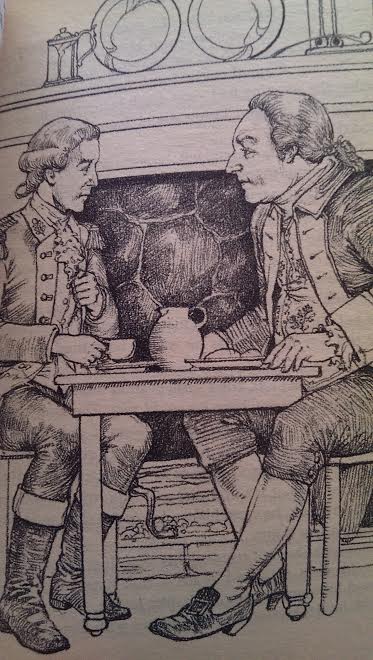
SecretIsOutPic1The Gentleman Spy — This is the story of Captain John Andre and General Benedict Arnold during the American Revolution.  John Andre was a British officer who was executed for his role in helping Benedict Arnold defect to the British side.
Abraham Lincoln’s Personal Spy — The famous Pinkerton detective agency, the first detective agency in the United States, played an important role in the American Civil War.

The Spy with “the Delicate Air” — Spies were not always part of an official organization.  Even a civilian could turn spy in the name of a cause she believed in as Belle Boyd did during the American Civil War.

The Black Chamber — In the early 1900s, agents of the Austro-Hungarian Empire tracked down a mysterious agent in the pay of Russia and discover that the person they were looking for was the man who had once been in charge of their own organization.

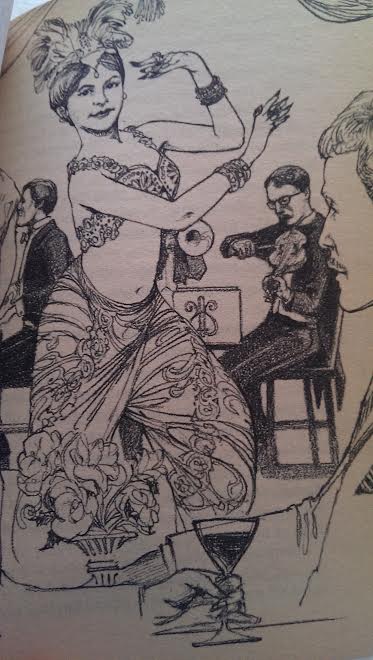
The Eye of the Morning — Mata Hari was one of the most famous spies of all time, although she wasn’t really successful.  It was more her reputation as a dancer and the manner of her death that made her famous.

SecretIsOutPic2The Phantom of the Desert — Lawrence of Arabia was actually Thomas Edward Lawrence, a British army Captain.  He helped the Arabs to fight against the Turks during WWI.

The Spy without a Country — A poor young man from Hungary with a habit of telling tall tales left home to seek his fortune and eventually ended up becoming a Member of Parliament in Britain under the name of Trebitsch Lincoln.  However, when Trebitsch Lincoln was in need of money during WWI, he decided to turn to spying.

Mincemeat Swallowed Whole — This is one of my favorite true spy stories!  During WWII, the British concocted a scheme to give false information to the Germans using a dead body that supposedly was a drowned British marine carrying important documents.

The Clenched Fist — Fritz Kolbe spied for the Allies from within Hitler’s foreign office during WWII.

The Third Man — Harold “Kim” Philby was a spy for British intelligence during the Cold War, but he was secretly working for the Soviet Union.s

The Spy Next Door — Colonel Rudolf Ivanovich Abel was a Russian spy who posed as an ordinary American, Emil Goldfuss, in New York City.  After he was captured, the Americans decided not to execute him, although that was the usual punishment for espionage.  Instead, he was held prisoner until he could be used for the famous prisoner exchange where he was traded to the Russians for the captured U-2 pilot, Francis Gary Powers.

Going to School in 1776

School1776Going to School in 1776 by John J. Loeper, 1973.

“The grass is green,
The rose is red,
Remember me
When I am dead.

Ruth Widmer”

This is a non-fiction book about what it was like for children to go to school around the time of the American Revolution.  The quote that begins the book, a short poem, was written by a real girl from 1776 in her copybook.  The book’s introduction says that it was included to remind readers that, “History is not just facts.  History is people.”  Part of the purpose of the book is to remind people about the lives of ordinary people, of real children, making history come alive in a way that mere recitation of important names and battle dates never can.

The book explains some basic facts about the Americas in 1776 and what led up to the Revolutionary War.  Then, it begins discussing what it was like to be a child at the time in different parts of the American Colonies.  The colonies were largely rural and even major cities were not the size that they are today.  However, there were differences in the ways families lived and the type of education the children received, depending upon where they lived and if they lived in towns or in the countryside.

School1776Pic1These explanations are told in story form, rather than simply explaining listing the ways children could live, learn, and go to school, trying to help readers see their lives through the eyes of the children themselves.  The children’s lives are affected by the war around them.  As the book says, many town schools in New England were closed during the war, so the students would attend “dame schools” instead.  A dame school was a series of lessons taught in private homes by older women in the community.  In other places, such as cities like Philadelphia, official schools were still open.  Discipline was often strict, and school hours could be much longer than those in modern schools.  Sometimes, children would argue with each other over their parents’ positions on the war.
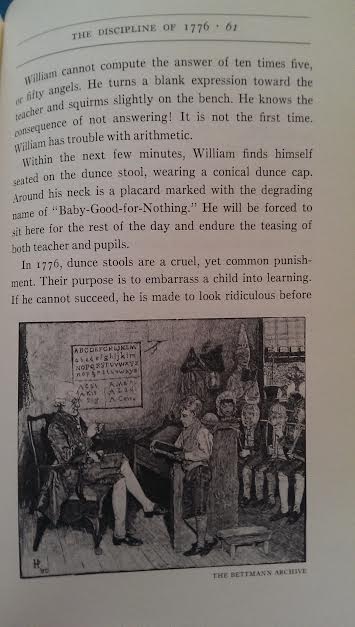
Some schools were similar to modern public schools, open to all children of a certain area and operated by the town fathers.  Others were church schools and included religious lessons.  Families with money were more likely to send their children to school than poorer families, who could not always afford tuition, although public schools would not always charge the students an extra tuition fee because the schools were funded with local taxes.  These systems varied throughout the colonies, and poor children in the South were less likely to be formally educated.  Wealthy plantation owners would open schools for the upper class children, and lower class children might receive lessons in “field schools.”  The field schools were just occasional, informal lessons given to the children in the fields by any adult who happened to be interested in the task.

Teaching in schools was not easy.  Sometimes, teachers were itinerant, moving from one school to another and finding work in agricultural areas between the growing seasons, when children would be free from chores to attend school.  Some teachers were even indentured servants, forced to remain in the employ of a person to whom they were indebted, often because that person paid for their passage from Europe to the Colonies.

School1776Pic2There were different standards for what girls and boys were expected to learn because their learning was guided by what they were each expected to do with their adult lives.  A typical school might teach boys subjects like, “writing, arithmetick [sic], accounting, navigation, algebra, and Latine.”  Generally, “reading, writing, arithmetic, and religion” were common elementary school subjects.  Latin lessons and other advanced subjects were typically for boys who planned to become lawyers or clergymen.  Girls were likely to receive little formal education beyond reading and writing, and black people were less likely to receive even that.

Of course, not every child went to school.  There were other ways for children to learn, depending on what they expected to do with their lives.  Apprenticeships were common.  Boys would go to live in the house of a person with a particular profession and learn that profession from the master.  Aside from basic training for a profession, the master would provide room, board, basic necessities such as clothing, and training in the “three Rs”, which were “reading, ‘riting, and reckoning.”  In return, the apprentice would provide his master with his labor for a period of time.

Girls could also serve apprenticeships, although theirs were more focused on the domestic arts because most of them were expected to marry, and they often married young, about the age of sixteen.  Beyond reading and writing, girls would also learn practical skills such as various kinds of needlework and also music and dancing.  The book describes in some detail the various types of needlework a girl could learn and the materials they used.  Typically, girls would create a “sampler” to show off all the stitches they’d learned, kind of like an apprentice’s master piece or a certificate of completion done in cloth.  Unlike modern “samplers”, these would not be just cross-stitch alone because the idea was for the girl to demonstrate her skill and versatility, and using only one stitch would not impress anyone.  Commonly, the sampler would include the alphabet and the numbers one through ten, which would all be done in cross-stitch (which was the basic embroidery stitch), but there would also be an inspirational quote, message or Bible verse, the girl’s name and the date of the sampler’s completion, and other decorative embellishments, which would be done in other stitches such as tent stitch, eyelet stitch, chain stitch, and French knot.  There could be as many as twenty different types of stitches in a single sampler, depending on the girl’s skill and what she had learned.  Girls hoped to do at least as well as their mothers in terms of the number of stitches they knew and skill in execution.

There are also sections in the book which describe the lessons that children learned, the types of school books they used, discipline in the classroom, ways children liked to have fun, and types of clothing that children wore in 1776.

This book is currently available through Internet Archive.

Trapped in Time

TrappedTimeTrapped in Time by Ruth Chew, 1986.

Audrey (called Andy) and her younger brother Nathan are having a picnic in Prospect Park in Brooklyn, New York, when Nathan falls and knocks over an old tree stump. They spot something shiny in the deep hole under the old stump, and Nathan climbs down to get it.  It turns out to be an old pocket watch, the kind that needs to be wound with a key.  Nathan has a small key in his pocket, made for a toy, and decides to try it on the watch.  He manages to wind it, but suddenly, the hands of the watch move backwards, the children feel strange, and everything around them seems different.  Although it takes the children a little while to realize it, they’ve traveled back in time about 200 years, back to the Revolutionary War.

They meet a boy named Franz and become friends with him.  Franz is a drummer boy for the Hessian soldiers, Germans hired by the British to help them fight against the rebelling colonists.  Franz’s superior orders his men to commandeer food and supplies from the people living in the area.  Franz is supposed to take a family’s cow, but the family desperately beg him not to because they have nothing left and will need the cow to support themselves.  Andy persuades Franz to leave the family and their cow alone.  However, disobeying the order means that Franz will be in trouble with his superior.  He decides that the only thing to do is to desert the army.

TrappedTimePicFranz had only joined the army in the first place because his parents were dead, and he didn’t know what else to do.  Now, he has to find a new place to live, somewhere where there won’t be other Hessians who would recognize him as a deserter.  Andy and Nathan also have problems because they’ve now realized what time they’re in, and they don’t know how to get home.  The watch no longer seems to work.

The children travel together, meeting others who help them and seeing the effects that all of the armies, British, Hessian, and American, have on the ordinary people as the war continues around them.

When they finally find a place where Franz can stay safely and someone he can call family, who can also use Franz’s help, Andy and Nathan realize who the watch really belongs to and how they can return to their own time.

The watch’s real owner is the person I thought it would be, and it took the kids unexpectedly long to realize it.  There is a hint of what happened to Franz when the kids finally return to their own time, but I kind of wished that they learned more about what Franz’s life turned out to be like.  From what the kids see, it seems that things went well for Franz and that he continued living in the house where they left him.

The book is currently available online through Internet Archive.