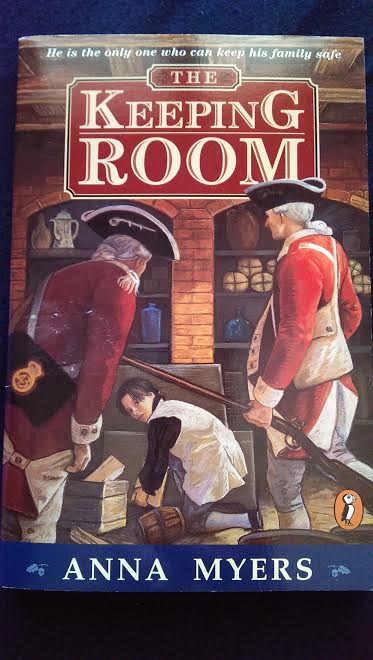
The Keeping Room

KeepingRoomThe Keeping Room by Anna Myers, 1997.

Joey was named after his father, Colonel Joseph Kershaw, a wealthy businessman in Camden, South Carolina during the Revolutionary War.  Joey is like his father in many ways.  He idolizes him and does everything as his father wishes.  When his father marches off to fight on the side of the revolutionaries, he tells twelve-year-old Joey that he must be the man of the house while he is away and look after his mother and the younger children.  Joey takes pride in his new position as man of the house, but he is soon to undergo hardships that will turn him into an older and wiser person.

Joey’s father and his troops lose their battle and are captured by the British.  Soon, the whole town is taken by the British troops, and they commandeer the Kershaw house, the biggest house in town, as their headquarters, keeping Joey and his family as prisoners.  Joey can only watch in helpless anger as the British set up gallows in his family’s garden and hang rebels, his father’s surviving troops.

Joey’s mother was a Quaker before her marriage, and so is Joey’s tutor, Euvan.  They do not believe in the violence of war or harboring hate.  Although Joey seethes with anger at his father’s imprisonment, his family’s captivity in their own home, and the death and destruction he sees around him, they make efforts to remind him that British soldiers are human too, some good, some bad, and not all monsters.  However, how can Joey see the British as anything but monsters when he has seen their cruelty, when he and his family have suffered at their hands, and when he has watched them put many good men to death?

Before the British captured the house, Joey managed to hide away his father’s pistol.  It isn’t enough to fight an army, but Joey knows that he will use it to fight if he gets the chance.

Throughout the story, Joey undergoes a transformation, not just from a boy to a man, but from his father’s little copy into his own person.  From the beginning, Joey identifies himself mainly as his “father’s son.”  He loves his father and truly idolizes him.  He wants to be just like him, and his father is grooming him to take over his businesses one day, to do everything the way he does.  Joey loves how respectful everyone is toward his father, a wealthy and successful man, and how respectfully they treat him when he is with his father.  He hangs on his father’s words and adopts all of his beliefs.  But when his father is gone, things are different.  People who were respectful of him because of his father now regard him as just a boy, a little spoiled and not really knowing or understanding much.

Joey struggles to grow into his new role as man of the house, to really be a man as his father would have wanted.  But along the way, he comes to realize that there are many things that his father didn’t really understand himself and that he was wrong about many things.

Joey’s father didn’t believe in educating women beyond basic reading and writing.  His sister Mary has defied their father’s wishes before by borrowing Joey’s books, and although he didn’t want to tattle on his sister, Joey could never bring himself to support her studies openly because he didn’t want to go against what his father wanted.  However, during their captivity, Joey comes to appreciate his sister Mary’s courage and intelligence.  She gives him great support through their harrowing circumstances. He is proud of her and realizes that she is worthy of the studies she craves.

Similarly, Joey comes to question his father’s beliefs about slavery. Although his father railed against British tyranny, claiming that he would never be a slave to them, he kept slaves of his own.  When Joey had previously questioned him about that, his father told him not to worry about it because it was part of “the order of things.”  But, Joey’s own experiences in captivity make him think differently.  He also comes to appreciate the two slaves who stood by the family to help them through their captivity, learning more about their lives and history.  Because of his experiences, he decides that he will never be a slave owner himself.

Most of all, Joey finally sees the truth of what his mother, Euvan, and even Biddy and Cato (the two slaves who remained with them) tried to tell him about hate and killing when one of the British soldiers gets killed while saving Joey’s life.

As Joey reacts to the frightening circumstances around him, doing what he can to protect his mother and younger siblings, he realizes that he must rely on himself and his own judgement, not his absent father’s, to handle the situation.  In the end, he decides that, although his still loves his father and eagerly waits his return home, he does not really want to be like his father anymore.  He has truly become his own man and is ready to stand up for the man he has become, even though his father may no longer want him to run his businesses.

This book is currently available online through Internet Archive.

Mary Geddy’s Day

MaryGeddyMary Geddy’s Day: A Colonial Girl in Williamsburg by Kate Waters, 1999.

This book is part of a series of historical picture books about Colonial America.

Mary Geddy was a real girl living in Williamsburg in 1776. In this book, she is reenacted by Emily Smith, a young interpreter at the Colonial Williamsburg living history museum. The story follows her through a single day in her life as it would have been typically experienced by girls around the beginning of the American Revolution (lessons, chores, shopping, and visiting with her friend) up until the moment when the vote for independence at the Fifth Virginia Convention was announced.

Mary Geddy’s father was a silversmith, which put them in the middle class for the times.  They had a comfortable house with a shop next door where Mr. Geddy sold his silver work.  The Geddy family also had slaves to take care of household chores.

At the beginning of the story, Mary knows that the Fifth Virginia Convention is voting on the subject of independence from Great Britain.  Mary is concerned about the prospect of war, and she knows that if the vote is for independence, she will probably lose her best friend, Anne.  Anne’s family are loyalists, and her family plans to return to England if the colonies decide to break away.

All through the day, people are speculating and worrying about what is going to happen as they go through the typical routines of their day.  Mary explains the clothing that colonial girls would wear as she gets dressed in the morning.  Then, her mother sends her out to buy eggs at the market.  Although she can see Anne there and hear some of the talk about what’s happening, Mary is kept at home for most of the rest of the day, practicing her sewing, learning to bake a pie with her mother, helping in the garden, and having her music lessons. She is learning to play the spinet.  She envies her brothers, who are allowed to help their father in his shop and therefore able to hear more of the talk than she is.

I particularly liked how they showed the coins that Mary uses when she goes shopping.  Even though Mary’s family lives in an English colony, she’s using pieces of eight, which is Spanish money.  The book doesn’t explain what currency she’s using or why, but that’s why the coins are those little triangular shapes, like little pieces of pie. Let me explain.

First, the American colonies had a currency problem.  They actually had a shortage of English currency because England didn’t want wealth to leave the English economy and go out to the colonies.  One of the measures they took to prevent wealth from leaving England was to make it illegal to export higher-value pieces of currency to the colonies.  People in the colonies needed something to replace the pieces of currency that they didn’t have or had in too short supply, so they resorted to other methods of exchange such as barter, IOUs recorded in ledgers, and currency from other countries.  They had some standard units of exchange for converting different currencies into British money because that was the way people in British colonies thought about money.  One of the most popular coins in use was the old Spanish dollar or piece of eight, which was worth eight reales (unit of Spanish currency).  However, sometimes, people wanted to use a smaller piece of currency for small purchases and transactions (like buying eggs), so they physically cut one coin into eight pie-shaped pieces (hence, “pieces of eight”), each worth only one real.  They had to do the coin cutting very carefully because the value of this type of money was based on the amount of silver in the coins themselves, and if they cut a coin unevenly, it would impact the value of the sections.  Each section of a piece of eight was called a “bit“, and two bits would be worth one-quarter of the value of the original coin, which is why some people in the US refer to a US quarter as “two bits.”  That’s what Mary is holding in her hand in the picture.  For more information, see the YouTube video from Townsends about The History of Money in America.

When they discover that the Convention voted for independence, there is celebrating in the streets, and Mary goes with her parents and brothers to see everything.  Her little sister is afraid of the noise and stays at home with the slaves.  Everyone is excited, but Mary is worried because she knows that her friend will leave and nothing will be the same again.

Throughout the book, you can see that the slaves are always a part of the family’s activities.  They do chores together, and when the family is not doing housework, the slaves are still working in the background.  Having slaves didn’t mean that the family never had to do any chores themselves, but they had to do less of them, giving them more time for other things, like music lessons and visiting with friends.  When the celebrating starts, the boy slave, Christopher, who is about the age of the Geddy children, wants to go and see what is happening himself, but he has to stay and help look after the younger girl in the family.  Although the slaves live as part of the household and seem to be on friendly terms with the Geddys (Mary speaks of them fondly, wishing that Christopher could join in the celebration and is happy that Grace, the slave who mainly works in the kitchen as the cook, seems proud of her for learning to make a pie), they have no say in making decisions and are expected to follow the orders they are given, even when they don’t want to or larger events are taking place.

In the back, there is more historical information about the period and the Geddy family.  There are also instructions for making a lavender sachet like the kind Mary and her friend Anne make and a recipe for apple pie that was used in Colonial Williamsburg, like the one that Mary learns to make in the story.

The book is currently available online through Internet Archive.

Sarah Morton’s Day

sarahmortonSarah Morton’s Day: A Day in the Life of a Pilgrim Girl by Kate Waters, 1989.

This book is part of a series of historical picture books. It features a young girl who was an historical interpreter at Plimoth Plantation, a living history museum, playing the part of a real pilgrim girl who lived in 17th century Plymouth.  The pilgrim girl’s name was Sarah Morton, and she was nine years old in 1627, the year that Plimoth Plantation reenacts.

As Sarah Morton, the girl takes readers through a typical day in her life.  She demonstrates the chores that a pilgrim girl would have to perform.  She explains the clothes that a pilgrim girl would wear and what people ate.  There is a recipe for 17th Century Indian Corn Bread, a simple recipe that readers can make at home, but it warns that modern people wouldn’t think that it tastes very good.  It’s basically just water and cornmeal grits.

sarahmortonpic1Although much of Sarah Morton’s day is taken up with chores, she also discusses her relationship with her mother and her new stepfather.  The death of a parent was something that pilgrim children often experienced.  After her father’s death, Sarah’s mother remarried, and Sarah is concerned about whether her new father likes her.

However, her stepfather is a good man who cares about her.  He gives her lessons in reading and writing, something that not every pilgrim girl would have.  He also gives her a special toy: a knicker box, which is a wooden box with arches for rolling marbles through as a game.  She gets to play with her friend, Elizabeth.

The two girls are also excited about a ship that has been sighted out at sea.  Soon, new people will be coming to their colony, and they wonder if the ship is also carrying letters from England or special goods that they would like, like a new bolt of cloth.

In the back of the book, there are sections explaining a little about the Plimoth Plantation living history museum, the real Sarah Morton, and the girl portraying Sarah Morton, Amelia Poole. The Plimoth Plantation site has more information about the real Sarah’s Morton’s life, including what happened to her when she grew up.  If you’re curious about what Amelia Poole is doing today, she is a fiber artist and lives in Maine.

The book is available to borrow and read for free online through Internet Archive.

sarahmortonpic2