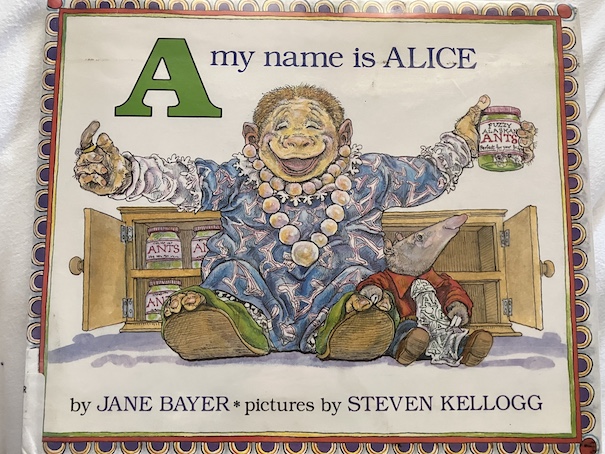
A My Name is Alice by Jane Bayer, pictures by Steven Kellogg, 1984.
I remember this book from when I was a kid! I always liked the pictures in the book, which are by Steven Kellogg, who also did the pictures for The Day Jimmy’s Boa Ate the Wash.
This book isn’t a story. It’s based on a talking game that’s often played on car rides called A My Name is Alice or Alphabet Chant. Like many casual folk games or childhood playground/car games, it goes by different names and has variable rules. In the back of the book, the author, Jane Bayer, says that she learned the game on a playground when she was a child in the 1950s. When she played it, they would bounce a ball while playing. This book was a favorite of mine when I was little because it was the first place I learned about this game.
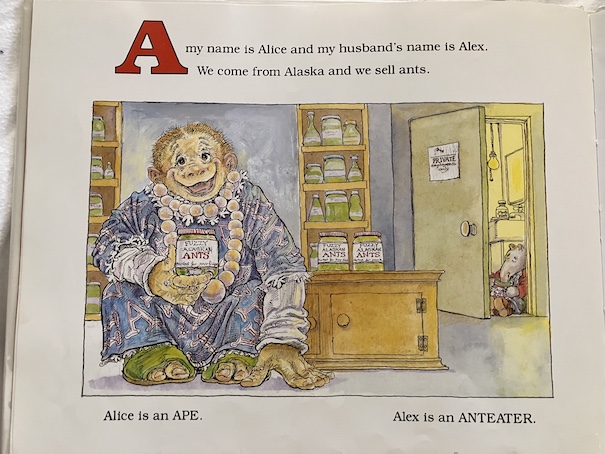
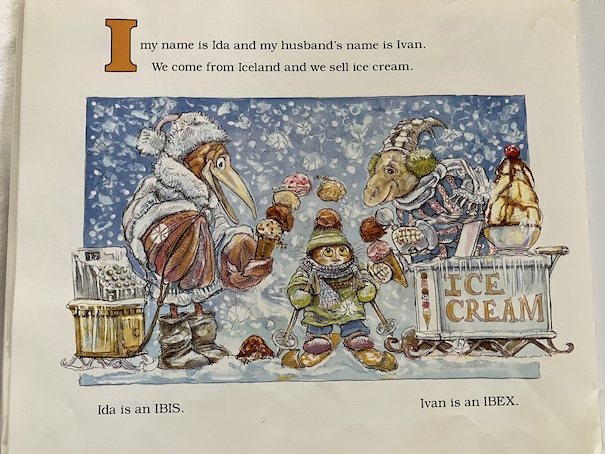
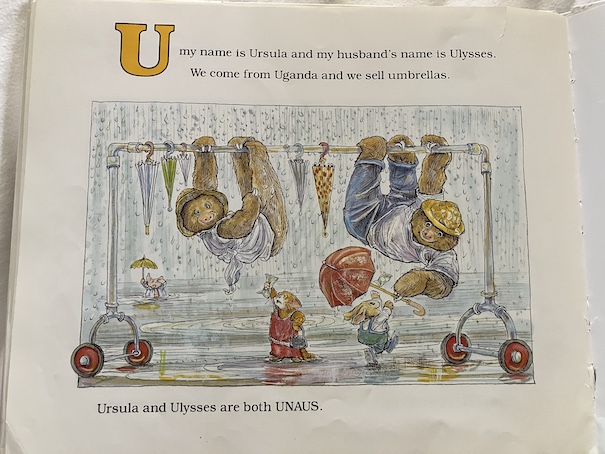
This game is an alphabet game where players have to follow the alphabet, giving the names of people, objects, and places all according to which letter of the alphabet they were currently on, using the following format: “(Letter) my name is (female name) and my husband’s name is (male name). We come from (place name), and we sell (object name).” (Because the rules vary, some people who have played this game with a slightly different format, possibly using the male name first.) First, you give all A names and words in this format, then you do the same for the letter B, then C, and so on to the end of the alphabet. (Or until you reach your destination, get stuck, get bored, etc.)
The fun of the game is that you can be as silly as you want with the names, places, and things to sell. The challenge is that it’s harder to think of names, places, and objects for certain letters than it is for others. Many kids playing this name will use the most common words they can think of first, took keep the game going quickly. However, the author deliberately goes for silly and unusual, which makes the book and the pictures fun and interesting.
She also adds the element that all of the “people” she’s talking about are animals, and the types of animals they are also fits the alphabet theme. It can be difficult to think of animals for certain letters of the alphabet, but again, she goes for the unusual ones. The husband/wife pairs being named aren’t always the same animal, either. When they match, it’s usually because it was too difficult to come up with two different animal names for particular letters. The types of animals are given under each picture.
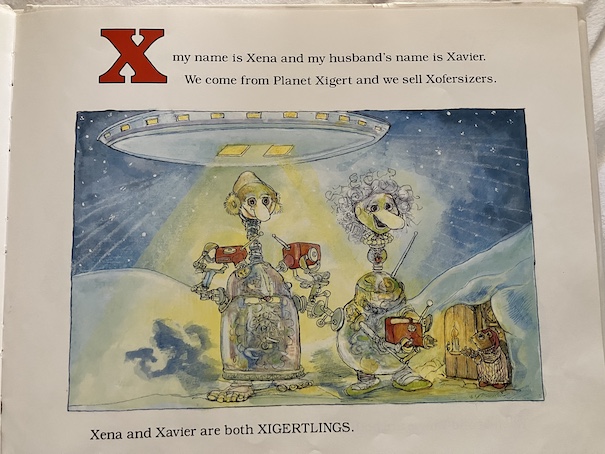
X is always the most difficult letter in an alphabet game because there aren’t many words or names that start with X. However, I liked the way the author dealt with it, just using aliens!
The book is available to borrow and read for free online through Internet Archive.
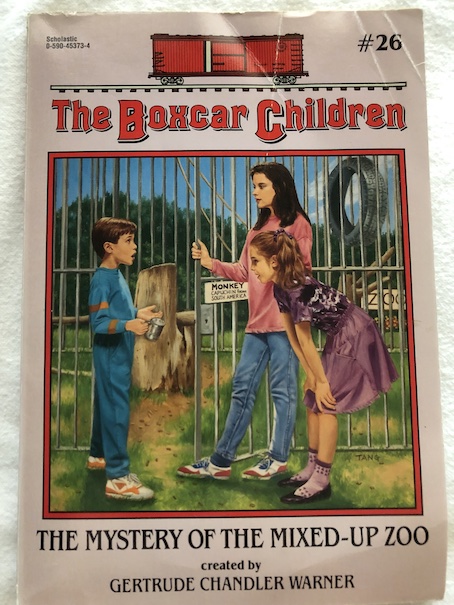
#26 The Mystery of the Mixed-Up Zoo by Gertrude Chandler Warner, 1992.
The Aldens are visiting an old friend of their grandfather’s, who owns a zoo. The friend, Edward, lives alone and isn’t very organized, so the Aldens offer to help him straighten up the house and do some cooking. Edward is pleased with their help and few home-cooked meals. However, strange things start happening at the zoo.
First, someone switches around all the signs identifying the animals, so each sign is next to the wrong animal. It looks like a silly prank, but then more things happen. Then, someone sabotages the electricity, making it difficult to keep and prepare the food for the animals. It gets worse when someone sabotages the temperature controls in the animals’ habitats, making it too hot for some animals and too cold for others. The Aldens help the zoo staff to fix the temperatures because the animals could actually be killed by being kept at the wrong temperature! Finally, someone steals the zoo’s monkey! Who could be behind these things?
The man who owns the local bookstore helps the Aldens find books about animals, but he seems oddly reluctant to talk about the zoo. A local woman, Helen Brooks, thinks that the zoo should be shut down because supporting it costs too much money for taxpayers. She doesn’t care what happens to the animals, and although many local people love the zoo, she plans to bring up the issue at the next town council meeting. When someone tries to sell the monkey to the local pet store, the Aldens start to get the answers they’re looking for.
My Reaction
I thought the mystery was all right, but I had some mixed feelings about the way the villain was handled. We see the villain and get to know the villain’s other role in the story before we know it’s the villains, but I just thought there could have been more build-up about the villain’s connection to the zoo before the person is revealed as the culprit. The attempted sale of the money kind of clinches the identity of the culprit without the Aldens really having to figure out why first.
I did think the book was interesting for the way they explain both how some of the pranks at the zoo are actually seriously dangerous to the animals’ health, like changing the temperatures in their enclosures. It also explains how the Aldens help the zoo employees to help take care of the animals, so the book has some educational quality.
Moonflute by Audrey Wood, illustrated by Don Wood, 1980, 1986.
One night, a little girl named Firen can’t sleep. It’s a hot summer night, the moon is full, and Firen feels like the moon has taken away her sleep, so she must go out into the night and look for it.
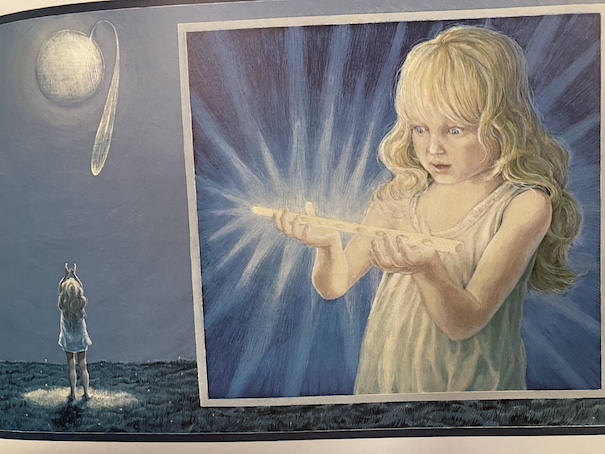
Outside, Firen raises up her hands to the moon and asks for her sleep back. The magical moon sends her a moonbeam, and when Firen touches it, she realizes that it’s solid. It’s actually a flute. When Firen plays the flute, it makes magical music that doesn’t sound like any normal flute, and it brings all sorts of wonderful smells of things that Firen loves. As she continues to play, she feels light and tingly, and she realizes that she is rising into the air!
Firen flies over the countryside, looking for her sleep. As she journeys through the night, she sees various animals and wonders if they have her sleep. She sees cats in a patch of catnip, whales playing in the ocean, and bats and monkeys in a jungle.
When Firen sees a couple of monkeys soothing a baby monkey to sleep, she thinks about her own parents and uses the flute to return home. Is the moonflute helping her find her sleep at home with her parents, or has she actually been asleep all the time?
The book is available to borrow and read for free online through Internet Archive.
My Reaction
This book follows the “It was all a dream” theme, where the main character experiences something fantastic, but they were dreaming all the time. While Firen was wondering where her sleep was, she apparently fell asleep. It isn’t definite that’s what happened, but it’s implied when her parents go to her room, and she’s in bed, without the flute. If readers would like to think of it differently, that Firen really did have her flying adventures, it’s possible to read it that way, too.
The pictures really make this book! The illustrations are oil paintings, and they are beautiful and ethereal. Firen witnesses some stunning scenes, like whales leaping in the ocean, with everything bathed in glowing moonlight.
I was intrigued by the name “Firen” because I don’t think I’ve heard it before, and I like unusual names. I couldn’t find much information about the name online, so it seems like it isn’t very common. I thought at first that it might be a modern, invented name, although one name site says that it has Arabic origins.
Whose Garden Is It? by Mary Ann Hoberman, illustrated by Jane Dyer, 2001.
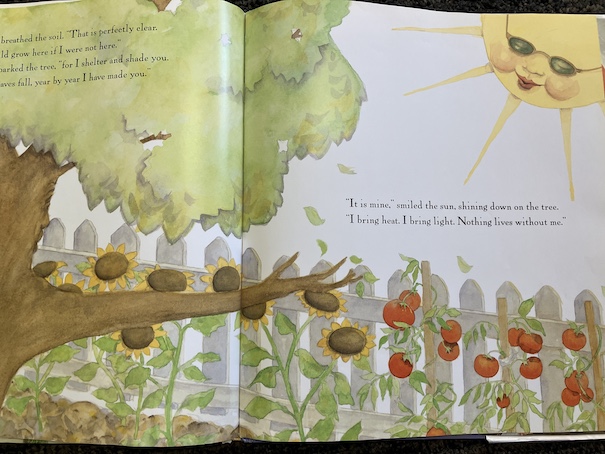
This is a cute picture book, told in rhyme, about who is the real owner of a garden.
One day, Mrs. McGee goes for a walk and passes a beautiful garden. She wonders aloud whose garden it is. Of course, the owner of the garden, who is tending the plants speaks up, but he’s not the only one.
A small rabbit also tells Mrs. McGee that the garden belongs to him because he’s lived there his whole life, and he eats the vegetables. Then, a woodchuck says that’s nothing because he eats everything that grows in the garden. A bird chimes in, saying he eats the worms from the garden. Then, a worm says that worms are there to make the soil in the garden better, so he’s the real owner of the garden.
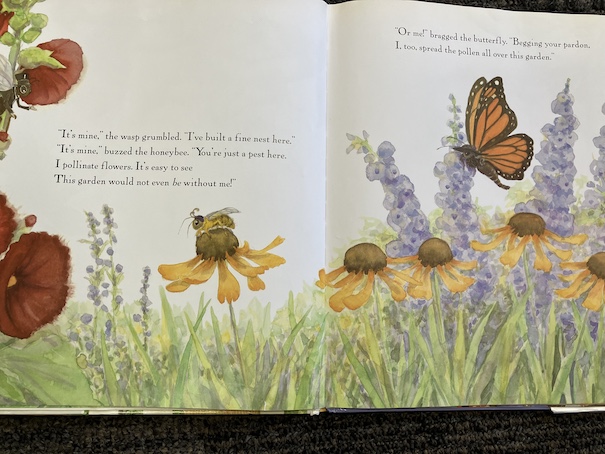
Various other creatures, big and small speak up, each of them pointing out that they live in the garden, what they’ve done for the garden, and what the garden has done for them. The bees and butterflies pollinate the flowers.
But what about the plants in the garden? They have a strong argument that they are what makes the garden a garden. Then again, the soil is where the plants grow, and the plants need the sun and rain to grow. Also, all plants grow from seeds, so the garden exists for the seeds that will be the future plants.
It seems that the answer to Mrs. McGee’s question isn’t as easy as she might have thought.
My Reaction
This is a charming story about how various plants, animals, creatures, and forces of nature are interconnected. The book doesn’t use the word “ecosystem“, but that’s the concept being described here. The garden’s ownership and the reason for its existence is much more than the gardener who owns the land and planted and tended the garden; it’s everything that’s growing in it, everything that contributes to its growth, and everything that depends on the garden. Without all of these creatures and natural forces put together, the garden wouldn’t be what it is.
The book doesn’t attempt to get scientific about the details of this garden ecosystem, and the animals wear clothes and talk, so the story isn’t meant to be entirely realistic. However, it is thought-provoking about how many different parts of nature affect each other. It could be a good book for introducing the topic to young children before teaching them about the science of ecosystems later. The rhyme scheme makes the story fun to read.
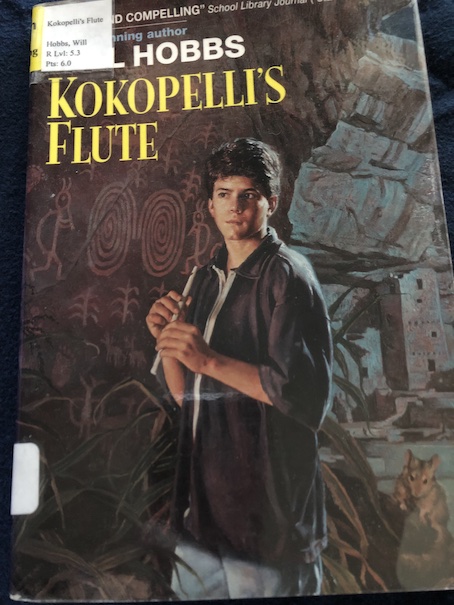
Tepary Jones, called Tep for short, has always been fascinated by the ancient cliff dwelling known as Picture House. One night, he goes there with his dog, Dusty, because he think it would be a great place to watch a lunar eclipse. However, he and Dusty aren’t there alone. Tep witnesses a couple of looters illegally digging for valuable artifacts. The looters uncover the burial of a medicine man and begin taking some of the things he had buried with him. They damage the site before they leave, but Tep discovers that they have left behind an unusual artifact, a small flute made of polished bone. When Tep picks up the flute, he feels compelled to play it. Not wanting to leave the flute behind in case the looters return, Tep takes it home with him.
That night, Tep has a strange dream that he turned into a packrat, like one of the literal packrats he saw up at Picture House. However, he soon realizes that this was not just a dream. Ever since he played the flute, he finds himself turning into the animal he saw the first time he did so. Tep returns the flute to the body of the medicine man and reports the looting to the authorities, hoping that, once the body is respectfully reburied, whatever magic or curse is afflicting him will end. Unfortunately, it doesn’t.
Tep still finds himself turning to the packrat at night, having uncontrollable urges to go out and explore and find food, and it’s dangerous because animal predators and even his own parents are after him. Rodents in the house are a serious concern because they can carry hantavirus, which causes dangerous respiratory infections in humans. After his mother catches sight of him in packrat form, Tep’s parents start setting out traps. His dog, Dusty, seems to know him even when he’s a rodent and helps to protect him, but Tep knows that he’s going to have to stop this transformation somehow, before either his parents catch him or a predator eats him!
Tep’s parents are academics and researchers who study ancient agriculture and cultivate varieties of seeds on their farm that require little water to grow. To buy himself time from his parents’ efforts to catch the packrat, Tep makes the argument that the packrat is a part of the ecosystem and that it might be performing an important role in the environment, like birds that help propagate seeds by eating them and then depositing them in new places. Tep brings up the fact that there are some seeds that really need to be processed in a bird’s digestive system before they can grow. It’s a thoughtful argument, but the looming threat of hantavirus in their community still means concern about the presence of rodents. Hantavirus is serious, even fatal, and people in their community have already fallen victim to it.
Tep returns to Picture House to try to find the flute again to break whatever spell is affecting him, but he can’t find it. He only hears what he thinks is the sound of someone playing the flute, and he’s not sure if he really hears it or if he’s imagining it. Then, a stranger comes to the farm, a man who appears to be a humpbacked Native American or possibly someone from Mexico or Central America. He calls himself Cricket, and Tep’s family thinks that he’s probably just another migrant worker. Tep shows Cricket around the farm and explains the different types of seeds they cultivate and how they can be used to keep particular varieties of plants alive for their drought-resistant or pest-resistant qualities. Cricket doesn’t say much, but he seems to approve of the idea of cultivating more varieties of seeds. When he helps Tepary to plant seeds, Tep notices that he uses a planting stick, like Native Americans traditionally did.
Of course, Cricket is no ordinary farm worker. Tepary notices his unusual ability with plants and animals, and one night, Cricket speaks with Tepary while he’s in his packrat form. Cricket knows more of what’s been happening than anyone because he is one of the legendary figures from Native American folklore known as Kokopelli. Kokopelli was a legendary humpbacked flute player known for bringing seeds to people, and Cricket says that he still visits people like Tep’s family, who are interested in the past, who cultivate the land, and who keep seeds alive. Tep appeals to him for help with his transformations, and Cricket says he will help, if he can, although he notes that Tep seems to have been managing well. Cricket says that Tep can use the flute to reverse his condition, but only if he knows the right notes to play on it. If he plays the wrong notes, he could change into something else and make his condition worse. The clues to the notes are contained in the pictures on the walls of Picture House.
Tep manages to use his animal form to play a trick on Coyote in the tradition of old trickster tales and to rescue his dog from the looters. Then, Tep’s mother contracts hantavirus. Cricket says that ancient people also suffered from the disease, and they used an herb to cure it. Nobody grows that particular herb anymore, but there should still be some contained in the medicine bundle buried with the old medicine man at Picture House. To save his mother and break the spell on him, Tep must return there to find the medicine man’s bundle and the flute.
The book is available to borrow and read for free online through Internet Archive (multiple copies).
My Reaction
I vaguely remember having read this book when I was a kid, around the time when it was first published in the 1990s. It stuck in my mind because it takes place in the Southwestern United States, where I grew up, and it was also the first time that I had heard about hantavirus, which is a serious concern in real life. I couldn’t remember exactly how the book ended, though.
Reading it as an adult, I understand more about the parents’ work and the commentary about interrelated aspects of the ecosystem than I did as a kid. I understood some aspects of environmentalism and ecosystems as a kid because those were topics that we discussed in science classes at school in the 1990s, but admittedly, science wasn’t my best subject, and I’ve had more time to grasp certain concepts since then.
There are agricultural researchers in real life who do what Tep’s parents are doing, trying to cultivate seeds for drought-resistant crops, which are important in places like the area where I live, that are very dry for much of the year, and are becoming even more important due to climate change. That type of research takes time to cultivate generations of plants and to propagate seeds with desirable qualities. Modern researchers also take information and inspiration from past agricultural practices to enhance modern techniques (paleoethnobotany or archaeobotany). When Tep is talking to Cricket, he explains why it’s important to keep growing a different varieties of crops because some varieties are more resistant to different types of problems that others, like drought-resistant crops or pest-resistant crops. One of the dangers of huge, corporate farms is that they produce too few varieties of particular types of crops, focusing on the most popular ones, leaving them vulnerable to being almost completely wiped out by particular disasters. People need to keep growing older and less popular varieties of crops to keep the plant varieties alive and keep producing seeds for new generations so agriculture as a whole will have those varieties to draw on for the plant qualities they need to cope with changes in the environment and/or particular plant diseases.
One of the reasons why I liked this book is that it references the legend of Kokopelli. Because I grew up in the Southwestern United States, I grew up seeing images of Kokopelli along with other Southwestern Native American symbols. Kokopelli is often used as a decorative image in Southwestern art, although not everyone who has or uses the decoration knows the legends behind it. Kokopelli is described in somewhat different ways in different stories, but he is generally a fertility figure who travels from village to village, bringing changes to the seasons and promoting good harvests. He is also a trickster figure and represents human fertility. In some stories, human women get pregnant everywhere he visits, including by Kokopelli himself, an aspect of the character that does not appear in this particular book because it’s not kid-friendly. There is a theory that the legends might be based on traveling Aztec merchants who arrived seasonally, carrying sacks of seeds and other goods to trade on their backs, giving them that hunched appearance.
The book frequently uses the word “Indian” instead of Native American. It seems to be meant in an informal way rather than a disrespectful one, although I found it irritating because it can be a bit confusing. When Tep uses it in relation to the Native American ruins nearby, context tells readers that he means “Native American”, but when he uses it when he talks about places around the world that use the seeds his family produces, it becomes more confusing. At one point, he uses the word “Indian” and then talks about an order his parents have received from Pakistan, so did Tep mean Native Americans or people from India the country in that context? I heard the word “Indian” used a lot in relation to Native Americans when I was growing up, and sometimes, I even have the urge to use it out of old habits, but I don’t really like using that word anymore. It’s not so bad if you say “American Indian”, but just saying “Indian” by itself is often confusing. I generally agree with the modern convention of saying “Native American” or using the name of a specific tribe, if you know the name to use, both because it sounds more respectful and because it really makes a difference in the clarity of the sentence. It’s just not as effective if someone immediately has to ask, “Wait a minute, do you mean ‘American Indian’ or ‘Indian from India’?”, and when it’s in writing, there isn’t even a live person there to ask.
One hot morning, Hilda finishes watering her garden and decides that she needs to rest for a while.
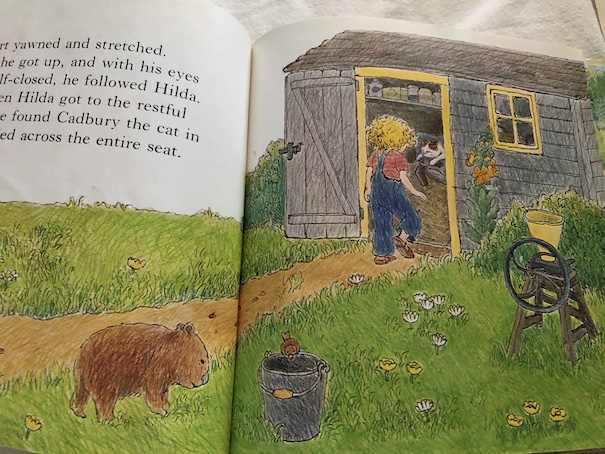
When Hilda needs to rest, she has a special place she likes to go – an old armchair that she keeps in a shed. She calls the chair her “restful chair.”
Hilda is joined in her restful chair by Osbert the wombat and Cadbury the cat. However, Osbert and Cadbury aren’t the only animals who enjoy the restful chair. Soon, a pair of rabbits ask to join the others in the chair.
As Hilda and her animal friends sit in the restful chair, other animals come to join them. As the chair becomes more loaded with animals, it starts to creak and groan.
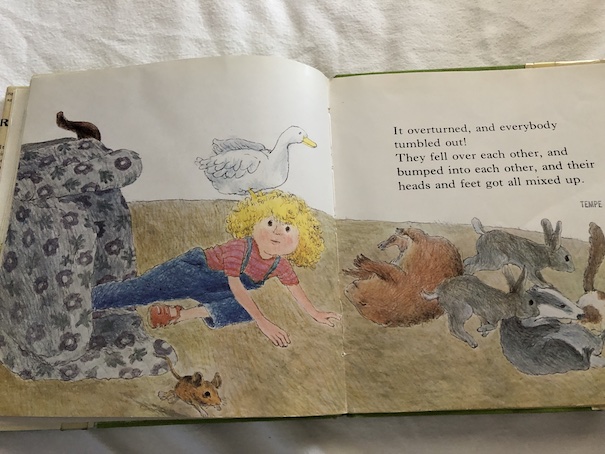
Eventually, the chair just can’t take it anymore, and it falls over, dumping everyone onto the floor.
Still, all the animals decide that they had a good rest. As the animals leave, Hilda sets the chair up again, and she and her animal friends go inside to have some watermelon.
The book is available to borrow and read for free online through Internet Archive.
My Reaction
This is a cute, fun story about animals who enjoy a comfortable chair as much as a little girl. Kids like stories with repetition, and they would probably enjoy seeing the parade of animals who come to join Hilda in her chair. They would probably also see the ending coming, that the chair won’t be able to hold everyone. It’s just a question of which animal is going to be the last straw for the chair. Fortunately, no animals were harmed by this experience, and even the chair seems okay, even though it fell over.
Because there is a wombat in the story, I assumed that the story takes place in Australia. It probably does, but from the publication information, it looks like it was first printed in Great Britain. The author was originally from Israel, but she was living in London at the time the book was published.
The Secret at Sleepaway Camp by Laura Lee Hope (Stratemeyer Syndicate), 1990.
Before I begin, I’d like to acknowledge Sean Hagins, for supplying me with photos of this book! Usually, I take pictures of books myself, but I just couldn’t find a physical copy of this one. Sean is a big fan of the Bobbsey Twins, particularly the New Bobbsey Twins mysteries, and you can see some of his video reviews as well as videos about his photography work on his YouTube channel, SJHFoto. Thanks, Sean!
The Bobbsey Twins are headed to Camp Evergreen this summer! Before they leave for camp, their mother, who is a part-time reporter for the local newspaper tells them that she was just covering a story about a baby polar bear who disappeared from the local zoo. Flossie is upset about it because she’s fond of the polar bear, Snowflake, and likes to see her when she goes to the zoo. Nobody knows exactly how Snowflake got out of her enclosure. All they know is that the gate was found open, and Snowflake was gone. Mrs. Bobbsey recommends that the kids forget about it for now and concentrate on having fun at camp.
Nan and Bert are going to be counselors’ helpers at camp, and all the kids are looking forward to activities like swimming, horseback riding, and archery. The only downside is that Danny Rugg, local bully and troublemaker, will also be there as a counselors’ helper. (Danny is a long-standing nemesis in the Bobbsey Twins series, from the original incarnation of the series. See The Bobbsey Twins of Lakeport.)
Strange things start happening at camp right from the moment that the Bobbsey Twins arrive. Tanya, the head counselor, tells them that, for some reason, all of the camp’s rowboats are leaking. When the kids investigate, they discover that someone has deliberately drilled holes in all of the boats.
The first thought that the Bobbsey Twins have is that Danny is responsible because he has a history of playing mean pranks, although he denies it. Danny does say that he doesn’t see why everyone else at camp should have fun while he’s miserable. His job as a counselors’ helper is working in the kitchen, and he hates it because it’s hot in there, and he thinks the cook is weird.
When Freddie goes to unpack in his cabin, he meets another boy named Ian. Ian is from the city and has never been to the countryside before. He’s a little nervous and homesick, and he says that the camp’s cook has told him that the camp is haunted. Freddie says that he’s sure there’s nothing to worry about and that they’ll have fun at camp.
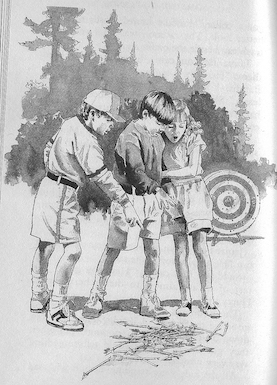
Arts and crafts goes fine, and the kids enjoy meeting the camp’s mascot, a tame raccoon named Bandit. Tanya explains that they found Bandit when he was just a baby and that the kids should never try to play with wild raccoons. However, when the kids arrive at the archery range, they discover that someone has snapped all the arrows in half! Because of the stories the camp cook has been telling everyone, some of the campers think that it’s the work of the camp’s ghost. The Bobbsey Twins still suspect Danny, and they offer their services to Tanya, to investigate and find out who’s really causing all the trouble at camp.
Danny isn’t the only suspect. Nan overhears the cook, Sal, telling the kids about a hungry, child-eating bear in the woods who is supposedly friends with the camp ghost. Does he just like scary stories, or does he have a special reason for wanting to frighten the kids at camp? Even Tanya seems to have something to hide, getting mysterious notes and meeting someone in secret.
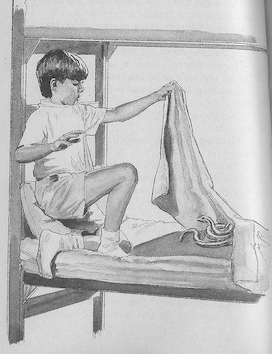
Soon, other strange things happen at camp. Someone puts a snake in Freddie’s bed, and the kids see strange lights in the woods at night. Then, someone steals all the ponies out of the corral and smashes the kids’ clay art projects. Some of the kids think that it’s the work of the ghost Sal has been talking about, but the Bobbsey Twins are sure that someone only wants them to think that. What are all the pranks and sabotage really about?
The book is available to borrow and read for free online through Internet Archive.
My Reaction
I was pretty sure I knew right away who was behind the camp sabotage, but this is one of those stories where there’s more than one person doing things that are unrelated. Danny eventually admits to playing some of the pranks, like the snake in Freddie’s bed, but not all of them. I was also wrong about who the main villain was. The missing polar bear at the beginning does figure into the mystery of the things happening at camp. I figured it would be important, but I didn’t guess how and why.
One of the clues the kids find is a lucky rabbit’s foot keychain. The kids comment that those used to be popular good luck charms, but not many people have them anymore. I have to admit that I had a pink one when I was a kid that I got from a novelty shop. I don’t think I realized at first that it was a real rabbit’s foot. I think I assumed that it was fake because I bought it in a place that sold magic tricks and costume props, so I figured it was imitation, like everything else. I figured it out eventually, and then, I didn’t feel quite so lucky about it. I’m sure that those keychains fell out of popularity because other people felt the same way I did about them, and they were concerned about animal cruelty. I believe it’s still possible to buy real and faux rabbit’s foot keychains, but it’s been a long time since I last saw them displayed at a store, so I think the kids were probably right about them not being as popular as they once were.
The Bobbsey Twins’ Adventure in the Country by Laura Lee Hope,1907, 1961.
Before I explain the plot of this story, I have to explain that this is one of the early Bobbsey Twins books, originally published in the early 20th century, and like other Stratemeyer Syndicate books that were still in print during the mid-20th century, it was revised from its original form to update the language, culture, and technology in the story and, especially, to remove questionable racial terms and caricatures. The physical copy of the book I read as a kid was the revised version, and I didn’t know about the revisions until I was an adult. When I describe the plot at first, I’m talking about the revised version, but I’m also going to explain some of the differences between the original version and the revised version, so you can see what changed.
The two sets of Bobbsey Twins (Nan and Bert are the elder set of twins and Freddie and Flossie are the younger set) are enjoying their summer vacation at home when their mother receives an invitation for the family to visit the children’s aunt and uncle on their farm and to attend an auction that will be held somewhere nearby. The aunt says that there is something that will be sold at the auction that she thinks will interest the family, but the adults are keeping it as a surprise. The children are excited because they like visiting the farm, and they’ve never been to an auction before.
Mr. Bobbsey has to work at his lumber yard, so the children and their mother take the train to the farm ahead of him, accompanied by their cook/housekeeper, Dinah. (Dinah is black and is a recurring character in the series. The book refers to her as “colored.”) The train trip is a bit chaotic because they nearly forgot to bring their packed lunch, and then, Fred’s cat escapes from its carrier and is nearly left behind when they reach their destination. However, they do get there safely.
At the farm, the children enjoy seeing their cousin, Harry, and visiting all the animals. Freddie loses one of the calves when he tries to take it for a walk, like it’s a dog, and at first, the children fear that it fell in the river and drowned. Fortunately, someone from a nearby farm finds the calf and brings it home. These unrelated misadventures are just the beginning of the children’s summer because there is a mystery that seems to be unfolding at the farm.
On their first night at the farm, Flossie wakes up in the middle of the night because she hears someone playing the piano. She wakes Nan, and the two of them go downstairs, but by the time they get there, whoever was playing the piano is gone. At first, the children’s uncle thinks that it was just a dream, but Nan knows that it wasn’t because a piece of sheet music was knocked off the piano. Later, when they hear the piano at night again, there are smudges on the keys.
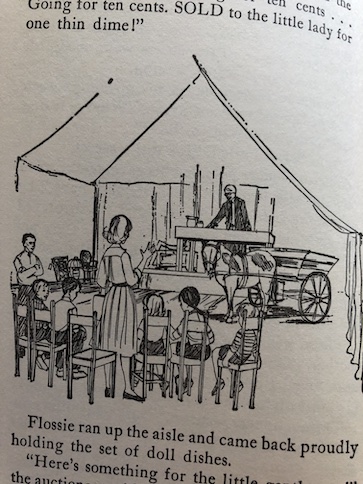
The auction is fun. The children each have a little money to buy something small for themselves, just for the experience of bidding on something at an auction. They all find something to buy, and some of the things they find are funny and eclectic. The mystery object that their mother is there to buy is a pony and cart. A neighbor of the aunt and uncle had a pony and cart that his grandchildren used, but they’ve moved away, and the Bobbseys have decided to buy it for their children. The twins’ aunt and uncle are willing to keep them at their farm because they can’t have a pony in the city, and their cousin can use them when the twins aren’t there. The children love the pony, and they have fun with him and the cart with some other kids. However, when they return to the farm after they auction, they discover that the family’s prize bull has been stolen!
The story is somewhat episodic, but there is a thread of mystery that runs through the whole book as the children try to find the missing bull. There’s a boy from New York City who was lost from a group heading to a nearby Fresh Air Camp (part of a charity that has existed since the 19th century to provide poor city children with enriching summer experiences in the countryside – I referred to it before in another vintage children’s book, Ruth Fielding at Sunrise Farm) who witnessed the theft but didn’t realize that the men he saw didn’t own the bull. There’s a Fourth of July celebration and a picnic with other kids, including a local bully. There is some real danger, where Flossie falls over the edge of a cliff and has to be rescued, and the family has to evacuate the farm temporarily when they fear that a nearby dam might break after a fierce storm. Along the way, the Bobbsey twins gather pieces of information that help them find the missing bull.
The book is available to borrow and read for free online through Internet Archive (multiple copies). The original edition of the book is public domain and available online through Project Gutenberg.
My Reaction
The Mystery
The mysteries in the story are pretty simple. The story is pretty episodic, and the nighttime piano-playing is unrelated to the theft of the bull. The reasons for that are partly related to the way the book was written in the original version. Originally, the book was more of a general collection of stories about how the Bobbsey Twins spend their summer on their aunt and uncle’s farm and have little adventures there, and it wasn’t really a mystery story. One of the features of Stratemeyer Syndicate books is that chapters are always supposed to end on cliffhangers to keep the stories exciting and encourage children to keep reading. That format lends itself well to the mystery genre, which is why some Stratemeyer series that originally started as more general fiction or adventure gradually evolved into mysteries, but some of the early books, like this one, kind of end up being somewhere between mystery and general fiction and read almost like collections of shorter, interrelated stories.
The theft of the bull didn’t occur at all in the original story, but there was a thread through the book about the piano playing at night. In both the new and the old versions, they eventually find out why, but there are different explanations between the versions. In both versions, the nighttime piano player is an animal, not a human.
Original Version vs. Revised
Like other Stratemeyer Syndicate books that were in print in the mid-20th century, the early Bobbsey Twins books were revised and reprinted around the time of the Civil Rights Movement, both to update the technology and slang in the stories and to remove inappropriate racial language. The 1960s edition of the book uses the word “colored” to refer to the housekeeper/cook who works for the Bobbsey family and her husband, which was an acceptable term in the early and mid-20th century (as in The National Association for the Advancement of Colored People, or NAACP), but the word “black” became the common accepted informal, generic term and “African American” became the accepted formal, specific term post-Civil Rights Movement because people were trying to distance themselves from racial words that, while they were not meant to be derogatory, had some emotional baggage attached to them. In the case of this particular book, the changes from the original version to the version I have include making Dinah more intelligent and eliminating the use of stereotypical black people speech. In the original book, even though she’s an adult, Dinah seems childlike in her reactions to things and seems to need the children to explain things to her, like the scale they see at the train station. When she speaks, her speech is spelled out with a strong accent (ex. “dat chile” instead of “that child”), and she throws out phrases like, “Lan’ o’ massy!” In the revised version, she acts and speaks more like the other adults.
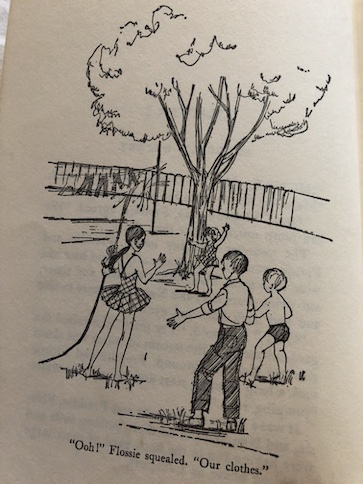
Something else that changed from the original version is how much emphasis there was on poor people vs. upper middle class people, like the Bobbseys. The older version of the story emphasizes more how poor the kid from the Fresh Air Camp is and how charitable the Bobbseys are toward him. There are also other instances of charity toward the poor, like when Nan lends another girl a dress because they need to wear white dresses for the Fourth of July celebration, and the other girl doesn’t have a white dress. The book is careful to mention that nobody else knows that the other girl was borrowing a dress from Nan, with the implication that it would have been embarrassing or a mark of shame for people to know that it was a borrowed dress instead of one of her own. Things like this appear in many vintage children’s books from the 19th century and early 20th century, but it’s not something you find much in modern modern books, at least not described like that. Even when I was a middle-class kid in the late 20th century, it wouldn’t be assumed that a kid would necessarily have certain types of clothes for a special occasion or that their family would be able to just quickly buy something new for one-time use. It was also normal for people to borrow things from friends, even just on whims, so borrowing a dress for one-time use for a special occasion wouldn’t have been regarded as either an act of charity or anything to cause embarrassment, if other people just happened to know about it.
Even though there are things in the stories that were changed to make the stories contemporary with the time of the revisions, the 1960s, there are still aspects of the stories that would be out-of-date culturally by 21st century standards. One of those issues relates to how the adults in the story handle the children. One of the adults in the story tries to resolve the bully situation by letting Bert physically fight the boy who was picking on him, telling both the boys to wrestle with each other to settle their differences and get it all out of their systems. This is not advice that most modern adults would give to kids, and one good reason for not giving that advice is that it doesn’t work, not even in this book. First of all, the kid being bullied might not be the winner of the wrestling match in real life, and no kid should be forced to fight physically just because some bully wants to beat them up. In the book, Bert wins the wrestling match because he’s had wrestling classes before, but as the case would probably be in real life as well, it resolves nothing. The bully is resentful about losing the fight and continues to bully him and play mean tricks on the other kids. The bully episodes are basically there just to add conflict and excitement to the story, and they don’t do much more than that.
I was a little surprised that they left in the part from the original story where the kids put on their own circus, and they have an act they call the “Sacred Calf of India.” In the revised version, Nan wears an improvised sari for this act, and they teach the calf to do a trick. Animals doing cute little tricks are just fine, but adding in the exoticism seems in poor taste. I suppose that they left this part in the revised version because it’s not trying to be insulting to people from India, more that the kids are trying to play on the concept of circus acts and snake charmers, but it is another example of something that you find sometimes in vintage books but wouldn’t be likely to find in modern ones.
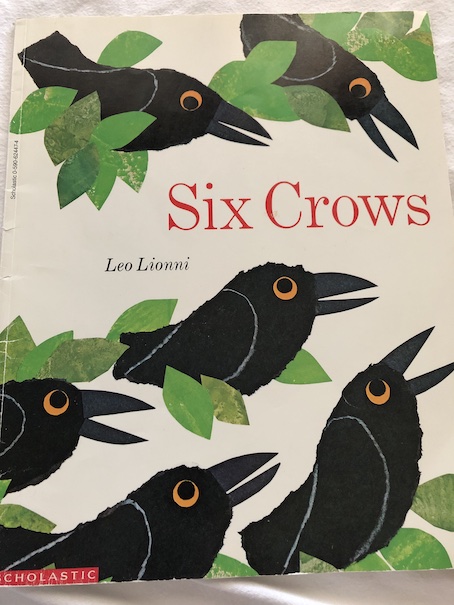
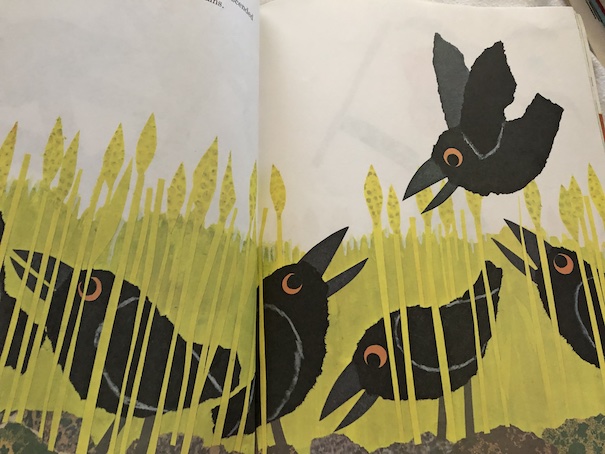
A farmer in the Balabadur Hills (the book doesn’t explicitly say that this story takes place in India, but it’s implied) has a good farm, but he also has a problem with the crows who live nearby. Whenever his wheat is ripe and about ready to harvest, the crows come and eat it.
Chasing the crows away doesn’t work because they always come back. The farmer decides to try building a scarecrow instead. It does frighten the crows, but with an unexpected result.
The crows decide that they must make their own scare-person, a kite that looks like a big, fierce bird, to scare away the scarecrow. When they fly over the field with their scare-person kite, the farmer gets scared and decides that he needs a bigger, scarier scarecrow.
The situation escalates, with the birds building an even bigger and scarier bird kite to scare the farmer.
Meanwhile, an owl who has been watching all of this unfold decides that it’s gone far enough and goes to talk to the farmer and the crows about the situation. The owl persuades both sides to speak to each other and work things out.
When they talk, the farmer and the crows realize that they don’t want to fight with each other. The crows depend on the farmer’s wheat for food, and the farmer realizes that he actually enjoys having the birds around. The owl fixes the mean-looking scarecrow to have a happy and friendly look.
I’m not sure that this is really a traditional fable because the book doesn’t provide any background information on the story and the author isn’t credited as doing a “retelling”, but the story is told in a folktale or fable format about conflict resolution. When the farmer and the crows are feuding, they continually escalate the situation with bigger and scarier “weapons” until the owl convinces them that the only way out of the situation is to talk it out and come to an agreement.
The book is available to borrow and read for free online through Internet Archive (multiple copies).
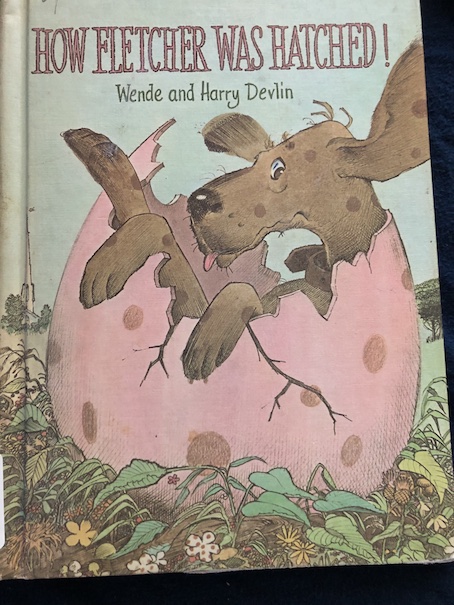
How Fletcher Was Hatched! by Wende and Harry Devlin, 1969.
Fletcher the dog is sad and upset because it seems like his owner, Alexandra, is forgetting about him. She’s been playing with the new baby chicks, which she thinks are cute, and she’s been forgetting to pet her dog or even fill his water bowl!
Distressed, Fletcher goes to see his friends, Beaver and Otter, at the pond. Beaver and Otter don’t have human owners, so they don’t understand Fletcher’s feelings about Alexandra, but they try to think of ways to get her attention. They think it would help if Fletcher could make himself more like the chicks Alexandra has been obsessed with. Aince he can’t make himself small and yellow, they decide that he should hatch out of an egg, like the chicks do. Fletcher is skeptical about this plan, but Beaver and Otter think that hatching out of an egg will be like having a new beginning in his relationship with Alexandra.
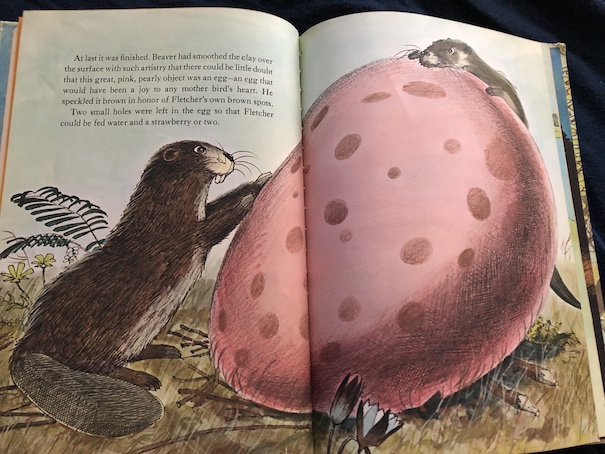
Beaver and Otter build an egg around Fletcher with reeds, grass, and clay from the river, leaving a little hole so they can give Fletcher water and food. When they’re done, it’s a very convincing but giant egg.
By the time they’re finished, it’s night. Fletcher is uncomfortable sleeping in the egg and wonders what Alexandra is doing. Meanwhile, Alexandra is having trouble sleeping because she’s worried about her lost dog.
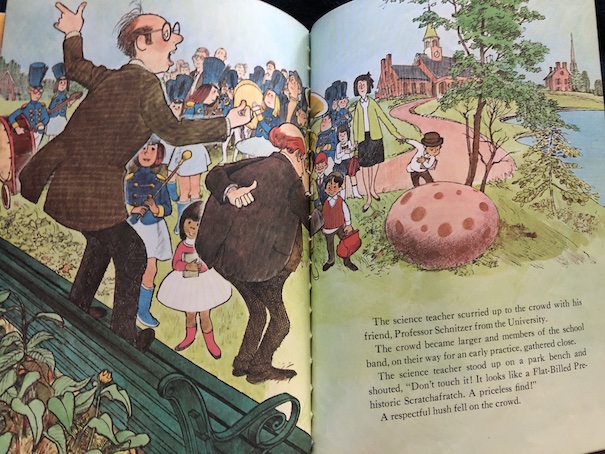
In the morning, Beaver and Otto roll the egg over to Alexandra’s school to make sure that she sees it. The first person who sees the egg, though, is the school’s custodian. He’s shocked at the sight of such a giant egg and starts yelling for the science teacher to come look at it.
Soon, the egg is surrounded by children and adults, marveling over what kind of it could be and where it came from. The science teacher brings a friend who is a university professor, and the two of them are convinced that the egg must belong to a rare creature, although they disagree about the type of creature it is.
Fletcher waits to hatch until he hears Alexandra. Alexandra’s friends are excited about the egg, but she’s just upset and only wants to go looking for her lost dog.
Fletcher decides it’s time to hatch, and he busts his way out of the egg. Alexandra is happy to see him, even though Fletcher’s attempt at peeping is a little weak. Everyone is confused, but Alexandra is just relieved that she has her dog back. Fletcher feels better, realizing that he is important to Alexandra, and she really cares about him, even though he’s not yellow and doesn’t peep.
The book is available to borrow and read for free online through Internet Archive.
My Reaction
I read this book as a kid, but I had forgotten much of the story. I remembered that Fletcher hatched out of an artificial egg and that he did it to get his owner’s attention, but I couldn’t remember why he needed attention. I can understand Alexandra being temporarily distracted by the little chicks on the farm, but forgetting to give her dog water is really bad for a pet owner. I felt like her parents should have noticed and said something. But, mostly, the situation is just set up for the purposes of this humorous hatching of a dog from a giant egg. Because the egg was created by animals, the humans in the story never find out how or why Fletcher got in the egg, which is actually the funniest part for me as an adult.
























 Jestress's Forgotten Books and Stories