The Desert is Theirs

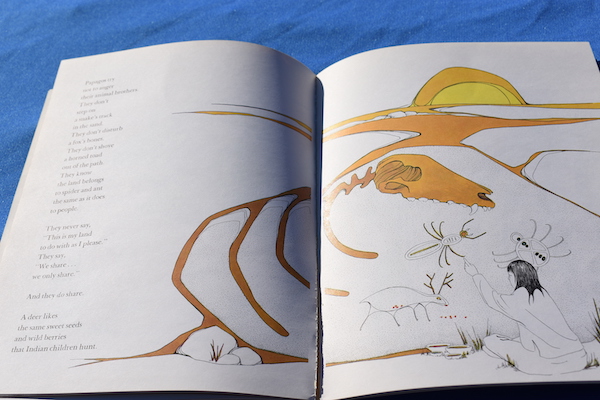
The Desert is Theirs by Byrd Baylor, illustrated by Peter Parnall, 1975.

The story in the book is written in a kind of poetical form, describing what life in the desert is like.  It talks about the kinds of animals that live in the desert and how the plants sometimes have to go without water for months because it doesn’t rain much.

It also describes the Desert People, the Papago Indians (Tohono O’odham – Which literally translates as “Desert People”).  Even though the desert is a harsh environment, the people who have lived there for generations think of it as home and like living there.

The book continues with a Native American creation myth that describes how the Earthmaker made a little plot of dirt and greasewood grew in it – the beginning of the desert.  Then, Coyote scattered seeds to grow cactus, and the Spider People sewed the earth and sky together.  In the creation story, other animals help to form the desert, which earns the respect of the Papago.  The Desert People recognize that they have to share the land with the animals as well as each other.

While the desert can be harsh, it isn’t barren.  In the desert, there are still plants to eat and use as medicine.  People also use grasses for weaving baskets and the soil itself for building homes.

People also learn patience in the desert.  It can take a long time for it rain.  Plants sometimes have to wait for years in order to bloom.  Animals wait for the coolness of night to come out.  People plant their crops very carefully.  But, even though they often have to wait, good things are worth waiting for.

I remember teachers reading this book to us in early elementary school because I grew up in Arizona.  It is a Caldecott Honor Book.

Diary of a Wombat

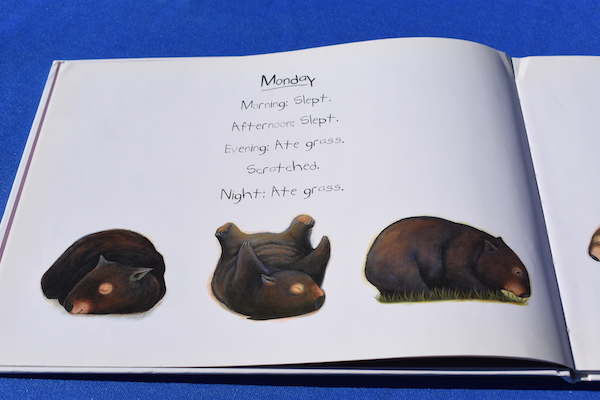
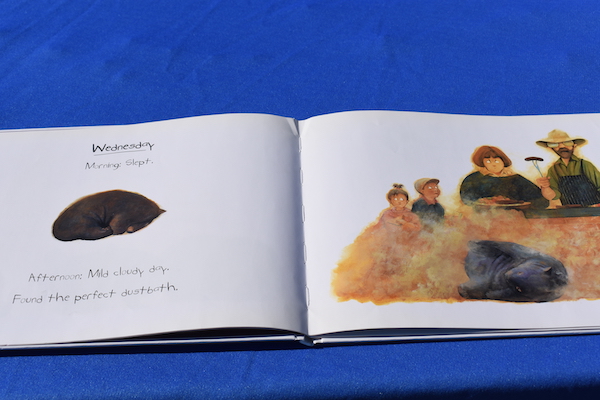
Diary of a Wombat by Jackie French, illustrated by Bruce Whatley, 2002.

This cute picture book is written in the form of a diary written by a wombat.  The early entries are mostly eating and sleeping, typical for an animal. 

It gets funnier when the wombat makes herself at home in someone’s yard.

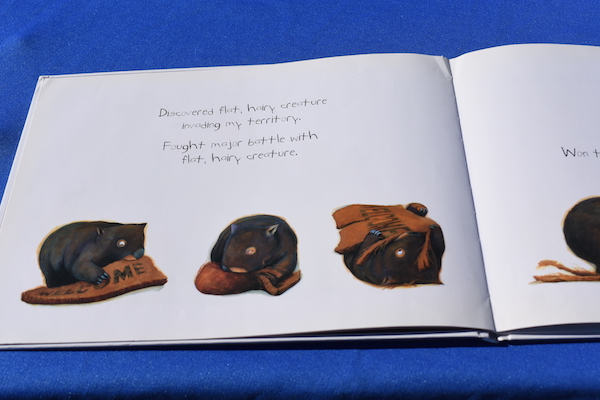
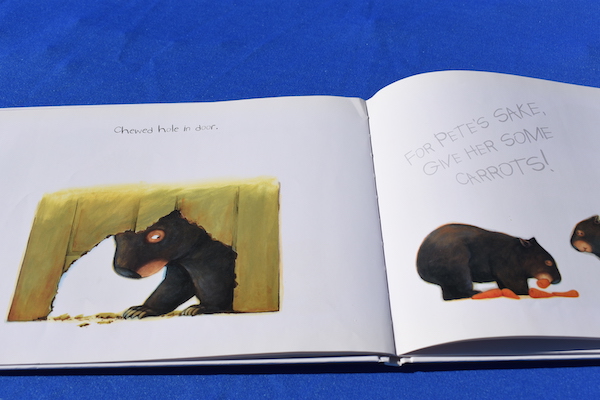
The wombat wins a fight with their doormat and demands food from the humans. They give the wombat a carrot. Big mistake.

Once you feed a wild animal, it comes back for more, and it doesn’t want to take “no” for an answer.

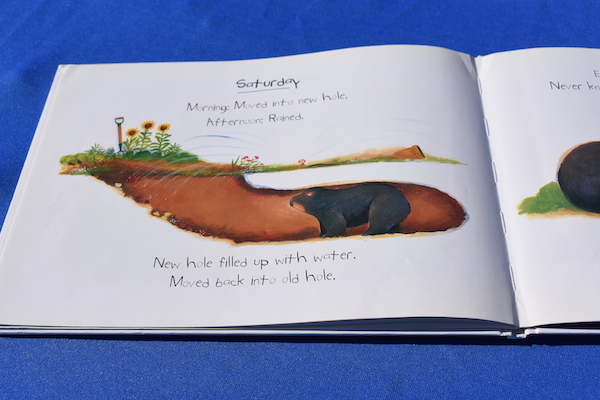
The wombat makes a hole in the humans’ yard but moves out when she doesn’t like their sprinkler.

She also gets tired of the carrots they’ve been feeding her and demands oats instead.

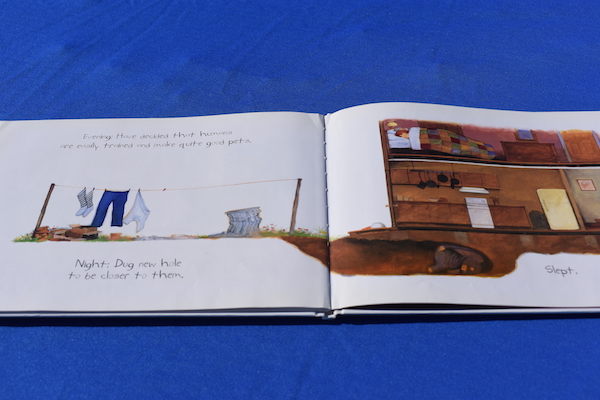
You could say that the humans now have a pet wombat, but the wombat looks at it the other way around.  The wombat is probably right.

This is one of those books where the pictures really make the story.  It’s also a good warning against feeding wild animals! Yet, the wombat is pretty cute . . .

Edward the Emu

Edward the Emu by Sheena Knowles, illustrated by Rod Clement, 1988.

Edward the Emu lives in a zoo, but he finds it boring.  He is so bored that he decides to try living with and acting like the other animals. 

First, he envies the seals who live in the pen next to his and always seem to be swimming and having fun.  So, one night, he jumps out of his pen to join the seals.  The next day, he hangs out with the seals, lying in the sun and balancing a ball on his nose.  It’s much more fun than his boring old pen, but then he overhears a zoo visitor say that the lions are “the best thing to see at the zoo.”

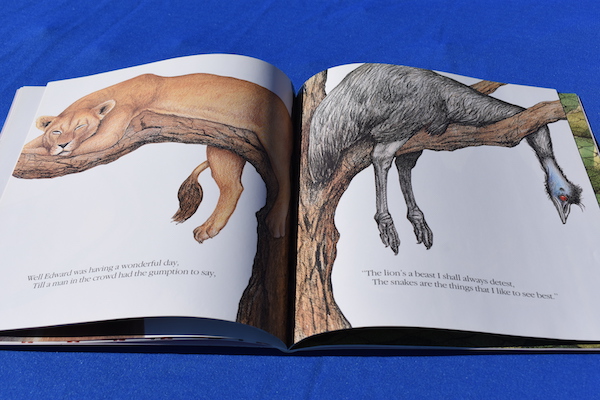
Edward once again switches pens, deciding that he’ll try to be a lion.  He spends the next day growling and snarling while the lions roar.  It’s a lot of fun, but then another visitor comments that he likes snakes the best. 

Once again, Edward switches pens and tries being a snake.  This time, someone comments about great emus are.  Feeling better about himself, Edward decides to return to his own pen. 

However, to Edward’s surprise, there is another emu in his pen, his replacement because he disappeared!  It’s not a problem, though, because the new emu, Edwina, is glad to see him, and Edward is less likely to be bored now that he has a friend.

A friend sent me this cute picture book from Australia.  The story is told in rhyme, and the pictures of Edward trying to be different types of animals are fun.

The Dancing Goat

The Dancing Goat by Bonnie Book, 1966.

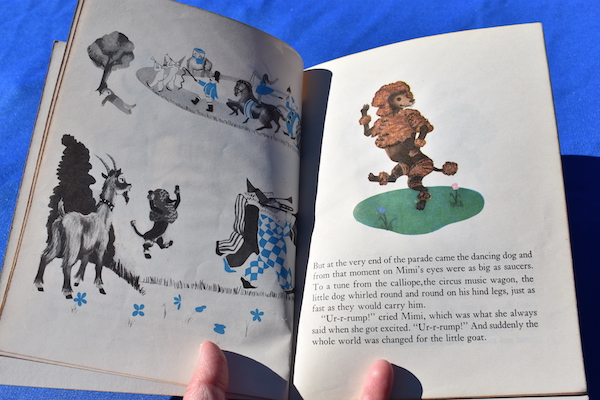
Mimi is a good little goat who lives with a poor farmer and his wife.  They like her and take good care of her, and in return, she provides them with milk that they sell to help make their living.  However, things change for Mimi when she happens to see a circus parade with a dancing dog.  From that moment on, all Mimi wants to do is to dance!

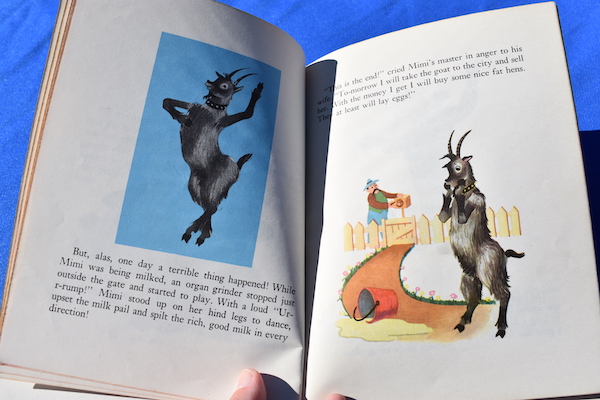
It wouldn’t matter so much except that Mimi develops a bad habit of dancing when the farmer is trying to milk her, spilling the milk.  Eventually, the farmer concludes that he can no longer afford to keep Mimi, even though he and his wife don’t really want to part with her.  Mimi is upset at the thought of losing her home, and when the farmer takes her to the market to sell her, she starts to cry.

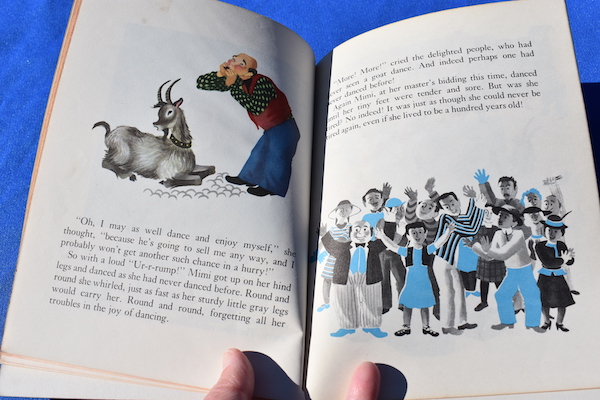
The people at the market don’t want to buy a crying goat and think that something is wrong with Mimi.  To cover up the noise of Mimi crying, the farmer starts to blow a tune on his comb.  Hearing the music, Mimi starts to dance again.

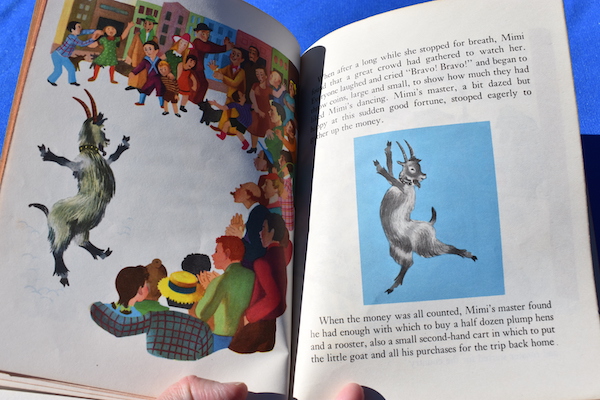
To the farmer’s surprise, everyone in the market loves Mimi the Dancing Goat, and they throw coins.  With the money that Mimi makes with her dancing, the farmer can now only afford to keep her but buy other livestock as well.  From then on, the farmer regularly takes Mimi to the market to show off her dancing and earn some extra money.  He plans to buy another goat to keep Mimi company, and he hopes that the new goat turns out to be a dancer, too!

I usually don’t like “animal almost loses their home” type stories because I always feel too sorry for the poor little animal, but the risk in this story is over pretty quickly, which helps. It also helped that the farmer and his wife genuinely liked Mimi and were only going to part with her reluctantly, so it wasn’t difficult for the farmer to change his mind as soon as Mimi showed that she could bring in money to help earn her keep.

The Large and Growly Bear

The Large and Growly Bear by Gertrude Crampton, 1961.

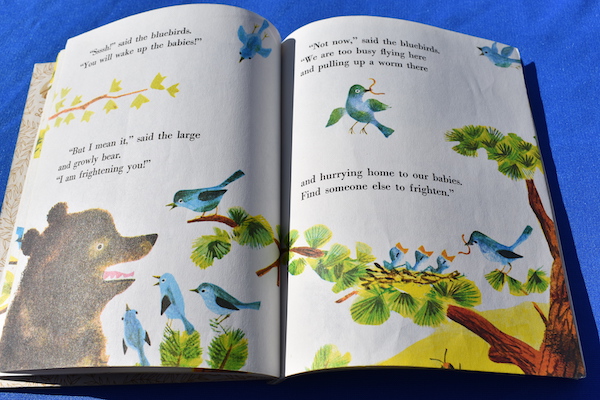
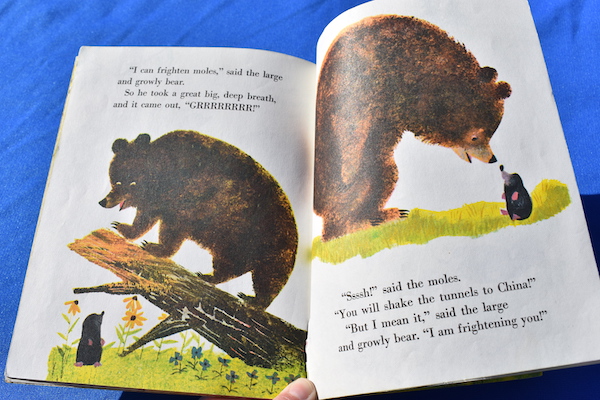
One spring day, a large and growly bear is bored.  What else can a large and growly bear do but find someone to scare with his growling?  But, finding someone to scare proves harder than he thought it would be.

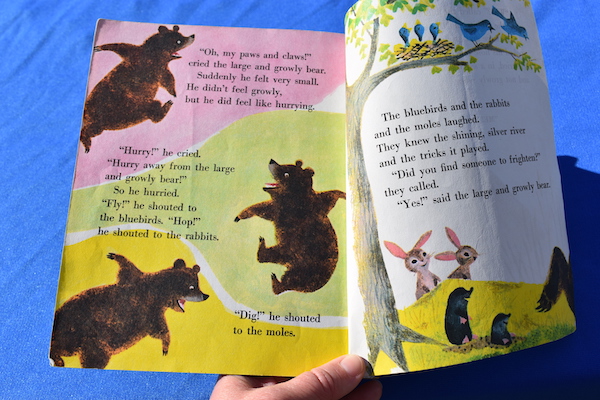
As the bear goes through the forest, trying to scare different types of animals, he discovers that they’re all too busy to be frightened of his growling.  The birds are busy feeding their babies, the rabbits are busy jumping around and counting their bounces, and the moles are busy digging tunnels halfway to China. All of them tell the bear to go find someone else to scare.

Eventually, he gets the idea of trying to scare the fish because fish just swim around and aren’t too busy to be scared, but when he gets to the river, he’s in for a big surprise! The easiest target to scare is . . . himself!

My Reaction

This is just a cute story that my brother really liked as a kid. It has repetition that kids like as the bear repeatedly tries to frighten different types of animals with the same disappointing result, and then a funny twist ending when it turns out the only animal who even has the time to be frightened by the bear is himself.  It’s a Little Golden Book.

Aunt Eater’s Mystery Halloween

AuntEatersHalloween

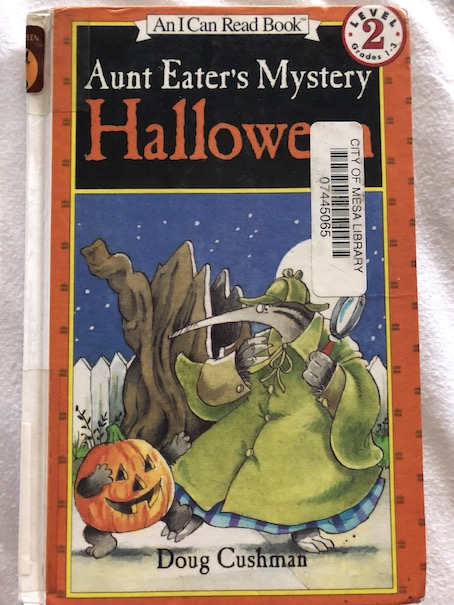
Aunt Eater’s Mystery Halloween by Doug Cushman, 1998.

This is a cute Halloween book for kids.  There are actually four short mystery stories in the book as Aunt Eater, dressed as Sherlock Holmes, goes to a Halloween party and encounters various spooky happenings.

Aunt Eater Sees a Monster

While she’s on her way to the Halloween party, Wally stops Aunt Eater and says that there’s a monster in his kitchen and that it ate his father.  When Aunt Eater takes a look, she sees a scary shadow in the kitchen and hears a terrible groan.  Is it really a monster?

AuntEatersHalloweenKitchenMonster

Aunt Eater Sees a Ghost

Aunt Eater continues walking to the party with Mr. Chumly, who is dressed as a turnip.  Mr. Chumly points out a hollow tree that they pass and tells her that it’s supposed to be haunted by a headless ghost.  Aunt Eater doesn’t believe in ghost, but then a scary jack o’lantern appears, moving by itself, and it’s followed by a ghost with no head!  Fortunately, there is a logical explanation.

AuntEatersHalloweenHeadlessGhost.JPG

Aunt Eater Hears Some Music

Aunt Eater is glad to see all of her friends at the party.  Miss Underbelly has brought her pet snake with her.  Later, the piano suddenly starts playing strange music without anyone sitting at it, and the snake has disappeared!  What do you suppose is happening?

AuntEatersHalloweenPiano

Aunt Eater Dances a Jig

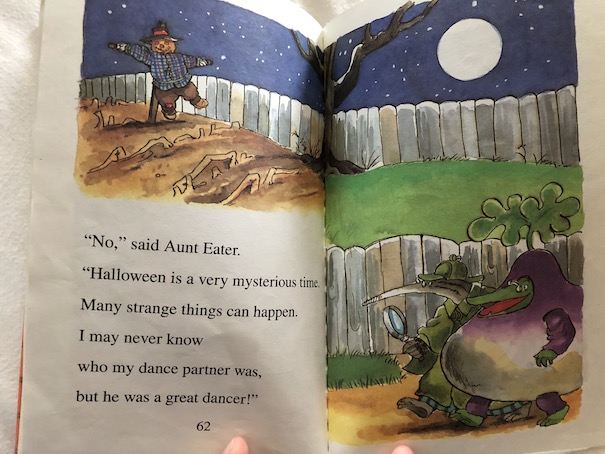
Mr. Fragg, a friend of Aunt Eater’s, is wearing a scarecrow costume, and he tells Aunt Eater that he’d like to dance with her later in the evening.  She does dance with a scarecrow, but then learns that it wasn’t Mr. Fragg because Mr. Fragg hurt his foot.  Who was that mysterious scarecrow?  Aunt Eater never figures it out, but readers do.

AuntEatersHalloweenScarecrow

The book is currently available online through Internet Archive.

The Day Jimmy’s Boa Ate the Wash

JimmysBoa

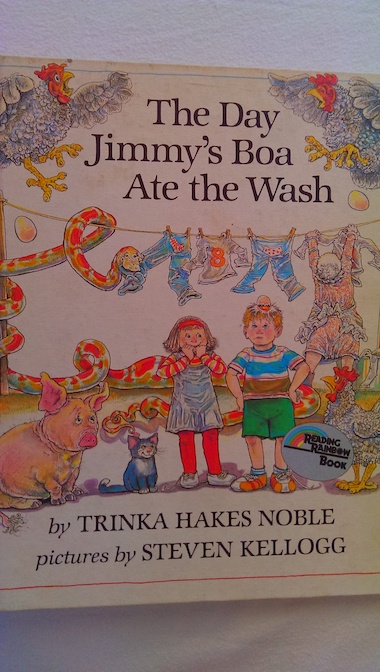
The Day Jimmy’s Boa Ate the Wash by Trinka Hakes Noble, pictures by Steven Kellogg, 1980.

The fun thing about this story is the backward way that the girl begins telling it, somewhat resembling The House that Jack Built, or better yet, the old No News Joke. The joke is really closer to the format of the story, with someone explaining the least eventful thing that happened as though it were the most important when it was just the end result of everything else.

A young girl (unnamed) arrives home, and her mother asks her how she liked her class trip to a farm that day. She says that it was boring until the cow started crying. When the mother asks her why the cow was crying, she says that the farmer wasn’t paying attention to where he was driving his tractor and knocked a haystack over on the cow.

As the mother continues to ask her daughter questions about what happened, backtracking through events, the real story begins to reveal itself:

The girl’s friend, Jimmy, had a pet boa constrictor, and he brought it along on the field trip so it could meet all the farm animals.

JimmysBoaFieldTrip

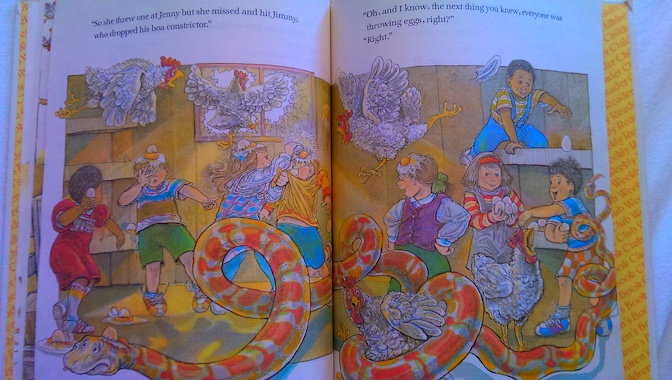
However, the chickens became frightened, and one of them laid an egg on one of their classmates. She thought that someone else threw it at her, so she threw another egg at him, which hit yet another student.

JimmysBoaEggs

From there, it turned into one big food fight, with students throwing eggs at each other, and when they ran out of eggs, they threw corn at each other. The corn was for the pigs to eat, so the pigs wandered onto the school bus and started eating the children’s lunches. From there, chaos ensued until the farmer’s wife suddenly screamed, and the children’s teacher hustled the children onto the school bus to go home.

JimmyBoaLeaving

The children never knew exactly why the farmer’s wife screamed (although the reason is actually in the title to the book), but two things quickly became evident: Jimmy accidentally left his boa constrictor behind on the farm, but he has acquired a pet pig because there was still one left on the bus.

This summary doesn’t quite do the story justice because the backwards way the story starts out is part of the fun. The pictures in the book are hilarious, and the boa constrictor is shown at the end to have become a beloved pet of the farmer and his wife, even making friends with the chickens.

This is a Reading Rainbow Book.  It is currently available online through Internet Archive.

Blair’s Nightmare

BlairsNightmareBlair’s Nightmare by Zilpha Keatley Snyder, 1984.

Now that school has started in the small town of Steven’s Corners, the Stanley family kids are dealing with the problems that kids have, handling teachers, friends, and the local bullies.  David has become the new favorite target of Pete Garvey, the bully in his grade in school. (At one point, he compares managing his time around Garvey to that old riddle about crossing a river where the boatman (a teacher, in this case) can’t leave one of the things he’s transporting alone with the other because one of them will eat the other – David sees himself as the prey and Garvey as the predator. Only, David, the prey, has to be the one to manage the maneuvering because the boatmen/teachers don’t.)  Blair, David’s younger brother, also seems to be suffering from school stress, reverting to an old habit of walking in his sleep at night.  Blair keeps saying that he’s getting up to see a nice dog who visits at night, but everyone thinks that he’s just dreaming while sleepwalking.  David thinks that having a dog actually sounds nice and is hoping that he can somehow convince his dad of that, too.

Mrs. Bowen, Blair’s teacher, isn’t amused by his stories about the dog or some of the other things Blair has been saying at school, like his friend “Harriette”, whom no one else has been able to see but apparently lives in the Stanleys’ house (see The Headless Cupid).  She thinks that Blair is “out of touch with reality,” and that his family should work on teaching him the difference between reality and fantasy.

In the middle of all this, things have been disappearing around Steven’s Corners, and people think that it might be the work of escaped prisoners.  The police have been looking for some escaped prisoners in the area, although they haven’t found anything, and the prisoners might not really be around.  David thinks that the things that have disappeared don’t really sound like the kinds of things that prison escapees would steal.  He thinks it’s more likely that Garvey and his trouble-making friends took them.

Then, David starts hearing that, for some reason, the sheriff’s dog has become afraid of going near the woods.  When they brought him out there to sniff for the escapees, he suddenly smelled something that seemed to make him very afraid, and now he shakes when they try to take him back to the area.  Janie, David’s younger sister, has also become very interested in the story of the escapees and seems to be trying to start her own investigation into the matter.

Part of the story has to do with the differences between perception and reality.  Amanda, David’s stepsister, proves to be an unexpected help in dealing with Garvey, taking it upon herself to punch him in the face when he tries to pick a fight with David.  However, it makes David embarrassed that Amanda feels like she has to stand up for him, and it’s further complicated by the fact that Amanda and Garvey seem to have a mutual crush on each other.  Life is full of mixed emotions, and David begins to discover that people’s personalities are more complicated than he once thought.  Some of Garvey’s bullying and trouble-making is really a bid for attention.  Garvey later admits that he didn’t really have intentions of beating David up; he was mostly hanging around David as an excuse to see Amanda and maybe do something that would get her attention.  However, learning that being mean and threatening isn’t the best way to get the kind of attention he wants from people isn’t a bad lesson.

David also learns that Amanda’s feelings toward him are more complicated than he originally thought.  Amanda and David fight a lot, and David thinks that she still doesn’t like having step-siblings, but she says that the reason she punched Garvey was that she suddenly realized that she couldn’t let anyone treat her brother badly.  It surprises her as much as David that, somewhere during their past couple of years of living together as siblings, having adventures, and having fights and arguments, she has come to think of him as her brother.  She shrugs it off as a sign that people just change over time.  She also tells him not to worry about their parents getting divorced when her mother, Molly, argues with David’s father about Blair’s sleepwalking and “dream” dog.  She says that their arguments are nothing like the ones that Molly used to have with her father and that it’s just human for people to fight once in a while.

As you might have guessed, there is also a lot more to Blair’s “sleepwalking” and his dog than his teacher suspects.  One night, while Garvey is over with David and Amanda, they learn how very real (not to mention extremely huge) Blair’s dog is.  For a time, all the kids in the family keep the dog a secret because they’re worried that their father will just send the dog to the pound.  All the while, David’s father and stepmother argue about whether discouraging Blair’s “fantasies” is healthy for him or not.  Molly doesn’t think it’s bad for a six-year-old child to daydream and have imaginary friends, but Blair’s father thinks that they should do as Blair’s teacher says and punishes the other children by revoking their allowance whenever they talk about Blair’s dog.  They have no idea that they’re actually the ones who have the least sense of what the true reality of the children’s situation actually is, and the children find themselves having to accept their punishments without argument in order to keep the secret, seeing it as a noble sacrifice for the safety of their dog.

Eventually, the secret does come out after the dog, now called Nightmare, helps to save the children when they finally encounter the escapees.  (You just knew they were hiding somewhere nearby, didn’t you?)  Nightmare’s backstory is rather sad and involves animal abuse.  His former owner actually tried to kill him, and he is injured.  When the kids’ parents finally learn the full truth, David’s father tries to insist that his rule about no new pets applies until Molly says that having Nightmare around would actually make her feel safer.

Personally, I think that the father could have been a little more apologetic.  He admits that the children were “not guilty” and that they can have their allowances back, but I would have liked to hear him actually say that he was “wrong”, using that word, and maybe add the word “sorry” to it.  It feels like the father is still dodging the reality of his own actions himself, especially considering that the lessons that he was basically instilling in the children were that the “truth” is whatever the people with authority and the ability to punish you decide it is; if that doesn’t happen to be the real truth, you’re not allowed to speak up and say so or argue with them to have some compassion; and if you need to handle real-life problems that they’re denying exist, you have to do so in secret, behind the backs of authority, which is basically there to be part of the problem, not a source of help or solutions.  Real life might sometimes work that way, but I don’t think it’s good to teach children that it’s the way things are supposed to be and that it’s the way they should behave themselves when they become the adults.  Lots of things could have been cleared up much faster if the father had allowed open discussion or asked further questions or even done a little investigating on his own to figure things out.  Parents not listening is a plot device used in a lot of children’s mysteries to set things up for the children to do their own investigating, but it always pains me a little because I’m the type to ask more questions.  I like to be sure of my ground before I stand on it, and I don’t leave things alone if I think there’s a real problem.  It also seems oddly out of character for the father of this story, considering that, in the first book, they established that he had never had a problem in the past with the kids keeping little animals that they found, like lizards and snakes.  So, why wouldn’t he even entertain the notion that Blair might have really found a dog and started feeding it at night?  If it had been me, given the kids’ history with animals and doing things in secret, I would have checked on what was really happening at night, just to be sure.

The matter of “Harriette”, who is a carry-over from the first book in the series (and may possibly be a ghost), is never cleared up.  Blair says that Harriette helped lead him to Nightmare and told him that everything would be all right.  The books in the series imply that Blair is psychic and that he can communicate with a girl who used to live in their house years ago, but it’s never established for certain.  At the end of the story, David, who has been been considering the issue of perceptions vs. reality decides that who or what “Harriette” is – ghost or just Blair’s imaginary friend – may also be just a matter of perception, and that it is probably best left that way.  Other than Blair’s occasional comments about Harriette, her presence is not felt by anyone else in the family, and there are no unexplained supernatural happenings in this story.  There are, however, some dated references to ’80s celebrities, like Magnum and Burt Reynolds.

The book is currently available online through Internet Archive.
Imogene’s Antlers

ImogenesAntlers

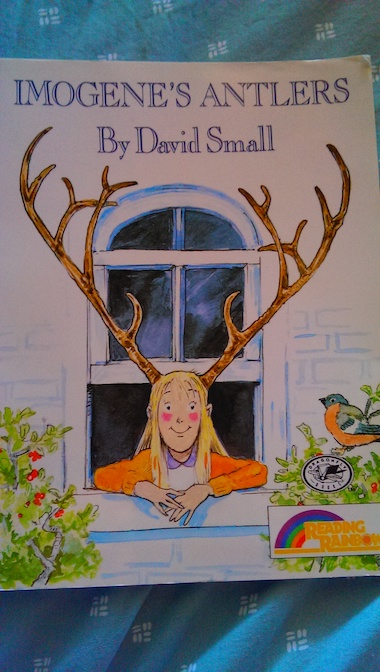
Imogene’s Antlers by David Small, 1985.

One day, a young girl named Imogene wakes up to find that she has sprouted antlers during the night. It comes as a shock to the rest of her family, and she finds that it’s very difficult to do things with large antlers sticking out of her head.

No one seems to know why Imogene has sprouted antlers or what to do about them. Imogene’s mother faints just about every time she looks at her daughter, and her attempt to help Imogene hide them with a specially-designed hat is pure disaster. Imogene’s brother, Norman, thinks that Imogene might be a rare kind of elk now.

However, Imogene still has a lovely day as the family maid uses her as a rack to dry towels and the cook decks out her antlers with donuts to feed the birds.  She even puts candles on her antlers as an elaborate candelabra while she practices her piano lesson.

ImogenesAntlersDonuts

Still, it’s a most bizarre day, and her family is relieved when the antlers are gone the following morning.  But, Imogene’s adventures may only be just beginning.

The book never offers an explanation for why Imogene grew antlers or why she now has a peacock tail, but it doesn’t really matter. This is just one of those books that’s fun to read because it’s silly. While Imogene’s mother panics over her daughter’s condition and tries to hide it under a ridiculously big hat at one point, readers don’t have to worry about the long-term implications of Imogene’s antlers (or any other animal transformations) because she just enjoys them for what they are. The peacock feathers may not have as many practical uses as the antlers did, but one can imagine that Imogene will make the most of them while she has them.  I loved this book when I was a kid!

This book was featured on Reading Rainbow.  It is currently available online through Internet Archive.

Ella the Elephant

EllaElephant

Ella the Elephant by Kurt Wiese, 1931.

EllaElephantMotherElla is a happy baby elephant in India.  Her mother takes good care of her, and she enjoys moving with the herd.  However, Ella’s carefree life with her mother ends abruptly when the herd is captured by humans!

Because Ella is small, she is able to escape when the other elephants can’t, but she finds herself alone and frightened in the jungle.  She doesn’t know what has happened to her mother, and she is in danger from predators in the jungle.

Other jungle animals help her, warning her of dangers and helping her to find out where her mother is.  She knows to look out for crocodiles in the river, and a peacock and some monkeys warn her about the presence of the tiger.  A kind water buffalo looks after her at night, using its size to intimidate and keep away the tiger.  The parrots help her to find the village where her mother is being held.  Eventually, she reunites with her mother in the human village after she is captured a second time.

I found this book at an antique store and included it here because I’d never seen it before, but I have mixed feelings about it.  The part about other animals helping little Ella is fun, but it’s somewhat disappointing that the story ends with both Ella and her mother in captivity.  The story ends with Ella’s reunion with her mother, and we don’t know exactly what happens to them after that. It appears that Ella and her mother will both be treated well by the humans who now have them, and they are relieved to see each other.  Still, to have them now living in captivity seems anti-climactic.