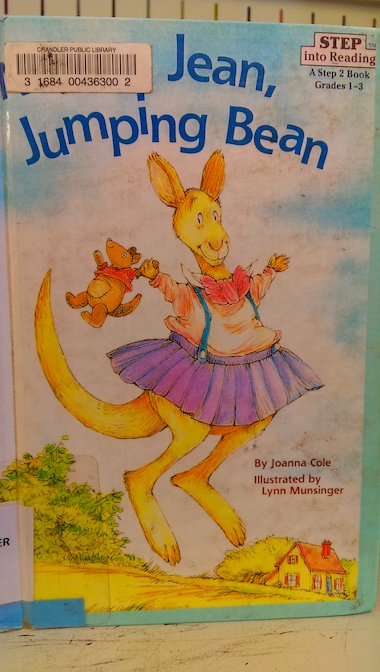
Norma Jean, a kangaroo, loves to jump! She goes hopping and jumping everywhere, all the time.
It’s pretty normal for a young kangaroo, but it sometimes causes problems. She keeps wanting to jump when her teacher wants her to sit still and and listen. Sometimes, accidents happen because she’s jumping around.
Without meaning to, she sometimes plays too rough with her friends because she has so much energy. One day, when her friends stop wanting to play with her after a series of disasters, Norma Jean decides that the only thing to do is to give up jumping. It makes her sad, but she doesn’t want to be thought of as a rough, clumsy klutz, who can’t sit still – a jumping bean.
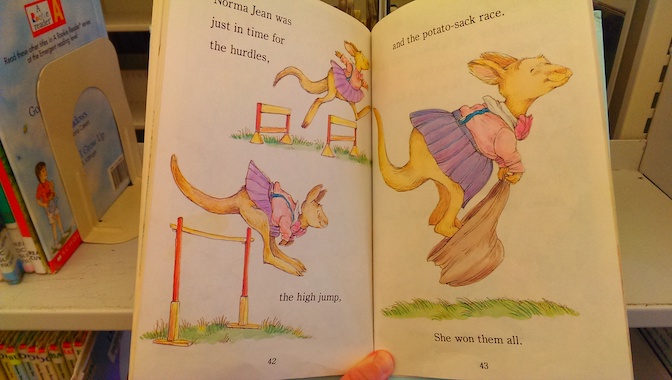
But, with the school’s field day coming up, Norma Jean realizes that jumping is okay, at certain times and certain places.
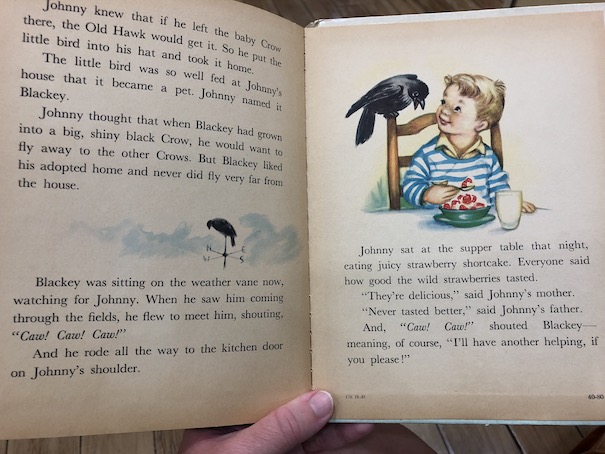
Johnny and the Birds by Ian Munn, illustrated by Elizabeth Webbe, 1950.
This cute little picture book is a collection of short stories about a little boy named Johnny and his adventures with wild birds. The stories are very short and are meant to teach children about wild birds.
Johnny and the Catbird – Johnny thinks that he hears a kitten while looking for strawberries, but it’s actually the sound made by a catbird.
The Blue Jays – Father Blue Jay scares a hawk away from his nest.
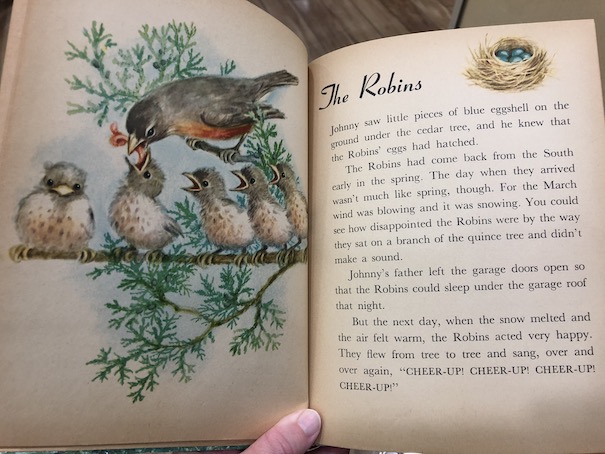
The Robins – Johnny knows that the Robin eggs have hatched when he sees the bits of blue eggshell under the tree where they live.
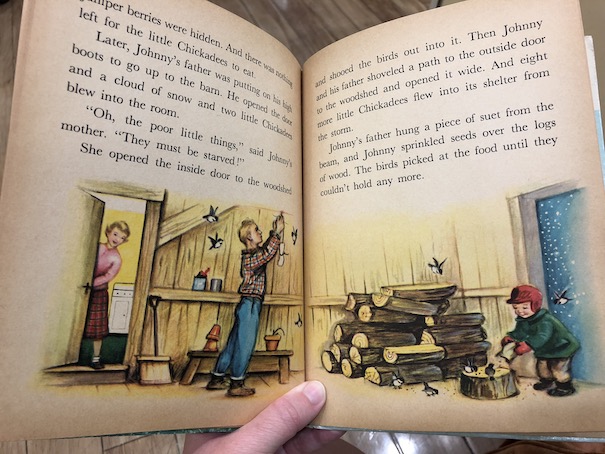
The Chickadees – The Chickadees don’t fly south during the winter like other birds, but Johnny’s family helps them when it’s snowing and they need something to eat.
The Crows – Johnny finds a baby Crow out of its nest. Apparently, it’s an orphan, and Johnny fears that it might get eaten by a hawk, so he takes it home and takes care of it. It becomes a pet, and he names it Blackey.
The book is available to borrow and read for free online through Internet Archive.
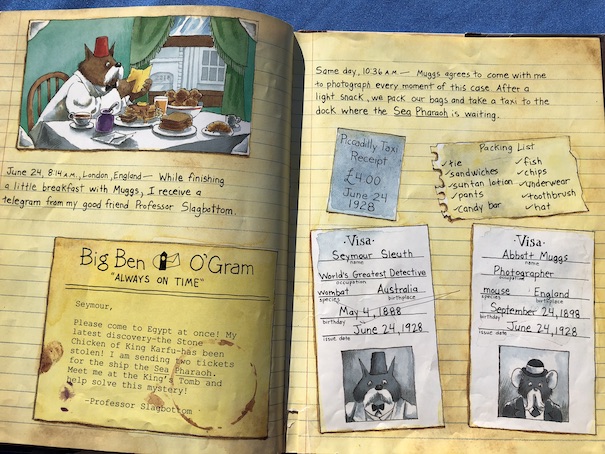
Seymour Sleuth, an Australian wombat living in London, introduces himself as “the greatest detective in the world.” His friend, Abbott Muggs, a mouse, is a photographer who assists him in his cases and documents them. When the story begins, Seymour receives a telegram from his friend Professor Slagbottom, who is working on an archaeological site in Egypt. Someone has stolen one of their finds, the Stone Chicken of King Karfu, and he needs Seymour’s help to find it! Seymour and Muggs head for Egypt!
King Karfu was a wealthy pharaoh and a wonderful cook, and the Stone Chicken may provide clues about the Lost Treasure of King Karfu, the nature of which is unknown. When they reach the dig in Egypt, Professor Slagbottom explains that he was researching a message in code on the outside of the Chicken when it was stolen. The suspects are the other people on the dig, who may be trying to steal King Karfu’s Treasure.
Seymour interviews the suspects one at a time and considers their connection to clues found at the scene of the crime. As an adult, I figured out who the culprit was pretty quickly, but for the benefit of child readers, Seymour provides notes about the clues and suspects to help them understand the connections. The pictures in the story also provide important clues. After Professor Slagbottom’s decoder is stolen, Seymour realizes who the thief is.
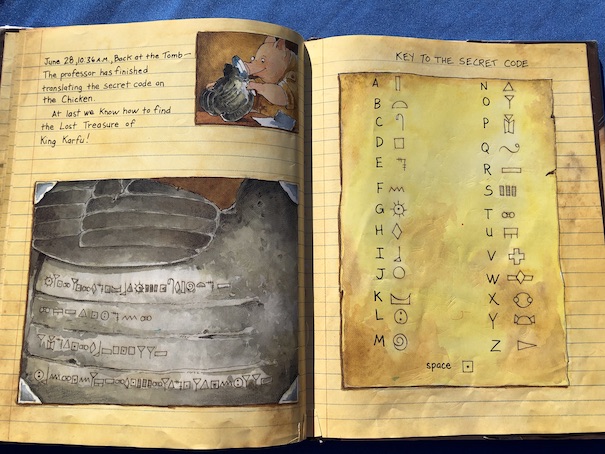
After they get the Stone Chicken back, readers can use the decoder provided to solve the code and learn where the Treasure is. It turns out that the Treasure is actually a recipe, written in the same substitution code – for peanut butter and jelly sandwiches!
I always like mysteries that involve codes and puzzles, and this cute animal mystery would be fun and challenging for young kids. With the key provided, it would be a good introduction to substitution codes for kids who have never seen them. There is one other book with Seymour Sleuth, The Mystery of the Monkey’s Maze. The author, Doug Cushman, is also the author of the Aunt Eater Mysteries.
The book is currently available online through Internet Archive.
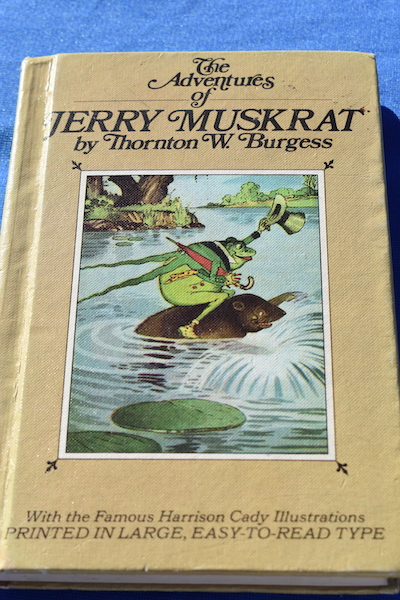
The Adventures of Jerry Muskrat by Thornton W. Burgess, 1914.
This book is part of a series of stories about the adventures of different animals.
Jerry Muskrat lives with his family and friends in the Smiling Pool and Laughing Brook, near the farm owned by Farmer Brown. Jerry’s mother warns him to look out for the traps that Farmer Brown’s son likes to set, but he’s sure that he can take care of himself . . . until he has a very narrow escape!
Jerry’s mother calls a meeting of the other animals to discuss the threat of traps after Jerry’s close call. They decide to ask Great-Grandfather Frog for his advice. He tells them that they must find all of the traps and use a stone or stick to trigger them. Then, when the traps have been sprung, they will bury them. The animals have some close calls while springing the traps, but they manage to set them off successfully.
However, they soon have a new problem: it seems like the water in the Smiling Pool is getting lower each day. When the animals investigate, they discover that someone has dammed the Laughing Brook that feeds the Smiling Pool! If they don’t do something about it, they might all have to go live on the Big River, and they don’t want to leave their home.
It turns out that the dam was made by Paddy the Beaver, Jerry Muskrat’s “big cousin from the North.” Jerry tries to make a hole in the dam so that the water will flow, but Paddy blocks it again, telling them not to mess with his dam. Jerry has to explain to Paddy why the residents of the Smiling Pool need the water. Once Paddy understands, he lets the water flow again.
The animals in the story refer to the place where they live in terms of their pool and brook and the nearby farm. You don’t really know exactly where they live, but there is one animal who has a Southern accent, “Ol’ Mistah Buzzard.” Ol’ Mistah Buzzard talks like the characters in Disney’s Song of the South, regularly dropping phrases like, “Where are yo’alls going?”, “Fo’ the lan’s sake! Fo’ the lan’s sake!”, and referring to other animals as “Brer Mink” and “Brer Turtle.” The book was written before the movie Song of the South was created in 1946, but long after the book that the movie was based on, Uncle Remus by Joel Chandler Harris from 1881. I suspect that the author of this book was inspired by the animal stories in Uncle Remus and that the Buzzard’s dialect is a salute to that. Unfortunately, that kind of dialect is really annoying for modern readers and may make it a difficult thing to read aloud to children. Mercifully, none of the other characters in the book do this. The parade of animals who hurry to find what has stopped the water in the brook is also a take-off from The Tortoise and the Hare story because the turtle, who was left behind by the others in their rush does become the first to find the source of the problem when the others stop to rest.
This book is over 100 years old and in the public domain now. There are multiple places to read this book for free online, but the one that I recommend the most is Lit2Go from the University of South Florida because it offers audio readings of the chapters in the book as well as the text. The book is also available online through Project Gutenberg.
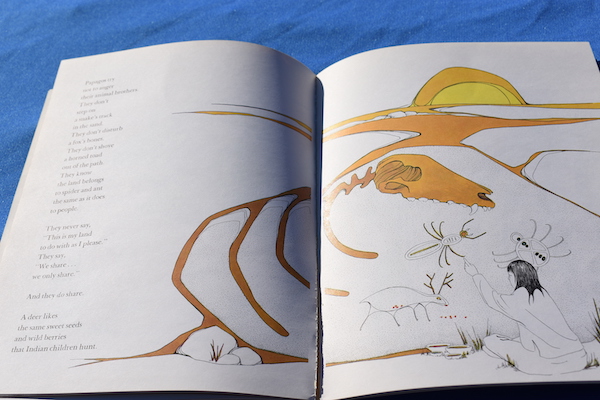
The Desert is Theirs by Byrd Baylor, illustrated by Peter Parnall, 1975.
The story in the book is written in a kind of poetical form, describing what life in the desert is like. It talks about the kinds of animals that live in the desert and how the plants sometimes have to go without water for months because it doesn’t rain much.
It also describes the Desert People, the Papago Indians (Tohono O’odham – Which literally translates as “Desert People”). Even though the desert is a harsh environment, the people who have lived there for generations think of it as home and like living there.
The book continues with a Native American creation myth that describes how the Earthmaker made a little plot of dirt and greasewood grew in it – the beginning of the desert. Then, Coyote scattered seeds to grow cactus, and the Spider People sewed the earth and sky together. In the creation story, other animals help to form the desert, which earns the respect of the Papago. The Desert People recognize that they have to share the land with the animals as well as each other.
While
the desert can be harsh, it isn’t barren.
In the desert, there are still plants to eat and use as medicine. People also use grasses for weaving baskets
and the soil itself for building homes.
People
also learn patience in the desert. It can
take a long time for it rain. Plants
sometimes have to wait for years in order to bloom. Animals wait for the coolness of night to
come out. People plant their crops very
carefully. But, even though they often
have to wait, good things are worth waiting for.
I remember
teachers reading this book to us in early elementary school because I grew up
in Arizona. It is a Caldecott Honor
Book.
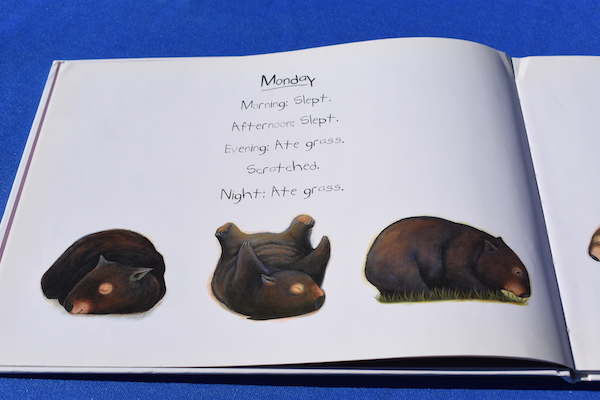
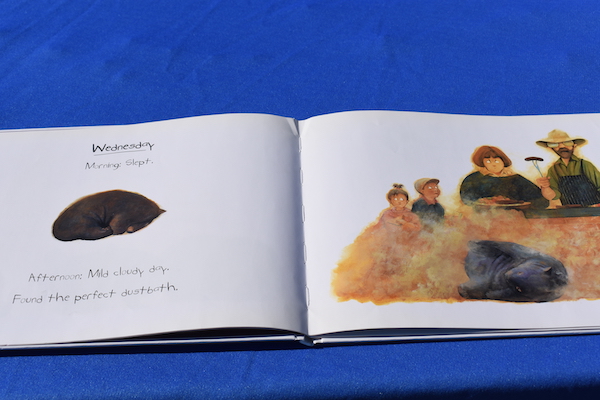
Diary of a Wombat by Jackie French, illustrated by Bruce Whatley, 2002.
This cute picture book is written in the form of a diary written by a wombat. The early entries are mostly eating and sleeping, typical for an animal.
It gets funnier when the wombat makes herself at home in someone’s yard.
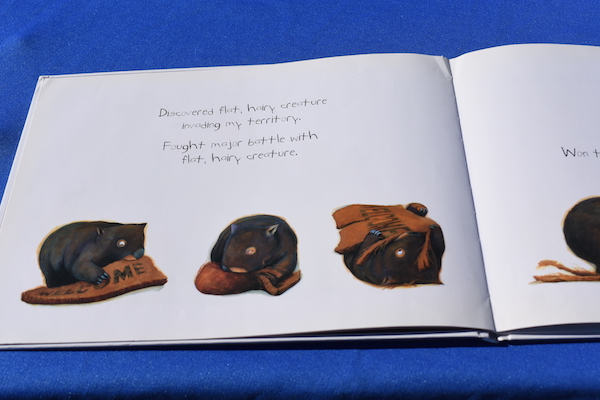
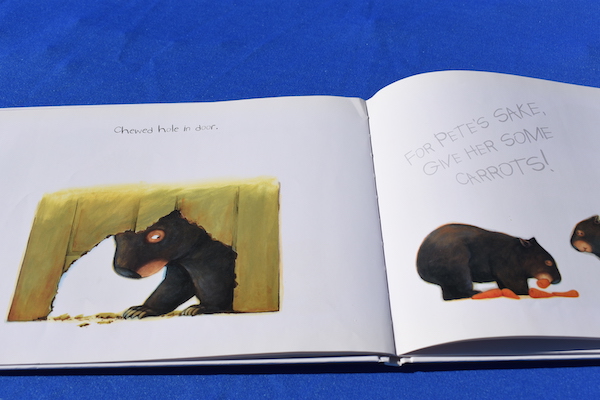
The wombat wins a fight with their doormat and demands food from the humans. They give the wombat a carrot. Big mistake.
Once you feed a wild animal, it comes back for more, and it doesn’t want to take “no” for an answer.
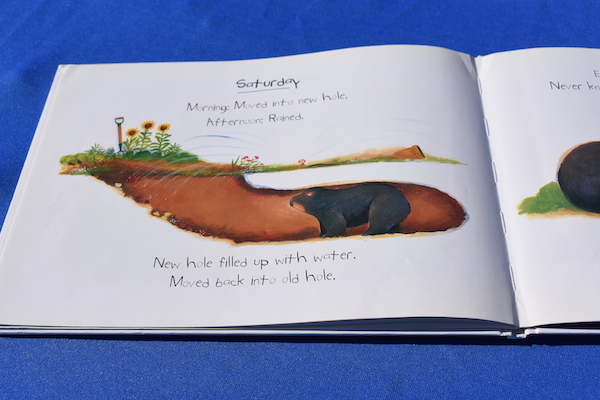
The wombat makes a hole in the humans’ yard but moves out when she doesn’t like their sprinkler.
She also gets tired of the carrots they’ve been feeding her and demands oats instead.
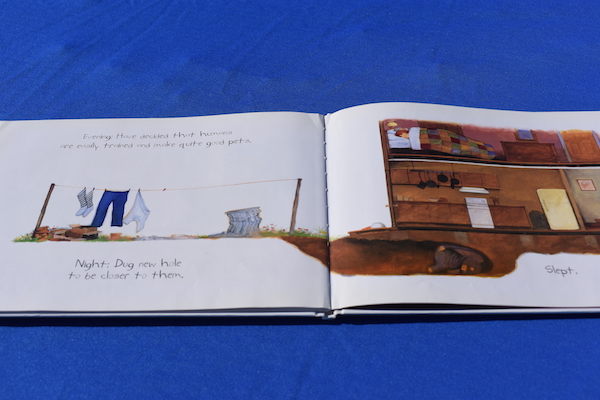
You could say that the humans now have a pet wombat, but the wombat looks at it the other way around. The wombat is probably right.
This is one of those books where the pictures really make the story. It’s also a good warning against feeding wild animals! Yet, the wombat is pretty cute . . .
Edward the Emu by Sheena Knowles, illustrated by Rod Clement, 1988.
Edward the Emu lives in a zoo, but he finds it boring. He is so bored that he decides to try living with and acting like the other animals.
First, he envies the seals who live in the pen next to his and always seem to be swimming and having fun. So, one night, he jumps out of his pen to join the seals. The next day, he hangs out with the seals, lying in the sun and balancing a ball on his nose. It’s much more fun than his boring old pen, but then he overhears a zoo visitor say that the lions are “the best thing to see at the zoo.”
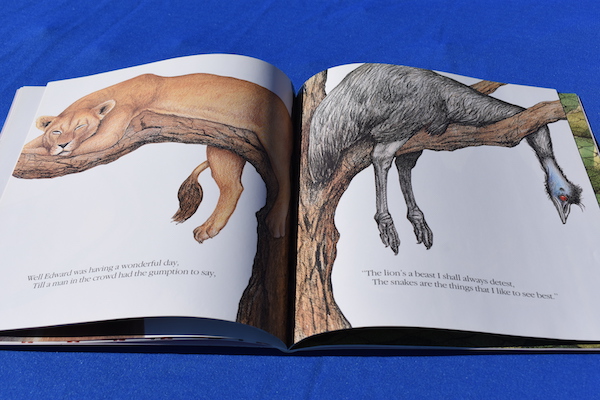
Edward once again switches pens, deciding that he’ll try to be a lion. He spends the next day growling and snarling while the lions roar. It’s a lot of fun, but then another visitor comments that he likes snakes the best.
Once again, Edward switches pens and tries being a snake. This time, someone comments about great emus are. Feeling better about himself, Edward decides to return to his own pen.
However, to Edward’s surprise, there is another emu in his pen, his replacement because he disappeared! It’s not a problem, though, because the new emu, Edwina, is glad to see him, and Edward is less likely to be bored now that he has a friend.
A friend sent me this cute picture book from Australia. The story is told in rhyme, and the pictures of Edward trying to be different types of animals are fun.
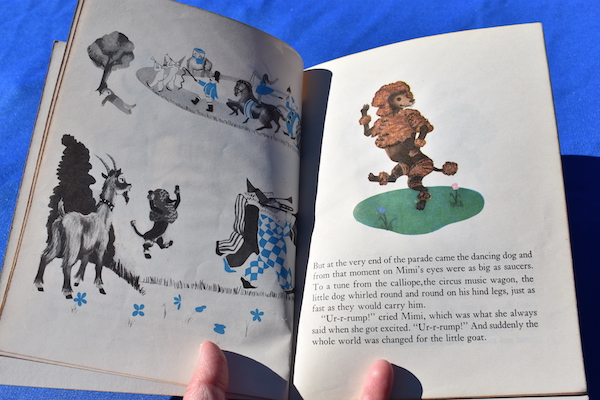
Mimi is a good little goat who lives with a poor farmer and his wife. They like her and take good care of her, and in return, she provides them with milk that they sell to help make their living. However, things change for Mimi when she happens to see a circus parade with a dancing dog. From that moment on, all Mimi wants to do is to dance!
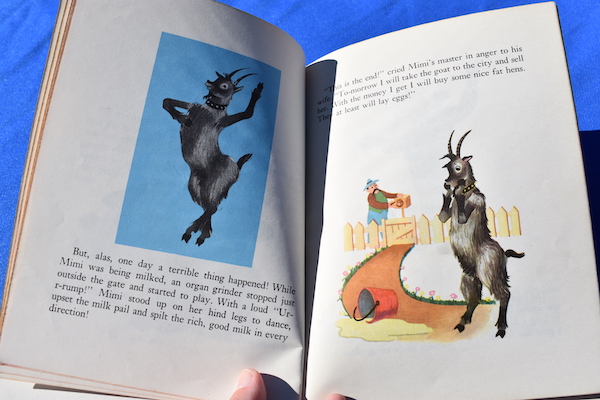
It wouldn’t matter so much except that Mimi develops a bad habit of dancing when the farmer is trying to milk her, spilling the milk. Eventually, the farmer concludes that he can no longer afford to keep Mimi, even though he and his wife don’t really want to part with her. Mimi is upset at the thought of losing her home, and when the farmer takes her to the market to sell her, she starts to cry.
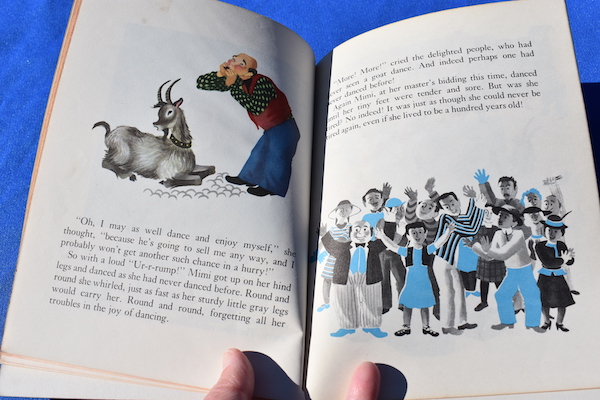
The people at the market don’t want to buy a crying goat and think that something is wrong with Mimi. To cover up the noise of Mimi crying, the farmer starts to blow a tune on his comb. Hearing the music, Mimi starts to dance again.
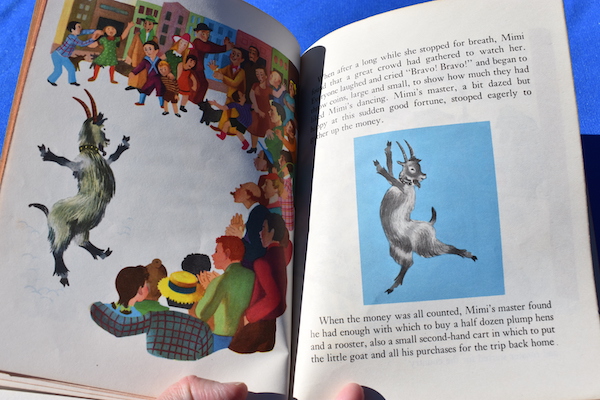
To the farmer’s surprise, everyone in the market loves Mimi the Dancing Goat, and they throw coins. With the money that Mimi makes with her dancing, the farmer can now only afford to keep her but buy other livestock as well. From then on, the farmer regularly takes Mimi to the market to show off her dancing and earn some extra money. He plans to buy another goat to keep Mimi company, and he hopes that the new goat turns out to be a dancer, too!
I usually don’t like “animal almost loses their home” type stories because I always feel too sorry for the poor little animal, but the risk in this story is over pretty quickly, which helps. It also helped that the farmer and his wife genuinely liked Mimi and were only going to part with her reluctantly, so it wasn’t difficult for the farmer to change his mind as soon as Mimi showed that she could bring in money to help earn her keep.
The Large and Growly Bear by Gertrude Crampton, 1961.
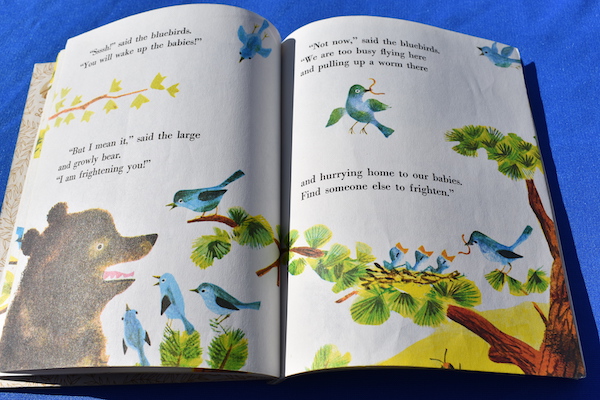
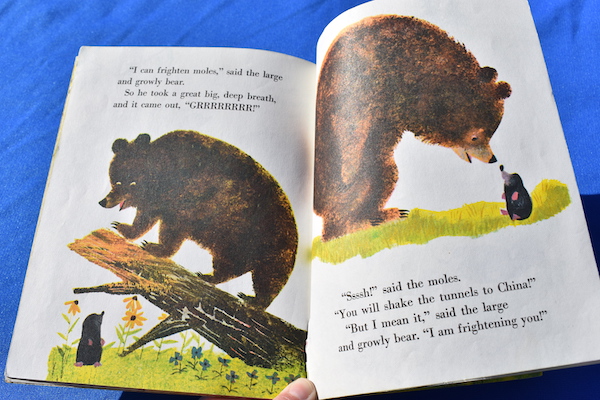
One spring day, a large and growly bear is bored. What else can a large and growly bear do but find someone to scare with his growling? But, finding someone to scare proves harder than he thought it would be.
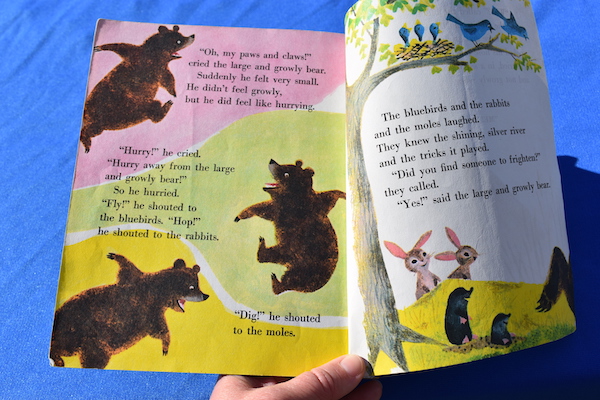
As the bear goes through the forest, trying to scare different types of animals, he discovers that they’re all too busy to be frightened of his growling. The birds are busy feeding their babies, the rabbits are busy jumping around and counting their bounces, and the moles are busy digging tunnels halfway to China. All of them tell the bear to go find someone else to scare.
Eventually, he gets the idea of trying to scare the fish because fish just swim around and aren’t too busy to be scared, but when he gets to the river, he’s in for a big surprise! The easiest target to scare is . . . himself!
My Reaction
This is just a cute story that my brother really liked as a kid. It has repetition that kids like as the bear repeatedly tries to frighten different types of animals with the same disappointing result, and then a funny twist ending when it turns out the only animal who even has the time to be frightened by the bear is himself. It’s a Little Golden Book.
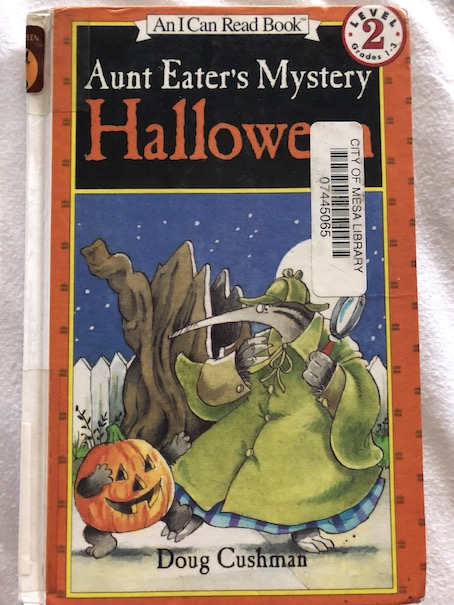
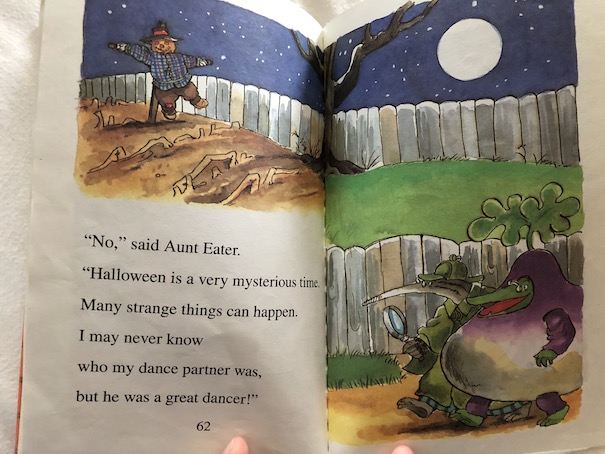
Aunt Eater’s Mystery Halloween by Doug Cushman, 1998.
This is a cute Halloween book for kids. There are actually four short mystery stories in the book as Aunt Eater, dressed as Sherlock Holmes, goes to a Halloween party and encounters various spooky happenings.
Aunt Eater Sees a Monster
While she’s on her way to the Halloween party, Wally stops Aunt Eater and says that there’s a monster in his kitchen and that it ate his father. When Aunt Eater takes a look, she sees a scary shadow in the kitchen and hears a terrible groan. Is it really a monster?
Aunt Eater Sees a Ghost
Aunt Eater continues walking to the party with Mr. Chumly, who is dressed as a turnip. Mr. Chumly points out a hollow tree that they pass and tells her that it’s supposed to be haunted by a headless ghost. Aunt Eater doesn’t believe in ghost, but then a scary jack o’lantern appears, moving by itself, and it’s followed by a ghost with no head! Fortunately, there is a logical explanation.
Aunt Eater Hears Some Music
Aunt Eater is glad to see all of her friends at the party. Miss Underbelly has brought her pet snake with her. Later, the piano suddenly starts playing strange music without anyone sitting at it, and the snake has disappeared! What do you suppose is happening?
Aunt Eater Dances a Jig
Mr. Fragg, a friend of Aunt Eater’s, is wearing a scarecrow costume, and he tells Aunt Eater that he’d like to dance with her later in the evening. She does dance with a scarecrow, but then learns that it wasn’t Mr. Fragg because Mr. Fragg hurt his foot. Who was that mysterious scarecrow? Aunt Eater never figures it out, but readers do.
The book is currently available online through Internet Archive.


















 Jestress's Forgotten Books and Stories