Why Mosquitoes Buzz in People’s Ears

Mosquitoes

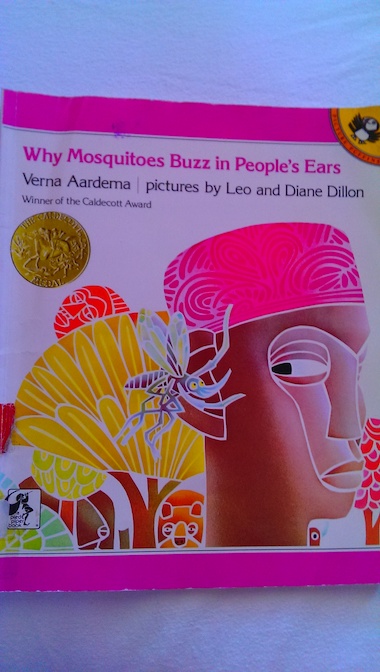
Why Mosquitoes Buzz in People’s Ears retold by Verna Aardema, pictures by Leo and Diane Dillon, 1975.

The story comes from a West African folktale, and all the characters are animals.

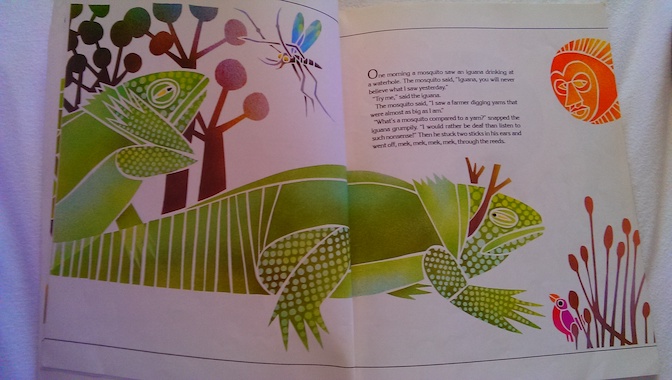
In the beginning, a grumpy iguana gets tired of hearing a mosquito telling tall tales. He sticks a couple of sticks in his ears so that he won’t have to listen anymore, and this decision leads to a series of unfortunate events that leads to the accidental death of a baby owl.

MosquitoesIguana

It starts with a snake trying to talk to the iguana, who does not hear him. The snake, thinking that perhaps the iguana is angry with him, goes to hide from him in a rabbit hole, startling the rabbit out. The chain reaction of events continues, with different animals startling each other, until a frightened monkey crashes through a tree branch, which breaks, killing the baby owl.

MosquitoesMonkeyTree

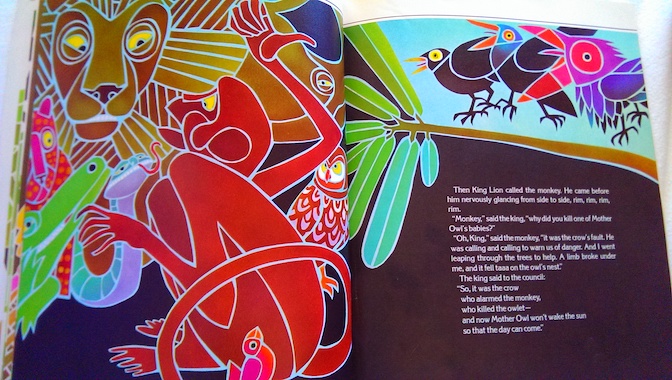
The Mother Owl is so distraught at the death of her baby that she doesn’t wake the sun so that dawn can come, as she usually does. When the other animals realize that dawn isn’t coming, King Lion calls a meeting to determine the reason why. Together, they trace the events backward to the iguana. The iguana is not at the meeting because he still has sticks in his ears and hasn’t heard a thing about it.

MosquitoesMeetingMonkey

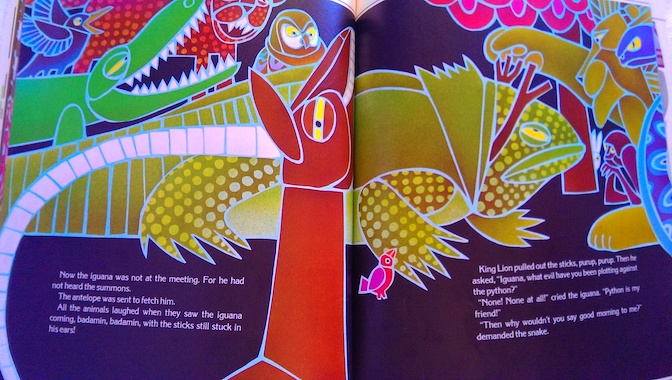
When the other animals track down the iguana and take the sticks out of his ears, they demand to know why he wouldn’t talk to the snake. When he tells them that he had sticks in his ears because he couldn’t stand listening to the mosquito’s stories anymore, the mosquito ends up taking the blame for everything. The Mother Owl is satisfied with the explanation and hoots to wake up the sun, although the mosquito escapes punishment by hiding. So, ever since, the mosquito whispers in people’s ears to find out if everyone is still angry.

MosquitoesMeetingIguana

The art style in the book is a little unusual. When I looked at the pictures the first time, I thought of them as looking stenciled. However, there is a note in the beginning of the book, near the copyright information, that says that the pictures are a combination of watercolors and india ink. The artists used an airbrush and pastels, and they created the “cut-out effect” with frisket masks and pieces cut out of vellum.

This book is a Caldecott Award winner. It is currently available online through Internet Archive.

The Great Kapok Tree

KapokTree

The Great Kapok Tree by Lynne Cherry, 1990.

The book begins with a letter from the author, saying that she wrote the book in order to explain to people the importance of rain forests and why they should be preserved.

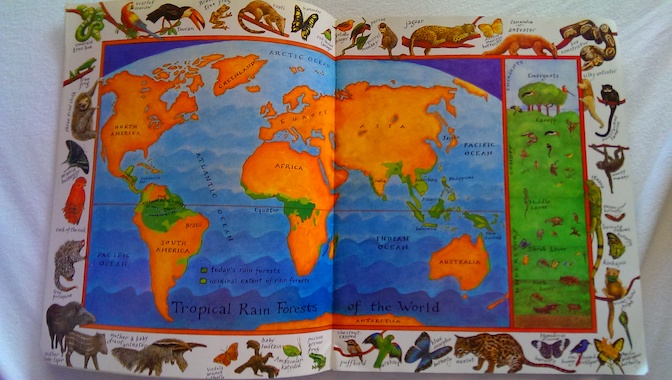
KapokTreeMap

Two men are walking through a rain forest. They are there to cut down the trees (probably for farming). The animals watch as one of the men begins chopping at a great Kapok tree with his axe. It’s hard work, and before the man gets very far with his chopping, he has to stop and rest.

As the man sleeps, the animals come to him and whisper to him not to chop the tree down. The boa constrictor tells him that his ancestors have lived there for generations. The monkeys tell him that if he chops all the trees down, there will be no tree roots to hold the soil in place, and it will wash away, eventually changing the land into a desert. The birds are worried because people use fire to help clear the forest, and it destroys everything. All of the animals are worried about where they will live and what they will eat if the forest disappears.

KapokTreeButterflies.jpg

The animals also point out to the man that destroying this forest would also be destroying his own future and that of his children. The forest produces oxygen for humans to breathe.

KapokTreeChild

Finally, a human child from the Yanomamo tribe that lives in the forest asks the man to wake up and look at him and all the animals. The man is startled and amazed by what he sees. He thinks about continuing his work, but seeing the child and all of the animals staring at him silently, hoping that he won’t, he decides that he can’t bring himself to do it and leaves.

KapokTreeEnd

I don’t remember reading this book when I was a kid, but I remember other stories very much like it.  Environmental issues like this were common topics of discussion when I was in elementary school during the early 1990s.  One of the movies of my childhood, FernGully, came out in 1992, a couple of years after this book was first published.  That movie is also based on a book, although it has even more fantasy elements than this story, which has talking animals.  Both of these stories demonstrate how many children during the 1990s were raised to be environmentally aware.

This is a Reading Rainbow Book. It is currently available online through Internet Archive (multiple copies).

Tawny Scrawny Lion

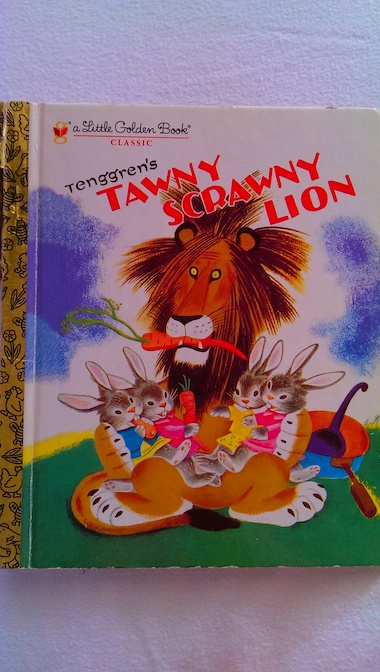
TawnyScrawnyLion

Tawny Scrawny Lion by Kathryn Jackson, illustrated by Gustaf Tenggren, 1952.

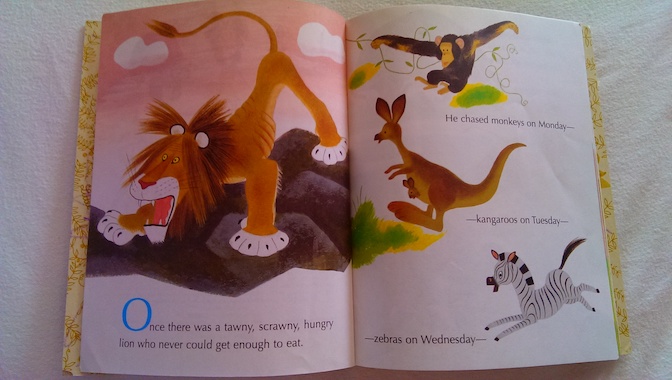
The tawny, scrawny lion can never get enough to eat! No matter how much he hunts and eats, he’s always hungry, and his ribs are showing. He thinks that it’s because hunting is so much work that he wears off anything he eats right away. If only the other animals didn’t run so much, trying to get away from him! (Gee, I wonder why.) He tries to tell the other animals that if they would just not run so much, he would have to eat less of them. Needless to say, that argument doesn’t impress them much.

TawnyLionHungry

Trying to get the lion to stop chasing the rest of them, the other animals convince the fat rabbit to go “talk things over” with the lion, thinking that if the lion eats the fat rabbit, he’d get fat for awhile and leave the rest of them alone.

Seeing how scrawny the lion is, the rabbit decides to invite the lion to join him and his siblings at his house for dinner. The lion likes the idea of going to the rabbits’ house, thinking of the nice dinner he could have on all the fat little rabbits, but things don’t turn out the way that the lion thinks they will.

TawnyLionRabbitTalk

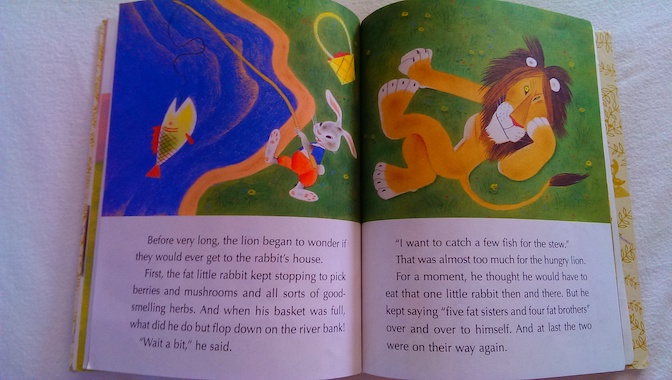
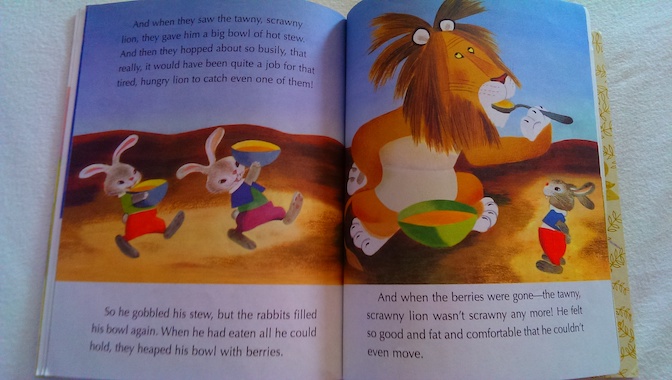
The rabbit tells the lion that they are making carrot stew tonight, but before they can eat, they need just a few more things for the stew. The lion follows the rabbit around as he gathers berries, mushrooms, and herbs and catches a few fish to add to the stew. By the time they’re done with all of that, the lion is too hungry and exhausted to chase the rabbits, so he accepts some of their stew instead.

TawnyLionFishing

To the lion’s surprise, the stew is actually very filling, and when he has eaten it, he isn’t hungry anymore. For the first time, he feels fat and satisfied. Because of that, the lion ends up not chasing the other animals anymore but helping the rabbits catch fish and gather berries for more of their amazing, wonderful stew!

TawnyLionStew

This is a popular Little Golden book that kids have loved for generations! The stakes are high for the rabbits, who could be eaten by the lion, but I think kids know that the rabbits are going to find a clever way to satisfy the lion without getting eaten. I think it’s also not bad to have a story that points out that, if you aren’t healthy eating the things you’re eating, it’s okay to change.

It is currently available online through Internet Archive (multiple copies).

The Biggest, Most Beautiful Christmas Tree

BiggestChristmasTree

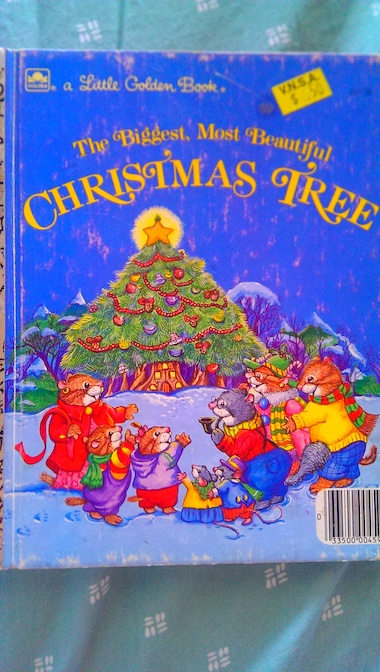
The Biggest, Most Beautiful Christmas Tree by Amye Rosenberg, 1985.

This is a Little Golden Book.

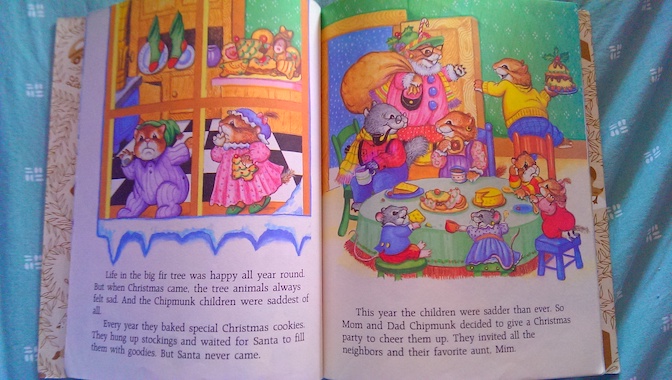
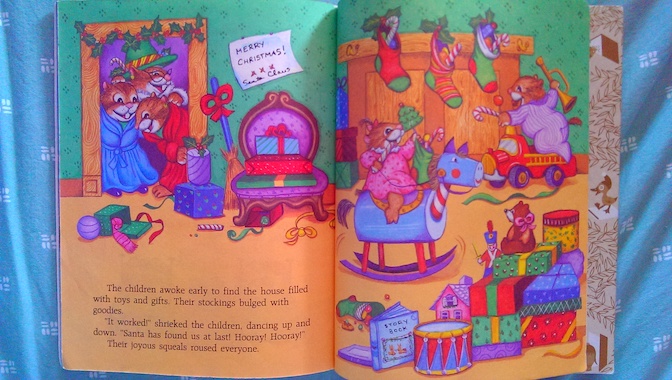
Every year at Christmas, the Chipmunk children, Nina and Nutley, are disappointed because Santa doesn’t visit their home in a large fir tree in the forest.  They always hang up their stockings and put out cookies, but for some reason, Santa never comes.

BiggestChristmasTreeDisappointment

However, this year, their Aunt Mim has figured out the reason why Santa passes them by and what to do about it.  Aunt Mim has realized that Santa can’t find their tree because it looks like every other tree in the forest.  What they have to do is to decorate their tree so that Santa can find it among all the others.

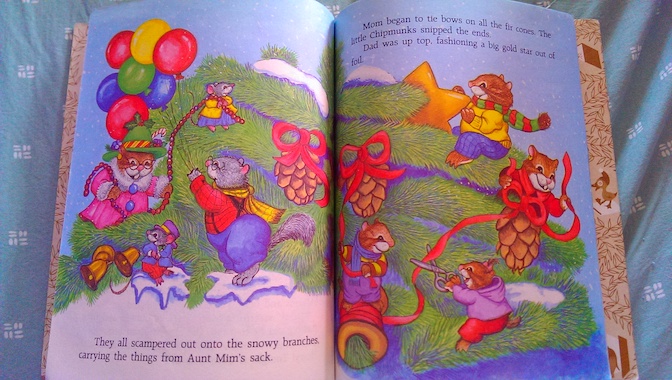
Aunt Mim brings lots of things they can use as decoration, and all of the other animals who live in the tree help with the decorating.  They tie bows on the pine cones, hang strings of berries, and paint balloons to look like large Christmas tree ornaments.

BiggestChristmasTreeDecoration1
BiggestChristmasTreeDecoration2

Sure enough, once Santa knows how to find the Chipmunk children, they get the kind of Christmas they’ve been waiting for!

BiggestChristmasTreePresents

This is just a cute picture book that I liked when I was young.  It is available to borrow and read for free online through Internet Archive.

Meet Felicity

American Girls

MeetFelicity

Meet Felicity by Valerie Tripp, 1991.

MeetFelicityPennyThis is the first book in the Felicity, An American Girl series.

Felicity, or Lissie as her family sometimes call her, is the daughter of a prominent store owner in Williamsburg, Virginia in 1774.  Sometimes, her father allows her to help in the shop, which is something that she enjoys.  However, that has happened less since her father took on a new apprentice named Ben Davidson.  Ben is fairly quiet and shy, and Felicity is only just getting to know him.  She sometimes envies boys for the more exciting opportunities they have while she has to help with more routine chores, like sewing, at home.

One thing that Felicity loves more than anything else is horses.  One day, she goes with Ben while he makes a delivery to Jiggy Nye, the tanner.  Jiggy Nye has a new horse that he says he won at gambling.  However, Jiggy Nye is cruel to any animal he gets, and Felicity fears for the beautiful horse he now has.  When Felicity tries to see the horse, which she calls Penny because of the color of its coat, Jiggy Nye drives her away.

That the horse is a fine animal and that Jiggy Nye is treating it badly are obvious, but at first, there doesn’t seem to be anything that Felicity can do about it.  Then, Jiggy Nye shouts at the horse one day that it’s worthless because he can’t handle it and that he’d give it to anyone who can ride it.  Taking Jiggy Nye at his word, Felicity sets out to tame Penny.

MeetFelicityRidingEvery morning for about a month, Felicity sneaks out of the house early, dressed in a pair of breeches that she borrowed from Ben without his permission.  She goes to visit Penny and gradually gains her trust.  When Penny finally allows her to ride her, Felicity thinks that she has won ownership of her, but Jiggy Nye accuses her of theft and takes back the horse.  He denies that he ever promised to give her to anyone who could ride her, although Felicity’s younger siblings agree that they heard him say so.

Felicity fears more than ever that Jiggy Nye will kill Penny, but now that she no longer has a chance of getting her from Jiggy Nye for herself, can she find another way to give Penny her freedom?

There is a section in the back of the book that describes life in Colonial America, particularly in Williamsburg, Virginia.  It also mentions the Colonial Williamsburg living history museum.  Another book about life in Colonial Williamsburg, with photographs from the living history museum, is Mary Geddy’s Day.

This book is currently available online through Internet Archive.

Basil in the Wild West

BasilWestBasil in the Wild West by Eve Titus, 1990.

This book picks up right after the previous book in the Basil of Baker Street Series, Basil in Mexico.

After leaving Mexico, Basil and his best friend Dr. Dawson journey north into the western territories of the United States.  There, some friends of their ask them to investigate a smuggling operation.  Mice have been illegally bringing Mexican antiquities across the border.

Basil realizes that the smugglers have been smuggling the antiquities in the open, pretending that they are ordinary replicas, the kind that tourists often buy.  Because the border guards aren’t experts in antiquities, they haven’t been able to tell the difference between harmless souvenir replicas and the real thing.

When they catch one of these smugglers, they learn that the mastermind behind the scheme is a mouse called J.J. in a town called Moriarty in New Mexico (the name of the town irritates Basil).  They go to the town with the help of some friendly horses and confront J.J..  At first, they think it won’t be too difficult because, although J.J.’s house is well-guarded, he is confined to a wheel chair because of an accident.  However, the wheel chair is an act, and J.J. is no ordinary mouse.

BasilWestPic2Although J.J. escapes, Basil and Dr. Dawson decide that the smuggling ring has been defeated and it’s alright to continue their sight-seeing.  However, their adventures are not over!
Basil and Dawson want to see the Grand Canyon, but it turns out that the hotel where they are staying is being terrorized by a weird, glowing Thing.  Nobody knows what it is, but guests think it could be some kind of ghost or monster, and many of them are too afraid to stay.  The owners of the hotel ask Basil to discover what the Thing is and stop whoever may be behind it before their hotel is ruined!

This book is really two stories in one, and neither has any direct bearing on the other.  In that way, it’s kind of disjointed.

The book is currently available online through Internet Archive.

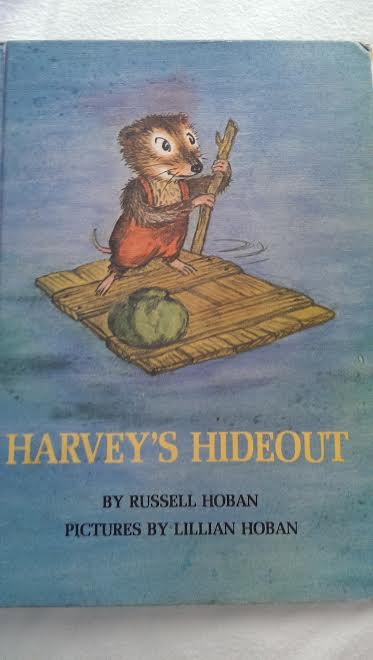
Harvey’s Hideout

HarveysHideout

Harvey’s Hideout by Russell Hoban, illustrated by Lillian Hoban, 1969.

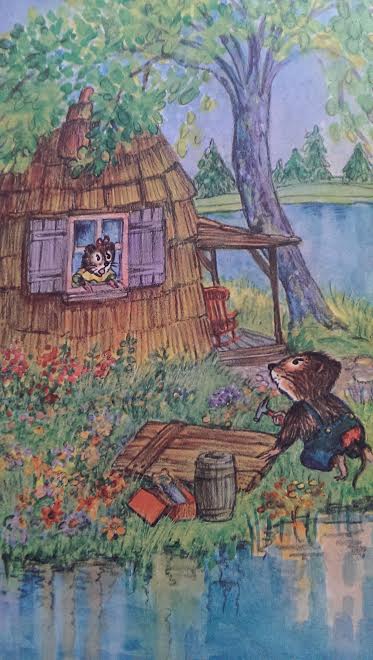
HarveysHideoutHouseSummer is difficult for the Muskrat kids this year.  Their friends are away for the summer, and Harvey and his older sister Mildred are getting on each other’s nerves.  But, there’s nothing that says they have to spend the whole summer with each other.

Harvey builds himself a raft and tells Mildred that he’s going off to meet with members of his secret club for a cookout where annoying big sisters aren’t welcome.  Mildred says that’s fine with her because she’s been invited to a party where there will be no annoying little brothers.  Harvey says that’s fine with him . . . except that it really isn’t.

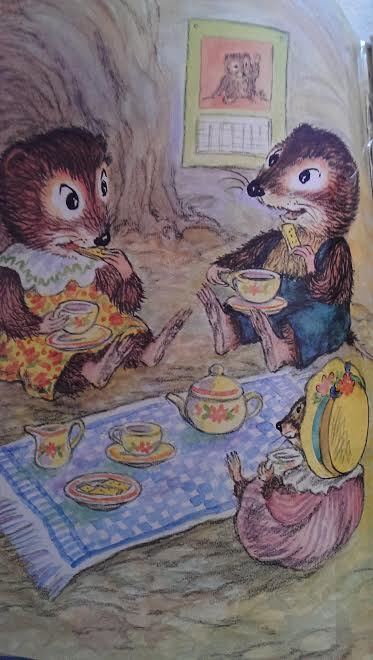
The secret hideout where Harvey has been spending his time is empty except for him and the comic books he brought with him, and his cookout is for only one person.  He just made up the story about the secret club to make Mildred jealous and to have an excuse to spend time away from the house and her.  Harvey appreciates the freedom, but he’s also bored and lonely and envies Mildred, wondering who she knows who is still in town, inviting her to parties every day.

Then, when Harvey tries to make some improvements to his secret hideout, he discovers that he’s not the only one to dig a secret hideout for himself in the area.  Harvey’s unexpected discovery leads to a change in his relationship with his sister.

HarveyHideoutSecret


The book is available to borrow and read for free online through Internet Archive, and new copies are also available to buy through Plough.  If you try it and like it, consider buying a copy to own!

HarveysHideoutFriends

My Reaction

This is a nice story about sibling rivalry and cooperation.  One of the parts I like best is early on in the story when Harvey and Mildred’s father lectures them for fighting and insulting each other. I hated that part when I was a kid, but I kind of like it now because I realize what the father is actually trying to say.  He points out that there is some truth in their insults, but they’re wrong about each other at the same time.  Part of the reason they fight is because they each have their faults (Harvey can be selfish and Mildred can be bossy), but they each unfairly assume that the other is a lost cause and that they can never be friends.  It’s only when they come to realize that they’re equally lonely (Mildred has been having tea parties with just her doll) and Harvey makes the first move in offering to share what he has with Mildred that they realize that they can each be the friends they both need this summer.

When I was a kid, I wished I had a hideout like theirs!  I also love the colorful illustrations in the story.

The Case of the Wandering Werewolf

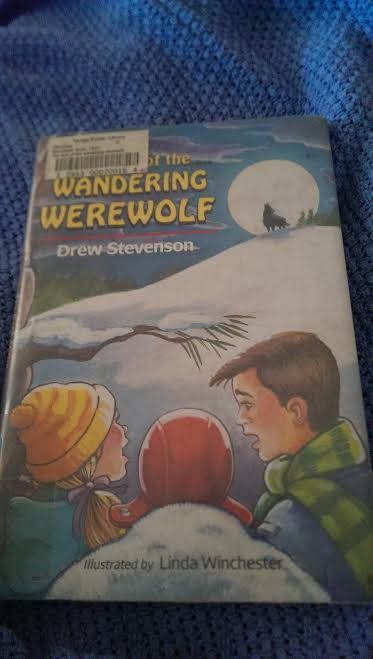
wanderingwerewolfThe Case of the Wandering Werewolf by Drew Stevenson, 1987.
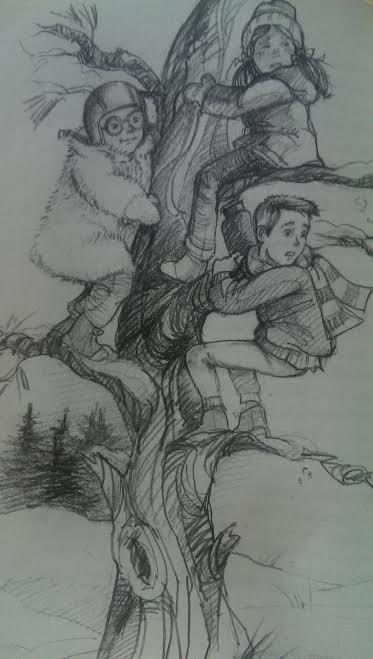
A boy called Chips approaches Raymond with the story that there might be a werewolf in Lost Woods, outside of town. Chips likes animals, and he has been going into the woods to spring animal traps that someone has been leaving there. One evening, Chips thought he saw a man who seemed to turn into a wolf, and the wolf chased Chips away, only stopping when Chips crossed the creek. Chips has heard of Huntley’s monster hunting activities, and he asks Raymond to tell Huntley about the werewolf and see if he will investigate.

To Raymond’s surprise, Huntley says that he has already heard about the werewolf from another source, which he refuses to reveal.  However, he is eager to investigate, on behalf of Chips and his other mysterious source. Verna, who overhears what Chips says about the werewolf, invites herself along on the hunt.

wanderingwerewolfpic1The monster hunt becomes more complicated when Bucky Bovine, a bully at their school, seems determined to stop them from going to Lost Woods to look for the monster. Does Bucky know something about the beast, or could he even be the monster himself?

As always, there are other explanations besides monsters and mysteries that require solving.  Fortunately, Huntley is an excellent detective as well as a Monster Hunter, and he puts the pieces together to explain not only the werewolf but other strange things that have been happening around town.

The book is part of the Monster Hunter series and is currently available online through Internet Archive.

Something Queer in the Wild West

SQWest

Something Queer in the Wild West by Elizabeth Levy, illustrated by Mordicai Gerstein, 1997.

Gwen and Jill go to visit Gwen’s Uncle Dale, who owns a ranch in New Mexico. The girls enjoy learning to ride horses, but Fletcher seems to be interested in an old barn.  C. J., who works on the ranch, tells the girls that the barn is supposed to be haunted by the spirit of a wild horse and that they should stay away from it.  Uncle Dale confirms the old legend, but the girls think there’s more to the story.

They have hear strange sounds coming from the old barn.  Then, the girls notice that Fletcher seems to be sneaking out during the night.  One night, they see a white horse roaming around when Uncle Dale doesn’t own a white horse. Could it be the spirit of the wild horse, or could it have something to do with a recent horse theft?

Fletcher’s odd behavior is a clue, and there is more to the old barn than the ghost story, as the girls suspected.  The “theft” isn’t quite theft, and the thief is actually trying to do something noble.  In the end, the girls decide to help, but they need Fletcher’s help to do it.

This book is part of the Something Queer Mysteries.  It is currently available online through Internet Archive.

SQWestPic2

Make Way for Ducklings

MakeWay

Mr. and Mrs. Mallard are looking for a new home where they can raise their babies.  After trying several places, they finally find a place that seems right on an island in the Charles River, not far from the Public Garden where people fed them peanuts.

MakeWayPic1

Then, one day, Mr. Mallard decides to take a trip to explore the river, leaving Mrs. Mallard and their ducklings on the island.  The two of them agree to meet again with their ducklings in the Public Garden in a week.  However, the journey from the river to the garden is perilous.  Mrs. Mallard and her ducklings need the help of some friendly policemen to make it safely through the city!

MakeWayPic2

The classic children’s picture book is cute and gentle with a happy ending for the Mallard family. This book is a Caldecott Medal winner and the Official State Children’s Book of Massachusetts.

MakeWayPic3

The book is available to borrow and read for free online through Internet Archive (multiple copies).