Among the Ghosts

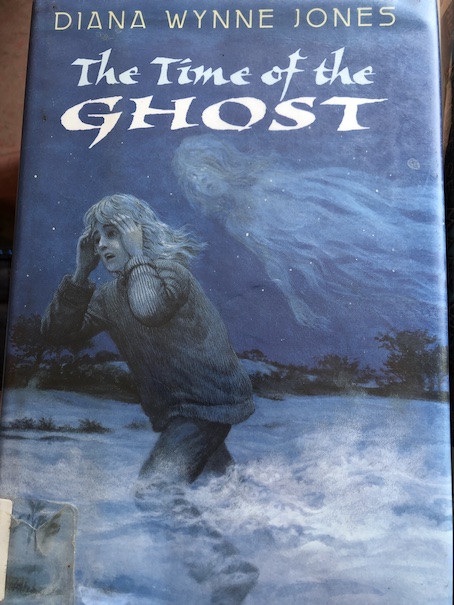
Noleen-Anne Maypother’s mother died shortly after she was born, while holding her for the first time, so her life started with her first encounter with death. Since then, Noh has been raised by her widowed father with some help from her two aunts. Noh doesn’t realize it, but there’s usually one child in her family in each generation who has unusual talents, and in this generation, it’s her.

One summer, her naturalist father is going to study newts in the Appalachian Mountains, so he sends her to stay with one of her aunts. However, when she arrives, she finds out that her aunt has gone on a trip to the beach with her cousins because she wasn’t expecting Noh to arrive. Unsure of what to do at first, Noh realizes that she can just go to her other aunt, Aunt Sarah, who teaches English at a boarding school. Noh is supposed to attend this boarding school this coming fall anyway, so she decides that she can just go to the school early.

By the time Noh arrives at the school, her father and Aunt Sarah have realized what happened, and Aunt Sarah is expecting Noh to arrive. From the very beginning, this school is strange, though. Noh likes the school, but she has an odd encounter with a strange old lady when she tries to take a shortcut through a cemetery, and the woman gives her something that looks like an evil eye.

Later, when Noh is exploring the school, she meets a friendly girl called Nelly. Nelly chats with her, but Noh feels uneasy around her, for some reason. Although Noh doesn’t realize it right away, the reason is because Nelly is dead. Nelly is part of a group of ghosts who inhabit the damaged West Wing of the school, where no students live now.

Each of the ghost children who “live” there now died at the school at varying points in the past. Nelly died from an allergic reaction to a bee sting, which was ironic because she always wanted to be an entomologist. Trina died falling from a horse, although that doesn’t keep her from being friendly and nosing into other people’s business. She likes to follow living students around and listen to their gossip. Henry is an older ghost, having died at the school at the age of 13, about 50 years earlier. He is lonely for his parents and his old life, even though he has the other ghosts for company, and he sometimes broods over the letters he got from home before he died. Thomas is older still. He’s been dead for about 80 years, and he likes watching the school’s cook make pies in the kitchen.

At dinner that night, Noh tries to ask about Nelly because she notices that she is the only child among the faculty. The adults tell Noh that there are no other students at the school yet and that they’ll arrive in the fall. Someone suggests to Noh that maybe she saw a ghost, and Noh starts to wonder. When she returns to the West Wing to investigate, she meet Henry. Noh is startled at this confirmation that there are ghost children at the school, and Henry is startled that a living person can actually see him. There are plenty of ghosts around the school, but Henry has never met a living person who can see ghosts before.

While the two of them are talking, something strange happens. A bright light appears, and Henry goes into it, disappearing. Noh doesn’t understand what happened or what it means. However, when she meets Trina later, she learns that other ghosts around the school have vanished, and Trina is worried. It seems to have something to do with the strange parades of ants that have been moving across the school, carrying something white with them.

Strange things have been happening at this school for generations. Noh learns that it’s a place that attracts people with unusual abilities, and it has been home to bizarre experiments and a shape-shifting monster that wants badly to eat “something big” as well as home to various ghosts. There are secret passages and hidden rooms and faculty who seem to know much more than they want to tell about the mysterious things that happen there. Noh must learn the school’s secrets to help her new ghost friends!

I enjoyed this creepy story. I think it was well-written and fun to read, although I also did feel like Noh figured out some things unnaturally quickly at the end. In the end, readers are given enough answers that the plot makes sense, and we can get a general pictures of what’s been happening at this school, but there are some things that appear intentionally open-ended. It felt to me like the author was setting up this story to be the first in a series, but as far as I can tell, it doesn’t have a sequel.

The story combines many elements of classic scary stories – spooky boarding school, ghosts, weird teachers with secret knowledge, secret passages and hidden rooms, girl with apparent psychic abilities that she doesn’t fully understand, secrets buried in the past, a bizarre invention that appears to have been made by some kind of mad scientist and has an unknown purpose, and a lurking monster that wants to eat someone. Although the story has plenty of creepy elements, they’re softened by humor along the way. There is a monster referred to as the “nasty thing that refuses to be named”, which appears periodically throughout the story to remind us that it once ate “something big”, that what it ate was “really big”, that it wants to eat “something big” again, that it can tell that readers don’t like it but that it doesn’t care what you think, etc. By the end of the story, we are told what the monster actually is, but it’s still on the loose, leaving it open to Noh and the ghost kids trying to hunt it down again later.

The author, Amber Benson, is also an actress, known for her role on Buffy the Vampire Slayer.

The Scandalous Sisterhood of Prickwillow Place

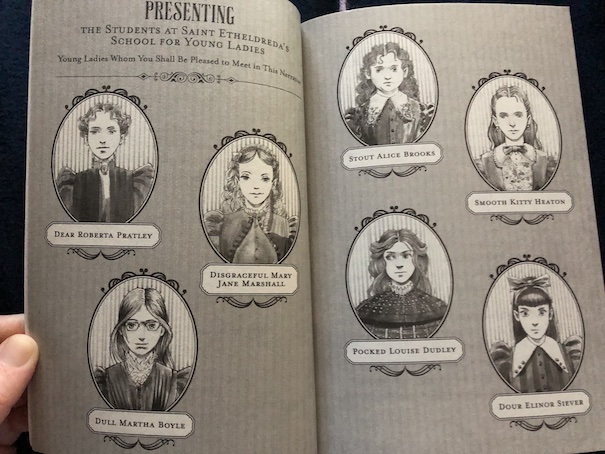
The story is set in England in 1890. There are seven girls at the proper Victorian boarding school known as Saint Ethelreda’s School for Young Ladies on Prickwillow Road in Ely. As the beginning sections of the book explain when they introduce the girls and members of their families and acquaintances, they were all sent to Saint Ethelreda’s because their families want them to become proper Victorian young ladies, ready to make suitable and socially-acceptably marriages. Some of the girls have defects in their characters or personal interests that are considered entirely unsuitable, and their families are hoping that the school’s discipline and propriety will cure them.

“Dear” Roberta Pratley – Her mother died while she was still young, and her father remarried. It was her stepmother’s idea to send her to boarding school, thinking her too soft, clumsy, awkward, and overindulged by her late mother. Her stepmother hopes that boarding school will strengthen her and turn her into a more graceful young lady. Roberta is known for being gentle and kind. She’s good at sewing.

“Disgraceful” Mary Jane Marshall – She was sent to boarding school by her mother, who has noticed that Mary Jane, while still rather young, is very pretty and precociously flirtatious, with a tendency to attract disreputable and penniless young men. Worse still, Mary Jane enjoys the company of these disreputable young men and regularly slips away from her mother to see them on the sly. Fearful that Mary Jane’s recklessness with young men will lead her into a disastrous marriage too early in life, her mother enrolled her in an all-female boarding school to keep her away from boys and, hopefully, give her a chance to mature and improve herself. So far, it’s not working. The only non-disreputable young man who interests her is the young local police constable.

“Dull” Martha Boyle – Martha has four brothers at home who make her life miserable with their pranks and teasing. Boarding school gives her an escape from them. She isn’t considered very bright, but she has a talent for music. She has a crush on a nearby farmer’s son.

“Stout” Alice Brooks – Poor Alice has a tendency to put on weight and is often compared unfavorably to her cousin Isabelle, who seems to be able to eat anything she wants without putting on an ounce. Alice doesn’t really hate Isabelle for this, but she’s tired of her grandmother’s criticism over it. She has a crush on a young law clerk.

“Smooth” Kitty Heaton – Kitty’s mother died when she was only four years old, and Kitty has no other siblings, which is a disappointment to her father, who hoped for a son to take over his business enterprises one day. Kitty’s father largely ignores her, and he has not yet noticed that Kitty is developing some shrewd business skills herself.

“Pocked” Louise Dudley – Louise’s face is scarred because she contracted smallpox at a young age. She survived this potentially-deadly illness because her devoted uncle, a talented doctor, nursed her through it. Ever since, she has revered her uncle and looks up to him as a mentor. Her uncle enjoys sharing his scientific and medical knowledge with her, he encourages her studies, and he thinks that she has the potential to a be doctor herself. Unfortunately, Louise’s parents don’t think that this is a proper profession for a young lady, so they sent her to boarding school to learn the kind of skills young ladies need to know to be wives and mothers. However, Louise has not given up her scientific interests.

“Dour” Elinor Siever – Elinor has a macabre side to her personality. Actually, her macabre side is most of her personality. When she was younger, she started sneaking out at night to explore, and she watched with fascination as the old grave digger in her town exhumed bodies to rob them or sell them for medical experiments. When the old grave digger spotted her watching him, she gave him a fright, and when her parents found out what she’d been doing, they packed her off to boarding school to put an end to this morbid interest and encourage her to be a sweeter, more cheerful, and more normal girl. None of that is working, but her morbid interests are about to come in handy when death comes to the little school.

One evening, while the headmistress of the girls’ school is dining with her visiting brother, both the headmistress and her brother are poisoned. The girls are saved because they were not eating the same food. Realizing that the headmistress and her brother are dead and quickly concluding that they were murdered, the girls debate about what to do. They consider calling a doctor, but it’s obviously too late for that. They could get the police, but before they do, the girls stop to consider what this will mean for themselves.

They have no idea who poisoned the headmistress and her brother. The girls prepared the food they were eating, so the poisoner could have even been one of them, or at least, they could be potential suspects. At the very least, the death of the headmistress means the end of the school, and the girls will all be sent home to their families. The truth is that the girls don’t want to go home. Each of them has some sort of tension at home or a reason why they were sent away, and they’ve all become like sisters to each other. More than anything, they want to be able to stay together and have some freedom from their tensions at home.

With their headmistress gone and no adults around to tell them what to do, what not to do, or how to be, the girls realize that they have unprecedented freedom to do as they like and be themselves, but that’s not going to last if they’re suspected of murder. Kitty is the first to suggest that they not tell anyone that the headmistress and her brother are dead, but she’s also the first to realize that, if they don’t find out who killed them, there will be a scandal, and each of the girls will be under suspicion for the rest of their lives. While Kitty relishes the idea of taking charge of the other girls and having them organize their own lessons and self-study from now on, according to the subjects that interest each of them the most, they also need to investigate and solve the murders. There is little hope for any of their future prospects if they have to go through life as murder suspects.

Their first problem arises when some friends of the headmistress and her brother show up unexpectedly as part of a surprise party for the brother’s birthday. Acting quickly, the girls hide the bodies and convince the guests that the brother has gone to India suddenly to tend to a sick relative and their headmistress has gone to bed because she was feeling unwell. However, one of the girls accidentally injures the ankle of the choir teacher, who has to spend the night at the school, causing them further complications. Desperately, the girls try to cover up the fact that their headmistress is dead and buy themselves time to investigate.

Although none of the girls is what their families consider a proper Victorian young lady, they each have skills that are useful to their deception and investigation. Kitty is good at organizing and managing people, and Mary Jane knows how to charm them. Elinor isn’t afraid of handling the dead, and Louise has scientific knowledge. Alice is the right size to pose for their headmistress in her clothes, and she has some acting ability.

Can the girls find the real murderer before someone figures out that two murders have taken place and blame the girls for them? What will the girls do if it turns out that the murderer is one of them? And, if it’s not one of them, what’s to stop the murderer from trying to kill again if he believes the girls’ ruse that their headmistress is still alive?

The book is available to borrow and read for free online through Internet Archive (multiple copies).

This is a humorous mystery with delightful characters! Although none of the girls is quite what their families or society wishes they were, readers will see that some of their supposed defects are actually strengths and skills. The humor in the story is dark, and the girls are unsentimental about the deaths of their annoying headmistress and her odious brother. They explain the reasons for their lack of sentimentality through their explanations of the victims’ characters. Neither of them was ever very nice to the girls, and they both had dark sides to their personalities.

Because some of the girls have morbid tendencies or possibly scandalous sides to their personalities that they need to cover up, it is plausible from the beginning that one of them could have had a reason to kill the headmistress, leaving readers more in suspense about the identity of the murderer. Although the girls love each other like sisters, there are moments when even they question whether they can really trust each other. However, the introduction of the headmistress’s friends and associates add other possible suspects to consider.

The first half of the book is largely about the girls getting themselves organized and covering up the deaths of the headmistress and her brother. They get more into solving the murders about halfway through the book, although they begin developing suspicions before that. I was pretty sure from the beginning that none of the girls did it, although the book does a good job of making it plausible that they could have. However, the girls soon learn that there were sides to their headmistress and her brother that they didn’t know about.

Early on, I had a theory that there could be more than one murderer involved. The headmistress and her brother didn’t seem to have exactly the same symptoms when they died, so I thought that it was possible that they were poisoned by different people coincidentally at the same meal. That’s not quite the right answer, although the parts of the story that made me think so are actual clues to what really happened. There are multiple villains in the story, some working together and some not. Some of what I suspected turned out to be true, but not all of it, and I didn’t figure out the whole situation before the characters explained it.

During the course of their adventures, the girls remain friends, and they also come to realize some things about themselves. Some of the girls develop budding romantic interests. Whether or not those fully develop, we don’t know, but it appears that there’s someone out there for everyone. Even Elinor finds someone to bond with over her morbid fascination for death. Some of the girls also come to realize talents they didn’t fully consider before and begin developing ambitions for their future. Kitty comes to reckon with her father’s lack of interest and emotional connection with her, and she also comes to realize that she shares some traits with him, even some of the less desirable ones. She realizes that she doesn’t want to be like her father, cold and commanding. While she felt little for her old headmistress, she was primarily motivated by her warm feelings for her best friends and fellow students, whom she regards as sisters. Because of her father’s detachment, she desperately guards the only warm connections she has in her life. Fortunately, the book has a happy ending. Circumstances allow the girls to continue with their education together in a way that supports all of their interests and under the guidance of someone who truly cares for them and understands them.

Tom Brown’s School Days

This classic children’s book from the mid-19th century is famous as the story that popularized the concept of British children’s boarding school stories, although many people in the 21st century haven’t read it themselves.

Young Tom Brown was brought up in a very close family, although they are often given to quarrels and drama among each other. He is the eldest of his parents’ children and spends his early young life in the vale where he was born, raised by his family and his nursemaid, Charity. Tom’s mother has a talent for training young servants. She is kind and patient with servants in training, treating them almost like older children of the family. Charity is rather clumsy and not too bright, and she has her hands full with young Tom. He is a strong and rebellious little boy. Charity’s relatives have a farm nearby, and she takes him there to pick up supplies for the Brown household. The people on the farm are kind to Tom, and they also help raise him. Because Tom resists training and supervision from women, the Brown family eventually hires an older servant, Benjy, to take care of Tom from about age four. Benjy takes little Tom fishing and tells him stories about the history of the Brown family. Generally, Tom’s early childhood is pleasant and easy.

As Benjy gets older, he is troubled more by arthritis and finds it harder to keep up with young Tom. Tom gets a governess at home, and when Tom begins lessons at the local school, he begins to calm down at home because he spends his energy at school and playing with the local boys in the village. Being friends with other boys his own age is good for Tom because they share the same interests and levels of energy. They play games and wrestle with each other for fun. Then, when Tom is nine years old, his family sends him away to boarding school. There are some sad goodbyes from the local boys in the village, and the other boys give him some little toys as going-away presents. This is the first time that Tom has ever been away from home, and this is where the story of Tom’s education really starts.

Tom spends about a year at a private school before going on to a public school. The author pauses here to explain the differences between British private schools and public schools. Unlike in the United States, “public” schools are still schools that require school fees, but private and public schools differ in who is accepted as a student and how the students are treated in their time outside of class. In the author’s time and young Tom’s time, students at private schools are more closely supervised in their off hours, with the idea that molding the students into good citizens (which is considered a higher goal in their education than the subjects taught in the classroom) cannot be adequately accomplished in classroom time only and that most of it takes place outside of the classroom. At public schools, the author says, the boys have more freedom and less supervision outside of class.

The boys at the private boarding school Tom attends are supposed to be supervised by school ushers, who monitor their behavior, resolve quarrels, and set a good example for them. Unfortunately, the ushers at Tom’s school aren’t very well educated or good at their job, and they have little interest in doing their job properly. As a consequence, the older students bully the younger ones, students are encouraged to tattle on each other, and physical punishments are used to keep the students in line. In spite of this and some homesickness, Tom actually has a pretty good time at school with his new friends at school. They have some adventures (some of which involves cruelty to animals they find, and the author makes it clear that he doesn’t endorse this and thinks that the bee stings they get are earned) and delight in scaring each other with ghost stories at night. However, this school isn’t really the best treatment or education Tom can get, so it’s just as well that he is sent to a public school after this.

Tom’s change in school comes when there’s an outbreak of disease in the area, and the schoolmaster of the private school is one of the people to become ill. All of the boys are sent home to their families. Since Tom has already told his father that he would rather attend a public school and since school at the private school is canceled for the rest of the term, Tom’s father decides to send him to Rugby. When Tom goes to Rugby, his father talks to him about his school experiences. Tom’s father says that he is going to Rugby at a younger age than he had planned to send him, and if schools are still like they were when he was young, he’s going to see people doing many cruel things and will hear bad talk from other people. He urges Tom, whatever happens at school, to be brave, kind, and truthful and, no matter what other people say, to not say anything he wouldn’t be willing to have his mother or sister hear him say. If he does these things, he won’t have to feel ashamed to see his family when he comes home from school, and they won’t be ashamed of him. This talk and the thoughts of his mother make Tom a little emotional, although he tries not to show it too much.

Tom’s father privately reflects on the reasons why Tom is going away to school. Partly, Tom is going to school because Tom really wants to go and have that experience. The fact is that Tom’s father doesn’t really care too much about Tom learning subjects like Latin, and his mother doesn’t care too much about academics, either. Tom’s parents aren’t too concerned about what kind of scholar Tom is. What Tom’s father really wants for Tom is what he has already told him to be. He wants his son to be brave and truthful, and he wants Tom to be a good and helpful English gentleman and a Christian. Basically, he’s more concerned with his son’s character and life choices than with his son’s grades. He thinks about whether or not he should warn Tom about various temptations he might experience at school, but he decides not to because Tom is still just a boy, and he thinks he wouldn’t understand.

Tom takes a stage coach by himself to school, nervous about what the school will be like but excited about the the experiences he is about to have. When Tom arrives at Rugby, a more experienced student, Harry East, helps Tom get settled and acts as a mentor to Tom about school life. East’s aunt is an acquaintance of Tom’s family, and she knew Tom would be coming to Rugby, so she asked East to hemp Tom. He explains the school grounds and uniform pieces to Tom, describes student activities and sports to him, and answers his questions.

Tom loves sports and is eager to play Rugby football, but East tells him that he won’t be able to play until he learns the game. Football is different at Rugby, and it’s a much rougher game than other schools play. East says players often get hurt and break bones. There is a match that day, and Tom finds it exciting to watch, especially since their house wins! After the match, East says that he doesn’t have any allowance money right now, so Tom buys some food they can have for tea, and they share some of it with some of the other boys from their school house. Tom starts making friends with the other boys, and they all talk about the match together.

After tea, East says that it’s time to join their house for singing. Tom is surprised, but East says that group singing among the students is a regular school activity. There are also speeches from other students at the school singing. Today’s speech is about their house’s victory at the football match. One of the students speaking, Brook, praises the players and congratulates them for their victory on behalf of the house, with all the other boys cheering. He says that their house won the match because their house has the best house spirit and team spirit, and they know they can depend on each other. However, he also issues a warning to the students about bullying in the house. Some of the older students have been picking on the younger ones. He doesn’t want to encourage tattling among the students, and he says that learning to deal with bullies is a valuable skill that makes a boy tougher, but at the same time, bullies are cowards, they encourage cowardly behavior among others, and they break up house spirit and bonds of teamwork among the students. He cautions everyone that too much bullying and allowing bullying to continue will destroy the house spirit that helped them win today, so if they want to continue winning and enjoying house victories, they’d better cut it out. Some of the younger students look at the older students have been doing the bullying, especially a boy called Flashman.

Brook also cautions the other students against drinking in the local pubs and talks to them about their new headmaster. Some of the students haven’t been happy with him because he’s changing some of the school customs. Students have been grumbling and would like to see the new headmaster gone, but Brook points out that Brook isn’t going anywhere and that the “customs” he’s been changing have been destructive pranks and other habits that were also causing problems. The new headmaster hasn’t touched some of the customs that really matter to the students, like their sports, and in fact, the headmaster was also watching the match today. There are mixed feelings among the boys at this part of the speech because they like the idea that the headmaster, who they call “the doctor”, was watching the match, but at the same time, the boys don’t really know him or trust him yet.

The author notes that the new headmaster found the school in a state of disorder and mismanagement when he took his position, and the changes he’s been making are about restoring order to the school. The boys, not knowing the difference between a more orderly and well-managed school and the one they got to know when they first arrived, don’t appreciate the doctor’s wisdom of kindness yet. Tom first encounters the doctor when he leads the students in prayers.

Before bed, Tom and the other younger boys meet with some bullying from Flashman and Flashman’s cronies. Some of the other boys are terrified, but Tom and East allow themselves to endure the bullying, being “tossed” by the older boys so the other boys will be spared. The other boys are grateful to them for this, so they start to hold Tom in high regard.

This eventful first day is a good introduction for Tom about what life at Rugby School will be like for him. Sports, bullying, pranks, fighting, camaraderie among the other students, singing, speeches, and the new headmaster are going to be major themes for him in his education. Like other younger students, Tom has to act as a servant and do chores for older students, part of a tradition called “fagging” (more about that below in my reaction). Tom does well in his classes at school because he has already had a good grounding in his subjects, and he is generally positive about his life at school, in spite of the bullying. He loves participating in the school sports and physical games, like Hare and Hounds.

However, things do get harder for Tom at school. Because he is doing so well at his grade level, he is quickly promoted to the next. When he gets there, with some of his new friends, like East, Tom becomes less studious and more unruly, like the others. Also, the older boys who were trying to set a good example for the others and protect the younger students from the bullies graduate from the school, leaving bullies and less conscientious students as the senior students. The bullying gets worse, and as Brooks had predicted, it breaks the spirit of teamwork in Tom’s house. The students in the house start dividing into factions of bullies and bullied, the younger students against the older.

The younger students get increasingly resentful of the ill treatment and bullying of the older students and start getting rebellious against the system of “fagging” at the school, with Tom and the others declaring that they simply won’t serve the older students anymore. When students like Flashman the bully call for them, they just pretend they don’t hear and refuse to answer them. Flashman and the others try to physically break into Tom and East’s room when they refuse to come, but Tom and East barricade themselves inside. Their success against the older students encourages other students to rebel. Tom considers going to the headmaster about it, but the others discourage the idea. None of the students want to go to the schoolmasters unless absolutely necessary because the students think that the right thing to do is to work out their own problems with each other.

Diggs, one of the older students who is nicer tells the others that, when he and Flashman were younger students, the students in their grade also rebelled against the older students to teach them not to bully them, but Flashman didn’t rebel with the others. Instead, he ingratiated himself to the older students, continuing to serve them and bribing them with treats he got from home. He has evaded discipline and consequences for his behavior by making himself into a useful toady for the students with more authority. Now, Flashman and his cronies increasingly bully the younger students and use physical hurt to subdue them. The younger students retaliate against them with pranks. Tom and East become Flashman’s particular enemies because they live close together in their house and because Tom and East started the rebellion and have been open and accurate in their criticism of his cowardice, refusing to be subdued by the beatings he gives them.

Matters with Flashman come to a head over a lottery, when Flashman pressures other students to turn over their tickets to him. Tom refuses to part with his, and Flashman and his cronies beat him and burn him, hurting him so badly that Diggs intervenes, worrying that they might kill Tom. Diggs shows Flashman to be a coward when he confronts him over the incident and hits Flashman, but Flashman doesn’t fight back because he’s afraid of getting hurt himself. This doesn’t end Flashman’s aggression against the younger boys, and when he starts getting worse again with Tom and East, Diggs urges the two boys to gang up on Flashman. For them to fight him singly wouldn’t be a fair fight because Flashman is several years older than they are and bigger, but Diggs considers it fair for both of them to stand up to Flashman at once. To Flashman’s shock, the two boys do gang up on him. He’s much bigger than they are but not as good at fighting and pretty cowardly about fights where he doesn’t have some obvious, overwhelming advantage. Tom and East win the fight, giving Flashman a cut on his head that bleeds. At first, Tom and East are worried about whether they’ve hurt Flashman badly, but Diggs has a look at the wound and tells Flashman off for being dramatic about how hurt he is. Flashman has only skinned his head a little, and he’s done much worse to the younger boys. Flashman never physically fights the boys again. He eventually leaves the school, being sent away by the headmaster after he becomes disgracefully drunk at a nearby pub one evening. The headmaster was already displeased with Flashman, and this was the last straw. The younger boys are glad to see the bully gone, although some of the older students bear some resentment against the younger ones for their rebellion and their triumph over someone from their level.

Tom and East are emboldened by their victory and for moving up at school, and they become regular rule breakers. They never consider the justice or reasons behind school rules, taking them more as challenges. They get into trouble for trespassing on someone else’s land to go fishing, and the land owner’s gamekeeper brings Tom before the headmaster. Later, Tom and East climb onto the roof of the school and carve their names on the minute hand of the school clock. They are caught because they accidentally change the time on the clock, and when someone investigates why the clock is wrong, finds their names.

Later, they sneak into town against the headmaster’s orders and get caught. They are both taken before the headmaster for this, and they receive floggings for their stunts. The headmaster also gives them a lecture about the dangerous nature of some of their stunts, pointing out that they could have fallen and broken bones from the clock stunt. He points out that they never think about the reasons why rules exist, thinking of them only as whims of the schoolmasters, which isn’t the case. The rules exist for good reasons, and they apply to everyone at the school, including Tom and East. The headmaster says he doesn’t want to keep giving them floggings for their stunts, and if they can’t gain some maturity and reform their behavior, he’ll send them both away from the school. Tom and East are shocked because they never thought that they might have gone far enough to risk their positions at the school. They love their lives at the school and don’t want to be sent home in disgrace. The headmaster tells them to think about their futures at the school seriously when they go home for a term break.

Privately, the headmaster has a word about the boys with one of the other schoolmasters. The headmaster is concerned that, if they continue their irresponsibility and recklessness, they will fail their studies, get into some really serious trouble, and possibly turn into thoughtless bullies of the younger children as they get older. The other schoolmaster acknowledges that they are not the best students and they are a problem, but he thinks that they’re not really bad boys and could still be turned into decent young men. He says to the headmaster that what these boys need is something to give them a sense of responsibility and suggests making each of them responsible for a younger boy at school. Protecting a new boy from the older bullies could settle them and make them more serious and responsible and prevent.

When Tom returns to school for the next term, he expects that he and East will be allowed to share a room and study, which is something that they’ve hoped for. They’ve been making plans for all the ways they can have fun and goof off in their own space. Instead, the school matron introduces Tom to a new boy who will be sharing his room and who will be Tom’s responsibility. George Arthur is a pale, timid, skinny boy, and Tom can see that he’s just the sort of boy who would be picked on by the others. Tom is annoyed at having his plans with East spoiled, but the matron stirs his sense of sympathy by telling him that George Arthur’s father is dead and that he has no brothers. Tom can see that young Arthur will probably be made miserable at school by bullies unless someone stands up for him and teaches him how to handle life at school, so he agrees to take responsibility for him.

The schoolmaster is correct that looking after little George Arthur changes the way that Tom looks at himself, his fellow students, and his education. The change starts when Arthur says his prayers openly at night, getting him a teasing from the other boys, who take any sign of weakness or sentiment as an opportunity for teasing. Tom defends Arthur from them. He also feels a twinge of shame because he remembers, for the first time in a long time, that he had once promised his own mother that he would always say his prayers at night, and he has become neglectful about this, specifically because he wanted to avoid the teasing or bad opinion of the other students. It shames Tom a little to think it, but he realizes that, although Arthur may be physically weaker than he is, he has displayed more moral courage than Tom has simply by saying his prayers, regardless of what the other students think.

Looking after Arthur gives Tom a sense of responsibility, as the schoolmaster hoped, and Tom appreciates feeling like he has a purpose. He enjoys seeing timid Arthur beginning to develop as a student and start to make a new friend on his own. However, Arthur also has things to teach Tom. Tom’s friendship with Arthur helps his own personal development and causes him to consider sides of himself he hasn’t thought about much. As Arthur opens up more to Tom, he explains that he is serious about religion because his late father was a clergyman. When he was alive, his father used to read the Bible with him. Inspired by Arthur’s example, Tom becomes more serious and starts exploring his religious side, although he takes some teasing and criticism from the other students over this budding sentimentality and defense of little Arthur. Tom and East start participating in Bible readings and study with Arthur, considering some of the deeper questions of life and religion that they’ve never considered before. They begin to think even more deeply about life and death when a disease spreads through the school. Arthur becomes ill and another boy dies. Tom is relieved when Arthur recovers, but his near death and the other boy’s death cause Tom to really consider life and death seriously for the first time.

As Tom develops a deeper understanding of life and religion, he finds himself a little at odds with East, who still doesn’t take life seriously. Fortunately, the two of them respect each other enough as friends to talk about their views seriously with each other. Tom doesn’t consider himself as knowledgeable about the subject or as good as explaining it to others as Arthur, but through their conversation, East realizes that he does actually care about the subject and goes to talk to the headmaster about his feelings and about confirmation. The headmaster’s kind understanding and reassurance is an inspiration to the boys, and they come to respect him, although Tom doesn’t fully understand the headmaster and what he’s done for the boys until he is a young man.

At the end of the story, Tom is with some college friends when he hears that the old headmaster has died, and he feel compelled to visit Rugby School again to pay his respects and reflect on his old headmaster.

The book is now in the public domain. It is available to read for free online through Project Gutenberg and Internet Archive (including an audiobook version). Tom Brown’s School Days has been made into movies and tv films and miniseries multiple times. There is also a sequel to this book called Tom Brown at Oxford, which focuses on Tom Brown’s university experiences.

Although it was not the first book set at an English boarding school, this 19th century book is famous for being the book that popularized the trend of British boarding school stories, which has continued for over 150 years since! There are also references to this specific story in other books, and I have to admit that it gave me a giggle to recognize the scene that Terry Pratchett parodied in his novel Pyramids. The story is semi-autobiographical, based on the experiences the author, Thomas Hughes, had when he attended Rugby School as a boy during the 1830s. There is now a statue of Thomas Hughes outside the Rugby School Library.

The headmaster in the story is only called “the doctor” for most of the story, until the very end, when Tom learns of his death and his last name is given as “Arnold.” Tom’s headmaster is based on Thomas Arnold, who was the real, historical headmaster of Rugby when the author of the book was a student there himself. The real Thomas Arnold did die suddenly of a heart attack at age 46 in 1842, and this book is an homage to his memory as well as the recollections and thoughts of the author on the subject of education. The real life Thomas Arnold did reform the habits and organization of Rugby School, like the headmaster in the story, focusing on the religious and character development of students and creating a system of prefects called “praepostors” as student monitors, something that is referred to in the story. Other British boarding schools copied and built on his ideas and practices. (Added fun fact: Thomas Arnold was the great-grandfather of the author Aldous Huxley, known for Brave New World.)

The book requires some patience for modern because the author spends some time setting the scene and explaining the background of Tom’s family and early childhood before really getting into the story. Part of the reason for that is that the author, Thomas Hughes, based the story on his own childhood and youth, and he spends some time comparing the childhood and conditions of life in young Tom’s time with life at the time he wrote the story.

Hughes admits that he doesn’t like the direction the social situation has been heading in his time, and he feels that his time period is at a changing point. He sees many of the old ways of life falling aside, and he partly blames the new upper classes, who take advantage of the working class, using them to enrich themselves (“buying cheap and selling dear”). He’s describing an increasingly industrialized and urbanized society with a significant wealth gap between the wealthiest members of society and the working class, which was characteristic of Victorian society. Hughes notes that some members of the upper classes profess to be trying to reform the lower classes, but the author says they don’t really understand the working classes at all. There is part of the story, early in the book, after he describes young Tom’s experiences at a local fair, where he delivers a lecture to the younger members of these rising upper classes on the subject. Hughes was a social reformer in the Victorian era, so he has many thoughts about how to improve society and a pretty accurate understanding of social conditions during his lifetime, and he works them into the story of Tom’s education.

It’s interesting to see Thomas Hughes’s descriptions of Rugby School and boarding school life and education in the 1830s. I’ve never been to a boarding school before, and neither have most of the other readers who enjoy boarding school stories. It’s getting to see a type of school that most of us will never attend that makes stories of this kind fascinating. Seeing them as they looked in the past is especially fascinating. I’ve read other books and seen documentaries about boarding schools in Britain, and it was interesting to note the aspects of school life that are the same or different from what someone might encounter in a modern school. From what I’ve learned about British boarding schools, extracurricular activities, like sports and singing, are still major features of British boarding schools that have stood the test of time. However, modern schools have cracked down on bullying and abuse from older, higher level students.

A couple of words that appears in the story, “fags” and “fagging” sound like derogatory terms from modern times, but it has nothing to do with homosexuality in this context. “Fagging” was a tradition at British public schools of this time and earlier, where senior students used younger students as servants, giving them menial chores to do. The “fags” described in the story are younger students, who are described as performing various tasks, like fetching things for the older students, cleaning, carrying messages, or arranging furniture for singing. The problem with the tradition of fagging was that it often led to bullying and abuse of younger boys at the hands of the older students, and this is something that’s addressed in the story. The bullying and abuse associated with this tradition is what led to the end of the tradition in modern times.

There are also other student habits which would seem odd by modern standards, including some which would definitely not be allowed for boys of this age. The students at the school are about 11 to 19 at the oldest, but they routinely drink beer, even the younger boys, although I think it’s probably a weak version. The ways the students are treated with regard to money and how they spend their money are also odd by modern standards. Their allowances may be withheld from them as a punishment. There are times in the story when students in need of money auction off some of their own belongings, a subject that appears in A Sweet Girl Graduate, although the boys don’t get in trouble for this as the girls in A Sweet Girl Graduate did. The older boys also impound the allowances of the younger boys for a lottery at one point, using the funds to purchase sweepstakes tickets on a horse race. The younger boys are not consulted about their participation in the gambling, and the only problem that arises from it is when Flashman tries to bully them out of their tickets to get ones he thinks are likely to win.

As the author reflects on his time at school, his experiences with friends and classmates, and the inspiration of his old headmaster, he also offers advice to other boys and his thoughts on what it means to be a man and to take charge of ones own development. I don’t think modern parents and teachers would agree on all of his advice, but he makes it clear what experiences from his school days have led him to believe what he does about how boys and men should conduct themselves.

At one point, he says that he has no problem with the idea of boys fighting with each other because he sees fighting and struggling as just part of the role of men in life. He says his only concern is whether or not they’ve chosen the right side to fight on. Flashman serves of an example of how bad people can actually be quite popular, at least among their cultivated cronies, and are often supported by the social system or know how to use the system to their advantage. The author warns other boys not to see another person’s popularity or social position as a sign that they are good people or that they are in the right in a situation because the opposite is very often true. What is good and right is independent of popularity, power, and money and is determined by other factors. He admits, through the character of Tom, that he has developed a soft spot for underdogs and says, even if you think the underdog is wrong in his beliefs, he shouldn’t be scorned but respected for his willingness to fight for what he believes, even knowing that he doesn’t have popular support.

At the end of the story, when the headmaster dies, the character Tom despairs because, although he has moved on from Rugby School, and he realizes that many of the boys who are there now don’t know who he is and wouldn’t recognize him as one of them, the headmaster was a guiding light in his life and spiritual development. He still feels ties to his old school and headmaster because his time there and the headmaster’s influence set him on the course for his life and development. The author reflects that Tom the character was still someone self-centered at this age, and in the first shock of hearing about the headmaster’s sudden death, he thinks of the loss of the headmaster as a personal loss that no one else would understand. However, when he returns to Rugby and thinks about it further, he realizes that he is not the only one whose life was touched by the man, remembering that he left behind a wife and children and that the headmaster cared about all of his students and influenced them all in different ways. Tom the character sheds some of his self-centeredness and realizes that it’s time to move on in his life. The author also says that there is a flaw in looking to mortal men, even the kindest and greatest among them, as the ultimate source of guidance because no mortal man lives forever. Tom the character will tend to his own spiritual development from this point forward and look to God Himself for guidance. In this way, it seems that young Tom the character has developed into the kind of young man his father wanted him to be in the beginning, making his education successful.

Before Tom learns of the headmaster’s death, he discusses his future ambitions with an old schoolmaster, saying that he wants to make a difference in the world as well as earn a good living. The schoolmaster cautions him to be certain of his priorities and know which of those two goals is more important. There are many people who spend their lives making money but do nothing of lasting importance for the world and other people, and there are many people who do good in the world without making much money. If Tom focuses too much on making money, he may sacrifice the goal of doing good in the world, so he needs to remember what he really wants to accomplish in his life and what he wants to prioritize.

Thomas Hughes went to Oxford after his time at Rugby School, like his character, and he became a lawyer, social reformer, and member of Parliament as well as a writer. Among his books are books about religion and the nature of manliness. The themes of Tom Brown’s School Days really were the themes of his life, and he genuinely means the advice that he offers to young men in the story.

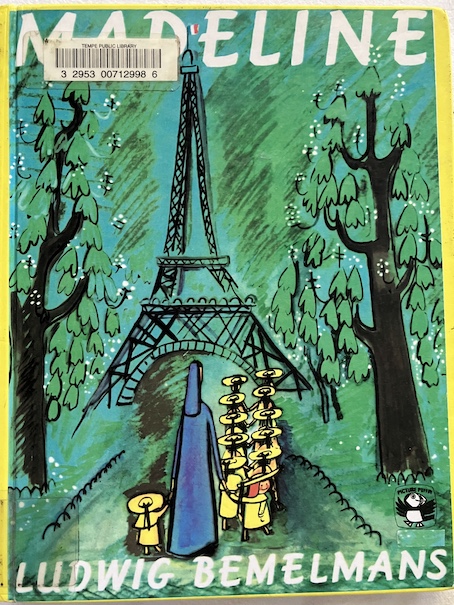
Madeline

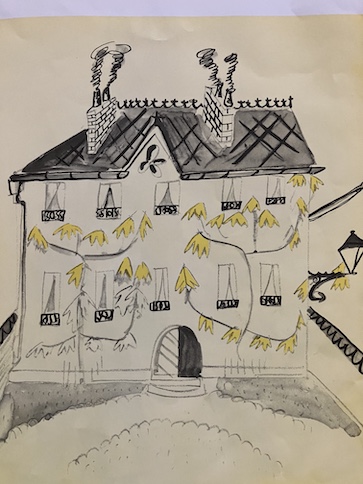
“In an old house in Paris
that was covered with vines
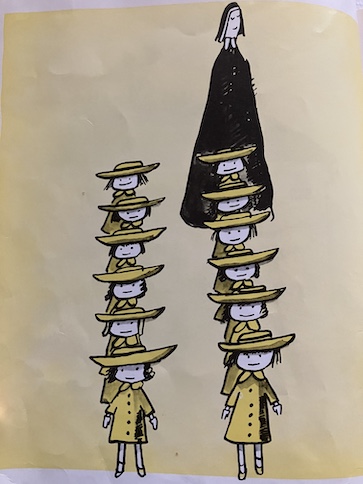
lived twelve little girls
in two straight lines.”

The Madeline stories are considered children’s classics today, and these words, which are the opening lines in other books in the Madeline series, introduce Madeline’s school. Madeline is a little girl who lives in a small boarding school in Paris, tended by Miss Clavel.

Madeline is the smallest girl at the boarding school. She’s a brave girl, who isn’t scared of either mice or lions at the zoo, and she sometimes does daring stunts that frighten Miss Clavel.

One night, Miss Clavel wakes up because Madeline is crying. She calls the doctor, who examines Madeline and rushes her to the hospital because she needs to have her appendix removed.

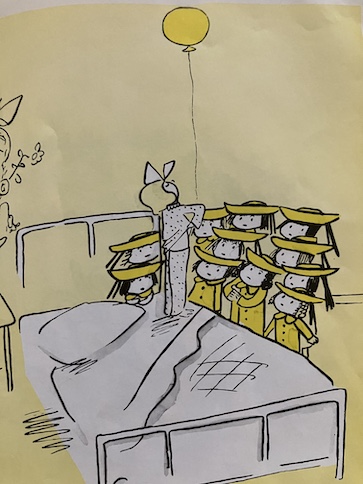
After the operation, Madeline has to stay in the hospital for a while. Miss Clavel brings the other girls from the school to visit her, and they are impressed by all the candy and presents that Madeline has received from her family. Even more impressive, Madeline now has a scar that she shows to the other girls.

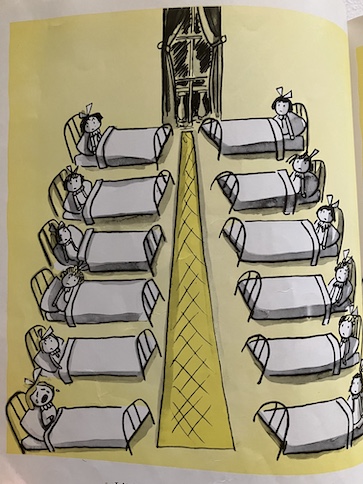
After the other girls return home and go to bed, Miss Clavel wakes up to find them all crying. Madeline has made having her appendix out look like so much fun, they all want to do it!

I wouldn’t say that I was a particular fan of Madeline as a kid, but I did read at least some of the books in the series. As an adult, I had forgotten that they were told entirely in rhyme, even though I still sometimes get those opening lines stuck in my head.

I remember thinking as a kid that I wouldn’t want to have my appendix out! Even if you get presents and an impressive scar, having an operation always sounded awful to me. It didn’t occur to me until I was older, but the Madeline cartoons and movie tended to portray Madeline as an orphan, but she isn’t. She’s just a student at a small boarding school. This book is one of the stories that mentions her family, with her papa sending her a dollhouse as one of the presents she receives while she’s in the hospital.

I also didn’t realize, until I was researching this series for the blog, just how old the first Madeline book was. It was originally published in 1939, on the eve of WWII. I don’t think the books ever have anything in them to tie the stories to any particular events, and they seem almost timeless, although I suppose that the girls’ school uniforms are a little old-fashioned. This timeless, idealized portrayal of Paris was popular with the book’s original audience of Americans during WWII.

I was curious about the author, Ludwig Bemelmans. He was born in Austria and grew up in Austria and Germany during the late 19th century and early 20th century. As a young man, he was apprenticed to his uncle, who owned a hotel, but Bemelmans was difficult to manage and got into trouble while working there. He later told a story about shooting and wounding a headwaiter who whipped him, although that might have been just a tall tale. Eventually, however, his uncle decided that he couldn’t deal with him, so he told him he would either have to go to reform school or go to the United States, where his father was living after having left him and his mother years before. He moved to the United States and lived there during WWI. He spent some time working in a series of hotels and restaurants. He eventually joined the US Army in 1917, although they wouldn’t send him to Europe because the US was at war with Germany, and he was German. He became a US citizen in 1918, and he developed an interest in art. He worked as a cartoonist before writing and illustrating children’s books. He wrote the first seven of the Madeline books, and the last one was published after his death. Since then, his grandson, John Bemelmans Marciano has written other Madeline books.

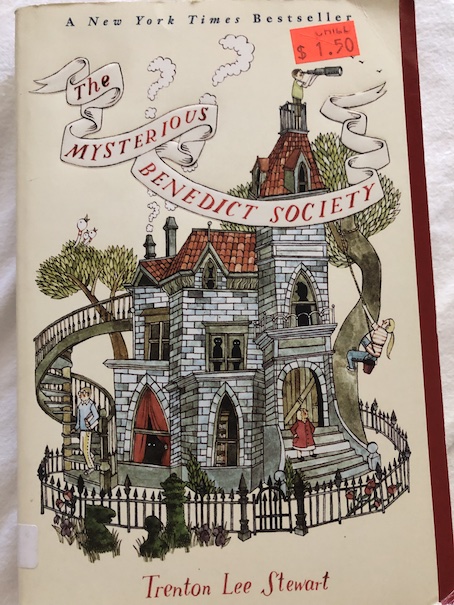
The Mysterious Benedict Society

A boy named Reynie (short for Reynard) is taking a series of tests to apply to an unusual school. Reynie lives in an orphanage in Stone Town, and he is highly intelligent. He is often laughed at by the other children for being smart and using big words. He has finished all of the lessons the orphanage has to offer and has been studying with a private tutor, but he is running out of things to do with the tutor. He and his tutor like to read the newspaper together, and they see an advertisement for gifted children looking for new opportunities. His tutor encourages him to look into the advertisement, which is how he comes to take a series of tests to qualify.

The tests have strange instructions. The first part of the tests asks some brain teaser questions and a few personal questions, such as whether Reynie likes to watch tv or listen to the radio (he doesn’t really like either) and whether he thinks of himself as brave. Only a few children qualify to take the next part of the test, which will be given at another building with students only allowed to bring a single pencil and eraser. The instructions say that if they bring anything else with them, they will be disqualified. Reynie would have asked more questions, but the person giving the first test leaves by a window to avoid having to deal with parents who are angry that their child didn’t pass the first test.

When Reynie arrives at the second building, there are two girls there, one of them with green hair. The green-haired girl accidentally drops her only pencil down a storm drain. Since she is only allowed to have one pencil and the others don’t have a spare one to lend her, it looks like she won’t be able to take the test. The other girl seems relieved that there will now be less competition, but Reynie solves the problem of the missing pencil by snapping his own pencil in half and giving the other half to the green-haired girl, who is named Rhonda. She is so grateful that she offers to help him on the test, saying that she already knows the answers. Reynie doesn’t understand how she can know the answers when they’ve only just arrived, but he turns down the offer because he doesn’t want to cheat. It’s just as well because the person administering this test tells them that cheaters will be “executed.” Then, she tells the shocked children that she means “escorted”, as in they will be escorted out of the building. She tells the children that they must follow the test instructions exactly, and although the test looks fiendishly difficult, Reynie does his best.

It turns out that the test is actually a puzzle and that the answers to all the questions are found within the test itself. Following the instructions shows Reynie how to find the answers. Reynie passes the test and is told to go on to the third part. Reynie wants to talk to his tutor, and the woman who administered the test says that she’s already spoken to her. She leaves Reynie to wait with another boy, who has a bald head. The bald boy, called Sticky as a nickname because things he reads stick in his head, says that, like Reynie, he was the only person in his group who passed the second test. When the boys compare their experiences, they realize that Rhonda was a part of the test. Each of them met a girl who lost their pencil and who offered to let them cheat off her.

The boys are soon joined by a girl named Kate, who is carrying a bucket full of random things, which she says are all useful. As an example, she describes how she met a girl earlier who lost her pencil in a storm drain and how she managed to get it back by using things from her bucket. The boys realize that she also met Rhonda and that she also passed the second test, including the Rhonda portion. Actually, Kate tells them that she failed the test, along with the other kids, but she was allowed to stick around for the next test anyway because she helped out the test administrator when she was cornered by angry parents.

The other tests that the children take are similarly puzzles and brain teasers. They all pass by using lateral thinking and unorthodox approaches that highlight their unusual personalities and unique abilities. When they are informed that they’ve passed the tests, they are joined by a fourth test-taker, who has also passed, weirdly by refusing to try to pass the tests. Instead, the fourth test-taker, a girl called Constance Contraire, passed the tests by questioning everything, including the very nature of the tests and trying to go contrary to every rule. The others can’t understand why she passed the tests when the did the opposite of everything she was told to do, but these tests aren’t like the types of tests students usually take.

After they are told that they passed the tests, the test administrators introduce the four children to the man behind the tests, the mysterious and narcoleptic Mr. Benedict. Mr. Benedict says that he has been trying for years to assemble a team of children with unique abilities to undertake a dangerous but important mission. It hasn’t been easy because he’s had a difficult time finding children who can pass his tests, and until now, too few children passed the tests at once to form the team. The test administrators are actually the first children who passed his tests years ago, but they’re too old to really be considered children now. They’re young adults. Now, with four passing children at the same time, Mr. Benedict thinks they finally have the children they need for the team.

Each of the children has demonstrated their thinking skills and unusual approaches to problems. Each of them is also alone, in one way or another, not accountable to any adults, so they can make their own decision to join the team without asking for adult permission. Mr. Benedict says that joining the team will be dangerous, and normally, he would never want to put children at risk, but the situation is serious, and harm may come to them and other people if they don’t solve the problem at hand. Each of the children considers the situation and decides to accept the offer to join the team. (Constance only joins after Mr. Benedict makes it clear to her that she would be joining not because she was told to join, but because she wants to and that her obedience to the group’s rules would also be because she chose it. Constance never does anything just because someone tells her to, which is part of the reason why Mr. Benedict recruited her.)

The kids are given rooms in Mr. Benedict’s book-filled house, which can only be entered through a complicated maze. They are under the guidance and protection of Mr. Benedict’s three assistants:

Rhonda – She was originally from Zambia and was one of the first children to pass Mr. Benedict’s tests several years earlier. Mr. Benedict adopted her.

Number Two – She is also one of Mr. Benedict’s adopted daughters, but she refuses to tell the children what her real name is, preferring to go by her code name. She always wears yellow and rarely ever sleeps.

Milligan – He is an amnesiac who knows nothing about his early life. He’s not even sure that his real name is Milligan, but it’s the only name he could remember. His earliest memory is about escaping from some people who were interrogating him, and he thinks his amnesia is due to a head injury.

When the children are told that they are being protected at Mr. Benedict’s houses, they want to know who or what they’re being protected from. Mr. Benedict explains that he has discovered that someone is sending subliminal messages to the general public through radio, tv, cell phones, and other forms of electronic media. These subliminal messages are being delivered in children’s voices, which Mr. Benedict thinks is part of the sender’s plan. Adults often disregard things that children say, which makes it easier for the messages to go into the adults’ subconscious brains. Some people, like the children and Mr. Benedict and his assistants, are less susceptible to these messages than other people. Mr. Benedict plays the messages for the children so they can hear what they sound like. The things they say are confusing and annoying, but they don’t sound immediately dangerous. Mr. Benedict says that these same messages are being transmitted in different languages all over the world, and he thinks that they’re merely the precursors to something more dangerous. However, Mr. Benedict things that the messages are merely a prelude to something more sinister. Constance asks why Mr. Benedict hasn’t gone to the authorities with what he knows, and he says that he has tried. He used to be a consultant for law and government agencies, but they no longer believe what he has to say. They think that he’s a crackpot. People who would have believed him and been his allies have mysteriously disappeared, and he is sure that’s also part of the sender’s plot, removing anybody who stands in his way.

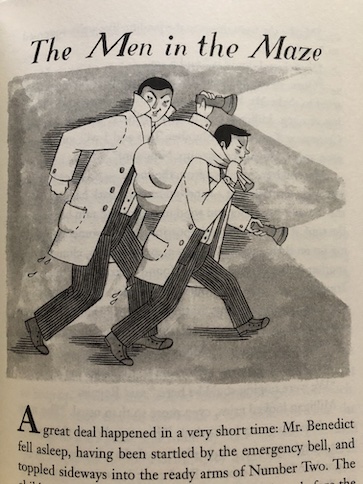
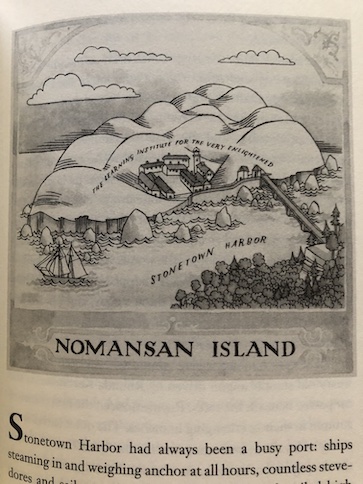
The children become fully aware of the danger when some men try to kidnap them from Mr. Benedict’s house. Mr. Benedict’s assistants subdue the kidnappers with tranquilizer darts and remove them from the house. Mr. Benedict explains that, if they had successfully kidnapped the children, they would have likely taken them to the Learning Institute for the Very Enlightened (the acronym isn’t bad, but the reverse acronym is), which is a mysterious boarding school on an island that teaches orphans and runaways and other children who, like the children in Mr. Benedict’s house, are alone and unsupervised by outside adults. Sometimes, the school also kidnaps vulnerable children to use for its sinister purpose.

Mr. Benedict believes that the mysterious messages are being transmitted from this school by a group of its top students. The dangerous mission that Mr. Benedict has in mind for the team of children is for them to infiltrate the school as students and join this elite group so they can learn the truth about what’s happening and how to stop it.

The children spend some time preparing for their mission at Mr. Benedict’s house while Mr. Benedict and his assistants work on forging papers and getting the children admitted to the school as students. The kids practice learning Morse code and other helpful skills. They also learn a little more about each other and start figuring out how they can work together as a team.

Reynie was orphaned as a baby and has no memory of his parents or his life before coming to the orphanage. Nobody really seems to understand him or care about him except for his tutor, Miss Perumal.

Kate also used to live in an orphanage because her mother died when she was small, and she was apparently abandoned by her father. She can’t remember her mother at all, and she only has one memory of her father from a time when he took her swimming. She remembers him as a nice man, but she thinks maybe she was wrong about that, since he abandoned her. She lived in the orphanage for several years before she ran away to join the circus. Because of her circus life, she’s very strong and athletic, and she’s also surprisingly good at estimating sizes and distances with just her eyes.

Sticky isn’t an orphan but a runaway. He thought that he had a happy life with his parents until they discovered his amazing memory. From then on, they insisted on entering him in contests and quiz shows to earn money. As Sticky won these contests, his parents became more and more money-grubbing, entering him in more and bigger contests. They stopped letting him play with friends and made him constantly study so he would know all the answers to everything. Sticky became stressed out and wanted to quit, but they wouldn’t let him. Eventually, he pretended to run away and hid nearby to see what his parents would do. At first, they were worried and tried to find him, but then, people began donating money to them to help in the search. His parents kept up the search in a nominal way, so people would continue to donate, but they weren’t really interested in finding him. They said to each other that they were getting more money for him not being there, so they were better off with him gone. Sticky was shocked at their lack of love and concern for him, so he left for real. The reason why he’s bald is that he used hair remover to disguise himself from anybody who might still be looking for him.

These three children get along well with each other, but Constance is different. She doesn’t tell the others much about herself or her background. She’s a contrarian who rarely shows any consideration for her teammates. She even refuses to stop calling Sticky “George Washington”, which is Sticky’s real name, but he hates it. Kate wonders why she’s on the team when she’s not a team player and doesn’t seem to have any special abilities. She is much smaller than the other kids and has a generally cranky disposition. Reynie talks to Mr. Benedict about it, and Mr. Benedict assures him and the others that he has a reason for wanting Constance for the team. She has traits that will be of help to them later. Constance is the one who names the team The Mysterious Benedict Society when the others have trouble thinking up a good name for themselves.

When the children arrive at the school, they are told that the top students there become “Messengers” and get special, secret privileges, so they have to try to gain those positions themselves. The school also gives them many weird, mixed messages, which sound a lot like the secret messages being broadcast from the school. The kids are told that there are very few rules at the school, but there are so many exceptions to the “no rules” rule that the school effectively has a lot of rules. The Messenger showing the kids around the school doesn’t understand what they mean when they point it out the inconsistency. The kids are encouraged to always leave their television sets on, and they are always watched by well-dressed people known as the Executives.

The Executives are former students, particularly former Messengers, who now act as teachers at the school. The lessons at the school are as contradictory and annoying as the secret messages being sent over radio and tv. The kids are just made to memorize and repeat these contradictory phrases, like “Work longer hours to have more free time” and “War is necessary to have peace.” None of the other students seem to notice how these phrases don’t make sense. They’re all just memorizing the messages to get good grades and competing to be given Messenger status. Nobody knows what the extra privileges are that Messengers have, but everybody wants them. Messengers also fear new students becoming Messengers because there can only be a set number of Messengers at a time, and the current Messengers can lose their status if other students pass them in their classes.

Most of the chores at the school are done by people called Helpers, who are not allowed to be speak unless someone asks them a question. They’re not even supposed to made eye contact with the students. Students are periodically called to a place called “the waiting room”, which seems to involve some kind of punishment. The other students seem terrified about it.

The kids are told that the school was founded by a wealthy man, Mr. Curtain, and that tuition is free for everyone. The messengers say that Mr. Curtain works very hard and never leaves the school. When the kids see Mr. Curtain at the welcoming assembly, they are shocked that he looks exactly like Mr. Benedict! They wonder if he could actually be Mr. Benedict and if they’ve been tricked. However, Mr. Curtain seems to have exactly the opposite character of Mr. Benedict. It seems that Mr. Benedict has an evil twin! The kids of the Mysterious Benedict Society have to figure out who they can really trust and if they’re now trapped at this very weird school with people who are truly dangerous.

I couldn’t find a copy of this book available online, but it’s still in print and easily available. It’s the first book of a series. It’s also been made into a tv series.

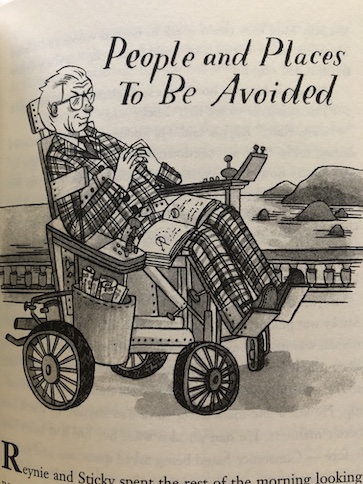
One of the things I loved about this book is that it is full of riddles, brain teasers, and wordplay. The name of the island where the school is located is Nomansan Island, or “No Man’s An Island.” Ha, ha.

Some of the characters’ names are also clues to their characters and identities. I understood the significance of Milligan’s name way before he and Kate did because I was already starting to look for word games and clues.

The messages that the kids and Mr. Benedict and his assistants send to each other take the form of riddles, just in case someone intercepts them. This makes some of Mr. Benedict’s instructions a little difficult for the kids to interpret, but it does add extra challenge for the readers as well.

Mental and emotional manipulation are major themes in the book. Mr. Curtain is actually a deeply insecure person who craves control over others. He understands enough about his own personal fears to understand how fear has a strong effect on other people, and he uses that as his weapon. Through his machine called the Whisperer, Mr. Curtain can dispense both fear and reassurance as he tries to steer the entire population in the direction he wants: putting himself in charge.

The strange messages being transmitted are meant to plant fearful and contradictory images in people’s minds, making them feel like everything is out of control. Then, he can present himself as the man with all the answers, soothing the fears that he intentionally created. He wants to be be put in a position of being in control of everyone and everything because that’s what he feels like he needs to feel safe and reassured.

The contradictory lessons and rules at the school are part of the images that he wants to place in people’s minds. The rules that there are no rules except when there are gives people a false sense of freedom when he’s in control. They no just longer notice the control because he’s told them to feel free, and they do. This goes along with the school’s teachings that there is no need for regulation of businesses except when there is. This leads up to government is good, except when it’s bad, and it’s always bad … because Mr. Curtain isn’t in charge. He wants everyone to distrust and disregard the forces that might oppose him and trust only him: the guy who says what everyone is apparently thinking and tells them things that make them feel good. (This all sounds scarily familiar.)

At one point in the story, Mr. Curtain explains to Reynie that the messages he transmits with the Whisper are simple ones with hidden layers of meaning and complexity because people who are scared, which is what Mr. Curtain wants them to be, crave simple answers to complicated questions to soothe their minds. Mr. Benedict says that one of the gifts that the children share is a love of truth, which allows them to resist the messaging, but I would argue the children also have a love for complexity. The puzzles and brain teasers bring out their complex thinking, and the kids like to think about things and examine them from different angles. They’re creative and unconventional, not just doing what other people might tell them is the “smart” thing to do. They’re not looking for just the easy answers and the warm fuzzies or what gets them ahead of other people today but the bigger pictures. Some people are scared to confront complexity and things they don’t understand, but other people thrive on it. They’re not scared by mere ideas or trying to avoid thinking because it’s difficult or unpleasant. In the end, it’s partly the children’s ability to confront some of the things that they’re truly afraid of, whether it’s doubts about themselves or their own cravings for comfort and belonging, that help them overcome Mr. Curtain and his machine. Fear is powerful, but facing up to it with honesty does more in the long run than trying to hide from it.

Many people in the story have repressed memories an hidden pasts. When some of these are revealed, t’she story also raises the question of how sorry we should feel for the villains. We learn that Mr. Benedict and Mr. Curtain are identical twins who were separated as babies when their parents will killed in a lab accident. They were raised by different people, but they both had hard childhoods. They are very much alike, but they are different in the ways they were raised and also in the ways that they responded to adversity in their lives. Mr. Benedict coped with his lack of family by surrounding himself with good friends, who became his new family. Mr. Curtain has gone a different route, seeking to control and manipulate other people.

Mr. Curtains evil plan, which he calls the “Improvement” is based on his hard childhood and his need for control over other people as an adult. We can feel badly that his youth was terrible, but he is doing truly evil things that harm people. The kids discover that many of the children at the school were actually kidnapped. When the children first arrive at the school after being kidnapped, they’re terrified, but they later become happy and obedient because Mr. Curtain has developed a method of wiping people’s memories (more accurate, hiding people’s memories from themselves), so he can make the people’s he’s kidnapped forget that they were kidnapped and scared. He targets orphans and runaways for his school because they won’t have parents or anyone else looking for them, and many of the kids cling to the school and try to excel there, becoming Messengers and Executives, because it gives them the feeling of belonging that they’ve always craved. Yes, Mr. Curtain had a bad childhood, but he’s using his adulthood to do horrible things to vulnerable kids who are very much like he was at their age.

When the kids realize that many of the people who are now Executives were once lonely, kidnapped children, they wonder if they should feel sorry for them. They think it over and decide that they don’t really feel sorry for them and that they still hate them. They feel that way because the Executives have become like Mr. Curtain. They have no empathy toward children who are very much like they were once, they knowingly do things to these vulnerable children that once terrified and hurt them, and they do it all for their own personal promotion and the good feelings they get from doing Mr. Curtain’s bidding. The machine Mr. Curtain uses for the children to transmit his messages to the world gives the children good feelings when they use it, feelings of comfort and having their worries wiped away, which is why the Messengers cling so hard to the “privilege” of using it. They all have sad pasts and a craving for belonging and achievement, but there are acceptable and unacceptable ways to deal with those types of feelings. Everything the Executives do, from assisting in the kidnapping other kids and punishing them in horrible ways at Mr. Curtain’s direction, is terrible. The kids know that the Executives have had their minds and emotions manipulated by Mr. Curtain, but even knowing that doesn’t help them relate much to the Executives because the Executives are still their enemies and still doing horrible things. Trying to sympathize with them won’t change that because the Executives only care about pleasing Mr. Curtain and get their comfort from his machine and sense of power and authority he gives them over the kids. They are not open to sympathy or bonding with others. Their only chance at redemption is getting their memories back and seeing Mr. Curtain and his manipulation of them for what it is.

The kids also realize that the missing agents and allies that Mr. Benedict talked about are the Helpers at the school. Mr. Benedict wiped their memories more thoroughly than he did the children’s because they were adults and had established lives, duties, and families outside of the school. He gave them mental reconditioning to turn them into the grunt workers at the school and to keep them from prying into the memories they have of their lives which periodically resurface. Unfortunately, he can do little about the depression that hangs over them constantly because, on some level, they know that they’re missing parts of themselves and their past lives. The kids realize that’s what happened to Milligan. He had his memory wiped by Mr. Curtain, but he escaped before he was reconditioned, which is why he’s more aware than the Helpers are. People whose memories were apparently wiped haven’t actually lost them, but they need reminders of things and people who were important to them in their past lives to bring their memories to the surface again.

I was pretty sure that I knew Milligan’s real identity and the fate of Kate’s father early in the book when Milligan said that “Milligan” was all that he could remember as his name. The entire book makes use of puzzles, and I realized that “Milligan” isn’t really a real name but a dim memory of the last thing that Kate and her father talked about doing. Later in the book, the kids find out that what triggers memories in the Helpers is someone mentioning people who were important to them or unfulfilled obligations. When Kate last saw her father, she wanted to go to the mill pond again, and they never did because her father disappeared, and everyone assumed that he had abandoned her instead of that he’d gone missing. This was partly the fault of Mr. Curtain because one of the secret messages he’s been transmitting is that “the missing are not missing, merely departed”, discouraging anyone from trying too hard to find all of the people he’s kidnapping. Therefore, it never occurred to anyone that Kate’s father was a missing person, only that he’d left. Kate is not only glad to have her father back but relieved to understand that the father she’d loved was abducted instead of abandoning her.

At the end of the book, it’s also revealed that Sticky’s parents were similarly victims of Mr. Curtain’s messaging. When their son disappeared, they knew only that he’d left, and they were stuck in the mode of not trying too hard to look for a missing person. I felt like the matter of Sticky’s parents was a little too easily resolved when Mr. Benedict reveals that they had not been saying that they were better off without Sticky but they felt like Sticky might be better off without them because he was much smarter than they were, and they felt like they’d failed as parents. They were charmed by living the high life for a while, but before the end of the book, they regretted not trying harder to find Sticky and blew all of their money in a real search. Mr. Benedict says that he believes that they’re sincere in wanting Sticky back because they really do love him, enough to throw off the last of the influence Mr. Curtain’s messages had on their minds.

Earlier in the story, Mr. Benedict told Reynie that, as a child, he used to wish for a family, but not anymore. Reynie asks him if he grew out of wanting a family, but Mr. Benedict says no, it’s just that he’s been able to build one of his own as an adult. He has his friends and associates and his adopted daughters. He also adopts Constance. Reynie is adopted by his beloved tutor, so he also gains a family, along with his new friends.

The Enchanted Castle

Two brothers and two sisters spend most of their time at boarding schools. The boys go to a school for boys, and the girls go to schools for girls, so the only times when they are together are when they are home for school holidays or visiting at the house of a kind, single lady who lives near to their schools. Although the children’s parents are grateful for their single friend for hosting the children as guests from time to time, the children find it difficult to play at her house because everything is so neat and proper, and they don’t feel quite at home. Then, during one school break, one of the sisters, the one who makes it home first, comes down with measles. With their sister sick, the other siblings can’t go home, which is a great disappointment, and their parents have to make other arrangements for them. When the children tell their parents that they don’t want to visit the single lady for the entire school holiday, the parents arrange for the boys, Gerald and James (called Jerry and Jimmy), to board at their sister Kathleen’s school. It will be fine for them to be there because Kathleen (called Cathy) is the only student remaining at the school during the holiday, and there will only be one teacher there to supervise them, the school’s French teacher.

This arrangement suits them better than going to the single lady’s house, although they think that they ought to find something special to do during the school holiday. Kathleen suggests that they write a book, but the boys aren’t thrilled by the idea. They would rather do something outdoors, like playing bandits. However, they are a little concerned about the French teacher’s supervision. Fortunately, Gerald is good at charming grownups, when he wants to. Through a combination of flattery and small, thoughtful favors to the teacher, he gets on her good side, and he manages to convince her that he and his siblings would like to have some time to themselves to play and explore outside, maybe in the woods. The French teacher understands that what they really want is some freedom from supervision, but she agrees to give them some time to themselves.

The children don’t actually know if there are any woods in the area, but they decide to do some exploring and see if they can find an adventure of some kind. They end up getting lost during their exploring, but they find it exciting. When they sit down to rest, they find a cave and decide to explore it. The cave turns out to be a tunnel that leads them to a beautiful garden with a lake with a decorative waterfall and swans. The children imagine that it’s the garden of a magical castle. Going a little further, they find a thimble with a crown on it and a thread tied to it. It looks like the kind of thimble that might belong to a princess.

When they follow the thread, they find a young girl in a beautiful dress who looks like she might be a princess. She looks like she’s asleep, so she looks like an enchanted princess or Sleeping Beauty. Jimmy doesn’t really believe that she’s a princess, but the others aren’t so sure, and anyway, it makes a fun game to pretend that she is. Since Jerry is the eldest of the children, Cathy thinks that Jerry should kiss her to wake her up. Jerry refuses, so Cathy says Jimmy should do it. Although Jimmy is sure that she’s really just an ordinary girl dressed like a princess, he says he’ll kiss her to prove he’s braver than Jerry and that he should be the leader for the rest of the day.

When Jimmy kisses the girl’s cheek, she opens her eyes and says that she has been asleep for 100 years. She insists that she’s a real princess and asks them how they got past the dragons. Jimmy still doubts that, even though she shows them a mark where she pricked herself on a spindle, just like in the Sleeping Beauty story. She invites them to come back to the castle and see her beautiful things. The children say that they are hungry, so they go with her go get something to eat.

When they get to the “castle”, the princess brings them bread and cheese to eat with some water. This seem depressingly ordinary, and the princess apologizes, saying that was all she could find. However, she claims that the food in the castle is magical, so it can be whatever they want. The children imagine that it’s roast chicken and roast beef, but all they get is bread and cheese. Cathy doesn’t want to admit at first that it’s just bread and cheese because (like with the Emperor’s New Clothes), there is an implication that there is something wrong with her if the magic doesn’t work for her. Jimmy isn’t discouraged by that, so he asks the princess if it’s a game, but the princess denies it, insisting that the food is magical.

Then, the princess takes the children to a hidden door behind a tapestry. The room inside has paneled walls and blue ceiling with stars painted on it. The princess calls it her “treasure chamber”, but the room is completely empty. The princess acts surprised when the children say that they can’t see any treasure, and they refuse to believe it’s because they’re magical or invisible. The princess has the children close their eyes while she says some magic words. When they open their eyes, suddenly, there are shelves with jeweled objects on them. The children have no idea how the princess accomplished this trick, so they start to believe that maybe she can do magic.

The princess suggests that they all put on some of the jewels and be princes and princesses, too. It’s amusing for a while, but the boys start getting tired of dressing up, and they’re still a little skeptical about who the princess is. They suggest that they go play outside, but the princess insists that she’s actually grown up and doesn’t play children’s games, and she has the others help her put all the treasures back in their proper places. She tells the children that various pieces of jewelry have magical property. Jimmy asks her if that’s really true or if she’s kidding, but the princess insists that it’s true. Jimmy asks her to demonstrate how the magic works. The princess says that she will try on the magic ring that makes her invisible, but only if everyone closes their eyes and counts first.

When the children open their eyes, all of the shelves of jewels are gone and so is the princess. Jimmy says that it’s obvious that the princess just went out the door of the room. When they close their eyes and count again, Jimmy keeps his eyes open and sees the princess hiding behind a secret panel. When he tells the others, the princess says that he cheated. The weird thing is, even though they hear the princess say that he cheated, they still don’t see her. They tell her to stop hiding and come out, but she says that she already has. She says that if they want to pretend like they can’t see her, that’s fine, but the children seriously can’t see her. When the princess realizes that they’re serious that she’s actually invisible, the princess suddenly gets scared. She tries to shake the boys and get them to say that she’s not invisible, and Jerry catches hold of her, still unable to see her. She tells them that it’s time for them to go because she’s tired of playing with them.

Jerry makes the princess look in a mirror to prove that she’s invisible, and the princess gets very upset. Cathy sensibly tells her to just take the ring off, but the princess says it’s stuck. She admits that the whole thing, up to this point, was just a game of pretend. She says that the treasure shelves were hidden behind some paneling, and she just moved it with a hidden spring. She never expected that any of it was actually magical. The truth is that the girl’s aunt works at the house as a housekeeper and that her name is Mabel. She was just playing at being an enchanted princess because the rest of the household is away at the fair, and she happened to hear the other children coming through the hedge maze, so she roped them into her game.

Since one of the objects that Mabel claimed was magical was a buckle that would undo magical spells, Cathy suggests that she try the buckle. Mabel says that’s no good because she only made up that it was magical, but Cathy points out that she also made up the part about the ring being magical, and it turned out to be true, so she might as well try the buckle. Mabel would, but they accidentally locked the key inside the room and can’t get in now.

The children sit down to think about the situation. Since they can’t think what to do, the other children think maybe they should leave and go get their tea, but Mabel insists that they can’t just leave her invisible like this. Instead, she suggests that she go with them to tea and leave her her aunt a note. While they have tea, maybe they can think of something else to help Mabel. In her note, Mabel says that she’s been adopted by a lady in a motorcar and is going away to sea. The others say that’s lying, but Mabel says that it’s fancy instead of lying and that her aunt wouldn’t believe her if she said that she was invisible.

When they return to Kathleen’s school, they have tea and supper. They let Mabel have one of the three plates laid out for them, and Jerry and Cathy share one between them. Fortunately, the French teacher isn’t eating with them and doesn’t see an invisible person eating, but the children don’t know how they’re going to handle breakfast the next morning. They say that Mabel can stay the night with them, sharing Cathy’s bed and borrowing a nightgown. Mabel says that she can get some of her own clothes from the house tomorrow because no one will be able to see her and that she’s starting to see some possibilities for being invisible.

In the morning, the maid who comes to wake Kathleen sees Mabel’s discarded princess dress on the floor and asks Kathleen where it came from. Kathleen makes an excuse that it’s for playacting, which means that she and her brothers will have to figure out some kind of play to put on with it. Mabel thinks that acting sounds exciting, but Kathleen reminds her that she’s still invisible, so no one can see her perform anything.

The children feel bad about Mabel’s lies in the note to her aunt, and they insist that they should go and tell her the truth. Mabel doesn’t think this is a good idea because her aunt won’t believe her, but she reluctantly agrees. When they try to talk to her, the aunt doesn’t really want to listen to them, thinking that it’s just another one of Mabel’s pranks. She says that maybe Mabel was changed at birth and that her rich relatives have finally claimed her. They try to tell her that Mabel is with them, only invisible, and the aunt tells them not to lie to her. They ask about Mabel’s parents, and the aunt says that she’s an orphan. The children think that Mabel’s aunt is crazy because she doesn’t seem concerned about her and doesn’t want to hear anything they have to say, but Mabel says that she thought that her aunt might act that way because she spends so much time reading novels and can imagine anything.

In the meantime, Mabel has had some thoughts about what she can do. She says that she might be able to continue living in the house where her aunt works because the place is supposed to be haunted, so she can play ghost herself. However, the others think that she should stay with them. They just need a way to get some money to buy extra food for her.

Sine the fair is still going on, Mabel suggests that Jerry put on a magic show at the fair to get some money. The others say that Jerry doesn’t know any magic tricks, but Mable points out that it doesn’t matter when he has an invisible friend who can move things around, unseen, and make things disappear. Jerry dresses up as a conjurer from India (in a way that would be considered equal parts cheesy and offensive by modern standards because it involves black face), and he puts on the magic show with Mabel’s help. It’s incredibly successful, and toward the end of it, Mabel feels the ring coming loose. She takes it off and gives it to Jerry, who ends the act by vanishing himself.

Now, Mabel is visible again, and it seems like they’ve solved their problem, but now, they have a new one. The ring is now stuck on Jerry’s finger, and he is the one who’s stuck being invisible. Although Mabel can now go home, she insists on staying with the other children and taking part in their next invisible adventure.

Jimmy says that, if he was invisible, he would turn burglar. The girls point out that would be unethical, so Jerry decides that he will be a detective. There are advantages to a detective being invisible. Then, Mabel remembers that the treasure room is still locked from the inside, and they have to do something about it. Jerry says that, as an invisible person, he can sneak in easily enough through a window. When he does this, he ends up foiling a robbery by actual burglars, although he also ends up letting them escape from the police because he knows that conditions in prisons are horrible and can’t bring himself to send anyone there.

After his adventure, the ring comes loose from his finger while he’s in bed, and the maid at the school, Eliza, finds it and decides to “borrow” it for an outing with her fiance. When her fiance can hear Eliza’s voice but not see her, he thinks that he’s taken some kind of strange turn or fit, possibly because he’s been in the sun too long. The children convince him to go home and lie down while they deal with Eliza. They take Eliza on a little adventure of her own because they’re beginning to see that the ring doesn’t come off someone’s finger until its purpose is fulfilled. Afterward, they manage to convince Eliza that it was all a strange dream that she had because she felt guilty about taking the ring without permission. The children also think that the ring’s power might be diminishing and could be completely spent because it seems like its effect has been lasting shorter and shorter amounts of time every time it’s used. However, this is really just the beginning of the ring’s magic, and it can do much more than they think it can.

At this point, they feel a little guilty that they haven’t spent much time with the French teacher, who is supposed to be looking after them, so the buy her some flowers. She is pleased with the gift, and they have a little party with Mabel as their guest. They find out that the French teacher has artistic abilities, although she rarely has time to draw these days because she’s so busy teaching. Mabel also tells them more about the man who owns the house where her aunt works. Although the house is grand, the man who owns it doesn’t really have enough money to support it and live there full time with a full staff because his uncle wrote him out of his will for falling in love with a girl he didn’t approve of. It’s sad because he also never married the girl because she was sent away to a convent, and although he did try to find her, he never did. Mabel, whose knowledge of convents comes from the scandalous gothic novels that she and her aunt read (much like the kind the main character reads in Jane Austen’s Northanger Abbey), speculates that the girl might be bricked up in a wall by now because that’s the kind of wicked thing that happens in books. The French teacher tells her that real convents aren’t like that and that the women who live there are good and take care of girls without parents, although they can also be strict, and the girls aren’t allowed to leave. She says it in a way that implies that she was one of those girls raised in a convent.

Since the children had claimed earlier that they were going to put on a show of some kind with the princess outfit, they decide to go ahead and perform for the French teacher and Eliza. To fill out the audience for their performance, they make a bunch of stuffed dummies, which the French teacher finds amusing. The children use the ring as a prop in their play, although none of them put it on, and Kathleen wishes that the dummies were alive so they could have better applause from the audience. To the children’s amazement and the French teacher’s and Eliza’s terror, the dummies (which the children think of as “Ugly-Wugglies”) do come to life and start clapping. In a panic, the children debate what to do. Jerry realizes that the ring is actually a wishing ring and is responding to the children’s wishes, so he wishes on the ring that the dummies were not alive, to undo Kathleen’s wish, but it doesn’t work.

To Jerry’s surprise, the dummies begin speaking to him, although their speech isn’t clear because they don’t really have proper mouths. They ask him for a recommendation to a good hotel or suitable lodgings. The dummies don’t seem to know what they are, and they are behaving like respectable, aristocratic people. Jerry tells them that he can show them to some lodgings, if they will wait for him a little. He makes some excuses to give himself time to reassure the French teacher and Eliza that the effect with the dummies was just a trick pulled by the children with string, and he recruits Mabel to help him find a place for the dummies. He does this in an insulting and condescending way, and Mabel tells him off for that, but she agrees to help him. They decide to hide the dummies somewhere on the grounds of the big house where Mabel and her aunt live, thinking that the magic will wear off eventually and that the dummies will turn into dummies again by morning. The dummies turn nasty when Jerry and Mabel try to shut them away, and they are helped by a strange man.

The strange man demands an explanation from the children about the angry people they’ve shut away, but the children don’t want to explain. The man says, if they won’t tell him what’s going on, he’ll simply have to let the people out and ask them, but the children are afraid of what the dummies will do if they’re released. The man assumes that the imprisoned people are other children and this is all some children’s game, so Jerry and Mabel decide that they have to tell him the truth, even though they know it all sounds crazy. They can tell that the man doesn’t really believe him. The man thinks maybe Jerry has a fever or something, and he says that he’ll see the children home. Jerry can tell that the man plans to open the door after the children are gone, and he warns him not to do that. He insists that the man wait until tomorrow to open that door and to wait for them to meet him to see it opened because, by then, they’re sure that the dummies will just be dummies again. The man reluctantly agrees.

When the children arrive the next day, they discover that the man didn’t wait for them to open the door, and he is now lying unconscious and injured, apparently attacked by the dummies. The dummies are gone except for the most respectable dummy, who seems concerned about the unfortunate man on the ground. Mabel runs for smelling salts to revive the unconscious man, and Jerry looks around to see where the other dummies are. They find that the other dummies have turned back into piles of old clothes, and only the one living dummy is left. He seems to be becoming far more real. The children revive the unconscious man, who turns out to be the new bailiff. The bailiff assumes that the strange visions he had were because he was injured accidentally. After the children are sure that he’s all right and send him on his way, they try to figure out what to do with the remaining living dummy.

The remaining dummy seems to have developed a life of his own and is quite a wealthy man, although the children aren’t sure that this will last because the ring’s magic never seems to last very long. Jimmy says that he wishes he was wealthy, and the other children are horrified to see him age quickly, turning into an elderly, wealthy man. Jimmy doesn’t seem to remember who they are, and he refuses to turn the ring over to them when they ask for it, trying to stop his wish. He acts like the dummy is an old acquaintance of his, and he just wants to go to the nearest railway station with his dummy acquaintance.

Jerry sends the girls home to make some excuses for his and Jimmy’s absence, and he follows the now-elderly and wealthy Jimmy on the train to London. There, he learns that Jimmy and the living dummy have somehow acquired business offices, staff, and backstories. Other people seem to have somehow known the two of them for years (a warping of reality that makes Jerry’s head swim because neither of them existed in their current state before) and say that they are business rivals. Jerry pumps a boy who works at one of the offices for information, claiming that he’s a detective and is trying to reunite the elderly Jimmy with grieving relatives. The boy’s advice is that it will be difficult to get through to elderly Jimmy but that he might use the living dummy’s rivalry with elderly Jimmy to arrange things. The living dummy (now known as U. W. Ugli) helps Jerry to get control of the ring, and he wishes himself and Jimmy back to the house where Mabel lives.

Jimmy is restored to his younger self, and the children debate about what to do with the ring. They can see that it has some dangers. Mabel says that she ought to put it back in the treasure room, where she found it. However, while they’re in the treasure room, they begin to wonder if any of the other pieces of jewelry are magical, since the ring became an invisibility ring after Mabel pretended it was. Mabel can’t remember exactly what she said any of the other pieces of jewelry did because, at the time, she was just playing pretend and making things up. Then, something occurs to Mabel. She realizes that the ring only became an invisibility ring because she said it was one, and it turned into a wishing ring when they started calling it that. She says that proves that the ring does whatever they tell it to do, changing its powers to match whatever they say. To prove the point, she declares that the ring will now make people tall, and when she puts it on her finger, she is suddenly unnaturally tall.

Mabel’s experiment did prove the point, but they now have to hide Mabel until the effects wear off. The children get a picnic from Mabel’s aunt and go to hide out in the woods overnight. However, Mabel complicates things when she turns the ring into a wishing ring, and then, she accidentally turns herself into a statue. The children have a nighttime adventure with some living statues, learning that all statues apparently have the ability to come to life at night. They can also swim, so they have a nice swim and a feast. The statue of Hermes tells the children that “‘The ring is the heart of the magic … Ask at the moonrise on the fourteenth day, and you shall know all.'”

Then, the children learn that Lord Yalding, the man who owns the big house, is planning to come, and that he is thinking of renting the house to a wealthy American. Mabel’s aunt is busy, getting the house ready for Lord Yalding and the American. However, it turns out that the children have already met Lord Yalding without realizing it, and with the ring and the treasures in the hidden treasure room, they have the power to secure his future and reunite him with his lost love … if only they can figure out how to manage the ring’s power without causing any more chaos.

The book is now public domain and available to borrow and read for free online through Project Gutenberg and Internet Archive (multiple copies), including an audio recording from Librivox. The story was made into a BBC television miniseries in 1979, but it’s difficult to find a copy these days. As of this writing (April 2024), the only dvd release was in Australia in 2013. Sometimes, clips of it appear on YouTube.

For the first part of the book, it isn’t obvious that there will be any real magic in the story. At first, the children are all just playing pretend with each other, and even when Mabel turns invisible, it’s possible to believe that the children might still be playing pretend and letting their imaginations run away with them. Because the adults don’t seem that concerned about Mabel, I thought that they might have been humoring the children in their game, but the children later realize that the ring has the effect of muting people’s concerns for the one wearing it, even if they’re doing something bizarre or dangerous. That ends when the person takes off the ring, and people become more concerned about them and where they’ve been. The magic in the story is real, and as the story continues it involves too many other people, even adults and various bystanders, for it to just be a game.

Throughout the book, various adults experience the effects of the magic ring and witness things that the children do with it. They come up with various explanations for what they’ve witnessed, so they can disregard it, but they unquestionably experience magical events along with the children and have some consequences from the children’s adventures. While Jerry retrieves Jimmy from London when he accidentally turns himself old and wealthy, they never do retrieve the living dummy, so U. W. Ugli remains doing business there until his magic finally wears off. His employees don’t seem to know what he is and have memories of having worked for him for years, so they report him missing when he finally disappears, and the notice appears in the newspaper.

There’s a lot of humor in the story as the children experiment with the magic, deal with the consequences of their adventures, and try to invent excuses to explain away the inexplicable. There are times when they do try to tell adults the truth about what they’ve been doing and what’s happening, but most of the time, the adults don’t believe them. Sometimes, they feel a little bad about lying to adults and making up stories, but they have to resort to that because nobody really believes the incredible truth.

When the children start telling Lord Yalding the stories of their magical adventures and about the treasures they’ve found in the house, they are unable to prove what they say at first. Lord Yalding gets a chance to experience the magic himself, he thinks that he’s going crazy. At the proper time, the ring’s magic reveals itself to Lord Yalding, his love, and the children so they can all see the true magic and learn the ring’s history, which is a story of magic and tragic love. Lord Yalding comes to understand that he is not crazy and that the magic is real. His lover makes one final wish that turns the wishing ring into a wedding ring. The magic ends, and the castle and grounds are changed because of it, becoming less grand and more ordinary, but Lord Yalding and his bride are able to have their happy-ever-after.

I thought it was interesting that the author provided a backstory for the magic ring, explaining where it came from and its effect on the house and its grounds. I didn’t think there were many clues to that backstory provided along the way, and some buildup to the explanation would have been nice. However, I recognize that the author didn’t have to provide any explanation for the magic at all. Many other fantasy stories don’t offer explanations for magical objects, leaving that up to readers’ imaginations, because the focus is more on the effects of the magic rather than its origins.

As far as we know, the children’s other sister, the one who was sick with measles in the beginning, never finds out what her siblings have been doing during this particular school break. The children remain close to Lord Yalding and his wife, and they host them at their house during school breaks afterward. In fact, it sounds like they spend more time with Lord and Lady Yalding than they do with their parents.

Overall, I enjoyed the story. E. Nesbit’s fantasy stories are children’s classics, and they have influenced other children’s fantasy books that came after them, especially Edward Eager’s Tales of Magic series.

Although the original story is now public domain, there are different versions of this book because there are simplified forms of the story for younger children, and some newer editions have removed some of the problematic parts of the story. Some of E. Nesbit’s books contain problematic racial language or stereotypes or have children doing things that would be unacceptable by modern standards. In this book, such incidents are relatively mild, and their absence wouldn’t materially change the character of the story.

For example, when Jerry dresses up an conjurer from India, he uses black face as part of his costume. In the 21st century, use of black face is considered derogatory toward people with dark skin. In a way, Jerry’s costume is played for comedy because it’s made from pieces of his school uniform, and someone points out that he’s left out spots in his skin makeup. Nobody believes that he’s a real conjurer from India, although they are impressed by his act because they can’t figure out how he accomplishes his tricks.

There is also some anti-Catholic sentiment, although the children seem to say certain things because they’ve gleaned them from sensational novels or things other people have said, and the author does correct for it. The first instance of this comes from Mabel’s concept of the dark deeds done in convents, which she has apparently learned by reading gothic novels. I’ve read some old gothic novels myself, and the idea that sinister things happen in secrecy in convents and abbeys was a popular concept from 18th and 19th century literature. It’s partly due to anti-Catholic sentiment and, probably, because the idea of a closed society that isn’t open to the general public makes for a compelling setting for dark secrets, somewhat like the way secret societies and boarding schools have become the setting for sinister happenings and dark deeds in Dark Academia literature. However, the other does have the character of the French teacher contradict this view of convents with a more benevolent and realistic one, that the people in them are caring but strict. There is one other comment that Jimmy makes in the story when he’s arguing with Mabel, when he seems to be implying something about Jesuits, a branch of Catholic priesthood:

“If you’d been a man,” said Jimmy witheringly, “you’d have been a beastly Jesuit, and hid up chimneys.”

I wasn’t entirely sure what this comment meant, although I think it might be a reference to the ways Catholics hid priests in priest holes, little hidden rooms, when they were at risk for arrest, torture, and even execution in Elizabethan England. Some of these little hiding places were in fireplaces, which I think is what the reference to hiding in chimneys means. At the time, the children were arguing about bravery, so I think Jimmy is implying that Mabel is the type to run and hide in the face of danger. (That might actually be the best option when there’s real danger. Just saying.) If I’ve understood his meaning, that makes Jimmy’s comment more of a slur against Mabel’s bravery than against Jesuits, although he does still call the Jesuits “beastly”, and he’s implying that’s a bad thing to be.

When you read public domain versions of the story online, they will have these elements in the story because they were part of the original book. However, if you find a physical copy in a library, it may or may not have these elements, depending on the printing. If it was printed during the late 20th century or any time during the 21st century, there is a good chance (although not completely guaranteed) that it’s a revised version and may have these parts written out or at least toned down.

The Crime That Has No Name

This is the second book in the Gosick series. Only two of these Japanese light novels were printed in English, but there is also an anime based on the series that has been dubbed in English.

It’s 1924, and mysterious things happen around the fictional European country of Sauville. The students at the elite boarding school called St. Marguerite Academy are obsessed with ghost stories and spooky legends, as are many of the people of Sauville. Kazuya Kujou, a Japanese student attending the school, is among the few who doesn’t enjoy these stories, but he can’t help but become involved. One of his closest friends is the mysterious and enigmatic Victorique, who is the subject of some spooky legends herself. Victorique is both a student and prisoner at the school. She is a child genius, and rather than attend classes with the other students, she prefers to spend all of her time reading and studying by herself in the conservatory at the top of the library. Kazuya is one of the few people who ever sees or speaks to Victorique because he brings her assignments from class.

The reasons why Victorique is allowed to skip class, have special library privileges, and housing away from the other students but is still a prisoner, forbidden to leave the school, are partially, but not completely, explained in this book. Victorique is not a normal girl or a normal student, and there are some dark secrets in her past that even she doesn’t fully understand.

When the story begins, Kazuya has just received his allowance from home, and another friend at school, Avril, convinces him to come shopping with her. Avril is one of the students who really loves ghost stories, and she insists on telling them to Kazuya, even though he doesn’t want to hear them. Avril knows about Victorique, and she tells Kazuya that the rumor is that Victorique isn’t really a human but a legendary creature call a “gray wolf.” Kazuya doesn’t think Victorique is anything other than an extremely smart but also extremely temperamental girl.

While they are shopping, Avril is a little offended that Kazuya has her help pick out a present for Victorique. Kazuya wants to give Victorique something because she’s normally not allowed to leave the school. Avril and Kazuya study some items being offered for sale by a nun, and Avril suggests that Kazuya give Victorique a fancy turban. As they look over the other items, a music box that is apparently some kind of magic trick bursts open and releases a pigeon. Then, the nun cries out that the most expensive item for sale, a fancy plate with historical value, has been stolen! Kazuya thinks that Victorique will enjoy hearing about the theft even more that getting a present.

When Kazuya tells Victorique about the theft, she says that it’s not that interesting because it’s a very simple matter. Before she can explain why it’s simple, her half-brother, Inspector Grevil de Blois, comes to the library to once again indirectly consult with his sister about the case. When he walks in and sees Victorique sitting there, wearing the fancy turban that Kazuya bought for her, he panicks, mistaking her for someone called Cordelia Gallo. Kazuya has no idea who he’s talking about, but neither of them seems to want to explain. Once Grevil realizes that he was mistaken, he pretends like nothing happened and starts talking about the case. Victorique simply explains that the thief was the nun, and that she was the one who set up the distraction with the music box and the pigeon.

The next day, Kazuya looks at the newspaper, and he sees that Grevil was unable to catch the nun before she got away. Then, something else in the newspaper catches his attention, a notice that says, “Descendants of the Gray Wolves. Midsummer Feast is near. We welcome you all with open arms.” The people of Sauville, and the school in particular, are obsessed with legends and ghost stories. The story of the Gray Wolves is a popular legend about a mythical race of people who are smarter than normal humans. The basis of the legend is that people who were unnaturally smart were said to be human-wolf hybrids. Kazuya remembers that people at the school call Victorique a “reincarnation of a Gray Wolf”, like they’ve been calling him “the Reaper” based on their stories and legends. He decides to show the notice to Victorique.

When Kazuya shows the notice to Victorique, she is shocked. After she accidentally trips and falls and throws a childish fit about it, she shows Kazuya a centuries-old account of a village of gray wolves who spoke human language. Kazuya doesn’t know what to think about the stories. To be honest, he’s never been very interested in the legends and ghost stories of Sauville, even though everyone else is obsessed with them. Instead, he finds himself wondering if Victorique is unnaturally sensitive to pain because it seemed like she really overreacted from her trip and fall. As an experiment, he gives her forehead a slight flick. When he does that, Victorique reacts as if he had just slapped her and tells him that she’ll never speak to him again. He tries to apologize, but Victorique ignores him, so Kazuya just storms out of the library.

Later that night, while Kazuya is studying, he looks up and sees what looks like a large suitcase moving on its own outside the window. It turns out to be Victorique, trying to sneak out of the school with way too much luggage. She’s still not speaking to Kazuya, but Kazuya is concerned about her because even normal students aren’t allowed to leave the school grounds after hours, and Victorique isn’t supposed to leave the school at all. Kazuya doesn’t know exactly why Victorique is sneaking out of the school, but he knows that, while she is extremely intelligent, she has very little knowledge of or experience with the outside world. He worries that she won’t be able to cope on her own. Even though Victorique still isn’t speaking to him, he leaves the school with her and finds out that she’s taking a train to the village that is hosting the Midsummer Feast and inviting the descendants of the Gray Wolves.

Victorique and Kazuya find themselves on a train with the thieving nun from before. She’s heading to the same town they are because she says that she grew up there. She introduces herself as Mildred Arbogast. When they get to town, the innkeeper says that they had better get inside because there’s a storm coming and the Gray Wolves come out on nights like that. He says that the Gray Wolves live in a village in the mountains and that they’re werewolves. They look like normal humans, but they hunt people when they come out. When the innkeeper describes them as being short with golden hair, it suddenly occurs to him that Victorique looks just like them.

In spite of Victorique looking like a Gray Wolf, the innkeeper allows them to rent rooms for the night. He lets Kazuya know that, since that notice appeared in the newspaper, other people who have been curious about the Gray Wolves have been showing up, but he thinks that they’re asking for trouble because the Gray Wolves won’t tolerate anyone looking into their affairs. When Kazuya says that the nun is from this town, the innkeeper says that isn’t true. It’s a small town, so everyone knows everyone else, and the nun is a total stranger.

When Victorique finally starts talking to Kazuya again, she says that the reason why she wanted to come to this place was to clear her mother’s name. Her mother is Cordelia Gallo, which is why Grevil mistook her for Cordelia. Victorique shows Kazuya a pendant she has made from a gold coin. On the other side of the pendant is a picture of Cordelia Gallo, and she really does look like Victorique. For the first time, Victorique talks to Kazuya about her mother. Cordelia was a dancer, but at some point, she became involved with Victorique’s father, the Marquis de Blois. After she gave birth to Victorique, she mysteriously disappeared, and Victorique was raised in isolation in her father’s mansion. (This is why Victorique is so naive about the outside world and awkward and temperamental around other people. She’s extremely learned in terms of book knowledge but low on experience with the outside world and other people.) Victorique only remembers seeing her mother once, when she sneaked up to her window one night and gave her the pendant, but she knows that her mother still watches over her. Victorique also knows that her mother was originally from the village of the Gray Wolves. Apparently, Cordelia was once a maid there, but she was banished from the village for committing a terrible crime. Her father became involved with Cordelia because he wanted a child with the blood of the Gray Wolves, although he has always been a little afraid of Victorique, which is why he keeps her at a distance, either held prisoner in his mansion or at the school for her entire life. (The Marquis de Blois is a nefarious character with grandiose schemes of power, which are addressed further in other stories in the series and in the anime based on them, and he wanted a child like Victorique as part of those schemes.) Now that an invitation has been extended to the descendants of the Gray Wolves, Victorique is determined to see the village where her mother came from and, if possible, clear her name of the crime she supposedly committed.

The next day, Victorique and Kazuya travel to the village of the Gray Wolves along with the nun and three young men, who say that they’re college students. The village has a Medieval look to it, and the people there wear old-fashioned clothes. People there recognize Victorique as Cordelia’s daughter immediately. It makes them uneasy, but they say that they do not hold her responsible for what Cordelia did and say that she is welcome to stay for the Midsummer Festival, even though her mother is a murderer.

The leader of the Gray Wolves, Sergius, explains that the Gray Wolves aren’t really werewolves. They’re normal people, but they prefer to live in isolation from the outside world. People just assume things about the Gray Wolves because they have odd, old-fashioned lifestyles, don’t mix with other people much, and inhabit a village in a mountainside surrounded by real wolves. The Midsummer Festival is one of the few times that they allow other people in from the outside. The purpose of the festival is to welcome home the spirits of their ancestors and pray for a good harvest.

Sergius invites Victorique and Kazuya to stay with him for the festival. In his manor, a maid called Harminia says that Cordelia murdered the previous village chief, leaving gold coins scattered around his body. Cordelia was an orphan who worked as a maid for the village chief at the manor. She was blamed for the chief’s death because she was the only other person who had access to his study, where he was murdered. Victorique says that they only have until the end of the festival to investigate the murder her mother was accused of committing because the village won’t let them stay any longer. However, there are more crimes afoot in the village, and the original murderer is still there after all these years.

There is an English translation available to read for free online at Internet Archive.

This is not a series for young kids. It’s more for teens and young adults because parts get truly violent and disturbing. I find the series interesting for its references to other detective series, ghost stories, and legends, but I have to admit that the plots of the stories get a little over-the-top. As the series goes on, the stories get weirder.

This particular story fills it parts of Victorique’s back story, which even she doesn’t fully understand at first. As I said, the Marquis de Blois is a nefarious character with an over-the-top, long-term plan to seize power in Sauville, using his young daughter’s mysterious heritage and Sauville’s obsession with legends and stories. His plot is revealed later, but this book focuses on Victorique’s mother backstory. Years ago, Cordelia was framed for a murder she didn’t commit. If she hadn’t been, she would never have left the village, and Victorique wouldn’t have been born. Victorique eventually discovers who committed the original crime and clears her mother’s name, but nobody from the outside will be able to return to the village for a long time because the drawbridge to the village gets destroyed. At the end of the book, Victorique still doesn’t know where her mother currently is, but she learns a few things about her life.

The motive for the original murder concerns prophecies and fortune-telling, like the first story in this series, although in a different way. The Gray Wolves believe in prophecies, just like the rest of Sauville believes in legends. In a similar way, there is at least some truth to these prophecies just like there is always at least some basis for Sauville’s legends. The previous chief of the village was murdered because he gave his murderer a prophecy at a past Midsummer Festival that person couldn’t bear to hear. As Victorique explains it, “It’s just fortune-telling. You didn’t have to take it seriously. But you had strong faith in the laws of the village and the words of the village chief. You could not doubt the divination.” Because this person didn’t doubt what the village chief said, they believed that the only way to change their fate was to kill the person who made the prophecy. Ironically, it is that crime that makes the prophecy come true.

The story raises the questions of whether fate is unavoidable and whether prophecies are self-fulfilling. If the murderer had asked the previous chief a different question at the festival or just refused to believe what he said, would things have turned out differently for everyone? There’s no real answer to that, but the murderer’s belief that the prophecy had power is what set everything in motion. Victorique and Kazuya also receive prophecies about their futures that cause them some worry. Because I know how the rest of the series goes, I know that there is some truth in the prophecies for them, that they will be caught up in events larger than themselves that will separate them, but that’s not the entire story for them. There is a separation coming for them in this series, but it’s only a temporary one. As strange as this series is, it actually does have a happy ending for our heroes. Whether the two of them might be separated again once WWII starts is a matter of speculation because the series doesn’t extend that far. It’s possible, but they will have plenty of time together first, and as Victorique points out, you don’t really have to believe fortune-tellers.

Gosick: the Novel

The year is 1924, and a boy from Japan named Kazuya Kujo is attending a prestigious boarding school called Saint Marguerite Academy, in the small European country of Sauville (fictional). The students at this school have an obsession with ghost stories. Kazuya is a very serious boy, and he doesn’t see the appeal of all of these gruesome stories, although his friend, Avril Bradley (an international student from Great Britain) loves them and insists on sharing scary stories with him. Part of the reason why Kazuya doesn’t like all the scary stories is that other students insist on calling him “the Reaper” based on a character from one of the more popular ghost stories. However, he’s not the only student at school who stands out, and some of the school’s ghost stories have more truth behind them than Kazuya would have dreamed.

There is one seat in Kazuya’s class which is always empty. That seat belongs to Victorique, and Kazuya is one of the few people at the school who has ever seen her. Victorique never comes to class, preferring to spend her time reading and studying by herself in the conservatory at the top of the library. One day, when their teacher gives Kazuya some papers to take to Victorique, Avril tries to ask Kazuya what Victorique is like. Kazuya doesn’t want to explain much about Victorique, just saying that she can be blunt and kind of mean, which is true. Victorique is brilliant, a child genius, and she looks like a little china doll, but she’s not easy to get along with. She’s temperamental and not used to dealing with other people in general. She smokes a pipe, like Sherlock Holmes, and makes deductions using her “fountain of knowledge”, even about places she hasn’t been and things she hasn’t witnessed, like Nero Wolfe.

Victorique is not allowed to leave the school grounds (for reasons which are explained as the series continues), and aside from Kazuya, there’s only one other person who visits her: her older half-brother, a local police detective. He never admits that he gets help from Victorique on his cases, and he typically prefers to act like he’s talking to Kazuya rather than speak to Victorique directly. Victorique, who is often bored, enjoys solving puzzles and mysteries, so she does give her brother help, although there is little affection between them.

One day, Victorique’s brother, Grevil de Blois, comes to consult with her, through Kazuya, about the murder of an elderly fortune teller. After hearing a description of the murder, Victorique correctly realizes that the fortune teller was killed by her maid. However, that isn’t the end of it. Kazuya thinks that it’s unfair that de Blois always takes the credit for Victorique’s solutions to mysteries. This time, when he finds out that the grateful family of the fortune teller has given de Blois a yacht as a present and that he’s planning to spend the weekend on it, Kazuya decides that he’s going to make de Blois share this present with Victorique. Victorique is normally forbidden to leave the school grounds, but with Kazuya threatening to reveal the true secret of his success, de Blois agrees to take Kazuya and Victorique with him on the weekend yachting trip. Neither of the two kids really likes de Blois, and the thought of spending an entire weekend with him, even aboard a luxury yacht isn’t great, but it is one of the rare opportunities Victorique has to leave the school.

Victorique has rarely been anywhere other than the mansion where she was born and the school, so everything is new and fascinating to her as they take a train to the seaside to meet de Blois at the yacht. When they get there, de Blois informs them that they’ve been having trouble understanding the maid who murdered the fortune teller because she only speaks Arabic, but apparently her motive was revenge for something she calls “the box.” Then, de Blois suddenly gets word that the maid has escaped. He has to leave the kids aboard the yacht, but he tells them to just stay there and wait for him.

Victorique realizes that the yacht once belonged to the fortune teller and that some of her belongings are still on it. Among them, they find a strange invitation to a dinner party called “Evening at the Bottom of the Box” on a luxury cruise ship anchored nearby. The invitation also mentions that the main dish will be rabbit. This is chilling because it is known that the fortune teller kept rabbits and periodically allowed her dog to hunt them. It was part of her fortune telling – she would predict things based on which rabbits survived the hunt and which did not. (There is a graphic description of this at the beginning of the book that I hated. Although I found the overall mystery intriguing, there are some very gross and violent things in it.) Since they are bored and want to learn what the mystery is about, Victorique and Kazuya decide to use the invitation and attend the dinner in the fortune teller’s place.

When Victorique and Kazuya join this mysterious dinner party on the luxury ship, Kazuya suddenly recognizes that the name the of ship is the same as the one of a ghost ship in one of the scary stories that Avril told him at school! The ghost stories that have been going around the school have more truth to them than Kazuya or even the students who are obsessed with them have guessed. Some dark things have happened in the history of Sauville which have become part of its local legends. Events that resemble the ones that happened years before and are described in the ghost story are starting to repeat themselves. There is at least one murderer among the dinner party guests, and someone is playing a deadly game. Now, Victorique and Kazuya will have to play along to find the answers and save their own lives!

This is the first book in the Gosick series of Japanese light novels and one of only two that were published in English. There is a full set in Japanese, of course, and I think the German language translation is also a complete set. There is an English translation of this first book available to read for free online at Internet Archive. Because not many copies were published in English, English copies are collectors’ items and can be expensive. As of this writing (September 2023), the cheapest copies on eBay are about $30, and they can go for much higher on Amazon. All of the stories in the series have been made into an anime, and that is available in the US on Amazon Prime. Because of the violence in the story, I would recommend this book and the anime for teens or young adults. It’s not for young kids!

This was the first book in this series that I read, one of only two published in English. The first time I read it, I was surprised at how many tropes of old ghost stories and detective stories that the series references. Victorique uses a pipe, which is an obvious reference to Sherlock Holmes and his famous pipe, but Victorique is also frequently a Nero Wolfe type of detective, relying on an assistant to go places that she can’t go and give her information. She spends most of her time amassing knowledge through reading, and she is able to use that knowledge to make order out of the “chaos” of a mystery.

The basis of this mystery is in fortune telling, and at the beginning of the story, Victorique is reading a book about fortune telling. She explains to Kazuya Kujo how fortune telling actually works. Basically, it’s all about psychology. People think that fortune telling works because they believe it will work, and they make things happen to cause the predicted future to happen. It’s like all prophecies are self-fulfilling prophecies – they may or may not have happened except that people believed that they would, so they made sure they did. People remember and record accurate predictions because those are the most exciting and amazing, and they forget all the inaccurate ones. Fortune tellers are also good at reading people and telling people what they want to hear, which is what they already think will happen or what they’re hoping and working to make happen.

Fortune telling is at the heart of the mystery. Mysteries in this series tend to have over-the-top plots, and this one is no exception. The grudge against the fortune teller and the other guests invited to the dinner goes back to when the fortune teller staged a very large experiment in fate at the request of some very wealthy and influential clients. This past fortune telling experiment was along the lines of the ones that she did with rabbits, only it was with human children. As I said, there are violent and gruesome aspects of this story, and in this case, they were playing with human lives.

As with other books and stories in this series, the ghost stories that the kids pass around at school turn out to have at least some basis in fact. Sauville (remember, it’s a fictional country) and some of its leading citizens have violent histories. There is a long history of conspiracies, power struggles, and general skullduggery in this place. Because of the citizens’ long obsession with stories and legends, much of what has happened there has become legendary, and important people have used the citizens’ superstitions and stories to obscure the truth. Solving the crime means exposing what really happened and the truth behind the legends.

What I found most interesting about this story was its references to some classic characters in detective fiction and ghost stories, and I appreciated Victorique’s thoughts on the nature of fortune telling and human expectations. In the end, it may be more important what people believe and work to make true than what was actually predicted. However, I have to admit that the over-the-top plots of these mysteries are probably a large part of why this series wasn’t printed beyond the second book in the United States. In the beginning of the book, there is also a reference to Kazuya being suspected of a crime. This incident was in the Gosick manga, not the light novels. It is shown in the anime, but I don’t think the manga was printed in English.

The Time of the Ghost

The Time of the Ghost cover

The Time of the Ghost by Diana Wynne Jones, 1981.

This isn’t a very long book, but it packs a lot in! This is both a time travel story and a supernatural ghost story, but with the odd twist that we don’t initially know who the “ghost” is, and she isn’t really dead. She’s trying to save her own life.

In the beginning, although this book is from the first person perspective, we don’t know quite who the narrator is. Even the narrator isn’t quite sure who she is or what has happened. Her last memory is that there was some sort of accident, and her mind doesn’t seem to be working right. Now, she seems to be walking through the countryside, but she can’t remember what happened earlier that day or even what she had for lunch. When she looks down to see what she’s wearing that day, she realizes in a panic that she can’t see herself. She has become a ghost!

It takes her some time to get her panicked thoughts together, but she gradually begins to recognize the countryside. She is surprised that she can look over a hedge, thinking that it was something she had always wanted to do before, and she must have grown. There is a small hut nearby, and she recalls that there is an old rag doll called Monigan inside. Exploring further, she finds herself at a school and locates a classroom she recognizes. To her surprise, she discovers that it’s a Latin class full of boys, and although she has no body, she is sure that she’s a girl, so this can’t be her class. However, she does recognize the teacher as someone familiar but also intimidating.

Leaving the classroom, she continues exploring the school, and she finds people she is sure are her family. She remembers that the woman is called Phyllis, and Phyllis is her mother. There are also girls called Imogen, Fenella, and Charlotte. The ghost thinks that these are her sisters and that her name is Sally because Phyllis seems to call her Sally, although nobody really seems to see her. Sometimes, people just seem to have a sense that someone is there, and the dog, Oliver, seems to know she’s there. Pieces of information click in the ghost’s mind. This family’s last name is Melford. The teacher in the Latin class is her father. Sally is short for Selina. Charlotte is called Cart as a nickname.

The ghost finds herself angry and hating her family. She wonders if she could have died in the accident she vaguely remembers and if she came back to get some sort of revenge on her family, but the idea horrifies her, and she’s sure that she wouldn’t have thought of it in other circumstances.

The ghost watches as Fenella goes to the little hut and pretends to worship the doll Monigan and call her forth, like the doll is some kind of oracle. The ghost remembers that Cart was the one who started this game a year before and that she always thought that it was a boring game. Cart started the game because the four sisters had been fighting over the doll or playing with it too roughly one day, and they had each grabbed an arm or leg and pulled the doll apart. Cart had felt guilty about that, so she sewed the doll back together (badly, because she’s bad at sewing), and she turned the doll into a kind of oracle that the girls would worship to make it up to the doll that she had been ruined. Now, the doll is moldy and mildewy from being left in the little hut for a year. Only little Fenella still plays this game, although the doll has never actually done anything magical when they’ve called on her.

Gradually, the ghost begins putting the pieces of her memories together. Her parents manage a boarding school for boys. The girls help out with chores at the school, but they’re mostly expected to stay out of the way. Although they attend a different school themselves, it feels like they never get a break from school because they live at one. They never even get summers off because there are summer courses for disabled children at the boarding school.

Sally the ghost listens to her sisters complaining about her in her absence. They resent her for being overly sweet and a perfectionist and for defending their parents when the other girls criticize them. Sally is angry with them for the things they say behind her back and for their constant bickering and drama. Imogen gets melodramatic and picks at her sisters because she’s worried about not achieving the music career she really wants. Cart keeps trying to shut Imogen down because she feels overwhelmed by sentiment and emotions, and admittedly, Imogen’s emotions are frequently overwhelming. This dynamic between Imogen trying to express her overwhelming emotions and Cart trying to shut her down is a large part of the quarreling between the girls. Fenella, the youngest of the sisters, is just being a silly little girl, and she is rather fed up with her older sisters. At one point, Sally finds a poem that Fenella wrote that explains her relationship with her sisters:

“I have three ugly sisters
They really should be misters
They shout and scream and play the piano
I can never do anything I want.”

It’s a pretty accurate description of what goes on in their house. All of the girls are loud and argumentative, and a large part of the tension in their house comes from the inability of any of them to do what they want to do. Sally notices some pictures on the walls and remembers their father (whom the girls only refer to as “Himself”, never as “father” or “dad”) yelling at them and calling them “bitches” for stealing art supplies from the school for drawing and painting. Imogen’s drama about her music career is because she’s not allowed to use the music room at the school for practicing, and she thinks that she’ll never get a chance to develop her abilities. The parents pay more attention to the students at the school than they do to their own daughters, even forgetting to leave the girls any supper sometimes. The girls’ home life is not happy, and that’s why they’re not happy with each other. The two oldest girls especially are not happy with their parents because of their neglect.

As Sally listens to her sisters talking about her, Cart and Imogen admit that they’re both jealous of Sally because she gets to be somewhere else that will be important to her future career. Sally wishes that they would say where she’s supposed to be because she can’t remember. She finds a few unfinished rough drafts of letters that she wrote to her parents, trying to tell them that life at the school didn’t have much to offer her and that she was going away, but Sally can’t imagine where she would have gone. One of the letters even says that her life is in danger, but from what?

There is a bright spot in the girls’ lives, and that’s a secret friendship they’ve developed with some of the boys at school. The boys visit them in the kitchen after dinner, and they have coffee together. As ghostly Sally watches one of these visits, the boys ask the girls what happened to Sally, which ghostly Sally is (literally) dying to hear. Sally’s sisters explain that Sally’s disappearance is part of a Plan the girls have.

It’s obvious that the girls’ parents neglect them. While Sally has always been defending their parents to the other girls, the other girls want to prove to her that their parents would never notice if something awful happened to one of them. A lot of the strange things that Sally has witnessed them doing that day are part of this Plan. Fenella has been going around the entire day with big knots tied in her hair, and their parents haven’t noticed. Fenella says that if they continue to not notice, she’ll act like she’s fallen seriously ill. Sally’s sisters say that Sally has gone to stay with a friend named Audrey Chambers, but their parents don’t know and still haven’t noticed that she’s even gone.
The sisters and the boys decide to try holding a seance for fun, and ghostly Sally uses this as an opportunity to communicate with them. Although she has some difficulty and misspells her message, she manages to convince Imogen that she’s the one communicating and that she’s dead. Imogen gets hysterical, but the others calm her down by phoning her friend’s house and confirming that Sally is there and that she’s fine. Ghostly Sally can’t understand it. She’s sure that she’s really Sally, but how can that be if Sally is definitely at her friend’s house?

Ghostly Sally seeks out living Sally, and to her surprise, she finds her, although she feels disconnected from this girl. She also learns that this Sally has been secretly doing things with a boy from the school, Julian, performing nighttime rituals with the doll, Monigan. Although ghostly Sally remembers having been friends with Julian, seeing him from outside herself makes her realize that Julian is actually sinister and disturbed. In her spirit form, she also realizes that their rituals with Monigan have stirred up something genuinely supernatural, apart from herself.

As things become more clear to her, the ghost begins to think that she was wrong about being Sally. She is still sure that she is one of the four sisters, neglected at her parents’ school, but she doesn’t think that she’s Sally after all, and that’s why she had no knowledge of Sally’s secret rituals with Julian and couldn’t remember where Sally was or what she was thinking. She also realizes that everything she has seen happened when she was younger. Somehow, after her accident, her spirit went back into the past, seeing things that she and her sisters used to do.

As the “ghost” wakes up in the hospital in the present day, she also realizes that she is not actually dead. She’s been having an out-of-body experience. Worse, her “accident” wasn’t really an accident. Someone tried to kill her. Julian, also older now in the present day, shoved her out of his car while they were driving somewhere. He was deliberately trying to kill her! Something that happened during that time in the past, during the time with the Monigan rituals and the girls’ Plan to confront their parents over their neglect led up to this attempted murder.

The “ghost” still can’t remember everything that happened in the seven years since then, leading up to the attempted murder, and she’s still confused about who she really is. She only senses that Monigan tried to kill her through Julian. Although the girls once thought that Monigan was just a game, Monigan is actually a real, evil spirit. Seven years ago, Monigan told them that it would claim a life, and now, Monigan is trying to do so. Can the “ghost” regain her memories and figure out what to do in time to save her life before the next attempt?

The book is available to borrow and read for free online through Internet Archive (multiple copies).

My Reaction

Earlier, I covered The Headless Cupid, in which children play at being witches and doing magical rituals that are clearly nonsense, but this book has children who are coerced by some ancient supernatural spirit into doing “real” occult rituals. The children’s rituals involve blood and cruelty to animals, which I didn’t like when I was reading the story. We don’t fully get to know what Monigan actually is, although there are indications that Monigan might be some kind of ancient goddess that craves sacrifices, especially human sacrifices. Monigan seems to remember receiving sacrifices before, in the distant past. Although Cart thinks that she invented Monigan, that Monigan is just a doll they tore, and that all of their rituals are just playacting, the “ghost” realizes that they were all being manipulated by the spirit called Monigan into thinking that. Monigan took advantage of the neglected children and their mentally ill friend for its own purposes. I think Monigan was based on Morrigan from Irish mythology. We are told in the story that this British boarding school is built on a site that has been inhabited from ancient times, and the girls’ father is obsessed with the archaeology of the area, which may also be responsible for stirring up this ancient spirit.

The intriguing part of this story is first that the readers aren’t sure whether or not the “ghost” is actually dead, and then, the readers as well as the ghost have to determine the ghost’s true identity. At first, the “ghost” thinks that she knows who she is, but then, she thinks that she was wrong. (Or was she?) Even when she is awake in the present day, her mind is still confused, and even two of her sisters, while they know that Julian’s attempt to kill her was part of Monigan’s curse, find it difficult to remember everything that happened when all of this started. The “ghost” has to go through the events of the past, with Monigan working against her all the time, to figure out what set off this threat against her before she runs out of time. She knows that Monigan plans to kill her before the day is over, and she doesn’t have much time left to break this curse or prevent it from happening in the first place. The “ghost” isn’t sure at first that she can change the past, but she gradually manages to get through to the other children and figure out a solution with the help of her sisters.

I found the parents in the story not just neglectful but actually cruel and infuriating. The father keeps calling his daughters “bitches” when he gets angry at them. When the girls appeal to their mother about how they’re not being fed and have to keep begging food from the school’s kitchen, the mother shuts her eyes and tells them to stop bothering the cook. The cook is also revealed to be stealing food from the kitchen herself, which may be the reason why both the girls and the students have little to eat, but when the girls tell their mother about it, their mother doesn’t want to hear about it. She just doesn’t want to go to the bother of finding another cook. I’m amazed that the girls haven’t actually died at some point before this or that social services hasn’t gotten involved. The girls do attend a different school from the one their parents manage, so they would have the opportunity to get help and attention from an outside source.

At one point, Fenella openly tells her mother that she’s neglecting them while she only pays attention to the boys at the school, and her mother says that girls can look after themselves while boys can’t. It’s like her mother looks at the girls like some people look at pet cats when they just let them roam and hunt for their own food. I don’t even approve of people neglecting their cats, like they don’t even have pets so much as a nodding acquaintance with feral animals. Even in the present day, when our “ghost” lies in a hospital bed after a murder attempt, their mother doesn’t come to see her because she’s too busy helping the boys at the school to pack their trunks. The father is openly hostile to his daughters, and the mother doesn’t seem to have any feeling or concern for them at all.

The concept of the book was interesting, but it’s not one that I would care to read again because I found it dark and frustrating, although it does end well. Things do improve for the girls in the past after their father discovers their weird rituals and sends them off to their grandmother’s house, angrily declaring that he never wants to see any of them again. The father’s rejection of them is actually a blessing. At their grandmother’s house, they get regular food and the attention that they desperately need. The mother partly redeems herself at the end of the book by coming to see her daughter after all, saying that she felt obligated to get the boys all packed but now that’s done, so she is free to stay with her daughter until she’s fully recovered. The girl does recover, and she begins reconciling herself to her past traumas, both the supernatural ones and the ones resulting from her parents’ neglect and her tumultuous relationship with her sisters.

One thing that the “ghost” accomplishes is that she gets a look at her past and herself as they really are, viewing herself and everything that happened from a neutral position as the “ghost.” Seeing herself from the position of a third person, she discovers that she doesn’t like the things she’s done or the person she’s been during these last several years. That’s why she has felt so disconnected from herself and her memories and why she couldn’t even recognize herself or the things she did in the past. The “ghost” is so upset with herself and ashamed of her life choices that she wonders if she’s really worth saving from Monigan. Fortunately, her sisters truly love her and know that she’s worth saving. Their bad choices and poor behavior to each other have been largely the result of their parents’ neglect, a trauma they all share and understand. Although the ghost doesn’t remember everything at first, the other sisters know that, after they went to live with their grandmother and received the attention and care they really needed, they all improved and their relationships with each other improved. They’ve been trying to move on from their past ever since, and they need to settle the matter about Monigan once and for all to truly be free to go forward in their lives. One of the sisters knows exactly what kind of sacrifice will finally appease Monigan and save her sister’s life.

Monigan wants something perfect as a sacrifice, but our “ghost” isn’t a perfect person. Nobody is perfect, and our “ghost” has become truly aware of her flaws and the nature of her troubled past through her out-of-body experiences. However, things can be perfect in someone’s imagination, and one of the sisters has a more powerful imagination than the others. Someone has a dream that is perfect, at least in her mind. When she gives Monigan that dream, she not only frees her sister from Monigan but herself from something that her future self has realized that she doesn’t really want. Both she and her sister have been clinging to things that were harmful to both of them, making them into the kind of people neither of them really wanted to be. It was their insecurity from their parents’ neglect that made them cling to things that they thought would make them special and distinct. Once they are free from these harmful influences, not only does Monigan stop trying to take their lives, but they are truly free for the first time to become something better. Monigan does claim one life at the end of the story, but in that case, it’s only justice.

Down a Dark Hall

Down a Dark Hall cover

Fourteen-year-old Kathryn Gordy, called Kit, is going to boarding school for the first time. She doesn’t really want to attend the Blackwood School for Girls, but her widowed mother has remarried, and she and Kit’s new stepfather, Dan, will be going on an extended honeymoon in Europe. Kit tried to persuade her mother to take her with them on the trip to Europe, but Dan is firm that she can’t come on their honeymoon trip. The Blackwood School has a good reputation, and graduation from the school would guarantee Kit entrance to a good college. At first, Kit thought it might not be so bad if her best friend, Tracy, could attend the school, too, but although Tracy applied to Blackwood, she wasn’t accepted there. Kit hates the idea of going there alone. Worse still, when her mother and Dan take her to the school, it’s an imposing, castle-like mansion that gives Kit the creeps. Her mother and Dan think it looks impressive, but just the sight of the building gives Kit a terrible sense of evil. Even though she doesn’t want to stay, her mother and Dan insist.

Because her mother and Dan have to leave on their trip, Kit has arrived at the school a day early, before classes will start. Madame Duret, the headmistress of the school, welcomes them and explains a little about the school’s history. The school is fairly new. Before it was a school, the mansion was the private home of a man called Brewer, who died about ten years ago. Because few people would want a house that size outside of town, the building was vacant for some time before the Blackwood School moved in, and there are some ghost stories and urban legends about it in the area. Kit’s mother and Dan laugh it off.

Madame Duret gives them a tour of the school and mentions her art collection. She says that she enjoys collecting lesser-known works by famous artists. The dorm rooms are incredibly luxurious. Each student will have a room to herself with a private bath and a canopied bed with velvet draperies. Art is important to Madame Duret, and she says that she wants the surroundings to inspire her students. When it comes time for Kit’s mother to say goodbye to her, her mother asks her if she thinks she could be happy at the school. If Kit really feels like there’s something wrong with the place, her mother is willing to delay her trip and make other arrangements. Shrugging off her earlier misgivings, Kit tells her mother that she will be fine, and her mother and Dan leave.

The school still bothers Kit, but she feels like she has to try to do well there for her mother’s sake. She knows that things have been hard for her since her father died several years before. Although nobody believes her, Kit remembers seeing her father’s ghost in her room the night he died in a car accident while he was on a business trip. Her mother has managed since then, but she wasn’t really happy until she met Dan, and Kit appreciates that her mother needs adult companionship. Still, Kit senses that this school is very strange, and there are things wrong it it. She can’t figure out why her friend, Tracy, was rejected by the school. The canopied bed is luxurious but kind of creepy because it reminds her of a scary story. Then, she notices that the bedroom doors have locks on the outside of the doors but not the inside.

At dinner that evening, Kit meets Professor Farley, who is a teacher at the school, and Madame Duret’s son, Jules. Professor Farley teaches math and science, and Jules, who has only recently gotten his degree, will teach music, giving the students piano lesssons. Madame Duret herself teaches languages and literature, and apart from these three, there are no other teachers at the school. Professor Farley says that he is the one who convinced Madame Duret to open a school in the United States, having seen her success at her school in England. A young cook named Natalie also works at the school, but strangely, Natalie says that Madame Duret doesn’t want her to speak to the students much.

When the other students begin arriving, Kit realizes that there aren’t going to be many students at this school, either. In fact, there are only three other students besides Kit: Sandy, Lynda, and Ruth. All of the girls also seem to be somewhat removed from their families. Sandy is an orphan who lives with her grandparents, who don’t drive, so they didn’t even drop her off at the school. Lynda and Ruth have both been to boarding schools before, and they were dropped off by a chauffeur. They say that Blackwood isn’t like their old school. Kit still wonders why Tracy wasn’t accepted to the school when there are so few students. Kit realizes that she herself isn’t a top student, and the other three students at this school are quite different from each other. However, Professor Farley says that there are other qualifications besides grades, and all of the girls at this school have the qualities they were looking for. Madame Duret refuses to discuss test results at all.

Kit does her best to settle into the school. Everyone acts nice to each other, and the classes are like having private tutors because there are so few students. However, Kit is still nervous and having strange dreams. She never remembers what she’s been dreaming about, but she dreads these strange dreams, so she has trouble getting to sleep. The only way she can get to sleep is to exhaust herself by reading and writing letters late at night until she is exhausted.

One night, while Kit is writing a letter to Tracy late at night, she hears a scream that is choked off suddenly. Although Kit is afraid, she feels like she has to investigate and find out if there is someone in trouble. She thinks the scream came from Sandy’s room. When Kit tries to check on Sandy, Sandy doesn’t answer, and she has trouble getting into Sandy’s room. Kit feels like there is someone in Sandy’s room, and the room is weirdly cold. When Kit finally gets the light on, Sandy is a little disoriented. She doesn’t remember screaming, but she remembers a strange dream about a young woman in old-fashioned clothing, who was watching her. Sandy tells Kit that she’s had strange dreams like this before, although not about this particular woman. When her parents were killed in a plane accident, Sandy sensed the accident when it happened, and she saw her parents in a dream, not unlike the apparent dream that Kit had about her father when he died. The next day, Kit talks to Lynda and Ruth and learns that they have also been having strange dreams that they have trouble remembering.

These dreams seem to be the one thing that all four of the Blackwood girls have in common, and all of them find them disturbing. When Kit has morning piano lessons, she feels strangely tired and her fingers are sore, as if she’s been playing the piano for hours already. Kit tries to talk to Jules about the strange things that have been happening and her own sense of unease. He tries to give her reasonable explanations, but from the way he speaks, Kit has the uneasy feeling like he knows something that he’s not telling. Jules tells Kit that he’s had some strange dreams himself, but he thinks it’s just the atmosphere of the strange old house. Kit asks him if he’s still having the dreams, and he says he is, but he also likes the house and thinks that it’s just a matter of getting used to the place.

Strange things continue to happen at the school. Lynda wakes up from a nap and suddenly draws an incredibly realistic portrait of Kit when she’s never even taken art classes or done any drawing before. Then, someone steals the portrait out of Kit’s room. Letters and post cards from Kit’s mother and Tracy reveal that they haven’t received any of the letters that she’s been writing to them. Sandy tells Kit that she has a sense that Blackwood School is evil, just like Kit felt when she first arrived.

Ruth is the one who realizes that all of the girls have ESP. Sandy and Kit both experienced ESP when they saw visions of their dead parents. Ruth admits that her excellent grades are only partly due to her naturally high IQ. She can also sense the contents of books without reading them and read the minds of people giving her tests, so she can give them exactly the answers they’re looking for. Lynda isn’t as bright as the other girls, but Ruth has been friends with her for a long time and has discovered that Lynda has memories of herself in a past life, when she lived in Victorian England. Ruth realizes that the girls’ psychic abilities are the reason why the four of them, and only the four of them, were chosen to be students at Blackwood School. The school has a dark purpose beyond providing an education, and these four isolated girls are there to fulfill that purpose.

The book is available to borrow and read for free online through Internet Archive. It was also made into a movie in 2018.

I read this book because it was mentioned as a book a character was reading in another children’s book, The Shimmering Ghost of Riversend, and because it occurred to me that it would fit the Dark Academia genre that’s been popular in the last few years. The reason why this book was mentioned in the other story is that both books involve ghosts who have the ability to act through other people and help them to do things that the living people couldn’t do by themselves. I have a tolerance limit on scary stories, but I felt like I had to read this one because it was mentioned in the other book, and I was curious about it. I’m not sure that I want to see the movie because trailers of the movie make it look even darker than the book, but the book didn’t go beyond my tolerance limits.

In Down a Dark Hall, Madame Duret has psychic abilities of her own and is using girls with psychic abilities to channel the spirits of famous dead people so they can complete works that they were unable to complete in life. Lynda draws and paints pictures that she shouldn’t be able to produce because she has no natural talent for art or training in it. She also begins signing her pictures with the initials TC because she is actually channeling the spirit and abilities of Thomas Cole. Sandy begins writing sonnets without having any prior interest and ability in poetry before because she is channeling Emily Bronte. Ruth finds herself making mathematical notes that are really too advanced for her and barely within her understanding. She’s not sure who she’s been channeling because the scientific and mathematical principles she’s been receiving have little personality attached to them. The reason why Kit’s fingers are always sore and she’s so tired every morning is that she’s been channeling Schubert and other musicians, playing piano music at night. There is one night when multiple musicians fight to control her and get their music out.

The girls are not channeling these spirits through any will or conscious effort of their own. Each of these episodes occurs either while the girls are asleep or just after they wake up from having been asleep. Madame Duret isn’t just facilitating this possession for the sake of art, literature, and scholarship, but also out of greed. She is known for having an impressive collection of works of little-known works of art from famous artists, but what no one else knows is that those works were not produced within the artists’ lifetimes. She has performed this same trick of using the psychic abilities of students to channel the spirits of dead artists to produce new works before, and she artificially ages these works so no one knows that they are new instead of previously-undiscovered works.

Being possessed by the spirits of the dead is disturbing enough, but the girls of Blackwood School also come to realize that the psychic bonds between them and these famous spirits are getting stronger over time. If they don’t find a way to escape Blackwood School soon, they will become permanent. Records in Madame Duret’s office reveal that some of her previous students died from their experiences, and others lost their minds and ended up in mental institutions. No one could stand this type of channeling over the long term and keep their sanity intact, and the spirits themselves don’t seem to have much or any concern for the well-being of the girls channeling them. They seem to have so many ideas that they want to get out that they push the girls harder and harder to produce them. Some of the spirits are gentler and more personable than others, but some regard the girls simply as tools to be used. They can even get violent when the girls resist them or when different spirits interrupt each other’s work. This is a very creepy book, and the girls have some close calls, but fortunately, it has a good ending. I like atmospheric books, but I don’t like books that are overly dark, and I was relieved that all the girls survived. I would have found it hard to take if children died during the course of the story.

Although I knew before reading the book that the story involved ghosts and possession, I initially thought that the isolation each girl has from family and friends was part of the reason why these particular girls were chosen for the school. Before I found out that each girl has psychic abilities, I noticed that none of them are in a position where they are very closely watched by their relatives. Kit’s mother and stepfather are going to be traveling through Europe, so they won’t be trying to visit the school anytime soon, and it would make sense if they didn’t hear from Kit for a while. Sandy is an orphan whose grandparents can’t travel easily, so they won’t be coming to check on her every weekend. Lynda’s mother is an actress who now lives in Italy, so again, there is a separation by great physical distance. Ruth’s parents are busy professionals with doctorates. None of the girls is likely to have any visitors while she’s at school or anybody who would be overly concerned about not hearing from them for a while. At first, I thought that could have been part of the reason why Tracy was rejected as a student, because she has both parents living, and those parents would be in more of a position to check on her and more likely to go to the school themselves if they didn’t hear from her. However, it turns out that her rejection is really because she isn’t psychic, like Kit. The chosen students’ relative isolation from family is just icing on the cake to their psychic abilities and plays into the plot as a reason why nobody outside the school realizes all the weird things that are going on.

I thought that the build-up of the sinister atmosphere at the school was great! Kit has a blatant sense of evil when she first arrives, which feels at first like we’re just being told that the place is evil, but there are also a lot of little details that support it. First, the place is overly luxurious for a boarding school, especially one with so few students to support it. Kit is quick to spot that the girls’ doors can only lock from the outside, which is chilling, although Jules says that’s just to keep people from going into their rooms when they’re not there themselves. However, someone does enter Kit’s locked room to take the portrait of her that Lynda drew, indicating that the girls’ rooms are not safe from anyone and that it’s possible for them to be locked in and unable to get out.

There are also hints from the beginning of the book that Madame Duret and Professor Farley are sinister. Blackwood is actually Madame Duret’s third school that we know about. She had one in France, one in England, and now, one in the US. For some reason, she tends to move countries, which seems odd for someone building a reputation as an elite educator. Boarding schools often have an air of tradition, and their reputations rest on long-term success, which is built over time. Moving around is actually a warning sign, at least to me, that Madame Duret doesn’t want to stay places long enough for people to figure out what she’s really been doing at her schools. Even Jules admits that he doesn’t know things about his mother because he has spent most of his life at other boarding schools himself, not at her schools, so the two of them have mostly been living apart. However, he does know about the possessions of the girls because he has the recordings of the music Kit plays at night. It’s just that he doesn’t fully realize the harm being done to the girls until the end of the book or the harm his mother has already done to previous students.

The old mansion the school is in has a sinister history. The former owner, Mr. Brewer, lost his wife and children, including a baby, in a fire at the house, mostly due to smoke inhalation because the fire didn’t damage the building too badly. After that, he lived as a recluse, and he would act like his family was still alive, buying things for them in town. He could have just lost his mind from grief, but there are indications that his family still haunted the house as ghosts. Locals started telling ghost stories about the place after a plumber heard a baby crying in the house.

Recent reprintings of this book have been updated to include the concepts of laptops, cell phones, and emails, which were not in use when the book was first written. The explanation for why the girls can’t use their laptops to email anybody or get outside help is that there is no Wi-Fi or Internet access at the school. They can write reports on their laptops, but they can’t do much else. Their cell phones don’t get signals, so they can’t call or text anyone.

The version of the book that I used for the cover image is one of the new, revised books with modern technology, and it also has an interview with the author, Lois Duncan, in the back, in which she talks about the inspiration behind the story, her own beliefs about ghosts and psychic abilities, and how she was impacted by the murder of her own daughter, which she earlier documented in a book called Who Killed My Daughter?, in which she consulted psychics for insight into her daughter’s death because the police seemed unable to make progress in the case. Her daughter’s murder happened in 1989, years after Down a Dark Hall was written. Lois Duncan wrote many suspense books for children and young adults, but after her daughter’s death, she gave up writing suspense because it was too upsetting for her to write about girls in danger. She started writing picture books instead. Duncan had already passed away by the time one of the suspects in the case confessed more than 30 years after the murder.