Kirsten’s Surprise

Kirsten, An American Girl

It’s winter, and Kirsten’s family is just starting to prepare for Christmas. Kirsten’s mother has her help make their Christmas bread. So many things have changed for their family since they came to America and moved to the frontier in Minnesota, Kirsten asks her mother if they will be celebrating Christmas just like they used to when they lived in Sweden. The family doesn’t have much money and can’t afford extra treats, but her mother says they will do the best they can.

When they arrived last summer, the family didn’t even have enough money to pay for a wagon to carry their belongings to their new house, so they had to leave them in storage in Riverton, including Kirsten’s doll, Sari. Since then, Kirsten has been using a stuffed sock as a doll. Kirsten’s mother tells her that her father has arranged for their trunks to be sent to Maryville, which is closer, but still 10 miles away. Kirsten is eager to retrieve them, but her mother says that will have to wait because there are too many other things they need to do now to get ready for winter. Kirsten worries that they won’t be able to get their trunks before the snows come. If the roads are blocked by snow, they won’t have their trunks until spring! The more Kirsten thinks about the trunks, the more she wishes that they had the things in them, the things that would remind her of her home in Sweden and make their cabin feel more like home.

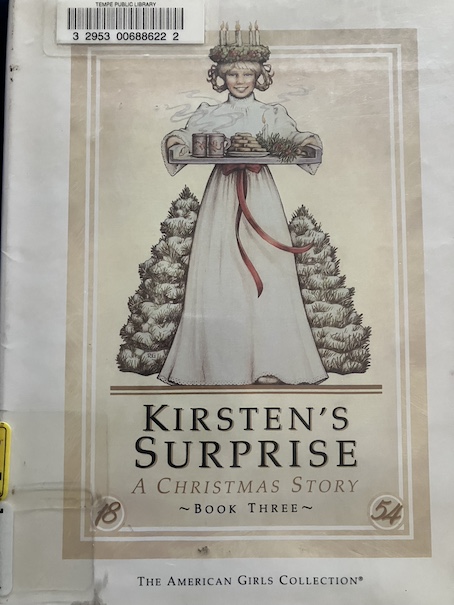
One day, while she is playing with her cousins, Lisbeth and Anna, Kirsten mentions St. Lucia, and she is surprised when her cousins don’t know what she is talking about. In Sweden, families traditionally celebrate St. Lucia’s Day before Christmas. However, Lisbeth and Anna were too young when they left Sweden, years before Kirsten left with her family, so they don’t remember that tradition, and since they came to America, they only remember celebrating Christmas in December. They ask Kirsten what happens on St. Lucia’s Day. Kirsten explains that it’s the shortest and darkest day of the year. One girl in the family dresses up as the Lucia queen, wearing a white dress and a wreath of candles on her head, and she wakes her family, bringing them a special breakfast with coffee and Lucia buns. Anna is enchanted by this description, and the girl talk about surprising their families with their own St. Lucia’s Day celebration.

Then, Kirsten remembers that the long, white nightgown she used for her St. Lucia’s Day dress last year is in one of her family’s trunks, and St. Lucia’s Day (December 13th) is only five days away. The other girls are about to give up on the idea of celebrating St. Lucia’s Day, but Kirsten thinks maybe they should ask Miss Winston if she knows what to do. Miss Winston is their schoolteacher, and she’s still living with Lisbeth and Anna’s families. Miss Winston has mentioned that she misses the Christmas parties her family and friends had back East, so the girls think that she might enjoy helping them plan a special surprise.

Miss Winston is happy to give the girls some candles and help them make St. Lucia crowns, but Kirsten’s father is still too busy to get the family’s trunks. He gets so annoyed with Kirsten asking about them that he tells her not to ask about them again. Lisbeth says that, if their plan won’t work out for this year, they can do it next year, but Kirsten feels badly for getting their hopes up. Her own hopes are also set on having a St. Lucia Day, but she doesn’t know what to do without the dress in the trunk.

Then, one day, she finally hears her father say that he will have time to go for the trunks, and he thinks he had better do it soon because there will be more snow coming. Kirsten is excited and asks if she can go along with him to get them. At first, he doesn’t want to take Kirsten because there won’t be much room in the sleigh for her, and he thinks it would be better for her to go to school with the other children, but she persuades him to let her come.

The journey to Maryville is fun, riding through the snow and singing a Christmas carol. Kirsten even gets a piece of candy at the general store. When they retrieve the trunks, Kirsten wants to open them right away, but her father says they need to leave because it’s already snowing harder, and they need to get home.

The weather gets worse on their way home, and Kirsten wonders if they should turn back, but her father thinks they can make it home. As it gets worse yet, Kirsten’s father gets out of the sleigh to lead the horse through the snow, and he accidentally twists his knee. With her father injured, Kirsten gets out the sleigh to lead the horse. The situation is dangerous, but fortunately, Kirsten realizes where they are, and she knows that there is a cave nearby where they can take shelter.

When Kirsten and her father arrive home, they are greeted by their worried family, and it’s St. Lucia Day. With some help from Miss Winston and her cousins, Kirsten is able to give her whole family their St. Lucia Day surprise, but it has even greater meaning because of everything they’ve been through.

There is a section of historical information in the back of the book about how Christmas was celebrated on the American frontier in the mid-19th century and how it was different from the Christmases families like Kirsten would have experienced in Sweden.

The book is available to borrow and read for free online through Internet Archive.

This was my favorite of the Kirsten books! Although there is some danger to Kirsten and her father when they get caught in the snowstorm after retrieving the trunks, everything turns out fine, and Kirsten saves her father because she insisted on going with him on the trip. This book is also fun because it introduces readers to the concept of St. Lucia’s Day. I think the first book I read as a kid that explained about St. Lucia’s Day was the nonfiction book Christmas Around the World, but I liked seeing this frontier family celebrate their St. Lucia tradition.

thought that Kirsten’s parents impatience with her “pestering” them about retrieving the family’s belongings was realistic, just like parents in real life might act when a child repeatedly asks for something they can’t give them right away. However, at the same time, Kirsten’s mother seems to understand that Kirsten is asking for the trunks for deeper emotional reasons. Not only does Kirsten badly miss her doll, which has been stored in one of the family’s trunks since the beginning of the series, but the other things in the trunk are both useful for the winter season and have connections to the people the family left behind in Sweden. With Christmas coming, Kirsten and other members in the family are missing those connections and the feeling of home. Kirsten’s mother points out that people are more important than belongings, but she also agrees with Kirsten that some belongings represent ties to other people.

Kirsten also misses the tradition of St. Lucia’s Day because that tradition usually marks the beginning of the Christmas season for the family. When Kirsten surprises her family by dressing in her St. Lucia costume, it’s a happy surprise for everyone and really makes everyone feel like Christmas. However, Kirsten also feels the significance of the holiday more than she ever did before because, having been welcomed home by the lights of their house and her waiting and worried family, she better appreciates the tradition of St. Lucia welcoming others with light and food.

As with other historical American Girls books, I also enjoyed the detailed colored pencil drawings of the characters and scenes!

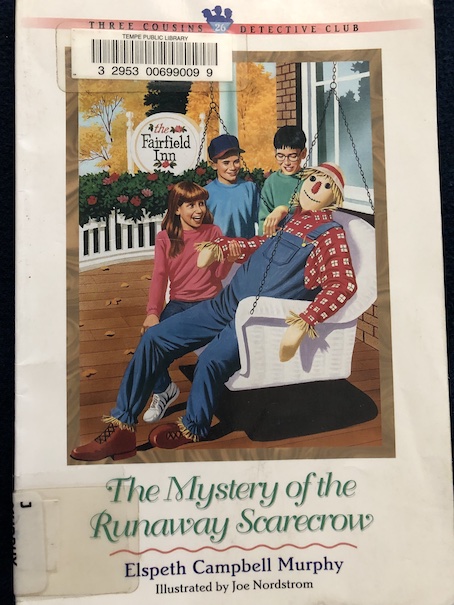
The Mystery of the Runaway Scarecrow

Three Cousins Detective Club

#26 The Mystery of the Runaway Scarecrow by Elspeth Campbell Murphy, 1999.

Sarah-Jane astonishes her cousins when she tells them that Buster, the scarecrow her mother made, which has been sitting outside of a local restaurant, has gone “on vacation. Scarecrows don’t just get up and go on vacation, and when they say that, Sarah-Jane says that Buster left a note saying that he had gone on vacation. The boys don’t believe scarecrows can write notes any more than they can go on vacation. Sarah-Jane admits that scarecrows don’t write notes, but someone else wrote a note on Buster’s behalf and left it behind when Buster disappeared. The note says that Buster is going on vacation and will be back when someone figures out where he’s gone. That’s weird enough, but Sarah-Jane says that Mr. Wesley, who owns the restaurant where Buster was, has been receiving pictures of Buster on his trip in the mail since he disappeared.

It seems like someone is playing a bizarre prank or maybe setting up some kind of treasure hunt involving the scarecrow. The town mayor says that Buster’s “vacation” has created more publicity for the town’s upcoming Fall Festival, so it could even be a publicity stunt. However, it’s been a few days since the last pictures of Buster arrived, and Mr. Wesley is inviting Sarah-Jane and her cousins to investigate Buster’s disappearance and find him because he knows that they like to solve mysteries.

The kids study the pictures for clues to Buster’s whereabouts, but the pictures are pretty generic. They show him outside a motel, at a gift shop, and at a gas station, but the locations aren’t very distinctive and could be found in any number of cities. The postmarks on the envelopes that pictures came in are all still in the area, so it seems like Buster didn’t go very far. They need to hurry if they’re going to find Buster in time for the town’s parade because the parade is tomorrow!

Then, Sarah-Jane reveals that something else mysterious has happened in the area recently. Someone stole a rare coin from Mr. Clark. This is also an intriguing mystery, but they don’t have many clues to start. Mr. Clark isn’t exactly sure when the coin disappeared because he doesn’t get out his coin collection very often.

For some strange reason, an older boy in Sarah-Jane’s neighborhood, Billy, seems very concerned about whether Sarah-Jane and her cousins have made any progress in finding Buster. Could Buster’s disappearance also have something to do with the missing coin?

Theme of the Story:

“The land has produced its harvest; God, our God, has blessed us.”

Psalm 67:6

The book is available to borrow and read for free online through Internet Archive.

My Reaction and Spoilers

I liked the way the person who took the scarecrow used the pictures to provide clues to their treasure hunt. Readers won’t be able to figure it out right away without explanation from the characters because the book doesn’t show all the pictures, but I liked the concept for how the culprit worked a series of clues into the pictures. There’s also a fun backstory behind the scheme. The prankster doesn’t have a sinister motive. The scarecrow caper is meant as a kind of prank/game/harmless publicity stunt.

I guessed pretty quickly who had taken the scarecrow, based on motive, but I liked the addition of Billy and the coin because it complicated the story and provided a second mystery on top of the first. There is a genuine crime in the story, but it’s not the one that the kids start out investigating.

The story takes place during October, but it’s not on Halloween. The town’s Fall Festival just seems to kick off the fall season in general.

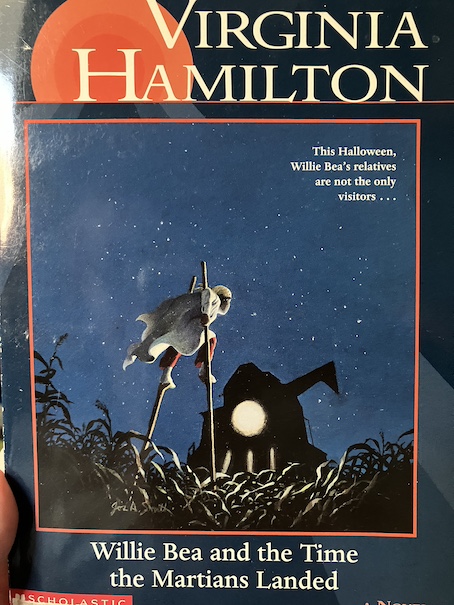
Willie Bea and the Time the Martians Landed

It’s Halloween 1938, and Willie Bea’s relatives have gathered at the old family farm, near where she lives. Money is tight because of the Great Depression, but one of her aunts lives and works in the city, making more money than the others, and is willing to help fund family dinners and provide a little extra for her nieces and nephews when they need something, like new clothes. The aunt is a little scandalous in their family for her multiple marriages, but the others appreciate her generosity, and the nieces and nephews like getting some extra attention and a few treats from her.

The family gathering is a bit chaotic with children running around and getting into trouble. One of Willie Bea’s cousins gets into particular trouble with her mother for using his bow and arrow set to shoot a pumpkin off of Willie Bea’s younger brother’s head. Their mother panics when she catches them doing it because he could have missed and killed the little boy, but Willie Bea tries to calm her mother. Willie Bea was less worried because she knows her cousin’s archery skill and that he wasn’t going to miss, but she understands that adults think of the risks and aren’t fully aware of what the kids are capable of doing. (I’m siding with the mother on this one. Even people who are very good at something can miss now and then, and it’s a big risk to take with someone’s life.) Willie Bea also realizes that the decision to use her little brother for the William Tell act actually came from another cousin because the cousin doing the archery wouldn’t have thought of it himself, and it’s not fair that her mother doesn’t know to blame this other cousin.

Willie Bea talks to her father about the incident, hoping that he’ll understand how unfair it is. However, her father tells her that what her cousin did was dangerous, no matter why he did it. Even though he has a reputation for being good with archery, even people who are good can still miss, and accidents can happen. (See?) Her father lets Willie Bea know that he’s aware that she and her cousins do risky things sometimes when they’re playing with each other, but as an adult, he and the other adults have a responsibility to tell them when something they’re doing is too risky and to put a stop to it. No matter how many times they’ve done some of these things without having an accident, some things are just accidents waiting to happen. They should never assume that an arrow can’t go wrong just because it hasn’t yet or that they can’t fall from a high place just because they haven’t fallen yet.

Willie Bea is a little embarrassed by the talk and feels like her father still doesn’t understand. However, Willie Bea herself has been starting to understand a few things about her relatives this Halloween, things that she either hasn’t noticed before or only half noticed. She can see that one of her cousins is too manipulative, noting the little tricks she uses to get her way and the things she says and does when she wants to be spiteful. She can see that her other cousin has trouble asking up for himself and is particularly vulnerable to manipulation.

Willie Bea also begins to notice things about the adults in the family and their relationships with each other. Aunt Leah, the aunt who has more money than the others and has been married multiple times seems glamorous and fascinating to Willie Bea. Aunt Leah is into horoscopes and fortune telling, and when she reads Willie Bea’s palm, she predicts something special for her. Although Willie Bea loves her own mother, she is intrigued by the family gossip that her father was seeing Aunt Leah before falling in love with her mother, and Willie Bea fantasizes about what it would be like to live with Aunt Leah in the city. She imagines that it would be exciting, and she asks her father why he chose her mother instead of Aunt Leah. Her father knows that Willie Bea doesn’t entirely understand what it’s like to make that kind of choice and what living with a woman like Aunt Leah would really mean. (It occurred to me that the multiple divorces Leah has had might be a clue.) He just explains to Willie Bea that his choice became clear after he got to know her mother as well as her sister, Leah. He knew her mother was the right choice because she was the kind of steady woman who would always be there for him.

That evening, while Willie Bea is putting together her hobo costume and the ghost costumes for her younger siblings and her parents are listening to the radio, Aunt Leah suddenly bursts in and starts having hysterics about it being the end of the world! It takes Willie Bea’s parents a while to get a clear answer from Aunt Leah about why she’s so upset. When she recovers enough to explain things, she says that she was listening to the radio, and she heard that Martians have invaded New Jersey! She describes the horrible, terrifying reports that the radio announcer made about the Martians destroying army troops with their deadly heat ray. Aunt Leah was so terrified by what she heard that she not only turned off the radio but unplugged it, and she says that she’ll never plug it in again, which might be a moot point, if aliens really are here to destroy the world. (If you know what was infamously broadcast on Halloween 1938, you know what Leah heard and that it’s not what she thinks it is.)

While Willie Bea’s parents are trying to decide what to make of Aunt Leah’s story, Willie Bea’s Uncle Jimmy arrives. He says that the rest of the family has also heard what Aunt Leah heard and that they’re all gathering at the old family farm. Rumor has it that people have seen the terrible invaders over at the Kelly farm. Willie Bea’s mother gathers the children and heads to the family farm that Willie Bea’s grandparents own to be with the rest of the family, while Willie Bea’s father tries to see if he can find the station that Leah was listening to and hear the reports for himself. It occurs to him that it might not be an invasion of the Martians but could actually be Germans and German war machines because they’ve all heard about the Nazi takeover of Germany, and he remembers the horrible Hindenburg disaster. If Germans could make a blimp that explodes into a fiery terror like that, then he thinks maybe they could make something that resembles an alien invasion.

At her grandparents’ farm, Willie Bea watches as various relatives panic, cluster around the radio, trade rumors, and try to figure what’s going on. Rumor has it that there are Martians on the Kelly farm, so Willie Bea convinces young Toughy Clay to go over there and try to see them for themselves. At Willie Bea’s insistence, they use the stilts that the children like to walk on to give themselves longer legs, so they can get there faster. Nothing is as it seems this Halloween, and Willie Bea’s expedition to see the Martians definitely doesn’t go as planned.

The book is available to borrow and read for free online through Internet Archive (multiple copies, including a short picture book version).

Almost of the characters in this book are African American. I don’t think it’s ever stated directly because there’s no need in the story to describe them, compared to anyone else, but I think it’s subtly implied. There is only one point in the story where race is mentioned at all, and that’s when Willie Bea is hurt, and the doctor comes to see her. Willie Bea describes the doctor as an old man who delivered most of the babies in her family and knows everybody in the community, and she says that he visits everyone, black or white, rich or poor. Willie Bea’s family is at the poorer end of the community because the doctor knows that people like them don’t normally call the doctor unless it’s something that they really can’t handle by themselves.

I found the family relationships in the story confusing at first. The kids are all referred to by nicknames, and when they are first introduced, it’s difficult to keep it straight who is whose sibling and who is a cousin, and who is older and who is younger. At least, that’s how it seemed to me. Relationships are explained gradually as the story continues, along with characters’ real names as well as nicknames, but it takes some time to get to the explanations.

The story has a slow start, and the real adventure doesn’t begin until about halfway through the book. In some ways, it’s a coming of age story for Willie Bea because she finds herself seeing her family in ways that she never has before, becoming more aware of different sides of their personalities and gaining more insights into their relationships with each other. She also comes to see firsthand what her father means about the stunts that she and her cousins pull and how she should never assume that they can’t get hurt just because they haven’t before. Much of this book is what I would call “slice of life”, a sort of glimpse into Halloweens of the past in a rural community, especially one particular Halloween that would have been memorable for anyone who was alive at the time in the United States.

The radio broadcast that has Willie Bea’s family and others in the community panicking over an alien invasion is The War of the Worlds, a play based on the novel of the same name by H. G. Wells. This type of panic over this particular radio performance was a real, historical incident because the radio play was presented in the format of news broadcasts at the time, and some people who tuned into the program late misunderstood what they were hearing and thought that it was a real news broadcast about an actual emergency. It wasn’t a widespread panic because, first, people who started listening to the broadcast from its beginning knew what they were listening to, and second, not everyone was listening to the broadcast at all. Still, there was enough panic over the radio performance that it became newsworthy and has become a piece of American history and lore.

I enjoyed the historical details in the story, particularly all the radio play references throughout the story. Willie Bea’s family likes to listen to radio shows, and I’m familiar with some of them because I also enjoy old radio plays. Her family likes to listen to The Shadow and Little Orphan Annie. Willie Bea likes to amuse her siblings by imitating people from the radio, singing theme songs and reciting jokes from Jack Benny, like the famous “your money or your life” joke.

Stonestruck

It’s WWII and Jessica knows that she will be evacuated from London soon, along with other children from her school. She doesn’t want to leave London and her mother, even though the bombings have gotten increasingly worse and frightening. Her father has already gone away to the front, and she has no idea if he will ever return. Then, one night, the unthinkable happens: their house is destroyed in a bombing. Jessica and her mother survive the bombing by sheltering in their basement, but Jessica’s pet cat is nowhere to be found. She doesn’t know if he survived the bombing and ran away somewhere or if he is buried somewhere in the rubble of their house. Jessica is traumatized, but with their home gone, her mother makes the decision to send Jessica away from London early. Jessica’s mother has decided that she will volunteer for service as an ambulance driver.

Jessica is terribly upset and worried about what will happen to her when her mother sends her away to Wales alone, but her mother assures her that she will be fine and that she will soon be joined by the other children from her school. They are being sent to a Welsh castle, where they will have classes together. Jessica’s mother tries to tell her that it will be fun and exciting, going to school in an old castle, but Jessica is too frightened and traumatized to think that this will be a fun adventure.

When Jessica’s train arrives at the station in Wales, she is met by Mr. and Mrs. Lockett, the gardener and housekeeper at the castle. They are friendly and welcoming to her, but on their arrival at the castle, Jessica hears a frightening scream. The Locketts don’t explain to her what the sound is and act like they haven’t heard a thing. When Jessica wakes up early the next day, she is relieved to see a peacock on the castle grounds, who gives the same strange cry that she heard the night before.

She is satisfied that the weird scream she heard has a logical explanation, but then, something else frightening happens. Although the morning is clear, there is one, strange, dense patch of mist on the castle grounds. Jessica thinks that it’s strange to see such a dense patch of mist in only one spot when there’s no mist anywhere else. Then, she hears a voice calling her name from the mist and the sound of children’s laughter. Jessica is confused because she’s only just arrived and hasn’t met anyone else there except the Locketts, and the rest of her classmates from her school in London aren’t there yet. It gives her an uneasy feeling, and when she sees a hand reach out of the mist and beckon to her, she becomes terrified and runs away.

At breakfast, Mrs. Lockett is cheerful and behaves in a perfectly ordinary manner. She expresses sympathy to Jessica over her ordeals during the bombings in London and the loss of her house and asks her what she plans to do before the other children arrive. She confides that she and her husband are not accustomed to children because they have none of their own, confirming that Jessica should be the only child in the castle right now. Jessica assures her that she can entertain herself. She asks Mrs. Lockett about the peacock that made the screaming sound, but Mrs. Lockett says that there are no peacocks on the ground and that she didn’t hear any scream. Mrs. Lockett is very disturbed by Jessica’s mention of a peacock. She says that the family that owns the castle won’t have peacocks on the grounds because they’re bad luck, and she sternly tells Jessica not to imagine things. Then, Mrs. Lockett gets a call that a train with 30 evacuees will be arriving, and she needs to help arrange accommodations for them. She leaves Jessica to entertain herself, but she warns her to stay out trouble and to stay away from the pond.

Jessica explores the grounds of the castle and meets Mr. Lockett again. Mr. Lockett, who prefers to be simply called Lockett, is kind to her, and she asks him about the peacock. Lockett seems to believe Jessica that she saw a peacock and finds it worrying. He says the same thing that Mrs. Lockett said, that peacocks are bad luck. He says that, for most people, a peacock’s cry means coming rain but that it means tears at the castle. He says that he knows that Jessica is sad right now, but he says that she should remember that she won’t always be sad. Some day, she will be happy again. He also cautions her to be careful what she wishes for.

When Mrs. Lockett returns, she says that she’s made arrangements for the evacuated children who are coming. She is sympathetic to the evacuees. Arranging housing for them is a hassle, although she says it’s for their own good to be evacuated. Lockett says that it’s good up to a point. He doesn’t speak much, but he observes that, while it’s necessary for the children to be sent away from the bombings, it isn’t so good that they’re being separated from their parents. He says that he’s sure that Jessica would rather be with her mother. Jessica is surprised that he understands how she feels. She says that, while the castle is nice and definitely safer than London right now, she really misses her her mother. Mrs. Lockett doesn’t want to dwell on that. Instead, she encourages Jessica to come with her to meet the evacuees’ train. She says that these new children from London will be friends and company for her. Jessica isn’t so sure because these children are strangers to her, not friends from her school, but she does go to meet the train with Mrs. Lockett.

People from the village have gathered to meet the other evacuated children. Some of the women have prepared food for children’s arrival, and some are talking about how many children they’ve been told to accept into their homes and their fears that some of them will have lice. When the children get off the train, Jessica can see that they are all hesitant and scared. Among the crowd, Jessica sees a boy she recognizes from the night of the bombing, standing outside of a burning house. She doesn’t know his name, but she feels a kinship with him because he also lost his home. Unlike the other children, he has no bags with him. Then, suddenly, the boy vanishes in the steam from the train. No one else seems to notice that he was there or that he’s now missing. Jessica wonders if she just imagined him.

The children’s teacher is checking the children’s names off a list as they are assigned homes, but Mrs. Lockett stops her, saying that she’ll see to it herself. However, Jessica notices that Mrs. Lockett puts it off. Jessica asks Mrs. Lockett how many evacuees there are, and she vaguely says about 20 or so, when she had said 30 before. When Jessica asks her again exactly how many there are, Mrs. Lockett says that it’s an old superstition in their town, that no one should ever count children twice. Jessica asks her why that is, but she brushes off the question. Later, Jessica sees Mrs. Lockett burning the list of evacuees. With the list gone, no one will be able to count how many evacuees there are.

After her mother calls the castle to check on her and tries to pretend that things are fine when Jessica knows they’re not, Jessica feels the need to go for a walk by herself. Mrs. Lockett lets her go, warning her to be back before dark. As Jessica explores the castle grounds, she experiences more strange phenomena. She sees the peacock and the mist again and hears a voice calling her name. She sees a boy on a horse vanish into the mist. Then, a troop of phantom children charge past her, laughing and calling her name, and Jessica is shocked to see that one of them looks like her!

Jessica knows that she’s not just imagining the things that she’s been seeing, and she struggles to understand what’s happening and what it means. She realizes that, every time something strange happens, she either sees the peacock or hears its cry. She also remembers that, the first time she heard its cry, she had the strange feeling that, while she went into the castle, a part of herself stayed outside. Is that other part of her the phantom girl that she saw, being chased by the other phantom children? It looked like her, but it also felt alien, like it isn’t really her.

Jessica discovers that the boy who vanished at the train station ran away and has been hiding out on the castle grounds. He was afraid to let himself be sent to a strange home with the other evacuees because he’s heard that evacuees are treated horribly. Jessica tells him that she’s been treated kindly at the castle. Before she can learn the boy’s name, he runs away again, frightened by a strange old woman.

The old woman is frightening and seems to know who Jessica is. She says that she’s going about her rounds, leaving food out for the children. She knows about the phantom children, who run around in the mist with their hands linked. She refuses to tell Jessica her real name, just telling her to call her Priscilla, and she warns Jessica to keep repeating to herself that things aren’t always what they seem.

Jessica asks Mrs. Lockett if she ever played chain tag, the type of tag game where children join hands whenever they’re caught and then continue chasing other children. Mrs. Lockett says that the children around here call that game Fishes in a Net. When there are four or more children in a chain, they surround other children to trap them. She says that she played it in another place as a child, but not here because their mothers would never allow them to. Jessica asks why, and Mrs. Lockett hesitates to answer, but she makes a reference to a boy she knew when she was young, who apparently played the game too many times and disappeared. Before he disappeared, he talked about the peacocks, which was why they decided to get rid of the peacocks on the grounds. Mrs. Lockett says that the Green Lady wanted him for her own. When Jessica asks her about the Green Lady, Mrs. Lockett suddenly brushes it off as an old legend that doesn’t mean anything. Lockett the gardener says that some stories build power with the telling, and that’s why people don’t want to tell them.

However, Jessica realizes that there is truth to the legend that Mrs. Lockett doesn’t want to explain. Mrs. Lockett knows that there’s enough truth to it to destroy the list of evacuated children so it will be harder to keep track of who’s there and who isn’t. The people of this town don’t count children twice because something that lurks in the mist vanishes children away, and no one wants to notice it or admit it’s happening, that it’s been happening for generations. As long as they don’t count children twice, they can tell themselves that no one is missing and nothing is wrong, even when it is. Jessica begins writing about all of her strange experiences in the journal that her mother gave her, trying to solve the mysteries of the castle and the mist. Something in the mist is after her, beckoning her to come to it, and like the others before her, if she goes to it, she will never come back.

At Jessica’s urging, Lockett tells Jessica what he knows about the story of the Green Lady. The Green Lady isn’t human. She’s a shapeshifter with a heart of stone. Years ago, she kidnapped the young lord of the castle, Harry, because he was a beautiful boy, and she wanted him for her own son. However, Harry was desperately lonely, living only with someone who had a heart of stone. He refused to speak aloud again until he had a human playmate. So, the Green Lady began stealing playmates for him, but it was never enough. There is one playmate in particular that Harry is waiting for, the one whose name he calls in the mist. That’s Jessica. Because only Jessica, frightened and lonely in a strange land, has the ability to break the spell.

The book is available to borrow and read for free online through Internet Archive (multiple copies).

Some reviewers on Goodreads have pointed out that this book is very similar in plot to an earlier book by the same author, Moondial. In Moondial, as in this book, there is a young girl who is sent away from home and encounters mysterious phenomena that involves children in past times who are suffering and need her help to free them. However, the two stories are not identical, and I like the way this particular book is framed around WWII child evacuees from London.

It is important to the plot that the child evacuees from London are scared because of the war and have been wishing that they can go home, but that they haven’t been raised in the atmosphere of fear and superstition that the children in Wales have been. They have worries, but they’re not the same worries as the Welsh people have. Jessica learns from Lockett that it is the wishing themselves away that splits the children’s spirits and leaves them vulnerable to being captured by the trapped spirit children. Lockett understands what is happening better than anyone and how the unhappy children from London feel because he was also once an unhappy child. He was abused at home when he was young, and he also wanted to get away. However, when confronted by the spectral children whose hearts have also turned to stone, he changed his mind and escaped their clutches. He explains to Jessica what she has to do to reclaim that part of her that split off from her when she wished that she could go home, and from there, Jessica realizes what she needs to do to end this ghostly game of tag and free the other trapped children. The first step is reconciling herself to her situation as it exists and no longer wishing herself away. In doing so, she is doing what all of the adults around her have been failing to do, both about the supernatural phenomena and about the current war – facing up to the situation and not trying to pretend like it is less serious than it really while no longer wishing it away. Then, she realizes that the only way to end the spectral children’s game is to beat them at it, and for that, she needs help from other children.

When one of the other child evacuees from London has been captured and spirited away, Jessica and the boy who has been hiding out convince the other child evacuees to help them get him back and free the other children who have been taken across the generations. They have some work convincing the other evacuees of what is happening, but when they do, they form their own team for chain tag or Fishes in a Net and face off against the team of spectral children. It has to be the evacuee children who end this curse because the Welsh children are too afraid to do it, and the Welsh children’s parents would never risk them in the attempt. The Welsh people aren’t as careful about the evacuee children, and some of them have been bullying and abusing some of the evacuees. There is some concern when they realize what the evacuee children are going to do, but no one stops them.

It isn’t entirely clear what happens when the evacuee children free children who were taken from previous generations because these older children simply vanish. Even Jessica isn’t entirely sure whether the children returned to their own times or if they’ve simply passed on. However, the people of the Welsh town realize that the children have finally been freed and that the spell is broken, and they are grateful.

Parts of the story were stressful to read. First, I found the loss of Jessica’s cat upsetting. They never learn exactly what happened to the cat during the story. Then, Jessica finds out that the other boy who lost his home also lost his mother and siblings in the bombing, showing her that her own losses, while serious, aren’t the worst ones. There are also instances where the local children bully the London children, and the Welsh parents blame the London children for it. Some of the Welsh people are kind to the evacuees, but some also bully and abuse them, seeing them as only rough, poor children who are troublemakers and an inconvenience to them.

Even Mrs. Lockett says that she feels lucky that she got Jessica as an evacuee because she is gentle and well-behaved, not like the other London children. Jessica realizes that this is an unfair prejudice. Although she does not consider herself a brave person, she finds her courage when she begins to confront some of the adults around her about the way they look at the London children and how they treat them. She asks the adults directly if they realize that the London children also don’t want to be there and that no one asked them if they wanted to be sent away from their parents. The adults, confronted with the reality of the the children’s feelings and the reasons for their being there, entrusted to their care, are embarrassed. They don’t have real reasons for their prejudices against the evacuees, only their unfair feelings and bad behavior, and they realize that when they are confronted directly with the realities of the situation and their own behavior. Really, I think that facing up to realities, even ones that are strange and scary, is one of the major themes of the book. It is Jessica’s realization that she can do that, when even the adults around her can’t or won’t, that gives her the courage to do what she needs to do to end the spell and save herself and other children.
Moondial

Araminta Kane, called Minty, has always had the ability to sense things that others can’t. For as long as she can remember, she has had the ability to sense and even see spirits. She doesn’t talk about it much because this happens to her routinely. When she does mention it, her mother assumes that it’s imagination or a trick of the light. Minty becomes more aware of her ability after her father dies, and she is still able to hear his voice from time to time.

She has been learning to cope with her father’s death and the changes to her life since it happened. She and her mother have been getting along pretty well, but her mother has to work long hours. It’s bad enough that Minty has to be alone so much on weekends, but her mother wonders what she will do during her school holidays. Minty’s mother decides to send Minty to stay with her godmother, Mrs. Bowyer, in the village of Belton, for the summer. Mrs. Bowyer is an elderly lady who lives in an old, stone cottage, which is near the old manor known as Belton House. Belton House once belonged to Lord Brownlow, but it is now owned by the National Trust (UK organization that focuses on preservation and protection of historic sites) and operates as a tourist attraction, open to the public. Mrs. Bowyer used to work for the Brownlow family as a domestic servant, and now, she sometimes helps out in the gift shop at Belton House.

Minty is happy about spending the summer with Mrs. Bowyer, who they call Aunt Mary, because she has heard about Belton House, and she would like to see it. She knows that there is a hidden tunnel on the property, and the idea of exploring it sounds intriguing. However, she wonders if that will be enough to keep her occupied all summer, and she does worry about whether her mother will be all right without her. She knows that her mother is still mourning her father and that she sometimes cries at night. Minty’s mother reassures her that she will be fine and that they’ll be too busy working to be sad and lonely. She also reassures Minty that she won’t be bored while she’s in Belton. When she stayed with Aunt Mary as a child, she always had the feeling that Belton was unusual somehow, that unseen things were happening beneath the surface. Minty asks her if she means ghosts, that the village is haunted. Her mother isn’t quite sure because she never actually saw any ghosts or anything of the kind.

Aunt Mary is happy to have Minty stay with her, and she says that Minty can help her in the shop at Belton House. She says that things at Belton House aren’t like they were in the old days, when the Brownlows lived there, and she remarks that they would turn over in their graves if they saw all the tourists and school groups tramping through their house and grounds. Before her mother leaves Belton, they explore the nearby churchyard together. Even though it’s July, Minty feels a strange gust of cold air. She senses that there is something strange about it, she plans to return later and examine the area more closely.

Minty has a strange sense that time doesn’t work in quite the same way in Aunt Mary’s village that it does elsewhere. She thinks it makes sense that time would stand still in the old graveyard because everyone there is dead, but Aunt Mary herself seems to move as if she’s in a different time as well. Aunt Mary is puzzled even about basic pieces of modern technology, not understanding even what Minty’s headphones are for.

While Minty is with Aunt Mary, she gets word that her mother has been in a car accident and is in the hospital. Minty is terrified of losing her mother as well as her father. A nice man named John Benson from her mother’s office is helping to arrange things, and Aunt Mary urges Minty to try not to think about it or worry too much, but Minty can’t help it. When Minty feels like she needs to get out of the house and go for a walk, Aunt Mary suggests that she go explore Belton House and meet Mr. World, the groundskeeper, who likes children.

When Minty meets World, he asks her if she’s there to meet the children. At first, Minty doesn’t know who he’s talking about, since she just saw a tour group of other children leaving the grounds. She asks if there are any children currently living in the old house, but World isn’t talking about living children. World tells her that there are children who haunt the place. He says that they’re trapped and need someone to free them, and he thinks that Minty will be “the one to turn the key” and set them free. This isn’t exactly reassuring talk for Minty’s current situation, but she has the feeling that what World says is true and that she’s just been given a kind of invitation that she can’t refuse.

In the gardens of the manor, Minty finds a mysterious sundial that has the power to take her back in time. The very first time she encounters it, it gives her a strange feeling, and for some reason, she keeps thinking of it as a “moondial” instead of sundial. Suddenly, Minty finds herself back in the Victorian era with a boy named Tom. Tom is an orphan from London who works at the manor house, and the adults there abuse him. Minty tries to intervene, but none of the adults can see or hear her, and she suddenly finds herself back in her own time, uncertain of what made her travel through time and what brought her back to the present.

Later, when Minty visits the old house again, she has another encounter with the sundial/moondial and finds herself visiting the grounds of the manor at night. This time, she meets a girl from the past called Sarah. Sarah sings little rhymes (old, traditional ones – Poor Mary (sometimes called Poor Jenny or Poor Sally, and sometimes she’s weeping for a lost sweetheart and sometimes for a playmate) and Girls and Boys Come Out to Play (listen on YouTube). Minty watches as a frightening adult dressed in black hurries her back into the house, calling her a “little devil.”

When Minty visits Tom’s time again, she learns that Tom has also seen Sarah. He seems to also have the ability to travel through time, and when he sees Sarah, it’s also at night. Tom still thinks that both Minty and Sarah are ghosts. Minty doesn’t know why this is happening, but she senses that she needs to help Tom and Sarah.

When Minty visits the hospital, she isn’t sure what to say to her mother, who is still in a coma, so she decides that she will make recorded tapes about her time-traveling adventures that she can play for her mother, along with some music. The doctor approves of Minty make tapes for her mother to listen to, but Minty tells him that what she has to say is private, and she makes him promise that he and the nurses won’t listen to them while they’re playing. The doctor promises that there won’t be anyone in the room, and they won’t listen to the tapes themselves.

Then, Aunt Mary has a visit from a strange woman called Miss Raven, who says that she’s an author investigating the ghosts at the manor house. Aunt Mary even accepts Miss Raven as a lodger at her house. However, Minty has a strange feeling that Miss Raven is not to be trusted. Miss Raven tries to get Minty to admit that she has seen ghosts. She watches Minty closely and tries to get Aunt Mary to limit Minty’s freedom to go places by herself. World also shares Minty’s suspicions of Miss Raven. He tells her that Miss Raven is probably after the children, and it’s up to Minty to save them. She doesn’t know how to do that, but she’s determined to try.

The book is available to borrow and read for free online through Internet Archive. There is also a BBC miniseries based on the book. It’s available on DVD through Amazon, and you can sometimes see it or clips of it on YouTube. There is also a similar (although not identical) story by the same author called Stonestruck, which involves child evacuees from London during WWII.

I read Stonestruck first, and I read Moondial specifically because another reviewer mentioned the similarities between the two stories. It seems like the author wanted to revisit the themes of Moondial in a somewhat different setting and with some twists when she wrote Stonestruck. The two stories aren’t identical, but there are similar themes of captive children or children’s spirits trapped across time. The time travel in this book centers around the mysterious sundial/moondial, while Stonestruck has ghostly children playing a game, and capturing other children.

There are features of both books that I like, so it’s difficult to choose a favorite between the two of them. I like the features of the child evacuee and the ghostly game from Stonestruck. This one has a truly haunting ending with a frightening scene on a Halloween night in the past. The ending of Stonestruck is a little more open-ended than the ending of Moondial. You can read my review of Stonestruck for more about how that ends, but it’s less definite what happens to the captive children or captive children’s spirits in that book. In this one, we do find out what happens to them. There are hints of Tom’s fate all the way through the story, but Minty doesn’t recognize it immediately, partly because “Tom” is actually a nickname rather than his real name. He later explains to her that kitchen boys are always called “Tom” no matter what their real names are.

Time is important to the story, and Minty realizes that the key to the time travel is that the supposed “sundial” is actually a “moondial.” Sarah refers to it as a “moondial” when they see her because Sarah typically only comes out at night because her face is disfigured by a birthmark and people think it’s a sign of the devil. Since Sarah almost never sees the sundial when the sun is out, it’s a “moondial” to her. The superstition about birthmarks is historical. However, I though that what the characters say about measuring time was interesting.

At one point, World gives Minty a book about sundials to study, and he explains that “clock time is mean time. Sundial time is what they call apparent time …” and the only exact time is star time. Minty takes that to mean that the moondial measures true time. You can measure time by the stars, using Polaris and the Big Dipper, and measuring time that way is based on a 24-hour clock rather than standard 12-hour clocks. Measuring time based on the Earth’s rotation, relative to fixed stars, is called sidereal time. What World says about clocks being based on “mean time”, meaning the “the sun’s average (mean) rate for the year” is true. Sundials measure “how the sun travels across the sky“, but the movement isn’t completely regular, which is why our clocks use the average movement rate. Because of the variations in the sun’s movement from the average or mean calculations, you can’t accurately set a clock or watch by a sundial, unless you know how to calculate for the variations. That’s what World means about sundials showing apparent time. Measuring time by the positions of the stars in the sky creates a “day” that is just slightly shorter than the standard 24-hour day that we measure on clocks. However, star time isn’t the only true way of measuring time. Stars appear to move with the rotation of the Earth, which is pretty accurate, but we now also have the concept of atomic clocks. Even those aren’t 100% accurate, though. There doesn’t seem to be a 100% infallible accurate way of measuring time, but atomic clocks are only off by about 1 second every 100 million years. They’re about as close to full accuracy as we are able to get. The book doesn’t go into all of the scientific details of measuring time because it’s a fantasy story, but I thought that working some real concepts of measuring time into the story was fascinating.

The book also works in the concept of the mottos that are traditionally carved on sundials, like the ones that say they only count the sunny hours. However, some sundials have deeper inscriptions, and the concept of inscriptions on sundials explaining time travel appears in some other fantasy books, like The Time Garden. In this book, Minty considers inscriptions like, “For the Night Cometh – cutting off all Power of Passing of Time” and “Light and Shadow by turns, but always Love.” Both of these inscriptions give her clues to how the moondial works and what she needs to do to help the distressed spirits of the past children, who are trapped in time. Tom and Sarah are both lonely and unloved children where and when they are. When Minty reunites them with the spirit of Tom’s sister, Dorrie, who he is separated from in life, the three spirits are able to be the love and company they each need. There are two carved figures on the sundial, Chronos and Eros – Chronos representing time and Eros representing love. Love transcends time.

Miss Raven is the villain of the story, even though we don’t really meet her until later in the book. Miss Raven may possibly be a witch, and she uses cats to spy on Minty. The details about how and why Miss Raven became a witch are never clarified. She also seems to have originated from Sarah’s time and was once her governess, although that isn’t really clarified, either. Did she turn evil because of her resentment of Sarah, or was she always like that? We also don’t really know why she’s after the children or the children’s souls. At the end, she seems to have vanished, perhaps banished by something Minty did on a fateful Halloween of the past in her final travel through time, although Aunt Mary thinks that she has departed in a normal way. There are things that aren’t fully explained by the end of the story, although we do learn what happened to Tom, and Minty knows that Tom’s spirit is now free and happy with the spirit of his sister and another lonely girl who badly needed friends.

The Halloween scene in the final time travel is really chilling, and it’s especially spooky in the miniseries version of the book.

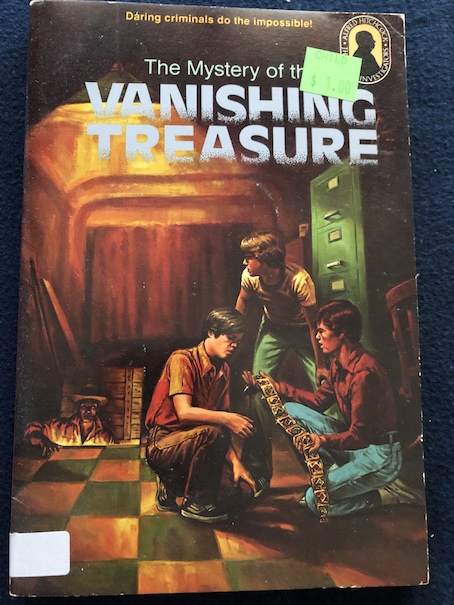
The Mystery of the Vanishing Treasure

The Three Investigators

The Three Investigators don’t have a case at the moment, so Jupiter entertains himself and his friends with an intellectual exercise – figuring out how someone could steal the Rainbow Jewels from an exhibit at the Petersen Museum, an exhibit that has been promoted in the local papers. Pete and Bob object that they solve thefts, not commit them, but Jupiter says that figuring out how a theft could occur would be useful in helping them understand thefts that actually occur. The boys go to the museum to see the exhibit and study it for security weaknesses.

While they are at the museum, a theft actually occurs, but not in any of the ways that Jupiter predicted that a theft could occur. It happens in broad daylight, with a room full of people and security, and the object that was take, a golden belt, was actually the heaviest and least portable object in the exhibit. Jupiter and his friends witness the start of the crime when Jupiter runs into an old acquaintance from his childhood acting days. This actor gleefully tells Jupiter to watch the stunt that he’s going to pull. He pretends to feel faint and then drops a fake jewel that looks like one of the real ones. This is a distraction for the guards, who are all focused on him when the real theft happens. The actor is in trouble for providing the thieves with a distraction, but he tells the police that he was hired to do it both to prove himself for a role in a movie and as kind of a publicity stunt. Of course, the movie wasn’t real, and he was just duped into helping the thieves.

Jupiter is intrigued by the theft and offers the Three Investigators’ services to the man in charge of the exhibit, but he turns them away because they’re kids. However, they soon have another mystery to consider. An elderly children’s author thinks that she is being stalked by gnomes. She lives in the same old house where she grew up, and she is known for writing books about gnomes, inspired by stories that her old Bavarian nanny told her. Years ago, she used to invite neighborhood children to her house for parties, playfully calling them her “gnomes”, and she would read to them from her books. However, the old families have grown up and moved away, and many of the old houses around her have been torn down and replaced with shops and businesses. The author doesn’t want to sell her house, even though she’s been pressured to sell by a developer, but lately, strange things have been happening at the house. She keeps seeing little men dressed like gnomes, and they play mean tricks on her. She swears that she’s not dreaming or crazy, which is what her nephew seems to think. She does genuinely believe in gnomes, but what’s been happening could also be someone playing a trick on her.

The Three Investigators might think that she was imagining things, except that Bob sees one of these gnomes out the window while they’re talking to the author. The boys try to chase after it, but it disappears before Jupiter and Pete can even get a look at it. They consider the idea that Bob could have imagined the gnome, based on his reading about them and the author’s stories, but he swears he didn’t. They decide to approach the situation from the assumption that someone is playing tricks on the author, and Jupiter and Pete decide to spend the night at the author’s house to see what happens.

While the boys are exploring the area, they decide to check out the defunct movie studio next to the author’s house. There, they overhear the developer who wants to buy the author’s house talking to the security guard at the old studio. What they say makes Jupiter wonder if they could have something to do with the theft of the gold belt, but when they discover the boys listening, they insist that Jupiter misheard them.

The son of the man in charge of the exhibit at the museum comes to consult the Three Investigators about theft of the belt, having overheard them offering their services to his father. Jupiter gives him a suggestion to check on while the Three Investigators look into the matter of the gnomes. Jupiter’s first guess about the theft of the belt isn’t quite right, but it turns out that there is a connection between the gnomes and the theft. The gnome incidents could be part of an effort to pressure the author into selling her house to the developer, but the digging sounds that accompany the gnomes make Jupiter realize that the gnomes have other motives.

The book is available to borrow and read for free online through Internet Archive (multiple copies).

Many of the Three Investigators mysteries are a little like Scooby-Doo mysteries, with ghosts, monsters, or other supernatural phenomena that have logical or human explanations. I like this mystery because gnomes are an unusual mythological creature to find in that kind of story. There are plenty of mystery stories with faked ghosts but few with staged gnome appearances. It’s a little bit of a spoiler to say that the gnomes are fake, but not much of one because that is really the assumption from the beginning. The children’s author believes in gnomes, but nobody else does, and even the author isn’t convinced enough to stop her from hiring the investigators to look into the situation.

The introduction of the theft of the golden belt from the museum at the beginning of the story introduces the idea that the theft is somehow related to the gnome appearances, and that is the case. What complicates the situation is that there are different people involved with both the gnome appearances and the thefts, and not everyone who’s involved in one plot is necessarily involved in the other. One of the complications of the story is figuring out who is involved in what and who is the ultimate mastermind behind the main mystery.
The gnome appearances also put this mystery into the category of mysteries that I call Mysterious Happenings – where something strange is happening with no obvious explanation, and much of the mystery involves figuring out the motive behind the mysterious happenings, which is usually related to an actual crime that is initially unknown to the investigators. A classic example of a Mysterious Happenings mystery is the Sherlock Holmes story, The Red-Headed League, which involves a man who is invited to join a club that requires him to do some meaningless busy work for money but which he suddenly discovers is fake. In that case, the mystery is figuring out the purpose of the club and why someone would play such an elaborate prank on this particular man. This Three Investigators story has a similar premise to the Sherlock Holmes story in the sense that someone is playing an elaborate prank on the author with the gnome appearances, and the question is why anyone would do that. Part of the reason that I mention the Sherlock Holmes story is that the motive behind the prank in the Sherlock Holmes story is the same as the motive for playing the prank with the gnomes, making me think that the author was inspired by The Red-Headed League.

As for who/what the gnomes are, the presence of the old movie studio and the use of a hired actor to create a distraction in the museum are clues. It’s also important to the story that it was children’s day at the museum, so there were a lot of kids on the scene when the theft happened. I suspected who was playing the part of the gnomes from the beginning, but I didn’t guess the full motive for the crime, even though The Red-Headed League is one of my favorite Sherlock Holmes stories. There’s a dramatic scene at the end of the book where the “gnomes” storm the kids’ headquarters at the salvage yard to retrieve the golden belt from Jupiter after Jupiter figures out where they hid it.

The Case of the Invisible Dog

McGurk Mysteries

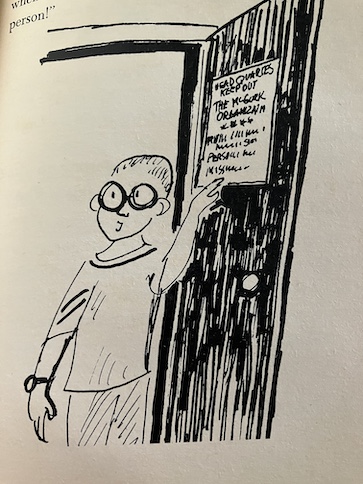
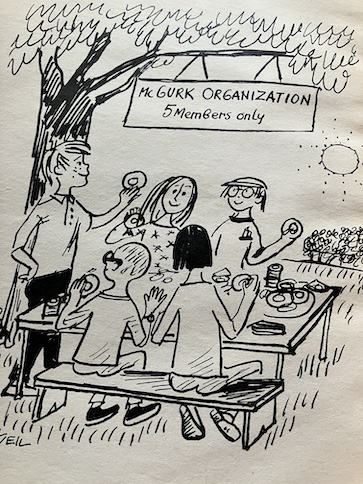
The members of the McGurk Organization are having their annual picnic in McGurk’s backyard when, suddenly, a doughnut leaps off the table and begins traveling through the bushes and grass. None of them can understand what’s happening because they can’t see anything that would cause the doughnut to move like that.

They go after the doughnut to see what happened, and they find Brains Bellingham, the nephew of Miss Bellingham, who lives next door. Brains has been staying with his aunt while his parents are out of town, and he always has a put-down for the members of the McGurk Organization. Brains is holding his aunt’s Yorkshire terrier, Dennis, and the missing doughnut, which has apparently been chewed by the dog. Brains apologizes for the dog ruining their “crummy” picnic, but he says that Dennis can’t resist doughnuts. However, that explanation doesn’t satisfy the McGurk Organization because none of them saw a dog carrying the doughnut, just the doughnut moving by itself. Brains makes an excuse about the dog being small and blending in with his surroundings, but the others can tell that he’s hiding something.

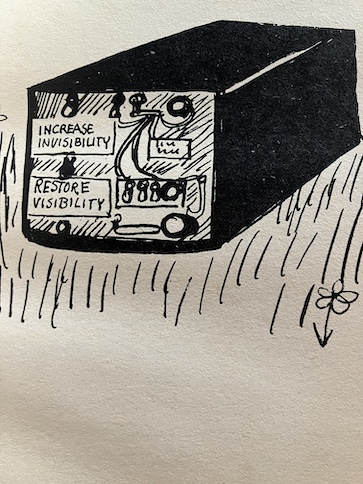
When Brains leaves for a moment because he says his aunt is calling him, they spot a strange black box in the grass. The box has dials and switches on it, and there are two labels: “Increase Invisibility” and “Restore Visibility.” Brains is known for building various inventions, so they know this is probably something he made, but does this device really make things invisible? Is that why they couldn’t see the dog when he stole the doughnut? They have a look inside the device, but since none of them is particularly good with electronics, they just know that it contains a bunch of wires and seems to be powered by batteries, and there is some kind of light inside the box. There are also doughnut crumbs inside the box.

When Brains sees them messing with the box, he yells at them to stop snooping. Joey, the organization’s secretary, knows that part of Brains’s problem with the organization is that he’s jealous because he really wants to join. He’s hinted before that they need a laboratory man to help them with forensics. McGurk might have taken him up on the offer except that Brains was condescending and insulting in the way he made it, calling them “dummies.” He’s a little younger than the rest of them, too, so his condescending attitude makes him seem even more like an annoying little kid. McGurk tries to ask Brains about his strange device, but Brains just refuses to answer and takes the box and the dog away.

The members of the McGurk Organization return to their picnic, but they can’t stop wondering about Brains, his strange invisibility device, and how he accomplished the trick with the dog and the doughnut. Most of the organization members are pretty sure that there must be some kind of trick to it, but they can’t figure out how Brains did it. While they discuss it in their basement meeting room, they hear what sounds like the jingle of dog tags, and Willie, who has a very sensitive nose, says that he smells a dog. They search the basement and find a dog’s rubber bone. Then, Brains shows up, looking for Dennis. To their astonishment, Brains seems to pick up an invisible dog, who seems to be struggling and making dog noises, growling and jingling tags!

When the organization goes to confront Brains about what just happened, they find him with his strange box. The box appears empty on the inside, but they hear dog sounds from it. Brains operates the controls and opens the box again, and Dennis comes out! Brains claims that he invented the invisibility box by accident while he was trying to develop a treatment for getting rid of Dennis’s fleas and ticks using light rays. Brains says that there is a side effect where Dennis sometimes turns invisible at random times without Brains intentionally turning him invisible but that he’s working on the problem.

McGurk is thrilled at the possibility that Brains might be able to build a machine big enough to turn a person invisible, and he even offers Brains membership in the organization if he can do it. Brains says he could, but to everyone’s surprise, he turns down the membership offer. He says that he knows they don’t really want him in the organization; they just want his machine. It’s a little embarrassing, but it’s true.

The members of the McGurk organization consider ways that they could get Brains to change his mind. McGurk considers blackmail, but Wanda says that wouldn’t be right for a detective organization. Wanda thinks McGurk should apologize to Brains for the way he turned Brains away when he tried to join earlier, but McGurk can’t stand the idea of apologizing. Willie thinks they could offer to pay Brains, but they don’t really have anything they could pay him. They all ponder what would happen if they let word of Brains’s invention get out to the public or even the government.

Then, Brains comes to them, asking for help. He says that Dennis has turned invisible again, and he’s run off! Can the McGurk Organization find an invisible missing dog?

The book is available to borrow and read for free online through Internet Archive (multiple copies).

I didn’t read this book when I was a kid, although I read many others in the series. Because I didn’t read this book before, I didn’t really know the story of how Brains joined the McGurk Organization. There are some references to it in some of the later books in the series, so I knew that, when the other members of the organization first met Brains, they were investigating him for some trick he’d played on them. I was used to Brains being their friend, so it seemed odd to see him as the antagonist/suspect they are investigating in this book.

During the story, the members of the McGurk Organization are pretty sure from the beginning that Brains is playing some kind of trick, but they’re not sure how. He does manage to convince them temporarily that he has successfully developed an invisibility device, but McGurk soon realizes that something Brains has said contradicts what’s happened. Then, he and the others reexamine what happened to figure out how Brains staged his tricks. They’re a little mad at being tricked, so they pull one more trick on Brains to get even before they all forgive each other. Brains shouldn’t have called the others “dummies” or been condescending to them, and the others shouldn’t have been too quick to write him off just because he’s a year younger than they are. In the end, McGurk says that anybody who’s clever enough to work out a complicated trick like this one deserves to be a member of the organization, and they hold another picnic to celebrate their new member.

The Case of the Tricky Trickster

The Bobbsey Twins

Before I begin, I’d like to acknowledge Sean Hagins, for supplying me with photos of this book! Usually, I take pictures of books myself, but I just couldn’t find a physical copy of this one. Sean is a big fan of the Bobbsey Twins, particularly the New Bobbsey Twins mysteries, and you can see some of his video reviews as well as videos about his photography work on his YouTube channel, SJHFoto. Thanks, Sean!

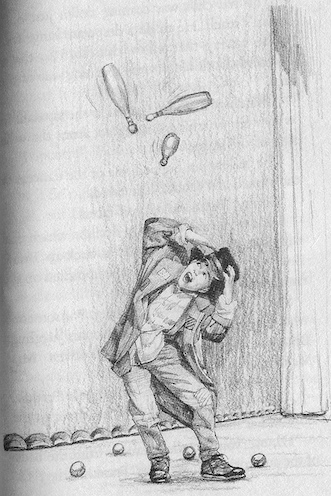
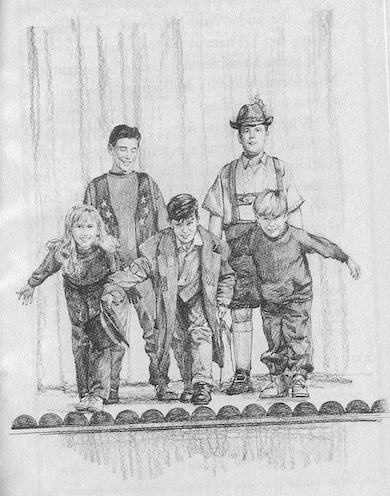
The PTAs at the schools the Bobbsey Twins attend, elementary and middle school, are holding a variety show to raise money, with students showing off their talents. A boy in Freddie and Flossie’s class, Brian, is going to put on a juggling act, but Freddie and Flossie are going to help another friend, Teddy, with his magic act. Nan and Bert have a rock band with some friends called the Aliens, and they’re going to be performing, too. Danny Rugg, the school bully, even has an act where he’s going to play the accordion.

However, things soon start going wrong with the show. During the rehearsal, someone turns on the Aliens’ amplifier, making a loud sound that startles everyone. Then, a pole falls and almost hits a student while she’s singing. Then, Brian slips on some floor wax. Freddie and Flossie suspect Danny of playing pranks on everyone because he was near the places where the pranks occurred, and it seems like the kind of thing he might do, but there are other suspects.

Some of the other students seem nervous about performing their acts or think that the show won’t really be that good. Could someone be trying to sabotage the show to get out of performing? Then again, there seems to be some kind of rivalry between the music teacher who is directing the show and Mr. Horton, the fifth grade teacher. Mr. Horton seems resentful that he wasn’t given the chance to direct the show, and he keeps trying to prove that the music teacher is doing things wrong and that he could do them better. Just how far would he go to prove that he would be the better director?

The book is available to borrow and read for free online through Internet Archive.

I thought that the mystery was good, although I also thought that the culprit was obvious about halfway through the story. It might take kids longer to figure out who it is, but there is one person who gets more than their share of the sabotage, and some of the tricks are ones that a person could only play on themselves. There is a student who is trying to get out of having to perform, but once the Bobbsey Twins figure out why, they manage to work things out so that the student is able to go ahead with their act.

The story reminded me a little of The Tap Dance Mystery in the Eagle-Eye Ernie series, although the mysteries aren’t the same. What reminds me of the other book is that both stories involve family expectations. Performing in front of classmates is enough to make anyone nervous, but having family with high expectations present puts a great deal of pressure on a child performer. There is a bit more than that because there are reasons why the student doesn’t think they can live up to everyone’s expectations, but fortunately, a little help from a friend can go a long way!

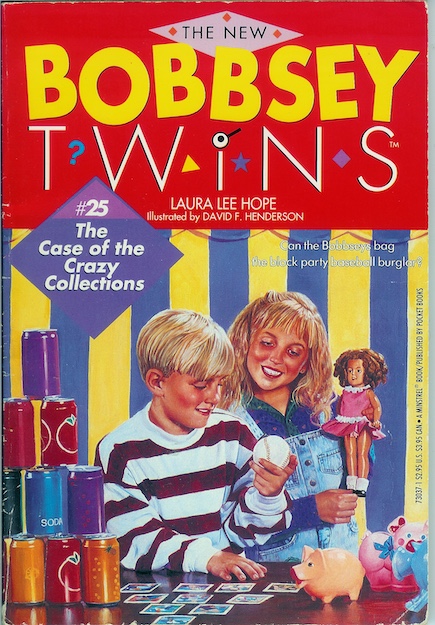
The Case of the Crazy Collections

The Bobbsey Twins

Before I begin, I’d like to acknowledge Sean Hagins, for supplying me with photos of this book! Usually, I take pictures of books myself, but I just couldn’t find a physical copy of this one. Sean is a big fan of the Bobbsey Twins, particularly the New Bobbsey Twins mysteries, and you can see some of his video reviews as well as videos about his photography work on his YouTube channel, SJHFoto. Thanks, Sean!

The Bobbsey twins’ neighborhood is having their annual block party, and the Bobbsey twins and their parents are helping to set up for it. As part of the party, the neighborhood has rented a tent, where kids from the neighborhood are displaying their collections. The neighborhood kids collect all kinds of things, like baseball cards, comic books, soda cans, autographs, and coins. One boy, Kevin, has an autographed baseball that his grandfather gave to him. The neighbors are charging people money to see the exhibit of collections, and the money will be used for a pizza party later.

Later, Kevin’s autographed baseball disappears. Could the baseball thief be Mr. Sher, a visitor staying with their neighbor, Mr. Andersen? Mr. Sher tried to buy the baseball from Kevin earlier, but Kevin turned him down. Then again, Kevin’s cousin, Steve, was jealous that Kevin has the baseball. Steve turned down the offer of some of his grandfather’s old collectible items in favor of a savings bond, which he has already cashed in and spend on video games. Steve tried to borrow more money from Kevin earlier, but Kevin turned him down because Steve hasn’t yet repaid him for money Kevin loaned to him before. Danny, the neighborhood bully, was also mad at Kevin earlier. He’s a friend of Steve’s and didn’t want to have to pay to see the collections. Then again, another local girl, Jennifer, collects autographs, and they see her at a collectors’ shop. Would she know the value of an autographed baseball, and was she trying to sell it? With so many people coming and going from the tent where the collections were on display, it’s hard to say who might have taken something. The thief may have even been the Bobbseys’ own dog, Chief, who has developed a habit of collecting and hoarding baseballs.

Then, another boy realizes that his prized hologram sticker is missing. Could the thief have taken that, too? Their clues are an unexplained slit in the back of the tent, some footprints, and a pin with Greek letters on it. Can the Bobbsey Twins find the valuable baseball and return it to Kevin?

The book is available to borrow and read for free online through Internet Archive.

Something I thought was interesting about this story was that it brings up the concept of collecting things for fun or sentimental value vs. collecting things because of their monetary value. Most of the kids in the neighborhood collect things just for fun. At first, Kevin doesn’t seem to fully realize the value of the autographed baseball. His attachment to the baseball is because he got it from his grandfather. When he had the offer to sell it to Mr. Sher, he refused because the baseball reminds him of his grandfather.

I had a strong suspicion about the identity of the baseball thief early in the story, and my guess turned out to be right, but I liked it that there were plenty of other suspects to consider. There are child suspects, adult suspects, and even the Bobbseys’ own dog. Any of these could be plausible. When they realize that the hologram sticker is missing, it raises the question of whether the person who took the baseball also took the sticker, if the sticker was taken by someone else, or if the missing sticker is just a red herring. Overall, I enjoyed the mystery, and I liked the abundance of suspects.

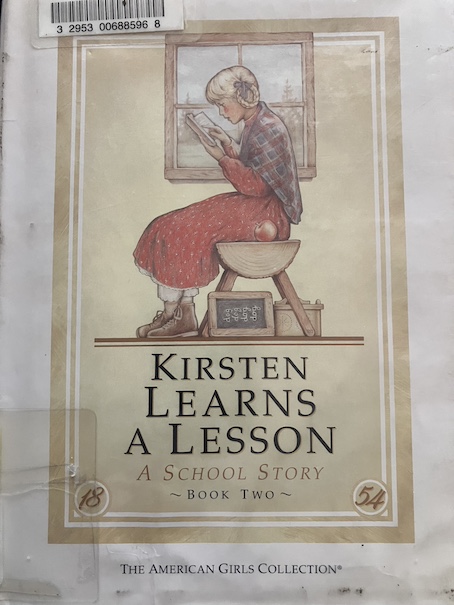
Kirsten Learns a Lesson

Kirsten, An American Girl

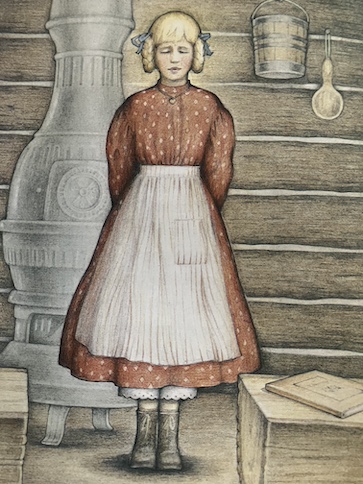
It’s November, 1854, and now that nine-year-old Kirsten’s family has settled in their new home in Minnesota and the harvest season is over, it’s time for the children to go to school. Kirsten and her brothers, Lars and Peter, will go to the small local school with their cousins, Lisbeth and Anna. Powderkeg School is a one-room schoolhouse in a little log cabin. Lisbeth and Anna’s stories about what Powderkeg School is like worry Kirsten. They talk about how strict their teacher, Mr. Coogan, is. Sometimes, the boys in class get rowdy and fight, and Mr. Coogan uses physical punishment on them. However, the girls tell Kirsten that she probably won’t have any problems with Mr. Coogan because he likes children who are well-behaved, and Kirsten is well-behaved. Still, Kirsten is nervous about what her new school will be like.

When they get to school, they learn that Mr. Coogan was injured in a fall from his horse, so they will have a replacement teacher, Miss Winston, who has only recently arrived from Maine. When one of the mean boys in class says he hops the horse also stepped on Mr. Coogan, Miss Winston tells him that nobody talks out of turn in her class and, although they live in the country, “we are not savages like the Indians.” (This is a 19th century attitude toward Native Americans, but this concept is challenged later in the story.)

Miss Winston has each of the children in class introduce themselves so she can get to know everyone. When it’s Kirsten’s turn to say her name, she forgets to address her teacher as ma’am, like the other students. Miss Winston insists that she say “ma’am”, and when she sees Kirsten struggling with the language, she asks Kirsten if she speaks English. Kirsten says that she speaks a little, and her cousins explain that her family just came from Sweden and that they speak Swedish at home. Miss Winston says that “practice makes perfect”, so Kirsten will practice her English in school. For now, she will have the easiest lessons and share seven-year-old Anna’s schoolbook.

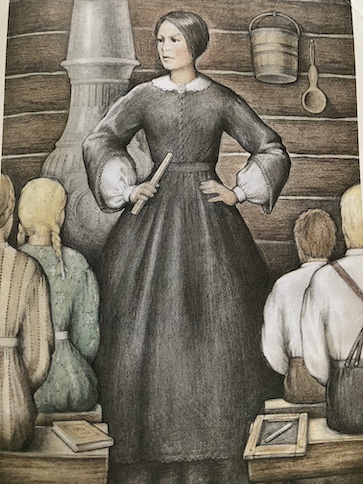
When the mean boy, Amos, laughs at Kirsten, Miss Winston glares at him and strikes the school’s iron stove with her ruler, startling the students. Miss Winston says that her father was a ship’s captain, so she knows how to be in charge of her students, like he was in charge of his crew. Then, she deconstructs the sentence “Miss Winston hit the stove”, pointing out which words are the subject, verb, and direct object of the sentence. Then she warns the class to “Be careful that the direct object of hit isn’t the student.” The implication is that Miss Winston is just as willing to use physical punishment against her students as Mr. Coogan was.

When Amos introduces himself to Miss Winston, we learn that he is nineteen years old, the same age as the new teacher, but the new teacher says that, in spite of being the same age, she’s still the teacher, and he’s the student. In spite of being more a young man than a boy in age, Amos has only just finished the third reader, and Miss Winston says her role is to help him read and do math like a man would, embarrassing Amos. (He can’t use his age to put himself on an equal footing with the new teacher because they are not intellectual equals. She’s the same age, but she has graduated from her own school and become a teacher, and he’s still struggling along with low level math and reading.)

Anna helps Kirsten with her lessons, and Miss Winston praises her for helping to teach Kirsten, but she doesn’t praise Kirsten for doing a good job. At the end of the school day, Kirsten and her cousins talk about the new teacher. Anna thinks that Miss Winston seems nice, but Kirsten thinks that Miss Winston doesn’t like her and that she seems very strict. She asks if that was what Mr. Coogan was like, and Lisbeth says he was worse. The best part of the day for Kirsten was lunchtime, when the children were allowed some play time. When she ran around and played tag with the other children, it didn’t matter if she didn’t speak much English.

When the girls play school with their dolls, Anna imitates Miss Winston and her comment about “savages.” Kirsten asks the other girls what that word means. They say it means “wild.” Kirsten asks them if the Indians (Native Americans) are really like that, and they say that some people say they’re kind and will help people if they need food but others day that they’re “cruel and bloodthirsty.” They’ve seen an Indian man before. He came to their house when their mother was roasting meat, and he left when their mother gave him some. They thought he looked pretty “savage” because his face was painted, and he had eagle feathers in his hair. The girls say that Native Americans also wear knives and live in tents. As a farmer, their father is concerned about the Native Americans. He knows that, if the farmers take too much of their usual hunting grounds for farming, it will drive away the animals, and the Native Americans will be starving and angry. While he is happy that he has been able to secure some farmland for his family (I explained a little about the famine conditions and lack of farmland in Sweden around this time that caused people like the Larsons to leave their country when I covered Meet Kirsten), he is aware that the Native Americans also need land for their survival.

At school, Miss Winston announces that each student will memorize a poem and recite it for the class. When they recite their poems, she wants them to say them with feeling and show the emotions their poem is trying to convey. Kirsten worries about this assignment because she’s still learning English. It’s hard enough for her to learn to read anything in English and understand the meaning of the words. She doesn’t know how she can also learn to memorize an entire poem and say it in front of everyone. Miss Winston gives Kirsten a short poem to learn, but having even a short one doesn’t seem to help Kirsten.

Meanwhile, Kirsten has her first encounter with a Native American when she spots an Indian (Native American) girl watching her while she’s getting water from the stream. The girl runs away, but Kirsten finds a blue bead that she dropped. Kirsten takes it and leaves her a little pretend cake that she and her cousins made for their dolls. Later, she finds that the cake is missing and that there’s a green duck feather in its place. She and the Indian girl trade little objects in this way, gradually becoming friends.

Kirsten’s secret friendship with the Native American girl becomes a comfort to her when school is stressful. Frontier teachers often board with families who live near the school, and when Miss Winston comes to stay at Kirsten’s aunt and uncle’s house, Kirsten feels like school is following her home. What’s worse is that Kirsten’s family will be joining them for dinner, and they will practice English during the meal. Kirsten knows that the meals, instead of being comfortable family time, will now be like lessons, and they will struggle to say things they would want to say because her family still hardly knows English. Worse yet, Miss Winston is cross with Kirsten because she can’t seem to memorize even her short poem.

Sneaking away to visit the Native American girl, who is called Singing Bird, gives Kirsten an escape from her struggles with English. Somehow, Kirsten and Singing Bird manage to communicate well enough with each other, even though neither of them speaks each other’s language. Then, Singing Bird takes Kirsten to see her village. To her surprise, Kirsten realizes that she has been gradually teaching Singing Bird English words without realizing it. However, Singing Bird’s people are going to be moving on soon. Kirsten’s uncle is correct that farming is driving away the animals the Native Americans depend on for food, and they’re suffering for it. Singing Bird invites Kirsten to come with her tribe when they leave, and it’s tempting to think of living an exciting life, traveling with Singing Bird and not going to school. But, is that what Kirsten really wants?

The book ends with a section of historical information about frontier schools in the mid-1800s.

The book is available to borrow and read for free online through Internet Archive (multiple copies).

Along with the first book in the series, this is the book that I remember the best of the Kirsten books. I think I either didn’t read the others or didn’t finish them because there are some sad things in the Kirsten stories that I didn’t like. In the first book, Meet Kirsten, another child Kirsten befriends on the journey to Minnesota dies of cholera. It’s historically accurate that some children died of disease on the journey west, but it was still hard to take. I also talked about how the reason why families like Kirsten’s wanted to come to America was that Sweden was experiencing famine around this time. The first book didn’t say much about that, but in this book, Kirsten remembers experiencing hunger in Sweden when her father’s crops failed and how her little brother cried from hunger.

Kirsten understands the plight of the Native Americans when they have to move to a new area when their food supplies run low. However, when Singing Bird invites Kirsten to come with them, she realizes that would mean leaving the rest of her family, and she can’t do that. While it’s tempting to go with her friend and escape the problems in her life, Kirsten can’t do that without also giving up the good things in her life and trading the problems in her life for a different set of problems. Although there are appealing aspects to their lives, the Native Americans also have their own struggles. To use an old adage, the grass isn’t always greener on the other side of the fence. People say it in different ways, but just because someone else’s situation is different doesn’t always mean that it’s better.

In this book, we also see what it’s like for Kirsten’s family as they begin learning English, so they can communicate with other people in their new country, and the children begin going to school. The little frontier school is different from other schools they’ve experienced before, and the teachers are strict. They have to be strict because some of the students are rough and fight with each other physically, and they have to make it clear that they’re not going to put up with that. This is a real-life aspect of schools from this time period. Fortunately, we never see the teacher actually using physical punishment against anybody. She just threatens to do it so her students will think twice about misbehaving.

When Miss Winston comes to board with Kirsten’s relatives, Kirsten thinks that everything is going to be worse, that she’s constantly going to be bombarded with lessons and the problems she’s been having at school. However, it turns into an opportunity for Kirsten and Miss Winston to get to know each other better. At first, Miss Winston can’t understand why Kirsten is having such a difficult time remembering her poem, even though it’s pretty short and easy. It’s partly because she’s still having difficulties with her English, but also, the content of the poem has no relation to anything currently happening in Kirsten’s life. It doesn’t interest her, and her mind is preoccupied with all the changes happening in her life, making it difficult for her to focus on the poem and remember it. When Miss Winston shows Kirsten a model of her father’s ship, it brings back memories of the ship Kirsten’s family traveled on when they came from Sweden. Miss Winston realizes that Kirsten has strong memories of the ship, so she gives her a different poem to memorize, one about a ship. Kirsten finds this poem easier to remember because it connects to memories she already has.

Although Miss Winston can be tough, she genuinely does care about Kirsten and looks for ways to help her learn. It just takes time to figure out the best way to help her, and Kirsten also needs time to adjust to her new language and new home. Once Kirsten sees that it’s possible for her to learn and for her new home to begin feeling like home, she begins to feel better about her new life in Minnesota.

I enjoyed the realistic aspects of the story and the references to historical events and real life conditions on the frontier. I think I liked this story better as an adult because I understood more about the historical background than I did when I was a kid. Parts of this series are still sad. Kirsten remembers people being sick and dying on the journey to America, and although she doesn’t go into detail about it, her family did suffer genuine hardship in Sweden.