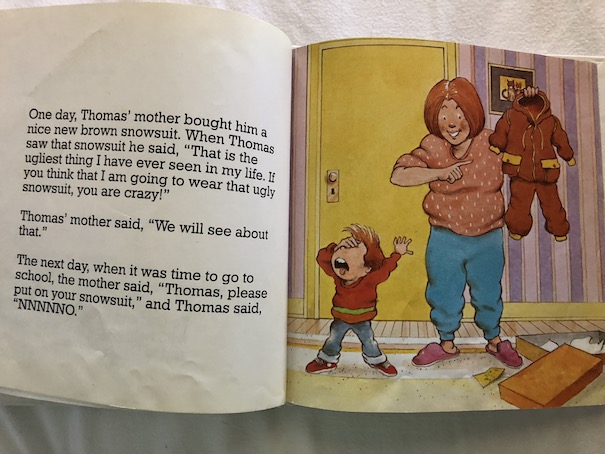
Thomas absolutely hates the new snowsuit that his mother bought him. He thinks it’s ugly. When it’s time for him to go to school, his mother has to wrestle him into it because he refuses to put it on himself.
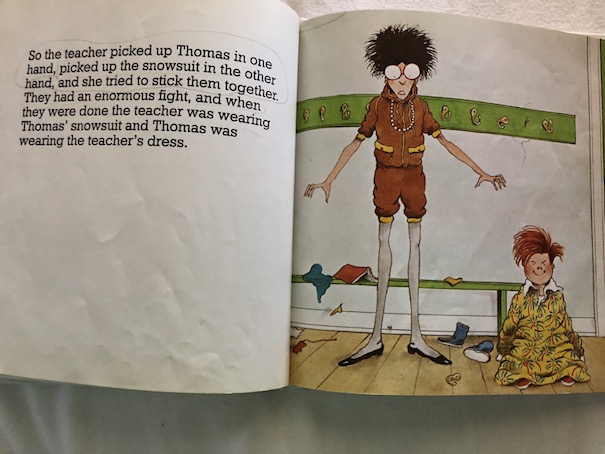
That’s fine until it’s time for Thomas to once again put on his snowsuit so he can go outside for recess. His teacher insists that he has to wear it, but he refuses. When the teacher tries to wrestle Thomas into his snowsuit, the results are hilarious!
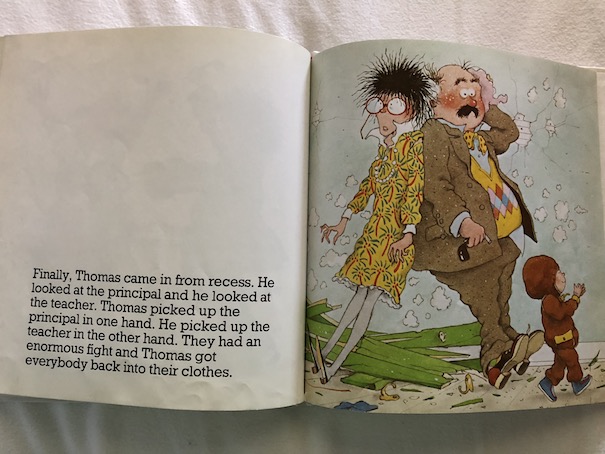
Thomas and his teacher end up getting their clothes all mixed up. When the school’s principal tries to help, it only makes things worse.
Finally, Thomas is persuaded to put on his snowsuit when a friend of his wants him to come out and play.
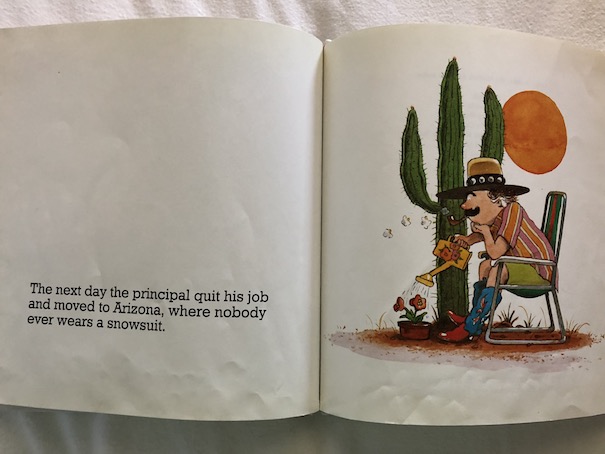
Thomas eventually helps set the teacher and principal right again after recess, and the principal decides that it’s time to retire to Arizona, so he won’t have to deal with snowsuits again.
Like all Munsch books, the storyline is bizarre and hilarious, and half the fun is watching it unfold in the pictures!
The book is currently available online through Internet Archive.
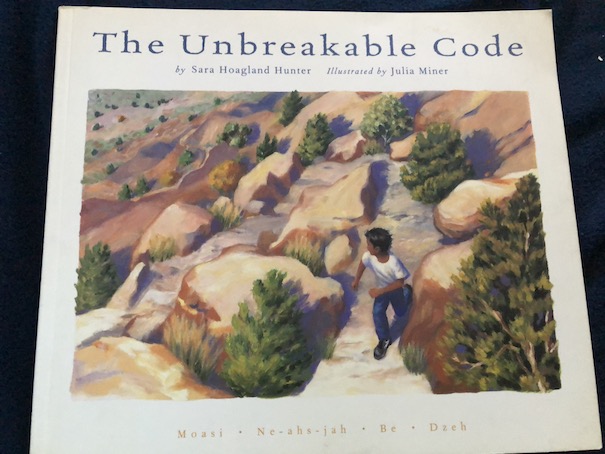
The Unbreakable Code by Sara Hoagland Hunter, illustrated by Julia Miner, 1996.
A young boy, John, is upset because his mother has recently remarried, to a man from Minnesota. Now, John is faced with the prospect of moving to Minnesota, and he doesn’t want to go. He would much rather stay with his grandfather on his farm on the Navajo Reservation. His grandfather points out that he’ll return in the summer, but that hardly seems good enough. Then, his grandfather tells him that he’ll be okay because “You have an unbreakable code.”
John asks what his grandfather means by that, and he says that the Navajo language is the unbreakable code. John worries that he’ll forget how to speak Navajo, but his grandfather says that he never did even though he had to attend a government boarding school at a young age and that the language saved his life during World War II. John’s grandfather was a code talker.
John’s grandfather tells John the story of how he became a Code Talker, starting with when he was at boarding school. The purpose of the government “Indian Schools” was to assimilate Native Americans into white American culture. They were known for forcing their students to abandon traditional clothing, cut their hair, take English names, and speak only English. John’s grandfather describes having to chew on soap whenever he was caught speaking Navajo. He was only allowed to return home during the summer to help his family with their sheep and crops.
Then, when he was in his teens, during World War II, he heard an announcement on the radio that the Marines were looking for young Navajo men who could speak both English and Navajo. Seeing it has a chance to escape, he ran away from school and enlisted. After life at a harsh boarding school, the military marches and drills were no problem, and all of the Navajos already had wilderness survival skills.
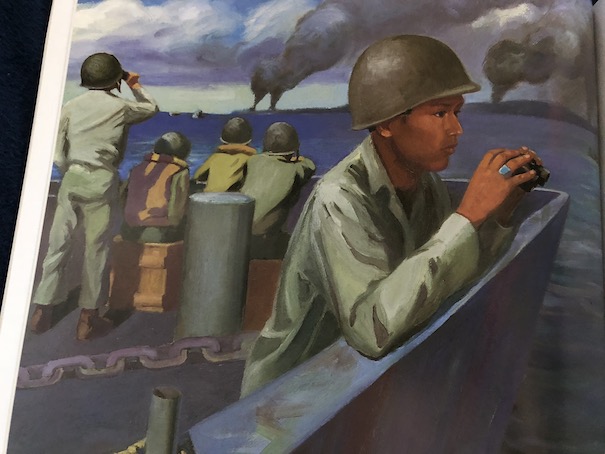
After they had completed basic training, they were told that they were needed for a secret mission in the Pacific. The Japanese had intercepted American radio transmissions and broken the codes they were using. The Marines wanted Navajo speakers because the language was almost unknown outside of the United States, not many non-Navajos had ever learned it, and at that point in its history, the language had not been recorded in writing, so there was no way that the Japanese could research it and learn it. The Marines and code talkers developed a system of code words in Navajo and military terms to use, so it wasn’t as simple as just speaking the language plainly. The system was highly effective.
John’s grandfather goes on to tell John about how bloody the war was and how his life was constantly at risk. Once, another American soldier even mistook him for a Japanese spy because he didn’t know what language he was speaking. Fortunately, one of his friends intervened and saved his life.
The code was never broken during the war, and John’s grandfather eventually made it home safely. However, the code talkers were not hailed as heroes because, for many years, the government wanted to keep the code a secret. No one was allowed to talk about it. John’s grandfather was glad to return to a peaceful life on his farm.
His grandfather’s story gives John the courage that he needs to face moving to a new place. After all, his grandfather had been to far more frightening places and faced them with courage. Knowing his family’s history gives John a new sense of his own identity and the knowledge that his identity and language will remain with him wherever he goes.
This book is available to borrow and read for free online through Internet Archive.
My Reaction and Additional Information
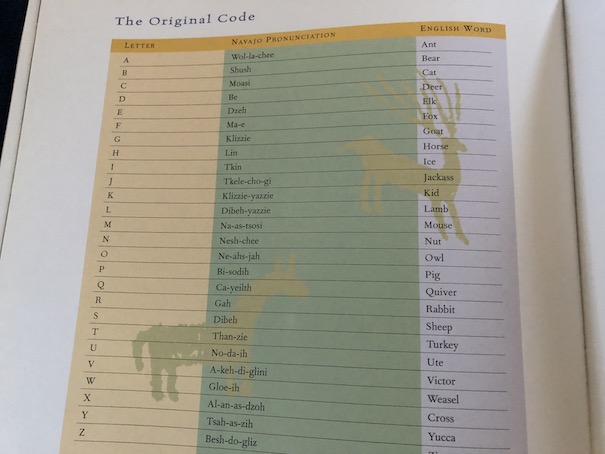
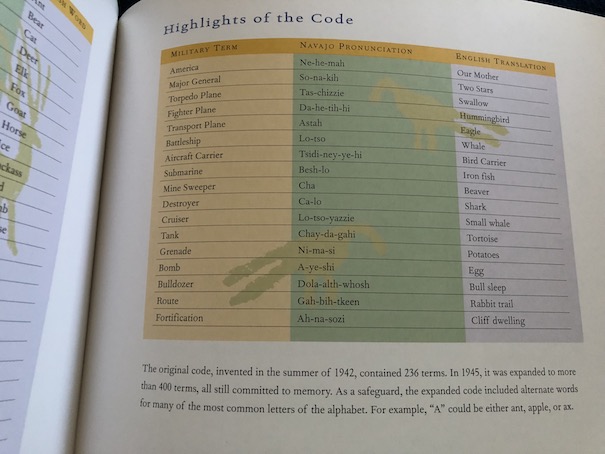
Even though this is a picture book, it isn’t really a book for very young children. There are descriptions of the blood and violence of the war that would be more appropriate for older children. There is a brief note from the author at the beginning of the book that explains a little about World War II and code talkers, and at the end of the book, there are charts that demonstrate how the code worked. This book is an a good way to introduce students to the topic of code talkers if they have never heard of them before.
In modern times, there is a written form for the Navajo language, and since I grew up in Arizona, the colleges I attended had classes in Navajo for those who wanted to study the language. I used to see the books for the classes in the school book stores, although I never studied Navajo myself. I met one of the code talkers once when he came to speak at our college. I believe that there are a few who are still alive at the time of this writing.
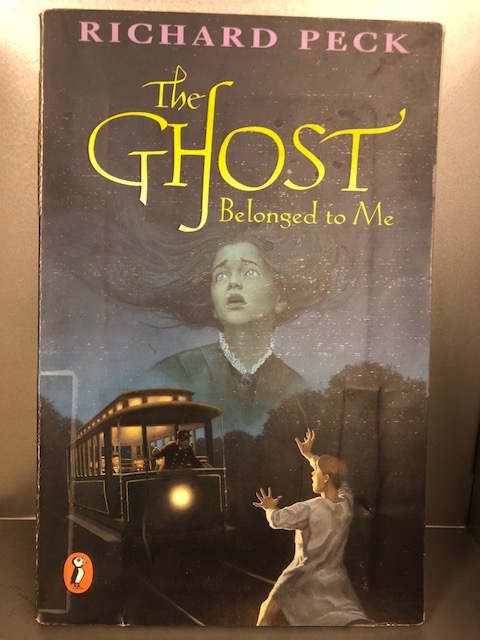
The book takes place in the 1910s in a small town on the Mississippi River. Alexander Armsworth, a boy in his early teens, is approached by a girl from his class who tells him that the barn on his family’s property is haunted and that Alexander himself has the ability to see the “Unseen.” The girl, Blossom Culp, is a poor girl from a family of outcasts who has been known to tell tall tales, so Alexander isn’t sure he believes her at first. However, he can’t help but be curious, and when he sees a light coming from the barn at night, he decides to investigate.
Inside, he finds the ghost of a young girl who warns him of danger on the trolley tracks near his house and tells him that he must act fast to save everyone. Frightened, Alexander gets the trolley to stop and learns that by doing so, he has saved the lives of everyone on board from a disaster at the bridge further on. Naturally, everyone wants to know how Alexander knew to warn them. When Alexander explains, he is met with skepticism from his social-climbing mother and sister and unwelcome attention from news people and curiosity-seekers from town.
The ghost, who tells Alexander that her name is Inez Dumaine, is also in need of help before she can rest peacefully. Alexander will need the help of those who believe in him and the ghost to find Inez’s body and return it to her home in New Orleans.
In this first book in of the Blossom Culp series, Alexander is the main character, but the other books focus more on Blossom, who discovers that she also has the ability to see ghosts. The book is available to borrow and read for free online through Internet Archive.
This is the movie that the Disney movie Child of Glass was based on, and the movie is available on dvd. Sometimes, you can also find it on YouTube, at least clips and reviews of it.
My Reaction
The story has sad and scary points, but those are balanced out by humorous situations. Alexander’s sister’s turmoil over the fiasco at her coming-out party is hilarious, and his mother’s change in attitude when she realizes that, instead of making them social outcasts, the ghost business actually attracts attention from one of the town’s leading citizens is a hoot. Blossom, of course, is wonderfully nosy, elbowing her way into Alexander’s life and selling tours of the haunted barn.
I was very young when I saw the Disney movie based on this book, Child of Glass (a live action movie that aired on television), and I was afraid of ghosts. However, years later, I took another look at the movie and decided to read the book that it was based on. When I did, I saw things I didn’t appreciate when I was young. The dialog and depiction of life in the early 20th century in the book are wonderful. It conjured up memories of Meet Me in St. Louis, especially the Halloween scene (which took place only about a decade earlier than this story). Unfortunately, this early 20th century setting wasn’t present in the movie version of this book because Child of Glass was placed contemporary with the time it was made, during the late 20th century.
The Disney movie was also different from the original book because it added the feature of the “child of glass” which didn’t exist in the original book. The “child of glass” was mentioned in a poem at Inez’s grave that explained how to lay her ghost to rest. At first, the Alexander and Blossom in the movie don’t know what it means, but it turns out to be Inez’s doll, which was lost when she was murdered by her wicked uncle. In the book, Inez died under different circumstances. However, the discovery of the doll in the movie uncovers the secret motive behind her murder, which is similar to the reason why Inez’s body was hidden in the book after she died in a riverboat accident. In the book, Inez’s spirit finds rest after her body is found and taken to her family’s cemetery in New Orleans. The Disney movie also turns this story specifically into a Halloween story, which wasn’t the case in the original book.
The One in the Middle is the Green Kangaroo by Judy Blume, 1981.
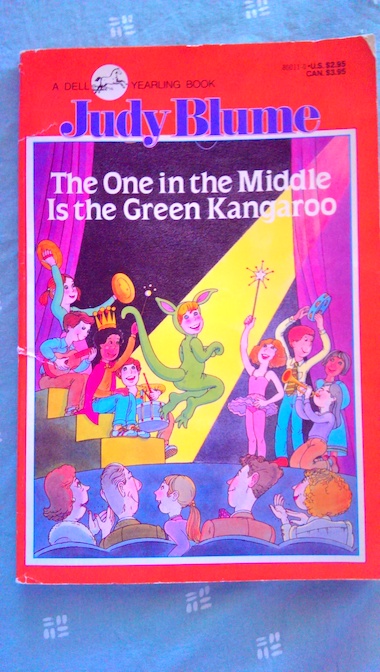
Freddy Dissel hates being the middle child in his family. Before his younger sister, Ellen, was born, he had his own room. Now, he has to share with his older brother, Mike. Mike gets new clothes, while Freddy has to wear Mike’s hand-me-downs. Mike and his friends won’t play with Freddy because he’s too little to play their games, and Freddy can’t play with Ellen because she’s too little for him. Freddy hates always being caught in the middle with nothing special to distinguish him from his siblings.
Then, Freddy finds out that there’s going to be a play at his school. Seeing it as his chance to do something special that his siblings haven’t done, he asks his teacher if he can be in it. At first, she tells him that the only kids in the play are older kids, around his brother’s age, but seeing his disappointment, she says that she’ll talk to the teacher in charge of the play, Ms. Matson, and see if there’s a part for him.
When Freddy gets his chance to try out for a part, he demonstrates to Ms. Matson that he can speak up loud and isn’t afraid to hop around on stage in front of everyone. He’s thrilled when she gives him the part of the green kangaroo. Now, his family and everyone else can see him do something that his brother and sister don’t get to do!
Even though he does get a little stage fright right before the performance, working through it and playing his role as the green kangaroo gives Freddy new confidence. From then on, he’s not just Freddy the middle child but Freddy, the one and only green kangaroo!
The story is set in London, in 1849. Fourteen-year-old John Huffam lives with his parents and sister and their servant, Brigit and attends a school taught by a former military man who acts like he is still in the army and teaches them little beyond discipline and what army life would be like.
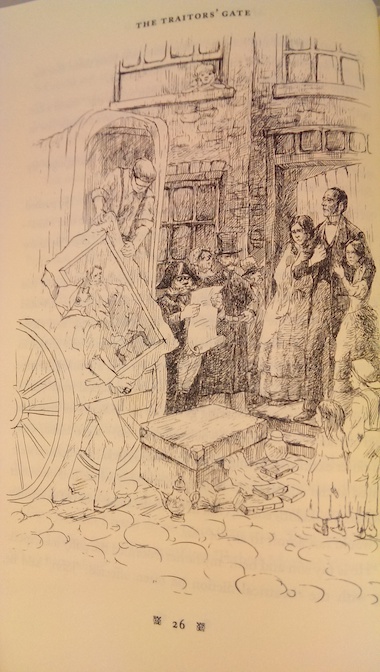
Then, one day, John is called home suddenly because of a family emergency. His family has fallen on hard times, and his father is in debt, so the family’s belongings are being confiscated. His father is summoned to appear in court, and if he cannot find the money to pay his debt, he will have to go to debtors’ prison. John’s father is shocked because he doesn’t actually owe any money to the man who is trying to call in the debt, Finnegan O’Doul.
In spite of this, John and the rest of the Huffam family must spend the night in the bailiff’s sponging house, the Halfmoon Inn. There, John’s father again promises John that there is no debt between himself and Mr. O’Doul. He even says that he doesn’t really know O’Doul, although John doubts him. It seems like his father has had dealings of some kind with the man that he wants to keep secret.
John’s father, Wesley Huffam, was originally from a fairly well-off family, but all the family’s money ended up going to a great-aunt instead of to him (possibly because it became obvious to his relatives that he had little skill at handling money in the first place). John’s father is resentful toward the great-aunt, Euphemia Huffam, for inheriting when he thinks that, as a man, he should have been first in line for the family’s money. However, with this enormous (although possibly false) debt hanging over his head, he may be forced to appeal to Great-Aunt Euphemia for help. He persuades John to go and visit Great-Aunt Euphemia on his behalf, since he is not allowed to leave the sponging house for now and the past quarrels between him and his aunt would make it unlikely that his aunt would want to see him. John is beginning to realize that there are pieces of his father’s life and their family’s past that have been kept from him, and he doesn’t like the idea that his father has been deceiving him, but with their family in such a desperate situation, he agrees to visit Great-Aunt Euphemia.
The bailiff, John’s mother, and Brigid all agree that John is going to have to be instrumental in solving their family’s problems. Of all the people in his family, he is the most practical, in spite of his young age. His father is an impractical man, stuck in a vision of his family’s former glory (and his aunt’s current money, which he does not share in) that doesn’t fit their current circumstances. John’s mother thinks that her husband’s job as a clerk for the Naval Ordinance Office doesn’t provide enough money for the family to live on, even though he earns more than twice what typical London tradesmen of the time do. The real problem is that the family doesn’t live within its means (it is eventually revealed that Wesley Huffam has been withholding money from his family that he uses for gambling), and John’s father’s snobbish attitude because he thinks of his family as being more grand than the commoners around them alienates people who might otherwise be friends and help them. John knows that he’s young, and he’s not completely sure what he can do to help his family, but he knows that there is no other option but to try. In the process, he learns quite a lot about life, himself, the people in his family, and the wider issues in the world around him, including some political intrigue that hits uncomfortably close to home.
Great-Aunt Euphemia agrees to see John when he comes to her house, but their first meeting doesn’t go very well. Great-Aunt Euphemia is ill (or says she is), and she bluntly tells John that his father was always bad with money. She is not at all surprised that he is in debt and needs her help. John gets upset at the bad things that Euphemia tells him about his father, and she gets angry when John tells her the amount of the debt. At first, John is sure that she will refuse to help them completely, but Euphemia tells him not to assume anything but that he should come back the next day. Her eventual contribution to helping John’s family in their troubles comes in the form of a job for John.
As John moves around the city, he gets the feeling that he is being followed, and he is. One of the people following him turns out to be Inspector Copperfield (or so he calls himself) from Scotland Yard. When John confronts him, the inspector seems to have a pretty good idea of the difficulty that his family is in and what John himself has been doing. John asks him why he cares, and the inspector says that John’s father is suspected of a crime and that John had better learn more about what his father has been doing and share that information with him. John doesn’t believe that his father could be a criminal, but the accusation is worrying because he knows that his father is hiding something (his gambling addiction isn’t the only secret he has).
The other person following John is a young girl in ragged clothes. The girl, who calls herself Sary the Sneak, approaches John herself, freely admitting that she’s been following him. In spite of her young age, Sarah (or Sary, as she is frequently called) lives on her own and must support herself because her mother is dead and her father was transported to Australia. People don’t often notice a young girl on the street, so sometimes people will pay her to follow someone and provide information about them. The reason why she tells John about it is because she isn’t above playing both sides of the street; sometimes, she gets the people she’s been following to pay her to provide them with information about the people who hired her to spy on them. She considers it even-handed. However, John has no money to pay her for information and finds her spying distasteful, so he doesn’t want to take her up on the offer at first.
However, John does a little spying of his own when his father sneaks away from the Halfmoon Inn, which he is not supposed to do. He follows his father to a pub called the Red Lion, where he witnesses his father gambling with money that he had claimed not to have. More than that, he sees his father arguing with a man who turns out to be O’Doul, another gambler. To John’s surprise, his teacher also shows up and seems to know O’Doul. When John later confronts his father with what he saw at the Red Lion, all his father will say is that he is carrying a fortune around in his head. Later, John overhears the bailiff speaking with someone else, an Inspector Ratchet from Scotland, saying that it appears that Wesley Huffam may be a traitor involved with spies and that the Inspector Copperfield who spoke to John earlier was an imposter, probably also a spy.
Could it be true? Is John’s father really a traitor, selling naval secrets from his job? If so, who can John trust? Conspirators seem to be around every corner, and John has the feeling that the people who are closest to him may be the biggest threats.
The book is currently available online through Internet Archive.
One night, after a party, Lord Inaba is killed in his room by a mysterious intruder. The only clue to the intruder’s identity is a red origami butterfly left at the scene. Lord Inaba’s death is an embarrassment to the shogun because Lord Inaba was in Edo under his protection.
It doesn’t take Judge Ooka long to decide that the murderer was a ninja. Ninjas are hired assassins known for their stealth and great skill with weapons. The butterfly left at the scene was to purify the spirit of the dead man and keep it from coming after his killer.
However, Judge Ooka says that it is not enough to know that that the murderer was a ninja; what they have to find out is who hired the ninja. He assigns Seikei the task of finding the source of the butterfly and learning who Lord Inaba’s enemies were. Judge Ooka finds a ninja he knows, Tatsuno, and convinces him to accompany Seikei on a journey through Lord Inaba’s territory and to teach him what ninjas are like. Although Seikei is not sure that he trusts Tatsuno, he learns to be grateful to him for his help and for saving him from the real danger, which comes from a surprising source.
While many children’s movies glorify the ninja, in real life, they were mercenaries, assassins for hire. They used clever tricks in order to gain access to their victims and to get away without being caught, which ended up giving rise to a number of legends about them, attributing an almost supernatural quality to their skills. While searching for the assassin and the person who hired him, Seikei learns a number of the tricks that ninjas used and the security measures that people would take to try to guard against them, such as nightingale floors (here is a video of a nightingale floor in a Japanese castle and another where you can hear the floor even better).
The book is currently available online through Internet Archive.
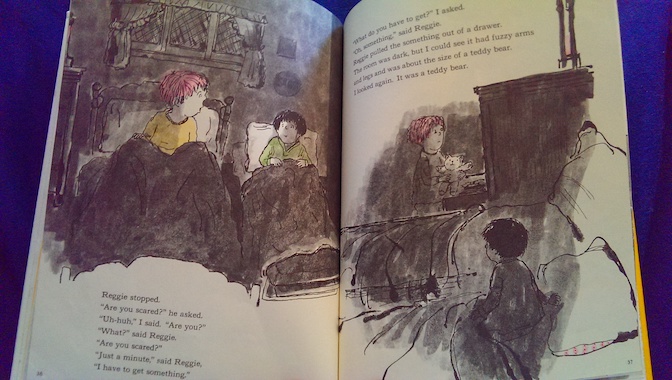
Ira, a young boy, is happy when his friend, Reggie, who lives next door, invites him to sleep over at his house. Then, his sister asks him if he’s going to take his teddy bear with him. At first, Ira says no, but his sister points out that he’s never slept without it.
Ira starts to worry about whether he should take the teddy bear with him or not. He worries that Reggie might laugh at him for having a teddy bear. His parents say that he won’t and that Ira should go ahead and take the bear with him. However, his sister says that Reggie probably will laugh.
Ira tries to talk to Reggie and sound him out on the idea of teddy bears to see if Reggie will laugh, but Reggie ignores Ira’s questions. Reggie is excited about all the things that he and Ira can do at the sleepover and eagerly explains his plans. It all sounds like fun, but Ira gets nervous when Reggie mentions ghost stories.
Ira continues to debate about whether or not he should take his bear with him. Before going over to Reggie’s house, he decides to leave his teddy bear at home.
The two boys have a lot of fun playing together at the sleepover. At bedtime, Reggie starts to tell a ghost story, and both of the boys are a little spooked. That’s when Ira discovers that Reggie has a teddy bear of his own.
The book is currently available online through Internet Archive.
My Reaction
This is a nice story about how the things that we worry other people will find ridiculous or embarrassing are often more common and less embarrassing than we think. At first, Ira worries (because of what his sister said) that Reggie will think that his teddy bear, named Tah Tah, is silly and childish, but after discovering that Reggie has a teddy bear named Foo Foo, Ira realizes that Reggie will understand how he feels about his bear and decides to run home and get it. Reggie probably dodged Ira’s earlier questions about teddy bears because he was similarly worried about what Ira would think of his bear. Sometimes, when people really open up to each other and talk honestly about the way they feel, they learn that other people have shared their feelings and experiences more than they might have thought.
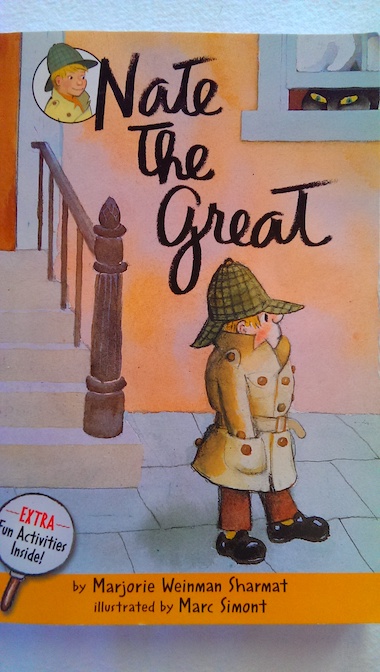
Nate the Great and the Phony Clue by Marjorie Weinman Sharmat, 1977.
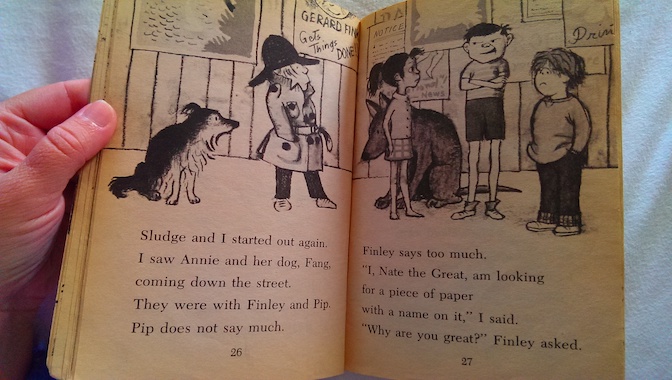
One day, as Nate is coming back from a run with his dog, Sludge, he finds a torn piece of paper on his doorstep that says “VITA.”
Realizing that this odd word is actually part of a longer word in a message, he decides to hunt down the rest of it.
Thinking that perhaps Rosamond’s cats may have found the message and torn it, he goes to Rosamond’s house. When he gets there, he sees that more of the message is up in a tree with Big Hex.
Even when Nate gets that piece, it still doesn’t tell him the full story of the message. It seems that someone is inviting Nate to come to their house at three that afternoon, but without a name or address, how will Nate know where to go?
It looks like there’s still one more piece missing from the message, so he begins looking for it. One of the other boys in the neighborhood, Finley, says that he doesn’t think Nate is really as “Great” as he says he is, and he doubts that Nate will find what he’s looking for. When Finley walks away, dropping a piece of paper behind him, Nate thinks that perhaps Finley is giving him a clue.
It turns out that the paper that Finley dropped says “phony clue” on it. However, Finley’s “phony clue” turns out to be the clue that Nate needs to solve the mystery!
My Reaction and Spoilers
This test of Nate the Great’s detective skills is actually a test set up by Finley and his friend, Pip, who have a bet about whether or not Nate will put all the pieces together by three o’clock. I thought that might be the case from the beginning, but I’m not sure whether that’s because the mystery is obvious or if I helf-remembered the solution to the mystery from when I first read the book when I was a kid.
Nate the Great Goes Undercover by Marjorie Weinman Sharmat, 1974.
Nate isn’t too fond of his next-door neighbor, Oliver. He thinks Oliver is a pest. Still, when Oliver tells Nate that someone keeps getting into his garbage cans at night, knocking them over and stealing garbage, Nate is curious.
Nate recently found and adopted a dog, which he calls Sludge, and he decides to take Sludge along on the case. After interviewing a couple of girls who live in the neighborhood, Rosamond and Esmeralda, Nate comes to the conclusion that no human would ever visit Oliver’s garbage cans at night. Humans are not interested in stealing someone else’s garbage or in visiting Oliver’s house because Nate is not the only person who thinks that Oliver is a pest.
So what does that leave? Perhaps some kind of animal? But what kind? There is only one way to find out, and it’s not going to be pretty. Nate has to hide out in Oliver’s garbage at night. It’s a dirty job, but, well, you know . . .
My Reaction and Spoilers
I think a lot of people would see the solution to this puzzle coming. I frequently debate about how many spoilers to include in these reviews/summaries (and frequently give in to the urge to offer them), but I think Sludge’s past as a stray dog and his expressions when Nate keeps feeding him pancakes really say it all.
Later editions of the book also have a section of activities in the back. There is information about animals that come out at night and things to do to make baths more interesting and recipes for hamburgers and ice cream (which are among the things that Rosamond says that she would rather eat than garbage).
Nate is eating his favorite breakfast, pancakes, when his friend Annie calls him from her house down the street, asking for his help in finding a lost picture. When Nate arrives at Annie’s house, she says that she painted a picture of her dog, Fang, and then left it on her desk to dry, but it disappeared.
After establishing that Annie’s house has no trapdoors or secret passages, Nate declares that this will be a very dull case. But, of course, he investigates anyway.
Nate searches Annie’s room, and not finding the picture, asks Annie who else knew about it. Annie says that she showed it to Fang, her little brother Harry, and her friend Rosamond.
Determining that Fang didn’t bury the picture of himself and that Rosamond is only interested in cats, that just leaves Harry. But, if Harry took Annie’s picture, why did he take it and what did he do with it?
My Reaction
This is a fun mystery for young children, one of the first mysteries that I read as a kid. The pictures in the book have clues, and it helps if kids know how to combine colors to create new ones (hint).
Later editions of the book also have a section of activities in the back. Most of them have to do with art and color, and there is also a recipe for pancakes.

















 Jestress's Forgotten Books and Stories