Nate the Great and the Phony Clue

NatePhonyClue

Nate the Great and the Phony Clue by Marjorie Weinman Sharmat, 1977.

One day, as Nate is coming back from a run with his dog, Sludge, he finds a torn piece of paper on his doorstep that says “VITA.”

NatePhonyClueJog

Realizing that this odd word is actually part of a longer word in a message, he decides to hunt down the rest of it.

Thinking that perhaps Rosamond’s cats may have found the message and torn it, he goes to Rosamond’s house. When he gets there, he sees that more of the message is up in a tree with Big Hex.

Even when Nate gets that piece, it still doesn’t tell him the full story of the message. It seems that someone is inviting Nate to come to their house at three that afternoon, but without a name or address, how will Nate know where to go?

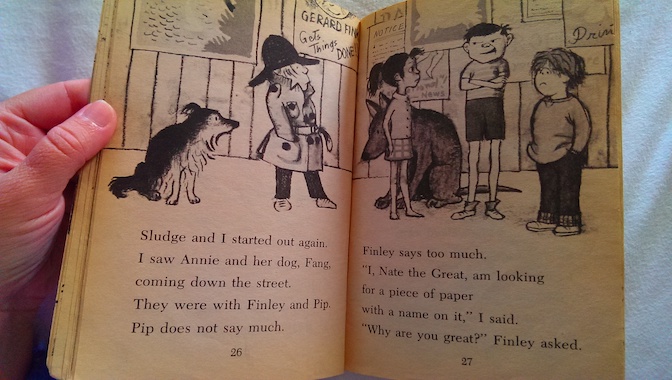
It looks like there’s still one more piece missing from the message, so he begins looking for it. One of the other boys in the neighborhood, Finley, says that he doesn’t think Nate is really as “Great” as he says he is, and he doubts that Nate will find what he’s looking for. When Finley walks away, dropping a piece of paper behind him, Nate thinks that perhaps Finley is giving him a clue.

It turns out that the paper that Finley dropped says “phony clue” on it. However, Finley’s “phony clue” turns out to be the clue that Nate needs to solve the mystery!

NatePhonyClueKids

My Reaction and Spoilers

This test of Nate the Great’s detective skills is actually a test set up by Finley and his friend, Pip, who have a bet about whether or not Nate will put all the pieces together by three o’clock.  I thought that might be the case from the beginning, but I’m not sure whether that’s because the mystery is obvious or if I helf-remembered the solution to the mystery from when I first read the book when I was a kid.

Nate the Great Goes Undercover

NateUndercover

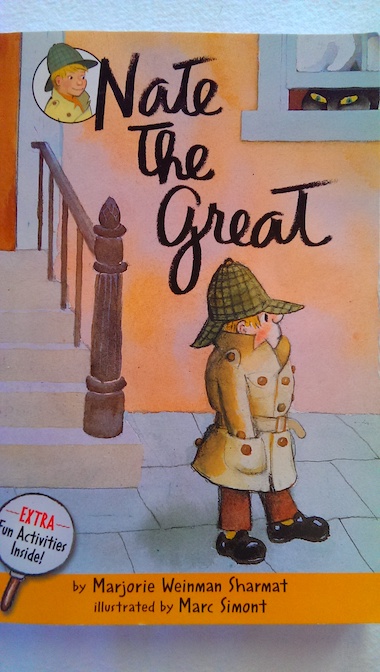
Nate the Great Goes Undercover by Marjorie Weinman Sharmat, 1974.

Nate isn’t too fond of his next-door neighbor, Oliver. He thinks Oliver is a pest. Still, when Oliver tells Nate that someone keeps getting into his garbage cans at night, knocking them over and stealing garbage, Nate is curious.

NateUndercoverOliver

Nate recently found and adopted a dog, which he calls Sludge, and he decides to take Sludge along on the case. After interviewing a couple of girls who live in the neighborhood, Rosamond and Esmeralda, Nate comes to the conclusion that no human would ever visit Oliver’s garbage cans at night. Humans are not interested in stealing someone else’s garbage or in visiting Oliver’s house because Nate is not the only person who thinks that Oliver is a pest.

So what does that leave? Perhaps some kind of animal? But what kind? There is only one way to find out, and it’s not going to be pretty. Nate has to hide out in Oliver’s garbage at night. It’s a dirty job, but, well, you know . . .

My Reaction and Spoilers

NateUndercoverNote

I think a lot of people would see the solution to this puzzle coming. I frequently debate about how many spoilers to include in these reviews/summaries (and frequently give in to the urge to offer them), but I think Sludge’s past as a stray dog and his expressions when Nate keeps feeding him pancakes really say it all.

NateUndercoverGarbageCan

Later editions of the book also have a section of activities in the back. There is information about animals that come out at night and things to do to make baths more interesting and recipes for hamburgers and ice cream (which are among the things that Rosamond says that she would rather eat than garbage).

Nate the Great

NateGreat

Nate the Great by Marjorie Weinman Sharmat, 1972.

Nate is eating his favorite breakfast, pancakes, when his friend Annie calls him from her house down the street, asking for his help in finding a lost picture. When Nate arrives at Annie’s house, she says that she painted a picture of her dog, Fang, and then left it on her desk to dry, but it disappeared.

NateGreatBreakfast

After establishing that Annie’s house has no trapdoors or secret passages, Nate declares that this will be a very dull case. But, of course, he investigates anyway.

NateGreatAnnie

Nate searches Annie’s room, and not finding the picture, asks Annie who else knew about it. Annie says that she showed it to Fang, her little brother Harry, and her friend Rosamond.

NateGreatYellow

Determining that Fang didn’t bury the picture of himself and that Rosamond is only interested in cats, that just leaves Harry. But, if Harry took Annie’s picture, why did he take it and what did he do with it?

NateGreatHarry

My Reaction

This is a fun mystery for young children, one of the first mysteries that I read as a kid. The pictures in the book have clues, and it helps if kids know how to combine colors to create new ones (hint).

Later editions of the book also have a section of activities in the back. Most of them have to do with art and color, and there is also a recipe for pancakes.

Guns in the Heather

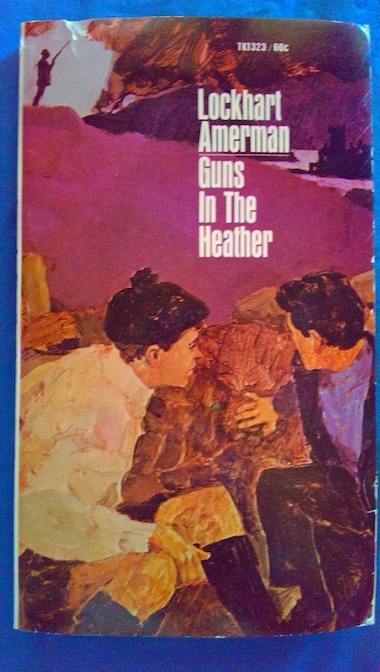
GunsHeatherGuns in the Heather by Lockhart Amerman, 1963.

This book was the basis for the Disney made-for-tv movie The Secret of Boyne Castle. However, the book and the movie are very different.  Although they have a similar premise, many details were changed in the movie version, the first of which is that the location of the story was moved from Scotland, as it was in the original book, to Ireland.

Jonathan Flower, sometimes called “Posy” by his friends, spends most of his time at various boarding schools.  His mother died when he was very young, and his father has a government job that takes him all over the world, so Jonathan has been in boarding schools in various countries, seeing his father whenever he can during school breaks.  For the most part, Jonathan doesn’t really mind it.  He and his father get along pretty well, and he knows that his father’s work is important.

Right now, he’s at a boarding school in Scotland.  He’s made a lot of friends there, spending holidays like Christmas and Easter at various friends’ homes.  He’s also developed an interest in rugby and cricket.  He anticipates that his father will meet him at the end of the school year so that they can go mountain climbing together over the summer break.  However, shortly before his father is expected to arrive, Jonathan receives a telegram from him, saying that he is to go to a certain place and meet a Mr. Finch.  Because the telegram contains certain words that this father uses when a situation is urgent, Jonathan goes to meet Mr. Finch and is kidnapped.

Mr. Finch, who also goes by the alias Dr. Fisher, holds Jonathan captive in a house, pretending that Jonathan is a patient who has volunteered for an experimental treatment.  Fortunately, Jonathan’s father, disguised as a milkman, soon rescues him.

While Jonathan’s father, who is actually a government agent, attends to some of his duties, Jonathan tries to go to the American embassy, only to be misled and almost recaptured. For a time, he is on his own, unsure of who to trust and how to reconnect with his father. When the two of them finally meet again, they both seek shelter with friends, but their enemies aren’t far behind, no matter where they go.  They end up staying with friends who own an old castle, but their enemies are planning a siege.

My Reaction

The style of the writing in this book doesn’t make for a particularly easy read.  It’s not overly difficult, but it starts off slow and is very dense, unlike many more modern books.  The scenes also change quickly throughout the book, and I had trouble keeping track of who some of the characters were.  Overall, I preferred the movie, even though it didn’t follow the book very closely.

In the Disney movie version, a strange man drives onto the grounds of an Irish boarding school, stumbles out of his car, and whispers an urgent message to a teenage American exchange student (played by a young Kurt Russell and renamed Richard Evans) that is meant for his older brother.  Then, the man dies from a bullet wound.  Another man, who is ostensibly from the American embassy in Dublin, abducts Richard after saying that he needs to go to the embassy to make a statement about the stranger’s death.  Richard is also accompanied by an Irish friend, Sean, when he is lured away from the school, and his friend helps him as they escape from the enemy spies holding them captive.  The two of them search for Richard’s older brother (who they have only just learned is a spy, whereas Jonathan was aware that his father worked for the government) to give him the dead man’s message.  In both the book and the movie, there is a final showdown with the bad guys at a castle, but in the movie, they go to the castle to retrieve a secret message that the dead man left there.  I don’t think that the movie is available on dvd, but I have seen it on YouTube and Internet Archive.

Liars

LiarsLiars by P.J. Petersen, 1992.

Sam lives in the small town of Alder Creek in California. The town is so small that they only have a one-room school (well, two rooms, if you count the library/storage room). Sam’s friend, Marty, describes most of what happens there as SOT (Same Old Thing) or MOTSOT (More of the Same Old Thing). However, their town contains some disturbing secrets, which they are about to learn.

Uncle Gene, an old man in town, has a reputation for being a “water witch.” He has the ability to find good sources of water when they need to dig a new well. He lets the local kids watch him when he’s using his dowsing stick and even lets Sam and Marty have a try. Sam has never really believed that Uncle Gene has any special abilities, even kidding Marty for believing in it. However, when Sam takes hold of the dowsing stick, he finds it drawn toward sources of water, like a magnet. Uncle Gene says that Sam has the gift and is a water witch, too. Sam is still somewhat skeptical, thinking that there’s probably something more scientific behind what he experienced, but from that time on, he finds himself sensing other odd things from the people around him.

In particular, Sam can sense when people around him are lying. It sounds like it would be a handy gift to have, but it has some drawbacks. Even when he can tell that someone isn’t telling the truth, he can’t tell exactly what they’re lying about. Some lies are obvious, like those of classmates bragging about things or Mr. Lopez saying that he enjoys living in the small town when, apparently, he really doesn’t. However, Sam can’t always distinguish between small lies or serious ones. Some lies seem to affect him more than others, possibly because the liars themselves feel more guilty about those, but by itself, that doesn’t tell him whether the lie is serious or not. He knows about Mr. Lawlor poaching animals in the forest, so that lie is also obvious to Sam, and he later realizes that his wife is lying about her teaching credentials. When he exposes Mrs. Lawlor’s lies, everyone becomes aware of Sam’s gift.

This ability becomes disturbing for Sam because it seems like everyone around him is lying about something. It’s also somewhat unsettling for some of his friends, like Carmen, who worries about what he’ll think of her if he catches her in a lie. Even Sam lies somewhat himself, saying that he knows that Carmen wouldn’t lie to him when he’s already caught her. But, Carmen sees right through his reassurance, even without sharing Sam’s gift. She’s the one who points out to him that the problem with his gift is that, even though he can tell when someone lies, he can’t tell exactly what they’re lying about or why they’re doing it. She mentions the little white lies people tell to spare someone’s feelings, like saying that they like a person’s clothes when they really don’t, but also how people sometimes lie when the truth is none of someone else’s business. The lie that Carmen told Sam earlier was about why the two of them couldn’t hang out together one day. She said that her parents were expecting company that evening, but the truth was that her parents have been fighting a lot, and she didn’t want Sam to see it because their personal problems are no business of his. This incident, along with a time when Sam has suspicions about an innocent person because the person falsely thought that she might actually be guilty of a crime lead Sam to worry even more about his gift.

However, there are real crimes being committed in his town, and Sam’s gift might be the only way to find who is behind it all. First, someone tries to break into Uncle Gene’s house. Uncle Gene thinks he knows why. Supposedly, there’s a hidden mine in the area, and he’s been looking for it for a long time. He thinks that he’s getting close and that someone was after his maps. Later, his house is set on fire.

But, is the lost mine the real reason why someone is after Uncle Gene? He’s been poking around in some out-of-the-way places during his search, and the kids know that he’s reported someone for growing illegal marijuana. Is the grower out for revenge? With Sam’s own father lying to him about his whereabouts, Sam worries that he may have something to do with what’s going on. It’s only a pity that his gift can’t tell him what his father, or anyone else, is lying about. It only tells him that they’re liars.

With more places making marijuana legally these days, this part of the story might not seem so serious as it did back in the 1990s, when schools were emphasizing that kids should “just say no” to drugs. Marijuana was viewed as being as bad as any other drug, and in this book, the grower doesn’t seem concerned about the possible medical uses.

Sam’s father is not the villain of the story, although he is engaged in something that he doesn’t want to reveal to his son or the rest of the town immediately. There is also a subplot about the death of Sam’s mother. She is already dead when the story begins, but Sam and his father haven’t completely healed. At the urging of Marty’s mother, who also helps Sam to explore his gift, the two of them begin talking about her more, when they had been avoiding discussing her for some time because talking about her was too sad for them.

In the end, Sam thinks that he’s found a way to stop sensing people’s lies (the less he pays attention to what he senses, the less he feels it, so he thinks that ignoring his gift will cause it to fade over time), which is a relief to him because he didn’t like always wondering what people were really lying about, and as Carmen said, some lies are for the best and should be none of his business. I think that’s true, especially the part about lying about things that should be no one else’s business. Some people can be rather pushy in wanting to know the details of other people’s lives, and if they won’t accept “I don’t feel like talking about it” or “I don’t want to tell you” for an answer, a lie of some sort might be a person’s only recourse. Depending on the circumstances, a lie might be harmful or it might protect. Like with Sam’s gift, it may not be immediately obvious which it is, either. Not that people should make a habit of lying, but there are times when it might be the best course of action for all concerned.

I’d like to add that there are many different ways of being truthful as well as lying.  If there are partial lies, and there are partial truths as well.  Some people think that politeness is a kind of lying, like in Carmen’s example of pretending that you like someone’s clothes when you really don’t, but that’s not necessarily so.  Being polite doesn’t mean that you’re pretending but perhaps you’re just choosing which of your thoughts are the most important to mention. Many, perhaps most of us, don’t just think one thing when someone asks us what we think about something.  For example, when someone asks your opinion of their clothes, you might think something like, “Well, I like the color, but I don’t like the style.  At least, I don’t like the way that style looks on you.  But, maybe that’s just because I’m not used to seeing you wear things like that.  I might change my mind later.  Actually, later on, I’ll probably forget that you ever wore that because I don’t care that much about clothes anyway.  Still a nice color, though.”  At least, that’s what goes on in my mind frequently.  There’s no point in telling anyone those random, meandering thoughts, so I just pick the most important part and tell them that I like the color.  Why bother being critical in an effort to sound truthful when the real truth of the matter is that clothes in general aren’t that important to me and I’ll probably just change my mind later, if it sticks in my mind long enough for me give it a second thought?

Then, there are the lies that some people label as the truth for their own purposes. I’ve seen plenty of people say harmful and insulting things to others and then hide behind the defense that they are “just telling it like it is,” when they actually aren’t. Usually, when people say that, they’re actually telling it like it isn’t: lies, exaggerations, or just plain insults disguised as truth. In those cases, their intentions were not to point out some important truth for the benefit of anyone.  Often, they were just trying to hurt someone’s feelings and then further hurt them by accusing them of not being able to handle the truth.  My rule of thumb for distinguishing between people who are really “telling it like it is” and liars who are just pretending is the same as the one I use with assessing advertisements: If a company has to shell out lots of money to tell you something about their product, it’s because what they’re saying isn’t something that you’d ever notice by actually using it.  If it were obviously true, there would be no need to put so much effort into telling you because you’d just know.  I think it’s the same with people who “tell it like it is.”  If someone has to actually say that they’re “telling it like it is,” it’s a strong hint that they’re probably not.  Similarly, anyone who brags about being truthful and trustworthy is probably doing it because they know that no one else would ever think to associate those qualities with them without being told.

Coffin on a Case

CoffinCaseCoffin on a Case by Eve Bunting, 1992.

Twelve-year-old Henry Coffin’s father is a private investigator, and Henry hopes to be one himself someday.  He’s learned a lot by watching his father in action.  One day, a sixteen-year-old girl, Lily, comes to the office and asks for help in finding her missing mother.  Lily found her mother’s car in their driveway with groceries still in it, and her mother is nowhere to be found.  She doesn’t want to go to the police because she once called the police about her mother being missing only to discover that there was a mix-up and that her mother had tried to leave her a note that she hadn’t seen.  Lily has double-checked this time to make sure that there was definitely no note from her mother and none of her mother’s friends have heard from her, but she worries that the police would think that she’s being paranoid, so she decided to consult a private investigator instead.

Henry’s father is concerned about the disappearance of Lily’s mother, but he’s unable to take the case because he has to go out of town.  He tries to refer Lily to another investigator or a friend of his who is with the police, but Lily just storms out of the office.  Henry wishes that he could take the case for his father.  His own mother abandoned him and his father when Henry was just a baby, so disappearing mothers are of great concern to him.  Later, when Lily gets in touch with him, Henry agrees to help her without telling either his father or Mrs. Sypes, the housekeeper who has looked after him since his mother left.

At first, there doesn’t seem to be much to go on.  Lily’s mother makes wooden storks that she sells as lawn decorations to people who have recently had a baby.  She was going to sell a couple before going to pick up the groceries, but Lily says that there is an extra one missing.  Somewhere between the grocery store and home, Lily’s mother made an unexpected stop . . . and there are signs that someone other than Lily’s mother drove the car to Lily’s house.  But, who was it, and what happened to Lily’s mother?

The answers to these puzzles put Henry on the trail of some dangerous thieves who would do just about anything to cover up their crime.

The book is available to borrow and read for free online through Internet Archive (multiple copies).

My Reaction

Henry shows excellent deductive reasoning as he analyzes the clues and reconstructs Lily’s mother’s trail to learn what happened to her. Both Henry and his father are inspired by the fictional character, Sam Spade, and Henry makes frequent references to him in the story, thinking what Sam Spade would say or do in certain situations.

Throughout the book, Henry also considers his own mother’s disappearance years ago.  Her abandonment of her family was her own choice, not an abduction, which makes her situation different from what happened to Lily’s mother.  Henry has no real memory of his mother, which pains him somewhat.  He sometimes dreams that she’ll return home one day for a happy ending, like in the movies, but he also realizes that’s really just a daydream.  When Lily’s mother is finally rescued, Henry and Lily continue being friends, and Henry also considers whether a relationship would be possible between his father and Lily’s mother.  It’s a nice idea, but Henry also thinks that isn’t likely, and he’s okay with that.

Top Secret

TopSecretTop Secret by John Reynolds Gardiner, 1984.

Nine-year-old Allen Brewster’s teacher, Miss Green, is obsessed with the science fair. Every year, there is a silver trophy awarded to the best science fair project and another prize for the best science teacher. No one in Miss Green’s class has ever won the trophy, and so Miss Green has never won the best science teacher award. All the best projects are done by older students. Miss Green hates it, and she’s been known to flunk kids who do especially bad on their science fair projects.

However, Allen Brewster thinks that he’s got the kind of project that Miss Green has been waiting for. When his mother served liver for dinner one night, Allen got to thinking how much nicer it would be if people didn’t have to eat, if they could just get nutrients from the sun, like plants do during photosynthesis. So, he decides that he wants to research human photosynthesis. When he tells Miss Green what he wants to do, she says that’s impossible and refuses to take his idea seriously. Instead, she tells him that he’s going to do a project on the topic of lipstick.

TopSecretTeacherAllen is angry that Miss Green didn’t take him seriously, and lipstick is the last thing that he’s interested in. His parents think that he should just do the lipstick project and forget about it. Even if human photosynthesis were possible, how could a nine-year-old possibly achieve such a thing? Real discoveries are made by important men, not little boys. However, Allen’s grandfather encourages him to persevere in what he wants. He says that Allen has everything that a important man would have: five good senses and a brain that he can use to think. Allen’s grandfather often thinks about strange things himself, and he encourages Allen to think all the time.

“Cause you know what you are when you stop thinking, don’t you?”

“What?”

“You’re dead.”

TopSecretGrandpaAlthough Allen acts like he’s carrying out the lipstick project, with his parents’ help, he continues studying photosynthesis on the side. When Allen gets stuck on what to do next, his grandfather advises him to “think crazy,” to just let his mind explore possibilities and see what it comes up with.

What Allen comes up with is that, in order for a person to experience photosynthesis, the hemoglobin in human blood would have to act like chlorophyll in plants, and the difference between the two substances is magnesium. By experimenting with kitchen leftovers, especially (and unfortunately), the liver his mother made, Allen discovers that he is beginning to experience photosynthesis. He is no longer hungry for food, he craves water, loves sunlight more than ever, and he is turning green.

When his parents realize what he’s done, they panic and take him to a hospital, but the doctor can’t find anything wrong with him. He thinks that Allen is green because of allergies. When he goes to school, people notice right away how weird he looks, but they think that it’s just makeup. Miss Green is furious, sending him home to wash the “paint” off.

Trying to get everyone to believe what he’s done, Allen goes to the local newspaper. They do a story about him, but people still aren’t convinced. However, the President of the United States happens to be visiting the city. Allen writes to him, hoping to convince him of his discovery. In the end, Allen’s discovery is recognized by the government (whose scientists also figure out how to turn him back into a normal human), but it’s also, unfortunately, now considered top secret. Allen won’t be allowed to talk about it anymore or claim credit for it. Putting it in the science fair is completely out of the question. Allen could keep quiet about the whole thing . . . but he doesn’t want to.

TopSecretDoctors

Allen’s discovery has problems. One of which, as he learns for himself while he’s a plant person, is that with photosynthesis, he’s completely dependent on sunlight. During a spell of bad weather, it’s only his desk lamp that keeps him alive. Then, the government people point out that if people aren’t dependent on food, society as we know it would break down. Industries that produce food or food-related items would no longer be necessary. In fact, people wouldn’t really have to work at all because they would no longer need to buy food. Allen thinks that sounds pretty good, but the world would no longer be the same. To the government, the economic and social repercussions of Allen’s discovery are the most important, but personally, I think it’s just as well that the project does end because I think bad weather would be an insurmountable problem.

The humor really makes this story.  I love Allen’s grandfather, who loves coming up with odd ideas and fully supports Allen’s project to turn himself into a plant person.  He matter-of-factly sprays his grandson with bug spray when he gets aphids and has a spot for Allen reserved in his garden, if he needs it.  I’m glad that Allen didn’t remain a plant person because I found his state a little disturbing, but Allen’s description of his experiment is pretty fun.

The Cuckoo Clock

CuckooClockStolz

The Cuckoo Clock by Mary Stolz, 1987.

Erich was a foundling, taken in by the Goddhart family as a baby after he was found on their doorstep. Frau Goddhart has a reputation for kindness, but sadly, that reputation is really all she has. She is outwardly kind, participating in local charities, only to enhance her reputation. At home, she is selfish and cruel, ruling the house with an iron fist and having tantrums when things don’t go her way. She sees Erich as an unwanted responsibility, only grudgingly raising him along with her own children because if she refused, it would ruin her reputation. Her husband is kind to Erich, but Frau Goddhart treats him more like a servant.

Erich only comes to know real love when he becomes Ula’s assistant. Ula is the town clockmaker, a master in his craft. Ula teaches Erich his craft and how to play the violin.


When Ula dies, leaving Erich his carving tools and his violin, the selfish Frau Goddhart tries to take them away, thinking that such things are too good for a mere foundling, a charity case. Before she can get these precious things, Erich runs away to seek his fortune elsewhere, but he leaves behind something that convinces the town that, although he may be the ungrateful wretch that Frau Goddhart says that he is, he has a talent that will lead him on to greater things.


One of the fascinating things about this book is the pictures, which are charming pencil drawings in a realistic style.  There is also a note in the back about the unusual typeface of the book.

CuckooClockStolzType

General Butterfingers

GeneralButterfingersGeneral Butterfingers by John Reynolds Gardiner, 1986.

Years ago, the Spitzers, an elite rescue force in the armed services, saved the life of General Britt.  To thank them, he invited the surviving members of the team to live with him in his house, taking care of them until his own death, along with his housekeeper Mrs. Wilson and her son Walter.  Walter is a bit of a klutz, so the old men kid him about being a “Butterfingers.”  But, Walter likes the old men and admires them.

After the General’s death, the General’s nephew, Ralph, claims his estate as his only living relative.  Unlike his uncle, Ralph is mean and selfish and sees the old men as nothing but leeches, using his uncle’s house and money.  He fires Mrs. Wilson and tells the old men that they only have a few days to get out of the house.  The old men have no other place to go except for the Veterans’ Hospital, and no one likes it there.  The men who are currently in the hospital keep hoping that the Spitzers will somehow figure out a way to rescue them.

GeneralButterfingersChessMrs. Wilson and Walter talk to a lawyer, but he says that, since the General apparently didn’t leave a will, the estate has to go to his nearest relative, which is Ralph.  As far as he’s concerned, there’s nothing they can do about, even though the General made a verbal promise to the men that they could stay in his house for the rest of their lives.

Walter tries to talk to Ralph and appeal to his better nature, but that doesn’t work, either.  Ralph has always been a selfish person, disliked even by his own family, and now, he’s bitter about it.  He sees Walter’s attempts at kindness just as a ploy to get the house and money and sends him away.

The more he thinks about it, the more Walter’s convinced that the General must have left a will somewhere.  When he and the men try to visit the General’s safe deposit box at the bank, they discover that someone using the General’s name visited the box on the day that the General died.  Walter realizes that it must have been Ralph.  He is convinced that Ralph knew that the General had left a will, but he stole it so that he could claim the General’s estate himself.  The question is, how are he and the men going to prove it?

GeneralButterfingersHospitalIn some ways, you could feel sorry for Ralph, who is a very unhappy person.  Because of his meanness and selfishness, his father spent years giving him pretty much anything that he wanted on the condition that he not come around to see him.  Ralph is hurt at his family’s avoidance and disdain for him, which is why Walter, at one point, invites him to come for dinner and be their friend.  However, Ralph’s motives are always selfish, and that causes him to suspect that the same is true of everyone, so he refuses their kindness.  It gives the impression that he’s probably done the same for many others over the years, for the same reasons.

Ralph wanted everyone’s approval, especially his family’s, but because of his self-centered nature, he never had any idea of how to go about earning it.  He didn’t know what would matter to others and earn their respect because he was only ever concerned with what mattered to him and what he wanted.  At one point, he angrily tells Walter that his uncle was impossible to impress.   He once tried proving to him that could fight, thinking that would impress an old soldier.  When he further elaborates that his “fight” involved beating up a girl solely to impress his uncle, it leaves little question of why his uncle was unimpressed.  So, Ralph was never able to relate to other people and what mattered to them, which is the root of his problems, but still entirely his own fault.

Ralph has stolen his uncle’s will as a last act of revenge, getting the better of his uncle and acquiring all of his uncle’s things because his uncle would never give him his respect.  In the end, however, his uncle did outsmart him.  Because he didn’t trust his nephew, he left a second will, which is discovered when Walter and the Spitzers stage a last battle against Ralph for their house.  But, the General left them more than just the house.  It turns out that Ralph, who says that he doesn’t believe in charity, has been living on his uncle’s charity for years.  The General’s final legacy allows the Spitzers not only to save themselves but all the other veterans in the hospital as well.

Alexander and the Terrible, Horrible, No Good, Very Bad Day

Alexander

Alexander and the Terrible, Horrible, No Good, Very Bad Day by Judith Viorst, 1972.

Everything is going wrong for Alexander today, from the very moment when he wakes up.  When he wakes up with gum in his hair and trips on his skateboard getting out of bed, he can tell that this isn’t going to be a good day at all.

AlexanderCereal

From getting crammed into the middle seat on the way to school to getting things wrong in class to fights with friends, things just get worse as the day goes on.  He sees other people getting good things and doing things right, but nothing works for him.

AlexanderDay

His bad luck continues all day long, right up to when he goes to bed.  His mother consoles him a little, saying that “some days are like that.”  Alexander threatens to run off to Australia to get away from everything that’s bothering him, but it won’t work because people can have bad days anywhere, even in Australia.

AlexanderDentist

The book doesn’t offer any real tips to avoiding bad days, mostly just sympathy, showing that bad days can happen to anyone, and they usually do at some point.  Sometimes, there’s nothing to be done about it except try to get through the day as best you can and hope that tomorrow will be better.  Readers can sympathize with Alexander because his problems are the kind of problems that everyone has had at some point, from little things like seeing siblings and friends get treats that he can’t share in to things like fights and cavities at the dentist.

AlexanderBedtime

There is a movie based on the book, but, of course, it’s a much longer story.  In the movie, when everything seems to be going wrong for Alexander and no one seems to care, he makes a wish that everyone could experience a day like the one he’s been having.  The next day, everyone in his family has everything going wrong for them.  It’s one chaotic event after another all day, but dealing with their problems together helps bring them closer.  In an odd sort of way, some of the pieces of bad luck end up working out for the best.

This book is the first of a series and was also featured on Reading Rainbow.