 Liars by P.J. Petersen, 1992.
Sam lives in the small town of Alder Creek in California. The town is so small that they only have a one-room school (well, two rooms, if you count the library/storage room). Sam’s friend, Marty, describes most of what happens there as SOT (Same Old Thing) or MOTSOT (More of the Same Old Thing). However, their town contains some disturbing secrets, which they are about to learn.
Uncle Gene, an old man in town, has a reputation for being a “water witch.” He has the ability to find good sources of water when they need to dig a new well. He lets the local kids watch him when he’s using his dowsing stick and even lets Sam and Marty have a try. Sam has never really believed that Uncle Gene has any special abilities, even kidding Marty for believing in it. However, when Sam takes hold of the dowsing stick, he finds it drawn toward sources of water, like a magnet. Uncle Gene says that Sam has the gift and is a water witch, too. Sam is still somewhat skeptical, thinking that there’s probably something more scientific behind what he experienced, but from that time on, he finds himself sensing other odd things from the people around him.
In particular, Sam can sense when people around him are lying. It sounds like it would be a handy gift to have, but it has some drawbacks. Even when he can tell that someone isn’t telling the truth, he can’t tell exactly what they’re lying about. Some lies are obvious, like those of classmates bragging about things or Mr. Lopez saying that he enjoys living in the small town when, apparently, he really doesn’t. However, Sam can’t always distinguish between small lies or serious ones. Some lies seem to affect him more than others, possibly because the liars themselves feel more guilty about those, but by itself, that doesn’t tell him whether the lie is serious or not. He knows about Mr. Lawlor poaching animals in the forest, so that lie is also obvious to Sam, and he later realizes that his wife is lying about her teaching credentials. When he exposes Mrs. Lawlor’s lies, everyone becomes aware of Sam’s gift.
This ability becomes disturbing for Sam because it seems like everyone around him is lying about something. It’s also somewhat unsettling for some of his friends, like Carmen, who worries about what he’ll think of her if he catches her in a lie. Even Sam lies somewhat himself, saying that he knows that Carmen wouldn’t lie to him when he’s already caught her. But, Carmen sees right through his reassurance, even without sharing Sam’s gift. She’s the one who points out to him that the problem with his gift is that, even though he can tell when someone lies, he can’t tell exactly what they’re lying about or why they’re doing it. She mentions the little white lies people tell to spare someone’s feelings, like saying that they like a person’s clothes when they really don’t, but also how people sometimes lie when the truth is none of someone else’s business. The lie that Carmen told Sam earlier was about why the two of them couldn’t hang out together one day. She said that her parents were expecting company that evening, but the truth was that her parents have been fighting a lot, and she didn’t want Sam to see it because their personal problems are no business of his. This incident, along with a time when Sam has suspicions about an innocent person because the person falsely thought that she might actually be guilty of a crime lead Sam to worry even more about his gift.
However, there are real crimes being committed in his town, and Sam’s gift might be the only way to find who is behind it all. First, someone tries to break into Uncle Gene’s house. Uncle Gene thinks he knows why. Supposedly, there’s a hidden mine in the area, and he’s been looking for it for a long time. He thinks that he’s getting close and that someone was after his maps. Later, his house is set on fire.
But, is the lost mine the real reason why someone is after Uncle Gene? He’s been poking around in some out-of-the-way places during his search, and the kids know that he’s reported someone for growing illegal marijuana. Is the grower out for revenge? With Sam’s own father lying to him about his whereabouts, Sam worries that he may have something to do with what’s going on. It’s only a pity that his gift can’t tell him what his father, or anyone else, is lying about. It only tells him that they’re liars.
With more places making marijuana legally these days, this part of the story might not seem so serious as it did back in the 1990s, when schools were emphasizing that kids should “just say no” to drugs. Marijuana was viewed as being as bad as any other drug, and in this book, the grower doesn’t seem concerned about the possible medical uses.
Sam’s father is not the villain of the story, although he is engaged in something that he doesn’t want to reveal to his son or the rest of the town immediately. There is also a subplot about the death of Sam’s mother. She is already dead when the story begins, but Sam and his father haven’t completely healed. At the urging of Marty’s mother, who also helps Sam to explore his gift, the two of them begin talking about her more, when they had been avoiding discussing her for some time because talking about her was too sad for them.
In the end, Sam thinks that he’s found a way to stop sensing people’s lies (the less he pays attention to what he senses, the less he feels it, so he thinks that ignoring his gift will cause it to fade over time), which is a relief to him because he didn’t like always wondering what people were really lying about, and as Carmen said, some lies are for the best and should be none of his business. I think that’s true, especially the part about lying about things that should be no one else’s business. Some people can be rather pushy in wanting to know the details of other people’s lives, and if they won’t accept “I don’t feel like talking about it” or “I don’t want to tell you” for an answer, a lie of some sort might be a person’s only recourse. Depending on the circumstances, a lie might be harmful or it might protect. Like with Sam’s gift, it may not be immediately obvious which it is, either. Not that people should make a habit of lying, but there are times when it might be the best course of action for all concerned.
I’d like to add that there are many different ways of being truthful as well as lying. If there are partial lies, and there are partial truths as well. Some people think that politeness is a kind of lying, like in Carmen’s example of pretending that you like someone’s clothes when you really don’t, but that’s not necessarily so. Being polite doesn’t mean that you’re pretending but perhaps you’re just choosing which of your thoughts are the most important to mention. Many, perhaps most of us, don’t just think one thing when someone asks us what we think about something. For example, when someone asks your opinion of their clothes, you might think something like, “Well, I like the color, but I don’t like the style. At least, I don’t like the way that style looks on you. But, maybe that’s just because I’m not used to seeing you wear things like that. I might change my mind later. Actually, later on, I’ll probably forget that you ever wore that because I don’t care that much about clothes anyway. Still a nice color, though.” At least, that’s what goes on in my mind frequently. There’s no point in telling anyone those random, meandering thoughts, so I just pick the most important part and tell them that I like the color. Why bother being critical in an effort to sound truthful when the real truth of the matter is that clothes in general aren’t that important to me and I’ll probably just change my mind later, if it sticks in my mind long enough for me give it a second thought?
Then, there are the lies that some people label as the truth for their own purposes. I’ve seen plenty of people say harmful and insulting things to others and then hide behind the defense that they are “just telling it like it is,” when they actually aren’t. Usually, when people say that, they’re actually telling it like it isn’t: lies, exaggerations, or just plain insults disguised as truth. In those cases, their intentions were not to point out some important truth for the benefit of anyone. Often, they were just trying to hurt someone’s feelings and then further hurt them by accusing them of not being able to handle the truth. My rule of thumb for distinguishing between people who are really “telling it like it is” and liars who are just pretending is the same as the one I use with assessing advertisements: If a company has to shell out lots of money to tell you something about their product, it’s because what they’re saying isn’t something that you’d ever notice by actually using it. If it were obviously true, there would be no need to put so much effort into telling you because you’d just know. I think it’s the same with people who “tell it like it is.” If someone has to actually say that they’re “telling it like it is,” it’s a strong hint that they’re probably not. Similarly, anyone who brags about being truthful and trustworthy is probably doing it because they know that no one else would ever think to associate those qualities with them without being told.
 Coffin on a Case by Eve Bunting, 1992.
 Top Secret by John Reynolds Gardiner, 1984.
 Allen is angry that Miss Green didn’t take him seriously, and lipstick is the last thing that he’s interested in. His parents think that he should just do the lipstick project and forget about it. Even if human photosynthesis were possible, how could a nine-year-old possibly achieve such a thing? Real discoveries are made by important men, not little boys. However, Allen’s grandfather encourages him to persevere in what he wants. He says that Allen has everything that a important man would have: five good senses and a brain that he can use to think. Allen’s grandfather often thinks about strange things himself, and he encourages Allen to think all the time.
 Although Allen acts like he’s carrying out the lipstick project, with his parents’ help, he continues studying photosynthesis on the side. When Allen gets stuck on what to do next, his grandfather advises him to “think crazy,” to just let his mind explore possibilities and see what it comes up with.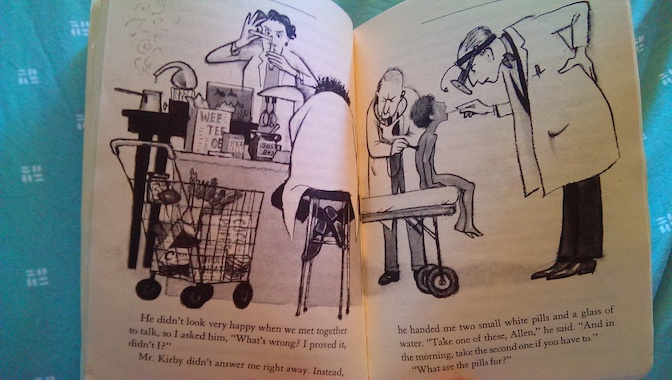


 General Butterfingers by John Reynolds Gardiner, 1986.
 Mrs. Wilson and Walter talk to a lawyer, but he says that, since the General apparently didn’t leave a will, the estate has to go to his nearest relative, which is Ralph. As far as he’s concerned, there’s nothing they can do about, even though the General made a verbal promise to the men that they could stay in his house for the rest of their lives.
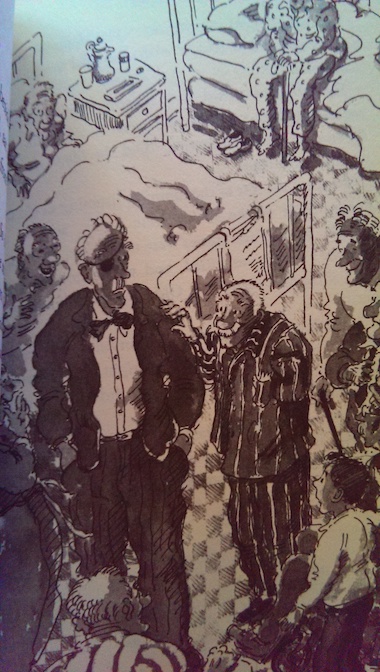 In some ways, you could feel sorry for Ralph, who is a very unhappy person. Because of his meanness and selfishness, his father spent years giving him pretty much anything that he wanted on the condition that he not come around to see him. Ralph is hurt at his family’s avoidance and disdain for him, which is why Walter, at one point, invites him to come for dinner and be their friend. However, Ralph’s motives are always selfish, and that causes him to suspect that the same is true of everyone, so he refuses their kindness. It gives the impression that he’s probably done the same for many others over the years, for the same reasons.


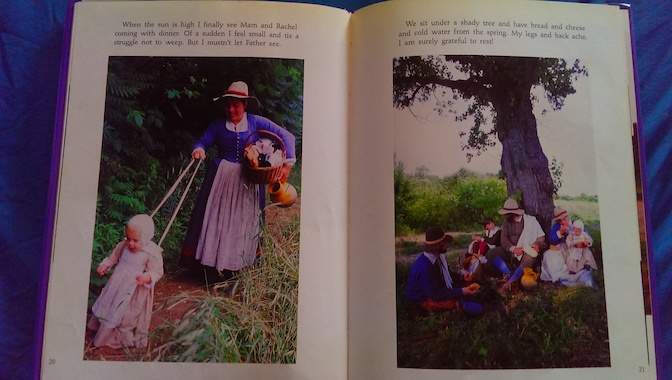




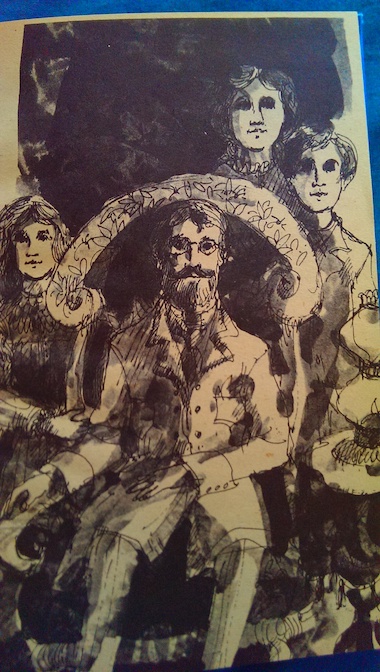 It’s 1851, and Professor Carver of Boston is living in an apartment above a candle shop with his wife and two children, his son Jamie and daughter Lorna. One day, a man named Mr. Giddings comes to see Professor Carver to request his help. For years, he has wanted to buy a particular farm with a beautiful house called Windy Hill. However, when he finally succeeded in buying the house and he and his wife went to live there, his wife became very upset. She said that she felt strange in the house and that she had seen a ghost. Now, she is too upset to return to Windy Hill. Mr. Giddings has heard that Professor Carver once helped a friend get rid of a ghost haunting his house, and he asks the professor if he would be willing to do the same for him.
 Jamie and Lorna are thrilled by the house, which is much bigger than their apartment in town. They can each have their own room, and there is an old tower in the house that was built by a former owner, who was always paranoid about Indian (Native American) attacks (something which had never actually happened). However, their new neighbors are kind of strange. Stover, the handyman, warns them that the house is haunted and also tells them about another neighbor, Miss Miggie. Miss Miggie is an old woman who wanders around, all dressed in white, and likes to spy on people. There is also a boy named Bruno, who apparently can’t walk and often begs at the side of the road with his pet goat, and his father, Tench, who is often drunk and doesn’t want people to make friends with Bruno.
 Then, strange things do start happening in the house. The quilt that Lorna has been making disappears and reappears in another room in the middle of the night. At first, the family thinks maybe she was walking in her sleep because she had done it before, when she was younger. However, there is someone who has been entering the house without the Carvers’ knowledge, and Jamie and Lorna set a trap that catches the mysterious “ghost.”
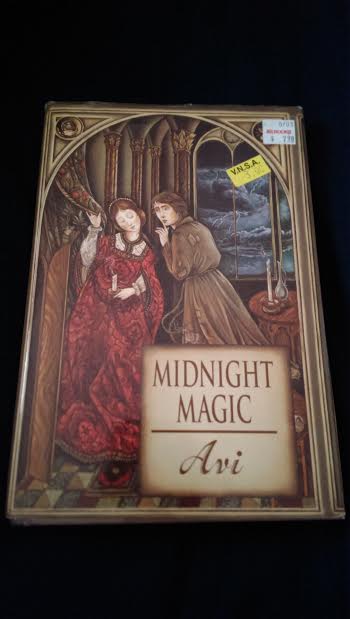 Midnight Magic by Avi, 1999.
