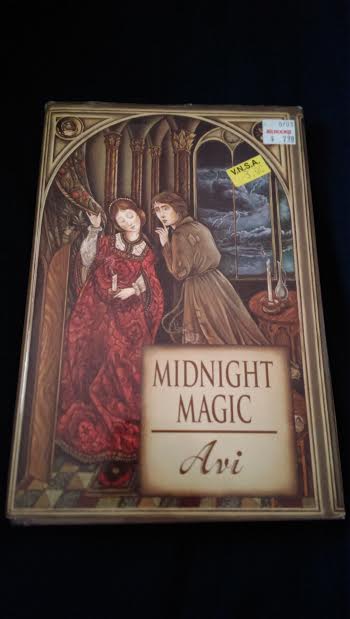
Midnight Magic

midnightmagicMidnight Magic by Avi, 1999.

The story takes place in Italy, toward the end of the Middle Ages.  Mangus, a formerly wealthy scholar and philosopher, is living under house arrest because the king believes that he has practiced black magic. Mangus was merely performing magic tricks to earn extra money, and in fact, does not believe in real magic.  However, the king is very superstitious and easily influenced by his scheming advisor, Count Scarazoni, who needed a scapegoat to distract everyone from his schemes.  Unfortunately, many people in the kingdom of Pergamontio believe that Mangus is a real magician with frightful powers.  Even Fabrizio, an orphan who is Mangus’s only remaining servant, believes that magic really exists.

When a messenger arrives, summoning Mangus to the castle to see the king, they are afraid that the king has reconsidered his decision to spare Mangus’s life. However, it turns out that the king is in need of Mangus’s help. He believes that his young daughter, Princess Teresina, is being tormented by a ghost, and he wants Mangus to use his magic to get rid of it.

Mangus again protests that he does not do real magic, but both the king and Count Scarazoni promise dire consequences if he fails to help them deal with the problem.  Mangus isn’t sure why Count Scarazoni has asked for his help because he knows that the count doesn’t really believe in magic, except perhaps as a way of appeasing the king.  The king promises that if Mangus can free the princess from the influence of the ghost, he will not only end Mangus’s house arrest but reward him with a generous pension.  Mangus has little choice but to agree to do his best, and the promise of the pension for his master convinces Fabrizio to do everything he can to make sure that Mangus succeeds, not only to save his master’s life but to restore his family’s fortunes.

But, what is the secret of the ghost?  Fabrizio believes in ghosts, even though Mangus doesn’t.  Princess Teresina insists that the ghost is real, appealing directly to Fabrizio to convince Mangus that it is. Adding to the mystery is the disappearance of the princess’s brother, Prince Lorenzo, and the murder of the princess’s tutor. Danger lurks in the castle, and conspiracies are around every corner. Could the troubled spirit really belong to the murdered prince?

The book is available to borrow and read for free online through Internet Archive.

My Reaction

I love historical books and spooky mysteries, and this is both! The Italian kingdom where the story takes place is fictional, but it takes its inspiration from real kingdoms of the later Middle Ages and early Renaissance, with Machiavellian intrigue, power struggles, and arranged marriages, even for children, that could influence the balance of power and successions. (There is talk of a potential arranged marriage in the story, but no child marriages actually take place.  If a child is old enough for ghost stories and murder mysteries and isn’t too frightened by them, there is really nothing more concerning than that to prevent them from reading this book.)

Princess Teresina is one of the most intriguing characters in the book.  Although young, she isn’t a shrinking violet or anyone’s fool, and she’s definitely not a tea party and ball gown kind of princess.  Like real life Medieval princesses, she is the product of a family who came to power by the sword and maintains it by the iron fist in the velvet glove and some clever political maneuvering, although some members of the family are more clever about it than others.  Princess Teresina well knows the family she was born into and what’s expected of her as royalty, and she knows to be careful about who she trusts and what the consequences of trusting the wrong people can be.  Although apparently terrified by the ghost, the princess has a kind of toughness and shrewd determination to do what she thinks is necessary.  She seems to be smarter and knows more than most people give her credit, and Fabrizio often wonders just how much she really knows.

One of the best things about the story is that, as soon as you think you know what’s going on, you learn that there is more to the story. There are conspiracies within conspiracies!

Hint: If you like pseudo-ghost stories, spooky stories of the Scooby-Doo variety, where there are logical explanations for the supernatural phenomena … you won’t be disappointed.

Old Black Witch

OldBlackWitch

Old Black Witch by Wende and Harry Devlin, 1963.

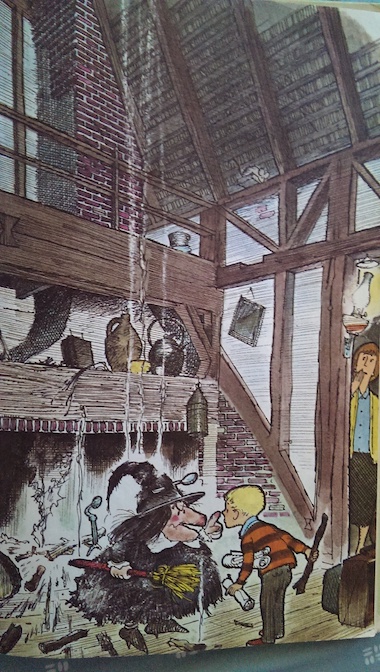
OldWitchChimneyA boy called Nicky and his mother are looking for a new place to live somewhere in New England.  The mother wants to buy an old cottage with the idea of turning it into a tea room.  At first, they have trouble finding a place, but finally they buy an old house that badly needs fixing up, not knowing that there is an old witch living there.

The witch (whom they call Old Black Witch, since she’s dressed all in black and sooty and doesn’t seem to have any other name) has been sleeping in the chimney of the house for about a hundred years, and they wake her the first time they try to start a fire in the fireplace.

The witch is furious to discover that the house has new owners and worried about where she’s going to live because she needs an old house to haunt.  Nicky and his mother invite her to stay and live in the attic, which has enough dust and cobwebs to satisfy her tastes, while they clean up the lower part of the house for the tearoom.

The locals have heard stories about the house being haunted, but the nice tearoom soon becomes popular with ladies in the area, especially after Old Black Witch decides to help out Nicky’s mother in the kitchen.  Old Black Witch’s blueberry pancakes are wonderful and win many fans for the tearoom.

Then, one night, a couple of burglars break in.  Since Old Black Witch is kind of evil herself, she can’t really fault them for wanting to rob the place . . . until she suddenly realizes that they’re stealing from her, too, and uses her magic to fix the burglars for good and give herself the pet toads that she’s been wanting.

This book is available to borrow and read for free online through Internet Archive.

OldWitchToads

My Reaction

One of the things that I like about this story, which was a favorite of mine when I was a kid, is that Old Black Witch isn’t particularly evil although she isn’t too nice, either.  She’s as bad and disagreeable as a cranky old witch who’s lived in a chimney for over 100 years ought to be, but not so bad that she can’t make some new friends and help them out once in a while.  Friendly enough for the kids, but not too sweet to be a real witch.  It’s part of a short series, although I haven’t managed to find any of the other books yet.  Some of the pictures are in full color and some are in black and white.  Don’t ask me why she has a spoon in her hat because I’ve never been completely sure, either.  Somehow, on her, it looks good.

The back cover of the book has the recipe for the blueberry pancakes.

OldWitchPancakeRecipe

There was a short film version of this story from 1969 called Winter of the Witch.  It follows the book fairly well, but with some variations (there were no burglars).  In the film, the pancakes have the power to make people happy, and that’s what gives Nicky’s mother the inspiration to open a pancake parlor in their house.  The witch finds a new sense of purpose, although she still plans on going back to her old, wicked ways once the world is happy enough to need a good, old-fashioned scare.  I don’t think that it was ever released on dvd, but it is possible to see it on YouTube and Internet Archive.

Felicity Saves the Day

American Girls

FelicitySummer

Felicity Saves the Day by Valerie Tripp, 1992.

This is part of the Felicity, An American Girl series.

FelicitySummerPlantationFelicity’s grandfather is a wealthy man who owns the Kings Cross Plantation.  Every summer, Felicity and her family go to visit him there, and Felicity loves it.  Her grandfather teaches her a lot of things, like which plants can be used for food and medicine, and takes her for horse rides around his estate.
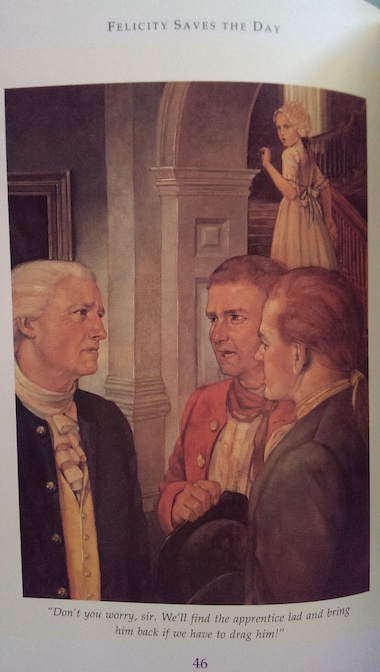
This year, while Felicity’s father and his apprentice Ben are minding the store at home,  Felicity has a special surprise.  As her grandfather inspects a group of horses that a friend wants to sell him, Felicity is stunned to recognize Penny, the horse she freed from an abusive owner in the first book of the series.  Penny is a little thin and dirty but otherwise well, to Felicity’s relief!  Her grandfather purchases Penny for Felicity and promises to keep her safely at his plantation so that Felicity can visit her and ride her regularly.

Felicity is happier than she’s been in a long time and writes an enthusiastic letter home to tell her father and Ben, but soon, she learns that Ben is not at home with her father.  Felicity and her siblings have set up a bird bottle, a special bottle that acts like a bird house for birds to nest in, and she checks it daily to see if there are any birds to show to her little brother.  One day, she finds a message in the bottle from Ben, pleading for help, along with a map to a place in the woods and Ben’s whistle.  When Felicity goes to the spot in the woods and blows the whistle, Ben comes out of hiding.

FelicitySummerBountyHuntersBen tells Felicity that he ran away from his apprenticeship to join the revolutionary army.  He wants badly to fight for the colonies’ freedom from England, but he had a bad fall while traveling and hurt his leg.  Felicity tries to convince Ben to let her get help for him and to return to her father to finish his apprenticeship, but Ben doesn’t want Felicity’s grandfather to find out that he’s there or why he ran away because he knows that he disapproves of the revolutionaries.  Because Ben kept her secret when she used to sneak out to see Penny, Felicity reluctantly agrees to keep Ben’s presence a secret for awhile, sneaking him some food and supplies.  She tells Ben that, while she thinks that standing up for what he believes is good, he’s going about it in the wrong way because breaking his apprenticeship was dishonest.

Then, Felicity learns that her father has placed an advertisement in the newspaper with a reward for anyone who can find Ben, and some rough-looking bounty hunters show up at the plantation to inquire about it.  Felicity knows that she must try to convince Ben to return on his own before he gets hurt worse than he already has!

A large part of the Felicity books is about taking responsibility and whether or not it’s right to break rules in the name of a good cause.  Felicity herself broke the rules to befriend Penny and later free her from a master who would probably have killed her.  This story raises the question of whether Ben’s form of rule-breaking is similar to what Felicity did or not.  Their situations and the reasons for their rule-breaking are different.  In her situation, Felicity had tried to behave as lawfully as she could until it became apparent that the only way to save Penny’s life was through rule-breaking.  In Ben’s situation, although he wants to help what he sees as a good cause, his rule-breaking isn’t strictly necessary, and he never tried to discuss his feelings with Felicity’s father and to work out an arrangement before running away because he thought that he already knew what Mr. Merriman would say.  Felicity points these things out to Ben, along with the fact that Ben is not in any real position to help the cause that he supports because he is injured, wanted, and in hiding.  He started on this venture ill-prepared and inconsiderate of the other people who depend on him back home and his own future, and while his belief in the revolutionary cause is genuine, he is also afraid of admitting his mistakes and needs to be urged to make things right.

In the back of the book, there is a section that talks about what people in Colonial America would do during summertime.  The weather in Virginia is hot and humid during the summer, and not everyone would get a chance to travel to the countryside, like Felicity’s family did.  The book talks about various ways colonists would use to cope with heat (keeping the kitchen with its fire separate from the house, eating in an open breezeway in the house, wearing lighter clothes, boys would go swimming although girls didn’t, etc.).  It also talks about life on Virginia plantations, including slavery.

The Secret Life of the Underwear Champ

UnderwearChampThe Secret Life of the Underwear Champ by Betty Miles, 1981.
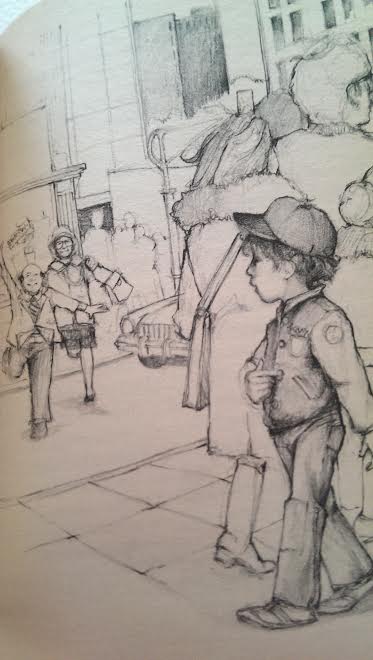
Ten-year-old Larry lives in Connecticut, but one day, while he and his mother are visiting his dentist in New York City, he gets spotted by the Zigmunds.  The Zigmunds own a modeling agency, and they think that Larry will be perfect for a series of tv ads.  At first, Larry is kind of excited about the idea of being on tv and earning extra money (maybe enough to get a new ten-speed bike!) until he realizes what he’s going to be advertising: underwear.

The Zigmunds like Larry because he’s a clean-cut, athletic kid who likes to play baseball, and the advertisements are supposed to feature a family playing sports together . . . in their underwear.  Larry also happens to have red hair, just like the girl already picked to play his sister in the commercials, Suzanne.  Suzanne has been in advertisements many times before, and the idea of advertising underwear doesn’t bother her at all.  The underwear kind of looks like athletic clothes and isn’t really revealing, but it’s still underwear.  Larry goes from feeling proud of his new tv advertising career to hoping that no one at school ever finds out about it.  But, how can Larry even hope for that when his underwear-clad form is going to be displayed on everyone’s tv set?

UnderwearChampPic1Now, Larry is wondering what he’s gotten himself into.  He worries about his filming schedule conflicting with baseball practice and makes up excuses about needing to visit the dentist when he has to film a commercial.  Money or no money, Larry just wishes that his life would return to normal!
After the filming is over, Larry starts to feel better about what he’s accomplished.  He and Suzanne have become friends (and she may possibly be his first girlfriend), and learning about the world of advertising was kind of fun.  But when the commercial actually makes it to tv, and Larry tells his best friend Robert about it, the dreaded teasing starts.

In some ways, Larry’s fears about teasing don’t turn out to be as bad as he fears, although it seems like it at first.  Robert laughs at him when he sees the first commercial and realizes why Larry’s been sneaking around and making excuses, but Larry tells him off for being mean and challenges him to think how he feels about it all.  Robert feels a little bad about laughing but says that he can’t help it and that other kids at school will react the same way.  He’s partly right, but he does help to put a stop to it, and the other kids do calm down.  Larry even enjoys some minor fame because he’s the only one of the kids to have been on tv at all.

There’s a lot of humor in the story, but it’s also surprisingly thoughtful as Larry considers why people find the idea of seeing someone in their underwear so funny.  After all, everyone wears underwear of some kind, even the President of the United States.  It’s a normal part of everyone’s wardrobe and a common part of everyday life.  The other people in the ad don’t act self-conscious while they’re being filmed in their underwear because it’s just part of their job, another part of daily life.  The book doesn’t mention sex, although the “mother” of the family in the ads gets a few whistles when she’s in her underwear, and Larry acknowledges that he and Robert sometimes giggle over advertisements with girls in their underwear.  Larry’s main conclusion is that people laugh about underwear because that’s just not how people normally see each other, so it seems weird.  After everyone has seen the commercial with Larry many times, people get used to the idea and it doesn’t seem so weird, so they get over the “funny” part and stop laughing.  Eventually, the other kids at school stop thinking so much about the underwear and just think it’s kind of cool that Larry was in a commercial.

The book is currently available online through Internet Archive.

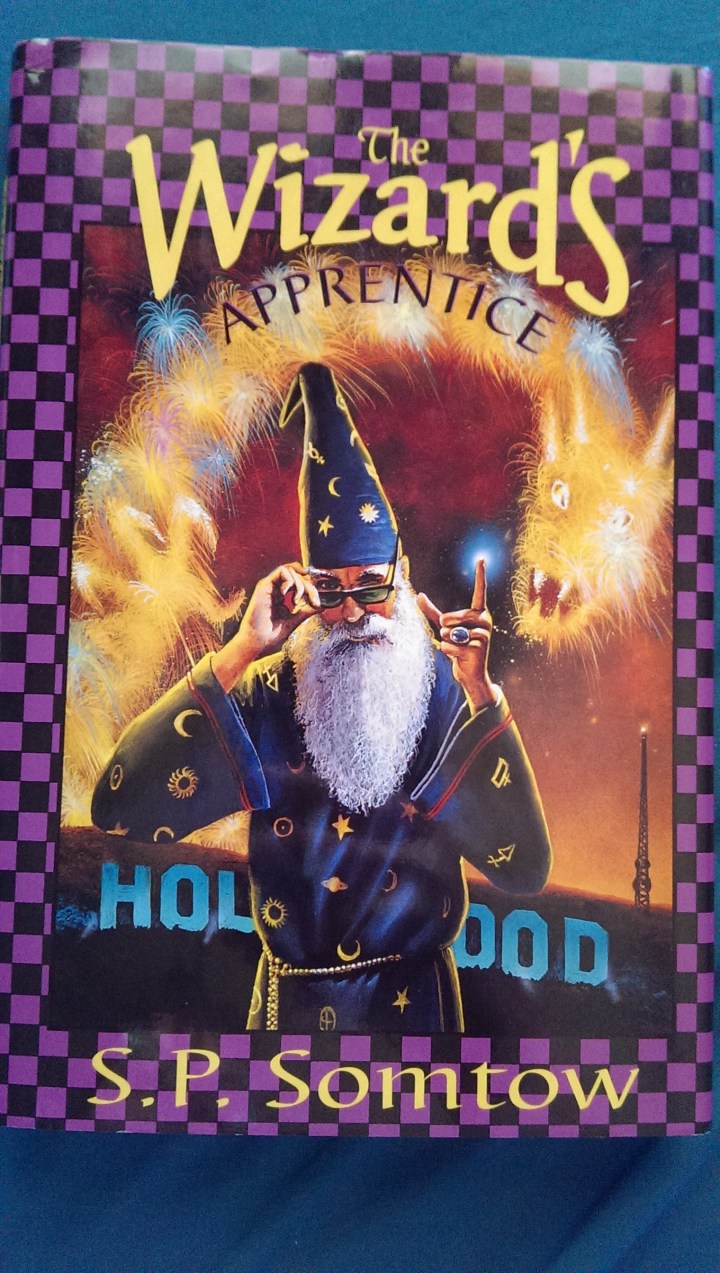
The Wizard’s Apprentice

WizardsApprentice

The Wizard’s Apprentice by S.P. Somtow, 1993.

WizardsApprenticePic1Sixteen-year-old Aaron Maguire thinks of himself as a typical teenager, even though his family is far from typical.  His mother is a buyer for a fashion boutique, and his father does special effects for monster movies in Hollywood.  They’re also officially “separated” and preparing for a divorce, even though they’re still living in the same house.  So far, they’ve just kind of divided the house in two in order to have their own space.  Aaron goes back and forth between the two halves of the same house as his parents share him.  It’s a little weird (and, to Aaron, also a little depressing), but there’s weirder to come.
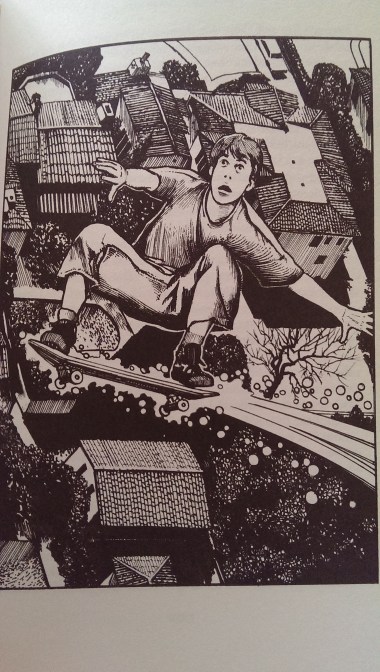
An old man approaches Aaron and tells him that he’s destined to be a wizard and that he will teach Aaron what he needs to know.  At first, Aaron thinks this man is nuts and probably homeless, but what he says is true.  The old man is the wizard Anaxagoras.  Anaxagoras demonstrates to Aaron how the skateboarding maneuver he had just pulled off defies the laws of physics and tells Aaron things about his personal life that no one should know (how angry he is with his parents about their separation and about his crush on Penelope Karpovsky, a girl he knows from biology class).  He also changes the dollar Aaron had offered him into a $100 bill and shows him that they can travel to magical lands and even through time.  Although Aaron still has trouble believing what he sees (his father does special effects for a living, after all), he becomes Anaxagoras’s apprentice.

Partly because Aaron still has doubts and needs something physical to convince him of the wizard’s powers and trustworthiness, Anaxagoras gives him a mirror.  It looks basically like an ordinary pocket mirror with a neon pink frame, but Anaxagoras invites him to ponder it and figure out what it does, telling him that what he does with it is important.

WizardsApprenticePic2However, when Aaron meets the divine Penelope for pizza and she asks to borrow a mirror to check her hair, Aaron lets her borrow Anaxagoras’s mirror.  He instantly regrets it because the mirror suddenly changes in Penelope’s hands.  Now, it has a tortoiseshell frame and is shaped like a heart.  Penelope, who has low self-esteem in spite of her prettiness, is suddenly really happy when she looks in the mirror and refuses to give it back, insisting that she wants to borrow it for a few days.  Because Aaron is in love with Penelope, he finally agrees to let her keep it for awhile.
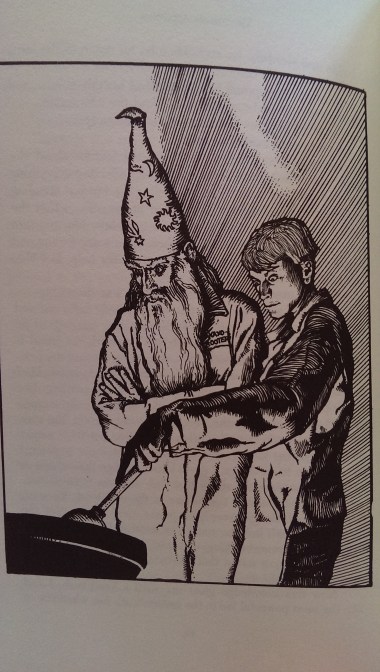
When Aaron tries to tell Anaxagoras about Penelope borrowing the mirror, he doesn’t seem concerned.  He just hurries Aaron on to his next lesson, which involves a plumbing problem.  Anaxagoras’s lessons are pretty weird, although Aaron finds himself learning that there is more magic in the everyday world than he ever suspected.

Aaron later attempts his own feat of magical plumbing at the studio where his dad is working and encounters a creature of darkness.  The mirror gets out of his hands, and he enchants a car in order to chase it down.  Finally, a dare from some classmates causes him to unleash a dragon on the unsuspecting city, one that only Aaron can understand and defeat, once he realizes the true nature of his magical mirror.

Aaron has a distinctive voice as a California teenager, and his first experiments with magic lead him to some surprising discoveries about himself which help him to understand and reconcile his feelings about his parents’ divorce.

Angelo the Naughty One

AngeloNaughtyAngelo the Naughty One by Helen Garrett, pictures by Leo Politi, 1944.
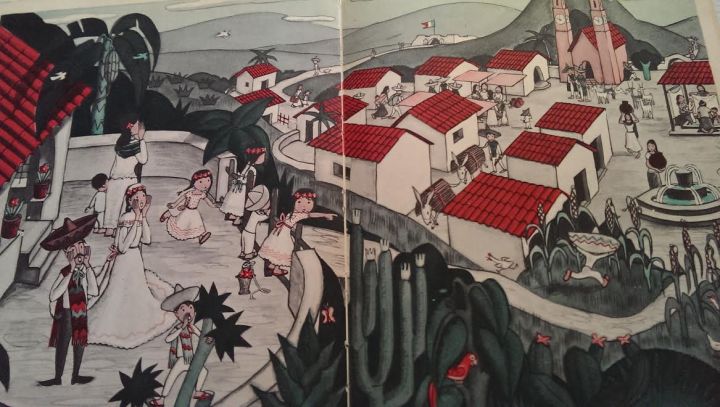
The title is a little misleading.  Angelo isn’t so much naughty as he is afraid, although Angelo could be considered naughty because his fear causes him to misbehave.

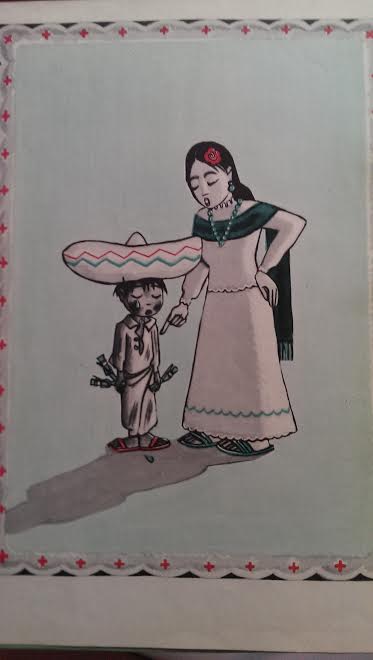
Angelo Silva hates to take baths because he is afraid of water.  Instead, he loves to play in the dirt with his toy soldiers.  He dreams of one day being a soldier himself, and he imagines that, as a tough soldier, no one would be able to tell him what to do, especially take a bath!  Angelo is in for a surprise.

When his family tries to make him take a bath so he will be clean for his older sister’s wedding, he runs away.

AngeloNaughtySearching

Eventually, he ends up at the fort outside of town, and he is caught by a group of soldiers, comrades of his sister’s fiance, who is also a soldier. Angelo is unable to admit his fear in front of these brave soldiers because he is ashamed that these brave men would think of him as a coward, although he cries and tries to fight his way out of it when they decide to give him a bath, declaring that they won’t know who he is until they get all the dirt off of him.  In the end, he is unable to resist their efforts to resist their efforts to clean him up.

Once Angelo is clean, the soldier who is going to marry his sister recognizes him.  The soldiers borrow some nice boys’ clothes for Angelo to wear and help him dress up nicely for the wedding.  With Angelo looking much better, Angelo’s brother-in-law to be says that Angelo can ride with him to the wedding on his horse.

Before they leave the fort, the soldier says, “Brother soldiers, sitting behind me on my horse is Angelo Silva, the younger brother of my bride, Maria Rosa.  After the wedding he will be younger brother to a soldier and I am sure he will be proud and happy to take baths so he won’t disgrace the army.”  Like a true soldier, Angelo has been given an order!

AngeloNaughtyWedding

Besides getting the warning about not behaving disgracefully, Angelo realizes that he is now free to enjoy the wedding and all the good food, so getting cleaned up has some benefits.  He also likes the attention he receives from others as they marvel at his sudden transformation from a dirty little boy into a clean young man.

The story doesn’t state it directly, but it’s partly about self-confidence and growing up. Angelo admires the grown men who are brave soldiers and would like to be like them, but he can’t until he faces his fears and realizes that what he was afraid of was not as bad as he believed it was.  Soldiers must do brave things, following orders and fulfilling their duty even when they’re afraid, and so must Angelo.  Angelo’s new pride in his appearance and diligence in keeping himself clean is part of his new self-confidence.  He isn’t just proud of how he looks but of his new achievement in getting over his fear, and he likes it that others are proud of him, too.  In the end, his nickname is changed from Angelo the Naughty One to Angelo the Brave One, which is what his father calls him because he has conquered his fear.

This picture book belonged to my mother when she was young.  The pictures are all done in shades of only four colors: black, white, red, and green.  The colors reflect the colors of the Mexican flag.

The book is available to borrow and read for free online through Internet Archive.

Egyptian Diary

EgyptianDiary

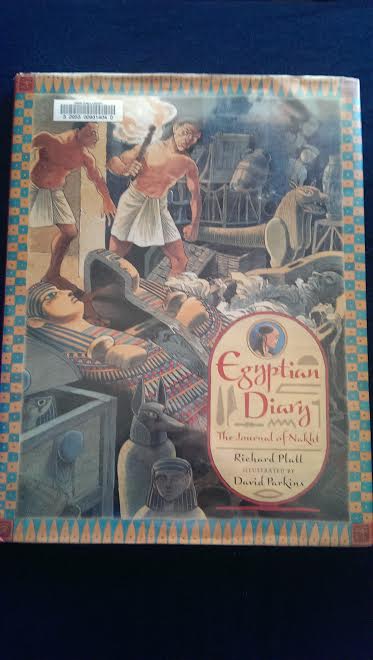
Egyptian Diary: The Journal of Nakht by Richard Platt, 2005.

A young boy in Ancient Egypt, Nakht, is excited because his family will soon move to Memphis because a distant relative has offered his father a job working as a scribe.  Memphis is a large, important city, with more opportunities than Esna, where the family currently lives.  Nakht is also training to be a scribe, so he begins writing an account of his family’s journey to Memphis and what they encounter when they arrive.

EgyptianDiaryPic1

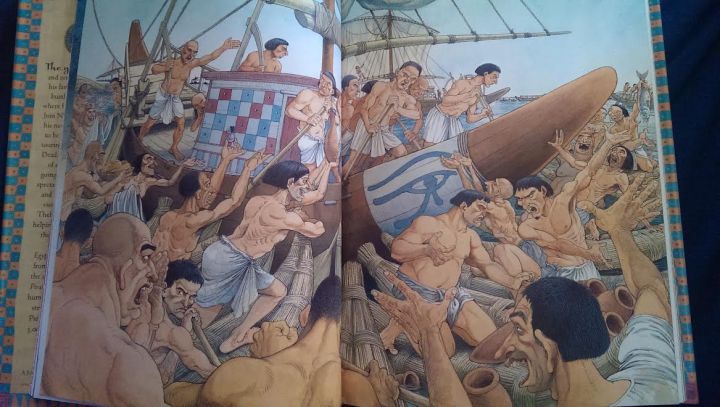
The journey to Memphis includes a boat trip down the Nile, past the City of the Dead near Thebes, where pharaohs are buried.  When they arrive in Memphis, they make themselves at home in their new house, which is bigger than their old one.  For the first time, Nakht has a private bedroom of his own, and the wall is decorated with a hunting scene.  Nakht also has a bed to sleep in, although he is still more accustomed to sleeping on a mat on the floor, as he did back in Esna.

In Esna, Nakht’s father had taught him his lessons as a scribe, but in Memphis, Nakht begins attending a school with other boys.  There, he practices his writing as always, although he must also learn the older, more formal hieroglyphic form of writing used on the walls of temples and for public inscriptions as well as the less formal writing used more commonly.  Nakht also receives lessons in building and engineering, which includes calculating the weight of the building stones, how many people it would take to move them, and how much food and drink the workers would need during their time of service).  Sometimes, their teacher also takes the students places for lessons, like taking them to the fields near the river so they can see how to build canals and how farmers water their fields.

There are many exciting things going on in Memphis.  Ships come and go from many places.  When the Nile floods, Nakht describes how the Controller of Granaries sets the taxes on grain for the following year by measuring the highest height of the Nile during the flooding time, which is an indicator of how good the next year’s grain harvest will be.  Nakht and his sister Tamyt witness the funeral procession of a scribe, complete with dancers, paid mourners, and a procession of servants carrying all of the furniture and supplies to be loaded into the man’s tomb for him to use in the afterlife.

EgyptDiaryPic2

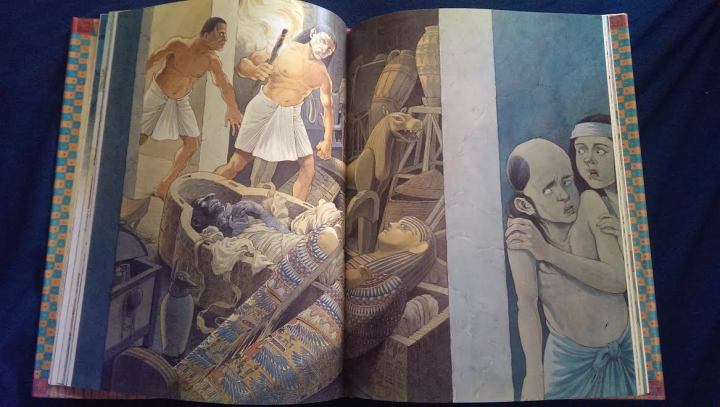
Then, Nakht learns that his father and other scribes are investigating tomb robberies in Saqqara.  Nakht and Tamyt have never seen the tombs before, but their father refuses to let them come with him.  Instead, the two of them sneak over by themselves to have a look.  While they are there, they witness the robbing of a tomb!  They get a good look at an unusual ring on the finger of one of the robbers and are shocked to later see an identical ring on the finger of a very important person!

EgyptDiaryPic3

At the end of the story, when Nakht and Tamyt are rewarded for their role in catching the thieves, it is revealed that the current king of Egypt is Hatshepsut, who is actually a woman.

EgyptDiaryPic4

Among the other things that Nakht explains about his life are how the doctor treated him when he broke his arm, how grain is harvested, how different types of craftsman work, and how houses are built.  Nakht also undergoes a special hair-cutting ceremony as a coming-of-age ritual.

There is a section in the back that explains more about Ancient Egyptian history and society.  It also explains Egyptian writing, religion, mummies, and tombs.

The book is part of a series of historical picture books.  It is currently available online through Internet Archive.

Pirate Diary

PirateDiary

Pirate Diary: The Journal of Jake Carpenter by Richard Platt, 2001.

Young Jake Carpenter lives with his father in North Carolina in 1716.  His mother is dead, and his father is a medical doctor.  His father wants him to become a doctor as well, but he has decided that it’s important to the boy’s education that he see something of the world first, so he is allowing Jake to go to sea with his uncle, Will, who is a sailor.  Jake is excited about the prospect, and Will has told him many stories about the sea.

PirateDiaryPic1

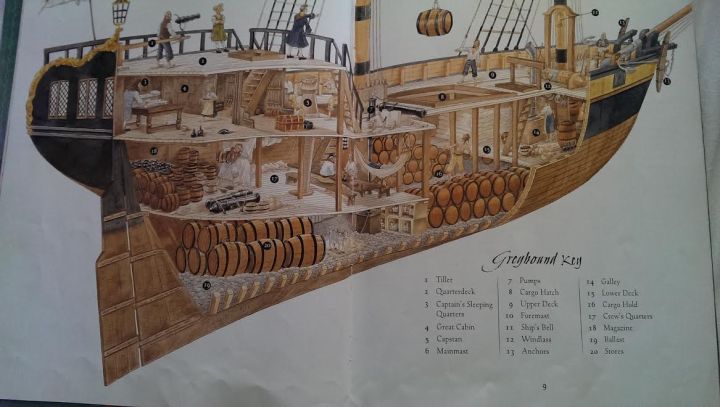
Jake isn’t allowed to bring much with him because there is limited space on board the ship for personal belongings, and there are many things that Jake has to get used to, like sleeping in a hammock, the names for all the different parts of the ship, seasickness, the poor quality of food on the ship, and using the horn lanterns which are safer for candles on board ship but don’t cast much light.  Jake makes friends with Abraham, the cook’s boy, who promises him extra food in exchange for teaching him to read.  Jake’s main job on the ship is to help the carpenter, so he begins learning his trade.

When the ship is underway, Jake and his uncle learn that the captain is running from debts and that the ship is carrying contraband.  Jake doesn’t think that smuggling is a very serious crime because the main purpose is to avoid paying extra taxes on certain types of goods, and other members of the crew say that it isn’t fair for Americans to continue paying taxes to England when the king doesn’t really care about them or what they want.  The ship sails the Caribbean, but crew members say that they try to avoid docking at English-controlled ports, like the ones in Jamaica, so they won’t have to pay the customs fees. Abraham says that even if they were caught with their contraband, the authorities would likely look the other way if they offer them a share.  Will tells Jake that the captain of the ship will most likely hold back their wages in order to keep them with the ship for as long as possible, like he does with other sailors.

Discipline on board the ship is harsh and arbitrary, according to the captain’s whims.  When Will speaks up to save Jake from a harsh flogging, he himself is flogged and abandoned in a small boat.  Jake believes that his uncle will die because they left him at sea with no provisions!

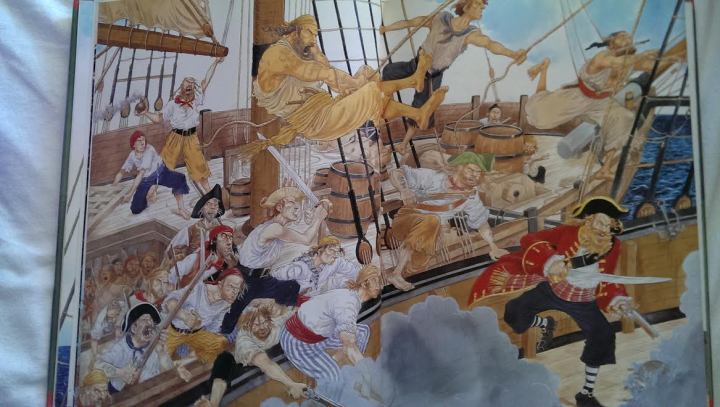
Then, the ship is captured by pirates!

PirateDiaryPic2

Far from making things worse, Jake’s situation and that of the rest of the crew actually improves because of the pirate attack.  With the captain captured, his cruel punishments are over, and members of his crew eagerly join the pirates in the capture.  The pirates ask the crew about the treatment their captain has given them, saying that it will help them to decide what to do with him, and crew members explain the cruelties they have suffered, including what the captain did to Will.  They end up marooning the captain and his equally-cruel second mate on an island with drinking water.

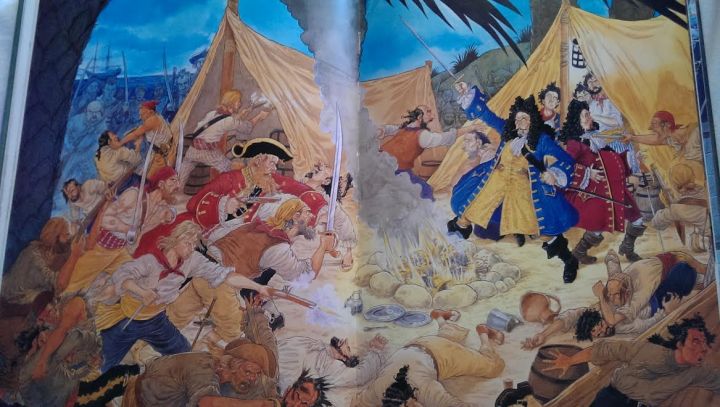
As Jake’s father predicted, Jake gets to see a lot and learn a lot about life and death during his time at sea, perhaps even more than expected while under the command of the pirates.  He gets some experience in dealing with injuries as he has to help the ship’s carpenter saw off the leg of a man whose wound was too infected to treat in any other way, although the man later died anyway.  Later, the pirates join up with other pirate ships, and Jake participates in a raid on a Spanish treasure fleet!

PirateDiaryPic3

It’s not all excitement, and Jake spends some time talking about the routine chores that sailors did and how they would pass the time on board ship when nothing else was going on.  He does get to see St. Elmo’s Fire on the upper rigging of the ship, and the crew spots a “mermaid” once on a misty day.

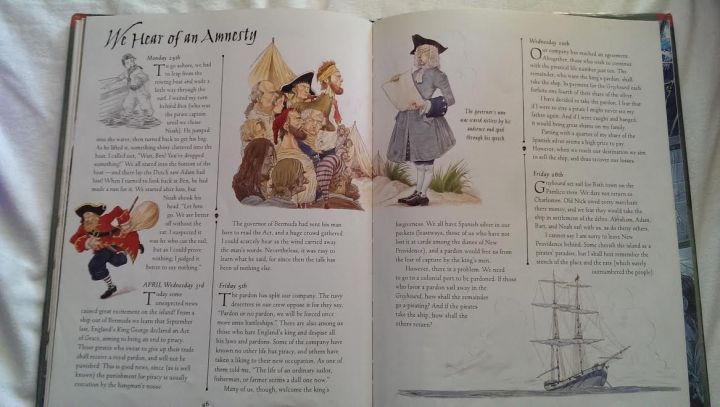
An offer of amnesty for those willing to give up pirating allows Jake and other members of the crew to return home where he learns that his uncle has managed to survive after all!

PirateDiaryPic4

In the back of the book is a section with historical information.  It explains the history and geography of the American Colonies, where Jake lived and the history of piracy from the first known pirates to the privateers and buccaneers that led to the golden age of piracy in the 18th century.  Jake is a fictional character, but some of the pirates that Jake met in the story were real people, and the section in the back explains more about them.  The book is part of a series of historical picture books.

Castle Diary

CastleDiary

Castle Diary: The Journal of Tobias Burgess, Page by Richard Platt, 1999.

Tobias is an eleven-year-old boy living in England in 1285.  He is from a noble family, and his father is sending him to his uncle to become a page.  As a page, Tobias will learn manners and skills that he will need as he eventually becomes a squire and then a knight.  During the first year of his training that he spends with his uncle, he keeps a diary of everything that happens to him and everything he learns.  Toby is a fictional boy, but his life and family are meant to illustrate what life was like for a young boy from his social level during the Middle Ages.

CastleDiaryPic1

The castle were Toby’s uncle lives is much bigger than his parents’ manor house.  Toby has to learn the roles of all the servants who live there: who is in charge of what and who reports to who.  Not all servants are equal, and some command more respect than others.  Some of them are even from noble families like his, including his aunt’s companion, Isbel.  Toby himself is assigned to do chores for his aunt like running errands, delivering messages, serving food at meals, and holding up the hem of her cloak when she walks outside.

Toby shares a room with the other pages at the castle, all boys of noble families and destined to become knights, just like him.  They have lessons in reading, writing, mathematics, Latin, and scripture from the castle’s chaplain, and he is a harsh disciplinarian.  They practice their lessons on wax tables that can be smoothed out and used again.  The boys also learn manners and start learning archery and about all the weapons and armor that knights use.  When they have time to play, they try walking on stilts and play at being jousting knights by carrying each other on their backs and trying to knock each other off.

CastleDiaryPic2

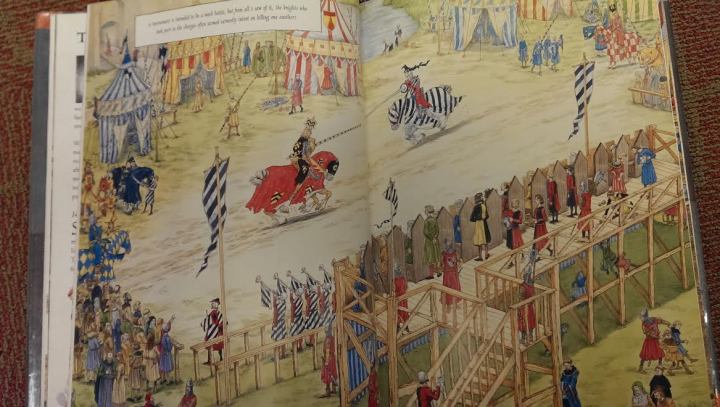
During the course of the year, Toby gets to witness a hunt, a joust, and a banquet with important guests.  At one point, he gets sick and receives treatment from a physician.  He also encounters a poacher on his uncle’s land.  This man is eventually caught (although Toby decides not to turn him in) and put on trial, but in the end, he is not punished because the jurors were sympathetic.  The book ends with a Christmas celebration, after which Toby goes home to visit his parents.

CastleDiaryPic3

In the back of the book, there is a section with more information about Medieval society, castles, sieges, weapons, armor, and the changes that eventually brought an end to feudal system that Toby knew.

The book is part of a series of historical picture books.  It is currently available online through Internet Archive.

CastleDiaryPic4

Tornado Jones

TornadoJonesTornado Jones by Trella Lamson Dick, 1953.

This book was recommended by a reader of this blog.  I haven’t been able to find a copy of it myself, but the reader thoughtfully supplied a picture of the cover.

The reader says:

“I lived in North Platte Nebraska from about February of 1953 till about April of 1955. During that time a book was written by Trella Lamson Dick entitled “Tornado Jones”. Everyone in my school in North Platte read that book many many times. We all loved it. Trella Lamson Dick was born, lived and died in small town of Orleans, Nebraska, Just East and a bit South of North Platte Nebraska. I have two copies of the book one for each of my grandsons. It may be something you might look into investing in I know there are copies available.

It is about a boy whose parents had died and he lived with his Aunt on a farm. In his adventures he discovered people who were digging dirt out in a gully and a pit in the middle of prairie land and he could not figure out why. It turns out that the book is a work of fiction but it is based on fact about the determination that the ‘Jeffrey Reservoir’ East of North Platte could actually be built and would function.”

The orphan boy, Tornado Jones, also has a mystery surrounding his name.  He doesn’t like to talk about it with other people, but when he makes a friend (the first one he’s ever had), Paul, he finally confides that the only clue he has to his real name is a glass bell.  The secrecy surrounding his name has made him uneasy for his entire life.  Tornado also believes that there is gold buried in the canyon nearby, and when he sees people digging there, he is sure that’s what they’re looking for.  Paul is fascinated at the secrets Tornado confides in him, and he and Tornado team up to uncover both the secret of the gold and Tornado’s name.  At the same time, Tornado’s family is worried about the beginning of the reservoir and dam, the construction of which threatens to flood the family’s home.  Can they save their home or will they have to give it up in the name of progress?

This book won the Charles W. Follett Award and is actually the first in a series about Tornado Jones.  There are two others.