Stories of Rainbow and Lucky: Handie

Stories of Rainbow and Lucky

I’ve been wanting to cover this series for some time. It’s an unusual series from the mid-19th century, written on the eve of the American Civil War, by a white author with a young black hero. Rainbow is a teenage black boy who, in this first installment of the series, is hired by a young carpenter, who is only a few years older than he is, to help him with a job in another town. The entire series is really one long story, like a mini-series, and each book is an installment in the story. 

This first book focuses mostly on the young, white carpenter Handie Level, why he needs to take this job in another town, and why he decides to hire Rainbow to come with him. The rest of the series follows the two young men, particularly Rainbow, through their adventures, learning life lessons, even dealing with difficult topics like racism. (Lucky is a horse, and Lucky enters the story later.) It’s unusual for this time period for black people to be the heroes of books and for topics like racism to be discussed directly. It’s also important to point out that our black hero is not a slave, he is not enslaved at any point in the series, and the series has a happy ending for him. People don’t always treat him right, but he does have friends and allies, and he manages to deal with the adversity he faces and builds a future for himself.

I want to explain a little more about the background of this book, but it helps to know a couple of things before you begin. First, the author was a minister who had written other books and series for children, Jacob Abbott. He had a strong interest in human nature and the details of everyday life, so his books are interesting for students of history. He explains some of the details of 19th century life that other people of his time might have taken for granted, and he also liked to explain the reasons why his characters behave as they do in the stories, exploring their personalities and motivations. Second, as part of the author’s character studies and also just for the fun of it, he made many of his character names puns that offer hints to the characters’ roles or personalities, so keep an eye out for that when new characters are introduced. Some of these pun name or nicknames are obvious, but others require a little explanation. Rainbow’s employer, Handie Level, is a level-headed carpenter who’s good with his hands, so the meaning of his name is pretty straight-forward. “Rainbow” is the nickname of our black hero, not his real name. We are never told what his real name is. He apparently has one, but even the author/narrator of the story admits that he’s not sure what it is. He is nicknamed “Rainbow” because he is “colored”, and that may require a little explanation.

During the course of the books, the author explains that “colored” was one of the more polite words used for African Americans during the mid-19th century. The author wanted to make his stories educational for children of his time, so there are points when characters discuss how to address African Americans politely, explaining which terms are acceptable and which are not acceptable. The basic rule that the author establishes of not referring to anybody by a name you think they wouldn’t want to be called still holds true today, no matter who you’re talking about. It’s important to consider other people’s feelings in how you describe them, and it’s good to teach children to notice and care about other people’s feelings. However, some of the polite racial terms the author recommends in the books sound out-of-date to people today and might leave modern readers wondering if they really are polite. The answer to the question is that they were considered polite at the time the book was written, but since then, some of the conventions regarding polite racial terms have changed.

A major shift in the terms used took place during the Civil Rights Movement, around 100 years after this series was written. People were intentionally trying to distance themselves from the emotional baggage associated with the racial terms that had been used previously, so instead of using “Negro” and “colored”, they began using “African American” as the formal term and “black” as the generic, informal term. This change in terms was meant to help create a sense of a fresh start at a time when cultural attitudes were changing. Because this book was written in the 19th century, the terms they use as the polite terms are the ones that were formerly used as the polite terms before that cultural shift. Even though most people wouldn’t speak like that anymore, you can still see the use of these terms occasionally, particularly in the names of organizations that were created prior to the shift in racial terms, like the United Negro College Fund (UNCF, founded 1944) and the National Association for the Advancement of Colored People (NAACP, founded 1909). So, yes, “Rainbow” is a pun nickname because he is “colored” in the sense of the racial term. Apparently, the author was amused that the term made it sound like he was colorful, like a rainbow, although I think he is also a colorful personality.

The way a person speaks does offer hints to their background and character. Jacob Abbott had a fascination for analyzing the details of human behavior and the ways other people react to the other people around them them. He was aware of what was considered polite in his time and how the words people use affect other people. In these stories, he deliberately offers teachable moments to show child readers the differences between people who behave politely and considerately and the people who do not. As you go through the stories, feel free to study the characters and their behavior. The author meant for people to notice who these people are and why they do the things they do.

This book is easily available to read online in your browser through NINETEENTH-CENTURY AMERICAN CHILDREN & WHAT THEY READ, I’m going to do a detailed summary below. If you’d rather read it yourself before you read my review, you can go ahead, but some people might want to know in detail what they’d be getting into. There’s nothing here that I think would be racially offensive because it’s quite a gentle, sympathetic story. However, I can immediately see a couple of reasons why this book and its series hasn’t become a better-known children’s classic. 

I wasn’t kidding when I said that the author goes into detail about some aspects of daily life and society in the 19th century. This story and its series, like others by the author, was meant to be education, so there’s a lot of teaching going on, both in the form of moral advice and general life lessons and in the specifics about how to handle money and negotiate business arrangements. It could still be interesting for someone studying daily life and social attitudes in the 19th century, but 21st century children might find it a bit dull. There’s more explanation than there is action and adventure, although I wasn’t bored while reading it, and there are a few interludes with character backstories, stories that the characters tell each other, and a strange dream Handie has. In the middle of the book, there’s kind of a touching story about a little boy and his widowed mother that I enjoyed, and it explains some of the reasons why the characters are in the situation they’re in.

Handie and Rainbow are the two main characters of the series, although most of this book focuses on Handie and his family. Their money troubles, an inheritance that Handie receives, and the arrangements that he makes on behalf of his family create the situation that causes Handie to hire Rainbow to help him with some work, which requires traveling to another town to manage his inheritance. The entire series tells the story of why they’re doing this, what happens to them on the journey to this new town, what they find there, and what it means for their futures, but it’s told in five installments. There are some spoilers at the end of this story to future stories in the series, which ruins some of the suspense, but this isn’t really meant as a suspense story. It’s a story about a couple of promising boys in the teenage years and what they do that sets them up for their future. One of them just happens to be black, and that’s something that figures more in the later stories in the series. This particular book has a few moments when the characters discuss race and the difficulties and discrimination that black people encounter in life, but it’s not a major focus. There is going to be outright racism in the stories, but this book mostly sets up the backstory of the characters and their situation.

Handie Level (his first name is short for Handerson, we are later told) is a poor boy who is reluctant to go to school because his clothes are so poor, but yet, he is eager to learn. Our narrator, an unnamed neighbor of the Level family, describes how Mr. Level has difficulty earning much money because he is not very strong and is physically deformed. He manages to earn sufficient money to keep himself, his wife, and their son in a basic way as a kind of repair man. He is very good at fixing things in his little workshop. However, he isn’t very good at managing the little money he has, and his wife isn’t very attentive about maintaining the house or the family’s clothes, making them look more poor than they actually are. It’s true that they don’t have much, but they could do better if they managed their resources better. It’s partly because they feel sorry for their poor state and not very hopeful about it improving that keeps them from striving to do better. In reality, they’re not that much worse off than their neighbors, but this feeling that they are is what keeps Handie from going to school and letting others see his poor state. Since he has not been to school so far and can’t read, Handie worries that he would be embarrassingly behind the other children if he tried to go.

One day, the kind neighbor/narrator sees Handie trying to teach himself to read. Wanting to help the boy, the kind neighbor gives him a book that will help him learn to read better than what he was trying to use. (The author of the story is probably inserting himself here as the friendly neighbor, especially because he also wrote other books about children’s education, children’s readers, and series of simple stories aimed at teaching children to read.) Handie is grateful and begins making more progress in his learning.

Handie also becomes more helpful to his parents as he grows older and takes an interest in learning to mend his own clothes. When his mother helps him to mend his clothes, he looks much better, and Handie praises his sewing ability. His mother is pleased at the praise, and we learn that her husband has been more in the habit of criticizing her efforts at everything rather than praising her. This constant criticism and lack of encouragement is another reason why she has not been trying harder to maintain the household and the appearances of her family. Handie’s praise encourages his mother, and with Handie’s help, she begins making more effort around the house and doing more mending. With his clothes looking nicer and his new ability to read, Handie feels more comfortable going to school, and he begins progressing in life.

As Handie grows up, he becomes more and more helpful to his parents, both around the house and in his father’s repair business. He begins taking jobs of his own and bringing in a little money. He helps his family improve their circumstances. Then, a new opportunity comes along. The man at the mill says that if Handie or his father can buy a horse and wagon, he would pay them good money to haul lumber for him. It’s a tempting offer, and it could be a job that Handie’s father could do that would pay him more than what he’s doing now, but Handie doesn’t know where they would get the money for the horse and wagon for either of them to use. Handie has been good about saving money from what he earns, but the amount they would need is a large sum.

When Handie finally talks to his father about the job offer, Mr. Level is upset. He has been very worried lately, and he reveals to Handie the reason why. Even though they own their house, there is a mortgage on it, and the mortgage holder (a lawyer in the village) is now insisting that the Levels pay him the full sum or the family will be turned out. Mr. Level doesn’t know where he will get the money to pay the full amount, and he doesn’t know where they can possibly live if they have to leave. Handie and his mother had no idea that Mr. Level had taken out a mortgage on the house, and they are distressed about the looming threat of eviction. The amount of money they would need to save their house is about the same as what it would take to buy a horse and wagon.

While the Levels are debating about what they can do, the story flashes back a few years to a little boy named Solomon Roundly and the reason why Mr. Level is in such financial trouble. Solomon belongs to an industrious but poor family on the other side of the village from the Level family. The family is saving up to buy their own farm when Solomon’s father suddenly dies of an illness. The neighbors do their best to comfort Mrs. Roundly and young Solomon. Among the neighbors, there is a black lady and her 12-year-old son, who sometimes looks after young Solomon and plays with him or takes him fishing. (The book uses the term “colored” to describe the black boy and his mother because that was one of the more polite terms at the time. There is a point later in the series where the narrator specifically explains this.) The narrator says that he doesn’t remember the black boy’s real name because everyone has called him Rainbow for as long as anyone can remember, and they’re not even very certain whether he ever had another name.

One day, another local boy, called Josey Cameron, is accidentally injured when he tries to throw a stone into an apple tree to knock down an apple, and the stone comes back at him and hits him just above his eye. The boy cries with fright and pain, and Mrs. Roundly takes him inside and tends to the wound. Mrs. Roundly asks young Solomon to fetch Rainbow and see if Rainbow can take the injured boy home in his cart. Rainbow agrees to take Josey home, and Mrs. Roundly tells him to be sure to drop the boy off close to his house but not right in front of it and to let him walk the rest of the way so that his mother will see that he is not hurt too badly. If Mrs. Cameron sees them drop off her son right at the door, she might panic, thinking that he couldn’t walk at all. The reason why this little incident matters is that it happens shortly before Mr. Roundly dies, and it starts off a chain of events which explains Mr. Level’s mortgage.

Mr. Cameron is so grateful for Mrs. Roundly tending to his son’s wound and arranging for his ride home that he arranges a little present for the Roundly family. He is a daguerreotypist, meaning that he makes daguerreotypes, which is an early form of photography. Basically, he has a photography studio. He has Mr. Roundly pose for a daguerreotype as a reward to his family for their help. Mrs. Roundly is happy to see the picture of her husband when they receive it, but later, after her husband’s death, she finds it a painful reminder of the loss. Young Solomon, seeing his mother crying over the daguerreotype of his father, decides that if it makes her so unhappy to see it, maybe he should get rid of it.

Solomon takes the daguerreotype and goes to see Rainbow and asks him for a ride into the village. Rainbow is happy to give him a ride, but he asks him why he wants to go there. Solomon says he’s going there “on business”, which makes Rainbow laugh because Solomon is so little. Yet, Solomon insists that’s the case and tells Rainbow he’ll see it’s true when they get there. 

On the way, Solomon insists that Rainbow tell him a story. Rainbow tells him the only one that he knows, a story about a man who killed a bear. (I find hunting stories rather gruesome, although I suppose 19th century children might have found this interlude thrilling.) Rainbow knows this story because his mother read it in an almanac once. Solomon asks Rainbow if he can read. Rainbow says he can’t read very well. His mother is too busy working to teach him, and it’s hard to learn on his own. He wishes he could go to school, but he says that the local people don’t like him to go. The other boys don’t want to sit near him, and people make trouble for him. Solomon wishes he could do something that would help, but he can’t think of anything.

In the village, Solomon asks Rainbow to take him to Mr. Cameron’s. When they get there, Solomon asks Mr. Cameron to make a daguerreotype of him, just like he did with his father and to replace his father’s daguerreotype in its case with his instead. Mr. Cameron is surprised at the request, especially since Solomon admits that his mother didn’t send him and he wants the picture for free, but he agrees to do it as a favor to the little boy. When Mr. Cameron makes the daguerreotype, Rainbow is standing behind Solomon, and he ends up in the picture as well. When Solomon sees it, he says that he didn’t mean Rainbow to be in the picture with him, but Mr. Cameron says that he doesn’t see a problem with it. In fact, he thinks that Rainbow’s presence really improves the picture and makes it “prettier.” Rainbow is surprised and flattered that Mr. Cameron, as a man of artistic sensibilities, thinks his face could make a picture more beautiful, and Solomon decides that the picture will serve his purpose as well with Rainbow in it. 

When he gets home, Solomon puts his new daguerreotype in the place where his mother kept his father’s picture, and he puts his father’s picture away for safe-keeping. In the morning, his mother asks him about the new daguerreotype, and Solomon explains what he did. He says that he did it so that his mother would think of him now, and not his father, so she would be less sad. His mother agrees that’s a good thing to do, and she says that she doesn’t mind having Rainbow in the picture, either, because Rainbow has been so kind to Solomon.

Taking her son’s words to heart, Mrs. Roundly decides that she needs to start thinking of her son more and planning for the future again. She has some money that her husband left her, so she decides to see the lawyer in the village, Mr. James, about investing it on her son’s behalf, so her son will be able to buy a farm when he is grown. Mr. James is the same lawyer who holds the mortgage on the Levels’ property, and the money that Mr. Level borrowed from Mr. James is the money that Mrs. Roundly invested with him. Mr. Level was in debt at the time, and he promised to repay the loan with interest, using his house as collateral for the loan. The money that Mr. Level must repay is being managed by Mr. James, but it’s actually for young Solomon Roundly and his mother. 

Mr. Level is not good at managing his money, he has been careless about making his payments on time, and because he didn’t tell Handie or his mother about it, there was no one else to remind him or make sure that he repaid the money he borrowed. Mr. James has already extended the loan and given Mr. Level chances to make payments, and Mr. Level hasn’t done it. Mr. James can’t in good conscience allow Mr. Level to not repay a widow and a fatherless boy the money he owes them because he knows they really need it. That’s why he’s insisting on payment now or he’ll take the house.

When we return to the present after the flashback that explains the nature of the problem, Handie decides that the only thing to do is to see Mr. James himself and try to negotiate with him on behalf of his father and family. On his way, he meets Captain Early, who offers him a ride. Handie accepts and decides to ask Captain Early for advice about debts and mortgages. Because his father doesn’t understand much about money matters, Handie also doesn’t really understand mortgages or what the family’s options are. 

Captain Early says that if the property that’s mortgaged is worth more than the current mortgage, it could be possible to take out a second mortgage from a different person and use it to pay off the first one, thus buying some time to fully repay the debt. Handie has some misgivings about this approach. Captain Early doesn’t think it would be hard to find another investor who would be willing to lend money in the hopes of earning interest on it, but Handie now knows that his father isn’t good at paying his debts or even the interest on them. Still, it’s the only sensible solution that anyone has proposed so far, so he decides to discuss the possibility with Mr. James.

When Handie goes to see Mr. James, they discuss the situation. Handie explains that he didn’t understand the state of his father’s finances before or he would have helped his father pay the debt, and Mr. James explains why he’s reluctant to allow them more time to pay. The reason why the matter is so pressing is that Mrs. Roundly and her son are living in a rented house, and the man who owns it is in need of money and wants to sell the property. If Mrs. Roundly gets her money back, she could buy the home herself, and she and her son could continue to live there. If she doesn’t, she will have to worry about where she and her son will live. To let the Levels continue living in their home while not repaying the debt would result in the Roundlys being evicted, and that would hardly be fair, since it was really their money in the beginning.

Handie agrees that it would be unjust to not repay the debt to the Roundlys and put their situation in danger, and he promises to try to work things out so he and his father can repay the money. Mr. James appreciates Handie’s practicality and understanding, and he says that it’s too bad that Handie is only 19 years old. If he was 21, he would be a legal adult, and he would be willing to invest in Handie himself to repay Handie’s father’s debt. The only reason why he can’t do it now is that, until Handie is a legal adult, his signature on any agreement wouldn’t be legally binding. Also, technically, under the law, Handie’s time and money don’t belong to him but to his father. Even if his father would allow him to have time and money to himself, everything that belongs to Handie, and even Handie himself, legally belongs to his father until he’s a legal adult. 

As for what Captain Early said about taking out another mortgage or loan, even if Handie tried to arrange such a thing, any loan made to him would really, legally, be another loan to his father. Even if Handie gave his father the money to settle his debt or any other loan, there would be no guarantee that his father would actually use the money for that purpose. Legally, he can do what he wants with any money Handie gives him, even if Handie is the one who earned it, and even if he just wastes it instead of settling his debts. The truth is that Mr. James has already approached potential investors about making another loan to Mr. Level, but nobody wants to loan him money. Mr. Level has been complaining openly to people in the village about how unfair it is that he’s going to lose his house because he hasn’t repaid his loan. By doing all that complaining, he’s publicly outed himself as a bad debtor, and while people feel sorry for him, nobody wants to trust him with their money.

The situation looks hopeless to Handie. All he can think of is that his family will have to sell their house and move somewhere else. Because they can get more money from the sale of the house than they need to cover the debt, they could use that money to move somewhere else. Mr. James says that whoever buys the house might lease it back to them so they can continue to live there. They would just be paying rent to continue living in the house rather than paying the mortgage. It’s not a great solution, but it’s the only one open to them, and they will be left with some money from it. Handie explains the plan to his parents and to Mrs. Roundly, and they all agree to it.

It will take a couple of months to settle the sale of the house, so Handie tells his father that they must try to earn as much money as they can during that time. Mr. Level says that there’s no way they can earn enough to stop the sale of the house in that time, but Handie says that it doesn’t matter. Whatever money they can earn will help in setting them up with a place to live and improving their financial situation. Thinking again about the offer of a job delivering lumber, Handie decides that, rather than trying to buy a horse and wagon, maybe he could rent one. He does so, his father begins delivering lumber, and he and his father begin saving up money and paying down the debt.

Then, Mr. James sends Handie a message to come see him. Mr. James has received word that Handie’s uncle has died and left him a small farm called Three Pines. Because his uncle left the farm to Handie and not to his father, Mr. James is to hold it in trust for him until he is 22. (This is one year past the age of adulthood, but this is what his uncle specified.) There is money to go with the property, and as the executor of the estate, Mr. James is directed to use the money to fix up the property and rent it out to a tenant on Handie’s behalf until Handie is old enough to have it. The bequest would be helpful to Handie if he could use it immediately to pay his father’s debt, but there is still the issue that Handie is underage. While Mr. James can rent out the property and use the money on Handie’s behalf, it would be against the terms of the will to use the money to pay Handie’s father’s debts. While helping his father would indirectly help Handie, that’s not quite good enough to satisfy the terms of the uncle’s will.

What Mr. James suggests is that they follow the terms of the will that require him to use the money from the estate to hire someone to fix up the property, and to that end, he will hire Handie to do the work and pay him for it. It seems odd to be hired and paid to work on a house that’s technically his, but it’s a logical solution to the problem. Because of the lawyer’s strict interpretation of the will and his role in executing it, he doesn’t think it would be appropriate to give Handie an advance on his work so he can settle the debt right away, insisting that Handie must do the work before getting any money. Handie thinks he’s being too strict, which is not really in his best interests at the moment, but he doesn’t see how he can argue. The proposition that Mr. James makes for him would still allow him to earn more money than he is currently earning.

When he tells his parents about the bequest and Mr. James’s proposition, they are happy that Handie’s uncle left him something but disappointed that Mr. James is unwilling to use the situation to help them more immediately. Handie himself thinks that Mr. James should have made a little exception to the rules to give him an advance on the money, although he has a dream that night that gives him a different perspective. In his dream, a fairy argues with a clock, telling it that it would do some good for it to go a little faster sometimes and a little slower at others, according to people’s needs. The clock says that the trouble is that, if he speeds up for one person, he might go too fast for another person’s needs, and if he slows down too much, it might cause trouble for someone who needs time to go faster. Because changing the flow of time can hurt one person at the same time as it helps another, it’s better for him to just keep the correct time. 

When he wakes up, Handie thinks about his weird dream and realizes that Mr. James is like the clock because he has to go strictly according to the rules, stable and predictable, to keep the situation steady for everyone. Sometimes, he might be tempted to do someone a favor by tilting the balance for them, but that can throw off other people who are also depending on him to follow the rules. Handie also considers the purpose behind his uncle’s will. His uncle and his father didn’t get along well, and his uncle was aware that his father was terrible at handling money. Handie himself has now become acquainted with his father’s lack of money sense and how it affects the rest of the family. He realizes that his uncle left his farm to Handie because he had heard that Handie was a practical boy and a good worker and would be more likely to take care of it. Therefore, he skipped over Handie’s father and left the farm directly to Handie, to be held in trust for him until he was a full adult to make sure that Handie’s father couldn’t use it for his own purposes or that Handie wouldn’t sacrifice something that would make a real difference to his future in his efforts to help his father. His uncle was planning for the long term, not the short term, something which Handie’s father never does but which Handie will have to learn to do if he wants a better future. Mr. James understands this thinking as well as Handie does, and that’s why he’s so adamant that they follow the terms of the will exactly.

When Handie speaks to Mr. James again, Mr. James reminds him that his father has a legal right to Handie’s time and anything that he earns through the use of his time. Time is a valuable resource, and Handie’s father owns his as a piece of property until Handie turns 21 years old. (In the book, Mr. James says, “You see the law requires that children should do something to reimburse to their parents the expense which they have caused them in bringing them up. … . They are required to remain a certain number of years to assist their fathers and mothers by working for them or with them. The time when they are finally free is when they are twenty-one years old.” This isn’t how society or the law would look at it in modern times, but I’ll have more to say about that later.) What Mr. James proposes to Handie is that he literally buy Handie’s time from his father, the remaining 2 years until Handie is 21 years old, for enough money to pay off the mortgage and give him plenty of extra money. If he does that, Handie will be working for Mr. James instead of his father for the next two years, and whatever he does or whatever he earns in that time would be for Mr. James. Handie agrees to this proposal because it would take care of his father’s money troubles. 

However, Mr. James improves the offer by saying that Handie has the ability to buy his own time, in which case he will be working for himself, owning his own time and his own earnings. He has spoken to a gentleman in the village who is willing to establish a loan for Handie, which he can use to buy his time from his father. As long as Handie stays healthy and continues working during the next two years, he will have more than enough money to repay that loan. Handie asks what happens if he gets sick or dies. Mr. James says this arrangement will require him to take out life insurance as security, to repay the loan in case something happens to him. The farm Handie has waiting for him can also be security for the loan in case Handie is sick or injured, and Mr. James will also endorse the note, meaning that he will pay the debt if Handie is unable to do it. It’s suitable for Mr. James to do that as the trustee for Handie’s inheritance and more legally-binding because Handie is still a minor.

Handie explains this new proposal to his parents, and they all agree to it. Handie’s mother is worried that this arrangement will involve Handie leaving home, and she doesn’t know what they’ll do with out him, but Handie says it’s necessary for him to go to the farm he’s inherited and begin fixing it up. It will bring in more money in the long run, and he will come home to his parents when everything is order and the farm is ready to lease to a tenant until Handie is 21. When they accept the proposal, Mr. Level is able to pay off his mortgage and save his ownership of his house, and he has enough money left over to buy his own horse and wagon to use in his new delivery job. With the family’s fortunes looking much better, Handie prepares to go to farm and begin his work there.

Hiring Rainbow

So far, the story has mostly focused on Handie and his family, and we haven’t seen much of Rainbow since he was helping young Solomon, but this is a small village, and Handie does know who Rainbow is. This is the part of the story that establishes the relationship between Handie and Rainbow and how Handie decides to hire Rainbow to help him with the work on his new farm.

As Handie prepares to go to the farm, which is near another town, Mr. James talks to him about the arrangements he’s made to provide Handie with money to pay him the wages for working for his own estate and also to allow him to buy whatever supplies and hardware he will need for repairs around the farm. Because Mr. James won’t be there to oversee things directly, he’s made arrangements to send money to Handie through another lawyer who lives near the farm. 

Handie is young, but he’s had experience as a carpenter. He can handle most of the work himself, but carpenters frequently need assistants to act as an extra pair of hands, helping them by holding boards in place or handing them tools as needed. Mr. James says that it would be appropriate for him to hire an assistant to help him, and he will provide money from the estate for that purpose. Since Handie doesn’t know anyone in this new town and wouldn’t know who to hire there, he decides that it would be better to bring an assistant with him from his village. He chooses Rainbow because, even though Rainbow is only 14 years old at this point, he’s big and strong for his age and is a good worker. He hasn’t had any training in carpentry at this point, but he doesn’t really need any experience to be an assistant. Rainbow is good at following instructions and is eager to do a good job and please people, and that’s more important.

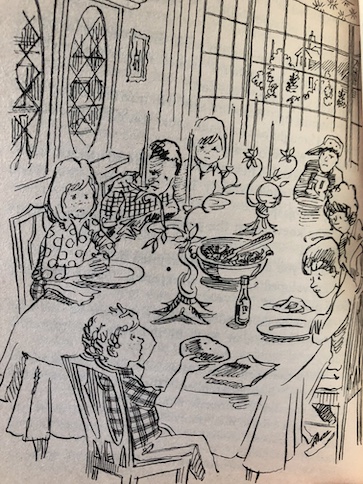
Before he asks Rainbow if he wants the job, Handie tells Mr. James what he’s thinking to see if he thinks it’s a good idea. Mr. James says that, before he talks to Rainbow, he needs to decide how much money he would be willing to pay Rainbow out of the estate and what his accommodations would be while they’re in the other town. Handie proposes what he thinks would be a decent wage for an assistant and says that he will pay for Rainbow’s room and board. They will have to board somewhere in town until the farm is suitable for them to live in. Mr. James says that may be difficult because not every boarding house would be willing to have a “colored” tenant. Tenants in boarding houses all eat together at the same dining table, and not everyone will want to see at the same table as a black person. (This is just like Rainbow said that the other boys at school wouldn’t want to sit with him and would make trouble.) Handie is confident that he can find a place for them to board anyway, so Mr. James says that the plan sounds fine to him, as along as Rainbow agrees to it and Rainbow’s mother approves.

Handie goes to Rainbow’s house, but Rainbow’s mother says that he isn’t home because he’s working in Mrs. Roundly’s garden. Deciding that he should offer the job directly to Rainbow first before talking to his mother, Handie goes to find Rainbow.

Rainbow is working with young Solomon in the garden, and when they stop to rest, Rainbow says that he has a new story to tell, besides his usual bear one. A man read it to him recently out of a newspaper. It’s about a thief who was caught trying to steal money from a miser, and there’s an interlude in the main story where Rainbow tells this story. (Actually, it’s more like the thief was trying to get the miser’s money through extortion because he writes the miser a threatening note, demanding that he leave a sack of money in a particular place.) The miser’s sons set a trap for the thief and catch him.

As Rainbow finishes the story, Handie comes along and explains his job offer to Rainbow. It would require the two of them living in another town about 30 or 40 miles away for about 2 or 3 months. Feeling like he should tell Rainbow the hardest parts of the job, he says that the work will be physically rough, and he’s not sure exactly where they will be staying or what the “fare” (food) will be like, but he promises that, if Rainbow comes with him, he will pay him and that Rainbow will eat as well as he does himself. The physically hard parts of the job don’t sound appealing, but like most boys his age, Rainbow is adventurous, and the idea of going to another town, exact destination unknown, sounds exciting. Young Solomon thinks it sounds exciting, too, and he says he wants to go along. Solomon tries to prove to Handie how much he can lift, and Handie says that’s pretty impressive, and he would take him, if he could.

Turning serious, Handie asks Rainbow what he really thinks of the job offer. Rainbow says that he likes the idea, but he’s not sure what his mother will think and if she will be all right at home without him. Handie says that Rainbow can talk it over with his mother, and Rainbow persuades him to come along to see her and explain the job himself. At first, Handie is worried about the objections that Rainbow’s mother, Rose, might make, but actually, Rose is a sensible woman and sees that this is a good job offer for her son. She will miss him while he’s gone, but she doesn’t want him to miss out on this opportunity because of that. Since they’ve all agreed that Rainbow will have the job as Handie’s assistant, Handie and Rainbow begin their packing and preparations for the journey to Handie’s farm.

Even though Rainbow’s latest new story was one told to him by someone else, we are told at this point that Rainbow has made progress in learning to read and is now doing well enough at it to find it enjoyable rather than a chore. He is now able to read from the New Testament. His mother laments that he can’t write as well as he can read. She hasn’t been able to teach him more because she’s not that good at writing herself. Because Rainbow can’t write very well, he won’t be able to write letters to her while he’s away. Rainbow says that Handie could help him with that, and his mother tells him that, while Handie is his employer, Rainbow should call him Mr. Level. Handie is almost a grown man, and he is acting as grown man, doing professional work and being Rainbow’s employer and supervisor. (The book uses the term “master”, but they don’t mean it in the slave sense. This story was written and published before the Civil War, and slavery is legal during this period, but Rainbow is a free person, who is being employed at his own consent and paid a salary. The term “master in this case is more in the sense of a supervisor, someone who will be directing Rainbow’s work and overseeing the results.) Rose tells Rainbow that, if he has any problems on this job or if he does anything that causes a problem, he needs to be honest and tell Mr. Level (Handie) about it. If Handie knows what the problems are, he can help fix them, and hiding them would only make them worse. She has a little rhyme about it:

“Wrong declared
is half repaired;
while wrong concealed
is never healed.”

She also tells him that if anyone in this new town tries to give him a hard time or tease him because he is “colored”, he shouldn’t mind them. Rainbow says that’s very hard sometimes. Rose says that she understands but that fighting people wouldn’t do any good. He is likely to be outnumbered (that’s literally what it means to be a “minority”), so it’s better to use patience and show as little reaction as possible. They’re more likely to stop their teasing if he doesn’t give them the reaction they’re trying to provoke. Rose uses some local dogs as an example, pointing out how each of them responds to teasing. The one that just responds to teasing with a look of contempt doesn’t get teased as much. Rainbow points out that the dog who doesn’t react could probably head off further teasing if he put a scare into the teaser, but Rose says that only works if someone is big enough to put a scare to a teaser without actually hurting him and if the bully doesn’t have a bunch of confederates backing him up.

She further reminds Rainbow that the Gospel says, “that we must study to show kindness to those that do not show kindness to us.” She says that, while he’s away, she wants him to continue reading the New Testament and saying his prayers. She also makes a point that she wants him to think about the meaning of what he’s reading and have it in his mind that he will follow it in his life. She hopes that perhaps, during his time with Handie, Rainbow will improve his reading and writing ability and that Handie will help him. Before Rainbow leaves the village, he goes around to say goodbye to some friends and neighbors, and one of them gives him an inkstand and pens so he can write.

This installment of the series ends with Handie and Rainbow leaving on their journey to the new town, Southerton. We are told that, “Handie and Rainbow had a very pleasant ride, but they met with an accident on the road which led to a singular series of adventures. They, however, at last arrived at Southerton in safety, and spent two months there in a very agreeable and profitable manner.” This is kind of a spoiler for the next book in the series, which is all about their adventures on their journey. We know that they eventually arrive safely and proceed about their business, but the narrator promises to tell everything in more detail in the next volume. Actually, there are also spoilers for the rest of the series because we are also told that everything goes well with Handie’s farm, Mr. James is able to find a good tenant to rent it, and when Handie eventually returns home, he finds that his parents have been doing well and that Handie is able to repay the loan that bought his time from his father. There’s no suspense about any of that, whatever else happens in the following stories. In fact, the book says that the loan worked out so well for Handie that Rainbow thinks that he’d like to try a similar arrangement when he’s older. Handie says that, by that time, he might have the money to make him a loan himself.

I covered some of this above, but there are a few more things I’d like to talk about. Although the plot is a little slow and must of it focuses on how business deals work and the importance of hard work and prudent living, I actually thought it was an interesting book. What I found most interesting about it was the look at the daily lives and concerns of people in the mid-19th century.

I was a little surprised at the way the lawyer explained the laws concerning the ownership of Handie’s time and the laws about the obligations between children and parents. The relationships between children and parents and how they should behave toward each other, specifically what children owe to their parents are central to the story. 

The parents in the story aren’t perfect people. Handie’s parents have some obvious flaws, particularly Handie’s father. Handie and his mother would have some justification for being upset with Mr. Level for getting their family into this financial hole and then depending on Handie to work out a solution, but they’re not really angry with him. Mr. Level is within his legal rights to use his money and theirs in whatever way he wants as the head of the household and Handie’s father, even though it’s obvious that he doesn’t really know what he’s doing. Nobody questions Mr. Level’s legal authority over his family’s financial affairs, although everyone knows he isn’t good at handling money, and they haven’t been able to get him to improve before. However, Mr. James and Handie recognize that whatever solution they work out together can’t violate Mr. Level’s rights to make decisions about his family’s affairs and must respect his authority over his son. What Mr. James suggests to Handie is a way of emancipating Handie’s financial affairs from his father’s while providing Mr. Level with generous compensation, which improves the circumstances of the entire family.

The part about children legally owing their parents some form of compensation for the costs of raising them surprised me. I’ve heard of that as a social convention, but I didn’t think there were actual laws about that. I’m not completely sure whether the author was right about that part or not because I had some trouble finding a source to verify that, but if anyone else knows the answer, feel free to comment below and tell us. 

In modern times, there are laws about the care of children, and parents can be charged with neglect if they fail to provide certain necessities for their children, but I don’t think I’ve ever heard of a modern law about children giving compensation to their parents. After all, children can’t choose their parents like they can choose from among possible employers and negotiate their terms, so it’s not quite like entering into a business arrangement. I can see the logic of children helping the parents who raised them as part of family loyalty and affection, but the amount of care that family members show each other is difficult to codify because it’s hard to measure and put a price tag on human feelings. Emotional support is a natural and important part of family life, and it occurs to me that might be difficult to prove how much family members might have shown to each other. People value it, and it’s hard to say how much of that might be a service that they render to each other in a family. 

It also occurs to me that individual families in the past may not have looked at their family through a legal lens, even if they had the legal means to do so. When Handie speaks to his parents about reorganizing their family’s financial affairs and about his new position, repairing the farm he inherited on behalf of his own estate, Handie tells his parents that, when he returns home from this job, he will live with them again but that he will pay them for his room and board. His mother tells him that paying to live with them won’t be necessary because he’s their son, but Handie insists because he will be working and earning money as an independent person, no longer a dependent of his father. 

What that exchange tells me is that Handie’s mother doesn’t view him as an economic resource for their family. He’s just their son, and she loves him and would care for him, even if he couldn’t pay her for it. Their family isn’t overly concerned about money, they hardly even know how to manage the money they have, but they do understand family and human feeling. There are upsides to that because they are prepared to support each other just out of love and family loyalty, even when that would hurt their financial situation. The downside is that Handie has realized that, for their family’s future security, they’re going to have to be a little more strict about the financial aspects of the life they share together. While he is grateful for his parents’ feelings for him, he thinks that insisting on upholding his financial obligations to his parents will be more beneficial to them in the long run. 

Maybe people in real life looked at it in a similar fashion, depending on their own family’s circumstances. Maybe there were times when they didn’t care that much about keeping track of each family member’s financial contributions and insisting on exact repayment from each other because their feelings for each other were in the balance and/or because some family members might not be in a position to compensate each other financially to the same degree because of health reasons or other issues. If the law is really as Mr. James says it is, the rules about children compensating their parents might have only been invoked in situations where there was some serious dysfunction in the family, like if a child resisted working or helping out at home at all, and the parents were desperate. If the parents were satisfied with their relationships with their children, they probably wouldn’t bother to keep strict accounting of their children’s monetary value or get petty about the laws with them. At least, that’s my theory. In the case of the story, the characters are in a pretty serious financial problem, with the threat of losing their home, so they seriously need to straighten out their finances according to the law.

So far, because most of the focus of the story is on the Levels’ financial woes and how they straighten out their affairs, the story hasn’t gone into detail about race relations. However, I already know that this becomes more of a central theme in later installments of the story. At this point, we know that Rainbow couldn’t go to school like Handie did because he wasn’t welcome there. Nobody uses the term “segregation”, but that’s basically what it is. Nobody explains the laws regarding this kind of segregation, so I’m not sure if there’s an official law about that for this village or not, but there seems to be at least a social convention about that. 

Rainbow says that people have teased and taunted him about his race, although when he’s about to leave home with Handie, many of the local boys say goodbye to him in a friendly way. The book says that many of the local boys like Rainbow because he is kind, which made me wonder how many of those boys were the ones who didn’t want Rainbow in school with them. The story isn’t clear on that point, although I have heard of that concept of some white people liking black people as long as those black people “know their place.” I suspect that the situation in this town may be something like that. Maybe most of the townspeople accept Rainbow in a general way, as a neighbor and a worker and someone they might wave to or chat with, but they can get offended or even nasty if he starts getting above the station that they think he should occupy in life. We don’t have any specific names of people who have harassed Rainbow, so we don’t know if any of them are also sometimes friendly, as long as they think they have the social upper hand. It just strikes me that many of Rainbow’s relationships with the people in this village are probably conditional ones, the condition being that he doesn’t seem like he’s trying to be as good as or better than they are.

Handie and Rainbow haven’t been far from home at this point in their lives, and going to this new town will be a major adventure for them. Mr. James knows that Rainbow may have some problems from the people they meet along the way and that Handie may have trouble finding places for them to eat and sleep on their journey because Rainbow is black. However, Handie decides that he really wants Rainbow and that he’s willing to take responsibility for the both of them and deal with whatever problems they encounter. When Handie promises Rainbow that Rainbow will eat as well as he does, he’s promising that either he will make sure that people give Rainbow the services that they both need or that he will forgo those services himself. He will only stay and eat in places that accept Rainbow as well, whatever that means for them both along the way. Handie is becoming a young man, and as befits a real man, he’s taking responsibility for someone younger and is determined to look after him as both an employer and friend. There will be more to say about this as we continue through the story.
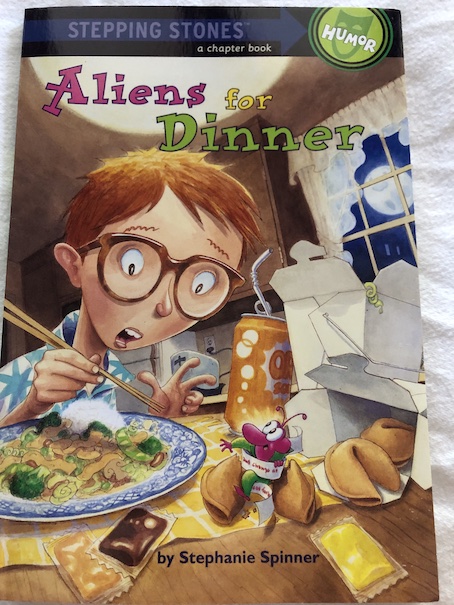
Aliens for Dinner

This book is part of the Aliens for Breakfast Trilogy, a short, easy chapter book series for elementary school children.

Richard Bickerstaff is unhappy because his mother has started dating a man named Bob Baxter. Richard thinks that Bob is weird, and he has an annoying habit of repeating himself. Then, one evening, when Bob is having dinner with Richard and his mother, Richard’s small alien friend, Aric, arrives with their Chinese food, hidden in a large fortune cookie. Aric is a commander of the Interspace Brigade, and they operate on a shoestring budget, so they often transport Aric in some form of food to save money.

Richard manages to slip away from his mother and Bob and takes Aric to his room, where Aric tells him about his latest mission. Earth is in danger from aliens from a planet called Dwilb. Dwilbs have a bizarre love of pollution, and pollution problems have gotten bad enough on Earth to attract their interest. The Dwilbs want to make Earth even more polluted so they can turn it into a pollution-themed amusement park for themselves called Toxic Waste Funland. Aric says that they’re so confident in their plan that they’re already running advertisements. Aric will need Richard’s help to stop them!

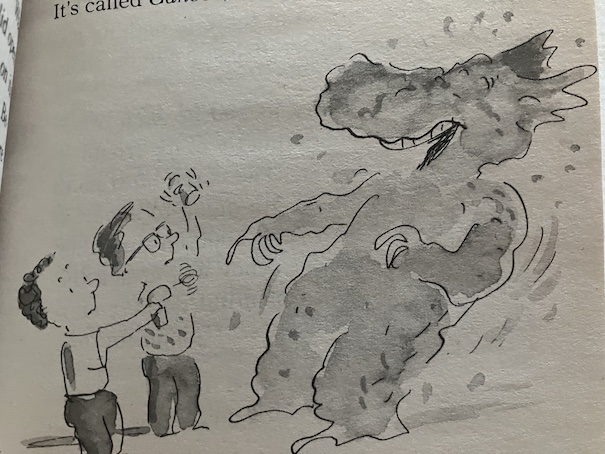
Richard asks Aric questions about what the Dwilbs are like. Aric says that they look like humans, but they have an odd habit of saying everything twice, and the repetition seems to have a hypnotic effect. Richard thinks that sounds familiar, and he remembers why when his mother and Bob come to say goodnight to him. Bob repeats himself! Richard starts to think that his mom might be dating an alien!

Meanwhile, the Dwilbs have caused a major oil spill nearby as part of their plan to pollute the planet further. Local people have been trying to help with the cleanup, but it seems like it’s just getting worse. Richard goes to take a look and sees Dwilbs splashing about in the oil, having fun! They love the oil spill, the exhaust from cars, and everything that’s dirty.

Richard asks Aric what they can do to stop the Dwilbs, but as often happens when Aric travels in the bizarre ways that Interspace Brigade sends him, has trouble remembering the Dwilbs’ weak point. While Aric struggles to remember, the Dwilbs start influencing the kids at Richard’s school, getting them hooked on a treat they call Sludgies. Under their influence, the kids start littering and stop caring about the environmental efforts their teacher is trying to talk to them about. Even Richard’s friend, Henry, is under their power and in no state of mind to help Richard.

Fortunately, there is a secret weapon right there at Richard’s school: the school principal and his ability to bore everyone almost to death. In the case of the Dwilbs, boredom is a serious threat!

The books in the Aliens for Breakfast Trilogy are humorous sci-fi stories, and the solutions to defeating the aliens always have some comic twist. The solution in this case is getting the school’s principal to speak to them and bore them out of their minds. Richard has to arrange for his principal to speak at a place where he knows all the aliens will hear him.

Richard has run into situations in previous books where strange people he knows turn out to be sinister aliens in disguise, and in this case, he thinks that Bob is one of the Dwilbs. However, there is a twist to this story. Bob isn’t one of the aliens. He’s a little odd, but he’s a human. His quirks just happen to resemble the Dwilbs. He has a habit of repeating himself, but he’s not at all bored by the way the principal speaks or the way Richard speaks when he imitates his principal. Bob is often a little boring himself. By the end of the book, Richard feels better about Bob when he discovers that Bob likes comic books as much as he does. The two of them start bonding by sharing comics. Bob has a collection of older comics that Richard has been wanting to read, and he lets Richard borrow them.

I like the references in the story to real franchises that fans of science fiction and comic books would know. Richard has a collection of X-Men comics.

The book was published in the 1990s, when I was still in school. I remember my teachers talking to us about environmental issues back them, especially about pollution and the importance of recycling. They often urged us to get involved and do our part to recycle and not litter. The environmental messages in this story, especially the ones Richard hears at school, bring back memories for me.

Aliens for Lunch

Aliens for Lunch cover

This book is part of the Aliens for Breakfast Trilogy, a short, easy chapter book series for elementary school children.

It’s spring break, and Richard and his friend Henry are bored. It seems like all of their friends have all gone somewhere for vacation, but they’re stuck at home. Richard’s mother leaves the boys home alone, telling them that there’s food for lunch in the refrigerator and a new sample of popcorn that arrived in the mail. The last time that a sample of a new kind of food arrived in the mail, Richard’s alien friend, Aric was hiding inside, and the same is true this time, too! Aric is back, and he needs Richard’s help!

Aric tells Richard and Henry that a valuable shipment of XTC-1000 was hijacked by aliens called the Graxians. XTC-1000 is the secret substance that makes all desserts taste wonderful. (I always thought that was sugar, but okay.) Aric’s planet ships XTC-1000 to other planets, and each shipment is supposed to last for thousands of years, but the Graxians are greedy, and they used up their supply too quickly, which is why they hijacked a shipment bound for another planet. It’s a real problem because, if that other planet’s desserts suddenly turn bland because they’ve run out of XTC-1000, they’re bound to start raiding desserts from other planets, like Earth.

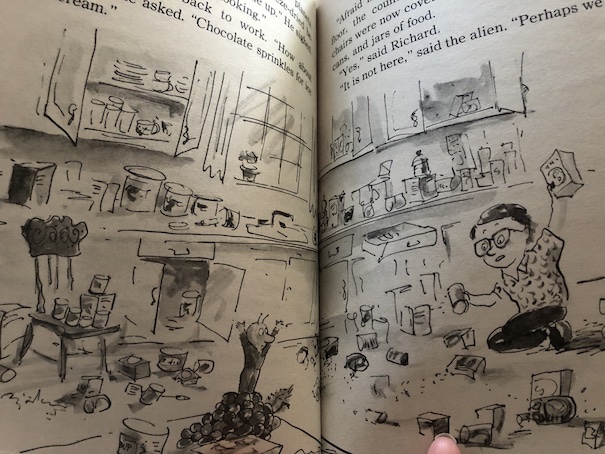
Aric’s Interspace Brigade was supposed to send weapons to help Aric and Richard face off against the Graxians, but as always, they’re on a strict budget, and the weapons they sent somehow failed to arrive. Richard and Henry do the best they can to improvise weapons with things they find in Richard’s kitchen, but they’re not very terrifying. The Graxians take Aric, Richard, and Henry prisoner after they board the ship. Can the boys manage to free Aric and discover what they need to subdue the Graxians?

I don’t think I read this book as a kid, although I remember reading the first book in the series. The Aliens for Breakfast Trilogy is a short series of funny science fiction stories as Richard and his alien friend do battle against the villains of the galaxy with food! I like the fact that even the aliens they fight find their efforts laughable when they try to use things that just don’t make sense, like when they try to use the kitchen gadgets as weapons. I also enjoyed the pun that the secret substance that makes desserts good is “XTC”-1000. (No, I don’t think they mean the illegal drug.) There is also a running gag that Aric’s space organization is always operating on a shoestring budget, which is why they often have to improvise weapons and modes of travel. The stakes are high but laughable at the time time, and somehow, they always manage to save the day! There is an extra joke at the end of this book where Aric gives both of the boys jackets from his space organization, telling them that girls find them irresistible. When the boys try wearing them for the first time, they come to the conclusion that neither one of them is ready to be irresistible.

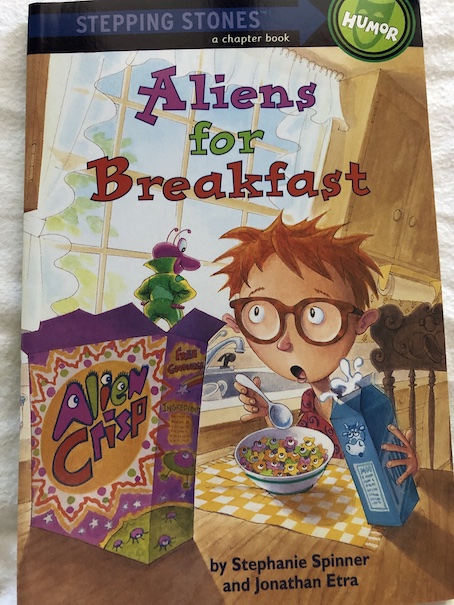
Aliens for Breakfast

This is the first book in the Aliens for Breakfast Trilogy, a short, easy chapter book series for elementary school children.

There’s a new student in Richard Bickerstaff’s class at school called Dorf. In spite of his strange name, Dorf is a good-looking blond boy with an irresistible smile. Everyone in class admires him and imitates him. Even Richard finds himself admiring Dorf’s clothes and wishing that he could wear the same thing, even his stupid bowling shirt. Then, when Richard sits down to breakfast one morning before school, he learns something startling about Dorf that changes everything.

Richard’s mother gives him a sample of Alien Crisp that came in the mail. She thinks that Richard will love it because of his love of science fiction, but right away, he can tell that this is no ordinary cereal. When he pours milk on the cereal, it comes to life! Actually, he has revived a small alien called Aric, who was sent to Earth from another planet in freeze-dried form in the cereal. Aric is a Commander of the Interspace Brigade, and he’s here to stop an alien invasion on Earth. His target is Dorf.

Dorf is no ordinary boy. He’s an alien in disguise and a dangerous one. His type of alien multiplies, and if that happens, Earth is doomed! There’s only one thing that can stop Dorf … and Aric has forgotten what it is. Being freeze-dried for the trip to Earth has scrambled his memory, but he knows that the weapon they need is an ordinary type of food from Earth.

While Aric struggles to remember what that secret weapon is, Dorf’s hold over Richard’s friends and teachers becomes stronger. Everyone is charmed by Dorft, and everyone wants to do whatever Dorf does. Only Richard resists, and that identifies him to Dorf as an enemy.

Dorf uses his powers to make Richard start dissolving. If Aric doesn’t remember that secret weapon soon, both Richard and Earth are history!

I remember reading this when I was in elementary school, although I forgot most of the story. I remembered the alien arriving in the cereal box, like those little toys we used to get in cereal as kids. I also remembered that he was under threat somehow and that Aric told him that he hoped he didn’t have big plans for the weekend, with the implication that, if they don’t do something, he won’t make it to the weekend.
There’s a lot of humor in the story. I was alarmed at how Richard’s fingertips start bleeding when the dissolving begins. That part sounds a little scary. He bleeds rather than starting to fade out, and I had forgotten about that part in the story. However, there is humor in the story that helps to soften it, and the solution is a simple one that works right away.

The story has some references to real life science fiction, like Yoda from Star Wars and the starship Enterprise from Star Trek.

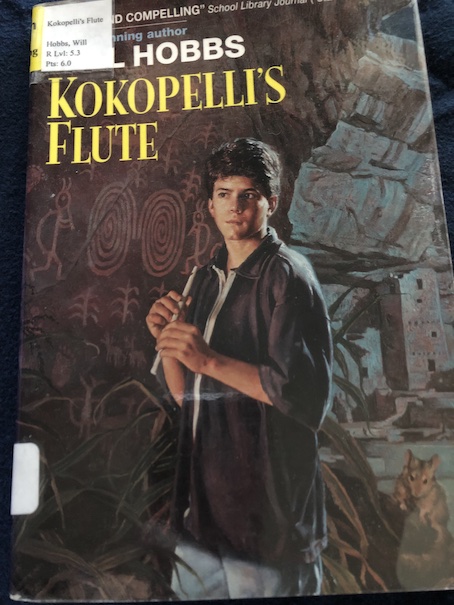
Kokopelli’s Flute

Kokopelli’s Flute by Will Hobbs, 1995.

Tepary Jones, called Tep for short, has always been fascinated by the ancient cliff dwelling known as Picture House. One night, he goes there with his dog, Dusty, because he think it would be a great place to watch a lunar eclipse. However, he and Dusty aren’t there alone. Tep witnesses a couple of looters illegally digging for valuable artifacts. The looters uncover the burial of a medicine man and begin taking some of the things he had buried with him. They damage the site before they leave, but Tep discovers that they have left behind an unusual artifact, a small flute made of polished bone. When Tep picks up the flute, he feels compelled to play it. Not wanting to leave the flute behind in case the looters return, Tep takes it home with him.

That night, Tep has a strange dream that he turned into a packrat, like one of the literal packrats he saw up at Picture House. However, he soon realizes that this was not just a dream. Ever since he played the flute, he finds himself turning into the animal he saw the first time he did so. Tep returns the flute to the body of the medicine man and reports the looting to the authorities, hoping that, once the body is respectfully reburied, whatever magic or curse is afflicting him will end. Unfortunately, it doesn’t.

Tep still finds himself turning to the packrat at night, having uncontrollable urges to go out and explore and find food, and it’s dangerous because animal predators and even his own parents are after him. Rodents in the house are a serious concern because they can carry hantavirus, which causes dangerous respiratory infections in humans. After his mother catches sight of him in packrat form, Tep’s parents start setting out traps. His dog, Dusty, seems to know him even when he’s a rodent and helps to protect him, but Tep knows that he’s going to have to stop this transformation somehow, before either his parents catch him or a predator eats him!

Tep’s parents are academics and researchers who study ancient agriculture and cultivate varieties of seeds on their farm that require little water to grow. To buy himself time from his parents’ efforts to catch the packrat, Tep makes the argument that the packrat is a part of the ecosystem and that it might be performing an important role in the environment, like birds that help propagate seeds by eating them and then depositing them in new places. Tep brings up the fact that there are some seeds that really need to be processed in a bird’s digestive system before they can grow. It’s a thoughtful argument, but the looming threat of hantavirus in their community still means concern about the presence of rodents. Hantavirus is serious, even fatal, and people in their community have already fallen victim to it.

Tep returns to Picture House to try to find the flute again to break whatever spell is affecting him, but he can’t find it. He only hears what he thinks is the sound of someone playing the flute, and he’s not sure if he really hears it or if he’s imagining it. Then, a stranger comes to the farm, a man who appears to be a humpbacked Native American or possibly someone from Mexico or Central America. He calls himself Cricket, and Tep’s family thinks that he’s probably just another migrant worker. Tep shows Cricket around the farm and explains the different types of seeds they cultivate and how they can be used to keep particular varieties of plants alive for their drought-resistant or pest-resistant qualities. Cricket doesn’t say much, but he seems to approve of the idea of cultivating more varieties of seeds. When he helps Tepary to plant seeds, Tep notices that he uses a planting stick, like Native Americans traditionally did.

Of course, Cricket is no ordinary farm worker. Tepary notices his unusual ability with plants and animals, and one night, Cricket speaks with Tepary while he’s in his packrat form. Cricket knows more of what’s been happening than anyone because he is one of the legendary figures from Native American folklore known as Kokopelli. Kokopelli was a legendary humpbacked flute player known for bringing seeds to people, and Cricket says that he still visits people like Tep’s family, who are interested in the past, who cultivate the land, and who keep seeds alive. Tep appeals to him for help with his transformations, and Cricket says he will help, if he can, although he notes that Tep seems to have been managing well. Cricket says that Tep can use the flute to reverse his condition, but only if he knows the right notes to play on it. If he plays the wrong notes, he could change into something else and make his condition worse. The clues to the notes are contained in the pictures on the walls of Picture House.

Tep manages to use his animal form to play a trick on Coyote in the tradition of old trickster tales and to rescue his dog from the looters. Then, Tep’s mother contracts hantavirus. Cricket says that ancient people also suffered from the disease, and they used an herb to cure it. Nobody grows that particular herb anymore, but there should still be some contained in the medicine bundle buried with the old medicine man at Picture House. To save his mother and break the spell on him, Tep must return there to find the medicine man’s bundle and the flute.

The book is available to borrow and read for free online through Internet Archive (multiple copies).

My Reaction

I vaguely remember having read this book when I was a kid, around the time when it was first published in the 1990s. It stuck in my mind because it takes place in the Southwestern United States, where I grew up, and it was also the first time that I had heard about hantavirus, which is a serious concern in real life. I couldn’t remember exactly how the book ended, though.

Reading it as an adult, I understand more about the parents’ work and the commentary about interrelated aspects of the ecosystem than I did as a kid. I understood some aspects of environmentalism and ecosystems as a kid because those were topics that we discussed in science classes at school in the 1990s, but admittedly, science wasn’t my best subject, and I’ve had more time to grasp certain concepts since then.

There are agricultural researchers in real life who do what Tep’s parents are doing, trying to cultivate seeds for drought-resistant crops, which are important in places like the area where I live, that are very dry for much of the year, and are becoming even more important due to climate change. That type of research takes time to cultivate generations of plants and to propagate seeds with desirable qualities. Modern researchers also take information and inspiration from past agricultural practices to enhance modern techniques (paleoethnobotany or archaeobotany). When Tep is talking to Cricket, he explains why it’s important to keep growing a different varieties of crops because some varieties are more resistant to different types of problems that others, like drought-resistant crops or pest-resistant crops. One of the dangers of huge, corporate farms is that they produce too few varieties of particular types of crops, focusing on the most popular ones, leaving them vulnerable to being almost completely wiped out by particular disasters. People need to keep growing older and less popular varieties of crops to keep the plant varieties alive and keep producing seeds for new generations so agriculture as a whole will have those varieties to draw on for the plant qualities they need to cope with changes in the environment and/or particular plant diseases.

One of the reasons why I liked this book is that it references the legend of Kokopelli. Because I grew up in the Southwestern United States, I grew up seeing images of Kokopelli along with other Southwestern Native American symbols. Kokopelli is often used as a decorative image in Southwestern art, although not everyone who has or uses the decoration knows the legends behind it. Kokopelli is described in somewhat different ways in different stories, but he is generally a fertility figure who travels from village to village, bringing changes to the seasons and promoting good harvests. He is also a trickster figure and represents human fertility. In some stories, human women get pregnant everywhere he visits, including by Kokopelli himself, an aspect of the character that does not appear in this particular book because it’s not kid-friendly. There is a theory that the legends might be based on traveling Aztec merchants who arrived seasonally, carrying sacks of seeds and other goods to trade on their backs, giving them that hunched appearance.

The book frequently uses the word “Indian” instead of Native American. It seems to be meant in an informal way rather than a disrespectful one, although I found it irritating because it can be a bit confusing. When Tep uses it in relation to the Native American ruins nearby, context tells readers that he means “Native American”, but when he uses it when he talks about places around the world that use the seeds his family produces, it becomes more confusing. At one point, he uses the word “Indian” and then talks about an order his parents have received from Pakistan, so did Tep mean Native Americans or people from India the country in that context? I heard the word “Indian” used a lot in relation to Native Americans when I was growing up, and sometimes, I even have the urge to use it out of old habits, but I don’t really like using that word anymore. It’s not so bad if you say “American Indian”, but just saying “Indian” by itself is often confusing. I generally agree with the modern convention of saying “Native American” or using the name of a specific tribe, if you know the name to use, both because it sounds more respectful and because it really makes a difference in the clarity of the sentence. It’s just not as effective if someone immediately has to ask, “Wait a minute, do you mean ‘American Indian’ or ‘Indian from India’?”, and when it’s in writing, there isn’t even a live person there to ask.

The Lives of Christopher Chant

This is the fourth book in the Chrestomanci series.  In this series, there are many different dimensions, and in each of those different dimensions, there are alternate versions of our world, and there are copies of every person in the world.  Different versions of our world can differ dramatically in their history, and individual people’s lives can differ dramatically between the worlds. There is one person in each generation who has no duplicates in any of the other worlds.  This person is called the Chrestomanci.  All of the talents, abilities, and lives that would have been spread across their duplicates in the other worlds are now centered on that one person, giving that person, literally, nine lives.  The Chrestomanci fills an important role, being better able than anyone else to travel across the dimensions and between worlds, and he acts to keep a balance between them and make sure that the different worlds keep their proper course. This book is about the childhood of the current Chrestomanci, Christopher Chant, and how he came to be the Chrestomanci.

Young Christopher Chant’s early childhood isn’t very happy. His parents have a very unhappy marriage, and his father never pays any attention to him at all. In fact, Christopher hardly even sees him and isn’t confident that he’d recognize him if he met him anywhere. Christopher later learns that his parents’ marriage was one of convenience. His mother has a great deal of money, and his father is from an important family. Christopher’s social-climbing mother wants him to be very important when he grows up. Christopher is mostly raised by a series of nannies and governesses, none of which stay very long. Servants in general don’t stay very long in the Chant household because the parents’ angry bickering and the passive aggressive notes that they force servants to pass to each other when they eventually stop speaking to each other directly make life unbearable. Christopher only learns that this is not how most households are when his nannies and governesses apologize to him before they leave.

Eventually, his parents’ relationship collapses entirely after his father loses a great deal of money, and his father either leaves his mother or is sent away in disgrace. His mother brings her brother, Christopher’s Uncle Rafe, to live with them instead, and she lets Uncle Rafe run the family finances and attend to Christopher’s education. Christopher enjoys having Uncle Rafe in the house because Uncle Rafe is a jolly man and actually pays attention to him, unlike his own father.

Something else that Christopher first thinks is normal but later learns isn’t normal at all are the strange dreams he has. Christopher often dreams of a strange place filled with valleys. Every time he enters one of the valleys, he has adventures there, and people give him presents. He often loses the presents before he returns home, but sometimes, he manages to keep them, waking up with them in his bed in the morning.

One day, the new governess Uncle Rafe hired catches Christopher playing with one of the strange objects and asks him where he got it. When he tries to tell her about his dreams, she doesn’t believe him at first. Thinking that he may have stolen the strange object from somewhere, she takes him before his mother and Uncle Rafe. However, Uncle Rafe does believe Christopher’s explanation. He says that Christopher seems to be a spirit traveler, having the ability to go to other worlds in his sleep, and he is amazed that Christopher was able to bring an object back with him.

Uncle Rafe asks Christopher to try a few tests of his abilities. First, he asks Christopher to look for a man in his dreams and to bring back a package from that man. Christopher does so successfully. The man is called Tackroy, and Tackroy explains more about the other worlds to Christopher. Every valley Christopher sees is a different world. There are series of worlds, and those series of worlds have numbers. The world where Christopher lives is number 12. At first, Tackroy thinks that there are only 12 worlds, but Christopher says that there are many more than that. Christopher can see better in the space between worlds because, as Tackroy realizes, he is actually there physically, where Tackroy can only be there mentally or in spirit. It is because Christopher can go to other worlds physically that he can bring back objects. Tackroy has hardly any substance in these other worlds, being almost like a ghost, until Christopher realizes that he can help make him more substantial. Both Tackroy and Uncle Rafe are excited by Christopher’s abilities.

Then, they decide to do a test of whether Christopher can carry something living from one world to another. Tackroy asks Christopher to get one of the cats from a temple in world 10. When Christopher enters the temple, he meets a young girl, just a little younger than he is. She says that she is the living embodiment of the goddess Asheth, which gives her special powers. However, she is not allowed to leave the temple except once a year to do a blessing, and she can’t interact much with anything or anyone from outside the temple. It’s a very boring life, and she isn’t very happy in it. When Christopher explains to her about wanting one of the temple cats for his uncle, she agrees to give him the most disagreeable cat in exchange for some books from his world because she is so bored. Christopher agrees, and she helps him to capture the cat. Unfortunately, the cat gives him away when he tries to leave the temple. Christopher is actually killed when a temple guard puts a spear through his chest! That is the first indication that Christopher has nine lives.

When Christopher wakes up, he is in his own bed at home, he has no injuries, and he still has the cat. At first, Christopher’s lack of injury makes him think that the other worlds might be a kind of dream after all, but that doesn’t explain how he still has the cat. Then, he has an accident while pursuing the cat in his room that brings down the curtain rod, which stabs him in the chest again! When he screams, the governess rushes in and tends him.

When Christopher wakes up again, he hears the governess and Uncle Rafe talking. The governess has placed healing spells on him, and she thinks he will recover. Uncle Rafe says that the cat from the Asheth temple is very rare and magical and that wizards would pay a lot of money for parts from the cat. Later, when Christopher sees that the cat is pleading for Christopher to let it go, he does so. As much as a he wants to please his uncle, it does seem cruel to kidnap an animal from its own world and take it to another to be killed and have its parts sold off, even if it’s a mean cat that almost got him killed. When the governess looks for the cat later and can’t find it, Christopher just reminds her that it is a magical cat, so she supposes that it just vanished.

Then, unexpectedly, Christopher’s worried father comes to see him without his mother’s knowledge. His father tells him that he had placed a spell on Christopher to monitor his life, and it seemed like the spell had told him that Christopher was dead. Christopher assures him that he’s fine. His father is relieved, but he is also still worried. He tells Christopher that he did Christopher’s horoscope and that the next year and a half will be dangerous for him. He also warns Christopher that his Uncle Rafe isn’t a nice person and that he should avoid getting mixed up in his business.

In spite of his father’s warnings, Christopher continues to participate in his uncle’s experiments in other worlds with Tackroy. Tackroy apologizes to Christopher profusely for the incident with the spear, saying that he would have felt horrible if Christopher had been killed. It becomes clear that Uncle Rafe’s “experiments” involves a business collecting and selling rare objects from one world to people in another. As Christopher helps Tackroy with it, the two of them become friends, and they enjoy exploring and learning about other worlds.

Things change when Christopher is sent to boarding school. He likes school and making his first friends with other boys. He does well in most of his subjects, although strangely, he can’t seem to do any magic in his magic lessons. It’s strange because Tackroy had told him that he’d probably be really good at magic because of his ability to travel through worlds. He hates to give up on magic studies because he really does want to learn more about magic.

Remembering his promise to bring some books to the goddess girl, Christopher asks a school friend with a sister for advice about what girls like. He buys a set of books about a schoolgirl called Millie. Unfortunately, he can’t seem to travel in his dreams at school, like he did at home. His uncle becomes impatient with him for not keeping his appointments with Tackroy, too. Christopher can’t think what’s wrong. Was there something special about his night nursery at home? Is he growing out of his old abilities?

When the school matron notices that Christopher is having trouble sleeping, she removes the new braces that he had put on his teeth, thinking that they’re causing him pain. Suddenly, Christopher is able to travel in his dreams again. He is able to deliver the books to the goddess girl and rejoin Tackroy in their work in the other worlds. Then, another accident that kills him again reveals his secret, extra lives to everyone, including his parents.

At first, it’s difficult to prove that Christopher has multiple lives, and his parents (of course) argue about what to do about it. After learning that Christopher’s mother secretly plans to take him abroad, Christopher’s father quickly removes him from his boarding school and takes him to Cambridge to be tested by an expert. In spite of his earlier apparent neglect, Christopher’s father does care about him, and for Christopher’s own good, needs to confirm a few things that he has already suspected about Christopher. The expert not only discovers the reason why Christopher was unable to perform magic in class (a sensitivity to silver that shuts down his powers whenever he comes in contact with it) but also proves that Christopher is a rare, nine-lived enchanter. Being one of those rare enchanters means that Christopher is destined to become the next Chrestomanci!

Christopher is shocked and dismayed when he is immediately made the ward of the current Chrestomanci, Gabriel DeWitt, and sent off to Chrestomanci Castle. It’s really the best place for him to learn about his new-found abilities, but Christopher fights it. DeWitt embarrasses him by telling him things about both of his parents and why neither of them is really suited to be his guardian. It’s all true, but that only makes it more embarrassing.

Christopher is lonely as the only child in Chrestomanci Castle, and while he is considered very important, nobody there seems to consider his feelings at all. Nobody cares that he would rather be a professional cricket player than a Chrestomanci! If it wasn’t for his natural abilities, which were just an accident of birth, nobody would have any interest in him at all. Also, even the heavy enchantments of Chrestomanci Castle can’t seem to stop the series of bizarre accidents that begin robbing Christopher of his extra lives. The only person who seems to understand Christopher is his secret friend, the goddess girl in world 10. Like Christopher, she is also a prisoner in her temple, being used by other people for her abilities but not really cared for as a person. More than anything, she wishes she could be an ordinary girl, like the girls in the books Christopher brings her, going to school and having friends.

Christopher wants to keep on working with Tackroy for his uncle because he loves exploring the other worlds and because it gives him some freedom from his life in Chrestomanci Castle, but Tackroy points out that his uncle has also been taking advantage of him. His uncle is getting rich off their activities, and he hasn’t even been paying Christopher for making them possible. Tackroy now knows that Christopher has died or nearly died more than once for his uncle’s business. Christopher has been getting deeply involved in something he doesn’t fully understand. The full truth is going to hurt, but Christopher needs to see it to save the lives he has left and realize his proper place in the world(s).

The book is available to borrow and read for free online through Internet Archive (multiple copies).

Some book lists place this book first in the Chrestomanci series because, if you follow a linear timeline of events in the stories, it does come before the other books, but it was originally the fourth book published, and I think it’s best to read the other books first, especially Charmed Life. The books in this series are fantasy, but they’re also mystery stories. There are secrets to be revealed in every book, and if you read this book first, it spoils some of the mysteries in Charmed Life.

It is a good book to read, though, because it provides some of the missing backstories of some of the other characters. At the end of Charmed Life, Christopher (as the current Chrestomanci) tells Eric/Cat about how he found out that he had nine lives and that he was going to be a Chrestomanci even though he couldn’t cast spells at first. His sensitivity to silver is a part of the story, and the way it is revealed in this book matches his earlier description in Charmed Life.

During the course of the book, we also learn a little more about the extended Chant family and get brief glimpses of Christopher’s cousins, who later go on to marry each other and become the parents of Cat and Gwendolyn Chant. The Chants are known for being a powerful magical family that produces enchanters, who are much more powerful than ordinary witches. Once every generation, they produce a disreputable one, which happens to be Christopher’s father in this generation. Christopher’s father is an enchanter, so he’s more powerful than general witches, but not nearly as powerful as Christopher. He has an over-reliance on the horoscope charts he draws, and they don’t always turn out right.

Christopher’s mother and his Uncle Rafe are part of the Argent family, which is also magically powerful but has a bad reputation. DeWitt doesn’t even specify at first what they are known for, only that he would never associate with them. It’s Christopher’s father, who does care about his son even though he doesn’t really know how to care for him, who points out that “Argent” means “silver”, and this is part of the reason for Christopher’s sensitivity to the metal. The Argent family, including his mother, and especially his Uncle Rafe, are toxic to Christopher in ways that he doesn’t fully understand and finds difficult to accept. Christopher’s mother doesn’t actually mean him any harm, like his Uncle Rafe does, but she is foolish and easily swayed by Rafe. Christopher comes to forgive her because he was also tricked by Uncle Rafe into doing his evil business when he was too young and naive to understand.

We also learn the origins of Christopher’s future wife, Millie, in this book. She is very powerful in Charmed Life, but this book explains why she is so powerful. One thing that I don’t think is adequately explained is how Christopher’s children, Julia and Roger, are not Chrestomancis themselves. After all, there is only one of their father, so I think it should be assumed that there are no duplicates of either of them in the other worlds, but they may be exceptions somehow because there was never a chance that they could have had duplicate selves or because their mother is actually the incarnation of a goddess.

The books in this series blend dark parts with some humor, which make the books lighter to read than they otherwise would be. Because of the dark parts, I wouldn’t recommend these books for anyone younger than the middle school level. Christopher does get killed multiple times in the book (although he still has extra lives left at the end), and there is trading in human lives and souls. The goddess girl, who takes the name of Millie, comes to realize that she is meant to be sacrificed when she gets too old to be the young incarnation of the goddess, which is a horrifying revelation. She runs away to Christopher’s world and begs him to help her go to a boarding school, like in the books she likes to read. Her goddess’s followers pursue her to Christopher’s world, and there is more bargaining for her life. Fortunately, the old priestess who has been caring for her is not as heartless as it seems at first. When she finally meets with the girl in front of Gabriel, she admits that she usually finds a way of sparing the young goddess incarnations, buying their lives with one of the nine lives from the temple cats. She has to do it in secret, but she has saved up enough money in jewels to pay for Millie’s education where she can be safe in this other world. To spare Christopher and the cats the children love from losing their lives, Gabriel kindly gives the priestess one of his own spare lives because he still has several lives left. He also accepts the responsibility of having Millie as his ward and arranging for her education.

Through his adventures and having to take charge as the Chrestomanci and rescue Gabriel when he is in trouble, Christopher comes to more fully understand what it means to be the Chrestomanci. He also comes to understand Gabriel a little better. He is surprised to realize that Gabriel has hated the job of Chrestomanci. Like Christopher, he also felt forced into the role and resented it, but he made himself do the job anyway because it is a vital job for the protection of his world and others. To Christopher’s even greater surprise, he realizes that when he does the job for real instead of just having boring lessons, he actually likes the job much better than Gabriel does and no longer resents being trained for it. Gabriel has also realized how lonely and isolated Christopher is, and he says that he is taking steps to bring other young magicians to the castle to work and be trained, so Christopher will have companions. The story ends happily, and there is even a reconciliation between Christopher’s parents.

Chocolate Fever

Chocolate Fever by Robert Kimmel Smith, 1972.

Henry Green absolutely loves chocolate, and he eats it all the time, at every meal! Although this doesn’t sound healthy, Henry’s parents let him eat as much chocolate as he wants because it never seems to affect his health. Henry doesn’t gain weight, have stomach aches, get cavities in his teeth, or suffer skin problems from eating all that chocolate, so his parents assume that it must be okay and let him eat whatever he wants. However, Henry is about to suffer some consequences from his chocolate obsession.

One morning, Henry starts feeling a little funny, and then, he notices that he’s breaking out in brown spots. His teacher takes him to the school nurse, and they notice that Henry’s rash smells oddly like chocolate. More little brown spots start popping out as they look at Henry.

They take Henry to the hospital, where the doctor who sees him is mystified. He says it’s like Henry is turning into a candy bar, and he starts talking about making medical history. In a panic, Henry runs away from the hospital. However, he ends up lost, and everywhere he goes, people notice his spots and the smell of chocolate.

Henry is afraid that he’s going to spend the rest of his life as some kind of chocolate freak, but a kind truck driver helps him and a candy shop owner who’s experienced this problem before provides a solution to his Chocolate Fever.

The book is available to borrow and read for free online through Internet Archive (multiple copies).

My Reaction and Spoilers

I remember hearing about this book when I was a kid, but I didn’t read it until I was an adult. I liked it, and I enjoyed the character of Mac, the truck driver who helps Henry. At first, Henry is reluctant to explain his situation to Mac, but Mac can clearly see (and smell) Henry’s condition, and he just waits for Henry to explain himself without pressing him for answers. When Henry explains that he’s afraid of being a freak for the rest of his life, Mac tells him that he’s “unique” and “sort of special”, not really a “freak.” Henry is afraid of everyone staring at him at all the time, but Mac says that he’s already had experience with that. Mac is a black man in a mostly white society, and he says that being different from other people is bound to attract some attention, but he’s proud of what makes him different because “black is beautiful.” Henry says that’s not the same as his situation because being covered with spots is ugly. It’s true that people with different colors of skin look the way they do because it’s natural for them to look that way, like people with different hair colors and eye colors. That’s not quite the same as someone suddenly breaking out in a weird rash.

Henry just wants to run away from him problems, but Mac convinces him that he has to deal with the situation instead of just running away. He has parents who care about him, and he at least needs to let them know where he is and what’s happening, and they can work out another way to deal with the problem that doesn’t involve returning to the hospital with the doctor he doesn’t like. Mac points out that it’s also possible that this problem of his is a temporary one that will clear up on its own.

Mac’s plan to call Henry’s parents is interrupted by a couple of robbers who hijack the truck, but when Mac finally delivers the cargo he’s carrying – a shipment of chocolate bars – to a local candy shop, the owner of the candy shop provides the solution that Henry’s been looking for. The candy shop owner once had a problem like Henry’s, and he teaches him that it’s possible to have too much of a good thing and that he needs to learn moderation. Cutting back on chocolate also means that Henry gets to experience and appreciate other flavors that he’s been ignoring. The story ends with the potential for Henry to get hooked on some of these flavors as well, and we’re left with the question of whether or not Henry has completely learned his lesson yet.

It’s a fun story about learning not to overdo things. One thing that surprised me was that Mac smoked a cigar because children’s books cut back on portrayals of smoking during the late 20th century to discourage children from taking up the habit. There were still some books that had people smoking, but it just struck me as interesting in this particular story because the story is about out-of-control habits.

Freckle Juice

Freckle Juice by Judy Blume, 1971, 2014.

Andrew admires his friend, Nicky, for all his freckles. Andrew thinks freckles are interesting, and if he had a bunch of freckles, maybe his mother wouldn’t notice when his neck was dirty and make him wash it every morning.

When Andrew asks Nicky how he got so many freckles, Nicky says that he was just born with them. However, a classmate, Sharon, overhears the boys talking and claims that she has a secret family recipe that can give a person freckles. She offers to sell her secret recipe to Andrew for 50 cents.

Andrew isn’t sure that he really believes that Sharon has a recipe that can give him freckles, but he figures that he has nothing to lose by trying it. After all, if it doesn’t work, he can always ask for his money back.

Sharon’s recipe is a disgusting conglomeration of weird ingredients. Does it actually stand a chance of working, or will the only thing it gives Andrew be a stomach ache?

I couldn’t find an online copy of this book, but I did find an online literature guide for using this book in the classroom on Internet Archive.

My Reaction and Spoilers

This is a short, easy book for kids in early elementary school, but it’s also a fun story about self-acceptance. Through this experience and the help of the kids’ understanding teacher, he comes to realize that there’s no point in envying other people, but there are benefits to learning to appreciate yourself. It turns out that, while Andrew was envying Nicky for his freckles, Nicky never liked them himself. The kids’ teacher helps them both to appreciate themselves for the qualities they have, pointing out that Nicky’s freckles suit him while they just wouldn’t look the same on Andrew. Hopefully, the kids also learn to beware of miracle cures and anything people like Sharon have to sell!

Encyclopedia Brown Takes the Cake

Encyclopedia Brown

Encyclopedia Brown Takes the Cake by Donald J. Sobol with Glenn Andrews, 1982, 1983.

This book is a little different from other books in the Encyclopedia Brown mystery series. Like other books, it’s a collection of short solve-it-yourself mystery stories with the answers to the mysteries in the back. However, this book also has special sections with recipes and cooking tips after each story. The recipe sections are based on things that happen in each of the stories. It’s best to read the stories first to avoid some of the spoilers in the recipe sections.

The book is available to borrow and read for free online through Internet Archive (multiple copies).

Stories and Recipe Sections:

The Case of the Missing Garlic Bread

Encyclopedia Brown’s neighborhood nemesis, Bugs Meany, and his friends stole some garlic bread and a chocolate cake meant for a birthday party. They deny it, but Encyclopedia Brown knows how to prove that they’re the thieves.

Kitchen Basics

The birthday boy’s mother gives the kids kitchen tips, like how to peel and cut vegetables.

The Case of the Fourth of July Artist

On the Fourth of July, a local boy known for trying to cheat people attempts to sell a picture of the Liberty Bell supposedly painted by one of his ancestors on July 4, 1776. Encyclopedia explains why the painting is a fake. (It was a good enough painting that the guy should have just tried to sell it as an ordinary painting instead.)

The Fourth of July Party

Encyclopedia and his friends make oven-fried chicken, some side dishes, and a red, white, and blue shortcake for their Fourth of July party. All the recipes are provided.

The Case of the Oven Mitt

A friend of theirs has started working in her father’s kitchenware store. On her first day, while she’s helping their friend, Hermes, to decide on a present for his mother, someone sneaks in the back and steals a couple of mixers. She feels badly about it, and at Hermes’s birthday party, Encyclopedia realizes that the thief is one of the party guests.

Hermes’s Birthday Brunch

In honor of a friend’s tooth collection, all of the food at the birthday party has something to do with teeth or foods that resemble teeth, like corny chowder and tooth-collector’s chocolate cake with frosting and teeth in the form of bits of marzipan and slivered almonds.

The Case of the Overstuffed Pinata

Bugs Meany steals a pinata from another boy. He insists that it’s his, but Encyclopedia proves it’s not.

A Mexican Fiesta

Encyclopedia and his friends make Mexican food, including cookies called polvorones, which are also known as Mexican Wedding cookies.

The Case of the Missing Watchgoose

A girl’s pet watchgoose goes missing. I didn’t like the solution to this one.

An Italian Dinner

The goose’s name was Christopher Columbus Day, so the kids cook an Italian-themed dinner.

The Case of the Secret Recipe

A friend of Encyclopedia’s, Beauford Twitty, invites his friends to his private potato museum to see his exhibits and sample a new recipe he’s created with a new variety of potato that his grandfather developed on his farm. While they’re there, someone steals a potato autographed by Yankees pitchers.

Dinner at the Twittys’

As a reward for helping to recover the potato, the Twittys give a dinner with no potato dishes at all: cream of chicken soup, meat loaf, corn pudding, baked tomatoes, lemon-buttered green beans, and apple pie.

The Case of the Chinese Restaurant

Oliver, who is a fan of Chinese food and the treasurer of the Service Club, is suspected of stealing from the Letterman’s Club treasury that was entrusted to him. Encyclopedia proves that he’s innocent.

A Chinese Banquet

Encyclopedia and his friends make Chinese food, including egg drop soup, Chinese riblets, egg rolls, and sweet and sour meatballs.

Snacks and Lunches

This section isn’t a story, just a collection of additional recipes for things like pizza made with pita bread, a variety of sandwiches, Twitty’s recipe for French fries from the potato story, French toast, cookies, and brownies.

Pointers from Pablo

Pablo, a young artist, offers advice on how to present and serve food while helping himself to cookies that Encyclopedia and Sally made.

The Invitation

The Invitation by Nicola Smee, 1989.

This fun picture book is written in comic book form. Almost all of the text is in speech bubbles in the pictures.

One morning, Leo finds an unexpected prize in his cereal box: an invitation to dinner at a fancy restaurant! He and his parents decide to accept the invitation, getting dressed up for the occasion.

The food is great, and Leo notices that there is a band playing. He asks his mother if she’s going to dance, and on a whim, she decides to dance with the waiter with the dessert cart.

From there, the evening goes from good to great for everyone! The restaurant turns into a party with everyone dancing, Leo’s mother swinging from the chandelier, and the musicians having the time of their lives!

Then, a lady who is a dancing with Leo loses one of her diamond earrings. Leo volunteers to find it for her, and it turns up in an unexpected place.

The evening is such a success that the owner of the restaurant invites them to dinner the next night, too!

The book is available to borrow and read for free online through Internet Archive. It was first published in Great Britain.

My Reaction

In real life, fancy adult restaurants tend to serve foods that kids don’t like and require a level of etiquette that kids often find stifling, but in this fun, comic book style story, Leo and his parents have the time of their lives on this fun evening out! All of the adults in the story are open to some zany fun, and even the owner of the restaurant enjoys himself so much that he’d love to have them back the next day.

Like all picture books, it’s the details in the pictures that really make the story. The story doesn’t tell you that the reason why the cereal box prize was an invitation to this restaurant is that the restaurant owner also owns that brand of cereal, but it’s shown in the pictures, with his name on the box. When Leo and his parents arrive at the restaurant, the owner meets them and compliments them on their taste in cereal. Later, he’s shown eating a bowl of his cereal himself. I also loved the picture that includes Leo’s mother letting loose and swinging on the chandelier. The other people in the restaurant are also eccentrics. One of the dancing women is wearing a dress with a banana print and a matching hat with a banana on it, and while Leo is searching for the lost earring, he finds a lady in an elephant print dress and fuzzy slippers. There’s nothing dull about this elegant dinner or the people enjoying it!