Twelve-year-old Mitch Adams is a newsboy for the summer, but the bicycle that he uses to deliver his newspapers is old and frequently breaks down. He often has to stop and fix it, which means that getting anywhere and delivering his papers takes him longer than it does for the other newsboys. If he doesn’t do something about it soon, his bike might break down completely, and he won’t be able to keep his paper route.
However, the paper he works for is having a contest for the newsboys, and the prize is a new bicycle. If Mitch can win the new bike, his problems will be solved. He’s been saving some money that he could use to get a new bike, but he’s hoping that, if he wins the new bike, he can use the money to buy a special present for his mother – a piano to replace the one they had to sell because they needed money after his father died. It’s an important present because his mother now has a job playing the piano for a dance studio, and she’s been thinking that, if she had a piano of her own again, she could also give piano lessons. In order to win the newspaper contest, Mitch has to be on time with his route, not get any complaints from customers, and sign up more new subscribers this month than any of the other newsboys. Mitch has been working hard at it, and by his count, he’s tied for first place with another boy. If he can keep up the good work to the end of the week, he stands a good chance of winning.
Mitch also has ambitions of becoming a reporter some day. When one of the best reporters for the paper, Jim McCain, says he wants to talk to Mitch about something, Mitch is delighted. Jim invites Mitch to meet him at the newspaper office early the next day so he can show him how the reporters get information from the police and fire department for their stories. Mitch is excited because he’s been asking Jim about that and agrees to meet Jim the next morning.
The next day, Jim actually lets Mitch do some of the calling to the fire department himself after first coaching him about what to say. In particular, he teaches Mitch to base his questions around the “five W’s” – who, what, when, where, and why – that make up a story. Because they live in a small town, there isn’t any particularly startling news from the fire department or the police, but Jim explains that people will want to know what’s happening in the area anyway. Some people may have heard the sounds of a fire engine recently, so they’ll check the newspaper to find out where the fire was, even if it was just a little brush fire.
After Mitch is done with his work for the newspaper, he meets his friend Lyle and Lyle’s younger brother Beanie for a bike ride and a cookout. As they look for a good place to set up a camp fire, they find an abandoned cabin in the woods and decide to take a look inside. There’s not much there, and the boys think that it might be fun to fix it up like it’s their secret hideout and camp there some night. They give the old house the nickname “Spook Cabin” because Beanie thinks it’s kind of creepy. Exploring a little further, they also discover that there’s a tree house in one of the trees surrounding the cabin that’s hard to see from the ground.
Soon, some exciting news comes to Mitch’s paper after all. There was bank robbery in a nearby town. One of the robbers got away, and the police are searching for him. Police officers patrol the town, on the lookout for the fugitive.
Then, a report about a campfire that was left unattended comes from the local fire department. From the description of the campfire, Mitch knows that his friends were the ones who set it because they made it the way they said they would for sending smoke signals. However, they never would have left their fire unattended. Mitch knows that something bad must have happened, and his friends need his help!
The book is available to borrow and read for free online through Internet Archive.
My Reaction
This is a pretty short chapter book, and I thought it was pretty obvious where the missing bank robber was going to end up, but I really liked the story. The part I liked best was all of the information about how a newspaper works, or rather, how it worked in the mid-20th century. The book would have been educational for its time, and it still is, but many of the processes involved in putting together a newspaper would be done electronically now, using computers. The characters in the story are using manual typewriters, printing presses, and teletype machines. There’s a scene where Mitch asks Jim how the teletype machines work, and Jim explains that they’re “a combination telegraph and typewriter.” The machines in the story would be considered antiques or at least somewhat outdated now, but Jim’s tips for asking the right questions to write a story still apply. When I was a kid, though, my teachers usually said it as the “five W’s and an H” – to write a story or essay, you need to know who, what, when, where, why, and sometimes how something happened.
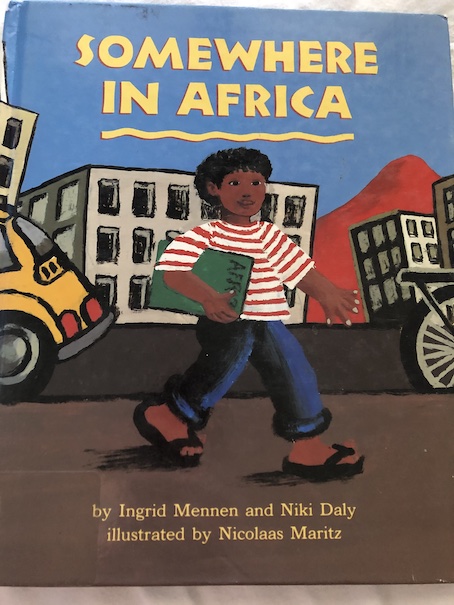
Somewhere in Africa by Ingrid Mennen and Niki Daly, illustrated by Nicolaas Maritz, 1990.
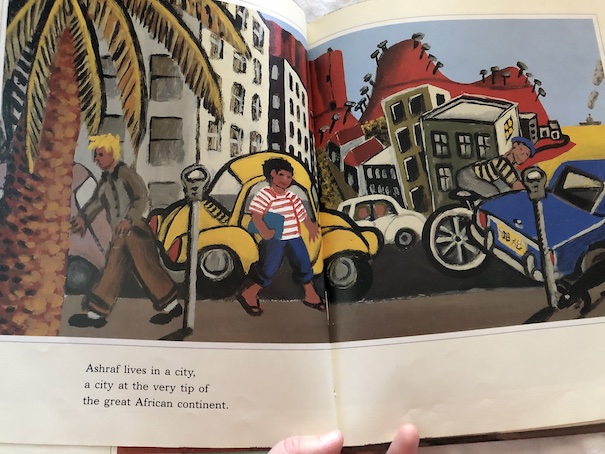
I didn’t read this book when I was a child, although it’s old enough that I could have, but I was fascinated when I found it in a Little Free Library because this is an American edition of a book that was originally from South Africa. I enjoyed the colorful painted pictures, and I think it’s a good book for explaining to American children what it would be like to be a kid in South Africa. For a child living in a city, life actually wouldn’t be too different from the lives of American children living in cities. Africa isn’t all savannas and animal safaris.
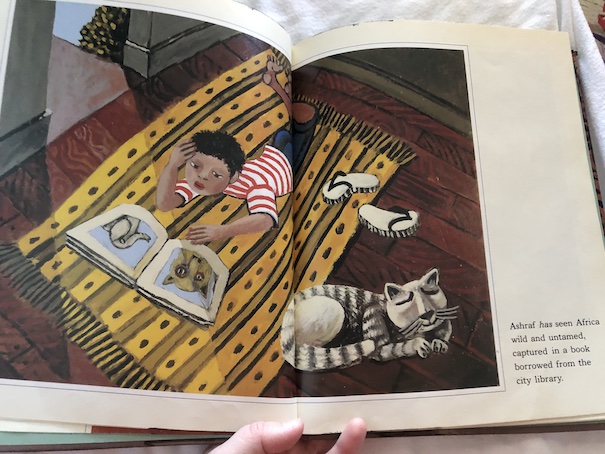
A boy named Ashraf lives in Africa. He doesn’t live in a place with lions, crocodiles, and zebras, though. He lives in a very busy city. Ashraf likes animals, and he reads about them in his favorite library book.
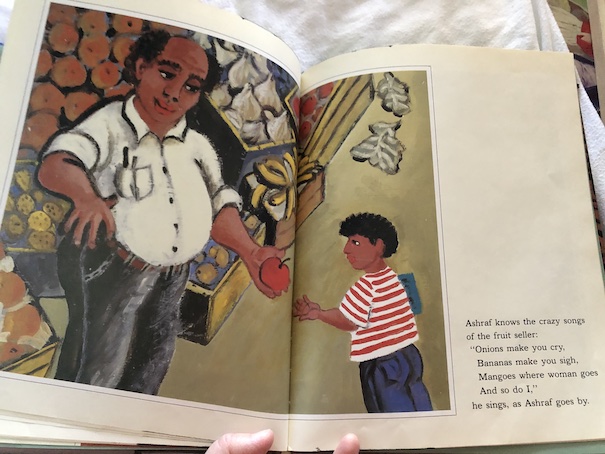
As Ashraf goes to the library, he sees all of the busy traffic of the city and passes by shops with fascinating things in their windows. In the market, there is a fruit seller singing about his products. Other people are selling flowers, and there are street musicians.
When Ashraf gets to the library, he checks out the same book about African animals again.
The book is available to borrow and read for free online through Internet Archive (multiple copies).
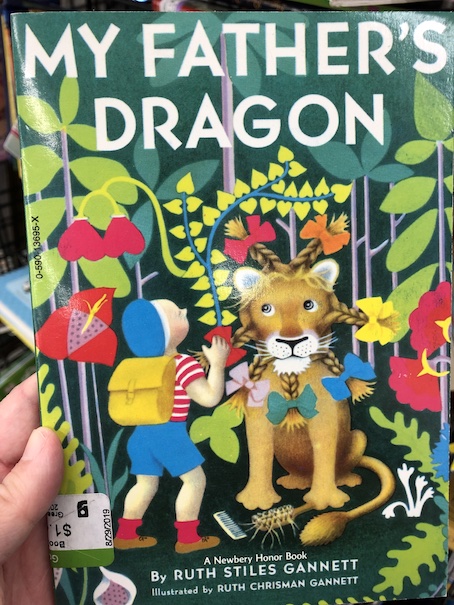
My Father’s Dragon by Ruth Stiles Gannett, illustrated by Ruth Chrisman Gannett, 1948.
This is a fantasy book where the author tells a story about her father’s adventures rescuing a dragon when he was a boy.
It all starts when the boy, Elmer Elevator, brings home an alley cat that he found. However, his mother doesn’t like the cat and doesn’t want Elmer to keep her. When he tries to feed the cat secretly, she throws the cat out and punishes Elmer. The boy and the cat take a walk in the park together, and the boy confides his wish to learn how to fly airplanes when he grows up. The cat says that he doesn’t have to wait until he grows up to learn how to fly.
The cat explains that she has traveled a great deal, and not too long ago, she visited the Wild Island, which is inhabited by wild animals. The island is divided in half by a river inhabited by crocodiles. Normally, the animals have to take the long way to get around the river to avoid being eaten by the crocodiles, but a few months before the cat visited the island, a baby dragon fell of his cloud and landed next to the river with an injured wing. The other animals on the island captured the poor baby dragon, and when his wing healed well enough for him to fly, they started forcing him to carry passengers and cargo over the river. They work the poor baby dragon too hard and mistreat him. The cat made friends with the little dragon and wanted to help him but didn’t know how because she couldn’t untie the rope that holds the dragon prisoner. The cat suggests to Elmer that the dragon would probably be happy to give him a ride if he helps to free him, and Elmer decides to do just that. Besides, he’s angry with his mother for mistreating the cat and doesn’t mind leaving home for awhile.
The cat decides that she’s too old to travel, so she stays behind, but she helps Elmer to prepare for the trip. Elmer stows away on a ship to the nearby Island of Tangerina and gets to the Wild Island by climbing over the rocks between them. When he reaches the Wild Island, he decides to look for and follow the river, but he has to be careful of the animals on the island.
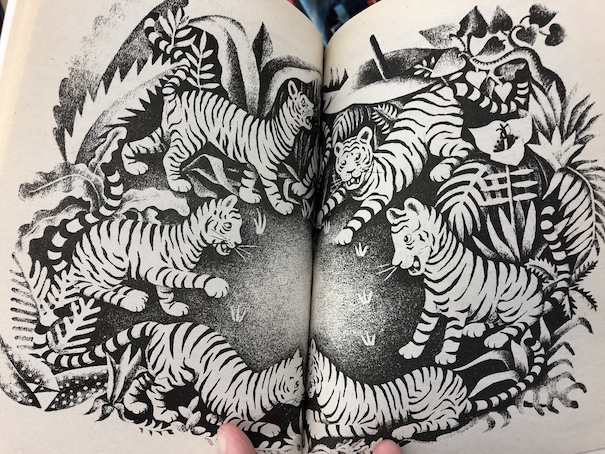
Elmer is found by some tigers who say that they’re hungry and curious to know what little boys taste like. However, remembering some of the cat’s advice, he offers the tigers some chewing gum because (apparently) tigers love it. He also tells them that it’s special chewing gum that will change colors when they chew it, and then, they’ll be able to plant it in the ground to grow more chewing gum. The tigers fall for it and forget about Elmer, who sneaks away.
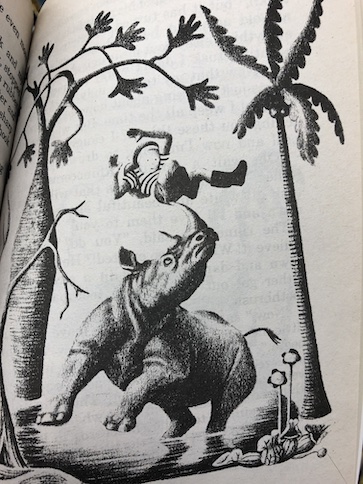
Elmer also has a dangerous encounter with a rhinoceros after he drinks from his “weeping pool.” The rhino wants to toss Elmer into his pool to drown him, but Elmer asks him what he has to weep about. The rhino says that he’s upset that his tusk is no longer as white and pretty as it used to be, and Elmer gives the rhino his toothbrush and toothpaste. The rhino lets Elmer go and begins using the toothbrush to clean his tusk, but by now, the boars have realized that there is someone on the island who doesn’t belong.
Elmer continues onward, helping a lion with a messy mane and a gorilla with fleas and befriending the crocodiles by offering them all lollipops, until he finally finds the dragon and rescues him. They fly away from the island together, but it’s not the end of their adventures.
There’s a reason why the author and illustrator’s names are very similar but not identical. If you read their short biographies, they explain that the illustrator was the stepmother of the author.
This book is a Newbery Honor Book, and it’s also the first in a trilogy about Elmer and the dragon and their adventures together. It’s available to borrow and read for free online through Internet Archive (multiple copies).
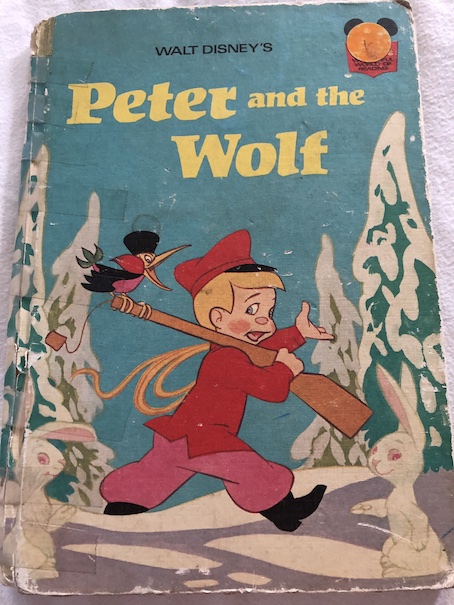
Peter and the Wolf by Walt Disney Productions, 1974.
This is the picture book version of Disney’s cartoon from 1946 based on Peter and the Wolf, which was originally a musical symphony for children, written by Sergei Prokofiev in 1936 for the Central Children’s Theatre in Moscow.
Young Peter lives with his grandfather near a forest in Russia. Peter’s grandfather warns him to stay away from the forest because there are hungry wolves there, but Peter thinks that he can catch a wolf himself. One day, while his grandfather is asleep, Peter sneaks out of the house to go catch a wolf.
Along the way, Peter’s friend, Sasha the bird, also warns him that there really are dangerous wolves in the woods and that he can’t hope to catch one with his toy gun. Peter insists that he’s going to try anyway, and Sasha says he’ll go along and help.
As they venture further, they are also joined by Sonia the duck. Ivan the cat tries to eat Sasha, but Peter makes him let Sasha go. Then, suddenly, a wolf appears!
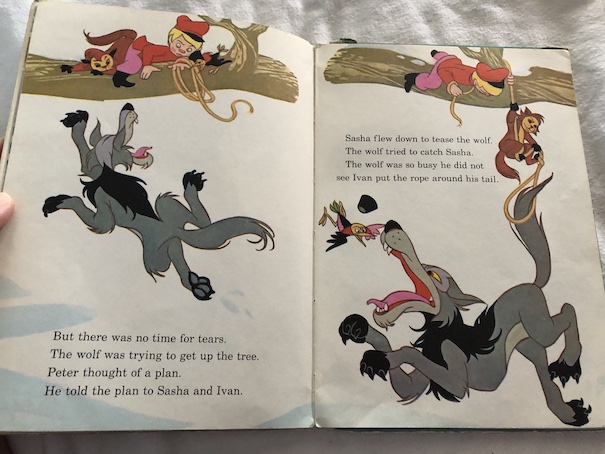
The wolf chases Sonia, and at first, the others think he actually caught and ate her. They manage to catch the wolf by the tail. Sasha attracts some help from some passing hunters.
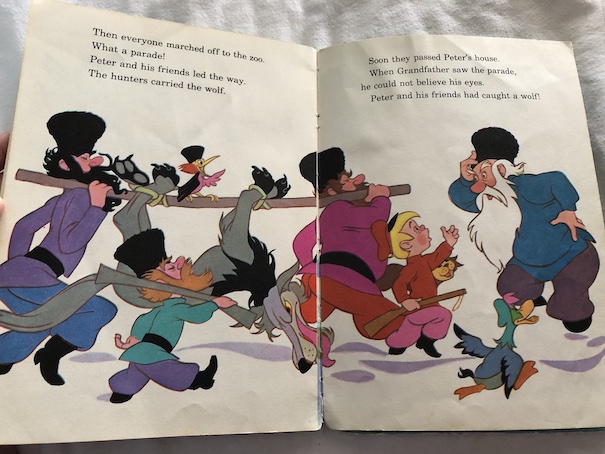
At first, the hunters want to shoot the wolf, but Peter asks them to take the wolf to the zoo instead, realizing that the wolf was just hungry. It tuns out that Sonia is safe after all, and they all take the wolf to show Peter’s grandfather.
The book is available to borrow and read for free online through Internet Archive (multiple copies).
Press and Bobby have followed Saint Dane to the territory of Cloral, a world completely covered by water and occupied by peaceful people who live in floating cities. Of course, with Saint Dane on the loose, things aren’t going to stay peaceful for long. An entire city of people are killed when they eat poisoned food, and it looks like Cloral’s entire food supply may be in danger.
Saint Dane is commanding a group of pirates raiding cities for their food supplies. Among the dead is Cloral’s last Traveler, and his successor is his son, Spader, who has no idea what the Travelers are or what kind of dangerous mission awaits him. Spader takes his father’s dead very hard and vows revenge upon Saint Dane. As Bobby, Press, and Loor, who Bobby introduces to Spader in order to help explain who Travelers are, acquaint Spader with his new duties as the Traveler of Cloral, they try to convince him that preserving the peace of Cloral is more important than seeking revenge. Spader is hot tempered, and they try to teach him to use peaceful means to combat Saint Dane, who has superior strength, anyway.
Before he died, Spader’s father left behind one clue to the solution of their problems: a reference to the lost city of Faar, apparently the last city on dry land on Cloral. According to legend, it sank many years ago, but its advanced civilization may not have been completely destroyed. Centuries ago, the water level of Cloral rose, and the people of Faar realized that their city would soon be underwater. They built a dome to protect their city, and they have been secretly helping the people in the floating cities by tending to their underwater farms and sharing technology with them. However, they have been afraid to openly reveal themselves to the rest of Cloral because they were worried about their culture becoming contaminated.
When Press, Bobby, and Spader tell them that Saint Dane knows where they are and is on his way to destroy them, most of the people flee the city. The dome is broken, and it looks as though they will be unable to retrieve the equipment that the people of Faar were going to give them to save Cloral’s food supply. However, the one person who remained in Faar and was killed was talking about making Faar “transpire.” Bobby, wanting to fulfill the dead man’s mission, activates the machinery to make it happen. It turns out that the people of Faar have made it possible for their city to detach from the ground and float to the surface, like the other cities of Cloral. Faar and its people have now rejoined the rest of Cloral, and they are able to retrieve the machinery they need. Sadly, Spader tries to chase down Saint Dane as he escapes through the flume, and Press is killed saving him. Spader volunteers to accompany Bobby on his mission to stop Saint Dane.
Throughout the books, Bobby, like Spader, has to come to terms with the fact that his life and his entire identity are not what he has always thought they were. Other Travelers also go through the same process as they learn about what it means to be a Traveler and to accept the mission of the Travelers. All through the series, there are other revelations about the nature of the Travelers themselves and how they came to be.
The book is available to borrow for free online through Internet Archive.
The Puppy Who Wanted a Boy by Jane Thayer, illustrated by Lisa McCue, 1958, 1985.
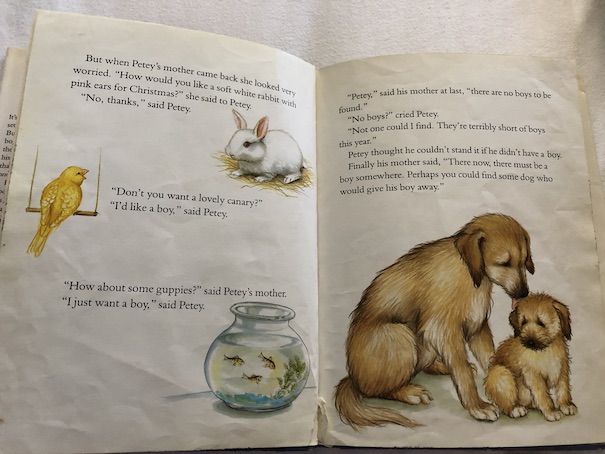
A puppy named Petey tells his mother that he wants a boy for Christmas. His mother says that he might get one if he’s good, and when Petey is a good puppy, his mother tries to find one for him.
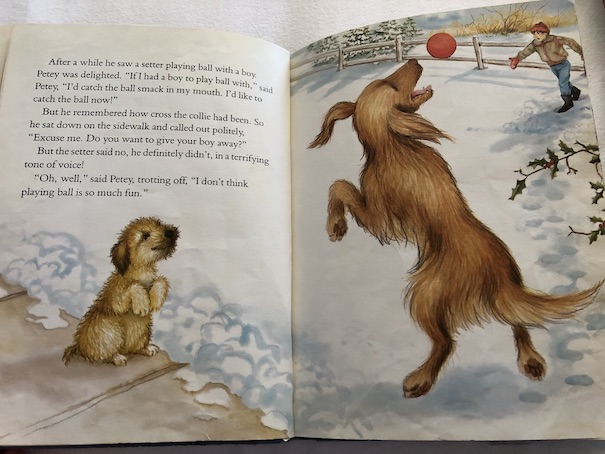
Unfortunately, Petey’s mother just can’t seem to find a boy for Petey anywhere. She suggests trying to see if any other dog is willing to part with his boy. However, no other dog wants to give up his boy.
Eventually Petey comes to an orphanage with a sign that says Home for Boys. Petey decides that if the boys have no parents, maybe they could also use a dog. It’s Christmas Eve, and most of the boys are inside are singing Christmas carols, except for one boy, sitting by himself outside.
Petey jumps into the lonely boy’s lap, and the boy loves him right away. When a lady comes to check on the boy, the boy asks if he can bring the puppy in, and she says yes.
All of the boys in the home love Petey and want to keep him. The lady says that Petey can stay if his mother lets him, and Petey knows that she will. Instead of getting just one boy for Christmas, Petey found fifty!
The story was first published in 1958, but my edition is from 1985 and has different illustrations. In the older book, the puppy looked like a beagle.
The book is available to borrow and read online through Internet Archive (multiple copies).
This is the final book in the Indian in the Cupboard series. At the end of the previous book, Omri’s father learned the secret of Omri’s special cupboard and key, that it brings small plastic figures to life.
At the beginning of this book, Omri’s father suddenly announces to his family that he wants to take them on a camping trip. It seems like an impulsive decision because this isn’t something that the family usually does, and Omri figures that it must have something to do with the secret that the father and son now share concerning their small friends from the past.
After Omri’s father discovered his secret, the two of them had a serious talk, and Omri explained to him all about his past adventures and the very real consequences that they’ve had, both in the present and in the past. They need to consider carefully what they’re going to do because Little Bear has asked them for help with some trouble that his tribe in the past is having with the British. Knowing the history of the interactions between Europeans and Native Americans, both Omri and his father know that something serious is about to happen to Little Bear and his people, but how can they help? Omri explains to his father that they have the ability to go back into the past themselves, but in order to do that, they need to find something big enough to hold both of them, and someone else would have to turn the key for them to send them and bring them back.
Omri’s father later admits to him privately that he thought up the camping trip as a way for the two of them to disappear for a couple of days without anyone asking questions. Although he proposed the camping trip, he plans to arrange for him and Omri to have a private trip by themselves, discouraging the others from going along. Omri’s father also thinks that he’s figured out what they can use to send themselves back in time – the family car. It’s big enough to hold both of them, it locks with a key, and there’s even an LB in the license plate number, which they take as a hopeful sign. But then, Omri realizes that there’s a problem with that scheme. Even though the car locks with a key, it’s not the kind of lock that an old-fashioned skeleton key could open. They need a key with a different shape, something flatter. They decide that they need the help of Jessica Charlotte, who made the last key. Fortunately, Omri has a way to talk to her because he has the plastic figure of Jessica Charlotte.
When Omri brings Jessica Charlotte back, he finds that she has attempted to drown herself in a river (an event hinted at in the last book) because of her guilt at accidentally causing her sister’s husband’s death. Omri brings back a WWII Matron who has helped them before to treat Jessica Charlotte. When Jessica Charlotte recovers, she thinks at first that she must have died and that Omri is part of her afterlife. Omri assures her that it’s not the case, that she’s still alive. She is still lamenting over having caused Matt’s death and ruined her sister and niece’s lives, but Omri explains to her that he’s Lottie’s grandson. Jessica Charlotte feels better, hearing that Lottie grew up, married, and had children, so her life wasn’t completely ruined. Omri can’t bring himself to explain how Lottie was killed in a bombing during WWII, but he asks for her help to create a new key. Aunt Jessie, as she asks to be called, agrees to help Omri, and he and his father give her their car key to duplicate.
However, when Aunt Jessie returns with the key, they realize that they’ve miscalculated. When a person comes from the past with anything they make or bring with them, it’s always small, like the miniature people themselves. Aunt Jessie’s key is a duplicate of the key they gave her, but it’s small, too small to use in the car. Omri and his father aren’t sure how to get around this problem, so they decide to go on the camping trip with Omri’s brother Gillon, just camping like normal, while they think it over.
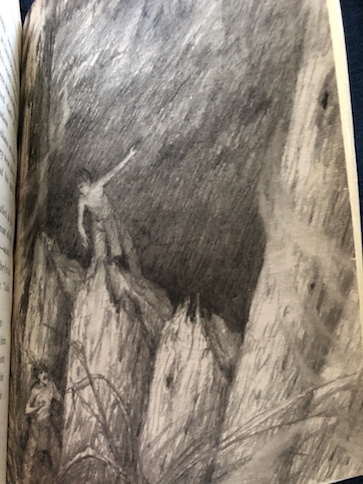
It turns out that something magic happened to the car key while it was in the past with Aunt Jessie. When Omri’s father turns the key in the car, Omri suddenly finds himself in the past, but not the past he was hoping to visit. Because they brought some things that belonged to his Great-Grandfather Matt with them on the camping trip, Omri suddenly finds himself in India, during the time that Matt was living there. Omri is inside a puppet in a marketplace, and his great-grandfather buys him. Also, to Omri’s shock, Gillon is also inside a puppet that his grandfather has.
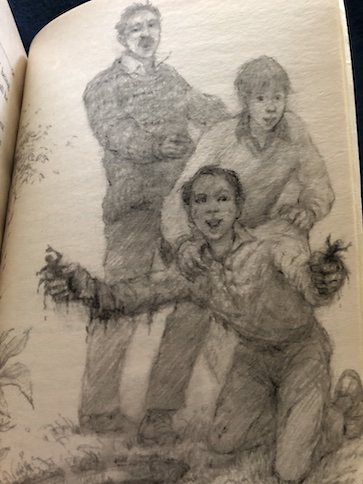
Their mother eventually rescues them by opening the car and turning the key. She was alarmed because it seemed like her husband and sons all passed out in the car. Omri and his father don’t have a real explanation for her, not wanting to explain that the car key is now magic. (She decides that there must have been an exhaust leak, and they were all overcome by fumes.) Gillon was knocked unconscious when his puppet was dropped on its head, and his mother takes him to the hospital, using her spare car key. (When Gillon recovers, he thinks it was just a weird dream he had because of the car fumes.) Meanwhile, Omri and his father talk about the situation, and Omri’s father reveals that, while the boys were taken to India, he ended up in Little Bear’s time because he was carrying some wampum belonging to Little Bear.
So, know they know that it’s possible for them to use their car key to go back in time, but if they try it a second time, who will turn the key for them to bring them back at the appropriate time? The only other person who can come with them on their “camping trip” who knows their secret and can be trusted to help them is Omri’s friend, Patrick. However, Patrick isn’t happy that he’s only there to help Omri and his father go back in time and that he won’t be going himself. He does agree to help them, but unfortunately, he has plans of his own while Omri and his father are occupied elsewhere.
The book is available to borrow and read for free online through Internet Archive (multiple copies).
My Reaction:
Although Omri’s father wonders at first whether it’s a good idea to try to help Little Bear because of the risk of changing the past and affecting the future, Omri has learned that it’s not quite as simple as that. During his previous adventures, he has felt an irresistible pull to use the cupboard and the key, even when he wasn’t always sure it was a good idea, and there are indications that Omri’s interactions with people in other time periods seem fated to happen. He did save Jessica Charlotte’s life when she tried to drown herself, and other things Omri has done seem to fit with wider events.
When Omri and his father are figuring out how to help Little Bear with his problems with the British in his time, they do some research about Little Bear’s time and talk about the ways that 18th century British people treated Native Americans. Knowing what Little Bear is likely to face, they feel like they have a responsibility to help him as best they can. When Little Bear explains in more detail what his people have been suffering at the hands of the British and other settlers, Omri feels guilty, knowing that he’s also British, while at the same time knowing that he was not responsible for things that happened before he was born. This is something that people still struggle with today, hearing about difficult periods of history and knowing that their ancestors (or at least other members of their society, if not literally their direct ancestors) played a role in making life difficult for others, setting up situations where real people suffered or were killed. The best Omri can do is to help Little Bear make the best possible decisions to ensure the survival of his people. Of course, being able to help with that much is part of the time traveling fantasy of this story. Real people can’t actually go back in time and intervene to influence others and change the course of history.
The books in this series aren’t for young children, and as the series progresses, they get more serious in subject matter. There is discussion of suicide, not just with Jessica Charlotte’s attempt to drown herself but when Little Bear explains that his first wife killed herself after being raped by white men. There is violence in the story when the Native American village is attacked and people are shot. Overall, the story is pretty straight-forward in the way in confronts the dark sides of history. Omri and his father advise Little Bear to take his clan to a place where they know that they will be relatively safe and among other Iroquois, but they know and admit to Little Bear that even that won’t solve all of their problems and that there will be other hardships in the future. It’s an imperfect solution to a massive problem, but Omri senses that it is best choice that they could make and that Little Bear and his family will live the safest possible life because of the decision they made, and their descendants will survive.
Omri and his father struggle with knowing that things are going to be hard for Little Bear’s people no matter what choices they make. There is no magical solution to everyone’s problems in the story, and the book doesn’t offer a firm moral or solution to Omri’s guilty feelings when he sees firsthand how badly Native Americans were treated (a form of “white guilt“, although the book doesn’t use that term). Overall, I would say that the book confronts the dark parts of history and human guilt on a very individual level. Omri and his father can’t solve the large issues completely because they can’t control them. They can’t control the past, and they can’t control other people, not even the people who come through the cupboard as miniature ones, like living toys. Everyone is an individual with their own choices to make, and every choice, even the wrong ones, changes the course of history.
After Omri saves Jessica Charlotte’s life, she realizes that what she thought was a dream before she stole her sister’s earrings was real, that she saw and spoke to Omri, and that he could have warned her about what would happen if she went through with her theft, how Matt would have died and how everyone’s lives would be changed for the worse. However, Omri did choose not to warn her because not everything was changed for the worse. After Lottie’s father died and her family lost their money, Lottie still grew up, fell in love, got married, and had a daughter. It’s true that she did die young in World War II, while her daughter was still an infant, and changing the theft of the earrings might have changed that in some way, but not without changing other things. Omri has discovered that changing things about the past, even seemingly small things, can change larger parts of history, and his psychic gift seems to guide him toward making only choices that help the flow of history instead of working against it. If he had prevented the theft of the earrings, his great-grandfather might have lived longer and so might Lottie, but if that happened, would Lottie have ever met the man she eventually married and had Omri’s mother? Omri’s father wouldn’t be happy without his wife and sons, and if Omri never existed, would some of the other things he did that impacted history have happened? Also, if Lottie hadn’t died in the bombing during WWII, would someone else have been where she happened to be and died in her place? The bomb that killed her would have fallen anyway because that was part of someone else’s choices, a person who never enters this story and whose decisions can’t be controlled. Time and history and the ripple effects caused by individual choices are complex. Omri has his psychic gift to guide him, and even his father, who admits that he never used to believe anything he couldn’t see for himself, comes to trust it.
People without this sort of magical gift have only themselves to rely on to make the best choices they can to make the world as good as possible, even in the face of others’ bad decisions. I think that a large part of the choices that Omri makes in the story and dealing with “white guilt” in real life come down to the combination of frustration and the acceptance of choices made by other people who can’t be controlled. Modern people might hate what happened in the past and feel badly if people related to them were part of it, but we don’t have the option to change things that have already happened. There comes a point where you have to accept the knowledge that you can’t control others, no matter how much you might want to make better choices on their behalf. The only person you can control is yourself.
I’m a white person, descended from colonial settlers in America, and I don’t actually see “white guilt” as a negative thing. I see it as a human thing. If you can feel real emotion at someone else’s plight, a wish that bad things didn’t really happen, or a feeling that what happened shouldn’t have happened and an honest desire to change even the unchangeable past for the better, it means that you’re a real, thinking, feeling human being with a sense of right and wrong, and there’s nothing bad about that at all. Feelings are just tools, to give us hints of what we need to do or how we need to behave in our lives. Feelings aren’t always completely accurate, but sometimes, they give us hints of things that need to be fixed or clues that whatever we did before didn’t really work, that we made the wrong choice or did the wrong thing. I think what upsets and confuses other white people about “white guilt” is the conflict between loving ancestors and wanting to be proud of them and admitting that some of them had a real dark side and did some pretty awful things. Some people have trouble dealing with that, thinking that it’s impossible to feel two things at once, loving someone and being angry with them for things that they’ve done, but it really is possible. Two things can be true at once, and you can have mixed feelings about many things.
Feelings are complex, as complex as people are, and I think it’s as possible for a person to both like and hate another person for the things they’ve done as it is to both like a sweater for the way it looks but not want to wear it because it’s itchy and uncomfortable. I think that’s about the best advice that I can actually offer to other white people trying to make sense of that feeling. Sure, that sweater looks pretty impressive. It has a nice color and a cheerful pattern, and you might think it would look impressive on you if you wore it, but honestly, it’s better if you just leave it on the mannequin. It’s overpriced, out of style, and won’t look at all impressive when it makes you constantly want to scratch all of the places where it itches. Let it go.
“God, grant me the serenity to accept the things I cannot change, courage to change the things I can, and wisdom to know the difference.”
The frustrating thing about feelings about the past and about other people’s lives is that we can’t fix those particular things. In real life, we can’t go back in time, and we can’t even “fix” other people in our own time because that’s something they have to do themselves, if they’re going to do it. You can suggest things to other people, but there’s always a point where they have to make the decisions themselves. But, the good news is that, if you can’t control other people, nobody can completely control you! The way I see it, the most useful thing about this “white guilt” is remembering that this is something we don’t want. Maybe there’s something charming about the rosy, nostalgic view of the past, but honestly, you wouldn’t be happy living there, and if you actually had to live with your ancestors, you’d probably discover that you wouldn’t see eye-to-eye on a lot of things and maybe wouldn’t even get along at all. So, why would you want to try to carry their old baggage with you into your life and spend your life and your precious time constantly trying to explain or excuse their bad choices? You’ve got your own to life.
Give credit where credit is due for both the good and the bad things, and let our ancestors’ records speak for themselves. You won’t accomplish anything for twisting your feelings into knots for trying to protect the feelings of the dead and justify their actions. They don’t even feel anything anymore. They are dead. Let them rest. We don’t want to add to bad things that have been done in the past and to keep having things in our lives to feel guilty about, and that’s okay because there are new choices to be made every single day. Put your focus there. You have a present to live and a future to plan. Knowing about the past is interesting and informative, but the past isn’t where we really live. Admire it like a nice sweater on a mannequin, take note of the price tag, and move on. We don’t have to make the same old choices that have made people, including ourselves, unhappy just because that’s the way things have been before or because we feel like we have something to prove about our ancestors. They had their chance to make the choices in their time, for good or bad (and frequently, some of each, but you can’t help that), and now, it’s our turn to make the choices because this is our time.
Speaking of bad decisions, Patrick almost gets Boone and Ruby killed because of his recklessness when he brings them back while Omri and his father were with Little Bear, which he did just because he was bored and felt left out of their magical adventure, which wasn’t really pleasant and fun for them anyway. Boone and Ruby both make it clear how they feel about that, and Omri also makes it clear that this is the end of the magic for him and Patrick. Boone and Little Bear have their own lives to live, and Omri’s gift tells him that it’s time to let them get on with living their lives without interference. Omri still has the cupboard and the key, but he no longer feels the pull he felt before to use them because he has played his part in history and in the lives of his little friends, and there is nothing more he needs to do. He doesn’t feel the need to lock these things away as he did before because he already knows that he will never feel the urge to use them again. When something’s over and the moment has passed, you just know.
Before the end of the story, Omri’s mother admits to him that she knows all about the little figures and that the cupboard brought them to life, although she never actually saw any of them herself. She has also inherited the family gift and is aware of what the cupboard does, even though she has not used it herself. All along, she’s been pretending that she didn’t know what was going on, although she really did. She’s a little sorry that she didn’t see the little people herself, but she knew that not interfering was the right thing to do. She thinks that letting the magic go and not using the cupboard again are the right decisions, and she doesn’t want Omri or his father to tell Omri’s bothers about the magic because, if they do, it will never end, and it’s really time for it to all end. This really is the final book in the series.
The Indian in the Cupboard by Lynne Reid Banks, 1980.
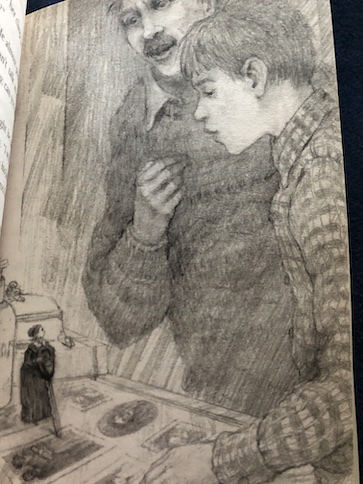
Omri thinks that he’s starting to get tired of collecting and playing with plastic figures when his friend Patrick gives him a plastic American Indian figure that he doesn’t want anymore for his birthday. At first, Omri doesn’t think much of the Indian figure because it’s just a used plastic figure that doesn’t match any other figure sets he has, so he’s not sure how he can use it in his games. Then, his brother Gillon gives Omri a wooden cupboard that he rescued from an alley. Omri likes the cupboard, and his mother lets him have an old key that happens to fit the cupboard so he can lock it. His mother says that the key used to belong to her grandmother’s jewelry box, which fell apart years ago. As Omri tries to decide what he wants to keep in the cupboard, his mother suggests putting his American Indian figure in it because she found it in the pocket of his other pants. Omri puts the toy in the cupboard and locks it. Later, he hears sounds coming from the cupboard, and when he opens it, he discovers that his toy Indian figure has come to life!
Omri is startled to see that the Indian has come to life, and the tiny Indian is afraid of him. The Indian pricks him with his tiny knife and threatens to hurt him if he comes closer. The Indian insists that he’s not small, it’s Omri who is big. When Omri’s mother comes into the room, Omri quickly shuts and locks the cupboard so his mother won’t see that his toy has come to life. Later, when he opens the cupboard again, the Indian is just a plastic toy again. Omri is sure that he didn’t imagine the figure coming to life, but he’s not sure why that happened or why it’s just a toy again now.
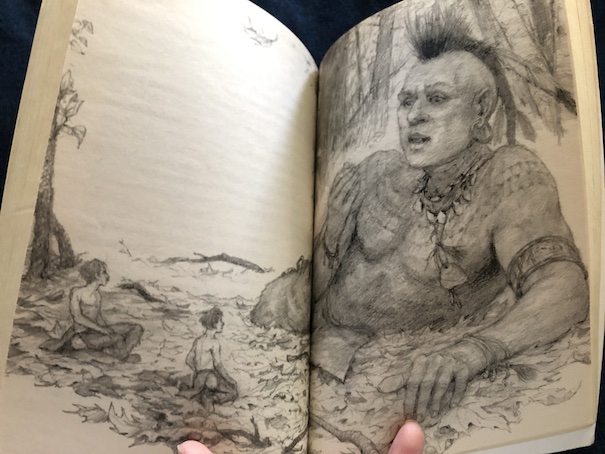
Then, that night, after Omri locks the Indian in the cupboard again, he comes to life once more. This time, when Omri opens the cupboard and talks to the Indian, he asks the Indian what happened. The Indian replies that nothing happened, he just went to sleep. Then, he asks Omri for food and a blanket. Omri asks the Indian more about himself and learns that the Indian is named Little Bear and is the son of an Iroquois chief. He offers Little Bear a plastic teepee from his collection of toys to sleep in, but Little Bear recognizes that it’s not a real teepee and besides, Iroquois sleep in longhouses, not teepees. Omri can’t provide a longhouse, so he makes a better-looking teepee out of sticks and a piece of felt, so it’s at least not plastic. Little Bear accepts it.
Omri begins to realize that either his new cupboard or the key that he’s been using with it or both are magical and can bring toy figures to life. He begins doing experiments to see how it works and what else he can make real. The plastic teepee becomes a real one after being locked in the cupboard, but a metal toy car doesn’t change at all, making Omri realize that, for some reason, the cupboard only works with plastic toys.
Omri tells Little Bear that he’s in England now, not America, and Omri discovers that Little Bear approves of the English because the Iroquois fought with the English against the French and the Algonquins. Omri asks Little Bear if he also fought, and Little Bear brags about what a fighter he is and how many scalps he’s taken, but adds that they were French and not English. It sounds kind of stereotypical, but the author is referring to real battles that took place during the 17th century and 18th century around the Great Lakes area, during the French and Iroquois Wars and the French and Indian War, giving Little Bear a rough time period and location. This is meaningful not only for historical reasons, but also because it indicates that Little Bear isn’t just a toy with no personality or history. As far as Little Bear is concerned, he’s a real person with a past and memories and a life beyond being Omri’s toy. In fact, he doesn’t really know anything about being a toy sometimes in Omri’s time period. Omri also realizes that Little Bear’s history makes him a real person, somehow pulled more than 200 years into the future in miniature form, instead of just a toy brought to life.
Still, Omri delights in having adventures with Little Bear, introducing him to things Little Bear otherwise wouldn’t have. When Little Bear says that he’s never hidden a horse before because the Iroquois don’t have them in his time, Omri brings one of his plastic horses to life so Little Bear can ride. When Little Bear gets hurt, Omri brings a WWI medic from his set of toy soldiers to life so he can treat the wound. The medic, Tommy Atkins, is alarmed when he sees Omri and confused when he’s asked to treat an American Indian, but he does so anyway, deciding that it’s all just a dream. Omri lets him think so and then puts him back in the cupboard to send him home.
Omri does some research about Iroquois to learn more about Little Bear and his history. Patrick wonders about Omri’s obsession with the little toy figure he gave him, but Omri is reluctant to tell him. Then, when Omri buys another Indian figure, an old Indian chief, and brings it to life, the poor old man goes into shock at the site of Omri and dies. Omri feels terrible about causing the old man’s death, coming to recognize that the old man was also a real person, sometime and somewhere, and he wouldn’t have died if Omri hadn’t put him in the cupboard and brought him into his time as a miniature person. Then, Patrick gives Omri a plastic cowboy figure. Omri doesn’t want it because he doesn’t want the cowboy to come to life and hurt or kill Little Bear. Patrick is impatient, saying that’s how the game of cowboys and Indians goes and that’s what people do with figurines of cowboys and Indians, have them fight. That’s when Omri realizes that he needs to explain to Patrick that it’s more than just a game and there are real people involved.
Patrick is stunned when Omri shows him Little Bear, and when Omri tells him about the dead chief, he comes to realize that this game is serious. In spite of that, Patrick asks Omri to let him bring just one figure to life. At first, Omri tries to prevent Patrick from bringing another figure to life because the situation is already complicated enough, but Patrick does so anyway when Omri leaves him alone in his room … and the figure that Patrick picks is the cowboy.
Having an American Indian and a cowboy both in Omri’s room, even in miniature form is just as much trouble as Omri feared it would be. The two of them pose a very real threat to each other, and Omri tries to do his best to help them get along with each other. To make things more complicated, Little Bear says that he wants a wife, and the boys take him to the store to pick out a female American Indian from the plastic figures. The school principal sees the figures, but fortunately, decides that he’s just unwell and hallucinating. Meanwhile, Omri has to impress on Patrick that their little people are actually people and not toys simply to be played with. Of course, there’s only one way to ensure that their new little friends will be able to safely continue their lives: send them home!
Personally, I would have ended the game and sent Little Bear home as soon as I realized that he could die, like the chief in the story, but the boys keep their miniature living people for much longer. In fact, this is the first book in a series, and the boys have further adventures with Little Bear, Boone the cowboy, and other figures/people.
This book was commonly used in schools when I was a kid, and it might still be. When I was a kid, my teacher didn’t go into detail about Little Bear’s time period or explain about the context of his life and the conflicts with the French and Algonquin that he described. Now, as an adult, I have more context for understanding what he’s talking about. I also appreciate the author of the book pointing out that different types of Native Americans lived in different types of homes in the past, something that Omri didn’t understand at first, and I liked that Omri started doing his own research to better understand the Iroquois. The book never gives an exact date to Boone the cowboy or Little Bear’s time periods, but by context, Boone has to be more than 100 years younger than Little Bear, from sometime in the late 19th century. I appreciate having some historical details added to a fantasy story about toys coming to life, but the book isn’t very specific, focusing more on the complications involved in keeping miniature people from the past alive and secret in Omri’s bedroom.
There is also a movie version of this book. The book is available to borrow and read for free online through Internet Archive.
Mystery of the Witches’ Bridge by Barbee Oliver Carleton, 1967.
Thirteen-year-old Dan Pride is an orphan. His father was an international correspondent, and during his early years, Dan lived in different European countries, as his parents traveled around to his father’s assignments. However, three years ago, his parents died in a plane crash. Since then, Dan has been living in a British boarding school. Now, he has returned to the United States to live with his father’s brother, Uncle Julian. Dan doesn’t know what to think about his new town because it’s very different from everything that he’s known before, but he likes the idea of belonging to a family once again because he has been lonely since his parents died.
The Pride family lives in a New England seacoast town. They were one of the founding families of the town in Puritan times, but Dan discovers that the local people aren’t particularly friendly with the Pride family. Billy Ben Corey, a man who works for his Uncle Julian, explains that the Pride family has been rather stand-offish with the townspeople, and there are also rumors and stories about witches that go back to Puritan times. Billy Ben says that most of the modern locals don’t really know all the details of the witch incidents, but the vague rumors that have circulated about the Pride family have caused the townspeople to treat them with suspicion.
This sounds like a somewhat sinister beginning to Dan’s life in York, Massachusetts as he comes to understand how much of life there is governed by the past relationships between the oldest families of the area. Billy Ben tells him that the Coreys have worked for the Prides for generations, but relations between the Prides and the Bishop family haven’t been good and that Dan should avoid them.
Dan presses Billy Ben for more information, and Billy Ben tells him the story of how one of his ancestors, Samuel Pride, was accused of witchcraft back in Puritan times. Some unfortunate happenings at the time, which were probably just the result of bad luck and bad weather, were blamed on him because he was kind of an odd, temperamental person. He was known for playing the fiddle extremely well, and people said that he used it to summon up the devil in the form of a black dog out of the marsh. The person who made the accusation and who led the group that came to arrest Samuel Pride was an ancestor of the Bishop family. Samuel came out to meet the group that came to apprehend them on the old stone bridge that leads to the island in the marsh where the Pride family has their house and farm, Pride’s Point. The story goes that when Samuel met the mob on the bridge, he placed a curse on them, that doom would come for them out of the night, out of the fog, and out of the marsh. Samuel and his wife were executed for witchcraft, and not only after, there was a terrible fog and a sickness that killed many people in town. People said that it was the result of Samuel’s curse. That’s why the Prides and the Bishops have a bad relationship even though they’re neighbors, why the townspeople are still a little suspicious of the Prides, why the Prides are somewhat standoffish of the townspeople (When you think about it, who really wants to be outgoing and friendly with people whose ancestors not only killed yours but who are not welcoming or friendly themselves because they have continually looked at you and your family with suspicion for generations, like you’re the weird ones? The townspeople basically created this situation and have been perpetuating it ever since, yet they act like the problem is with the Pride family instead of themselves. Gaslighting is a relatively new term from the 20th century, but the concept has been around forever, used even by people who don’t know what it is and that it’s what they’re really doing.), and why people in the area are afraid of the stone bridge that they call the Witches’ Bridge, the place where the curse was supposedly delivered. Even into modern times, people in the area see strange lights in the marsh and hear mysterious fiddle music or dog howls that they think might be Samuel’s ghost.
There is still more to come because the mysterious misfortunes of the Pride family have continued even into modern times. Dan is named for his grandfather, Daniel Pride, who died suddenly under very mysterious circumstances, something that still haunts his Uncle Julian. Young Dan learns the story from Mrs. Corey, a relative of Billy Ben’s, who is Uncle Julian’s housekeeper. Daniel Pride had been working to change the family’s image in the eyes of the local people, debunk all the old ghost and witch stories, and lay past quarrels to rest. To try to make peace with the Bishop family and restore the Pride family’s former fortunes, Daniel had been trying to arrange to buy the shipyards that the Bishop family owned, which had formerly been owned by the Pride family. The Bishop family initially agreed to the sale, and one foggy night, Daniel went to see the Bishops to finalize the sale. What happened after that is still a mystery. Daniel was found dead the next day near the old chapel with a look of terror on his face. It’s known that he had a heart condition, so he apparently had a heart attack, but from the marks on the ground, it also appears that he had been running before he collapsed, possibly deliberately frightened to death. Also, there were marks on the ground nearby where his briefcase fell, but the briefcase containing the sale papers was never found. The superstitious people in the area think that Daniel’s death was another symptom of the family’s curse, but it might also have been deliberate murder and theft. The Bishop family insist that they never finalized the sale of the shipyard with Daniel before his death, but Uncle Julian believes that the sale was finalized and that the Bishops are lying to take advantage of his father’s sudden death, just like their ancestors arranged the execution of Samuel for their own advantage. Uncle Julian remains suspicious and bitter about what has happened, just as the townspeople continue to look at the Prides suspiciously.
All of this makes York seem like it’s not the best place to raise a sensitive young orphan, and that’s basically what Uncle Julian says to Dan when Dan arrives at Pride’s Point. Uncle Julian seems elderly and physically frail, and Dan senses that he is a deeply troubled man. Uncle Julian tells Dan that the family and the old family home have a troubled history. That’s why Dan’s father decided to go away and live his life traveling to different places, and that’s why Uncle Julian delayed sending for Dan for so long after his parents’ deaths. Uncle Julian doesn’t seem to think that Pride’s Point is a very healthy place, and he hints at buried secrets. However, he does say that, now that Dan is there, there are going to have to be some changes.
Dan doesn’t think this sounds too hopeful, and he’s lonely and disappointed that he hasn’t found the happy family and home he was hoping for and that he doesn’t even seem particularly welcome there. He can’t even really enjoy playing his violin because of the connection people there seem to have between “fiddle” music, witchcraft, and his supposedly sinister ancestor. As Dan is looking around his new bedroom that night, he suddenly spots a mysterious flashing light from his window, outside in the marsh. It’s creepy because it not only supports all the ghost and witch stories that Dan has just heard but because he recognizes the patterns in the flashes of light as Morse Code … and the message being sent is his own name: D-A-N P-R-I-D-E.
Dan doesn’t believe that any supernatural force was using Morse Code to flash his name at night. It was obviously some human person, but who would do that and why? What is the truth about his grandfather’s death? Is Uncle Julian right that the Bishops caused Daniel Pride to die and then lied about the sale of the shipyard to cheat the Pride family? Or is someone else responsible?
The book is available to borrow and read for free online through Internet Archive.
My Reaction
I stand by my earlier statement that there is basically inter-generational gaslighting of the Pride family going on. It’s gone on for so long that the townspeople have trouble recognizing what they’re doing or stopping themselves from doing it, even though some of them seem to have the feeling that it isn’t right. At one point, some of the townspeople who come out to Pride’s Point to help fight a fire make jokes about the Pride curse. I could sense tension in them, and I think it was an attempt to lighten the mood, but under the circumstances, it wasn’t really appropriate for them to joke around, especially not about something that’s been a sensitive topic for the Prides, something that has literally caused members of their family to die and others to be persecuted for generations. Keep your audience in mind, and learn how to read a room, people of York!
Uncle Julian hates the stories and rumors that have circulated about his family since before he was born, but he doesn’t know what to do to stop it, and he sometimes wonders if it wouldn’t be better for the family to simply leave their old family home and start up again somewhere else. Mrs. Corey tells Dan that every single time anything bad happens in the area, people either look at the Prides suspiciously or find a way to blame them, even though they didn’t have anything to do with whatever it was. Dan can tell that Uncle Julian is so accustomed to having people blame him and his family for things and repeat scary stories about them that he halfway believes the stories in spite of himself, and he’s overly sensitive anytime it looks like the townspeople might be trying to blame the Prides for something yet again. That’s what makes this situation gaslighting, because the community’s constant untrue stories have warped even the Prides’ sense of reality and views of themselves. The community of York as a whole has created a situation that makes it difficult for the Prides to make friends with other people and get reality checks, and the most dangerous part of it is that among the few people that the Prides are in the habit of trusting is someone who turns out to be the person they should fear the most.
I couldn’t help but notice that there was someone in the story that Dan trusted too much in the beginning. It’s partly because Dan is young and in a situation where he is just getting to know the circumstances and people involved, but even when this person says things that are untrue, contradictory, or just plain mean, he doesn’t call him on it or seem to question within himself why this person is talking like that, at least not until about the middle of the book. Gaslighters will do this to a person, playing mind games, lying, alternately being friendly and praising their victim and then putting down their victim and/or trying to blacken their name to other people, discouraging them from getting close to people who care about them and might actually help them, acting like normal things that the victim does or feels are somehow weird or abnormal, trying to keep their victims in a constant state of confusion, unsure of what the reality of the situation really is. Although I found myself angry with the people of York in a general way for perpetuating something awful that their ancestors did for generations and for being apparently oblivious to what they’re doing in modern times, there is a definite villain in the story who is both deliberately and concretely evil.
There is a parallel drawn in the story between Uncle Julian’s big, black dog, Caliban, who is disfigured from an old injury and the Pride family themselves. Dan is afraid of the big dog, and Billy Ben tells him that it attacked him once, but Uncle Julian says that Caliban is just distrustful because he was badly abused and injured in his earlier life. People are like that, too. I understand that because I used to volunteer at an animal shelter, and that’s where I got my dog, Betty. (If you look at my About page, you’ll see a picture of Betty.)
I’ll never know Betty’s complete history because she was found wandering alone without a collar before she was brought to the shelter. However, I’m pretty good at reading between the lines, and I can read at least part of the story from her behavior. Betty is afraid of anyone, even me, walking behind her, and I’ve noticed since her shelter days that sometimes, her back end looks a little off-center when she runs. Her tail has an odd, permanent bend at the very tip that we didn’t discover until we had the hair on it trimmed. I think she’s been kicked hard from behind before, hard enough to leave permanent injury. She’s not as scared of things as she used to be after having lived with my family for a few years, but she used to be terrified of newspapers or anybody standing over her with anything in their hands, so I think she’s been hit with things before. Betty also gets scared when people laugh. She’s not as scared as she used to be because she’s gotten used to us laughing at something funny on tv, but there are times when she’s cringed and slunk away with her tail between her legs from people when they laugh and she can’t figure out why they’re laughing. Betty’s fear of laughter actually disturbs me because I think I know why it scares her. Based on her reaction, I’ve think that it’s likely that whoever hurt Betty before laughed when they did it. I think Betty has an association between laughter and pain, and that’s why she takes laughter as a bad sign, reacting fearfully to it when she thinks it might be directed at her. Laughing while inflicting pain is a sick thing to do, the product of a sick mind. There are stories in Betty’s reactions, and I’m disturbed by the mental picture I have of the person who had Betty before.
I have to admit that my own history has also both colored/given me insight into Betty’s behavior. If it isn’t obvious from comments in my previous reviews, I don’t see teasing as a positive thing. I’ve reacted to it in the past much like Betty does to sudden, unexplained laughter, which is why I understand the feeling behind it. Some people say that they like to tease their friends and people they like, but I just don’t like it, and I’ve learned to be more open and honest about how I never will like it. I do not have good feelings about people who tease others for fun, and I deeply resent being told that I have to like it because the people doing it are “just having fun.” It’s not a bonding activity, not with me, no matter who says it is. I absolutely refuse to “bond” with anyone who does it. Anyone telling me that I have to change myself to like people who tease is 100% guaranteed to get on my bad side. I have a bad history with teasing and bullying, I have a bad history with the people who do it, and I just don’t want to be around it. Teasing involves getting a laugh at someone else’s expense, benefiting from their discomfort, and getting a good feeling from making someone else feel bad. I don’t think any of that is right, and it doesn’t take much for it to get way out of hand, especially when people have the impulse press harder to get the reaction they want to their “jokes”, like the other person just didn’t get it, instead of cutting it out when their “jokes” just aren’t funny. It’s always awkward when it comes from people who don’t know the sore spots that they shouldn’t poke at and try to act like they’re special friends who should be cut some slack when the reality is that we don’t really know each other that well, we’re not really close friends, and no such special relationship actually exists between us. Real friends understand and demonstrate respect for each others’ feelings, and they don’t intentionally poke at a friend’s sore spots, like the people of York did to Uncle Julian with their jokes in this story.
What ties all of this together is that Betty’s reaction to laughter is like Uncle Julian’s reaction to the townspeople and their jokes and comments; it’s a conditioned response from long-term negative association. The townspeople are uneasy because Uncle Julian doesn’t laugh with them, but Uncle Julian doesn’t laugh with the townspeople because none of it was actually funny. By perpetuating these witch stories, even in the form of “jokes”, they’re constantly feeding the myths and ghost stories and making the situation worse, and they don’t seem to care about how he or his family feels or how it affects their lives. You can tell who respects you and who doesn’t by seeing who tries to treat you the way you want to be treated. The people of York were making jokes to soothe their own feelings, sharing in-jokes that they’ve had with each other at the Prides’ expense, and they got really uncomfortable when suddenly confronted with Uncle Julian’s, feelings that they helped to provoke and didn’t want to deal with.
Don’t worry about Betty. It’s sad that she’s been afraid of things and it’s kept her from being more outgoing and friendly, but we’re working through it. In non-pandemic times, I take her to places where I know she’s welcome, and she has acquired a fan club of people who like to see her and say hi whenever we visit. Anytime she seems uneasy because we’re laughing about something, I sit next to her, pet her, and praise her for being a Good Girl so she knows that nobody is trying to be mean to her and that we value her. When someone has been programmed through negative reinforcement, positive reinforcement is needed for balance. I’m trying to build more positive associations for her. It’s working, and she’s improving. She behaves very well and is very happy little dog when she’s treated well. Don’t worry about me, either. I’ve had some bad experiences, but I’m not the only one who’s had to deal with this stuff. There are lots of different kinds of people in the world, and I’ve learned some things about finding the kind of people I want to be around and making it clear how I want to be treated. I just gripe and vent now and then because I don’t like mean behavior or seeing others in these situations, and I’m all out of patience for it. I’ve learned what to do to help remedy such problems, but that doesn’t stop me from resenting the people who create problems that need to be solved.
The way both people and animals behave offers clues about what’s been happening with them. Sometimes, they offer warning signs of people to avoid, and sometimes, they are signs that the person or animal is in distress and needs some outside help and support. Caliban’s behavior in the story is more defensive than aggressive. That is, Caliban is reacting, not instigating … and if I saw what Dan saw in the story, I would know immediately to be very suspicious of the person Caliban hates the most because it explains where the source of harm in his life is. In a similar way, the Pride family is mostly reacting, not instigating. They have been harmed, both physically and psychologically, for an extended period of time, and while they seem to have the sense that’s the case, they’ve been too close to the problem for too long to see what the source of the greatest harm really is. But, about halfway through the book, Dan does learn to correctly read the people around him and comes to realize who is really his friend and how isn’t, based not on how others talk about them but by how they each actually treat him. When you pay attention and think about people’s actions in context, you can see who really has your best interests at heart and who doesn’t.
Dan spends much of the story, particularly at the beginning, feeling like he is unwanted, both in York and at Pride’s Point. At first, he thinks that his Uncle Julian doesn’t want him, but he gradually realizes that’s not it. There is someone else who doesn’t want Dan there, for reasons of their own. As I was reading, I noted times when this person said and did things that manipulated Dan’s feelings, even actively trying to make Dan feel bad while carefully seeming “honest” or “helpful” so Dan would continue to listen. I felt so much better when Dan finally realized the truth about this person. I have to say that I was really angry with Uncle Julian when I discovered that he was fully aware of who hurt his dog and that he still trusted this person. For me, the first hint of that would have caused me to permanently sever the relationship because it’s sick behavior and a sign of a disturbed mind, but I can only suppose that he felt unable to because he had been dependent on this person for too long, largely shunned by the wider community, who could have given him a reality check if they’d had a firmer grasp on reality themselves.
Dan, who had never heard of the Bishops before arriving in York, finds himself becoming angry and resentful of them, hating them for what they’ve done to his family for generations. His uncle even warns him not to get involved with the family, but that’s exactly what the real villain wants. When Dan makes friends with a boy named Pip Cole and his twin sister, Gilly, he confides his anger at the Bishops and how he blames them for this whole mess and for perpetuating it for generations, but Pip knows more about the situation than Dan suspects, and he has seen a different side of the problem. Pip tells Dan his family would have less problems if they would just forgive the Bishops, but Dan doesn’t believe it at first because, the way he sees it, the Bishops are the villains, who have actively profited from their villainy all along. I appreciate Dan’s situation. Pip doesn’t fully appreciate that, for Dan and his uncle, it’s not just about the past because they’re still actively suffering from the townspeople’s stories, rumors, and suspicions about them. It’s hard and maybe impossible to forgive something that’s ongoing from people who see no problem with the situation and aren’t particularly sorry. On the other hand, the resolution of this situation requires at least one of the parties involved to make the first move. Dan’s grandfather was trying, but his mysterious death prevented his mission from being completed. Even Uncle Julian reveals that he had been prepared to forgive the Bishops and marry their daughter, but some of the circumstances of his father’s death led him to believe that his fiance actually had a hand in it, and that apparent betrayal is what has left him such a haunted man all of these years.
The stories that Dan has heard about his family are not the complete story. Dan eventually comes to realize that the Prides and the Bishops each have only half of the real story, and because of their reluctance to associate with each other, the Bishops partly out of continued superstition and guilt, not knowing how to deal with the Prides’ anger, and the Prides, because they are both justifiably angry and accustomed to unfair treatment and being shunned by the community. However, it’s important that they do talk to each other because it’s the only way for each of them to get the complete picture of what’s really been happening and learn the real villain’s true motives.
The key to establishing the truth is in the missing briefcase, and both Dan and his enemy are searching for it. Dan needs to make peace with his family’s past, and he finds some help from a mysterious hermit called Lamie, who lives alone in the marsh. Lamie is another outcast of the York community. People avoid him because he has a reputation for being weird. People in this community in general may be “normal” in the sense that their behavior is fairly uniform, but uniformity by itself isn’t a virtue. When you’ve got an entire community doing something they shouldn’t, being the odd one out can be a good thing. Lamie helps Dan when he needs it, and Dan discovers that Lamie is actually a very kind and understanding person. Lamie’s solitary lifestyle is rather unorthodox, but he’s actually happy in his solitude because he knows who he is, he takes care of himself, he’s comfortable with himself, and he’s living the kind of life he likes, in touch with the natural world. When Dan talks to Lamie, he realizes that Lamie is comfortable with his own identity and at peace in his own mind in a way that his uncle isn’t. Even more importantly, Lamie sees things from a different perspective because he isn’t part of the groupthink of this community.
Lamie was friends with Dan’s grandfather, and he tells Dan about a hidden chamber built by the Prides’ ancestors, where Dan’s grandfather kept important family papers. However, Lamie tells Dan that he isn’t sure that he should look for it if his only motive is revenge. Dan does have a desire for revenge after all of the stories of injustice toward his family that he’s heard and what he’s suffered himself since he arrived in this area. Lamie helps to calm Dan’s desire for revenge by quoting from St. Francis of Assisi, emphasizing the importance of forgiveness instead of revenge. The part about truth speaks to Dan, and he comes to realize that what he really wants, more than revenge, is to know the truth about what happened to his grandfather. Lamie tells him that he saw some of what happened the night his grandfather died, from a distance. Because of the fog, he couldn’t see everything, but he knows that the Bishops were telling the truth that Dan’s grandfather didn’t make it to their place that night to complete their deal, defusing Dan’s anger at them for their supposed lies. Lamie’s memories also give him clues about the true identity of his grandfather’s attacker and the location of the secret hiding place. However, to find it and to evade his enemy, Dan will need the help of the very people his uncle has forbidden him to associate with.
I found the parts about the gaslighting of the Pride family and the poisonous duality of their true enemy frustrating and anger-inducing, but once Dan speaks to Lamie (really, my favorite charcter in the story) and begins to sort out who he can trust and who he can’t, I felt a lot better. The story is very atmospheric, with a grand old house and property, surrounded by a foggy marsh, and even when the characters know who their enemy really is, they are kind of trapped with him in a dangerous cat-and-mouse situation as they both race to find what they’re really looking for. By the end of the book, all of the old mysteries are wrapped up, including the source of the the mysterious “fiddler” music.
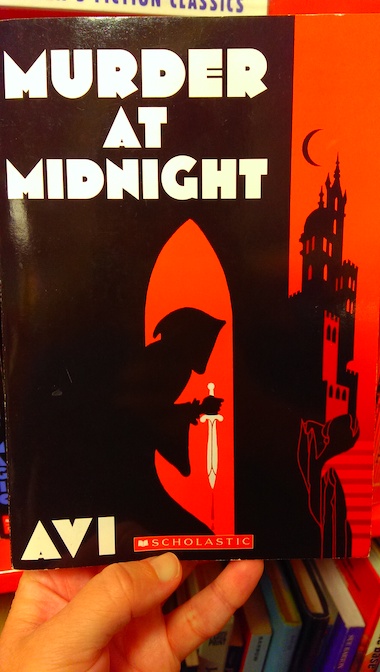
Fabrizio was an orphan living on the streets of the medieval city of Pergamontio before he was taken in as a servant by Mangus and his wife, Sophia. It was really Sophia’s idea that Mangus needed a personal servant. Mangus says that he is able to take care of himself, and he is impatient with Fabrizio because Fabrizio is ignorant and uneducated.
When Sophia goes to visit her sister, Fabrizio tries extra hard to please Mangus so that Mangus will continue to let him live in his house. Mangus is primarily a scholar, but he supplements his income by performing magic tricks at a local tavern. That evening, a black-robed figure appears at the magic show, warning of danger coming to Mangus. The next day, the magistrate, DeLaBina, accuses Mangus of spreading papers with treasonous messages about the king around the city. During this time, all writing is by hand, and no one can understand how these papers can all look so identical unless they were produced by magic.
At first, DeLaBina offers to let Mangus go if Mangus gets rid of the papers and reveals the identity of the traitor. When Mangus protests that he cannot do real magic and that he knows nothing about the papers, he is arrested. Shortly afterward, DeLaBina is murdered. Fabrizio’s only hope of saving his master, and himself, is to find the real traitor.
The book is available to borrow and read for free online through Internet Archive.
My Reaction and Spoilers
I didn’t like this book as well as I liked the original Midnight Magic. Partly, the problem was that I feel like some of the events of this story should have changed people and events in the other book, and they don’t because this book, which is supposed to take place earlier than the other story, was actually written after the other story. It all just seems out of order, and I didn’t like the addition of Prince Cosimo to the royal family. In this book, Prince Cosimo is the crown prince of Pergamontio, not Prince Lorenzo from the previous book. Prince Cosimo did not appear in Midnight Magic (although his absence is explained by the end of this book) and was never even referred to in that book (which is the part that really bothers be me everyone in that book would have known all about him and what happened to him, and I feel like Fabrizio should have at least thought about him in passing, it’s just weird when characters suddenly exist in a series that you know didn’t exist before).
Basically, there is a plot (although not by the person who did the plotting in the other book) to overthrow the king, who is wildly superstitious. The printing press is a relatively new invention in this time period, and Pergamontio has never had one before, which is why no one can understand why the writing on the papers is so strangely uniform. This is the other thing that bothers me about this book. Pergamontio is supposed to be somewhat backward in comparison to other kingdoms, partly because the king is so superstitious, but it just seems like going a bit far for people to suspect that oddly-uniform writing would be a sign of witchcraft because people of that time would already be aware of the existence of signet rings and official seals which were used as stamps in wax to mark documents, like a kind of signature. Like a printing press, those would also produce an identical image, time after time of use. Basically, they’re all just complex forms of stamps. Superstitious or not, I think that people of that time who were capable of reading probably would have been able to tell that a stamp of some kind was being used, even though they might not have seen one as complex as a printing press before.
In the story, a family has recently brought a printing press to the city, and printing the treasonous papers was the first job they were hired to do. Shortly afterward, Maria, the daughter of the family, was arrested while passing out the papers. Her parents are taken into custody by Count Scarazoni, who is a sinister character in his own right but is actually in opposition to the real traitor in this book.
Scarazoni was the figure in the black robe who tried to warn Mangus. Fabrizio is arrested when he tries to gather up more of the papers for Mangus so they can learn where they came from. He is nearly executed for treason, but he is saved by Scarazoni because Scarazoni realizes that the real traitor wanted him dead because he feared that Fabrizio might know too much. At the prison, Fabrizio meets Maria and helps her to escape as well. Maria explains to him the true origins of the papers, and they find DeLaBina’s body. This is the murder referenced in the title of the book, and they must solve it to uncover the identity of the real traitor!
As in the other book in this series, Fabrizio and Mangus use a magic trick at Mangus’s trial to shock the traitor into revealing himself. Although, at the end of the story, the king still believes that Mangus is a real magician, Scarazoni points out that without Mangus’s “magic” the real traitor might not have been discovered. The king tells Mangus that he will let him go provided that he confine himself to his own home and no longer practice magic, setting events up for the beginning of the other story.
















 Jestress's Forgotten Books and Stories