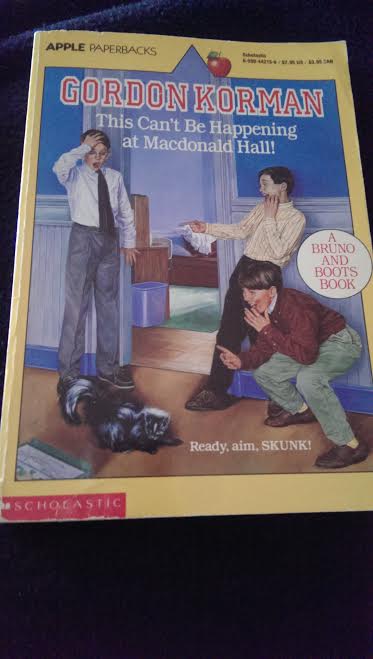
This Can’t Be Happening At MacDonald Hall

macdonaldhallThis Can’t Be Happening at MacDonald Hall by Gordon Korman, 1978.

Bruno and Melvin (called Boots) have been roommates ever since they began attending boarding school at MacDonald Hall.  The two of them are best friends, and they do everything together.  Quite a lot of what they do involves practical jokes.  But, they’ve really been pushing the limit with their antics, and when they go a little too far during a hockey game, the headmaster gives them the ultimate punishment: they can no longer share a room.  Mr. Sturgeon thinks that they’re a bad influence on each other.  Each of them is assigned to a new roommate, and they won’t even be able to hang out together.

The prospect of losing each other as best friends is too much for Bruno and Boots. Besides, neither of them likes their new roommates.  Boots has to share a room with George, who comes from a wealthy family and is only interested in money.  George is also a germophobe who hates it that Boots sneezes every morning when he wakes up.  Bruno’s new roommate is Elmer, the school’s supreme science nerd.  Elmer isn’t happy about Bruno’s presence, either, because Bruno and his belongings take up valuable space that Elmer requires for his many projects.  Obviously, the situation is completely intolerable for everyone.

Bruno, the idea man of the duo, declares that he will find a way for him and Boots to become roommates again.  They meet secretly at night to discuss their plans.  The boys try every tactic they can think of.  They try making themselves completely obnoxious to their new roommates so that Mr. Sturgeon will have pity on them and give them their old room assignments.  They try framing George and Elmer for some outrageous pranks of their own so Mr. Sturgeon will think that they’re a bad influence on Bruno and Boots.  Bruno and Boots even try (as an extreme measure) behaving themselves!  What will finally work?

This is the first book in the MacDonald Hall Series (or Bruno and Boots) series.  It is currently available online through Internet Archive.
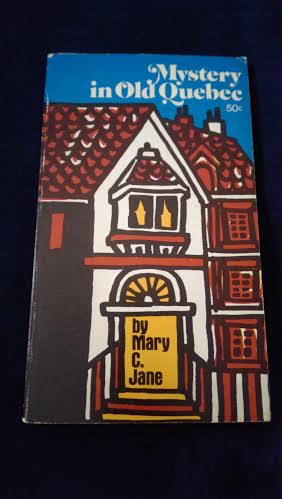
The Mystery in Old Quebec

mysteryoldquebecThe Mystery in Old Quebec by Mary C. Jane, 1955.

Mark and Kerry, a brother and sister, are visiting Quebec with their father, who is on a business trip. Their father allows them to explore the city on their own during the day while he works (something that would be unlikely to happen in modern times). The kids enjoy sight-seeing and learning French words and phrases.  They even make a new friend in the city, but they are troubled by events at the quaint little inn where they are staying.

On their first day there, Kerry’s coat mysteriously disappears and reappears with some strange messages in the pocket.  A boy wants them to take a message to someone in the city.  At night, Kerry hears someone crying in the next room. Is the boy being held prisoner at the inn? If so, why? Kerry and Mark are determined to help in any way they can, but time is running out.

The book is currently available online through Internet Archive.

My Reaction and Spoilers

mysteryoldquebecpicThe solution to the mystery involves family quarrels, custody issues, and racial tensions. In spite of that, this is actually a very gentle story.  In the end, the kids are dependent on the people the mysterious message was intended for to help a troubled, lonely child.  It turns out that the boy is an orphan, and some of his relatives are white, and some are First Nations (Native American). There is a fight for the boy’s custody, but the boy knows where he really wants to be.
The author describes the atmosphere of Quebec in some detail. The famous landmarks probably haven’t changed much, although I don’t know if all the descriptions are accurate anymore. I also thought it was interesting how the author includes some French phrases and their pronunciations and translations as the kids learn to communicate with French-speaking people in the city.

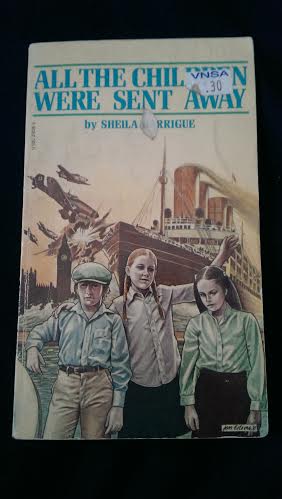
All The Children Were Sent Away

It’s 1940, and Sara Warren’s parents are sending her to stay with her uncle in Canada until the war is over.  With the increasing bombings of England, her parents have decided that it’s just too dangerous for Sara to stay, and her uncle has written, asking them to send her.  Many other British families are sending their children away to escape the bombings, and Sara travels to Canada on a ship with other British child evacuees.  All of them are worried about the families they’ve left behind and what it’s going to be like, living in another country.  They also worry about whether or not they’re ever coming back.

Sara’s escort for the trip is Lady Drume.  She is a bossy, over-bearing woman with very definite ideas about how children should be raised.  She doesn’t like Sara to talk to the sailors on the ship because they can be “impertinent,” and she doesn’t want her to play with the other children because they’re “guttersnipes!”  She even refuses to attend the lifeboat meeting or let Sara go without her!  To Sara’s mind, Lady Drume is as bad as any Nazi.

Sarah still manages to make friends with some Cockney children, Ernie and Maggie, seeing them whenever she can get away from Lady Drume, and an old sailor called Sparky makes sure that she understands safety on board the ship and attends the lifeboat drills.

But, when Lady Drume forces Sara to cut her hair after she’s been waiting so long for it to grow out, Sara decides that’s the last straw!  With the help of her friends, Sara hides from Lady Drume on the ship.  In the process, she learns something about Lady Drume which changes some things for the better, although it takes an outbreak of measles for Lady Drume to really understand and appreciate Sara.

This book is available to borrow and read for free online through Internet Archive.

Part of trouble with Lady Drume and her behavior is that she’s actually very afraid.  She doesn’t like to talk about lifeboats or life jackets because the war and the possibility of sinking frighten her.  She deals with problems by being brusque and trying to ignore frightening things, charging on ahead with whatever seems like a practical course of action to her.  It’s not even just the war but the changing world around her that frightens Lady Drume, a woman who’s used to knowing who’s who and what’s what and getting things done the way she likes them.  But, the rigors of their journey and their mutual vulnerability when they’re sick help lower Lady Drume’s barriers.  Lady Drume isn’t a bad person, and in the end, she arranges a special surprise for Sara to make her exile from England more bearable.

The end of the story is a brief section explaining Sara’s return to England, having been away for a few years, and her feelings at seeing how England and her parents have changed during that time.

There is a sequel to this book that shows what happened during Sara’s time in Canada called The Eternal Spring of Mr. Ito.  It focuses on suspicion of Japanese people following the bombing of Pearl Harbor.  There were Japanese internment camps in Canada as well as the United States during World War II.

Sheila Garrigue’s books about child evacuees from England were partly based on her own experiences as a child evacuee during World War II, as explained in her obituary after her death in 2001.