The Children of Noisy Village

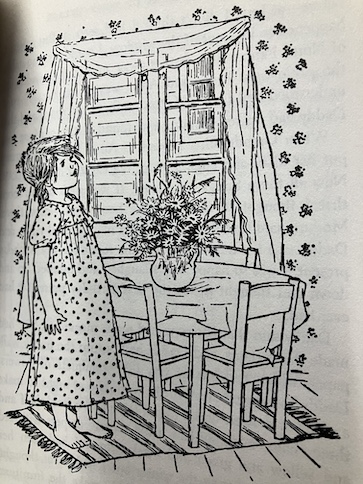
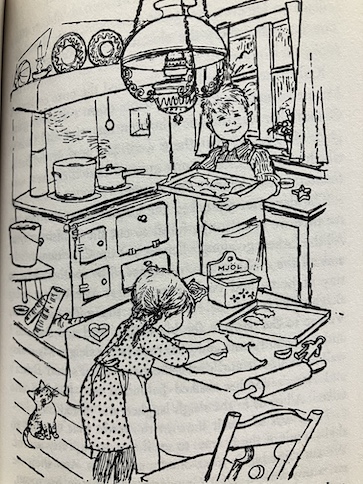
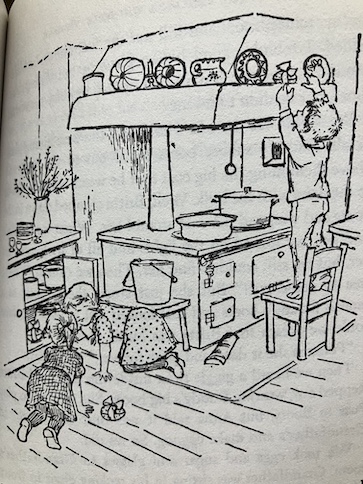
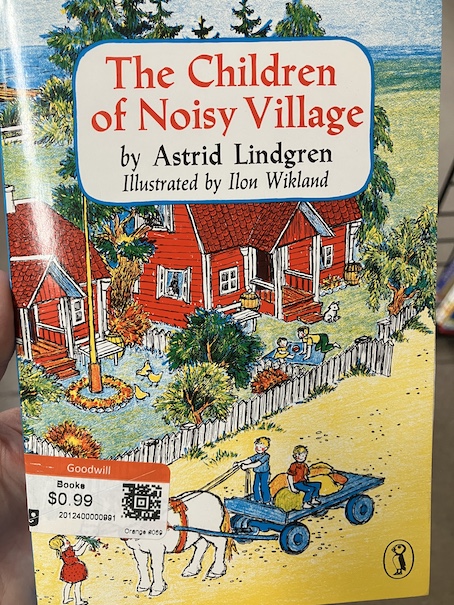
The story is told from the point-of-view of nine-year-old Lisa, a Swedish girl who has two older brothers, Karl and Bill. She and her family live on a farm that people call Middle Farm because it’s between two other farms, North Farm and South Farm. The three farms together are called “Noisy Village” because there are so many children around. The children who live on South Farm are Ulaf and his little sister Kirsten, who is only a year-and-a-half old, and North Farm has two girls, Britta and Anna, who are Lisa’s friends. Ulaf is friends with Karl and Bill. Sometimes, Lisa tries to play with her brothers, but they often tell her that she’s too little, and she sometimes thinks of the boys as a nuisance. Ulaf will sometimes play with girls, although Karl and Bill sometimes tease him about it, but there are also a limited number of children in the area to play with, so being willing to play with whoever is around is a good thing. Through the story, Lisa tells little stories and talks about the things that all of the children of Noisy Village do together.

When Lisa was younger, she used to share a room with her brothers before getting a room of her own. At night, Karl used to tell ghost stories, while Bill likes to talk about adventures. Lisa tells a story about how her brothers scared her one night with a ghost story and how they rigged up a trick to make it look like their room was haunted. Although Lisa sometimes misses the stories that her brothers used to tell her at night, she’s also relieved that she has a space of her own so she doesn’t have to put up with their pranks or them bossing her around all the time. Bill and Karl like their room because their window is close to Ulaf’s window, and the boys like to use the tree between their houses to go back and forth between the two rooms. The room that Lisa has now used to belong to her grandmother, before her grandmother moved in with an aunt. Lisa’s family remade the room for her as a present for her seventh birthday. Lisa’s room faces North Farm and Britta and Anna’s room, so the girls can send each other notes or signal to each other through their windows.

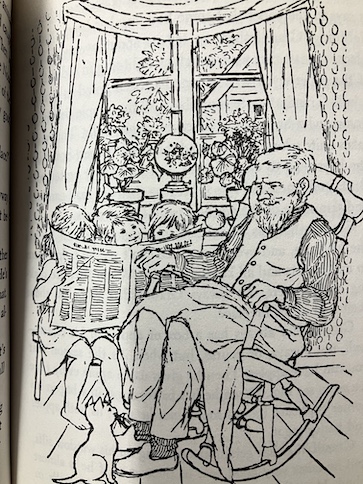
Some of the children at Noisy Village have pets, and Lisa explains how Ulaf got his dog, Skip, from the mean shoemaker, who was mistreating him. Britta and Anna don’t have any pets, but their grandfather lives with them, and the other children at Noisy Village like to visit him. Britta and Anna’s grandfather tells the children stories. One of his stories is about how he ran away from home as a boy. Inspired by the story, Lisa and Anna decide that they should have their own adventure, running away from home temporarily. However, they think that they have to run away during the night, and they both miss their opportunity because they fall asleep.

The children like to play games of pretend on their way home from school, which makes their mothers wonder what they’re doing and sometimes get them into trouble. Anna and Lisa accidentally get on people’s nerves one time, when they try too hard to follow their teacher’s advice about doing things to make people happy. They often end up doing the wrong things because they don’t know what other people really want or what people say they want doesn’t seem like enough. They finally succeed in making someone happy when they share some of their things with a girl from school who is sick.

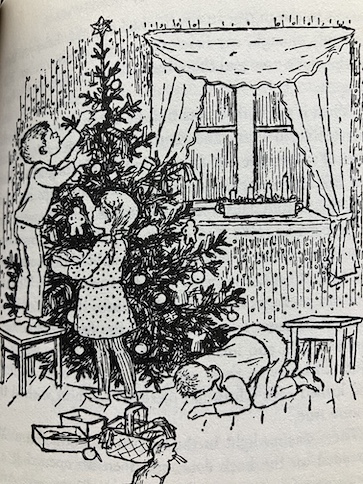
The children’s adventures continue through the year. The people of Noisy Village have a charming, old-fashioned Christmas. At a Christmas party at a relative’s house, they play old-fashioned party games and tell stories. Lisa also describes a Swedish tradition of finding an almond in porridge, which is supposed to be a sign of marriage in the coming year. The children are allowed to stay up late on New Year’s Eve. The boys scare the girls with some firecrackers, and Britta and Anna’s grandfather teaches the children the tradition of pouring melted lead into water to see what shapes it will form to predict what will happen in the new year. On Easter, the children paint eggs and make egg nog.

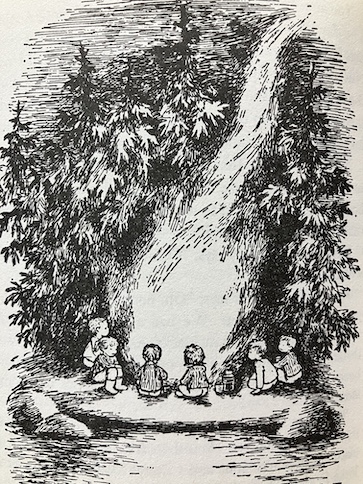
Eventually, school lets out for summer vacation. The children go swimming and catch crayfish during the summer. When they go fishing for crayfish, they camp out in the forest, near the lake, with Lisa’s father and the other men. The children make little huts to camp in. The boys try to scare the girls with stories about goblins. The children appreciate their idyllic lives in Noisy Village!

My Reaction

This book is a series of pleasant, gentle, slice-of-life stories about the children who live on a collection of small farms outside of a Swedish town, probably some time in the mid-20th century. Because there is little mention of any form of technology in countryside, it could set almost be any time in history from the 19th century to the time when it was written in the 1940s. The one thing that identified it as the 20th century for me is when they mentioned “turning on lights” in the house rather than lighting lamps. Even into the mid-20th century, not all farm houses had electricity, but it seems that these do. Other than that, these children seem to be living an idyllic, “unplugged” life in the countryside that people who are into cottagecore would aspire to! I think it would be a nice book to read children at bedtime because it’s very gentle.

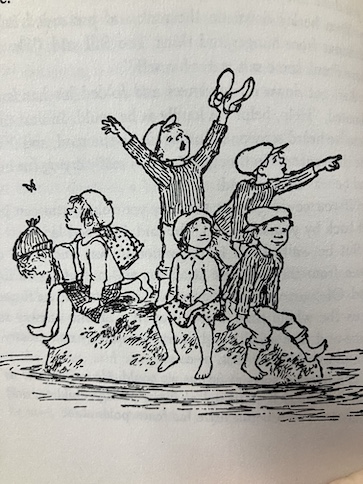
I enjoyed reading about the games that the children play with each other and with their families. The children like playing games of pretend that seem to be inspired by books they’ve read. The girls play at being princesses, while the boys play at being Indians, probably American Indians (Native Americans) because one of young Bill’s ambitions is to be an Indian Chief when he grows up. We don’t really encourage playing at being “Indians” today in 21st century America because that can devolve into caricatures of someone else’s racial group (cowboys are still fair game because that’s a profession, not an ethnicity), but that sort of thing was pretty common in the mid-20th century, even outside of the United States. I’ve read British books from around the same time period that also refer to children playing at being American Indians, so it was something that seems to have captured children’s imaginations, even internationally. The children also pretend that they’re marooned or shipwrecked on a rock at one point, something else that often appears in children’s literature and is based on older books.

I particularly enjoyed some of the descriptions of Swedish holiday traditions through the year. Some of them are very similar to traditions in the United States and Britain around this time and even earlier, like in the 19th century. They have a charming Christmas with friends and family and a party with old-fashioned parlor games. I’ve heard of the tradition of finding an almond in porridge or pudding before, but I think that’s more common in Scandinavian countries than in the United States. In Britain, there are traditions associated with finding things (like a coin or a bean) in porridge or pudding, but it’s not really common in the US. Another thing that stood out to me was that Lisa said they made egg nog at Easter. In the US, people typically have egg nog at Christmas, but when I thought about it, it does make sense for Easter because of the association with eggs.

One other thing that stood out to me in the book was the little huts that the children make when they’re camping out by the lake. It reminded me of the huts that children in The Secret Summer (Baked Beans for Breakfast) made.

The Curious Garden

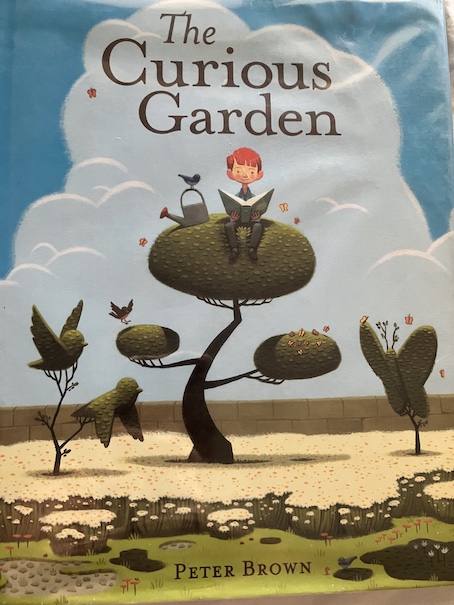
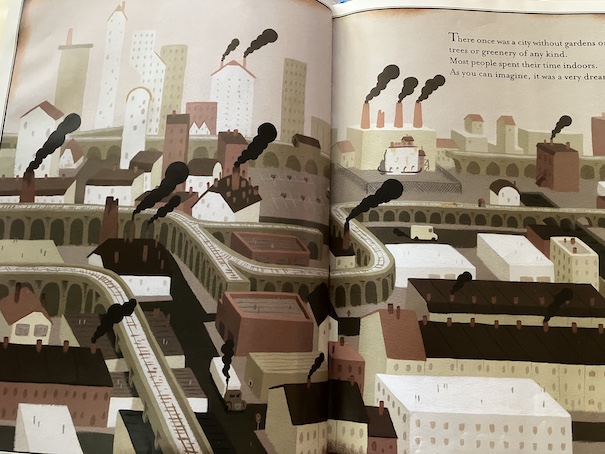
A boy named Liam lives in a dreary city where there aren’t any gardens or green spaces. Most people in the city spend most of their time inside. However, Liam likes to explore outside.

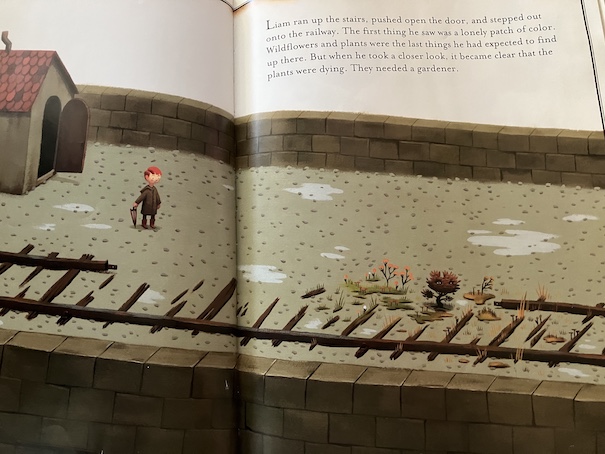
One day, while exploring some disused train tracks, he finds a few plants struggling to survive. Liam doesn’t know much about plants, but he decides to help them by giving them water. Gradually, he begins to learn more about what will help the plants, and they begin to grow and spread into a small garden.

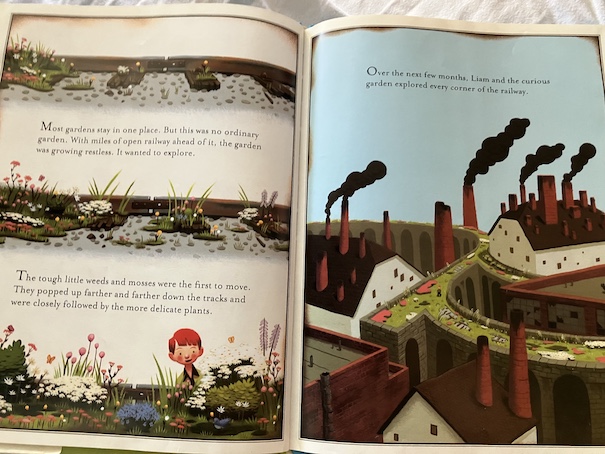
As Liam helps the plants, they begin to spread all along the old railroad tracks. During the winter, the plants are covered in snow, and many of them are killed or have suffered badly from the cold. However, because Liam spent the winter studying about plants and gathering some gardening tools, he is able to restart the garden.

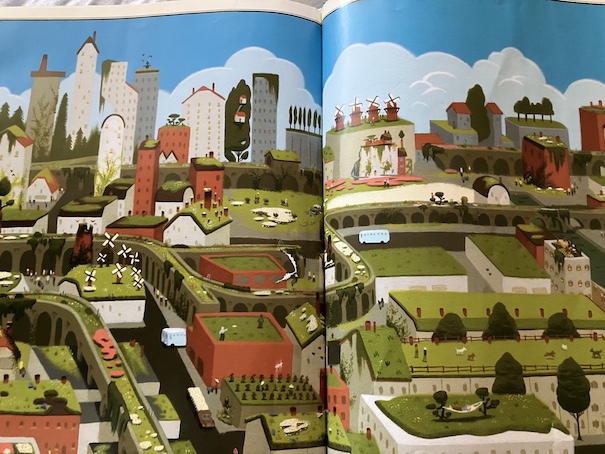
As the garden spreads through the city, other people begin to notice, and they start joining Liam in tending the garden. Greenery begins taking over places and things that are disuses and abandoned, and people encourage the plants to grow where they can enjoy them. Because of their efforts, the city is transformed!

There is an author’s note in the back of the book about the inspiration for the story. There was an elevated train in Manhattan that was shut down in 1980, and plants took over the abandoned tracks. The author, Peter Brown, considered what it would be like if the phenomenon took over an entire city.

The pictures in the book are great, and some pages are full pictures with no text, just showing how the garden grows and spreads through abandoned places in the city. I love how this story was inspired by the way plants take over abandoned places in real life. Plants can grow in some unlikely places, when nothing interferes with them, and in the story, the boy discovers that they can spread further with a little help.

By the end of the story, his entire city is completely transformed into a greener, more eco-friendly place. It’s not just that there are more plants and green spaces in his city, but the factories that we see in early scenes are no longer putting out all that smoke by the end, and we see windmills in the pictures as alternative forms of energy production. We aren’t told exactly why some things are changed about this city, but it seems like the increasing presence of the green spaces has caused people to change aspects of their lives and businesses to accommodate and preserve them. It’s an idyllic solution that doesn’t show a lot of the conflict that occurs in real life, when some people are ready for a change and others just don’t want to change. Still, I like this mage of a hopeful future because it comes as an antidote to the dystopian quality that we see in many forms of modern entertainment.

In the Garden with Dr. Carver

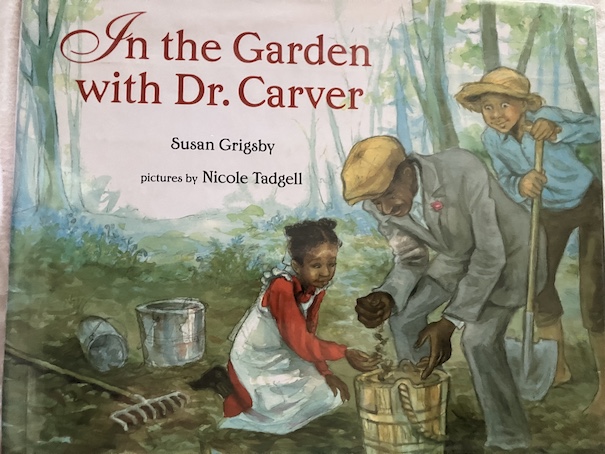
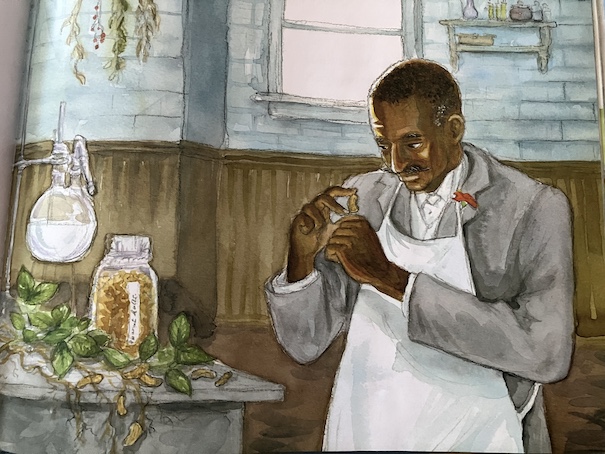
This picture book is about George Washington Carver, as told by a young girl named Sally.

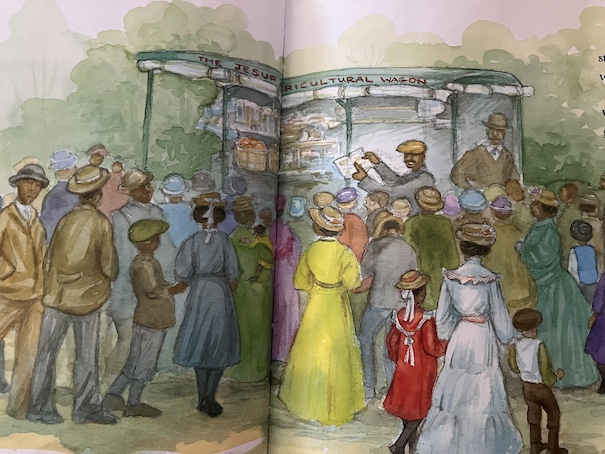
The first time Sally sees him is when he’s traveling with his wagon, pulled by a mule. Sally knows that Dr. Carver is a famous plant scientist from Tuskagee and that he uses his wagon as a kind of mobile school. It contains seeds, plants, and gardening tools, and people come to Dr. Carver for advice about growing plants. The nutrients in the soil of this area have been depleted by growing cotton, and Dr. Carver has been advising them about how to restore the soil. He also advises them about new ways to use common crops.

Dr. Carver visits Sally’s school to help the children with their garden. He teaches them how to use observation to notice the conditions that benefits plants and figure out how to help plants that aren’t doing well. When a boy is about to kill a spider, Dr. Carver stops him, pointing out that the spider helps their garden by eating bugs that are pests for the plants. He teaches the children that everything is part of an ecosystem (although he doesn’t use that word) and that they need to observe and understand the roles each plant and creature has in the ecosystem before deciding to eliminate or change anything. The reason why they remove weeds like dandelions is that their presence doesn’t help the other plants, and they take resources the other plants need. Although, he also shows them that dandelions are edible, so they are not wasted.

Dr. Carver teaches the children about restoring the nutrients in depleted soil using fertilizer and compost made from decaying plant matter and organic materials that most people simply throw away. Dr. Carver teaches them not to waste anything, helping them to make a scarecrow and markers for their plants from scraps of wood and other things people have thrown away.

Eventually, Dr. Carver has to return to Tuskagee, but the lessons he teaches the children stay with them.

There is a section at the back of the book that explains that Sally and her school are fictional, but George Washington Carver was a real person and the story is based around his life and writings. He was born as a slave in Missouri about a year before the abolition of slavery, so he grew up as a free person. He began learning about agriculture and botany from an early age, and as he grew older, he sought out schools that would help him further his knowledge and share it with others. He taught at Iowa State College before Booker T. Washington (see More Than Anything Else for a picture book about his youth) recruited him to be the head of Tuskagee‘s Department of Agriculture in 1896. He also believed in bringing education to people who couldn’t come to a college to learn by sending out bulletins about farming techniques and booklets for teachers in lower grades to use in their classrooms. His mobile school in a wagon was another form of outreach that has been imitated in other places.

I enjoy books about historical figures, and I found this story about George Washington Carver gentle and fascinating. There are some parts that I think I appreciate more as an adult than I would have as a child, making this a book that I think would appeal to readers across different ages and something that parents and teachers would enjoy sharing with children.

Although Sally wasn’t a real person, the lessons she and her classmates receive from George Washington Carver help to illustrate Carver’s real-life work and the lessons that he shared with people of his own time. I appreciated the level of detail the story provided about how people can use observational skills to diagnose and fix possible issues with ailing plants, the importance of understanding that plants exist as part of an ecosystem and that gardeners and farmers need to understand how all parts of the ecosystem interact, and how nutrients can be restored to depleted soil. I can’t remember whether I had heard before about how cotton farming depleted soil nutrients, but I appreciated how that explanation helped explain a real problem facing farmers of Carver’s time and how Carver was helping them to solve it.

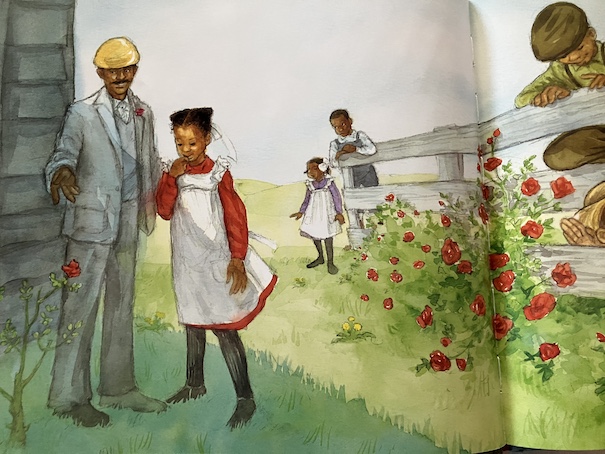
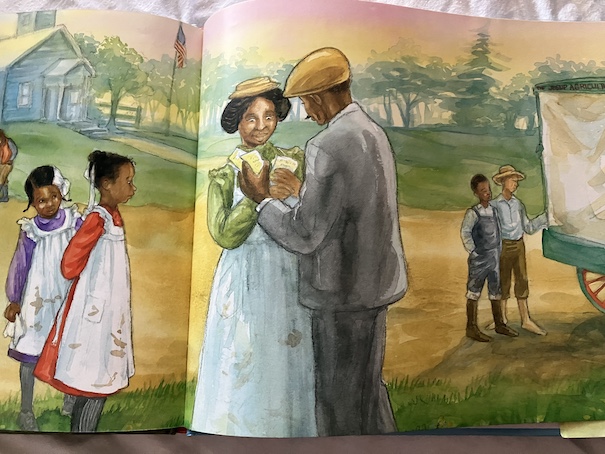
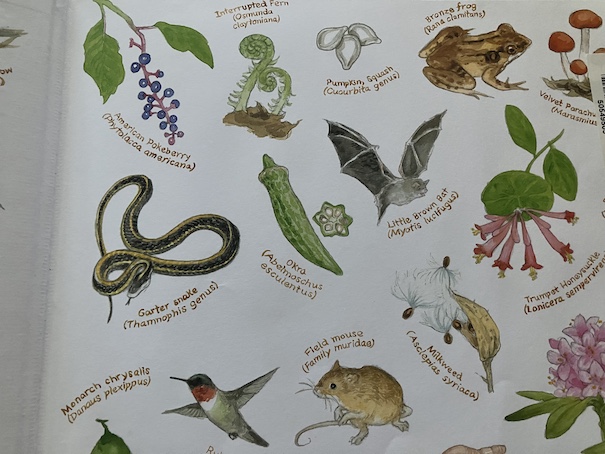
I think this book would appeal to fans of cottagecore as well as people interested in American history. The illustrations are beautiful, and even the inner covers are lovely, with small, labeled pictures of plants and creatures. As the book explains, George Washington Carver himself used drawings of plants and creatures in his work, and in the story, he teaches the children to make their own drawings to help themselves study details of the natural world.

Emma’s Afternoon

Six-year-old Emma has to stay home from school during the summer term because she has measles. By the time her quarantine period is over, Emma is feeling better but is bored and restless, eager to get back to school. However, the doctor thinks she should take an extra week off school to recover further.

As Emma continues to sit at home, she knows the other children are back at school, and she can’t help but think about all the things she’s probably missing and wonder if anybody there misses her. Her mother urges her to find something to do so she’ll be happier and the time will pass faster, but Emma is in a disappointed mood and doesn’t feel like trying to make herself happy. She resists all of her mother’s efforts to cheer her up or get her involved in some activity.

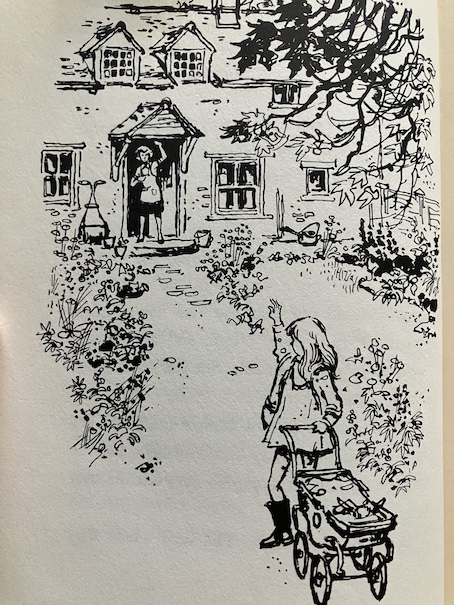
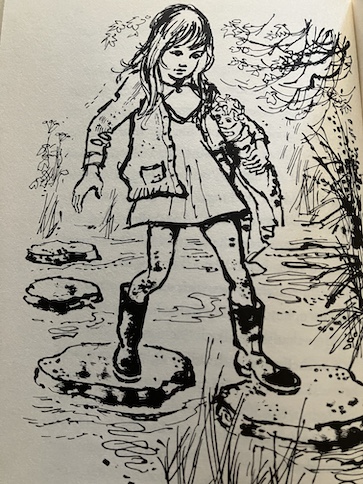
Finally, her mother suggests that she could go to Streamcross, a little area with stepping stones across a stream, where Emma has been with her father before. Emma loves the spot, but she’s never been there alone before. Now, her mother thinks she’s old enough to go alone. Emma takes along her doll, Annabel, and some biscuits (cookies, because this is a British book).

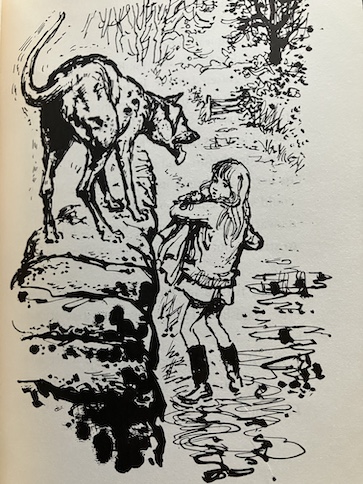
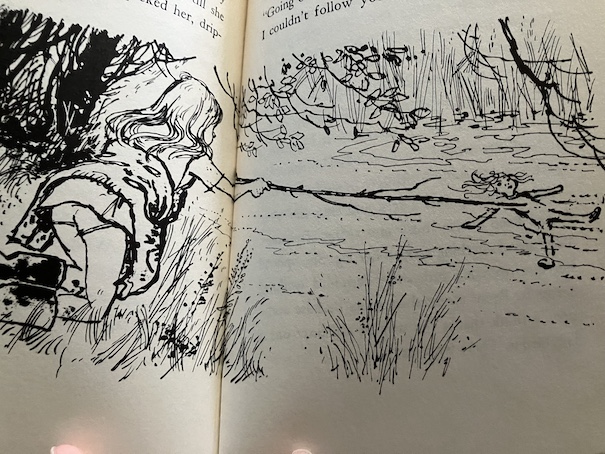
Along the way, Emma has adventures. She has to rescue Annabel from a farm dog. She picks wildflowers. She falls when trying to get a look at a bird’s nest, and she gets stung by nettles. When she tries to clean her doll and the doll’s dress in the stream, she ruins the dress and almost loses Annabel in the stream!

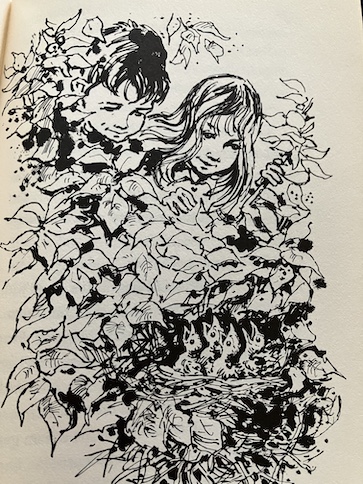
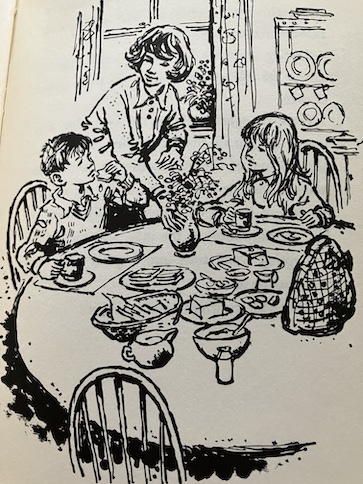
Then, Emma meets up with, Billy, a boy from school. She hides from him because of the state she and Annabel are in, but he spots her because she’s left a few things behind, and Billy plays detective, following the clues. Fortunately, Billy doesn’t laugh at her or her doll. The two of them discover that they share a love for this special spot in the stream, and they trade secrets about it. Emma shows Billy a bird nest she found, and he shows her a hidden spring. Then, he helps Emma to get home, past the farm dog, and stays to tea at Emma’s house.

The book is available to borrow and read for free online through Internet Archive. The American title for this book was Betsy’s Afternoon. The only part of the story that was really changed for the American version was the name of the little girl.

At the end of the story, Emma looks back on the afternoon as being lovely. Not all of it was lovely, like her frightening encounter with the dog or ruining Annabel’s dress and almost losing her completely. During the course of the afternoon, Emma falls down, gets muddy, and is stung by nettles. Still, even when things go wrong, Emma enjoys having an independent adventure, and when she has a friend to share it with her, it gets even better. She also learns that people did miss her at school.

Emma’s adventures are relatively low-key, slice-of-life adventures, but they’re the kind of small adventures that are meaningful, especially to a young child. None of the problems she encounters are very serious, and Emma doesn’t really have any lasting consequences from them, except for ruining her doll’s dress. The dog part was a little scary at first, but Emma isn’t bitten, and Billy later explains that he knows the dog, and it never leaves its farm, so they’re in no danger. Billy is a nice friend, and the two of them appreciate the natural beauties of their favorite spot. In the end, Emma’s adventures and her meeting with a friend who feels the way she does about Streamcross are just what she needs to cheer herself up!

I enjoyed the way the author connected with Emma’s feelings and thought processes. Readers really see through the eyes of a young child – her thoughts, her frustrations, the way she solves problems, and her joy at small discoveries and accomplishments. This is a short chapter book that would be appropriate for children in early elementary school but can still be pleasing to adults.

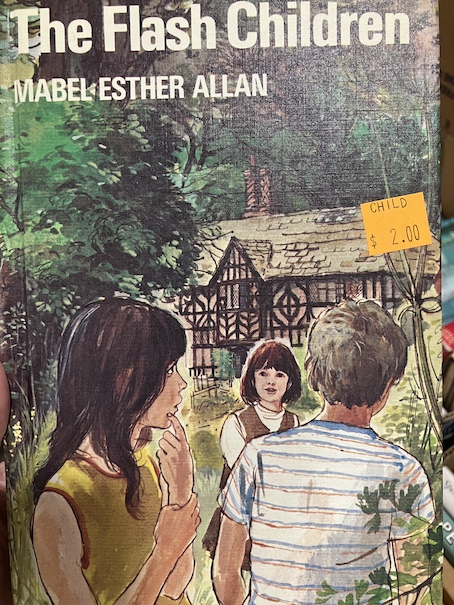
The Flash Children

The Briggs family moves to a new house in July, and the three Briggs children are upset about leaving their old home and friends. Their father tries to reassure them that they’ll make new friends in their new home, but ten-year-old Dilys isn’t so sure. She knows that her mother is also not happy about the move, but it can’t be helped. Her father used to be a cowman on an estate in their old town, but the estate has been sold to be turned into an army training camp, so he has to go somewhere else for a new job.

Their new home will be a cottage near a “flash”, which is a kind of salt lake. Flash Cottage, as their new house is called, turns out to be an ugly modern brick house, not at all like the charming old cottage where they used to live. Their old cottage had a beautiful garden, but this little house doesn’t have much at all. Most of the views from the house are also ugly. The embankment behind the house, where the train tracks are, makes parts of the house dark and blocks the view, and there’s a chemical plant a couple of miles away. There isn’t much else in the area to see. The bright spots of their new home are the lake and the train tracks that run near the house. The fast-moving trains make Dilys a little nervous and they also make the house kind of loud, but eleven-year-old Arthur finds them fascinating. Arthur takes a yellow bedroom at the back of the house, where he can see the trains. Dilys shares a blue bedroom with their little sister, Megan, with a view of the chemical plant in the distance. All three of the children find the house strange and ugly and wonder how they’re ever going to feel at home there.

Dilys doesn’t think she’ll ever like the new house, although she thinks it might be nice if they could go rowing on the lake. Their mother worries about the children falling in the flash because they have to travel across an unfenced causeway when coming to or leaving the house. The children will have to catch a school bus to go to the local school, and Arthur wonders what the other children in the area are like. The children hope to find some friends because, if they don’t, they don’t really know what they’ll do with themselves. There doesn’t seem to be much in the area to do for fun.

The Briggs children meet a boy and girl about their age on their first day at the new house, but the meeting doesn’t go well at first. Arthur stops the other boy and girl from throwing rocks at some ducks. Dilys warns him about making enemies of people because they need some friends in their new home, but Arthur can’t stand to see people being cruel to animals. The other boy and girl already know who the Briggs children are because they were told they would be coming, but Arthur surprises them with a Welsh phrase. The Briggs children’s mother is Welsh, and they grew up near Wales. The boy, whose name is Dan Brown, thinks at first that Arthur was speaking French, but his sister, Edith, recognizes the phrase as Welsh because someone told her that the family was part Welsh. Dan and Edith argue about it, and Arthur asks them if they often argue with each other. The Brown kids admit that they do because there just isn’t that much else to do in the area. Boredom is also the reason why they tease animals, and because they tease animals, they’ve been banned from Colonel Melling’s farm, where Mr. Briggs will now be working with the cows. Sometimes, when they have money, they can take a bus to town to find other things to do, but they don’t always have the money to do that.

Mr. Briggs tells the children that the Brown children are the nearest children in the area. Their mother is dead, and they have an aunt looking after them. Their father also works at Colonel Melling’s farm. The Briggs children aren’t sure that they like the Brown children or want to be friends with them, but they might be their best or only option for friends at all. Their father persuades them to give the Brown children a chance, but Dilys wonders if, before long, they’ll all be so bored that they’ll start throwing rocks at ducks, too.

School isn’t too bad once it starts. Dilys meets another girl she likes, but unfortunately, the other girl lives too far away to see easily when they’re not in school. Some other kids at school tease another new boy named Brian because he’s partially blind. Dan and Edith turn out to be among the worst bullies, and Arthur and Dilys get so angry with them that they get into a fight. Dilys tells Edith that she’s ashamed of how she acts, she thinks it’s disgusting, and she wishes Edith would turn deaf so she can see what it’s like to live with a disability. The other kids back down rather than fight Arthur, and surprisingly, Edith is actually a little embarrassed when she sees how angry and disgusted Dilys is with her. It seems like the behavior of the local kids is as rough and ugly as the area where they live, but Dilys finds herself interested in Brian because he seems to be a different type of person.

Mrs. Briggs is as homesick as the kids for where they used to live, but she starts to make friends with Miss Brown, the aunt looking after Dan and Edith. Mrs. Briggs says that Miss Brown is a nice lady, but she doesn’t entirely know how to cope with the children, and Dan and Edith often misbehave and make trouble. She’s only been living with her brother and the children since their mother died last year.

One day, Dilys and Arthur go exploring, and they find an unexpected green area down a road that makes them feel more like home. They get caught in a sudden storm, so they take shelter under a railway bridge, where they meet Dan and Edith, also taking shelter. They start talking more about the area and places to explore, and Dan and Edith say that they can’t go down by Mr. Lowe’s farm anymore. Arthur asks them why, and they admit that they stole some plums from him and left his gate open, so the livestock got out. Arthur and Dilys can see why Mr. Lowe would be angry, but Dan and Edith defensively add that they didn’t leave the gate open on purpose. They just forgot to close it because Edith got stung by a wasp and was upset, but Mr. Lowe won’t believe them. They say it’s a pity because the area is much more interesting over there. There’s an old manor house, a stream, and a ruined mill over that way.

Things change for the children when Dilys, Arthur, and Megan befriend an artist who lives in a cottage nearby, John Zachary Laurie, and he’s a friend of Colonel Melling. He takes them out rowing on the flash and talks to them about how they like their new home. The Briggs children confide in him how unhappy they’ve been since they moved to the area because everything is so ugly, but the artist points out that it’s not really an ugly place. He says he finds it fascinating to paint because it has certain “dramatic effects.” When he shows them his pictures, they’re very different from the kind of pictures that the children are accustomed to seeing. Rather than conventional flowers and pretty landscapes, they are filled with angles and a lot of grays and browns, but with unexpected dashes of color. They’re unmistakably pictures of the area, but not in a way the children usually see it. The landscape in the paintings is familiar but strange, ugly but also oddly enchanting. John Laurie even gives them one of his paintings, the one he did of their new house, Flash Cottage. He says he knows the children hate the house now, but he thinks it has interesting angles, and if they learn how to look at things a little deeper, they’ll see more than they do now.

Although Dilys isn’t quite sure that she understands it, she begins to feel what the artist is talking about. Things that are strange start to feel familiar, and even in the ugliness of the landscape and the picture of their house, she begins to feel a sense of fascination and attraction. It’s not exactly pretty, but it is compelling.

When school lets out for the summer, the Briggs children once again find themselves bored and lonely. The few other children they like don’t live close to them, like Dan and Edith, and the Briggs children still think Dan and Edith are pains and troublemakers. Looking for something to do, Arthur, Dilys, and Megan decide to explore the old manor house that Dan and Edith mentioned.

It turns out to be a beautiful place, although it’s old and deserted. To their surprise, they discover that the property actually belongs to Brian’s family, the Pelverdens. They live in a little cottage behind the old manor house. Brian has a little sister, Mellie (short for Melinda), who would be a good friend for Megan, but Brian seems less than pleased that Arthur and Dilys have discovered where he lives. Brian’s father explains that they haven’t been living here long. The manor house has been in the family for generations, but it’s fallen into ruin because they haven’t had the money to maintain it for a long time. They only recently inherited the place themselves when Brian’s grandfather died. The Pelverdens don’t expect to ever live in the manor house themselves, but their hope is that, if they get it sufficiently repaired, they might have it registered and preserved as a historic building and get a grant to maintain it. The Briggs children eagerly volunteer their services to help with the project over the summer. They have nothing else to do, and they still miss the garden from their old cottage, so helping to replant the manor garden would be fun for them. The Pelverdens’ cottage and the crumbling old manor house are more beautiful to them than anything else they’ve seen since they moved, and they feel more like home.

Mellie is immediately happy to have found a friend in Megan, but Arthur and Dilys find it harder to make friends with Brian. Brian has known all of his life that he’s different from other kids because of his vision problems, and he’s used to people treating him differently or making fun of him. He tries very hard to be as “normal” as he can and prove to everyone that he can do things other kids can do. Because he feels like he has something to prove to everyone, he’s often less friendly than he could be, but Dilys is determined to earn his trust.

However, Dan and Edith are still problems. The Briggs children fight them off one day when they catch them teasing the Briggs’s cat. Edith is offended that the other kids keep telling them everything they do is wrong. Then, another day, they show up at the old manor house and break a window by throwing rocks. When the Briggs children and Mr. Pelverden confront Dan and Edith about what they’ve done, Dilys come up with a plan that might solve the Dan and Edith problem and prevent them from making further trouble.

The book is available to borrow and read for free online through Internet Archive. There is a sequel to this book called The Flash Children in Winter, which is about the children experiencing their new home in autumn and the lead up to their first Christmas there.

I thought this book was interesting because it has aspects of a cottagecore style story, but there are parts of it that contrast with the typical cottagecore aesthetic. The main characters in the story, the Briggs children, have come from an environment that would be like a cottagecore dream: an actual old cottage with a beautiful garden attached to an old manor house, where they were allowed to help out. Then, they have to move to a far more plain and conventional house in an ugly area with a view of a chemical plant. It’s understandable that they would feel badly about the move. Moving and starting over again would be difficult for anybody, but most people would find their new environment downright depressing, especially after hearing what their old home was like.

When they find out that Brian’s family lives in a cottage and is renovating their old manor house to turn it into a historic site, the story goes back to the charming sort of environment the children come from. However, it’s not just about the children finding a way back to the kind of environment that has the beauty and charm they crave but also learning to see what makes different types of environments fascinating, even enchanting. The Flash Cottage isn’t a real cottage, and it’s not as pretty as their old home, but after talking to the artist and looking at things from an artist’s viewpoint, taking into account the features of a place that make it unique, Dilys comes to see how a shift in perspective can make many different environments more attractive, in their own way.

Learning to get along with Dan and Edith also involves finding a different perspective and a different way of dealing with them. It’s not just about seeing the good side of Dan and Edith as they are. Frankly, the two of them are pain-in-the-butts. Dilys realizes that their problem is that they are thoughtless. They don’t think about other people, how the things they do affect anyone else or make them feel. Their thoughts begin and end with themselves. They’re bored and feel unwanted at home since their mother’s death, so they cause trouble because they just can’t seem to think anything else to do. Personally, I don’t think either Dan or Edith is very intelligent or imaginative because intelligence could be used to reason out why people react to them the way they do and a little imagination would help them put themselves in other people’s position or help them think of different things to do or ways to approach other people. However, Dan and Edith don’t do any of those things on their own. It never even seems to occur to them that they could. They only get upset when other people are unhappy with them and seem totally unable to understand why.

Even though Dan and Edith don’t seem either very bright or very considerate, it does occur to Dilys that they could learn to be helpful if someone actually set them tasks to do to keep them busy. At her persuasion, Mr. Pelverden and the other children allow Dan and Edith to join their efforts to clean up the manor. Dan and Edith are actually eager to accept the opportunity to help out with the others because they are incredibly bored and seriously need something to do and people to be with. When the others are dubious about whether they’ll actually do any helping or if they even know how to help, they try to prove that they can do things that are useful for a change. It also proves educational for Dan and Edith because, in helping to clean up the manor, they’re also forced to face damage they have caused themselves and begin to realize how things they’ve been doing have caused trouble and made extra work for other people. They’re not used to seeing themselves as other people see them or dealing with the consequences of their actions, and it’s an eye-opening experience for them. Later, they all have to face off against a motorcycle gang that comes to vandalize the manor, and Dan and Edith have come to see where their loyalties really lie and what menaces people can be when they act like they used to.

The story ends happily for the children and for the manor, which is going to be preserved. The Briggs children feel more at home in their new home, Dan and Edith have greatly reformed, and Brian has learned to be more open with people about his disability, so other people come to understand him better and treat him more kindly. Some of the people who made fun of him before admit that they didn’t understand just how bad his vision was, so they didn’t know why he seemed to struggle so much. Dilys still tells off those kids for not having figured it out, but at the same time, she is the one who tells Brian that he has to make things clear to people and not try to pretend that his condition doesn’t exist or that he doesn’t need some help when he actually does.

The author, Mabel Esther Allan is also a very interesting person. During her life, she wrote more than 100 books for children, under different pen names. She struggled with vision problems of her own when she was young, which was part of the inspiration for Brian in the story. During WWII, she worked was part of the British Women’s Land Army, and she also worked as a teacher.
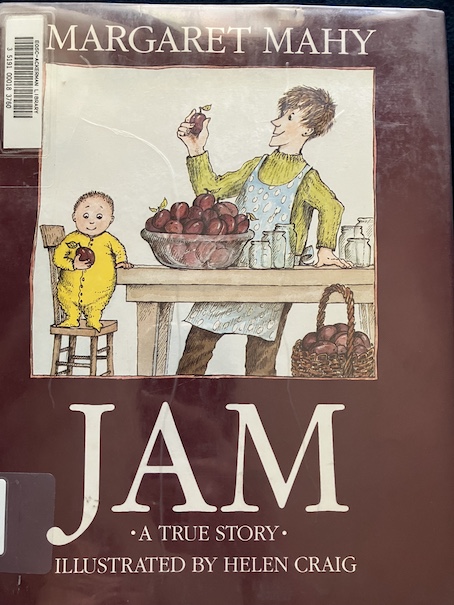
Jam

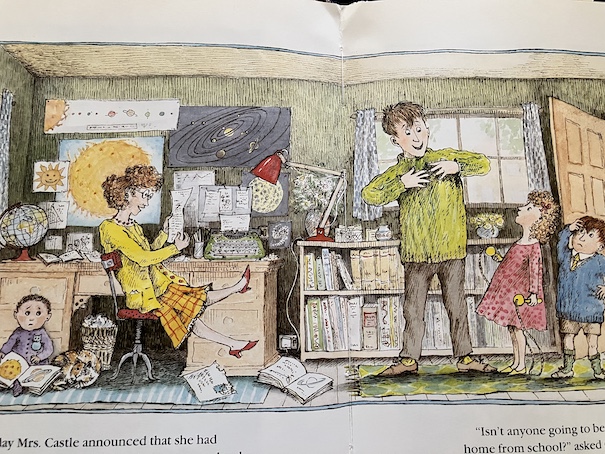
Mr. and Mrs. Castle have three children and live in a house with a plum tree in the backyard. When Mrs. Castle gets a new job, Mr. Castle is proud of her and decides that he will stay home and look after the children. Mr. Castle likes being home with the children, and he does all sorts of useful things around the house.

One day, he realizes that he’s been so efficient at getting things done around the house that he’s run out of things to do. While he’s thinking about what to do next, he hears an odd sound. It turns out that the sound is ripe plums from their plum tree, hitting the roof as they fall off the tree.

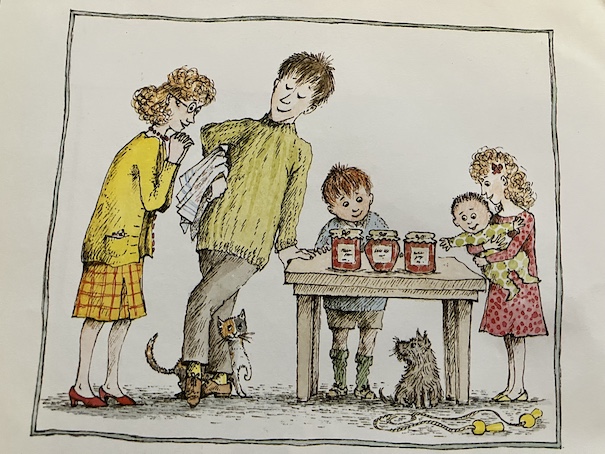
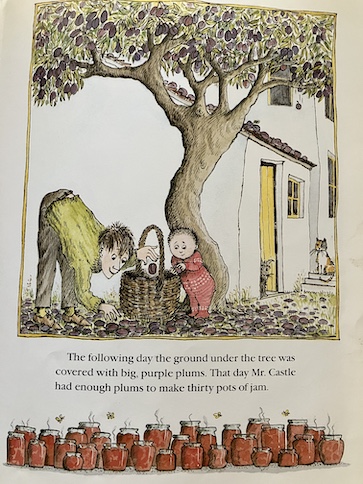
Mr. Castle gathers up the ripe plums and makes plum jam. His family loves it, so the next day, when many more plums have fallen, he gathers those up and makes even more plum jam. As more and more ripe plums fall from the tree, Mr. Castle can’t stand to see them go to waste, so before long, the family has far more plum jam than they have jam jars.

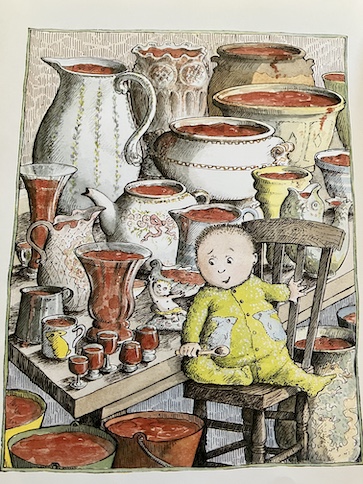
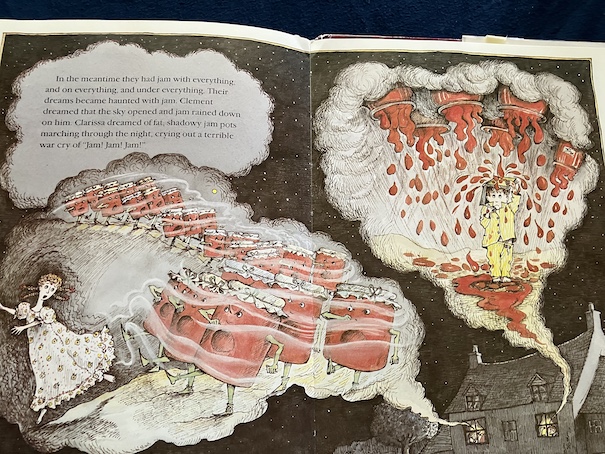
Then, comes the real challenge: eating all the jam. As the weeks go by, the family eats jam with everything, and Mr. Castle makes many recipes involving jam, but there’s still plenty of jam left. They try everything they can think of to use up all the jam, including using it to re-tile the bathroom, but there’s just too much jam! It gets to the point that family members are starting to have jam-related nightmares!

Will they finish all of their plum jam before the plums are ripe again? Will they ever be able to eat anything without jam ever again?

The book is available to borrow and read for free online through Internet Archive. The book also includes a simple recipe for plum jam.

This story is funny, especially because it’s supposed to be “a true story.” I have the feeling that the author’s family had a similar incident where an experiment in jam-making went too far and became overwhelming. The family in the story eats jam in various ways to use it up, and Mr. Castle even uses it for handyman projects, like fixing a leaky roof or gluing down bathroom tiles. They never mention the idea of selling the extra jam or giving it away as gifts, probably because those ideas would make too much sense and would help solve the problem, and the story is meant to be silly.

Besides how overwhelmed the family feels about the amount of jam they have to eat, there are plenty of other funny things happening in the story. Mrs. Castle’s new job is with some scientists who are “developing an electronic medicine to cure sunspots.” It doesn’t make any sense, but the story emphasizes how proud Mr. Castle is that his wife is so clever, and the topic of sunspots appears throughout the rest of the story as a running gag. I also thought it was cute how Mr. and Mrs. Castle refer to their children, the little Castles, as being “Cottages.”

There is minor mention of alcohol in the story. There are a couple of points in the story where the parents are mentioned as drinking sherry, which isn’t very common the US. I checked, and the author, Margaret Mahy, was from New Zealand.

The Mother Goose Cookbook

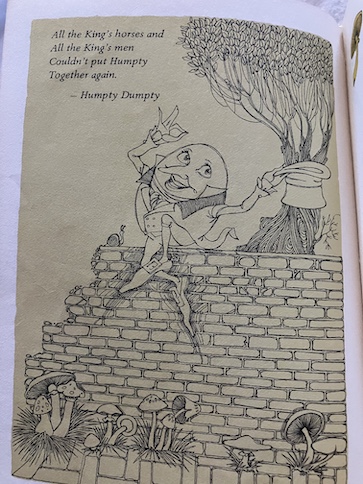
I remember reading this book from my local library when I was a kid, and I had to look it up again because there were a couple of things that stuck in my mind about it. First, the recipes in this book are also based on songs and fairy tales, not just nursery rhymes, and second, while there are other cookbooks that use nursery rhymes and fairy tales as themes, this one chooses some of the more unusual ones. There are some common rhymes and references in the book, like using Humpty Dumpty for an egg recipe and referencing Little Miss Muffet for Curds and Whey, but there also less common ones, like Aiken Drum. Overall, I liked the variety of nursery rhyme and fairy tale references in the book, and I think the recipes generally fit the references well.

Second, some of the recipes sound a bit fancy for a child’s cookbook, but as a kid, I found them intriguing because they had a kind of old-fashioned quality that I thought made them seem more like nursery rhyme and fairy tale foods. Because, as a kid, I rarely ever had the patience to read the introductions to books before plunging right in, I missed some of the historical information behind some of these recipes and rhymes that the book explains in its introduction. Rereading this as an adult, though, I really appreciated the thought that the author put into the history of food in nursery rhymes.

The introduction begins by posing the question that many children have asked when hearing or reading nursery rhymes, “What are curds and whey, anyway?” I certainly wondered that when I was a kid, and the book notes that many parents also don’t know the answer. It goes on to explains that the “Mother Goose Era” (not really defined but probably the era when the rhymes were first composed) spans roughly from 1600 to 1800, and the foods mentioned in the rhymes is a mixture of real foods and imaginary ones. The author researched real, historical recipes and adapted them for modern use, while trying to remain as faithful as possible to the original nature of the dishes. In the cases where the author couldn’t find information about the dishes or where the foods mentioned seem to be imaginary, she created original recipes to represent them.

Although the author intends this book for children, I personally thought that the nature of some of the recipes and the difficulty of some of them make them more suitable to nostalgic adults.

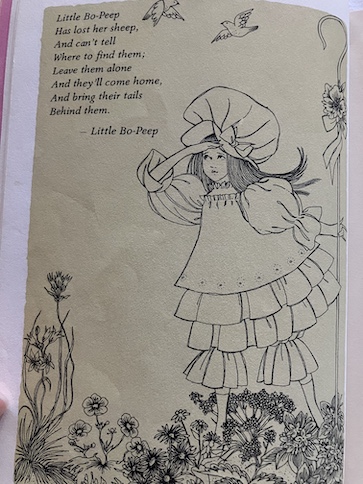
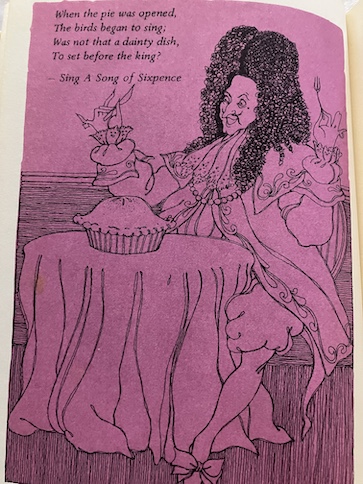
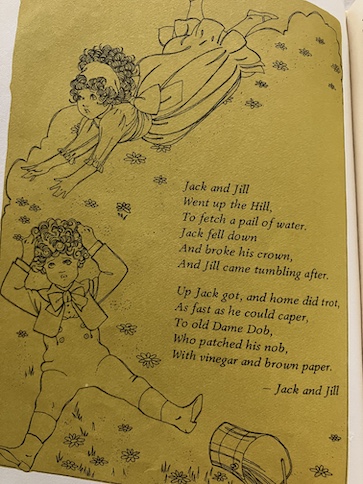
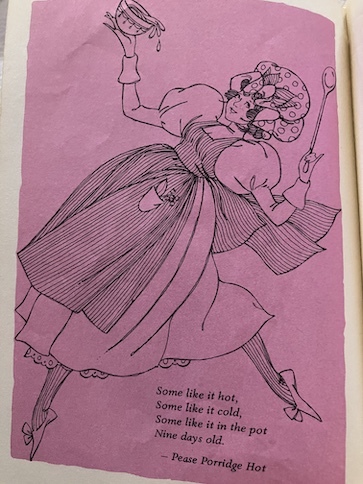
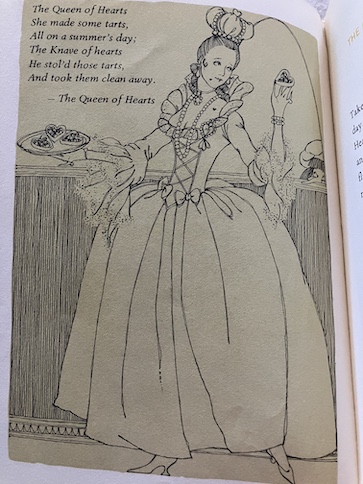
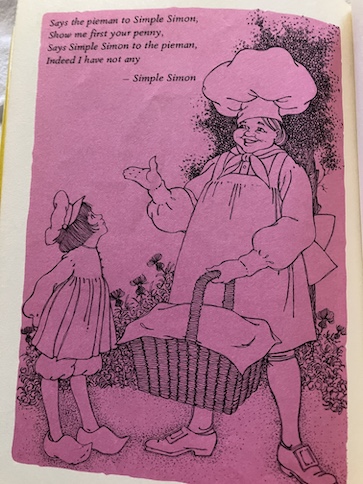
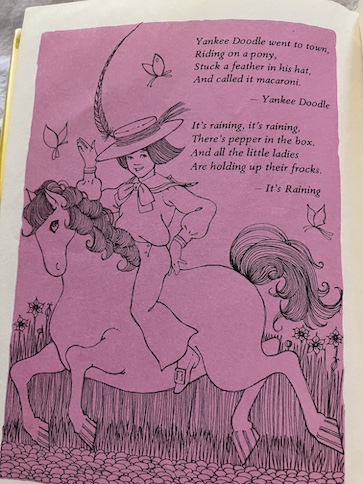
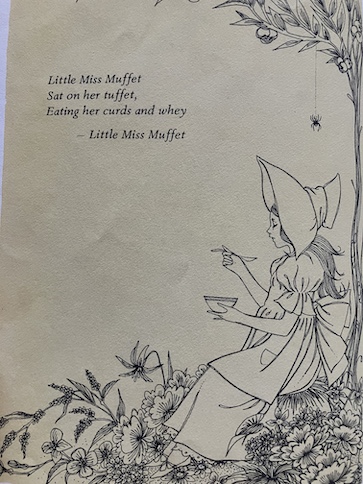
The recipes in the book are sorted in alphabetical order, skipping a few letters of the alphabet that they didn’t have recipes to match. Each of the recipes is accompanied by a pen-and-ink picture of the nursery rhymes or fairy tale connected to the recipe, and the pictures are on backgrounds of varying shades of purple and light green.

The book is available to borrow and read for free online through Internet Archive.

A is for:

Aiken Drum’s Glum Gallimaufry – This is a kind of stew made with mutton and vegetables, one of the dishes that I would think more suitable to an adult than a child. Stews in general aren’t too hard if you start with pre-chopped meat and veggies, but I don’t think many modern children are accustomed to eating mutton or would be interested in doing so. At least, in the United States, mutton isn’t a very common food.

B is for:

Betty Pringle’s Pastry Pigs

Bubble and Squeak, a la Bo-Peep – This is a dish made with lamb and cabbage.

C is for:

Cock Robin en Cocotte – I never liked this rhyme, and the recipe is for cooking small poultry.

Curds and Whey, One Way – It doesn’t precisely define what “Curds and Whey” are, but it’s a dairy dish made with soured milk and oatmeal.

Curds and Whey, Another Way – There’s a second method for making it.

D is for:

Daffy-Down-Dilly’s Jolly Jelly

Dappled Grey’s Farthing-a-Mare Gingerbread

E is for:

Elsie Marley’s Nine O’Clock Barley

F is for:

The Fatted Figs from Budleigh Fair – This one asks you to fry figs in fritter batter, but it doesn’t give you the recipe for the batter.

Four-and-Twenty Blackbird Pye – This is another recipe that I think only an adult might try. The “blackbirds” are made from beef liver.

G is for:

Good Pulled Bread for Tommy Tucker

H is for:

Hickory Dickory Flummery – A flummery is a type of old-fashioned dessert.

I is for:

Intery Mintery Cutery Corn

J is for:

Jack-a-Dandy Kissing Candy – This is a very old-fashioned candy – candied rose petals and violets. I think I have had candied flowers at a living history museum, but I’m not sure where to get the rose petals and violets to make any myself.

Jack and Jill Johnnycakes – This recipe is accompanied by a vinegar pudding sauce.

K is for:

King Arthur’s Bag Pudding en Croute

King Boggen’s Three-Farthing Turnips

L is for:

Little Betty Botter’s Better Butter Batter – This is a shortbread recipe

L’Orangerie St. Clemens

M is for:

Margery Daw, Petit Pois – This is a dish of peas, but there’s a little game as a twist. You add either a corn kernel or a small onion to the peas, and whoever gets the corn or onion on their plate has good luck.

O is for:

Oeufs a la Humpty Dumpty – “Oeufs” is the French word for eggs. This recipe wants you to serve it with Bechamel sauce, but there’s no recipe for the sauce.

P is for:

Pease Porridge Chaud-Froid – This porridge is made with oatmeal instead of peas.

Peter’s Pickled Peppers

Pippin Hill Ladyfingers – This is a dessert made with apples.

Punch and Judy Rolling Pin Pie – This is an apple pie recipe.

Q is for:

Queen of Heart’s Purloined Tarts – These are heart-shaped cherry tarts.

R is for:

Rowly Powly’s Roly-Poly – The name of this rhyme is unfamiliar to me, but I know a variation of it under the name Georgie Porgie.

S is for:

A Salamagundi for Solomon Grundy – This is a dish with potatoes, carrots, and onions.

St. Dunstan’s Belfry Bacon

St. Swithin’s Rainwater Tea – This is a recipe for an herbal tea made with actual rain water. I’m not sure that I would recommend people actually gathering and drinking rain water, but the herbal tea sounds nice, and this section does explain a little about St. Swithin and the tradition behind the rhyme that goes with it.

Simple Simon’s Ha’Penny Buns

Slitherum Slatherum Soul Cakes – I was fascinated by the recipe for Soul Cakes, an old tradition from Halloween, All Saints Day, and All Souls Day. The book says that they should be made on the eve before All Souls Day (evening of November 1) rather than Halloween. However, from my earlier Halloween research, I know that different countries and regions had their own traditions and their own recipes for Soul Cakes. There is no single, universal recipe for Soul Cakes.

T is for:

Three Men in a Tub Pommes de Terre – This is basically a recipe for french fries, using three potatoes soaked in a tub of ice water before being fried in hot fat. (The book doesn’t explain why, but I know that doing that makes them crispier.)

Tuppeny Rice – This is a sweet rice dish made with cinnamon and sugar and marmalade.

Tweedle Dee’s Dumplings a Deux – These dumplings include cow’s liver.

W is for:

Willy Wood’s Wondrous Pennyloaves

Y is for:

Yankee Doodle’s Pepperbox Noodles

Z is for:

“sleeping after all this good eating!”

Home for a Bunny

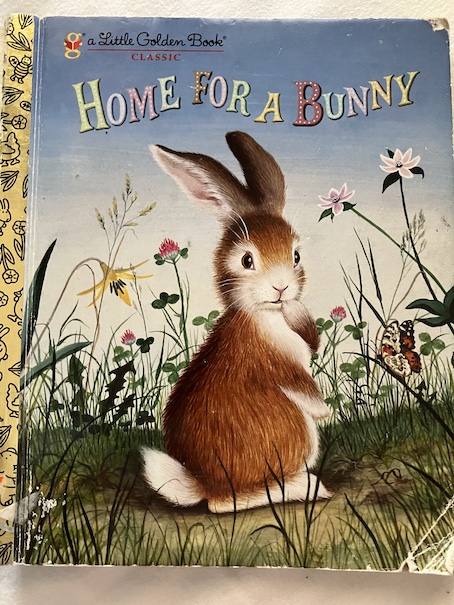
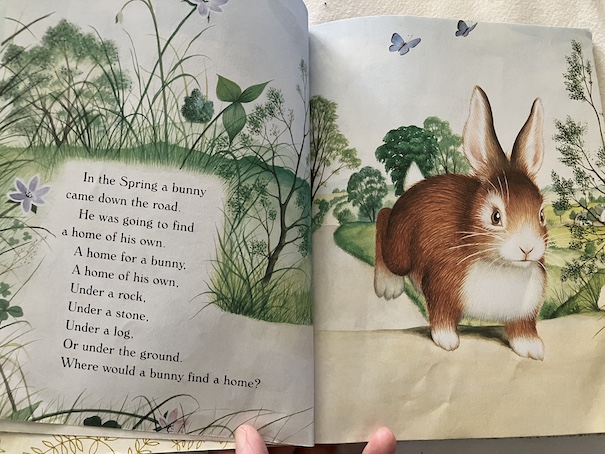
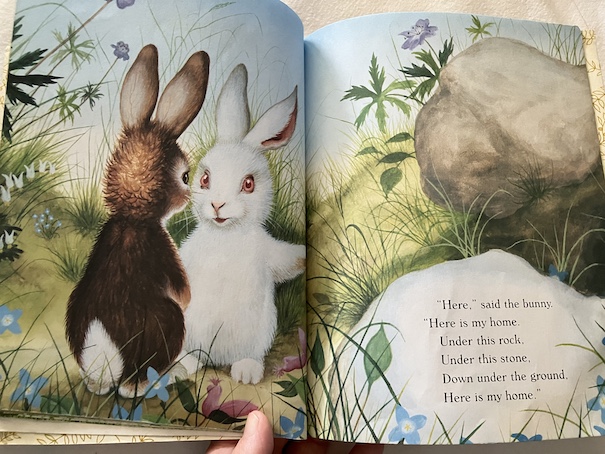
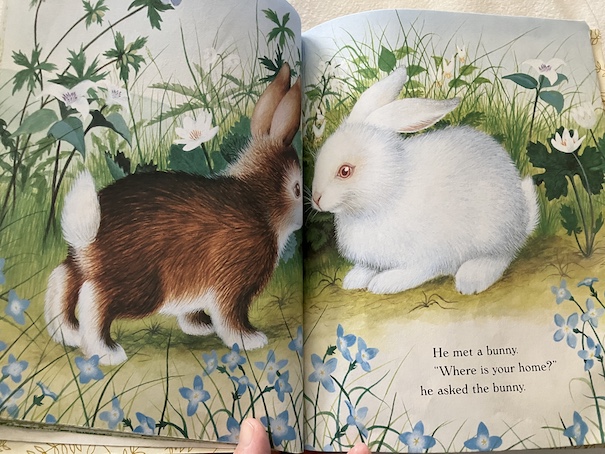
It’s springtime, and a little bunny is searching for a new place to call home.

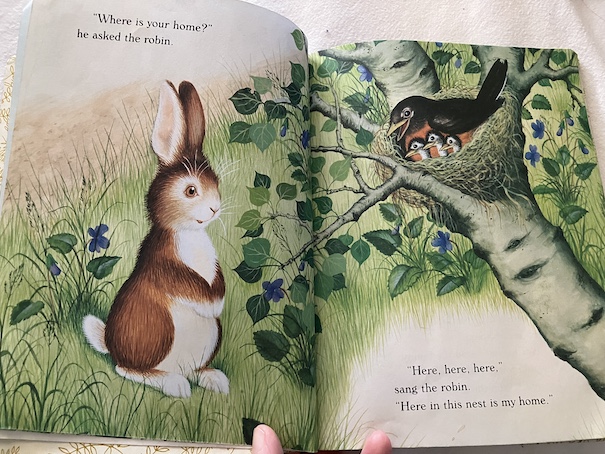
As he looks for a place that might suit him, he asks the other animals about their homes. However, most of the homes of other animals wouldn’t work for him. The bunny knows he couldn’t live in a nest like the birds or in a bog like a frog.

There is a point when the bunny thinks another animal’s home might suit him, when he talks to a groundhog who lives in a log, but the groundhog is not willing to have him as a housemate.

The bunny finally finds his home when he meets another bunny, who invites him to stay!

The book is available to borrow and read for free online through Internet Archive (multiple copies).

This vintage Little Golden Book is a calm and sweet story about a little bunny finding a home that’s just right for him. I liked how the bunny looks at other animals’ homes to figure out if any of them would be right for him because it shows young children how each animal’s home has conditions that are right for that animal but wouldn’t be right for a different type of animal. The bunny realizes that a nest in tree wouldn’t work for him because, unlike birds, he can’t fly and would fall out of the nest. Similarly, he can’t live in a bog with a frog because he’s not amphibious and would drown. (The book doesn’t use the term amphibian or amphibious, but I think kids would get the idea that some animals are better able to live in and around water than others.)

The story also includes the idea is that what makes a home is also who shares that home. The bunny thinks that the place where the groundhog lives could work for him, but he’s not a groundhog and the groundhog doesn’t want to share his home with the bunny. The place where the bunny eventually finds is rabbit hole he can share with another bunny, who is happy to have him as a companion. It’s a calm story with a happy ending because there is a home for everyone and someone for everyone.

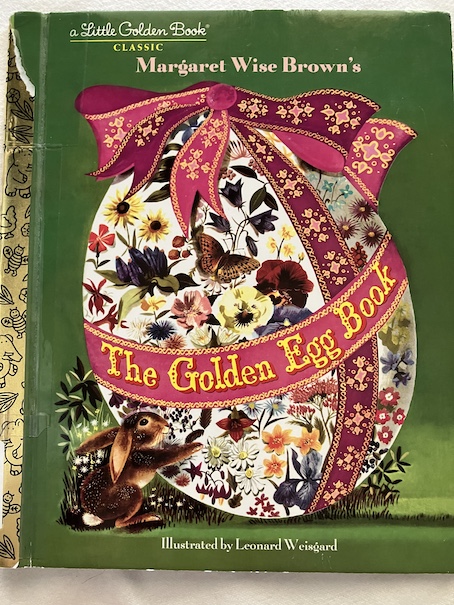
The Golden Egg Book

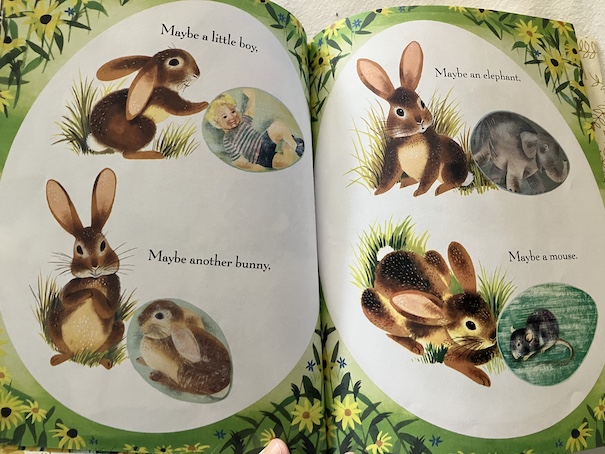
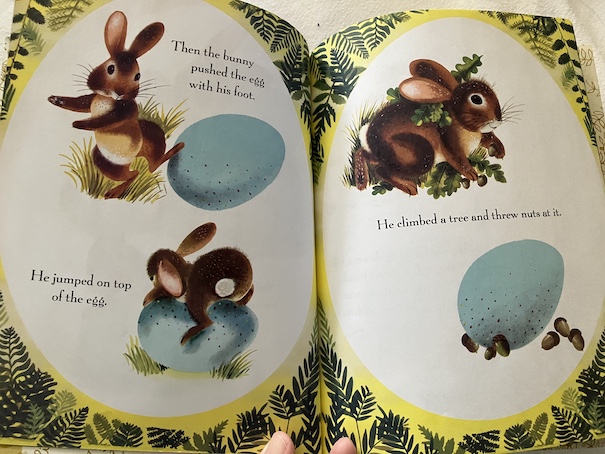
One day, a little bunny finds a blue egg. He knows there’s something inside the egg because he can hear it moving, but he doesn’t know what kind of egg it is. He imagines all the different creatures that could be inside the egg.

He tries to figure out how to get the egg open. He shakes it, kicks it, jumps on it, rolls it down a hill, and throws nuts and small rocks at it. Nothing he does causes the egg to open.

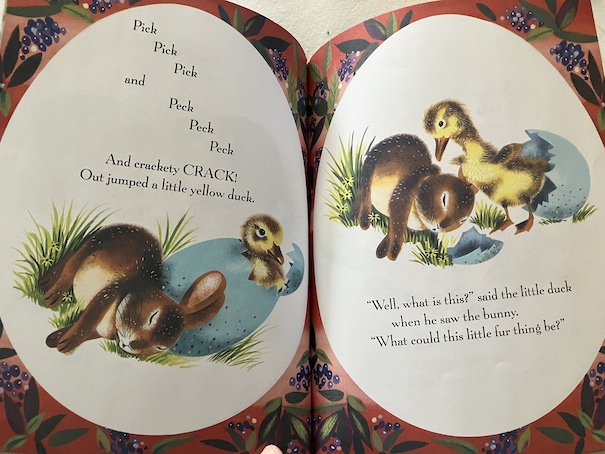
Eventually, the bunny falls asleep next to the egg, and while he’s asleep, the egg hatches! The animal that hatches out becomes the bunny’s best friend!

This is a vintage Little Golden Book, originally printed in the 1940s, about two young animals trying to figure each other out. The bunny apparently knows that some things hatch from eggs, but he’s not sure exactly how that happens or what sort of things might come from an egg. Even little kids will know that the things that the little bunny thinks might come from an egg are silly, like a little boy or an elephant, but that’s part of the fun of it.

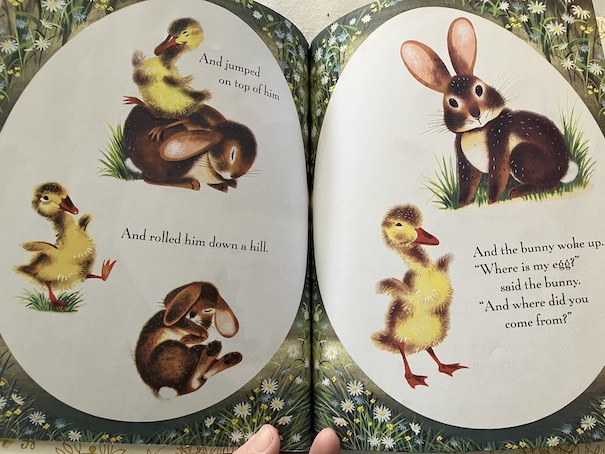
There’s some repetition in the story, which young children enjoy, because when the duckling hatches out of the egg and finds the bunny asleep, he tries some of the steps that the bunny tried on his egg to get the bunny to wake up, like pushing the bunny with his foot, jumping on him, or rolling him down the hill.

Fortunately, neither animal hurts the other in their attempts to hatch the egg or wake up the bunny, and the two become friends. It’s just a cute little picture book that might be fun for springtime or Easter!

The Little House

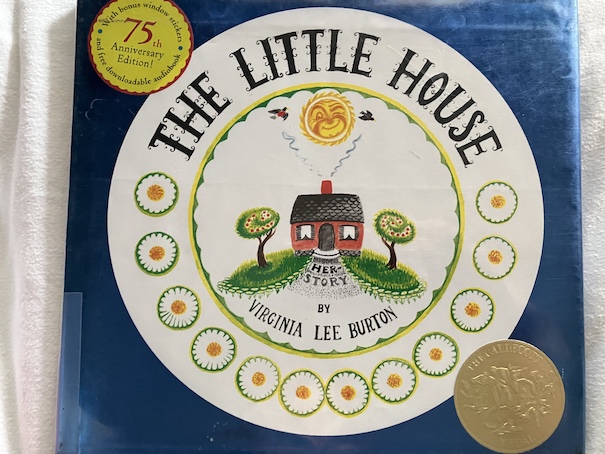
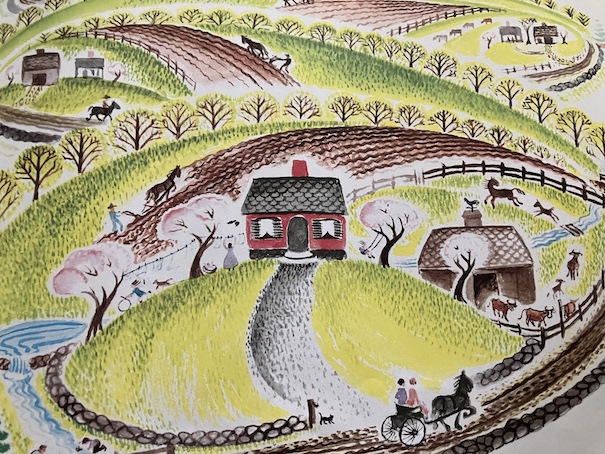
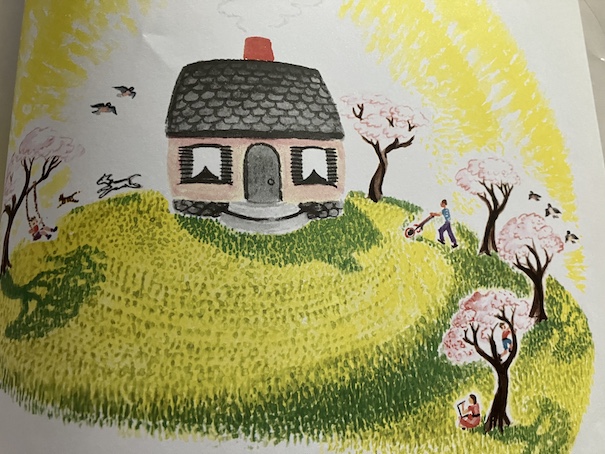
A family builds a strong little house in the countryside, dreaming of their descendants living in her. The little house is happy in the countryside, watching the changing seasons as the years come and go.
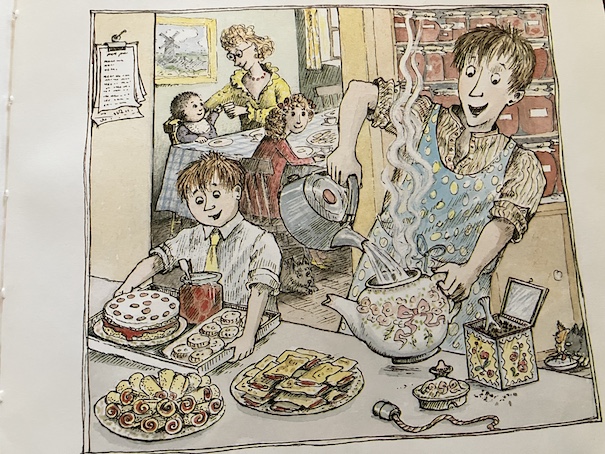
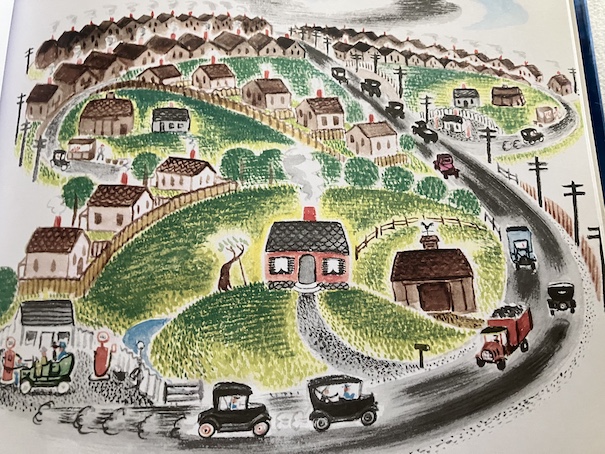
Over time, things begin to change, though. Other farms are built around the little house, but then, a big road is built, and the little farms gradually give way to suburbs.

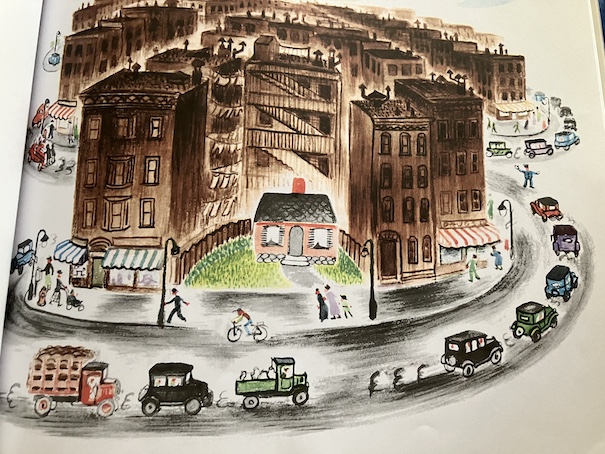
Eventually, the houses around the little house turn into bigger houses and apartment buildings. As time goes on, the little house is no longer in the countryside or even the edge of the city, but it’s actually engulfed by the city itself.

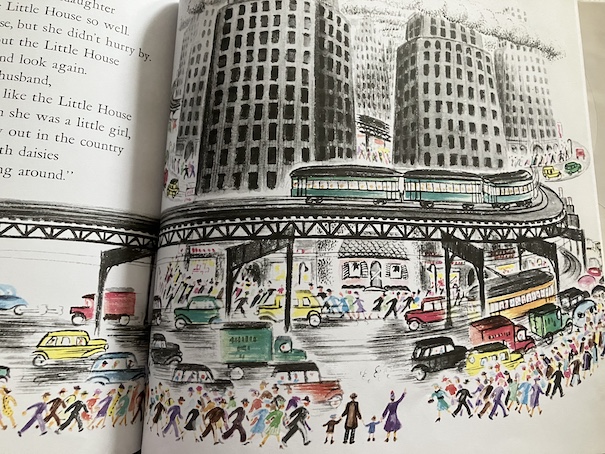
The city becomes more and more crowded with taller and taller apartment buildings, more roads and trains, and crowds of peoples. The little house stands empty and becomes run-down. She can hardly see the sky and can’t feel the changing of the seasons the way she used to because there isn’t much nature around her to sense changing.

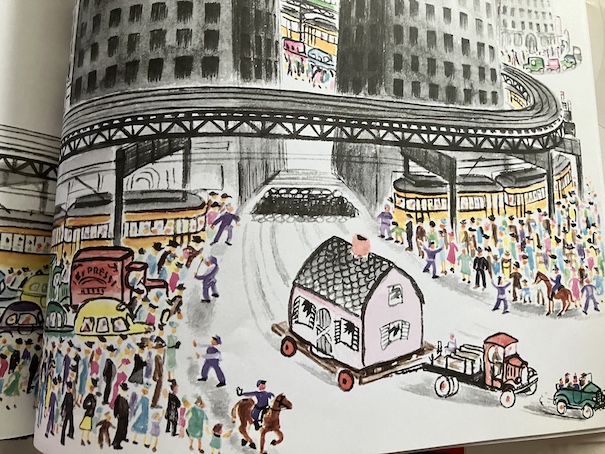
Fortunately, the little house is rescued from this terrible situation. One day, the great-great-granddaughter of the man who built the house spots the little house in the city and recognizes it as the one her family owned. When she and her husband look into it, they verify that this is her family’s old house, and they decide that they want to move it to the countryside, like when her family lived there.

Because the little house was built so strongly, they’re able to move it intact to the countryside. The little house is happy to once again live in the countryside with the family who always loved her!

The book is available to borrow and read for free online through Internet Archive.

This vintage picture book is about the nature of change. Growing cities do expand into the countryside around them, so a house that was once outside of the city is gradually touched by and then engulfed by the nearby city as it expands. Readers get the feelings of the house as the world around her changes. At first, she’s a little intrigued by the city and isn’t sure if she likes it or not, but as the city becomes overcrowded, the house is neglected, and she can no longer sense the seasons, she decides that she doesn’t like it. When things change for the house again, she is relieved.

I remember this story from when I was a kid, and I remember feeling sad when the poor house was run-down and neglected in the city, surrounded by the towering apartment buildings. However, the book has a good ending. Houses can be moved, and the family that once owned this house remembers it and rescues it from the city, moving it to the countryside, where they all feel more at home. Things change, but sometimes, they change for the better. The house can’t move itself when it isn’t happy, but the family gives it the help and attention it needs.
When I reread this book as an adult, it suddenly occurred to me that this book was originally published during WWII, when the world was changing in some very scary ways. I think a book like this might have been reassuring to children of that time. Life is full of changes, but sometimes, things can change for the better again.