The Mystery of the Goldfish Pond

Three Cousins Detective Club

Timothy’s father wants him to sing at his boss’s retirement dinner. The boss’s wife heard Timothy sing once with his choir, and she wants him to sing a special song for her husband at the start of the dinner. His cousins are invited to come along so he won’t be the only kid there. Timothy doesn’t really want to do the singing, but his parents convince him to do it anyway because the boss’s wife is so fond of him and his singing.

Timothy’s father hopes that the dinner will go well because the boss has been worried about the possibilities of competitors getting their hands on information about their new product. Earlier, the boss temporarily misplaced an important memo about it, and he was worried that someone else got their hands on it.

Timothy’s song goes well, and after the dinner, the kids are allowed to walk outside in the garden while the adults listen to a series of speeches. The gardens outside the banquet hall are beautiful, and the kids start to enjoy themselves. Then, they accidentally overhear a couple of adults talking. They can’t quite catch everything they say, but something strange is going on, and something secret is hidden somewhere in the garden.

The theme of this story is Proverbs 11:13, “No one who gossips can be trusted with a secret, but you can put confidence in someone who is trustworthy.”

The book is available to borrow and read for free online through Internet Archive.

The crime that the adults were plotting involves the theft of information. The kids have to figure out the parts of the conversation they couldn’t hear clearly to figure out where the information is hidden. I thought that the clue the children try to figure out was fairly easy. Part of the conversation the kids try to figure out sounds like “-ake -urtle”, and there aren’t many words that sound like “-urtle.”

The boss’s wife seemed eager for the children to go outside, into the garden, and tell her about it later. The kids wondered why she seemed so eager for them to go outside and what she was hoping that they would tell her afterward. It sets the stage for the kids to expect that something unusual or mysterious might happen, which proves to be the case when they overhear the important conversation. The boss’s wife says later that she suspected something might happen because she knew her husband was worried about people stealing company information, and she realized that this dinner would be a convenient place to hand it off to someone.

We never learn exactly what kind of information or new company products the adults were concerned about. We also don’t know exactly who was trying to steal the information or what happens to that person later. The part that the children care about is that they were able to stop the hand-off of the information.

The Mystery of the Silly Goose

Three Cousins Detective Club

As soon as they arrive home from their trip to the powwow in the previous book, the cousins are approached by Timothy’s neighbor, the snobby 13-year-old Lyddie, with another mystery. While they were out of town, someone went around the neighborhood, stealing lawn ornaments. Lyddie is concerned because her grandmother has come to live with her and her parents, and her lawn geese were stolen. One of the geese was the mother goose with a silly-looking bonnet on her head, and the others were her goslings. Lyddie’s grandmother is rather attached to the geese because they were a present from someone.

The three cousins don’t really like Lyddie because she and her friends are usually unfriendly and too concerned with being “cool” all the time. However, they feel sorry for her grandmother and agree to take the case. To their surprise, most of the lawn ornaments are actually pretty easy to find. They were hidden in some obvious places around the neighborhood. The only ones that are difficult to find are the geese. Who hid the lawn ornaments and why?

The theme of this story is Proverbs 24:3-4, “It takes wisdom to have a good family. It takes understanding to make it strong. It takes knowledge to fill a home with rare and beautiful treasures.”

The book is available to borrow and read for free online through Internet Archive (multiple copies).

Part of the mystery has to do with image, but it also has to do with sentimental attachment. Lyddie is very obsessed with image because she and her friends try so hard to maintain their cool image. Although she calls in the cousins to find the missing lawn ornaments, she only does it because her grandmother takes the loss of the mother goose so hard. Lyddie doesn’t see why the goose is so important, although she knows that her grandmother is attached to it because it was a present from someone.

The situation changes when Lyddie’s grandmother reveals the full story behind the lawn geese and her own understanding of the situation. Lyddie cares for her grandmother, and she comes to see the geese in a new light once she understands why they matter to her grandmother. It’s not the value of the geese, and it’s not about how the geese look. It’s all about the person her grandmother associates with them. Fortunately, Lyddie’s grandmother is a very understanding woman, and when the lawn ornament thief explains the issue, they work things out to everyone’s satisfaction.

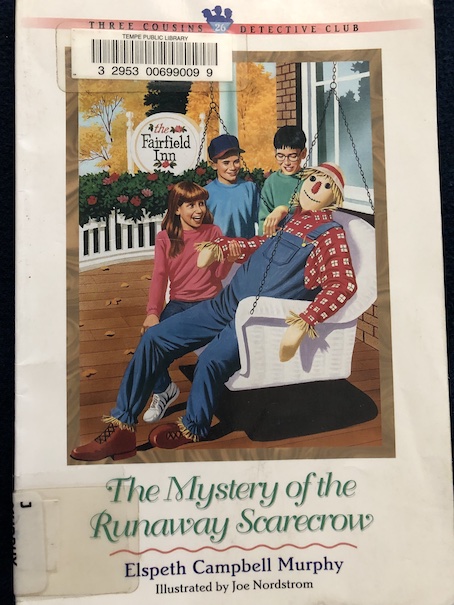
The Mystery of the Runaway Scarecrow

Three Cousins Detective Club

#26 The Mystery of the Runaway Scarecrow by Elspeth Campbell Murphy, 1999.

Sarah-Jane astonishes her cousins when she tells them that Buster, the scarecrow her mother made, which has been sitting outside of a local restaurant, has gone “on vacation. Scarecrows don’t just get up and go on vacation, and when they say that, Sarah-Jane says that Buster left a note saying that he had gone on vacation. The boys don’t believe scarecrows can write notes any more than they can go on vacation. Sarah-Jane admits that scarecrows don’t write notes, but someone else wrote a note on Buster’s behalf and left it behind when Buster disappeared. The note says that Buster is going on vacation and will be back when someone figures out where he’s gone. That’s weird enough, but Sarah-Jane says that Mr. Wesley, who owns the restaurant where Buster was, has been receiving pictures of Buster on his trip in the mail since he disappeared.

It seems like someone is playing a bizarre prank or maybe setting up some kind of treasure hunt involving the scarecrow. The town mayor says that Buster’s “vacation” has created more publicity for the town’s upcoming Fall Festival, so it could even be a publicity stunt. However, it’s been a few days since the last pictures of Buster arrived, and Mr. Wesley is inviting Sarah-Jane and her cousins to investigate Buster’s disappearance and find him because he knows that they like to solve mysteries.

The kids study the pictures for clues to Buster’s whereabouts, but the pictures are pretty generic. They show him outside a motel, at a gift shop, and at a gas station, but the locations aren’t very distinctive and could be found in any number of cities. The postmarks on the envelopes that pictures came in are all still in the area, so it seems like Buster didn’t go very far. They need to hurry if they’re going to find Buster in time for the town’s parade because the parade is tomorrow!

Then, Sarah-Jane reveals that something else mysterious has happened in the area recently. Someone stole a rare coin from Mr. Clark. This is also an intriguing mystery, but they don’t have many clues to start. Mr. Clark isn’t exactly sure when the coin disappeared because he doesn’t get out his coin collection very often.

For some strange reason, an older boy in Sarah-Jane’s neighborhood, Billy, seems very concerned about whether Sarah-Jane and her cousins have made any progress in finding Buster. Could Buster’s disappearance also have something to do with the missing coin?

Theme of the Story:

“The land has produced its harvest; God, our God, has blessed us.”

Psalm 67:6

The book is available to borrow and read for free online through Internet Archive.

My Reaction and Spoilers

I liked the way the person who took the scarecrow used the pictures to provide clues to their treasure hunt. Readers won’t be able to figure it out right away without explanation from the characters because the book doesn’t show all the pictures, but I liked the concept for how the culprit worked a series of clues into the pictures. There’s also a fun backstory behind the scheme. The prankster doesn’t have a sinister motive. The scarecrow caper is meant as a kind of prank/game/harmless publicity stunt.

I guessed pretty quickly who had taken the scarecrow, based on motive, but I liked the addition of Billy and the coin because it complicated the story and provided a second mystery on top of the first. There is a genuine crime in the story, but it’s not the one that the kids start out investigating.

The story takes place during October, but it’s not on Halloween. The town’s Fall Festival just seems to kick off the fall season in general.

Prince Caspian

The Chronicles of Narnia

Prince Caspian by C. S. Lewis, 1951.

This book starts with the four Pevensie children from the previous book in the series heading to their boarding schools by train. The girls are going to one school, and the boys are going to another. As they’re waiting for their trains at the station, they suddenly feel themselves being pulled and dragged by some unseen force. They feel like it’s magic of some kind, and they all join hands to stay together. The next thing they know, they’re in a forest. They wonder if they might have returned to Narnia.

They explore the area and realize that they are on an island. When they search for food, they find an abandoned apple orchard and the ruins of a castle. Something about the ruins seems strangely familiar to the children. When Susan finds a golden chess piece, they realize that the castle is the ruins of Cair Paravel, the castle where they used to live as kings and queens during their previous time in Narnia. The children are sad that the castle is now ruins. They’re also puzzled at how it can be ruins when they last saw it intact, and when they lived there, the castle was on a peninsula, not an island. Even though their previous adventures only took place a year before for them, it looks like many years, maybe centuries, have passed in Narnia.

They find their way into their old treasure room and discover that it is undisturbed. They leave the jewels and riches there, but they find the special presents that they were given during their last adventure and take them because they may be helpful during this adventure. The one thing they can’t find is Susan’s magic horn, which can be used to summon help in desperate times. Susan realizes that she had it with her during the stag hunt right before they returned to their own world from Narnia, and it was probably lost in the woods.

When they rescue a dwarf from some men holding him captive, the dwarf thanks them. He says that they were planning to drown him as a criminal, but he doesn’t fully explain. Instead, he offers to catch some fish for them all to have breakfast because all the children have are apples. When the children mention that there is firewood at the castle, he is amazed. He’s heard stories about an old castle there, but he wasn’t sure that it was real. The rumors are that the forest around the castle ruins is haunted.

After they eat, the dwarf explains that he is a messenger for Caspian, the king of Narnia. He then qualifies that by explaining that Caspian should be the king. The old Narnians recognize him as the rightful king, although he is considered one of the new Narnians himself. Prince Caspian was an orphan raised in the castle of his Uncle Miraz. He was mostly raised by his nurse and wasn’t very close to his aunt and uncle, but his uncle acknowledged him as his heir because he had no children.

According to the dwarf’s story, Prince Caspian has a fascination for the old days of Narnia from his nurse’s tales, when there were fauns and talking animals in Narnia, but his uncle says those are just fairy tale stories for little kids. The Pevensie children realize that the legends that Prince Caspian was told as a young child were about them and their adventures. People still tell stories about them, but not everyone believes them.

Miraz forbids Caspian from believing in those stories or talking about them again and sends away Caspian’s nurse. Instead, he hires a tutor for Caspian called Doctor Cornelius. Caspian misses his nurse, but he enjoys his lessons with Doctor Cornelius. From Doctor Cornelius, he learns that his ancestors and other humans came to Narnia from another land and conquered it. However, Doctor Cornelius is reluctant to explain exactly whom his ancestors conquered. Doctor Cornelius quietly admits that Miraz forbids anyone from talking about Old Narnia because it’s supposed to be a secret. Over time, Doctor Cornelius lets Caspian know the secrets of Old Narnia, which confirm to him that his nurse’s stories were true.

Caspian’s ancestors were the ones who silenced the taking animals and drove away or killed other races who inhabited Narnia. The reason why Miraz won’t let anybody talk about the history of Old Narnia and denies that other species once lived there is to cover up that his ancestors stole Narnia from its rightful inhabitants and that most of the humans are merely transplants to this land, not its rightful heirs. Doctor Cornelius reveals himself to be a dwarf, one of those few who still live in Narnia in secret. He is also part human, which is how he is able to pass for a human. He says that there are others there in disguise. Caspian feels like he should apologize to Doctor Cornelius, although he knows that what his ancestors did to the dwarves was not his fault. Doctor Cornelius says that apologies are not necessary, but he knows that Caspian will one day be king and can help the remaining Old Narnians who still live there, hiding from Miraz.

The stories about the woods around Cair Paravel being haunted were invented by Caspian’s ancestors to hide Narnia’s past and also because they want the forest to separate them from the sea. Caspian’s people fear the sea because, although they deny that Aslan exists, the legends all say that Aslan will return from across the sea. They fear the wrath that Aslan may visit on them for what they did to Narnia and its peoples. However, not all humans have this fear of Aslan and Old Narnia. Others, like Caspian, are fascinated and would like to see Narnia become more like its past self, with magic and talking animals and dwarves and fauns. As Caspian gets older, he realizes that many people in Narnia are unhappy with Miraz and the way he rules Narnia. He is a cruel king.

One night, while Caspian’s aunt is very ill, Doctor Cornelius wakes him and prepares him for a journey. He tells Caspian that he is not just the prince but the true king of Narnia. His father was the true king, and after Caspian’s parents were dead, Miraz took the throne for himself. Miraz murdered or exiled Caspian’s father’s old friends and supporters. Caspian was too small at the time to understand or have any memory of this, but now, Miraz is planning to murder Caspian. His aunt’s “illness” was actually childbirth, and now that she has given birth to a son, Miraz is planning to eliminate Caspian so his own son can be his heir with no opposition from the true heir. Doctor Cornelius says that Caspian has no other choice but to flee to another, friendly kingdom. To help him on his way, Doctor Cornelius gives him some food, a purse of gold, and Susan’s magic horn, an Old Narnian artifact found after she and her siblings disappeared from Narnia.

While Caspian is fleeing, he has an accident and is knocked unconscious. He is found by a dwarf and talking animals. They almost kill him as one of their enemies, but Caspian explains who he is and why Miraz wants to kill him. The dwarf still wants to kill him, but the badger realizes that Caspian is a hopeful sign. The golden age of Narnia was when human children ruled, and young Caspian’s belief in the Old Narnian stories and assertion that he has longed to meet Old Narnians like them are signs that he could be a true high king like King Peter. The badger says that he would be willing to follow King Caspian if he remains true to Old Narnia and its people.

Caspian is allowed to stay among the Old Narnians in hiding. He gradually makes friends with different species, and they begin to form a rebellion against Miraz. Doctor Cornelius finds Caspian and warns him that his uncle is searching for him. Caspian’s supporters convinced him that it was time to blow Susan’s horn to summon help, and that was how the Pevensie children were summoned back to Narnia.

The dwarf explaining all this to the Pevensie children is the same doubting dwarf who almost killed Caspian and ended up joining his supporters. The men trying to kill him were Miraz’s people. Trumpkin, the doubting dwarf, now doubts that the Pevensie children are the help they were hoping for. They are children again, not the great kings and queens they were when they left Narnia. The children aren’t too troubled by his doubts because they know who they are and the victories they have already achieved in Narnia. They have not lost all the skills they gained in Narnia before, and the more time they spend in Narnia, the more they become like the kings and queens they once were and still are. They outfit themselves from their old treasury and prepare to once again battle again evil in Narnia in support of Aslan.

The book is available to borrow and read for free online through Internet Archive (multiple copies, including some in different languages).

My Reaction

The books in The Chronicles of Narnia are famously Christian allegories, and Christian themes continue through this book. There are people who are doubters, but those who remain faithful believers in Aslan (who represents Jesus in this series) are the ones who prevail in the end. Like Jesus, Aslan wants his followers to do what they can on their own but is often near to offer them strength, support, and hints about the right thing to do. However, some people are more perceptive to his guidance than others, especially Lucy, and there is a theme that runs through the story about belief in things from people who have not seen them directly and are relying on other people’s experiences. As Lucy has a greater capacity for perceiving Aslan, some other people have a greater capacity for general belief. Edmund has learned his lessons from the previous book. Feeling badly about his earlier doubting of Lucy and how he had once belittled her, he becomes her biggest supporter during times when she can see Aslan and others can’t, urging his older siblings to listen to her. Some people, including Peter and Susan, doubt whether Lucy has actually seen Aslan when they haven’t seen him himself. Trumpkin, the doubting dwarf, is the classic Doubting Thomas of the story. He doubts everything, every step of the way, from Caspian’s intentions to the existence of the Pevensies and Aslan, but he keep son going until he sees the Pevensies himself and has the opportunity to see their abilities in action. Among Caspian’s followers, there are some, like the badgers, who have always believed in Aslan and always will, and there are others who are won over when they see for themselves.

There are also themes in the story that can apply equally to religious issues and political ones. Miraz struggles from the beginning to control the narrative of how his family came to rule Narnia and how he himself became the king when his brother’s son was actually the true heir. There are people who know the truth about both of these issues, but he’s not above censoring people, exiling them, and even killing them to prevent people from talking about the truth openly. Miraz is not a good king and has his self-interest in mind more than his subjects’, but he’s sharp enough to know that nobody really likes him or wants him to be king except he has convinced them that he has the authority to be king and that their self-interest lies with him. If people came to see him and his family for who and what they truly are and what they’ve actually done, he would lose all of that, and he knows it. Authoritarian rule is like that. It relies on maintaining the sort of image that, realistically, they can’t maintain if people know what the individuals involved are really like. Authoritarians try to make themselves look stronger and better than normal humans to cover up for their flaws, but the image collapses when they can’t or won’t deliver what they promise, and people see them for the flawed humans they really are, often more flawed than the people they tried to convince were weaker.

Aslan eventually reveals that Caspian and his people are not just from a foreign country in the world of Narnia, but their distant ancestor were actually pirates from our world. They had conquered and looted an island in the South Seas, murdered many of the inhabitants, and taken the women for their own. Then, they had argued and fought among themselves. Some of the pirates took their women and tried to hide in a cave from the others, but it was a gateway to the world of Narnia, and that was how they got there to later conquer Narnia. When Caspian hears this, he says that he wishes that he had come from a more noble lineage than murdering pirates, and Aslan tells him that, further back than the pirates, he is also a son of Adam and Eve, just like the Pevensies, and that lineage is noble enough. I liked this explanation because, in modern times, people have struggled with the concept of having slave-owning ancestors, fearing criticism, punishment, or some form of reparations for it. I’ve heard some people saying that they don’t want to be ashamed of themselves or their ancestors. They are hung up on one part of their family’s history, a history that, when you think about it, goes back as far as humans go, and they fear blame and shame for that. I don’t think I’ve heard many consider that their family didn’t always own slaves. They were something other than slave-owners before that, even if some of them can’t quite remember what that was. I’m not big on ancestor veneration and imitation, but everyone’s ancestry goes back too far to remember every generation. Even if some generations weren’t good examples, they’re not the only past generations, if you see what I mean. Maybe, instead of looking at what their family used to be and lost and might be blamed for even having, they should consider that what they’ve become since then might just be a return to what they were before that period in their family’s history, which might just be better and noble enough.

Earlier in the story, when the Old Narnians talk about whether to support Caspian or continue to support him, there are some who waiver in their support or withhold it, also out of self-interest. While nobody really likes Miraz, Narnian history and legends influence the way that the Old Narnians feel about Aslan and his supporters. Most of the Old Narnians remember the White Witch from the previous book as a wicked ruler, but the dwarves and wolves fared better under her than other species. Their descendants forget that their relatively better treatment came from their collaboration with the witch and their participation in her wickedness, and even then, the relatively better treatment still wasn’t that great. (Plus, some of the wolves are actually werewolves, not just talking animals, like the others.) They just vaguely remember that there was a time when a ruler put them in a better position relative to other species, which they are not now. In fact, they feel like they are now treated worse and given fewer supplies than the other groups. The other groups say that’s not true, but it feels like it is to them because they are no longer better off than the others. They miss that and want it back. When they become impatient with Caspian and feel like he won’t give them the treatment they want, they rebel, and some of them are killed. Prince Caspian and the others feel badly about that because the might not have rebelled and been killed in the struggle if circumstances were different and they had felt more satisfied, but they had no choice but to defend themselves from their attack.

The book also looks at the type of people who support authoritarian rulers. Much of their support also has to do with self-interest or apparent self-interest. Miraz does have supporters among the human nobility who helped him accomplish his rise to power and who helped do his dirty work in getting rid of his brothers old allies. Since then, some of them have become disillusioned with Miraz. Miraz has not followed through on what he promised them before in exchange for their loyalty and support, furthering his own self-interest instead of theirs, and that’s the one thing they can’t accept. The thing about supporting someone who is selfish and is willing to throw former supporters to the wolves or even kill relatives in pursuit of power … is that you end up being one of those former supporters who may be thrown to the wolves or killed when your leader pursues self-interest and power. Some people never think anything through. They may have assumed that they would be a special exception to the leader because of their support, but nobody is special to Miraz but himself. Everyone else is just a tool to be used until he can’t find a use for them or they seem to be a hindrance.

When Aslan reveals the true history of Caspian’s people to them, many of them are afraid that Aslan is going to kill them all for what they’ve been and what they’ve done, which is another factor in their support of Miraz and his narrative. Even some of those who knew the truth before were too scared to say anything or do anything about it because they feared the blame, guilt, and consequences that might follow acknowledging the truth. A major reason for their fear is that they and their ancestors have not been merciful to anybody, so it never occurs to them that someone else might have better intentions for them.

At the end of their adventure, when it’s time for the Pevensies to go home, Aslan tells them that Peter and Susan will not be returning to Narnia next time because they are getting too old, but Edmund and Lucy will return someday. It’s a common theme in children’s fantasy books that only children can experience certain types of magic, and when they get older, they can no longer experience it or believe in it. It’s a trope that is meant to explain why grownups don’t experience this type of magic in the real world and why the adults in stories think that the children are just imagining things when they experience magic, but to me, it doesn’t logically follow in this story. We already know that at least one adult the Pevensie children have met believes in Narnia and magic because he has also experienced them, and we know that the ancestors of Caspian’s people arrived in the world of Narnia as adults. The Chronicles of Narnia don’t seem to have a consistent principle about who can visit the world of Narnia or believe in it, not in age or even in moral character because Caspian’s ancestors were murdering pirates. I think, in the case of Caspian’s ancestors, it might have something to do with explaining how even flawed and immoral people can rise to power or even seemingly have God’s favor, when it seems like they’re the last ones who should. It seems to be a combination of random chance (happening to wander into the right cave, in this case), their own choices (conquering other people), and possibly, part of a much longer game on Aslan/God’s part (eventually producing Caspian, who is the kind of ruler Narnia needs, even though it involved a lot of evil along the way – the evil being the humans’ choice, not a requirement). That’s some speculation and interpretation on my part, but I think the story kind of sets that up. Aslan seems completely aware of what’s going on and what has been happening but hasn’t tried to interfere until the critical moment in this story when Prince Caspian needs his help to fulfill his destiny.

The Mystery of the Gingerbread House

Three Cousins Detective Club

#13 The Mystery of the Gingerbread House by Elspeth Campbell Murphy, 1997.

Sarah-Jane lives near a couple whose names are Jack and Jill. They live in an old Victorian gingerbread style house. They have been fixing up the old house, and Sarah-Jane has been acting as a messenger, carrying samples of wallpaper to them from her mother, who is a decorator.

Sarah-Jane brings her cousins to see the house, and Jill shows them an old photograph that she and her husband found of the children who used to live in the house a hundred years ago and a friend of theirs. When the kids first arrived at the house, they startled someone who was working in the parlor. However, Jack and Jill insist that it was not either of them. They look in the parlor and are surprised to see that someone has continued the work they were doing, removing some of the old wallpaper that needs to be replaced. Why would someone sneak into the house to continue their work?

Someone has learned an important secret about the house and something hidden inside, and they are trying to find it before Jack and Jill stumble across it in their renovation work.

The theme of this story is Proverbs 25:13, “A trustworthy messenger refreshes those who send him. He is like the coolness of snow in the summertime.”

The Hidden Message

Adventures in the Northwoods

The Hidden Message by Lois Walfrid Johnson, 1990.

The story, like the others in its series, is set on a farm in Wisconsin during the early 20th century.

One night, Kate McConnell wakes up to hear her mother and stepfather talking. The family needs money for the new planting season, so Papa Nordstrom has decided to take a job in a lumber camp over the winter. It will keep him away from home for a couple of months. He doesn’t really want to leave his family, but there’s a new baby on the way, and they really need the money. His absence on the farm means that the children will have to take on extra chores to help out. Kate also worries because conditions in lumber camps can be dangerous. Her birth father was killed in an accident in a similar camp, and she doesn’t want the same thing to happen to Papa Nordstrom.

Before Papa Nordstrom leaves for the lumber camp, he butchers a pig so his family will have meat while he’s gone. With winter setting in, it’s important to make sure that food supplies are secure. That’s why Kate knows it’s serious when her friend Josie tells her at school that someone stole her family’s steer, the one they were planning to butcher for meat this winter. Her family has no other source of meat, and they might go hungry if they can’t find the steer. Josie asks Kate for help because she and Anders solved a mystery involving a mysterious stranger who took things before.

One of the possible suspects is an older boy who has recently returned to school, who the others call Stretch. Kate has never met Stretch before because he’s been gone from school, doing farm work, since before she arrived in the community. Anders knows him, though, and he tells Kate that Stretch is trouble. Part of the reason they call him “Stretch” is that he has a habit of stretching the truth. Kate finds Stretch handsome at first, but Anders warns her not to get involved with him. Kate thinks Anders is exaggerating about Stretch because other people at school seem to like him. Anders says that if Kate wants to like someone, she should like Erik instead. Kate has a kind of rivalry going with Erik since he dipped her braid in his inkwell, and it permanently stained her dress. Anders says that Erik didn’t really mean to ruin her dress, but Kate is still unhappy about the incident. So, although Kate can tell that Erik is more responsible in other ways and is a bright and dedicated student, and they go to the same church, she has reservations about liking him.

However, Kate soon comes to realize just how dangerous Stretch is. Their teacher warns them all away from the frozen lake because the springs in the lake make the ice unpredictable. While the others play on the playground, Stretch talks Kate into walking by the lake with him. He says that he knows it’s safe because he was out on the lake earlier that morning, although Kate has her doubts about it. Then, Kate spots Anders’s dog out on the ice. Worried about the dog, Kate tries to call to him, but the dog doesn’t come to her like he usually does. Kate steps onto the ice to get the dog, and the ice breaks. Kate nearly drowns in the icy water, but Erik saves her. Kate realizes that, when she was in danger because of Stretch, Stretch actually abandoned her to drown. Later, he won’t even admit that he was the reason why Kate went down to the lake in the first place. When Kate is warmer and able to think better, she also begins to realize that the reason why Anders’s dog wouldn’t come to her when she called was because she was with Stretch, and the dog is afraid of Stretch, indicating that Stretch has been cruel to the dog in the past.

Kate’s brush with death opens her eyes to what Stretch is really like. It also creates a problem because the teacher writes a letter to Kate’s mother about the incident, letting her know that Kate did something very dangerous. Kate doesn’t want her mother to know what happened because it would upset her, especially with Papa Nordstrom being away and the children supposed to be behaving responsibly to help her on the farm. Kate wants to hide the teacher’s letter and not tell her mother, although Anders and Lars try to persuade her to be honest about what’s happened. They argue about it, and Kate accuses them of wanting to tattle on her, threatening to tell on them if they do something wrong. She feels sorry for upsetting them, especially young Lars, but she’s afraid of how her mother might react when she finds out what happened. Anders warns her that her mother might still find out what happened from someone else and that by being dishonest and fighting with Lars, she’s starting something that she’s going to regret. But, Kate can’t even bring herself to confide in anyone that Stretch was the reason she went down to the lake. Even though he almost got her killed and didn’t even try to help her, she can’t bring herself to tattle on him. (That’s dumb, on several levels. I’ll explain why below.)

After the incident with Kate falling through the ice, Stretch avoids going to school for awhile. Then, one day, Kate sees him stealing candy at the general store. Even though Kate knows what she saw, she still can’t bring herself to tell on him, and she even begins making excuses for him in her mind to make him seem less bad. When he offers her a ride home, she’s a little hesitant, but she decides to accept to avoid the long walk home. On the way, she asks him why he didn’t help her when she fell through the ice, but he never answers her. She also notices that his hand is oddly blue, and when she asks about that, he says that he must have just worked that hand too hard when he was cutting wood. However, he doesn’t have wood in the back of his wagon. He’s hauling boxes of something. This time, she decides to tell Anders about Stretch stealing, but she doesn’t mention the boxes in the back of Stretch’s wagon because she still doesn’t know what to think about them.

The secret about the ice incident comes out when Kate’s step-siblings, feeling uncomfortable about her deception, play a prank on her to get her to tell on herself. Knowing how afraid of mice Kate is, they put a dead one in a box with the label, “Pretty on the outside, like this on the inside,” on top. When Kate opens it, she screams, and her mother comes running. Knowing why they played this prank on her, Kate explains the truth to her mother. Her mother gives her a punishment for lying to her before, and Kate sees how upset she is that Kate didn’t tell her the truth earlier.

However, Kate hasn’t quite learned her lesson about lying. She sneaks out when she’s supposed to be grounded in her room by climbing down the tree outside the window. While she’s outside without permission, she spots a loose cow belonging to Josie’s family and guides it back to them. It’s a good deed, but she was still out without permission, and Tina spots her. Kate is angry and accuses Tina of “spying” on her and tries to persuade her not to tell. Kate can tell that Tina is upset and worries about lying to her mother and making her mad. Kate feels badly, but she can’t seem to stop herself from doing these things. She still continues to sneak out during her period of being grounded. When little Tina tries to imitate her by climbing down the tree herself and gets stuck, Kate has to rescue her. Her mother spots them once they’re down on the ground, and Kate confesses everything.

Kate feels like an awful person because Tina could have been badly hurt or even killed by following her example. Her mother says that everyone is awful in the sense that humans are all imperfect, and that’s why they commit sins. That is why God sent His son to redeem human sins. It’s good to be sorry when you’ve done something wrong and ask for forgiveness because forgiveness will be granted, and if you accept Jesus as your Savior, he will take away your sins. (I’ve heard this before, the part about everyone being “awful”, or words to that effect. This is kind of a Protestant way to phrase this. When I’ve heard it before, it usually seems to be from Protestants with a more Evangelical outlook, although that might vary. I don’t disagree with the principles, but Catholics would say it differently, and I may include a little more about it in my reaction.)

Meanwhile, there are still more thefts occurring in the community. Someone robs Erik’s family of all of the vegetables and fruit they’ve canned for the winter. Having food stores stolen at the onset of winter puts the family in a precarious position, and everyone else in the community worries about their foods stores, too.

One day, when Erik is at Windy Hill, Anders starts teasing Kate about her organ playing. He takes it too far, and both Kate and Erik tell him to stop. To Kate’s surprise, Erik hits Anders when he refuses to stop when asked, and the boys start to fight. Kate’s mother comes in, stops the fight, and makes the boys clean the room as punishment, which leads to several revelations. Kate comes to realize that Anders is a major reason why Erik has been teasing her. Anders has been urging Erik to tease her and also using Erik as an excuse for his own teasing. Now, Erik is getting as tired of it as she is. Erik confides in Kate that he knows that Stretch was the reason she went down to the lake when she fell in, and the only reason he hasn’t told anyone else is that he can’t prove that Stretch was there or that he abandoned Kate when she got into trouble.

As the kids move Kate’s organ back into position from the cleaning, Anders almost drops his end, and he accidentally opens a secret hiding place in the organ, knocking a hidden book onto the floor. The book contains church hymns in Swedish, but there’s also a torn part of a note in English. Unfortunately, they don’t have enough of the note to really understand what it means. (This is the “hidden message” of the title, and it doesn’t enter the story until about the final third of the book. I suspected it was a Biblical quotation, but I couldn’t place it from the fragment.) The note fragment contains the word “fear”, which makes the children worry that someone might be in trouble and asking for help. Erik asks them when and where they got the organ, but Kate explains that they bought it a few months ago at a fair in Grantsburg, and she doesn’t even know the name of the man who sold it. Papa Nordstrom might know, but since he’s away, they can’t ask him.

Stretch still seems like the likely suspect for the food thefts. Kate has seen him do some suspicious things, and he’s been telling some obvious lies, but she and Anders have difficulty finding any positive proof to get the authorities to intervene. Then, the thief takes the pig that Papa Nordstrom left for his family and the lid from their stove, rendering the stove useless until it’s replaced. With the stakes that much higher, Kate knows that they have to catch the thief, fast!

Kate also manages to figure out who originally owned the organ and who left the book and the message in the secret hiding place. The original owner is someone Kate already knows who used to play the organ. As I guessed, the message is actually part of a Biblical quotation (Psalm 118, Verse 6). The message is part of the theme of the story, but it doesn’t have anything to do with the theft directly. However, some strange things that the former owner of the organ has observed help to provide Kate and Anders with the proof they need to get back everything that was stolen. The story ends at Christmas.

The book is available to borrow and read for free online through Internet Archive.

Themes and My Reaction

In some ways, I was disappointed in this book. The identity of the thief isn’t really a surprise. Most of the mystery concerns how to prove it. Also, even though the title of the book refers to the hidden message, the mystery doesn’t center around the hidden message, and the hidden message doesn’t contribute directly to the solving of the mystery. Its main contribution to the story is to provide a theme: “The Lord is on my side; I will not fear. What can man do to me?” This quotation does give Kate the courage she needs to confront the thief.

Honesty in Relationships

I don’t blame Kate for having reservations about liking Erik at first. I know that things end up improving between them as the series goes along and even during this book, but he really did do something dumb and started off on the wrong foot with her. He’s not the first to do it, and frankly, it’s become a rather sad cliche. (It’s not unlike Gilbert in Anne of Green Gables and the way he started off wrong with Anne by making those “carrots” comments about her hair.) I’ve heard people say that boys will do mean things like that because they like girls and just don’t know how to say it, but you can’t just let people keep causing problems without some feedback about it because it doesn’t lead to good relationships. You don’t want to give someone the impression that you’re okay with teasing or rough play when you’re not because, if they don’t know it bothers you, they’ll never stop doing it, and it will drive you crazy. We all teach people how to treat us through the feedback we give. If Erik really cares about Kate, he’ll learn to give her the kind of attention she wants instead of the kind she doesn’t.

I started feeling better about Erik when he started standing up to Anders because Anders was going to far and wouldn’t stop even after both Erik and Kate telling him to stop. I appreciated that, while Erik may have initially felt compelled to join Anders in teasing Kate, Erik seems to have developed a sense of when to stop teasing and is willing to draw a hard line when necessary, even standing up to a friend and telling him “no.” Toward the end of the story, Anders finally has an honest talk with Kate, asking her why she didn’t tell him that Stretch was with her at the lake and abandoned her when she got in trouble. The answer is that Anders teases Kate all the time about everything. His constant teasing prevents her from confiding in him about things that they really should discuss. His teasing shuts down conversations before they even start. Anders finally tells Kate that he is her brother and wants to help her when she needs it, and he says that he wouldn’t tease her about anything really important. That attitude sounds promising. Unfortunately, he still insists that he’ll be the judge of what’s important, so I think that relationship still needs some work.

I’ll never understand people who say that teasing helps build relationships. Never. I’ve never seen it work that way in real life, not for building relationships of any depth, at least not unless the relationship has already been established on another basis first. It usually goes the other way, preventing relationships from developing or getting deeper than being shallow because relentless teasing does tend to shut down conversations and prevent people from opening up to each other. Why should someone tell you anything at all if they know that’s the reaction they’re going to get from you and that you don’t care that they don’t like it? The only times when teasing seems tolerable in real life is when the people involved already have built solid relationships with each other based on other qualities, really know each other well, and trust each other. Relationships are frequently based on trust, and you simply can’t trust someone who’s not really listening to what you say so much as trying to figure out how to use any and every little thing you say as a punchline for a dumb and hurtful joke for their own amusement or so they can score a few points off someone else and feel clever about it. I see it more as using other people than building a relationship with them. I just don’t feel endeared to anyone who only seems to be using me to score points to impress some third party onlookers. You can’t build a relationship based on teasing by itself. At least, I know I can’t. It just doesn’t work. What I’m trying to say is that Anders has not built a relationship with Kate and is both oblivious or resistant to feedback. He does not know when to take a hint and shut up even when people tell him plainly and not even when someone physically tackles him to the ground over it. So far, Kate has been doing all the heavy lifting in her relationship with Anders, trying to win him over, and he’s not really giving her much in return, although he’s slowly starting to show some signs of being helpful.

The characters in the story also alternately worry about being thought of as tattle-tales or criticize others for “tattling.” I’ve always thought all that “tattling” stigma was dumb. I know sometimes “tattling” means complaining about really petty things to one-up someone else, which is truly annoying (as I think all forms of one-upmanship are). However, people also use that word to try to shame people for talking about problems that really do need to be discussed. The way I look at it, if you’re going to be either mean or an idiot in a way that hurts other people, you forfeit your rights to complain about those other people talking about your meanness or idiocy. It’s not like the person talking about you made you do what you did, they didn’t ask to hurt by you, and if you did what you did in public, where other people could see it, it already counts as public knowledge anyway.

In 1906, when the story takes place, the Kate’s biggest worry is that her mother will hear about things she’s done from a neighbor at church because that’s their biggest opportunity for seeing and talking to other people. Every kid at school knows that she almost drowned, and since that was the big event of the day, they all no doubt told all of their parents about it. It’s common knowledge, not tattling. In the early 21st century, news of Kate’s brush with death at the lake would be all over social media before the end of the day because an entire classroom of people is aware of what happened and will be excited to talk about it. Even in cases where something happened that wasn’t serious enough for the school to immediately call the parent and tell them directly, any usual incident at school will get around fast. Usually what irritates people about “tattling” is that it can be pointless, petty nitpicking. However, the lake incident in this book was a matter of life and death, so I think complaining about anybody “tattling” is pretty dang petty itself. I think there needs to be a distinction between petty complaining and serious discussion. I think the anti-tattling attitudes people have teach bad morals, including dishonesty, self-delusion, and excuse-making, all issues that Kate has to confront in herself during the course of the story.

By choosing not to “tattle” on Stretch, which actually wouldn’t be “tattling” so much as just giving an honest answer to questions people were directly and specifically asking Kate about how she happened to be out on the frozen lake, Kate has also left Stretch open to doing similar things in the future to other innocent victims. She isn’t helping herself or the next person who could use some honest warnings. She didn’t initially trust Anders’s warnings about Stretch because he wouldn’t answer her questions about Stretch in specific terms (perhaps for fear of being thought a tattler), but Kate is now in a position to describe Stretch’s behavior in very specific terms herself, from first-hand knowledge. Anders was trying to be honest with Kate in his warnings, but he wasn’t fully honest and is already known for being an annoying teaser, which is why he didn’t seem believable. For all Kate knew, it just might have been another of his dumb jokes to embarrass her. (Another problem with too much teasing – no one knows when you’re actually trying to be honest and sincere about something, and few people are prepared to believe it because those are not a teaser’s default modes. If the teaser has already built a relationship based on qualities other than teasing alone, I suppose those close to him might be able to tell the difference, but no one else will, and Anders hasn’t built that kind of relationship with Kate yet.) If Anders had simply said why he didn’t trust Stretch, maybe Kate would have believed him and been more careful in the first place. Kate had to learn the hard way that Anders was telling her the truth about Stretch, and now, she’s going to have to learn the hard way that she also needs to drop her “tattling” hang-ups and be fully honest with herself and other people. Again, we teach others how to treat us, and Stretch could use some fully honest lessons from various people in his life. Don’t worry; he does get some help at the end of the book.

I was interested in what Anders said at the part of the story where he and Kate are talking about whether it’s better for her to like Stretch or Erik. Anders says that Papa Nordstrom has said that liking people is a choice, and people can make good choices or bad choices about who to like, which leads me to a few comments I have about the religious themes in the stories.

Sin and Forgiveness

I’ve explained before that I came from a family of mixed religions, although I was raised Catholic, and my religious education has also been somewhat mixed from childhood, although mainly Catholic. The only reason why I mention it is because, although Catholics and Protestants have similar ideas about the flawed nature of humanity, the causes of sin, and the role of Jesus in redeeming humanity, they have different ways of phrasing these concepts, which can sometimes give people wrong impressions and make it seem like their views are more different from each other than they actually are. When I see it, the differences are partly on where each puts the emphasis and the words they use.

A friend of mine (Mormon) was taking a college religious studies course and she was irritated by the way the teacher talked about original sin and about human beings as being “awful.” I can’t remember the exact phrasing she said that the teacher used, but it was something similar to what the mother says in this book about everyone being “awful.” My friend told me about it because she knows I’m Catholic and don’t mind discussing these things, and she thought her teacher was Catholic. I said that didn’t sound like a Catholic speaking. I looked it up, and it turns out that the teacher was specifically speaking from an Evangelical viewpoint, which is what I expected would be the case because, as I said, I’ve heard this before. I get the concept, but I don’t like that phrasing. It seems like it implies that all humans are inherently “bad” (which is what got on my friends’ nerves), but that’s not really the concept, not in real life or in this book.

The article that I linked in the first paragraph of this section explains it very well, but as a quick overview, the real issue is not that humans are inherently “bad” or “awful.” Not completely. (That’s what some people call the doctrine of “total depravity“, although even some of its adherents say that’s still a misunderstanding of the concept of “total depravity.”) It’s just that human beings are not perfectly good. Humans are inherently imperfect, which is different from just being flat-out “awful.” We’re not completely good or completely bad, just imperfectly between the two. Since we have elements of each in us, neither side can be ignored to get the full picture, and we can make choices about which of our sides we favor and try to maximize. Because we are imperfect as humans, we all sometimes have impulses, desires, and lapses in judgement that lead us to sin. That’s a part of who we are, but at the same time, we also have other desires for relationships with God and our fellow human beings that lead us to self-improvement and a desire to do good for others.

As Papa Nordstrom observed, we all have the ability to make choices. (This is part of the concept of “free will.” Catholics believe strongly in the concept of free will and reject any concept that original sin renders people unable to use their free will to make good decisions and consciously reject flawed impulses. I think that helps make “original sin” seem less of a tragedy because, while there’s always a struggle, knowing that there are still things you can do about it helps. Nobody’s doomed just for being human.) People can make good choices or bad choices. They can choose to give in to their worst impulses or practice mindfulness and self-discipline to resist them and strive for improvement. Understand that there are times when anyone could potentially do the wrong thing or have the impulse to do it. It happens to everyone from time to time, in varying degrees, throughout their lives. But, having the impulse to do something doesn’t mean you have to give in to it every time. Because human beings are imperfect, we often need some help and support to make the right choices when we’re struggling, and that’s the help that Christians look for when they turn to Jesus, accepting Him as their Savior, the example of what to do when they’re not sure how to control their feelings and impulses. People just need to make the choice to seek out that help when they’re struggling with bad habits or a crisis of conscience because there is help available, both spiritual help and help from other human beings. People can choose to say they’re sorry for bad decisions they’ve made and ask for forgiveness and guidance for making better choices, both from God and their fellow humans. (Kate should have been honest with her mother because she’s there to help and guide her and needs to know when something serious happens.) I prefer that description to saying that “we are all awful.” We’re not “awful.” We’re imperfect, and even if we’ll never be perfect in our human state, we can improve. That doesn’t sound as bad, does it?

The part where Kate rescues Tina from the dangerous situation she was in because of Kate’s bad example sort of reminds me of the end of Disney’s Freaky Friday from 1976, when the mother and daughter are talking about what they’ve done and what they’ve learned from being each other for a day:

“I am so much smarter than I thought. And so much dumber.”
“Oh, my darling, aren’t we all?

Other Interesting Topics

I thought the part of the story where Kate was talking to her organ teacher, Mr. Peters, about the difference between playing by ear and learning the notes was interesting. Mr. Peters points out that Kate is in the habit of playing songs by ear but she hasn’t really learned to read music. He tells her that she’ll learn more if she gets in the habit of reading the music for herself instead of depending on someone else playing a song for her to learn it. She later uses her new knowledge of reading music to learn to play one of the songs in the Swedish book of hymns. Musical notes are the same even if the songs are written in other languages.


Patrick

Patrick: Patron Saint of Ireland by Tomie dePaola, 1992.

This picture book is about the life and legends of St. Patrick, who is the patron saint of Ireland and the reason for St. Patrick’s Day, which is mainly celebrated in modern times by wearing the color green, and often, a shamrock or shamrock symbol. Some places also hold parades and other special celebrations.

The historical St. Patrick was born in Britain during the time when it was ruled by the Roman Empire. When he was young, he was abducted and sold into slavery in Ireland.

In Ireland, Patrick was forced to work as a shepherd for the man who bought him. Roman Britain was Christian, but Ireland was still pagan at this time. Patrick found it a strange and lonely place, and he prayed that he would be able to go back home.

Later, Patrick got his chance to return home aboard a ship that was carrying hunting hounds to be sold in France. Patrick tried to buy passage on the board, but the captain was reluctant to take him at first because he thought that Patrick was probably an escaping slave, and he didn’t want to get in trouble for taking him. However, the dogs on ship kept howling when Patrick was sent off, and the captain noticed that when Patrick was on the ship, the dogs were quiet, so he changed his mind.

When they reached France, the area where they landed was deserted because there had been a war. The men and dogs were hungry and couldn’t find anyone to help them. The captain said to Patrick that if his God was so powerful, why didn’t he pray and get God to help them? Patrick did, confident that God would help, and a herd of pigs appeared, providing them with food.

Patrick eventually returned home to Britain and rejoined his family, but he had dreams about Ireland in which a man called Victoricus appeared with letters from the Irish people, asking Patrick to return. Patrick felt that he was called to bring knowledge of God and Christianity to Ireland. He decided to become a missionary.

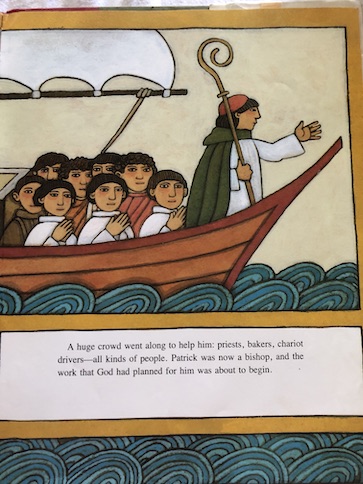
Patrick studied and worked his way up to become a bishop, and when he returned to Ireland, he brought others with him to help in his work. Upon his return to Ireland, he became friends with an Irish chieftain named Dichu, who also became a Christian. He gave Patrick a barn, which Patrick turned into the first church in Ireland.

Patrick and his followers suffered opposition in Ireland. At one point, a king tried to kill Patrick and ended up killing his chariot driver and friend, Odran, instead. In spite of that, Patrick persevered.

Patrick died on March 17, 461. After his death, he was declared a saint, the patron saint of Ireland, and the date of his death became his saint’s day. Many legends grew up around him, and the book explains the most popular stories.

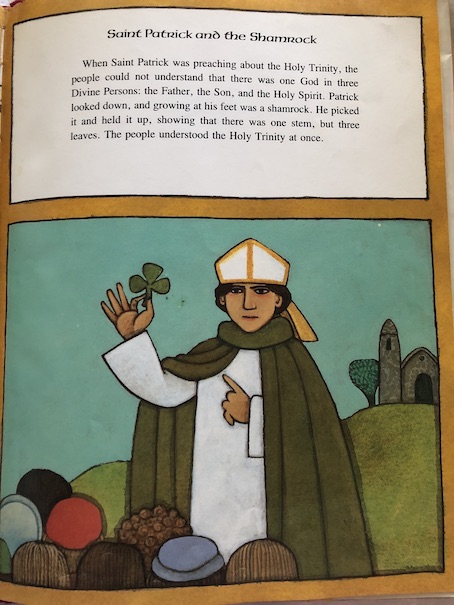
Among the most popular stories about St. Patrick are that he drove all of the snakes out of Ireland, frightening them away by beating on a drum. Another story says that he used the shamrock to explain the concept of the Holy Trinity, which is why the shamrock is an important symbol of Ireland and St. Patrick’s Day.

The book is available to borrow for free online through Internet Archive.

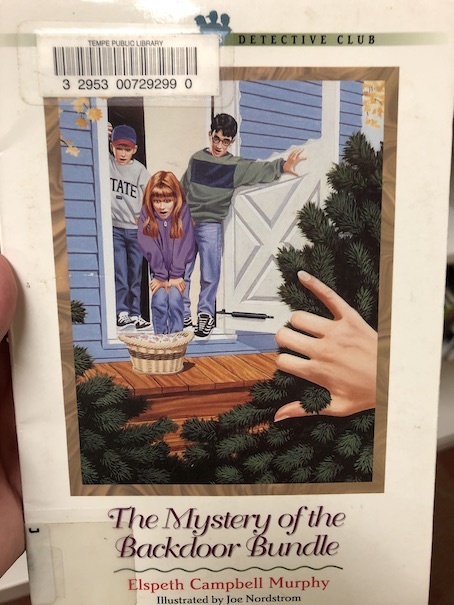
The Mystery of the Backdoor Bundle

Three Cousins Detective Club

#28 The Mystery of the Backdoor Bundle by Elspeth Campbell Murphy, 2000.

Sarah-Jane’s mother owns a decorating business, but recently she and her business partner have started repairing dolls because he has discovered that he has a talent for it. One day, while the Sarah-Jane and her cousins, Timothy and Titus, are sitting in the kitchen, someone knocks on the door and leaves a basket with a doll inside it. There is a note with the doll that says, “Please help me!”

When the kids show it to Sarah-Jane’s mother and her business partner, the partner says that the doll is an antique. The question is why anyone would simply abandon the doll with a note asking for help. The only clues they have are some footprints, a button, and a scrap of paper outside with logo of a blue kangaroo.

The doll is hiding a secret, and it’s up to the cousins to learn what it is and to help someone who cannot ask for help directly. This person has done something that they can’t admit to doing, but they’re trying to do the right thing and need some help to make it right.

The theme of the story is Psalm 147:3, “[The Lord] heals the brokenhearted and binds up their wounds.”

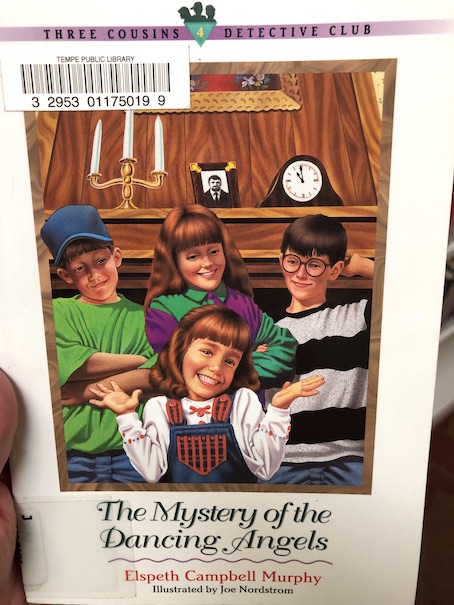
The Mystery of the Dancing Angels

Three Cousins Detective Club

#4 The Mystery of the Dancing Angels by Elspeth Campbell Murphy, 1995.

Sarah-Jane, Timothy, and Titus are visiting their grandparents over the summer when their grandmother’s cousin comes over to discuss some information she has found about their family’s genealogy. The kids’ great-great-great-grandfather was a woodcarver, and he did some work in a large house that is now being restored. There is a story that an expensive ruby necklace that belonged to the former owners of the house may be still hidden somewhere on the property.

The prospect of exploring the old house and maybe finding the missing necklace sounds exciting, but the kids also must spend their time looking after their distant cousin, Patience, who is only four years old and has a tendency of getting into trouble.

When little Patience disappears inside the house, the kids are worried, but she soon returns with the answer to a riddle that has been passed down in their family for generations. Dealing with little kids requires patience, but Patience herself notices details in the woodwork in the house that the adults and older children haven’t noticed.

The theme of the story is patience.

The book is available to borrow for free online through Internet Archive.

The Mystery of the Silent Nightingale

Three Cousins Detective Club

#2 The Mystery of the Silent Nightingale by Elspeth Campbell Murphy, 1994.

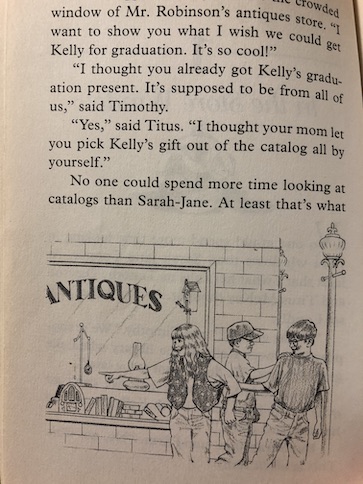
Sarah-Jane’s baby-sitter and friend, Kelly, is graduating from high school. Soon, she will be going away to college. Sarah-Jane is sad that she is leaving, but she is happy her family was able to find her a nice graduation present.

After they pick out their present, Sarah-Jane sees a locket with a nightingale on it in a store window. The nightingale is a Christian symbol for joy, and Sarah-Jane thinks that it would have made a nice present for Kelly if they didn’t already have one.

To everyone’s surprise, someone else buys the locket and leaves it at Kelly’s house. Sarah-Jane feels a little strange that someone else took the idea that she’d had for Kelly’s present. However, it is even more mysterious that there is no note or card with it to say who it is from. Kelly asks the cousins to help her find out who gave her the locket so that she can thank them. As it turns out, the present isn’t just an ordinary graduation present. It’s actually a thank you from someone who has been grateful to Kelly for a long time for a kindness she wasn’t even aware that she had done. Sarah-Jane even had a hand in it herself although she also wasn’t aware of it. Sometimes, it’s the smallest good deeds that can make the biggest difference in someone’s life.

The theme of the story is joy.

The book is available to borrow for free online through Internet Archive.

Themes and Spoilers:

The person who left the present for Kelly is Janice, who works for Kelly’s father. The kids had wondered why she seemed to recognize them when they stopped by Kelly’s father’s office early to show him Kelly’s graduation gown. It turns out that Janice has been grateful to Kelly for years for something kind that Kelly did for her when the cousins were very young. Kelly always used to read to the cousins when they were small, particularly Sarah-Jane. She took Sarah-Jane and the others to the library the day that Sarah-Jane got her first library card. That same day, Janice was also at the library.

Janice had never learned to read and was unable to finish her education. For a long time, she was ashamed to admit to anyone that she couldn’t read. Then, she heard about classes at the library for adults who had never learned to read and decided to go there. When she got to the library, she didn’t know where the classes were being held. She couldn’t read the signs, and she was too embarrassed to ask the librarian. There were some people she knew in the library, and she was so afraid of any of them finding out why she was there that she almost left. Then, Janice saw Kelly with Sarah-Jane and the boys. She saw how happy Sarah-Jane was to get her new library card, and she decided that she really wanted to learn to read, too. Janice knew that Kelly wouldn’t look down on her like some adults would, so she asked Kelly to help her find the class. Kelly helped her, even though she forgot about it later, and Janice was grateful to her for keeping her from backing out.

After Janice learned to read, she was able to finish her education. When she realized that the girl who had helped her years ago was her boss’s daughter, she wanted to give her a present. She wanted it kept secret at first because she was still embarrassed that it took her so long to learn to read. She was worried about what her boss would think of her. However, Kelly’s father doesn’t hold it against her, and Janice’s strict supervisor, Dorothy, even asks her to help tutor her grandson, who has been having learning difficulties.