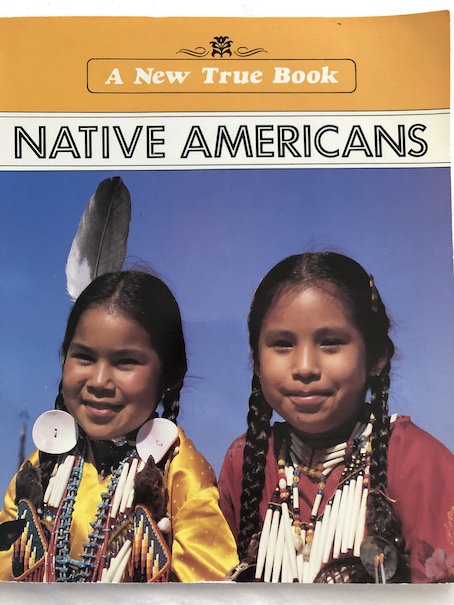
This book is part of the New True Books series, a series of nonfiction picture books on a variety of topics. This particular book gives an overview of the history and culture of Native Americans.
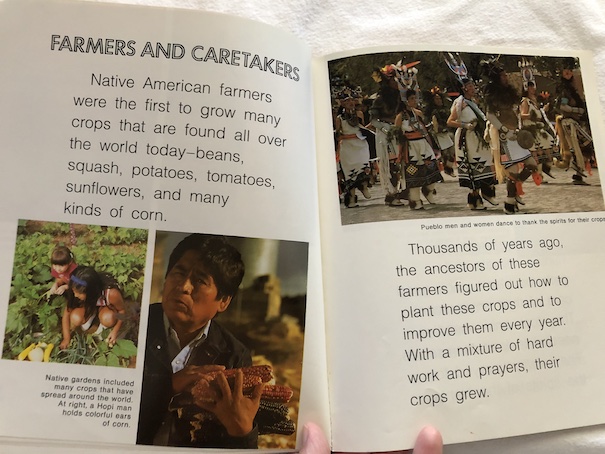
The book starts with some basic definitions and broad explanations of certain aspects of Native American culture, beginning with the explanation of why Native Americans are sometimes called “Indians.” The book notes that each tribe of Native Americans also has a name for itself. Each tribe has had its own culture, which it thought was better than other tribes’ cultures, but throughout history, tribes have interacted and traded with each other. One factor that made Native American cultures different from each other was whether tribes relied mainly on farming or hunting and gathering for food.
The book refers to hunter-gatherers as “caretakers”, a term that I can’t recall seeing before for hunter-gatherers. The reason why they use the term “caretakers” is they say that hunter-gatherers took care of their environments and only took the plants and animals they needed for survival, not wasting anything.
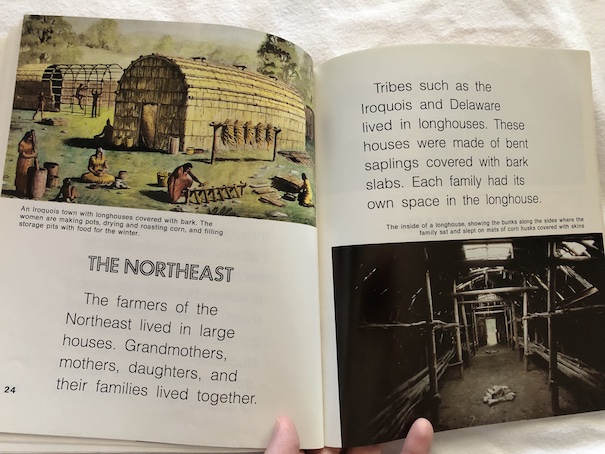
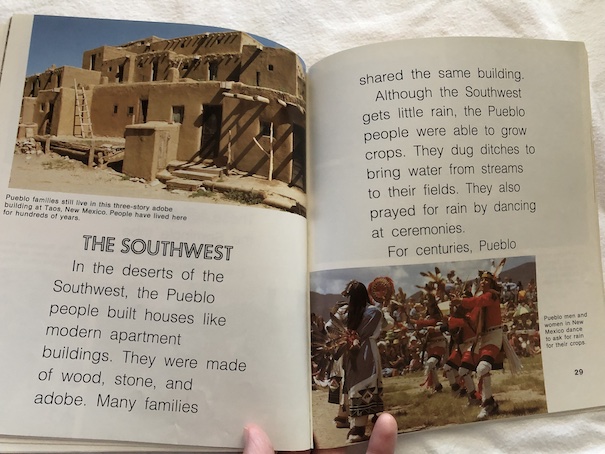
There are sections of the book that discuss some general aspects of Native American culture, like types of homes and tribal leaders. Of course, as the book notes, many cultural aspects varied, depending on the tribe, the environment where they lived, and whether they were mainly farmers or “caretakers.”
The book also has sections about the Native America tribes of various regions of North America, like the Northeast, the Southeast, the Southwest, the Northwest Coast, and the Plains.
The book ends with a brief section called Changes, which explains how Native American cultures were impacted by the arrival of Europeans in North America.
The book is available to borrow and read for free online through Internet Archive.
North American Indian Sign Language by Karen Liptak, 1990, 1995.
This book is going to be one of three I’m planning to cover on the same topic because this book includes a list of recommended reading about North American Indian Sign Language, and I happen to have two other sources from that list in my collection. The other books I have are much older, and I’d like to compare them to this newer book and explain why the newer one does things differently.
To begin with, older books about this topic frequently just use the term “Indian” or “American Indian” to refer to Native Americans. This particular book defines its terms right at the beginning. The author says, “North American Indians are currently called both American Indians and Native Americans. I have chosen the term American Indians to reflect the preference voiced in a recent informal survey at an intertribal powwow in Reno, Nevada, and to help readers find the book more easily. The signs presented in this book are based on the sign language used by the American Indians of the Great Plains.” I appreciate it when authors explain their thinking clearly.
The introductory section of the book explains the purpose and history of using sign language for intertribal communications. It starts with an example of a fictional encounter between two members of different tribes who are strangers to each other. At first, they’re not sure who the other one is and if they’re someone who can be trusted, but when they begin using sign language to signal to each other who they are and what their intentions are, they realize that they’re from tribes who are friendly with each other and that it’s safe to continue communicating.
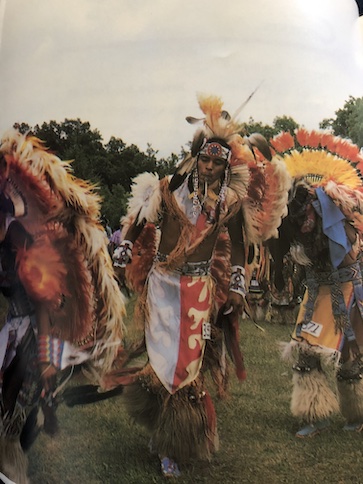
This particular form of sign language was particularly popular among Native Americans of the Great Plains, including the Cheyenne, Sioux, Kiowa, and Blackfoot tribes to allow communication between tribes that did not share a common spoken language and also within tribes in situations that demanded silent communication, such as during hunting and warfare or when communicating with people who could not hear well. American Indian sign language isn’t commonly used in modern times because there are others more commonly used, but it still appears sometimes at powwows or in Native American ceremonial festivals. This book is meant to present the sign language for fun and education.
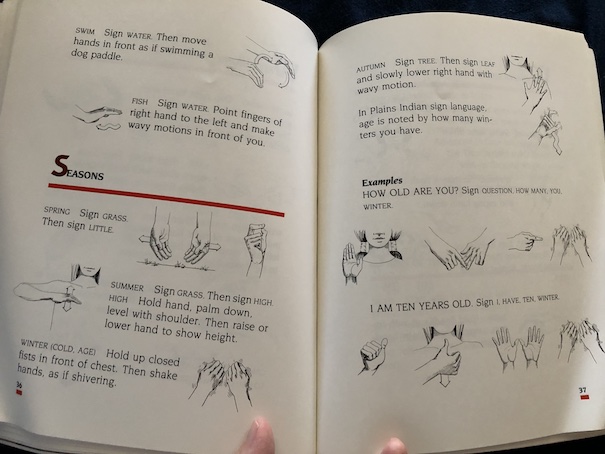
It begins by explaining basic hand and finger positions and introducing some basic vocabulary, demonstrating signals for simple words, like “I”, “You”, “Yes”, and “No.” All of the hand signs are shown in drawings with arrows to indicate movement where necessary. It also introduces how to signal that you are asking a question.
The rest of the vocabulary is presented in themed sections, introducing words for family members, counting, seasons of the year, weather, time, food, clothing, feelings. This is different from the older books about American Indian sign language, which had vocabulary words organized alphabetically, like a dictionary. I prefer the approach of the themed sections because they demonstrate related words together and provide information for forming sentences as needed, like how to indicate that a concept is past tense. Later sections build on earlier sections, like when the section about seasons draws on the earlier concepts of counting and how to ask questions to demonstrate how to ask how old someone is or how to tell someone your age.
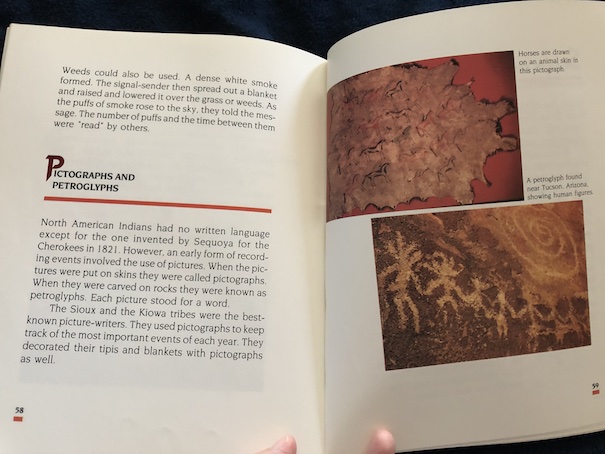
There are also sections at the back of the book discussing other methods of communication used by Native Americans, including smoke signals, pictographs, and petroglyphs.
The book is part of a series by the same author about various aspects of Native American culture. It’s available to borrow and read for free online through Internet Archive.






 Jestress's Forgotten Books and Stories