Addy Saves the Day

American Girls

AddySummer

Addy Saves the Day by Connie Porter, 1994.

Now that the Civil War is over, families are looking forward to the soldiers returning home and reuniting with loved ones.  Some families have been split forever because loved ones died in the war.  Addy‘s family still doesn’t know what happened to her brother Sam or her little sister Esther.  She and her parents have been making inquiries at various aid societies that have been helping people who were sick, injured, or displaced by the war, but so far, they haven’t received any word about Sam or Esther.  To help raise more money for their search, they’ve started growing vegetables in a community garden that they can sell.

The Walkers aren’t the only family in this position, and their church has decided to hold a public fair to raise money for victims of the war and families in need.  Addy and Sarah are looking forward to taking part in the fair, but they are annoyed because they’ll have to work with bossy Harriet, a snobby girl from their school.  Harriet’s family is wealthier than most black families, and Harriet loves to brag about the things they have that others don’t.  Although many families, like Addy’s, are worried about not knowing where their relatives are or whether they are alive or dead, Harriet brags about knowing exactly which army unit her uncle is in and what a distinguished career he has had.  Harriet is eager to take part in the fair and tell the other children what to do, but her family doesn’t need any charity themselves.

Harriet tries to tell the children’s group at the church what they should do for their act at the fair, and it mainly involves her being the star of the show.  However, the group decides to take Addy’s suggestion instead.  They are going to make puppets out of old thread spools and put on a puppet show.  They can also sell some of the puppets they make.  Addy is proud that her idea was the one that the group chose because she thinks of it as a victory over snobby Harriet, but her parents remind her that the fair isn’t supposed to be a contest.

The purpose of the fair is to raise money to help people, and no one is supposed to compete with anyone.  If the act for the fair is going to be a success, Addy and Harriet will have to find a way of working together to make it happen.  When Harriet picks a fight with Addy while the children are making their puppets, the minister’s wife tells them that she’s going to make them work with each other at the puppet show, forcing them to sort out their differences.

It isn’t until Harriet receives some bad news that she comes to understand the pain that other families, like Addy’s, have been feeling, and Addy comes to see that, in the end, Harriet is just an ordinary person, a little girl with feelings that can be hurt.  With a new understanding of each other, the girls find the motivation that they need to work together and make the fair a success.  Then, when someone tries to steal their group’s hard-earned money, the two of them find a way to stop the thief and get the money back!

This is the book where Addy’s brother rejoins the family.  When he was freed from slavery, he joined the Union army and lost his arm to a battle wound.  He shows up at the fair and recognizes the jokes and riddles Addy tells at the puppet show as ones that he used to tell her.

In the back of the book, there is a section with historical information about the changes taking place in American society around the time of the Civil War with increased immigration and urbanization.  It describes public parks and monuments built after the war.  Since this book took place in summer, it also talks about what people would do in order to cool off from the summer heat.  Wealthier people would travel to resorts, but poorer people would make do with enjoying the relatively cool public parks, swimming (less so for women and girls than men and boys), and taking part in outdoor activities.  In all cases, the various summer activities were still segregated by race with separate areas in public parks and sports teams for black people.

AddySummerHistorical

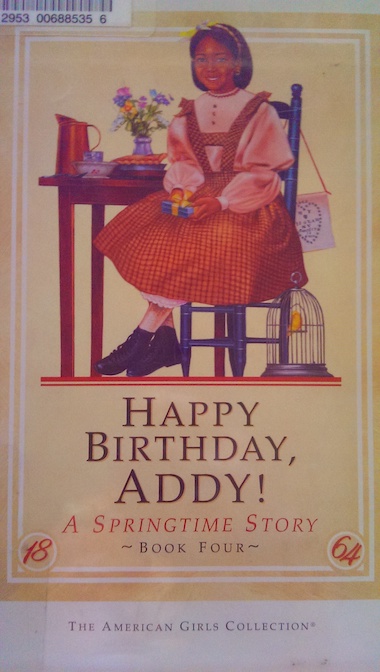
Happy Birthday, Addy!

American Girls

AddyBirthday

Happy Birthday, Addy! by Connie Porter, 1994.

Things are improving for Addy and her mother now that her father has finally joined them in Philadelphia.  Addy’s father has found work delivering ice, so the family has been able to move to bigger rooms in a boarding house.  However, making a new life for themselves in freedom still isn’t easy.  Addy’s father worked as a carpenter on the plantation where they used to live, and he’d like to find steady work in carpentry, but he’s having trouble finding an employer who is willing to hire a black man.

Addy’s family might be free from slavery, but they are still not treated as equals to white people.  There are places where black people can’t go and things they aren’t supposed to do, like riding on most of the city streetcars.  It angers and upsets Addy, but she doesn’t know what she can do about it.  She isn’t the only one who feels that way, and there’s been talk of violence in the city over it.

The boarding house where Addy’s family now lives is owned by Mr. and Mrs. Golden.  Then, Mr. Golden’s elderly, blind mother moves in with them.  Affectionately called M’dear, she’s a pleasant lady and tells Addy interesting stories, jokingly saying that she’s so old that she “was there the day God invented dirt.”  When she asks Addy how old she is, Addy says that she’s nine but doesn’t know when her birthday is exactly.  It was common for slaves not to know their birthdays because their parents couldn’t read or write and no one else thought it was important to record the dates of their births.  M’dear tells her that she should claim a birthday for herself.


Addy’s parents think that choosing a birthday for herself is a good idea, and her father says that he will make ice cream for her new birthday.  He has found a broken ice cream freezer that someone threw out, and he’s fixing it up for the family to use.  However, Addy isn’t sure at first what day she wants to choose.

One day, M’dear is feeling poorly, and she’s out of headache medicine.  Addy and Sarah offer to go get more for her.  To get to the drug store, they get on board one of the streetcars that black people are allowed to ride, which can be dangerous because they have to ride on the outside.  Then, the man at the drug store makes them wait until he’s served the white customers, speaking rudely to them.  When they try to take the streetcar back home, there is an argument that ends with all of the black people being thrown off the streetcar.  When M’dear hears about what the girls went through, she offers some wise thoughts about how people have to continue living their lives and being themselves, no matter what difficulties life throws their way.


In the end, circumstances continue to improve for Addy’s family when her father finally finds the kind of work he’s been looking for and Addy finds a special day to claim as her birthday when the end of the Civil War is finally announced.

I liked M’Dear’s message that the way people are treated doesn’t really change who they are.  The black people in the story are treated badly not because of what they did so much as what other people think they are or want them to be.  However, what other people think doesn’t change the nature of reality.  No amount of bullying or thinking that someone else is inferior or telling them that they are inferior can actually make them be inferior.  It can make things hard and unpleasant for the other person, but it will never actually change the reality of who they are, and people who think it does delude themselves.  M’Dear may be blind, but she sees much more clearly that most because she understands the reality of the situation better than they do.  Addy’s father has trouble finding work because he is black, but the fact that potential employers don’t like his appearance doesn’t make him any less the craftsman he is.  He has all the skills he needs; he just needs someone who has the ability to notice them.

In the back of the book, there is a section with historical information about how children were raised during the Civil War with some special information about the lives of slave children.  It also talks about children helped to support the war effort.


A Hugga Bunch Hello

HuggaBunchHello

A Hugga Bunch Hello by Phyllis Fair Cowell, illustrated by Ron C Lipking, 1985.

Bridget likes having her grandmother living with her and the rest of her family. Her grandmother always has time for her and is willing to give her a hug. Her parents are often too busy, her brother thinks hugs are just for girls, and her Aunt Ruth is too fussy.

Then, Aunt Ruth tries to persuade everyone that Bridget’s grandmother should go live in a nursing home. Bridget doesn’t want her grandmother to leave, but she doesn’t know what to do about it.

While she worries, a strange little person steps out of her bedroom mirror. This little person is Huggins, one of the Hugga Bunch. She says that she knows about Bridget’s problem and thinks that she can help. She invites Bridget to come with her to Huggaland.

HuggaBunchHelloMirror

In Huggaland, the Hugga Bunch take Bridget to see the Book Worm, who may have the solution that Bridget seeks. Both the Hugga Bunch and the Book Worm say that aging can be slowed by affection and “the knowledge that they are needed,” but Bridget thinks that the only solution is to find a way to actually make her grandmother young again.

The Book Worm says that if that’s what Bridget wants, then her grandmother must eat fruit from the Youngberry Tree. Unfortunately, the tree is in the territory of the Mad Queen of Quartz. Although the Hugga Bunch are afraid of her, Bridget is willing to face her for her grandmother’s sake.

Getting there involves going through a few obstacles, including walking sideways on a sideways sidewalk and facing a frightening beast who turns out to be a baby elephant who was under a spell. When they reach the tree, the mad queen takes them prisoner and turns Bridget into a statue. Fortunately, the others manage to break free and save her.

HuggaBunchHelloTree

Bridget is happy at being able to bring the Youngberries to her grandmother, but as she passes through the mirror into her room, she accidentally drops them, and they disappear.

Not knowing what else to do, Bridget runs to give her grandmother a hug before she leaves, encouraging her brother to do the same. Bridget’s father wasn’t happy about her grandmother leaving, either, and seeing how much the children will miss her, he declares that she should stay.

This book was made into a made-for-tv movie.  It is currently available on YouTube.  It follows the plot of the book pretty closely.

Mailing May

MailingMay

Mailing May by Michael O. Tunnell, 1997.

Four-year-old Charlotte May lives in a small town in Idaho in 1914. May, as her family calls her, wants to visit her grandmother in another town, but travel during this time is difficult and expensive. With a lack of roads that are easy to travel, the only comfortable way to get to May’s grandmother’s town is by train. Unfortunately, May’s family can’t afford to buy a train ticket for her.

MailingMayParents

May wants so badly to go see her grandmother that she even asks at the local general store if the owner can hire her, but he doesn’t have any work that a little girl could do.  Then, May’s mother’s cousin helps the family to find a more affordable alternative. If May can’t travel as a passenger, is it possible for her to travel as . . . mail?

MailingMayPostOffice

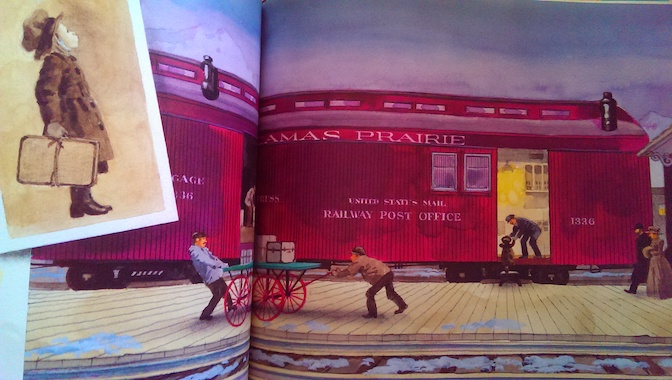
It turns out that the rate for mailing a live package the size of May is much cheaper than the fee for a passenger ticket.  Because May’s mother’s cousin works in the mail car on the train, he could take responsibility for her during the trip.  So, with a label on her clothes, declaring her to be “baby chicks” and the proper postage stuck to her jacket, May undertakes the journey to her unsuspecting grandmother’s house.

MailingMayTrain
MailingMayMailCar

This story was based on a real incident. In fact, May wasn’t the only child to be sent through the mail when their parents couldn’t afford to send them as passengers. I also like the book for its glimpse at travel and mail services over 100 years ago.

The book is available to borrow and read for free online through Internet Archive.

MailingMayGrandmother

Zathura

Zathura

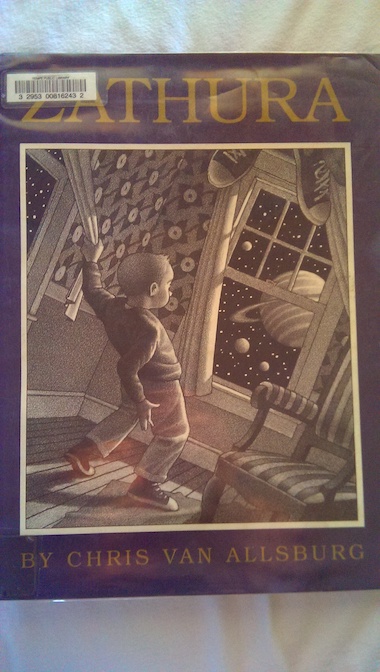
Zathura by Chris Van Allsburg, 2002.

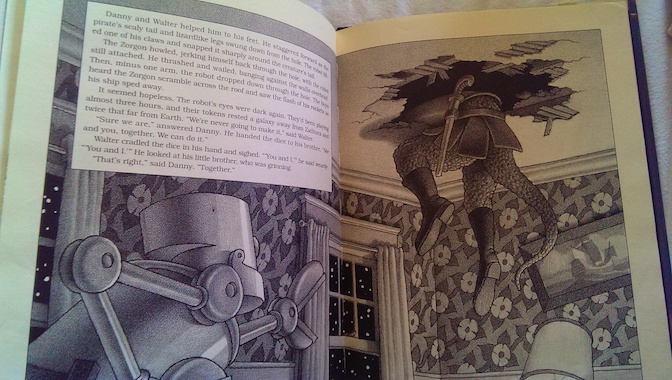
This book begins where Jumanji ends. It’s not completely a sequel because it has a different set of children and a new game, but it’s connected because the two children from Jumanji left the board game in the park again after they finished it, and they saw two boys that they know pick it up and take it home.

ZathuraBrothersWrestling

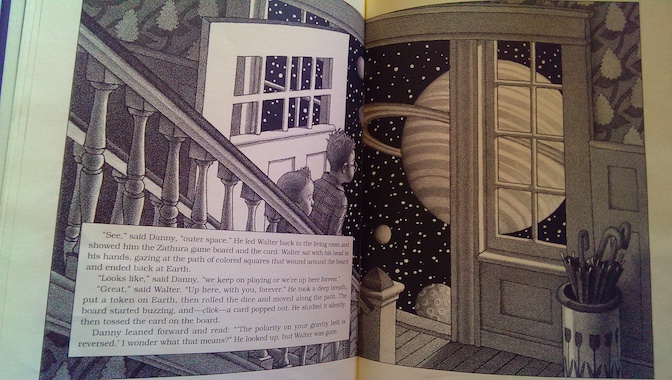
However, the two boys, Danny and Walter, don’t end up playing the same jungle board game, Jumanji, that was in the previous book. They find a second board game in the Jumanji box called Zathura and decide to try it instead. Zathura is a space-themed game where players travel a path from Earth to the planet Zathura. Like in Jumanji, elements from the board game come to life as the boys play, and someone must reach the end in order to end the game.

ZathuraStartingGame

Danny and Walter, a pair of brothers, fight a lot. Walter hates doing things with Danny. However, when Danny starts playing the game, sending their house into outer space, Walter must join in and play with his brother in order to bring the game to an end so they can go home. The two of them learn teamwork as they help each other face the dangers of the game while trying to reach Zathura.

ZathuraOuterSpace

There is a movie version of this book, but there are major differences between the original book and the movie. The conflicts between the two boys are similar in the book and the movie, but the movie added a subplot about the boys’ parents being divorced (they weren’t in the original book), an older sister for the boys (it was just the two of them originally), and a kind of alternate reality where the older boy was trapped in the game by himself for years because he wished his brother away before finishing the game until his alternate self realized that he cared about his brother and wanted to cooperate with him.  In the original book, nobody was trapped in the game.

ZathuraAlienRobot

Chris Van Allsburg illustrations are always good, although I have to admit that I preferred the illustrations in Jumanji to the ones in Zathura.  It just seems to me that the pictures in Jumanji were more detailed and realistic.

The book is currently available online through Internet Archive.

ZathuraGoingHome

The Bassumtyte Treasure

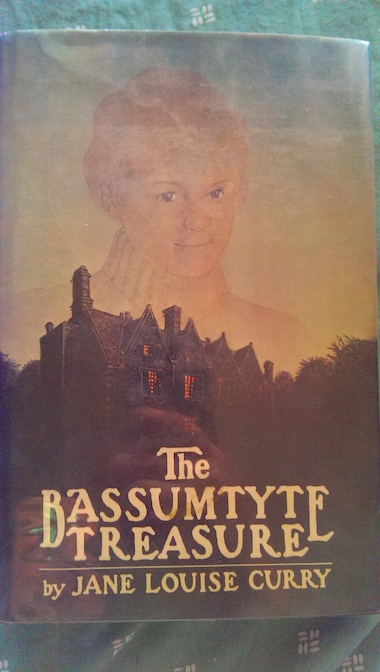
BassumtyteTreasureThe Bassumtyte Treasure by Jane Louise Curry, 1978.

When young Tommy Bassumtyte’s parents died, he went to live with his grandfather. However, his grandfather is now dead, and he is living with his 92-year-old great-aunt, who is in a wheelchair, and her 72-year-old daughter, who has recently had her driver’s license revoked due to her poor eyesight. Although the pair of them have taken good care of Tommy, neighbors have become concerned that they will not be able to do so for much longer because of their age and failing health. Rather than see Tommy sent to a foster home, they decide that he must go to the man who Tommy learns should really be his legal guardian, a distant cousin also named Thomas who lives in the family’s ancestral home, Boxleton House, in England.

The elder Thomas Bassumtyte, who should have taken Tommy when his grandfather passed away, has also since died, but his son, also named Thomas, agrees to take him. Tommy is quickly shipped off to England before there can be a custody hearing in the United States about him because the relatives fear that some official might try to prevent Tommy from being sent out of the country. Tommy is eager to go because he remembers fantastic stories that his grandfather told him about Boxleton House. The current Thomas Bassumtyte also lives there, although the place has become rather run-down, and he fears that he will not be able to keep the place much longer. Thomas was a mountain climber, but he was injured in a fall and hasn’t been able to work much since. He tells Tommy that the two of them might have to move when he is fully recovered and can do more work for the Foreign Office, but Tommy loves Boxleton House from the first moment he sees it and wants to stay.

According to the lore of Boxleton House, a distant ancestor of theirs hid a treasure there, but no one has been able to find it. If young Tommy and Thomas can find it, it would solve many of their problems, and they would be able to keep the house and restore it. All young Tommy has is the mysterious rhyme that his grandfather told him and the strange medallion that his great-grandfather brought with him when he went to the United States in the late 1800s. Thomas tells him that the treasure was supposedly hidden by a distant ancestor of theirs who was fond of riddles, called Old Thomas.

The Bassumtytes were secretly Catholic during the reign of Elizabeth I. Old Thomas was alive then and had a son called Tall Thomas. Tall Thomas traveled frequently and was mysterious about the places he went. One night, he returned to Boxleton House with a young baby, who he said was his son. He had married in secret, and his young wife had died shortly after giving birth. Tall Thomas also brought her body back to Boxleton for burial. However, that wasn’t Tall Thomas’s only secret. Although he remarried, giving his son a stepmother, and lived on for a number of years, he was eventually executed for smuggling messages for the captive Catholic queen, Mary, Queen of Scots. The family was stripped of its noble title and only barely managed to hang onto their house and land. If there was a treasure hidden during this time, it was probably something that the Bassumtytes were afraid would be confiscated by the queen’s soldiers as punishment for the family’s disloyalty or something that Mary had given to Tall Thomas to hide for her.

As Thomas tells Tommy more about the house and the family’s history, he points out Tommy’s uncanny resemblance to Small Thomas, Tall Thomas’s son, as shown in an old painting. Tommy feels a strange connection to Small Thomas, and begins seeing and hearing strange things. An older woman comforts him in the middle of the night, having him recite the same rhyme that his grandfather taught him. A small painting later reveals that this woman was Small Thomas’s grandmother. She appears to Tommy other times, giving him a glimpse back in time and clues to solve the puzzles of Boxleton House.

It is only when Thomas accepts the advice of a family friend who works for a museum that they come to understand the full significance of their family’s heirlooms and the hidden treasure. The treasure may not be quite what the Bassumtytes have always believed it was, but then, the Bassumtytes themselves aren’t quite who they always thought they were, either.

The book is available to borrow and read for free online through Internet Archive.

The Root Cellar

RootCellarThe Root Cellar by Janet Lunn, 1981.

Rose Larkin is an orphan, living with her grandmother, a stern businesswoman.  Her grandmother travels frequently on business, so from the time Rose came to her when she was three years old, she just took Rose with her wherever she traveled, tutoring her in school subjects in the evening after work.  Rose’s early life is largely one of travel to strange places and isolation.  When her grandmother is working, Rose is pretty much left to her own devices, often either reading alone in their hotel rooms or exploring strange cities by herself.  Not going to school, she has no friends her own age and doesn’t really know how to behave around other children or live as part of a normal family.

When her grandmother dies suddenly of a heart attack in Paris when Rose is twelve years old, her remaining relatives have to decide what to do with her.  She temporarily stays with aunts who are into fashion and high living before goes to live with another aunt and uncle and their boys on an old farm.  Aunt Nan (Rose’s father’s sister) and her husband are better suited to caring for Rose and can give her a more settled family life, but Rose’s other relatives don’t seem to think much of Aunt Nan, who is an author of children’s books.  Rose has heard that Aunt Nan has no sense and that the family has just moved to a shabby little farm house in Canada.  Rose is prepared not to be happy there, on a dumpy little farm, miles from anywhere, with a bunch of strange people.

Her new life gets off to a bad start when there is no one to meet her at the house when she arrives.  As she waits for her aunt and uncle to return, a strange old woman appears who seems to know her.  She calls herself Mrs. Morrisay and acts like she belongs to the house.  But, when Rose’s relatives arrive home, Mrs. Morrisay suddenly disappears, and none of them seem to know anything about her.  Later, Rose sees a girl making a bed upstairs, but her relatives just laugh when Rose asks them about the maid, which is who Rose thought the girl was.  There is no maid in this house, and Rose is the only girl.  To Rose’s annoyance, her relatives think she imagined the whole thing.

Actually, life in her aunt and uncle’s house in the country isn’t as bad as her other aunt has lead her to believe, but becoming part of their household isn’t easy because Rose is used to a very different kind of life.  The house is definitely old and in bad need of repair, and her relatives are noisy and disorganized, at least more so than Rose is accustomed to.  Rose isn’t used to the chaotic life of a family with a lot of children, and Aunt Nan has another on the way.  Also, tourists who are fans of Aunt Nan’s books sometimes stop by the house, and Rose doesn’t like dealing with their scrutiny and questions.  Sam, one of the older boys in the family, seems to resent Rose’s presence in the house, and Rose overhears him saying a lot of bad things about her to her aunt, calling her snobby and criticizing her appearance.  Rose takes his attitude as further evidence that she doesn’t really belong in their house and that she’ll never fit in.  If they think badly of her, why should she think any better of them?

Rose also becomes increasingly aware that there is something not quite normal about her relatives’ house, especially the old root cellar, and the people she saw on her first day in the house are part of it.  Sam thought that he might have seen a ghost in the house one day, an old woman, and Rose recognizes his description as that of the Mrs. Morrisay she saw on her first day there.  She sees Mrs. Morrisay in her bedroom later, suddenly walking through a wall.  Rose thinks Mrs. Morrisay is a ghost, but Mrs. Morrisay tells her that she’s not dead, just “shifting” through time and that she wants Rose to stay in the house and help restore it to its former glory.  Rose doesn’t know why or how she can possibly help Mrs. Morrisay.

Rose learns that her aunt’s house was once an old farm house that belonged to the Morrisay family, and there is still an old root cellar on the property, a relic from the time when people had to store certain kinds of food underground to keep them cool and prevent them from spoiling.  One day, Rose goes down into the root cellar and meets a mysterious girl dressed in old-fashioned clothes, the same girl she saw earlier, making beds.  Although Rose and the other girl don’t realize it immediately, Rose has gone back in time.  The girl was someone who lived on the farm in the past, during the 1800s.

Rose and the girl in the past, Susan Anderson, become friends, and Rose is grateful for another girl to talk to.  Susan is an orphan herself, living with the Morrisay family as a servant girl.  She and Will Morrisay, old Mrs. Morrisay’s son, are friends, and both of them are sympathetic to Rose when she tells them about her new life with her relatives and the problems she has. Rose finds herself wishing that she could stay in the past with them forever.  However, once they realize that Rose is traveling through time when she goes in the root cellar, they also discover that it isn’t reliable about exactly when Rose will reappear in the past.  Although at first there are only days between Rose’s visits from her perspective, months or years pass in her friends’ lives between her visits.  They eventually manage to solve this problem through a friendship pact where they exchange favorite objects.  It’s at a good time, too, because soon Rose’s friends need her help as much as Rose needs them.

After a terrible fight with her relatives in which her aunt slips and falls and Rose worries that her aunt and the baby might die, Rose runs away to the root cellar and goes to see her friends, discovering that in their time, Will has gone away to fight in the American Civil War alongside his favorite cousin and has not returned.  It’s been awhile since Susan has heard from him, and she fears the worst.  Rose suggests that they go to look for Will at his last known location, but it’s a difficult, perilous journey. At first, they’re not sure whether they’ll find Will alive or not.

When they finally find Will, he is a changed man from the war, and Rose and Susan have to help him to remember who he really is and where he really belongs.  In helping Will to remember where he comes from, his life before the war, and how much Susan needs him, Rose comes to realize some important things about herself and where she really belongs.

The book is available to borrow and read for free online through Internet Archive.

My Reaction and Spoilers

As difficult as the choice is, Rose realizes that she must return to her own time, face the consequences of her earlier actions, and do what she can to become a real member of her new family.  After she returns home and the root cellar is destroyed in a storm, it seems as though she might never see her friends from the past again, but friendship can transcend many boundaries, including time.

I didn’t realize this the first time I read the book, but it’s actually part of a loose trilogy.  I say loose because none of the main characters from each story appear in the others (except, perhaps, for one who is in both the second and third books), which also take place in different time periods.  What binds the stories together is the location where the stories take place and also some distant family relations, particularly focusing on the Anderson and Morrisay families.

It is something of a spoiler, but it seems that the time travel in this story may not be so much a matter of the house being special or magical, but because Susan is special.  It is revealed in one of the other books, Shadow in Hawthorn Bay, that her grandmother was psychic.  Will and Susan briefly refer to Susan’s grandmother and her stories about ghosts when talking to Rose.  Susan seems to have little control, especially later in life, over her ability to shift through time, but it may be her special attachment to the Morrisay house and her need for Rose’s friendship and help that makes Rose’s time travel possible.  It’s never explicitly stated that Susan inherited her abilities from her grandmother, but I think that it is implied during the course of the books.

Magic Elizabeth

MagicElizabeth

Magic Elizabeth by Norma Kassirer, 1966.

Young Sally’s parents are away on a business trip, so she’s been staying with Mrs. Chipley, but now Mrs. Chipley has a family emergency to tend to. Mrs. Chipley’s daughter is ill, and Mrs. Chipley needs to go and help her with her children. While Mrs. Chipley is gone, there is only one other person for Sally to stay with: her Aunt Sarah, an elderly woman who Sally doesn’t really know. Aunt Sarah moved to California when Sally was just a baby, and the only reason why she has returned is that she has decided to sell her old house.

MagicElizabethArrival

Sally is a rather shy girl. She’s uneasy around Aunt Sarah, who is obviously unaccustomed to spending time with children, and Aunt Sarah’s creepy cat, Shadow. The house is old, chilly, and filled with strange things. However, Sally is enchanted with the bedroom that Aunt Sarah gives her and the portrait of a girl and her doll that hangs on the wall. The girl looks very much like Sally herself, and Aunt Sarah tells her that the girl was also called Sally and lived in that bedroom as a child, many years ago.

MagicElizabethKitchen

Fascinated by this earlier Sally and her beautiful doll, modern Sally decides to try to find the doll. Although her aunt tells her that she shouldn’t go poking around in the attic, Sally can’t help herself. She finds a trunk with Sally’s name on it full of girls’ clothes, just the right size for modern Sally to wear. There is a doll in the trunk also, but it’s not the same doll as the one in the portrait. When Sally reads the diary in the old trunk she learns the reason why. The doll in the picture, Elizabeth, was lost many years ago, when the earlier Sally was still young. As modern Sally plays dress up with the earlier Sally’s old clothes and studies herself in the mirror, she finds herself taken back in time, seeing the house through earlier Sally’s eyes. In the past, it was a busy and happy household with parents, an elderly aunt, earlier Sally, Sally’s little brother, and Sally’s pet cats.

A short time later, Aunt Sarah wakes modern Sally on the floor of the attic, and they assume that it was all a dream, but this look into the past changes Sally’s feelings about the house and her aunt’s cat, who suddenly seems friendlier and reminds her of the mother cat she saw in the past. Aunt Sarah also seems a little less stern as they discuss earlier Sally and her lost doll. Aunt Sarah says that no one ever saw the doll again after it disappeared on Christmas Eve all those years ago.  Earlier Sally had put the doll on top of the Christmas tree, like an angel, and after the family finished singing Christmas carols, the doll was gone.  They could never figure out what happened to her.  Modern Sally thinks that sounds very sad and wants to investigate the mystery of the missing doll, although Aunt Sarah isn’t very enthusiastic. She says that if the doll could be found, it would have been found long ago, and the earlier Sally has long since grown up and no longer needs it. Although, oddly, Aunt Sarah remarks that the earlier Sally had always thought that Elizabeth was “a little bit magic.”

Modern Sally continues to look for the doll anyway and also continues having moments when she sees the past as the earlier Sally did many years ago, especially when she looks into the mirror in the attic. One day, she invites a neighbor girl named Emily over, and while the two of them are looking around the attic, Emily finds Elizabeth’s old doll bonnet. The girls are excited because they now know for certain that Elizabeth is still in the house, waiting to be found. The girls are running out of time to find her. If Aunt Sarah agrees to sell the house, it will be torn down to build apartments. But, Sally falls ill with the flu, and it isn’t until Shadow gives her an important clue that Sally realizes where Elizabeth must be.

This book is currently out of print, but it’s one that I’d dearly love to see in print once more!  It is available to borrow and read for free online through Internet Archive.

My Reaction and Spoilers

Adults reading this story will probably realize before the children do (spoiler) that Aunt Sarah herself was the earlier Sally, the one who lost her favorite doll many years ago. “Sally” is a nickname for Sarah, like “Molly” can be for Mary and “Peggy” can be for Margaret, although any of those names can also be used by itself.  (In the Middle Ages, it was common for popular names to get different variations of nicknames by changing one sound in the original name and then changing one more sound in the first nickname to get another one, and sometimes even moving on to change one more sound to get yet another nickname that was very changed from the first. Those nicknames that look significantly different from their original names are a holdover from that practice, having lasted even into modern times.  John/Jack works on the same principle.  Fun fact!)  When Aunt Sarah grew up, she stopped using her childhood nickname, but the name was passed on to modern Sally.

At first, modern Sally sees her stern aunt as being witch-like, all dressed in black and fussy, but gradually, the memories of the past, her new relationship with young Sally, and the finding of her slightly-magical doll soften her. There are hints of Aunt Sarah’s youth in the attic, although Sally at first dismisses thoughts that some of the lovely things there could have belonged to her cranky old aunt because she has trouble thinking of her aunt as once having been young, pretty, and sweet. However, part of the theme of the story is that everyone was young once. Aunt Sarah is is bent and achy from arthritis, giving her the witch-like appearance and making her short-tempered at times. She also hasn’t been around children much for years, and part of her fussiness comes from forgetting what it was like to be young herself. Modern Sally, with her resemblance to her elderly aunt, and Elizabeth the doll both work their magic on her, reminding her what it was like to be a young girl and helping to revive a more youthful spirit in her.

I was happy that (further spoiler) Aunt Sarah decides not to sell the house after all, not just because she and Sally will get to spend more time together, but because old houses like that are rare these days. I like the idea that the old family heirlooms in the house will now be preserved, like the sleigh out in the old barn and the melodeon, a type of small organ.  I liked the way the book described the melodeon making musical sounds as people walk past it because of the way the floor boards move.  I also loved the description of the gas plant that Sally sees in earlier Sally’s memories.  If you’d like to see what a gas plant looks like when it’s lit, have a look at this video on YouTube.MagicElizabethMelodeon

Merry Christmas From Eddie

MerryChristmasEddie

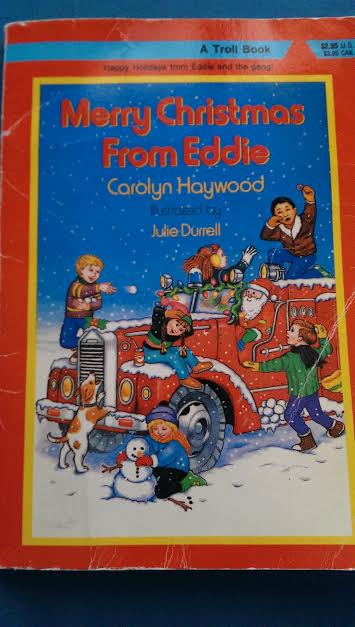
Merry Christmas From Eddie by Carolyn Haywood, 1986.

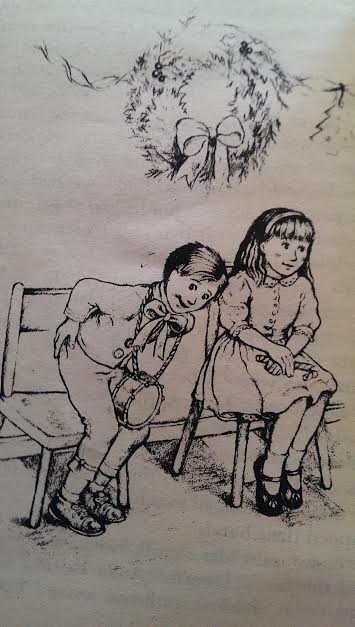
This is a collection of short stories, most of which involve one of Haywood’s favorite characters, Eddie.  Eddie is often full of big ideas and is eager to get involved in new projects.  Although this book was written in the 1980s, aspects of it seem more like Christmas in the 1950s in a fairly small town.  A few of the stories at the end focus around a special children’s program that the kids take part in.

The book is currently available online through Internet Archive.

Stories in the Book:

Merry Christmas from Eddie Fire EngineEddie’s Christmas Card

Eddie loves the decorations down at the used car lot, especially the fire engine with Santa Claus at the wheel.  Eddie thinks it would be great if his father could take a picture of him sitting next to Santa Claus so he can use copies of it as Christmas cards, but a surprise snow storm changes his plans.

How Santa Claus Delivered Presents

Every year, there’s a large public Christmas party at the town hall, and children from the local children’s shelter are invited and given presents.  This year, Eddie’s father is in charge of the celebration. Mr. Ward is loaning the fire engine from his car lot for transporting the presents, but they need some extra help transporting the extra-large Christmas tree.

Christmas Is Coming

Eddie and Boodles go Christmas shopping.  Boodles wants to get a pet bird for his mother, and Eddie has decided to buy a small present for a little boy on his street who has a broken arm.  Then, Eddie ends up winning a prize for being the ten thousandth child to enter the department store.  It solves the problem of what to buy for the little boy, but getting it home isn’t going to be easy.

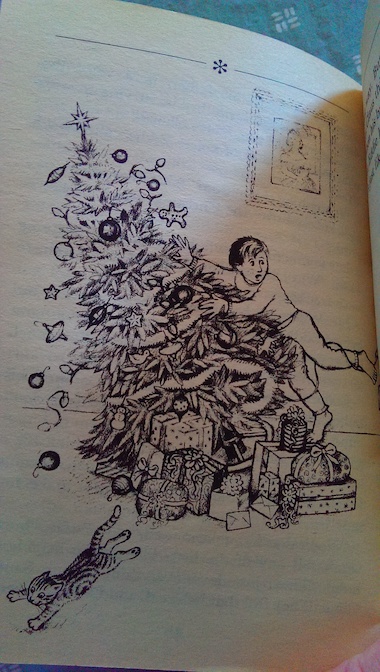
Merry Christmas from Eddie TreeHow the Christmas Tree Fell Over

Eddie is old enough to figure out that his father is the one who puts the presents under the Christmas tree on Christmas Eve, eats the cookies they leave out, and leaves a thank you note from Santa.  This year, he gets a funny idea: he’ll leave extra presents under the tree for everyone and a second thank you note for the cookies and make everyone wonder where they came from.  But, his brilliant idea doesn’t quite go as planned.

Christmas Bells for Eddie

Eddie regrets that he never joined the school orchestra now that he’s learned that they will be performing for a Christmas program on television.  His mother suggests that Eddie could sing, but he says that the singing parts have gone to Anna Patricia’s cousin, L.C..  Then, Eddie’s father gives him an early Christmas present that will allow him to join the orchestra after all.

Merry Christmas from Eddie Christmas ProgramThe Christmas Concert

L.C. is spoiled and refuses to sing unless they give him chocolate-covered marshmallows.

New Toys from Old

Eddie’s third grade class is collecting and repairing old toys to be given as presents to the children at the children’s hospital.  Boodles has some fun making Anna Patricia think that Eddie painted the wrong colors on a doll’s face, and people question whether it was such a good idea to turn a nice white horse into a zebra.

The Christmas Program

Eddie has to be Little Boy Blue in the program that his class is putting on at the children’s hospital, but he has doubts about whether his old costume fits him well enough to get through the program.

The Mystery of the Christmas Cookies

Eddie’s mother plans to make some cookies for Eddie to give to his teacher, Mrs. Aprili, for Christmas, but a series of mistakes prevents him from giving those cookies to Mrs. Aprili.  Eddie finally gives up and orders some cookies from the bakery for her.  However, unbeknownst to Eddie, someone else tries to correct for his mistake and ends up creating a mystery for both Eddie and his teacher when a second batch of cookies unexpectedly arrives that is very different from both the cookies he ordered from the bakery and the ones his mother baked.

Cranberry Christmas

CranberryChristmas

Cranberry Christmas by Wende and Harry Devlin, 1976.

Mr. Whiskers normally enjoys Christmas, but this year, he has problems.  To begin with, he can’t go skating on the pond near his house with the children of Cranberryport because his disagreeable neighbor, Cyrus Grape, claims that the pond is actually on his property, not Mr. Whiskers’, and has forbidden the children to set foot on it.  Mr. Whiskers is sure that he’s wrong, but he’s having trouble finding the paperwork to prove that the pond actually belongs to him.

Then, Mr. Whiskers’s sister, Sarah, is coming for Christmas.  She believes that Mr. Whiskers doesn’t take proper care of himself or his house, and she is trying to persuade him to come and live with her.  Mr. Whiskers doesn’t want to do that because he likes his independence.

To help impress Mr. Whiskers’ sister, Maggie and her grandmother help him to fix up his house for Christmas.  In the process, they discover something that helps to settle the question of who really owns the pond.

My favorite part was when Maggie and Mr. Whiskers made Christmas ornaments out of Mr. Whiskers’s seashell collection, which he had been keeping in his bathtub.

In the back of the book, there is a recipe for the cranberry cookies that Maggie makes.  The book is part of a series.