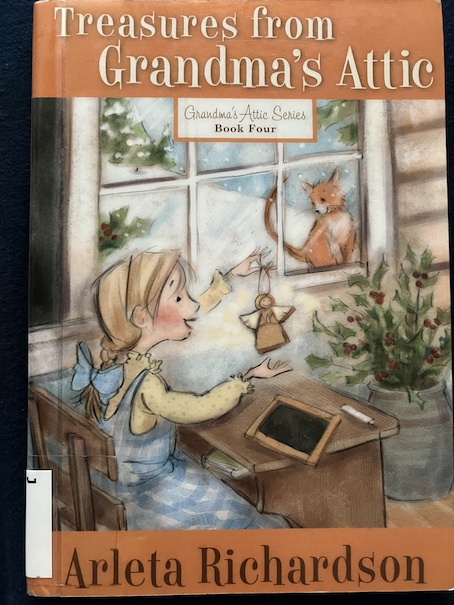
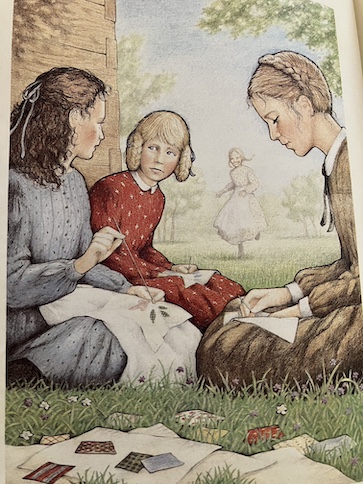
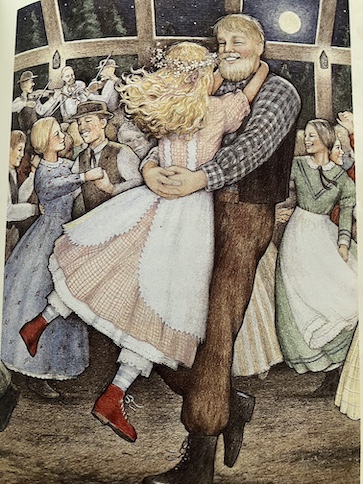
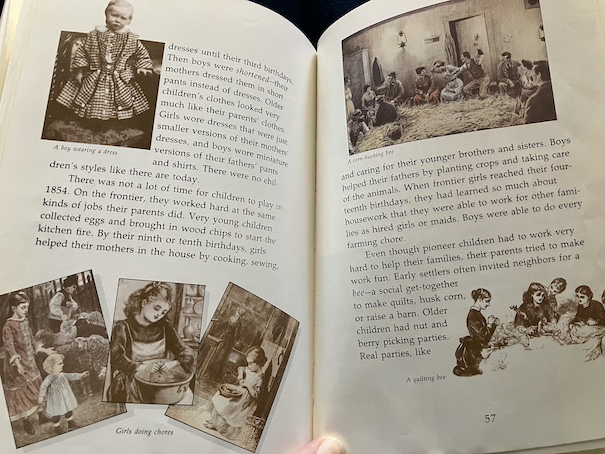
Treasures from Grandma’s Attic by Arleta Richardson, 1984, 2011.
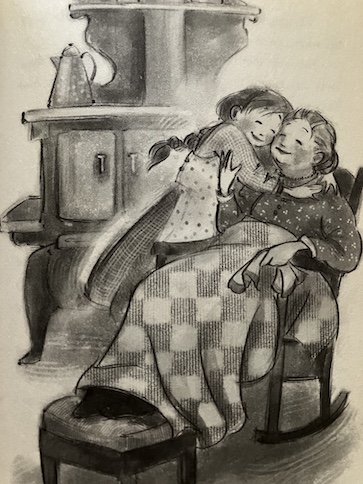
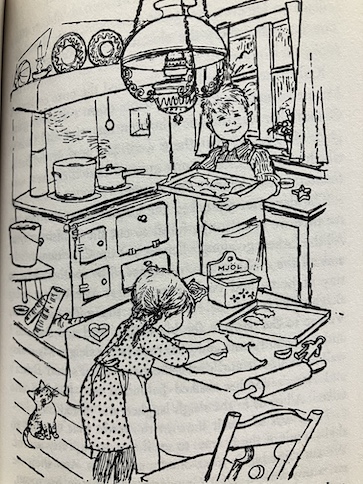
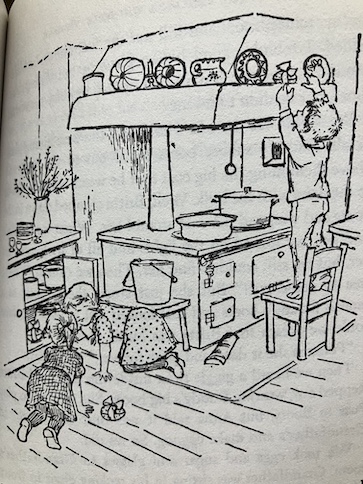
The Grandma’s Attic series by Arleta Richardson is based on her grandmother’s reminiscences about life growing up on a farm in Michigan during the 1800s. This is the fouth book in the series, and like the first three, it’s a collection of short stories.
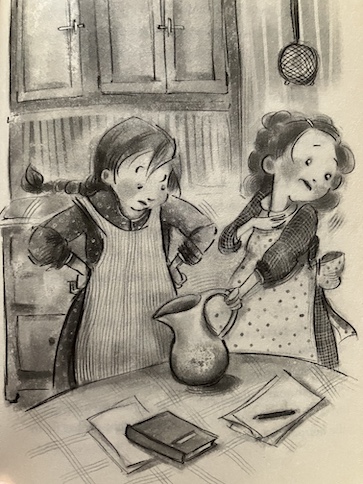
Usually, the stories are framed as grandmother, Mabel, telling her granddaughter some story about herself or her family when she was young, but in this book, the stories don’t have the framing element of the grandmother talking to her granddaughter. Instead, each story is just Mabel, talking about something that happened when she was young. Many of the stories in this book focus on things that happen at the small local school and lessons that they learn. The books don’t always say exactly how old the children are or what the year is, but the beginning of this book says that the year is 1886, and Mabel and Sarah Jane are thirteen and a half years old. The stories that follow the first one take place in order because characters and situations introduced in the earlier stories are referenced in the later ones.
Many of the scrapes the Mabel and her friend Sarah Jane are relatable, the kinds of minor trouble that many children (and even some adults) get into. I particularly liked the story about the fortune teller because it’s similar to something my mother told me about someone who heard something frightening from a fortune teller (or someone who claimed to be able to read palms). Even as an adult, this person similarly couldn’t get the idea out of their head once they heard something that they dreaded would happen, even though it never did. Fortunately, nothing truly tragic happens in any of the stories in this book or in the series in general. The stories are pretty calm, and many of them have a moral to them, many of them Christian-based.
The book is available to borrow and read for free online through Internet Archive.
Stories in the Book:
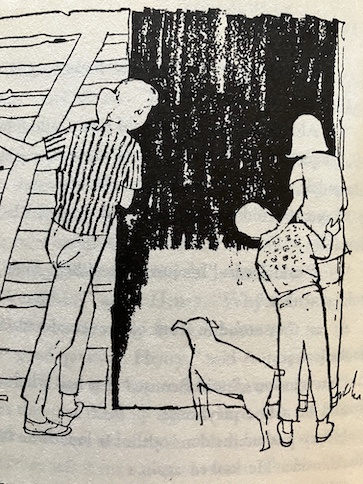
Cousin Agatha
Mabel’s father’s Cousin Agatha invites herself to join the family for Thanksgiving, further inviting herself to stay through Christmas. Cousin Agatha is highly critical and difficult to get along with, so the family starts getting nervous when she talks about wanting to stay with them for the long term. Mabel and her brothers consider doing things to irritate her so she won’t want to stay, but Mabel comes to realize that part of the reason why Agatha acts the way she does is that she’s a nervous and insecure person, starved for attention and affection.
A New Friend
A new girl named Mary comes to school, and when she gets a crush on one of Mabel’s brothers, she tries to make herself into Mabel’s best friend. However, when Mabel refuses to help her scheme to ingratiate herself to Mabel’s brother, Mary turns spiteful and tries to get Mabel in trouble.
Christmas Spirit
The children at school draw names for a gift exchange at Christmas. However, one girl, Hannah, is sour and grouchy, and she says that, if she doesn’t draw a name she likes, she won’t bring a gift. Mabel gets Hannah as her name, and she gives Hannah a gift, but when Mabel doesn’t get a gift herself, she blames Hannah. She later realizes that she’s misjudged the situation.
The Perfect Paper
Warren is a boy at school who shows off how well he does at school, and he makes it a point that he thinks boys are smarter than girls. Mabel prays that she’ll do better than Warren on their next math test to teach him a lesson, and at first, it seems to work. However, her father notices that one of the problems was marked incorrectly, meaning that Warren actually got a better score than she did. Mabel finds herself in the position of having to tell the teacher about it, but both she and Warren learn lessons about qualities that are more important than perfect test scores and the relative worth of boys and girls.
Wesley’s Lesson
Wesley is a big boy at school, and the others sometimes tease him or scold him about how much he eats. Wesley’s eating habits can sometimes be a problem when he eats things that everyone was supposed share (as in the Christmas story), but his size is mainly a problem when he’s careless. One day, he runs hard into Sarah Jane while playing, knocking her to the ground. He’s apologetic, but Sarah Jane is angry and embarrassed. She persuades Mabel to help her get some revenge and teach Wesley a lesson, but their teacher ends up teaching the girls a lesson about respecting their classmates’ feelings.
The Seamstress
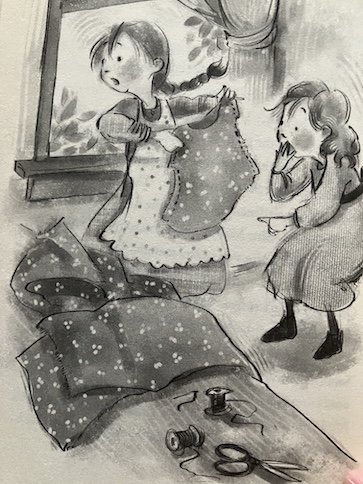
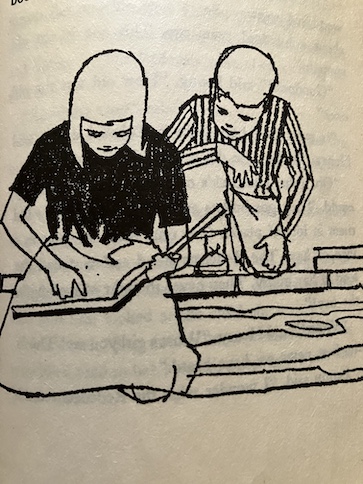
Mabel wants a new dress for the ice cream social, but her mother doesn’t have time to make one. Mabel insists that she’s old enough to make a dress on her own, but her mother knows that’s harder than Mabel thinks.
The Autograph
Cousin Agatha sends Mabel a special present, a book autographed by the author. Mabel is eager to take it to school to show everyone, but her mother doesn’t think it’s a good idea. It turns into a problem when Warren offers to buy the book from Mabel. She loves the gift, but the money Warren promises her could mean more because she wants to buy something for her mother. Then, Sarah Jane suggests forging the author’s signature in a cheap copy of the same book. Does Mabel have it in her to be a forger?
The Farewell Party
The children learn that their teacher, Miss Gibson, will be leaving, and she’ll be replaced by another teacher, Mrs. Porter. The children at school aren’t happy about it because they like Miss Gibson, and they worry that Mrs. Porter might be mean or that she wouldn’t like them. The children decide that they can’t let Miss Gibson leave without having a farewell party for her, but they learn that the adults are planning a surprise of their own.
Really Responsible
Mabel starts thinking of all the things she’d like to do with her future. Sarah Jane thinks getting married is the best thing to do, but Mabel wants to do something that she can do on her own rather than having her role in life defined by the man she marries. Sarah Jane doesn’t think that she can do anything big like that on her own because she isn’t always reliable and responsible, and Mabel complains that nobody has any faith in her, but she worries that maybe Sarah Jane is right. Mabel’s mother uses a lesson from the Bible to show Mabel that, if she wants to prove that she’s responsible in big ways, she should prove herself responsible in small ones first. However, Mabel’s absent-mindedness soon gets her into trouble again!
The Tangled Web
Mabel is looking forward to a birthday party, but everything goes wrong from the moment she wakes up. It’s a rainy day, and Mabel is sick. Mabel’s mother insists that she stay home. Sarah Jane says that’s fine because the party has been rescheduled. The problem is that the party has been rescheduled to Sunday, and their families believe that Sunday should always be a day of rest. When the girls sneak out to the party without permission, they get caught up in their own scheme.
Gypsies
Mabel’s mother takes in a gypsy family temporarily because their baby is sick, and they need help. Their neighbors ask her if she’s doing the right thing because they think that gypsies can’t be trusted, and even Mabel’s brothers have heard that they’re thieves. However, Mabel’s father says that they shouldn’t assume things about other people because good and bad people can be found among any group, and Mabel’s mother points out that, whatever else they are, they’re human beings who need help. The gypsies themselves prove their own character when it’s time for them to leave, and they repay their hosts’ generosity.
The Expensive Bookcase
When Sarah Jane’s father makes a new bookcase for her, Mabel decides that she’d also like one for her birthday. Mabel’s father agrees on the grounds that it will help Mabel to be more neat and tidy. However, the project turns out to be bigger than they thought when Mabel’s mother decides that Mabel could also use new curtains and new paint in her room, and then, Mabel decides that she would like her bed spread dyed to match. Mabel ends up owing her brother a surprising amount of favors in exchange for the work.
Monday’s Child
Mabel is fascinated by the poem about the days of the week that children are born on. Since Mabel was born on a Monday, according to the poem, she should be “fair of face.” Sarah Jane was born on a Friday, so she’s supposed to be “loving and giving.” Mabel’s mother says that it’s only a poem, not something to live by, and that beauty is as beauty does. The person who does the right thing is the most beautiful person. Mabel has trouble believing that until she sees a lovely girl at the general store who demonstrates the concept that beauty doesn’t bring happiness or character.
The Fortune-Teller
Mabel and Sarah Jane wonder about the future and what the fortune teller in town might have to say to them. Mabel’s mother warns her that curiosity can lead to trouble and that if she tries to have her fortune told, she might hear something she won’t like. However, the girls can’t resist seeing the fortune teller. Although the girls promise themselves that the fortune telling is just for fun and that they won’t take it seriously, when Mabel hears something that she doesn’t like, she has trouble getting it out of her head. Because she’s been primed to believe the prediction, she misinterprets something that she overhears.
Revenge
Mabel can’t find her cameo pin, and she blames her brother Roy because of his teasing and tricks he plays. Later, a comb disappears from her room, and Mabel again blames Roy. He doesn’t exactly deny that he didn’t take these things, although he implies that Mabel probably lost them herself. When a quarter disappears from the money that Mabel has been saving to buy a present for her mother, Mabel is sure that Roy is responsible, but she can’t spoil the surprise for her mother by admitting that she’s been saving money for a present. Mabel decides that she needs to take matters into her own hands and teach Roy a lesson but ends up teaching herself one.
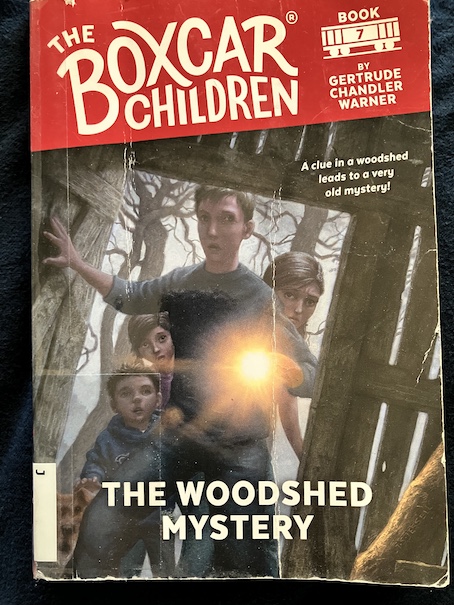
#7 The Woodshed Mystery by Gertrude Chandler Warner, 1962.
Grandfather Alden’s sister, Aunt Jane, calls and tells the family that she’s decided to move back east. She’s been living on the family’s old ranch out west, but she has decided that she would like to return to the east, where Mr. Alden and his grandchildren live. She asks Mr. Alden if he can buy back the old farm where the two of them grew up, so she can move back there. Mr. Alden is pleased that his sister will be moving closer so he and his grandchildren can see her more often and that they have a chance to reclaim their old home.
He calls the man who now owns the farm, Elisha Morse, and finds that he’s selling it pretty cheaply because it’s gotten pretty run down. Mr. Morse says that Mr. Alden probably won’t like the farm now because it’s in rather poor condition and has a leaky roof. He’s selling it because he couldn’t really afford to maintain it. However, Mr. Alden says that’s fine and agrees to buy it. He and his grandchildren go there to get it fixed up and ready for Aunt Jane’s arrival.
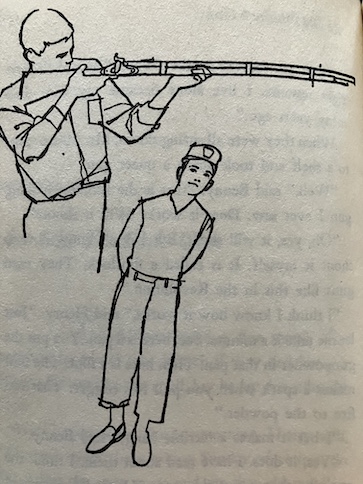
Grandfather Alden tells his grandchildren about the village near the farm and their neighbors as they drive to the farm. One house in particular used to be owned by the Bean family. Aunt Jane was once fond of their son, Andrew, and there was a point when she might have married him, but he got into some serious trouble as a young man and left town over it. Apparently, he used to shoot at trees in the area to scare away trespassers from his family’s farm, but one day, he accidentally set the woods on fire. It was a pretty bad fire, and he felt like he couldn’t show his face in town again. Last they heard of him, he’d gotten a job as a sailor and was traveling around the world. Nobody knows what he did after that or where he is now.
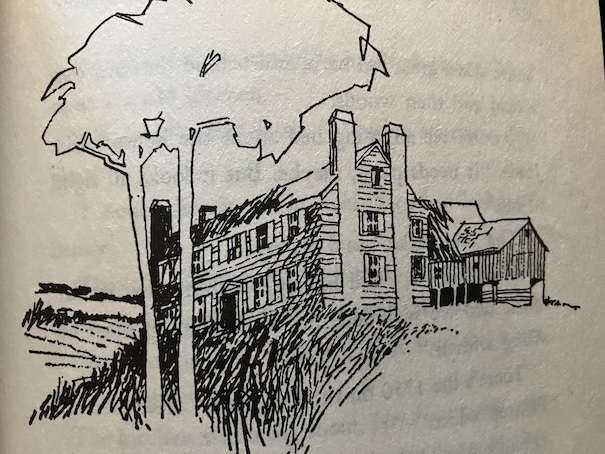
The Alden farm is very old indeed. It was originally built in 1750. The house has four chimneys, a barn, and a woodshed. It’s painted white, and when the Aldens approach it, it doesn’t look like it’s in such bad condition to them. The Aldens go inside and look around, admiring the old-fashioned fireplace and other features. The place is dusty and dirty, so it needs a thorough cleaning, but other than that, they don’t see any serious problems.
They talk to the son of the man who sold them the house, Simeon “Sim” Morse. His father said that he would be able to help them fix the leaky roof, and Mr. Alden presses him to tell him why his father thought the house was in such bad shape when it doesn’t really look that bad. At first, Sim Morse hesitates to say anything, but when Mr. Alden insists, he admits that it’s not so much about the physical condition of the house so much as the feeling it gives people.
People have regarded the area as bad luck since the incident when Andy Bean caused the fire. The rumor is that he did it while playing with a gun that he actually found on the Alden farm, an antique that appears to date from the Revolutionary War. Since then, it seems like people who have tried to live on the Alden farm have had bad luck, and nobody seems comfortable staying there, although nobody seems able to point out anything specific that gives them that odd feeling about the house. Sim Morse’s father still has the antique gun that apparently started the fire, and Mr. Alden says that he’d like to see it. He also arranges with Sim Morse to make some repairs to the house and to add a couple of indoor bathrooms because the house never had indoor bathrooms.
When the Aldens see the antique gun that Mr. Morse has, it turns out to be an old flintlock gun. When Violet reads a book about the Revolutionary War that she found in the farmhouse, she sees a picture of a gun that looks a lot like the one Mr. Morse has. It’s in a section of the book that talks about leaders of the Revolution hiding and their men hiding weapons to use in the war. The Aldens start to wonder if that gun could have been one of those hidden weapons.
Then, they discover that someone has been hiding and camping out in the old woodshed on the property. When they search the woodshed, they find a hidden cave or tunnel. Could this be the secret of where Andy Bean once found the old gun? Could the person who’s been hiding in the woodshed know something about a secret that dates back to the Revolutionary War?
My Reaction
This book is one of the original 19 books in the Boxcar Children series, written by the original author. Because it is one of the original books in the series, the child characters have aged from the first book. Rather than being the usual ages from the first book and from the later ones, with the children’s ages frozen at Henry being 14, Jessie being 12, Violet being 10, and Benny being 6, we are told at the beginning of the story that Henry is now in college and both of the girls are in high school, Jessie as a senior and Violet just entering. (Although, I kind of quibble with that because there’s supposed to be only 2 years’ difference in age between Jessie and Violet, so if Jessie is a senior, I would expect that Violet would be a sophomore, unless Jessie skipped a grade ahead.) Benny is still in elementary school because he’s much younger than the others, but he’s no longer a little kid.
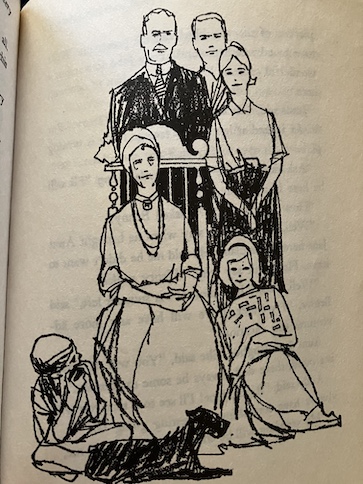
We also get more of the backstory of the Alden family in this book. They’re not the first family to own the old farmhouse, and during the story, we do learn who owned the farm at the time of the Revolutionary War. However, we also learn some things about the Aldens when Mr. Alden and his sister Jane were young and living on this farm. Jane admits that she made a mistake when she was younger, not marrying Andy Bean when he asked her, and she admits that her primary reason for not wanting to marry him was ridiculous. The fact is, Jane thought that “Bean” was a silly last name, and she just didn’t want to be known as “Mrs. Bean.” Because she put Andy off and because Andy left the area after the incident with the gun and the fire, the two of them went their separate ways for years. Fortunately, the theme of family members or old friends becoming reconciled after years of estrangement crops up a lot in the Boxcar Children books. As the children investigate the matter of the antique gun and the odd things happening around the farm, they eventually learn where Andy is, and he and Jane reconcile. In later books in the series, Jane and Andy are married, although in later books, the children often come to stay with Aunt Jane when Andy is out of town on business, so we don’t always see him and Aunt Jane together.
I didn’t think the mystery was too mysterious, but I enjoyed seeing the Alden children during the books when the children are starting to grow up and seeing the Alden family grow and chance while getting a glimpse of their past. Because Jessie is a teenager in this book, it’s also hinted that she and John Carter, a former FBI agent who works for her grandfather, have a mutual crush. John Carter disappears as a character in later books, especially because the children’s ages become frozen, and it would be inappropriate for him to have a crush on Jessie when she’s only 12 years old for the rest of the series. In this book, if Jessie is a high school senior, she’s probably either 18 years old or almost 18, which is more acceptable.
Similarly, I think it’s worth pointing out that the Alden children are able to do some of the things that they do without adult supervision partly because, especially in these earlier books, they’re aging, and they’re not as young as later books in the series declare them to be. At this point, Henry is a legal adult in college, and Jessie is either at or close to legal adult status. At their ages, they’re not only legally old enough to be on their own in many instances but also old enough to take charge of younger siblings without other adults or local authorities thinking it unusual.
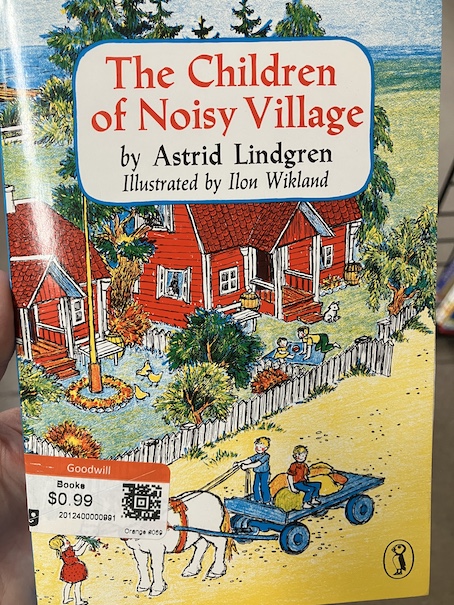
The Children of Noisy Village by Astrid Lindgren, 1947.
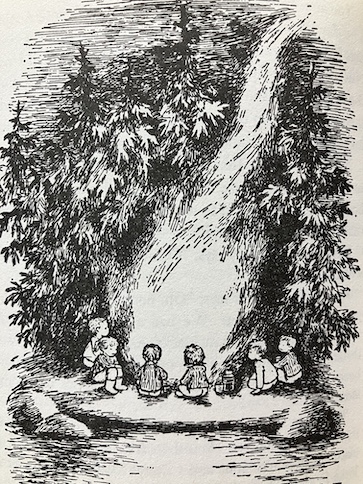
The story is told from the point-of-view of nine-year-old Lisa, a Swedish girl who has two older brothers, Karl and Bill. She and her family live on a farm that people call Middle Farm because it’s between two other farms, North Farm and South Farm. The three farms together are called “Noisy Village” because there are so many children around. The children who live on South Farm are Ulaf and his little sister Kirsten, who is only a year-and-a-half old, and North Farm has two girls, Britta and Anna, who are Lisa’s friends. Ulaf is friends with Karl and Bill. Sometimes, Lisa tries to play with her brothers, but they often tell her that she’s too little, and she sometimes thinks of the boys as a nuisance. Ulaf will sometimes play with girls, although Karl and Bill sometimes tease him about it, but there are also a limited number of children in the area to play with, so being willing to play with whoever is around is a good thing. Through the story, Lisa tells little stories and talks about the things that all of the children of Noisy Village do together.
When Lisa was younger, she used to share a room with her brothers before getting a room of her own. At night, Karl used to tell ghost stories, while Bill likes to talk about adventures. Lisa tells a story about how her brothers scared her one night with a ghost story and how they rigged up a trick to make it look like their room was haunted. Although Lisa sometimes misses the stories that her brothers used to tell her at night, she’s also relieved that she has a space of her own so she doesn’t have to put up with their pranks or them bossing her around all the time. Bill and Karl like their room because their window is close to Ulaf’s window, and the boys like to use the tree between their houses to go back and forth between the two rooms. The room that Lisa has now used to belong to her grandmother, before her grandmother moved in with an aunt. Lisa’s family remade the room for her as a present for her seventh birthday. Lisa’s room faces North Farm and Britta and Anna’s room, so the girls can send each other notes or signal to each other through their windows.
Some of the children at Noisy Village have pets, and Lisa explains how Ulaf got his dog, Skip, from the mean shoemaker, who was mistreating him. Britta and Anna don’t have any pets, but their grandfather lives with them, and the other children at Noisy Village like to visit him. Britta and Anna’s grandfather tells the children stories. One of his stories is about how he ran away from home as a boy. Inspired by the story, Lisa and Anna decide that they should have their own adventure, running away from home temporarily. However, they think that they have to run away during the night, and they both miss their opportunity because they fall asleep.
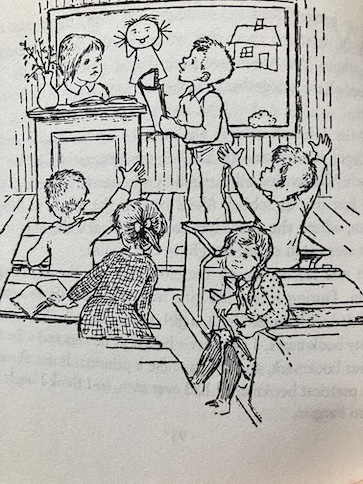
The children like to play games of pretend on their way home from school, which makes their mothers wonder what they’re doing and sometimes get them into trouble. Anna and Lisa accidentally get on people’s nerves one time, when they try too hard to follow their teacher’s advice about doing things to make people happy. They often end up doing the wrong things because they don’t know what other people really want or what people say they want doesn’t seem like enough. They finally succeed in making someone happy when they share some of their things with a girl from school who is sick.
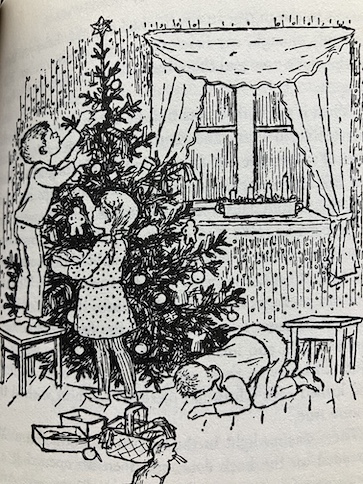
The children’s adventures continue through the year. The people of Noisy Village have a charming, old-fashioned Christmas. At a Christmas party at a relative’s house, they play old-fashioned party games and tell stories. Lisa also describes a Swedish tradition of finding an almond in porridge, which is supposed to be a sign of marriage in the coming year. The children are allowed to stay up late on New Year’s Eve. The boys scare the girls with some firecrackers, and Britta and Anna’s grandfather teaches the children the tradition of pouring melted lead into water to see what shapes it will form to predict what will happen in the new year. On Easter, the children paint eggs and make egg nog.
Eventually, school lets out for summer vacation. The children go swimming and catch crayfish during the summer. When they go fishing for crayfish, they camp out in the forest, near the lake, with Lisa’s father and the other men. The children make little huts to camp in. The boys try to scare the girls with stories about goblins. The children appreciate their idyllic lives in Noisy Village!
My Reaction
This book is a series of pleasant, gentle, slice-of-life stories about the children who live on a collection of small farms outside of a Swedish town, probably some time in the mid-20th century. Because there is little mention of any form of technology in countryside, it could set almost be any time in history from the 19th century to the time when it was written in the 1940s. The one thing that identified it as the 20th century for me is when they mentioned “turning on lights” in the house rather than lighting lamps. Even into the mid-20th century, not all farm houses had electricity, but it seems that these do. Other than that, these children seem to be living an idyllic, “unplugged” life in the countryside that people who are into cottagecore would aspire to! I think it would be a nice book to read children at bedtime because it’s very gentle.
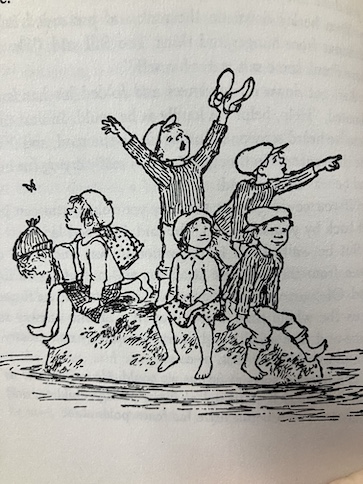
I enjoyed reading about the games that the children play with each other and with their families. The children like playing games of pretend that seem to be inspired by books they’ve read. The girls play at being princesses, while the boys play at being Indians, probably American Indians (Native Americans) because one of young Bill’s ambitions is to be an Indian Chief when he grows up. We don’t really encourage playing at being “Indians” today in 21st century America because that can devolve into caricatures of someone else’s racial group (cowboys are still fair game because that’s a profession, not an ethnicity), but that sort of thing was pretty common in the mid-20th century, even outside of the United States. I’ve read British books from around the same time period that also refer to children playing at being American Indians, so it was something that seems to have captured children’s imaginations, even internationally. The children also pretend that they’re marooned or shipwrecked on a rock at one point, something else that often appears in children’s literature and is based on older books.
I particularly enjoyed some of the descriptions of Swedish holiday traditions through the year. Some of them are very similar to traditions in the United States and Britain around this time and even earlier, like in the 19th century. They have a charming Christmas with friends and family and a party with old-fashioned parlor games. I’ve heard of the tradition of finding an almond in porridge or pudding before, but I think that’s more common in Scandinavian countries than in the United States. In Britain, there are traditions associated with finding things (like a coin or a bean) in porridge or pudding, but it’s not really common in the US. Another thing that stood out to me was that Lisa said they made egg nog at Easter. In the US, people typically have egg nog at Christmas, but when I thought about it, it does make sense for Easter because of the association with eggs.
One other thing that stood out to me in the book was the little huts that the children make when they’re camping out by the lake. It reminded me of the huts that children in The Secret Summer (Baked Beans for Breakfast) made.
Christmas Farm by Mary Lyn Ray, illustrated by Barry Root, 2008.
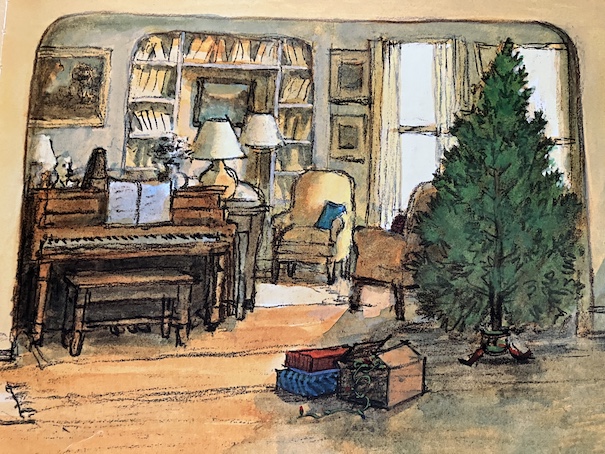
Wilma has grown flowers for years, but now, she’s decided that she wants a change. She thinks about what she would like to do with her garden next spring while she’s getting ready for Christmas. Going out to cut a Christmas tree makes her think that maybe she would like to grow Christmas trees instead of flowers.
She starts by ordering 62 dozen small balsam trees (744 trees, for those who are counting), and she gets the boy from next door, Parker, to help her prepare the site for them. They use string to lay out rows for planting the trees.
Wilma knows that it will take longer than a year for the trees to grow big enough to be Christmas trees. As the trees grow, Wilma has to mow around them and take care of them, with young Parker helping her more as he also grows bigger. Wilma loses some trees to pests and weather conditions every year, but by the time the trees are big enough to sell, she has 597 left.
In the months leading up to Christmas that year, people reserve trees, and they also get a buyer who owns a Christmas tree lot in the city. Most of the trees are sold, but there are still some left. They know that the trees that were cut down will sprout again, but they’re also going to order some new ones.
In the back of the book, there is a section that explains more about growing Christmas trees with a chart showing how long it takes the trees to grow.
My Reaction
I thought this book was a sweet and fun look at Christmas tree farms. It takes years to grow trees big enough for Christmas trees, so there is a considerable time investment, and farmers know that they will lose some of their trees to pests or bad weather condition during that time. It’s a project that requires long-term planning and investment.
I always feel a little sorry for the trees when they’re cut down, but I liked how this book explains that, because the stumps of the cut trees are still there with their roots, even cut trees will regrow. The end of this book touches on the cycle of replanting and regrowth, with Wilma and Parker planning for their next phase of planting and cultivating new trees.
I also thought the addition of Parker to the story helps to show the passing of time and the growth of the trees because the boy grows a few years older during the time when they’re letting the trees grow bigger. By the time they’ve sold their first crop of Christmas trees, Parker is getting old enough to take more of an active role in planning the next crop.
#124 The Pumpkin Head Mystery by Gertrude Chandler Warner, 2010.
The Aldens are getting ready for Halloween, and they go to the Beckett farm to get some pumpkins. Mr. Beckett has been having trouble this year because he broke his leg. He’s been letting a hired assistant, Bessie, handle the pumpkin patch, but she is short-tempered and not very good with customers. Mr. Beckett fired her once before, but he had to take her back this year because he was desperate for help.
Mr. and Mrs. Beckett’s daughter, Sally, has been trying to persuade them to sell their farm and come live near her and her children in Florida. She thinks they’re getting too old to manage the farm by themselves and that this recent injury of Mr. Beckett’s proves it. The Becketts say that they don’t want to give up their farm and that they’re not ready to retire. Then, one of the farm hands, Jason, says that Mr. Beckett broke his leg while chasing a pumpkin-headed ghost, but Mr. Beckett denies that it exists.
Later, someone trashes the pumpkin patch and smashes a lot of pumpkins, and for some reason, Bessie faints. The real estate developer who is pressuring the Becketts to sell their farm, Dave Bolger, shows up again and tries to persuade the Becketts to sell. Sally thinks her parents should take the offer, but they still refuse. The Aldens help clean up the pumpkin patch in time for the next hayride, so the Becketts won’t have to cancel it, and Sally tells them that the farm is haunted and that the stories Jason has been telling about the pumpkin-headed ghost are true.
A glowing pumpkin has been seen floating through the fields at night, seemingly with no body underneath it. When it appears, they hear scary voices, telling them to leave the farm and leave the spirits in peace. Mr. Beckett did injure his leg while trying to chase after it on his horse. The Aldens think this sounds scary, and they ask Sally if the farm was always haunted. Sally admits it wasn’t, but she is serious that she thinks her parents should sell the place and move closer to her and her family.
The Aldens want to help the Becketts, and they start doing some seasonal work at the farm, making flyers for their hayrides and dressing up in costumes as part of the spooky attractions. Then, someone steals the scarecrow that Benny made from the Aldens’ house, and a new pumpkin-headed ghost appears on the farm!
Are there actually any ghosts, or is someone pulling a trick on the Becketts? Is it one of the people trying to pressure the Becketts to sell the farm or someone else, for a different reason?
My Reaction
I enjoyed this spooky mystery! The author did a good job of making multiple characters look like good suspects for playing ghost on the farm. Mr. Bolger and Sally both want the Becketts to sell the farm, and scaring farm workers and visitors away from the farm would add pressure to the Becketts. Bessie isn’t very good at her job, but the Aldens discover that she needs money because her husband is sick. Could she have been paid to commit some sabotage on the farm or could she be trying to get back at the Becketts for firing her last season? Jason has worked on the Becketts’ farm for years and seems to love the place, but he’s been arguing with Mr. Beckett about the way he runs the farm. Maybe Jason wants the farm for himself! There are some good possibilities for suspects.
There were some clues that I thought were obvious, like the connection between the disappearance of Benny’s pumpkin-headed scarecrow and the sudden appearance of a new pumpkin-headed ghost on the farm, but child readers may find the mystery more challenging. Even though I thought some parts were obvious, because there were several suspects, each of which seems to be doing something sneaky that they want to cover up, I wasn’t sure whether some of them might be working together or not.
The book has the right amount of spookiness for a Halloween story without being too scary for kids. In some ways, like with all Scooby-Doo style pseudo-ghost stories, I thought that it was a little silly for the plot to frighten people away from the farm to succeed. My reasoning is that, since this story is set in the Halloween season and some parts of the farm are deliberately set up as haunted attractions with people running around in costumes, I would think most farm workers and visitors would just attribute the pumpkin-headed ghost to either a Halloween prank or just part of the act at a spooky attraction.
One of the possible motives that they never discuss in the story is that the ghost act could be a publicity stunt to draw more visitors to the park. While the premise of the story is that people are being scared away, in reality, there are a lot of curiosity-seekers who would want to go to a supposedly haunted attraction to see what all the fuss is about. Publicity isn’t the real motive of the fake ghost, but I’m just saying that it could have been a real possibility that was overlooked. There are a lot of places, like hotels and restaurants in historic buildings, that capitalize on any potential ghost stories to attract curious thrill-seekers.
Something I appreciated is that the real estate developer is Dave Bolger, which is a homage to Ray Bolger, who played the role of The Scarecrow in the 1939 movie of The Wizard of Oz. Is that a hint? I’ve decided not to spoil the solution of the mystery!
Isabel’s House of Butterflies by Tony Johnston, illustrated by Susan Guevara, 2003.
The story begins by explaining that the forests of Michoacan, Mexico are a sanctuary for monarch butterflies, but that sanctuary is in danger because of logging activities. The large-scale industry is a major threat, but sometimes poor people living in the area also chop down trees because they need to sell the wood. The author notes that there have been efforts to preserve these trees, but it’s difficult to enforce laws protecting them, and no one is sure what will happen to the monarch butterflies if the trees disappear.
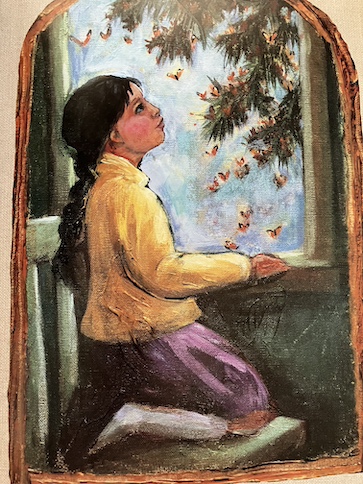
Isabel is an eight-year-old girl living with her family on a small farm, and the tree outside their house attracts butterflies on their migration route. She calls it, “La casa de las mariposas,” which means “The House of Butterflies.” Her family is poor, but they can’t bring themselves to chop down their special butterfly tree, like other families in the area have done. They love it that the butterflies appear there every autumn, and they think it’s a beautiful miracle to see them return every year. Sometimes, tourists come to the area to see the butterflies, and that brings the family a little extra money.
However, one year, there is very little rain, and they have a very bad harvest. The family sells their pigs and continues on as best they can, but their money is running low. They don’t have many resources left for money, and Isabel’s father is reluctantly considering cutting down their butterfly tree. He doesn’t want to do it, but he doesn’t know what else to do.
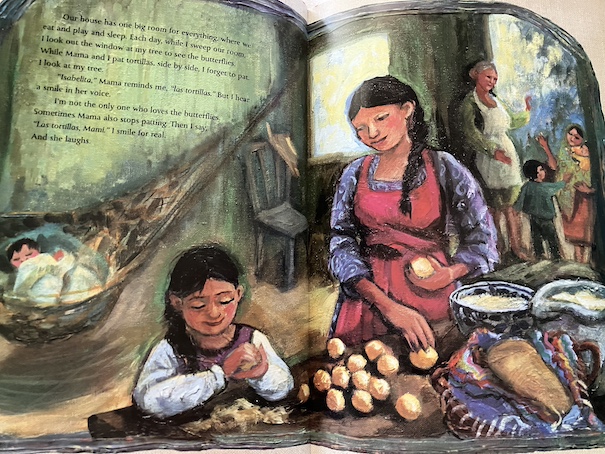
Isabel is distressed at the loss of the tree and the butterflies, so she suggests another plan to her parents. She often helps her mother to make tortillas, so she tells her mother that maybe they can set up a stand selling tortillas to the tourists who come to see the butterflies. The family decides to give Isabel’s plan a try.
The book is available to borrow and read for free online through Internet Archive.
My Reaction
The story ends on a somewhat hopeful note, but it bothered me a little because it’s not definite that Isabel’s plan is going to work. Isabel is hoping that they’ll be able to make enough money that they won’t need to cut down the tree, but we only see them getting set up, so we don’t know if they’re successful or not. I would have preferred to see them succeeding so we would know that things are going to get better, but the story just ends at that point, and it’s left up to the minds of the readers whether they were successful or not.
I think that hopeful but slightly worrying note at the end of the story is meant to reflect how people trying to preserve natural resources often feel – they have ideas and plans to help preserve natural areas and resources, but nobody knows for sure what will work or how well their plans will work. It’s realistic, if a little bit of a let-down. However, while nothing is guaranteed to be successful and life has its uncertainties, there is hope in the people who are willing to try different approaches to problems rather than simply giving up. The book does speak to the concerns that modern people, even children, have about the environment and the search for systems that work better than the ones that we already have.
The pictures in this book are soft, colorful, and lovely. Although the family is poor, they appreciate the small pleasures in their lives, like making the tortillas and the yearly appearance of the beautiful butterflies. I did also feel a little sorry for the butterflies the pigs ate, but the story doesn’t dwell on that part too much.
This book was published by Sierra Club Books for Children, and there is a small note with the publishing information about the origins of the Sierra Club, which is dedicated to protecting scenic and ecological resources.
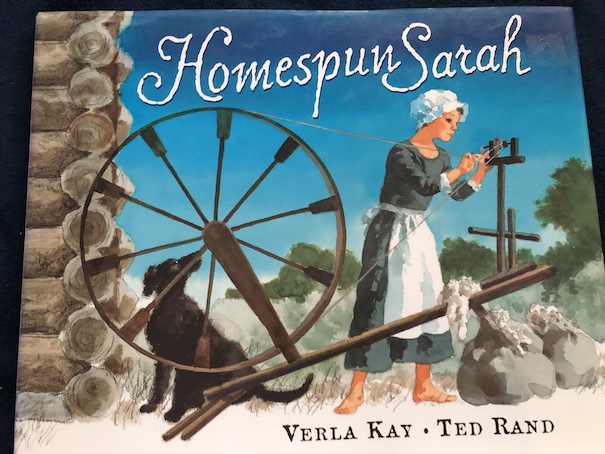
Homespun Sarah by Verla Kay, illustrated by Ted Rand, 2003.
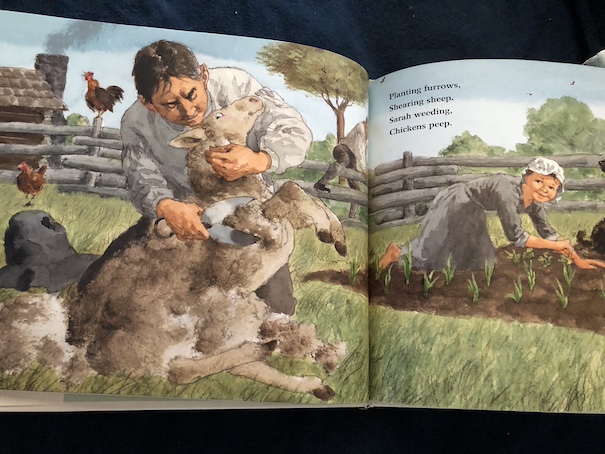
This picture book tells a story in rhyme about a girl living in 18th century Pennsylvania and what she and her family do to make her a new dress when she begins outgrowing her old one.
As Sarah gets dressed one morning, her old dress is noticeably tight, and it’s beginning to get too short for her. Because her family lives on a farm, they must produce most of what they need themselves, and that includes clothing. For Sarah to have a new dress, they must make one themselves entirely from scratch, which is what “homespun” means – they make the dress from homemade cloth from yarn that they have spun themselves.
Various family members carry out different household chores, and as the story continues, readers see how everything they do is not only a part of the family’s daily life but also contributes to the creation of the new dress. The family raises sheep, so they must start by sheering the sheep to get the wool for the dress.
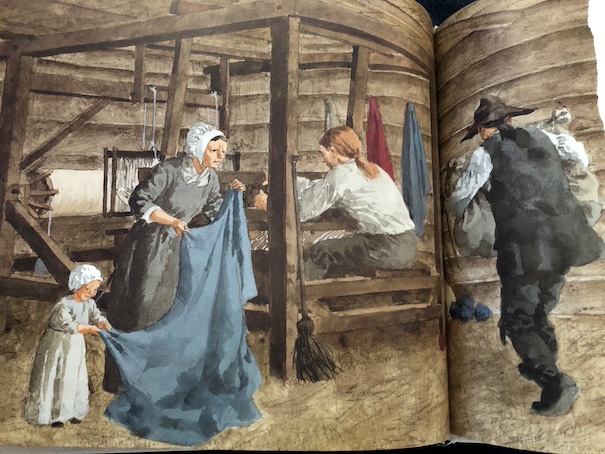
In between doing routine chores, like doing the laundry and making new candles, they card and comb the wool and spin it into yarn with their spinning wheel. The family also owns a large loom, which is how they weave the wool yarn and flax into cloth called linsey-woolsey. The cloth they make is blue and red, dyed using plants that they have produced and gathered.
Once they’ve made the homespun cloth, Sarah’s mother measures her to plan the size of the dress and sews the dress. Sarah gets a new red dress, while her younger sister gets a blue one. Sarah is excited about her new dress, which fits her much better than the old one, and spins around to show it off!
The author’s note at the beginning of the book says that the story is set in Pennsylvania during the 1700s, and she wanted to show how people lived during that time, having to produce everything or almost everything they used by themselves. It also shows various aspects of family life, from where and how they slept to what they ate. The characters in the book, even the children, are shown drinking beer, but the author explains that is because water wasn’t considered entirely safe to drink. The beer they drank back then was very weak and “barely alcoholic”, which was why the children could have it. (We have water treatment facilities and devices available in the United States in modern times to ensure the quality of the water, so this isn’t something that we typically do now, especially with children, and I have more to say about this in my reaction.)
The book is available to borrow and read for free online through Internet Archive.
My Reaction
When I was a kid, I often skipped over prefaces and author’s notes because I just wanted to get to the story, but the author’s note really adds some historical depth and helps to clarify some aspects of the story that children might misunderstand. For example, I thought that the clarification about the mention of the characters drinking beer was important. Alcohol, chemically speaking, is actually a mild poison. It’s mild enough that humans can have it in small amounts without dying or even becoming ill (although we can get sick or die from large amounts, and some people have a greater or weaker natural tolerance to it, compared to each other), but even weak alcohol might kill germs in water and make it safer for humans to drink. This is the way it’s being used in this book. Because this book is for children, it’s helpful to explain this so that child readers understand that what the characters have isn’t quite the same as modern beer and that it’s not okay for children to drink modern beer in the same way. I think this is good book for parents or other adults to read with kids, so the adults can point this out to kids and help them to understand other historical elements of the story that they might miss or misunderstand.
The author’s note also explains that, because people during the time the story is set, had to make their own clothes by hand, and making was a very time-consuming, labor-intensive process, people had far fewer clothes back then than they do now. It was common for someone to have only one set of clothes that they wore every day until they were no long usable. Getting a new set of clothes was an exciting occasion, and that’s what the story in the book tries to capture. When readers see what this family goes through to create just one new dress for a girl who is outgrowing her last one, they can understand how much that dress means to the girl who receives it.
I love books that show how things are made, so I appreciated this book for the process it shows. However, because the story is told in short, simple rhymes and focuses on the how the process would look to a casual observer without getting too detailed, I felt like there were many parts of the process that were implied rather than stated. For example, they don’t explicitly mention that the red and blue dyes for the cloth came from the red berries the girls gathered or the blue flowers of the flax plant, but it’s implied by the earlier mentions of these plants and the way the book showed the characters gathering them. That could be enough for a casual reader, but I’m the kind of person who likes hearing the details of the process, so I would have liked more detailed explanations.
I did appreciate the way the book showed aspects of daily life in the 18th century. Some of them are explained in the author’s note, but there are also other parts of daily life to notice in the pictures. One of my favorite ones was the way that the youngest child in the family is tied to her mother or older sister’s apron strings to keep her from wandering away and getting into trouble while they’re doing their chores.
Understood Betsy by Dorothy Canfield Fisher, 1916.
Elizabeth Ann is an orphan who lives with her Great-Aunt Harriet and her first-cousin-once-removed Frances, who she calls Aunt Frances. Her relatives took her in when she was only a baby, after her parents died, and her life with them is the only one she has ever known. Her relatives love her, and Aunt Frances is particularly devoted to her. Ever since Elizabeth Ann came to live with them, she has devoted her entire attention to the little girl. She reads anything she can find about how to parent a child and makes it a point to know everything that’s going on in Elizabeth Ann’s life at school and sympathize with her over ever difficulty and misfortune she encounters. Elizabeth Ann certainly doesn’t lack for attention and affection, but Aunt Frances’s devotion and sympathy often go a little too far.
Aunt Frances is rather an anxious person, and she has unintentionally transferred many of her worries and anxieties to Elizabeth Ann, making her a rather timid and fearful little girl. She has also made it such a point to shield Elizabeth Ann with so much attention that Elizabeth Ann is never allowed to go anywhere or do anything by herself, making her feel like she can’t do things alone. Aunt Frances tries so hard to shield Elizabeth Ann from anything difficult or unpleasant that any difficulty she does encounter seems unbearable. While Aunt Frances’s intentions are good, and she tries hard to always understand and sympathize with Elizabeth Ann about everything, but there are some things about both Elizabeth Ann and herself that Aunt Frances doesn’t really understand. Then, when Elizabeth Ann is nine years old, something happens that changes her life forever.
When Great-Aunt Harriet gets sick, the doctor says that she must go to a warm climate and that Aunt Frances is going to have to take care of her. However, the doctor is adamant that Elizabeth Ann shouldn’t go with them because he doesn’t want to risk the girl catching Great-Aunt Harriet’s disease. Elizabeth Ann can’t imagine life without Aunt Frances, and Aunt Frances worries about where Elizabeth Ann will stay. Her relatives in Vermont, the Putneys, say that they are eager to have her. They would have taken her when she was a baby, but Great-Aunt Harriet and Aunt Frances never trusted the Putneys. They say that they are not sympathetic enough and that life on their farm would be too harsh for the delicate, sensitive little girl they have decided that Elizabeth Ann is. Instead, they decide that she should go live with some other cousins who live in the same city they do.
However, these relatives aren’t particularly eager to have her, and after Great-Aunt Harriet and Aunt Frances have already left town on their train, they discover that a member of their household has come down with scarlet fever (what strep throat can turn into if it isn’t treated with antibiotics) and that the household must be quarantined. There is a brief moment of panic when they realize that they can’t even bring the girl into their house. Then, they remember the Putneys. If Great-Aunt Harriet and Aunt Frances couldn’t bring themselves to send Elizabeth Ann to these other relatives, these cousins can. In fact, they must, and there’s no way Elizabeth Ann can argue, even though she is afraid of the Putneys because of all the negative things she’s heard her aunts say about them.
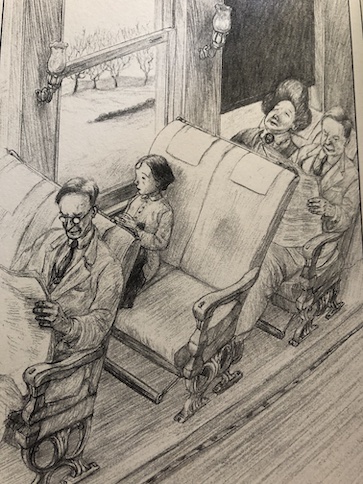
A relative who is traveling on business takes Elizabeth Ann partway by train and then makes sure that she gets on the right train to go to the Putney’s town in Vermont alone. Timid, fearful little Elizabeth Ann finds herself traveling completely alone for the first time to go to a place she’s never been and meet relatives she is sure she won’t like. Fortunately, many of Elizabeth Ann’s preconceived ideas are turned on their head from the first moment she steps off the train and is greeted by Great-Uncle Henry.
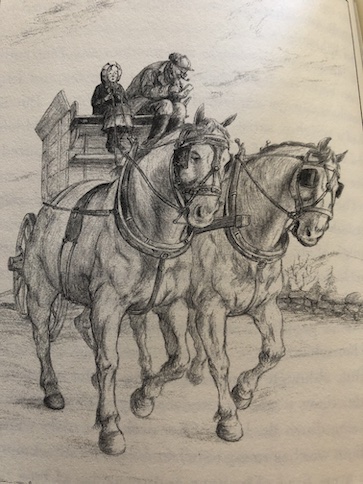
If it had been Aunt Frances greeting her, Aunt Frances would have immediately worried and fussed over her and asked her how she stood the ordeal of traveling. However, Uncle Henry acts like Elizabeth Ann hasn’t been through any ordeal at all. Instead, he just greets her cheerfully and helps her into his wagon. In fact, as they drive along, he unexpectedly gives the horses’ reins to Elizabeth Ann and lets her drive while he does some math. (We don’t know why he needs to do this; he just says he does.) He just tells her to pull on the left rein to make the horses turn left and the right rein to make them go right. Being handed this unexpected responsibility is terrifying for timid little Elizabeth Ann, and she has a moment of panic, worrying that she doesn’t always remember her left from her right. Then, Elizabeth Ann has an unexpected revelation: it doesn’t really matter if she doesn’t remember the names for the directions or which is which because she can just look and see where she wants the horses to go and pull the reins in that direction, no matter what that direction is called. After all, it’s not like horses really understand the words “left” and “right” anyway, just the direction of the pulling. This is an important revelation for Elizabeth Ann, who is usually accustomed to Aunt Frances doing everything for her, including her thinking. She has never really had to figure out things by herself before. When she voices this revelation to Uncle Henry, he simply agrees that she is correct, and Elizabeth Ann feels a rare sense of pride in her accomplishment.
When they reach the Putney Farm, Great-Aunt Abigail and Cousin Ann are glad to see her, but they don’t overly fuss, either. They call Elizabeth Ann “Betsy” and show her the hook where she can hang her cloak. Betsy is a little offended that they don’t help her take it off and hang it up for her the way Aunt Frances did. Their lack of fussing and expecting her to do things for herself makes her feel at first as if they don’t really care about her. Their farmhouse is also fairly small, it’s lit with kerosene lamps, and they do their own cooking instead of having a servant, like Great-Aunt Harriet and Aunt Frances did. These things make Betsy realize that the Putneys are poor, and she has a moment where she is overcome, thinking that she will be miserable in a poor, deprived household. Then, Aunt Abigail hands Betsy a kitten and tells her that, if she likes it, it can be her cat.
Betsy always wanted a kitten, but Aunt Frances would never let her have one because she was afraid that they would carry disease. Betsy forget her worries and misery while playing with the kitten, which she names Eleanor. She is also relieved that her relatives don’t fuss about her not liking certain foods. Aunt Frances always tried to make her eat her beans for nutrition, but the Putneys don’t care when she avoids them because she has a good appetite for everything else on the table. In fact, Betsy eats much more at the Putney farm than she ordinarily does because she is allowed to eat more of what she likes and nobody fusses over how much she’s eating or if she’s eating the right things. For her first night at the farm, Betsy has to sleep with Aunt Abigail because her room isn’t ready yet, but she ends up finding Aunt Abigail’s presence reassuring.
In the morning, her relatives decide to let her sleep in because she’s tired from traveling. When Betsy wakes up, she lies in bed for a while, waiting for someone to tell her to get up. When no one does, she get the idea, for the first time, that she can get up when she’s ready and doesn’t need for someone to tell her to do it. She also dresses herself and does her own hair for the first time. In a way, it’s a little thrilling because Betsy realizes that she can do her hair the way she wants it instead of the way Aunt Frances does it, and she copies a hairstyle she envied on one of her old classmates. However, it does bother her a little that her relatives don’t seem to care about whether or not she needs help and aren’t stepping forward to help her automatically. She does fine, but she’s accustomed to an adult hovering over her as a sign of caring.
Her relatives explain that they were letting her sleep as late as she wanted that day because they knew she would be tired. Cousin Ann gives her breakfast and lets her have as much milk as she wants because, unlike in the city, they produce their own milk from cows rather than buying it in quarts, so they don’t have strict limits on how much they can have in a day. Betsy is pleased by this, but she has another moment of panic when Cousin Ann tells her to wash her dishes after breakfast. Betsy has never washed her own dishes before and doesn’t know how. Seeing Betsy’s hesitation, Cousin Ann offers a view brief instructions, and Betsy accomplishes the task.
On her first day, she also sees Aunt Abigail making butter, something that Betsy has never seen before. She is accustomed to buying butter, not making it, and she didn’t even know before what butter is made from. Aunt Abigail is astonished that Betsy doesn’t know these things, but Uncle Henry points out that city life is different, and Betsy has probably seen things they haven’t, like how roads are paved. Betsy gets excited because roads being paved is a familiar sight to her, but she becomes embarrassed and confused when her aunt and uncle try to ask her questions about how the workmen do it. While she has seen roads being paved before, she took the sight for granted and never really noticed the details. Aunt Abigail suggests to her that she watch the butter making process closely and even take part in it so, if someone asks her later how it’s done, she can tell them all about it. Betsy accepts the lesson and even has fun making butter.
Then, her relatives surprise her by telling her that it’s time for her to go to school for afternoon lessons. They let her miss the morning lessons so she could rest, but now that she’s rested and had some time to look around the farm, she should go to the afternoon lessons. Worse still, they tell her that she should walk there by herself. Betsy panics again because Aunt Frances never let her walk to school by herself, but her relatives just give her a few directions to the school and a sugar cookie to take with her and send her out the door. Betsy could balk at this and say that she can’t do this and won’t, but their expectation that she can and will and her hesitancy to tell them differently make her walk down the road in the direction they say.
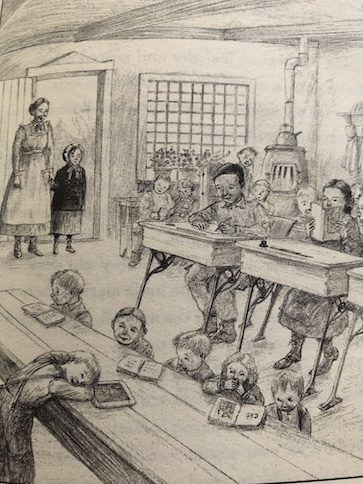
She almost misses the schoolhouse because it’s a much smaller building that she expected. Her school in the city was a multi-story building, but the local school is just a small, one-room schoolhouse. Fortunately, the teacher has been expecting her and looking out for her arrival, so she calls Betsy inside as she passes. Betsy is astonished at how few students there are, compared to her old school, and because there are so few, all the grades are just in that one schoolroom.
Even more confusingly, Betsy learns that this little school doesn’t do grades the way her old school did. Because there are so few students, and they’re all sharing the same room, it doesn’t matter too much what grade each student is studying in which subject. The teacher just moves them up and down as necessary to help them learn at their own, individual levels. At her age, Betsy knows that she should be in the third grade at school, but when the teacher has her read out loud with the other students at the third grade level, Betsy does much better than they do. She loves reading, and she reads all the time on her own, so she has progressed much faster in her reading skills than other children her age. Her teachers at her old school just never noticed because they were trying to keep track of so many students that they couldn’t pay that much attention to individual students’ progress. Her new teacher decides that she can read at a seventh grade level. Betsy is stunned and proud. The idea that she could move up multiple grade levels at once never occurred to her before as an option, but then, she worries that she can’t move up to seventh grade because she isn’t very good at math. She tries to explain this to the teacher, but the teacher isn’t concerned because she doesn’t make students study at one, consistent grade level for every subject. They can move ahead faster in some subjects than in others. When they’re struggling with one subject, she holds them back in that subject alone until they’ve mastered it. She does put Betsy back one grade level in math when she sees that Betsy is struggling, telling her that she can move up later when she’s had some time to review the material and improve.
It’s what Betsy really needs, but Betsy finds it disorienting that she isn’t part of one, consistent grade level at school. She says that she doesn’t know what that makes her, and the teacher replies that she is simply Elizabeth. Before, Betsy’s concept of school was that, every year, the students would simply move up one grade level, and that the goal of school was just for the students to move up through the levels appropriate to their age. Now, she is being introduced to the concept that the goal of education is for her to master the concepts being taught to her, regardless of the grade level, so that she will have the ability to do things like math, reading, and spelling. As long as she can learn to do these to a satisfactory level and keep improving, her specific grade doesn’t matter. In fact, when Betsy is upset later about failing an examination at school because she was nervous and made a lot of mistakes, Cousin Ann tells her that there’s no need to be nervous and that her grade on a single examination doesn’t matter because, regardless of how she did on that particular test, she knows that she actually does know the material and can use that knowledge in daily situations.
Betsy is also unexpectedly given the responsibility of looking out for a younger girl at the school, Molly. Because Molly is so good at reading, the teacher has Betsy listen to Molly read at the first grade level and asks her option of how Molly did and if she seems like she could manage the second grade level reading. Betsy has never had an adult ask her to supervise anyone younger before, and she unexpectedly discovers that she likes it and likes teaching someone younger. Later, Betsy is asked to hold Molly’s hand while they cross a log over a stream because the teacher wants older children to hold the hands of the younger ones and help them. Actually, holding Molly’s hand helps Betsy more than it helps Molly because Molly has walked on this log before and Betsy hasn’t, but being responsible for someone younger makes Betsy more bold. Although she would have been afraid to walk that log if she had to do it by herself, she can’t refuse when she has the responsibility of helping Molly. Later, she also helps to rescue Molly when Molly falls in a hole and needs help to get out. Betsy wanted to run for help at first, but when Molly begged her not to leave her alone, Betsy decides that she should do what Cousin Ann would do and figure out how she can use the things around her to solve the problem, spotting a branch that helps the younger girl climb out. Even though Betsy gets scared, when she has someone smaller than herself depending on her, she finds her courage.
Betsy has other adventures with Molly and her other new friends while living with the Putneys. When Molly’s mother becomes ill and has to go to the hospital, Molly is upset because she will have to move in with some cousins in the city who don’t really want her. Having been in this type of situation before herself, Betsy is immediately sympathetic, and she gets her relatives to agree to let Molly stay with them. Molly becomes like a little sister to Betsy, and they share in other adventures together. Along with some other girls from their school, they form a sewing circle to make some clothes for a poor boy at their school who lives with a stepfather who spends all of his money on alcohol. The book doesn’t shy away from describing how the boy is neglected, and the girls in the sewing circle are moved to tears when they go to the boy’s house to deliver the new clothes and see the circumstances he lives in. The Putneys also become concerned about the boy’s welfare, and they help arrange for him to be adopted by a man they know who has been talking about adopting a boy. Later, for Betsy’s birthday, Betsy and Molly go to the fair with some neighbors, but they are accidentally left behind when the people who were supposed to give them a ride home had to leave to tend to an emergency. Betsy is terrified, but with Molly to look after, Betsy manages to keep her head and think of a way to earn some money so they can buy train tickets home.
Betsy has been living with the Putneys for about a year when she gets a letter from Aunt Frances, who says that she will arrive soon to reclaim her. Aunt Frances thinks that Betsy must have been having a miserable time without her, but Betsy has actually come to think of the farm as home and loves it there. She doesn’t want to hurt Aunt Frances’s feelings or seem ungrateful for all the love and attention that Aunt Frances has lavished on her over the years. It seems like Betsy has to resign herself to returning to her old life in the city … unless Aunt Frances has also been making some changes to her own life since they were last together. When Betsy and Aunt Frances meet again, they truly come to understand each other, and they find a way for them all to live their best lives.
This book is now public domain and is available to read for free online through Project Gutenberg and Internet Archive (multiple copies, including audiobooks).
My Reaction
Educational Themes
I really enjoyed this book! I’d heard about it for years and never got around to reading it before. Dorothy Canfield Fisher was an early advocate of the Montessori method of education in the United States, and in particular, this book presents many of the principles of the Montessori method and how it can help children. The educational themes in the story are obvious when Betsy sees the differences between the one-room schoolhouse in the country and her old school in the city.
The benefits of the smaller class size are immediately obvious. Betsy loves reading but she always hated her reading class in school because each student took turns reading, so the most any particular student could read was one or two sentences, and even then, they might not get a turn if the class ran out of time before they got to all of the students. This description feels like an exaggeration of how reading classes might have gone at a bigger school, but there may be some truth in it. When I was at school, my classes typically had about 20 to 30 students in them, and when we took turns reading, we did more than that. It’s difficult to say for sure because I don’t think Betsy ever said exactly how many students were in her class, but I would think they would have to have at least twice as many as that to be as bad as she described. According to Going to School in 1876, some large city schools could have classes of 50 to 60 students during the late 1800s, so that is possible for a class in the early 1900s or 1910s as well. I do take the point that it’s easier for a teacher to keep track of the progress of individual students when the class size is smaller.
I also appreciated what the teacher said about allowing students to progress faster in subjects that are their strengths, even if they have to take extra time for problem areas in other subjects. When I reviewed The Beast in Ms. Rooney’s Room, there is a boy in that book who was held back a year in school because of his problems in reading, and he was embarrassed about not moving to the next grade with his classmates. If he could have moved forward in some subjects, it might not be so embarrassing for him to be held back in the one subject that gave him the most trouble. The problem is that he couldn’t do that because the classes at his elementary school are organized the way the ones at my old elementary school were – one single teacher at a particular grade level teaching all of the subjects for that grade level. Under that system, remaining at a particular grade level in one subject means remaining at that grade level, with that teacher for all subjects.
There is only one teacher at the one room schoolhouse in the story, so there’s no conflict about a student seeing one teacher for some subjects and another teacher for other subjects at a different grade level. All of the students are in just that one room with one teacher all the time, so the only difference when a student moves up or down in level for a subject is the book that the teacher gives them to study. That means that changes in grade level can be done informally for any or all subjects, whenever the teacher decides that a student is ready to move to the next level. The student just turns in their old book and gets a different one to study. If most grade levels were determined that easily for different subjects, I think there would be fewer parents who would be concerned about the prospect of holding a child back a grade temporarily to give them a better grounding for moving forward later, and students would experience less embarrassment about problem subjects if they could receive acknowledgement for better skills in other subjects. However, I can see that this system would be complicated in bigger public schools, and there would have to be a point when the student would have to master their series of subjects at a particular level to know when they could graduate from their school. I think that’s part of the purpose of the examinations Betsy describes in the book, but because the book only covers a single year, we don’t see what happens when a student is ready for graduation.
Emotional Management
In the beginning, Aunt Frances, in spite of all of her good intentions and research into psychology and raising children, unintentionally transfers her personal anxieties to Betsy without really giving her the tools that she needs to manage them, so they feel overwhelming to Betsy. The solution to this problem, as presented in the book, seems to be mostly being around people who do not express worries about things (if they’re nervous about anything, they mostly cover it up and don’t talk about it, except for one time, which I’m going to talk about) and who present manageable challenges to Betsy to show her that she can handle more than she thinks she can. I like the part about giving Betsy manageable challenges and some basic instructions for how to accomplish them when she doesn’t seem to quite know what to do. If they had just thrown challenges at her with no instruction at all, in a kind of sink-or-swim fashion, I think she would have been just overwhelmed and more panicky. However, I think there’s a point in the story that could use more clarification.
The differences between Betsy’s sets of relatives is initially presented, particularly by the aunts she’s been living with, as one of understanding and sympathy. Great-Aunt Harriet and Aunt Frances initially don’t like the Putneys because they don’t seem sympathetic enough, especially with people who are sensitive and nervous. Aunt Frances dedicates herself to sympathizing with Betsy about everything and talking to her about everything in her life, and the book presents this as a negative because their sympathetic conversations about the worries they have end up being a way of making each other more nervous. I think, in real life, there’s a happy medium between never talking about worries and wallowing in them.
The first problem with Aunt Frances’s attempts to sympathize with Betsy is that she makes assumptions that things that bother her will also bother Betsy, and this becomes the way that she accidentally transfers her anxieties to Betsy. Second, when Aunt Frances sympathizes with Betsy about worries or problems, she tends to dwell too much on the problem itself and how bad it feels, magnifying the issue and making Betsy feel worse. What I’m trying to say is that Aunt Frances’s attempts to sympathize would have worked much better if she had been willing to listen to Betsy’s concerns and sympathize a little about how certain things can make a person nervous but then move on to offering practical tips to deal with these feelings and different ways of looking at situations to take some of the anxiety out of them.
I didn’t like it when Cousin Ann seemed to shut Betsy down when she was talking about how tests at school make her nervous because I don’t like the idea of shutting people down when they’re talking about something important to them, but what made it better to me was that she did listen to Betsy for a bit before that and had already offered her a different way to look at tests that makes them seem more fun and less scary. When Cousin Ann cuts the conversation short seems to be the point when discussing and sympathizing is about to turn into brooding and dwelling on the negative. My only thought on that conversation is that it might have helped for Cousin Ann to point that out. Rather than asking if Betsy really wanted to keep talking about this, which makes it sound like disinterest in what Betsy’s saying, I think it might have been better to point out that, if she keeps dwelling on the parts of the experience that make her feel bad, she won’t let herself move forward, to see the parts of the experience that could be exciting opportunities and possible triumphs. Perhaps, it would be good to add that one poor test experience doesn’t mean that others will feel the same way or that she can’t do better the next time, especially if she spends her time in between tests focusing on how much she enjoys what she’s learning and how it can be fun to show others what she’s learned and what she enjoys about her lessons, putting herself in a better frame of mind for the next time someone asks her questions about what she’s learned. I just think that approach would help emphasize the lesson that Cousin Ann would really like to teach Betsy about reframing challenges in her mind and also help clarify that she’s not ending the conversation because she’s not sympathetic but because it’s better to give the positive thoughts time to take hold rather than dwell on the worries.
I think it’s also important for both Betsy and Aunt Frances to recognize that it’s okay to feel nervous but that it’s possible to handle situations even though they make them nervous. As someone who has had life-long issues with anxiety, I can also attest that one of the best approaches is learning not to be afraid of feeling afraid of something. That is, learning to recognize that being nervous isn’t a sign that a situation is unmanageable or that the feeling of anxiety itself is necessarily going to be overwhelming, something that Betsy learns through practical experience in the story. There are still times in the story where Betsy is afraid and has to handle difficult situations, but she learns that she can proceed and do what she needs to do even though she’s nervous and isn’t sure at first how things will work out. It isn’t explicitly spelled out in the story, but this is probably the most important lesson that Betsy was missing from her time living with Aunt Frances.
Betsy’s Family
There are no villains in this story. Although readers can see at the beginning that living with Great-Aunt Harriet and Aunt Frances has caused some emotional complications for Betsy because she has taken on their worries and anxieties, they do mean well and have made real efforts to understand Betsy and support her, as best they know how. Great-Aunt Harriet and Aunt Frances just have very different, more timid personalities than the Putneys and don’t find their style of communication reassuring or appealing. However, Betsy discovers, to her surprise, that she does come to appreciate the Putneys and that they are a good influence on her, helping her to come out of her shell, discover new abilities and interests, and develop some self-confidence.
At first, Betsy is a little offended that her Putney relatives don’t fuss over her like Aunt Frances did, and it makes her feel like they don’t care about her, but they do care. They are just more low-key in showing the ways that they care. They are a family that doesn’t like to fuss about anything. Personally, I thought that Cousin Ann should have let Betsy talk a little more when Betsy was distressed about doing badly on her exam, but I do see her point that Betsy’s talking about it seemed to be upsetting her more because she was dwelling on the problem rather than consoling herself and looking for solutions or new ways of thinking about the situation. Cousin Ann points out that exams aren’t always negative, and even when one doesn’t turn out so well, it’s not the end of the world, giving Betsy a new way of looking at the situation and defusing Betsy’s sense that every little setback is a tragedy.
The Putneys show how much they truly care when Betsy and Molly are accidentally left behind at the fair. When Betsy manages to get Molly home, she sees her relatives rattled and upset for the first time when they realized that the girls were lost, and they do some rare fussing over the girls, praising Betsy for her ingenuity in handling the situation. Although the Putneys normally make it a point to deal with things coolly and calmly, they do care about the girls and can get upset if they think there is a serious problem. They are not without feelings. They are also genuinely upset when they think Aunt Frances is going to take Betsy away, each finding their own way to show Betsy how much they care and how much they will miss her.
Spoilers
Fortunately, Betsy is allowed to stay with the Putneys in the end. When Aunt Frances comes to get her, she reveals that, in the year they’ve been apart, she has met a man and fallen in love. She is going to marry him, but marrying him means making some changes to her life, the greatest one being that they are not going to return to their old house. Great-Aunt Harriet has recovered from her earlier illness and has gone to live with another relative, and because her new husband has to travel constantly for business, Aunt Frances won’t be keeping a settled house at all. Aunt Frances, although usually timid, is actually looking forward to doing some traveling. She is still afraid of things like animals and would never be an outdoor/country kind of person, but travel to different cities sounds like her kind of excitement. However, she can see the difficulty of traveling with Betsy. Constantly moving would be difficult for her education, a complication that I was surprised that the characters didn’t spell out when they were talking to each other, given the educational themes of the story.
Betsy and Aunt Frances come to a new understanding of each other and the differences in the lives they want to live when they talk about what these changes would mean for their lives. Aunt Frances doesn’t want to simply abandon Betsy to the Putneys if she isn’t happy with them, but she can see that Betsy does like living there and would be happy to stay. Betsy hadn’t wanted to make Aunt Frances feel abandoned and unappreciated by telling her in the beginning that she wanted to stay with the Putneys, but when she learns that Aunt Frances will be happily married and enjoying the new experience of travel, she is able to tell Aunt Frances that she can see that having her come along would be inconvenient for her and that she would be happy to stay with the Putneys. Neither of them is offended or worried about living apart now because they can see that each of them will be happier with Betsy living with the Putneys. Aunt Frances is now free to get married and go where she wishes with her husband, assured that Betsy is doing fine and living in a stable home with people who care about her, even if it’s not quite living the lifestyle that she would like herself. Aunt Frances also promises to come visit sometimes, so it’s not a permanent goodbye.
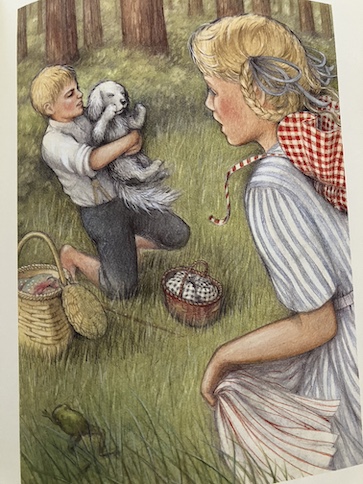
It’s summer, and for a frontier family, the summer chores can be the most fun! Kirsten and her younger brother, Peter, are going fishing. They’re hoping to get enough fish for their family and their Uncle Olav’s family to have for supper. There is plenty of trout in the stream, and they should be able to get enough fish, although sometimes, disasters happen on their fishing trips. Once, Peter chased a skunk, and their mother also warns them to be careful of snakes and bears. Kirsten wears a whistle around her neck that she can blow if they get into trouble. Kirsten thinks her mother worries too much.
The children take their dog, Caro, fishing with them. Kirsten is a little concerned because Caro likes to chase things, but Peter insists that he can watch the dog and fish at the same time. When they don’t seem to have much luck getting big enough fish in the stream, they decide to go upstream to the pool. The fishing goes well, but Caro is stung by a bee.
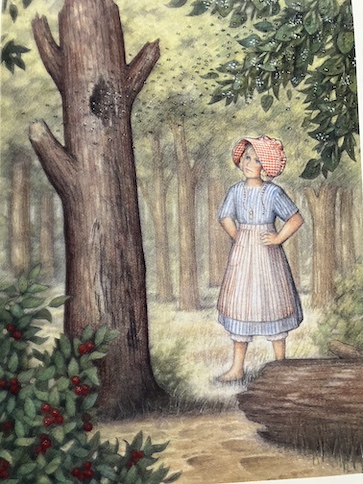
Kirsten realizes that Caro must have found a “bee tree”, a tree where bees have built their hive. Kirsten is interested in finding the tree because it’s a source of honey and honeycomb that their mother can make into special treats. If they can collect enough honey, their father might even be able to sell some and buy some of the things the family needs. They need to be careful while looking for the tree, though, or they might get stung themselves. Kirsten is pleased when she finds the tree, but she notices that there are marks on it from a bear’s claws, so it looks like a bear was trying to get the honey, too. Kirsten could ask her father how to get the honey and get him to help, but she wants to figure out how to do it herself and surprise everyone. She asks Peter to keep the bee tree a secret while she tries to figure out how to get the honey, and Peter reluctantly agrees.
Meanwhile, Kirsten’s cousins tell her about the town’s Fourth of July celebration. Kirsten’s family hasn’t lived in America for very long, so her cousins have to explain the significance of the holiday to her. Every year, the nearby town holds a parade and picnic with music and games. A lot of the local farmers also bring things to sell, like pies, butter, or preserves, and they use the money they make to buy things they need. Kirsten thinks again about the honey tree and the things her family could buy. She really wants a straw hat, like her cousins wear.
Later, when Kirsten is picking berries with her cousins, she sees a little black bear cub. She thinks it’s adorable, but Lisbeth says they have to leave the area immediately. If the baby is near the berries, its mother is sure to be somewhere nearby, and mother bears get dangerous if they think someone might hurt their cubs. Kirsten doesn’t really take the warning seriously until she tries to take Peter and Caro back to the bee tree with her to get the honey, and they meet the mother bear face-to-face!
The book ends with a section of historical information about the wilderness on the American frontier in the 1800s. Wild plants and animals were sources of food, but they were also sources of danger, like the bears in the story. The attempts of the pioneers to control the land were about securing sources of food and reducing sources of danger. There is information in the book about how pioneers cooked and how they dealt with changing seasons and weather. It also discusses the Fourth of July and how trips to town were rare treats for pioneer farming families.
The book is available to borrow and read for free online through Internet Archive (multiple copies).
My Reaction and Spoilers
It’s a good story about the difference between bravery and being foolhardy. From the beginning, even young Peter reminds Kirsten that being brave and being foolish are not the same thing. After their hair-raising encounter with the bear, in which the children have a narrow escape and their dog is injured (but fortunately not killed), the children’s father lectures Kirsten about putting both her life and her little brother’s life in danger. When Kirsten explains what she was trying to do with the bee tree, her father also tells her that she doesn’t really know what she’s doing. She took his equipment, but if she had carried out her plan the way she was thinking of doing it, she would have both destroyed the hive and ruined the honey as well as getting badly stung. Kirsten should have just gone to her father as soon as she found the tree and got his help from the beginning. Kirsten is ashamed for getting their dog hurt and putting herself and her brother in danger and almost ruining her special find, and she apologizes.
Because Kirsten’s father now understands the situation, he gets Kirsten’s older brother, Lars, to help him move the colony of bees to their farm. He knows how to set up hives and keep bees long term, so instead of this being just a one-time find and honey harvest, they will be able to get honey from the bees regularly. Kirsten goes with her father and Lars to watch them move the bees. She does it because she’s been having bad dreams about the traumatic escape from the bear, and she thinks it will help her to recover if she goes to the area again and sees it with her father and brother, when it’s safe.
Kirsten still feels bad that she wasn’t able to get the honey all by herself and that her attempt to do it was a disaster, but her mother consoles her. She says that she and Kirsten’s father understand that Kirsten was just trying to help and that her discovery has helped them. She just needs to learn to be careful as well as being brave. I thought that it was also a lesson in learning to share the glory instead of trying to take all the credit by going it alone and risking the success of the project, but the book didn’t quite say that. Kirsten wanted to be the one to say that she did it all herself, but because she couldn’t really do it all herself, everything went wrong. She could have accomplished her goals by talking to her father in the beginning and still been the heroine who found the bee tree, as her mother pointed out. She still gets credit for what she did without needing to take credit for what she couldn’t do alone.
The book ends with the family enjoying the Fourth of July celebration. Thanks to the discovery of the bees, they are able to buy the things they need.
Happy Birthday, Kirsten by Janet Beeler Shaw, 1987.
It’s spring, and Kirsten’s family is planning to build a new barn on the farm that they share with Uncle Olav and his family, and her mother is expecting a new baby.
One day, while they are outside, working, dark clouds come, the wind picks up, and Aunt Inger thinks it might be a tornado. She urges everyone to get into the root cellar for safety. Miss Winston, the school teacher who is staying with Uncle Olav and Aunt Inger, joins them in the cellar. She brings her quilt with her for comfort and because it reminds her of home, so she wouldn’t want to lose it to a tornado.
She tells Kirsten and her cousins that her mother and other women and girls in her family made the quilt for her as a present when she left Maine. The scraps of cloth in the quilt came from clothes members of her family used to wear and things she used to wear when she was younger. Everyone who worked on the quilt signed it, making it a “friendship quilt.” Kirsten and her cousins ask Miss Winston if she could teach them to make a quilt like this one, and she agrees. She says that she will give them some muslin for the backing, but they’ll have to supply the scraps of cloth for the designs themselves. Because it takes a lot of work to make a big quilt, she suggests that they each make a square. Quilts are an unusual concept to the Swedish family because people in Sweden during their time usually use woven blankets. Kirsten’s mother also reminds her that she will need her help to sew more clothes for the new baby. Kirsten’s cousins, Anna and Lisbeth, suggest that they do their quilt sewing during recess at school, and Miss Winston agrees.
At school, the girls trade cloth scraps with each other and invite other girls to join them in quilting. One of the other girls, Mary Stewart, has done quilting before, so she helps the others. While the girls sew, they talk, and Kirsten talks about the baby that her mother is expecting. Mary says that the little girl her family calls her little sister is actually her cousin. She was born as one of a set of twins to Mary’s aunt, but the other twin died at birth, and their mother died shortly after, so Mary’s mother took the baby to raise with her family. Stories like that worry Kirsten because she worries that something might happen to her mother or the new baby.
Mary also brings up the topic of whether or not Miss Winston will move on. She’s been going to Powderkeg School for four years, and every year, the previous teacher moves on, and they get a new one. Although Kirsten initially had trouble with Miss Winston, she has become fond of her, and she wouldn’t like to see her go. With all the other changes happening in Kirsten’s life, she doesn’t want any other major changes now. Kirsten suggests to the other girls that they turn their quilting project into another friendship quilt for Miss Winston, signing it like her family members signed their quilt. The other girls debate about whether they could manage to finish a quilt like that by the end of the summer term. Lisbeth thinks they could, but Mary doesn’t want to rush the project because the best part of making a quilt is sewing it with your friends.
The talk then turns to Kirsten’s birthday. She will be turning ten years old soon. She didn’t celebrate her last birthday because that was during their voyage to America. Mary says that ten is a more important birthday anyway, although Kirsten isn’t sure if her family will do anything for her birthday this year, either. Everyone’s attention is taken up with preparations for the new baby.
When Kirsten’s mother tells her that the new baby is about to be born, she also tells her that she remembers the day Kirsten was born, too. She says that she will never forget that day because she had been hoping for a daughter, and she knows that Kirsten’s birthday is coming in two more weeks. Kirsten is happy that her mother remembers, and she hurries to get her aunt to help with the birth of the baby.
Fortunately, Kirsten’s new sister is born safely, although Kirsten has to take some time away from school to help her mother with the new baby and household chores. However, her mother tells her that her friends from school will be coming to the raising of the new barn, which is the day before Kirsten’s birthday, and she will allow Kirsten to have her birthday free to have fun with her friends.
At the barn raising, Kirsten and her friends have a chance to work on their quilt again. Kirsten is behind on making her quilt square, but her friends have arranged a special surprise for Kirsten’s birthday.
There is a section in the back of the book about babies and young children on the frontier during the mid-1800s. Children were born at home then, with the help of family members and midwives because there were few doctors and hospitals on the frontier. With limited access to medicine and without some of the modern medicines we have today, childbirth and early childhood were often risky. It was sadly common for families to lose a child or two before they were five years old. Because accidents as well as illness posed a threat to young children, parents were often strict with discipline so their children would listen to them and follow their instructions to avoid disaster.
This part of the book also talks about the phases of a child’s life on the frontier. Older children wore clothes that looked like smaller versions of their parents clothes, and they would often do the same kinds of chores that their parents did on their farms. Most children expected to become farmers or farm wives, like their parents. They were raised doing farm work, and they didn’t expect to do anything else when they were older.
Although their lives were filled with chores, there were still some opportunities for fun. Sometimes, neighbors would turn chores into social occasions, called “bees.” These work parties could center around any kind of chore that the community needed to do and could do together, like raising a barn or making quilts, like the characters in the story. Along with accomplishing their task, it was a chance for friends and neighbors to get together and talk and have a little fun.
The book is available to borrow and read for free online through Internet Archive (multiple copies).
My Reaction
I don’t think I read this particular book in the Kirsten series when I was young. I wasn’t as fond of the Kirsten books as I was other series in the American Girls franchise because there are some really sad parts in the series. However, I really enjoyed this particular book. Kirsten is worried at first about the welfare of her mother and her family’s new baby because she knows that life on the frontier can be dangerous, and sometimes mothers die in childbirth, and babies don’t always survive. Fortunately, everything turns out well for Kirsten’s mother and new little sister.
This is a happy spring story with a focus on new life and friendship. Even the smallest kitten in the new litter seems like it’s going to be fine. I liked it because, while life on the frontier could be very hard, it’s nice to see that not everything turned out as a tragedy. The book ends with the barn raising and birthday celebration for Kirsten.