Stories of Rainbow and Lucky: Three Pines

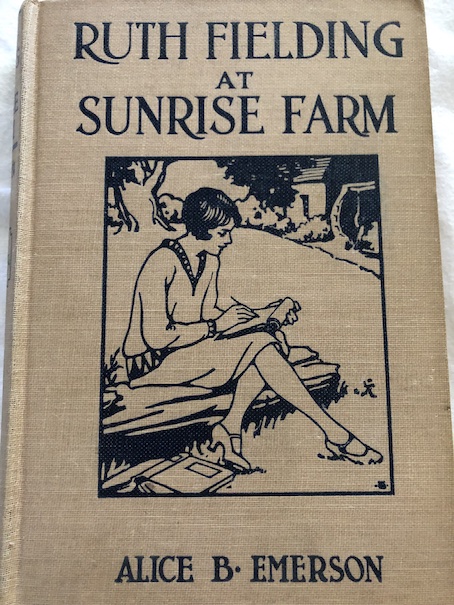
This is the third book in the Stories of Rainbow and Lucky series. I’ve already started covering this series, and I have to do all five books in a row because the series is set up like a mini-series. That is, none of the books in the series can stand alone; they are all installments of one, longer story. They only make sense together.

It’s an unusual series from the mid-19th century, written on the eve of the American Civil War, by a white author with a young black hero. Rainbow is a teenage black boy who, in the previous installments of the story, is hired by a young carpenter who is just a few years older than he is to help him with a job in another town. The rest of the series follows the two young men, particularly Rainbow, through their adventures leaving their small town for the first time, learning life lessons, and even dealing with difficult topics like racism. (Lucky is a horse, and Lucky enters the story in this installment!) The story is unusual for this time period because it was uncommon for black people to be the heroes of books and for topics like racism to be discussed directly. It’s also important to point out that our black hero is not a slave, he is not enslaved at any point in the series, and the series has a happy ending for him. People don’t always treat him right, but he does have friends and allies, and he manages to deal with the adversity he faces and builds a future for himself. Keep in mind along the way that there are a lot of pun names in this series and that people’s names are often clues to their characters.

This particular installment in the series focuses on their arrival at their new town and what their neighbors are like. There is a racial slur in the story. Although there are hints in the earlier books, this story does particularly contain a lesson about the polite words to use when talking about black people by mid-19th century standards. I’ve explained this before, but the terms that they considered polite in the mid-19th century aren’t quite the same as what we would consider polite by 21st century standards, and the main reason for that was a cultural shift that took place in the mid-20th century with the Civil Rights Movement. Up to that point, “black” was unconsidered impolite and unflattering, and the terms “Negro” or “colored” were preferred. You can see remnants of this is the name of organizations formed prior to the Civil Rights Movement, such the National Association for the Advancement of Colored People (NAACP) and the United Negro College Fund (NCF), although those terms sound outdated today. During the Civil Rights Movements, people wanted to distance themselves from the older racial terms because they came with a lot of emotional baggage attached to them, and they wanted a fresh start. Because of that, from the late 20th century to the 21st century, the term African American has been considered the polite, formal term (some call it “politically correct”, but I think “polite” covers it well enough) and “black” has been used as the informal, generic term. One point this particular story makes, which I think applies to all eras and circumstances, is that the best policy is to refer to people by whatever terms the prefer themselves and to never call anyone something you think they wouldn’t like. One of the characters says that to do otherwise makes for “ill blood.”

This book is easily available to read online in your browser through NINETEENTH-CENTURY AMERICAN CHILDREN & WHAT THEY READ, I’m going to do a detailed summary below. If you’d rather read it yourself before you read my review, you can go ahead, but some people might want to know what it’s like in more detail.

The story picks up where the previous installment left off, with Tolie taking Handie and Rainbow into Southerton by wagon. On the way, Handie asks Tolie questions about the farm that he’s inherited, which is called Three Pines. The farm used to be much finer, but it has become run down, and Handie will have plenty of work fixing it up with Rainbow’s help. Handie’s plan is to get a room at the local tavern for a day or two, where he and Rainbow can stay until they get a chance to see the farm and fix it up enough for them to live there for the next two or three months, while they’re working there. His backup plan, if they can’t get a room at the tavern, is to make up beds from straw for them to sleep on at the farm because he doesn’t expect to find any furniture there. Tolie confirms that there probably won’t be any beds, but there won’t be any straw there, either. The place has been empty for some time, and it was probably cleaned out by the neighbors. They stop at a farm that Tolie knows nearby, which belongs to Mr. Workworth, to buy some bundles of straw, just in case they need it, and Tolie tells them a little more about the Three Pines farm’s neighbors.

Tolie says that the woman who lives next door to the Three Pines farm is Mrs. Blooman (Tolie calls her “Ma’am Blooman”), and he describes her as “the crossest and ugliest old vixen in town.” They pass her farm on the way into town, and they see her looking out of the window at them.

When they come to the Three Pines farm, they decide to go up to the house to have a look at the place and drop off the straw. The house at Three Pines is painted red, and there’s a broad field between it and the Blooman farm. There’s also a little yard around the house, surrounded by a fence, and the yard is full of litter. Tolie doesn’t see how they can get in because it looks like the house is all locked up. (I don’t know why the lawyer didn’t provide Handie with a key to the house or tell him where to find one.) Handie looks over the situation and decides that their best bet is to try one of the windows on the upper floor because he thinks that they’re less likely to be locked. They look around the barn and the shed to see if they can find a ladder, and they find a jar of wheel-grease. When Handie sees the grease, he comments that this will be useful, and he comes up with an alternate plan. With Rainbow’s help, he removes one of the doors to the shed from its hinges. They prop this door against the house, and Handie uses it to climb up to an upper window and get inside and open a door for Rainbow.

Once they get into the house, Handie says that they should make a fire in the kitchen fireplace “to drive the spooks out of the house.” The story says that neither of them really believes in “spooks” as in ghosts, but the house has a lonesome atmosphere from being empty for so long, and they know that a cheery fire will make the place feel more cozy and lived-in. Handie sends Rainbow out into the yard to pickup some chips and kindling from the yard litter that they can use to start a fire.

Since they got into the house successfully and have straw to make beds for themselves, they decide to forgo renting a room at the local tavern and just camp out in the house instead. Handie has Rainbow fetch a few things that they found while exploring the shed and barn, including the jar of grease and an old tin mug, and he uses them to make a primitive oil lamp so they will have a light while they explore the rest of the house. He explains to Rainbow what he’s doing as he works on the lamp. It’s sort of a thrown-together lamp with a short wick, but it will do for one night, and Handie promises that they will get a better lamp later.

Handie says that they will explore the house together before they go to bed. Rainbow is relieved that they will have a look around, not because he thinks the house might be haunted, but because it occurs to him that there might be some trespasser hiding somewhere, like a drunk, a crazy person, or criminals hiding out. He knows he will feel better if they look in all the rooms and make sure that there’s nobody else there. Handie is less worried about trespassers and more generally curious to see what the house looks like, so he goes first in their exploring.

The house is generally a mess, with broken floor boards, a door with a half-broken hinge, signs of a leak in the roof, and litter everywhere. Handie can see that they have their work cut out for them, getting the house in shape. However, Handie is generally pleased with the layout of the house. There is a bedroom that connects to both the kitchen and parlor, and he thinks that, when he’s old enough to get married and come to live here with his wife, she will be pleased with that room and how easily it connects to the rest of the house.

They are startled by a cat, which dashes from the house out to the barn and shed. Handie asks Rainbow to try luring the cat back to the house with some cheese, which is the only food they have that might interest a cat. Rainbow is very good with animals, and he makes friends with the cat. Handie says that cats tend to belong to places rather than people, and they tend to stay in their territory, even if the people leave. He figures that the cat just belongs to the house, and he invites Rainbow to give the cat a name, something that would be appropriate to the Three Pines farm. Rainbow decides to call the cat Pineapple. The narrator reflects that pineapples don’t come from pine trees, which are the source of the farm’s name, but Handie and Rainbow are satisfied that the name has “pine” in it.

The next morning, Handie gets up early to meet the stage coach, which delivers their luggage and his tool box. Then, he and Rainbow begin setting up for the work that they’re going to do on the farm. They start cleaning up the yard and setting up Handie’s new workshop in a back room of the house. They haven’t even had breakfast yet, so they go into town to get some food at the tavern. After they eat, Handie sends Rainbow back to the farm while he goes to see the local lawyer. As explained in the first part of the series, the lawyer who is handling Handie’s inheritance until he is old enough to take full possession of the farm himself has made arrangements to send money from his uncle’s estate to him so that he can buy what he needs to fix up the farm and to support himself and Rainbow while they’re working on the project. 

When Handie returns to the farm, he tells Rainbow to start sweeping the house while he starts to prepare some wood to make a workbench for himself. They don’t have a broom, and they hate to bother the neighbors to borrow one, but Rainbow says that he knows how to make one himself from hemlock, and there is hemlock growing nearby. Handie sends Rainbow to collect the hemlock and says that he will make a handle for the new broom. When Rainbow returns with the hemlock, he says that he met Mrs. Blooman. She asked him who was at Three Pines and what they were doing there. Rainbow explained to her who they were, and Mrs. Blooman gave him a kind of wild look before saying that she hoped that Handie Level would have a good time working on the farm and went away. She behaves very oddly, and Handie says she is probably unhappy because people don’t like her. Handie thinks that they should do something nice for her when they have the chance so they can make friends with her and cheer her up.

They finish up their first day on the farm by walking around the grounds and taking note of all the things they will have to do. The garden has many good plants, but it will need weeding. There’s an old summerhouse that’s in such bad condition that Handie decides they will just have to pull it down. To their surprise, they see that someone has been mending the fence at the end of the lane, but they’re not sure who did it. 

As they approach the three pine trees that give the farm its name, they see a black colt that looks shaggy and wild. They wonder who owns the colt, and they notice an old man fishing nearby with a boy, so they decide to ask him. This leads to the part of the story I mentioned earlier, the conversation about the polite way to describe black people, by mid-19th century standards. The old man, called Old Uncle Giles by most people, is fishing with his grandson, Jerry. Old Uncle Giles is blind, and Jerry is helping him. When he hears someone approaching, Old Uncle Giles asks Jerry who is coming:

“I don’t know who they are, grandfather,” said he, after gazing at Handie and Rainbow a moment intently. “One of them is a black fellow.”

“Call him a colored fellow, Jerry,” said the old man. “They all like to be called colored people, and not black people. Every man a right to be called by whatever name he likes best himself.”

“But this is a boy,” replied Jerry.

“The same rule holds good in respect to boys,” added the old man. “Never call a boy by any name you think he don’t like; it only makes ill blood.”

Handie greets them and introduces himself, and Uncle Giles tells him more about the history of Three Pines farm. The story behind the three pine trees is that they were planted by the young daughter of a former owner of the farm. The man’s wife died, and he was so upset that he nearly gave up the farm and moved away. However, he had a young daughter to support, so he decided to keep the farm and tend it as best he could. As he was clearing trees from the land to plant fields, he brought his little daughter along with him because there was now nobody to take care of her at the house. His daughter asked him why he was cutting down all the pretty trees, and he explained how they had to make space for planting crops. However, his daughter saved three very small pine trees and planted them in a special little garden she made for herself. She made her father promise not to touch those three little trees, so he left them for her and protected them. That was over 70 years ago, and now, the three pine trees are tall and strong. The girl herself grew up and moved away, and how she’s 80 years old, about 5 years younger than Uncle Giles is.

A few days later, a little boy comes to the Three Pines farm and says that his “ma’am” asks to borrow a saw. When Rainbow and Handie try to question him about who is “ma’am” is and why she needs a saw, he doesn’t seem to know quite what to say. The little boy says that his name is Tom and points in the direction of Mrs. Blooman’s house when they ask him where he came from. Rainbow expects that Handie will lend Mrs. Blooman a saw because he said that he would like to do Mrs. Blooman a favor, but instead, Handie explains to the boy that he doesn’t have the kind of saw Mrs. Blooman needs. Handie’s saws are special carpenters’ saws, not the ordinary wood saws that someone might use for cutting up old lumber or firewood. They would be dulled if they were used for that purpose because that kind of wood probably contains old nails or sand and dirt. The boy seems a little confused, so they can only hope he understands well enough to repeat Handie’s message to his mother.

Rainbow knows that Handie could easily resharpen one of his saws if Mrs. Blooman dulls it, but Handie explains to him that’s not the point. He says that it wouldn’t really be doing someone a favor in the long term to humor an unreasonable request, and this particular request is unreasonable. She’s asking to use tools which are important to him and his work in a way that they are not intended to be used and which would damage them. Yes, he could repair the damage, but he doesn’t want her to get in the habit of thinking that it’s okay to use his tools in this way. There are limits to what another person can ask for and what favors Handie is willing to grant. ”We must help our neighbors all we can, but we must not let them loll upon us and make us carry them, instead of doing what they can for themselves.” He fully expects Mrs. Blooman to argue with him about his refusal to loan her a saw, but he also knows that’s because she doesn’t understand the nature of his trade and tools and doesn’t know how unreasonable her request is. He expects that she will come to understand and accept it eventually, and then, the neighborly relationship between them will improve.

A short time later, Tom returns and tells them that his mother says that Handie’s type of saw will do. Handie and Rainbow puzzle over what she means by “that’ll do.” Handie says maybe they’ve misunderstood what kind of task Mrs. Blooman is trying to do, since Tom isn’t able to describe it well. Since Handie is busy, he tells Rainbow to go over to Mrs. Blooman’s farm with Tom and see what the task is. If it’s a simple task that would be appropriate for a carpenter’s saw, like cutting a piece of clean lumber, they can can do that for Mrs. Blooman. If it isn’t the right kind of task for the saw, like cutting up old wood for firewood, he should explain to Mrs. Blooman herself why that type of saw isn’t appropriate for the job.

Rainbow goes over to Mrs. Blooman’s with Tom, who doesn’t really talk the entire way, even though Rainbow tries to talk to him. When they reach Mrs. Blooman, Rainbow explains the situation to her, and she reacts angrily, becoming the only person to use n-word that has appeared so far in the series:

She called Handie and Rainbow all manner of hard names, and wound up by telling Rainbow himself never to dare to show his sooty face upon her premises again. “For if there is any thing in the world that I absolutely hate,” she said, “it is a nigger.”

She is being deliberately insulting, and when she’s done with her tirade, she turns around and goes straight back inside her house. Rainbow returns to Three Pines farm and tells Handie what happened. Handie says that he is relieved that Rainbow didn’t give her any retort or that she didn’t allow him the chance to do so. Some people think that having a clever retort to crush someone who has said something rude or cruel is the best response, but Handie disagrees:

“The best thing to do when any body says any thing angry or cruel to us is not to make any reply, but to leave the sound of the words which they have spoken remaining their ears, without doing any thing to disturb it. If we say any thing ourselves we take the sound away, whereas, if we leave it there them to hear and think of, it makes them feel worse than any thing we can possibly say pay them back.”

Handie assumes that Mrs. Blooman, left alone with her own words echoing in her ears, will regret what’s she’s said and will be more civil the next time they meet her. Rainbow says that this might be likely, but he doesn’t care whether she is not. The truth is that he’s angry about the way Mrs. Blooman talked to him, although he doesn’t want to say so out loud. He is not eager to try to make friends with Mrs. Blooman.

While Handie and Rainbow are talking, the narrator says that Mrs. Blooman is feeling guilty about her behavior. It’s not because she thinks that she was unreasonable so much as she realizes that Rainbow was just the messenger for the person who refused her demands. It occurs to her that Handie is the one to blame for not lending her the saw, and it was just Rainbow’s bad luck to be the one who had to tell her. This doesn’t mean that she has any better feelings toward black people, just that Rainbow isn’t the person to blame for the immediate problem, and that she should make it up to Rainbow for that reason. Using another slur mentally, she thinks, “I need not have scolded poor blacky about it, after all … It was not his fault, I suppose, that the young curmudgeon would not lend me a saw.”

A few days after this nasty incident with Mrs. Blooman, Rainbow sees Mrs. Blooman running down the road, trying to stop the black colt that they saw earlier. She calls to Rainbow to help, but he is also unable to catch the colt. Mrs. Blooman doesn’t blame him for this. She says that the colt, whose name is Lucky, has a habit of escaping, and it’s always difficult to get him back. Eventually, he will be caught by someone and taken to the pound, and then, she’ll have to pay to get him out again. (The narrator adds the information that Lucky’s behavior is Mrs. Blooman’s fault. She has encouraged Lucky to jump fences into other people’s pastures to graze or to just to graze along the roadsides. She has not just allowed him to be free roaming but actually encouraging in this, so she has encouraged him to develop habits that are causing problems with her neighbors, creating situations that have caused her neighbors to be angry with her.)

Rainbow volunteers to go after Lucky anyway and either try to catch him or drive him in the direction of home, provided that Handie is willing to let him go. Mrs. Blooman doubts both whether Handie will let Rainbow off work and whether Rainbow will be able to accomplish the task, but Rainbow is determined to try. As established in the previous book in the series, Rainbow loves horses and knows how to handle them. Handie allows Rainbow to go in search of the colt and lets him take some bread with him to try to lure him.

Rainbow has some strong cord, and he uses it to make a kind of halter for Lucky. When he finally spots the colt, he approaches him very carefully. He’s just making some progress with the colt when a group of boys comes along. They recognize Lucky and think it would be fun to drive him toward the pound. Rainbow speaks up and says he already has charge of the horse. The boys argue a little about it, but they finally leave Rainbow alone with the colt. Gradually, Rainbow begins feeding some bread to Lucky. He talks to him, saying:

“Now, Lucky … why can’t you and I be good friends at once, without any more playing off and on? … I’m a colored boy, it is true, Lucky; but then you can’t complain of that, for you are blacker than I am, and nobody likes you the less on that account. I am not heavy to carry, and then I shall never whip you unless you really deserve it, and then, you know, it will be for your good.”

That last part didn’t sound very reassuring to me, the reader. However, Rainbow is able to get his harness on Lucky. When Rainbow gets up on Lucky’s back to ride him home, Lucky starts running in the opposite direction from home. Lucky tries to throw Rainbow off or scare him at first, but when he realizes that Rainbow isn’t scared and loves being on his back, Lucky begins to calm down and enjoy the ride himself.

Eventually, Rainbow is able to take Lucky back to the Blooman farm. Mrs. Blooman is glad to see that he has caught Lucky and offers to pay him for his help, but Rainbow refuses. Instead, he asks if he can lead the horse around while Tommy rides him. Mrs. Blooman isn’t sure that’s safe at first, but Rainbow says it will be fine and Tommy wants a ride, so she allows it. Then, she invites Rainbow into the kitchen and gives him a big piece of pie. Rainbow is a little surprised at how tidy the kitchen is and how good the pie is, and the narrator says:

“it was very natural that he should be so, for when we find that a person is marked with bad or disagreeable qualities of one kind, we are very apt to form an unfavorable opinion of him in all respects. But when we do this we usually make a great mistake, for good and bad qualities are mixed together in almost all human characters, and nothing is more common than for a woman who is rude and selfish, and makes herself hateful to all who know her by her ugly temper and her perpetual scolding, to be very neat in her housekeeping, and an excellent cook.”

Yes, Mrs. Blooman is a definite pain-in-the-butt, obviously rude and selfish, outwardly hateful and bad-tempered to her fellow human beings, but at least, she knows how to cook and keep her house clean. I guess that’s some consolation, although I can’t help but think that the ability to make a pie doesn’t matter much in situations where you don’t actually need a pie but just need to be able to communicate with someone without them flying off the handle and becoming verbally abusive.

Mrs. Blooman asks Rainbow where he got the halter for Lucky. When Rainbow says he made it, Mrs. Blooman asks him if she can keep it for Lucky. Rainbow says that the cord he used wouldn’t be strong enough to prevent Lucky from breaking it, but he could make another one, if she has some stronger rope. She says that all she has is the rope she uses for clothesline. Rainbow has a look at it and decides that it looks strong enough, so he makes her a new halter.

There is another house near the Three Pines farm, and that’s the house that belongs to Mrs. Fine. Mrs. Fine’s house is on the edge of Southerton, and unlike Mrs. Blooman, Mrs. Fine is a very polite woman. However, beneath her politeness, she is also cunning and scheming. It’s more that she has discovered that having pleasant manners can help her to get what she wants.

One day, Mrs. Fine wants to go somewhere in her wagon, but the man who works for her isn’t there, and she can’t harness the horse to the wagon by herself. She happens to see Rainbow passing the house on an errand for Handie, and she decides to get him to help her. Instead of just explaining the problem and asking him for help, she starts by chatting with him in a friendly way and offers him some flowers because she knows that Handie is replanting the garden at his house. Rainbow is reluctant to stop on his errand, but he feels that he has to because she’s being friendly and offering something for Handie. Then, while they’re looking at the flowers, Mrs. Fine comments that she knows Rainbow likes horses, and she invites him to come look at her horse. Rainbow says that he really needs to continue with his errand, but Mrs. Fine says that it won’t take long. Rainbow can tell immediately that the horse is difficult to handle, and then, Mrs. Fine brings up that she would like to go somewhere but can’t manage the horse herself. After all this maneuvering, Mrs. Fine could finally ask Rainbow if he can help her harness the horse, but she draws it out, step by step, first getting him to lead the horse out of the barn for her, and then, asking him if he would put on the horse’s collar. At this point, Rainbow cuts to the chase:

“If you wish to have the horse harnessed, ma’am, I can harness him for you just as well as not,” said Rainbow. “If you had told me so at the gate, I should have been perfectly willing to come and do it.”

Rainbow does harness the horse for Mrs. Fine, and later, he tells Handie about the incident. Handie thinks that it’s very funny, although Rainbow is impatient with Mrs. Fine’s roundabout way of asking for what she wants or needs. He says that, between the two of them, he thinks he likes Mrs. Blooman better than Mrs. Fine because at least she’s straight-forward. 

The narrator agrees with Rainbow on this point. Mrs. Fine is in the habit of pretending that things are better than they really are, and she pushes other people to agree with her in what she pretends. Her children are often the targets of this behavior. She will often offer them something great in exchange for them doing chores, but what she gives them isn’t as good as what she promised. Then, she just pretends that she gave them what she promised. She also often assigns difficult or distasteful chores in a way that, at first, makes it seem like she’s doing them a favor or letting them have a treat. She has a smooth manner, but she takes advantage of people, even her own children. The worst part is the deceptiveness. Nobody (again, not even her own children) can trust her when she’s being nice or promising something because there’s probably going to be a catch somewhere.

While they’re talking about the differences between Mrs. Fine and Mrs. Blooman, Handie asks Rainbow what he thinks about Mrs. Blooman’s cooking. Since Rainbow liked Mrs. Blooman’s pie, Handie is thinking about making arrangements with Mrs. Blooman for them to buy their meals from her instead of going to the tavern in town all the time. They can’t really cook at the Three Pines farm, and if they could get their meals next door, it would save them a lot of time going back and forth to town. Rainbow agrees that Mrs. Blooman’s cooking is good and the plan to buy meals from her would work for him.

Handie goes to see Mrs. Blooman about arranging to buy meals from her. When he gets there, Mrs. Blooman is immediately suspicious about his reasons for visiting, bracing herself for some complaint, because that’s usually why people come to see her. She invites Handie inside, and he compliments her about how neat her house is. His compliments soften her a little, but she’s still suspicious and raises the question with him about whether or not he’s come to complain about something. Handie asks her what he could complain about. Mrs. Blooman isn’t sure, but people do often complain to her, mostly about Lucky getting into their pastures. (As established earlier, this is her fault.) Handie says he’s not complaining about anything and that he thinks she’s a good neighbor. He says he’s looking forward to living next door to her when he’s old enough to take full control of his farm, although he speculates that she might have married and moved away by then. Mrs. Blooman is surprised by that comment, but Handie says he doesn’t see why she shouldn’t marry. To his mind, the only thing stopping her is her obvious capability and independence, that she seems to be managing things on her own and wouldn’t be interested in marriage. Handie is young yet, too young to get married himself, but he offers this thought about what men are looking for in a wife:

“You see, when a man looks out for a wife, he wants somebody to take care of, not somebody to take care of him. He likes to have his wife a little timid and gentle, so that she will lean upon him, and look to him for help and for protection. When a woman shows that she is perfectly able to go alone, and fight her own way through the world, he lets her go. He wants one who will lean upon him, and look to him, and let him fight for her.”

(I also think it’s important to point out that we don’t really know much about Mrs. Blooman’s backstory. We know that she must have been married at some point because she’s a “Mrs.” and she has a little boy, but we don’t know what happened to Mr. Blooman. Pressumably, Mr. Blooman is dead, and Mrs. Blooman is a widow. Since she was married once before, I wouldn’t think that the idea that she could marry again would be so surprising. She has a child, which might be a complication if she wants to remarry, but my idea is that her biggest barrier to remarriage is that she has a uncontrolled temper. I’ll have some further thoughts about Handie’s assessment of her marriage prospects in my reaction below. )

Since Mrs. Blooman brought up the subject of Lucky getting into the pasture, they discuss putting up fences, although Handie says that he will allow Lucky to graze in the pasture at regular intervals. Then, Handie brings up the topic which he really came to discuss, which is buying meals from Mrs. Blooman.

Mrs. Blooman is surprised about Handie’s request to buy meals from her, but she agrees to the arrangement. Handie will pay her regular amounts of money on top of allowing Lucky grazing time in his pasture, and Mrs. Blooman says that he and Rainbow can come to her house for their meals.

This arrangement works out well for all of them. Handie and Rainbow enjoy her cooking, and they notice that Mrs. Blooman starts dressing better and taking more care of her appearance when they come to her house. She doesn’t often receive visitors (as previously established), and Handie and Rainbow make it a point to dress as nicely as they can when they call at her house, making her feel like she should take more care to look nice as well. Handie also makes it a point to compliment Mrs. Blooman on her appearance when she looks nice, to encourage her to continue to take care of her appearance. (This is similar to how he encouraged his mother to take better care of their clothes and house in the first book by showing his appreciation every time she did something nice and complimenting the behavior he wanted to encourage. He’s using positive reinforcement.) The narrator points out:

“This is the true way to promote improvement in those who, though within the reach of our influence, are not in any sense under our control. It is not by pointing out their faults and exhorting them to amend, but by noticing what is right, and commending it, and thus encouraging them to love and to cultivate the virtue, whatever it is that you wish them to acquire.”

Handie and Rainbow also help Mrs. Blooman with some repairs to her house and yard while they’re there, and they encourage young Tommy by giving him some simple jobs to do to help and praise him when he does well. Rainbow also takes the opportunity to become better friends with Lucky. He gives him little crusts of bread as a treat, so Lucky always looks forward to Rainbow coming.

There is an upsetting incident where Rainbow comes to Handie and tells him that someone has shot a couple of robins he was caring for near the pine trees. Rainbow is so angry and upset about the deaths of the robins that he wishes he could shoot the shooter himself. Handie is alarmed, and Rainbow amends that to saying he would shoot the person in the legs with salt. It’s all talk because Rainbow doesn’t have a gun, and Handie is relieved about that. Handie says that he doesn’t think shooting someone would teach them to behave better, and Rainbow agrees, but he still feels like there should be some punishment for this.

When the shooter comes along, they see that it’s a boy who lives in the area named Alger. Handie and Rainbow confront him about what he did, Handie saying that it was a “good shot” in the sense of accuracy but not in the sense that it was a good thing to do. They explain that those two robins were parents, and they had a nest with babies in it. With the parents gone, the babies will starve if they don’t help them. Alger says that he didn’t know about the babies and wouldn’t have shot the robins if he had known. Handie and Rainbow say that Alger should get the nest and raise the babies since he made them orphans. Alger doesn’t think he can get to the nest when Rainbow points out where it is, but Rainbow helps get it down.

Alger is charmed by the babies when he sees them, and Rainbow makes him promise to take care of the baby birds and feed them properly. Alger agrees, and he plans to make pets of them. Unfortunately, he carelessly puts the nest where a cat can get at it when he gets home, and the cat eats the babies. Alger feels terrible about this, realizing that, with one shot, he destroyed an entire family of adorable birds. If he hadn’t shot the parents, they wouldn’t have taken the babies out of the tree, and if they were still in the tree, they wouldn’t have been eaten by the cat. Alger thinks to himself that he’ll never shoot another robin. “Thus, although Handie’s mode of managing the case proved unhappily unsuccessful, so far as saving the lives of the little birds was concerned, it had the effect of awakening the dormant sentiments of humanity in Alger’s bosom …” Alger’s sadness at seeing the full, awful consequences of his actions directly teaches him an important lesson about thinking before he does things and understanding that his actions affect other living creatures, something that the author reflects, he couldn’t have learned by getting shot in the legs.

The narrator tells us that other boys in Southerton didn’t like Rainbow when he first arrived in the area, presumably because he’s black. However, Rainbow is generally a friendly and helpful person, and he gradually won them over by helping them with problems that they had. Rainbow is physically strong and also clever, and the local boys discovered that he could help them do things that they couldn’t do themselves, causing them to turn to him when they need help with things and develop a friendlier relationship with him.

One day, some younger boys come to Three Pines farm and ask Rainbow for some wood shavings from Handie’s carpentry work because they want to make a bonfire. Rainbow asks them where they plan to make this fire, and they say that they want to make it out in the street. Rainbow says that’s too dangerous because a fire in the street would scare horses that might come along. Instead, he says that he will help them make a space in the garden for their bonfire. He takes them to a clear space in the middle of the garden and gives them some wood shavings and some matches. Then, he goes back to his work and lets them have their fire. (This sounds dangerous, too, leaving them unsupervised with matches and fire, but fortunately, nobody gets hurt or burns anything down.)

When Rainbow sees how much the younger boys enjoy the bonfire, he thinks that he should make a large one for them some evening. He plans a bonfire party and starts inviting other boys, but he only invites boys who are twelve years old or younger. The younger boys are relieved that the older boys aren’t invited because the older boys give them a hard time. Rainbow doesn’t tell them about the bonfire right away, either, because he wants that to be a surprise. He just tells them that he wants to have a party, and he says that they should bring some bread and butter for their supper because the kitchen at Three Pines still isn’t set up for cooking. When Rainbow discusses his plans with Handie, Handie approves of the party and buys some gingerbread in town for the boys’ dessert. Mrs. Blooman, whose son Tommy is also part of the party, lets the boys take some milk from her cow when they ask.

The story describes how the boys set up their bonfire, and the boys play hide-and-seek until it’s dark enough to light the fire. Everyone has a good time, and the bonfire is impressive. When the fire has burned out, Rainbow gives the boys rides on Lucky. Generally, the party goes well, nothing goes wrong, and it’s just a pleasant interlude in the story.

The narrator says that, all the time that Handie and Rainbow have been at Three Pines, they spend an hour in the evening helping Rainbow to improve his writing skills. Sometimes, Rainbow writes letters to his mother or works on accounts, but other times, he copies quotations with some moral lesson, which he often decorates with little drawings and hangs on the walls of the room where he’s staying. One day, Rainbow asks Handie about a poem by Pope, which says:

“Teach me to feel another’s woe,
To hide the fault I see:
That mercy I to others show,
That mercy show to me.”

Rainbow asks Handie if he thinks they should always hide other people’s faults. Handie, says, yes, unless there’s a good reason for calling attention to them. As an example, he reminds Rainbow of how he revealed when he saw a thief hiding a bag with the stolen goods in the last book in the series. In that case, he had to tell what he saw so that the stolen goods could be return to the owner. However, in lesser circumstances, there is no good reason to point out every little, petty fault in other people. The narrator agrees with the principle, although he notes that it can sometimes be difficult to tell when there might be a good reason to reveal someone else’s fault or wrong-doing.

“On the other hand, in respect to the ordinary faults and foibles of our friends and acquaintances, it is plain that we ought to do all in our power to conceal them. They who take pleasure in talking over these faults and in setting them out in a strong and ridiculous light among each other, merely for amusement, evince a very unchristian and a very hateful spirit, and do very wrong. But then there is a third class of cases, in which a conscientious person is sometimes quite at a loss to know whether a certain act of wrong-doing which has come to his knowledge ought to be divulged or concealed.”

This brings us to the incident with the “torpedos,” which tests that principle and presents a case where Rainbow wonders whether or not he should tell what he knows. The story explains that “torpedos” are small explosives that some of the local boys make for fun. They roll up fulminating powder (which is highly volatile) in some paper with sand and lead shot. Because the fulminating powder is so volatile, the torpedos explode with a loud bang when the boys just throw them on the ground.

One day, little Tommy Blooman sees some other boys setting off torpedos for the first time. He doesn’t know quite how they work, but he’s fascinated. He asks the boys to set off more for him, but the other boys need to go home, so they just give Tommy a couple of torpedos for himself. Tommy thinks at first that they need to be lit with a match, like “India crackers” (I think they’re referring to fire crackers), so he puts the torpedos in his pocket and plans to go ask Rainbow for a match to set them off. When he asks Rainbow for a match, Rainbow thinks that he’s going to make another little bonfire, like the local boys sometimes do, and gives him one. Tommy wraps the match up in his pocket with the torpedos, planning to light them later. (You can see the disaster impending, can’t you? See, this is why we, as a society, discourage children from playing with matches, especially unsupervised. You just can’t make assumptions about what kids are going to do with them.)

When Tommy gets home, Joseph, the man who works for his mother, is taking Lucky into the barn. Joseph asks Tommy to help him spread some straw for Lucky, and Tommy does, but somewhere, he loses the little paper bundle he made with the torpedos and the match. Tommy returns to the yard and the barn later, looking for it, but he doesn’t see it anywhere. Fortunately, he leaves the barn door unlatched when he leaves, so Lucky is able to get out later.

Lucky accidentally steps on the bundle with the torpedos in it because it’s in his stall, and he sets them off. The loud bang scares him, and he bolts, running for the Three Pines farm. Meanwhile, the explosion and Lucky treading on the match starts a fire in the Bloomans’ barn.

When Lucky runs to the Three Pines farm, he goes to the place along the porch where Rainbow usually gives him some food, and he begins pawing with his hooves to get Rainbow’s attention. Rainbow is asleep, but he wakes up when he hears the horse and wonders why Lucky is there in the middle of the night. He looks out the window and see the fire at the Blooman barn, and he wakes up Handie. The two them rush over to the Blooman farm to help.

When they get there, Mrs. Blooman is in a panic, and Joseph is starting to work on the fire. Handie clams Mrs. Blooman down, and they help Joseph fight the fire. Eventually, they manage to put it out. Mrs. Blooman and her son go back to bed because it’s still night, and Joseph sits up to keep watch, in case there are still sparks smoldering, which can start a new fire. Handie and Rainbow go back to their own farm. In the morning, they return to the Blooman farm to see how things are.

By this time, Rainbow has had time to think, and he remembers Tommy asking him for matches. Thinking that Tommy’s request might have something to do with the fire, Rainbow questions him about what he did with the matches. Tommy reluctantly admits that he lost them and tells Rainbow about misplacing the bundle with matches and torpedos. He thought he dropped them in the yard somewhere, but Rainbow correctly realizes that Tommy lost them in barn, and that’s how the fire started. 

However, Rainbow is reluctant to tell anybody what he knows. After all, Tommy didn’t start the fire on purpose, and Rainbow realizes that everyone might be really mad at Tommy for being careless with matches. On the other hand, though, Rainbow has to admit that Tommy was careless with the matches and should never have taken them into the barn. When Rainbow lets some of the boys have matches, he warns them to be careful. But, now that the fire is over, what good would it do to tell everyone about it? It’s not like the fire can be undone now. Rainbow has good intentions, although the narrator points out that there is a selfish motive in Rainbow’s concealment of what he knows because, as the person who let Tommy have matches, he is also partly to blame.

Handie later tells Rainbow that the damage done to Mrs. Blooman’s barn isn’t the problem. Mrs. Blooman had insurance, so she’s going to get some money to take care of rebuilding the barn. The real problem now is that the thinks Joseph is responsible for the fire. She thinks that he was smoking his pipe in the barn and got careless, since as far as she knows, Joseph was the last person in the barn before the fire. She is planning to send Joseph away because of his carelessness. Now, Rainbow is worried about Joseph losing his job and being falsely accused because he didn’t speak up about what he knows about Tommy and the matches.

To make sure that he really has the story straight, Rainbow talks to Tommy one more time, and Tommy admits that he went out to the barn to find the torpedos and matches after Joseph left, but he never found them. Tommy also admits that he’s the one who left the barn door unlocked because he was too short to latch it again, although he’s glad he did that now because that allowed Lucky to get out of the barn when it caught fire. Satisfied that he now understands the full situation Rainbow realizes that he needs to tell Handie what really happened so Joseph won’t take the blame. Rainbow is also willing to face whatever criticism he gets for supplying Tommy with the matches. First, Rainbow tells Handie what he knows, and then, Handie speaks to Mrs. Blooman about the situation.

Fortunately, neither Handie nor Mrs. Blooman are angry with Rainbow or Tommy. Handie believes that Rainbow has learned a lesson from this experience and doesn’t feel the need to lecture him. Mrs. Blooman no longer blames Joseph for the fire, and actually, she’s not really upset about the fire because it has allowed her the opportunity to rebuild her barn with some improvements, so she doesn’t lecture Tommy. (Personally, I thought she ought to talk to Tommy at least somewhat, pointing out that the fire shows him how dangerous fires can be and how she wants him to be careful with matches and explosives, regardless of whether or not the ones he had caused the fire. It’s not just about the fire in the barn but the future fires Tommy might cause, if he doesn’t understand that how he treated those matches and explosives was dangerous.)

With this incident behind them, Handie continues work on repairing his farm. In a few more weeks, it’s in pretty good shape, and he soon finds a suitable person to rent the farm. Before he and Rainbow return to their home town, Handie also works on the new barn for Mrs. Blooman. There are just a couple more matters to attend to. One of them is the cat, Pineapple. At first, Rainbow wants to take the cat home with him, but sadly, Pineapple is killed in an accident when a wood pile falls on her. The author describes how the accident was caused by the careless way a local girl removed wood from the bottom of the pile, probably a warning to child readers of the story. The other matter is the horse, Lucky. Rainbow has become extremely fond of Lucky, and now Lucky has a new barn to live in, but there’s more to the story between him and Rainbow, which the author promises to tell in the next installment in the series.

The story is episodic, like other installments in this series. Within the book, there are smaller stories and incidents. Overall, I liked it, and the author’s analysis of human nature and behavior are thought-provoking. I don’t agree with him on everything, but he does a good job of examining the feelings and motivations of his characters.

The criminal we met before, in the previous book, spoke contemptuously of black people and didn’t want to ride inside the coach with Rainbow, but Mrs. Blooman is even more over-the-top in her reaction to being told that she can’t borrow one of Handie’s tools. So far, she is the only character in the book to use the n-word. I’ve read other vintage and antique children’s books where characters’ language, including their choice of racial language is a clue to their personal character. Sometimes, as with the criminal in the previous book, it indicates a bad upbringing and a disreputable character. Mrs. Blooman’s language is also a clue to her character, but the author takes it in a somewhat different direction, and he also introduces another woman, whose behavior is opposite to Mrs. Blooman’s, to provide further insight into both of them.

Is Mrs. Blooman actually a racist? She certainly sounds like one, and she explicitly states that she doesn’t like black people, in very crude terms. On some level, she might be, but there’s more going on with her than that. Basically, Mrs. Blooman’s worst problem is that she’s bad-tempered and has little or no impulse control. In modern terms, she has no filter, and she lacks it pretty badly. Whenever something happens that gets her angry, even if it’s a situation that she created herself (maybe even especially when she’s caused the problem herself), she lets loose with the worst, most insulting language she knows. It might be debatable how much she means what she says literally, but she certainly means the emotion behind it, and that emotion is that she wants to hurt other people’s feelings whenever she feels bad.

Handie seems to see what’s behind Mrs. Blooman and her behavior, and he uses a kind of positive reinforcement with her to draw out her better nature. He finds parts of her behavior and her nature that he wants to encourage, and he makes it a point to praise her for them repeatedly, giving her an incentive to do more of what is pleasant and less of what is unpleasant. Through this technique, Mrs. Blooman’s behavior gradually improves, and she becomes helpful to both Handie and Rainbow.

One of the points that I find difficult to believe is the idea that Handie puts forth is that Mrs. Blooman probably regrets the nasty things she says to Rainbow soon after she says them and that, if she is left to consider them, she will probably change her behavior out of embarrassment over the way she acted. Personally, I have doubts about this. I don’t doubt that such a person might feel badly or embarrassed about saying something rude; I just don’t expect that their behavior will improve that quickly because of that embarrassment. I’ve seen similar people before just dig themselves in deeper, doubling down on their bad behavior, because they feel like they have something to prove. What they do indicates that they think that, if they make any attempt to change their behavior, they would be tacitly admitting that they were wrong to do what they did, and they can’t or won’t do that because it would compromise their egos. To avoid that, they often increase their bad behavior, trying to prove that there’s nothing wrong with what they’ve done, that nobody can stop them from acting any way they choose, and because nobody can stop them or give them any consequences for their behavior, they must have been right to do what they did all along. Even if nobody else buys it, they’ll do it if they can use that to convince themselves. I’ve seen this often enough that I would have expected Mrs. Blooman to behave the same way for the same reasons, doubling down on the bad behavior save face and/or prove that nobody can control her when she can’t control herself. Like other people I’ve seen, Mrs. Blooman has ingrained bad habits and a sense that she’s entitled to take out her own bad feelings on other people. So, if she’s feeling bad again, even if it’s because she’s feeling bad about her own behavior, I would expect her either to take it out on someone else or double down on her previous behavior to try to prove to herself and everyone else that she can do what she wants and not feel badly about it. Even if she does actually feel badly about it, she still might try to repeat the behavior to prove to herself that she doesn’t need to feel bad. Lather, rinse, repeat ad nauseum.

However, I did like the author’s suggestion that it’s best to make no reply to such people when they’re being rude and nasty. Handie’s idea is that it leaves their own rude words echoing in their ears with no one’s retort to distract them from what they said themselves. I do think there’s something to this idea. In modern times, a lot of people put their emphasis on having a good comeback to crush the offender, but those can be difficult to think of in the moment, and also, there are many offensive things a person can say which just don’t have any good response. The offender can also use any rude or harsh reply that someone might make to try to blame the other person for their own attitude problems or to try to prove that the other person is no better than they are. Handie is correct that this is likely to compound the problem and distract from the real issue, which is the original rudeness. I don’t take it as a guarantee that the person will come to their senses and realize that their behavior was inappropriate, but offering no reply would at least not add any potential distractions from the real issue or fuel for further arguments.

Mrs. Fine is the opposite of Mrs. Blooman in many ways. She is far more polite in her outward behavior than Mrs. Blooman, and she is far more controlled and calculating. Mrs. Blooman lashes out without a thought, while Mrs. Fine is a schemer. Mrs. Fine’s polite veneer is a tool to get people to do what she wants, and she’s not above lying to provoke people’s sympathy and get her way. When Rainbow realizes that’s what she’s doing, he says that he actually prefers Mrs. Blooman to Mrs. Fine. Yes, Mrs. Blooman is temperamental and offensive, but with her total lack of impulse control, she couldn’t scheme or manipulate to save her life. Rainbow appreciates that, as difficult as she is, at least he knows where he stands with her. Mrs. Fine uses politeness and promises to make people feel like they can’t refuse to do what she wants, but the worst part is that she is deceptive. She often misrepresents what she wants or doesn’t fulfill her promises to the people who help her, even her own children. I would argue that she’s not fooling people as much as she thinks because people who have dealt with her before are on to her tricks. It can still be difficult to refuse her because of the way she uses what seems like politeness to make people feel obligated to go along with her, but at the same time, people who are accustomed to her behavior can tell when she’s stringing them along, that she isn’t likely to follow through on promises, or that there’s going to be a catch somewhere in any offer or request she makes. Rainbow catches on after one encounter, and Mrs. Fine’s children don’t really believe anything she says to them anymore.

Handie and Rainbow interact more with Mrs. Blooman than with Mrs. Fine in the story, so Mrs. Blooman’s behavior is examined more, and Handie finds a solution to dealing with her. They don’t deal more with Mrs. Fine, Mrs. Fine’s behavior isn’t examined as much, and Mrs. Fine doesn’t change during the course of the story. I developed a few theories of my own regarding why Mrs. Fine acts the way she does. My main theory is that Mrs. Fine’s behavior is probably a reflection of the family that raised her. I suspect that her family probably insisted on good behavior in the sense of being polite and agreeable, or at least faking it, but also made it difficult for her to ask for things she wanted and needed openly. I think that she probably developed her behavior as a coping mechanism because she felt like it was the only way for her to get what she needed from other people when she couldn’t directly ask. She still uses it when she thinks that she can’t get her children to cooperate with her just by asking them or telling them what she wants them to do. Because she doesn’t expect people to accept her real requests or her real reasons, she invents them. It wouldn’t surprise me if her own mother did that or had the habit of pretending that bad circumstances are better than they actually are to cover up for some unpleasant realities. We don’t know for sure because the book doesn’t provide her background details, but I base that theory somewhat on times when I’ve been around people who were disrespectful to me and wouldn’t accept what I said when I was voicing real opinions or concerns. Those types of circumstances can lead a person to become a bit cagey to work around difficult people. It can be awkward and embarrassing, but as I said, there are some things and some people who simply have no good response. Maybe Mrs. Fine could learn to be a little more sincere if people made it clear that they want to know what her real needs are, that it’s safe for her to be honest with them, and that they refuse to play along with her when she pretends that things are other than they really are, but that’s just my theory.

So, do I agree with Rainbow’s assessment that blunt Mrs. Blooman with the faulty filter is easier to get along with than the slick Mrs. Fine? Actually, I didn’t like either of them. Mrs. Blooman improved her behavior, which made it easier to follow her the rest of the story, but I refuse to accept the premise that there’s a choice to be made between these two women just because they were both neighbors of Handie’s and their behavior was juxtaposed. Mrs. Blooman and Mrs. Fine are both examples of extreme behavior, just in opposite directs. Mrs. Fine is too controlled and too controlling where Mrs. Blooman represents a lack of control and self-awareness. Neither trait is really appealing. While the two are represented as a comparison with a choice between them, neither of them makes an easy neighbor when taking as individuals. Between Neighbor A and Neighbor B, my preference is for Neighbor C, someone different and more moderate in their behavior. In this case, Neighbor C is really represented by Handie himself.

Handie does use some flattery and politeness to smooth things over with Mrs. Blooman, but what makes his behavior less manipulative than Mrs. Fine’s is that it contains no deception. Being honest doesn’t have to mean being rude and nasty, which is a concept that Mrs. Blooman struggles with. Handie is just honest about the things he finds appealing, emphasizing the positive, but he didn’t lie about what he finds positive about Mrs. Blooman. Mrs. Blooman also hasn’t made the connection that her own negative behavior provokes the negative interactions she has with other people, while Handie understands that positivity brings out more positive reactions in other people. Mrs. Fine has a sense of that as well because she knows that politeness and a smooth manner bring cooperation, but she doesn’t use that technique in an honest way. Handie makes business arrangements with Mrs. Blooman that suit his needs, but he’s honest about what he wants and what he has to offer her in the arrangements, and he follows through on his promises, which Mrs. Fine never does. Of course, Handie is the most balanced character in the story because he’s the one who is meant to demonstrate to Rainbow and young readers of the stories how to behave and how to get along with other people. He’s not entirely perfect because the author has established that he sometimes tries too hard, but he is meant to set a good example.

I’m pointing out Handie’s role as the good example to follow because I’ve noticed that many people tend to like “no filter” people, seeing them as the alternative to people who are a bit too smooth and manipulative, like Mrs. Fine. I think it’s important to realize that the Mrs. Bloomans and Mrs. Fines of the world are the extremes they actually are, and most of life isn’t about choosing between them. They both have their problems, and Mrs. Blooman only becomes a helper when she changes her behavior in response to the opportunity that Handie gave her. Handie is more the ideal, balanced person, someone who has control of himself and his responses to other people but not in a deceptive way. He uses his abilities to promote positive outcomes and considers the benefits to everyone involved rather than merely using people for his own purposes or taking out his frustrations on them. Life isn’t about picking between Team A or Team B any more than everyone is neither Neighbor A or Neighbor B. It’s about trying to be something better than either of the extremes and maybe bringing out the best of everyone.

I was amused by Handie’s thoughts on the subject of marriage, especially because he is a nineteen-year-old who has never been married, and he was delivering them to a woman who had evidently been married before. I don’t fault him for having thoughts on what he’s looking for in a wife, and I think a nineteen-year-old can have a sense of what other young men are looking for in a wife, but Mrs. Blooman is a Mrs. with a young son, after all. It’s not like she hasn’t had a man in her life before. Handie uses his thoughts about marriage to flatter Mrs. Blooman, in a way, by pointing out that there are positive qualities that a man might see in her, but I just think that she probably knows that since at least one man has married her in the past.

One of the striking parts of what Handie says about marriage is that a man wants a woman he feels would need him to protect her and take care of her, whereas he might feel that a woman who is strong and independent wouldn’t need him in her life. I can see that a person likes to feel that their partner needs them and that they have a definite role to play in the other person’s life. However, it did strike me as odd that Handie would characterize Mrs. Blooman’s level of capability as the major barrier to her remarrying. 

As far as barriers to remarriage go in Mrs. Blooman’s life, there are far more obvious ones that Handie doesn’t mention. I considered whether or not Mrs. Blooman’s son might be a barrier to her remarriage. It’s debatable. Some men might be reluctant to commit to being an instant father, but on the other hand, there might be some men who would appreciate her son and also take it as a sign that they might have other children together. The biggest obstacles I can see for Mrs. Blooman come from herself and her own behavior. I think Handie doesn’t mention them because he’s trying to stick to promoting positives, but her temperament nature and lack of self-control are the first, most obvious aspects of her character that would make her difficult for another person to live with. Mrs. Blooman provokes other people with her bad behavior, lack of self-awareness, and lack of consideration for other people. She overcomes this by absorbing Handie’s emphasis on her positive qualities and changing her behavior to match his positivity and level of effort to put forth her best image, but she doesn’t change to become more dependent on him or any other man beyond her basic business arrangements. In fact, it’s her capability that gets Handie to make his business arrangement with her about meals for himself and Rainbow.

Farm wives have to be capable people because there are many jobs to be done on a farm, and everyone has a role to play. Like other farm wives, Mrs. Blooman has learned to cook and care for her house and her child. She has hired a man to work for her to help run the farm and manage the animals, but she’s still in charge as his employer. Even if Handie marries a woman to share his life on the farm and he sees himself as taking care of her by running the farm well, she will also have to do her part in taking care of the farm house, the cooking, any children they have, and possibly Handie himself during times when he might become sick or injured. Although the historical view would be that the man is the head of the household, providing for his family, the day-to-day reality is that everyone in the family is providing something for each other because everyone has a part to play. I know that, one day, Handie might well be grateful for a woman who will let him lean on her occasionally as well as her leaning on him because everyone needs someone to depend on for something. The image of a capable woman might sound like a modern one that evolved as more women started working outside the home or needing to work to provide an extra income, but women back then were workers as well, just not in a paid, official capacity, and their ability to do what they needed to do for their families was necessary. Handie might not be thinking about that right now because he is probably envisioning himself as the strong hero to the young woman of his dreams, but I think he might come to appreciate that aspect of a woman’s role in his life eventually.
Apple Tree Christmas

Apple Tree Christmas book cover

Apple Tree Christmas by Trinka Hakes Noble, 1984.

A farm family in 1881 lives in their barn because they haven’t built a separate house yet. Outside the barn, there is an old apple tree that the family loves.

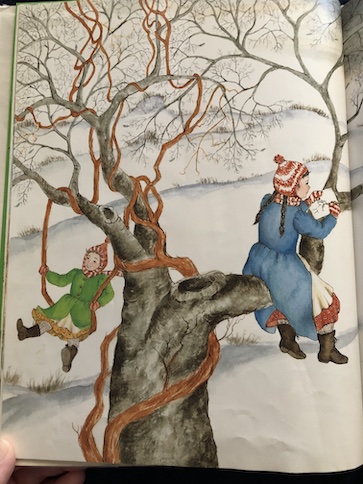
They like to pick the apples from the tree, and use them for cider and applesauce. The two girls in the family like to climb the tree. Josie, the younger girl, likes to swing on the vines that hang from the tree’s branches. Katrina, the older girl, likes to draw in the tree with her paper resting against a crooked branch. She thinks of that special limb as her “studio.”

Then, a terrible winter storm ruins the apple tree before Christmas. The whole family is sad at the loss of the tree, but Katrina is particularly devastated at the loss of her studio. Will she even be able to draw again if she can’t craw in her special place?

The family uses most of the ruined tree as firewood, and they use apples they’ve saved from the tree as decorations on their Christmas tree. However, because of the loss of the apple tree, it doesn’t really feel like Christmas to Katrina. Then, their father shows them that he has saved their favorite parts of the tree and turned them into special Christmas presents.

The book is available to borrow and read for free online through Internet Archive.

My Reaction

I thought this was a charming Christmas story! When I first saw the title, I guessed that the family would use an apple tree as a Christmas tree, but that’s not it at all. It’s just about the family feeling sad about the loss of their apple tree and how the remains of the tree made it a memorable Christmas. Because the father of the family saved their favorite parts of the tree when he was cutting up the rest for firewood, they will still be able to enjoy the things they loved about the tree, particularly Katrina, who receives a special drawing table made out her favorite branch of the tree.

The author dedicated the book to her own father because he made a special drawing board for her. On the inside dust jacket of the book, the explains that the inspiration for the apple tree and vine swing came from her own childhood in rural Michigan.

I love the artwork in this book! The pictures are realistic and detailed, and they have an old-fashioned charm that fits well with the modern Cottagecore aesthetic. I love the family’s home in the barn, with the girls sleeping in the loft and being wrapped in colorful patchwork quilts! The first book that I read by this author was The Day Jimmy’s Boa Ate the Wash, but she wasn’t the illustrator for that book. I didn’t know the she did illustrations, but seeing the illustrations in this book makes me want to see more by her!

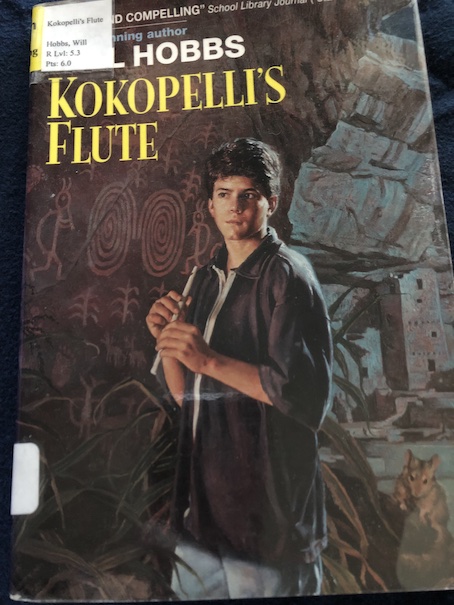
Kokopelli’s Flute

Kokopelli’s Flute by Will Hobbs, 1995.

Tepary Jones, called Tep for short, has always been fascinated by the ancient cliff dwelling known as Picture House. One night, he goes there with his dog, Dusty, because he think it would be a great place to watch a lunar eclipse. However, he and Dusty aren’t there alone. Tep witnesses a couple of looters illegally digging for valuable artifacts. The looters uncover the burial of a medicine man and begin taking some of the things he had buried with him. They damage the site before they leave, but Tep discovers that they have left behind an unusual artifact, a small flute made of polished bone. When Tep picks up the flute, he feels compelled to play it. Not wanting to leave the flute behind in case the looters return, Tep takes it home with him.

That night, Tep has a strange dream that he turned into a packrat, like one of the literal packrats he saw up at Picture House. However, he soon realizes that this was not just a dream. Ever since he played the flute, he finds himself turning into the animal he saw the first time he did so. Tep returns the flute to the body of the medicine man and reports the looting to the authorities, hoping that, once the body is respectfully reburied, whatever magic or curse is afflicting him will end. Unfortunately, it doesn’t.

Tep still finds himself turning to the packrat at night, having uncontrollable urges to go out and explore and find food, and it’s dangerous because animal predators and even his own parents are after him. Rodents in the house are a serious concern because they can carry hantavirus, which causes dangerous respiratory infections in humans. After his mother catches sight of him in packrat form, Tep’s parents start setting out traps. His dog, Dusty, seems to know him even when he’s a rodent and helps to protect him, but Tep knows that he’s going to have to stop this transformation somehow, before either his parents catch him or a predator eats him!

Tep’s parents are academics and researchers who study ancient agriculture and cultivate varieties of seeds on their farm that require little water to grow. To buy himself time from his parents’ efforts to catch the packrat, Tep makes the argument that the packrat is a part of the ecosystem and that it might be performing an important role in the environment, like birds that help propagate seeds by eating them and then depositing them in new places. Tep brings up the fact that there are some seeds that really need to be processed in a bird’s digestive system before they can grow. It’s a thoughtful argument, but the looming threat of hantavirus in their community still means concern about the presence of rodents. Hantavirus is serious, even fatal, and people in their community have already fallen victim to it.

Tep returns to Picture House to try to find the flute again to break whatever spell is affecting him, but he can’t find it. He only hears what he thinks is the sound of someone playing the flute, and he’s not sure if he really hears it or if he’s imagining it. Then, a stranger comes to the farm, a man who appears to be a humpbacked Native American or possibly someone from Mexico or Central America. He calls himself Cricket, and Tep’s family thinks that he’s probably just another migrant worker. Tep shows Cricket around the farm and explains the different types of seeds they cultivate and how they can be used to keep particular varieties of plants alive for their drought-resistant or pest-resistant qualities. Cricket doesn’t say much, but he seems to approve of the idea of cultivating more varieties of seeds. When he helps Tepary to plant seeds, Tep notices that he uses a planting stick, like Native Americans traditionally did.

Of course, Cricket is no ordinary farm worker. Tepary notices his unusual ability with plants and animals, and one night, Cricket speaks with Tepary while he’s in his packrat form. Cricket knows more of what’s been happening than anyone because he is one of the legendary figures from Native American folklore known as Kokopelli. Kokopelli was a legendary humpbacked flute player known for bringing seeds to people, and Cricket says that he still visits people like Tep’s family, who are interested in the past, who cultivate the land, and who keep seeds alive. Tep appeals to him for help with his transformations, and Cricket says he will help, if he can, although he notes that Tep seems to have been managing well. Cricket says that Tep can use the flute to reverse his condition, but only if he knows the right notes to play on it. If he plays the wrong notes, he could change into something else and make his condition worse. The clues to the notes are contained in the pictures on the walls of Picture House.

Tep manages to use his animal form to play a trick on Coyote in the tradition of old trickster tales and to rescue his dog from the looters. Then, Tep’s mother contracts hantavirus. Cricket says that ancient people also suffered from the disease, and they used an herb to cure it. Nobody grows that particular herb anymore, but there should still be some contained in the medicine bundle buried with the old medicine man at Picture House. To save his mother and break the spell on him, Tep must return there to find the medicine man’s bundle and the flute.

The book is available to borrow and read for free online through Internet Archive (multiple copies).

My Reaction

I vaguely remember having read this book when I was a kid, around the time when it was first published in the 1990s. It stuck in my mind because it takes place in the Southwestern United States, where I grew up, and it was also the first time that I had heard about hantavirus, which is a serious concern in real life. I couldn’t remember exactly how the book ended, though.

Reading it as an adult, I understand more about the parents’ work and the commentary about interrelated aspects of the ecosystem than I did as a kid. I understood some aspects of environmentalism and ecosystems as a kid because those were topics that we discussed in science classes at school in the 1990s, but admittedly, science wasn’t my best subject, and I’ve had more time to grasp certain concepts since then.

There are agricultural researchers in real life who do what Tep’s parents are doing, trying to cultivate seeds for drought-resistant crops, which are important in places like the area where I live, that are very dry for much of the year, and are becoming even more important due to climate change. That type of research takes time to cultivate generations of plants and to propagate seeds with desirable qualities. Modern researchers also take information and inspiration from past agricultural practices to enhance modern techniques (paleoethnobotany or archaeobotany). When Tep is talking to Cricket, he explains why it’s important to keep growing a different varieties of crops because some varieties are more resistant to different types of problems that others, like drought-resistant crops or pest-resistant crops. One of the dangers of huge, corporate farms is that they produce too few varieties of particular types of crops, focusing on the most popular ones, leaving them vulnerable to being almost completely wiped out by particular disasters. People need to keep growing older and less popular varieties of crops to keep the plant varieties alive and keep producing seeds for new generations so agriculture as a whole will have those varieties to draw on for the plant qualities they need to cope with changes in the environment and/or particular plant diseases.

One of the reasons why I liked this book is that it references the legend of Kokopelli. Because I grew up in the Southwestern United States, I grew up seeing images of Kokopelli along with other Southwestern Native American symbols. Kokopelli is often used as a decorative image in Southwestern art, although not everyone who has or uses the decoration knows the legends behind it. Kokopelli is described in somewhat different ways in different stories, but he is generally a fertility figure who travels from village to village, bringing changes to the seasons and promoting good harvests. He is also a trickster figure and represents human fertility. In some stories, human women get pregnant everywhere he visits, including by Kokopelli himself, an aspect of the character that does not appear in this particular book because it’s not kid-friendly. There is a theory that the legends might be based on traveling Aztec merchants who arrived seasonally, carrying sacks of seeds and other goods to trade on their backs, giving them that hunched appearance.

The book frequently uses the word “Indian” instead of Native American. It seems to be meant in an informal way rather than a disrespectful one, although I found it irritating because it can be a bit confusing. When Tep uses it in relation to the Native American ruins nearby, context tells readers that he means “Native American”, but when he uses it when he talks about places around the world that use the seeds his family produces, it becomes more confusing. At one point, he uses the word “Indian” and then talks about an order his parents have received from Pakistan, so did Tep mean Native Americans or people from India the country in that context? I heard the word “Indian” used a lot in relation to Native Americans when I was growing up, and sometimes, I even have the urge to use it out of old habits, but I don’t really like using that word anymore. It’s not so bad if you say “American Indian”, but just saying “Indian” by itself is often confusing. I generally agree with the modern convention of saying “Native American” or using the name of a specific tribe, if you know the name to use, both because it sounds more respectful and because it really makes a difference in the clarity of the sentence. It’s just not as effective if someone immediately has to ask, “Wait a minute, do you mean ‘American Indian’ or ‘Indian from India’?”, and when it’s in writing, there isn’t even a live person there to ask.

The Bobbsey Twins’ Adventure in the Country

Bobbsey Twins

The Bobbsey Twins’ Adventure in the Country by Laura Lee Hope,1907, 1961.

Before I explain the plot of this story, I have to explain that this is one of the early Bobbsey Twins books, originally published in the early 20th century, and like other Stratemeyer Syndicate books that were still in print during the mid-20th century, it was revised from its original form to update the language, culture, and technology in the story and, especially, to remove questionable racial terms and caricatures. The physical copy of the book I read as a kid was the revised version, and I didn’t know about the revisions until I was an adult. When I describe the plot at first, I’m talking about the revised version, but I’m also going to explain some of the differences between the original version and the revised version, so you can see what changed.

The two sets of Bobbsey Twins (Nan and Bert are the elder set of twins and Freddie and Flossie are the younger set) are enjoying their summer vacation at home when their mother receives an invitation for the family to visit the children’s aunt and uncle on their farm and to attend an auction that will be held somewhere nearby. The aunt says that there is something that will be sold at the auction that she thinks will interest the family, but the adults are keeping it as a surprise. The children are excited because they like visiting the farm, and they’ve never been to an auction before.

Mr. Bobbsey has to work at his lumber yard, so the children and their mother take the train to the farm ahead of him, accompanied by their cook/housekeeper, Dinah. (Dinah is black and is a recurring character in the series. The book refers to her as “colored.”) The train trip is a bit chaotic because they nearly forgot to bring their packed lunch, and then, Fred’s cat escapes from its carrier and is nearly left behind when they reach their destination. However, they do get there safely.

At the farm, the children enjoy seeing their cousin, Harry, and visiting all the animals. Freddie loses one of the calves when he tries to take it for a walk, like it’s a dog, and at first, the children fear that it fell in the river and drowned. Fortunately, someone from a nearby farm finds the calf and brings it home. These unrelated misadventures are just the beginning of the children’s summer because there is a mystery that seems to be unfolding at the farm.

On their first night at the farm, Flossie wakes up in the middle of the night because she hears someone playing the piano. She wakes Nan, and the two of them go downstairs, but by the time they get there, whoever was playing the piano is gone. At first, the children’s uncle thinks that it was just a dream, but Nan knows that it wasn’t because a piece of sheet music was knocked off the piano. Later, when they hear the piano at night again, there are smudges on the keys.

The auction is fun. The children each have a little money to buy something small for themselves, just for the experience of bidding on something at an auction. They all find something to buy, and some of the things they find are funny and eclectic. The mystery object that their mother is there to buy is a pony and cart. A neighbor of the aunt and uncle had a pony and cart that his grandchildren used, but they’ve moved away, and the Bobbseys have decided to buy it for their children. The twins’ aunt and uncle are willing to keep them at their farm because they can’t have a pony in the city, and their cousin can use them when the twins aren’t there. The children love the pony, and they have fun with him and the cart with some other kids. However, when they return to the farm after they auction, they discover that the family’s prize bull has been stolen!

The story is somewhat episodic, but there is a thread of mystery that runs through the whole book as the children try to find the missing bull. There’s a boy from New York City who was lost from a group heading to a nearby Fresh Air Camp (part of a charity that has existed since the 19th century to provide poor city children with enriching summer experiences in the countryside – I referred to it before in another vintage children’s book, Ruth Fielding at Sunrise Farm) who witnessed the theft but didn’t realize that the men he saw didn’t own the bull. There’s a Fourth of July celebration and a picnic with other kids, including a local bully. There is some real danger, where Flossie falls over the edge of a cliff and has to be rescued, and the family has to evacuate the farm temporarily when they fear that a nearby dam might break after a fierce storm. Along the way, the Bobbsey twins gather pieces of information that help them find the missing bull.
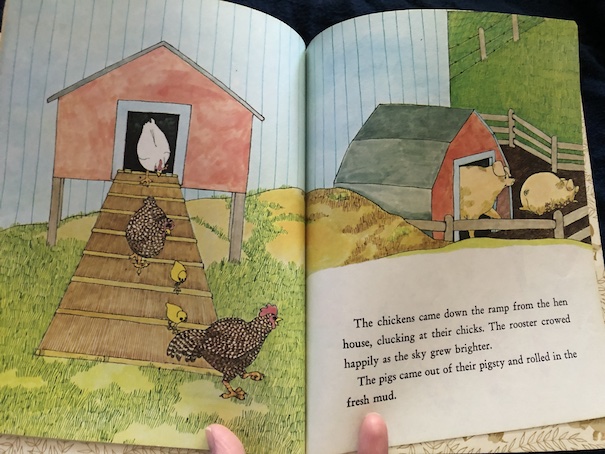
The book is available to borrow and read for free online through Internet Archive (multiple copies). The original edition of the book is public domain and available online through Project Gutenberg.

My Reaction

The Mystery

The mysteries in the story are pretty simple. The story is pretty episodic, and the nighttime piano-playing is unrelated to the theft of the bull. The reasons for that are partly related to the way the book was written in the original version. Originally, the book was more of a general collection of stories about how the Bobbsey Twins spend their summer on their aunt and uncle’s farm and have little adventures there, and it wasn’t really a mystery story. One of the features of Stratemeyer Syndicate books is that chapters are always supposed to end on cliffhangers to keep the stories exciting and encourage children to keep reading. That format lends itself well to the mystery genre, which is why some Stratemeyer series that originally started as more general fiction or adventure gradually evolved into mysteries, but some of the early books, like this one, kind of end up being somewhere between mystery and general fiction and read almost like collections of shorter, interrelated stories.

The theft of the bull didn’t occur at all in the original story, but there was a thread through the book about the piano playing at night. In both the new and the old versions, they eventually find out why, but there are different explanations between the versions. In both versions, the nighttime piano player is an animal, not a human.

Original Version vs. Revised

Like other Stratemeyer Syndicate books that were in print in the mid-20th century, the early Bobbsey Twins books were revised and reprinted around the time of the Civil Rights Movement, both to update the technology and slang in the stories and to remove inappropriate racial language. The 1960s edition of the book uses the word “colored” to refer to the housekeeper/cook who works for the Bobbsey family and her husband, which was an acceptable term in the early and mid-20th century (as in The National Association for the Advancement of Colored People, or NAACP), but the word “black” became the common accepted informal, generic term and “African American” became the accepted formal, specific term post-Civil Rights Movement because people were trying to distance themselves from racial words that, while they were not meant to be derogatory, had some emotional baggage attached to them. In the case of this particular book, the changes from the original version to the version I have include making Dinah more intelligent and eliminating the use of stereotypical black people speech. In the original book, even though she’s an adult, Dinah seems childlike in her reactions to things and seems to need the children to explain things to her, like the scale they see at the train station. When she speaks, her speech is spelled out with a strong accent (ex. “dat chile” instead of “that child”), and she throws out phrases like, “Lan’ o’ massy!” In the revised version, she acts and speaks more like the other adults.

Something else that changed from the original version is how much emphasis there was on poor people vs. upper middle class people, like the Bobbseys. The older version of the story emphasizes more how poor the kid from the Fresh Air Camp is and how charitable the Bobbseys are toward him. There are also other instances of charity toward the poor, like when Nan lends another girl a dress because they need to wear white dresses for the Fourth of July celebration, and the other girl doesn’t have a white dress. The book is careful to mention that nobody else knows that the other girl was borrowing a dress from Nan, with the implication that it would have been embarrassing or a mark of shame for people to know that it was a borrowed dress instead of one of her own. Things like this appear in many vintage children’s books from the 19th century and early 20th century, but it’s not something you find much in modern modern books, at least not described like that. Even when I was a middle-class kid in the late 20th century, it wouldn’t be assumed that a kid would necessarily have certain types of clothes for a special occasion or that their family would be able to just quickly buy something new for one-time use. It was also normal for people to borrow things from friends, even just on whims, so borrowing a dress for one-time use for a special occasion wouldn’t have been regarded as either an act of charity or anything to cause embarrassment, if other people just happened to know about it.

Even though there are things in the stories that were changed to make the stories contemporary with the time of the revisions, the 1960s, there are still aspects of the stories that would be out-of-date culturally by 21st century standards. One of those issues relates to how the adults in the story handle the children. One of the adults in the story tries to resolve the bully situation by letting Bert physically fight the boy who was picking on him, telling both the boys to wrestle with each other to settle their differences and get it all out of their systems. This is not advice that most modern adults would give to kids, and one good reason for not giving that advice is that it doesn’t work, not even in this book. First of all, the kid being bullied might not be the winner of the wrestling match in real life, and no kid should be forced to fight physically just because some bully wants to beat them up. In the book, Bert wins the wrestling match because he’s had wrestling classes before, but as the case would probably be in real life as well, it resolves nothing. The bully is resentful about losing the fight and continues to bully him and play mean tricks on the other kids. The bully episodes are basically there just to add conflict and excitement to the story, and they don’t do much more than that.

I was a little surprised that they left in the part from the original story where the kids put on their own circus, and they have an act they call the “Sacred Calf of India.” In the revised version, Nan wears an improvised sari for this act, and they teach the calf to do a trick. Animals doing cute little tricks are just fine, but adding in the exoticism seems in poor taste. I suppose that they left this part in the revised version because it’s not trying to be insulting to people from India, more that the kids are trying to play on the concept of circus acts and snake charmers, but it is another example of something that you find sometimes in vintage books but wouldn’t be likely to find in modern ones.

Six Crows

Six Crows by Leo Lionni, 1988.

A farmer in the Balabadur Hills (the book doesn’t explicitly say that this story takes place in India, but it’s implied) has a good farm, but he also has a problem with the crows who live nearby. Whenever his wheat is ripe and about ready to harvest, the crows come and eat it.

Chasing the crows away doesn’t work because they always come back. The farmer decides to try building a scarecrow instead. It does frighten the crows, but with an unexpected result.

The crows decide that they must make their own scare-person, a kite that looks like a big, fierce bird, to scare away the scarecrow. When they fly over the field with their scare-person kite, the farmer gets scared and decides that he needs a bigger, scarier scarecrow.

The situation escalates, with the birds building an even bigger and scarier bird kite to scare the farmer.

Meanwhile, an owl who has been watching all of this unfold decides that it’s gone far enough and goes to talk to the farmer and the crows about the situation. The owl persuades both sides to speak to each other and work things out.

When they talk, the farmer and the crows realize that they don’t want to fight with each other. The crows depend on the farmer’s wheat for food, and the farmer realizes that he actually enjoys having the birds around. The owl fixes the mean-looking scarecrow to have a happy and friendly look.

I’m not sure that this is really a traditional fable because the book doesn’t provide any background information on the story and the author isn’t credited as doing a “retelling”, but the story is told in a folktale or fable format about conflict resolution. When the farmer and the crows are feuding, they continually escalate the situation with bigger and scarier “weapons” until the owl convinces them that the only way out of the situation is to talk it out and come to an agreement.

The book is available to borrow and read for free online through Internet Archive (multiple copies).

Ruth Fielding at Sunrise Farm

Ruth Fielding

Ruth Fielding at Sunrise Farm or What Became of the Baby Orphans by Alice B. Emerson (Stratemeyer Syndicate), 1915.

When the story begins, Ruth and her friends are at boarding school, and they are having a secret night meeting of their club, the Sweetbriars, to initiate some new members. Their initiation ceremony includes the story about the statue with the harp in the fountain that the girls were told during a scary initiation to another club in an earlier book, but the Sweetbriars are against tormenting and hazing new members. Instead of the scary ceremony, their initiation ceremony involves marching around the fountain while chanting a rhyme about the statue. There is supposed to be a mild prank of splashing the new members as if the fountain did it, but that’s as much hazing as the Sweetbriars will allow.

However, their ceremony is interrupted when one of the girls who is already a member of the club starts screaming. When everyone runs to see what happened, the girl who was supposed to do the splashing of the new members is all wet and says that someone pushed her into the fountain. She doesn’t know who did it, but she saw someone run away afterward. Ruth catches this mysterious lurker, and it turns out to be a younger girl who doesn’t belong to their school at all. The girl says that she had just been at the fountain, getting a drink of water. She says her name is Raby and that she ran away from some people called Perkins, who beat her. Ruth isn’t able to get much of Raby’s story that night, but she can tell that the girl is in trouble, so she says that if Raby will meet her the next morning, she can give her some money and help her.

The next day, Ruth’s friend, Madge Steele, invites Ruth and the other girls to spend part of the summer at a farm that her family bought near Darrowtown, where Ruth used to live with her parents before they died. The farm is called Sunrise Farm, and this trip is also meant to be a graduation party for Madge. Madge is older than the other girls, a senior at Briarwood, so these are her last few months at the school.

Ruth slips away from the others to bring some food to Raby, and she learns more about the girl’s plight. Raby explains that she’s an orphan. Raby is her last name, and her first name is Sadie. She was at an orphanage with her two younger brothers, a set of twins called Willie and Dickie. However, kids are only kept at the orphanage until about age 12, when they are put to work. Sadie is about 12 1/2 years old, and she was separated from her brothers when they were taken in by another family and she was sent to work for the Perkins family. The Perkins family acted kind in front of the adults at the orphanage, but they started treating her badly as soon as they got her to their home. Ruth is very much aware that she is also an orphan, and if it hadn’t been for her uncle and her friends, she would never have been able to go to a school like Briarwood and might have ended up in a situation very much like Sadie’s.

Ruth gets to see for herself what Mr. Perkins is like. While the girls are talking, he enters the school grounds to find her. Sadie runs away and hides, and Mr. Perkins grabs hold of Ruth. He has a whip with him, and he whips Ruth across the knees, demanding that she tell him where the runaway girl is. Mr. Perkins is interrupted by a stage driver, Mr. Dolliver, who sees what’s happening and yells at Mr. Perkins to leave Ruth alone and not to bother any of the girls at the school. Mr. Perkins claims that he didn’t know Ruth was a student, and Mr. Dolliver makes Mr. Perkins leave. When he’s gone, Ruth explains the situation with Sadie to Mr. Dolliver. Mr. Dolliver tells her that it’s against the law to help runaways. Ruth asks if that means that Sadie will be sent back to the Perkins family if she’s caught, and Mr. Dolliver says that’s probably the case: “Ye see, Sim Perkins an’ his wife air folks ye can’t really go agin’—not much. Sim owns a good farm, an’ pays his taxes, an’ ain’t a bad neighbor. But they’ve had trouble before naow with orphans. But before, ’twas boys.” Ruth says she hopes that the boy orphans also ran away from the Perkins family, and Mr. Dolliver says, “Wal—they did, by golly!” (Oh, surprise, surprise.)

Ruth begs Mr. Dolliver not to turn Sadie in if he sees her, and Mr. Dolliver says that his plan is to not see her, and he advises Ruth to do the same. Ruth tries leaving some food out for Sadie again, but she doesn’t return to the school. She hasn’t been returned to the Perkins family, either. Ruth is glad that she’s not with the abusive Perkins family, but she’s still worried about where Sadie went and what she’s going to do. As the school year comes to an end, Ruth gets a letter from Aunt Alvirah saying that her Uncle Jabez is willing to let her go to Sunrise Farm with her friends during the summer. Aunt Alvirah has hired a “tramping girl that came by” to help with the work around the Red Mill, so Ruth will be free for a relaxing visit. Ruth later learns that the “tramping girl” was Sadie, but Sadie has moved on to find work elsewhere by the time Ruth gets home from boarding school. Ruth hears stories about her from other people who employed her or helped her, and her best friend’s brother, Tom, says that he paid for her to get a ride on a train to a town called Campton.

Soon, it’s time for Ruth and her friends to go to Darrowtown and meet at Sunrise Farm. It’s an emotional journey for Ruth because she has bittersweet memories of Darrowtown from when she lived there with her parents, when they died, and the period when she was an orphan there, before she went to live with her great uncle. While she’s there, she stops to visit with Miss Pettis, a seamstress who looked after her before she went to live with Uncle Jabez. Miss Pettis is happy to see her, and the two of them spend some time catching up on what’s been happening to everyone since Ruth left Darrowtown.

When they all get to Sunrise Farm, Madge’s father is annoyed because he’s discovered that their neighbors, the Caslons, are having a bunch of “fresh air children” coming in the summer. (“Fresh air children” are children who come from the city, usually from unfortunate backgrounds, to experience the fresh air and wholesome activities of the countryside. There are still programs that do this, including the Fresh Air Fund in New York. In fact, I think that might be the program that the Caslons are supposed to be participating in as a volunteer host family during the story because it existed in this time period, and the series is generally set somewhere on the East Coast.) Mr. Steele thinks that the Caslons are bringing in a bunch of children to make noise and annoy him personally, but Madge says that she’s heard that they take in children like this every summer. Madge’s parents see this as a personal inconvenience to them. Ruth knows that Mr. Steele is a wealthy businessman who has always lived in the city. He doesn’t know much about the countryside, doesn’t understand the people who live there, and has little patience for any of it. When he bought Sunrise Farm, he did it with the idea of being kind of a gentleman farmer, but it’s starting to become obvious that he has little idea of what that means.

It turns out that Sadie’s little brothers are among the group of orphans who are visiting the Caslons this summer, and Sadie soon shows up, looking for them. At first, Mr. Steele thinks he should call the orphanage when Sadie shows up at Sunrise Farm, but after she rescues his young son from a runaway horse, Mr. Steele is grateful and decides not to. Instead, he plays host to Sadie and her brothers at Sunrise Farm. Then, they learn that a lawyer has been looking for the Raby family because they have inherited some property in Canada. When the Raby twins and some of the other “fresh air” boys run away and get lost on a prank, Mr. Steele and Mr. Caslon join together to find them and get a new respect for each other.

This book is now in the public domain and available to borrow and read for free online through Project Gutenberg.

My Reaction and Spoilers

This is one of the books in the series that is really more adventure than mystery. There are some moments of slight mystery, when Ruth wonders where Sadie is or where her brothers are, but those are cleared up pretty quickly, just by chance, without Ruth having to go out of her way to investigate. The Raby children’s unexpected inheritance is quite a convenient coincidence, but it still leaves the children’s custody to be decided. At first, I thought that they might stay with the childless Caslons, but Mr. Steele, having been won over by the children, agrees to look after them and manage their inheritance until they’re old enough to manage it themselves. It feels a little classist that rich Mr. Steele gets the children and manages their inheritance, but by the end of the book, the Steeles are getting along better with the Caslons, so I suppose they’ll be seeing each other on a regular basis. The Caslons will also probably continue to invite “fresh air” kids from the city to visit their farm.

I really appreciated the part in this book where Ruth gets emotional about returning to the town where she used to live with her parents before they died. Orphans are common in children’s literature, partly because their orphaned status can be a reason for leaving home and finding adventure. However, I’ve noticed that many children’s series don’t dwell on the loss of the parents for long after it occurs and the adventure starts. Even when a child grieves for the loss of a parent, that grieving doesn’t show up much in sequels in a series as the story focuses more on the orphan’s adventures and new friends, like they kind of got over it. The Boxcar Children, for example, rarely mention their parents at all, and their cause of death isn’t even described in the main series (except for the oldest edition of the first book, which has a really dark first chapter). Ruth Fielding, as a character, was kind of a precursor to Nancy Drew in the Stratemeyer Syndicate, and Nancy Drew also lost her mother, but she never really talks about it. Ruth is usually a pretty happy person, even in difficult circumstances, but I like this acknowledgement that she still feels something from the loss of her parents. Even though she tries to keep cheerful and busy, there are times when she can still get sad about their loss. It’s like that in real life. Even when someone has had a long time to get accustomed to a loss, they can still have moments when they think about it and feel sad. This is the type of character development that I like in the Ruth Fielding series that doesn’t appear much in other vintage children’s series.

This book also addresses the fact that, as orphans go, Ruth has been more fortunate than some. Ruth’s uncle isn’t rich, and he’s kind of a miser, but he still takes care of her, gives her a place to live, and makes sure that she gets an education. Uncle Jabez sometimes says that he doesn’t know what good a fancy education will do for Ruth and that other girls like her stay home to help with chores or go out and get jobs. However, Ruth’s friends are getting an education, so Uncle Jabez decided in earlier books that Ruth should go to the same school and not be left out. Ruth comes to see how other people look at orphans. People accept Ruth because she lives with her uncle and goes to school with girls from better-off families, but would they all look at her the same way if she’d been forced to grow up like Sadie?

Mr. Steele is rather self-centered, thinking only of his convenience in everything. He sees the presence of the young orphans next door as some kind of personal affront to him because he thinks they’re just there to cause noise and mess and make trouble for him. Madge and her mother don’t like that kind of talk, but Madge’s brother echoes everything his father says. Even some of the other guests at Sunrise Farm express similar sentiments about how troublesome the young orphans are or must be, even for the Caslons: “Just think of troubling one’s self with a parcel of ill-bred children like those orphanage kids.” However, when the young people talk to the Caslons, they learn that the Caslons love having the orphans visit them every year. While Mr. Steele tells himself (and anyone who will listen) that the Caslons have only decided to do this out of spite for him, they’ve actually been hosting orphans for years, long before they ever met the Steeles, and it has nothing to do with the Steeles. Their own two children died very young, and they find joy and fulfillment in helping to take care of other children. They know that kids cause a certain amount of noise, mess, and chaos, but they feel like the inconveniences are worth it because they truly enjoy the children and have fun with them.

There is also a theme in the story about neighbors, what makes somebody a good neighbor or a bad neighbor. Mr. Steele thinks that the Caslons are bad neighbors from the beginning, both because they invite the orphans to join them for the summer, which Mr. Steele thinks is going to cause him some kind of personal inconvenience, and because the Caslons refuse to sell their farm to him when he decides that he wants to buy them out, like he’s entitled to their farm and they’re somehow “bad” for not letting him have it when he wants it. From my perspective, Mr. Steele is the bad neighbor because he’s the one who comes in without knowing the things that people in this area do, and he expects everyone to change their plans even sell out to him just on his say-so. Mr. Steele wants everything to be about him, even when it takes place on someone else’s property, and it bothers him that other people’s property belong to them and not to him. It seems to me that various characters in the story rate their neighbors not on how their neighbors behave or what they actually do but on how they happen to feel themselves at that particular moment. Mr. Steele seems to be in a mindset where I would expect that anything a neighbor did on his own property would be some kind affront to him because what he really wants is the neighbor’s property itself. It feels to him like his neighbor is doing things to him because, in his mind, the neighbor’s property is already his, even though it’s not, so the neighbor is already committing a trespass just because they are on their own land and doing what they’ve always done there, which Mr. Steele doesn’t own outside of his own mind. Fortunately, Mr. Steele’s experiences with the Raby children and his acknowledgement that Mr. Caslon is more experienced with this area and better able to find the lost children than he is humble him a little and get him to take a different view of both the Caslons and the “fresh air” children.

Some of the characters seem to have poor priorities when it comes to figuring out who makes the best neighbors, and I think maybe they should take some of their neighbors’ actions under realistic consideration. I don’t know what Mr. Dolliver means when he says that Mr. Perkins “ain’t a bad neighbor.” That’s definitely not the impression I’m getting. When someone storms onto someone else’s property in a full rage and starts randomly grabbing and whipping a girl he’s never seen before, it’s not just a red flag anymore. A red flag would be a warning of potential danger, and this is full-on, uncontrolled physical violence in action in front of a witness! Ruth’s skin is described as having red welts from the whip! If this is part of Mr. Dolliver’s definition of a neighbor who “ain’t bad”, just how does he define a bad one? Honestly, where are the limits? It seems like the only thing Mr. Perkins has going for him is money from his “good farm” and “taxes”, which makes me think maybe the locals are easily bought off. As long as this neighbor seems to be contributing money (through direct or indirect means, through taxes) and there is the option to ignore his behavior, the local people seem content to ignore the behavior and accept the money.

From what Mr. Dolliver says about Mr. Perkins’s problems with other orphans before, his physical violence is repeated behavior. By Mr. Dolliver’s admission, the Perkins family has never had a different result with any orphan they’ve had in their custody. Each time, they mistreat the orphan and the orphan runs away in desperation, unable to return to the orphanage that’s supposed to be caring for them because the adults there seem to think that it’s more important to not say “no” to the Perkins family than to ensure the physical safety of children. I’m pretty sure they’re getting money for this, because otherwise, why in the name of all that is truly good, holy, and sane, would anybody ever let him have access to any other orphans after he’s already gone through multiple orphans in this fashion already? To very loosely quote Oscar Wilde, to lose one might be considered unfortunate, to lose two begins to look like careless, and to lose three or more brings everyone involved in the process into question. Insanity is doing the same thing over and over and expecting a different result each time. How many minors is the orphanage prepared to sacrifice to the Perkins family before they decide it’s enough, and at what point will it dawn on them that the Perkins family is the common element to the disappearance of all of the previous orphans?

I’m just going to say it: Mr. Perkins is a dangerous weirdo. He’s unsafe with vulnerable children or really anyone who gets in the way when he’s angry and is not in a position of authority or able to fight back. I’m sure his neighbors are either being bribed or they’re all in deep denial about it and that’s why they end up being complicit in the continuance and repetition of orphan abuse. I know that, as a character, Mr. Perkins is deliberately set up as a villain and an obstacle in the story to be escaped or overcome, but he’s such an over-the-top violent character, running around with a whip that he uses on total strangers, it just brings the orphanage, the neighbors, and everybody in the community who still calls this wacko a basically decent neighbor into question.

The Mystery of the Sinister Scarecrow

The Three Investigators

#29 The Mystery of the Sinister Scarecrow by M. V. Carey, 1979.

Jupiter Jones is going on a buying trip with Hans and Conrad, the men who work for his uncle’s salvage yard, to see someone who had some things to sell to his uncle. Jupiter’s friends, Bob and Pete, go with them, but they’re all stranded when their truck blows a tire. They look around for a place where they can call the salvage yard to explain their situation and get help, and they see a large house with a cornfield nearby.

However as Jupiter approaches the house to ask to use the phone, he is suddenly tackled by a man with a jagged rock in his hand! Hans comes to his defense, and the man is surprised and sorry when he realizes that he’s just tackled a boy. It turns out that the man is nearsighted and has lost his glasses on the ground. He starts to explain that he thought that he was tackling a scarecrow, and then, he suddenly stops and says that he’s been having trouble with trespassers. Jupiter asks him what meant when he talked about the scarecrow, but the man dodges the question. Instead, he asks them why they’re there, and they explain about wanting to use the phone.

The man invites them into the house to use the phone. The man isn’t really a farmer. His name is Dr. Wooley, and he’s an entomologist who’s working on a book. He’s studying army ants, which are carnivorous. He shows them the colony he’s studying, but the sight of all those ants just encourages them to finish their call and leave fast.

However, Jupiter is still intrigued about why Dr. Wooley seemed to attack him because he thought he was a walking scarecrow. He persuades Bob and Pete to return to the area with him to investigate. When they stop in a cafe, a man there hears them talking about the scarecrow, and he says that he’s seen the walking scarecrow himself. He works in the area, doing security for a nearby museum. The boys ask him for details about his sighting of the walking scarecrow, and he says that he saw it near the Radford house, which is where the boys met Dr. Wooley.

When they go to the place where the man saw the scarecrow, they meet a woman named Leticia. Leticia asks them what they’re doing, and they explain about looking into a sighting of a walking scarecrow. Suddenly, Leticia gets very excited. She has seen the scarecrow herself, but no one will believe her. She asks the boys if they will come to the house and explain to Mrs. Chumley that she really did see a walking scarecrow.

Leticia Radford is a jet-setting heiress who lives in the mansion by the cornfield. Mrs. Chumley has been with her family a long time as a secretary and housekeeper, but she’s been confined to a wheelchair for years after being in a car accident. Leticia spends most of her time traveling in Europe, but she returns home periodically, usually after one of her disastrous romances. She has phobias of both insects and scarecrows. Actually, her fear of scarecrows is related to her fear of insects and other creepy-crawly things. Leticia explains that, when she was a child, a scarecrow fell on her when she visited a pumpkin patch one Halloween, and when it broke apart, it had spiders in it, so she always associates scarecrows with bugs. Until the boys explain that other people have seen the walking scarecrow, Mrs. Chumley had thought that Leticia had imagined it.

Leticia blames Dr. Wooley for the walking scarecrow because he made a scarecrow after he moved into the cottage on the estate property to do his research on the ants. Dr. Wooley makes her nervous because she associates him with both bugs and scarecrows. Leticia says that the scarecrow seems to be targeting her because it has shown up multiple times, seemingly looking for her, and once, it hid in her car and threw bugs on her.

While the boys are in Leticia’s mansion, explaining to the other people in the house that Leticia hasn’t imagined the scarecrow, Dr. Wooley shows up, angrily accusing the boys of faking their car trouble the day before just to get into his lab. Dr. Wooley says that someone dressed as a scarecrow entered his lab, hit him on the head, and stole a jar of some of the ants he’s been studying. It doesn’t take them long to figure out where the ants went because Leticia finds them in her bedroom, along with the jar from Dr. Wooley’s lab.

It’s obvious that someone is purposely trying to frighten Leticia by dressing as a scarecrow and tormenting her with bugs, the two things guaranteed to terrify her. The boys are surprised when Dr. Wooley is the one who hires them to find the person tormenting Leticia. Dr. Wooley says that he isn’t responsible for frightening Leticia, but he can see that it all looks bad for him because he was the one who made a scarecrow and the ants in Leticia’s room were his ants. He doesn’t want his professional reputation ruined, and he also feels sorry for Leticia. Leticia can’t figure out why anyone would target her because she’s never been a threat to anyone, but she may be more of a threat to someone than she knows.

My Reaction

The combination of a mystery involving scarecrows and insects and someone who is afraid of both scarecrows and insects is a little strange, but I thought the author did a good job of explaining how the two are related in this story. Leticia’s two fears are connected because she thinks of scarecrows as being homes for bugs.

One of my questions during the mystery was wondering whether someone is trying to convince Leticia that she is crazy (“gaslighting” her, like in the movie of the same name) or just trying to drive her away from the house. I had a couple of theories about what could be going on. Some of what I considered turned out to be right, but someone I suspected turned out to be completely innocent.

At first, I also wondered if there would be an unexpected romance between Leticia and Dr. Wooley because the story establishes that they are both single, and there are points when they hang out together when they don’t have to. However, the story doesn’t end with any clear romance. Leticia is still afraid of insects at the end, which would make romance with an entomologist awkward. She does allow Dr. Wooley to continue his work on her property, though. The boys also notice that Leticia seems to branching out and finding new interests at home rather than running off to Europe again, so that might represent some new developments in her character and a possible turning point in her life.

Where Will All the Animals Go?

Where Will All the Animals Go? by Sharon Holaves, illustrated by Leigh Grant, 1978.

This book is one of the Little Golden Book picture books.

A little boy named Matt goes to visit his grandfather on his farm. They notice a storm approaching, and Matt worries about where the animals will go when the storm comes. His grandfather tells him that the animals all know where to go.

The animals also notice the approaching storm. When the rain comes, Matt and his grandfather go inside the house with the cats. After the storm is over, Matt’s grandfather takes him outside to show him where all the animals went during the storm.

Matt watches as all of the animals, both the domesticated animals of the farm and the wild animals who also live there, emerge from their hiding places. Every animal has a place to go, and they’re all fine after the storm.

The book is available to borrow and read for free online through Internet Archive.

My Reaction

I like this story because it’s very calm. I think it could make a good bedtime story for young children. Although the boy in the story is concerned about the animals and where they will go during the storm, the animals are never in any danger. The grandfather knows that the animals will all be fine, and he reassures his grandson that they all have a place to go. It’s reassuring that the storm is natural, the animals know what to do when it happens, and the boy sees that everything is fine. The story ends with the boy and his grandfather watching the sun come out after the storm.

The Hidden Message

Adventures in the Northwoods

The Hidden Message by Lois Walfrid Johnson, 1990.

The story, like the others in its series, is set on a farm in Wisconsin during the early 20th century.

One night, Kate McConnell wakes up to hear her mother and stepfather talking. The family needs money for the new planting season, so Papa Nordstrom has decided to take a job in a lumber camp over the winter. It will keep him away from home for a couple of months. He doesn’t really want to leave his family, but there’s a new baby on the way, and they really need the money. His absence on the farm means that the children will have to take on extra chores to help out. Kate also worries because conditions in lumber camps can be dangerous. Her birth father was killed in an accident in a similar camp, and she doesn’t want the same thing to happen to Papa Nordstrom.

Before Papa Nordstrom leaves for the lumber camp, he butchers a pig so his family will have meat while he’s gone. With winter setting in, it’s important to make sure that food supplies are secure. That’s why Kate knows it’s serious when her friend Josie tells her at school that someone stole her family’s steer, the one they were planning to butcher for meat this winter. Her family has no other source of meat, and they might go hungry if they can’t find the steer. Josie asks Kate for help because she and Anders solved a mystery involving a mysterious stranger who took things before.

One of the possible suspects is an older boy who has recently returned to school, who the others call Stretch. Kate has never met Stretch before because he’s been gone from school, doing farm work, since before she arrived in the community. Anders knows him, though, and he tells Kate that Stretch is trouble. Part of the reason they call him “Stretch” is that he has a habit of stretching the truth. Kate finds Stretch handsome at first, but Anders warns her not to get involved with him. Kate thinks Anders is exaggerating about Stretch because other people at school seem to like him. Anders says that if Kate wants to like someone, she should like Erik instead. Kate has a kind of rivalry going with Erik since he dipped her braid in his inkwell, and it permanently stained her dress. Anders says that Erik didn’t really mean to ruin her dress, but Kate is still unhappy about the incident. So, although Kate can tell that Erik is more responsible in other ways and is a bright and dedicated student, and they go to the same church, she has reservations about liking him.

However, Kate soon comes to realize just how dangerous Stretch is. Their teacher warns them all away from the frozen lake because the springs in the lake make the ice unpredictable. While the others play on the playground, Stretch talks Kate into walking by the lake with him. He says that he knows it’s safe because he was out on the lake earlier that morning, although Kate has her doubts about it. Then, Kate spots Anders’s dog out on the ice. Worried about the dog, Kate tries to call to him, but the dog doesn’t come to her like he usually does. Kate steps onto the ice to get the dog, and the ice breaks. Kate nearly drowns in the icy water, but Erik saves her. Kate realizes that, when she was in danger because of Stretch, Stretch actually abandoned her to drown. Later, he won’t even admit that he was the reason why Kate went down to the lake in the first place. When Kate is warmer and able to think better, she also begins to realize that the reason why Anders’s dog wouldn’t come to her when she called was because she was with Stretch, and the dog is afraid of Stretch, indicating that Stretch has been cruel to the dog in the past.

Kate’s brush with death opens her eyes to what Stretch is really like. It also creates a problem because the teacher writes a letter to Kate’s mother about the incident, letting her know that Kate did something very dangerous. Kate doesn’t want her mother to know what happened because it would upset her, especially with Papa Nordstrom being away and the children supposed to be behaving responsibly to help her on the farm. Kate wants to hide the teacher’s letter and not tell her mother, although Anders and Lars try to persuade her to be honest about what’s happened. They argue about it, and Kate accuses them of wanting to tattle on her, threatening to tell on them if they do something wrong. She feels sorry for upsetting them, especially young Lars, but she’s afraid of how her mother might react when she finds out what happened. Anders warns her that her mother might still find out what happened from someone else and that by being dishonest and fighting with Lars, she’s starting something that she’s going to regret. But, Kate can’t even bring herself to confide in anyone that Stretch was the reason she went down to the lake. Even though he almost got her killed and didn’t even try to help her, she can’t bring herself to tattle on him. (That’s dumb, on several levels. I’ll explain why below.)

After the incident with Kate falling through the ice, Stretch avoids going to school for awhile. Then, one day, Kate sees him stealing candy at the general store. Even though Kate knows what she saw, she still can’t bring herself to tell on him, and she even begins making excuses for him in her mind to make him seem less bad. When he offers her a ride home, she’s a little hesitant, but she decides to accept to avoid the long walk home. On the way, she asks him why he didn’t help her when she fell through the ice, but he never answers her. She also notices that his hand is oddly blue, and when she asks about that, he says that he must have just worked that hand too hard when he was cutting wood. However, he doesn’t have wood in the back of his wagon. He’s hauling boxes of something. This time, she decides to tell Anders about Stretch stealing, but she doesn’t mention the boxes in the back of Stretch’s wagon because she still doesn’t know what to think about them.

The secret about the ice incident comes out when Kate’s step-siblings, feeling uncomfortable about her deception, play a prank on her to get her to tell on herself. Knowing how afraid of mice Kate is, they put a dead one in a box with the label, “Pretty on the outside, like this on the inside,” on top. When Kate opens it, she screams, and her mother comes running. Knowing why they played this prank on her, Kate explains the truth to her mother. Her mother gives her a punishment for lying to her before, and Kate sees how upset she is that Kate didn’t tell her the truth earlier.

However, Kate hasn’t quite learned her lesson about lying. She sneaks out when she’s supposed to be grounded in her room by climbing down the tree outside the window. While she’s outside without permission, she spots a loose cow belonging to Josie’s family and guides it back to them. It’s a good deed, but she was still out without permission, and Tina spots her. Kate is angry and accuses Tina of “spying” on her and tries to persuade her not to tell. Kate can tell that Tina is upset and worries about lying to her mother and making her mad. Kate feels badly, but she can’t seem to stop herself from doing these things. She still continues to sneak out during her period of being grounded. When little Tina tries to imitate her by climbing down the tree herself and gets stuck, Kate has to rescue her. Her mother spots them once they’re down on the ground, and Kate confesses everything.

Kate feels like an awful person because Tina could have been badly hurt or even killed by following her example. Her mother says that everyone is awful in the sense that humans are all imperfect, and that’s why they commit sins. That is why God sent His son to redeem human sins. It’s good to be sorry when you’ve done something wrong and ask for forgiveness because forgiveness will be granted, and if you accept Jesus as your Savior, he will take away your sins. (I’ve heard this before, the part about everyone being “awful”, or words to that effect. This is kind of a Protestant way to phrase this. When I’ve heard it before, it usually seems to be from Protestants with a more Evangelical outlook, although that might vary. I don’t disagree with the principles, but Catholics would say it differently, and I may include a little more about it in my reaction.)

Meanwhile, there are still more thefts occurring in the community. Someone robs Erik’s family of all of the vegetables and fruit they’ve canned for the winter. Having food stores stolen at the onset of winter puts the family in a precarious position, and everyone else in the community worries about their foods stores, too.

One day, when Erik is at Windy Hill, Anders starts teasing Kate about her organ playing. He takes it too far, and both Kate and Erik tell him to stop. To Kate’s surprise, Erik hits Anders when he refuses to stop when asked, and the boys start to fight. Kate’s mother comes in, stops the fight, and makes the boys clean the room as punishment, which leads to several revelations. Kate comes to realize that Anders is a major reason why Erik has been teasing her. Anders has been urging Erik to tease her and also using Erik as an excuse for his own teasing. Now, Erik is getting as tired of it as she is. Erik confides in Kate that he knows that Stretch was the reason she went down to the lake when she fell in, and the only reason he hasn’t told anyone else is that he can’t prove that Stretch was there or that he abandoned Kate when she got into trouble.

As the kids move Kate’s organ back into position from the cleaning, Anders almost drops his end, and he accidentally opens a secret hiding place in the organ, knocking a hidden book onto the floor. The book contains church hymns in Swedish, but there’s also a torn part of a note in English. Unfortunately, they don’t have enough of the note to really understand what it means. (This is the “hidden message” of the title, and it doesn’t enter the story until about the final third of the book. I suspected it was a Biblical quotation, but I couldn’t place it from the fragment.) The note fragment contains the word “fear”, which makes the children worry that someone might be in trouble and asking for help. Erik asks them when and where they got the organ, but Kate explains that they bought it a few months ago at a fair in Grantsburg, and she doesn’t even know the name of the man who sold it. Papa Nordstrom might know, but since he’s away, they can’t ask him.

Stretch still seems like the likely suspect for the food thefts. Kate has seen him do some suspicious things, and he’s been telling some obvious lies, but she and Anders have difficulty finding any positive proof to get the authorities to intervene. Then, the thief takes the pig that Papa Nordstrom left for his family and the lid from their stove, rendering the stove useless until it’s replaced. With the stakes that much higher, Kate knows that they have to catch the thief, fast!

Kate also manages to figure out who originally owned the organ and who left the book and the message in the secret hiding place. The original owner is someone Kate already knows who used to play the organ. As I guessed, the message is actually part of a Biblical quotation (Psalm 118, Verse 6). The message is part of the theme of the story, but it doesn’t have anything to do with the theft directly. However, some strange things that the former owner of the organ has observed help to provide Kate and Anders with the proof they need to get back everything that was stolen. The story ends at Christmas.

The book is available to borrow and read for free online through Internet Archive.

Themes and My Reaction

In some ways, I was disappointed in this book. The identity of the thief isn’t really a surprise. Most of the mystery concerns how to prove it. Also, even though the title of the book refers to the hidden message, the mystery doesn’t center around the hidden message, and the hidden message doesn’t contribute directly to the solving of the mystery. Its main contribution to the story is to provide a theme: “The Lord is on my side; I will not fear. What can man do to me?” This quotation does give Kate the courage she needs to confront the thief.

Honesty in Relationships

I don’t blame Kate for having reservations about liking Erik at first. I know that things end up improving between them as the series goes along and even during this book, but he really did do something dumb and started off on the wrong foot with her. He’s not the first to do it, and frankly, it’s become a rather sad cliche. (It’s not unlike Gilbert in Anne of Green Gables and the way he started off wrong with Anne by making those “carrots” comments about her hair.) I’ve heard people say that boys will do mean things like that because they like girls and just don’t know how to say it, but you can’t just let people keep causing problems without some feedback about it because it doesn’t lead to good relationships. You don’t want to give someone the impression that you’re okay with teasing or rough play when you’re not because, if they don’t know it bothers you, they’ll never stop doing it, and it will drive you crazy. We all teach people how to treat us through the feedback we give. If Erik really cares about Kate, he’ll learn to give her the kind of attention she wants instead of the kind she doesn’t.

I started feeling better about Erik when he started standing up to Anders because Anders was going to far and wouldn’t stop even after both Erik and Kate telling him to stop. I appreciated that, while Erik may have initially felt compelled to join Anders in teasing Kate, Erik seems to have developed a sense of when to stop teasing and is willing to draw a hard line when necessary, even standing up to a friend and telling him “no.” Toward the end of the story, Anders finally has an honest talk with Kate, asking her why she didn’t tell him that Stretch was with her at the lake and abandoned her when she got in trouble. The answer is that Anders teases Kate all the time about everything. His constant teasing prevents her from confiding in him about things that they really should discuss. His teasing shuts down conversations before they even start. Anders finally tells Kate that he is her brother and wants to help her when she needs it, and he says that he wouldn’t tease her about anything really important. That attitude sounds promising. Unfortunately, he still insists that he’ll be the judge of what’s important, so I think that relationship still needs some work.

I’ll never understand people who say that teasing helps build relationships. Never. I’ve never seen it work that way in real life, not for building relationships of any depth, at least not unless the relationship has already been established on another basis first. It usually goes the other way, preventing relationships from developing or getting deeper than being shallow because relentless teasing does tend to shut down conversations and prevent people from opening up to each other. Why should someone tell you anything at all if they know that’s the reaction they’re going to get from you and that you don’t care that they don’t like it? The only times when teasing seems tolerable in real life is when the people involved already have built solid relationships with each other based on other qualities, really know each other well, and trust each other. Relationships are frequently based on trust, and you simply can’t trust someone who’s not really listening to what you say so much as trying to figure out how to use any and every little thing you say as a punchline for a dumb and hurtful joke for their own amusement or so they can score a few points off someone else and feel clever about it. I see it more as using other people than building a relationship with them. I just don’t feel endeared to anyone who only seems to be using me to score points to impress some third party onlookers. You can’t build a relationship based on teasing by itself. At least, I know I can’t. It just doesn’t work. What I’m trying to say is that Anders has not built a relationship with Kate and is both oblivious or resistant to feedback. He does not know when to take a hint and shut up even when people tell him plainly and not even when someone physically tackles him to the ground over it. So far, Kate has been doing all the heavy lifting in her relationship with Anders, trying to win him over, and he’s not really giving her much in return, although he’s slowly starting to show some signs of being helpful.

The characters in the story also alternately worry about being thought of as tattle-tales or criticize others for “tattling.” I’ve always thought all that “tattling” stigma was dumb. I know sometimes “tattling” means complaining about really petty things to one-up someone else, which is truly annoying (as I think all forms of one-upmanship are). However, people also use that word to try to shame people for talking about problems that really do need to be discussed. The way I look at it, if you’re going to be either mean or an idiot in a way that hurts other people, you forfeit your rights to complain about those other people talking about your meanness or idiocy. It’s not like the person talking about you made you do what you did, they didn’t ask to hurt by you, and if you did what you did in public, where other people could see it, it already counts as public knowledge anyway.

In 1906, when the story takes place, the Kate’s biggest worry is that her mother will hear about things she’s done from a neighbor at church because that’s their biggest opportunity for seeing and talking to other people. Every kid at school knows that she almost drowned, and since that was the big event of the day, they all no doubt told all of their parents about it. It’s common knowledge, not tattling. In the early 21st century, news of Kate’s brush with death at the lake would be all over social media before the end of the day because an entire classroom of people is aware of what happened and will be excited to talk about it. Even in cases where something happened that wasn’t serious enough for the school to immediately call the parent and tell them directly, any usual incident at school will get around fast. Usually what irritates people about “tattling” is that it can be pointless, petty nitpicking. However, the lake incident in this book was a matter of life and death, so I think complaining about anybody “tattling” is pretty dang petty itself. I think there needs to be a distinction between petty complaining and serious discussion. I think the anti-tattling attitudes people have teach bad morals, including dishonesty, self-delusion, and excuse-making, all issues that Kate has to confront in herself during the course of the story.

By choosing not to “tattle” on Stretch, which actually wouldn’t be “tattling” so much as just giving an honest answer to questions people were directly and specifically asking Kate about how she happened to be out on the frozen lake, Kate has also left Stretch open to doing similar things in the future to other innocent victims. She isn’t helping herself or the next person who could use some honest warnings. She didn’t initially trust Anders’s warnings about Stretch because he wouldn’t answer her questions about Stretch in specific terms (perhaps for fear of being thought a tattler), but Kate is now in a position to describe Stretch’s behavior in very specific terms herself, from first-hand knowledge. Anders was trying to be honest with Kate in his warnings, but he wasn’t fully honest and is already known for being an annoying teaser, which is why he didn’t seem believable. For all Kate knew, it just might have been another of his dumb jokes to embarrass her. (Another problem with too much teasing – no one knows when you’re actually trying to be honest and sincere about something, and few people are prepared to believe it because those are not a teaser’s default modes. If the teaser has already built a relationship based on qualities other than teasing alone, I suppose those close to him might be able to tell the difference, but no one else will, and Anders hasn’t built that kind of relationship with Kate yet.) If Anders had simply said why he didn’t trust Stretch, maybe Kate would have believed him and been more careful in the first place. Kate had to learn the hard way that Anders was telling her the truth about Stretch, and now, she’s going to have to learn the hard way that she also needs to drop her “tattling” hang-ups and be fully honest with herself and other people. Again, we teach others how to treat us, and Stretch could use some fully honest lessons from various people in his life. Don’t worry; he does get some help at the end of the book.

I was interested in what Anders said at the part of the story where he and Kate are talking about whether it’s better for her to like Stretch or Erik. Anders says that Papa Nordstrom has said that liking people is a choice, and people can make good choices or bad choices about who to like, which leads me to a few comments I have about the religious themes in the stories.

Sin and Forgiveness

I’ve explained before that I came from a family of mixed religions, although I was raised Catholic, and my religious education has also been somewhat mixed from childhood, although mainly Catholic. The only reason why I mention it is because, although Catholics and Protestants have similar ideas about the flawed nature of humanity, the causes of sin, and the role of Jesus in redeeming humanity, they have different ways of phrasing these concepts, which can sometimes give people wrong impressions and make it seem like their views are more different from each other than they actually are. When I see it, the differences are partly on where each puts the emphasis and the words they use.

A friend of mine (Mormon) was taking a college religious studies course and she was irritated by the way the teacher talked about original sin and about human beings as being “awful.” I can’t remember the exact phrasing she said that the teacher used, but it was something similar to what the mother says in this book about everyone being “awful.” My friend told me about it because she knows I’m Catholic and don’t mind discussing these things, and she thought her teacher was Catholic. I said that didn’t sound like a Catholic speaking. I looked it up, and it turns out that the teacher was specifically speaking from an Evangelical viewpoint, which is what I expected would be the case because, as I said, I’ve heard this before. I get the concept, but I don’t like that phrasing. It seems like it implies that all humans are inherently “bad” (which is what got on my friends’ nerves), but that’s not really the concept, not in real life or in this book.

The article that I linked in the first paragraph of this section explains it very well, but as a quick overview, the real issue is not that humans are inherently “bad” or “awful.” Not completely. (That’s what some people call the doctrine of “total depravity“, although even some of its adherents say that’s still a misunderstanding of the concept of “total depravity.”) It’s just that human beings are not perfectly good. Humans are inherently imperfect, which is different from just being flat-out “awful.” We’re not completely good or completely bad, just imperfectly between the two. Since we have elements of each in us, neither side can be ignored to get the full picture, and we can make choices about which of our sides we favor and try to maximize. Because we are imperfect as humans, we all sometimes have impulses, desires, and lapses in judgement that lead us to sin. That’s a part of who we are, but at the same time, we also have other desires for relationships with God and our fellow human beings that lead us to self-improvement and a desire to do good for others.

As Papa Nordstrom observed, we all have the ability to make choices. (This is part of the concept of “free will.” Catholics believe strongly in the concept of free will and reject any concept that original sin renders people unable to use their free will to make good decisions and consciously reject flawed impulses. I think that helps make “original sin” seem less of a tragedy because, while there’s always a struggle, knowing that there are still things you can do about it helps. Nobody’s doomed just for being human.) People can make good choices or bad choices. They can choose to give in to their worst impulses or practice mindfulness and self-discipline to resist them and strive for improvement. Understand that there are times when anyone could potentially do the wrong thing or have the impulse to do it. It happens to everyone from time to time, in varying degrees, throughout their lives. But, having the impulse to do something doesn’t mean you have to give in to it every time. Because human beings are imperfect, we often need some help and support to make the right choices when we’re struggling, and that’s the help that Christians look for when they turn to Jesus, accepting Him as their Savior, the example of what to do when they’re not sure how to control their feelings and impulses. People just need to make the choice to seek out that help when they’re struggling with bad habits or a crisis of conscience because there is help available, both spiritual help and help from other human beings. People can choose to say they’re sorry for bad decisions they’ve made and ask for forgiveness and guidance for making better choices, both from God and their fellow humans. (Kate should have been honest with her mother because she’s there to help and guide her and needs to know when something serious happens.) I prefer that description to saying that “we are all awful.” We’re not “awful.” We’re imperfect, and even if we’ll never be perfect in our human state, we can improve. That doesn’t sound as bad, does it?

The part where Kate rescues Tina from the dangerous situation she was in because of Kate’s bad example sort of reminds me of the end of Disney’s Freaky Friday from 1976, when the mother and daughter are talking about what they’ve done and what they’ve learned from being each other for a day:

“I am so much smarter than I thought. And so much dumber.”
“Oh, my darling, aren’t we all?

Other Interesting Topics

I thought the part of the story where Kate was talking to her organ teacher, Mr. Peters, about the difference between playing by ear and learning the notes was interesting. Mr. Peters points out that Kate is in the habit of playing songs by ear but she hasn’t really learned to read music. He tells her that she’ll learn more if she gets in the habit of reading the music for herself instead of depending on someone else playing a song for her to learn it. She later uses her new knowledge of reading music to learn to play one of the songs in the Swedish book of hymns. Musical notes are the same even if the songs are written in other languages.

Picking Peas for a Penny

Picking Peas for a Penny by Angela Shelf Medearis, drawings by Charles Shaw, 1990.

This picture book is based on stories from the author’s family and is told from the point of view of her mother, when she was a child in Oklahoma in the 1930s. The story is told in rhyme with a kind of sing-song counting from one to ten as they pick peas and put them in their baskets.

The 1930s was the time of the Great Depression. Many people were out of work, but this African American family has a farm and makes money by growing and harvesting crops. It doesn’t pay much, and everyone needs to help, but because times are hard, they are glad that they are able to do the work and earn the money.

It’s hard work that takes all day in the hot sun, but the girl telling the story says that she and her brother have a little fun while they’re doing it, too. Their grandmother tells them not to goof off because they work to finish. The grandfather of the family offers the children a penny for every pound of peas they pick and says that he’ll take them into town to spend it, so the children start a pea-picking race with each other.

After the work is done, they visit the general store in town, and the children have the opportunity to buy treats for themselves. They only have pennies, but it’s enough to buy some penny candy and soda pop. After the hard work they’ve done, it feels like a rich reward.

In the back of the book, there’s a picture of the author’s family. Although the story itself doesn’t mention it, the name of the girl in the story is Angeline.

The book is available to borrow and read for free online through Internet Archive.