More Perfect Than the Moon

More Perfect Than the Moon by Patricia MacLachlan, 2004.

This is the first book in the Sarah, Plain and Tall Series that is narrated by Cassie, the younger daughter in the family. 

By this time, Cassie is about eight years old, and her grandfather, who rejoined the family in the previous book, has been living with them for a few years.  Caleb has also found a girlfriend (Violet, Maggie and Matthew’s daughter).  When Cassie writes entries in the family’s journal (started by Anna in the first book), they are partly fantasy, like when she thinks that Caleb and his girlfriend will someday marry and go to live in Borneo, where they will eat wild fruit.  When Caleb tells her that the things she’s writing aren’t the truth, she says, “It is my truth.”  (Oh, criminy!  I hate it when people say that.  Well, she doesn’t really mean it in the sense that I’m sick of hearing it.  I like games of pretend, but only those where the people playing them realize that it’s both a game and pretend.)  Fortunately, it’s just that Cassie is an imaginative child, and most of what she imagines is wishful thinking about things she would like to see happen.  With Cassie, the journal becomes not just a documentary of family events but of her feelings about them and what she imagines.

As Cassie grows more observant because of her writing, she notices that her mother’s behavior is changing.  Sarah is sleeping a little more, and she doesn’t always want to eat. Cassie worries that she’s sick.  Then, one day, Sarah faints.  Jacob takes Sarah to the doctor, and in the journal, Cassie writes about how her mother is well and will bring home a perfect present for her, “More Perfect than the moon,” in the hopes that it will come true.

When Sarah comes home and Cassie tells her what she wrote, Sarah says that it is true because she is pregnant.  Her perfect present will be a new baby.  Cassie doesn’t think that a baby sounds like a perfect gift.  She doesn’t want the baby because she doesn’t want things to change.  She is determined not to love the new baby.  Anna (who is now engaged to her boyfriend, Justin) tells Cassie that she didn’t love her at first, either, but she came to love her.  When Cassie asks Anna what made her love her as a baby, she says that she couldn’t help it and that she’ll understand when the new baby arrives.  All the same, Cassie can’t help but wish her mother would give birth to a cute little lamb instead.

Then, Cassie hears Sarah telling her friend, Maggie, that she thinks she’s too old to have a baby.  Cassie knows that Anna and Caleb’s mother died giving birth to Caleb, and she worries that the same thing could happen to her mother.  She thinks that the “terrible baby” is putting her mother’s life in danger.  Sarah tells her that’s not really the case, that she just thinks that it will be difficult to run after a young child again.  Still, Cassie worries and tries to keep an eye on her mother.  Sarah tells her that it isn’t necessary and that she will let her know when she needs her, like when the baby is going to be born.

As everyone guessed, Cassie’s feelings about the baby change once he arrives and she sees him for the first time.  At one point, Cassie admits to Sarah that some of the things she writes in her journal are nasty, but Sarah understands and says that one of the reasons to keep a journal is “To put down feelings. That way they don’t clutter up your head.”  Sarah knows that Cassie has a lot of worries about the new baby and the changes that will come in their family, and she knows that the journal is a way for Cassie to sort out her feelings. Once Cassie gets her worries and bad feelings out of the way, she is better able to move on to better things. Journals can be therapeutic.

The book is available to borrow and read for free online through Internet Archive (multiple copies).
Skylark

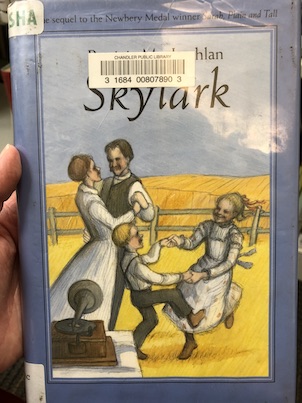
Skylark by Patricia MacLachlan, 1994.

The second book in the Sarah, Plain and Tall Series picks up about two years after the first book, shortly after Sarah marries Jacob, the father of Anna and Caleb.  That summer is very dry, and people worry about when it will rain next.  If there is no rain, their farms will be in danger.  Some people have been known to simply abandon their farms and move on during especially long dry spells.  Jacob says that their family won’t leave, no matter what, because “Our names are written in this land,” meaning that they have a commitment to it because they were born there and make their lives from the land.  However, Sarah was born in Maine, and Caleb worries that, if the dry spell goes on too long, Sarah will want to return to Maine.

The year goes on, and Sarah settles in to life on the farm.  Her cat, Seal, has kittens.  Sarah reflects on the baby animals and seems thoughtful about babies.  However, people are becoming ever more concerned that the water in the wells is lower than usual.  As people keep hoping for rain, Sarah gets a letter from Maine, saying how lovely and green everything there is.  The land around the farm is dry and brown, and the family has had to ration their water carefully, their supplies running increasingly low. 

Eventually, a family from the area has to pack up and leave because their well is dry.  Sarah is upset, trying to think of some way around the problem, but there is nothing to be done.  Everyone’s supplies are running low, and they’re already doing everything that can be done.  Sarah hates feeling helpless against the problem.  When Sarah’s best friend, Maggie, talks about leaving with her family, Sarah says that she hates the land because it takes so much and gives nothing back.  Maggie tells her that she’s like a lark that hasn’t come to land yet and that, if she is hoping to survive in this land and make a home there with Jacob, she will have to write her name in the land, just as he has.

Although the characters become increasingly distressed, in a way, I like the story for that.  Sarah is a strong, capable woman, but even she doesn’t have all the answers to every problem.  It’s upsetting for her to realize that, but it’s very human.  After the family’s barn catches fire and burns down, Jacob persuades Sarah to take the children and visit her family in Maine.  While they are gone, he will take care of the animals and try to keep the farm going, waiting for rain.

In Maine, Sarah and the children stay with Sarah’s aunts.  Aunt Mattie, Aunt Harriet, and Aunt Lou, who have never married, are called “The Unclaimed Treasures.”  They shower the children with affection.  Still, the children miss their father and worry about what is happening on the farm.  Sometimes, the children have bad dreams in which their father is unable to find them.

In the end, the rain comes on the prairie, and Jacob comes to Maine to collect his family.  Then, the family learns that Sarah is expecting a baby.  Anna worries a little because her mother died giving birth to Caleb, but Jacob and Sarah reassure her that everything will be fine.  When they return home, Sarah writes her name in the dirt, signaling her commitment to her new life on the prairie.

There is a movie based on the book that follows the story very well. In fact, some of the dialog is almost word-for-word from the original. The book is available to borrow and read for free online through Internet Archive (multiple copies – including one in Spanish).

Sarah, Plain and Tall

Sarah, Plain and Tall by Patricia MacLachlan, 1985.

This is a popular book to read in schools in the United States, the first in a series.  It’s a Newbery Award winner, and it shows aspects of farm life during the early 20th century and the concept of mail-order brides, a practice from American frontier days where men living in the West or Midwest, where there were not many available women in the population, would write to agencies or advertise for a bride from the East.  The process for arranging these marriages could vary, but it typically started with written correspondence before the man and woman would meet in person.  In this book, the man looking for a bride, Jacob Witting, is a widower with two children who has a farm on the Great Plains.  The story is narrated by his older child, Anna. The book isn’t very long, and it’s a pretty quick read, but it’s filled with colorful imagery and emotion.

Anna has had to help take care of her little brother, Caleb, since he was born.  Their mother died shortly after giving birth to him, and Caleb frequently asks Anna questions about what their mother was like.  Anna’s memories of their mother are fading because she was still very young when she died, but she really misses her.

Then, Jacob tells the children that he has advertised for a bride from the East, the way a neighbor of theirs did.  The children like their neighbor’s new wife and wouldn’t mind having a mother like her.  The father has received a reply to his advertisement from a woman in Maine, Sarah Wheaton.  Sarah has never been married, and now that her brother is getting married, she feels the need for a change in her life.  She loves living by the sea in Maine, but she is willing to move to start a new life.  She says that she would like to know more about Jacob and his children.

Jacob and the children write letters to Sarah, getting to know her better.  They come to like each other, but the children worry about whether Sarah will change her mind about coming to see them or whether she’ll like them or their farm when or if she comes.  When Sarah tells them that she’s coming during the spring, she says that they will know her because she will be wearing a yellow bonnet and describes herself as being plain and tall (the title of the book).

Sarah will stay with the family for a time while they decide if they can be a family together and if she will marry Jacob that summer.  There are adjustments that they will all have to make.  Life on the prairie is very different from what Sarah is used to, and the children still worry that she won’t want to stay.  Sarah brings seashells from Maine to show them, and they teach her about the local wildflowers.  One of my favorite scenes was where Sarah cuts Caleb’s hair, and they put the hair clippings out for birds to use in their nests.  Caleb was particularly concerned about whether Sarah would sing like their mother used to, and Sarah does. 

Through it all, the children can tell that Sarah really misses the sea.  Sarah does say that the land around the farm kind of rolls, a little like the sea, and they play in a haystack, like it was a dune by the sea.  When they visit their neighbors, Sarah talks with Maggie, the mail-order bride who came from Tennessee.  Maggie understands Sarah feels, missing her home in Maine, and it upsets Anna to hear them talk about missing their old homes.  However, Sarah says that things were changing at home, and Maggie comments that, “There are always things to miss, no matter where you are.”  What the women realize is that, although they miss their old homes, they have grown to love the new people in their lives and would miss them if they tried to go back to where they came from.

At one point, Sarah goes to town alone, and the children worry that she won’t come back, but she does.  She just went to town to buy colored pencils in her favorite sea colors.  Sarah does stay and marry Jacob, setting up the rest of the series.

The book is available to borrow and read for free on Internet Archive (multiple copies).

My Reaction

There is a movie version of this book, which follows the story pretty well. The book wasn’t specific about the time period, although it seems to take place during the early 1900s. The movie and its sequels are set during the 1910s, which makes sense for the rest of the series. The book also didn’t say exactly where the farm was, but the movie clarifies that it’s in Kansas. The movie also emphasizes how much the whole family, particularly Jacob and Anna, misses the mother who died.  In the movie, Jacob forbids the children to use any of his dead wife’s things and doesn’t want to talk about her.  However, when Sarah realizes that trying to avoid his wife’s memory is hurting Anna, she brings out some of the dead wife’s belongs to use, helping the family to make peace with the past and prepare for the future. 

In the movie, Jacob’s pain over his wife’s death is partly about guilt as well as grief. The book doesn’t really talk about why Anna’s mother died after childbirth, but in the movie, Jacob has a painful discussion with Sarah about how he blames himself for his wife’s death because the doctor had warned them that they shouldn’t have any more children after Anna.  Apparently, Anna’s birth had been difficult and caused complications because his wife was so young, and the doctor had said that having another child would be dangerous.  However, after a few years went by, they decided to try for a son to help run the farm, thinking that enough time had gone by for it to be safe.  When his wife died giving birth to Caleb, Jacob felt terrible, thinking that he should have taken the doctor’s warning more seriously and not tried to have another child.  Confessing all of this to Sarah helps Jacob to make his own peace with what happened.  However, none of this discussion appears in the book.

In both the book and the movie, Jacob also has to adjust to Sarah’s different personality.  Sarah is more stubborn and independent than his first wife, with her own way of doing things.  Living with her is different from living the mother of his children.  However, Jacob comes to love Sarah for the person that she is.

The Cabin Faced West

The Cabin Faced West by Jean Fritz, 1958.

Ten-year-old Ann Hamilton hasn’t been very happy since her family decided to move West.  Her family lives in 18th century Pennsylvania, and moving West means homesteading in an area where there are few other families, none of which have girls Ann’s age.  Her father and brothers love the adventure of starting over in a new place on the western frontier (what is considered the frontier for their era), but Ann is lonely, surrounded by boys, and missing their old home.  When her father built their cabin, he purposely placed it so that the door faces to the west because he says that’s where their future lies.  Ann’s brothers, Daniel and David, also make up a rule that no one can complain about the west (partly because Ann had already been doing a lot of complaining), saying that anyone who does so will get a bucket of water poured over their head, and they make a game out of trying to catch each other complaining about something.  So, there is nothing Ann can do but suffer in silence and write in her diary, a present from her cousin Margaret when the family left Gettysburg.

There’s a boy close to her age who lives nearby, Andy McPhale, but Ann doesn’t think much of him.  He makes jokes about her being “eddicated” because she can read and write.  Sometimes, he seems like he wants to play with her, but she’s a girl, and he doesn’t want to play girl games.

Andy McPhale also worries about his mother.  His father believes in hunting and trapping more than planting.  Rather than grow some of their food, Andy’s father goes off for days at a time on hunting expeditions, leaving his family with very little while he’s gone.  Ann’s family thinks that this is a sign of poor planning for the future and don’t think highly of Andy’s father for it.

Later, they meet a young man named Arthur Scott who has just arrived in the area and is looking for land to settle on.  When Mr. Scott first arrives, he meets Ann on the road.  Ann has allowed the hearth fire to go out, and she is on her way to her aunt and uncle’s house to borrow some from them because she doesn’t know how to start a fire by herself.  Understanding her problem, Mr. Scott gives Ann a ride home on his horse and helps her to restart the fire, promising not to tell her parents.  They invite him to stay for lunch, and he talks about his time at Valley Forge with Washington’s soldiers when he was only 13 years old.  He was too young to fight, but he volunteered to drive an ammunition wagon.  Ann thinks of George Washington as a hero, and she finds it thrilling that Mr. Scott served with him.

Arthur Scott becomes a friend of the Hamilton family, and Andy McPhale seems jealous of him and the attention that Ann pays to him.  Then, Andy tells her that his family has decided to go back to town for the winter.  In the spring, they will return to the area and try farming, persuaded by their experiences working with the Hamiltons.  To Ann’s surprise, Andy offers for Ann to come with them.  She could visit Gettysburg and stay with her cousin Margaret again.  Ann has been lonely, being the only girl in the area, and it’s a tempting offer.  However, Ann feels like she must stay for her family’s sake and so she won’t feel like a deserter.  When a storm destroys a good part of her family’s crop, she feels terrible and wonders if it’s all really worth it.

In the end, there is a great surprise coming for Ann: she gets to meet her hero, George Washington, when he comes to see some land that he has purchased nearby.

The book is currently available online through Internet Archive (multiple copies).

My Reaction and Addition Information

I first read this book when I was a kid in elementary school. As the cover of the book says, the author won the Laura Ingalls Wilder Medal, which honors authors and illustrators for children who have made long-term contributions to children’s literature. Laura Ingalls Wilder was the author of the semi-autobiographical Little House on the Prairie books, but because those books contain uncomfortable racial language and situations, her name were removed from the award in 2018. The award still exists, but it’s now called the Children’s Literature Legacy Award, which is more descriptive of its purpose.

I liked this book as a kid, although I had forgotten many of the details before I reread it as an adult, and I’m not sure if I fully understood the history behind the story when I was a kid. I think stories actually become more interesting when you know the background, so I’d like to discuss the history a little.

The story is based on the real life of Ann Hamilton, the great-great-grandmother of the author of this book, who did get to meet George Washington in 1784. The author is essentially retelling an old family story. The real Ann Hamilton married Arthur Scott when she grew up.  The place where they lived, called Hamilton Hill in the story, is now called Ginger Hill. In fact, it seems that a member of the Hamilton family caused the name change, although that story isn’t really one for children.

One of the parts of the story that I always remembered from when I read it in school as a kid was the part where Ann talks about “mother’s fried wonders”, basically describing a fried donut. People in the 18th century did make various types of fried pastries, varying in style and name depending on where they lived. For an example of early American donuts, see this video by Townsends about 18th century doughnuts, where they make doughnuts and talk about the history and evolution of American “dough nuts” (they talk about the name and how it seems to come from the original shape – nut-shaped pieces of dough).

The Princess in the Pigpen

The Princess in the Pigpen by Jane Resh Thomas, 1989.

Elizabeth is the nine-year-old daughter of a nobleman in London in the year 1600, and she’s very sick.  However, while she’s lying in her bed with a terrible fever, she suddenly finds herself in a pigpen in 20th century Iowa with no idea how she got there. At first, she doesn’t even know where she is, and when she is found by the McCormick family, the family who owns the farm, they have no idea who she is or where she came from.  That she is very ill is obvious, so they take Elizabeth to the local doctor, who says that she has scarlet fever (what strep throat turns into when it’s neglected, it’s serious and life-threatening) and gives her penicillin, which helps her to recover.

However, there is still the question of how Elizabeth ended up on the McCormick farm in Iowa in the first place.  Elizabeth tells them that she is from London and insists that the year is 1600.  Ann, the McCormicks’ daughter, who is about the same age as Elizabeth, doesn’t believe that Elizabeth is really from the past.  The current year is 1988, and Ann thinks that Elizabeth is probably crazy, but obviously in need of some help.  The McCormicks tell the local sheriff about Elizabeth, and he begins looking through reports of missing persons to find one that fits her.

Still, it’s hard to explain Elizabeth’s strange clothing (Ann is sure that Elizabeth must be rich because her dress is obviously very fancy) or the antique toys that were found with her (a doll and a music box).  When Ann goes to school, Elizabeth stays at home with her mother, Kathy, and asks her about all the strange things that she’s been seeing around her, like cars and electric lights.  Kathy assumes that Elizabeth is merely confused and that her memory has been affected by her illness.

By coincidence, Kathy is a historian, teaching at a nearby university, and has studied English history.  She is aware of Elizabeth’s family, including her father, Michael the Duke of Umberland.  When Elizabeth asks her if she knows what happened to her mother, who was also ill when she last saw her, Kathy says that she was still alive in 1605, which means that she must have survived her illness.  Kathy quizzes Elizabeth in English history, and Elizabeth knows the correct answers because they are all current events to her.  Kathy thinks that someone must have taught Elizabeth history but notices that Elizabeth really seems to believe everything she says and knows a surprising amount of detail.

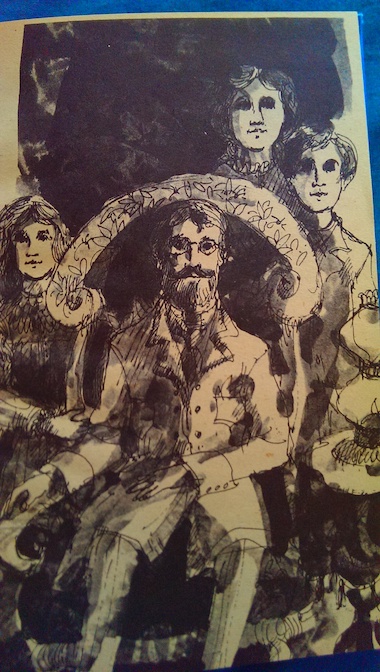
Further research into history and Elizabeth’s family tells Elizabeth the years when her parents and other people she cares about will die, which is distressing to her.  Ann begins to believe Elizabeth about her life when Elizabeth describes her home to her, and the description matches one in a book.  In the same book,there is also a portrait of Elizabeth’s family from 1605.  In the portrait, Elizabeth is a little older than she is now, and her mother has had another baby.  Elizabeth’s doll and music box are also in the painting.  The book also contains an account of the fire that later destroyed the manor house.  According to the book, Elizabeth managed to save the lives of her family by alerting them to the fire and also managed to salvage a couple of valuable books.

Now that Ann is convinced that Elizabeth is really from the past, they must find a way to help Elizabeth to return home so that she can save the lives of her family!

The book is available to borrow and read for free online through Internet Archive.

My Reaction

There were a couple of things that I liked about the time travel in this story. One is that it seems that it was fated to happen. Elizabeth is meant to survive her illness and to save the rest of her family. She was only able to do that because she had been to the future and learned about the dangers they would be facing. When she returns to her own time, she doesn’t change the past but makes sure that things turn out the way they were supposed to.

I also found it interesting that Elizabeth’s family has no living descendants in the late 20th century. Her family continued beyond Elizabeth’s time, but the family line apparently ended before the time period of the modern characters in the story, so we don’t have one of those moments that sometimes occurs in time travel stories where the modern characters meet a descendant of the past characters. That can be a fun moment in some stories, but I appreciate the variety.

At one point in the book, Ann makes a reference to the book A Wrinkle in Time, about other children who get “lost in space and time.”

The Day Jimmy’s Boa Ate the Wash

JimmysBoa

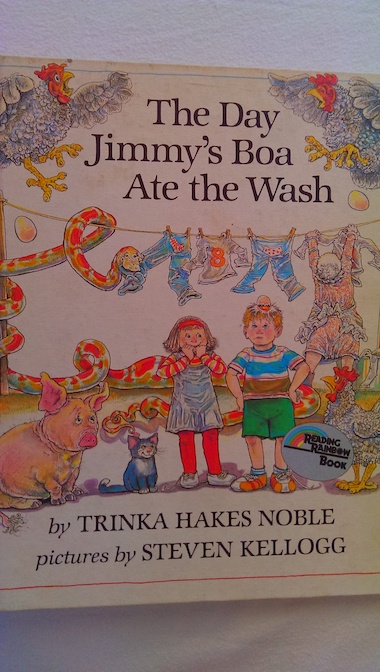
The Day Jimmy’s Boa Ate the Wash by Trinka Hakes Noble, pictures by Steven Kellogg, 1980.

The fun thing about this story is the backward way that the girl begins telling it, somewhat resembling The House that Jack Built, or better yet, the old No News Joke. The joke is really closer to the format of the story, with someone explaining the least eventful thing that happened as though it were the most important when it was just the end result of everything else.

A young girl (unnamed) arrives home, and her mother asks her how she liked her class trip to a farm that day. She says that it was boring until the cow started crying. When the mother asks her why the cow was crying, she says that the farmer wasn’t paying attention to where he was driving his tractor and knocked a haystack over on the cow.

As the mother continues to ask her daughter questions about what happened, backtracking through events, the real story begins to reveal itself:

The girl’s friend, Jimmy, had a pet boa constrictor, and he brought it along on the field trip so it could meet all the farm animals.

JimmysBoaFieldTrip

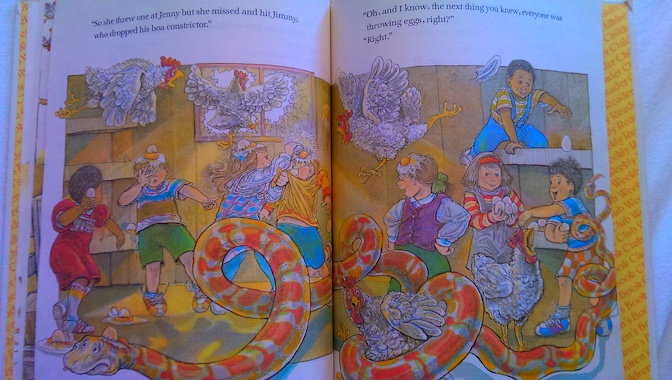
However, the chickens became frightened, and one of them laid an egg on one of their classmates. She thought that someone else threw it at her, so she threw another egg at him, which hit yet another student.

JimmysBoaEggs

From there, it turned into one big food fight, with students throwing eggs at each other, and when they ran out of eggs, they threw corn at each other. The corn was for the pigs to eat, so the pigs wandered onto the school bus and started eating the children’s lunches. From there, chaos ensued until the farmer’s wife suddenly screamed, and the children’s teacher hustled the children onto the school bus to go home.

JimmyBoaLeaving

The children never knew exactly why the farmer’s wife screamed (although the reason is actually in the title to the book), but two things quickly became evident: Jimmy accidentally left his boa constrictor behind on the farm, but he has acquired a pet pig because there was still one left on the bus.

This summary doesn’t quite do the story justice because the backwards way the story starts out is part of the fun. The pictures in the book are hilarious, and the boa constrictor is shown at the end to have become a beloved pet of the farmer and his wife, even making friends with the chickens.

This is a Reading Rainbow Book.  It is currently available online through Internet Archive.

Mystery on Nine-Mile Marsh

Nine Mile MarshMystery on Nine-Mile Marsh by Mary C. Jane, 1967.

Lucille Pierce has been feeling lonely because her other friends joined a club with some other girls that meets over the weekend, and Lucille hasn’t been invited to join. The only people who are available to hang out with now are her brother Brent and his friend Kevin, and they don’t always want a girl hanging out with them.

When Brent and Kevin have an argument because Kevin laughed at Brent’s horrible spelling during a spelling bee (Brent is horrible at spelling because he never stops to think about what he’s doing, and he gets into fights fast because he also has a quick temper), Kevin invites Lucille to join him as he goes out to have a look at the old house on Moody Island before the new owners take over. The old farmhouse stands on an island in the marsh. Sometimes, people hear odd sounds coming from the house, and some people believe that it’s haunted by the ghost of John Moody, who was lost at sea years ago. Old Mrs. Moody, John’s widow, was a hermit in her final years, and now, the only living member of the Moody family is Clyde Moody, John’s nephew. Everyone had expected that Clyde would inherit the old Moody house, but instead, Mrs. Moody left it to a man named Arnold Lindsay, an apparent stranger. Miss Rand, who owns the diner not far from the Moody house thinks that Mrs. Moody should have left it to Clyde. Clyde has had problems with alcohol and hasn’t been able to hold any job for very long, and Miss Rand thinks that having the house to care for might have been good for him, providing him with some stability. No one even has a clue who Arnold Lindsay is.

Nine Mile Marsh HouseLucille and Brent take a bike ride out to the island, but a noise in the barn frightens them away. It isn’t that they really think there’s a ghost, but they’re concerned that someone may be trespassing on the property. They decide to keep an eye on the house to see if they can see anyone sneaking around, but they don’t.

A short time later, Lucille, Brent, and Kevin meet Arnold Lindsay, who turns out to be a nice man. Like the children, he becomes concerned about the condition of Pedro, the donkey that the Turner family owns and leaves neglected in one of their fields. To give the donkey a better life, Mr. Lindsay buys Pedro, telling the kids that they can come out to the Moody house and visit him.

Mr. Lindsay doesn’t have any idea why Mrs. Moody left him the house, either. He’s a writer, but not a famous one. He just writes newspaper columns. All he or the children can think of is that Mrs. Moody must have been a fan of his columns. She didn’t get out, but she did read newspapers.

Nine Mile Marsh PedroMr. Linsday has also heard strange noises around the Moody house, and he asks the children what they know about it. They tell him the ghost stories about the Moody place, but they say that they don’t really believe that there’s a ghost. Mr. Lindsay is fascinated by the stories. He says that his impression was that the noises he heard came from the cellar, but he didn’t see anything when he investigated. He invites the children to help him investigate further sometime.

Meanwhile, Lucille tries to make friends with a new girl at school, Barbara Rosen. At first, Barbara doesn’t want to be friends because she thinks that Lucille is part of the Saturday Club with the other stuck-up girls, but she becomes friendlier when Lucille tells her that she’s not with them. Barbara had worried that the snobby girls didn’t like her because they thought something was wrong with her, but she really likes Lucille and thought for sure that she would have been asked to join the club, too, having been involved in a lot of other activities at school. Both girls find it reassuring that the fact that they weren’t asked to join the club doesn’t mean that that there’s anything wrong with them, but maybe with the girls running the club and their priorities in choosing friends. Having each other for friends makes them both feel less lonely, so they can stop worrying about the club and its members so much.

Nine Mile Marsh MeetingBarbara’s father owns a clothing store in town, and she says that some of his customers have been saying bad things about Mr. Lindsay. Some of them have even said that he might be a spy. Lucille thinks that’s ridiculous and that they’re only saying things because they wanted to buy the property or see it go to Clyde. Lucille has to admit that she doesn’t know much about Mr. Lindsay, so she can’t swear that the rumors aren’t true, but she still thinks that he’s probably just a nice guy, and she wants to see him keep the house so that Pedro will have a safe place to live.
With Clyde Moody and others sneaking around the property, seeming to look for something, and Clyde’s new accusations that Mrs. Moody was never legally married to his uncle and therefore had no right to will the property to anyone, Lucille, her brother, and their friends try to help prove that Mrs. Moody was really Mrs. Moody and that the house does rightfully belong to Mr. Lindsay.

Part of the theme of this story is about loyalty.  Lucille feels hurt that the girls she had previously thought were her friends abandoned her to join the Saturday Club.  She thinks that people who are real friends should stand by each other, no matter what other friends come into their lives.  However, looking back on her friendship with these other girls, she comes to realize that she was mostly friends with them because they were the girls who lived nearby, and neither of them really had other options.  In the end, they didn’t really have much in common, and she realizes that she doesn’t think very highly of them, so she is as free to move on and make new friends as they are.

Similarly, that is how some of the people in town feel about Clyde Moody.  It isn’t so much that they like him as he’s always been there.  He’s familiar to them, and it would have made sense for Mrs. Moody to will the Moody house to him.  It doesn’t make sense to them that she would leave her house to someone she’s never met, so they get upset about it and assume that there must be something wrong with the situation or with Mr. Lindsay himself.  However, nothing is wrong with Mr. Lindsay, and Clyde isn’t really worth their loyalty.  He’s a known troublemaker who associates with other troublemakers, like the Turners. Mr. Lindsay really is a better person.

In part of the story, the children catch Miss Rand sneaking around the property.  At first, they think that she was there to help Clyde or get Mr. Lindsay in trouble, but she tells Mr. Lindsay that she was actually there for very different reasons.  There was something on the property that she wanted to protect.  She wasn’t sure that she could trust Mr. Lindsay, and she knew that she couldn’t trust Clyde, so she was taking it on herself to look after it.

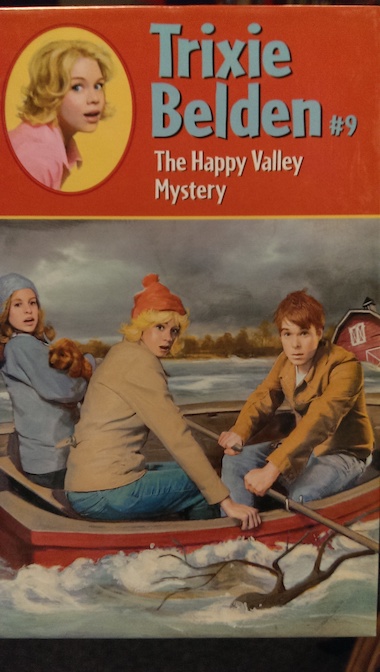
The Happy Valley Mystery

Trixie Belden

TBHappyValley

#9 The Happy Valley Mystery by Kathryn Kenny, 1962.

Trixie’s uncle, Andrew Belden, after hearing about the mysteries that the kids have solved, invites them all to spend a week on his sheep farm in Iowa. He won’t be there because he has to take a trip to Scotland, but the Gormans, who are taking care of the sheep, could use their help. Someone has been stealing sheep from the farm, and no one seems able to figure out who it is or how the sheep keep disappearing.

Although Andrew Belden mainly wants the kids to relax, have fun, and learn a little about taking care of sheep, Trixie just can’t resist the challenge to save her uncle’s sheep.  In this book, Trixie is teased a lot for her detective ambitions, and she embarrasses herself a couple of times by suspecting the wrong people. Part of the trouble comes from the fact that she doesn’t know the people in the area and who can legally be the area of her uncle’s farm.

There is a harrowing scene where Trixie and her friends are caught in a flood.  This book also develops the relationship between Jim and Trixie more.  For awhile, each of them is jealous because they think that the other likes someone else.  At the end, Jim gives Trixie a bracelet with his name on it as a sign that they are now boyfriend and girlfriend.

The book is currently available online through Internet Archive.

The Ghost of Windy Hill

GhostWindyHill.jpg

The Ghost of Windy Hill by Clyde Robert Bulla, 1968.

GhostWindyHillFamilyIt’s 1851, and Professor Carver of Boston is living in an apartment above a candle shop with his wife and two children, his son Jamie and daughter Lorna.  One day, a man named Mr. Giddings comes to see Professor Carver to request his help.  For years, he has wanted to buy a particular farm with a beautiful house called Windy Hill.  However, when he finally succeeded in buying the house and he and his wife went to live there, his wife became very upset.  She said that she felt strange in the house and that she had seen a ghost.  Now, she is too upset to return to Windy Hill.  Mr. Giddings has heard that Professor Carver once helped a friend get rid of a ghost haunting his house, and he asks the professor if he would be willing to do the same for him.

At first, Professor Carver is reluctant to agree to help.  He doesn’t believe in ghosts, and when he helped his other friend, he didn’t get rid of any ghosts.  His friend had only believed that his house was haunted, and after the professor and his family had stayed there for awhile without experiencing anything unusual, his friend relaxed and was reassured that the house was alright.  Mr. Giddings asks if the professor and his family would be willing to stay at Windy Hill for the rest of summer and see if they see anything unusual.  If they don’t, perhaps Mrs. Giddings will feel better about the house and be willing to return there.  Although the professor is still not that interested in the house, his family is, so he agrees to spend the rest of the summer there, about a month.  His family can escape the summer heat in the city, and he can work on his painting while someone else teaches his class.

GhostWindyHillLadyJamie and Lorna are thrilled by the house, which is much bigger than their apartment in town.  They can each have their own room, and there is an old tower in the house that was built by a former owner, who was always paranoid about Indian (Native American) attacks (something which had never actually happened).  However, their new neighbors are kind of strange.  Stover, the handyman, warns them that the house is haunted and also tells them about another neighbor, Miss Miggie.  Miss Miggie is an old woman who wanders around, all dressed in white, and likes to spy on people.  There is also a boy named Bruno, who apparently can’t walk and often begs at the side of the road with his pet goat, and his father, Tench, who is often drunk and doesn’t want people to make friends with Bruno.

The kids make friends with both Bruno and Miss Miggie.  Bruno is unfriendly at first, but Lorna brings him cookies, and she and her brother tell him about life in the city.  Miss Miggie brings Lorna a bag of scrap cloth so that she can make a quilt.  Nothing strange has been happening in the house, so the family knows that they will be returning to the city soon, reassuring Mr. Giddings that the house isn’t haunted.

GhostWindyHillBoyThen, strange things do start happening in the house.  The quilt that Lorna has been making disappears and reappears in another room in the middle of the night.  At first, the family thinks maybe she was walking in her sleep because she had done it before, when she was younger.  However, there is someone who has been entering the house without the Carvers’ knowledge, and Jamie and Lorna set a trap that catches the mysterious “ghost.”

As Professor Carver suspected, there is no real ghost at Windy Hill, but this story has a double mystery.  First, there is the matter of the mysterious ghost, who is not there to scare the Carvers away but actually to make them stay.  Then, there is the question of what Mrs. Giddings saw that upset her so much, if anything.

The book is easy to read for younger readers and accompanied by black-and-white pictures.  My only complaint is that some of the pictures are a little dark, and the artistic style makes them a little difficult to interpret.

The book is available to borrow and read for free online through Internet Archive.

Tornado Jones

TornadoJonesTornado Jones by Trella Lamson Dick, 1953.

This book was recommended by a reader of this blog.  I haven’t been able to find a copy of it myself, but the reader thoughtfully supplied a picture of the cover.

The reader says:

“I lived in North Platte Nebraska from about February of 1953 till about April of 1955. During that time a book was written by Trella Lamson Dick entitled “Tornado Jones”. Everyone in my school in North Platte read that book many many times. We all loved it. Trella Lamson Dick was born, lived and died in small town of Orleans, Nebraska, Just East and a bit South of North Platte Nebraska. I have two copies of the book one for each of my grandsons. It may be something you might look into investing in I know there are copies available.

It is about a boy whose parents had died and he lived with his Aunt on a farm. In his adventures he discovered people who were digging dirt out in a gully and a pit in the middle of prairie land and he could not figure out why. It turns out that the book is a work of fiction but it is based on fact about the determination that the ‘Jeffrey Reservoir’ East of North Platte could actually be built and would function.”

The orphan boy, Tornado Jones, also has a mystery surrounding his name.  He doesn’t like to talk about it with other people, but when he makes a friend (the first one he’s ever had), Paul, he finally confides that the only clue he has to his real name is a glass bell.  The secrecy surrounding his name has made him uneasy for his entire life.  Tornado also believes that there is gold buried in the canyon nearby, and when he sees people digging there, he is sure that’s what they’re looking for.  Paul is fascinated at the secrets Tornado confides in him, and he and Tornado team up to uncover both the secret of the gold and Tornado’s name.  At the same time, Tornado’s family is worried about the beginning of the reservoir and dam, the construction of which threatens to flood the family’s home.  Can they save their home or will they have to give it up in the name of progress?

This book won the Charles W. Follett Award and is actually the first in a series about Tornado Jones.  There are two others.