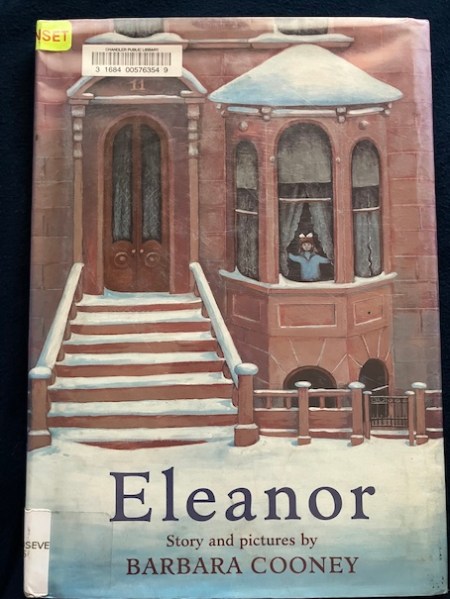
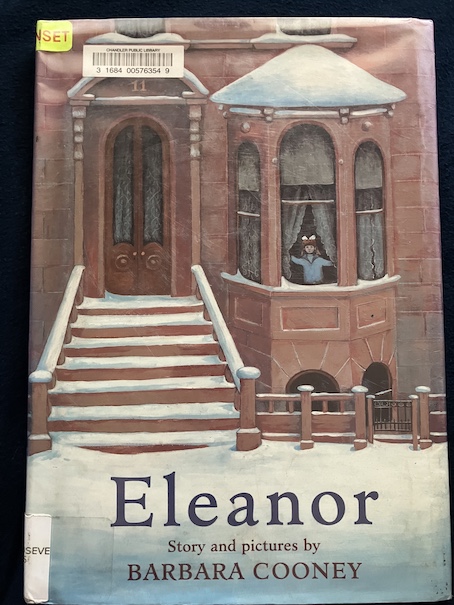
Eleanor story and pictures by Barbara Coooney, 1996.
This picture book tells the story of Eleanor Roosevelt’s early life. Eleanor Roosevelt (full name Anna Eleanor Roosevelt) was the niece of Theodore Roosevelt (called Uncle Ted in the book), and later, in life, the wife of Franklin Delano Roosevelt (a distant cousin) and First Lady of the United States. This book is about her childhood, so it doesn’t explain about her husband or marriage until the Afterword at the end.
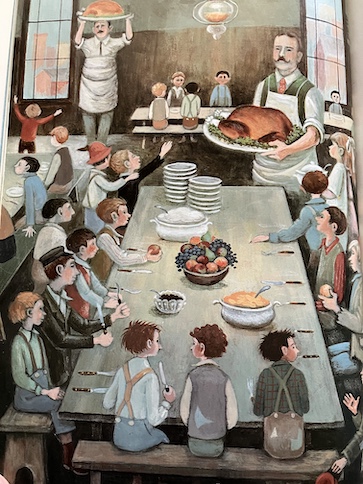
Eleanor’s home life wasn’t particularly happy. She was a disappointment to her mother in a number of ways. Her mother had hoped for a boy, and she didn’t think Eleanor was a pretty baby. Her mother often called her “Granny” as a nickname because she was such a serious child and seemed rather old-fashioned looking, and she reminded her mother of an old woman. When Eleanor’s younger brothers were born, Eleanor often felt left out when her mother spent time with them.
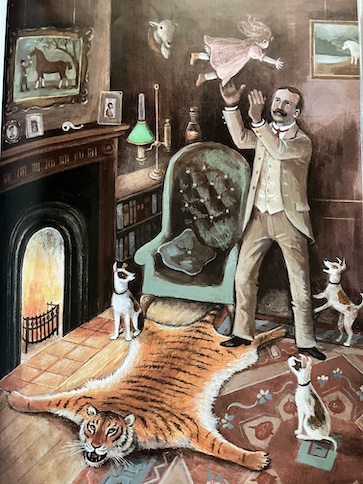
Eleanor’s father loved her and enjoyed playing with her and spending time with her, but she didn’t get to see him often as she was growing up. Her father, Theodore Roosevelt’s brother, Elliot Roosevelt, was a traveler and socialite and later became estranged from his family. Still, although he wasn’t a particularly reliable person and wasn’t present much, Eleanor was very attached to him and sometimes felt like he was the only one who really loved her.
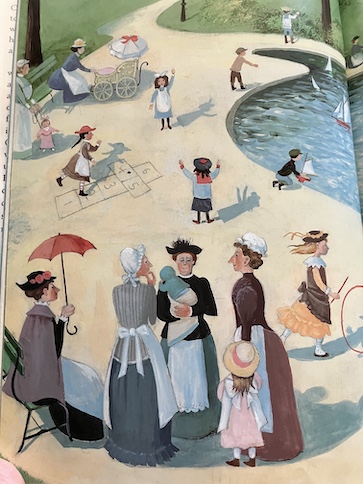
Much of Eleanor’s early life was spent with her nanny, who spoke to her in French, so she mastered the language at an early age. Eleanor was very shy, so she didn’t spend much time with other children. She did spend some time with relatives, too. Sometimes, she helped them with charitable projects, giving her a sense of caring for the less fortunate.
When Eleanor was eight years old, her mother died of diphtheria, and she and her little brothers went to live with her grandmother and the aunts and uncles who also lived with her. Her father had been living apart from the family at this time, but he returned after his wife’s death. After that, he would visit Eleanor sometimes and take her for outings. However, he was sometimes neglectful. The book explains that he died in a fall when Eleanor was nine years old.
Life with her grandmother was difficult for Eleanor because her grandmother made her wear old-fashioned clothes, she had a strict governess, and her aunts and uncles seldom paid attention to her because they were busy with their own work and projects. Other children didn’t think much of Eleanor because she was shy and wore old clothes. Sometimes, her cousin Corinny would join her for dinner, but Corinny never liked it because the house was so grim and silent.
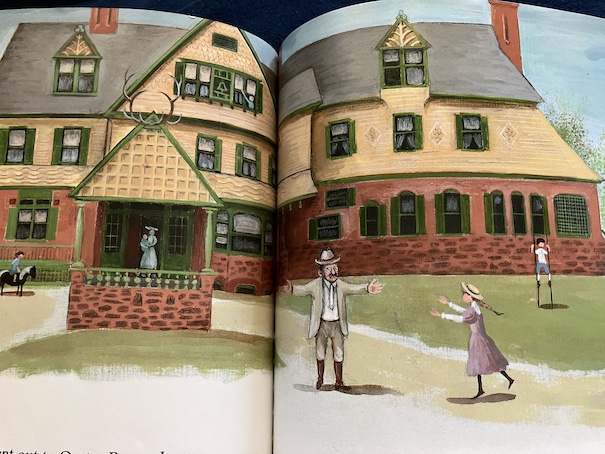
Eleanor was happier when they would go to her grandmother’s summer house, Oak Terrace. At the summer house, she could play games, daydream, read, and catch tadpoles with her little brother Brudie. Sometimes, she would go out in the rowboat with one of her aunts. There were also times when she visited her Uncle Ted and his family. Sometimes, she would play with her cousin Alice Roosevelt because they were the same age, but Alice teased her dreadfully, and Eleanor often found her a little intimidating. Her relatives encouraged her to be brave and to do things that she found scary, but she often found it difficult to keep up with them and some of their daring stunts.
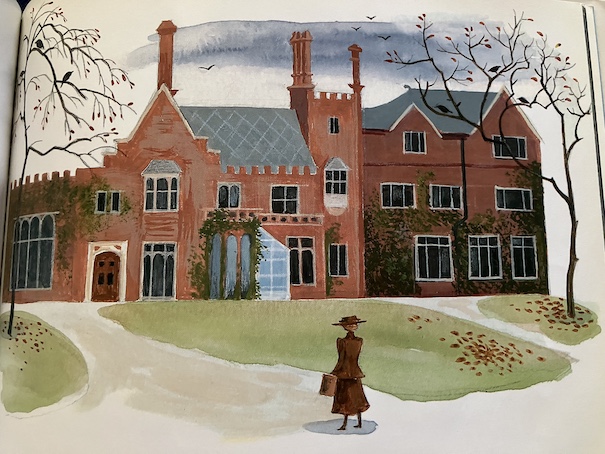
Eleanor was often considered the “ugly duckling” of the family, but things changed for her when her grandmother decided to send her to boarding school in England. She attended a school called Allenswood, and the headmistress, Mademoiselle Souvestre, became a mentor to her.
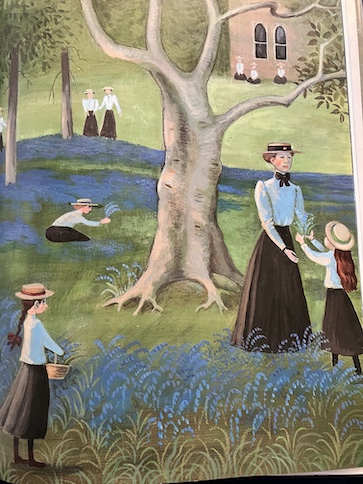
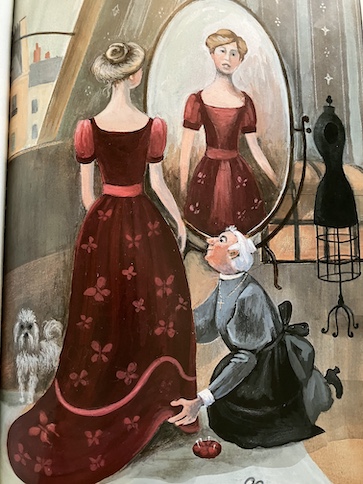
Thanks to the lessons in French from her former nanny, Eleanor excelled at boarding school. Because the school had a rule that the girls should only speak French at dinner, Eleanor was the only girl at first who felt comfortable talking, a rare change for her. Eleanor made friends with the other girls at school and was happy there. Mademoiselle Souvestre encouraged Eleanor’s sense of independence, opened her eyes to the world around her, took her along on trips to Europe, and advised her to get clothes made in Paris, ridding her of the clothes her grandmother made her wear. By the time she returned home from boarding school, Eleanor was happier and more confident than she had been before, and she credited Mademoiselle Souvestre for her influence.
The book is available to borrow and read for free online through Internet Archive.
My Reaction
I enjoyed this book for its focus on Eleanor Roosevelt’s childhood. Many books about famous people focus on what they did when the became famous, but I enjoyed seeing her as a shy, awkward child, when it didn’t seem obvious that she would one day be famous. By seeing how she grew up, I feel like I’ve come to understand more about her.
Eleanor Roosevelt came from a wealthy family, but her early life wasn’t very happy. She was deeply affected by her mother’s sense of disappointment in her for not being prettier and by her parents’ troubles and their separation from each other. She was orphaned at a young age, and one of her younger brothers also died not long after their mother. She often felt like she didn’t fit in with her family, and they didn’t seem to understand or appreciate her.
The book explains a little about her father’s estrangement from the family, but it doesn’t go into all the details or some of the dark reasons why. The truth was that he was an alcoholic. His alcoholism was the beginning of his strained family relationships, but then, he had an affair with a servant girl who worked for his wife and fathered a child by her. When that happened, Theodore Roosevelt had him forcibly removed from his family’s home and did his best to keep him away from his children as much as possible, even after his wife’s death. When the book says that Eleanor’s father died in a fall, that was a soft way of explaining it. The truth is that he committed suicide because he was drinking even more heavily after his wife and one of his sons died, and he was depressed about the rest of the family keeping him away from his remaining children.
I thought it was interesting that Eleanor really blossomed at boarding school. She had always been a shy girl, but she was very studious and spoke French, skills which suited boarding school life well. Boarding school encouraged her to spend more time around other girls her age and took her away from her family’s influence, giving her the opportunity to find herself and bond with other people. In particular, the headmistress of the school became her mentor and encouraged her to look at the world in new ways and to become the best version of herself.
What To Do About Alice? by Barbara Kerley, illustrated by Edwin Fotheringham, 2008.
Theodore Roosevelt had done many things in his life, from herding cattle to hunting grizzly bears, but one thing he could never seem to do was manage his daughter, Alice. From early childhood, Alice was a lively girl, always having things she wanted to do and places to go. She called it, “eating up the world.”
Alice’s mother died when she was a baby, only two days after she was born. The loss was very difficult for her father, and people felt sorry for Alice. However, since Alice had no memories of her mother, she didn’t feel the loss so much, and she didn’t want people to pity her. Eventually, her father remarried, and Alice had half-siblings. Because of her father’s political career, the family traveled between New York and Washington, DC. Alice enjoyed this lifestyle and the experiences she had in different places where they lived.
For the most part, Alice’s childhood busy and full of fascinating experiences, but she did have problems as well. She went through a period where she had to wear braces on her legs because they weren’t growing properly. (The book doesn’t explain why she had this condition, partly because the exact cause is unknown. The common belief was that she might have had a mild form of polio, but that isn’t definite.) The braces worked, and eventually, she no longer had to wear them. Her father encouraged her to engage in physical activities and learn to ride a bicycle because he didn’t want her previous condition to make her overly cautious.
It turned out that there was little need to worry about that. Alice was a wild child! She would run off to explore the cities where she lived, and she once joined an all-boys club, sneaking them in disguised as girls! Concerned that Alice was getting too wild and becoming a bit of a “tomboy” (a girl who acts like a boy and likes things boys like – I don’t think this term is used as much anymore because the modern view is more that people shouldn’t allow themselves to confine their interests based on gender stereotypes).
Theodore Roosevelt considered sending Alice to boarding school to give her some discipline and teach her more ladylike habits, but the idea upset Alice so much that he eventually decided to let her continue her education at home. Alice used the books in her father’s library to study seriously. She read books by famous authors and studied subjects like Greek, geology, and astronomy, discussing them with her father.
When Alice was seventeen years old, Theodore Roosevelt was elected President of the United States. Alice and her half-siblings thrilled people with their wild behavior and exotic pets. (The book mentions Alice’s pet snake, Emily Spinach.) However, Alice also developed a serious interest in politics. She became a goodwill ambassador and took part in public projects, like the Buffalo Exposition. Her antics often became the subject of newspaper reports and society gossip. It earned her some criticism, but because she was such a personable young woman, she was also a social success. She gained the nickname of “Princess Alice.”
Eventually, Alice married a congressman named Nicholas Longworth. She continued to act as an advisor to her father and take part in diplomatic events. The entire time, she was known as an irrepressible personality!
My Reaction
I enjoyed the book for its fun look at a colorful character from American history, although it was on the cartoonish side. In multiple pictures, she is shown holding a giant spoon. It confused me a little at first, and then, I realized that it was a reference to her saying about “eating up the world.”
The Roosevelts were a colorful family in general. Teddy Roosevelt encouraged his children (and nieces and nephews, as explained in the book about Alice’s cousin, Eleanor) to be brave and daring, and Alice and her half-siblings were known for their wild stunts and the small zoo of bizarre animals that members of the family kept as pets. The book shows Alice and her half-siblings sliding down the stairs in the White House on serving trays, something that they did in real life, although it doesn’t explain in the text that’s what they were doing.
Alice was both a scandalous figure and an admired person in her time, and I thought the book did a good job showing that. She was an eccentric person who often trampled on social conventions, but she was also a highly social person and pleasant to be around, so she tended to shine in social and diplomatic situations.
Her life wasn’t always as happy and cheerful as the story shows. She had tensions with both her father and stepmother while she was growing up, and her marriage wasn’t especially happy. There were times when she opposed her husband politically, and she is also known to have had affairs with other men. Her daughter was probably the result of one of these affairs. Of course, these darker subjects aren’t exactly suitable for a children’s picture book. The book gives enough of an indication of tensions within her family by showing her father’s reactions to her various antics and the way she threw fits to convince her father not to send her to a traditional school. Overall, the book is a fun introduction to the life of a fascinating but complex person.
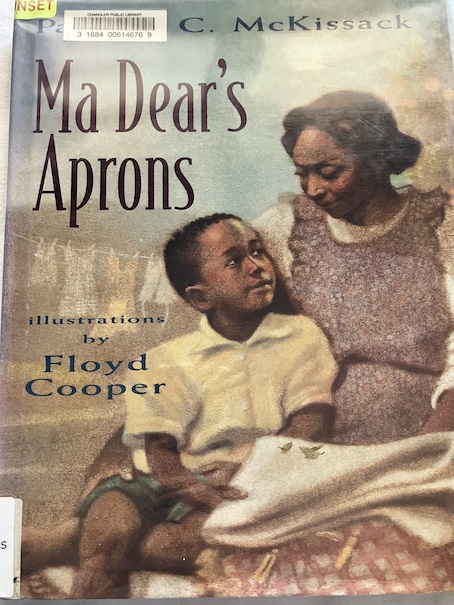
Ma Dear’s Aprons by Patricia C. McKissack, illustrations by Floyd Cooper, 1997.
Young David Earl’s mother, called Ma Dear, has a different apron for every day of the week, and David can always tell what day it is and what the task of the day is by which one his mother is wearing.
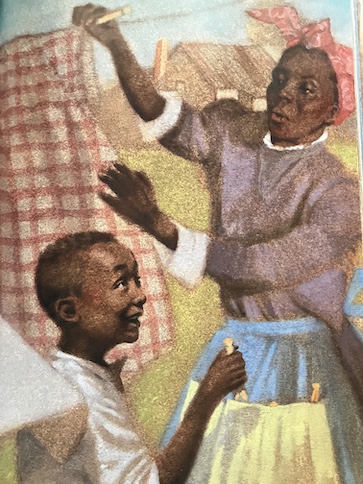
On Monday, she likes to wear her blue apron because that’s wash day, and she keeps clothespins in the pocket of that apron. After she’s done with the laundry, she has time to talk to David Earl, and she tells him about his father, who died as a soldier.
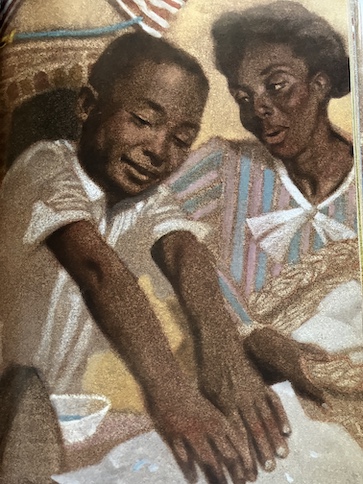
On Tuesday, she wears her yellow apron, when she does her ironing. On Wednesday, they deliver the finished laundry to their clients, and Ma Dear gives David Earl a treat from the hidden “treasure pocket” in her green apron.
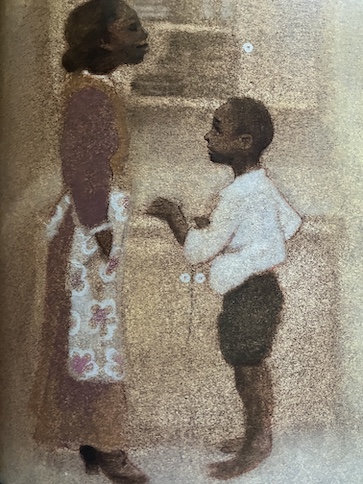
On Thursday, Ma Dear wears her pink apron, and they pick vegetables and visit people who are sick or elderly at their homes. On Friday, Ma Dear cleans the house of another family, so she wears her brown apron. David Earl comes along, and she sings to him while she works. Saturday is for baking pies to sell, so she wears her flowered apron. She also gives David Earl a bath on Saturdays.
The best day of all, though, is Sunday. Ma Dear doesn’t work on Sunday, so she doesn’t wear an apron
My Reaction
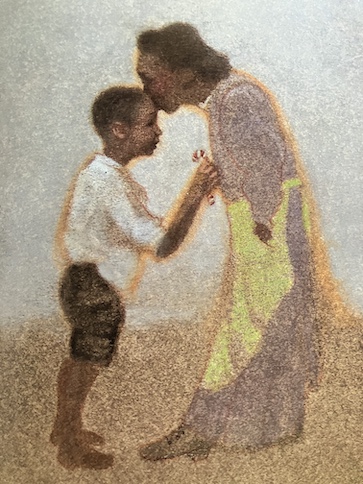
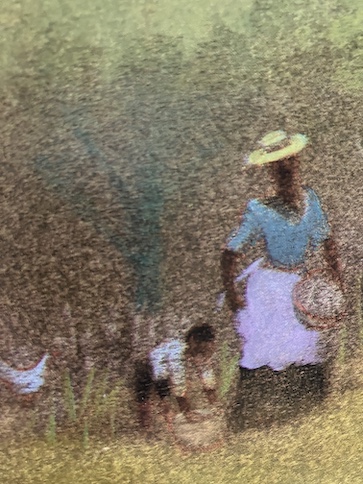
The book starts with an author’s note, explaining that the characters in this story are based on her own family. “Ma Dear” was the nickname of her great-grandmother, Leanna, and Leanna was a single mother in Alabama during the early 1900s, who earned money by doing laundry, cooking, and cleaning for other people, like Ma Dear in the story. The story is about the family stories told to Patricia C. McKissack about her great-grandmother and how she made time for her children, even when she was tired from working hard. The aprons in the story are like one that Patricia McKissack inherited that used to belong to Leanna.
The author’s note, which I would have probably ignored when I was kid because I was too eager to get into the story, made this story better for me. I liked the explanation that this was a family story about a real person. The aprons are a device to help readers connect to memories of the real Ma Dear, similar to how the girls in Aunt Flossie’s Hats (And Crab Cakes Later) hear family stories and memories because they’re associated with the hats in their aunt’s collection. It’s a sweet way to share family memories.
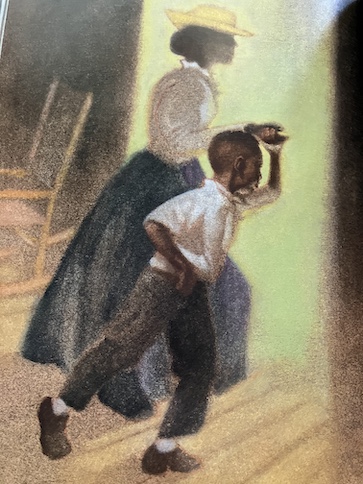
I also like the soft, old-fashioned pictures that accompany the story. Their softness and sometimes slightly blurred quality help create the mood of memories.
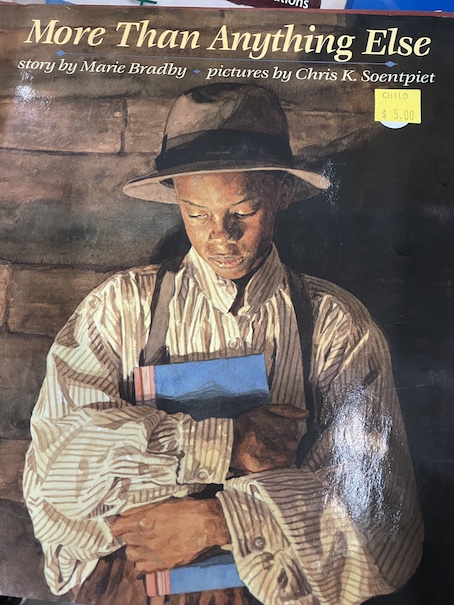
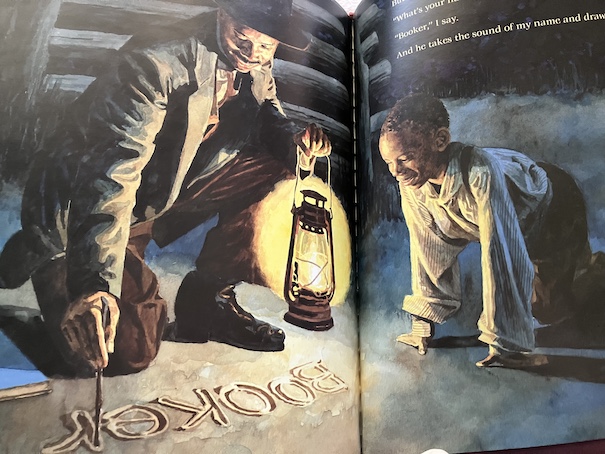
More Than Anything Else by Marie Bradby, pictures by Chris K. Soentpiet, 1995.
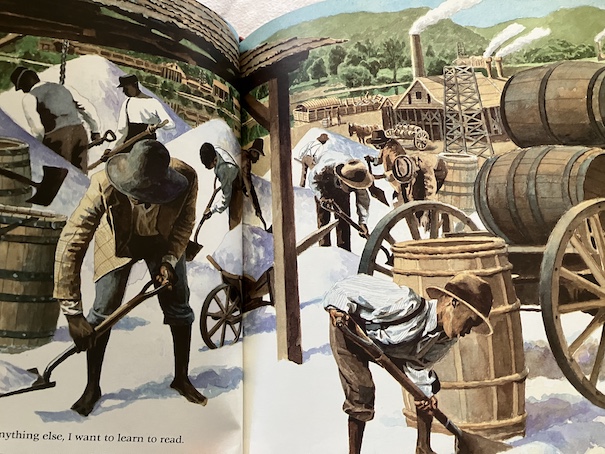
Young Booker lives with his family in a little cabin, and every morning, before the sun is up, he goes to work with his father and brother. They work at the saltworks, shoveling salt into barrels, and it’s hard, tiring work.
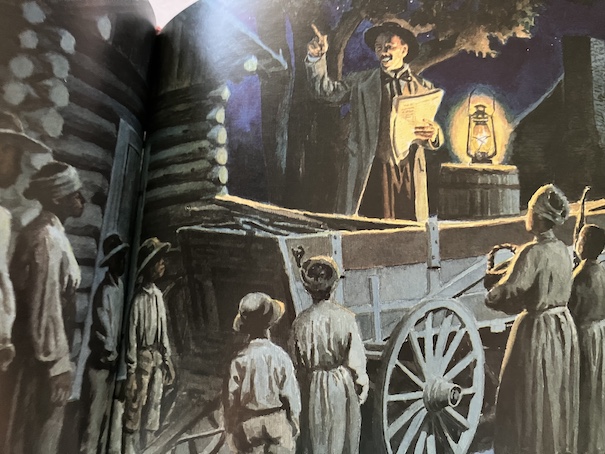
There is something on young Booker’s mind, though. More than anything else, he wants to learn how to read. One evening, he sees a black man reading aloud from a newspaper to a group of listeners, and he wishes that he could read like that himself. It inspires him that the man is black, like himself, showing that reading isn’t just something for white people.
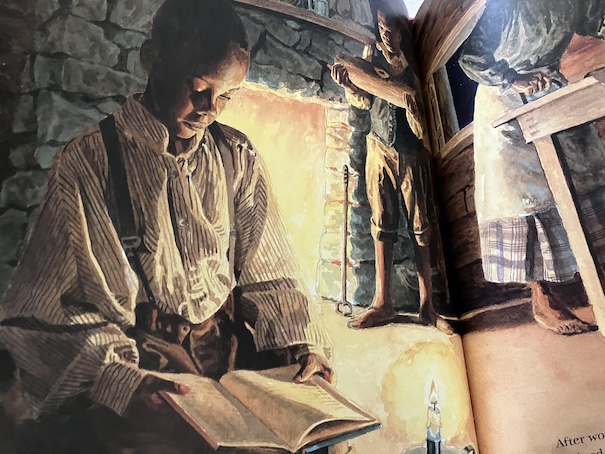
Booker tells his mother how badly he wants to learn to read. His mother can’t read herself, but somehow, she manages to find a book for him to study. Booker tries to figure out how to read by studying the letters in the book, but he just can’t figure out it by himself.
Then, Booker thinks of someone who could help him: the man who was reading the newspaper. Before Booker can learn to read, he needs some help from someone who already knows.
My Reaction
The boy in the story is a young Booker T. Washington. The book doesn’t refer to him by his full name in the story because it’s told from his perspective and because, when he was young, he was never referred to by a surname and was only known as Booker. We only get his first name, but the book summary makes it clear that it is Booker T. Washington, the famous African American educator, who lived from 1856 to 1915 and was the first principal of the Tuskegee Normal School, which later became Tuskegee University. He was born into slavery, but he was freed as a child during the Civil War.
I’m not sure whether the description of how he learned to read from this story actually happened in real life. From what I’ve read, he learned to read at a school managed by the Freedmen’s Bureau. Another account that I read said that he wanted to learn to read after seeing white children going to school and that his mother got him a book that taught him basic reading and writing. I don’t know whether he was ever inspired by seeing a black man reading a newspaper, but I couldn’t find anything about it. Because I’ve read some differing accounts, I think that either Booker’s exact inspiration for learning to read is unknown or that there were multiple influences in his early education, with different people putting emphasis on different aspects.
I liked the story, although it doesn’t explain more about Booker T. Washington’s life. I think it would have been more educational if it explained to readers what he did when he grew up, showing how he became a teacher and influenced others’ lives and education. It’s a little disappointing that kids can read the story as it is without really understanding who Booker T. Washington was and what he did. A section of historical information in the back of the book would have helped add context to the story. The story in the book simply ends at the point where Booker learns to write his own name, but I think that showing how this simple accomplishment in basic reading and writing started him on a path to greater accomplishments.
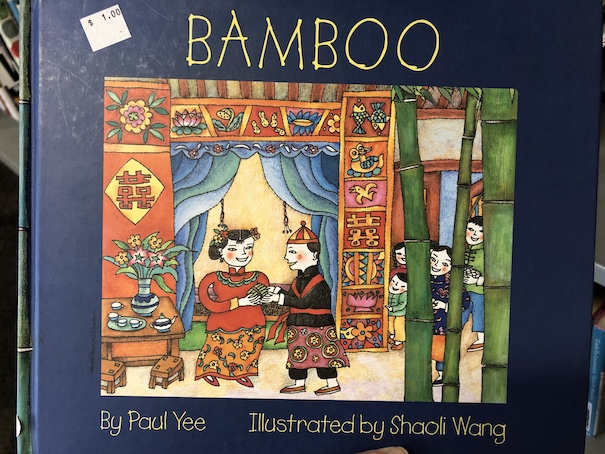
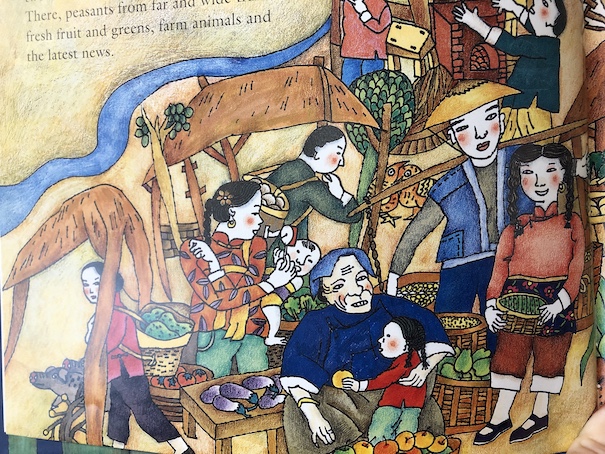
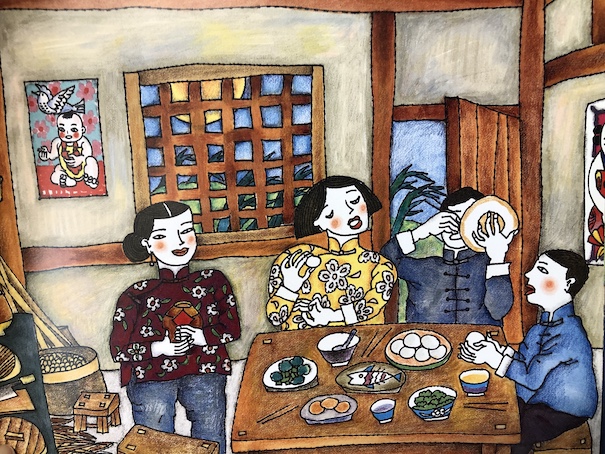
Bamboo by Paul Yee, illustrated by Shaoli Wang, 2006.
Bamboo is a young farmer. He falls in love with a girl called Ming and marries her. His brother, Banyan, approves of the marriage, but Banyan’s wife, Jin, doesn’t like Ming. When Bamboo and Ming marry, Ming gives Bamboo some bamboo seedlings, and they plant a bamboo grove.
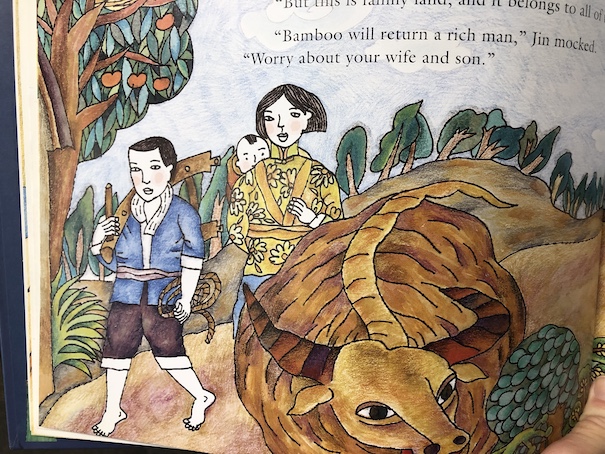
The two couples, Bamboo and his wife and Banyan and his wife, tend the farm together, although Jin complains frequently about the farm work. Then, Jin gives birth to a son, and Bamboo thinks that their growing family can use more land. He decides to go to the New World to earn more money to buy land.
Although the two brother have shared the farmland between them, Jin convinces Banyan to claim the best parts of the farm for them while Bamboo is gone. Her argument is that Bamboo will likely return rich, and Banyan needs to provide for his family. They leave very little for Ming to use to support herself in Bamboo’s absence.
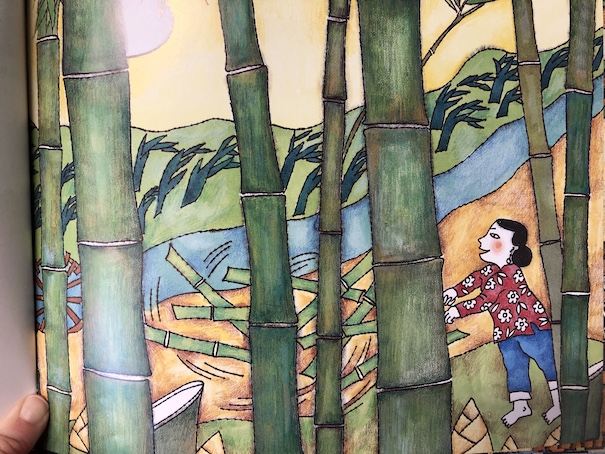
However, the bamboo that Bamboo and Ming planted is magical, and it tills the soil for Ming. When Jin discovers that, she tries to steal the bamboo poles, but they hit her instead. In retaliation, she gets Banyan to throw the poles in the river. Ming cuts a new pole, and it helps her by carrying water. Angrily, Jin gets Banyan to destroy all the bamboo, but Ming’s field still grows rice, and the bamboo grows back.
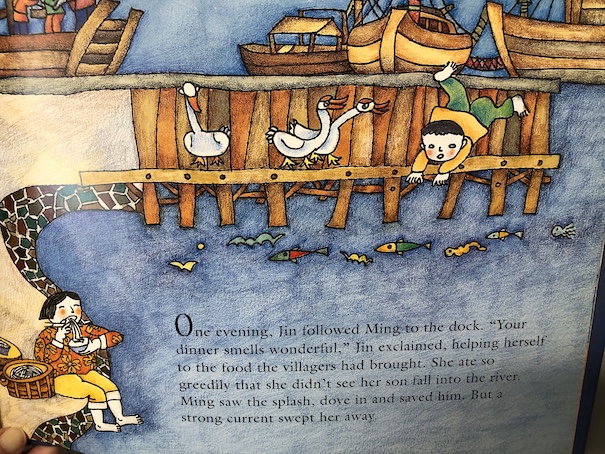
Bamboo writes to Ming that he is returning with gold, but then, she gets word that his ship has sunk. Still holding onto hope that he will return, she keeps going to the dock to wait for him. The kind villagers bring her food while she waits, but Jin eats it. While Jin is eating, her young son falls in the water, and Ming jumps in to help him. She saves the boy, but she is swept away by the current.
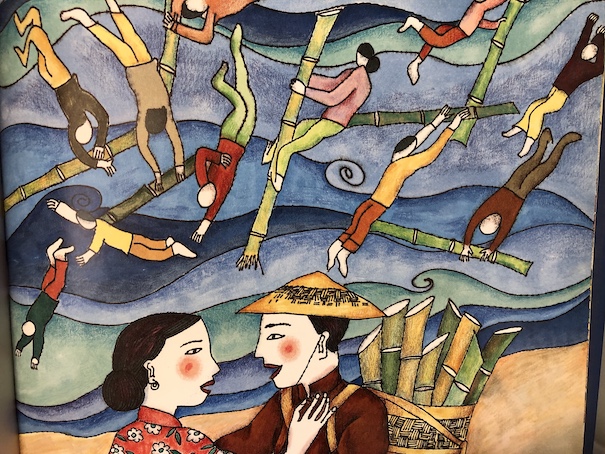
However, Bamboo saves her, and Ming discovers that Bamboo and the others on his ship were rescued by the bamboo poles that Banyan threw in the river.
The book is available to borrow and read for free online through Internet Archive.
My Reaction and Spoilers
This story is written in the style of a folk tale or fairy tale, although I don’t think it is a folk tale. The book didn’t mention that it was based on a folk tale or a retelling of an old story. It does have some similarities to fairy tales, with the cruel, greedy, and jealous relative; the kind and patient woman who is mistreated; and magical objects that help the good woman with her problems.
The trip to the “New World” and finding gold sounds a little more modern than most folk tales and fairy tales, like something that might have happened in the 19th century, but the idea of the husband being away on a long journey sets up the situation for what happens to his wife while he’s away. Like in fairy tales, everything works out for the best in the end. The bamboo poles that Banyan threw in the river save his life when they reach him, and when Ming saves her young nephew’s life, Jin apologizes for the way she’s been treating her. The story’s familiar themes are comforting. Readers can be confident that there will be a happy ending, and I liked it that the very act of throwing the bamboo poles in the river, which was meant to be a punishing act, is what saves the day.
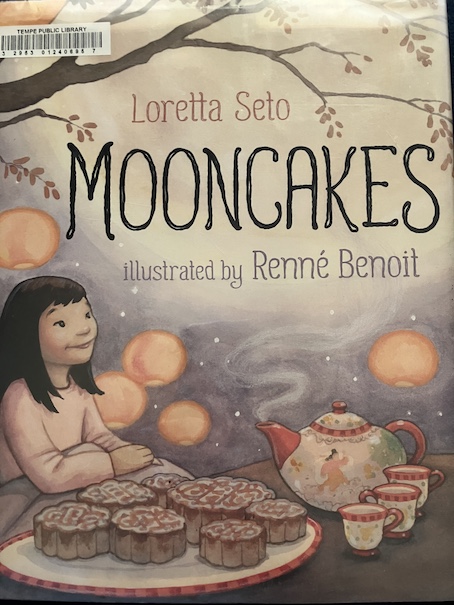
Mooncakes by Loretta Seto, illustrated by Renne Benoit, 2013.
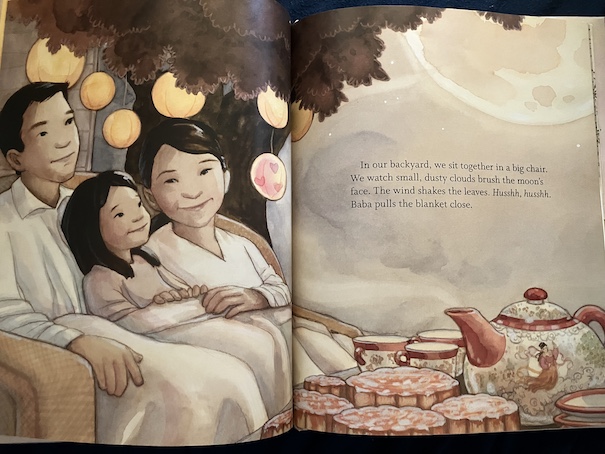
A young girl is excited because tonight is special, and she will be allowed to stay up late and eat mooncakes with her parents for the Chinese Moon Festival. They decorate with paper lanterns, and they spend the evening looking at the night sky from their backyard.
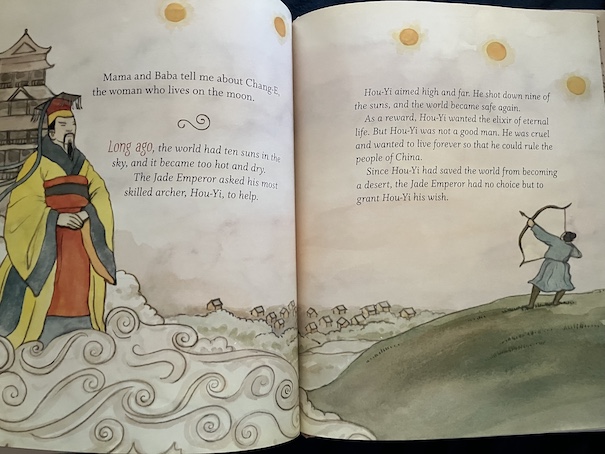
Her parents, called Mama and Baba, tell her stories from Chinese legends. The book includes the stories they tell, like the story of Chang-E (who was a woman who escaped from her cruel husband with the elixir of life and now lives in the Jade Palace on the moon), the story of the woodcutter Wu-Gang (who chops wood forever on the moon in his quest for eternal life), and the story of the Jade Rabbit (who lives on the moon with three magicians and brings food to people who need it).
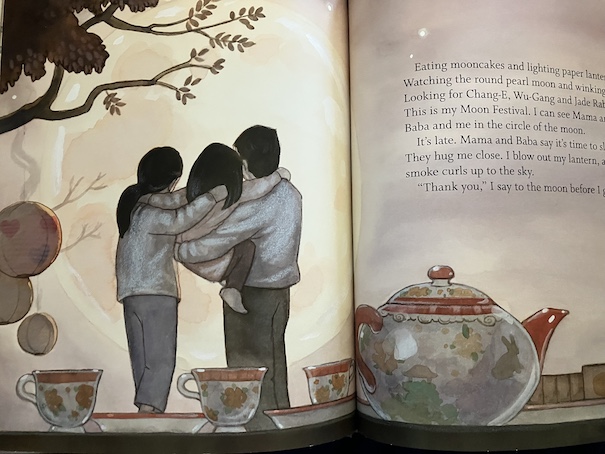
As they tell stories, the girl and her parents drink tea and eat mooncakes. The girl tries to look for the characters that they talk about on the moon until it’s time for bed.
There’s an Author’s Note in the back of the book that explains a little more about the Chinese Moon Festival. It’s a harvest festival that takes place in the eighth month of the lunar calendar. It also honors family, and even family members who can’t be together will remember that the rest of their family is looking at the same moon, no matter where they are.
My Reaction
I know that I’m presenting this story out of season because the Chinese Moon Festival is in autumn. Because it’s based on the lunar calendar, it sometimes happens in September and sometimes in October. I did my review at this time of year because it fit best with my blog’s schedule.
I enjoyed experiencing this lovely festival through the eyes of a young girl, having a gentle celebration with her parents. It’s an idyllic evening of cozy story-telling, and I really enjoyed the three folktales introduced in the book! I enjoy folk tales from different countries, and I liked these brief stories. I think this book would make a good beginning introduction to Chinese folklore for young children.
The focus of the story and the pictures in the book alternate between the stories the parents tell and the girl and her parents as they enjoy their evening together. I think this would make a great bedtime story.
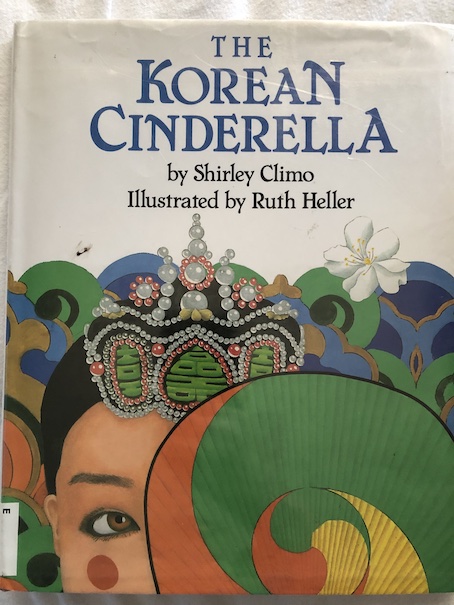
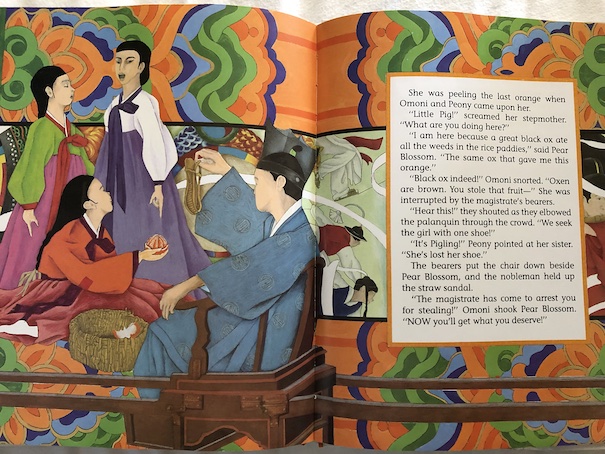
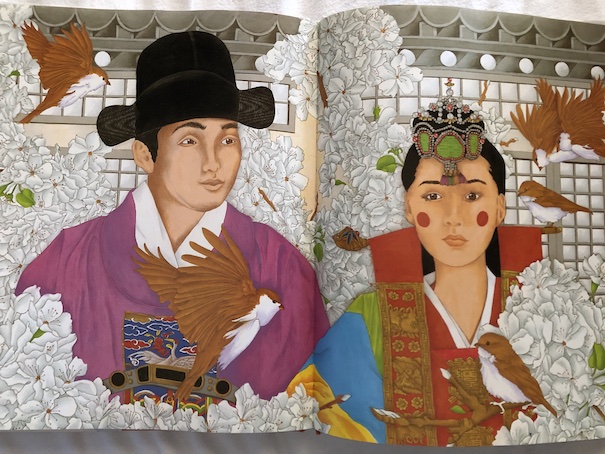
The Korean Cinderella by Shirley Climo, illustrated by Ruth Heller, 1993.
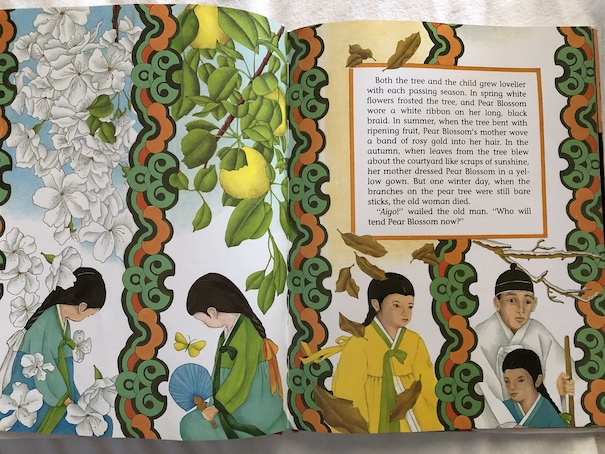
In this Korean version of the classic Cinderella story, a couple who live in a little cottage have a daughter they call Pear Blossom. Pear Blossom is a lovely girl, and when her mother dies, her father thinks that he should remarry, so he will have a wife to help care for his daughter.
The village matchmaker matches him with a widow who also has a daughter, a girl called Peony. However, after the marriage, it becomes clear that Pear Blossom’s new “mother” doesn’t like her, and her new “sister” doesn’t either. Her stepmother and stepsister are jealous of her, so they nitpick everything she does and make her do all the chores. As Pear Blossom’s father’s health worsens, he is less able to interfere with their mistreatment of Pear Blossom, and the stepmother schemes to find a way to get rid of Pear Blossom entirely.
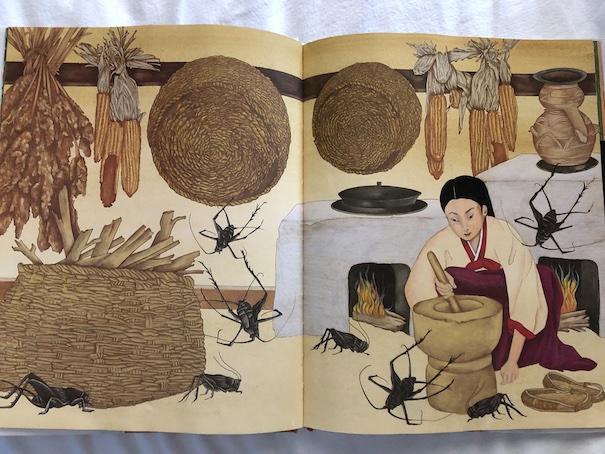
The stepmother keeps assigning Pear Blossom chores that she thinks will be impossible for her to complete, but various animals take pity on her and help her. A frog helps her to fill a jug that has a leak by plugging the leak, and some sparrows help her to hull a massive amount of rice.
One day, Pear Blossom’s stepmother and stepsister go to a festival in the village, leaving Pear Blossom at home. The stepmother says that she can only go to the festival if she weeds the rice paddies first. However, a huge black ox appears out of a whirlwind and takes care of the task for her!
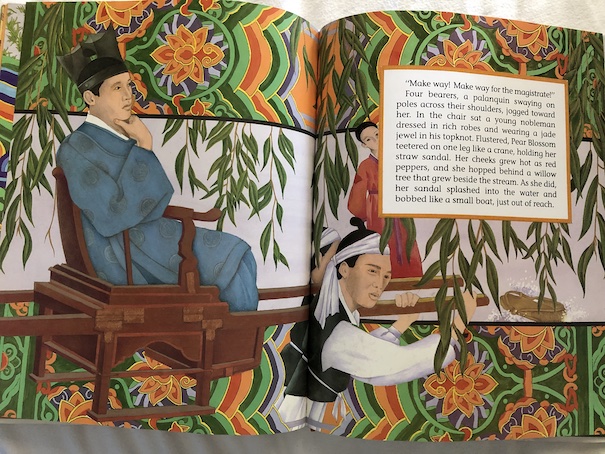
On her way to the festival, Pear Blossom sees the handsome magistrate but accidentally loses one of her sandals as she gets embarrassed and runs away. The lost sandal helps the magistrate to find Pear Blossom at the festival, and he declares that he wants to marry her.
There is an Author’s Note in the back of the book about the background of this fairy tale, and the author notes that there are multiple Korean versions of this story. There’s also an Illustrator’s Note that discusses the style of the illustrations. It explains about how designs that appear in the illustrations are based on designs from Korean temples, and there is also information about the clothing the characters wear.
The book is available to borrow and read for free online through Internet Archive.
My Reaction
Shirley Climo has written multiple picture books about versions of the Cinderella story form around the world, and it’s fascinating to see how a story that so many of us recognize varies from country to country while still maintaining the same basic pattern. An aspect of this particular version of the story that Climo explains in her Author’s Note is that the animals that help Pear Blossom in the story are sent by a kind of “goblin” called a tokgabi or doggabi. The story itself says this, but in folklore, this kind of “goblin” can represent the benevolent spirit of someone who has died. In this story, the spirit might be Pear Blossom’s mother. This explanation makes sense to me because I remember reading something similar about the Chinese version of the Cinderella story. The story of Rhodopis, which Climo retold in The Egyptian Cinderella, may be the oldest form of the Cinderella story, and it doesn’t have that element of the girl’s deceased mother helping her through trials until she finds happiness, but it does put the concept of the Fairy Godmother from European version of the story in a different light.
This is another children’s picture book where I appreciated the notes from the author and illustrator because they add more depth to the story. When I was a kid, I never read notes like that because I was only interested in the story itself, but notes like this make the book more appealing for older readers.
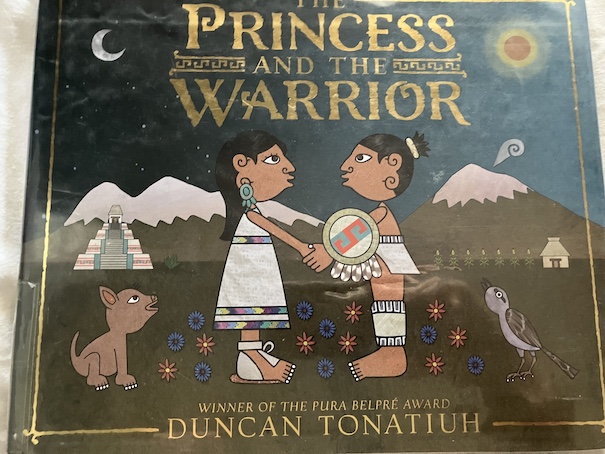
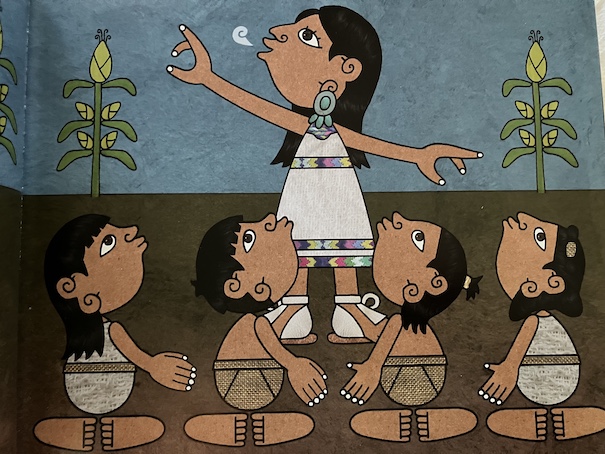
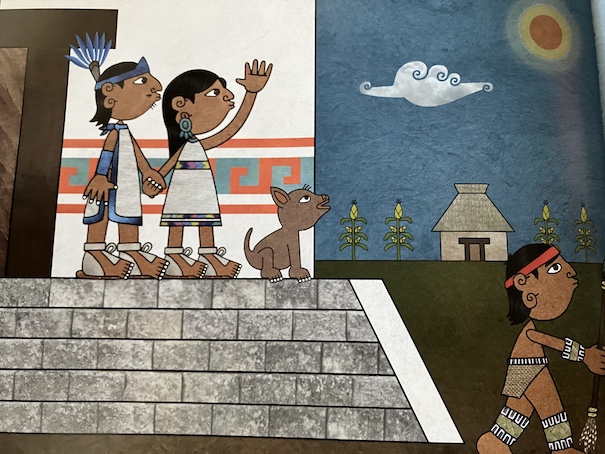
The Princess and the Warrior by Duncan Tonatiuh, 2016.
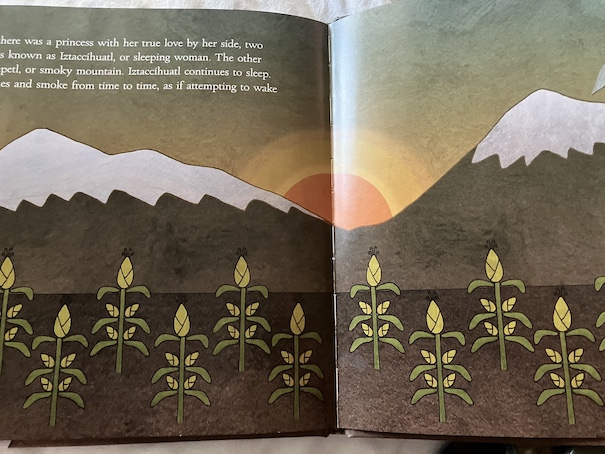
This story is a folktale about the origins of a pair of volcanoes near modern Mexico City.
The Aztec emperor had a beautiful daughter, Princess Izta, and there were many men who wanted to marry her. They gave her many wonderful gifts, but Princess Izta wasn’t impressed by any of them.
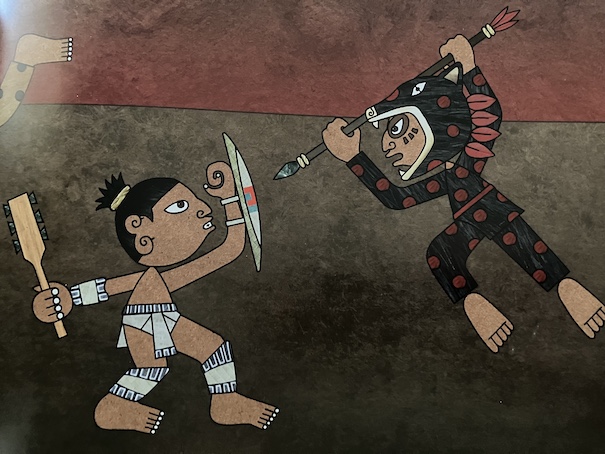
The man she loved was a warrior called Popoca. Unlike her other suitors, he really loved her for the person she was. The emperor disapproved of Princess Izta marrying a warrior who wasn’t from a wealthy, influential, or royal family, but he also knew that Popoca was brave and a good warrior. Their kingdom was at war with a neighboring kingdom, led by Jaguar Claw, so the emperor promised Popoca that, if he could defeat Jaguar Claw, he would allow him to marry Princss Izta.
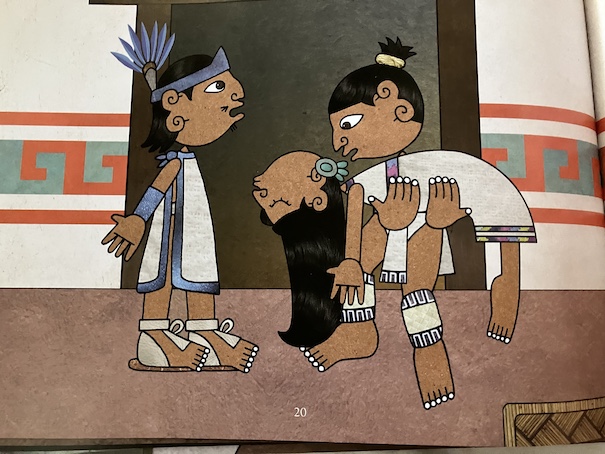
There were hard battles against Jaguar Claw, but Jaguar Claw gradually realized that he would lose the war. As a final act of revenge before defeat, he sent a messenger to tell Princess Izta that Popoca was dead. Worse still, the messenger gave Princess Izta a potion that would supposedly help her with her shock but which put her into a deep sleep.
When Popoca finally returned victorious, he was shocked and grieved to find Princess Itza in a deep sleep, from which nobody seemed able to wake her. He sat by her side, waiting for her to wake up. The story is based around the two volcanoes, one which looks like a sleeping woman and is dormant, and the other which looks like it’s sitting upright and shows signs of activity.
There’s an author’s note in the back of the book about the origins of the legend and how this version of it differs from other versions and about the volcanoes that inspired the story, Iztaccihuatl and Popocatepetl. There’s also a glossary of Nahuatl words used in the story.
My Reaction
I hadn’t heard this story before, but I enjoy folktales from around the world! The art style is fascinating, incorporating aspects of traditional Aztec art, such as showing things in a very two-dimensional style and human beings in profile. Even though there is fighting depicted in the story, it isn’t too graphic for children
When I was a kid, I would never read author’s notes, but I appreciate them as an adult, especially in cases like this, where they provide more information about the background of legends. This picture book is meant for children, but it can also be fascinating for adults, especially with the addition of the background information.
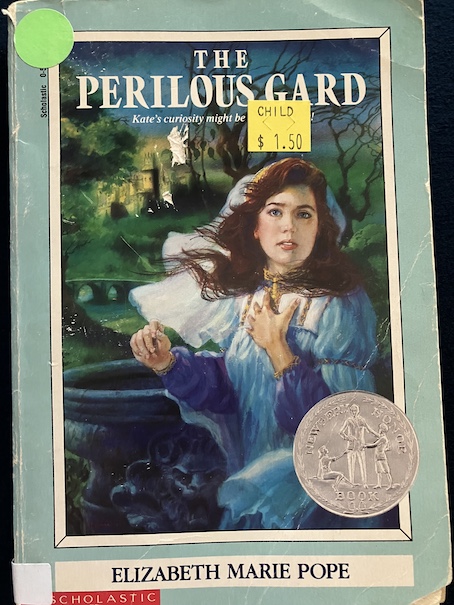
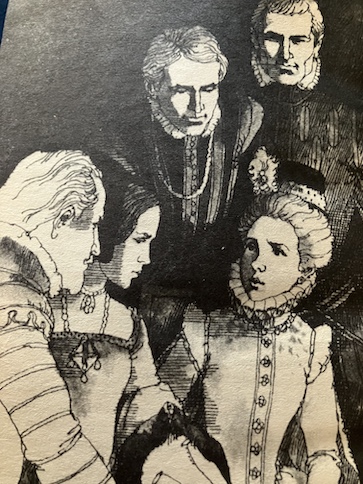
Kate Sutton and her sister, Alicia, live in the household of Princess Elizabeth in the year 1558. Alicia hates the Hatfield palace because it’s dreary and poorly maintained, apparently on purpose because Queen Mary Tudor resents Princess Elizabeth and wants her and her household to be uncomfortable. Kate and Alicia are maids in the household, and Alicia decides to write a complaining letter to Queen Mary about the condition of the house. Alicia thinks of herself at trying to help Princess Elizabeth by explaining how bad the conditions there are, but her letter gets heated and insulting toward the queen. Alicia is accustomed to getting away with things and with people not being angry with her because she’s pretty. However, Kate has to be the one with a brain, and she sees immediately that Alicia’s letter is bound to cause trouble.
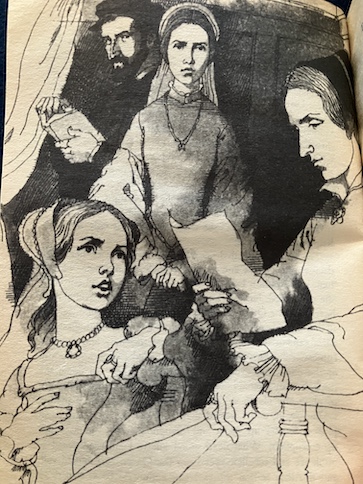
When Princess Elizabeth receives a reply to Alicia’s letter, she summons the sisters to see her. Queen Mary is very direct in her letter about what she thinks of Alicia Sutton’s letter, but she ultimately blames Kate for it because Alicia is a favorite of hers and Kate reminds her too much of her father, who she never liked. She believes that Alicia is only a sweet innocent and that Kate is a corrupting influence, which is unfair. Queen Mary has decided to separate the sisters, taking Alicia into her own household and sending Kate to Sir Geoffrey Heron at his house, Elvenwood Hall, in Darbyshire. The queen wants Kate to stay at Elvenwood Hall and out of her sight or hearing from now on. Kate has no idea where Elvenwood Hall is, other than in Darbyshire, and she doesn’t know Sir Geoffrey Hall. Although Alicia is initially pleased that the queen doesn’t blame her, she becomes remorseful when she realizes that Kate is taking the blame for the letter, when she knew nothing about it. She offers to write to the queen again and confess everything, taking full responsibility for the letter, but Princess Elizabeth, Roger, and Kate herself all tell her not to. The queen’s mind is made up, and another of Alicia’s letters might make it worse.
Princess Elizabeth asks her tutor, Roger, if she knows anything about Sir Geoffrey Heron, and he says that he’s heard of him. The house, Elvenwood Hall, has another name, Perilous Gard. The word “gard” indicates that the place was once a castle, but Roger knows that the house has been rebuilt with old parts cleared away. The other part of the name “perilous”, indicates that there is a superstitious element to the place, like places rumored to be inhabited by fairy folk or associated with pagan religion. One of his old pupils told him some stories about the place, but Roger would rather not repeat them. The accounts that Roger has heard of Sir Geoffrey say that he is an honorable man, so he thinks that Kate will be safe in his household.
Other than that, Kate has little idea of what to expect from Elvenwood Hall. She doesn’t think that Alicia’s dire fears that Kate will be thrown into a dungeon are true. The queen wants her out of her sight, and that’s why she’s sending her to a relatively remote area where she won’t have to deal with her and putting her under the supervision of a supporter of hers, who is supposed to keep her out of trouble. Kate isn’t actually under arrest.
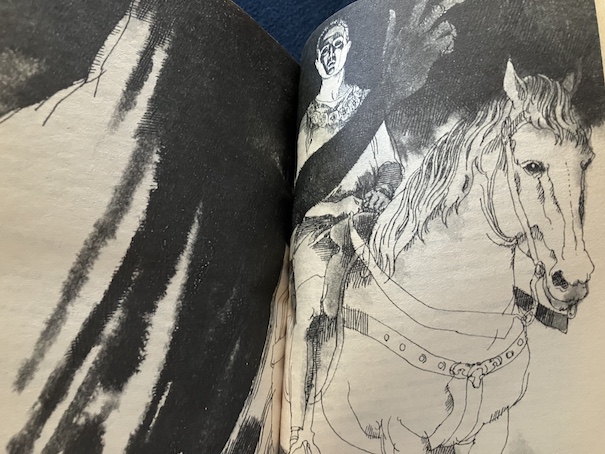
The journey to Elvenwood Hall is rough. On the way, the traveling party meets an old harper, Randal, who Sir Geoffrey says is a little addled since he suffered from a serious illness. When they tell the harper that Kate is coming to stay at Elvenwood, Randal asks if she might be lost like the last girl. Sir Geoffrey seems upset about what Randal says and hurries Randal away to get some food. Then, Kate hears a laugh and sees a strange woman looking at them from the hill. Then, her horse acts up, and when Kate looks again, the woman is gone.
When Kate sees Elvenwood Hall, it doesn’t seem to be very old due to the recent rebuilding, and its interior is luxurious, compared to the house where Princess Elizabeth is living. It is surrounded by ancient stone walls and battlements, and the older parts of the house are more castle-like and crumbling. Sir Geoffrey is still in the process of renovating the castle and turning it into a luxurious manor. The elderly Dorothy, former nurse to Sir Geoffrey’s wife, is the manor’s housekeeper, and Master John is the estate’s steward. Master John seems cold and unfriendly, but he is in charge whenever Sir Geoffrey is away.
Much to Kate’s dismay, Sir Geoffrey will be leaving Kate under Master John’s supervision while he makes a trip to Norfolk. Kate gets the impression that Sir Geoffrey doesn’t like being at Elvenwood, in spite of its renovations, but under the queen’s orders, Kate is required to stay at Elvenwood and not to travel away from it. Sir Geoffrey also tells her that the queen will not allow her to write to anyone or communicate with anyone outside of Elvenwood without Sir Geoffrey’s permission, of in his absence, Master John’s permission. Sir Geoffrey says that he will not be back at Elvenwood until All Saints’ Day, so Kate will be under Master John’s authority for months.
Elvenwood used to belong to Sir Geoffrey’s wife’s family, the Wardens, and old Dorothy doesn’t like Sir Geoffrey or any of the Heron family. Dorothy says that Sir Geoffrey’s brother, Christopher Heron, was responsible for the death of Sir Geoffrey’s daughter, that he had admitted it, and that Sir Geoffrey never punished him for it. Sir Geoffrey knows that Dorothy has been gossiping with Kate, but he is not upset with Kate for it. He also doesn’t offer any further explanations about what Dorothy said before he leaves on his trip to Norfolk.
Elvenwood Hall is pretty comfortable and nobody there mistreats Kate, but she is often lonely because the place is isolated. The farthest Kate is allowed to go from Elvenwood Hall is to the nearby village, but there isn’t much there. When Kate visits the village, people stare at her and act like they’re afraid of her. Even the village priest makes the sign of the cross at her, as if he thinks that she is something evil. Mostly, Kate has Dorothy as her companion.
Then, one day, she notices a pair of visitors, and Dorothy says that they are pilgrims, coming to visit the holy well on the grounds. Kate knows that some people believe that holy wells have the power to heal or make people more beautiful. Dorothy says that the holy well in the cave here will take away sorrow and pain, if a visitor offers a gift in exchange. The gift is for “those who rule over the well”, who Dorothy says were in this land long before saints and Christianity, but she hesitates to say more about it. She says that Kate can ask Master John, if she wants to know.
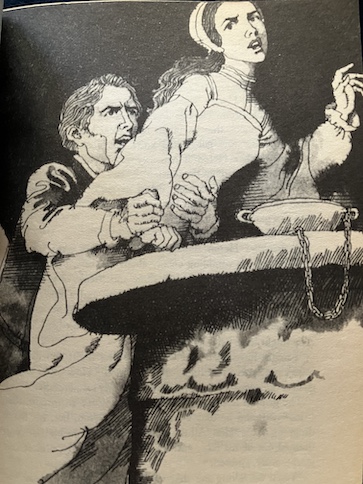
When Kate decides to take a look at the well herself, Christopher Heron finds her, grabs her, and hauls her away from it. Kate is startled, and he explains that he thought that she would fall in and be lost in the chasm under the rocks there. Kate thinks that’s silly because the well has a wall around it, but Christopher explains that’s what happened to Sir Geoffrey’s daughter, Cecily. At least, that’s what Christopher thinks happens to her.
He explains that Cecily was a little girl and that her mother was dead when he and his brother came to live at Elvenwood. One day, Sir Geoffrey left on one of his trips, and Christopher was responsible for Cecily. Cecily liked playing a kind of hide-and-seek game, but that day, Christopher found her antics irritating. He left her with Master John and went for walk to visit the well. However, he spotted Cecily following him, so he made a mock wish at the well that Cecily, being a spoiled child, would be in the care of someone else. And, that was the last time he saw Cecily. He supposes that she must have fallen when he wasn’t looking, although he didn’t actually see her fall, and they never found her body. They only found one of her shoes on the path. Christopher feels horribly guilty about losing Cecily, and he knows how her loss has hurt his brother, who has been the only person who loved and cared of him since his mother died giving birth to him. For him to lose Cecily when Geoffrey trusted him to take care of her was terrible, and he knows that his brother has not looked at him in the same way since. As a penance, Christopher has been living in the old leper’s hut on the estate whenever his brother is not in residence.
It’s sad, but Kate thinks that Christopher has been spending too much time feeling sorry for himself. She thinks it would be more sensible if he made a confession to the local priest to clear his conscience rather than brooding over what he could have done or should have done. Christopher says that it’s none of her business what he does, and he will give himself whatever penance he thinks is fitting. Kate thinks that Christopher is indulging in pride and self-pity over what was merely an accident.
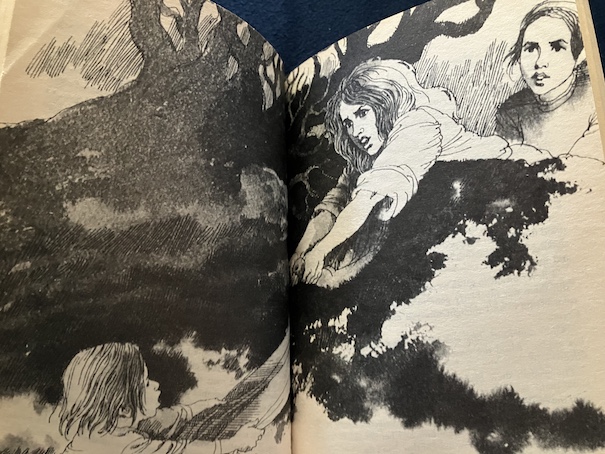
When Kate helps to rescue a local boy from a flooded river, his grateful mother talks to her about the guardians of the well, insisting that it’s really the fairy folk. She says that they live in a cave under the hill, that the strange woman Kate saw on the hill is their queen, and that they sometimes steal away children to be their slaves … or worse. She and others in the village think that’s what really happened to little Cecily and that the people at the castle know it, too. She thinks they’re purposely letting Christopher blame himself so that Sir Geoffrey won’t learn that his daughter is really alive and a captive of the fairies.
It does seem to Kate that everyone but the Herons genuinely believes in the fairies and that’s what Dorothy was talking about when she was talking about the guardians of the well being older than the saints. She reflects that Roger believed that the stories about fairies are just references to pagan gods and religious practices, and she starts to wonder if the people of Elvenwood, or the Perilous Gard, are secretly practicing pagan rituals with their traditions about the well. If the fairies are only superstition and the remnants of old religion, though, who was the mysterious woman who was watching Kate’s arrival? Could that have actually been a real fairy queen?
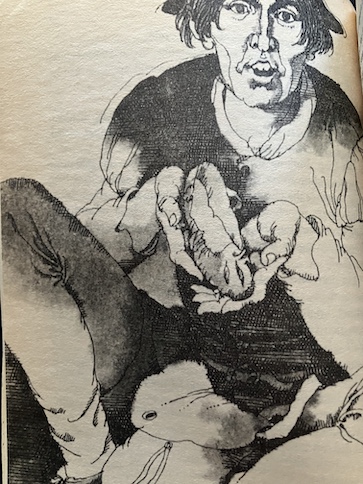
Kate tries to discuss it with Christopher, but he’s convinced that he knows what must have happened to Cecily. Then, they have an encounter with Randal, who tells them that the fairies have stolen away his wits. He knows he’s a bit addled and missing some memories, but he insists that the fairies did it to him because they couldn’t use a musician as one of their sacrifices, so they sacrificed his wits instead. Then, he claims that he has seen a little golden-haired girl dancing with the fairies and that she gave him her slipper to show to someone. To their astonishment, Randal produces a little girl’s slipper that matches the one Cecily lost on the path the day she disappeared! This slipper is much more worn than the other one, indicating that the girl who wore it continued to wear it after she disappeared.
Realizing that Cecily is still alive, Christopher wants to make a thorough search of the chasm beneath the well, but Kate urges caution. Whatever is going on at the well and whatever happened to Cecily, she’s sure that the people at the castle know about it, like the woman from the village said. If they don’t want to find and rescue Cecily themselves, it’s because they have something to hide. Sir Geoffrey’s wife seemed eager to leave this place, where Kate is now trapped by the queen’s orders, after her marriage, and Sir Geoffrey only returned here after she was dead, apparently unaware of the dark things that have happened here and still may be happening. Whatever is going on, the people of Perilous Gard are involved, and Kate and Christopher cannot expect any help from anyone in the castle.
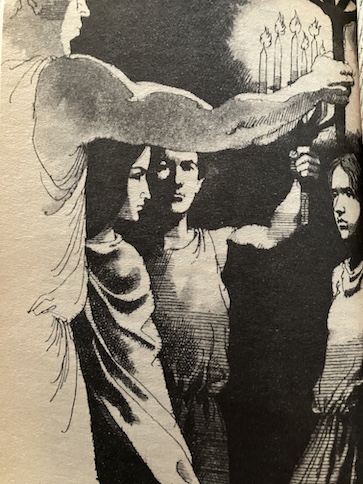
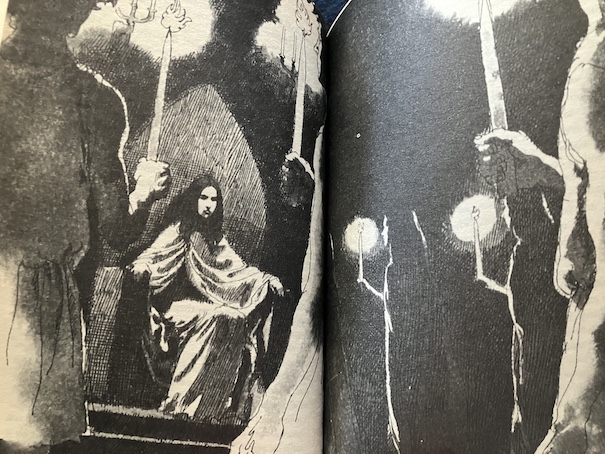
People leave coins and gold as gifts to the well when they ask it for something, and Christopher wonders if that could be the secret source of money for the estate that has funded all the luxurious renovations. Master John could be secretly taking all of the offerings the pilgrims leave. On the other hand, the name of the family that once owned this estate was “Warden”, a name that indicates the caretaker for something. Were they once the caretakers of the well, of a remaining cult of pagans that still practices the old religion and its rituals … or perhaps of actual fairies? What was Sir Geoffrey’s wife afraid of in her old family home, and where is little Cecily now? Was she taken as a hostage to ensure that Sir Geoffrey wouldn’t interfere with whatever the people at the castle are doing … or as a potential sacrifice to fairies or pagan gods? They reflect that the story of Tam Lin, about a lover who rescued her beloved from the fairies, was set on All Hallow’s Eve (Halloween). Cecily’s father plans to return on All Saint’s Day, the day after All Hallow’s Eve (November 1). Kate and Christopher need to get word to Sir Geoffrey or rescue Cecily themselves before it’s too late!
This is a Newbery Honor Book. It is available to borrow and read for free online through Internet Archive (multiple copies).
My Reaction and Some Spoilers
This book was fascinating and suspenseful! From the beginning, I wasn’t really sure whether or not this was a fantasy story. It turns out that it’s what I call pseudo-fantasy. It has all the trapping of fantasy, and there are points when it seems like something supernatural might be happening. However, it seems that, in the end, the “fairies” are humans practicing pagan rituals and who have convinced themselves that they are somehow different from the other humans who live above ground, out of the caves. There may be things that indicate that they might be more than that, but overall, Kate believes from the very beginning, that they are merely humans with strange and dangerous practices. As she puts it, “There were never any heathen gods, only heathen people who believed in them.”
Ancient Religion and Folklore
In their attempts to free Cecily, Christopher and Kate become the captives of the “fairies”, and Christopher is in danger of being used as one of their sacrifices. During their captivity, Kate gets to see some of their practices, and she realizes that they control people through things they give them to drink that affect their minds, and she learns what she needs to know about their rituals and beliefs to thwart their plans. In real life, there are a lot of gaps in our knowledge of pre-Christian religion in Britain because the practitioners didn’t leave written records. Mostly, what know about them is based on archaeology and accounts left by the Romans, which may not be entirely accurate. In the story, the “fairies'” beliefs are based around the idea of sacrifices, energy from humans and the earth, pieces of folklore, and probably the use of some kind of psychedelics. The most interesting and revealing part of their beliefs comes when Kate discusses the need for sacrifice with the fairy queen, and the two of them face off with their respective religious beliefs. During their discussion, they compare their beliefs on the subject of God/gods, power, and the purpose of sacrifice.
The fairy queen says that sacrifice is necessary to take the power from a human life and put it into the land and people through to keep them alive. In spite of her group’s isolation and life in the caves, she seems to understand some of the basics of Christianity, and she says that Kate should understand the notion of sacrifice because Christianity is built around one particular sacrifice. The fairy queen compares Christ’s sacrifice to the sacrifices that her cult holds – one person must give their life for the sake of the others as a way of transferring their life energy. Kate is a Christian, and she knows this description of Christ’s sacrifice isn’t completely accurate, but she tries to convince the queen that Christ’s sacrifice makes other sacrifices unnecessary. She says, since Christ gave Himself for the sake of humanity, He has guaranteed humanity’s safety so no others need to pay the price He paid. The queen argues that Christ’s sacrifice happened a long time ago, that His life energy has passed, and their cult holds a sacrifice on All Hallow’s Eve every seven years to renew the energy. Kate argues that Christ was special as the son of God, the only God that truly exists, and that His energy never dies, that it has transferred to living humans. She uses the story of Christopher’s namesake, St. Christopher, as an example of Christ’s power extending to humans. Unfortunately, the queen takes that to mean that Christopher holds some of Christ’s power in him, so sacrificing Christopher would not only give them the power of his life force but the power of Christ as well. Kate realizes that she can’t persuade the fairy queen or make her understand because the queen will just take everything she says and try to fit it into her views and what she has already decided needs to be done.
The philosophical and theological discussion between the two of them was fascinating, but the only way Kate can disrupt the sacrifice and save Christopher is to use the power of stories these people already believe. Kate never cared much for folk tales and ballads before, but she knows that the queen believes in the legend of Tam Lin and that the method the heroine from that story is the only one that can save a sacrifice like Christopher. When Kate finds out that the queen completely believes in that story, she realizes that she has to use the heroine’s solution from the story to rescue Christopher.
This is a point where the actual ritual differs from the magic in the story of Tam Lin. In the story of Tam Lin, he is physically changed into various forms that are frightening or difficult to hold onto, but his lover has to keep hold of him for him to be released from the magic. In this story, Christopher is not actually transformed into anything. It’s more psychological. The fairies believe that people who are going to be sacrificed need to give themselves to the sacrifice willingly, so they use psychological manipulation to convince Christopher that he has nothing to live for, playing on his feelings of guilt for not protecting his niece better and other traumatic pieces of his past, like his mother dying while giving birth to him and his father resenting him because of it. To hold on to him, like the heroine in the story, Kate has to speak up and convince him that the fairies are lying to him and that he does have things to live for. She needs to hold on to his mind and get him to assert his own will to survive while the fairies try to convince him that the only purpose he has left is to offer himself for sacrifice. “Holding on” in this case means holding on to one’s sense of self and one’s purpose, even in the face of doubts, insecurities, personal trauma, and the toxic influence or manipulation of other people.
Personal Growth
In her arguments with Christopher to get him to see that his life is worth living, Kate also confronts her own inner demons and insecurities – that everyone prefers her pretty sister, that she was blamed for things her sister did, etc. Their experiences with the fairies and confronting their personal demons are traumatic for Christopher and Kate, but they grow through them and come away with a better sense of self and greater self-assurance. Kate’s growth shows in the end both because she other women realize that she no longer fits into her clothes and will need new ones and in her maturity with dealing with her old insecurities when she sees her sister again.
There is a point when, because Alicia is thoughtless in the way she talks and has a habit of giving people the wrong impression about things, Kate thinks that Christopher has fallen in love with Alicia as the prettier sister and that he is going to marry her. This is crushing for Kate because Alicia is often favored by people and because she has fallen in love with Christopher through their shared experiences. The fairy queen makes a last appearance in which she offers to give Kate something to make Christopher fall in love with her, but Kate rejects it. While it would hurt for Christopher to reject her in favor of Alicia, and it would add to past hurts she’s had about Alicia being the favored girl, Kate has grown emotionally through the story. She is above the manipulations of the fairies, and whatever she encounters in her life that might cause her hurt, she has the emotional strength to handle it and do the right thing in spite of it. Her rejection of using dirty tricks is rewarded when Christopher proposes to Kate. Her doubts of his love were only because Alicia is thoughtless in the way she says things to people and because of Kate’s remaining insecurities. Kate is happy that she can accept Christopher’s honest love for what it is without attributing it to any manipulation. They’ve been through the worst together, they’ve seen each other’s insecurities, and they love each other all the more for it.
It isn’t just Christopher and Kate who grow through their experiences. Sir Geoffrey realizes that his own bad decisions and blindness to what was going on contributed to the danger his daughter was in. He had no idea what his steward was involved in and what was going on around the castle. He also realizes that little Cecily needs the attention of someone who can devote herself more to the little girl without distraction and a life in a more settled place with greater access to broader society, so he sends Cecily to her aunt’s house in London. Sir Geoffrey’s acceptance of his own failings absolves Christopher of the last of his guilt over Cecily’s disappearance/abduction.
I also appreciated that characters in the story didn’t hate each other even when they had suffered hut because of them. Sir Geoffrey didn’t stop loving his brother when he thought that Christopher had failed to protect Cecily. He found the loss of his daughter difficult to take, and his brother’s role in that was hard on his feelings for his brother. However, Sir Geoffrey never sought to banish or punish Christopher for it, and when he finds out that Christopher is in trouble, he races to the rescue! In the end, Kate also cares about Alicia. Even when she was punished for the letter that Alicia wrote and thought that she might lose Christopher to her, she didn’t let spite and resentment take over. I appreciate the characters’ growth, and I also liked the way they dealt with their emotions when they were hurt and things were difficult. They still care for their family members because, deep down, they still love them and want to do right by them, even when it isn’t easy.
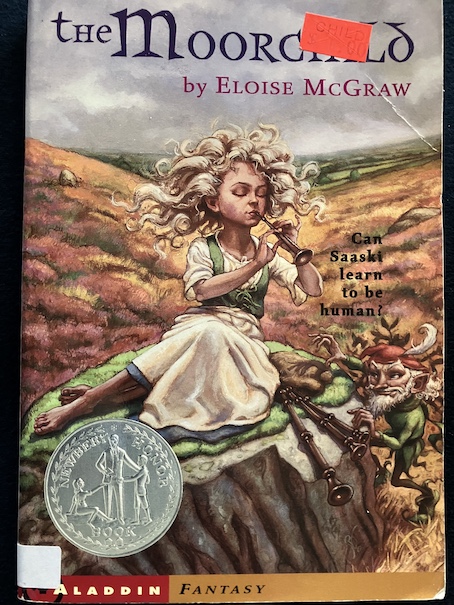
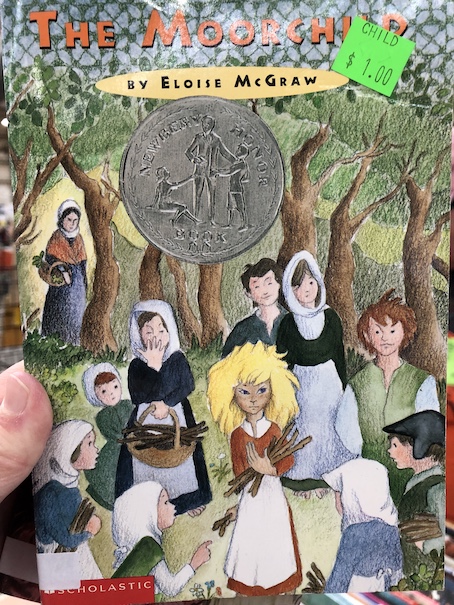
When Saaski was only a few months old, her grandmother, Old Bess, started to notice that she didn’t look right, compared to the rest of the family or even compared to the way she looked when she was a newer baby. The grandmother tried to brush those thoughts aside, thinking that children change as they grow, and people of the village think that she’s odd herself as a widow who lives alone and knows about herbs. All the same, Saaski seems unusually fussy and throws tantrums, becoming a child who’s difficult to control. It could just be colic, or it could be something stranger.
Old Bess begins to put the pieces together about Saaski’s strange behavior. Saaski seems to hate or fear her own father, and Old Bess realizes that it’s because he is a blacksmith and wears an iron buckle on his belt. Saaski has an aversion to iron. She also has an aversion to salt, and only honey seems to soothe her. Saaski’s eyes change color from time to time, and Old Bess realizes that Saaski not only isn’t her grandchild but that she isn’t even human. Saaski is a changeling, a fairy child switched out for the human child before her christening.
When Old Bess tries to tell her daughter and her husband that Saaski is a changeling, her daughter refuses to believe her. Her husband seems to consider that Old Bess might be right, but he absolutely refuses to do the cruel things to the child that Old Bess tries to tell them will cause the fairy folk to take the changeling back and bring them their real daughter. Old Bess says that Saaski must either be made to tell her true age, which she cannot do because she cannot talk yet, or the parents must do cruel things to her, like beat her, burn her, or throw her down a well. The parents say that they cannot do such things to a baby, no matter what kind of baby it is, and they no longer want to discuss the matter, forbidding Old Bess to tell anyone else of her suspicions.
However, in this case, Old Bess is correct. The child known as Saaski is a changeling, and she knows it herself. Although she is in the form of a human baby, she knows that she is not really a baby. Her fairy name was Moql. She doesn’t know her true age, but she knows that she is a fairy youngling and that she used to live among the other fairies in the fairy mound. She doesn’t like being part of this human family, and she wishes that the fairies would take her back, but she knows that, whatever happens, they never will reclaim her. Even if this family treats her cruelly and the fairies decide to remove her from their house, she knows that they will just place her with a different human family.
The problem is that, unlike other fairies, Moql has no ability to hide from humans. Other fairies can change their shape or color, fade, or just wink out of human vision entirely, but Moql can’t. The fairies discovered it one day when Moql was unable to hide from a human shepherd. She is able to escape from the shepherd, but her blunder isn’t forgiven by the other fairies. Moql’s inability to hide from humans was considered a danger to whole band of fairies. She was taken before the prince of the fairies. When he sees that Moql cannot hide from humans, he remembers that a human man entered the fairy mound some time ago and stayed awhile with a fairy woman. Moql’s mother was a fairy, but her father was that human. As a half-human, Moql will never have the abilities that the other fairy younglings have.
When Moql is considered a danger to the other fairies, they feel little attachment to her or desire to keep her. They don’t consider a half-human likely to work out among the fairies, so they decide to swap her for a human child who might make a good servant to the fairies. They’ve done this before with other younglings like Moql. Moql is frightened because she doesn’t know how to be human. Life in the fairy mound is all that she knows. She is only half human, and if she’s not working out as a half fairy, how can she possibly work out as a human? What if she can’t work out as a human? Will she belong anywhere? What if she belongs nowhere?
The fairies tell her that she will start life all over again as a human baby and that she will forget all about the mound and her past life. The other fairies think nothing of casting her out. None of them really care about her. The fairies don’t feel emotions like humans do, and they don’t feel very much about anybody. Moql’s birth mother doesn’t feel anything for her but a mild curiosity and no concern for her future. Fairy mothers don’t really develop an attachment to their children, who are raised communally in the fairy nursery and school. Most fairies don’t even know who their parents are, and they don’t really develop feelings for their parents any more than parents feel attached to their children. Even fairy couples don’t stay together very long, forgetting about each other when they become bored with the relationship and moving on to others. Fairies don’t really care that much about relationships, like brother and sister, and fairies don’t even have a sense of what being a “friend” means. So far, even Moql hasn’t felt that much for anybody, either. Moql’s first human feelings come with her despair about being torn away from everything and everyone she’s ever known, made worse from realizing that nobody else feels anything for her. In their position, she might not feel anything for the loss of one of them because that’s the fairy way, but the human part of Moql longs for belonging and fears what will happen to her if she can’t find a place or people to belong to.
When Moql wakes the next day, she finds herself as the baby Saaski, but in spite of what the fairies said, she still retains her memories of her fairy life. Everything in this human household is strange. She fears the people who are supposed to be her parents, and most of the things that they offer her to soothe her aren’t soothing to a fairy or half-fairy, which is why she screams and throws tantrums. When she hears Old Bess describe her as a changeling and tries to urge her parents to do things to get rid of her, Moql realizes that she is stuck as a human, no matter what happens. Her only hope is to make herself forget or at least pretend that she doesn’t remember being a fairy and to try her best to be the human baby Saaski. It means pretending that she doesn’t have the ability to do things that a human baby shouldn’t be able to do and that she doesn’t know things that she actually does know. It’s not easy, but Saaski’s memories do fade a bit with time. She has vague memories of her past life, but the longer she lives as a human, the less she remembers of her past.
Time passes, and Saaski grows into a child, but the humans around her have an odd feeling about her. They whisper about her behind her parents’ backs. She doesn’t look like other human children, and odd things seem to happen around her. Saaski doesn’t trust Old Bess because she knows that Old Bess has always suspected she was a changeling. Other children in the village have heard their parents whispering about Saaski, and they start asking her if she really is a changeling. By that point, Saaski isn’t sure anymore what that means.
Old Bess does look for an opportunity at first to get the fairies to take back the changeling, considering shoving her into a pond at one point. However, when she realizes that Saaski has real feelings, she cannot bring herself to do it. She realizes that Saaski is also a victim of the switch when she was exchanged for the real Saaski. She doesn’t really belong among them, Saaski knows it, and Old Bess can tell that it hurts that she’s different and that others don’t accept her. Old Bess isn’t sure how much she understands about herself, her past, or her situation, but it’s been as unfair to her as it has been to the real Saaski and her family. The sense of belonging Saaski craves eludes her.
The only place Saaski really feels at home is out on the moor by herself, although she doesn’t really remember why anymore. That is where she first meets the orphan boy, Tam, who travels with the tinker. Tam knows what other people say about Saaski, but he isn’t afraid of her and likes her anyway. He is the first person who really seems to accept Saaski. For a time, her father forbids her to go on the moor again after she has a distressing encounter with a shepherd, who seems to recognize her as being a fairy.
Surprisingly, Old Bess turns out to be an ally of Saaski’s, urging her parents to let her go to the moor again. She knows how restless Saaski has been, confined to their home. The only thing that has soothed her is the old bagpipes that once belonged to her father’s father. She seems to know how to play them without anyone ever teaching her. Eventually, her parents allow her to return to the moor, partly so she won’t keep playing the bagpipes at home. When she’s able to see Tam again, he is happy to see her, and she shows him how she can play the bagpipes.
There are other things that Saaski seems to know without knowing how she knows. She sometimes sees strange symbols that no one else seems able to see. When Old Bess realizes that she can see these symbols, called runes, the two of them discuss it. Old Bess can’t see them herself, but she knows about them. She learned a lot about such things from an old monk she once cared for and from the books he left behind, which is also where she gained her knowledge of herbs.
Old Bess admits to Saaski that, like her, she is considered strange and that she doesn’t quite belong to the village where they live. She was brought to the village as an infant after she was found abandoned in a basket at a crossroads. They left her at the miller’s house, and she was raised by the miller and her wife. She doesn’t know who her birth parents were, where they came from, or why she was abandoned as an infant, and she was told that the gypsies who found her almost drowned her as a changeling before deciding to leave her in the village.
Saaski also knows that she doesn’t belong in the village, although she can’t think where she does belong. She can’t explain how she is able to see and understand fairy runes or do the other things that she seems able to do, apparently without anyone teaching her. Over time, she gradually discovers or rediscovers the things she could do and knew as a fairy. She discovers that she can see fairies when she spots one stealing Tam’s lunch. Later, a group of fairies try to steal her bagpipes. To Saaski’s surprise, she is able to understand their language, and they seem to recognize her.
Then, after the children in the village bully Saaski again, an illness comes to the village, afflicting all of the children but Saaski. Old Bess says it’s a normal childhood illness she’s seen before, and the children probably got it from the gypsy band who recently passed through town. However, the villagers, who have always been suspicious of Saaski whisper that Saaski is responsible, that she has cursed the other children. Saaski denies is, but the villagers are becoming increasingly hostile. They want her out of the villager, but if Saaski can’t stay there, where can she go?
When Saaski tries to bargain with a fairy for some help to hide from the villagers, the fairy reminds her that she was a fairy herself and that she was never able to disappear. Saaski is stunned at this confirmation of the villager’s suspicions about her being a changeling. When she tells Old Bess about it and about the memories that are now returning to her, Saaski realizes that she really doesn’t belong in this human village, at least not fully. Yet, she remembers that she doesn’t fully belong among the fairies, either. Once again, it leaves her the question of where she does belong. Saaski is going to have to take her fate into her own hands, but before she does, she wants to do something for the family that raised her and has loved her, in spite of everything: find the original Saaski in the fairy mound and return her to her parents.
The book is a Newbery Honor Book.
My Reaction
I enjoyed the story because it is a unique portrayal of the folkloric idea of changelings. Another book I read on the same topic, The Half Child, is told from a real world, historical point of view, without fantasy. In that book, changelings are disabled children or children who aren’t “normal” in some way who are labeled as being something other than human or “real” children because people of the past couldn’t understand why they were different or what was wrong with them.
The Moorchild, however, is fantasy and builds on the folklore concept. In other books with changelings, we see the changelings from the point of view of other people, who wonder about their true nature, but this book includes multiple viewpoints, including that of the changeling herself. In folklore, it isn’t entirely clear why the fairies would want to change their children with human children, leaving them to be raised by other people and possibly never seeing them again. This book builds on that concept, portraying the changeling children as being half human and/or flawed in some way, compared to the other fairies. They do use the human children they gain in the swap as servants, which is a folkloric concept, but this story explains why the fairy child left in exchange for the abducted human child is an acceptable loss to the other fairies.
Fairies in this story don’t have the same types of feelings as humans. In fact, they don’t seem to feel much at all, making most of their lives literally care-free because they just don’t care that much about others or the consequences of their actions. However, they don’t feel much emotional attachment to each other, either. Saaski/Moql’s birth mother doesn’t feel much of anything for her daughter or for the man whose life she changed and worsened through her seduction and rejection. She is completely unconcerned about what has happened to them or what will happen to them because of her. Later, Saaski realizes that the fairies are aware that Saaski is blamed for pranks they played, but they don’t mean it spitefully. They genuinely don’t care whether Saaski or someone else is blamed for things they do as long as they never get caught themselves. When Saaski realizes that the other fairies genuinely don’t care about her or what happens to her, she knows that they will never take her back and that she will never rejoin them.
Saaski feels more emotion than full fairies feel, but she doesn’t always respond in acceptable or predictable ways to the humans she lives with because she doesn’t share all of the emotions they feel. She craves a sense of belonging, but she doesn’t really know how to get it or create it. At times, she feels love and gratitude without being entirely sure what she’s feeling or how to express it. Strangely, she also doesn’t experience hate and resentment in the same way humans do. Tam tries to explain it to her, and Saaski recognizes that the children in the village who bully her feel hatred and resentment to her, but she doesn’t feel those emotions herself. She doesn’t like it when they bully her, and she feels hurt by them, but the emotion of hating and wanting to hurt them back isn’t there. I thought that was an interesting concept, exploring someone with non-conforming emotional reactions. Saaski’s emotions in the story are explained by her fairy heritage, but what made it interesting to me is that neurodivergent humans also have different ways of experiencing and showing emotions that can change the way they are accepted by or interact with other people, which brings the idea of changelings full circle, back to the concept of children who aren’t like other children from birth or a young age.
I thought it was fascinating that we get to see things both from Saaski’s point of view and from the point of view of other people, particularly Old Bess. Old Bess is the first to realize that Saaski is a changeling and not her “real” granddaughter. She understandably wants her real granddaughter back, and she knows the folklore that fairy folk will take back a changeling who has been abused. However, Saaski’s parents, even knowing or suspecting that Saaski might be a changeling, cannot bring themselves to do anything cruel to her, and Old Bess comes around to that point of view herself. By observing Saaski, she sees that Saaski is a child, if not an entirely human child, and an innocent victim of the switch herself, with feelings and a difficult life ahead of her because she doesn’t fit in with this community.
Old Bess also recalls and admits to Saaski that her own past isn’t quite normal and that she also doesn’t quite fit in. I wondered if we would ever get the full story of Old Bess’s past, but unfortunately, we don’t. We know that she was abandoned as an infant, apparently rejected by her birth family or guardian, but we never learn why. I had wondered at first if Old Bess would turn out to be a grown-up changeling. It seems that people once suspected that about her, but apparently, she isn’t because she can’t see the fairies or fairy writing in the way Saaski does. It seems that Old Bess is fully human and not half fairy. In the end, the important point is that, when Old Bess is honest with herself and Saaski about her past, her story has some elements in common with Saaski’s situation. They have both known rejection and abandonment, the difficulties of trying to fit in when they don’t entirely fit in, and the love of people who accepted them and cared for them in spite of it all.
I appreciated that Saaski’s parents do their best to love and care for Saaski even when they know she’s strange and may not be their daughter. They stand up to the people who bully their daughter and pressure them to get rid of her. In fact, in the end, even after Saaski and Tam set out into the world together and they have their birth daughter back, they still think of Saaski and miss her sometimes. Saaski was no replacement for the daughter they lost when they were switched, but at the same time, they realize that their birth daughter doesn’t entirely replace Saaski in their lives and affections. In the end, it’s like they’ve had two daughters, both of them “real”, although one didn’t fit in and eventually left to start a new life elsewhere.


 Jestress's Forgotten Books and Stories