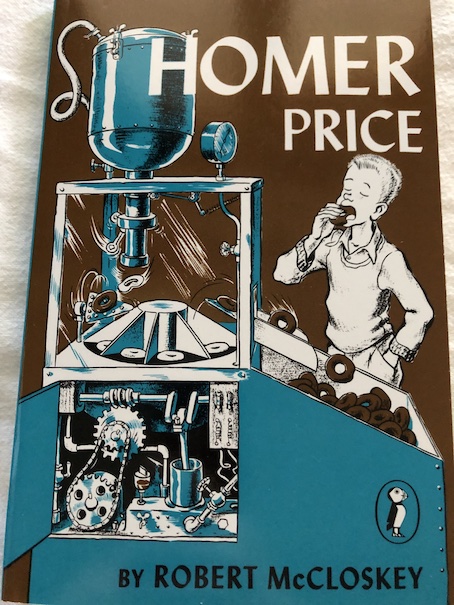
Homer Price is a collection of short, humorous stories about a boy who lives in a Midwestern town called Centerburg. His parents own a tourist camp with cabins and a filling station, and Homer helps out there with odd jobs. In his spare time, he has a hobby, building radios.
Many people remember this book specifically for the episode of the doughnut machine that goes out of control. Stories in the collection have been made into tv episodes or short films three times, and two of those are based on the doughnut machine story. (Sometimes, they appear on YouTube.) There is also a sequel to this book called Centerburg Tales: More Adventures of Homer Price.
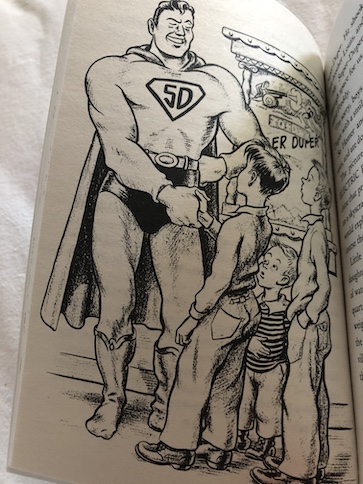
It didn’t occur to me until I started reviewing the book for this site, but it was first written and published during WWII. The war doesn’t play any part in any of the stories in the book, but it occurred to me as a fun collection of stories that its first audience of 1940s children might have enjoyed as a break from the chaos of the world around them. Various aspects of 1940s society and culture appear in the stories in humorous ways, like the comic book superhero who resembles Superman (a character introduced in comic books in 1938), lunchrooms (small diner-style restaurants), and the concepts of advertising, mass production, and suburbs with prefabricated houses.
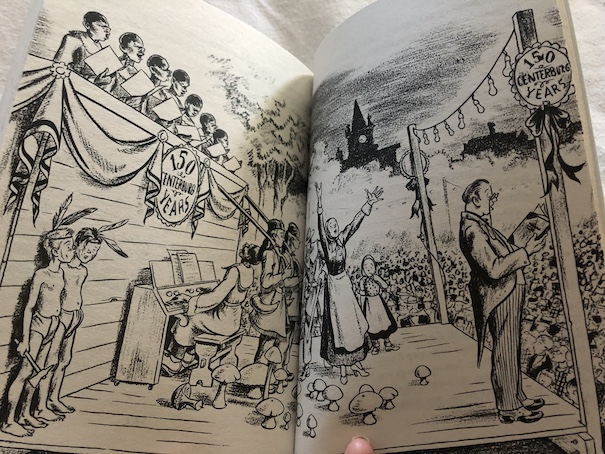
There is one incident that readers should be aware of that concerns descriptions of Native Americans. When the town holds its 150th anniversary celebration, Homer and his friends have roles in skits about the history of the town, playing Native Americans, and part of their costume involves dyeing their skin, which would be considered tasteless and racist in the 21st century. Their skit also includes a “scalping scene” (not really described, except saying that it “had to be modified somewhat”), which would also definitely not pass modern standards in any public performance. Because this is a collection of intentionally humorous stories, I’m not sure whether the author included this stereotypical depiction of kids playing Native Americans in a tasteless way to poke fun at such depictions or not, but I though it was worth mentioning for the benefit of people sharing these stories with children, so you know that part is there.
I didn’t notice anything particularly concerning about the depiction of black people in the book. Black people are included in the stories as members of the community without too much attention to the fact that they’re black. They’re simply part of the town, and nobody makes a big deal about them being there or refers to them by any derogatory names. One black boy finds a wealthy lady’s bracelet inside a doughnut in the doughnut machine story, and the local African Baptist Church choir performs at the town celebration.
Stories in the Book:
The Case of the Sensational Scent
One evening, Homer gets his usual bedtime snack of milk and cookies and leaves some milk out for his pet cat. However, a skunk wanders in and finds the milk. Homer decides to try keeping the skunk as a pet, naming it Aroma. Aroma helps to thwart a gang of robbers.
Case of the Cosmic Comet
Homer and a couple of friends are reading comics and marveling over a superhero called Super Duper (who is sort of like Superman). Later, Homer’s friend Freddy says that there’s going to be a Super Duper movie playing in town and that Super Duper himself will be there. Homer isn’t quite as enthralled with Super Duper as Freddy is because he knows it’s just fiction, and he thinks the stories are kind of formulaic, but he agrees to come to the movie. When the Super Duper’s car crashes as he leaves, they see that the Super Duper is actually an ordinary human who doesn’t really have super strength and can get hurt. Fortunately, he isn’t hurt badly, and the boys take their disillusionment well, profiting from the help they give him.
The Doughnuts
Homer’s aunt and uncle own a lunchroom, and his uncle is a gadgeteer with a weakness for buying labor-saving devices. One of these devices is an automatic doughnut-making machine. One day, Homer’s uncle is trying to fix the doughnut-making machine, and he asks Homer if he can finish fixing it and make some doughnuts for him while he runs an errand (really, he’s going to play pinochle at the nearby barber shop) because Homer is good with mechanical devices. When Homer gets some help from a patron, mixing up masses of doughnut dough from her family’s old recipe and runs the machine, Homer has trouble turning off the machine. It just keeps making more and more doughnuts! What are they going to do with all these doughnuts, and will they ever get the machine to stop?
Mystery Yarn
Miss Terwilliger is locally known as a great knitter. She’s taught most of the local women how to knit, and everybody also loves her fried chicken. She has two admirers who would like to marry her, the local sheriff and Homer’s Uncle Telly, but she just can’t make up her mind which she would like to marry. When the Sheriff and Homer’s Uncle Telly compete to see which of them has the largest collection of string, the Sheriff arranges for the two of them to unroll their giant balls of string at the local fair to prove which of them has more string. They also decide that whichever of them win the contest will also win Miss Terwilliger … until they discover that Miss Terwilliger also collects string and is determined to enter the contest … and she just might be beat them both. All’s fair in love and string collecting, and to the winner go the spoils!
Nothing New Under The Sun
A strange man comes to town. He seems a little odd and kind of shy. The sheriff is a little concerned about who he might be. The stranger himself just makes an odd comment about having been away from people for a long time. The stranger might be a shy eccentric, but the sheriff is concerned that he might be some kind of fugitive. The sheriff talks to various people around town, and they all offer their advice about how to judge a person’s character and what they think about the stranger. Various people say that he reminds them of someone from a story, and the town librarian identifies the character they’re thinking of as Rip Van Winkle. Could this stranger really be an old man who fell asleep for 30 years in the mountains, like in the story? If so, what’s with the bizarre vehicle the stranger has? When Homer finally persuades the man to show him his car and tell him who he is, the story turns out to be stranger than fiction: he’s a man determined to literally “build a better mousetrap” and turns out to be a kind of modern-day Pied Piper.
Wheels of Progress
Centerburg is celebrating its 150th anniversary with a public celebration and the creation of a new suburb with mass-produced, prefab tract houses (the kind made fun of in the song Little Boxes by Malvina Reynolds, which “all look just the same”). The identical nature of the houses turns into a nightmare when the street signs aren’t ready in time for the grand opening celebration, confusing the townspeople.
Fun fact: The original name of the town is revealed to have been “Edible Fungus” after the edible fungus that kept the original settlers who founded the town alive. The choir in the story sings a song about it.
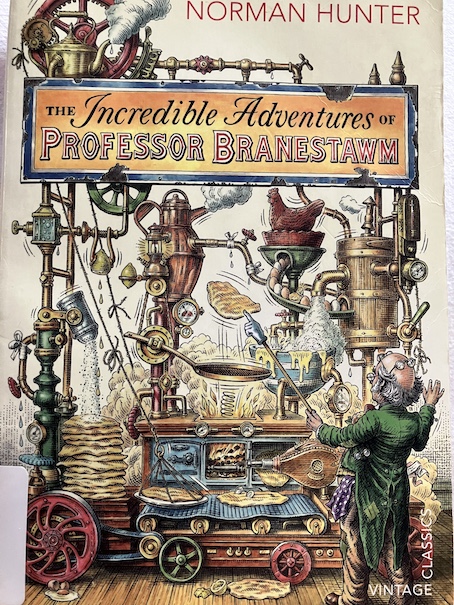
The Incredible Adventures of Professor Branestawm by Norman Hunter, 1933.
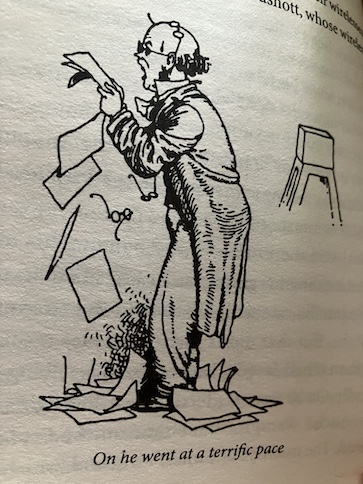
Professor Branestawm is a classic absent-minded professor. He’s is a balding man who wears several pairs of glasses, one of which is for finding the other pairs of glasses when he inevitably loses them. He’s a very clever man, but everyone knows that his inventions are likely to cause chaos. He’s not an easy person to talk to, so he doesn’t have many friends. His best friend is Colonel Dedshott, who is a very brave man.
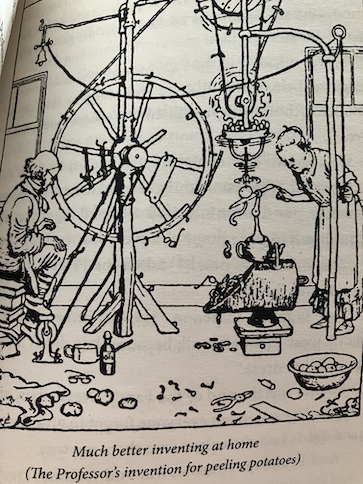
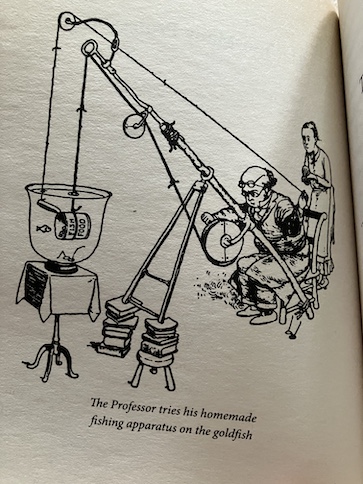
Every chapter in this book is about another of the Professor’s inventions and the adventures that the Professor, the Colonel, and the Professor’s housekeeper, Mrs. Flittersnoop, have with them and with various situations that the Professor creates with his absent-mindedness. The stories are accompanied by pen-and-ink drawings. I love the way almost every picture of the professor shows him shedding one or more of his many pairs of glasses and that the Colonel’s weapon of choice is a slingshot!
Chapter 1: The Professor Invents a Machine
One day, Professor Branestawm invites the Colonel to his house to see his latest invention, which he says will revolutionize travel. When the Colonel arrives, Professor Branestawm explains his idea. First, he points out that, if you’re traveling somewhere, you’ll arrive in half the amount of time you ordinarily would if you travel there twice as fast. The Colonel says that makes sense. Then, Professor Branestawm says that, the faster and faster you travel, the sooner you arrive at your destination. That also makes sense. Further, Professor Branestawm says, you eventually start traveling so fast that you arrive before you even start, and if you go fast enough, you can arrive years before you start. The Colonel doesn’t really understand this, but he takes the Professor’s word for it. The Professor has built a machine that will allow them to travel that fast, and the Colonel is eager to try it. He suggests that they try going back in time to a party he attended three years earlier. The Professor insists that they take some powerful bombs with them, just in case of emergencies (don’t try to make sense of it, there isn’t any), and the Colonel has his trusty catapult (slingshot) and bullets with him.
It turns out that, rather than going to the party three years earlier, they arrive at the scene of a battle that took place in another country two year earlier. Although they already know how the battle turned out, the Professor and Colonel can’t resist joining in with their bombs and catapult, and they end up wiping out an entire army and changing the result of the battle in favor of the revolutionaries. The revolutionaries are so grateful to them for their help that they take them to the palace of their former king, put the two men on the enormous throne there, and make them the new presidents of the country. Professor Branestawm realizes that they’ve made a terrible mistake and changed history because the king’s army was the one that was originally supposed to win the battle. The Colonel, however, doesn’t care because he thinks it sounds like fun to be a president and can’t wait to do some ruling.
Of course, the ruling of the two presidents doesn’t go well. Neither one of them really knows anything about running a country. Since they blew up all the country’s troops, there are no troops left for the Colonel to review, and he ends up playing with toy soldiers. Meanwhile, the Professor really just wants to get back to his inventing. Eventually, the revolutionaries get tired of this and tell them that they’ve decided that they don’t want any presidents, so they’re giving them a week’s notice before they’re out of a job. The Professor and the Colonel try not to take any notice (ha, ha) of the revolutionaries’ attempts to dethrone them. This just leads to the revolutionaries trying to imprison them in the dungeon, so the Professor and the Colonel are forced to escape in the Professor’s machine, which takes them back to the exact time and location where they started. They arrive just as the Professor’s housekeeper brings them some tea, so they have their tea, go about their usual business, and leave it to the historians to deal with the complications of the two of them changing history.
Chapter 2: The Wild Waste-Paper
When Professor Branestawm’s housekeeper puts a bottle of cough syrup with no stopper into the waste-paper basket, it accidentally creates a waste-paper monster! It turns out that it wasn’t really cough syrup in the bottle. It was a special life-giving formula that the professor invented. He only keeps it in a cough syrup bottle because cough syrup is the only thing that neutralizes the life-giving formula and stops it from bringing everything it touches to life, including the bottle holding it. Now that they’ve accidentally created a waste-paper monster, what can they do to stop it, especially since it seems to have the ability to use tools and is currently trying to saw down the tree where the Professor and his housekeeper are trying hide?
Chapter 3: The PRofessor Borrows a Book
Professor Branestawm accidentally loses a library book about lobsters, so he goes to another library to get the same book. By the time that he needs to return the library book, he has found the first one and lost the second one. For a while, he manages to avoid library fines by continually returning and checking out the same book from both libraries because the libraries don’t notice which library the book is from. Of course, he eventually loses the first book, too. He tries to fix the situation by getting the same book from a third library and then one from a fourth library, when he loses the third book. Where will it all end? How many libraries will have to share this one book, and where on earth are all these books about lobsters going?
Chapter 4: Burglars!
Professor Branestawm and his housekeeper go to the movies to see a documentary about brussels sprouts. (The housekeeper doesn’t care about brussels sprouts, but there’s a Mickey Mouse cartoon included with the feature, and she wants to see that.) When they get back, they discover that the house has been robbed! Professor Branestawm decides that he’s going to invent a burglar catcher, but the only burglar he catches is himself.
Chapter 5: The Screaming Clocks
Professor Branestawm’s clock stops, so he takes it to a clock repair shop. It turns out that the clock has only wound down because the Professor has forgotten to wind it. The Professor decides that he’s going to invent a clock that will go forever and never need winding. (This story is set before clocks that don’t need winding became common.) The Professor does invent a clock that will never stop and never need winding, but he makes a critical mistake: the chimes never reset after they strike twelve. They just continue counting up and up, endlessly, with no way to stop them! Just how many times will they endlessly strike before something terrible happens?
Chapter 6: The Fair at Pagwell Green
The Professor visits a local fair and invites the Colonel to join him. The Colonel ends up winning most of the prizes for the various games, and the Professor accidentally gets left behind in the waxworks exhibit, being mistaken for a wax statue of himself. When the Professor decides that it’s finally time to get up and go home, the people who work in the waxworks think that a wax statue has come to life!
Chapter 7: The Professor Sends an Invitation
Professor Branestawm writes a letter to the Colonel, inviting him to tea, but because he is distracted, thinking about potatoes, he accidentally writes a muddled letter and then mails the paper he used to blot the letter instead of the letter itself. The message that arrives at the Colonel’s house is a backward, muddled mess, and he has no idea who sent it to him. Since it looks like it’s written in some strange language he doesn’t know, the Colonel decides to take it to the Professor to see if he can decipher it. The Professor fails to recognize the letter as what he sent and has forgotten that he sent it. Will the two of them figure out what the letter is about, or will they eventually just give up and have some tea?
Chapter 8: The Professor Studies Spring Cleaning
Professor Branestawm’s housekeeper’s spring cleaning creates some chaos in the professor’s house, and the Colonel suggests that Professor Branetawm invent a spring cleaning machine. Predictably, the spring cleaning machine creates an even bigger mess and far more chaos.
Chapter 9: The T00-Many Professors
Professor Branestawm invents a very smelly liquid that brings things from pictures to life. The things from the pictures go back to being pictures when the liquid dries. Of course, there are some things that cause big problems when they’re brought to life. Possibly the most chaotic pictures that come to life are pictures of the Professor and the Colonel and the professor’s housekeeper. Who is who and which is which?
Chapter 10: The Professor Does a Broadcast
Professor Branestawm is invited to give a talk on the radio, and the Colonel helps him to rehearse. However, because he gets mixed up, he almost misses his own talk, and when he finally gives it, he speaks too fast and discovers that the time slot for his talk is much longer than he thought it was. Listeners are confused, but everything is more or less all right when the Children’s Hour comes on.
Chapter 11: Colonel Branestawm and Professor Dedshott
The Professor and the Colonel are going to a costume ball. Since the Professor doesn’t know what to do for a costume, the Colonel suggests that the two of them dress as each other. This causes some confusion, and neither of them likes each other’s clothes. The Professor’s social skills aren’t even great at the best of times, and the truth is that he’d rather be inventing things at home in his “inventory” (pronounced “invEnt – ory” as in a laboratory where you invent things, ha, ha). Then, the Countess at the ball raises the alarm that her pearls are missing! Everyone is confused when they try to get “the Colonel” to find the thief, and he doesn’t seem to know what he’s doing. It takes a while for things to get sorted out, but at least the Professor and the Colonel develop a new appreciation for being themselves instead of being each other.
Chapter 12: The Professor Moves House
Professor Branestawm’s house has gotten so full of his inventions that it’s become difficult to live there, so he’s decided to move to a new house. Moving to the new house is an escapade, and when Professor Branestawm and his housekeeper get there, they discover that the water and gas haven’t been connected up yet. Professor Branestawm’s attempts to remedy the situation render the new house unlivable, so he is forced to move back to his older house.
Chapter 13: Pancake Day at Great Pagwell
Professor Branestawm invites his friends and various members of the community to his house for a party, where there will be tea and pancakes. Everyone is happy to go because of the promise of pancakes, but when they’re all there, Professor Branestawm reveals that the party is to unveil is newest invention: a pancake-making machine! As the library man predicts, the pancake-making machine goes wrong (just like the Professor’s other inventions), but it’s all right because the town council comes up with a new purpose for it.
Chapter 14: Professor Branestawm’s Holiday
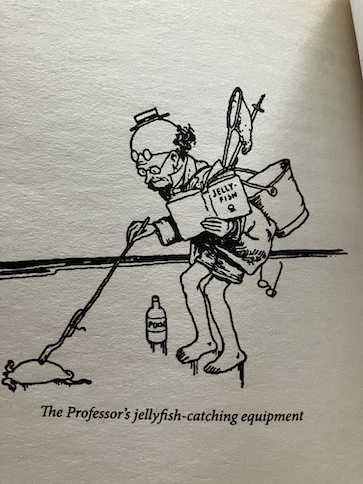
Professor Branestawm takes a trip to the seaside. He asks the Colonel to join him and bring his book about jellyfish, but unfortunately, he neglects to tell the Colonel where he’s staying (partly because he forgot where he was supposed to stay and is actually staying somewhere else). When the Colonel tries to find the Professor, he accidentally mistakes an entertainer dressed as a professor for Professor Branestawm. When the entertainer isn’t acting like himself (so the Colonel thinks), the Colonel becomes worried and decides medical intervention is necessary.
The book is available to borrow and read for free online through Internet Archive (multiple copies). It’s the first book in a series about Professor Branestawm, and it was also adapted for television multiple times.
My Reaction
Kids won’t learn anything about real science from Professor Branestawm, but the stories in the book are funny and not meant to be taken seriously at all. Most of the stories are about some pretty silly things that don’t really mean much in the end, but when you think about it, the Professor’s antics do lead to some pretty serious consequences, from wiping out an entire army just for the fun of it (pretty horrific in real life) and changing the course of history to accidentally blowing up someone’s house with his perpetually-chiming clock. No matter what the Professor does, though, there never seem to be any lasting consequences.
Even when people around him brace themselves for when the Professor’s latest project inevitably goes wrong, everybody still thinks that the Professor is pretty clever. The Colonel always thinks the Professor is clever, and even when he knows that the Professor is bound to do something that’s going to cause chaos, he enjoys the excitement. The housekeeper sometimes goes to stay with her sister, Aggie, when the chaos and excitement get too much for her.
The stories are just meant to be enjoyed for their zaniness, and there’s no point in analyzing them much. You don’t have to worry about whether anything the Professor does makes sense or exactly how he got any of his inventions to work. You can just enjoy seeing how everything develops and watch the craziness unfold! It sort of reminds me of Phineas and Ferb’s summer projects, which cause some chaos but are ultimately funny and always disappear at the end of the day. Enjoying these stories is what they used to say in the theme song for the tv show Mystery Science Theater 3000:
“If you’re wondering how he eats and breathes And other science facts, Just repeat to yourself “It’s just a show, I should really just relax …”
I can promise you that, no matter what happens in any of the stories, the Professor and his friends will ultimately be fine and will probably have a cup of tea (or “a cup of something”) afterward. This book was originally published in Britain the early 1930s, and it was read by children during the Great Depression. I can imagine that it might have given children then a good laugh and some escapism during troubled times.
Strangely, at least one of the Professor’s inventions, the clock that never needs winding, is a real invention that we have every day because time has moved on (ha, ha) since this book was originally written and published. In fact, it’s very unusual to find clocks that need to be wound these days. Of course, the part about the clock perpetually chiming more and more and blowing up when it gets to be too much is just part of the craziness of Professor Branestawm.
Danny Dunn and the Swamp Monster by Jay Williams and Raymond Abrashkin, 1971.
Professor Bullfinch receives a cryptic message, which he says is written in the style of a telegram (he calls it “cablese” – a way of shortening messages because people pay for telegrams by the word). As Professor Bullfinch and Danny study the message further, they can draw more conclusions about the sender, who is not specified. They know it’s someone with money because the hotel it was sent from is expensive. From one of the terms used, they think the sender is a scientist, and because he sent a message written to be a telegram as a letter, he’s probably absent-minded. That description seems familiar to Professor Bullfinch.
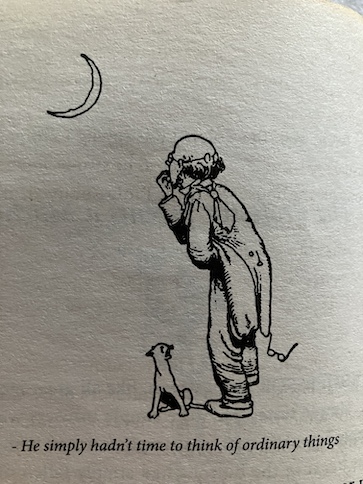
Then, a strange man comes to the door who seems oddly distracted and confused. He greets Danny as if he were an old friend, but Danny has no idea who he is. He thinks the man is crazy, but Professor Bullfinch recognizes him as his old friend Dr. Benjamin Fenster. Of course, Dr. Fenster is the person who sent the confusing message. It turns out that Dr. Fenster meant to send that message to Dr. Ismail at the University of Khartoum, but he accidentally got it mixed up with the message he was going to send to Professor Bullfinch. Dr. Fenster is an absent-minded professor type, and he’s always doing things like that. Although, he does correct Danny when he mentions this, saying that he’s not actually a professor, and it’s not so much that he’s absent-minded so much as that he has a lot to think about and can’t think of everything at once.
Their conversation is interrupted when something goes wrong with the experiment that Professor Bullfinch and Danny were working on before Dr. Fenster arrived. A warning goes off, and Professor Bullfinch yells to Danny to shut off the machine. However, Danny can’t find the shut off switch, so he panics and pulls an electrical cord, sending an electrical current through the project before Professor Bullfinch turns off the switch. When they examine the results of the experiment, they’re surprised. Professor Bullfinch was trying to develop a new polymer, but the accident with the machine and the electrical current have turned the polymer into a superconductor and a very powerful ring magnet with a circular magnetic field.
While they’re examining the results of the experiment, Dr. Fenster wanders off, lost in thought. Danny worries if he’ll be okay, wandering around on his own, but Professor Bullfinch says that he’ll be fine. Dr. Fenster often does this when he’s thinking something through. Danny’s friends, Joe and Irene, arrive, commenting on seeing a man who was acting strangely and wondering if there’s something wrong with him. Danny explains to them who Dr. Fenster is and tells them about the ring magnet. Then, Dr. Fenster bursts back in, very excited, because he’s figured something out. He thinks the magnetic polymer ring might be the solution to a problem he’s been trying to solve.
Dr. Fenster is a zoologist, and one of his projects is to investigate accounts of legendary animals. Although many scientists tend to disregard stories of unknown animals as purely legendary, sometimes, they turn out to be previously unreported/undiscovered species. (“Undiscovered” in the scientific sense. Obviously, people have seen them, or they wouldn’t tell stories about them. These are species that haven’t been officially documented as having been discovered among the scientific community.) Investigating rare or possibly unknown species is what Dr. Fenster does.
Dr. Fenster is currently investigating reports of a creature called the lau, which apparently lives in swampy areas around the source of the Nile River in Uganda. The lau is supposed to be an enormous serpent with tentacles on its head. The legend around it says that if a person sees the lau first, the lau will die, but if the lau sees the person first, the person will die. When the others ask him if he thinks that’s real, Dr. Fenster says that he thinks that’s more metaphorical, like when someone says they felt petrified, it doesn’t mean that they literally turned to stone, or if someone says that their blood froze, it just means that they felt horrified. He thinks that the idea is that a serpent could kill a person, if they didn’t see it and disturbed it, but if the person saw the serpent first, they would kill it to avoid the threat.
The problem that Dr. Fenster has been trying to solve is how to move around the swamp and keep the area under observation during the night as well as the daytime, without possibly disturbing the creature he’s trying to find. It’s difficult to get around that swampy area in daylight, but it’s even more difficult at night, and he doesn’t want to use lights because that could frighten away the lau. He’s been thinking that he would like to mount some specialized cameras in certain strategic areas, but he couldn’t figure out how to mount them, and the cables he would have to use would be long and heavy. Having seen what the magnetic polymer can do, though, he thinks that could be the solution to the problem. It doesn’t weigh much itself, but when they test it, they discover it can support the weight of a grown man.
Dr. Fenster invites Professor Bullfinch and the children to join him on his expedition. He’s independently wealthy, and he can afford to pay for all them to come along. However, Danny’s mother has reservations about how safe this expedition is, and she can’t imagine that Joe or Irene’s parents will allow them to go on the trip, either. It takes time for Dr. Fenster to persuade the children’s families that the trip is safe enough for them. Eventually, they give in and allow the children to travel to Africa as a special Christmas present. Dr. Fenster doesn’t have any time limit on his own investigations, but the parents limit the children to only two weeks.
When they get to Africa, the first place that Dr. Fenster takes them is to Khartoum University in Sudan, where he introduces them to Professor Ismail, the Director of the Department of Zoology. Professor Ismail has helped Dr. Fenster with travel arrangements, equipment for the expedition, and the necessary government permits. Danny asks Professor Ismail what he thinks about the stories of the lau and whether it could be something like a dinosaur that has somehow survived. Professor Ismail says that many things are possible because there known oddities among animals, like the platypus, which lays eggs even though it’s a mammal. He shows them a fish called clarias lazera, which has the rare ability to leave water and live on land for a period of time.
The children get something to eat at a local cafe and talk excitedly about what the lau could really be and how its discovery could be “the most important discovery of the century.” Irene notices that a man in the cafe looks very interested in what they’re saying and follows them when they leave.
When the expedition reaches the site Dr. Fenster wants to investigate, they persuade some of the Nuer people who live there to show them where they’ve see the lau. They are initially reluctant and warn them that the lau is dangerous, but they do show them an area, and the members of the expedition start setting up cameras to watch it. As they begin exploring, they do find large trenches that are like the paths supposedly left by the giant serpents.
Dr. Fenster explains to the disappointed children that he won’t take them along to confront the lau directly, even if they do find it because of the possible danger. He and Professor Bullfinch will handle the creature, using the tranquilizer gun that Dr. Fenster brought along. They plan to have the children watch on the monitors and keep an eye on the base camp. However, the children see something unexpected when they’re looking at the monitors: the same strange man who was following them in Khartoum. Who is he and why has he followed their expedition?
When the children tell Professor Bullfinch and Dr. Fenster about him, they meet up with the man, and he introduces himself as a rare animal collector. He offers to join their expedition and help them, but Dr. Fenster refuses. One of the Nuer recognizes the man as a disreputable character who would do anything for money, and Dr. Fenster thinks he’s a poacher, who would try to capture rare animals and sell them, rather than simply study them scientifically. It seems that, aside from protecting themselves from the possibly dangerous lau while they study it, they might also have to protect the lau.
The book is available to borrow and read for free online through Internet Archive (multiple copies).
My Reaction and Some Spoilers
The lau is a cryptid in the real world as well as in the story, and the details Dr. Fenster offers about where it supposedly lives and historical mentions of the creature are accurate. Accounts of what the lau might actually be in real life vary. It could be a type of python or a very large fish, like a catfish. In the story, when they do find the lau, it turns out to be an enormous catfish, the kind that can live without water for a time and move on land, but it also turns out to be electrical, like an electric eel. Professor Bullfinch and Dr. Fenster decide that it’s related to the malapterurus, which is in keeping with real world theories about the lau.
The story makes some good points about known animals in the real world that are considered oddities because they have qualities that don’t normally apply to other animals of their type, like how the platypus is an egg-laying mammal. Just because something sounds unusual doesn’t mean that it’s impossible. There are wide variations among creatures in the animal kingdom. I thought it was interesting that they brought up the clarias lazera, which is a type of catfish that can live and move on land. A similar type of catfish that can live and move on land appeared in the children’s mystery book The Mystery of the Other Girl.
I’m not sure whether the accident that produced the magnetic polymer makes any reasonable scientific sense, but there a few interesting facts in the story. When they get to Africa, Dr. Fenster explains to them that there are actually two Nile rivers – the White Nile and the Blue Nile. They get their names because the soil they pass through gives them each a different color.
There are some words of another language included in the story when they reach Uganda, but I’m honestly not sure whether they’re real words or just made up to make it seem like Dr. Fenster can speak the local language. I tried putting them through Google translate to see if it could recognize them as anything, but it came out as nonsense. However, it’s supposed to be a language spoken by the Nuer people, so it might be something that Google translate doesn’t know.
Sometimes, I’m a little suspicious when I encounter obscure foreign words in old children’s books. I’ve read other old children’s books which use made-up words in place of an actual foreign language, probably because the writers didn’t know how to write something in a real foreign language but they wanted something that looked like it could be from another language. They were probably also acting with the assumption that kids wouldn’t know the difference, so it wouldn’t matter. I could be doing these authors a disservice by being a little suspicious here. Perhaps they did some extra research to learn a few phrases in a language that would be very obscure in the United States. It’s just that, having seen fakery elsewhere, it’s something I find myself looking for when I see instances of languages that would be difficult to fact-check.
Faking words in a real spoken language is less tolerated in the 21st century than it used to be, especially in a book that’s supposed to have educational qualities, so I hope they didn’t attempt to do that. Faking lesser details in a fiction book that’s supposed to have some real facts tends to cast suspicion on just how many of the other “facts” in the book are fake. This is an adventure story, not a textbook, so it’s true that some creative license is allowed. I still don’t know if their magnetic polymer concept is at all plausible, but the Danny Dunn stories are science fiction adventures, so some creative license there is allowed. However, readers like to feel that they can trust a certain amount of supporting detail to be correct. It’s also considered a cultural insult to use fake nonsense words in place of actual words from a language people really speak. Hopefully, that’s not the case here, but I wanted to point out the concept so readers can see how the use of real words strengths a story while faking them weakens it.
The story offers about the Nuer people, but I’m not sure how accurate they are. I don’t know where the authors got their information. They say that Nuer people don’t have chiefs and don’t follow orders from anybody, but according to the eHRAF World Cultures collection through Yale University, their clans do have headmen, and they also have sub-chiefs.
#15 The Mystery of the Goldfish Pond by Elspeth Campbell Murphy, 1997.
Timothy’s father wants him to sing at his boss’s retirement dinner. The boss’s wife heard Timothy sing once with his choir, and she wants him to sing a special song for her husband at the start of the dinner. His cousins are invited to come along so he won’t be the only kid there. Timothy doesn’t really want to do the singing, but his parents convince him to do it anyway because the boss’s wife is so fond of him and his singing.
Timothy’s father hopes that the dinner will go well because the boss has been worried about the possibilities of competitors getting their hands on information about their new product. Earlier, the boss temporarily misplaced an important memo about it, and he was worried that someone else got their hands on it.
Timothy’s song goes well, and after the dinner, the kids are allowed to walk outside in the garden while the adults listen to a series of speeches. The gardens outside the banquet hall are beautiful, and the kids start to enjoy themselves. Then, they accidentally overhear a couple of adults talking. They can’t quite catch everything they say, but something strange is going on, and something secret is hidden somewhere in the garden.
The theme of this story is Proverbs 11:13, “No one who gossips can be trusted with a secret, but you can put confidence in someone who is trustworthy.”
The book is available to borrow and read for free online through Internet Archive.
My Reaction and Spoilers
The crime that the adults were plotting involves the theft of information. The kids have to figure out the parts of the conversation they couldn’t hear clearly to figure out where the information is hidden. I thought that the clue the children try to figure out was fairly easy. Part of the conversation the kids try to figure out sounds like “-ake -urtle”, and there aren’t many words that sound like “-urtle.”
The boss’s wife seemed eager for the children to go outside, into the garden, and tell her about it later. The kids wondered why she seemed so eager for them to go outside and what she was hoping that they would tell her afterward. It sets the stage for the kids to expect that something unusual or mysterious might happen, which proves to be the case when they overhear the important conversation. The boss’s wife says later that she suspected something might happen because she knew her husband was worried about people stealing company information, and she realized that this dinner would be a convenient place to hand it off to someone.
We never learn exactly what kind of information or new company products the adults were concerned about. We also don’t know exactly who was trying to steal the information or what happens to that person later. The part that the children care about is that they were able to stop the hand-off of the information.
#9 The Mystery of the Eagle Feather by Elspeth Campbell Murphy, 1995.
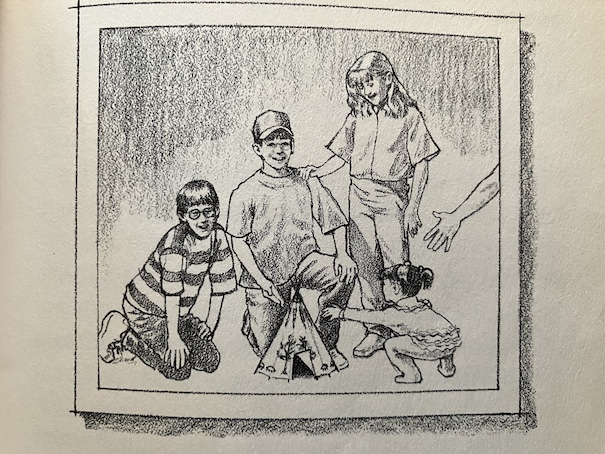
Timothy is excited because he has a chance to meet his pen pal, Anthony Two Trees, for the first time. Anthony is a Native American, and he will be dancing at a powwow. Timothy’s cousins get to come along on the trip, too.
Soon after they arrive, though, they learn that someone has been taking pieces of the dancers’ costumes, like fans or headdresses made of eagle feathers. Who could be taking the costume pieces and why?
The costume pieces and the eagle feathers they contain are very expensive, and the kids realize that the thief might be thinking of selling them. It is illegal to deal in eagle feathers because eagles are an endangered species. Even the Native American dancers have to write to the government in order to get eagle feathers for their costumes from eagles that died in zoos. Therefore, the costumes are expensive and require a lot of effort to put together, and losing them is a real blow. The rarity and cost of the feathers might prove to be a temptation to a thief.
The theme of the story is self-control.
The book is available to borrow and read for free online through Internet Archive.
My Reaction
I wasn’t sure if I was going to like this story. I understand the fascination kids have with Native Americans and their costumes and dances. I felt like that when I was a kid, too, but there’s also an element of cringe to it. The cringiness comes from kids (and even adults) who get wrapped up in the fascination of the appearance of other people’s traditions and treat them more like playing dress-up than traditions with deeper, underlying meaning and significance or depicting Native Americans as being stereotypes from old movies and books rather than real, living people.
Fortunately, I was pleased at how this story shows that Timothy’s friend, Anthony, is a regular boy who shares his interest in baseball. They emphasize that Native Americans don’t live in tepees any more, and they don’t treat the Native American characters like stereotypes. I enjoyed some of the facts the story provided about Native American dances and costumes, like the regulations regarding the use of eagle feathers.
#10 The Mystery of the Silly Goose by Elspeth Campbell Murphy, 1996.
As soon as they arrive home from their trip to the powwow in the previous book, the cousins are approached by Timothy’s neighbor, the snobby 13-year-old Lyddie, with another mystery. While they were out of town, someone went around the neighborhood, stealing lawn ornaments. Lyddie is concerned because her grandmother has come to live with her and her parents, and her lawn geese were stolen. One of the geese was the mother goose with a silly-looking bonnet on her head, and the others were her goslings. Lyddie’s grandmother is rather attached to the geese because they were a present from someone.
The three cousins don’t really like Lyddie because she and her friends are usually unfriendly and too concerned with being “cool” all the time. However, they feel sorry for her grandmother and agree to take the case. To their surprise, most of the lawn ornaments are actually pretty easy to find. They were hidden in some obvious places around the neighborhood. The only ones that are difficult to find are the geese. Who hid the lawn ornaments and why?
The theme of this story is Proverbs 24:3-4, “It takes wisdom to have a good family. It takes understanding to make it strong. It takes knowledge to fill a home with rare and beautiful treasures.”
The book is available to borrow and read for free online through Internet Archive (multiple copies).
My Reaction
Part of the mystery has to do with image, but it also has to do with sentimental attachment. Lyddie is very obsessed with image because she and her friends try so hard to maintain their cool image. Although she calls in the cousins to find the missing lawn ornaments, she only does it because her grandmother takes the loss of the mother goose so hard. Lyddie doesn’t see why the goose is so important, although she knows that her grandmother is attached to it because it was a present from someone.
The situation changes when Lyddie’s grandmother reveals the full story behind the lawn geese and her own understanding of the situation. Lyddie cares for her grandmother, and she comes to see the geese in a new light once she understands why they matter to her grandmother. It’s not the value of the geese, and it’s not about how the geese look. It’s all about the person her grandmother associates with them. Fortunately, Lyddie’s grandmother is a very understanding woman, and when the lawn ornament thief explains the issue, they work things out to everyone’s satisfaction.
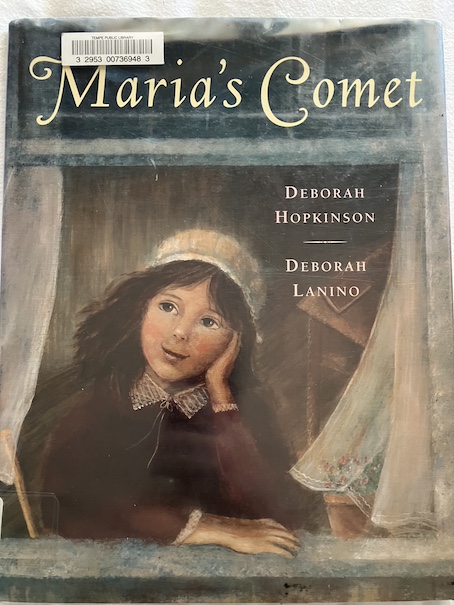
Maria’s Comet by Deborah Hopkinson, illustrated by Deborah Lanino, 1999.
This picture book is a fictional story about a real person, Maria Mitchell. (She pronounced her first name “ma-RYE-ah”, not “ma-REE-ah”.) Maria Mitchell was born into a Quaker family on Nantucket Island, Massachusetts in 1818, and she became the first female astronomer in the United States. She is known for discovering a comet only viewable through a telescope in 1847, and she also became the first astronomy professor at Vassar College. She is the namesake of the Maria Mitchell Association, a science center on Nantucket. She was also an abolitionist, although this topic is not touched on in the book. Maria’s father taught her about astronomy when she was young and encouraged her interests and career at a time when not many women were encouraged to pursue careers or higher education.
Maria’s papa is an astronomer. At night, he goes up on the roof their house to use his telescope, and he explains how the telescope works, gathering and focusing light to make distant objects look larger and closer than they would with just a person’s eyes. He especially likes to look for comets. In their time, they’re not entirely sure what comets are made of, and that’s part of what makes studying them interesting. Maria imagines what it would be like to travel across the sky with a comet, encountering the different planets.
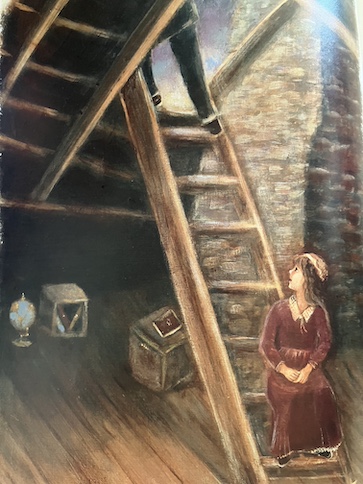
Most of Maria’s life centers around their house and family in Nantucket. There are nine children in the family, so Maria helps with chores and tells her siblings bedtime stories. Sometimes, she and her brother Andrew go into the attic and use an old atlas to pretend that they’re explorers. When they read books, Maria likes books about astronomers, but Andrew likes books about sailors. He wants to be a sailor himself.
When Andrew gets older, he runs away from his family to go to sea on a whaling boat. The entire family is sad that he is gone, and Maria soothes her siblings by telling them stories about all of the amazing places their brother will go. That night, after supper, Maria asks her father if she can come with him to look through his telescope or “sweep the sky” as she thinks of it. For a moment, Maria thinks they will say no, but they agree. Maria wants to be an explorer of the sky, like her brother wanted to explore the seas.
Maria’s father points out Polaris, the North Star, to Maria and says that sailors use it to navigate. Maria wonders if Andrew might be looking at the same star right now. Then, she sees a comet streak across the sky.
There’s an Author’s Note in the back of the book that explains about the real life of Maria Mitchell. It has some comments about what people of her time knew and didn’t now about the planets. When she was young, people only knew about seven planets in the solar system. Neptune was discovered during her lifetime (although not by her), and Pluto wasn’t discovered until 1930, after she had died. There is also a section about the astronomy terms used in the story and famous astronomers.
My Reaction
I enjoy books about historical people, although the author admits in the Author’s Note that this particular story about Maria Mitchell is fiction. I have mixed feelings about that. I don’t like to fictionalize real people, and I’m not entirely sure whether there’s any truth to the story about Maria’s relationship with her brother and how she felt when he left to become a sailor. On the other hand, I did appreciate how the book showed Maria becoming interested in astronomy by watching her father and joining him in his studies of the sky, which is apparently true. Overall, I did enjoy the story.
The pictures in the book are wonderful. They capture the coziness of an old-fashioned 19th-century home and also the wonderment of looking to the skies and imagining exploring the big, wide world and the stars beyond it.
Moonflute by Audrey Wood, illustrated by Don Wood, 1980, 1986.
One night, a little girl named Firen can’t sleep. It’s a hot summer night, the moon is full, and Firen feels like the moon has taken away her sleep, so she must go out into the night and look for it.
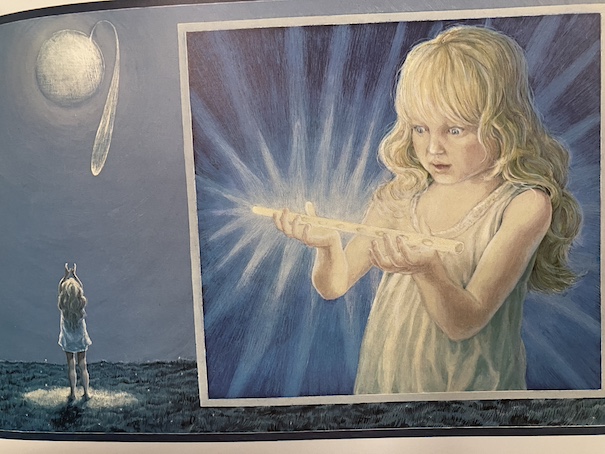
Outside, Firen raises up her hands to the moon and asks for her sleep back. The magical moon sends her a moonbeam, and when Firen touches it, she realizes that it’s solid. It’s actually a flute. When Firen plays the flute, it makes magical music that doesn’t sound like any normal flute, and it brings all sorts of wonderful smells of things that Firen loves. As she continues to play, she feels light and tingly, and she realizes that she is rising into the air!
Firen flies over the countryside, looking for her sleep. As she journeys through the night, she sees various animals and wonders if they have her sleep. She sees cats in a patch of catnip, whales playing in the ocean, and bats and monkeys in a jungle.
When Firen sees a couple of monkeys soothing a baby monkey to sleep, she thinks about her own parents and uses the flute to return home. Is the moonflute helping her find her sleep at home with her parents, or has she actually been asleep all the time?
The book is available to borrow and read for free online through Internet Archive.
My Reaction
This book follows the “It was all a dream” theme, where the main character experiences something fantastic, but they were dreaming all the time. While Firen was wondering where her sleep was, she apparently fell asleep. It isn’t definite that’s what happened, but it’s implied when her parents go to her room, and she’s in bed, without the flute. If readers would like to think of it differently, that Firen really did have her flying adventures, it’s possible to read it that way, too.
The pictures really make this book! The illustrations are oil paintings, and they are beautiful and ethereal. Firen witnesses some stunning scenes, like whales leaping in the ocean, with everything bathed in glowing moonlight.
I was intrigued by the name “Firen” because I don’t think I’ve heard it before, and I like unusual names. I couldn’t find much information about the name online, so it seems like it isn’t very common. I thought at first that it might be a modern, invented name, although one name site says that it has Arabic origins.
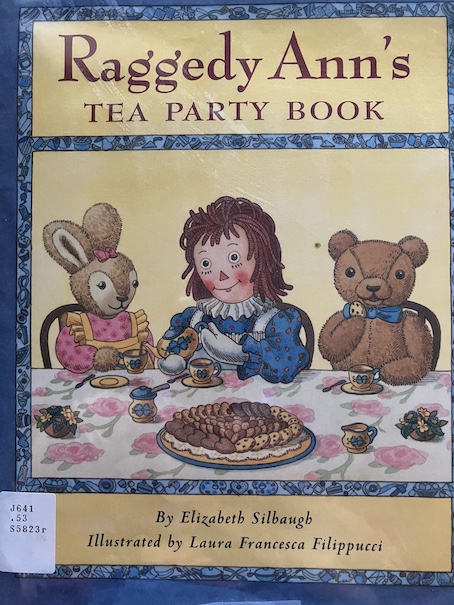
Raggedy Ann’s Tea Party Book by Elizabeth Silbaugh, illustrated by Laura Francesca Filippucci, 1999.
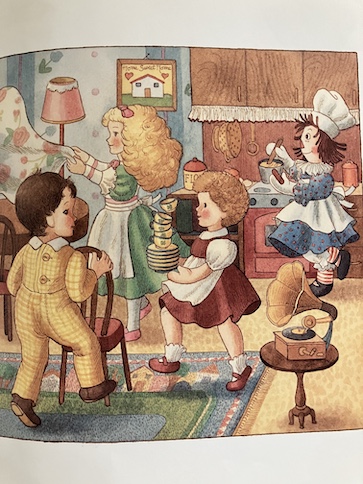
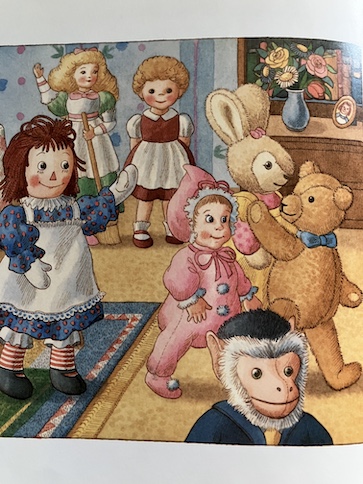
This book is a children’s guide to planning a tea party with Raggedy Ann. As in the original books, Raggedy Ann is a doll who lives with a girl named Marcella, and she likes to have tea parties with Marcella’s other dolls and stuffed animals.
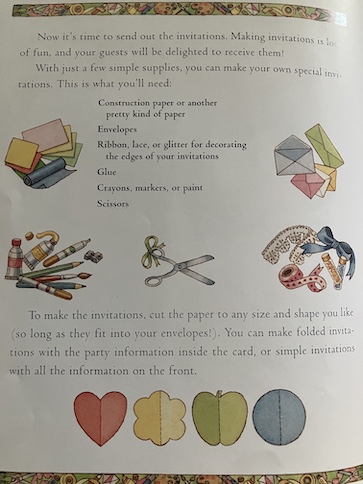
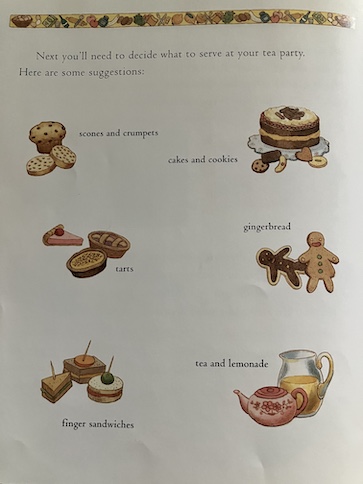
The book explains how to plan and prepare for a tea party, from figuring out how many guests there will be and making sure there are enough seats for everyone to choosing a menu and games to play. There are tips for making party invitations and a section of recipes in the back of the book.
The food ideas aren’t too complicated. The book recommends keeping preparations simple because a party is about having fun. Setting the table is an activity by itself. Raggedy Ann gets her guests to help her, and they put on music while they do it. They want to make the table setting pretty, and they make sure that everyone knows each other and is included in the conversation. Tea parties are a time to practice good manners and make sure everyone is enjoying the party. At the end of the party, guests can also help clean up while they play music.
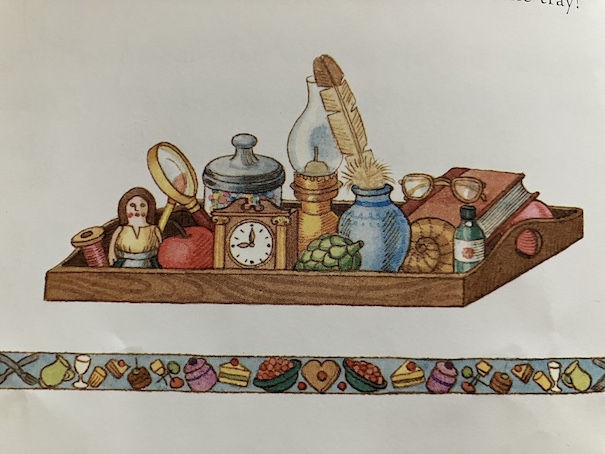
For games to play, they recommend the classic game of Telephone, Fiddly Diddly (a guessing game), and Memory Tray, where guests look at a tray of objects for a limited amount of time and then try to remember everything they’ve seen.
The recipes included in the book are:
Easy Chocolate Cakes
Creamy Pink and White Icing
Tiny Sandwiches – They suggest a variety of possible fillings, including tuna, ham, tomato, hard-boiled egg, cucumbers, cheese, fruit, or jam.
Raggedy Ann’s Candy-Heart Cookies – These are heart-shaped cutout cookies because Raggedy Ann has a candy heart.
Uncle Clem’s Super-Simple Scotch Shortbread
Marcella’s Lemonade
The book is available to borrow and read for free online through Internet Archive (multiple copies). There is another book by the same author called Raggedy Ann’s Birthday Party Book, about planning a birthday party.
My Reaction
I found it charming and nostalgic, and I loved the colorful pictures! I didn’t read this book as a child, but it is the kind of book I would have liked. The party-planning tips are useful, taking child readers step-by-step through planning the party, inviting the guests, and preparing food and entertainment. I liked the advice to keep things simple, so even the host/hostess can enjoy the party instead of getting stressed over complicating preparations. The recipes in the book fit the tea party theme, and they are simple enough for children to make or at least help in their preparation without being overly simplistic.
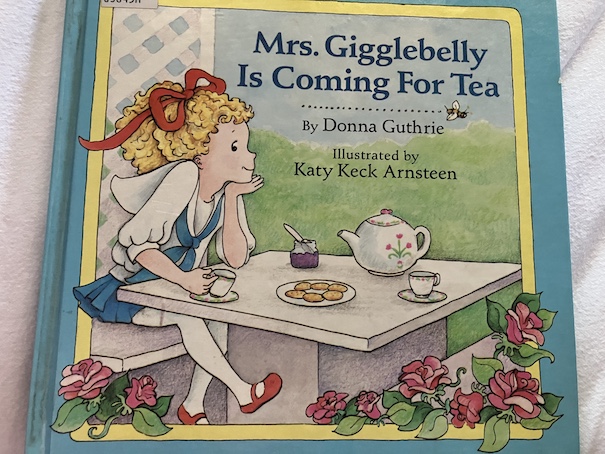
Mrs. Gigglebelly is Coming for Tea by Donna Guthrie, illustrated by Katy Keck Arnsteen, 1990.
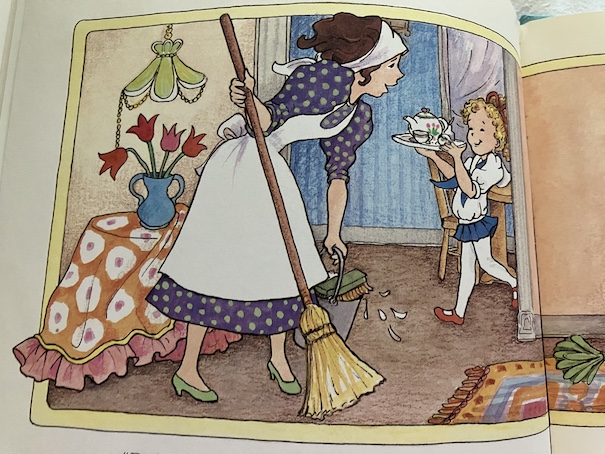
Elizabeth Ann tells her mother that Mrs. Gigglebelly is coming for tea today, but her mother says that she’s in the middle of her spring cleaning and doesn’t have time to prepare for Mrs. Gigglebelly today. In fact, she suggests that Mrs. Gigglebelly might be busy today, but Elizabeth Ann says that Mrs. Gigglebelly always has time for tea with her.
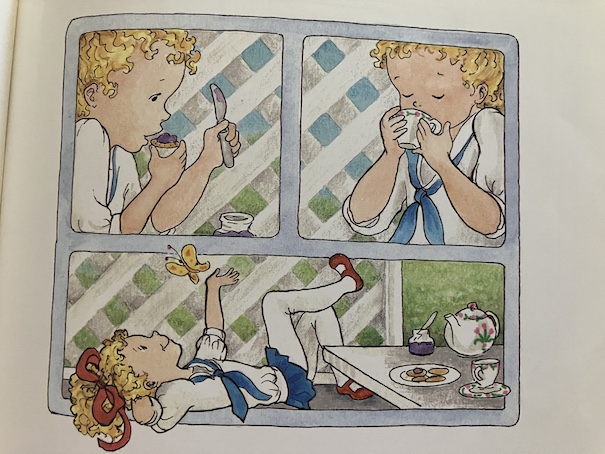
Since her mother is busy with chores and can’t prepare tea or a cake for Mrs. Gigglebelly, Elizabeth Ann fixes some lemonade and crackers with grape jelly for their “tea.” While Elizabeth Ann waits in the garden for Mrs. Gigglebelly, her mother dashes about, doing her chores.
At first, it seems like Mrs. Gigglebelly isn’t going to come, but she eventually arrives because she always has time for Elizabeth Ann … so does her mother.
My Reaction
This is a cute story about a mother who makes time for her child, even when she’s busy. “Mrs. Gigglebelly” seems to be a game of pretend the mother and daughter play together when they have their tea parties. On this particular day, the mother is very busy, but she still throws together a costume for their game. The book doesn’t say that “Mrs. Gigglebelly” is Elizabeth Ann’s mother, but it’s implied in the story, and in the last picture, readers can see pieces of “Mrs. Gigglebelly’s” improvised costume around the room.
I thought it was sweet that the mother in the story took time for a little fun and silliness and a special moment with her daughter, even though she had work to do. Some mothers might just lecture their child about how they’re busy and the child just has to accept that, but this mother understands that her attention is important to her child. Sometimes, it’s the little moments that mean a lot, even if it’s just pausing to share a snack. She does make her daughter wait because there are things she has to do, but the wait is worth it because the mother follows through and makes the effort to make time for her daughter.
Elizabeth Ann also doesn’t nag her mother about hurrying up or try to convince her mother to drop everything she’s doing and play with her instead of doing her cleaning. Instead, she waits patiently, confident that her mother will have time for her eventually because her mother has already established that her daughter is a priority and that she will make time for her. It looks like this mother-daughter pair understands each other well and that they have a good relationship with each other, and I like that.