Fin M’Coul retold and illustrated by Tomie de Paola, 1981.
This is a retelling of a classic Irish folktale. The story is fun and silly, but one of the parts of this story I like the best is the introduction of the Giant’s Causeway – a real place with a magical look. There’s a geological explanation of this rock formation, but this story introduces the folkloric explanation.
In ancient times, when Ireland was inhabited by giants and magical creatures, a giant named Fin M’Coul lived on Knockmany Hill with his wife, Oonagh. One day, as he is building a causeway between Ireland and Scotland, Fin M’Coul hears that another giant, Cucullin, is coming.
Cucullin has a fearsome reputation, and he has beaten up many other giants, just to prove how strong he is. So far, Fin M’Coul has been able to keep out of his way, but Cucullin is now looking for Fin M’Coul to beat him. In fact, he’s so close that there’s no time for Fin M’Coul to get away.
Fin M’Coul goes home to his wife and asks her what he should do. Oonagh says that he won’t have any peace until he gets this confrontation with Cucullin over with, but Fin M’Coul doubts that he could be a match for Cucullin in a fight. Oonagh decides that they’re going to have to defeat Cucullin with cunning rather than strength.
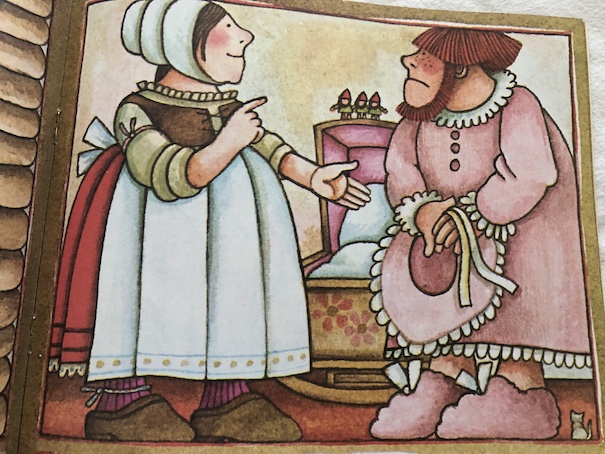
She quickly does a special charm to bring them success, and then, she begins setting the scene for the trick they’re going to play on Cucullin. She makes up a giant cradle and makes her husband dress in baby clothes and sit in the cradle. It’s ridiculous, but Oonagh has a plan.
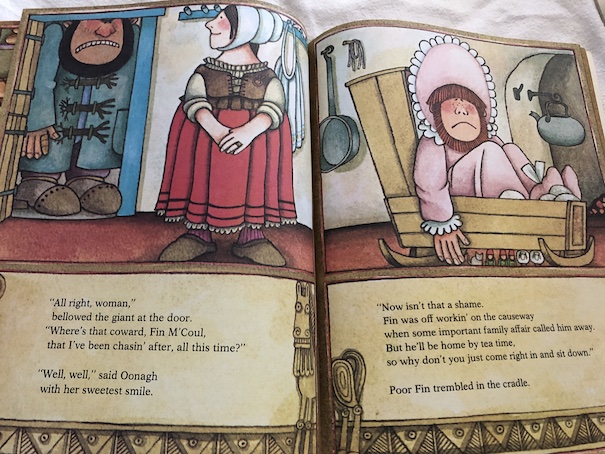
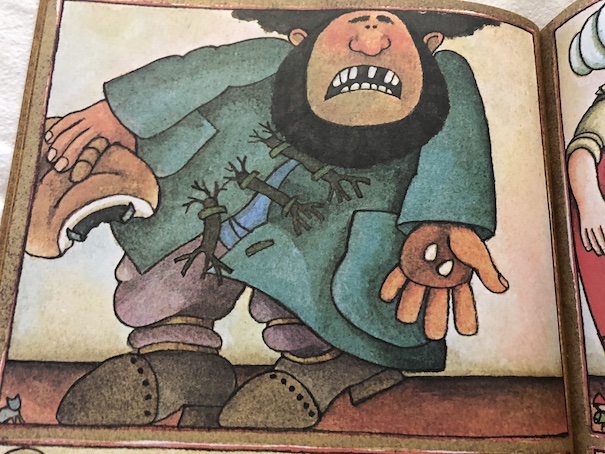
When Cucullin comes, Oonagh tells him that her husband isn’t home, but she invites him to come in and wait with her and her “baby.” Not only is the “baby” astonishingly large, even by giant standards, but Oonagh carefully convinces Cucullin of the baby’s unusual strength. She tricks him into thinking that the “baby” can eat bread and cheese that’s rock hard while giving Cucullin bread with a frying pan in the center and a real stone instead of cheese. Not only does Cucullin break his teeth on these things, but if Fin M’Coul’s “baby” can eat these things, how much stronger could Fin M’Coul be?
Oonagh’s tricks allow Fin M’Coul to get the upper hand against Cucullin and defeat him once and for all!
There is a brief section in the back of the book that explains a little about the background of the legend. I love the pictures in this version of the story. Tomie de Paola books always have fun illustrations, but if it weren’t for the little people and animals in the pictures with the giant characters, you might almost forget that the main characters in the story are all giants.
The book is available to borrow and read for free online through Internet Archive.
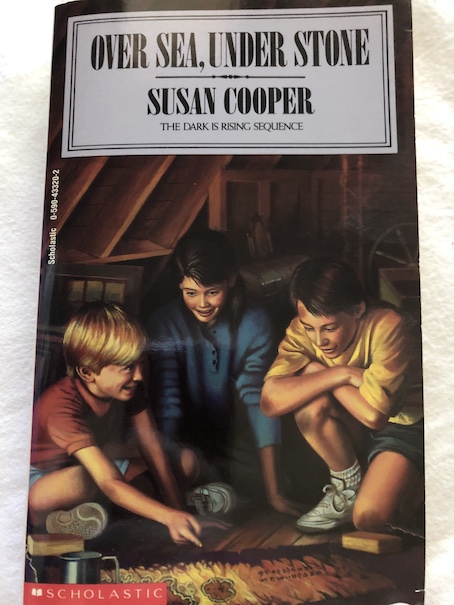
This is the final book in The Dark is Rising Sequence, and it focuses on the epic battle between the forces of good (the Light) and the forces of evil (the Dark). Like the other books in this series, it uses and references folklore and Arthurian legends. At the end of the previous book, the characters used a magical harp to wake “the Sleepers” in Wales. The man that the children know as Merriman Lyon is actually Merlin from the Arthurian legends, and Will Stanton has discovered that King Arthur had a son named Bran who was brought into the 20th century by Guinevere and Merlin to protect him from his parents’ troubles in their own time.
Twelve-year-old Will Stanton is spending some time with his brothers at Midsummer because his oldest brother, Steven, has come home for a visit from his service in the navy. While the boys are out fishing, Will begins having visions of the distant past. He sees people who seem to be fleeing from something, and these people are talking about the terrible things that their pursuers would do to them if they caught them. Will watches as they bury something, some kind of treasure. He sees smoke on the horizon and has a sense of fear that tells him these people are right to be afraid. Then, suddenly, Will is back with his brothers in modern times, and a strange black animal, probably a mink, is sitting there, staring at Will. His brothers run the mink off, commenting on how oddly it was behaving.
Steven talks to Will in private about some odd things that have been happening that have let him know that Will must be involved in something strange. Strangers in other countries that Steven has visited have approached him and, with no explanation, have asked him to tell Will that the Old Ones of different regions are “ready.” Steven wants to know who these people are, how they know Will and know that Steven is will’s brother, what Will is involved in, and what they mean when they say that they’re “ready.” Will doesn’t want to answer at first because he knows that Steven won’t understand, but Steven insists that he wants an explanation. Will explains to him, as best he can, about the Old Ones, the magic of the world and the universe, and the opposing forces of the Dark and the Light that are fated to battle with each other. (This is the most complete and concise explanation of how magic works in these stories and how their universe is ordered.) As Will expected, Steven doesn’t believe him and insists that he can’t be an “Old One” because he is only twelve years old and Steven remembers when he was born, but Will asks him whether it’s any more plausible that a twelve-year-old boy would be involved in smuggling or other suspicious activities. Steven doesn’t know what to think, but then, some white moths come, and Will recognizes them as creatures that are reputed to carry away memories. After they leave, Steven doesn’t remember their conversation at all and is no longer interested in the idea of the “Old Ones.”
On the way home, Steven deals with a young local bully who stole an instrument case from a smaller boy. The bully threatens to send his father after Steven, and Steven, being a tough member of the navy, says that he’d be happy to talk to his father about the bully. The father does come to talk to Steven eventually, and the Stantons see that the young bully’s bad behavior is fueled by racist things that his father thinks and says. The father of the bully has no self-awareness. The Stantons are disgusted by him, but Will’s father says to his kids that they know that such disagreeable people exist and “You can’t convince them, and you can’t kill ’em. You can only do your best in the opposite direction—which you did.” (The part of the observation about not killing people sounds a bit violent, but I think I understand. You might not like certain people, and you might find them a hardship to have around, but you can’t just get rid of them, out of the world, anymore than the racist bully has either the right or the ability to get rid of all the people he doesn’t like. All people are a part of the world and all have a right to be there … no matter how much of a trial and hardship some of them make themselves to other people because they either don’t understand that other people are making allowances for them on a daily basis that they don’t make for others or deny knowing it to preserve their self-image and justify their bad behavior. Yeah, I’m a bit fed up with some people myself, but we’re all stuck with each other, so we all have to make the best of it.) Will finds himself evaluating this man as an Old One, trying to decide if he is also an agent of the Dark. He seems to be an ordinary human, but it has already been established that even ordinary humans can also serve the Dark, even unknowingly. Will finds himself thinking that people have multiple sides to their personalities, indicating that this obnoxious man may have a role to play in the upcoming struggle, either for good or evil, and whichever role it is will be his personal choice. On the other hand, there is a concept in this story that there are people and things outside of the battle between Light and Dark, people who are either neutral or a mixture of Dark and Light. In other words, this jerk could simply be just a random jerk and hold no other significance but that. (Spoiler: He doesn’t appear again in this story, and the jerk isn’t significant. He’s just a rude guy with a nasty son and some personal issues that are causing him to be a bad example. On the one hand, I’m was a little disappointed because I thought they were setting something up with this incident, but on the other hand, the character was so oblivious and full of himself that saying that he’s insignificant in the grand scheme of things actually pleases me.)
Later, the mink shows up again and kills some of the Stanton family’s chickens, not even carrying them off. It seems like the mink is merely killing for the pleasure of killing, not to eat. Will recognizes that the animal is another creature of the Dark and almost kills it, but he decides not to because it wouldn’t do any good. He knows that the Dark is rising, and killing this small creature won’t stop what is about to happen.
Will continues to have visions of the past and a sense that he is sometimes between time periods. Old Ones can travel between time periods, and even Will has done this before. The rising of the Dark that is happening in the 20th century is actually the Second Rising. The First Rising of the Dark was during the time of King Arthur, about 1500 years earlier. Will travels to that time with Merriman/Merlin and witnesses that struggle. There is a connection between the First Rising and the Second Rising. They are both part of the same, larger battle. Old Ones aren’t bound by time like normal humans, and the struggle between Light and Dark also transcends time.
To protect the six signs that Will had to gather in the second book of the series, he and Merriman hid them in the past, during Roman Britain. Now, Will has to retrieve them because they will be needed for the upcoming struggle. Will and Merriman have to go through multiple time periods to get the signs, and then, they have to summon the other Old Ones for the final battle. However, one of the Old Ones, a vital one, is missing. Will realizes that he must go to Wales once again to find the Old One known as The Lady.
In Wales, Will is reunited with Bran from the previous book and with the three Drew children from previous books, whose parents are staying at a local golfing hotel at Merriman’s suggestion. All of them will be needed for the battle is coming. They will each have to face their own tests of character and courage, and when it’s over, their futures will be in their own hands. They all go on their own trips through time, and Will and Bran visit the Lost Land, where Bran was actually born.
The book is available to borrow and read for free online through Internet Archive (multiple copies).
My Reaction and Spoilers
I often find myself feeling a little disappointed at the ends of books or tv shows that have a long wind-up to some kind of epic battle or revelation because what happens rarely meets my expectations. When a single event or plot point has been built up over a long time, the imaginations of readers and viewers sometimes have such high expectations that the final resolution of it can feel a little like a let down. With this one, I had some mixed feelings.
I liked it that all of the major characters had roles to play in the final events. I would have been disappointed if some of the major characters had fallen away. I didn’t want Bran to replace the Drew children in the story, for example. However, everyone has a role and at least one major test of character or bravery. There is a twist toward the end where a minor character but someone we’ve seen before in a sympathetic role turns out to have been secretly evil all the time. It’s a terrible blow to one of the other characters, but he comes to accept that this person deceived him about who she really is and the attachment he felt was to the facade not the person as she actually is.
One of the aspects of this series that interests me the most is that it’s pretty thorough in the way it addresses the problem of evil in human beings. Throughout the series, it has shown what the agents of evil in the form of agents of the Dark are like. Some of them are deceptive about who they really are and what they really want, like the secretly evil character in this book, shocking even people who are close to them when they learn the truth. It’s true that many of us have been shocked by someone in our lives who wasn’t quite what we thought they were or had something unsavory about them or their behavior that we never suspected because they were careful to hide it. In the first book of the series, there was a betrayal of trust that led someone to turn to the Dark side. In other books, we’ve also seen neutral people or natural forces, people who choose a side by accident and aid the causes of good or evil unwittingly because they’re wrapped up in their own issues and don’t see the bigger picture, and as mentioned about the bully and his father, there are also people who are a mixed bag, with the potential go to either way, shift back and forth, or just hover somewhere in the middle. The series covers quite a lot of the nuances of the choices people make about their behavior and the choices they make between good and bad.
That being said, even though this book explains the background to the battle between Light and Dark in a more straightforward way than other books, I felt like I never completely understood the motives of the Light and the Dark. It seems like the two of them are just naturally opposing forces. They don’t seem to have any specific over-arching goal that they’re trying to accomplish other than defeating each other. What their exact plains are once they’ve achieved victory isn’t clear.
Of course, readers know that the Light will win, and when it does, Merriman says that there won’t be further battles between Dark and Light. Merriman and other Old Ones move on to another world, where they say they have work to do, although Will Stanton will remain as “the Watchman” to continue watching over the world. Merriman says that the two of them will see each other again someday. Merriman says that the future of this world is in the hands of the children and other people of the world, referencing man’s ability to destroy the world. This book, and the rest of the series, was written during the Cold War, when people were particularly afraid of the threat of nuclear weapons. It seems like the legends and prophecies are over. Bran remains in the present although his father, Arthur, invited him to the past because he has become part of the 20th century and is bound to his friends and adoptive father by affection.
I enjoyed all the references to old legends during the course of the story. The Lost Land is a legendary country off the coast of Wales. They don’t use the name Lyonesse, but I think that’s what they’re referring to. Accord to the book, people can still hear the bells of the lost city, a legend that’s been applied to other lost towns in legends, and a phenomena that has a scientific explanation, When Bran and Will go there, they meet a bard named Gwion (Taliesen).
This is the fourth book in The Dark is Rising Sequence, and it picks up not long after the previous book ends.
Will Stanton has been very ill with hepatitis, and the doctor ask advised his parents to send him somewhere to rest for a while and recover his strength. In the previous book, his sister Mary had gone to stay with relatives in Wales after she had the mumps, so his parents agree to send him there. Even after he recovers, Will has a nagging feeling that he’s forgotten something very important. What he’s forgotten are the clues that he and his friends discovered at the end of the previous book, but little by little, they come back to him.
Will calls his relatives Aunt Gem and Uncle David, but really, they’re distant cousins. On his way to stay with them on their farm, Will sees a mountain that locals call “the Grey King”, which begins bringing back Will’s memory of the clues to the next item of power that he and his friends are supposed to find. An encounter with a strange dog with silvery eyes brings back the rest of Will’s memory, reminding him that he is the youngest of the Old Ones and it is his mission to find a magical harp in Wales.
The owner of the dog is an albino boy named Bran, who surprisingly knows the clues that Will had been struggling to remember. Bran reveals that Merriman visited him before Will arrived, told him to keep an eye out for Will and help him, and taught him the first part of the clue rhyme as a show that he can be trusted. The boys talk about what the clues in the rhyme mean. Will is supposed to find the harp on “the Day of the Dead”, which Will thinks means Halloween and which is coming soon, but he’s confused because the rhyme also refers to the end of the year. Bran says that Halloween might have once been regarded as the time of the New Year (which is true, and I discussed it in the History section of my Halloween Ideas site), and the two of them discuss some old traditions and superstitions about Halloween.
On Halloween, Bran and Will go into the mountains, and Will’s knowledge and abilities are tested before they are given the harp. Yet, Will is not the one to play it because he doesn’t know how. Bran is the harper. He also seems to have a strange connection to one of the lords who guarded the harp in the mountains. On the way down, the boys have a frightening encounter with a fox who has been killing sheep in the area, but weirdly, nobody else else can see the fox but the boys. A disagreeable farmer shoots poor Bran’s brave dog because he thinks that the dog is the one killing the sheep, and Bran is inconsolable. (I hate books where the dog dies.)
However, their work is not yet done. Will has to use what he’s learned from Bran about playing the harp to wake the Sleepers, who will aid the Light in the upcoming battle against the Dark. Bran also comes to learn his true identity and that of his mother. Although he is not one of the Old Ones, Bran is special and will play a pivotal role in the battle between Light and Dark.
The book is a Newbery Medal winner. It is available to borrow and read for free online through Internet Archive (multiple copies).
My Reaction and Spoilers
Even though this book is the Newbery Medal winner in the series, I didn’t like it as well as the earlier books. It’s partly because the dog Cafall dies, and I always hate books where the dog dies. I love dogs, and also, I realize that it’s often a cheap way to give readers and emotional wrench, to kill off a beloved animal. Also, I missed the familiar characters from the earlier books. The Drew children are not in this story, and even Merriman doesn’t play much of a role. For most of the story, Will is alone, although he does make an important friend in Bran, whose past is more mysterious than most people know.
Although, Cafall also represents one of the innocent sacrifices in the name of the battle between good and evil. Bran is angry at Cafall’s death and says that neither he nor his dog were part of Will’s battle or quest, and it wasn’t fair for them to be dragged into it or for Cafall to be killed. He’s partly right, although he is actually much closer to the center of this battle than he knows. Another character in the book talks to Will about the apparent callousness of the Light for those who end up being sacrificed in the struggle. Will’s answer is that some things cannot be helped. They might want to protect everyone and make things work out well for everyone, but circumstances don’t always make it possible, and there are times when trying to save someone or make someone happy could cause something else to happen that would be worse for everyone. I’m not completely satisfied with that explanation because, in this particular instance, I don’t see why this sacrifice was necessary and I feel like it could have been avoided, like I felt that another tragedy in The Dark is Rising could have been avoided. I suppose the principle that avoiding one sort of bad thing could lead to something worse could be true, but I just don’t feel it in these stories.
I was more convinced and intrigued by the concept of people who aid the dark without knowing that they’re doing it. In the previous book in the series, the author addressed the idea of neutral parties in the struggle between good and evil, but this book introduces the idea of ignorant or deluded people who do bad things without realizing. In the story, they aren’t regarded as true agents of the Dark because they haven’t consciously joined the Dark side and don’t even know that there’s any Light/Dark struggle happening around them, but they are doing what the Dark wants them to do and hurting people and the cause of the Light either because they are being tricked and manipulated into doing it or because they have some other motive that allows them to do bad things because they don’t care as much about the concept of good and evil as much as accomplishing their own goal.
In this case, the unwitting helper of the dark is the farmer who shot Bran’s dog. He genuinely did think that the dog was killing his sheep, so he thought that he was just protecting his property by killing the dog. That could be seen as a good motive gone astray, but when Bran’s real history is revealed, it is also revealed that the farmer also has darker motives for his bad behavior that he has been trying to keep hidden. It’s not just about protecting his sheep but also his resentment against Bran and Bran’s father, so he enjoyed hurting them by killing their dog. The farmer’s resentment goes back to when Bran’s mother, Guinevere, brought him out of the past to be raised by his adoptive father in the 20th century. Bran’s real father is King Arthur, but by the time Bran was born, Guinevere had already betrayed Arthur and feared that he would reject his son because of what she did. She wanted Bran to grow up in a safe place, away from his parents’ struggles. At her request, Merlin (which is Merriman Lyon’s real identity), brought her forward in time to the 20th century to find a new home for Bran. Bran’s adoptive father is a good man, and Guinevere knew that her son would be safe with him. He loved her in return and wanted her to stay and marry him, but Guinevere knew she couldn’t stay, so she left secretly, leaving Bran behind. Her departure might have been hastened because the farmer was jealous of Bran’s adoptive father for having Guinevere. Although he didn’t know Guinevere’s true identity, she was a beautiful woman, and the farmer wanted her for himself. He apparently tried to attack her or maybe even force himself on her, and he was fought off by Bran’s adoptive father and a friend of his. Although the farmer is a married man, he still harbors possessive feelings about Bran’s absent mother and resentment toward the men who stopped him from taking her. By extension, he also resents Bran. In the end, he is driven mad by his obsessions and his manipulation by the forces of the Dark.
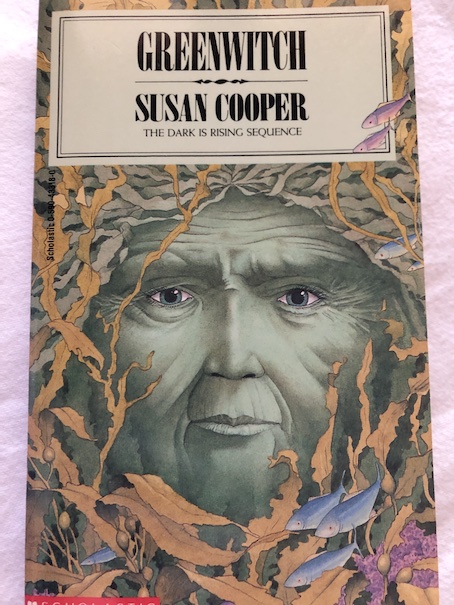
This is the third book in The Dark is Rising Sequence, and it brings together the two sets of characters who have already been established in the series: the three Drew children from the first book and Will Stanton and the Old Ones from the second book.
The story begins with the theft of the grail that the Drew children found in the first book with their Great-Uncle Merry, otherwise known as Merriman Lyon. The grail was stolen from the museum where it was being studied, and Merry wasn’t there because he was supposedly on an extended trip to Greece. However, when word of the theft spreads, Merry comes back to see the children. He is the only person other than the children who know that the thieves who took the grail were not ordinary thieves but agents of the Dark, the forces of evil. Merry say that he believes that they took the grail because it will lead them to something else that they’re seeking. He says that he will need the children’s help again and asks them to trust him. There will be danger, but he promises them protection. The children agree and accept Merry’s invitation to spend their holidays in Cornwall with him again.
Meanwhile, Will Stanton is bored because his older brothers and sister are off doing other things. Even though he is secretly one of the Old Ones and has great powers, he is also still the youngest in his family and feels left out of things that his older siblings are able to do. Then, a mysterious stranger arrives and introduces himself as Will’s Uncle Bill. Will was named after Bill, who is one of his father’s brothers and has been living in the United States for as long as Will can remember. Will’s parents are glad to see Bill, and Bill offers to take Will with him on a trip to Cornwall because a friend of his who is also staying there will have a couple of nephews about Will’s age staying with him. Will is eager to go, and his parents agree to let him.
Of course, the friend that Uncle Bill is talking about is Uncle Merry, and the nephews are Simon and Barney Drew, along with their sister Jane. At first, the Drew boys don’t like Will much because they think he’s going to interfere in their mission with their Uncle Merry, not knowing yet that Will has special powers and is directly involved in the fight against the Dark as their ally.
Shortly after they arrive in the village where the Drew children stayed in the first book, Will and Uncle Merry mention a pagan ceremony that is still being practiced in the area called the Greenwitch. Uncle Merry says that Jane may watch it, but not the boys because only women are allowed to attend the ritual. However, the dog Rufus that the children befriended on their last visit is kidnapped, and they are given the warning that the captain who owns him had better stay away from the Greenwitch if he wants him back. Unbeknownst to the children, the captain, who is the man who owns the house where they stayed last time, is another of the Old Ones.
Still, Mrs. Penhallow, the wife of a fisherman they met in the first book, invites Jane to come with her to see the Greenwitch being made. Jane doesn’t know what that means at first, but she goes to the ceremony anyway. Jane watches the local women weaving branches together to make a strange figure. It makes Jane uneasy because it doesn’t seem human but it has a kind of power. The women tell her that few people can sense its power but that people make wishes on it before tossing the Greenwitch into the sea for luck. Jane is given the opportunity to make a wish herself, and she finds herself wishing that the Greenwitch could be happy because she senses a loneliness about the figure. She feels a little silly for that wish after she realizes that she could have wished to find the grail again instead. One of the women there approves of the sentiment of Jane’s wish although she notes that it’s also a dangerous one because it’s difficult to know what might make someone happy. Some people find happiness in dark or dangerous things, but in this case, it might be a very good wish.
However, the forces of darkness are also targeting Barney. Barney has recently been developing artistic skills, like the children’s mother, and an artist who serves the Dark steals one of his drawings to gain control over him. The Dark needs Barney, at least for a short period, because he can do something that none of them can; Barney can look into the grail and tell them what he sees.
The book is available to borrow and read for free online through Internet Archive (multiple copies).
My Reaction
There are even more pagan references in this story than in the previous two. The Greenwitch is a fictional ceremony, but it seems like it’s based on or inspired by a kind of folk magic. It might be that the local women who make the Greenwitch are meant to represent a coven performing magic. I’m not going to go too deep into the history pre-Christian traditions because this isn’t a real ritual that I can trace and the history of neo-paganism is complicated. If you’re curious, I recommend watching this documentary about the life of Gerald Gardner, the founder of Wicca. I don’t really believe in Wicca myself, but I think Gerald Gardner is a delightful eccentric and fun to hear about. (Just don’t show the documentary to kids without watching it yourself. There are a couple of things in there that night not be suitable for young kids.)
It’s not all focused on the folklore of the British Isles, though. At one point in the story, the characters seek the help of Tethys, a figure from Greek mythology. The Greenwitch is meant as a tribute to her, so she has power over it, and the characters need something from the Greenwitch. This story introduces the idea that, although the stories are about the struggle between good and evil, Light and Dark, there are also some powerful, ancient forces that are not part of this struggle, including Tethys and the Greenwitch. These forces are neutral, and their neutrality requires that they neither help nor hinder either side in the struggle. Tethys and the Greewitch are among those neutral forces.
Part of this story also involves characters doing things they shouldn’t because they don’t have all of the information they really need to make better decisions. Ignorance and half-knowledge are annoying parts of stories like this, plot devices to allow characters to get into dangerous situations. It all works out for the best in the end, though.
The day before his eleventh birthday on Midwinter, Will Stanton has an uneasy feeling that something is about to happen. First, the rabbits that his family keep behave oddly. Then, other animals seem to be afraid of him when they never have before. When he and his brother James go to pick up some hay from Mr. Dawson, Mr. Dawson makes an odd comment about “the Walker” being abroad and that it’s going to be a bad night. Then, Mr. Dawson says that he has something for Will for his birthday. He gives Will an odd iron ornament and tells him to keep it safe and not talk about it with other people. Everything about this day seems odd to Will, but he accepts this unusual gift.
That night, Will has an increasing sense of terror, and a rook apparently breaks the skylight in his room during a snow storm. The next day, Will can’t seem to wake up his sleeping family. He puts on warm clothes and leaves the house with a strange feeling that this is somehow his destiny. Things in the area look different, as if he is now in a different time, sometime in the past. Eventually, he sees a man he knows who works for Mr. Dawson, John Smith. John Smith is working on horseshoes for a black horse that belongs to a mysterious stranger in a dark cloak. The mysterious stranger offers him food and a ride on his horse, but Will refuses both. The stranger gives him an uneasy feeling, and without really knowing why, Will says that he is looking for “the Walker.” The cloaked stranger tells him that “the Rider is abroad” and tries to grab him, but John Smith pulls him out of the way, and the stranger is angry. John Smith tells Will that he is just newly woken and will have to figure things out for himself but to trust his instincts today. A beautiful white horse appears, and John Smith says that Will can ride it, if he wants, but Will’s instincts tell him that he needs to go on alone. As he leaves, Will sees John Smith giving the white mare shoes that look like the iron ornament that Mr. Dawson gave him.
As he explores the countryside further, Will encounters a wandering tramp that he saw attacked by rooks the day before and confronts him as being “the Walker.” The Walker is defensive and suspicious, and he asks Will to show him “the Sign.” Will realizes that he must mean the iron ornament that he now wears on his belt, but before he can show it to the Walker, the Rider comes and frightens the Walker away. The Rider sees his Sign and comments that Will only has one of them so far, and that won’t help him much. Fortunately, the white mare comes and carries Will away from the Rider.
The white mare carries Will away into the hills, he has a sensation like he’s falling, and then, he finds himself alone in the snow near a pair of carved wooden doors that appear to be standing by themselves, attached to nothing. Will pushes on the doors and finds himself in what seems to be a great hall, hung with tapestries. There is an old woman and a tall man standing by the fireplace, and they greet him. Will tries to ask them about the doors and why they seem to be standing by themselves, but the doors have vanished behind him. The man says that Will’s first lesson is that nothing is what it seems to be.
The man introduces himself as Merriman Lyon (introduced in the previous book in the series), and he says that he and Will were born with the same gift, the power of the Old Ones. Now that it’s Will’s eleventh birthday, his gift is awakening, but he must learn how to control it. At first, Will doesn’t think that he has any particular gift, so Merriman shows him how he can receive mental pictures from someone else’s mind and send them a mental picture and how he can even put out a fire with his mind. Will becomes convinced that he does indeed have powers that normal boys don’t have. Merriman tells him that this gift is a burden, like many special gifts, but he was born with this gift for a special purpose.
Merriman says that he doesn’t want to tell him too much yet because the full knowledge of his destiny may be dangerous for him while he is still learning to use his gift. However, he does tell Will that he is actually one of the Old Ones, the first of his kind to be born in the last 500 years, and he will be the very last of them. Like other Old Ones, he will play a role in the battle between good and evil. His first role is that of the Sign-Seeker. He must find the six Signs and guard them. The iron ornament is the first Sign, but the others won’t be as easy to find.
Will returns to his family and his ordinary life, buying Christmas presents for his siblings for the coming holiday, but he knows that his life is no longer ordinary. He has much to learn about how to use his powers, and the sinister forces that pursue him to try to stop him from carrying out his mission.
The book is a Newbery Honor Book. It’s available to borrow and read for free online through Internet Archive (multiple copies). The book was adapted as a movie called The Seeker in 2007.
My Reaction and Spoilers
Fantasy books sometimes have to deal with the subject of religion and the relationship between magic and religion. This book also does so somewhat, but I noticed that it also seems to try to remove itself from consideration of the issue at the same time. At one point, Merriman discusses the idea of witches and witchcraft trials with Will, telling him that none of those involved were Old Ones, like the two of them. He says that everyone involved with witchcraft trials were ordinary humans, most of the people who were called “witches” were innocent victims although a small number were genuinely evil, and generally, the witchcraft trials were the result of human madness and irrationality, not genuine magic. In other words, readers don’t need to worry about trying to reconcile the power of the Old Ones with witchcraft because the author says that the two of them are two different, unrelated things.
Will and his family celebrate Christmas during the course of the book, and they go to church, so it’s apparently fine for an Old One to also be a Christian. Yet, there is a scene at church on Christmas where Will and John Smith have to stop the forces of the Dark attacking the church. The minister tries by calling on the powers of God and exorcising the evil spirits, but John Smith says that the minister’s efforts don’t work because “This battle is not for his fighting”, apparently indicating that the powers of Light and Dark as portrayed in this story are somehow outside of any religion or the interference of any god because they are forces that are completely unto themselves. The traditional Christian view would be that God commands the forces of good and light while the devil commands the forces of evil and darkness, but they’re saying here that’s not the case in this story. Will’s thought is that there is a place that exists out of time where all the Gods that ever were came from and also all of the forces and powers in the world, and it seems like some of these exist independently of each other, that they don’t have any beginning and so none of them is less old than any of the others. There is an element of pagan and folklore traditions that runs through these books, and I think that part of this concept references that, but I also see that looking at the battle between Light and Dark in this way, as being something independent of absolutely everything else, leaves the author of the stories free to have it play out in whatever way makes a good story without having to make it adhere to any rules and traditions other than the ones she’s chosen.
Of course, even fictional magic has to follow some rules in order to make logical sense to the readers. As I said, there are pagan and/or folklore traditions that are implied to be true or to have more significance than most people would suspect. Will uses holly as a form of protection for his home during Christmas. Aside from its association with Christmas, there are also many folkloric superstitions about holly. It is also revealed that part of what makes Will so special is that he is the seventh son of a seventh son, another concept from folklore.
A theme that is carried over to this book from the first one in the series is that evil can sometimes appear innocent and even friendly. People who have appeared as friends before can be revealed to be secretly evil or coerced to the dark side, even people who have been close before. Those who aren’t as in tune with the battle between good and evil may be fooled by friendly smiles, charming manners, and a pleasant appearance, but those who are aware of the difference between dark and light can feel when someone isn’t right.
There is one case in this book where a previously good person turns to the Dark because he feels betrayed about how Merry put his life at risk for the cause of the Light. I feel like this could have been avoided if Merry had been more honest with him in the beginning about the risks of what they were doing and the reasons why it was so important, but Merry seems to feel like it was all inevitable, something that was fated to be. Yet, at the end of this person’s life, Merry emphasizes that all of the choices this person made were his own, and although he went through much suffering because of things that had to happen as they did, he could have still had a better life even while undergoing his ordeals if he had made different choices along the way. I think I see what he means, that there are some things in life that are unavoidable but people can make them better or worse through their own choices and behavior, but I still feel like Merry set him up for this bad situation because he didn’t explain things properly when he should have. Maybe that was Merry’s bad decision, too?
Parts of this book actually reminded me of The Box of Delights, a vintage children’s fantasy book that also takes place at Christmas. In both books, Herne the Hunter, a character from folklore, makes an appearance, and the boys in each story get turned into different animals through their adventures with magical books.
The Drew family is spending the summer in Cornwall with their Great-Uncle Merry. Professor Merriman “Merry” Lyon isn’t really a relative, but a very old family friend who teaches at a university and has a somewhat mysterious past. Of the three Drew children – Simon, Jane, and Barney – Barney is the one most looking forward to their time in Cornwall because he loves Arthurian stories, and he is fascinated by Cornwall’s connections with King Arthur. Simon is more interested in watching boats.
One day, while the children are bored because it’s raining, they start playing at being explorers inside the house where they’re staying and discover a secret passage to a hidden room. There, they find an old manuscript that seems to be some kind of treasure map! It seems like parts are written in Latin, but even Simon, who has studied Latin in school, can’t read it all. At first, they wonder if they should tell their parents about it, but they decide not to, at least not right away, because their parents would probably tell them not to touch it because it doesn’t belong to them. They feel like they just have to figure out what it means and what it might lead to.
The family makes the acquaintance of a yacht owner, Mr. Withers, and his sister, and the two of them invite the whole family to go for a ride on their yacht. Mrs. Drew is an artist and wants to spend the day painting, so she declines, and so does Jane. Jane says that she’s afraid of getting seasick, but really, the Witherses give her an uneasy feeling. Jane feels like there’s something that’s not right about them, and it’s strange that Miss Withers asks them if they’ve found any secret passages in the house just after they actually found one. None of the children confide anything in Miss Withers. Mr. Withers seems oddly interested in the books in the house.
The next day, while her father and brothers go out on the yacht with the Witherses, Jane studies the manuscript and tries to figure out what it means. When she also finds an old guidebook to the area in an old trunk, she realizes that the map on the manuscript shows the area where they are staying, but there’s something strange about the coastline. The coastline on the old map is a slightly different shape. Jane wonders if one of the two maps could be wrong or if the coastline has changed somehow over the years because the manuscript looks very old.
Since the guidebook was written by the local vicar, Jane decides to go see him and ask him about the coastline and whether it’s changed over the years. She takes along the guidebook but not the manuscript. However, the vicar she meets says he’s the new vicar, not the old one who wrote the book. She talks to him about the book and the coastline anyway, but he gives her a bad feeling, similar to the one that the Witherses give her. The vicar discounts the idea of the coastline changing, and he asks Jane uncomfortable questions about the books in the house, pressing her for answers that she doesn’t have and doesn’t want to give him.
When the boys come back from the yacht, and Jane tells them about the guidebook and the vicar, Simon is irritated that Jane tried to investigate the manuscript without them, and he doesn’t think she should have talked to the vicar. Jane says that she didn’t tell the vicar about the manuscript, only the guidebook, and Barney says that what Jane learned is important.
The next morning, they wake up to find that the house has been ransacked. Books have been tossed all over in the middle of the night by someone who was clearly hunting for something. The children are sure that their mysterious intruder was searching for the manuscript, which is safe because Jane had it hidden in her bed. But, who was it? Was it the vicar or the Witherses? All of them seemed interested in old books and manuscripts, and they all seem suspicious. What is the real significance of the manuscript anyway?
Still not wanting to tell their parents or the police who were called to investigate the break-in, the children confide in Great-Uncle Merry about the manuscript and their suspicions. Uncle Merry knows more about the manuscript than the children know, and he tells them about a lost grail, a copy of the original Holy Grail, inscribed with the true story of King Arthur and about an ancient struggle between good and evil, a struggle that the children have now joined.
The book is available to borrow and read for free online through Internet Archive (multiple copies). The book was once adapted as a tv mini-series, but apparently, no copies of it survive.
My Reaction and Spoilers
This book is the first in a series about the struggle between good and evil, known as the Light and the Dark, and all of the other books in the series also draw on Arthurian legends. Merry and the children appear in other books, although not always together. Merry (the children sometimes call him Gumerry, which is short for Great-Uncle Merry) isn’t quite what he appears to be, which is how he knows things that other adults don’t know. There are hints in this book about Merry’s real identity, but it isn’t explained in this book, although Barney has a feeling that his name is a clue.
When Merry explains about the battle between good and evil, he says that the struggle has been going on for ages, and neither side ever completely wins or completely loses. It’s like that in this story, too. At first, I wasn’t completely sure whether they would actually find the grail or if it would turn out to be a MacGuffin, only existing to drive the action without it being really important whether it was actually found or not. The heroes do actually find and successfully retrieve the grail, but they also lose the manuscripts they’ve found before they can completely study them. It’s a victory, but not a total victory, and the villains are still around and may reappear in the future. This story ends in a way that indicates that this could have been a standalone book, which it might have been originally, before the author decided to continue the series, but the ending is also open, making the continuation of the series natural.
There are references to old folklore traditions throughout the story. I’ve never seen The Wicker Man, but I saw a comment on a YouTube video where someone compares a public festival from this story to a scene in The Wicker Man, so there may be the implication that this is a more ancient form of celebration with more significance than the modern characters think. In fact, old traditions and folklore from the British Isles also appear in various forms throughout the series, and there are references to pagan beliefs.
I didn’t like the part where the kids were pretending to be explorers, and they were talking about acting out one of those scenes with “rude natives” (Simon’s words, and even he has to admit that he doesn’t quite know what it means when Barney asks him, although he’s aware that it’s a different sort of “rude” from the word meaning “impolite”) who want to make them gods and encountering cannibals. That type of scene always annoys me in books, and I’m sure that they’re referencing some of the vintage books I’ve read where that happens or ones very much like them. It’s really my only complaint about this story. Fortunately, that part doesn’t last very long because the kids find the manuscript and get on with the fantasy story.
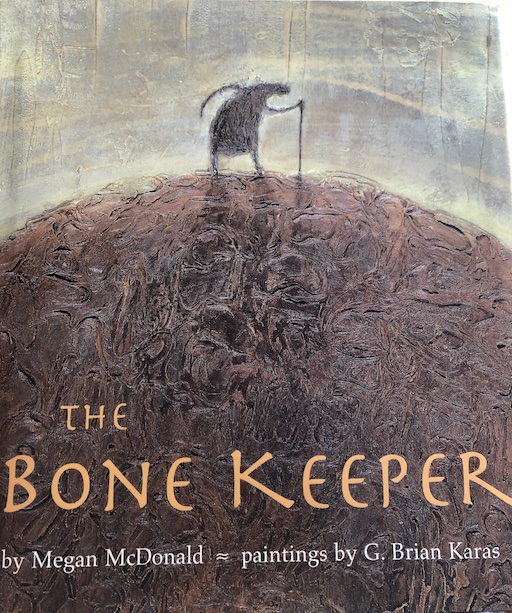
The Bone Keeper by Megan McDonald, paintings by G. Brian Karas, 1999.
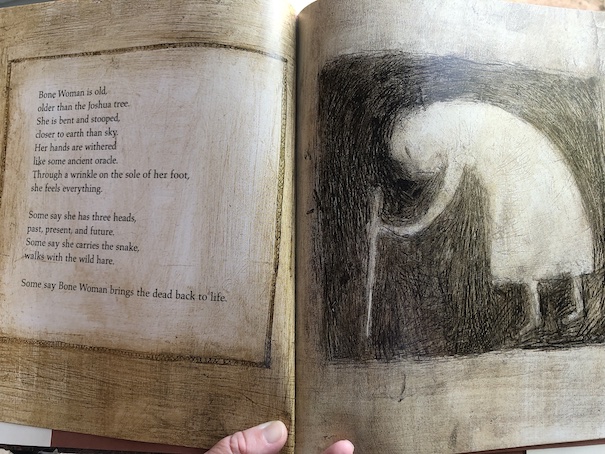
The story in this picture book is written as an unrhymed poem and illustrated with paintings that resemble paintings on a cave wall.
Bone Woman is a strange old woman. She is ancient, legendary, may have powers to bring back the dead, and lives in a cave full of bones.
She spends her time searching for bones in the desert sand. She collects the bones, studies them, and arranges them to form complete skeletons.
When she manages to complete a skeleton, she performs a ritual to bring the creature back to life!
The book is available to borrow and read for free online through Internet Archive.
My Reaction
This is one of those picture books that I think would actually be appreciated more by adults than by children. The poetry and art style seem more sophisticated than the styles that children seem to prefer. Most of the pictures are not very colorful, using a lot of grays and browns and black, although the art style is unusual and fascinating, looking like paintings and drawings scratched into rock.
I think kids could understand the action of the story – a strange old woman who lives in a cave collects bones, assembles them into skeletons, and can use them to bring animals back to life. It’s a strange story, partly because there is no explanation about why she is doing this.
One of my regrets about this book is that it doesn’t explain the background of this story. I had expected that there would be a section at the back of the book that would explain more, but there isn’t. From the context – the pictures, the style of the story, the names that the woman is called, and the fact that the artist thanked the Phoenix Public Library and the Heard Museum (both places that are familiar to me) in the dedication – adults can figure out that this is a story from folklore, but it’s not immediately clear what kind of folklore. Anyone who doesn’t already know the story might be confused. I didn’t know this story when I read the book, so I had to look it up.
The story of the Bone Woman has been told and referenced in other books. The story of La Huesera (the Bone Woman) is a Mexican folktale. Sometimes, it’s also called La Loba (the Wolf Woman) because that is the animal that she particularly wants to resurrect. The Bone Woman is a “wild woman” or a “crone” who uses a kind of natural magic to bring life to lifelessness and restoring what was lost.
More Scary Stories to Tell in the Dark collected from folklore and retold by Alvin Schwartz, drawings by Stephen Gammell, 1984.
This is the second book in a series of popular ghost stories and American urban legends. Many of us who were children in the 1980s and 1990s heard these stories on school playgrounds, at summer camps, or at sleepovers, even if we didn’t read them in this book first. I found the stories in the first book in the series to be more familiar to me from my childhood than the ones in the second book, but there are still many popular and familiar ghost stories here. There is a section at the beginning of the book where the author/compiler discusses why stories like these have been popular for generations. In the back of the book, there is another section with more detailed information about the origins of the stories and their variants.
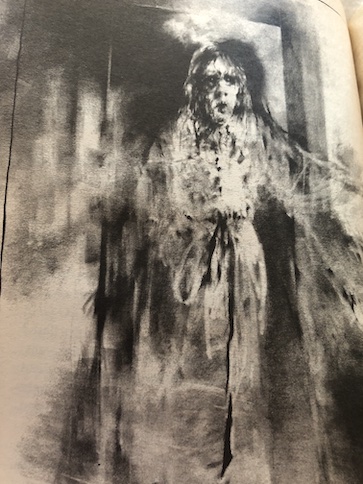
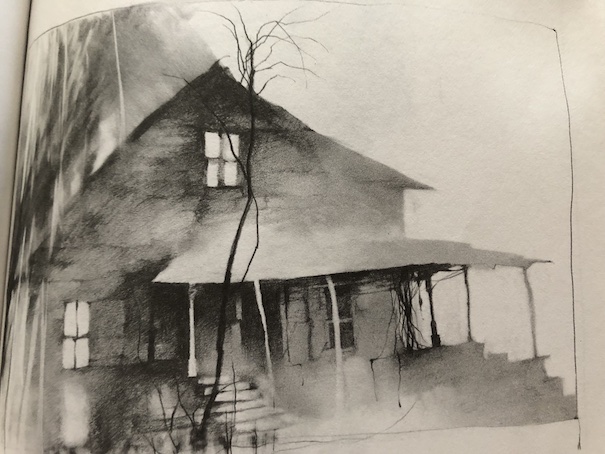
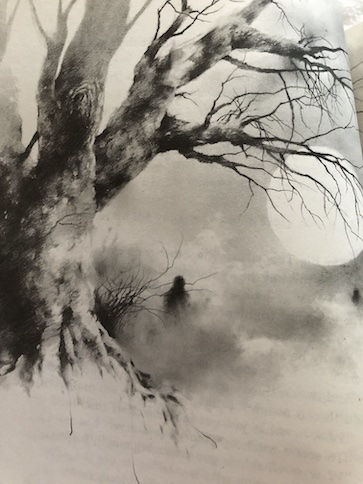
The drawings in the book also complement the stories well. They’re all in black-and-white and have an ethereal look, as those they were composed of spirits or smoke.
The book is available to borrow and read for free online through Internet Archive (multiple copies).
Stories Included in the Book:
The stories are divided into sections by theme or by the effect that the stories are supposed to have.
When She Saw Him, She Screamed and Ran
This section has stories about ghosts.
Something Was Wrong – A man is walking down the street, but for some reason, everybody is afraid of him. What’s wrong?
The Wreck – A guy meets a girl at a dance … only to learn that she was killed before she got there.
One Sunday Morning – A woman goes to church on Sunday but discovers that this isn’t a normal church service.
Sounds – Some fishermen take shelter in an empty house during a storm and hear the sounds of a past murder.
A Weird Blue Light – The crew of a ship during the Civil War witness something very strange, possibly the ghost of a pirate ship.
Somebody Fell From Aloft – The ghost of a murdered sailor gets his revenge.
The Little Black Dog – A murderer is followed by the ghost of a dog.
Clinkity-Clink – A grave digger steals the silver dollars laid on the eyes of a corpse, but the dead woman wants them back. (This story is supposed to end with a jump scare, like ghost stories told aloud around a camp fire.)
She Was Spittin’ and Yowlin’ Just Like a Cat
This is a selection of strange stories about different topics.
The Bride – The famous story about a bride who plays hide-and-seek and accidentally gets locked in a trunk.
Rings on Her Fingers – A thief tries to steal the rings from a dead woman, only she may not be quite as dead as everyone thinks.
The Drum – Two young girls meet a gypsy girl with a special drum that controls dancing figures. The girls want the drum, but the gypsy girl says that she’ll only give it to them if they do bad things.
The Window – One dark night, Margaret sees something with glowing eyes outside her window. What is it?
Wonderful Sausage – A butcher murders his wife and turns her into sausage.
The Cat’s Paw – A woman turns herself into a cat.
The Voice – A girl hears a voice in her room at night, but nobody is there.
When I Wake Up, Everything Will Be All Right
This section has stories about dangerous and scary places.
“Oh, Susannah!” – A university student thinks her roommate is humming at night, but her roommate is already dead.
The Man in the Middle – A girl sees three men on the subway late at night, but something’s wrong with the one in the middle.
The Cat in a Shopping Bag – A woman accidentally runs over a cat, and she puts the body in a bag to dispose of, causing a thief to get a terrible shock.
The Bed by the Window – A room at a nursing home has only one bed by the window. When one man kills another to get the view, he gets a shock.
The Dead Man’s Hand – A group of nursing students resent a fellow student who seems too perfect and decide to play a prank on her.
A Ghost in the Mirror – This story explains the spooky sleepover game Bloody Mary. Kids (typically girls) go into a dark or diml-lit room and look in a mirror to see a scary face appear. (This is actually a psychological trick, sometimes referred to as the “strange-face illusion“. Humans instinctively look for faces and facial emotions, and when someone can’t see their own face in the mirror very well because the room is too dim, their mind will try to reconstruct the missing details and interpret them, creating some strange illusions, like it’s someone else’s face when it’s just their own. The book doesn’t explain that, but that’s basically what “Bloody Mary” really is.) In the game, the identity of “Bloody Mary” and what she’ll supposedly do if you see her varies. This story explains different versions of the ghost story associated with the game.
The Curse – A fraternity initiation results in the deaths of two pledges and a curse on the remaining members.
The Last Laugh
This section has spooky stories with a humorous twist.
The Church – A man takes shelter in an abandoned church during a storm and thinks that he sees ghosts inside, but they aren’t what they appear to be.
The Bad News – Two old friends who love baseball and wonder if there’s baseball in heaven. There’s good news, and bad news.
Cemetery Soup – A woman makes soup with a bone she finds in the cemetery.
The Brown Suit – A woman thinks that her dead husband would look better in a brown suit for his funeral, and the funeral parlor comes up with a bizarre solution.
BA-ROOOM! – A spooky song.
Thumpity-Thump – People move into a spooky house and hear a mysterious thumping noise.
Scary Stories to Tell in the Dark collected from folklore and retold by Alvin Schwartz, drawings by Stephen Gammell, 1981.
This collection of creepy stories was a popular staple of my childhood! The stories included in the book are not original stories but popular ghost stories and American urban legends that were spread around by word of mouth before being collected and written down. Many of us who were children in the 1980s and 1990s heard these stories on school playgrounds, at summer camps, or at sleepovers, even if we didn’t read them in this book first. The very popularity of these stories was part of the popularity of this particular book and others in its series. The stories were frightening yet familiar, and reading them as an adult brings a sense of creepy nostalgia and Halloweens past. There is a section at the beginning of the book where the author/compiler discusses why stories like these have been popular for generations. In the back of the book, there is another section with more detailed information about the origins of the stories and their variants. The back of the book recommends these stories for ages 9 and up.
The drawings in the book also complement the stories well. They’re all in black-and-white and have an ethereal look, as those they were composed of spirits or smoke.
The book is available to borrow and read for free online through Internet Archive (multiple copies). There is also an audiobook copy.
Stories Included in the Book:
The stories are divided into sections by theme or by the effect that the stories are supposed to have.
Aaaaaaaaaaah!
This section has stories that are meant to make listeners jump at the end, like the kind people like to tell around camp fires, and there are tips for how to deliver the jump scares at the end.
The Big Toe – A boy finds a toe that seems to be growing in his garden, and his family decides to eat it (God only knows why), but that’s just the tip of something bigger …
The Walk – Two men walking down a road are each frightened by each other.
“What Do You Come For?” – A ghostly man comes down the chimney, part by part … and he comes for YOU!
Me Tie Dough-ty Walker! – A boy and his dog wait for a ghostly head that falls down a chimney.
A Man Who Lived in Leeds – A spooky rhyme.
Old Woman All Skin and Bone – A popular spooky song.
He Heard Footsteps Coming Up the Cellar Stairs
These are all stories about ghosts.
The Thing – Two friends see a frightening thing crawl out of a field, and it turns out to be prophetic.
Cold as Clay – A farmer separates his daughter from the man she loves, but when the man dies, his ghost makes sure that she gets safely home.
The White Wolf – When wolves are killing farmers’ livestock, a man becomes wealthy by hunting them. Then, a ghostly wolf takes its revenge.
The Haunted House – A preacher rids a haunted house of its ghost and brings her murderer to justice.
The Guests – A pair of travelers are looking for a room for the night. An elderly couple offers to let them stay in their house, but the travlers get a shock the next morning.
They Eat Your Eyes, They Eat Your Nose
These are an assortment of stories, and some are kind of gross-out stories. I never liked the gross-out scary stories when I was a kid, but I know some kids were really into them.
The Hearse Song – An old, traditional scary song that has several variations. “Don’t you ever laugh as the hearse goes by, For you may be the next to die.”
The Girl Who Stood on a Grave – Some kids at a party say that the graveyard down the street is scary, and one of them claims that if you stand on a grave, the person inside will reach up to grab you. A girl at the party doesn’t believe it and accepts a bet to go stand on a grave with frightening results.
A New Horse – A farmhand tells his friend that a witch turns him into a horse and rides him at night, and his friend finds a way to put a stop to it.
Alligators – A woman claims that her husband turns into an alligator at night and is turning their two sons into alligators as well. People don’t believe her, but there’s more truth to her story than they know.
Room for One More – A man has a prophetic dream that saves his life.
The Wendigo – A man on a hunting trip hears the wind calling to his companion. What does it mean?
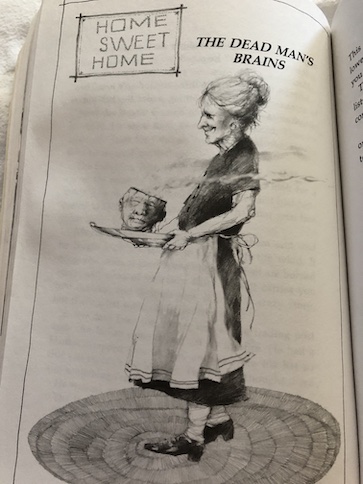
The Dead Man’s Brains – This story is actually played as a game, and it’s especially popular on Halloween. Many of us have played some version of the game, where someone describes the body of a dead person, giving people weird and creepy things to feel that are supposed to be body parts. In reality, the “body parts” are common things, usually food, like peeled grapes to represent eyes, etc.
“May I Carry Your Basket?” – A man walking home late at night helps a strange woman to carry her basket, but what’s inside the basket is truly terrifying!
Other Dangers
These are more modern horror stories and urban legends than the earlier ones in the book, and they focus less on old ghosts and more on the dangers of modern society.
The Hook – This is a popular story at camps and sleepovers! A young couple is listening the radio in their car when they hear about an escaped murderer. The girl gets frightened and wants to go home, and it’s only when they get there that they realize how close they came to being his next victims.
The White Satin Evening Gown – A girl wants to go to a dance but doesn’t have much money for a dress to wear. When she finds a dress that she can rent cheaply, it turns out that there is something very wrong with it.
High Beams – A girl realizes that she’s being followed as she drives home alone at night, but her pursuer isn’t the one she should be afraid of.
The Babysitter – A young babysitter keeps getting strange calls … and they’re coming from inside the house.
Aaaaaaaaaaah!
Even though this section has the same name as the first section, the stories in the final section of the book have humorous twists.
The Viper – One of my old favorites! The characters in The Haunting of Grade Three tell this story to each other. A woman keeps getting calls from a man calling himself “the viper.” Who is he, and what does he want?
The Attic – Rupert is looking for his dog when something happens to him on the way to check the attic that makes him scream.
The Slithery-Dee – A short rhyme.
Aaron Kelly’s Bones – Aaron Kelly is dead, but he doesn’t feel dead enough to stay in his coffin and won’t go back there until he does.
Wait Till Martin Comes – What will the cats do when Martin finally comes?
The Ghost with the Bloody Fingers – When dealing with a ghost, sometimes the practical approach is best.
The First Book of Tales of Ancient Egypt by Charles Mozley, 1960.
The book begins with a section “About this book” that introduces the stories, but I felt like it could have said a little more. The introductory section points out how amazing it is that these folktales and myths from Ancient Egypt have survived thousands of years to reach us, but there’s a bit more to the story than that. For a long time, people were unable to read texts written in Ancient Egypt because knowledge of ancient writing was lost when Egyptian culture changed and developed new writing systems. Modern people eventually regained the lost knowledge of Ancient Egyptian writing when the Rosetta Stone was discovered because the Rosetta Stone contains the same message written in three different systems of writing – Ancient Greek, Ancient Egyptian hieroglyphics, and Ancient Egyptian demotic script. Because European scholars knew Ancient Greek at the time the Rosetta Stone was discovered, they were able to use the Ancient Greek portion of the stone to learn how to read the rest of it. It took years of study for them to fully understand not only the message on the stone in all three writing systems but to learn to apply the rules of Ancient Egyptian writing to other messages and carvings and decipher what each of them meant. Even in modern times, scholars are still working on translations of Ancient Egyptian writing and publishing new books of Ancient Egyptian stories that modern people have not read in English. It’s not just that these stories have survived for thousands of years to reach us; it’s also that people worked very hard to learn exactly what did survive for those thousands of years and make it possible for ordinary people to understand it. This book for children would not have been possible without many years of scholarly research.
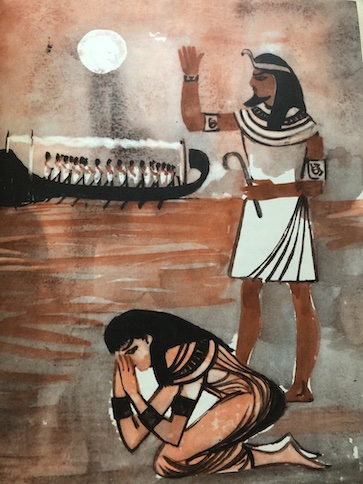
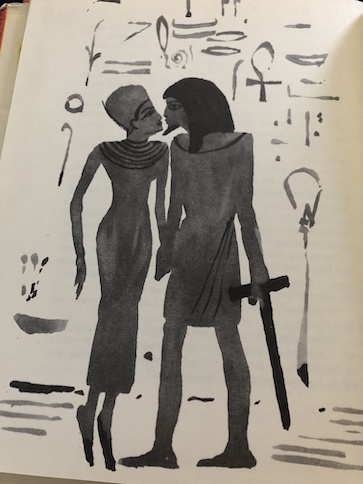
The pictures in the book are sometimes monochromatic in different colors and sometimes full color.
The book is available to borrow and read for free online through Internet Archive.
The stories in the book are:
The Magic Crocodile – When King Khu-fu is bored and nothing seems to please him, his sons tell him stories to amuse him.
In his first son’s story, in the distant past, during King Nebka’s reign, magic was commonplace, and King Nebka had a young magician named Uba-na-ner at his court. At first, the magician was very happy, but then, the woman he was going to marry ran off with another man. Angry, the young magician made a magical crocodile out of wax and sent it to attack his former fiance’s new husband. After the crocodile killed the new husband, the magician’s former fiance went to the kind and accused the magician of murder. Faced with the king’s questions, the magician confessed what he had done. The magician expressed remorse and turned over the box where he kept the wax crocodile. The king pardoned him because of his remorse but hid the box with the wax crocodile so it couldn’t be used again. That seems to be letting a magical murderer off lightly, and King Khu-fu doesn’t find the story very interesting.
In the second son’s story, there is a powerful wizard named Zaza-man-khu in the reign of King Sene-fe-ru. When Sene-fe-ru is feeling down, he asks Zaza-man-khu for something to cheer him up. Zaza-man-khu suggests a boating trip on the palace lake, rowed by singing maidens. At first, the trip is pleasant, but then, something happens that upsets all of the maidens, and they stop singing and start crying. Soon, everyone is crying so hard that it’s difficult for the king or his wizard to find out what’s wrong. It turns out that one of the maidens lost a precious jewel in the water, and it was some kind of lucky amulet. Now, she’s worried that something bad will happen to her, and all of the other girls are crying in sympathy with her. The king promises that he will give the maiden plenty new jewels if she stops crying, but she says that she needs that particular amulet, and none of the other maidens will start rowing the boat again until they figure out what to do. The king’s wizard is able to retrieve the lost jewel by parting the waters in the lake so he can walk out across the bottom of the lake and find it. King Khu-fu finds the story mildly interesting and says that it would be impressive if there was such a wizard in their time.
King Khu-fu’s eldest son says that he knows of such a wizard, a man named Didi, who is supposed to be 110 years old. Interested at last, King Khu-fu says that he wants to meet Didi. According to stories about Didi, he can restore life to a person or animal after it’s been beheaded, but how far will they make him go to prove it?
Isis and the Secret Name of Ra – This story explains the origins of the goddess Isis. In the beginning, Isis is not a goddess but a clever young woman. Although she is clever and has extensive magical knowledge, it isn’t enough for her. She wants to learn the secret name of the sun god Ra (Ra isn’t the secret name itself) to gain power over the whole world. People call Ra by many different names, but Isis is aware that he has one secret name that no one knows and from which he derives his power. Isis creates a magical snake that bites Ra, and Ra experiences pain for the first time. Isis offers to help heal him from the bite (that she caused), but she says that she needs to know Ra’s secret name. Ra says that if she knows the name, she will also become immortal, and Isis says that she’ll try to bear it (wink, wink). So, Isis becomes immortal and heals Ra from the poisonous snake wound.
After she becomes a goddess, Isis continues living as a mortal woman for awhile, but then she marries King Osiris. Osiris is a great king who teaches his people how to farm, and Isis teaches them healing arts. Their kingdom is great and peaceful, and Osiris and Isis have a son they name Horus. For a long time, no one, not even Osiris, knows that Isis is actually an immortal goddess. However, Isis’s powers allow her to sense evil and deception from Osiris’s jealous brother, Set. Osiris can’t believe that his brother is evil. Then, Set tricks Osiris into getting into a chest and throws him into the river and drowns him.
When Isis realizes what has happened, she realizes that she has the power to restore Osiris to life. At first, Isis is unsuccessful in her attempt to bring Osiris back to life because too much time has gone by since his death, but Thoth, the god of wisdom, has pity on her and Osiris and raises Osiris to serve as king of deserving spirits among the dead.
King Setnau and the Assyrians – King Setnau is a gentle and peaceful king, so even though Egypt has enemies, he does not try to improve Egypt’s army. Although most citizens love King Setnau, his generals don’t. When the King of Assyria decides to invade, seeing Egypt as easy prey, the angry Egyptian army refuses to obey the king and fight for Egypt. In despair, King Setnau prays at the temple and then tells his people about the army’s refusal to obey him. The ordinary citizens decide that they will be the king’s new army themselves. They are untrained and have mostly improvised weapons, and Egypt’s official army doesn’t take them seriously. However, King Setnau is appreciative of their loyalty and prays the he will be a suitable leader to them so they can save their kingdom. In the end, they are successful with a little help from the gods and a swarm of field mice.
The Wonder Child – King Usi-ma-res has a son who is a wise sage, Sat-ni. However, Sat-ni is unhappy because he and his wife have been unable to have a child, and they want one more than anything. Sat-ni’s wife prays for a child, and finally, she gives birth to a son, Se-Osiris. Se-Osiris turns out to be remarkably intelligent and learns very quickly. As he progresses in his studies, he begins learning magic, and by the age of twelve, he is already a master magician.
One day, a man from Ethiopia comes to the pharaoh’s court with a challenge: he has a sealed book and he wants to see Egyptian wizards attempt to read the book without breaking the seal. The pharaoh consults with all of his wizards and magicians about the book challenge, and Sat-ni says that he suspects that the book and its contents are protected by some kind of spell that will prevent the Egyptian wizards from reading it. However, Se-Osiris insists that he can read the book. To demonstrate, he proves to his father that he can read any book from his father’s library even though he has never seen it before while his father holds it sealed in another room. Pleased and amazed with his son’s skill, Sat-ni brings Se-Osiris to court to answer the challenge.
At first, the Ethiopian man sneers at the young boy who claims that he can answer his magical challenge, but the pharaoh says that it’s a sign of how great Egyptian magic is that even a twelve-year-old Egyptian can answer any challenge that Ethiopia could set. In front of everyone, Se-Osiris reads the book without even touching it, telling an ancient story about three Nubian magicians and their boasting of the ways that they would punish the King of Egypt for the amusement of their king and how the King of Egypt gets revenge.
However, the story doesn’t end there. The mysterious Ethiopian turns out to be the spirit of one of the magicians from the story in the book, who was disgraced through the magic of the Egyptian magicians and who has come back to settle the score. Se-Osiris must now face him in a magical duel.
The Thief and the King’s Treasure – King Rhamp-si-ni-tes loves gold and treasure more than anything. He loves it so much, he allows criminals and corrupt official to buy their way out of trouble. The king compromises law and justice in the land, thinking only of getting more gold and jewels. He neglects the state of his kingdom and even his own daughter. Soon, the king also becomes paranoid, constantly afraid that someone might take some of his beautiful treasures. Finally, the king hires an architect to design a safe place to keep his treasure, a vault no thief could enter.
However, the king is a terrible ruler and also a dishonest man. He pays the architect only a fraction of the money he promised him, so the architect clever engineers a secret entrance to the treasure vault so he and his sons can enter any time they want and help themselves to the money that the king owes them and all of his other subjects.
For awhile, it works, but then, the king notices that someone has been taking some of his treasures. He has some metal workers build a terrible mantrap that traps one of the architects sons. When it becomes clear that he is hopelessly trapped and their whole family may suffer the king’s wrath once he realizes who has been stealing from him and how it was done, the trapped son tells his brother there is only one, terrible solution – his brother must cut off his head. The trapped brother will die anyway because the king will have him killed, but if his brother removes his head, no one will be able to identify him, and the rest of their family will be safe. Reluctantly, his brother does as he asks.
However, the fact that the head was removed from the body tells the king that the dead thief must have had a confederate. He has his guards display the body of the thief publicly on a hill and watch for anyone who shows grief at seeing it. The dead man’s mother quietly grieves at the loss of her son, and when she says that she wants to see her son properly buried, his brother figures out a clever way to retrieve the body.
The king is enraged, but his neglected daughter decides that she also wants to find the thief, seeing it as her chance to secure her future in spite of her father’s neglect. She promises her father that she can find the thief but only if he promises her that she can have whatever she wants afterward. The king promises, not realizing that the one thing that the princess wants is to marry the thief.













 Jestress's Forgotten Books and Stories