The Ninth Jewel of the Mughal Crown

BirbalTales

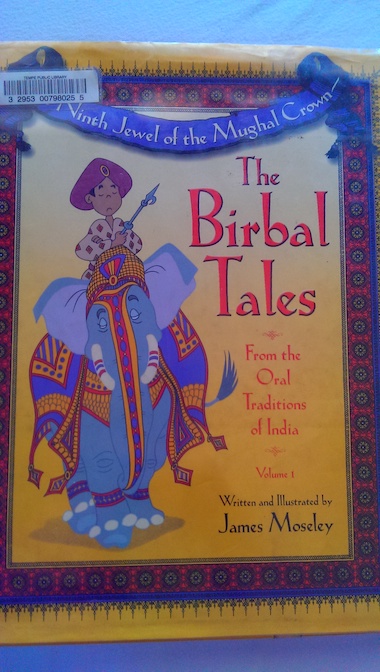
The Ninth Jewel of the Mughal Crown: The Birbal Tales by James Moseley, 2001.

BirbalTalesRealBirbalThe characters in the stories, Emperor Akbar and his friend and advisor Birbal (birth name Mahesh Das) were real people who lived in India during the late 16th century. Over the years, stories and legends have grown up around them, although the truth is pretty incredible by itself.

This book, which is a collection of some of the stories about Akbar and Birbal, begins by explaining a little about their history, and there is another section in the back that explains more about their lives.  The book’s introduction says that Akbar’s father died when he was young and that Akbar’s reign was considered a Golden Age in India’s history, although it mostly focuses on his “Nine Jewels.”  The section in the back gives a little more context.

To begin with, Akbar was one of the Mughal Emperors.  The book doesn’t explain much about what that means, but understanding it helps to set the stage for the stories.  The Mughal Empire consisted not only of modern day India but also some of the surrounding countries.  The empire was first established by Akbar’s grandfather, Babur, through conquest.  Babur was born in the region that we now call Uzbekistan, although his family’s origins were Mongolian.  They were distantly descended from Genghis Khan.  They were also descended from Tamir (sometimes called Tamerlane), giving them Turkic and Persian connections.  The early years of the Mughal Empire were unstable, but when Akbar’s father died and Akbar became emperor at a young age, his regent helped him to stabilize the empire and expand it through a mixture of further conquest and diplomacy.  The reputation of wealth and power in the Mughal Empire eventually led to the adoption of the word “mogul” in English to describe a wealthy and powerful person, especially one who has high standing in a particular field of expertise (something which, as you’ll see, was of particular importance to Akbar).  Using the riches and resources gained through his territorial expansion, Akbar worked to develop the economy of his empire and to support the arts and learning.

BirbalTalesRealAkbarAkbar had a great love of learning, but unfortunately, was dyslexic at a time when people didn’t understand the condition very well.  (To put it into context, Akbar was a contemporary of Elizabeth I of England.)  Even though, like the European Emperor Charlemagne (who lived much earlier but was also apparently dyslexic), he wanted to learn to read, he struggled with it throughout his life because of his condition.  Akbar didn’t want his reading difficulties to interfere with his learning or his love of the arts, so he found another way around the problem.  In a way, it’s similar to what Charlemagne did, surrounding himself with learned advisors who would read to him and discuss important topics with him, verbally teaching him whatever he wanted to know.  Akbar chose his advisors very carefully, seeking out people who had demonstrated excellence in subjects that were important to him. Akbar’s advisors became famous for their fascinating and unusual skills and personalities.  He had nine special advisors who were close to him, which is why they were called, “The Nine Jewels of the Mughal Crown.”  Legends grew up around these men and their abilities:

Tansen – An expert in music, whose singing voice was said to be so amazing that he could make candles burst into flame with a song.

Daswant – A master painter.

Todar Mal – An expert in finance.

Abul Fazl – A great historian.

Faizi – Brother of Abul Fazl, a famous poet.

Abud us-Samad – A master at calligraphy, he also designed the imperial coins.

Man Singh – A great military general.

Mir Fathullah Shirazi – A man of many skills, including the fields of medicine, astronomy, philosophy, and finances.

Birbal – Akbar’s Minister or Raja, who had a reputation for cleverness, quick wit, and the service of justice.  He was the “Ninth Jewel”, and his stories are the focus of this book.
BirbalTalesMeetingThere are many more stories about Birbal than the ones included in this book, but they are all about how Birbal uses his wits to serve Akbar and aid the cause of justice.  Like all good legends, the stories are partly based in fact, but have grown with each retelling to the point where it can be difficult to say where the real people leave off and the legends begin.

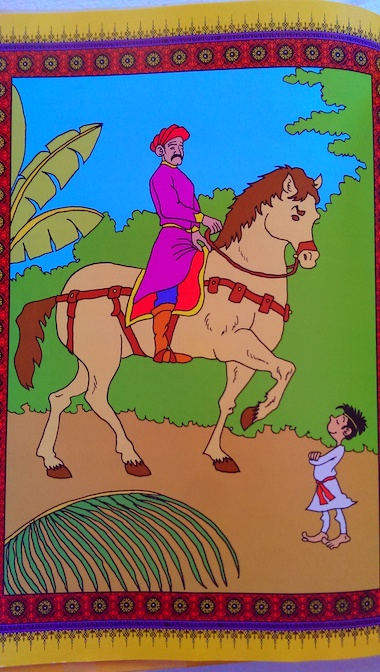
In the first story in the book, Akbar meets Birbal when he is still a child.  Fascinated by the boy’s combination of courtesy and boldness and his unusual wit, he gives the boy a ring and tells him that when he is grown, he should come to his palace at Fatehpur Sikri.  Years later, Birbal does go there, but when he shows the ring with the emperor’s seal on it to the guard on duty, the guard refuses to let him in until he promises to give him half of whatever the emperor gives him.  When Akbar sees Birbal, he is pleased to meet him again but stunned when Birbal asks him to give him 100 lashes.  When Birbal explains the reason for his bizarre request, it not only gets the laughter of the court, but the approval of Akbar, who appreciates this bold approach to the problem of bribery.

BirbalTalesPortraitFrom then on, Birbal gains a reputation for his ability to mediate disputes and find unusual solutions to problems.  His favored position at court gives him some jealous enemies, but he handles them with the same cleverness that he uses to solve every problem.

In one of my favorite stories, one of the noblemen at court attempts to cheat Daswant out of his rightful fee for painting his portrait by changing his appearance (shaving his beard, shaving his mustache, etc.) after each portrait sitting and then claiming that the portraits Daswant paints do not really look like him.  When Daswant explains the situation to Birbal, he gets the nobleman to promise to pay for an “exact likeness” of himself in the presence of Akbar.  Then, Birbal shows him a mirror, which Akbar agrees contains an exact likeness of the nobleman and deserves payment.

BirbalTalesCoinPurseIn another of my favorite stories, Birbal determines who is the true owner of a coin purse when a flour merchant and an oil merchant each claim that it belongs to them.  He pours the coins into a pot of boiling water and notes the oil that bubbles to the surface.  Because the coins are covered in oil, they obviously belong to the oil merchant.  If they had belonged to the flour merchant, they would have been covered in flour.

One of the interesting aspects of Akbar’s friendship with Birbal was their religious differences.  Akbar, like the rest of his family, was Muslim, and Birbal was from a family of Hindu Brahmins. The Mughal Empire was a multi-cultural society, and Akbar was aware of it.   At one point, he attempted to develop a new religious movement that combined aspects of Islam and Hinduism in order to further unite his subjects, but it never caught on as a mainstream religion, possibly because Akbar’s own strong personality as its leader was one of the most attractive features.  Akbar did seem to genuinely believe in religious tolerance and promoted widespread education among his subjects.

Birbal, the historical person, was eventually killed in battle, and Akbar greatly mourned his loss.  The Mughal Empire continued for generations beyond Akbar, although it eventually collapsed through a combination of military, administrative, and economic decline; the decentralization of power in the empire; internal discord; and interference from outsiders that paved the way for the British colonization of India.  That’s kind of a simplistic description of a long, complicated period of history, but the end of the Mughal Empire was marked by the beginning of British rule in India.  In 1858, the British East India Company deposed the last of the Mughal emperors, sending him into exile, around 300 years after the reign of Akbar began.

The Blind Men and the Elephant

BlindMenElephant

The Blind Men and the Elephant retold by Lillian Quigley, 1959.

This story is based on an old folktale from India.

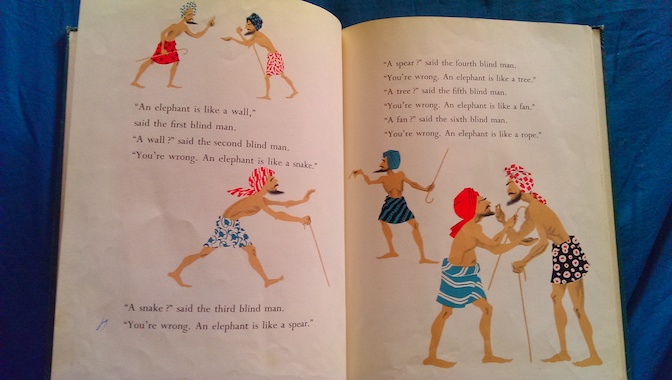
Six blind men, who all live together, realize that although they have heard a lot of people talk about elephants, none of them has ever seen one and that they don’t really know what elephants are like.  They have heard that the Rajah, whose palace they live near, has many elephants, so they decide to go to the palace to learn more about them.

BlindMenElephantCourtyard

When they reach the palace, where a friend of theirs works, there is an elephant in the courtyard, so the blind men start feeling it with their hands.  Because the elephant is large, each of the men ends up feeling a different part of the elephant and coming to different conclusions about what the elephant is like.

BlindMenElephantImpressions

As they stop to take a rest, they begin arguing about their conclusions because their experiences of the elephant were very different from each other’s.  When the Rajah hears them arguing, he explains to them that the problem is that each of them is only talking about one part of a very large animal and that if they really want to know what elephants are like, they must consider all the pieces together.  Recognizing the wisdom of what the Rajah says, the men sit down and discuss what they’ve learned more calmly.

BlindMenElephantArgument

The book doesn’t explain the background of the story, but the folktale is famous and is often used to describe situations where people each understand only part of a larger truth or where people stubbornly argue about very complicated issues from very limited viewpoints without considering all sides.

BlindMenElephantEnd

Clever Tom and the Leprechaun

CleverTom

Clever Tom and the Leprechaun by Linda Shute, 1988.

This picture book is based on an Irish folktale, The Field of Boliauns.

Tom Fitzpatrick thinks that his fortune is made when he is lucky enough to catch sight of a leprechaun one day.  If a person can manage to catch hold of a leprechaun and frighten him, the leprechaun will hand over his gold.  Tom thinks of himself as a clever man, so he doesn’t see how he could fail.

CleverTomCapture

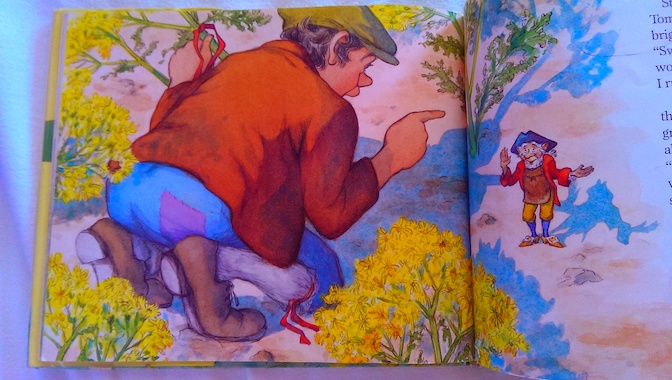
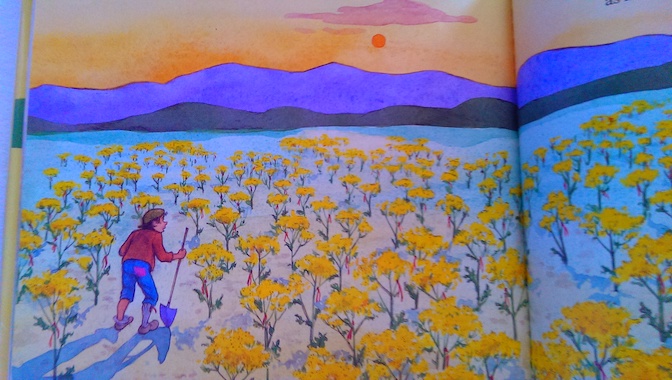
Tom does capture the leprechaun, and the leprechaun does promise to show him where his treasure is buried.  The leprechaun directs Tom to a field of boliauns (a kind of weed, also known as ragwort or ragweed) and points out the plant which marks the place where he buried his treasure.

CleverTomField

Tom needs to get a shovel to dig for the treasure, but he worries about whether he’ll correctly remember the spot when he gets back.  He takes off one of his red garters and ties it on the plant so he’ll be able to find it again, making the leprechaun promise not to touch it while he’s gone.

CleverTomGarter

The leprechaun promises not to touch the garter, but Clever Tom isn’t quite as clever as the leprechaun.  When Tom gets back to the field with his shovel, he’s in for an unpleasant surprise.

CleverTomTrick

Clever Tom might not have his fortune made after all, but he has a great story to tell to the younger generation.

CleverTomTaleTelling

In the back of the book, there is a section with more information about the folk tale, Irish legends and leprechauns, and Irish culture and history.  One of the things I found interesting was the explanation that the leprechaun in the picture book is wearing a red coat because that’s how they are described in Irish folklore.  It’s usually the Trooping fairies who are described as wearing green, like we often see leprechauns depicted in St. Patrick’s Day decorations.  The stories of buried gold left by leprechauns may also may also be based on treasure hoards left by Viking raiders during the Early Middle Ages.  The leprechaun in this story also has ale made from heather, which is something that only Danish Vikings were said to know how to make.

The Legend of the Bluebonnet

LegendBluebonnet

The Legend of the Bluebonnet by Tomie dePaola, 1983.

This is a story about the Comanche People in what is now Texas, based on an old folktale.

There has been a severe drought and famine in the land for a long time, and many people have died.  The survivors pray to the spirits for help in ending the drought, and they receive a sign that it will not end until someone among the Comanches makes a sacrifice of the thing that is most dear to them.

LegendBluebonnetShaman

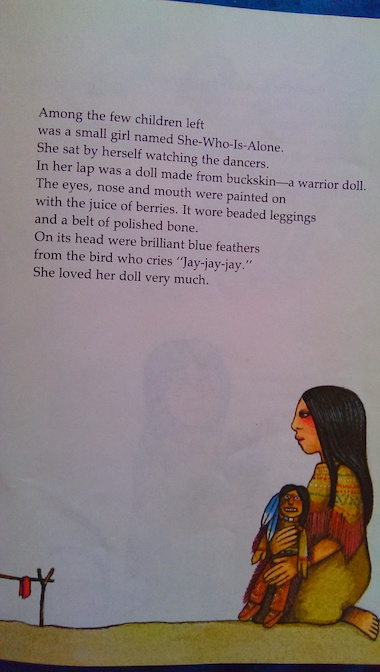
The people debate about who is supposed to make the sacrifice and what object the spirits could want, but one young girl thinks that the spirits are talking about her and her doll.  The girl is called She-Who-Is-Alone because she is the last of her family.  Her parents and grandparents are dead, victims of the famine.  The only thing she has left to remind her of them is her doll, a warrior with blue feathers in its hair, that her parents made for her before they died.

Desperate to end the drought and famine and to save her people, the girl makes the difficult decision to sacrifice her doll by burning it.  Her sacrifice is rewarded not only by the end of the drought but by the sudden appearance of a field of flowers as blue as the feathers in her doll’s hair.  The girl receives a new name from her people, acknowledging her sacrifice on their behalf.

LegendBluebonnetFlowers

A section in the back of the book explains a little about the Bluebonnet flower, which is the state flower of Texas, and the origins of the story in the book, which is based on a folktale.  This is also a little information about the Comanche People.

The book is currently available online through Internet Archive (multiple copies).

The Five Chinese Brothers

FiveBrothers

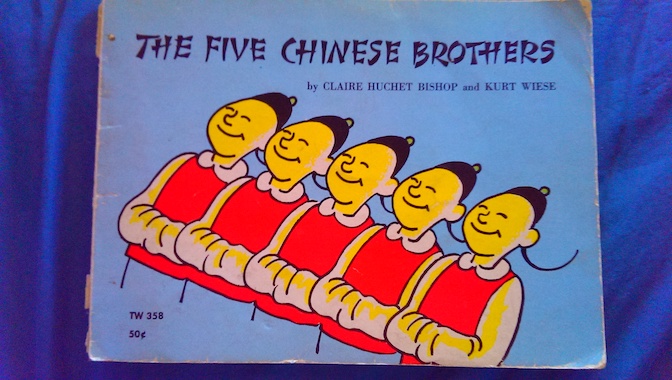
Although this picture book has faced some criticism for promoting Asian stereotypes (largely about the way the characters are drawn), it has nostalgic appeal for some people and is still in print.  What I find interesting about it is that it is actually based on an old folktale, Ten Brothers.  Folktales of this type, where people with different types of super-human powers must help each other to overcome obstacles, can be found throughout the world.  Another story on this theme is How Six Made Their Way in the World.

In this story, there is a family in China with five brothers who look alike, except that each brother has a unique super power (listed by birth order):

  • One can swallow the entire sea, although only for a limited amount of time.
  • One has a neck as strong as iron.
  • One can stretch his legs extremely far.
  • One is impervious to fire.
  • One can hold his breath for an unlimited amount of time.

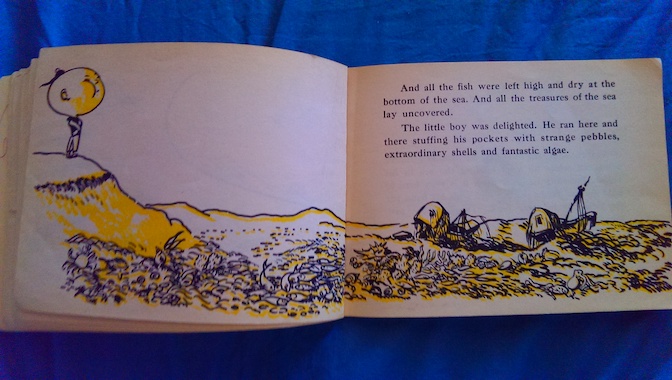
They live in a village by the sea and make at least part of their living by fishing.  One day, a young boy asks to go fishing with the brother who can swallow the sea (they don’t have names in the story, they’re just referred to by ability or birth order).  At first, the brother is reluctant to allow it, but when the boy begs, the brother agrees only on the condition that the boy obey him and return to his side as soon as he gives the signal.  The brother swallows the sea and allows the boy to collect as much fish as he likes from the empty sea bed.  However, the boy gets too wrapped up in all the amazing things he finds on the empty sea bed and ignores the brother’s frantic signals to return.

FiveBrothersSeaSwallow

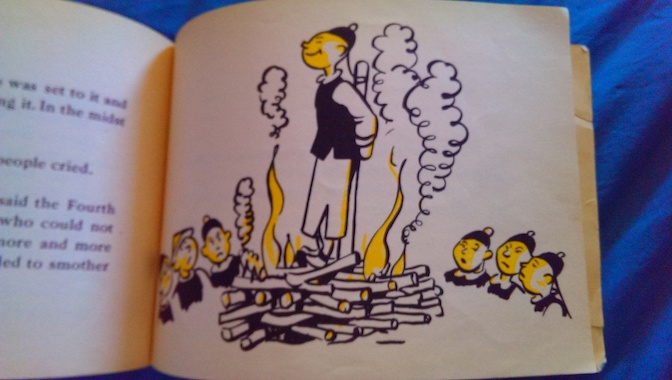
Finally, the brother cannot hold back the sea any longer and releases it.  The boy drowns, and the brother is arrested for the boy’s death.  The judge decrees that the brother will be executed by having his head cut off.  Before the execution, the brother has a last request: that he be allowed to return home to say good-bye to his mother.  The judge allows it, and the brother switches places with his brother who has a neck like iron.

FiveBrothersHead

Needless to say, the execution doesn’t go as planned, and everyone is astonished when the executioner cannot cut off the brother’s head.  The judge decrees that he will be executed by drowning instead.  However, he does grant the brother’s request to say good-bye to his mother once again, giving him the chance to switch places with another brother who can safely face the next ordeal.

FiveBrothersBurn

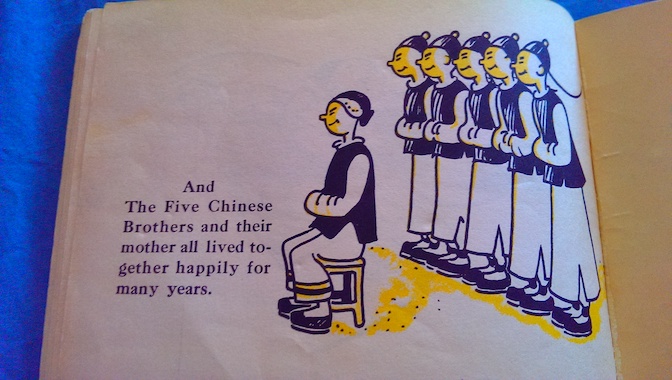
The process continues through one form of execution and another as each of the brothers survives, using his own special power.  Finally, the judge decides that if the man (he doesn’t know there’s more than one, apparently) cannot be killed, he must be innocent and pardons him.

The book is currently available online through Internet Archive (multiple copies).

FiveBrothersFamily

Jenny, the Halloween Spy

JennyHalloweenSpy

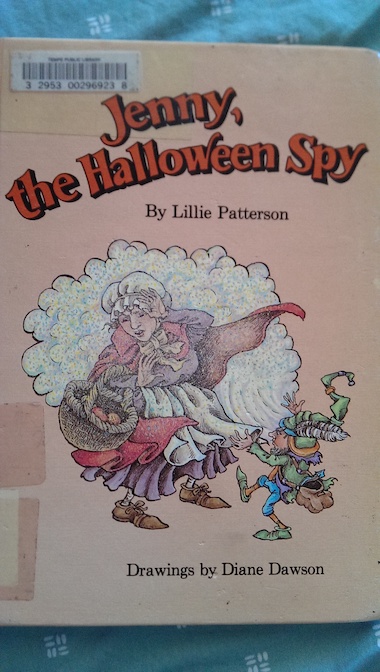
Jenny, the Halloween Spy by Lillie Patterson, 1979.

JennySpyWitchOne Halloween, Jenny goes to visit Nancy, a woman who local people say is a witch.  Jenny is curious about magic and, knowing that there are magical creatures abroad on Halloween, she wonders if she might see something unusual at Nancy’s house.

As she arrives at the house, Jenny peeks inside before announcing herself and sees Nancy putting some kind of oil in her eyes.  After Nancy welcomes her inside and offers her some cider, Jenny sneaks a little of this oil and puts it in one of her eyes to see what it does.  She discovers that the oil allows her to see magical beings that are hidden to most people.  There are fairies in Nancy’s house and rich furnishings that appear very ordinary to Jenny’s unaffected eye.

Using her new ability to see magical creatures, Jenny goes to the town market to see what is going on there.  However, when she catches a pixie stealing some fruit, the fairies and other “wee folk” decide to put an end to Jenny’s spying on their activities.  With some magic dust, the pixie removes her ability to see magical creatures and tricks her into getting onto an enchanted horse that takes her on a wild ride ending with a view of the devil!

The book is available to borrow and read for free online through Internet Archive.

My Reaction

JennySpyFairiesThis is a kind of cautionary story about the dangers of curiosity.  Jenny’s curiosity invites the attention of dangerous creatures and leads her into a frightening situation, something that she never wants to repeat.  For the most part, I think that curiosity is a trait that should be encouraged, but Jenny did deliberately seek out a person with a dangerous reputation and pry into the things she was doing, even trying some herself because she wanted to know more about it, so she could be considered to have gone looking for trouble.

In some ways, this book is very strange, but I can see where it draws on old folklore.  The end part about seeing the devil (accompanied by headless hounds) is a little bizarre and rather frightening for a modern children’s picture book but in keeping with folklore about Halloween and witches.  Although everything that happens to Jenny is supposedly really happening, part of me did wonder about the oil that she put in her eye because plants with hallucinogenic properties are used in folk medicine.  As far as the story is concerned, though, the magic and supernatural creatures are real.

The pictures are colorful and fascinating, but this book may be frightening for very young children.  Some of the fairies remind me a little of the pictures that inspired the Cottingley Fairy hoax.

The Mystery of the Haunted Trail

MysteryHauntedTrailThe Mystery of the Haunted Trail by Janet Lorimer, 1989.
Brian Kelly wasn’t too excited at first when his teacher assigned his class to write letters to students at a school in Hawaii.  He doesn’t really like to write, and the whole thing sounded boring, but it turned out to be pretty fun when his new pen pal, Alani, wrote back.  Brian discovered that he and Alani had a lot in common, and he even got to meet Alani when his family came to California on a trip.  Then, best of all, Alani’s family invited Brian to spend part of the summer with them in Hawaii!

Brian loves Hawaii from the moment he arrives.  Alani’s family lives in a rural area near Kalawa.  All of the families in the area raise their own vegetables and keep animals.  They depend on what they earn from selling food although some of them, like Alani’s mother, who is a nurse, have other jobs as well.  Alani’s father, like Alani’s grandfather, is primarily a farmer.  Alani’s grandfather lives with him on land that the family has owned for generations.

Alani and his family enjoy showing Brian around their island and talking about the history of the place.  Brian particularly likes the stories that Alani’s grandfather, who they call Kupuna, tells them, although some of them are frightening.  At the luau that the family and their friends have to welcome Brian to Hawaii, Brian overhears people talking about the Night Marchers.  They say that the Night Marchers have been seen recently and that bad things have been happening in the area, like crops dying and the nearby stream starting to dry up.  Some people seem to think that it’s a sign of bad luck and that maybe they should move away from the area.

According to Kupuna, the Night Marchers are a ghostly parade of the ancestors of the people who have lived there for generations.  Sometimes, it’s just ordinary people and sometimes it’s the souls of warriors.  Sometimes, Hawaiian gods may even walk among them.  But, when they march, any living person must either flee from them or, if that is impossible, they must lie down and hide their eyes.  At the head of the Marchers is a ghostly spearman who will strike down any living person who sees them, unless that person is related to one of the Marchers themselves.  They spare members of their own families.  People who are struck by the spear of the Marchers appear to have died of a heart attack.

The place where the Marchers supposedly walk is an old trail that leads to a sacred place where Alani’s ancestors are buried.  Brian is curious to see the place, but Alani warns him away, saying that they are not allowed to go there because it’s too dangerous.  However, Brian soon sees the Marchers himself one night in Alani’s family’s fields, and the next day, their crops are dead.  When Brian notices strange footprints in the fields as well, he realizes that some living people may be responsible for the awful things that have been happening in the area, but the only way he can prove it would be to explore the haunted trail himself and track the “ghosts” to their lair.

Janet Lorimer’s books are interesting because they are often a combination of mystery and ghost story.  There are logical explanations and living villains who are responsible for the things that are happening to Alani’s family and their neighbors, but there is also a definite supernatural element to the story as well.  Telling you where one ends and the other begins may be saying too much.  It may be more fun to let you find out yourself.

The book is currently available online through Internet Archive.

Christmas Around the World

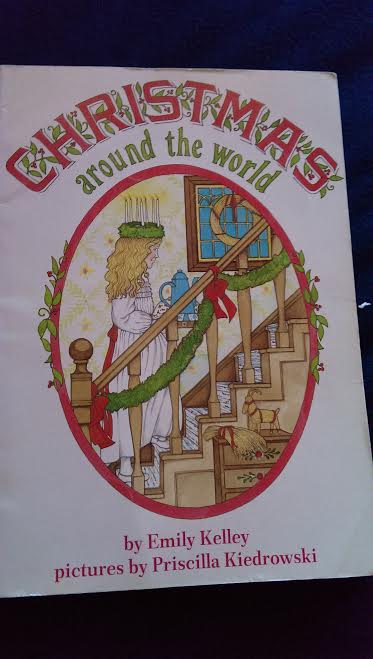
christmasworldChristmas Around the World by Emily Kelley, 1986.
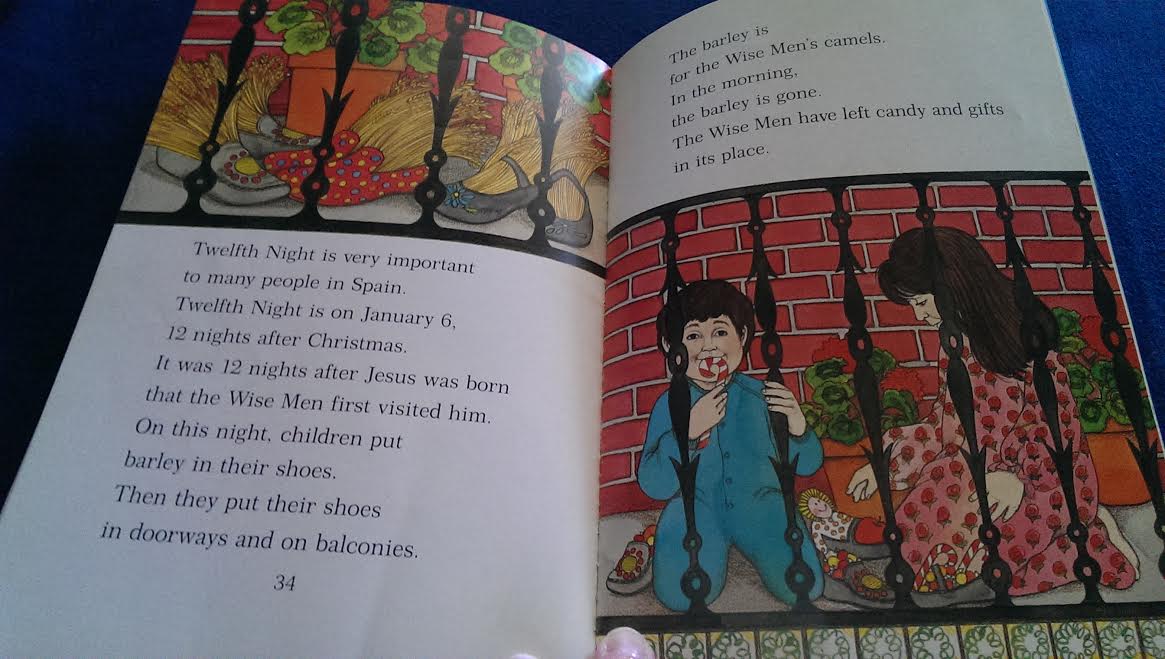
This is a non-fiction book that describes Christmas customs from various countries around the world.  There is some history and folklore associated with different Christmas traditions in every country.  The main countries described are Mexico, Iran, China, Sweden, Iraq, Spain, and Norway, although there is a section in the back that briefly mentions a few other countries.

In some countries, children leave out their shoes instead of their stockings in the hopes of receiving small presents in them.  Sometimes, the gifts are from Santa, and sometimes, they’re from someone else, like the Wise Men.  In other countries, people do not give gifts on Christmas, except maybe new clothes for the children.

Some of the traditions described are older ones, based on folklore, like the one about hiding brooms and tools from witches and bad spirits in Norway.  In countries in the Southern Hemisphere, Christmas is associated with summer instead of winter, changing the way people celebrate the holiday.  Each country has their own special foods associated with the holiday, too.

christmasnorway

The book also describes traditions that are associated with other special days related to Christmas, such as St. Lucia Day in Sweden (December 13) and Twelfth Night, when the Wise Men came to visit Jesus (January 6).  These special days are kind of an extension of the Christmas season in different countries.

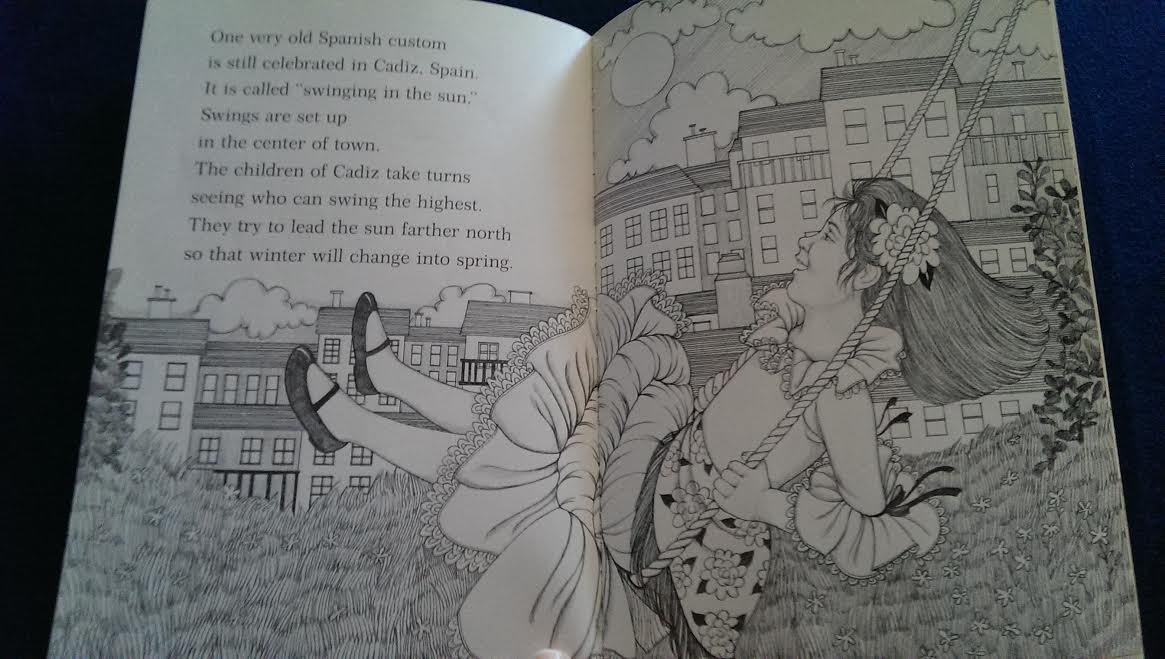
christmasspain

christmasspain2

The pictures in the book are beautiful.  Some of them are in color and some are in black and white.

christmasmexico

In the back of the book, there are jokes, a craft project, and a recipe for Christmas cookies.

The book is available to borrow and read for free online through Internet Archive.