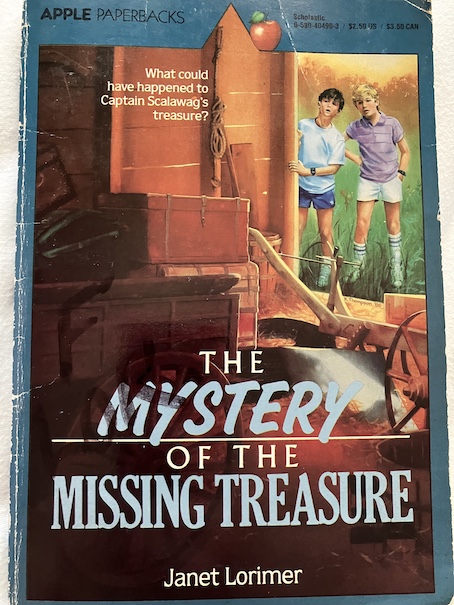
The Mystery of the Missing Treasure by Janet Lorimer, 1987.
Pete’s family has moved from the city to a small town because his father has taken a new job, and the move hasn’t been easy for him. Besides leaving his friends and his school, he’s had to give up roller skating because there’s no roller rink and judo because there’s nowhere to take lessons. So far, there are really only two things that Pete likes about his new town: his new friend Danny and the local legend of Captain Scalawag and his treasure.
When Pete asks Danny for details about Captain Scalawag and his treasure, Danny explains that Captain Scalawag (real name Seth Delaney) had been a captain the Confederate army during the Civil War. He was injured and invalided out of the service, so he became a traveling peddler, although he didn’t have much luck with that. Eventually, he came to their small town in California and took a handyman job with the woman who once owned the house where Pete’s family now lives. Many of the people who had settled the town had come from the South, and Captain Scalawag (as he came to be known later) told them stories about the suffering in the South because of the war. Sympathetic townspeople gave Captain Scalawag their jewelry and raised money for him to take back to the South to set up relief efforts. However, Captain Scalawag was a conman and had no intention of using any of that money for its intended purpose. When the townspeople confronted him about it, he refused to return the money and refused to tell anybody where he hid it. The angry townspeople hanged Captain Scalawag for his theft and deception, but they never figured out what he did with their money and jewelry.
Pete is intrigued by the story and says that he wants to find the treasure, but Danny doesn’t think he has much of a chance. Over the years, many people have searched for the treasure, and they’ve never found anything.
Danny takes Pete swimming in the nearby river with some other boys from the town. Pete gets irritated because one boy, Duffy, teases him about being from the city, and the two of them have a diving contest near some dangerous rocks to prove which of them is the best. They both succeed in making their dives, but although the are declared equals, Pete has the feeling that their problems with each other aren’t over.
After the swim, Danny suggests that they go into town and watch people setting up for the play that they have every Fourth of July, which is a reenactment of the story of Captain Scalawag. Pete is interested, but he feels strange and passes out.
When he wakes up, people are fussing over him, and he seems to be in some kind of old-fashioned general store. A woman in old-fashioned clothing, who calls herself his mother is worried about him, and for some reason she calls him Zeb. Then, Pete wakes up again and finds himself in the local doctor’s office. The doctor said that he had heat exhaustion from being out in the sun too long while swimming. Pete’s father is there, and Pete tries to tell him about his vision of being in the general store in the past. Pete’s father thinks he just had a strange dream, although the doctor says that his office is on the site of the town’s old general store, which burned down years ago.
Pete continues to have trouble fitting in with the local kids. One evening, Duffy and Danny take him on a “snipe hunt“, abandoning him in the woods. (This is an old prank, often played at summer camps, but I think this book was actually the first place I heard of it as a kid.) When Pete realizes that he’s been the victim of a joke, he tries to walk home, but gets lost and falls in the mud. Finally, dirty and disheveled, he makes his way to the road and hitches a ride from Bob, the local deputy his older sister is dating.
When Pete explains to Bob what happened, Bob offends him by laughing. Bob explains that it’s an old prank, and he’s amused that anybody is still doing that. Seeing how angry Pete is, he tries to tell him not to be too angry over the prank and to reassure him that the local boys aren’t so bad, in spite of the prank. He says that the boys are just trying to have fun. It’s almost like a kind of hazing or initiation, and although Bob doesn’t quite explain it this way, he seems to think that if Pete accepts it with good grace, it will put him on a better footing with the other boys. Bob thinks that, given time, Pete will start to see the humor in it, and the next time some other new kid moves to town, Pete might well be the first to suggest taking the newbie on a snipe hunt himself, having become one of the initiated.
In spite of Bob’s apparent indulgence for youthful pranks, he does seriously ask Pete who was involved because, as a responsible adult, he can see that there are more serious issues involved in the prank. It was bad enough that Pete ended up dirty and humiliated, but if he had gotten more seriously lost or had fallen in the river, trying to find his way home after dark, none of it would be funny at all. Bob thinks that he should have a word with the other boys about the the consequences of their actions and give them a warning against pulling pranks where people could get hurt. Pete refuses to say who exactly was involved because he thinks that would just make him a snitch and make everything worse for him socially than it already is. Bob decides to let it go for now, just taking Pete home.
That night, Pete has another dream, where he seems to be seeing things through the eyes of Zeb. He sees the house where he’s living now as it used to be in the past, and he sees the man called Captain Scalawag, persuading the people who live there to contribute to relief efforts in the South due to the war. Then, Pete feels ill and seems to pass out in the dream, waking up in modern times in his own bed. He could just shrug it off as a dream, brought on by the stories he’s been hearing about Captain Scalawag and the old things his parents have discovered around the house and the barn that hind at events in the past. However, when his mother shows him more old photographs she’s found, Pete realizes that the details in his dream were far too accurate for him to have simply imagined them, from the details of the house in the past to the faces of the people he saw talking to Captain Scalawag.
More and more, Pete comes to realize that his dreams are no ordinary dreams. For some reason, he is able to see the past through the eyes of Zeb, a boy who died young around the time that Captain Scalawag conned the local people out of their money and treasures and hid the loot somewhere. Is Zeb himself trying to tell him something or show him something that everyone else has missed?
The book is available to borrow and read for free online through Internet Archive.
My Reaction and Some Spoilers
I remember reading this book as a kid, although I had forgotten many of the details. I remembered Captain Scalawag stealing/scamming people out of valuables and then hiding them, but I had forgotten that the basis of his scheme was convincing people to donate to support the Confederacy during the Civil War. That was surprising because the story is set in California, and the concept of supporting the Confederacy is never appealing to me. I think I forgot that part because, as a kid, the important idea is that Captain Scalawag was a conman with a hidden treasure, and that’s all I cared to remember.
I remember finding it spooky that Pete was seeing things through the eyes of a dying/dead boy. Pete in the story does worry about getting stuck in Zeb’s body in the past, knowing that Zeb doesn’t have much time left to live. However, Zeb is trying to tell Pete something that he realized that indicates what Captain Scalawag did with the treasures he took from the townspeople. Zeb tried to tell people before he died, but because he was severely ill and delirious, nobody understood what he was really trying to say. It turns out that the treasures have been in the barn the entire time, but Captain Scalawag changed their appearance, so the townspeople have overlooked them the entire time. It’s a case of hiding in plain sight.
Pete’s confrontations with the local bully add a subplot to the story. Danny apologizes to Pete about joining in Duffy’s prank against him, and Danny admits that Duffy scares him, too. Eventually, Pete has to fight Duffy physically, but Duffy doesn’t know that Pete took judo lessons in the city, so he’s not as defenseless as Duffy thinks. During the course of their fight, Pete also saves Duffy from being bitten by a snake, so Duffy has to admit that he has some gratitude toward Pete. He’s also impressed by Pete’s fighting techniques. The two of them end up working out a compromise with each other, with Pete agreeing to teach Duffy some judo and Duffy agreeing to teach him some of the knowledge he has from living in the country, like how to kill a snake. (Pete warned Duffy about the snake, but Duffy is the one who killed it.) Because they were fighting out behind the barn, Duffy is also on hand when Pete has his final revelation from Zeb, so he gets to be part of the discovery of the treasure, along with Pete and Danny.
I wasn’t happy when Bob laughed off the kids’ snipe hunt prank against Pete at first. I don’t like pranks, and I think it should be more understandable that some people just don’t want to be part of them, especially when Bob has directly seen the aftermath of the prank. He did redeem himself a little for me when he realizes that the prank could have had much more serious consequences and that, as a responsible adult, he really should point that out to the boys involved. The potentially serious consequences of pranks is part of the reason why I don’t like them. There’s just too much potential with many of them to go horribly wrong. The way Bob seems to be looking at the snipe hunt is like it’s some kind of local initiation stunt for newcomers, although he doesn’t exactly use those words to describe it. However, the idea of it being a kind of initiation doesn’t really redeem it for me. Fraternity initiations and hazing often go wrong, and that’s why universities often crack down on them.
As I recall, this book was the first place I heard about the concept of a snipe hunt. Years later, I was on a church retreat in college, and someone joked about taking someone else on a snipe hunt. I’ll admit that I was briefly gleeful about knowing what that was when the other person didn’t. I almost did go along with it, but I just didn’t have the heart to let someone else in for a prank like that. I would have felt bad if something happened to that person in the woods at night, and I figured they would at least be upset. Since the person did seem worried and asked directly what a snipe hunt is, I told them, so I spoiled the joke before it really happened. I think I made the right decision, though.