Wizard’s Hall

Wizard’s Hall by Jane Yolen, 1991.

Henry hadn’t seriously considered becoming a wizard.  It was just one of a number of things he considered being when he was young.  However, when he suggests the possibility when he is eleven years old, his mother unexpectedly jumps on the idea and immediately packs him off to Wizard’s Hall, the school for young wizards.  Although Henry expresses doubts, his mother tells him that it’s only that he try that counts.  Being a dutiful son, he immediately sets out for Wizard’s Hall to enroll.  He has a moment when he gets worried and tries to turn back, but he discovers that he can’t because his destiny is at Wizard’s Hall, the road there won’t let him turn back.

At Wizard’s Hall, the Registrar (after consulting with a strange bird or animal in a cage called called Dr. Mo) changes Henry’s name to Thornmallow, saying that he’s prickly on the outside but squishy on the inside.  Henry isn’t happy about being given a new name, but he accepts it as part of what he has to try at the school.  The Registrar and the teachers also refer to Thornmallow oddly as what they “desperately need.”  Something is deeply wrong at Wizard’s Hall, and the teachers are hopeful that Thornmallow will be the one to save them, although he doesn’t appear to have much aptitude for wizardry.

On his first day, his teachers discover that he is tone-deaf, which is unheard of for wizards.  Wizards have to recite their spells in the proper tones, and Thornmallow can’t do it.  When one of his teachers tries to help him by covering his years while he attempts to recite, Thornmallow accidentally recites a spell that produces an avalanche of snow and roses.  It’s more powerful than anyone expects of a beginning student, especially one like Thornmallow, who has no prior knowledge of spells and doesn’t show much aptitude in other ways.  Thornmallow wonders briefly if he might have some special, hidden talent for wizardry, but he is unable to produce the same results when he is alone.

Although Thornmallow feels lonely and out-of-place at his new school, he persists because he promised his mother that he would try, and the teachers at the school also say that trying is important.  He also makes his first real friends his own age at the school.  A couple of other first-year students, Tansy and Willoweed (called Will for short) are assigned to be his Guardians, helping him to become acquainted with the school and its rules, and another girl, Gorse, also becomes his friend.  Thornmallow realizes that he would miss his new friends if he were to leave, although he briefly considers it, having the feeling that his first spell was just a fluke and that he doesn’t have any real talent for magic.

However, just when Thornmallow goes to tell his teachers that he thinks that his admittance to the school was a mistake, he overhears them talking about the serious threat to the school: the school is in danger from an evil sorcerer and his Quilted Beast (a “quilted beast” doesn’t sound particularly threatening because quilts are soft and comfy, but it’s way worse than that).  The teachers don’t know how to defeat the Master and his Beast, but they know that it’s vitally important for the school to have its full quantity of students, 113.  They were almost full when they sent out a call for the final student and got Henry/Thornmallow.  Although they aren’t sure why Thornmallow is the proper final student, it seems that he has some important role to play in the situation. When he learns the danger that they’re in, Thornmallow realizes that he has to stay and try to help them as best he can.

The book is available to borrow and read for free online through Internet Archive.

My Reaction and Spoilers:

Master Hickory, one of the teachers, explains to Thornmallow and his friends that the Master was one of the original founders of the school years ago.  The main founder had been Doctor Morning Glory, and she sent out a call for others to help her, bringing 13 sorcerers to found the school.  However, one of the others, Nettle, was prickly in every sense of the word.  He enjoyed using his words (and words are very important in magic and in the story) to sting and hurt others.  Eventually, the other 13 founders pushed him out of the school, and he turned to dark magic to get revenge. 

The Quilted Beast is made out of the dark pieces of the souls of each of the other founders, all “quilted” together.  Master Hickory explains that everyone has a little darkness in them in the form of very deep emotions, the kind that can tempt people to do bad things, if they let them get out of control.  I particularly liked the explanations of how people have their dark sides and how mature people deal with them.  At first, Thornmallow struggles to understand why the teachers are so upset that their dark sides have been removed because he thinks that would make them better.  However, Master Hickory explains that by “dark side,” he doesn’t mean the parts that are necessarily evil; he means the parts that could become evil, some of which are actually good.  Master Hickory says that some of the strongest human emotions can turn to evil if they aren’t kept under control.  For example, ambition out of control can become greed, or admiration out of control can become envy.  Having these feelings isn’t evil by itself; it’s the way people respond to their feelings that determines that.  Even love, which is considered good, is a deep emotion that can turn to something evil if used improperly, and so can count as part of a person’s dark side.  Mature people learn to deal with their feelings and control them, using them in the best ways.  People who aren’t mature, don’t.  Thornmallow, who often quotes his mother’s words of wisdom throughout the story, says, “Good folk think bad thoughts; bad folk act on ‘em.” 

I find those words of wisdom familiar because that’s something that my own parents impressed on me, “You can feel anything, but you don’t have to act on it.  You never have to act on it.” It was okay to have feelings and to say how we felt, but just “feeling like it” wasn’t an excuse for misbehavior. Everything has limits. You can’t hit your sibling just because you feel like it, and you can’t call people names just because you’re mad.  You can feel any way you want, but no matter what you’re feeling, you still have to behave, within the rules. If you don’t, there will be problems, and those problems won’t go away because of how you “feel.”  This probably explains a lot of my impatience toward people who don’t control themselves and don’t have limits for their behavior.  It’s not that I think it’s always easy or that people are always completely successful; it’s more that I have no respect for those who think it’s impossible and don’t even want to try, which brings us back to the story …

Master Hickory says that the teachers who had the smallest dark sides have still been basically functional since having them taken away, but those of particularly strong feelings have been damaged by the attack, including Morning Glory, who was both the most loving and the most ambitious of all the teachers.  What happened to Morning Glory isn’t fully explained until almost the end of the story, but the loss of her has been devastating to the school. When Thornmallow tells his friends about the problem, the kids are scared, but if there’s one thing that Thornmallow believes in, it’s trying. He and his friends are determined to try and save the school from the Master and the Quilted Beast, but time is running out.

The importance of trying is the theme of the story. Thornmallow/Henry doesn’t know his real talents or abilities, but just by showing up and trying to help, he learns that he possesses a special ability that makes him the right person to stop the evil wizard. Although he is not good at magic, not an enchanter, he has the ability to act as an enhancer for the abilities of others. The times when Thornmallow succeeds in his spells are when he’s working with, especially touching, one of the other wizards. He is able to use the talents of others and magnify them to be greater than anything either of them would do by themselves. By himself, Henry isn’t particularly special, but he can unite his friends and combine the talents of others, just by trying.

Another interesting aspect of the story is that the magic at Wizard’s Hall is largely based on word play. The characters play off words, using special names to point to the true natures of people and to change situations to be what they need them to be, which turns out to be part of the solution to their problem. Words spoken aloud at Wizard’s Hall have power and can change reality. For example, the names that everyone is given when they arrive at Wizard’s Hall are clues to the kind of people they are and what their abilities are. Thornmallow’s name is already explained, and at first, he puzzles a little over Tansy’s name when he meets her. Tansy is a black girl, and Thornmallow knows that tansy is a bright yellow flower. Gorse later explains to him that Tansy got her name because of her sunny personality. It’s not about what she looks like but what she is. Gorse describes herself as being small and prickly, and she seems proud of it because she’s comfortable with herself as she is. Before they can defeat the Master, who is really Nettle, they realize that they need to learn more about what Nettles are, which gives Thornmallow a clue as to what he needs to do and the words he needs to use.

The Whipping Boy

The Whipping Boy by Sid Fleischman, 1986.

Jemmy is an orphan who lives in the royal castle as the prince’s new whipping boy.  Prince Horace, or Prince Brat, as the prince is commonly called, is known for constantly misbehaving, playing mean pranks, and refusing to do his lessons (he tells his tutor that he doesn’t need to learn how to read because he could always get someone else to do his reading for him).  However, in their land, it is illegal for anyone to use any kind of physical force or punishment on a prince.  Instead, the royal family employs a whipping boy to take the prince’s punishments for him.  As you can imagine, seeing someone else whipped in his place does little to correct the prince’s bad behavior.  In fact, the prince usually likes the spectacle of the whipping boy yelling.  He doesn’t like it that, unlike the others, Jemmy never yells when he’s whipped.

Jemmy was recruited for the role of whipping boy off the streets, where he survived by being a mudlark and rat catcher.  There are benefits to living in the palace, even if his purpose in being there is to take the prince’s punishments.  Jemmy gets food to eat and nice clothes to wear and attends the prince’s lessons with him, where he pays attention when the prince does not.  Jemmy actually loves the books and learning he receives.

After about a year, though, the prince suddenly comes to Jemmy in the middle of the night and tells him that he’s running away from home and wants Jemmy to come with him as a manservant.  When Jemmy asks him why he wants to leave, the prince says that he’s bored.  Jemmy wonders why Prince Brat wants him to come along instead of a friend, but then he realizes that, as nasty as he is, Prince Brat doesn’t have any real friends.

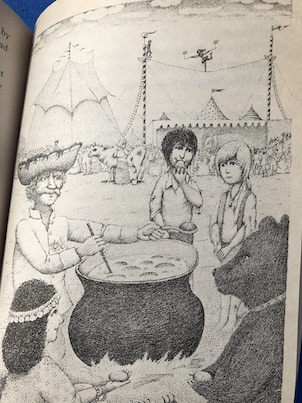
When the two of them are outside of the palace, Jemmy is tempted to run off and leave Prince Brat to fend for himself, but before he can make up his mind about it, the two boys are taken prisoner by bandits, Cutwater and Hold-Your-Nose Billy (named for all the garlic he eats).

Prince Horace tries to pull rank on the bandits, telling them who he is and ordering them to go away.  It’s a mistake.  When the bandits see the royal crest on the saddle of the horse that the boys are riding, they decide that they can probably get a good ransom for the prince.  Since neither of the bandits can write, they try to make the prince write his own ransom note, but of course, Prince Brat can’t write because he’s refused to learn. 

Jemmy, seeing an opportunity to turn the situation around, offers to write the note instead.  As Jemmy suspected, when the bandits realize that he can write and Horace can’t, they start assuming that he’s actually the prince and that the two boys have switched places.  After writing the note, Jemmy suggests that they let the “whipping boy” (Horace) take it to the castle, thinking that not only will Horace get safely away but that he’ll be rid of Horace after that.

To Jemmy’s surprise, Prince Horace ruins the whole scheme by refusing to return to the castle.  Jemmy tries to reason with him, but Horace says that he won’t go home until he’s ready.  The boys to manage to slip away on the bandits, and Horace insists on following Jemmy even though Jemmy wants to be rid of him.

Although Jemmy can’t understand why, Horace says that he’s having the time of his life.  For once in his life, he doesn’t have people fussing over him and telling him to keep his clothes clean.  Horace has found palace life stifling and boring, and he feels like his father hardly notices him or cares.  Part of the reason why Horace acts up is to get his father’s attention.  Jemmy is surprised by these insights into the prince’s life and character, and he is also surprised that, when he finally gets the chance to slip away and leave Horace behind, he can’t do it.  He knows that Horace isn’t used to life outside the palace, and Jemmy worries about what might happen to him if he’s left alone, although he tells himself that Horace could always return to the castle.

Before their adventures are over, Horace gets to experience what it’s like to do chores for himself and even to be whipped by the bandits, when they think he’s the whipping boy.  Being whipped himself shows Horace what he has subjected others to on his account.  Jemmy is surprised that Horace bears the punishment without crying or complaining, something which Horace says that he learned from watching Jemmy, who made it a point to take whippings with quiet dignity.  Horace also learns what other people really think of him when a woman at a fair comments on the prince’s disappearance, using the “Prince Brat” nickname and saying that the young prince is a “terror” and bound to be a terrible king when he’s older.  Usually, people are careful about what they say in front of the prince, and Horace is shocked to find out how disliked he is because of his bad behavior.  However, Horace’s new experiences and realizations bring a change in his outlook and personality that make him more sympathetic and likeable.  There is also the realization that what Horace really needs in his life isn’t a whipping boy to take his punishments for him but someone who can be a real, honest friend with him, like Jemmy.

In the end, Jemmy becomes the prince’s companion, not his whipping boy, so that the prince will be less lonely and stop acting out to get attention.  The king promises that Horace can keep Jemmy as his companion and his responsibility as long as Horace himself can behave responsibly and do his lessons as he should.

Although the country and characters in the story are fictional, the practice of keeping a whipping boy so that princes wouldn’t have direct physical punishment was a real practice.  Even today, the term “whipping boy” can stand for a person who takes blame or punishment in the place of someone with higher rank or authority, even when the person of higher rank is the one at fault.  For example, if a business manager or CEO makes a bad decision and orders one of his employees to do something they shouldn’t and the employee gets the blame for it as if what they did was their idea and not the boss’s, that employee can be considered the “whipping boy.” Another example would be if a stepchild in a family was given blame or punishment in place of a biological child because of favoritism on the part of the punishing parent (similar to the crude saying “beaten like a red-headed stepchild“). In fact, depending on the circumstances, a “whipping boy” might not even be a person, but a thing or a concept that is blamed instead of the person or thing that is the true cause of a problem, such as blaming “modern society” or “kids these days” for an individual’s bad habits or behavior, “the government” or “the system” for a business’s bad decisions or policies, or “millenials” for practically everything they’ve been blamed for by older people. It is similar to the concept of the “scapegoat” or “fall guy” but with the connotation that the person who is really at fault, the one who is trying to avoid blame or punishment, succeeds because of higher rank, authority, seniority, or some other form of favoritism among those who will assign blame or punishment.

This book is a Newbery Medal Winner and is available online through Internet Archive (multiple copies).

There is also a movie version of the book, sometimes called Prince Brat and the Whipping Boy.  The movie follows the concept of the original story pretty well, but it elaborates more on Jemmy’s life before he became the whipping boy and on how Horace feels neglected by his father.  In the movie, Jemmy is pressed into service as whipping boy by the king’s soldiers, who don’t bother to find out if he has any other family.  Although Jemmy is an orphan in both the book and movie, in the movie, he also has a younger sister he looks after, and part of what he wants to do when he leaves the palace is to find her.  The boys together learn that the younger sister was arrested for attempting to steal a handkerchief in Jemmy’s absence, and they have to rescue her from prison, a side adventure that didn’t occur in the book.  In the movie, Horace also explains to Jemmy that his mother died in a riding accident when he was young and that his father pays more attention to affairs of state than he does to him.  Horace is shown multiple times trying to get his father’s attention, only to be brushed off because his father is too busy.  In the movie, the king almost declares war on another country, thinking that Horace was kidnapped over a border dispute, something that didn’t happen in the book.  In both the book and the movie, Jemmy’s new friendship with Horace brings about a change in the prince.  At the end of the movie, both Jemmy and his sister are taken in to the palace as companions for Horace. Sometimes you can find this movie or clips of it on YouTube. Although it was originally released on VHS, it is currently available on DVD.

The Ravenmaster’s Secret

The Ravenmaster’s Secret by Elvira Woodruff, 2003.

Forrest Harper is the son of the Ravenmaster of the Tower of London in 1735.  The story begins by explaining the tradition of keeping ravens at the Tower of London because of the superstition that the Tower would be conquered by its enemies if the ravens ever abandoned it.  This superstition led to the creation of the job of Ravenmaster, who looks after a flock of ravens that live at the Tower with wings clipped so that they can’t fly away.

Forrest Harper lives at the Tower with his parents and sisters, training to become a Ravenmaster, like his father.  He likes the ravens, and they like him.  He is pretty good at caring for ravens, but there is something that bothers him: he thinks that he isn’t brave enough and that others think that he is a coward, too.  He is smaller than the other boys and is often teased.  He has trouble cutting up the squirrels that the rat catcher’s boy (his only real friend, although his mother doesn’t approve of him) brings to him to feed to the ravens.  Even though it’s necessary, Forrest doesn’t like the sight of blood and feels kind of sorry for the squirrels.  Worse still, when Forrest’s family attends the public hangings (which were treated as a kind of festival day with music and entertainment in Forrest’s time), Forrest is unable to look at the criminals who are being hanged.  The one time he does try it, he throws up, and again, the other boys tease him mercilessly for it.  Forrest’s problem, as readers will see, isn’t so much that he’s a coward as he has more empathy than the other boys, both for animals and people, and that isn’t really as much of a problem as he believes.  His father tells him to ignore the bullies because they are foolish, and their foolishness will show in time.

Forrest sometimes dreams of going out into the wider world, beyond the Tower, where he could do something brave that would impress everyone.  The rat catcher’s boy, whose real name is Ned although most people just call him Rat, also dreams of running away because he is an orphan, treated harshly by his master and always in danger of being turned over to the chimney sweep to be used as a climbing boy.  He doesn’t think that Forrest has a real problem because his life at the Tower is pretty good, living comfortably at the Tower with his parents, whatever the local bullies say.  Still, the two boys often imagine what it would be like to go to sea together and have adventures.  When there is an announcement that a new prisoner will be arriving at the Tower, a Scottish Jacobite rebel, Forrest thinks that helping to guard a dangerous rebel will make the Tower bullies respect him.

To Forrest’s surprise and embarrassment, this rebel actually turns out to be a girl.  She is the daughter of the rebel Owen Stewart, who is being held in a different tower at the Tower of London (the Tower of London is actually a fortress with multiple towers – she is imprisoned in Bloody Tower and her father is in Bell Tower).  She has been charged with treason, along with her father and uncle.  Forrest isn’t happy about being given the task of taking food to a girl prisoner. 

However, Madeline McKay Stewart, the girl prisoner, is pretty tough in her own right.  Although Maddy’s been separated from her father and uncle and all three of them are likely to be executed, she is being pretty brave about it.  She talks to Rat and Forrest.  She is interested in Forrest’s pet raven, Tuck, and tells him about how she used to feed baby owls back home.  She talks about her life and family in Scotland, and Forrest realizes that he’s starting to think of her as a friend instead of an enemy to be guarded.

While Forrest is used to hearing English people criticize the Scots for being “savage,” he is astonished and a bit offended when Maddy talks about English people being “evil.”  For the first time, it makes him think of the situation from the other side.  He knows that not all English people are evil and realizes, having seen that Maddy actually has refined manners, that Scottish people aren’t “savage.”  One day, at Maddy’s request, he takes a message to her father in exchange for her ring, which he plans to sell in order to buy Ned back from the chimney sweep after the rat catcher loses his term of indenture to the chimney sweep in a game of cards, sparing him from the horrible life and health problems that the young climbing boys suffer.  Then, Owen Stewart gives Forrest a message to take back to Maddy.  Without really meaning to, Forrest realizes that he has suddenly become a go-between for the rebels and could be considered a conspirator under English law.

As Forrest considers the fate that lies ahead for Maddy and the nature of war between England and the Scottish rebels, it occurs to him that the adults in his life have often done the opposite of the things that they have always taught him were important.  His father always emphasized fairness, yet the war and Maddy’s possible execution are unfair.  Maddy shares Forrest’s feeling that the world might be a better place if people didn’t become adults and abandon their values.

Then, Maddy’s father and uncle are shot while attempting to escape, and Maddy is left completely alone.  Forrest feels badly for Maddy.  Soon after, he is unexpectedly approached by a carpenter who seems to know that he has become friends with Maddy.  The carpenter, who is a stranger to Forrest, tells him that Maddy will soon be executed by beheading but that he has a way to save her life.  Forrest has to decide if he is willing to trust the stranger and save Maddy, knowing that doing so would make him a traitor himself.

One of the parts of this story that interested me was how Forrest noted the hypocrisy in the adults around him as he was trying to decide what he should do.  Qualities that adults often praise and try to instill in their children are often ignored in the way that the adults live and even in how they treat other children, like Ned and Maddy.  Abandoning values, even the ones that they really want their children to have, isn’t something that adults have to do as they grow older, but it is something that some adults do if they think they must in order to live as they want to live or accomplish something that they want to accomplish.  The adults who think that Maddy should be beheaded would probably say that they were doing it for the greater good in promoting their cause against the rebels.  However, treating Ned as a piece of disposable property is something that they mostly do because they can and because they know that there is nothing that Ned can do to stop them.  Ned actually tries to repay his indenture legally with money that Forrest gives him, but although the sweep accepts the money, he refuses to let him go, saying that no one will take Ned’s word over his and that he could always use the money to make sure that Ned is hung as a thief if he tries to make trouble.  It is this type of attitude and situation that make the children realize that they are on their own to solve their problems and that working within the law is not going to be an option for them because the law is not just and it is not on their side.  It’s a frustrating situation, and I often feel frustrated when I encounter this type of thing in books, but fortunately, things do turn out well in the end.

This is one of those coming-of-age stories where a boy must decide what he stands for and where he really belongs.  Through Maddy and the inscription on her ring, which means “Face Your Destiny,” Forrest comes to understand the destiny that is right for him as he helps both Maddy and Ned escape to a better life elsewhere. 

The book also includes some interesting historical information. There’s a map of the Tower of London in the front of the book, and in the back, a short history of the Tower with information about famous prisoners and escapes. There is also a glossary of English and Scottish words that modern children (especially American children) might not know, such as breeches, wench, loch, and tattie-bogle (scarecrow).


The book is currently available online through Internet Archive.  (To borrow a book through Internet Archive, you have to sign up for an account, but it’s free, and then you read the book in your browser window.)

Spoiler: In the last chapter of the book, it explains what happened to the characters after the story ends.  Forrest does become the Ravenmaster after his father, realizing that it is the right kind of life for him and that he no longer desires to have adventures outside the Tower.  He has a wife and daughter, and years later, he receives a message from Ned, who says that he has become a captain in the Royal Navy and that Maddy has gone to live in the colonies with other Stewarts (something that my own Jacobite ancestors did, which is how I got to where I am now).

River Quest

Dinotopia

#2 River Quest by John Vornholt, 1995.

Thirteen-year-old Magnolia and Paddlefoot, a Lambeosaurus, are apprenticed to the Habit Partners of Freshwater. Habitat Partners keep an eye on different aspects of the environment on Dinotopia and make sure that the environment is maintained and cared for. The Habitat Partners of Freshwater are specifically concerned with the bodies and sources of freshwater all over Dinotopia.

When Magnolia’s master, Edwick, is injured badly during the eruption of a geyser, he and his partner, a Saltasaurus named Calico, retire and leave the post to Magnolia and Paddlefoot. Magnolia thinks that she is still too young for the position, and she and Paddlefoot worry about whether they are ready to handle the job. However, they have no choice because a crisis has arisen, and Edwick is in no shape to handle it.

The Polongo River, which supplies the water for the waterfalls that power virtually everything in Waterfall City, is drying up. Magnolia and Paddlefoot must journey up the river to find out what is happening and restore the river to its proper course.  Along the way, they find friends who can help them, but completing their mission means coming perilously close to the Rainy Basin where the meat-eating dinosaurs live.

The book is currently available online through Internet Archive.

Windchaser

Dinotopia

#1 Windchaser by Scott Cienein,1995 .

Raymond Wilks is the son of a ship’s doctor. They are sailing on a ship taking convicts to the British colonies in Australia when the prisoners revolt and take over the ship during the middle of a terrible storm. Raymond’s father is killed, and the ship is wrecked, but Raymond escapes with a young thief named Hugh O’Donovan. The two of them are taken to shore by friendly dolphins, and they meet up with some of the inhabitants of Dinotopia.

At first, they are frightened of the dinosaurs, but everyone is kind to them. They are taken to Waterfall City, one of the most beautiful places in Dinotopia, and they begin learning about the history and ways of the land. People in Dinotopia don’t use money, and everyone shares with each other, trading goods and services for everything they need. There is no crime in Dinotopia because everyone has all that they need and everyone looks after each other.

Raymond, although still mourning his father’s death, thinks that Dinotopia is a wonderful place, and he admires the attitude of the people there. Hugh, who was orphaned at a young age and forced to steal to survive, has difficulty believing that the people are all as nice as they seem or the society as perfect as they say. His harsh childhood has taught him not to trust others too much. Little by little, the people of Dinotopia win Hugh over, and he desperately wants to become worthy of the kindness that people show him, although he doubts whether he ever can.

As Hugh and Raymond struggle to come to terms with their new life in Dinotopia, they encounter a flying dinosaur called a Skybax who is suffering from an old injury. The Skybax, called Windchaser, shows up from time to time and causes trouble. He is the only unhappy creature they have seen since arriving in Dinotopia, and Raymond develops a strong desire to learn what is wrong with him and help him. Raymond’s struggles to help the unhappy dinosaur lead him into danger, and Hugh fears that he may lose the best friend he’s ever had.

The book is currently available online through Internet Archive.

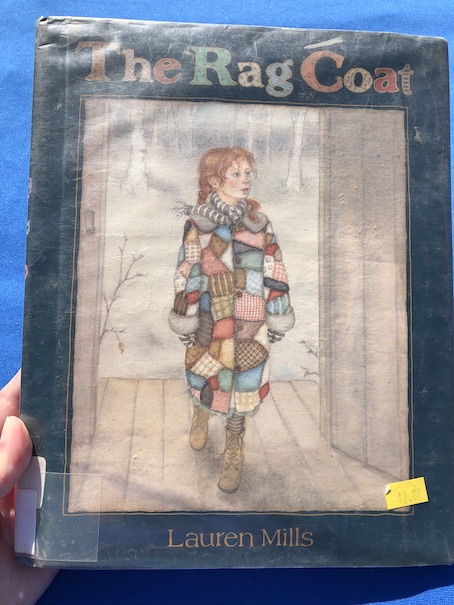
The Rag Coat

Minna is a poor girl, the daughter of a coal miner.  Her father has been ill with the miner’s cough, so Minna has to help her mother to make quilts that the family can sell for money.  She wants to attend school, but she can’t because she is needed at home and her family can’t afford a warm coat for her when winter starts.  It’s too bad because Minna really wants to make some friends her own age, and she would meet other children at school.  Her father says that he will find a solution to the problem, but he dies before he can.

After Minna’s father’s death, some of the other women in the community come to the house to work on making quilts with Minna’s mother.  When the women say that the quilt pattern they are using is named after Joseph’s Coat of Many Colors, Minna wishes again for a coat.  When the other women, who are mothers themselves, realize that Minna cannot go to school until she has a coat, they decide to make one for her.  They don’t have much money, but they do have plenty of quilting scraps.  They decide to make a new, quilted coat for Minna out of their old scraps.

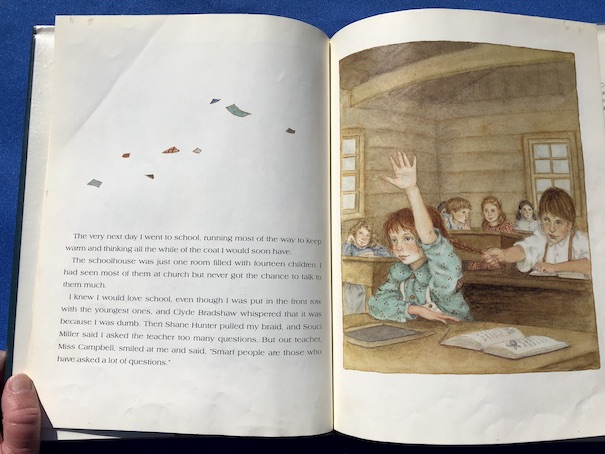
Minna starts going to school and does well, although she gets some teasing because, as a new student who has never been to school before, she has to sit with the youngest children, and Shane pulls her braid.  Something that Minna particularly likes at school is Sharing Day (what my school always called “Show and Tell”), where students are given the chance to show special things to the class and talk about them.  Minna decides that when her coat is ready, she will show it to the class during Sharing Day.

As the coat is being made, Minna admires all of the beautiful colors of the cloth scraps in the coat and adds a piece of her father’s old jacket as well.  Each of the other scraps in the coat also has a story that goes with it.  The cloth pieces come from old clothes and blankets that people in the families of the quilting mothers have used, and they memories attached to them.  The mothers tell Minna all of the stories as they work on the coat, and Minna loves it.

However, when Minna wears the coat to school for the first time, the other kids make fun of her for wearing rags.  Minna is really upset and runs away into the woods.  After thinking about it, Minna remembers what her father said about how people really need other people, and she decides to go back to school.  There, she tells the other students that the rags in her coat are actually their rags, and she begins reciting the stories that go with them.

One of the scraps is from Shane’s old blanket from when he was a baby.  He was born so small that everyone was afraid that he’d die, but the blanket kept him warm, and he later carried it around with him until it fell apart.  Shane is happy, seeing the scrap of his favorite blanket again in Minna’s coat.  Everyone else gathers around Minna, looking for their scraps in the coat and listening to the stories behind them.  Each of the scraps in Minna’s coat is like an old friend that none of them ever thought they’d see again.  The other children apologize to Minna for their teasing and Minna says that friends share and that it took all of them to make her coat warm.

The book doesn’t say when this story is supposed to take place, but based on the children’s clothing, I think it’s about 100 years ago or more. It doesn’t say exactly where this story takes place, either, but a note on the dust jacket says that it takes place in Appalachia. The author said that she was inspired by Appalachian crafts that she learned from the women in her family and a patchwork coat that she wore as a child. However, years later, the author revisited this story and rewrote it in a longer version, and some of the explanations that accompany the new version of the story elaborate more on the background.

The author rewrote this story in a longer, novel form called Minna’s Patchwork Coat (2015). In the back of that book, the explanation behind the story mentions that the year of the story is 1908. It also discusses some cultural references and songs included in the expanded version of the story that were not part of the original. It states that the inspiration for this story came not only from the author’s experiences but from a song written by Dolly Parton, Coat of Many Colors, which was made into a picture book itself after the publication of this book.

There is also an expanded retelling of the story called Minna’s Patchwork Coat, and I’d like to talk about some of the differences. For example, the ending message of the story is slightly changed in the longer version, or at least the emphasis of the moral is different. The original book emphasized how much “people need people” and how the goodwill of many people (in the form of the quilting mothers and their hard work and scraps, cast-off from all of their children) changed Minna’s life. They emphasize it at the end, talking about how Minna’s coat is the warmest of all of them and that it took a lot of people to make it that way. However, in the expanded version, Minna also explains that when she started school, she liked her classmates better than they liked her because, thanks to their mothers’ stories as they made her coat, she already knew who the other children were, but none of them really knew anything about her. The message of the expanded version is that it is important to learn others’ stories to learn who they really are and to become friends with them.

Actually, I don’t like the second version of the story as well as the original. I thought that the moral and the story were stronger when the focus was on how people benefit from having relationships with other people because people can do great things when a lot of people contribute a little. Remember, it took a lot of people to make Minna’s coat warm because each of them contributed at least one scrap to it and others took the time to put them all together. It was their stories that made the coat special, more than just an ordinary coat. The expanded story has that element, too, but more emphasis is placed on Minna needing to share her story with the other children to win their respect and approval. I didn’t like the notion that Minna needed to win their approval by telling her story. Also, this story takes place in a small mining community. I find it difficult to believe that the other kids wouldn’t basically know her story already. Her mother knows their mothers. Their families see each other at church before Minna goes to school. The disease that took her father’s life isn’t terribly unusual for coal miners, and probably, a number of the other children are the children of coal miners as well. It seems to be the major industry in the area. Minna’s family might be more poor than the others’ since her father’s illness and death, but I don’t see why their circumstances would be so different and incomprehensible to people who must have seen her and her family around and who knew them from church or through their parents’ associations. One thing that small towns and communities are known for is everyone knowing everyone else and their business, so why didn’t they all know Minna’s story already? Even if the quilting mothers didn’t talk about helping to make the coat for Minna, the other kids should have known about the family’s money circumstances and the tragic death of Minna’s father. I don’t see why the other kids would have known so little about her or thought that she was so unusual.

The expanded version of the story also features a Cherokee midwife and a biracial friend for Minna who did not appear in the original story. This friend, Lester, is also something of an outcast among the other children, and Minna and the stories from her coat help the other children to be more accepting of him as well. It’s a nice thing, I guess, but it felt a little artificial to me because I knew that it wasn’t part of the original story. I hesitate to criticize it too much because the basic message of the story isn’t bad, but I guess that the way the second version came out just doesn’t have the same feel to me. The author put things into it that weren’t in the original, and with that change in emphasis on the ending, it makes the story and characters feel a little less natural to me now. I often feel the same way when I see a movie version of a story that adds things that weren’t in the original book.

Linda Craig and the Clue on the Desert Trail

Linda Craig

Linda Craig and the Clue on the Desert Trail by Ann Sheldon, 1962.

Linda and her friend, Kathy, are exploring Olvera Street in Los Angeles before a horse show when Kathy notices a strange man watching them.  While the girls were shopping, Linda bought a small horse statue that reminded her of her own horse.  As the girls finish lunch, Linda notices an odd symbol on the statue that looks like an arrowhead, but before she can study it more, the man grabs the horse and runs off.  Linda tries to chase him down to get the horse back, but the man drops it and breaks it.  Linda picks up the horse’s head and decides to go back to the shop where she bought it to see if she can get another one.

The shop doesn’t have another horse like the one Linda bought.  It was unglazed, and the others are glazed.  Disappointed, Linda goes on to the horse show, where she is taking part, along with her brother Bob and his friend Larry.  At the show, they see the mysterious man again, and he apparently steals the broken head of the horse statue that Linda had kept.  Bob thinks that maybe the man is some kind of smuggler and that there was something hidden in the head that Linda hadn’t noticed.

Linda goes back to the shop to talk to the owner again, and he tells her that the horse was a special order from Mexico for a man named Rico.  Rico said that he was a traveling salesman and that he would collect the horse at the shop, but when he didn’t turn up to get it, the shop owner decided to sell it. Linda asks the shop owner to send her another horse statue like the broken one if one comes into his shop and reports all of this information to the police.  Then, when she returns to the horse show, she finds a threatening message, warning her to “Beware. Stay away from C. Sello.”  The note is signed with the symbol of an arrowhead, similar to the one on the horse statue.  Linda also reports this note to the police, but she can’t resist trying to figure out who C. Sello is and how this person fits into the mystery of the possible smugglers.

Soon after, the shop owner calls Linda to say that another horse statue did come into the shop and that he has sent it to her but now someone has broken into his shop and smashed every horse statue he has. Realizing that what they wanted was not in the shop, the bad guys are soon on Linda’s trail, even kidnapping one of her friends by mistake, thinking that it’s her. They even try to poison Linda’s horse!

At the end of a desert trail, the Mojave Trail, there is a ghost town with sinister characters and old cliff dwellings with Native American petroglyphs that may hold part of the secret to the mystery.

The story contains some anecdotes about California history, which is interesting. I have to admit, though, that I thought that the warning note for Linda was pretty silly. C. Sello turns out to not be a person but a clue about what the smugglers are smuggling, and they didn’t have to tell Linda what it was because she hadn’t heard about it at that point and wouldn’t have any reason to know what they were talking about. If they really wanted to get her to leave them alone, they could have left a more vague warning that didn’t include any clues like “Go home!” or “Go away!”

Kate’s Camp-Out

Sleepover Friends

#6 Kate’s Camp-Out by Susan Saunders, 1988.

Kate’s family is spending the weekend at a cabin at Spirit Lake, and Kate is allowed to bring her Sleepover Friends with her.  However, what promised to be a fun and exciting weekend soon comes with complications.  First, Kate discovers that the Norwood family will be in a cabin nearby.  Dr. Norwood is a colleague of her father’s, but his two sons, Sam and Dave, are pests who like to play practical jokes.  When they arrive at the cabin, there is also no electricity (a problem that they fix the next day), and they learn that the reason the lake is called Spirit Lake is because there are some scary stories about the place.  Kate’s father tells the girls a story before bed about an old fur trapper who murdered another fur trapper for his money.  The ghost story is interrupted by Dr. Norwood, who comes over to see if everything is all right because there have been some break-ins in the area recently.

The girls are spooked by the ghost story, but the next day, they also encounter the Norwood boys and realize that they’re every bit as awful as Kate remembers them.  First, Sam and Dave trick a couple of the girls into wading out into a deeper area of the lake so that they’ll fall in and get wet.  Then, when the families meet for a barbecue, the boys give a couple of the girls worms in a bun instead of sausages.

Because of their bad experiences with the boys, the girls are allowed to go back to their cabin while the others finish the barbecue.  While the girls are at the cabin, they accidentally find a secret hiding place in the fireplace with a pouch of old coins inside!  The girls wonder if that could be the stolen money from the ghost story, but Stephanie, who has been reading a book about ghost stories from the area, says that the dates on the old coins are later than the story took place.  According to the book, a ghost child was once seen around their cabin, but the girls can’t figure out why a child would have hidden so much money.

While the girls wait for the adults to return from the barbecue, they fix dinner for themselves and decide to hold a séance to contact the spirits.  They don’t really believe that the séance will work when they try it, but without any tv or radio, they don’t have anything else to do, and they can’t get their minds off the ghost stories. 

To the girls’ surprise, they actually hear strange knocks in reply to the questions that they ask the spirits.  Then, a child’s giggle convinces them that it’s just the Norwood boys, spying on them and trying to scare them again.  It’s the last straw, and the girl plot how to get even with the Norwood boys!

The book is currently available online through Internet Archive.

My Reaction and Spoilers

This is one of those stories that has a somewhat ambiguous ending. When the girls try to catch the Norwood boys playing ghost, they instead discover the identities of the people behind the recent break-ins at the cabins. Later, they learn that Sam and Dave actually have alibis for the time that they heard the ghost noises, leaving them wondering if the knocking and giggling could have actually been a ghost. The girls do manage to play a prank on the boys before the end of the story, but they never learn the story behind the old coins.

I liked the part where they never firmly establish whether or not there was a ghost because it’s fun to leave people wondering. People who like ghost stories can imagine that the girls did hear a ghost, but if you don’t like the scary explanation, you can imagine that there’s another explanation for the noises. However, I found the lack of resolution behind the presence of the coins a little disappointing. The owner of the cabin they were using lets each of the girls keep a single coin as a souvenir (and the coins really are valuable collectors’ items) and gives the others to a local museum. I think I would have liked the story better if the girls found an explanation for the presence of the coins at the museum, so at least part of the story would be resolved.

There are two main theories that I have behind the events in the story. One is that the thieves in the area hid some stolen coins in the cabin for some reason and they were the ones trying to scare the girls during their seance. The other is that the mystery of the coins ties in with the child ghost in some way, hinting at dark unknown deeds from the past. Alas, there is no confirmation about which of these theories, if any, is true.

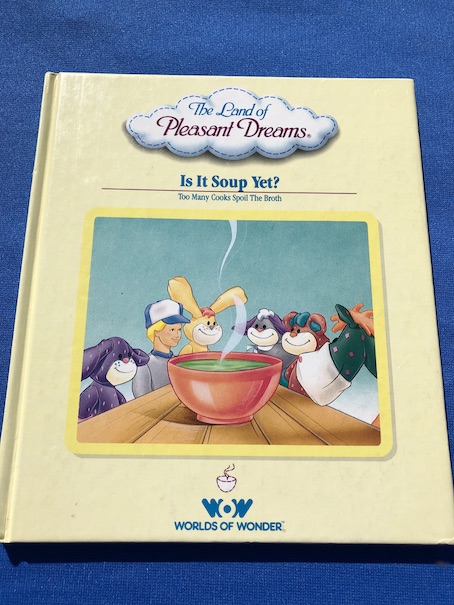
Is It Soup Yet?

The Land of Pleasant Dreams

Is It Soup Yet? By Ane Weber, Ron Krueger, and Tony Salerno, 1986.

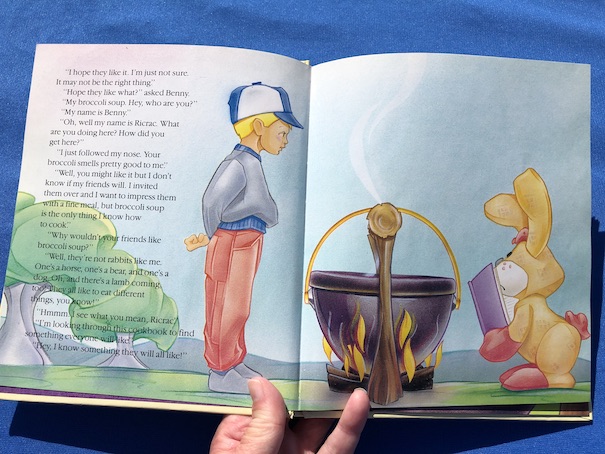
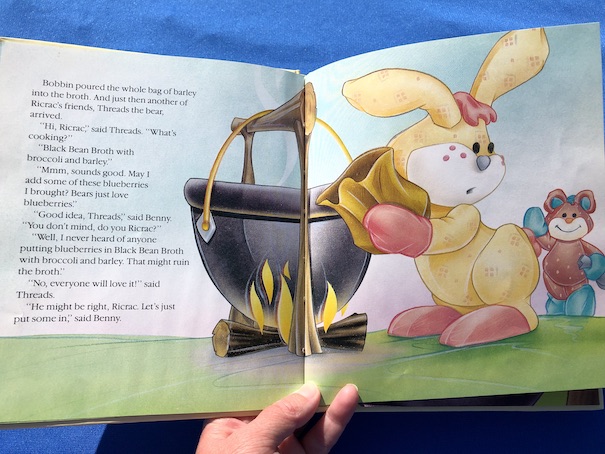
When Benny enters the Land of Pleasant Dreams, he meets Ricrac Rabbit.  Ricrac is trying to cook something for his friends, but he’s worried because the only thing he knows how to make is broccoli soup, and he doesn’t know if his friends will like it because they all have different tastes.

Because Benny’s father is a chef, he suggests that Ricrac try his recipe for black bean broth because everyone loves that when his father makes it.  Ricrac decides to give it a try, adding the black beans to his broccoli soup. 

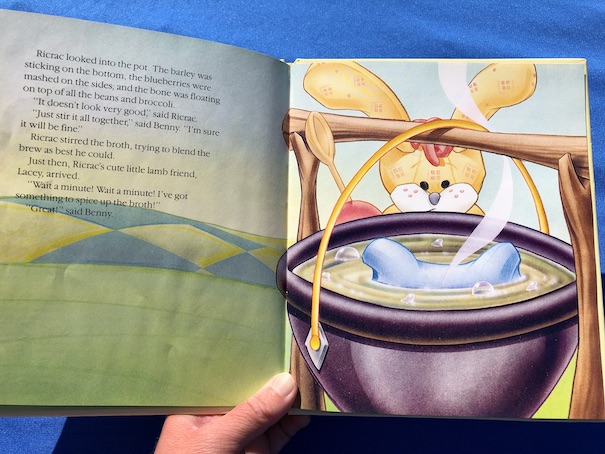
However, as each of Ricrac’s friends arrive, they also decide to bring their favorite ingredients with them.  Bobbin the Horse brings barley, and Threads the Bear brings blueberries.  Then, Snips the Dog brings a bone, and Lacey the Lamb brings buttercups.  In an effort to please everyone, Ricrac adds each ingredient to the soup.

When they finally try it, the soup is horrible.  At first, everyone argues about which ingredient ruined the soup, but Benny realizes that their real mistake wasn’t trying the soup according to Ricrac’s original recipe.  When they try the broccoli soup as it was supposed to be made, without the extra ingredients, it’s really good.

Moral: Too Many Cooks Spoil the Broth.

The point of the story is that trying to please everyone often means pleasing no one.  When planning a project, if you try to stretch it in too many different directions, it’s difficult to accomplish anything because you’re not focusing on anything in particular. In the end, you have to pick one way and stick with it, focusing on what you can do best.

The book is available to borrow and read for free online through Internet Archive. This book was made into an episode for the tv series with puppets. Sometimes, you can find it or clips of it on YouTube.

Max, the Bad-Talking Parrot

Max, the Bad-Talking Parrot by Patricia Brennan Demuth, illustrated by Bo Zaunders, 1986.

Don’t worry, Max’s “bad” talk isn’t really that bad.

Max is a parrot who belongs to a woman named Tillie.  They live in a house that has been made into two apartments.  The woman who lives in the apartment above them is Mrs. Goosebump.  Mrs. Goosebump is Tillie’s friend, and Max likes her, too.

Because Mrs. Goosebump works the night shift in a toll booth, she always comes to see Tillie and Max in the morning, when her shift is over.  Max always greets her with one of his rhymes.  Everything Max says is a rhyme.

However, one day, as Max is dozing on Mrs. Goosebump’s shoulder during one of her visits, he thinks that he hears her calling him an ugly bird.  Max gets upset and returns to his cage, not ever saying goodbye to Mrs. Goosebump when she leaves.  He feels badly about the insult, and when Mrs. Goosebump visits later, he only gives her insulting rhymes, like, “Cupcake, bagel, cinnamon roll, Your brain’s as full as a donut hole!”

Mrs. Goosebump and Tillie have no idea why he’s so angry. The only thing that they can think to do is ignore him.

Later that night, a burglar breaks into Tillie’s apartment and starts stealing some of her things, including Max!  Max is scared, but by coincidence, the burglar stops to pay at Mrs. Goosebump’s tollbooth.  When Max recites some of his rhymes for her, she recognizes one of his usual rhymes and calls the police.

After Max is rescued, he finally tells Mrs. Goosebump why he was so angry, and Mrs. Goosebump explains that she actually said that he was “snugly”, not ugly.  With the misunderstanding cleared up, the two of them become friends again.  Max is also considered a hero for alerting Mrs. Goosebump about the robber.

When I was a kid, I thought that Max’s rhymes were funny, and the scene with the robber at the tollbooth is funny because Max tricks Mrs. Goosebump into believing that the burglar is insulting her before he says the rhyme that Mrs. Goosebump recognizes.  The book is also a good lesson about the importance of talking to people about what you’re feeling in order to clear up misunderstandings.