Betsy-Tacy

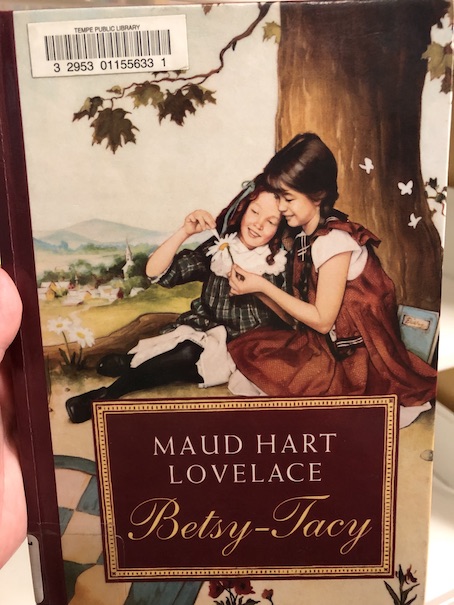
Betsy-Tacy by Maud Hart Lovelace, 1940.

This is the first book in a series about two best friends growing up in Minnesota around the turn of the 20th century. The stories in this book and the rest of the series are based on the author’s own childhood experiences with her best friend.

At the beginning of the book, Betsy meets her best friend, Tacy (short for Anastacia), for the first time after Tacy’s family moves into a house nearby when the girls are both about five years old.  Tacy is very shy and doesn’t want to talk to Betsy at first.  It isn’t until Betsy’s fifth birthday party, a short time later, that the girls really get to know each other and become friends.  After that, they are inseparable, almost to the point where people begin to think of them as one person, Betsy-Tacy. 

Each of the chapters in the book is a short story.  Some of them are about everyday things, like how Betsy would make up stories about her and her friend, how the girls would play dress up and paper dolls, or how they would have a “store” and sell bottles of colored sand to their friends.  Some of the stories are touching, as the girls help each other through some of the most important times of their young lives.  Betsy, the more out-going one, helps shy Tacy through the trauma of their first day of school.  Tacy, who has many brothers and sisters, reassures Betsy that everything will be alright when Betsy’s younger sister is born.  Both girls struggle to come to terms with the death of Tacy’s baby sister. 

At the end of the story, the girls make a new friend when a family moves into the chocolate-colored house with the stained glass window that the girls had always admired.

In the 60th anniversary edition of the book, there are pictures of the author and her best friend, Bick, who is the model for Tacy in the stories, and pictures of the author’s family.  There is also a description of the author’s early life and how the stories were based off her recollections of her own childhood.

This book is available to borrow for free online through Internet Archive.

The Storyteller

Magic Charm Books

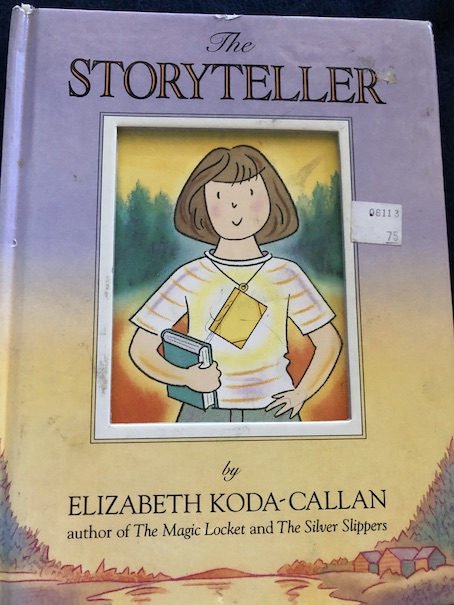
The Storyteller by Elizabeth Koda-Callan, 1996.

A young girl (unnamed, like in the other books in this series) who likes reading more than anything is sent to summer camp by her parents. When her parents first suggest the idea, the girl thinks that she might like camp, but then she gets worried that maybe she won’t or maybe she won’t make any friends there. She takes some of her books with her in case she needs something to do.

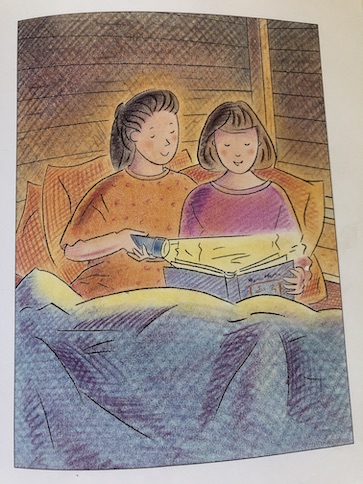
At first, it seems like camp isn’t going to be much fun after all. While the other kids seem to enjoy the typical camp activities, the girl doesn’t seem to be any good at them and doesn’t enjoy them much. However, she does make a friend, Jenny. When Jenny is homesick at night, the girl reads to her to help her feel better.

During the day, the girl keeps slipping back to her cabin to read while the other campers play volleyball because she isn’t good at the game. The camp counselor catches her reading all by herself, but she understands why the girl feels like she isn’t good at the other camp activities. To help her feel better, the counselor promises her an activity that she will be good at.

That night, while the campers are gathered around the campfire, ready to tell campfire stories, the counselor suggests that the girl read to them out of one of her favorite books. With Jenny’s encouragement, the girl reads to the other campers.

The other campers like the way the girl reads to them by the campfire, and Jenny helps the girl to improve at other camp activities. At the end of camp, the counselor gives the girl a charm shaped like a book as a reward for her storytelling skills.

All of the books in this series originally came with charms like the ones described in the stories. This book originally included a little golden book charm for the reader to wear. The hole in the cover of the book was where the charm was displayed when the book was new. The books in the series often focus on the unnamed main character (who could represent any girl reading this story – the books were aimed at young girls) developing new self confidence, and the charms were meant to be either a sign of their new self confidence or inspiration for developing it. In this case, the charm is a reward for the way the girl used her skills to make camp better for everyone while developing new skills in other activities.

The book is available to borrow for free online through Internet Archive.

Anna, Grandpa, and the Big Storm

Anna, Grandpa, and the Big Storm by Carla Stevens, 1982.

The story takes place during the Great Blizzard of 1888. Anna’s Grandpa is visiting her family in New York City, but he thinks the city is boring. He says that there isn’t much there for him to do. One day, Anna is worried about getting to school because it is starting to snow heavily. Anna’s mother says that she can stay home, but Anna is supposed to be in a spelling bee, and she doesn’t want to miss out. Grandpa volunteers to take Anna to school on the elevated train.

As the two set out, Anna begins to get scared because the storm is getting worse. Grandpa urges her on, and the two make it onto the train. Before they can go very far, the tracks freeze over, and the train gets stuck. Anna and her Grandpa are trapped in the train with a bunch of strangers, waiting for rescue.

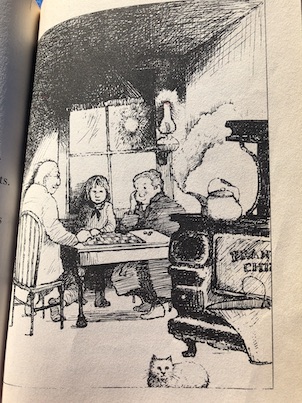
Anna and Grandpa make friends with the other people on the train, finding ways to keep themselves moving and warm while they wait for help to arrive, like playing “Simon Says.”  Even though Anna doesn’t make it to school for the spelling bee, their adventures turn out to be good for the people they are able to help and the new friends they make.  Grandpa sees a different side of life in the city and decides to stay for awhile longer so he can spend time with some new friends.

The story is based upon actual accounts of the famous blizzard when many other people were trapped on the elevated trains around the city. The book is available to borrow and read for free online through Internet Archive.

Rosy Noses, Freezing Toes

Pee Wee Scouts

#13 Rosy Noses, Freezing Toes by Judy Delton, 1990.

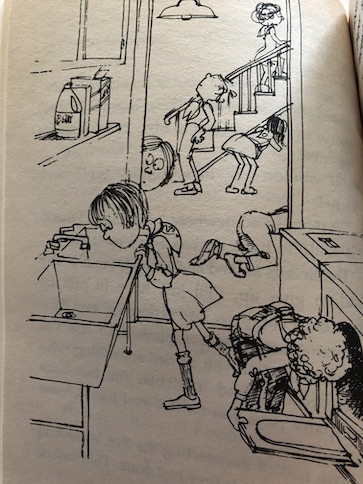
At one of the scout meetings, Mrs. Peters, the troop leader, says that her antique vase is missing. It’s a family heirloom, and Mrs. Peters wants to ask the scouts if they know anything about its disappearance or if they have any idea of what could have happened to it. None of them knows, but they’re fascinated by the mystery. After they search the house and can’t find it, Mrs. Peters says that she’ll just have to report its disappearance to the insurance company. Mrs. Peters is willing to let the matter go at that, but the scouts keep wondering what happened to the vase and if one of them could have taken it.

Mrs. Peters tells the scouts that the next badge they will earn will be their music badge. To earn the badge, the children will have to sing or play an instrument or tell the group about the life of a composer. Some of the children already play instruments and know what they’re going to do, but others aren’t sure. Since it’s December, Mrs. Peters suggests that some of them could sing popular Christmas songs or a Hanukkah song.

Sonny Betz declares that he doesn’t want to participate because he can’t play an instrument and over the next few days, he seems upset and nasty with people. Molly asks him what the matter is, and Sonny tells her that his mother is forcing him to take violin lessons. Mrs. Betz has always wanted Sonny to learn to play the violin, and his new violin teacher has assured her that Sonny will be able to learn the first line of Jingle Bells in time for the scouts’ music show, even though it’s coming up fast. Sonny isn’t happy about it, and to make him feel better, Molly tells him that he’s lucky because nobody else will be playing the violin and it will make him different. Unfortunately, the other kids tease him and call him “Maestro,” so he starts feeling bad.

Molly doesn’t like the way the others keep teasing Sonny, and when Tracy says that Sonny is a baby, Molly tells her that it’s not his fault because his mother is the one who makes him take violin lessons and keep the training wheels on his bike even though he’s in the second grade and all the other things that people tease him about. Mrs. Betz doesn’t realize how much Sonny hates some of the things that she makes him do and how much the other kids tease Sonny about these things. Molly overhears her mother saying that Sonny will “be a handful by the time he gets to high school,” probably because she’s imagining that Sonny will rebel against all things his mother has been making him do once he’s a teenager. Actually, it’s not going to take that long.

Mrs. Peters uses the insurance money from her vase to buy a piano. The scouts’ music show goes okay at first, although none of the kids are spectacular at music. Molly, Mary Beth, and Lisa paint their noses red and sing Rudolph the Red-Nosed Reindeer. Kevin whistles. Roger plays White Christmas on the drums with no other accompaniment, confusing everyone about what song he’s actually playing. Poor Sonny has to go last, when everyone is starting to get tired of the entertainment, but he doesn’t play well. The other scouts cover their ears, and the screeching of the violin makes the dog bark and Mrs. Peters’s baby cry. Sonny is so upset that he runs away from the show and has a fit.

The next day, Molly learns that Sonny has run away from home completely, leaving behind a note that he’s heading to Alaska. Everyone is searching for Sonny and getting worried about him being outside alone in the snow. However, Molly soon discovers that Sonny hasn’t gone as far as everyone fears and he’s certainly not on his way to Alaska. She discovers Sonny hiding in her family’s bathtub. Sonny explains to her that he didn’t have the money to go to Alaska, but he couldn’t bring himself to go home, and he picked Molly’s house to hide in because Molly is the only one who didn’t tease at him. Molly promises not to turn him in, but she says that he won’t be able to stay in her bathtub forever. His mother has called the police to report his disappearance, and Molly’s parents are bound to find him eventually. Sonny swears that he can’t go home because he hates playing the violin so much. What can Molly do to help him change his mind?

I didn’t like the way the other scouts were so mean to Sonny in the book. Sonny does do childish things, like being mean to the younger kids on the playground when he’s upset and throwing fits when things go wrong. However, Molly tries to be understanding with Sonny, even when he’s being fussy and whining, and she recognizes that Sonny is in a difficult position. His mother has certain expectations of him, and Sonny doesn’t think that anything will change her mind. The way things work out, though, makes it seem like Sonny never really explained to his mother how upset he was about the violin lessons and maybe not even how upset he’s been about some other things. Part of Sonny’s difficulty and the reason why he seems babyish to the other kids is that he seems to have trouble managing and articulating his emotions, including standing up for himself and what he really wants. Some of the other scouts help Molly to convince Sonny that running away isn’t the solution, and Molly calls Mrs. Betz to tell her that Sonny is okay but won’t come home until she promises that he can stop playing the violin. Sonny declares that he wants to see that in writing, and his mother gladly writes him a note that says that he doesn’t have to play the violin again.

So, what about the antique vase mystery from the beginning of the story? Before the end of the book, they do locate the missing vase (not really stolen, more misplaced and forgotten), but Molly accidentally breaks it. Mrs. Peters says that it’s okay because, with the vase broken, she doesn’t have to give the money back to the insurance company, and she gets to keep her new piano. She’s been wanting a piano, and the truth is that she never really liked the vase, even though it was a family heirloom. Yay? Merry Christmas!

The book is available to borrow for free online through Internet Archive.

Mystery in the Old Cave

Mystery in the Old Cave cover

Mystery in the Old Cave by Helen Fuller Orton, 1950.

Mystery in the Old Cave nut gathering

Andy and Joan Draper are excited about spending the fall and winter in the country. Usually, they live in an apartment in New York City and only go to their family’s vacation home in Vermont during the summer. However, this year, some friends of their father will be moving to New York, and they’ll need a place to stay because they are having trouble finding an apartment of their own. The children’s father has decided to rent their apartment to his friends while his family stays in Vermont. That means that the children will have to go to school in Vermont, but the children like the idea because they will be able to do things that they normally can’t do when the seasons change, like gathering nuts. When the first frosts come, the hickory nuts on the trees fall to the ground, making it easy to collect them.

After Andy and Joan collect nuts for the first time, they decide to store them in the old sugarhouse on the property. Normally, the family doesn’t use the sugarhouse for anything, but it used to be used during the times when their vacation house was a working farm and people tapped the maple trees for their sap to make maple syrup. They would process the sap in the sugarhouse. Sometimes, farm hands also used to sleep there during the harvest.

Soon, the children begin to suspect that there’s a stranger hanging around the property. Their dog, Ponto, barks at someone the children don’t see and comes running back to them, acting like someone kicked him. Later, a strange man approaches them and asks them if they know anything about a cave in the area. Andy and Joan don’t know anything about a cave. The man tells them that it’s supposed to be near the old sugarhouse, but if the children haven’t seen it, it might have caved in or something. He seems very secretive and doesn’t want the children to tell anyone that he’s been asking questions, and the children wonder if he could be the one who kicked their dog earlier. Later, someone (perhaps this strange man) steals many of the nuts that the children gathered and even some cookies. The children change their minds about storing things in the sugarhouse and decide to keep their gathered nuts in an unused room in the main house. The only clue to the identity of who’s been sneaking around is a red pencil that the person dropped.

Mystery in the Old Cave store

The children make friends with a boy named Phil who lives nearby. Phil is an orphan who lives with his Cousin John (who he sometimes calls Uncle John because he is so much older), a mean and stingy old man who doesn’t treat him very well and makes him work hard around the house instead of going to play after school with the other kids. He doesn’t even replace Phil’s clothes when they get old and torn. Phil gets a job at the local store to earn some money for a new sweater, but Cousin John even confiscates Phil’s earnings.

Mr. Lane, who owns the local store, is nice, and he tells Andy and Phil about how maple syrup and maple sugar are made, something that everyone in town used to participate in so that it was like a community party. The boys think it sounds like a lot of fun, and while they are talking about the old sugarhouse, Mr. Lane mentions that, once, some thieves joined in when they were making making syrup. Nobody knew they were thieves at first; they were just a couple of strangers who came along with everyone else and started helping out. Later, there were some robberies in the area, and the thieves were found hiding in a cave near the sugarhouse. Mr. Lane says that he and his friends used to play in that cave when they were young, and Andy and Phil decide that they want to find it.

Mystery in the Old Cave bones

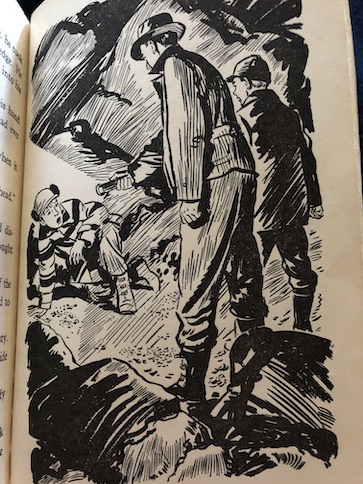
The boys take some tools with them while they’re looking for the cave, in case the entrance has been covered over, which turns out to be the case. Once they dig through the entrance, the rest of the cave appears intact. They find some old bones inside that probably belonged to a bear. They can’t look around much more because the cave is too dark, so they decide that they’ll return later with some lanterns. Mr. Lane tells the boys that there still might be stolen loot around because they never did find everything that the thieves took, including a pearl necklace that belonged to Andy’s grandmother, who was living there back then. Could these things be what the mysterious stranger is looking for?

Mystery in the Old Cave stove in store

During the course of the book, Mr. Lane begins to notice that Phil’s cousin isn’t giving him enough food. Cousin John denies Phil food when he refuses to turn over the extra money that he’s been earning to him. Mr. Lane gives Phil food from the store to eat. While Phil is at the store, he overhears the stranger, who calls himself Joe Williams, talking to Mr. Lane. Joe Williams admits that he’s looking for treasure in the area. Mr. Lane says that he doesn’t have high hopes that Joe Williams will find anything around the cave because the whole area was searched thoroughly years ago.

Phil tells Mr. Lane that he can’t stand living with his cousin anymore and wants to run away. Mr. Lane tries to persuade him not to go, saying that he can deal with Phil’s cousin, but Phil has had enough and worries that his cousin will make life hard for anyone who tries to help him. When Phil hides out in the old sugarhouse, he meets up with Joe Williams, who explains to him more about how he knows about the treasure that may be hidden in or around the cave. He’s about ready to give up the search, but Phil finds something that everyone else has overlooked.

In the end, Andy and Joan’s parents decide to take Phil in. Phil’s cousin agrees to sign over custody to the Drapers, provided that he gets to keep the money from Phil’s job that he took and the money that Phil’s mother left for Phil’s upkeep. I’m pretty sure that’s illegal and that the courts and social workers would have something to say about that if this story happened in real life in the 21st century, but in the story, Mr. Draper accepts the deal and basically uses the money that was meant for Phil to pay off his cousin to surrender custody of the boy. The story ends at Thanksgiving, with Phil sitting down to Thanksgiving dinner with his new family, who will really love him and treat him much better than his cousin did.

Mystery in the Old Cave hiding

This is one of those older mystery stories that’s really more adventure than mystery. There’s really only one suspect for the odd person sneaking around, and his reasons for sneaking around turn out to be exactly what he said they were. There is no other hidden purpose or secret past behind that man other than what he said, and in the end, he just kind of leaves the story. The kids don’t have many clues to the location of the stolen items, and in the end, Phil finds them more by accident than anything else.

Sometimes, when I’m unsatisfied by the ending of a story, I like to make up an alternate one of my own. If I were writing this, I’d have had Phil’s nasty cousin be involved in the robbery and the hunt for the hidden loot. For example, maybe he was actually one of the original thieves and had a falling out with his partners, and he’s secretly searching for the rest of the loot they hid for years. Maybe he’s had to redouble his efforts recently because they’re getting out of prison soon, and he wants to get to the hidden loot before they do. Cousin John is money-hungry enough that it could be plausible, and that would allow the story to end with him being sent to prison, which seems fitting.

This isn’t important to the story at all, but I just wanted to say that the copy I have of this book is damaged in a very odd way. On some of the beginning pages, someone has cut out a few of the words, ransom-note style. I don’t know why that happened. There aren’t enough missing for a real ransom note, and some of the cut-out words are still stuck in the pages, but since this is a mystery book, I kind of like the image of someone using it to write some kind of mysterious secret message.

I haven’t been able to find an online copy of this book yet, but Internet Archive has others by the same author.

The Secret of Terror Castle

The Three Investigators

TITerrorCastle#1 The Secret of Terror Castle by Robert Arthur, 1964, 1992.
In the first book in the series, Jupiter, Pete, and Bob form the Three Investigators, an organization dedicated to solving all kinds of mysteries.  It was particularly Jupiter’s idea. They have been friends for a long time, and they used to have a club dedicated to solving puzzles. Now, they’ve decided that they want to solve more complicated problems and mysteries. Jupiter has won the use of a Rolls Royce and chauffeur for a month by entering a contest at an auto rental agency, so he thinks that it would be a good time to get started because they will have transportation to anywhere in the city.

Jupiter also has an idea for their first case, something that will help them get publicity for their new investigative organization. There is a rumor that a director, Reginald Clarke, is looking for a genuine haunted house to be the setting of his next movie. Jupiter manages, through some clever trickery, to get an interview with Reginald Clarke and persuades him to introduce this account of their first case if he and the other investigators can find a genuine haunted house right in town. Clarke takes them up on it, not because he thinks they will succeed, but because he sees it as the only way to get Jupiter to stop doing an unflattering impersonation of him.

Jupiter, however, is confident that they will be successful because he already knows the perfect place to investigate. Terror Castle is a large mansion that was built years ago by an old actor who was in silent films. All of his movies were scary ones, and since his death under mysterious circumstances, no one has succeeded in staying in the castle very long. Strange apparitions have been seen there, and anyone who tries to spend the night there is overcome by inexplicable terror. As far as Jupiter is concerned, all they have to do is prove that the castle is really haunted, and that means that the Three Investigators must visit it themselves.

In the original books, the director that Jupiter tries to find a real haunted location for was Alfred Hitchcock.  Alfred Hitchcock introduced the early books in the series and played minor roles in some of them, and The Three Investigators capitalized on his reputation.  When the series was re-released, however, Alfred Hitchcock was replaced by a fictional director, and his role in later books was taken by a fictional mystery author named Hector Sebastian.  In the re-released version of the first book, Reginald Clarke refers the boys to Hector Sebastian at the end of the story so they can help a friend of his to find his missing parrot, which leads directly into the subject of the next book.

The haunting in this story (as with others in the series) has a reasonable explanation, not a supernatural one.  In fact, one of the things that I always found memorable about this book was the explanation of how the inexplicable feelings of terror people experienced were created using sound waves which could be felt but which were beyond the normal range of human hearing.  I’m not sure whether the book was completely correct about the science behind this technique, but I have heard about sounds being used to create odd or even harmful effects on human beings in real life.  As for the reasons behind the haunting, they concern the original owner of the castle and the life he lived.

This is one of the books in the series which was made into a movie, The Three Investigators and the Secret of Terror Castle, but the movie was very different from the original book.  In the movie, the owner of the castle was an inventor, not an actor.  Part of the plot also concerned Jupiter’s deceased parents and a mystery that they had been investigating.  Jupiter’s parents were not part of the original book at all.  A villain who appears in some of the other books in the series also makes an appearance in the movie, although he had nothing to do with this particular story in the original series.  Overall, I don’t recommend the movie for fans of the original series.  The changes don’t seem to be for the better, and I think people who remember how the original story was and liked it would be disappointed in the movie.

There are multiple copies of this book available to borrow for free online through Internet Archive, both the original version with Alfred Hitchcock and the updated one.

Aunt Morbelia and the Screaming Skulls

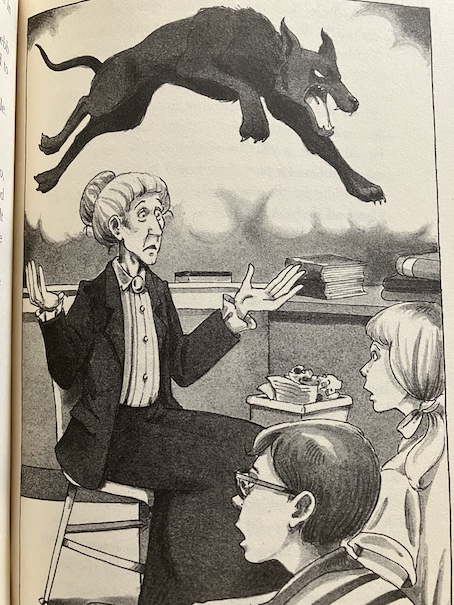
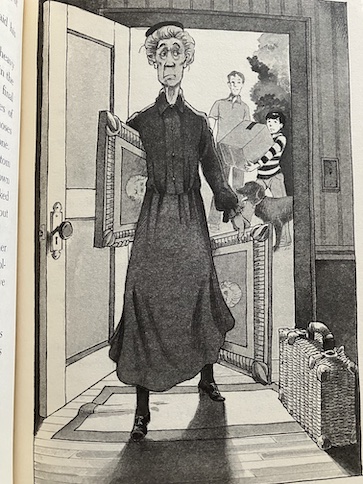
Todd Fearing is worried because his Great-Aunt Morbelia is coming to live with his family.  He has never met her before, but he has heard that she is rather strange, and he knows that his life will never be the same again.  Aunt Morbelia is very superstitious, and she sees bad omens everywhere.  When she first arrives at Todd’s house and sees that the family owns both a black dog and a black cat, she takes it as a sign that she should leave right away.  It takes a lot persuading to get her to stay on a trial basis.  By Joan Carris.

Having Aunt Morbelia at his house is sort of a mixed blessing.  On one hand, Aunt Morbelia likes baking good things for him to eat and helps him with his homework.  Todd is dyslexic and has extra assignments to help him improve his reading.  Aunt Morbelia used to be a teacher, and Todd really appreciates the help she gives him. On the other hand, Todd doesn’t like scary stories, and Aunt Morbelia’s talk of ghosts and bad omens gives him nightmares.  His friends like to hear her stories, particularly Rocky, a girl who typically doesn’t like feminine things.  Rocky, whose real name is RosaLynn, constantly pesters him about when Aunt Morbelia will tell more stories. 

Eventually, Todd gets tired of Rocky’s obsession with ghost stories and the way she encourages Aunt Morbelia to keep telling them, and he and his best friend, Jeff, decide to play a trick on her to cure her appetite for scary stuff.  However, their trick backfires, and in their attempt to make it up to everyone, especially Aunt Morbelia, they end up making things worse. 

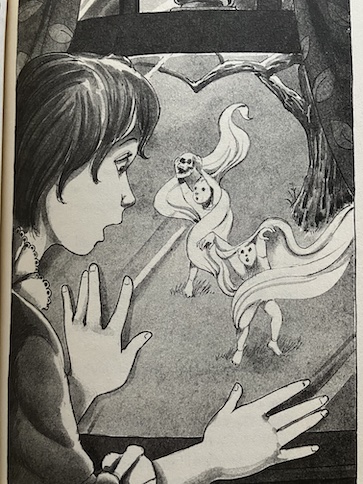
Todd and Jeff succeed in scaring Rocky by dressing up as ghosts and showing up at her house in the middle of the night. They have so much fun with their trick that they decide to go to their friend Alan’s house to try it on him. Alan lives in the house right behind Todd’s, and that’s where they run into trouble. When they start their ghost act, they can’t get Alan to wake up and come to the window to see them. Jeff decides to throw a rock at Alan’s window to wake him up, but the rock breaks the window. To make matters worse, they startle Todd’s black cat, causing the cat to yowl. The boys run back to Jeff’s house, but Jeff’s father catches them. Todd has to go home and apologize to Aunt Morbelia, who was frightened very badly when the cat started howling.

The boys decide to take Aunt Morbelia on a tour of the historic places in town to make up for scaring her. Unfortunately, Jeff includes the funeral home that his father runs on the tour because it is in one of the oldest buildings in town. Although Todd tells her that she doesn’t have to go in if she doesn’t want to, Aunt Morbelia thinks that it would be rude to refuse. Unfortunately, Jeff’s father arrives with a dead body before their tour ends, and Aunt Morbelia faints when she sees it. Aunt Morbelia tells the boys that it isn’t their fault, but she says that she’s not sure she really belongs in their town. Even with all of Aunt Morbelia’s superstition craziness and spooky stories, Todd still doesn’t want her to leave.  Is there still something he can do to convince her to stay?

The book is currently available online through Internet Archive. There is also a sequel to this book, Beware the Ravens, Aunt Morbelia!

When I first read this book, I was expecting a spooky mystery, but it’s really more about a boy adjusting to a relative coming to live with his family and dealing with his dyslexia. Although Todd initially has some reservations about Aunt Morbelia living with him and his parents and her spooky stories scare him, Todd and Aunt Morbelia gradually come to understand each other better, and Todd genuinely wants her to stay. To help Aunt Morbelia change her mind about leaving, Todd has all the people who have met Aunt Morbelia since she arrived come by the house and tell her how much they all want her to stay.  After everyone has visited her, Todd himself tells her that he doesn’t want her to go.  They talk about the scary stories and how Todd feels about them, and Aunt Morbelia tells Todd that if he doesn’t want to hear a scary story, he can be honest with her and tell her so.  Now that the two of them understand each other better, Aunt Morbelia agrees to stay, and she accepts the invitation that one of Todd’s teachers makes to help tutor children at the learning center.

I didn’t like the part where the boys played the trick on Rocky and how awkward things were with her afterward. Jeff’s father says that part of that, with Rocky drifting away from her friendship with the boys, is because the kids are growing up. He says that, as they grow up, girls start changing before boys do and have different interests from boys and different ways of looking at things, including more tomboy girls, like Rocky. Toward the end of the story, Rocky does appear to need more friendships with other girls, and Todd decides that Jeff’s dad is probably right, that Rocky thinks and acts differently from his guy friends because she’s a girl, even if she’s usually not a particularly “girly” girl. Part of that may be true, but the boys’ trick was pretty mean. I think that the real issue is that real friends shouldn’t do that to each other, and Rocky might really be questioning what she’s looking for in a real friend. Although, to hear some of my male friends talk about their youths, boys (at least certain ones) might be more accepting and forgiving of that kind of rough humor from friends than girls would be, so perhaps boys vs. girls issues are partly at the heart of it.

I thought that the parts where Aunt Morbelia was helping Todd with his dyslexia were interesting. I don’t really have any experience with the condition myself, and I’m not quite sure what techniques teachers really use to help dyslexics. One of the tricks that Aunt Morbelia uses is to break down tasks into smaller pieces to make them more manageable. For example, Todd feels badly that he can’t keep the orders of months straight. When he tries to recite the months of the year in order, he mixes them up, which makes him feel bad because most kids his age should be able to do this easily. When I first read this, I wasn’t sure if this is a common issue among dyslexics, although I thought that I remembered reading something about dyslexics having trouble remembering the orders of certain things, like lists of instructions. I looked it up, and apparently, it is a common issue, along with memorizing things like days of the week. There are different techniques for handling it, some of which involve associating the things to be remembered with something else that sticks in the mind more easily, such as a rhyme or song. Aunt Morbelia does some association with Todd but she also breaks the months down into groups of three, representing the four seasons of the year, and giving him small bits of information to memorize. She calls the spring months, “the flower months” and the fall months “the leaf months” and so on. Todd finds that technique helpful, and Aunt Morbelia says that once Todd has mastered the seasons of the year, they will put the season of the year together so that he can recite the entire year. Todd also describes other ways that he is affected by his dyslexia and techniques that his teacher uses to help him.

The School at the Chalet

The School at the Chalet by Elinor M. Brent-Dyer, 1925.

This is the first book in the Chalet School Series.  This series is uncommon in the United States.  People from Britain or countries with heavy British influence would be more familiar with this series.  It’s considered classic!

When the story begins, Madge and Dick Bettany, who are brother and sister, a set of twins, are discussing their family’s situation.  Their parents are dead, and they have very little money and no family members they can rely on.  Madge and Dick are grown and are ready to begin making their own way in the world, but their younger sister, called Joey, is still a child, and her heath has been poor.  Dick has a job, but he really can’t afford to support his sisters.  However, Madge has had an idea: she wants to start a school.  Dick worries that they don’t have the capital necessary to start a school, but Madge says that she could start one in continental Europe instead of England, where they are from, because the costs would be lower.  She even has a specific place in mind, a chalet near a lake, close to a town called Innsbruck in the Tiernsee (Austria).  Joey could live with her at the school and continue her education in the company of the other students, and Madge thinks that the climate there might even be better for her than England.  She has already written a letter to find out if the chalet is available, and it is.  If they sell most of what they own in England, Madge thinks that they’ll have enough to buy what they need in Europe.  Madge says that she thinks she could handle about a dozen girls, between the ages of twelve and fourteen or fifteen.  She knows someone who could help her teach, Mademoiselle Lepattre, and between them, they are qualified to teach French, German, sewing, and music.  Dick is still a little concerned about whether or not Madge can pull off the school, but he agrees that she should go ahead with her plans (since she likely will anyway) and says that if she runs into trouble, she should contact him for help.

Madge even knows who her first pupil at the boarding school will be: Grizel Cochrane.  Madge has already had her as a student, and she is friends with her family.  She knows that Grizel has been unhappy at home since her father remarried because she and her stepmother do not get along.  Grizel’s stepmother has already been pressuring her father to send her away to boarding school, but he loves her and has been reluctant to part with her.  However, Grizel has been miserable, and her father decides would be more willing to send her away with someone he already knows.  Grizel is pleased at the idea of joining Madge and Joey at a school in Europe, and the Madge gains her first student.

Dick and Mademoiselle Lepattre go to the chalet first to take the larger trunks and belongings and begin getting settled, while Madge, Joey, and Grizel follow them.  Along the way, they see some of the sights of Paris.  By the time they arrive at the chalet, Mademoiselle Lepattre’s young cousin, Simone Lecoutier, has arrived at the school to be a pupil, and Madge has arranged to accept an American girl named Evadne Lannis, who will arrive later.  These four girls, Joey, Grizel, Simone, and Evadne, are the school’s first boarders.  The school soon acquires a few day pupils who live nearby: Gisela and Maria Marani (a pair of sisters), Gertrud Steinbrucke, Bette Rincini, Bernhilda and Frieda Mensch (also sisters).  Maria is much younger than the other girls, only nine, but her mother asked that she be admitted along with her older sister. There are public schools for children in Innsbruck, but the father of one of the new local pupils thinks that the Chalet School might be healthier for his daughter because, while he doesn’t think much of English educational standards (Grizel takes exception to that comment), they shorten the school day (compared to the average school day of Austria or Germany of the time) and encourage participation in sports and games. The local girls are curious to see what things are going to be like at an English style school, and if it will be like other English schools they’ve heard about.  The school also soon gains more students and boarders:

  • Margia and Amy Stevens – ages 8 and 11, their father is a foreign correspondent from London who needs to travel for his work, and the girls’ parents wanted to find a stable place for the girls to stay.
  • Bette Rincini’s cousins, who have come to stay with her family
  • A pair of sisters from another town across the lake
  • Two more children from a nearby hotel
  • Friends of Gisela from Vienna
  • Rosalie and Mary, two girls Joey and Grizel know from England

As the school grows and the girls settle into life at the school, they make friends with each other, although it’s awkward in some cases.  Madge notices that Simone is often by herself and she asks Joey if she and the other girls are being nice to her.  Joey says that they try, but Simone often sneaks off alone, and she doesn’t know where Simone goes.  Joey tries to ask Simone if she’s unhappy, and Simone tries to deny it.  The truth is that Simone is really homesick.  Joey finds her crying by herself later and comforts her, and Simone finally admits how much she misses her mother.  Simone also says that she feels left out because everyone else at the school has someone to be close to.  Other girls at the school share nationalities with at least some of the other students.  Simone is the only French girl at the school.  The Austrian girls are close to home, and Joey and Grizel already knew each other before they left England.  Seeing the other girls being such close friends makes her feel more left out.  Joey apologizes for making Simone feel left out and assures her that she will be her friend.  Simone asks her to be her best friend because she really needs someone to confide in, and Joey agrees, although she finds Simone rather needy and clingy. 

It turns out to be a difficult promise because Simone gets very jealous when Joey makes friends with other girls, and she tries to convince Joey to only be friends with her.  Simone is very dramatic, and she even ends up cutting off her long braid in an effort to impress Joey and get her attention when she learns about the other girls who will be coming from England.  Simone is so desperately lonely and finds it so difficult to make new friends that she is terrified that Joey will abandon her completely when she has other friends.  Joey gets fed up with her behavior and tells her that she’s being selfish. Joey knows that Simone would find it easier to make more friends herself if she would stop moping and being sad and gloomy.

After Juliet Carrick, another English girl, joins the school, Gisela is made head girl, and other girls are made prefects.  Bette is a sub-prefect, and one day, when she tells Grizel to put her shoes away, Grizel is rude to her, and Juliet laughs.  Gisela and the prefects discuss the situation and agree that Grizel, who wasn’t causing problems before, is now acting up because Juliet thinks that it’s funny.  When Gisela sends someone to bring Grizel to the prefects’ room to talk about it, Grizel refuses to come and see them, and she realizes that something needs to be done.  If the head girl and prefects let a girl get away with disrespecting them or not following the rules, the prefect system and student government would fall apart.  Grizel feels a kinship for Juliet because neither of them has a happy home life. Juliet has been raised to believe that the English are superior to everyone else, and she has no shame in showing it.  Juliet encourages Grizel to adopt her prejudices, but at a school in Austria with students of varying nationalities, that can’t be allowed.  Madge supports the prefects, and Grizel is punished for her behavior.

Juliet is still a bad influence, sometimes encouraging other girls to act up with her. When Madge refuses to allow the girls to pose by the lake for some film makers, Juliet convinces some of other girls to sneak away with her and volunteer to be filmed without Madge’s knowledge.  However, the father of one of the local girls catches them. He explains to the film makers that it would be inappropriate to film the girls because they don’t have permission from either the girls’ parents or teachers, and he takes the girls back to the school.  Grizel’s temper and excessive patriotism also get the girls into trouble when they encounter a German tourist who makes it plain that she is disgusted at the presence of the English girls. (This is after The Great War, World War I, so that may be the reason.)  While the German woman was being deliberately rude and insulting to the girls, Joey points out that Grizel’s hot-headed reply to her has now caused them more trouble.  Grizel does apologize for not using more restraint.

Juliet’s home life turns out to be even worse than the other girls know, but they learn the truth when Juliet’s father sends a letter to Madge saying that he and his wife relinquish their custody of Juliet to the school.  The letter says that Madge can do whatever she likes with Juliet.  If she wants to keep Juliet at the school and have her work for her future tuition, that will be fine, and she is also free to send Juliet to an orphanage.  The point is that her parents have left the country, they consider Juliet a burden that they would rather not bring with them, and while they might one day feel able to reclaim her, chances of that are not looking good.  When Juliet learns about the letter, she cries and says that she had been afraid that they would do something like this.  Her parents tried to abandon her at a different school once before, but the school had insisted that they take her back.  Madge now has no idea where Juliet’s parents are.  However, she can’t bear to turn Juliet over to an orphanage, so she promises Juliet that she will keep her and that she can help to pay for her tuition by working with the younger children at the school.  Although Juliet’s behavior hasn’t been very good up to this point, Juliet is grateful to Madge and does earnestly try to please her and to maintain her place at the school. Before the end of the book, Juliet’s parents die in an automobile accident, giving Madge and the school permanent custody of her. Most of the other students (except for Joey) do not know that Juliet’s parents tried to abandon her before they died.

Through the rest of the book, the girls have adventures together and forge the new traditions of their school.  They celebrate Madge’s birthday, get stranded in a storm and have to spend the night in a cowshed, start a magazine for the school, and play pranks on each other. When Grizel’s pranks and disobedience go too far and she is punished harshly for it, she gets angry and runs away from the school, becoming stranded on a nearby mountain. Joey goes after her to save her, and both girls are ill after their experience.

The book ends with Madge and a few of the girls caught in a train accident. Fortunately, they escape the accident without serious injury, and they also manage to help the German woman who had insulted the girls earlier. A man named James Russell helps them. The book ends at this point, and the story continues in the next book in the series. James Russell is a significant continuing character.

The book is currently available to borrow for free online through Internet Archive.

Sixteen and Away from Home

Sixteen and Away from Home by Arleta Richardson, 1985.

The year is 1889. Mabel O’Dell turns 16 years old at the beginning of the book, and her mother gives her a journal as a present. Soon, she and her best friend, Sarah Jane Clark, will be starting the final years of their education at the academy in town. Mabel worries about going to the academy, first whether they’ll pass the entrance exams, and then whether they’ll be homesick because they will have to board in town. Sarah Jane assures her that it will be okay because they’ll be going together, and they’ll probably be too busy at school to think about homesickness much. Mabel’s mother is a little worried about the foolishness that young women can get into when they’re on their own. However, the girls do pass their exams and are admitted to the academy, and their parents agree to let them go.

In town, the girls will be staying with Sarah Jane’s Aunt Rhoda. Aunt Rhoda’s housekeeper, Lettie, seems to resent the girls being there for reasons they don’t understand. When school begins, the girls are shocked to learn that they’ll have to wear bloomers for “physical culture” classes. The teacher gives them a sewing pattern so they can make the uniform themselves. The girls imagine that their parents would be shocked to see them running around without skirts on. Fortunately, Mabel and Sarah Jane will have all the same classes, along with all of the other first year students. They have to take Grammar and Rhetoric, Biology, Latin, History, Calculus, and Physical Culture (physical education or PE).

They also quickly realize that the class troublemaker is going to be Clarice Owens, who unfortunately sits near Mabel because they all sit in alphabetical order by last name. Clarice deliberately picks on Mabel and Sarah Jane for coming from the countryside, calling them “hayseeds.” Mabel is disgusted because she can never think of a good comeback until after Clarice walks away. (Yeah, I’ve been there before.) Sarah Jane thinks she’s jealous of Mabel for being prettier. Mabel doesn’t really believe that, but she appreciates the thought. Molly, one of the other town girls, is friendlier. She says that she knows Clarice has always thought she was better than everyone, but she’s not usually this deliberately mean. Mabel says that maybe it would help if they knew the reason.

Through the rest of the school year, Clarice tries one scheme after another to cause trouble for the girls, especially Mabel. Mabel tries to be as patient as she can with Clarice, trying to let her know that she’d rather be a friend than an enemy, but Clarice gets angry and upset when Mabel tells her that she forgives her for all the awful stuff she does. Mabel thinks that there’s something hurting Clarice and affecting her behavior, although Molly tells her that she shouldn’t waste her sympathy on Clarice because “she gets what she wants.” Molly thinks that they should just be grateful for those times when Clarice isn’t immediately stepping on them to get what she wants because that happens, too.

When Mabel is injured in a sledding accident and has to stay in bed for awhile, she worries about falling behind in her classes. Lettie talks to her and brings into question the reason why she’s so concerned about her standing in class. Is it really because she loves learning, or is it because she’s trying to compete with the other students? Mabel starts to consider how too much competitiveness can spoil a person’s attitude and take the enjoyment out of things. Competition has much to do with Clarice and her attitude.

Things get worse when Clarice’s grandmother becomes ill and her parents arrange for her to stay in the house with Mabel and Sarah Jane while they go to see her grandmother. Clarice is rude to the servants in Aunt Rhoda’s house and sneaks out of the house during the night. Lettie tells the girls that Clarice’s mother was strong-willed as a girl, and she’s given a lot of her attitude to Clarice. There was a boy that Clarice’s mother had always wanted for herself, but he married someone else. Although Clarice’s mother also married and had a child, she never completely got over losing her first choice to someone else. Since the man she originally loved has a son the age of her daughter, Russell Bradley, she might be hoping that Clarice will marry him. Clarice certainly is interested is Russ … who is apparently more interested in Mabel.

Mabel considers that allowing Clarice to be with Russ and not trying to compete with her would help settle things between them, but as Sarah Jane says, Russ’s feelings on the issue matter. To get the most out of her education, Mabel needs to focus on her love of learning instead of comparing herself to her classmates, and to get the most out of their relationships with other people, all of the girls need to focus on caring about other people and their feelings.

The book is part of the Grandma’s Attic series. It is available to borrow and fread for free online through Internet Archive.

My Reaction

The problem with Clarice and her mother and their attitudes and expectations is that they do not take anyone else’s feelings into account other than their own and don’t even inform people of what they really want, yet they expect everyone else to somehow accommodate their wishes and feel toward them exactly how they want them to feel. These are not reasonable expectations at all. For most of the book, Mabel is completely unaware that Clarice’s meanness comes from the fact that she sees her as competition, and even then, it’s not really clear at first what Clarice is trying to compete for. Mabel didn’t ask or agree to be Clarice’s competitor in anything, and she’s not even trying to be. In fact, she’s been trying everything that she can to avoid it. Russ also apparently has no idea what Clarice is really after because he doesn’t have the same feelings about Clarice that she has about him. He’s just trying to live his life and focus on his own feelings and interests, and as far as he’s concerned, Clarice doesn’t really enter into it. Russ has no obligations to Clarice and her mother, and even Mabel doesn’t have the right to tell him how to feel or what to do to get rid of Clarice’s ire.

When Clarice pulls one last trick on Mabel, and she still forgives her, Clarice finally tells her that she gives up because, “You can’t go on disliking someone who refuses to be disliked.” I have to admit that I found the end to be a bit unbelievable. I’ve never encountered anybody who was that much of a pain and who ever let someone else’s kind behavior stand in the way being a pain. The response that I’ve usually seen is that they congratulate themselves on finding someone who’s never going to fight back and use that opportunity to run roughshod over them. They usually blame the kind person for making it easy to take advantage of them. As even the book says, people cannot decide how anyone else should feel or force them to feel anything in particular. It just doesn’t work. Mabel cannot “refuse to be disliked” because what Clarice likes or dislikes is all in her own mind. All that Mabel can decide is how she feels and what she’s going to do about it.

What Mabel really does decide is that, whether she likes or dislikes Clarice, she’s not going to compete with her and try to fight or match her meanness. It isn’t so much a matter of likes and dislikes in the end as Clarice discovering that she’s running a race with no other runners. If there’s no one to race against, there isn’t really a race at all, and no one cares if you walk off with the trophy or not. Maybe there was never even a trophy there to begin with.

If I’ve said it once, I’ve said it a million times, I don’t like bullying or one-upmanship, and I have no interest in sympathizing with anyone who does those things. Part of the trouble I have with overly-competitive personality traits is the same trouble that actors sometimes suffer when they’re out in public: they don’t always know when to stop acting, stop posing, or stop performing. Overly-competitive people don’t know went to stop competing. Where does the one-upmanship end and the human person actually begin? Or is that their personality all by itself? Do they have any interests outside of being competitive, or are they only about competition just for the sake of competition? Do they wan to be good at something for a purpose or because they just love it, like the love of learning, or is everything they do just about trying to look better than someone? I was reading this article recently, about how trying to keep up an image all the time too often leads to a person having no real substance or sense of self.

By herself, Clarice doesn’t present much to connect with or sympathize with. Clarice doesn’t really seem like a real person to me. She’s rather a one-dimensional character. This is a problem with a lot of bullies in children’s books. She apparently has very generic family issues that are supposed to explain her behavior with little insight into how she really feels about anything. At least, that was how she seemed to me. The explanation behind these family issues comes from a youthful romantic trauma of her mother’s, but what does that really mean to Clarice herself? She seems to have some kind of fear of being second-best, possibly because her mother has pushed her in that direction, but again, we return to the question of second-best at what? Is it that she fears being rejected by classmates or potential boyfriends, or does she fear not living up to her mother’s expectations? If her mother is still pining for her first boyfriend, what does that say about her parents’ relationship with each other? Does her mother view her own husband as second-best, the consolation prize in the contest of life, and what does that mean for Clarice’s relationship with her father? What does Clarice really want out of life and what, specifically does she want to be the best at doing? The idea of romance with Russell may be wish-fulfillment for her mother, but what do she and Russell really have in common? What does she have in common with anybody, when we mainly see her in competition with everyone?

I wouldn’t have nearly as much patience with her as Mabel because, when it comes right down to it, I wouldn’t see Clarice’s friendship as a prize worth winning. Mabel went through quite a lot to get through to Clarice, but her efforts only pay off right before the end of the book, so we don’t really see much of what Clarice is like after she says that she’s giving up the competitive mean girl act. Apparently, Mabel will get the benefit of not having to put up with Clarice’s mean tricks from now on, which is something, but if Clarice isn’t being mean and sneaky, what is she? Who is she, really?

In real life, people have hobbies, interests, and life goals, but Clarice doesn’t seem to have much that really interests her. Are Clarice’s goals really hers or her mother’s, as they hint? What does Clarice want, or has she even thought about what she wants? In modern times, a sixteen-year-old still has years of education ahead of her because more people attend college these days, but once Clarice finishes at the academy in town, her education is likely over. She only has a couple of years left to think about a direction for her life before she has to get on and live it as a full adult. Even if her destiny seems to be someone’s wife and mother, connecting with someone emotionally to the point where they would want to be married and sharing a life with her would be difficult for someone who has no real interests to connect to or a sense of how to build a shared life with someone else. For a while, she seemed to do well at memorizing the reading from Alice in Wonderland that she was going to perform with Mabel at the end of the school year, but that was just another part of her tricks so that she could back out at the last minute and let Mabel down. It was all part of an act by itself. Does Clarice really like acting? Does she like books? Does she like anything?

Clarice doesn’t even seem to have any close friends of her own, which is very unlike the real-life bullies I’ve known. Most of them do have friends and hangers-on who enjoy their mean humor (the thing that often binds them together and bolsters their bad behavior) or who put up with it because of some other benefit they get from that friendship, but Clarice doesn’t seem to have anybody and isn’t really offering anything. It just doesn’t seem realistic and makes me feel like Clarice is there mostly to be the cardboard cut-out of a nemesis. That may be why she gives up so easily in the end.

I would have found her change more believable if Russ had straight-up told her that her mean tricks and selfish attitude are the reasons why he doesn’t like her and isn’t interested in her. That would have been motivation for Clarice to change because it would give her both something to lose by not changing (Russ and others getting angry and saying they’ve had enough of her attitude) and something to gain by taking on different habits (like the possibility that Russ might change his mind if she can demonstrate that she can do as many unselfish deeds as Mabel, something that might actually appeal to Clarice’s competitive personality). I would also have found it believable if Clarice changed her mind about Russ because she ultimately realized that Russ is what her mother wants for her, not what she wants for herself, and that there are other possibilities that she likes better. I would also have liked it if Clarice had been planning to back out on the reading of Alice in Wonderland in order to ruin the presentation for Mabel but changed her mind at the last minute because she realized that she loves the story or performing so much that she just can’t bring herself to miss the event, that she has found something that she loves doing more than causing problems for someone else. Reassessing the consequences of behavior or finding different goals are the kinds of self-motivation that provoke real people to change.

On the other hand, maybe the real issue is Clarice has sensed that she’s fighting a losing battle for Russ, and as Sarah Jane noted, you can’t control the way other people feel. If Russ doesn’t love Clarice, he’s just not going to love her. Perhaps she can tell, even when he’s with her, that he’s not thinking of her and just isn’t going to be interested in her the way she is with him. There’s only so much effort that a person can pour into getting someone’s attention before it starts to get really awkward when they don’t get the attention they’re looking for. Even if Russ doesn’t spell it out for her, she can probably tell that she doesn’t want to be with someone who clearly doesn’t want to be with her. Clarice still might not know quite what she really wants yet, but she might have figured out that’s one thing she doesn’t want, to be with someone who doesn’t think of her as his first choice or even much of a choice at all. All along, she’s been trying to compete with someone who doesn’t even want to compete for a prize that doesn’t want to be won by her because he’s already picking another winner. It brings us back to the idea of one person attempting to run a race all alone. It’s not really a race, it’s just one person running down the street, getting sweaty and tired, with no real prize to win, and who is there to care when they start or stop? That might actually be the most believable explanation of them all.

The books in this series have Christian themes, including this one. As the characters discuss the problem of Clarice and other situations, they often turn to the Bible for inspiration, sometimes discussing specific quotes that relate to the concepts they consider, like forgiveness and revenge.

On a fun note, I liked the description of the Halloween party activities. I was born around Halloween, and I often have a Halloween-themed birthday party. I’m sometimes fascinated by the traditions of Halloweens past. In the book, they call it a Halloween party, but the activities are more harvest-themed than spooky. They bob for apples and run races with apples balanced on their heads, and they also play tug-of-war and Skip to My Lou.

Meet Samantha

American Girls

Meet Samantha by Susan S. Adler, 1986.

This is the first book in the Samantha, An American Girl series.

Samantha Parkington is a nine-year-old orphan. She belongs to a wealthy family and lives with her grandmother, called Grandmary, in the Hudson Valley in New York. Grandmary is often strict with Samantha, trying to teach her to be a proper young lady, but Samantha finds it difficult. Samantha’s grandmother loves her, but she has very old-fashioned ideas about how girls should behave. When Samantha wants to try making and selling boomerangs in order to earn money to buy a doll, using instructions from The Boys’ Handy Book, her grandmother stops her, saying that young ladies do not earn money. She would rather that Samantha earn the doll as a reward for doing what she is told and practicing her piano lessons. Samantha also has an uncle, Uncle Gard, who has a girlfriend named Cornelia. Cornelia is a more modern woman, who would see nothing wrong with Samantha wanting to earn some money.

One of her grandmother’s servants, a black woman named Jessie, is kind and motherly to Samantha. Jessie often patches Samantha up after her various escapades and mishaps. Jessie’s husband, Lincoln, is a train porter, and Jessie tells Samantha exciting stories about the places that Lincoln has seen in his work, like New Orleans. Sometimes, Lincoln brings Samantha post cards from these places.

Samantha soon learns that a new girl her age is coming to a neighbor’s house. She has been wanting a playmate, so she goes over to the neighbor’s house to introduce herself. The new girl’s name is Nellie, but she has come to be a servant for the neighbors, the Rylands. Nellie’s family is poor, so Nellie needs to work as a maid help her parents earn money and support her younger sisters. Samantha is surprised when Nellie describes her family’s circumstances in New York City. Samantha has never been poor, and she doesn’t know what it’s like to be cold and hungry. Nellie says that the air in the countryside is better for her, and she gets better food working for the Rylands. Nellie tells Samantha that she has never been to school, and Samantha offers to teach her.

Then, Jessie suddenly announces that she is leaving her job at Grandmary’s house. Grandmary doesn’t seem surprised, but Samantha is. Jessie offers no explanation for leaving, and when Samantha tries to ask, Grandmary and the other servants do not want to talk about it. Samantha tells Nellie about Jessie leaving, coming up with fanciful reasons why she might leave her job, but Nellie offers the practical explanation that Jessie might be having a baby. Nellie knows more about it than Samantha because she has younger sisters, but she acknowledges that adults of this time period do not like to talk about people having babies, particularly in front of children. Neither Nellie nor Samantha entirely knows why.

However, Samantha is still concerned about Jessie. Samantha doesn’t know where Jessie lives, but Nellie does. The two girls sneak out one evening to visit Jessie and learn for themselves what the matter is. This is the first time that Samantha has been to the part of her town where black people live, further opening her eyes to the lives of people from lower classes of society. Nellie is a little surprised at how Samantha, who is more educated, sometimes knows so little about the ways that other people live.

It turns out that Jessie does have a new baby. Jessie reassures Samantha that she and the baby are fine, but since her husband needs to travel because of his job as a train porter, she needs to stay at home with her baby now. Samantha thinks of a way to help Jessie keep her job and care for her baby at the same time, persuading her grandmother to let Jessie come back. Unfortunately, Nellie soon has to leave because Mrs. Ryland doesn’t think that she’s strong enough to work as a maid and decides to send her back to her family in New York City. Samantha gives Nellie her new doll as a going-away present, and she is very concerned about how Nellie and her family will manage.

In the back of the book, there is a section with historical information about how wealthy people and their servants lived during the early 1900s.

Something that occurred to me later is that Jessie is about the right age to be Addy‘s daughter, from another American Girls series. I don’t think that there’s a real connection between Jessie and Addy because the Samantha books were written before the Addy series. However, when I stopped to think about their relative ages (Addy would be about 49 years old in 1904, and Jessie is probably in her 20s), it occurred to me that if Addy had a daughter, she would probably be an adult at this time, and she might be doing something very similar to what Jessie is doing, working as a seamstress.

The book is currently available to borrow for free online through Internet Archive.