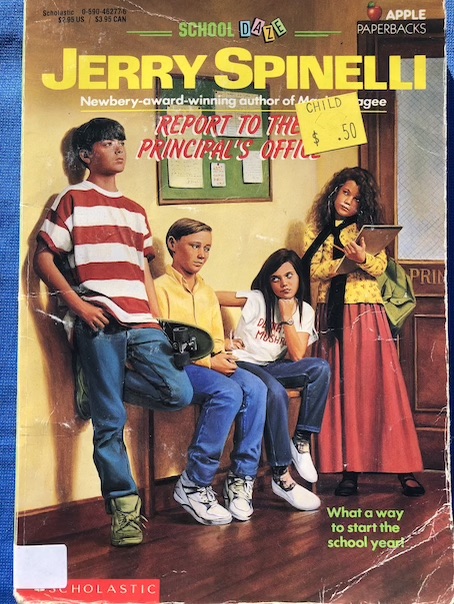
Report to the Principal’s Office by Jerry Spinelli, 1991.
This is the first book in a series about a group of unlikely friends in middle school.
The start of the new school year is a disaster for Sunny Wyler. Her best friend, Hillary, lives directly across the street from her house, and they’ve been close for their entire lives, always attending the same school. However, because of the construction of a new middle school in their town and changing school zone lines, which happen to be drawn directly down the middle of their street, Sunny and Hillary will now be sent to different schools for middle school. (During my childhood, parents could sometimes ask for a boundary exception for kids from the local school district so they could attend a different school with their friends, but that doesn’t appear to be an option here.) Hillary tries to be optimistic, pointing out that the new middle school that Sunny will be attending is much nicer than the old middle school that she will have to attend, but Sunny doesn’t care about that. She just wants to go to school with her best friend.
Sunny thinks that she’s come up with a plan to reunite with Hillary. She’s decided to make herself so obnoxious at her new school that they will kick her out, and her parents will have no choice but to send her to Hillary’s school. She’s decided to wear an old t-shirt that says “Death to Mushrooms” every day, never washing it, so she’ll smell bad. She’ll refuse to wash her hair, so it will be dirty and greasy. Above all, she’ll have the worst attitude, never smile, and never talk, never even answering if her teacher asks her questions in class.
Eddie Mott first encounters Sunny Wyler on the bus to school. She sits next to him, and he can tell right away that she has problems and a bad attitude, and that’s the last thing he wants for the beginning of his new school year. Eddie is trying to adopt a more grown-up image in his middle school years, and he desperately wants to fit in with the other kids. He’s trying to wear the right clothes, be friendly with other kids, and above all, avoid problems. None of that has prepared him for Sunny.
There is one person, though, who has done his best to prepare for all the kids who will be coming to the new middle school, the school’s principal, Mr. Brimlow. Over the summer, he studied the details of the incoming students, and he can recognize them on sight as soon as they arrive. When the school bus driver tells him that there’s a kid on the bus who refuses to get off, he recognizes the kid immediately as Eddie. Between dealing with Sunny’s aggressive unfriendliness and being roughed up by older kids on the bus, Eddie can’t bring himself to come to the school. The bus driver, impatient to get to his other job, actually drives off with the principal, Eddie, and Salem, a girl with literary ambitions who wanted to study the situation for story fodder, still on board.
Things are generally going wrong all over Plumstead Middle School as everyone, including the teachers, try to figure out their way around, but Mr. Brimlow is calm and good-natured, and getting back to school with Eddie and Salem after their bus adventure breaks the ice between them. When Mr. Brimlow gets back to his office, he finds Dennis “Pickles” Johnson waiting for him. Dennis, who gained his nickname from the time he decorated his family’s Christmas tree with actual pickles and the incident made the local paper, is an amateur inventor who made his own oversized skateboard that looks like a pickle. The reason why he was sent to the principal’s office is that his skateboard won’t fit in his locker, and he can’t have it in class. When Pickles asks the principal what could happen if he were allowed to ride his skateboard around the school, the principal asks to try the skateboard himself. He’s unable to stop himself and ends up rolling into a nearby classroom and crashing into the geography teacher’s desk, proving to Pickles (and everybody else) what could happen if Pickles is allowed to use his skateboard in the school hallways. Mr. Brimlow forbids Pickles to bring the skateboard to school again but also thanks him for the fun ride and invites him to lunch.
Far from being upset by the strange beginning to the school year, Mr. Brimlow is actually grateful for the eccentric students and their shenanigans because he really likes to get to know his students, and he particularly learns a lot about Eddie, Salem, Pickles, and Sunny on their first day. It hasn’t escaped his notice that Sunny is being purposely sour to other people, and it isn’t really a surprise when one of her teachers sends her to the principal’s office after she deliberately answers all of her math problems wrong, misspells everything in a writing assignment, writes all of her assignments in extra tiny writing to make them difficult to read, and then pretends to flick boogers at Eddie.
When she’s sent to the principal’s office, Sunny thinks that her plan of being obnoxious has already worked and that she’ll soon be sent home or to Hillary’s school, but the principal ends up inviting her to lunch along with Pickles, Eddie, and Salem. The principal actually enjoys the experience, and rather than punishing any of the students for their various shenanigans from the morning, he decides to give each of them special jobs to help them settle into life at their new school. Since Eddie was a flag raiser at his old school, Mr. Brimlow gives him that job at Plumstead Middle School, assigning Pickles to help him. He puts Sunny in charge of taking care of an escaped hamster that the kids found, and noting Salem’s interest in people’s personalities and organizational skills, puts Salem in charge of all of the other students as they are given the collective job of coming up with a mascot for the school.
Through these activities, the four kids become friends with each other and also start to become a real part of their new school. Instead of being kicked out, Sunny is the one who comes up with the winning idea for the school’s new mascot, the Hamsters, becoming attached to the hamster that she has to care for and upset during a time when she thinks that he’s dead. (Fortunately, the hamster is fine in the end.) Eddie thinks of himself as a wimp for being pushed around by the older kids, but Pickles becomes his friend and sticks up for him, and Salem writes a story about him to show him why he’s actually a hero in his own small way.
It’s a good story about a group of unlikely friends with likable, eccentric characters. In the end, the principal’s tactic of helping the students to adjust to middle school by getting them more involved works well, and even Sunny realizes that she can be happy in her new school with her new friends while still being friends with Hillary from across the street.
The book is available to borrow and read for free online through Internet Archive.
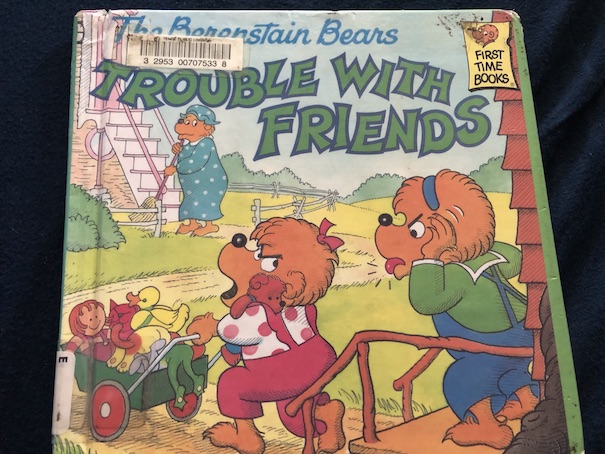
The Berenstain Bears and the Trouble with Friends by Stan and Jan Berenstain, 1986.
“When making friends, the cub who’s wise is the cub who learns to compromise.”
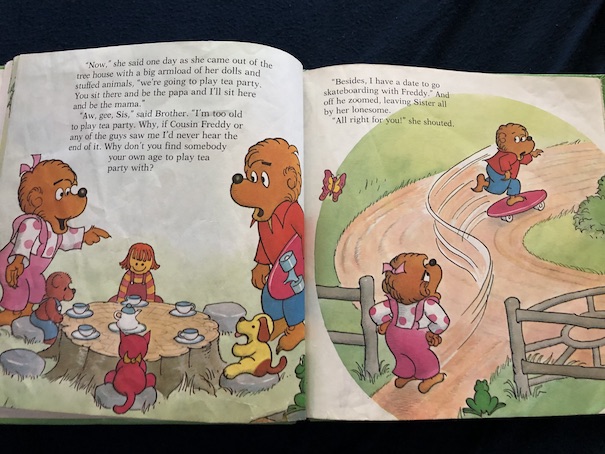
Brother and Sister usually play pretty well together, but Brother is two years older than Sister, and he doesn’t always want to play girls’ games like tea party and house. Brother likes to hang out with Cousin Freddy, but Sister doesn’t have a friend who lives close enough to play with her after school.
Then, one day, a new family moves in down the road, and they have a girl who’s Sister’s age. The new girl’s name is Lizzy, and she likes to do many of the things that Sister likes to do. The girls start playing together right away. Sister thinks that Lizzy is fun, but a little bossy … kind of like Sister herself.
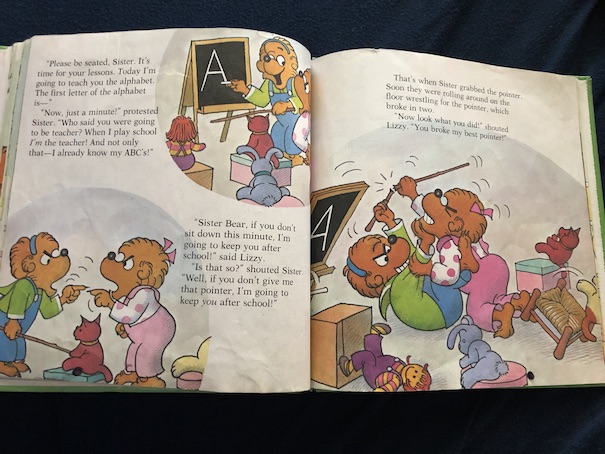
Later, Sister takes some of her stuffed animals to Lizzy’s house so they can play school. However, the girls argue over who is going to play the part of the teacher. Both of them want to play the teacher, and during their argument, they break Lizzy’s pointer stick.
Sister goes home angry, but Mama Bear reminds her of the reasons why she might want to make up with her new friend. Getting along with people can be difficult, but there are many things that are difficult to do alone. Having friends can be a lot of fun, certainly much more fun than sitting home and being lonely. If Sister wants to make up with Lizzy, she needs to accept her for the person she is and recognize that she can be a bit bossy herself sometimes. Both of the cubs need to give a little, let each other have their way sometimes, and care about each other’s feelings.
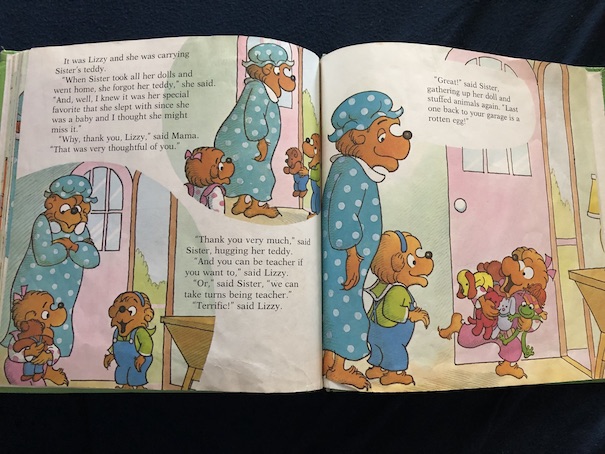
Lizzy drops by to return Sister’s teddy bear, which she left behind. She remembers what Sister told her about her teddy bear and why it’s important to her, showing that she does care about Sister’s feelings. The girls make up and agree to compromise and take turns being the teacher when they play school. Both the girls realize that getting along with friends means considering each other’s feelings and being willing to compromise.
The book is available to borrow and read for free online through Internet Archive (multiple copies).
Night is an owl who likes to go out hunting for food at night, and Day is a poodle who lives with family called the Pennyfeathers. Because Day is usually only out during the day and sleeps in the family’s house at night, they don’t usually meet. However, by chance, Day rescues Night from a fox.
Night is grateful, and the two of them become friends. However, because they are normally active at very different times, they can’t easily meet to talk to each other.
They sometimes leave each other little treats, like a bone with some meat or something from one of Night’s hunts.
They also begin meeting at the kitchen door at night to talk to each other.
However, Day’s barking and Night’s hooting is too loud, and they start keeping the Pennyfeathers awake at night. At first, they can’t figure out why Day keeps barking every night, but their son, Bobby, sneaks out one night and sees the way Day seems to be talking to the owl.
Bobby correctly realizes that Day and the owl are friends and that they’re just trying to talk to each other. To solve the problem, Bobby builds a dog house for Day so that Day can comfortably sleep outside and talk to his owl friend without disturbing everyone.
Day likes the new dog house, and Night meets him there every night so the two friends can talk whenever they want.
My Reaction
This is a cute picture book that I’ve liked since I was a kid. I like the way that Day and Night talk to each other and some of Day’s misconceptions about what his humans are thinking. When Mr. Pennyfeather yells at them to be quiet, Day tells Night that he thinks Mr. Pennyfeather is barking at the moon.
Some of the pictures are in black-and-white and some are in color. It seems to be common in older picture books to have a mixture of black-and-white and color images. I think it might partly have been done to save money on printing.
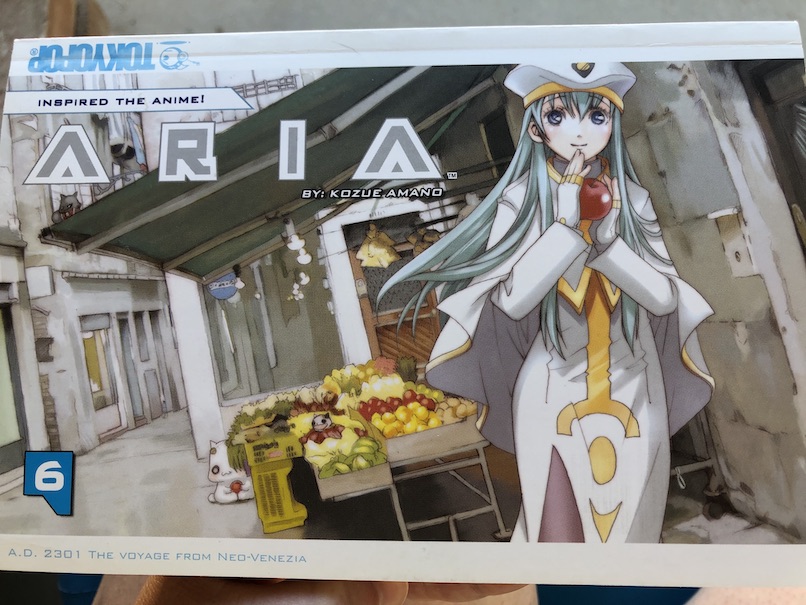
Aria Volume 6 by Kozue Amano, 2005, English Translation 2011.
This is the sixth volume of the second part of a fascinating manga series that combines sci-fi, fantasy, and slice of life. The series takes place about 300 years in the future, when Mars has been terraformed and renamed Aqua (because of all the water on its surface). The human colonies on Aqua are designed to resemble old-fashioned cities on Earth (called Manhome here). The people of Aqua prefer a much slower pace of life than people on Manhome, and aspects of life on Aqua more closely resemble Earth’s past.
The series is divided into two parts. The first two books are the Aqua volumes and introduce Akari Mizunashi, the main character, a young girl who came to Aqua to learn to become a gondolier in the city of Neo Venezia (which resembles Venice). Female gondoliers, called Undines, give tours of the city, giving Akari plenty of time to admire the beauty of her new home and meet interesting people. The two Aqua books are the prequel to the main series, Aria. Aqua covers Akari’s arrival on the planet, her introduction to life on Aqua, and the beginning of her training. The main Aria series show Akari’s continuing training, her progression to becoming a full Undine, her evolving relationships with her friends, and as always, her delight in learning more about her new home and admiring its beauty.
The series has received some criticism for being slow and lacking danger and adventure, but that is not really the point of the series. The main purpose is to show people how to appreciate the small pleasures of life. The sci-fi and fantasy elements (the spaceships, advanced environmental controls, intelligent Martian cats, and even the occasional appearances of the legendary Cait Sith) are mainly background to the stories about the magic of friendship and simple pleasures. Each volume contains a few short stories about Akari and her friends and the little adventures they have on a daily basis and the life lessons they learn. It’s a great series for relaxing when you’re stressed out.
Unfortunately, although this book is only about halfway through the series, this is the last book of the series that I actually own because the others haven’t been printed in English yet, although I think that additional volumes will be published in English.
The stories included in this volume are:
Orange Days
Athena comes to visit Alicia at Aria Company, and the trainees’ mentors reminisce about how they first met when they were trainees.
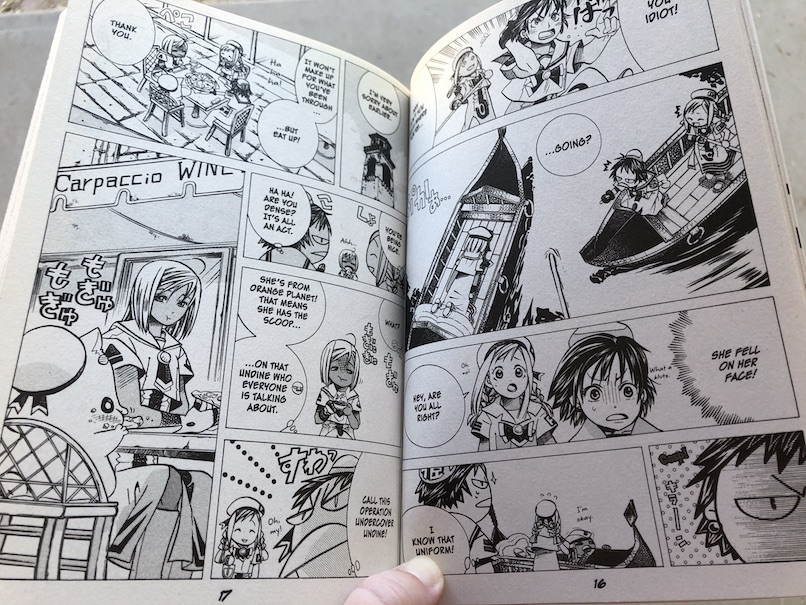
Akira was just as prickly and competitive when she was young as she is as an adult. Although trainee Akira said that she was just observing the “losers” at Aria Company, she kept coming around and became friends with Alicia. When she heard about a new trainee at Orange Company with an amazing singing voice, Akira wanted to seek her out, worried about the competition.
While she was telling Alicia about it, the two of them accidentally had a collision with young Athena’s gondola, which is the first time either of them had seen her. Athena was knocked over by the collision, so the other two girls treated her to lunch, partly to make it up to her and partly because Akira wanted to pump her for information about the new trainee at Orange Company, not knowing that Athena herself was the new trainee.
However, Athena didn’t answer their questions about the new trainee. Even back then, she was a person of few words, and she just made a drinking straw crawly snake to amuse President Aria. Still, Athena became friends with Alicia and Akira, joining them in their practice sessions, like Akari, Aika, and Alice share their practices together. Alicia and Akira only discovered that Athena was the trainee with the amazing voice when they decided to practice singing canzones one day.
The mentors end their reminiscences by saying that it seems hard to believe that, now that their training is over, they are so busy that they hardly have time to see each other. When they were trainees, it felt like they would always practice together every day, but now, their lives are different. These comments make the present trainees uncomfortable because they realize that the same thing is likely to happen to them when their training is complete. Alice, Aika, and Akari have come to value each other’s friendship and companionship, and they find it difficult to imagine being without each other.
However, Alicia and Athena tell the girls to not worry too much about it. Time is always moving forward, and it’s true that things will change for them, but that’s not entirely a bad thing. Even though they sometimes miss their training days when they spent so much of their time together, they are also happy with their current lives. They enjoy their careers, and they like helping to train new Undines. In fact, helping to train the next generation of Undines helps them to connect to their own pasts because the young Undines remind them of their own training days. Alicia’s advice is to enjoy where you are and what’s currently happening around you as much as you can. Life will eventually move on, and things will change, so you might as well make the most of where you are now and enjoy it to the fullest, so you will be ready to move on to the next stage of your life and enjoy that as well. Athena says, “Fun times really aren’t meant to be compared. Just enjoyed.”
The young trainees are still affected by the story of their mentors’ friendships and the changes in their lives. Aika points out to Akari that their lives aren’t changing just yet, but the girls have come to a greater realization that their lives will eventually change.
It’s just like how, when people are young and in school, surrounded by the same other students every day, it can be hard to imagine that there will come a day after you graduate when you won’t all be working at the same place and you won’t all be eating lunch together every day. As you get busy building careers and families, it will be harder to see each other and keep in touch. However, that’s not entirely a bad thing. As some people like to say, “You can’t begin the next chapter of your life if you keep rereading the last one.” There are many things in life to enjoy and accomplishments to be made, and like Alicia and Athena explain, you might as well enjoy where you are right now and make the most of it so you won’t look back with regret when it’s time to move on.
Venetian Glass
Akatsuki’s elder brother comes to Aria Company to hire Akari to transport some delicate Venetian glass. Akari is excited because this is the first time that anyone has specifically hired her, although, because she isn’t a full Undine yet, Alicia will have to accompany her on her errand.
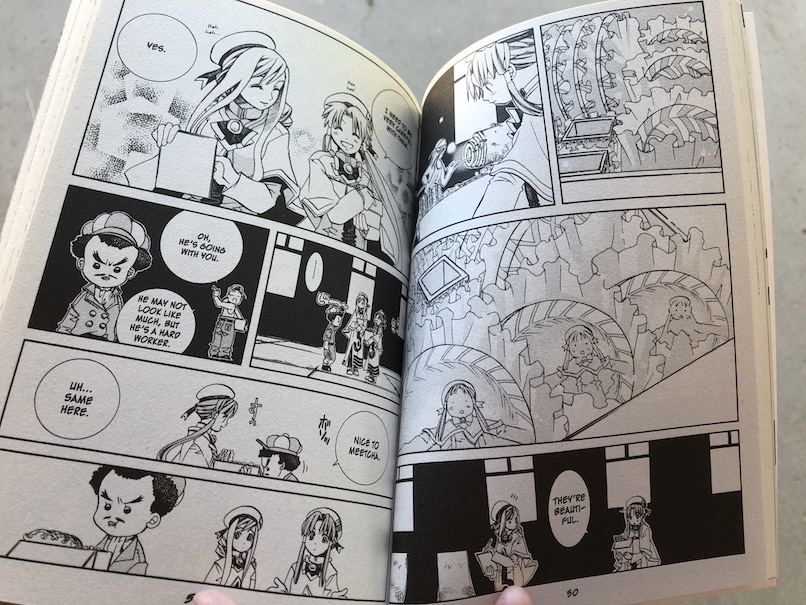
When they go to pick up the glass, Akari sees glass-blowing and Venetian glass for the first time.
One of the workers from the glass factory seems kind of surly, but he accompanies them while they transport the glass and explains the history of Venetian glass and what makes it so special.
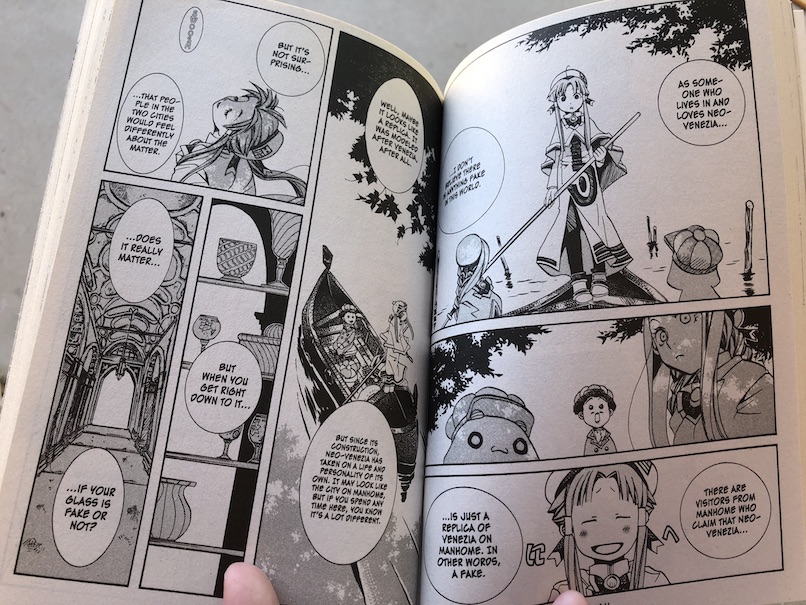
The reason why the glass worker is so surly is that he feels like a lot of people don’t appreciate his craft. He and his master put their heart and soul into their work, but people say that their “Venentian glass” is fake because it’s made in Neo-Venezia, not in the real Venice, which sank beneath the ocean years ago. The worker laments that the craftsmen who left the sinking city were scattered across Earth before making their way to Neo-Venezia and that details of their craft have been lost over time. Neo-Venezian glass will never be quite the same as the original Venetian glass, and people will never look at it the same way, which the worker finds depressing.
However, one of Akari’s great strengths is finding the beauty in everything and bringing it out for other people to see. She tells the worker that the glass is kind of like Neo-Venezia itself. It’s true, it’s not the original Venice, only re-created in its image. Some aspects of it are the same, but it’s also a different place, on another planet. To some people, that might make it seem like a fake city, just an imitation of the original, but Akari doesn’t think that the real vs. fake concept matters because she loves the city for the beautiful treasure it is. Similarly, Akari thinks that Neo-Venezian glass is a treasure by itself and likes it for what it is, regardless of what the original was or what others say about it.
The worker finds Akari’s viewpoint inspirational and is enchanted by Akari herself, remarking that she’s also a unique treasure. Akatsuki’s brother jokes that Akatsuki might have a rival now for his affection for Akari. Akari knows that Akatsuki has had an unrequited crush on Alicia, so she doesn’t think too much about it. Although it’s true that Akatsuki has a crush on Alicia, Akatsuki’s brother is also correct that Akari inspires greater feelings in others than she realizes and Akatsuki values Akari more than he lets on, maybe more than even he realizes himself. Akari is unique because of her unusual way of looking at things, and her optimistic point of view influences others.
Snow White
One day, while they’re practicing together, Akari asks Aika what kind of adult she wanted to be when she was a kid. Aika, who has admired and even hero-worshipped Alicia ever since Alicia was kind to her when she was a young child, says that she’s always wanted to be an elegant woman like Alicia. Akari says that she wants to be like Alicia, too, but Aika criticizes her for wanting to copy her ambition and says that it’s not likely that Akari would ever be as elegant as Alicia because she still does kid-like things, like collecting stuffed animals.
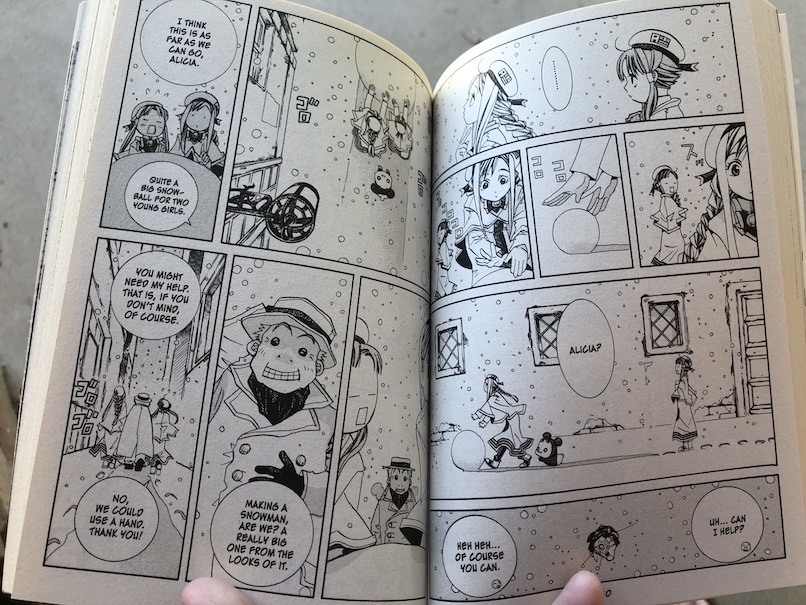
Their discussion causes Akari to wonder what sort of adult Alicia wanted to be when she was a little kid, and she asks Alicia about it while they’re out walking one day. Instead of answering her directly at first, Alicia demonstrates by starting to build a snowman and pointing out how the people around them react to it.
Each time Alicia and Akari start to make a large snowball for the base of the snowman, different adults stop and help them to make it a bit bigger.
Alicia says that she noticed people like this when she was a child. There are always adults who, when seeing a young girl making a snowman, feel compelled to help her because she can make a much bigger snowball with their help. That’s the type of adult Alicia always wanted to be.
Alicia genuinely enjoys not only her career as an Undine but her role as a teacher and mentor in Akari’s life and in the lives of her friends, helping them to develop in their trade and to become better Undines because of her influence.
Stray Cat
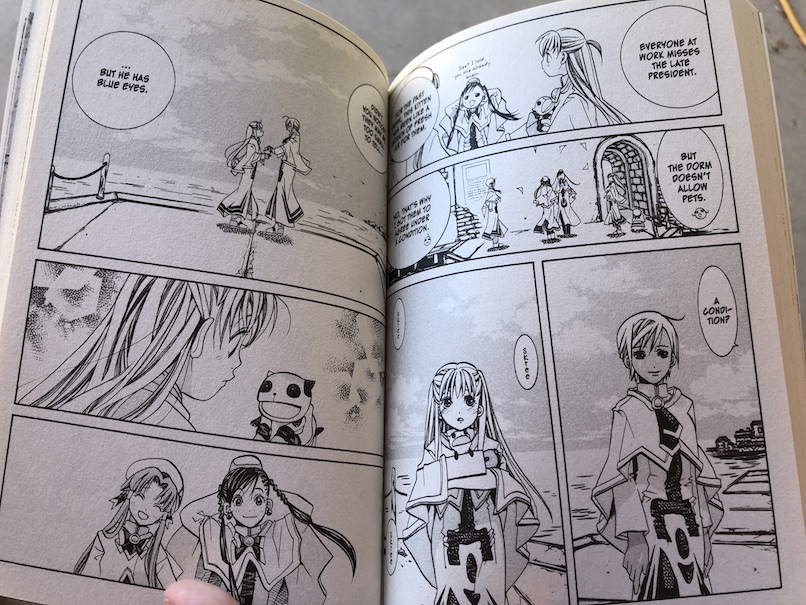
Alice finds a tiny stray Martian cat one day while waiting for Akari and Aika to meet her for practice. The cat’s mother doesn’t seem to be around, and Alice doesn’t know whether the little cat is lost, orphaned, or abandoned. When Aika arrives for practice, she finds both Alice and Akari lying on the ground next to the cat because it looks so happy lying in the sun that Alice thinks they should also try it.
Although Aika warns Alice that she won’t be able to keep the cat because she lives in a dorm at Orange Company and isn’t allowed to keep pets, Alice becomes attached to the cat, names it Maa, and hides it in her room.
At first, she is afraid that her mentor, Athena, will be angry with her, and Aika scares her by saying that Athena will probably kill the cat because she doesn’t like cats. However, Alice loves Maa because she misses the previous president cat of Orange Company, who recently passed away, and Maa reminds her a little of him.
When the secret gets out, and Alice is confronted by Athena about the cat, Alice is scared because Athena is holding a knife for slicing fruit and runs away to leave the tiny Maa where she found him, thinking that it might be the only way to save his life. However, she finds herself unable to abandon Maa and returns to get him, only to find him missing from the box where she left him. In a panic, she spends all night searching the city with her friends to try to find Maa.
However, when they finally give up the search, they discover that Athena has Maa. When she had tried to talk to Alice before, she wasn’t angry. She followed Alice to the place where she left Maa and retrieved him and has been waiting for Alice to return to Orange Company. In Alice’s absence, Athena has persuaded Orange Company to keep Maa as their new company president. Like the other cats used as the presidents/mascots of gondola companies, Maa also has blue eyes.
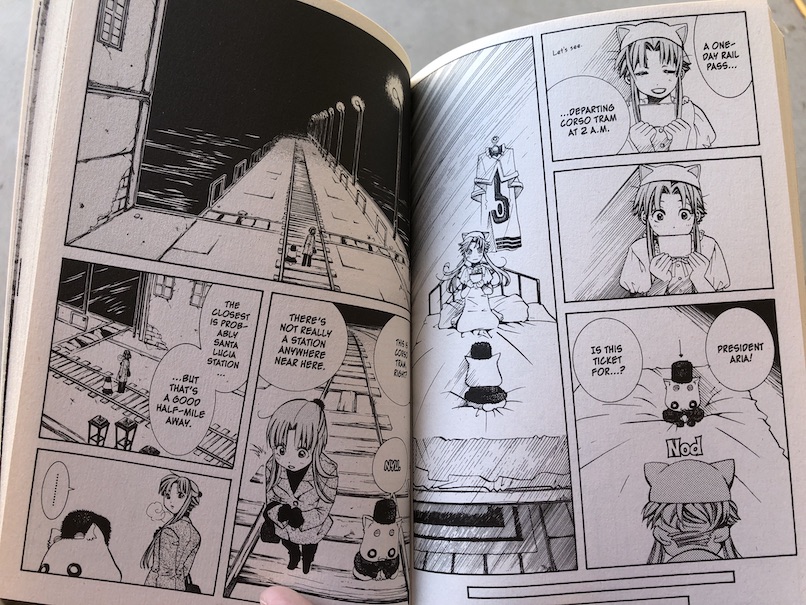
Aika has a more practical explanation for what it is, that the sounds of freight trains are more noticeable at night, when everything is quiet, but Akari discovers the truth when President Aria gives her a special train ticket.
It turns out that the mysterious train is a train of cats. (Guess who the conductor is?) Akari could use the ticket from President Aria to ride the train, but instead, she gives it to a sad little kitten who lost his ticket.
Because Akari doesn’t board the train, she never finds out where the train was going. The next morning, it all seems like a strange dream, except both Akari and President Aria have the stamps on their foreheads that Cait Sith gave them.
A Parallel World
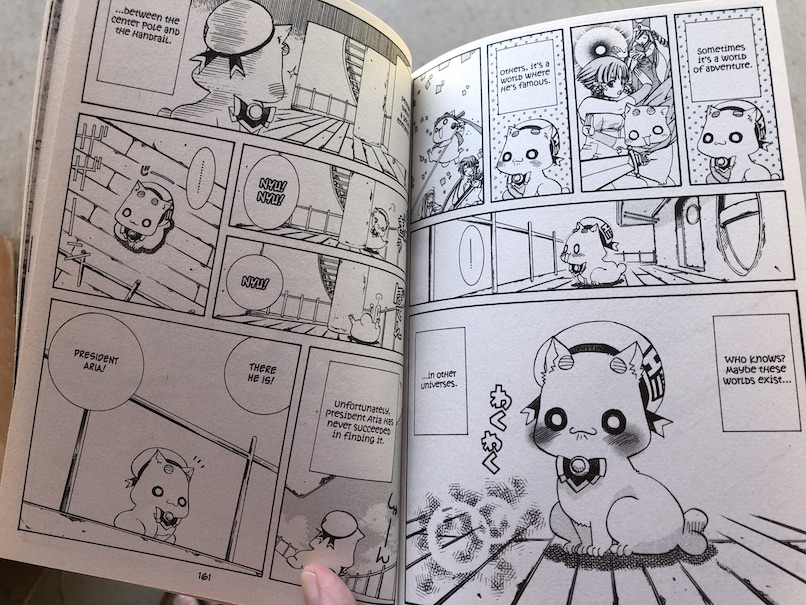
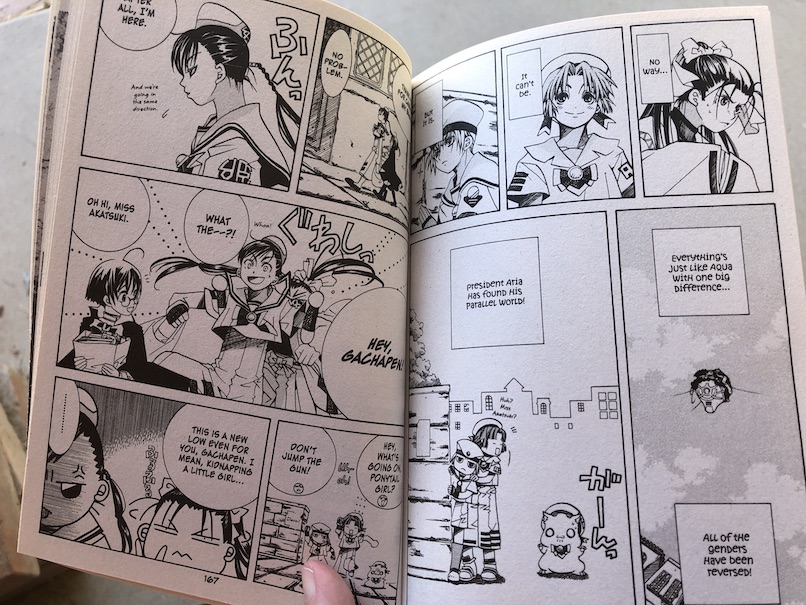
President Aria accidentally finds a parallel world in which all the people he knows who are girls are boys and vice versa. Frightening!
President Aria has always wanted to find a gateway to another world, but everything seems so strange that all he wants to do is get back to his world.
He ends up returning to the world he knows when someone tosses him too high in the air while playing with him. Did any of it really happen, or was he just dazed from when he fell?
This one isn’t one of my favorite stories in this series because I think that the premise is kind of goofy. The characters don’t really look all that different when their genders are switched. Most of the difference is in hair styles, and the uniforms of the Undines have pants when they’re normally just long dresses.
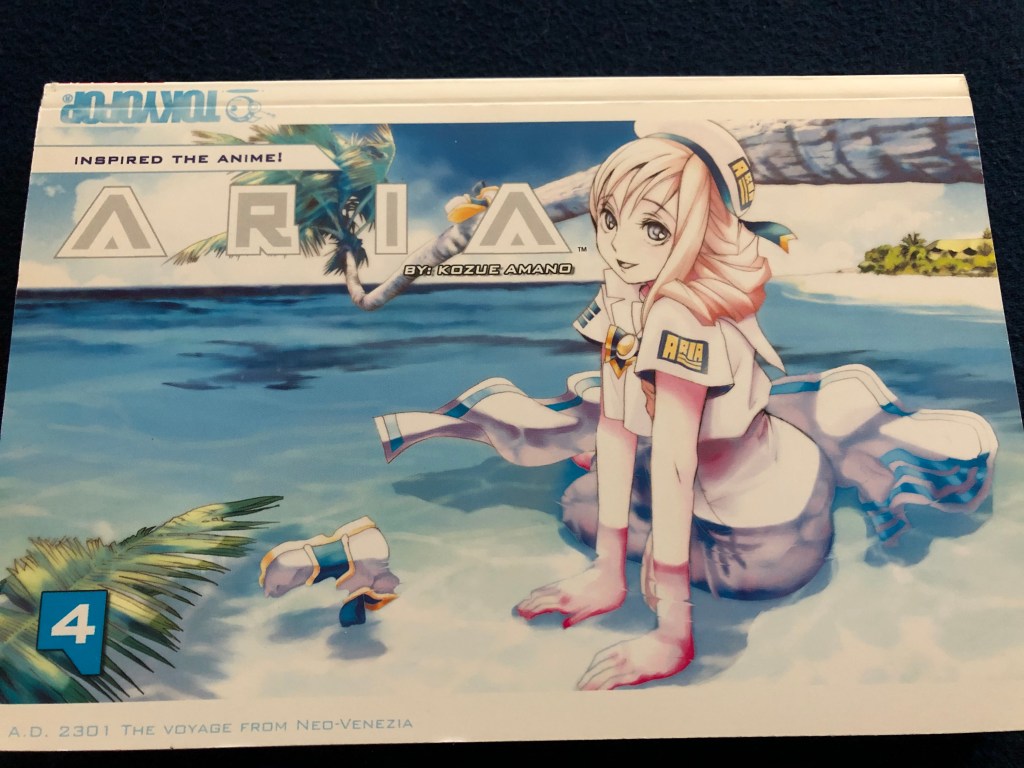
Aria Volume 4 by Kozue Amano, 2004, English Translation 2008.
This is the fourth volume of the second part of a fascinating manga series that combines sci-fi, fantasy, and slice of life. The series takes place about 300 years in the future, when Mars has been terraformed and renamed Aqua (because of all the water on its surface). The human colonies on Aqua are designed to resemble old-fashioned cities on Earth (called Manhome here). The people of Aqua prefer a much slower pace of life than people on Manhome, and aspects of life on Aqua more closely resemble Earth’s past.
The series is divided into two parts. The first two books are the Aqua volumes and introduce Akari Mizunashi, the main character, a young girl who came to Aqua to learn to become a gondolier in the city of Neo Venezia (which resembles Venice). Female gondoliers, called Undines, give tours of the city, giving Akari plenty of time to admire the beauty of her new home and meet interesting people. The two Aqua books are the prequel to the main series, Aria. Aqua covers Akari’s arrival on the planet, her introduction to life on Aqua, and the beginning of her training. The main Aria series show Akari’s continuing training, her progression to becoming a full Undine, her evolving relationships with her friends, and as always, her delight in learning more about her new home and admiring its beauty.
The series has received some criticism for being slow and lacking danger and adventure, but that is not really the point of the series. The main purpose is to show people how to appreciate the small pleasures of life. The sci-fi and fantasy elements (the spaceships, advanced environmental controls, intelligent Martian cats, and even the occasional appearances of the legendary Cait Sith) are mainly background to the stories about the magic of friendship and simple pleasures. Each volume contains a few short stories about Akari and her friends and the little adventures they have on a daily basis and the life lessons they learn. It’s a great series for relaxing when you’re stressed out.
The stories included in this volume are:
Neverland
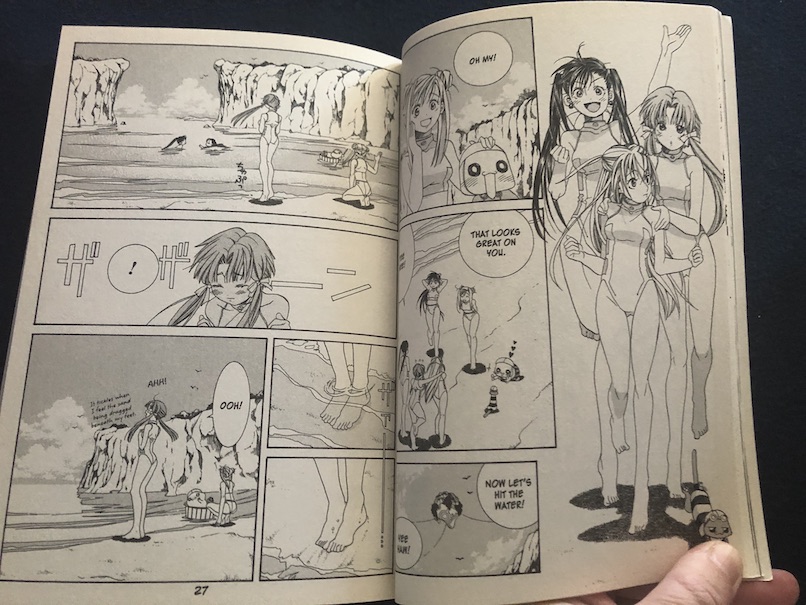
Alicia and Akira arrange a special, surprise trip to the beach for the trainees, a happy day that reminds Akari of Neverland. It starts out with an invitation for each of the trainees that supposedly comes from Peter Pan, inviting them to Neverland, but it turns out to be a fun day at a beach that President Aria found.
Akira wanted the day to be a day of training, but Alicia convinced her that a day of rest and relaxation would benefit the trainees more. The girls put on their swimsuits and enjoy a day of swimming.
Akari thinks that the beach and their day there really is like Neverland, and Alicia realizes that it is because of the way that Akari looks at things. Akari’s strength is the ability to enjoy the simple pleasures in life for what they are, finding the magic in daily life.
This story emphasizes the theme of the series, which is that the most important thing is to choose to be happy.
Traveling Water
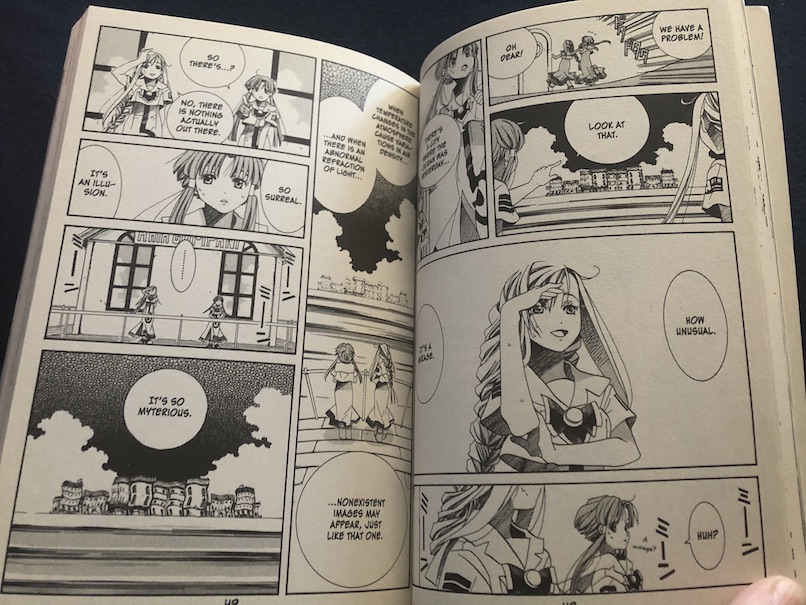
Summer on Aqua is very hot, and Akari experiences her first mirages. People on Aqua sometimes call them “traveling water” because they can look like water that you can never reach. (I grew up in Arizona, and I grew up seeing that. On a straight road, the heat waves will look like distant water, waving and reflecting the scenery, but they appear to dry up or move further away as you go toward them.)
On a very hot day, Akari sets out to buy a night light chime and, oddly, seems to find herself all alone, except for President Aria. She follows President Aria, hoping that he will lead her to a place where she can cool off.
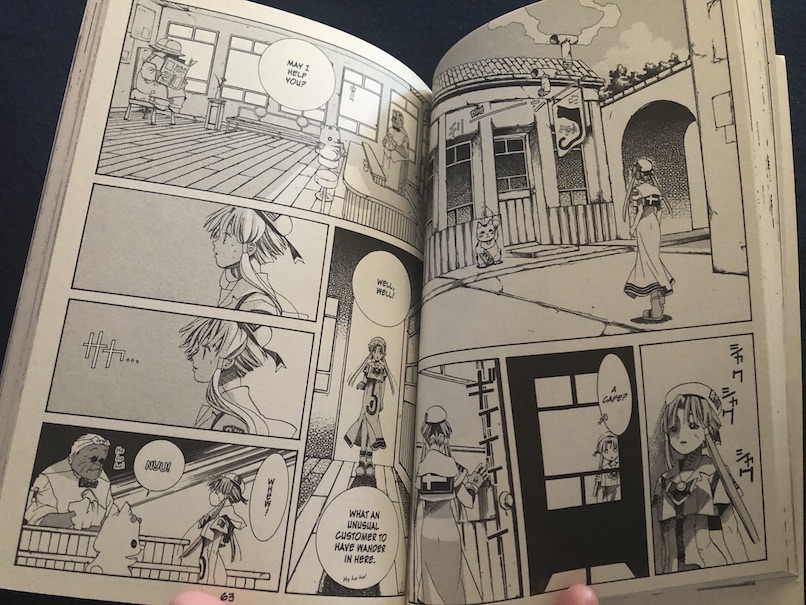
Akari finds herself at a mysterious cafe, which is nice and cool. The server gives her and President Aria ice cold milk, and Akari feels better, but the cafe is no ordinary cafe.
It turns out that the cafe is a secret hangout for cats and their king, Cait Sith. Humans do not ordinarily find their way there. They give Akari a special night light chime and urge her to go on her way …
Unless it was all just another mirage.
I love this story for its “was it all a dream” theme and for the cat-shaped chime that helps confirm that it all really happened. I also like the idea/warning that the server offers to Akari, that maybe it’s a good thing not to completely catch up to a mirage. Akari is sometimes a special guest of the magical characters that inhabit their world, going to places and seeing things that others don’t, but she can’t stay among them because her life is in the human world, and she has to let the fantasy elements slip away to return to her ordinary life that is a little less ordinary for the experiences she’s had.
Flying Fish in the Sky
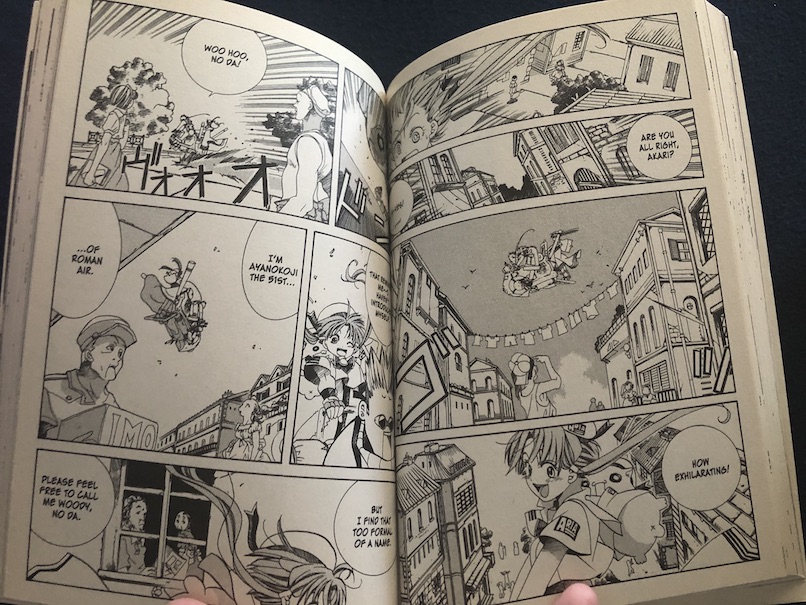
Akari notices that some of the professions on Aqua relate to the four elements: water, fire, earth, and air. The Undines represent water because they spend their time rowing their gondolas, the Salamanders represent fire because they control the heat levels in the atmosphere to control the weather, and the Gnomes represent earth because they work underground to control gravity. The fourth element-based profession is Sylph, which represents air. They are flying deliverymen.
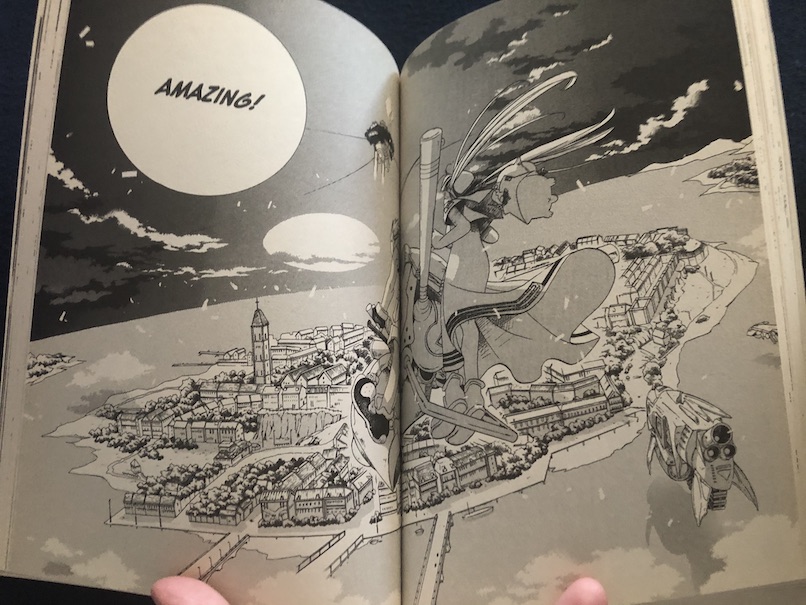
Akari helps a sylph called Woody, a flying deliveryman with a poor sense of direction, after he falls off his flying bike and loses the map he depends on in order to make his deliveries. It’s kind of a scary ride, but it’s also exciting, and Akari gets a bird’s-eye view of her city.
Woody also appears in later stories.
The Legendary Major Fairy
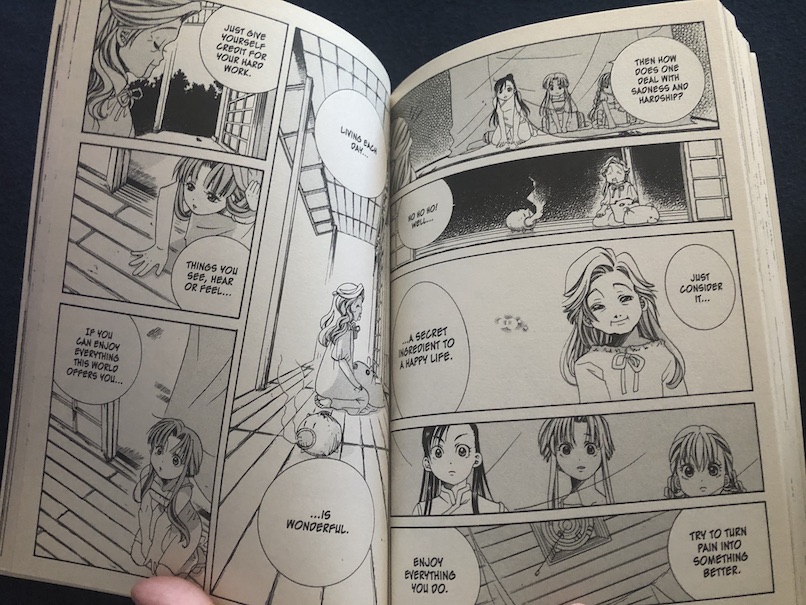
The trainees go to meet the founder of Aria Company, who is considered the Legendary Major Fairy, the grandmother of the younger Undines. She now lives in the countryside, and as the girls help her with some chores and enjoy other activities, Aika keeps looking for hidden tests of their skills or lessons slipped into the activities.
When hidden tests and lessons don’t seem to be in these activities, and the activities just are what they appear to be, Aika gets impatient and worries that maybe the older woman thinks that they’re hopeless and not worth teaching. She asks the Legendary Fairy, who asks them to call her “Grandma”, directly for some advice about being a great Undine, and what she tells them is both simple and yet something that is easy for people to forget.
Grandma’s advice is another repetition of the themes of the entire Aria series, but it’s worth repeating. She tells the girls to enjoy themselves in everything they do (the activities she gave them earlier were for them to enjoy, nothing more), remember that the world and life itself is full of things to enjoy, give yourself credit for your hard work, and when you encounter pain and sadness, try to turn it into something better.
The Redentore
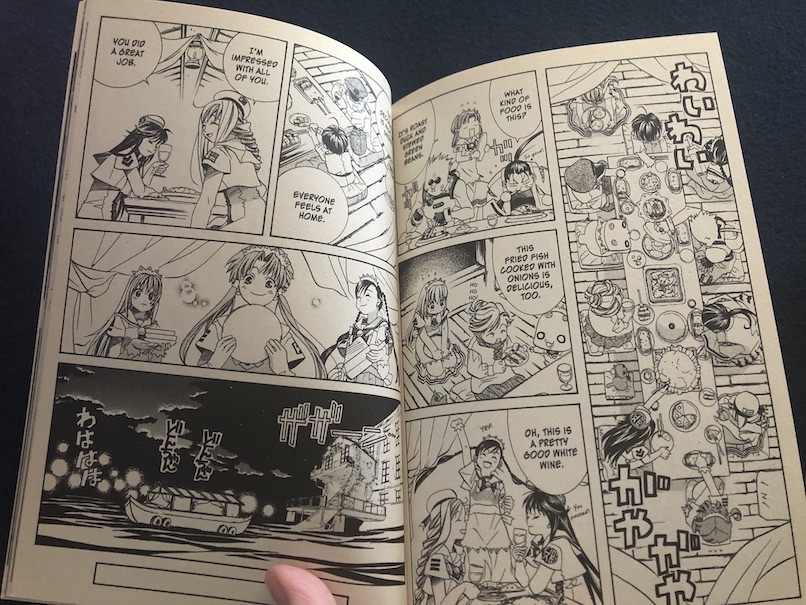
The Undines celebrate Rendentore, a special festival of thanksgiving, with a party on a boat for all of their friends, organized by the trainees. In keeping with the tradition, the trainees invite special guests and use the opportunity to improve their hostess and entertaining skills, designing invitations and planning the meal and entertainment.
The party is a success, and one of the best parts is that the girls have brought together a group of people who otherwise would not have spent time together, except they are tied together by their roles in the lives of the girls.
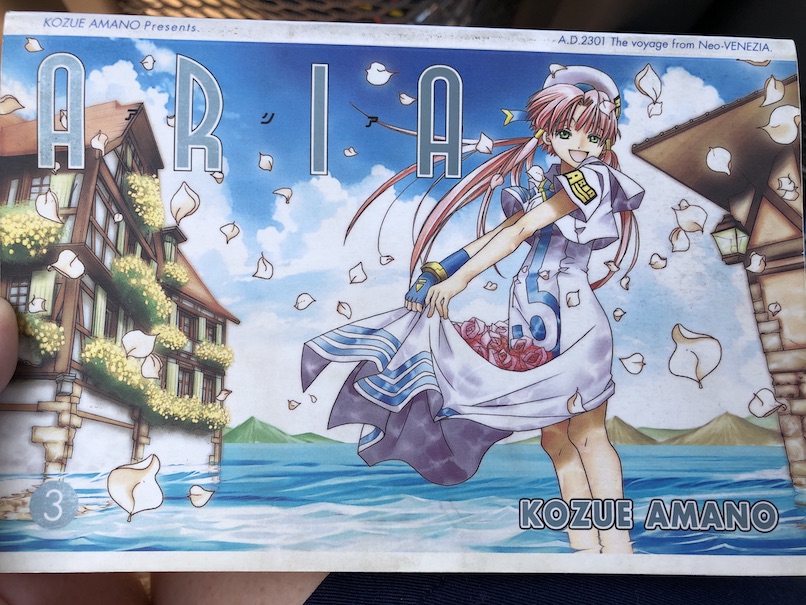
Aria Volume 3 by Kozue Amano, 2003, English Translation 2004.
This is the third volume of the second part of a fascinating manga series that combines sci-fi, fantasy, and slice of life. The series takes place about 300 years in the future, when Mars has been terraformed and renamed Aqua (because of all the water on its surface). The human colonies on Aqua are designed to resemble old-fashioned cities on Earth (called Manhome here). The people of Aqua prefer a much slower pace of life than people on Manhome, and aspects of life on Aqua more closely resemble Earth’s past.
The series is divided into two parts. The first two books are the Aqua volumes and introduce Akari Mizunashi, the main character, a young girl who came to Aqua to learn to become a gondolier in the city of Neo Venezia (which resembles Venice). Female gondoliers, called Undines, give tours of the city, giving Akari plenty of time to admire the beauty of her new home and meet interesting people. The two Aqua books are the prequel to the main series, Aria. Aqua covers Akari’s arrival on the planet, her introduction to life on Aqua, and the beginning of her training. The main Aria series show Akari’s continuing training, her progression to becoming a full Undine, her evolving relationships with her friends, and as always, her delight in learning more about her new home and admiring its beauty.
The series has received some criticism for being slow and lacking danger and adventure, but that is not really the point of the series. The main purpose is to show people how to appreciate the small pleasures of life. The sci-fi and fantasy elements (the spaceships, advanced environmental controls, intelligent Martian cats, and even the occasional appearances of the legendary Cait Sith) are mainly background to the stories about the magic of friendship and simple pleasures. Each volume contains a few short stories about Akari and her friends and the little adventures they have on a daily basis and the life lessons they learn. It’s a great series for relaxing when you’re stressed out.
The stories included in this volume are:
First Gale of Spring
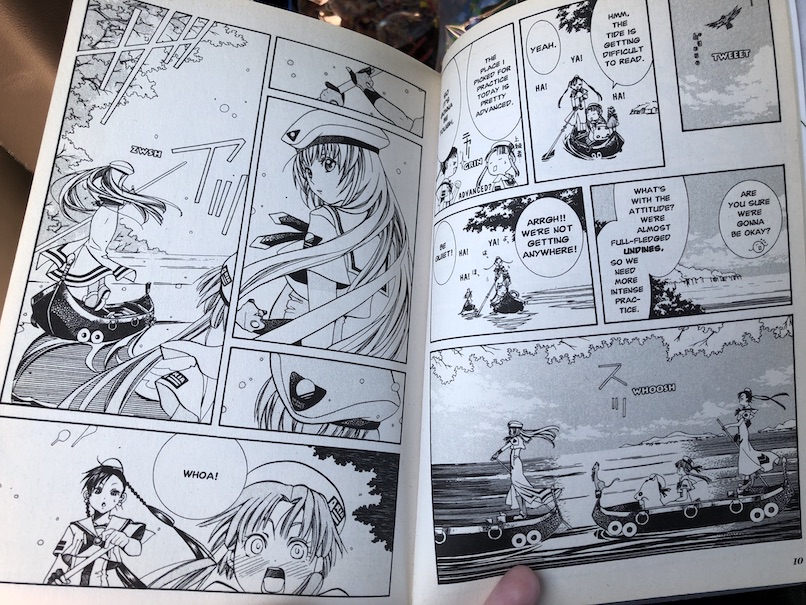
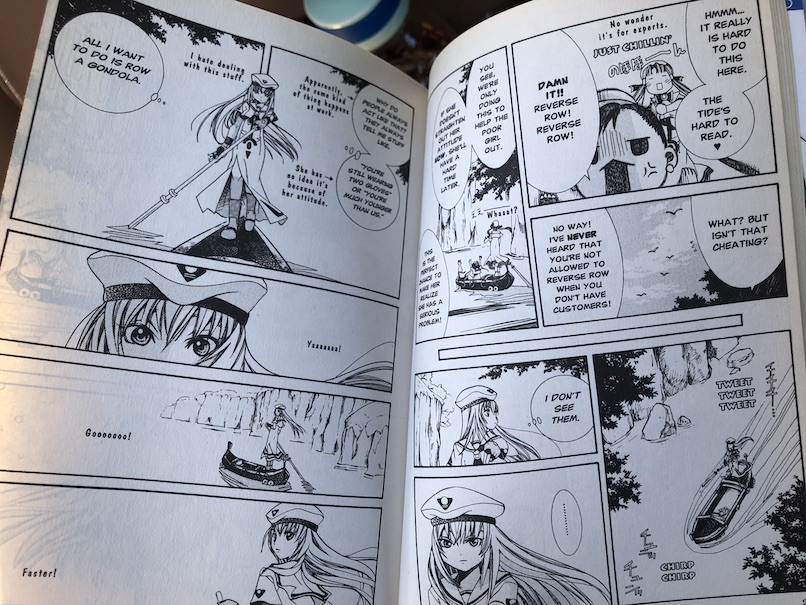
It’s been a full year (full Martian year, which is equal to two Earth years) since Akari moved to Aqua and began her Undine training, and she’s happy that it’s spring again! While Akari and Aika are practicing their rowing one day, they meet another trainee Undine, Alice.
Alice is a young prodigy, only 14. Even though she is rather young and still in school, she’s really good at handling a gondola. However, Aika takes an instant dislike to her, partly because she belongs to Orange Company, a rival of Aika’s gondola company, Himeya. Akari tries to be friendly to Alice and tries to invite her to join them for lunch, but Alice is rude and unfriendly to them.
Aika thinks that Alice has an uppity attitude and is disrespectful to them even though they’re higher level trainees than she is. (There is some mild swearing in this part of the story. Most of the Aria series doesn’t have any swearing at all.) To prove her point and put Alice in her place, Aika decides to challenge Alice to a race.
Part of the reason why Alice is so prickly and unfriendly is that she thinks that people look down on her for being young and because they’re jealous of her skills , but she doesn’t realize how her abrasive attitude affects the people around her and their perceptions of her.
Aika has Akari row their gondola in the race, partly so she can use her secret ability to row a gondola backwards really fast, but Akari has her own ideas of how the race will end. Akari is still thinking of the beauty of spring, and even though she makes sure that her gondola will come in second by stopping to pick flowers (the fact that they had time to pick an entire boatload of flowers indicates just how much of a lead they had), she uses them to remind the other girls
Alice actually appeared in one of the prequel books to the Aria series, Aqua Volume 2, as the friend who went with Akari to visit Aika when Aika had a cold. It was the only Aqua story she was in, and this story in the third volume of the Aria series is the true introduction to her character.
Under the Cherry Blossoms in Full Bloom
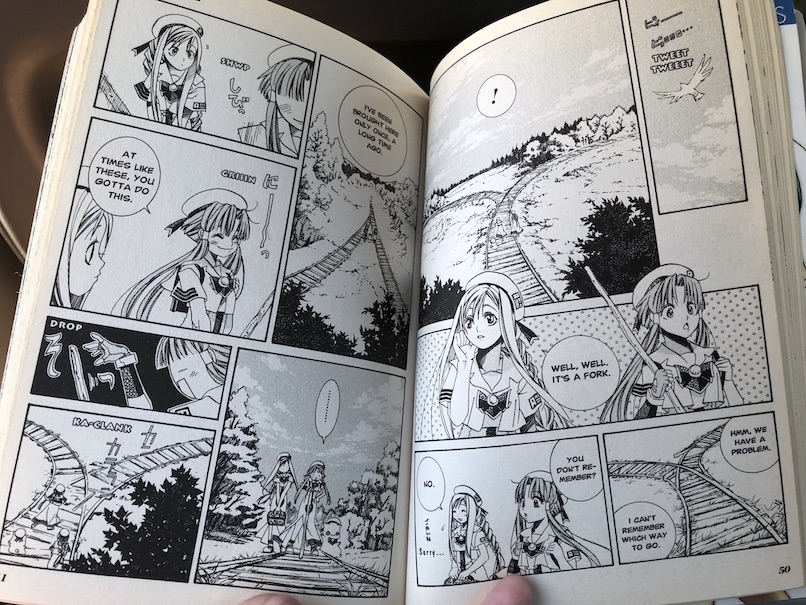
Alicia and Akari decide to go on a picnic to enjoy the beauty of nature in spring. Alicia has a special place in mind for a picnic, but the two of them get lost on the way. Although Alicia remembers that getting to her special spot involves following some old train tracks, when they split off in different directions, she can’t remember which way to go.
Akari picks a random direction. It turns out that the direction she picks doesn’t take them to Alicia’s special place, but they find something else interesting: an abandoned train car underneath a cherry tree in full bloom.
The girls explore the train car and find that part of the roof is missing. They lie in the train car and enjoy the cherry blossoms raining down on them. Akari apologizes to Alicia for not finding her special place, but Alicia says that’s fine because this place is nice, too. She says that sometimes, you have to get a little lost to find something new.
Town Treasure
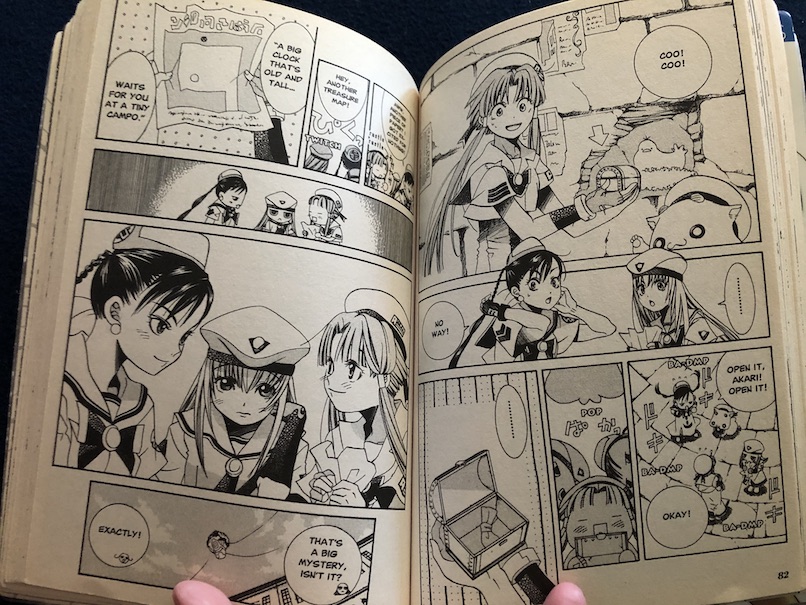
Akari, Aika, and Alice find a message in an old gondola that they borrow from the gondola repairman while Aria Company’s gondolas are being service. The message is in a small box in a hidden compartment of the gondola, and it turns out to be the first clue in a treasure hunt with a special surprise at the end.
Curious to find the treasure, the girls follow the clues through Neo Venezia, and their search leads them to take a second look at places they pass by all the time with little notice and takes them to lesser-known parts of the city that even Aika and Alice, who were born there, haven’t seen.
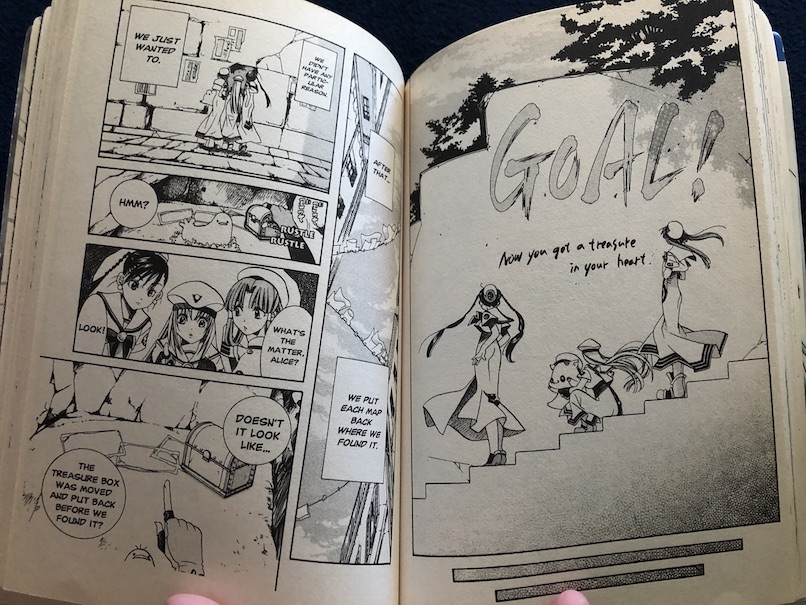
The treasure hunt finally ends on an often over-looked stairway that actually provides an excellent view of Neo Venezia, and the treasure they find there is the one that made Akari enjoy the treasure hunt from the very beginning.
The girls decide to put all the clues back where they found them, and to their surprise, they notice that there are marks that indicate that many other people have done the same.
Three Water Fairies
Akari and Aika are training under two of the Three Water Fairies, the best-known Undines on Aqua. However, Aika’s mentor, Akira, is much more strict than Alicia. One day, Aika gets fed up with Akira’s strictness and decides to run away and train under Alicia.
When Akira shows up to reclaim her wayward trainee, Akari learns more about Alicia, Akira, and especially about Aika. Akira was seen briefly in Aqua Volume 2, when Aika snuck out of her room to go buy some pudding, and she was the person Aika was trying to avoid because she was the one making her rest from her cold. However, Akira wasn’t actually introduced until this book, like Alice. This story reveals that Alicia and Akira were friends as trainees, like Akari and Aika, and have had a bit of a rivalry, being considered among the three best Undines, but they haven’t seen each other much in recent years.
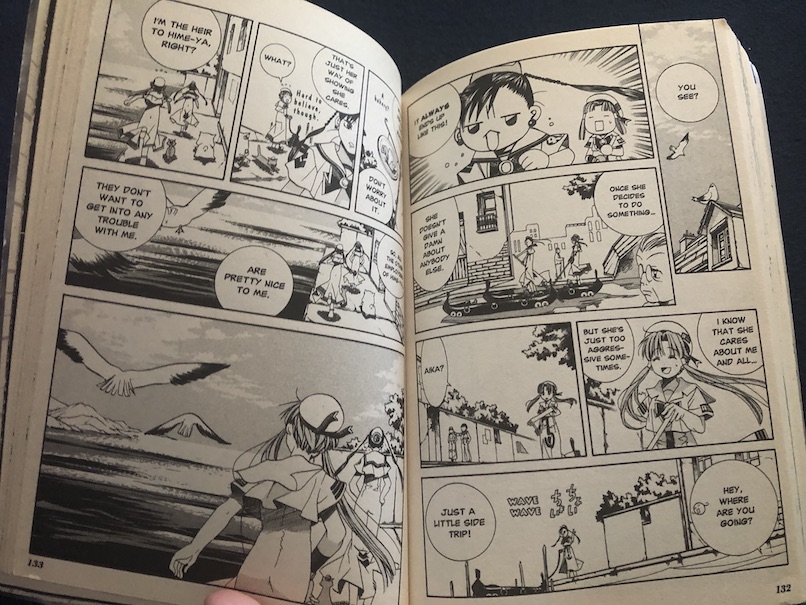
Aika had reveals that the reason why she admires Alicia so much is that Alicia was nice to her when she was a child. One day, when she was upset about something, Alicia found her and gave her a ride in her gondola and cheered her up by trying different hairstyles with her hair. This experience is what made Aika want so badly to become an Undine herself. However, Aika could not train under Alicia at Aria Company because her parents actually own Himeya Company, something that Aika has never told Akari before. Aika’s family expects her to work her way up through the ranks as an Undine and eventually take over Himeya Company.
To settle the matter of Aika’s future training, Akira proposes a contest, a race between Aika and Akari, to determine whether Aika will become Alicia’s student or return to Himeya Company with Akira. As Alicia guesses, the “race” between their trainees gives Aika an opportunity to return to Himeya without sacrificing her dignity. It also gives both Akira and Aika an opportunity to consider how they really feel about each other and how much they appreciate each other.
While Akira and Alicia talk about Aika and how she’s both similar to and different from her mentor, Akari and Aika aren’t really having a race. Instead, they talk about how Aika feels about Akira.
Aika says that her position as the future heir of Himeya Company doesn’t matter much to her because she just wants to be an Undine, like Alicia, but she admits that people at Himeya treat her differently from the other trainees because they know who she is. They are extra nice to her and try to avoid getting on her bad side because they want to be friends with the boss’s daughter, who will be their future boss someday. Aika admits that, strict as Akira is, she’s also the one who’s the most honest with her, correcting her when she needs it and not worrying about making her angry. Aika realizes that she needs that honesty in her life and that Akira’s training is helping her. At Aika’s insistance, the girls end their “race” and go buy some walnut pastries for Akira, which Aika offers to her as an apology before returning to Himeya with her. Akari realizes the the bond between Aika and Akira is stronger than either of them wants to admit, and she hopes that, someday, she’ll have a bond that strong with Alicia.
This story is important for explaining more of the backstory of the characters and how they relate to each other. There is a running theme in these stories of having characters whose names begin with the letter ‘A’. In most cases, I don’t mind because the names are usually different enough that it doesn’t matter, but Akira and Akari are rather close.
Festa del Boccolo
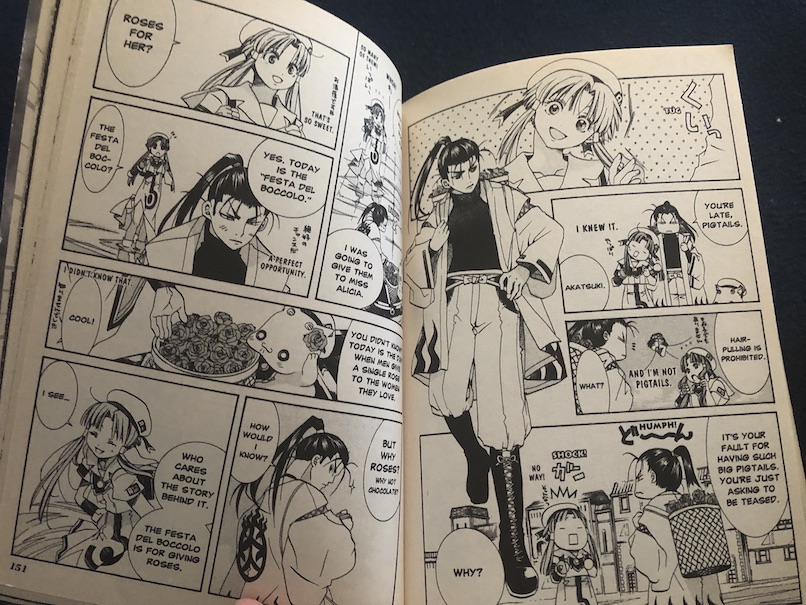
Festa del Boccolo is the time when men give red roses to the women they love. Akatsuki has had a crush on Alicia for a long time, and he enlists Akari’s help to give her a boatful of roses to impress her. He needs her help because the town is flooded during high tide again, as it is every year during late spring.
Unfortunately, his elaborate gesture doesn’t go as planned because Alicia has already received many other roses from other people, and she assumes that Akatsuki has bought all of his roses for Akari.
Akatsuki accidentally spills the roses in the water, while trying to get Alicia’s attention. He thinks that he’s completely screwed everything up, but Akari points out that his gesture wasn’t futile because, like the roses floating on the water, his love for Alicia spreads out around him and touches everyone, and one day, Alicia is bound to notice. Akatsuki gives Akari a single rose to thank her for her help, and the two of them enjoy a walk together through the flooded city.
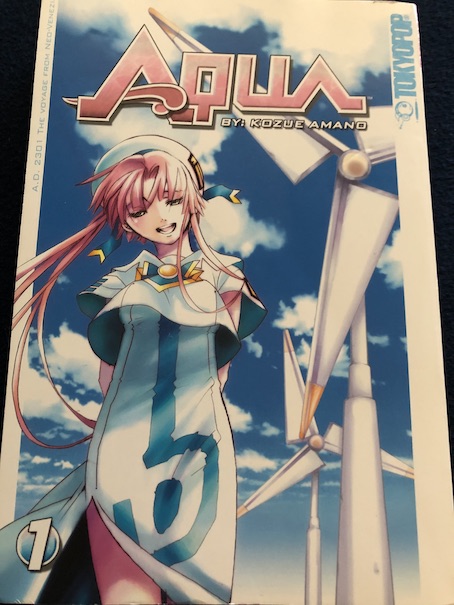
Aqua Volume 1 by Kozue Amano, 2003, English Edition 2007.
I debated at first about whether or not I wanted to include any Japanese manga or light novels in this blog. When I was in high school and college, I knew a lot of people who were really into anime and manga, and I know that there are teens who still are, and my overview of children’s literature in different decades wouldn’t be complete if I didn’t mention that. However, the variety is pretty extensive, some of the series run very long, and it’s impossible to just skip around in some series because the story-telling is very linear, and I didn’t want them to take over the blog. Also, I tend to like the less popular ones, so I’d be bound to get some grumbling from manga fans about why I chose these when there are so many others that are more exciting or more iconic. Notice that I didn’t say “better.” “Better” is subjective, and I like what I like. I decided to go ahead and make an exception in this case because this is one of my favorite manga series and because I think this is something that people could really use right now. The stories are very calming, and they’re good to read during stressful times.
This book is the first volume of a series. I don’t have them all because they haven’t all been published in English yet, but know how it ends, and it’s a really good series with a happy ending. If you’re not familiar with manga, they’re basically graphic novels from Japan. I can’t read Japanese, so I rely on the English translations. However, manga like this typically follow the Japanese format of reading from right to left instead of left to right, like in English, so the books open and the pages flow in the opposite direction. When you look at the panels on a page, remember to look at them in right to left order.
The Aqua and Aria series is unusual because it combines elements of science fiction and fantasy, but most of the stories themselves aren’t really either science fiction or fantasy. That’s just the setting for the stories. The stories themselves are more slice-of-life, about daily events or small adventures in the lives of the characters and sometimes lessons they learn from them. There is a lot of emphasis on slowing down and enjoying the simple pleasures in life.
The series takes place in the future, when Mars has been terraformed and renamed Aqua (because of all the water on its surface). The human colonies on Aqua are designed to resemble cities on Earth (called Manhome here). The people of Aqua prefer a much slower pace of life than people on Manhome, and aspects of life on Aqua more closely resemble Earth’s past.
A young girl, Akari Mizunashi, comes to Aqua to learn to become a gondolier in the city of Neo Venezia, which resembles Venice. Female gondoliers, called Undines, give tours of the city, giving Akari plenty of time to admire the beauty of her new home and meet interesting people.
There are two parts to this series, called Aqua and Aria. The two Aqua books are the prequel to the main series, Aria. Aqua is only two volumes long, and it covers Akari’s arrival on the planet, her introduction to life on Aqua, and the people who will be her friends. In the Aria books, Akari progresses in her training as an Undine. All of the books in both series contain several short stories.
This book, the first one in the Aqua series, focuses on Akari’s arrival on Aqua and her friendship with Aika, the first fellow Undine trainee she meets.
The stories included in this first volume are:
The Water Planet
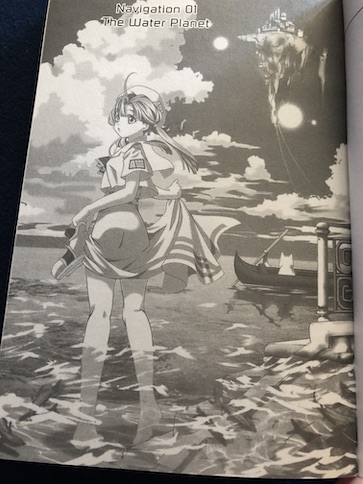
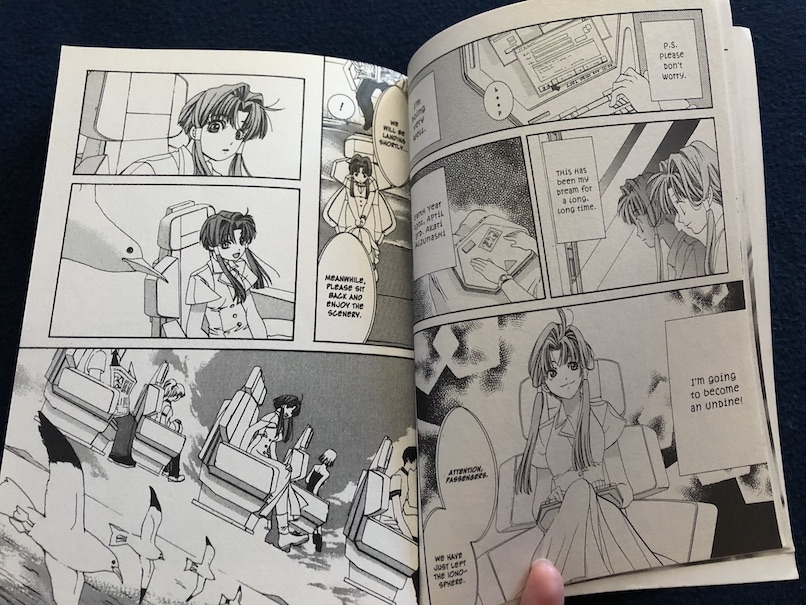
The series begins with Akari Mizunashi on the shuttle carrying her from Manhome to Aqua. She is typing a message to someone on her computer, but there is nothing to indicate who she is writing to. This is a running theme throughout the series, but the identity of Akari’s pen pal isn’t revealed until the very end of the series, and it wouldn’t make sense if I told you who it is right now. Akari explains a little about the history of Mars/Aqua, and how the melting of Mars’s polar ice caps during the terraforming of Mars 150 years earlier has turned it into a water planet, earning it the name Aqua. Currently, the year is 2301.
One of the nice things about the Aqua/Aria series is the imagery. As Akari’s shuttle arrives at Mars/Aqua, the walls of the shuttle turn transparent, so the travelers can feel like they’re flying in with the seagulls.
On Earth/Manhome, Akari lived in Tokyo, Japan. The modern cities of Manhome are very tidy and convenient, with people able to work and shop from home. Still, Akari has felt like something is missing from her life in all the convenience and tidiness. In Neo Venezia on Aqua, people rely on boats constantly to help them get around town, which is inconvenient, but Akari finds it calming and peaceful, which is why she wants to become an Undine, one of the female gondoliers who act as tour guides and help travelers to navigate Neo Venezia. Overall, life on Aqua and in Neo Venezia has a much slower pace than that on Manhome.
Akari arrives on Aqua and meets a friendly mailman and the only two employees of the gondola company she will work for: her mentor, Alicia, and the company’s president, a Martian cat named Aria. All gondola companies on Aqua have a Martian cat as their mascot/president. Alicia explains that Martian cats are as intelligent as humans, even though they can’t talk, but in many ways, President Aria still acts like a very large kitty.
The Guide on the Water
Akari wakes up on her first morning at the gondola company Aria, and she meets Aika, who is a trainee at Himeya, another gondola company. She catches sight of Aika hanging around, watching Alicia, and Aika witnesses Akari’s first time practicing in a gondola under Alicia’s watch.
Akari is embarrassed to learn that when she practiced rowing on Manhome, she was doing it backwards, standing in the front of the boat, which would block the view of her passengers. Because Akari practiced the wrong way on Manhome, she can row very fast the wrong way, but is clumsier when she tries to row the correct way.
However, Aika tells Akari that Alicia is the best of the Undines, and Akari is reassured that under Alicia’s guidance, she will do better. Aika hero-worships Alicia (for reasons that are explained further in later books), and she agrees to become Akari’s friend partly so that she can see more of Alicia. Aika and Akari become best friends through the course of the books, sharing their training and adventures.
The City Submerged
Akari wakes up one morning and is shocked to find that the lower floor of Aria company has flooded, but Alicia explains to her that this is a natural phenomenon in Neo Venezia in Spring.
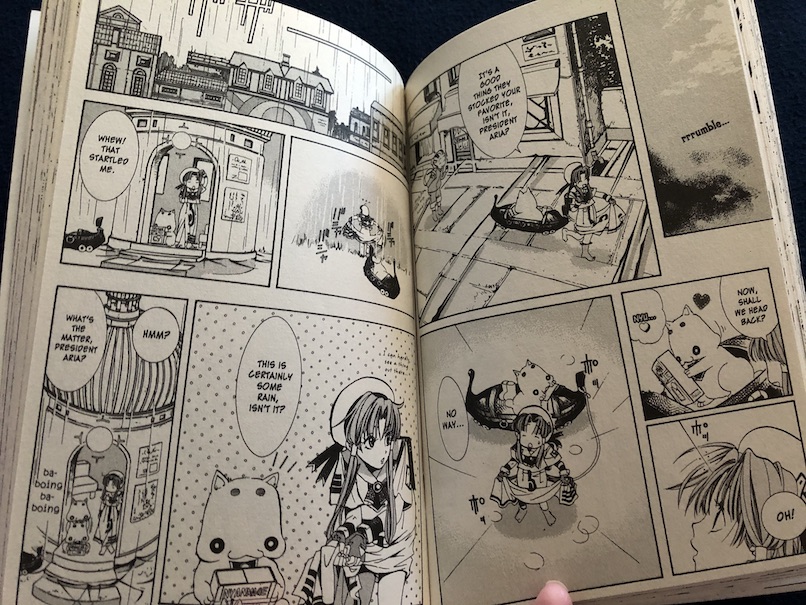
Much of the city is flooded during this high tide, causing many of the businesses in town to close temporarily and making it unsafe to go out in gondolas. However, when President Aria needs more of his favorite food, Akari decides to venture into the city on foot.
On the way home, Akari and Aria are stranded when it starts to rain and travel become more dangerous, but Aika sees them and invites them to spend the night at Himeya Company with her. Himeya Company is a much larger gondola company than Aria Company, with many more employees living there.
Aika and Akari have a sleepover in Aika’s room, and Aika asks Akari who she’s always writing to, but Akari tells her that it’s a secret. When the rain stops, Akari admires the view of the water by moonlight. (There are two moons in the sky because this is Mars.)
The Kingdom of Cats
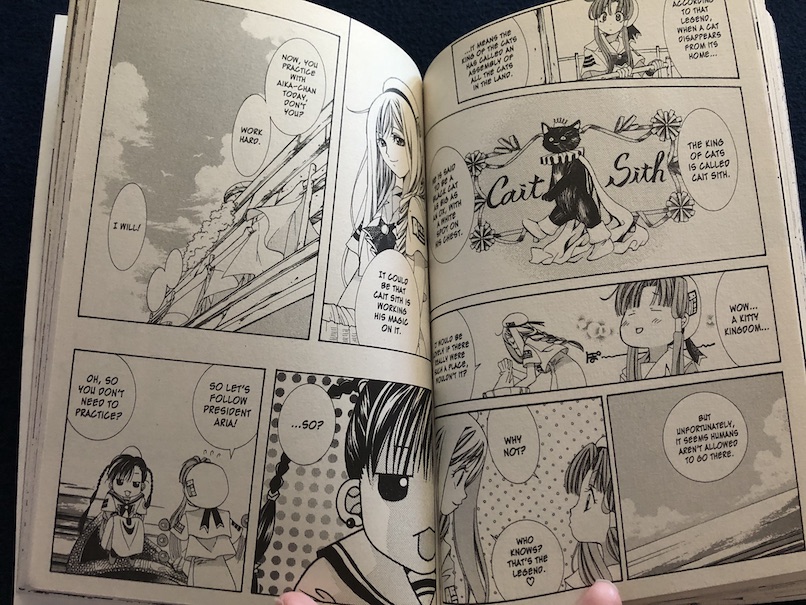
President Aria sometimes ventures off alone, and Alicia tells Akari the story of Cait Sith and the mythical kingdom of cats.
When Akari and Aika practice their rowing together, Akari convinces Aika to help her follow President Aira to see if there’s any truth to Alicia’s story perhaps get a look at the kitty kingdom ruled by the legendary king of the cats, Cait Sith.
However, the trip is stranger than they bargained for. The girls find themselves on a strange waterway through apparently abandoned buildings, going around in circles until President Aria points the way out. Akari only gets a glimpse of the cats before they leave.
The Hill of Hope
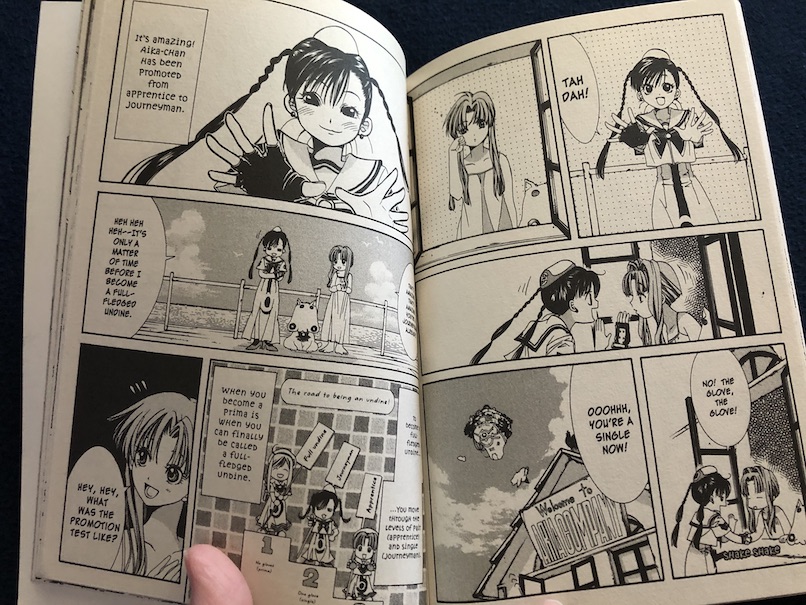
Aika shows up at Aria company one morning to brag about how she has been promoted to single (the next step up in gondola training, as shown by the gloves that the girls wear – as the trainee Undines learn the techniques to row their boats more skillfully, they get fewer callouses and need their gloves less, removing them one at a time as they are promoted to new levels).
Akari tries to ask Aika what the promotion test is like, but Aika refuses to tell her. The Undines traditionally keep the test a secret from their trainees until they pass the test. When Alicia hears about Aika’s promotion, she decides to take Akari on a special picnic, giving her the opportunity to prove her skills and introducing her to the concept of aquatic elevators, or canal locks. There is a special surprise for Akari at the end of the journey.
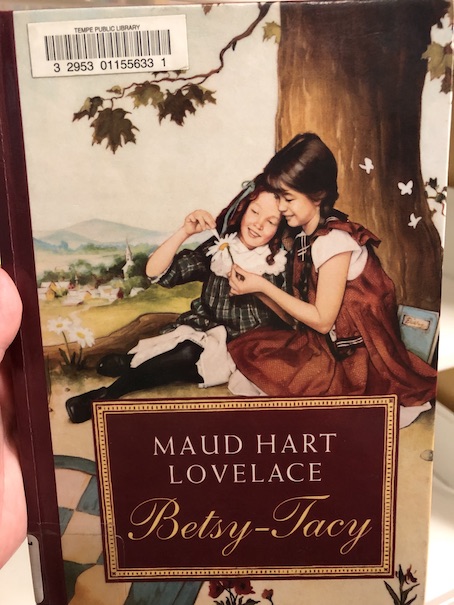
This is the first book in a series about two best friends growing up in Minnesota around the turn of the 20th century. The stories in this book and the rest of the series are based on the author’s own childhood experiences with her best friend.
At the beginning of the book, Betsy meets her best friend, Tacy (short for Anastacia), for the first time after Tacy’s family moves into a house nearby when the girls are both about five years old. Tacy is very shy and doesn’t want to talk to Betsy at first. It isn’t until Betsy’s fifth birthday party, a short time later, that the girls really get to know each other and become friends. After that, they are inseparable, almost to the point where people begin to think of them as one person, Betsy-Tacy.
Each of the chapters in the book is a short story. Some of them are about everyday things, like how Betsy would make up stories about her and her friend, how the girls would play dress up and paper dolls, or how they would have a “store” and sell bottles of colored sand to their friends. Some of the stories are touching, as the girls help each other through some of the most important times of their young lives. Betsy, the more out-going one, helps shy Tacy through the trauma of their first day of school. Tacy, who has many brothers and sisters, reassures Betsy that everything will be alright when Betsy’s younger sister is born. Both girls struggle to come to terms with the death of Tacy’s baby sister.
At the end of the story, the girls make a new friend when a family moves into the chocolate-colored house with the stained glass window that the girls had always admired.
In the 60th anniversary edition of the book, there are pictures of the author and her best friend, Bick, who is the model for Tacy in the stories, and pictures of the author’s family. There is also a description of the author’s early life and how the stories were based off her recollections of her own childhood.
This book is available to borrow for free online through Internet Archive.
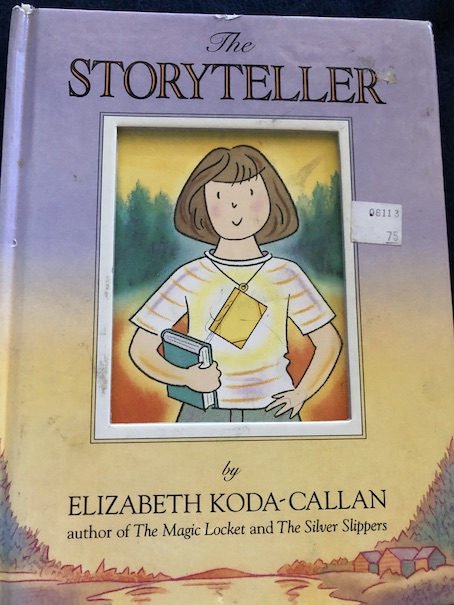
A young girl (unnamed, like in the other books in this series) who likes reading more than anything is sent to summer camp by her parents. When her parents first suggest the idea, the girl thinks that she might like camp, but then she gets worried that maybe she won’t or maybe she won’t make any friends there. She takes some of her books with her in case she needs something to do.
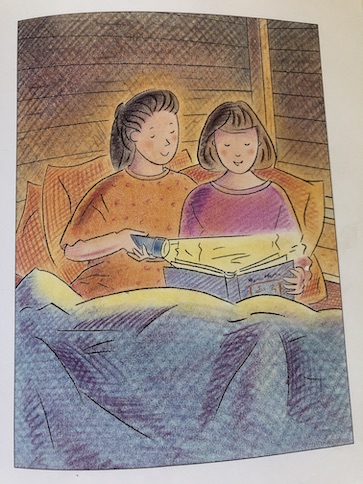
At first, it seems like camp isn’t going to be much fun after all. While the other kids seem to enjoy the typical camp activities, the girl doesn’t seem to be any good at them and doesn’t enjoy them much. However, she does make a friend, Jenny. When Jenny is homesick at night, the girl reads to her to help her feel better.
During the day, the girl keeps slipping back to her cabin to read while the other campers play volleyball because she isn’t good at the game. The camp counselor catches her reading all by herself, but she understands why the girl feels like she isn’t good at the other camp activities. To help her feel better, the counselor promises her an activity that she will be good at.
That night, while the campers are gathered around the campfire, ready to tell campfire stories, the counselor suggests that the girl read to them out of one of her favorite books. With Jenny’s encouragement, the girl reads to the other campers.
The other campers like the way the girl reads to them by the campfire, and Jenny helps the girl to improve at other camp activities. At the end of camp, the counselor gives the girl a charm shaped like a book as a reward for her storytelling skills.
All of the books in this series originally came with charms like the ones described in the stories. This book originally included a little golden book charm for the reader to wear. The hole in the cover of the book was where the charm was displayed when the book was new. The books in the series often focus on the unnamed main character (who could represent any girl reading this story – the books were aimed at young girls) developing new self confidence, and the charms were meant to be either a sign of their new self confidence or inspiration for developing it. In this case, the charm is a reward for the way the girl used her skills to make camp better for everyone while developing new skills in other activities.
The book is available to borrow for free online through Internet Archive.
Anna, Grandpa, and the Big Storm by Carla Stevens, 1982.
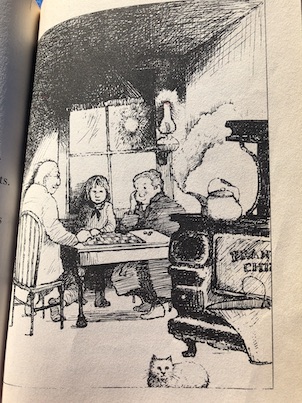
The story takes place during the Great Blizzard of 1888. Anna’s Grandpa is visiting her family in New York City, but he thinks the city is boring. He says that there isn’t much there for him to do. One day, Anna is worried about getting to school because it is starting to snow heavily. Anna’s mother says that she can stay home, but Anna is supposed to be in a spelling bee, and she doesn’t want to miss out. Grandpa volunteers to take Anna to school on the elevated train.
As the two set out, Anna begins to get scared because the storm is getting worse. Grandpa urges her on, and the two make it onto the train. Before they can go very far, the tracks freeze over, and the train gets stuck. Anna and her Grandpa are trapped in the train with a bunch of strangers, waiting for rescue.
Anna and Grandpa make friends with the other people on the train, finding ways to keep themselves moving and warm while they wait for help to arrive, like playing “Simon Says.” Even though Anna doesn’t make it to school for the spelling bee, their adventures turn out to be good for the people they are able to help and the new friends they make. Grandpa sees a different side of life in the city and decides to stay for awhile longer so he can spend time with some new friends.
The story is based upon actual accounts of the famous blizzard when many other people were trapped on the elevated trains around the city. The book is available to borrow and read for free online through Internet Archive.












































 Jestress's Forgotten Books and Stories