Ramona and Her Father by Beverly Cleary, 1975, 1977.
It’s September, and second-grader Ramona Quimby is already making out her Christmas list. However, Christmas this year might not be what Ramona expects. Her father comes home and explains that he’s been laid off from his job because a larger company bought the company he worked for and laid off the extra workers. Mrs. Quimby has a part time job, but it doesn’t pay much. Everyone in the Quimby family soon becomes worried about money.
Mrs. Quimby finds another job that’s full time, but Mr. Quimby still struggles to find work. Ramona doesn’t like to see her father so worried and stressed, and she tries to think of some way she could also earn money. When her father comments about how much money a boy on a television advertisement must have made, Ramona sets herself to memorizing various advertising phrases and repeating them, hoping to be discovered and hired to make an ad herself. Unfortunately, things that people say on ads don’t work in real-world settings, especially when you tell your teacher that her wrinkled stockings look like elephant skin.
The family has to eat food that they don’t particularly like in order to save money, and they start buying cheaper cat food for their cat. Picky-picky refuses to eat the cheap cat food, and before Halloween, he eats part of the girls’ jack o’lantern in desperation. Beezus, upset at the idea that their cat is apparently starving and desperate, angrily asks her father why they can’t afford Picky-picky’s usual cat food when they seem to have enough money for his cigarettes. (It’s a valid question. During my first semester of college, I totaled up a classmate’s expenses on cigarettes and realized that what she spent on them for a year was about the same as full-time student tuition at our community college, by early 2000s standards.) Her father tells her that’s none of her business, and Beezus retorts that it is her business. Cigarettes are harmful, and Mr. Quimby is spending money on them that the family desperately needs.
Ramona is worried because this is the first time that she’s heard that cigarettes are bad, although Beezus says that she learned it in school. Ramona tries to ask her father if what Beezus said is true, and he just says that he expects to be an old man someday, the kind that tells reporters on his hundredth birthday that he owes his longevity to cigarettes and whisky. This joke doesn’t reassure Ramona. Ramona decides that she’s going to get her father to stop smoking.
Ramona gets Beezus to help her make anti-smoking signs. At first, their father tries to ignore the signs, and then he starts getting annoyed with them. Ramona worries that she’s been mean to her father and upset him too much, but he later admits that she was right and that he’s going to try to quit smoking. Ramona takes him at his word and throws his cigarettes away, although he said that he would rather have cut down gradually. Still, his wife and daughters are happy about him quitting. For awhile, Mr. Quimby is edgy and irritable as he tries to get used to not smoking as well as still looking for a job.
As Christmas approaches, the girls’ Sunday school begins preparing to put on a Nativity play. Beezus gets cast as Mary, which pleases her because Henry Huggins is going to play Joseph. Ramona is so excited about the play that she wants a creative role for herself, and after the shepherds are cast, she says that she wants to be a sheep to go with the shepherds. The Sunday school teacher says that sounds like a good idea, but they’ve never had any sheep in the play before and don’t have a costume for her. Ramona says that her mother could make her one, and other children also say they want to be sheep.
However, as Beezus points out, now that their mother is working full time, she doesn’t really have time to sew a costume. Their mother also says that they can’t afford to buy new cloth for a costume, and the best she can do is an old white bathrobe that she might be able to alter into costume. Ramona’s father snaps at her that she’s been inconsiderate for expecting her to do something like this without asking first. Ramona feels badly and overhears her father calling her a spoiled brat. With his irritability, he’s been picking at her for various things, and one day, Ramona argues with him when she comes home from school and smells cigarette smoke.
Ramona’s father reassures her that he hasn’t purchased any new cigarettes. He just found an old one in a pocket that he forgot that he had and decided to smoke it to see if it would help him feel better. The two of them have a heart-to-heart talk about Ramona worrying about why they can’t be a happy family. Ramona’s father tells her that their family is happy. It’s just that no family is perfect and nobody’s life is perfect, and everyone goes through hard times now and then. The people in Ramona’s family still love each other and do their best for each other even when things are hard and they don’t always get along.
Things improve for the Quimbys as Christmas approaches. Mr. Quimby finally finds a new job. Ramona almost backs out of the Nativity play because her mother didn’t have time to make her a full costume, and she feels silly with what she’s wearing, but she changes her mind with the help of three older girls who were recruited to replace the Three Wise Men who backed out of the play.
One thing that kind of surprised me in the story was that Ramona’s parents seemed mildly scandalized when Ramona and Howie sang “99 Bottles of Beer on the Wall.” Beezus, who learned the song at summer camp and taught it to Ramona says that the neighbors will probably think they’re beer guzzlers after hearing Ramona and Howie sing it all up and down the street. It struck me as weird because I remember that everyone knew that song when I was a kid in the 1980s and 1990s, and nobody thought anything of it. I certainly never heard of anyone being scandalized by it. It’s just a silly counting song, and nobody really thought that any kid singing it had ever had beer. In fact, it was a common song for parents to get their kids to sing on long car trips because it takes a long time to finish, and during that time, the kids aren’t complaining or asking, “Are we there yet?”
The book is available to borrow and read for free online through Internet Archive (multiple copies).
Six-year-old Ramona Quimby thinks of herself as brave. Now that she’s going into the first grade, she’s no longer just a little kid. She even stood up to some boys on the playground who were making fun of her older sister, Beatrice, for being called “Beezus.”
However, Ramona soon discovers that not every sees her the way she sees herself. Beezus is embarrassed at the way her little sister told off those boys and is sure that they’re now going to make a much bigger deal of the incident at school because of it. Beezus says that she’s sick of her silly nickname, which rhymes with “Jesus” and just wants to be called “Beatrice.” Ramona agrees with her, both because she feels bad that she accidentally embarrassed her sister and because it’s her fault that Beezus got her nickname. When she was smaller, Ramona couldn’t pronounce the name “Beatrice” very well and ended up saying “Beezus” instead, and the mispronunciation stuck. Ramona is trying hard to be a big kid now, and she doesn’t like to remember that she used to not even be able to say her own sister’s name. Ramona agrees to call her sister Beatrice in public and to only use the Beezus nickname at home.
Ramona wants to be taken seriously, and she hates it when her mother is amused by some of the silly things she does. (I know the feeling, and so do many other people!) The last thing she wants is to just be a silly little kid that people laugh at, and nobody seems to understand how she feels. She especially hates it when her sister keeps calling her a pest.
Fortunately, their mother understands that part of the problem is that the girls are getting bigger, and they’re starting to feel cramped sharing a room with each other. Mr. and Mrs. Quimby have decided to add an extra room onto the house so the girls won’t have to share anymore, and Mrs. Quimby is going to take a part-time job to help pay for it. Before the girls can start arguing about who gets the new room, Mrs. Quimby tells them that it’s already decided that they will take turns, trading off rooms every six months and that Ramona will have the first turn in the new room.
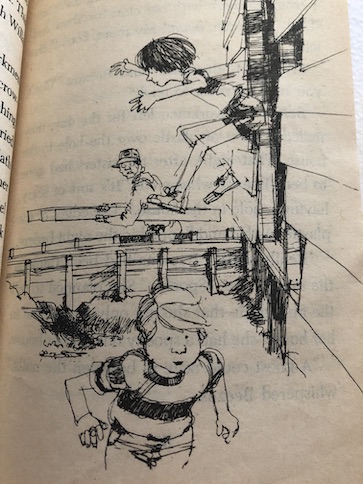
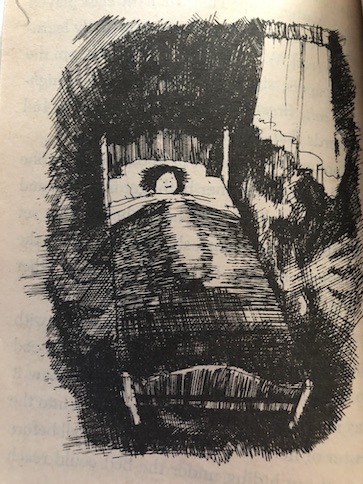
Watching the workmen make a hole in the wall of their house and build the new room is fascinating, although Ramona doesn’t have the patience for planning, methodical work, and learning how different tools are supposed to be used, like her friend Howie. Ramona prefers playing their made-up game of Brick Factory, where she and Howie smash old, broken bricks with rocks. Ramona takes the opportunity to put her special initial, a Q with cat ears and whiskers, into the wet concrete for the floor of the room, and she can’t resist the opportunity to jump through the new hole in the wall of their house. The workmen cover the hole with a sheet of plastic when they go home for the day, but the girls think it’s kind of spooky having a hole in the wall of their house. They imagine that something horrible could sneak in through the hole, like a ghost, maybe one that looks like a gorilla. Ramona can’t wait to tell the other kids all about it when she starts first grade!
Unfortunately, the new school year doesn’t start out the way Ramona hopes. Instead of everyone being excited about her news and how she watched the workmen chop a hole in the side of her house, everyone laughs because the teacher had just made a joke about her being Ramona Kitty Cat because she drew the cat ears and whiskers onto the Q on her name tag the way she always does. Ramona hates being laughed at and made to feel like a fool. Worse still, her friend Howie doesn’t defend her because Ramona said that they “chopped” a hole instead of “prying” it open with crowbars. Because of Ramona’s technical inaccuracy, Howie makes her sound like she was lying about the whole thing!
Then, when the kids make paper bag owls for Parents’ Night, Susan copies Ramona’s design, and the teacher, Mrs. Griggs, praises Susan to the whole class for coming up with the idea of having the eyes looking to the side. She doesn’t even notice Ramona’s owl. Ramona, afraid that everyone else will think that she’s the copycat because of Mrs. Grigg’s public praise of Susan’s owl, just like they all thought she was a liar and laughed at her before because of what Mrs. Griggs and Howie said on the first day of school, crumples her owl up and throws it away before anyone can see it. But, that doesn’t help relieve Ramona’s feelings at the injustice of the situation. She’s owl-less because of Susan stealing her idea. In a fit of temper, she crumples up Susan’s owl, too, and runs away when Susan tells on her even though Mrs. Griggs repeatedly says that she doesn’t like tattletales. (Honestly, I’ve never understood why adults tell kids that. It just encourages kids to behave badly and label others as “tattletale” when they complain, even when the complaint is just. It just gives bullies more power to act with impunity. I also think kids should be encouraged to talk about things, especially some of the more difficult things to talk about, and the whole “I don’t want to hear from tattletales” shuts down conversations before they even start. I’ve guessed that it has something to do with not wanting to take the time to deal with a lot of petty complaints, but at least hear someone out before you decide what they’re going to tell you and how important it is!) Even when Ramona explains the situation to her mother, she can tell that her mother doesn’t fully understand how she feels, and she is forced to apologize to Susan. Mrs. Griggs makes it all the more embarrassing by forcing Ramona to apologize in front of the whole class. Ramona knows that Mrs. Griggs doesn’t understand her and is sure that Mrs. Griggs hates her.
Ramona’s new room isn’t much of a comfort, either. She finds it a bit spooky, and when she’s alone in it, her imagination runs wild, like it did the night that she and her sister were imagining what kind of ghost could get in through the hole in the wall. Ramona certainly doesn’t feel very brave and grown-up about having a room to herself, but she refuses to admit it because she doesn’t want anyone to think that she’s a baby for being scared.
Things come to a head when Mrs. Griggs sends home a progress report that says that Ramona needs to use more self-control and keep her eyes on her own work. Ramona knows that it’s totally unfair because she’s been very self-controlled since the owl incident, in spite of Mrs. Griggs’s inconsiderate lack of understanding, and the only reason why she sometimes looks at the paper of the boy next to her is that he’s been seriously struggling with his work, and she’s been trying to help him. When Ramona is so fed up that she tells her family that she needs to say a bad word and the worst word she can think of to say is “guts”, everyone laughs at her, and Ramona bursts into tears, unable to take it anymore.
Tears and anger serve a purpose, though. Sometimes, an outburst is the only way to make someone understand, and understanding is what Ramona most needs. The family has an honest discussion about Ramona’s feelings, and Beezus tells her that she understands what it’s like to be little and laughed at for doing or saying something silly, reminding her mother about the times when she laughed about things she did, back when Ramona was too little to remember it. Beezus says that her mother’s laughter hurt her feelings when she was Ramona’s age, too, and Mrs. Quimby apologizes. Beezus also says that she never liked Mrs. Griggs very much when she was her teacher, either. Ramona asks if she could switch to the other first grade class at school, but her mother is reluctant to arrange it because her schoolwork has improved and because some of Mrs. Griggs’s criticism was correct and that Ramona does need to improve on her self-control. Mrs. Quimby also says that she wants Ramona to learn to understand and work with different types of people. Mrs. Griggs might not be her kind of person, and she might not always understand Ramona, but Ramona isn’t always easy to understand.
Personally, I didn’t think that last comment was a very good way to put it. One of the great things about the Ramona books is that Ramona’s feelings are easy to understand and identify with. Beezus certainly understood what Ramona meant about what it’s like to be laughed at for just being a kid. It’s something many of us experienced when we were kids, and we identify with how Ramona feels about it. (Didn’t Ramona’s mother ever go through this herself, or does she just not think about it? I kind of wondered when she didn’t seem to understand what her daughters were talking about at first.) I think it would have been better to put more of the emphasis on the idea that different types of people need to learn to respect each other and get along even when they don’t fully understand each other. Other people aren’t always easy to understand, but that’s not because Ramona herself is difficult to understand. Ramona’s feelings aren’t any less understandable than Mrs. Griggs’s, it’s more that not all people have the same capacity for understanding others because they don’t have as much empathy as others or the imagination to consider circumstances they haven’t personally been in themselves or are too focused on their own priorities and don’t have the time or patience for understanding. Adults often don’t consider things from a child’s point of view because their adult priorities in their busy adult lives take precedence, they discount the validity of what children think and feel because children are less experienced in life and sometimes express themselves clumsily, and they don’t slow down and take a step back or a second look or listen when they should. But, they could show a little more consideration for the child’s feelings even they don’t fully understand them. My own first grade experience wasn’t any better than Ramona’s, and I had my own “Mrs. Griggs.” Adults forget that kids can feel and experience things beyond their ability to fully explain them to others. One of the difficulties of being young, at least for me, was not having the vocabulary necessary to make myself understood or ask all the questions that I wanted to ask, and I often had to deal with adults who were short on patience. I can see that Ramona also struggles with finding the right words to express what she’s feeling or what’s really happening, like when she used the word “chopped” instead of “pried” to describe how the workmen opened a hole in the side of her house. I think that learning words and new ways to communicate with different people is an important part of the story.
Fortunately, Ramona’s father is right that the bad things will blow over, and Ramona’s situation improves. Some of the other kids in class become sympathetic to Ramona because they recognize that Mrs. Griggs shouldn’t have made her apology to Susan an embarrassing public apology. Ramona, although frequently bored in class, learns to read better, and she enjoys reading, finding that she can read more interesting stories when she knows more difficult words. She also meets her older sister’s teacher, and he calls her Ramona Q instead of Ramona Kitty Cat, like Mrs. Griggs did, making Ramona realize that there’s life beyond first grade and that better, more sympathetic teachers are waiting for her. She also becomes less afraid of her new room.
A scary encounter with a dog on the way to school that causes Ramona to lose one of her shoes also brings some unexpected sympathy and understanding from Mrs. Griggs. Ramona comes to understand that Mrs. Griggs is trying to be helpful when she offers her one of the old boots from the lost and found to replace the shoe she lost, that Mrs. Griggs simply doesn’t understand Ramona’s feelings about those old boots (they’re old, dirty, and kind of yucky), and that she isn’t likely to understand because she has her own priorities. Instead of getting mad at Mrs. Griggs for her lack of understanding, this realization causes Ramona to come up with her own creative solution to the problem. Ramona gains a better image of herself because of her creative problem solving and her bravery in a difficult situation. Mrs. Griggs also begins to show signs of understanding that Ramona is a creative person who needs a little room to demonstrate her creativity.
The book is available to borrow and read for free online through Internet Archive (multiple copies).
How to Snoop in Your Sister’s Diary by Janet Adele Bloss, 1989.
Lately, Haley has been jealous because her older sister, Lauren, has a new boyfriend and is spending all of her time with him. Haley feels neglected because Lauren doesn’t want to spend time with her any more. Haley resents the new boyfriend and worries about what Lauren and her boyfriend are doing together, so she begins regularly snoops in her sister’s diary to learn the details of Lauren’s relationship with her boyfriend.
However, Haley soon reads something shocking in her sister’s diary. Lauren might be about to do something disturbing and dangerous. But, what can Haley do about it when she wasn’t even supposed to know anything about it? If she reveals what she knows, Lauren will know about her snooping.
It turns out that Lauren already knows about the snooping and is angry with Haley about violating her privacy. Lauren isn’t actually doing anything wrong or even thinking about doing something wrong. She only wrote the shocking section in her diary to scare Haley, sort of like proving the old saying about how people who eavesdrop might hear things that they wish they wouldn’t (although the original saying is about how eavesdroppers might hear bad things about themselves). When Haley finally goes to plead with Lauren not to do what she thinks Lauren is about to do, Lauren reveals the truth, and the girls have an honest talk about what’s really been happening between them.
Personally, I didn’t think that the characters in the book acted in a very realistic manner. The main character didn’t react to certain situations in the way I would have expected, given her age. This is one of those stories which depends on characters holding things back and not communicating with each other openly for much of the story because, if they did, the story would have been resolved right away.
Big changes are happening in the life of Amber Brown. She’s back from her trip to England, during which she got chicken pox, and she’s about to start fourth grade. However, her best friend, Justin, has moved away, so she’s going to have to face the start of the new school year without him. Amber worries about whether she’ll be able to find a new best friend. Meanwhile, she’s also still adjusting to her parents’ divorce and her father’s move to Paris, France, and her mother has recently started dating a man named Max. Amber’s mother wants Amber to meet Max, but Amber doesn’t feel ready for that and is still quietly hoping that maybe her father will come back and her parents will reconcile.
Amber’s friend problems seem be solved when Brandi sits next to her in their new class. Brandi has changed since the last school year and is no longer best friends with snobby Hannah. Being friends with Brandi also forces Amber to make some changes. Brandi is quick to tell her on the first day that she isn’t Justin and that Amber can’t expect her to do the things that Justin would have done. Brandi is less excited about being friends with Amber than Amber is about making friends with her.
Amber worries that she doesn’t know how to make friends and especially that she doesn’t know how to make a best friend. She and Justin got to know each other when they were little kids, and Amber didn’t even have to try to make him her friend. However, that turns out to be the key to making friends with Brandi – not trying so hard and letting their friendship develop naturally.
When Amber and Brandi both have to go to the school’s afterschool program because their mothers work, they get to know each other better. Brandi hasn’t actually lived in Amber’s town for very long, having moved there to only about a year before, and when she moved, she also left behind her best friend and had trouble making a new one. When Brandi joined Amber’s class the year before, almost everyone already had a best friend and didn’t seem interested in making time for a new one, which is why she tried being friends with nasty Hannah. However, Hannah turns out to be mean to everyone, even the person trying to be her best friend, which is why Brandi stopped trying to be Hannah’s friend. Brandi has actually wanted to be friends with Amber for some time, but Amber was always too occupied with Justin, and after Justin left, Brandi was afraid that Amber was just looking for a Justin replacement and wouldn’t like her for who she really is. Amber tells her that she really does like her for being Brandi.
Amber comes to realize that it’s actually a good thing that Brandi isn’t exactly like Justin. She still keeps in touch with Justin by mail, but it’s also fun doing things with Brandi that she would never have done with Justin. Brandi teaches Amber to blow bubble gum bubbles with her nose. Because Brandi is a girl, Amber and Brandi can also do girl things together, like braiding each other’s hair. Brandi also likes to read more than Justin does, and the girls start talking about books with each other. Amber learns that not all changes are bad or difficult and that letting new people into her life brings interesting variety.
By the end of the book, she also comes to understand more about why her mother values her new relationship with Max. Justin’s mother was Amber’s mother’s best friend, and when Justin’s family moved away, Amber’s mother lost her best friend, too. That, combined with her loneliness since her divorce, led Amber’s mother to seek out new relationships, which is how she met Max and became fond of him. Max is apparently a nice man, and he even goes to the trouble of seeking out a particular mermaid toy for Amber because Amber’s mother told him that Amber really wanted one. At the end of the book, Amber still isn’t sure that she’s ready to meet Max because she feels like she needs some time to adjust to the other changes in her life first, but she begins to feel a little more open to the idea of change and letting new people into her life.
The book is very realistic about the gradual changes that Amber goes through as she starts fourth grade and learns how to make a new friend. Not everything in her life is completely resolved, like her feelings about her parents’ divorce and her mother’s new boyfriend, but Amber is making progress and growing up a little.
The book is available to borrow and read online through Internet Archive.
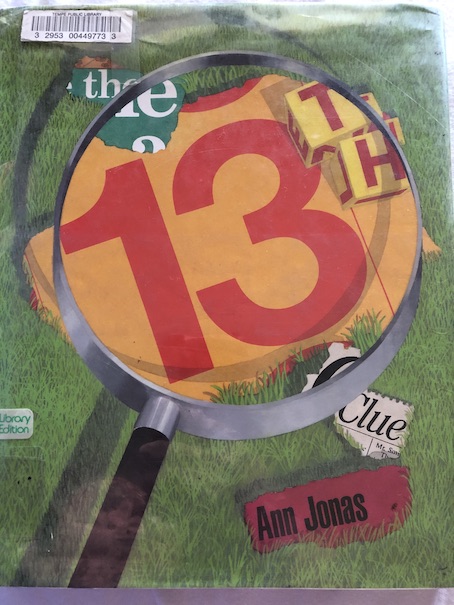
This picture book is almost entirely pictures. The pictures present clues to a treasure hunt and reveal the true story of the book.
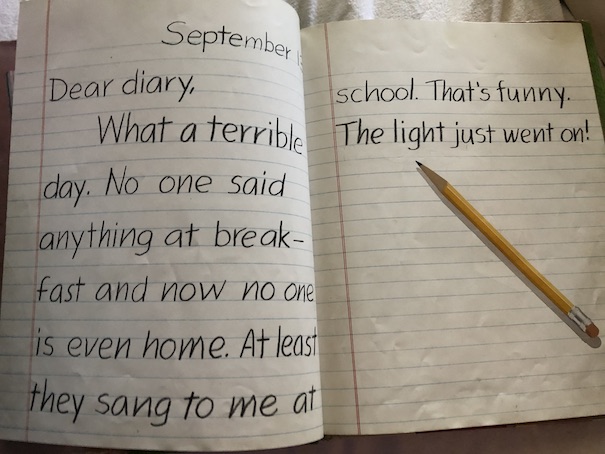
The book begins with a diary entry. At first, we don’t know who is writing it, but this person writes about what a bad day it’s been. We know that the person must be a kid because they mention school, and I guessed that it was the person’s birthday because people sang to them at school. But, she thinks that others have forgotten her birthday. The diary entry breaks off when the person notices a light going on in the house when, supposedly, no one else is home.
From this point on, until the very end of the book, the text is presented in the form of clues for our birthday kid (who turns out to be a girl, as shown in shadows and a reflection in water in later illustrations) to follow that lead to the place where her friends are waiting to give her a surprise party. Readers can figure out the clues along with the girl, some of which are easier and more direct than others.
I love puzzle books, and I thought that it was interesting how we don’t even know who the main character of the book is, only finding that out as the book continues. I liked the challenge of figuring out the clues as the book went along, although none of them were particularly difficult. They aren’t written in any kind of code, just kind of hidden in plain sight, most of them using objects that are part of the rest of the scene. Some of the letters of words are jumbled and have to be unscrambled. I’m sure it would seem harder to children.
This is a pretty easy book, but not one that would be suitable to read to children who can’t read themselves. There are no solutions provided to the puzzles, but that’s okay because, first of all, they aren’t very hard, and second, there are no opportunities for the reader to make choices based on the puzzles, so there is nothing for the reader to get wrong. The end of the story is obvious. Most of the fun is just studying the pictures to see the cute ways her friends decided to hide their “secret” messages. The hardest message to spot is the one written in the hillside.
The book is available to borrow for free online through Internet Archive.
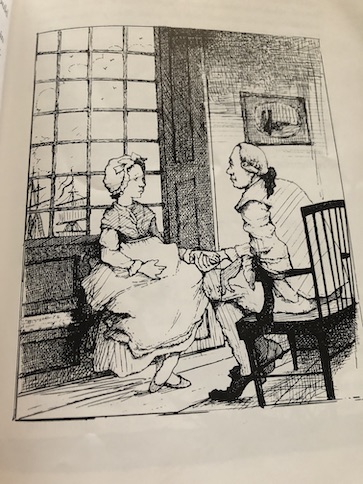
Phoebe the Spy by Judith Berry Griffin, illustrated by Margot Tomes, 1977.
Phoebe Fraunces is a thirteen-year-old girl living in New York in 1776. The Fraunces family is black, but unlike most black people in the American colonies at the time, they have never been slaves. (There were some free black families who had never been slaves during this period of history, but they were uncommon.) Phoebe’s father, Samuel Fraunces owns a tavern called The Queen’s Head. It’s a popular place for people to meet, and Samuel Fraunces allows some prominent Patriots to meet there in secret and discuss their plans. Being party to such meetings could come with consequences as the colonies are on the brink of war.
One day, in April 1776, Samuel confides in his daughter that he has overheard something disturbing. He believes that George Washington’s life is in danger, that there are soldiers who are willing to kill their general for money. Samuel is worried about what he heard, but he isn’t sure what the plot against George Washington actually is and has no proof of what he heard. He’s afraid that if he tells Washington about what he heard too soon, without proof, the conspirators will just wait for a safer time to strike, so he asks Phoebe to help him uncover the truth. Samuel knows that George Washington will be coming to New York soon, and he has asked Samuel to help him find a housekeeper for the house where he will be staying. Samuel wants Phoebe to take the housekeeper position and to keep her eyes open for signs of danger.
Phoebe doesn’t know if she can do what her father wants her to do. She isn’t sure what she’s supposed to be watching for, and she doesn’t know how she could stop the plot if there is one. Her father tells her that she should look out for a man who is part of George Washington’s bodyguard and whose name starts with the letter ‘T’. This is all that Samuel was able to tell about the conspirator from the conversation that he overheard. He tells Phoebe to be careful, not to trust anyone, and to meet with him regularly in the market to tell him what she has learned. The two of them also discuss how odd it is that a man like George Washington, who owns slaves, would be at the center of a fight for freedom. Phoebe hopes that he will free his slaves after the war is over, although her father doubts that will happen. Still, the Fraunces family supports the cause of the Patriots, and Phoebe agrees to help her father find the conspirators and save George Washington’s life.
Phoebe is young to be a housekeeper, but she is accepted into Washington’s household. There, she meets Mary the cook and her son Pompey. Pompey also performs chores for the family, like carrying firewood. The work isn’t too hard for Phoebe because much of it is what she is accustomed to doing for her family’s tavern, like making beds, cleaning the silver, and making sure that meals are served on time. George Washington doesn’t say much when he’s around Phoebe, but she carefully observes the people around him. Every day, she goes to the market to buy food and see her father.
At first, Phoebe has nothing to report to her father. Everyone around George Washington seems to be nice or at least behaving normally, and nobody’s last name begins with the letter ‘T’. Mr. Green, a member of George Washington’s bodyguard, seems a bit unfriendly, but a younger man, Mr. Hickey, seems rather nice and sometimes gives Phoebe little presents.
However, there is a traitor among the household, and although it pains Phoebe when she learns who it is, she must do her duty and protect the life of the person she has promised to protect.
Some of the pictures in the book are black-and-white drawings, and some are in muted colors.
The original title of this book was Phoebe and the General. It is available to borrow and read for free online through Internet Archive.
Historical Background
The story is based on the real Fraunces family of New York. Samuel Fraunces really did own a tavern called the Queen’s Head and allowed Patriots to meet there. A note in the back of the book explains that after the war ended, he was given a reward by Congress, and he changed the name of the Queen’s Head to Fraunces Tavern. Fraunces Tavern still exists today, and it is still a restaurant, although part of it has been converted into a museum.
The racial identity of Samuel Fraunces has been in dispute for some time. No one is completely sure what he actually looked like. There is a portrait of a white man that has been reputed to be Samuel Fraunces, but the true identity of that portrait is in dispute. Samuel Fraunces is known to have had the nickname of “Black Sam”, but different sources describe the family differently. All that is known of Samuel Fraunces’s background is that he was born around 1722 and was originally from the West Indies. It’s possible that the Fraunces family may have been mixed race because some sources refer to Samuel Fraunces as “mulatto” (an old term for someone born to a white parent and a black parent, not considered a polite term now), which might explain the other, differing accounts of the family’s race.
The story of Phoebe Fraunces saving George Washington’s life is legend, but the facts regarding that incident are also in dispute. The legend might be based on a misunderstanding, and Samuel Frances’s real daughter, Elizabeth, does not seem to have been old enough at the time to have taken part in this adventure. The story has had a tendency to appear and reappear around patriotic milestones in the United States, first around the centennial in 1876 and then around the bicentennial in 1976, when this book was written.
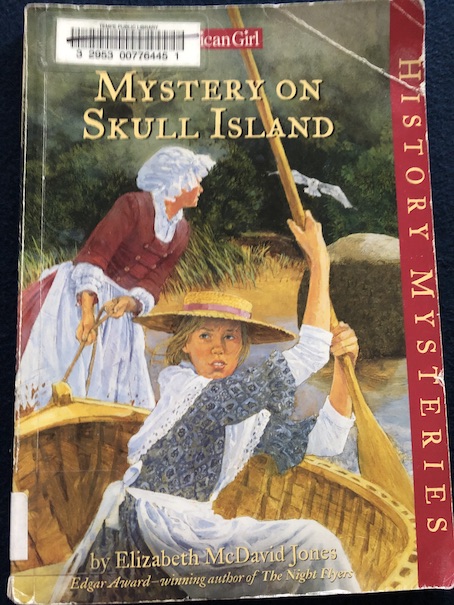
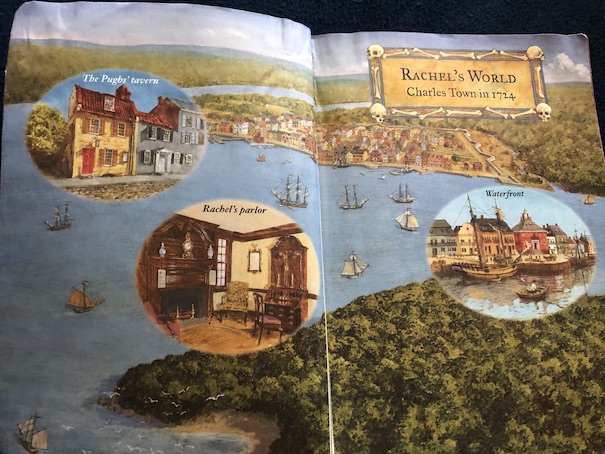
It’s 1724, and twelve-year-old Rachel Howell is traveling to where her father lives in Charles Town, South Carolina. Rachel has been living with her grandparents in New York since her mother died seven years earlier. Her father also used to live in New York, but after his wife’s death, he decided to move to South Carolina, hoping to start a new life. Now, her father has established himself in South Carolina and wants Rachel to come and live with him. Rachel has wanted to live with her father for some time, but she’s nervous because she doesn’t know what life in South Carolina will be like.
Rachel’s new life has a terrifying beginning when the ship that is taking her to Charles Town is attacked by pirates. The pirates force the passengers on board to hand over jewelry and other expensive items. They even take Rachel’s pendant, which belonged to her deceased mother. Fortunately, the pirates don’t hurt or kill anyone and let the ship go once they’ve taken everything of interest to them.
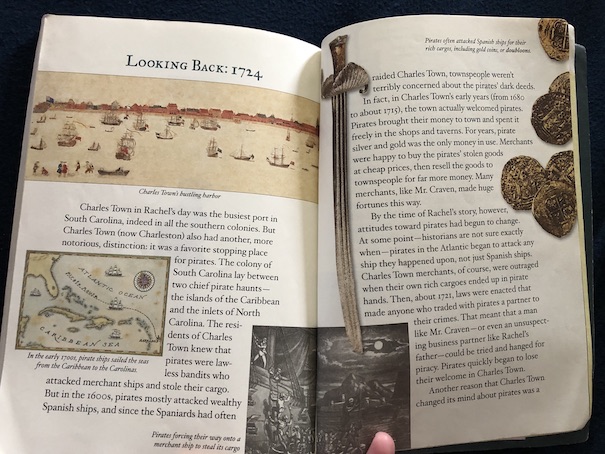
When Rachel arrives in Charles Town, she and her father have difficulty recognizing each other at first, but they are happy to finally be together. Rachel’s father is appalled when he hears about the pirates stealing Rachel’s mother’s necklace, but he is relieved that Rachel is all right. He explains that piracy has been a serious problem to shipping in the area. The local government has tried to combat the problem with harsh punishments, hanging many offenders. However, the pirates have money, and so local businesses still tolerate their presence.
The talk of pirates is shocking, but Rachel is soon in for another shock when her father tells her that he has become engaged and that Rachel will soon have a new mother. Rachel had been looking forward to having some time alone with her father to get to know him again, so she is not pleased at the news, but the engagement is the main reason why her father has sent for her. He wants Rachel to have a mother to care for her and for them to live as a complete family again. He tells Rachel that his fiance, Miranda LeBoyer, is from Philadelphia. She will be arriving in Charles Town soon with her aunt.
Rachel’s father is often busy with his work in the shipping industry, but he grants Rachel more freedom than she had with her grandparents, so she is able to explore her new town and make some new friends. The first friends she makes are the Pugh family, especially the daughter, Sally, who is about Rachel’s age. The Pughs own a local tavern, and Rachel often goes to visit them, sometimes helping with chores and learning to cook. She tells Sally about her worries about her new stepmother, but Sally says that she might not be so bad.
Like her life in South Carolina, Rachel’s first encounter with the woman her father plans to marry takes a disturbing turn. First, Miranda seems to disapprove of Sally and her brother, and Rachel fears that she will interfere with their friendship. Then, her father’s new business partner, Mr. Craven, stops by, and Rachel notices that Miranda seems to both recognize and dislike Mr. Craven. She overhears a conversation between the two of them in which Miranda calls Mr. Craven a “scoundrel” and refers to some kind of illegal dealings in his past. Yet, when Rachel’s father tries to ask Miranda what they’re talking about, Miranda lies and says that they’re discussing the weather and hurricanes that occur in Charles Town. Rachel worries about why Miranda would lie to her father and what kind of dishonest business Mr. Craven might be doing. What are the secrets that people in this town are hiding, and is Miranda really what she seems to be? With the help of her new friends, will Rachel find out the truth before it’s too late?
There is a section in the back of the book with historical information about piracy and life in South Carolina during the 18th century.
The book is available to borrow and read for free online through Internet Archive.
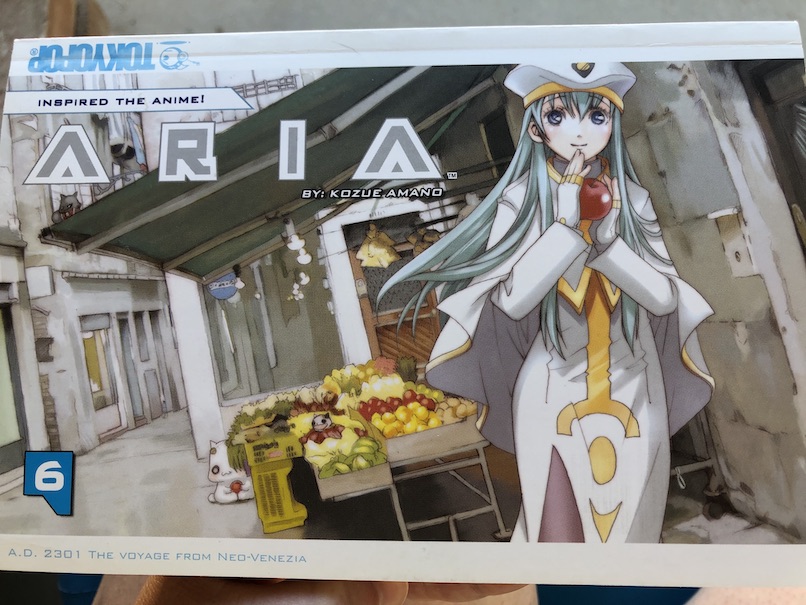
Aria Volume 6 by Kozue Amano, 2005, English Translation 2011.
This is the sixth volume of the second part of a fascinating manga series that combines sci-fi, fantasy, and slice of life. The series takes place about 300 years in the future, when Mars has been terraformed and renamed Aqua (because of all the water on its surface). The human colonies on Aqua are designed to resemble old-fashioned cities on Earth (called Manhome here). The people of Aqua prefer a much slower pace of life than people on Manhome, and aspects of life on Aqua more closely resemble Earth’s past.
The series is divided into two parts. The first two books are the Aqua volumes and introduce Akari Mizunashi, the main character, a young girl who came to Aqua to learn to become a gondolier in the city of Neo Venezia (which resembles Venice). Female gondoliers, called Undines, give tours of the city, giving Akari plenty of time to admire the beauty of her new home and meet interesting people. The two Aqua books are the prequel to the main series, Aria. Aqua covers Akari’s arrival on the planet, her introduction to life on Aqua, and the beginning of her training. The main Aria series show Akari’s continuing training, her progression to becoming a full Undine, her evolving relationships with her friends, and as always, her delight in learning more about her new home and admiring its beauty.
The series has received some criticism for being slow and lacking danger and adventure, but that is not really the point of the series. The main purpose is to show people how to appreciate the small pleasures of life. The sci-fi and fantasy elements (the spaceships, advanced environmental controls, intelligent Martian cats, and even the occasional appearances of the legendary Cait Sith) are mainly background to the stories about the magic of friendship and simple pleasures. Each volume contains a few short stories about Akari and her friends and the little adventures they have on a daily basis and the life lessons they learn. It’s a great series for relaxing when you’re stressed out.
Unfortunately, although this book is only about halfway through the series, this is the last book of the series that I actually own because the others haven’t been printed in English yet, although I think that additional volumes will be published in English.
The stories included in this volume are:
Orange Days
Athena comes to visit Alicia at Aria Company, and the trainees’ mentors reminisce about how they first met when they were trainees.
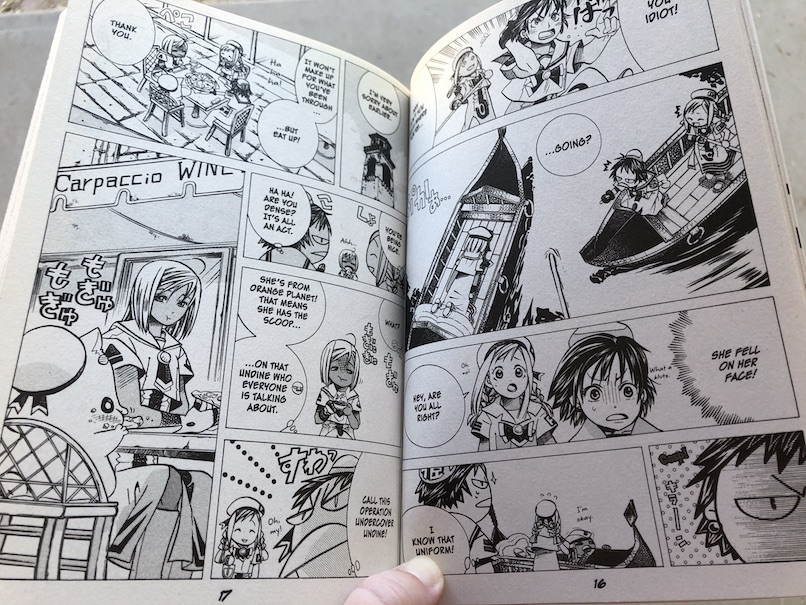
Akira was just as prickly and competitive when she was young as she is as an adult. Although trainee Akira said that she was just observing the “losers” at Aria Company, she kept coming around and became friends with Alicia. When she heard about a new trainee at Orange Company with an amazing singing voice, Akira wanted to seek her out, worried about the competition.
While she was telling Alicia about it, the two of them accidentally had a collision with young Athena’s gondola, which is the first time either of them had seen her. Athena was knocked over by the collision, so the other two girls treated her to lunch, partly to make it up to her and partly because Akira wanted to pump her for information about the new trainee at Orange Company, not knowing that Athena herself was the new trainee.
However, Athena didn’t answer their questions about the new trainee. Even back then, she was a person of few words, and she just made a drinking straw crawly snake to amuse President Aria. Still, Athena became friends with Alicia and Akira, joining them in their practice sessions, like Akari, Aika, and Alice share their practices together. Alicia and Akira only discovered that Athena was the trainee with the amazing voice when they decided to practice singing canzones one day.
The mentors end their reminiscences by saying that it seems hard to believe that, now that their training is over, they are so busy that they hardly have time to see each other. When they were trainees, it felt like they would always practice together every day, but now, their lives are different. These comments make the present trainees uncomfortable because they realize that the same thing is likely to happen to them when their training is complete. Alice, Aika, and Akari have come to value each other’s friendship and companionship, and they find it difficult to imagine being without each other.
However, Alicia and Athena tell the girls to not worry too much about it. Time is always moving forward, and it’s true that things will change for them, but that’s not entirely a bad thing. Even though they sometimes miss their training days when they spent so much of their time together, they are also happy with their current lives. They enjoy their careers, and they like helping to train new Undines. In fact, helping to train the next generation of Undines helps them to connect to their own pasts because the young Undines remind them of their own training days. Alicia’s advice is to enjoy where you are and what’s currently happening around you as much as you can. Life will eventually move on, and things will change, so you might as well make the most of where you are now and enjoy it to the fullest, so you will be ready to move on to the next stage of your life and enjoy that as well. Athena says, “Fun times really aren’t meant to be compared. Just enjoyed.”
The young trainees are still affected by the story of their mentors’ friendships and the changes in their lives. Aika points out to Akari that their lives aren’t changing just yet, but the girls have come to a greater realization that their lives will eventually change.
It’s just like how, when people are young and in school, surrounded by the same other students every day, it can be hard to imagine that there will come a day after you graduate when you won’t all be working at the same place and you won’t all be eating lunch together every day. As you get busy building careers and families, it will be harder to see each other and keep in touch. However, that’s not entirely a bad thing. As some people like to say, “You can’t begin the next chapter of your life if you keep rereading the last one.” There are many things in life to enjoy and accomplishments to be made, and like Alicia and Athena explain, you might as well enjoy where you are right now and make the most of it so you won’t look back with regret when it’s time to move on.
Venetian Glass
Akatsuki’s elder brother comes to Aria Company to hire Akari to transport some delicate Venetian glass. Akari is excited because this is the first time that anyone has specifically hired her, although, because she isn’t a full Undine yet, Alicia will have to accompany her on her errand.
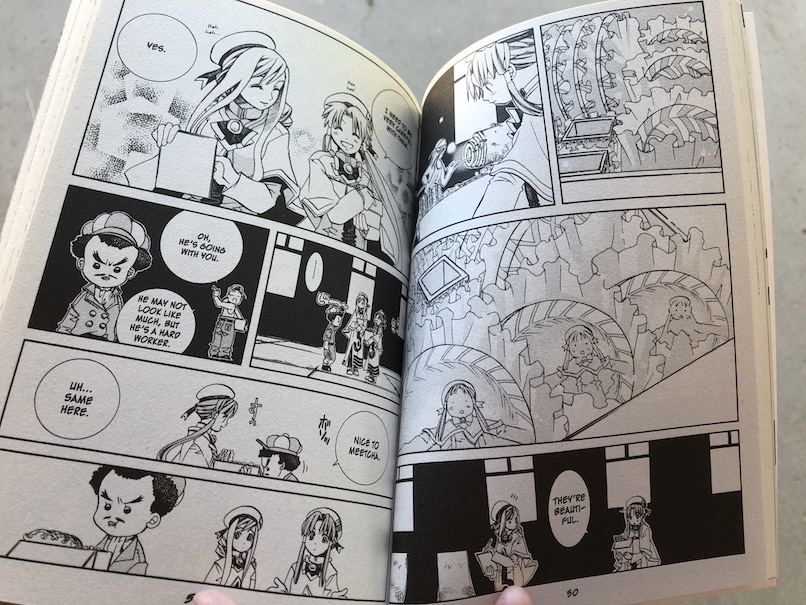
When they go to pick up the glass, Akari sees glass-blowing and Venetian glass for the first time.
One of the workers from the glass factory seems kind of surly, but he accompanies them while they transport the glass and explains the history of Venetian glass and what makes it so special.
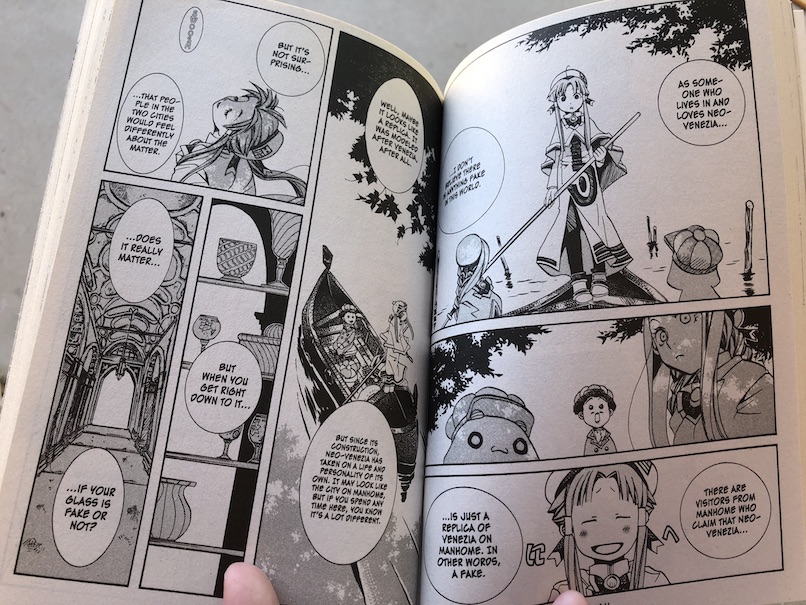
The reason why the glass worker is so surly is that he feels like a lot of people don’t appreciate his craft. He and his master put their heart and soul into their work, but people say that their “Venentian glass” is fake because it’s made in Neo-Venezia, not in the real Venice, which sank beneath the ocean years ago. The worker laments that the craftsmen who left the sinking city were scattered across Earth before making their way to Neo-Venezia and that details of their craft have been lost over time. Neo-Venezian glass will never be quite the same as the original Venetian glass, and people will never look at it the same way, which the worker finds depressing.
However, one of Akari’s great strengths is finding the beauty in everything and bringing it out for other people to see. She tells the worker that the glass is kind of like Neo-Venezia itself. It’s true, it’s not the original Venice, only re-created in its image. Some aspects of it are the same, but it’s also a different place, on another planet. To some people, that might make it seem like a fake city, just an imitation of the original, but Akari doesn’t think that the real vs. fake concept matters because she loves the city for the beautiful treasure it is. Similarly, Akari thinks that Neo-Venezian glass is a treasure by itself and likes it for what it is, regardless of what the original was or what others say about it.
The worker finds Akari’s viewpoint inspirational and is enchanted by Akari herself, remarking that she’s also a unique treasure. Akatsuki’s brother jokes that Akatsuki might have a rival now for his affection for Akari. Akari knows that Akatsuki has had an unrequited crush on Alicia, so she doesn’t think too much about it. Although it’s true that Akatsuki has a crush on Alicia, Akatsuki’s brother is also correct that Akari inspires greater feelings in others than she realizes and Akatsuki values Akari more than he lets on, maybe more than even he realizes himself. Akari is unique because of her unusual way of looking at things, and her optimistic point of view influences others.
Snow White
One day, while they’re practicing together, Akari asks Aika what kind of adult she wanted to be when she was a kid. Aika, who has admired and even hero-worshipped Alicia ever since Alicia was kind to her when she was a young child, says that she’s always wanted to be an elegant woman like Alicia. Akari says that she wants to be like Alicia, too, but Aika criticizes her for wanting to copy her ambition and says that it’s not likely that Akari would ever be as elegant as Alicia because she still does kid-like things, like collecting stuffed animals.
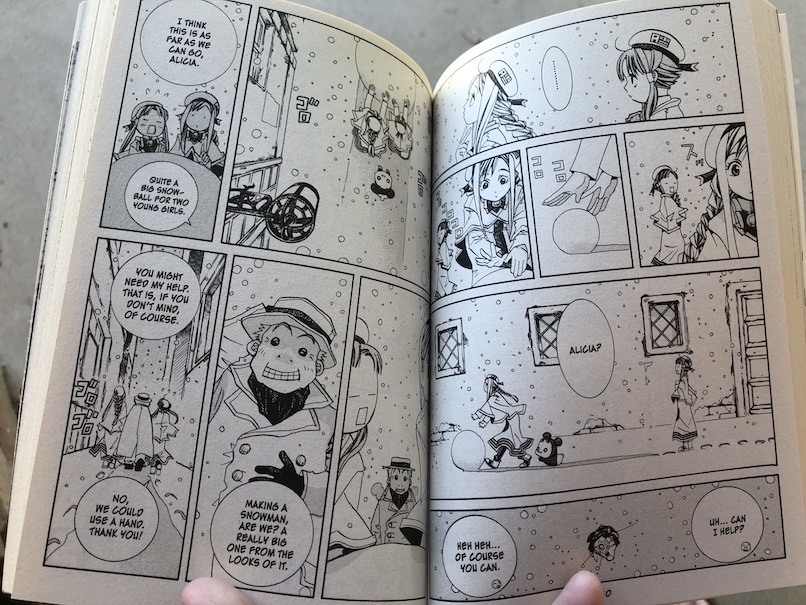
Their discussion causes Akari to wonder what sort of adult Alicia wanted to be when she was a little kid, and she asks Alicia about it while they’re out walking one day. Instead of answering her directly at first, Alicia demonstrates by starting to build a snowman and pointing out how the people around them react to it.
Each time Alicia and Akari start to make a large snowball for the base of the snowman, different adults stop and help them to make it a bit bigger.
Alicia says that she noticed people like this when she was a child. There are always adults who, when seeing a young girl making a snowman, feel compelled to help her because she can make a much bigger snowball with their help. That’s the type of adult Alicia always wanted to be.
Alicia genuinely enjoys not only her career as an Undine but her role as a teacher and mentor in Akari’s life and in the lives of her friends, helping them to develop in their trade and to become better Undines because of her influence.
Stray Cat
Alice finds a tiny stray Martian cat one day while waiting for Akari and Aika to meet her for practice. The cat’s mother doesn’t seem to be around, and Alice doesn’t know whether the little cat is lost, orphaned, or abandoned. When Aika arrives for practice, she finds both Alice and Akari lying on the ground next to the cat because it looks so happy lying in the sun that Alice thinks they should also try it.
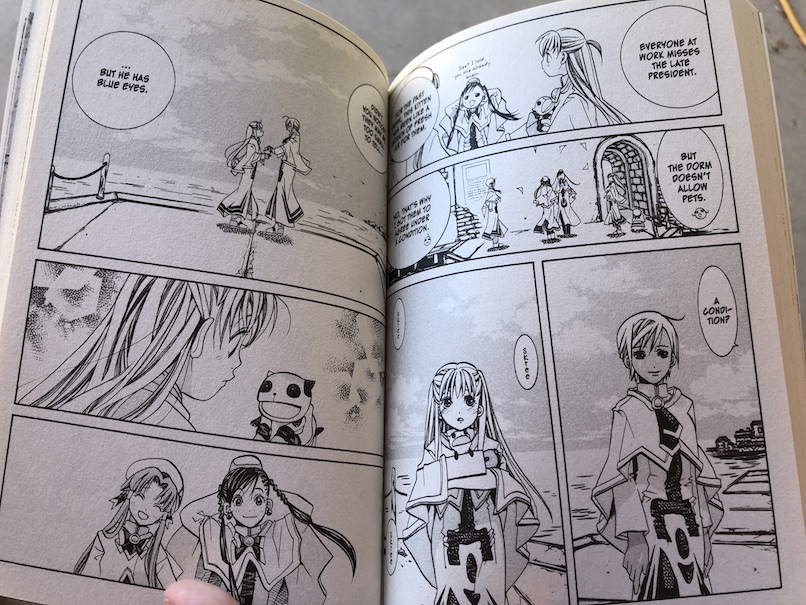
Although Aika warns Alice that she won’t be able to keep the cat because she lives in a dorm at Orange Company and isn’t allowed to keep pets, Alice becomes attached to the cat, names it Maa, and hides it in her room.
At first, she is afraid that her mentor, Athena, will be angry with her, and Aika scares her by saying that Athena will probably kill the cat because she doesn’t like cats. However, Alice loves Maa because she misses the previous president cat of Orange Company, who recently passed away, and Maa reminds her a little of him.
When the secret gets out, and Alice is confronted by Athena about the cat, Alice is scared because Athena is holding a knife for slicing fruit and runs away to leave the tiny Maa where she found him, thinking that it might be the only way to save his life. However, she finds herself unable to abandon Maa and returns to get him, only to find him missing from the box where she left him. In a panic, she spends all night searching the city with her friends to try to find Maa.
However, when they finally give up the search, they discover that Athena has Maa. When she had tried to talk to Alice before, she wasn’t angry. She followed Alice to the place where she left Maa and retrieved him and has been waiting for Alice to return to Orange Company. In Alice’s absence, Athena has persuaded Orange Company to keep Maa as their new company president. Like the other cats used as the presidents/mascots of gondola companies, Maa also has blue eyes.
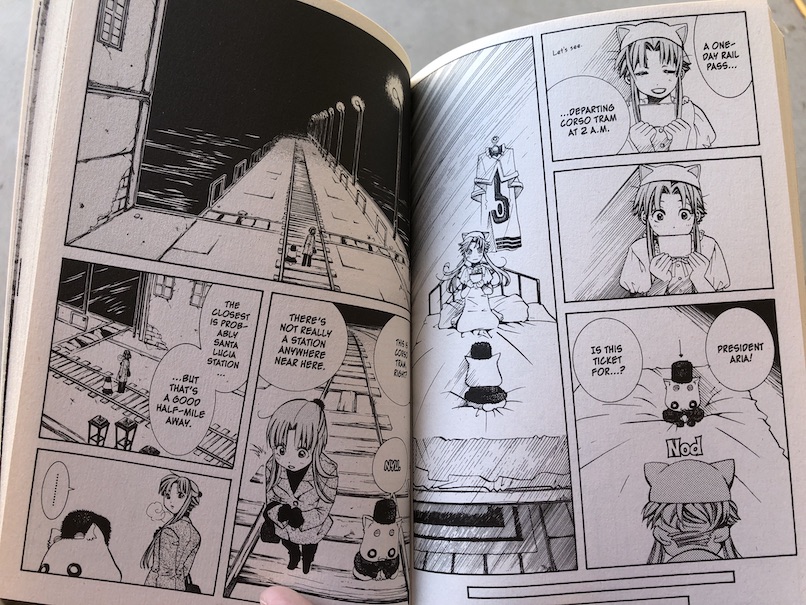
Aika has a more practical explanation for what it is, that the sounds of freight trains are more noticeable at night, when everything is quiet, but Akari discovers the truth when President Aria gives her a special train ticket.
It turns out that the mysterious train is a train of cats. (Guess who the conductor is?) Akari could use the ticket from President Aria to ride the train, but instead, she gives it to a sad little kitten who lost his ticket.
Because Akari doesn’t board the train, she never finds out where the train was going. The next morning, it all seems like a strange dream, except both Akari and President Aria have the stamps on their foreheads that Cait Sith gave them.
A Parallel World
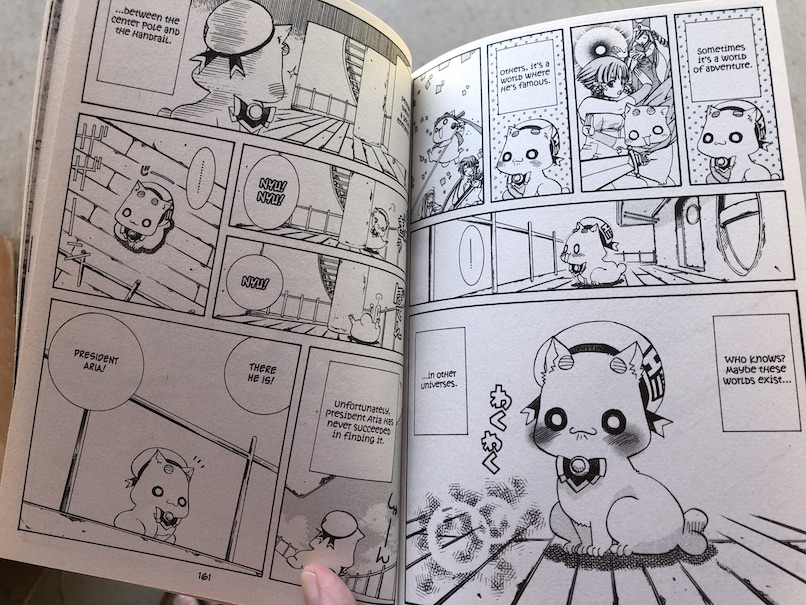
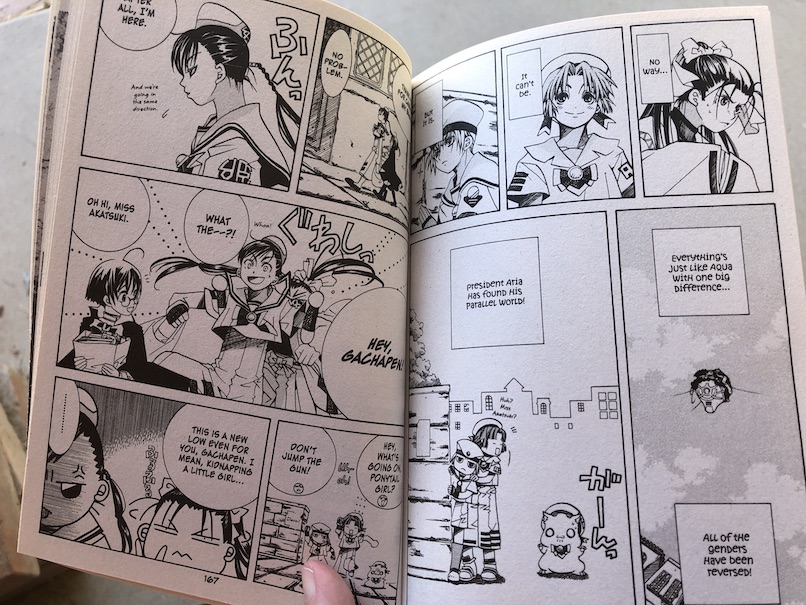
President Aria accidentally finds a parallel world in which all the people he knows who are girls are boys and vice versa. Frightening!
President Aria has always wanted to find a gateway to another world, but everything seems so strange that all he wants to do is get back to his world.
He ends up returning to the world he knows when someone tosses him too high in the air while playing with him. Did any of it really happen, or was he just dazed from when he fell?
This one isn’t one of my favorite stories in this series because I think that the premise is kind of goofy. The characters don’t really look all that different when their genders are switched. Most of the difference is in hair styles, and the uniforms of the Undines have pants when they’re normally just long dresses.
Aria Volume 5 by Kozue Amano, 2004, English Translation 2009.
This is the fifth volume of the second part of a fascinating manga series that combines sci-fi, fantasy, and slice of life. The series takes place about 300 years in the future, when Mars has been terraformed and renamed Aqua (because of all the water on its surface). The human colonies on Aqua are designed to resemble old-fashioned cities on Earth (called Manhome here). The people of Aqua prefer a much slower pace of life than people on Manhome, and aspects of life on Aqua more closely resemble Earth’s past.
The series is divided into two parts. The first two books are the Aqua volumes and introduce Akari Mizunashi, the main character, a young girl who came to Aqua to learn to become a gondolier in the city of Neo Venezia (which resembles Venice). Female gondoliers, called Undines, give tours of the city, giving Akari plenty of time to admire the beauty of her new home and meet interesting people. The two Aqua books are the prequel to the main series, Aria. Aqua covers Akari’s arrival on the planet, her introduction to life on Aqua, and the beginning of her training. The main Aria series show Akari’s continuing training, her progression to becoming a full Undine, her evolving relationships with her friends, and as always, her delight in learning more about her new home and admiring its beauty.
The series has received some criticism for being slow and lacking danger and adventure, but that is not really the point of the series. The main purpose is to show people how to appreciate the small pleasures of life. The sci-fi and fantasy elements (the spaceships, advanced environmental controls, intelligent Martian cats, and even the occasional appearances of the legendary Cait Sith) are mainly background to the stories about the magic of friendship and simple pleasures. Each volume contains a few short stories about Akari and her friends and the little adventures they have on a daily basis and the life lessons they learn. It’s a great series for relaxing when you’re stressed out.
The stories included in this volume are:
Mailman-San
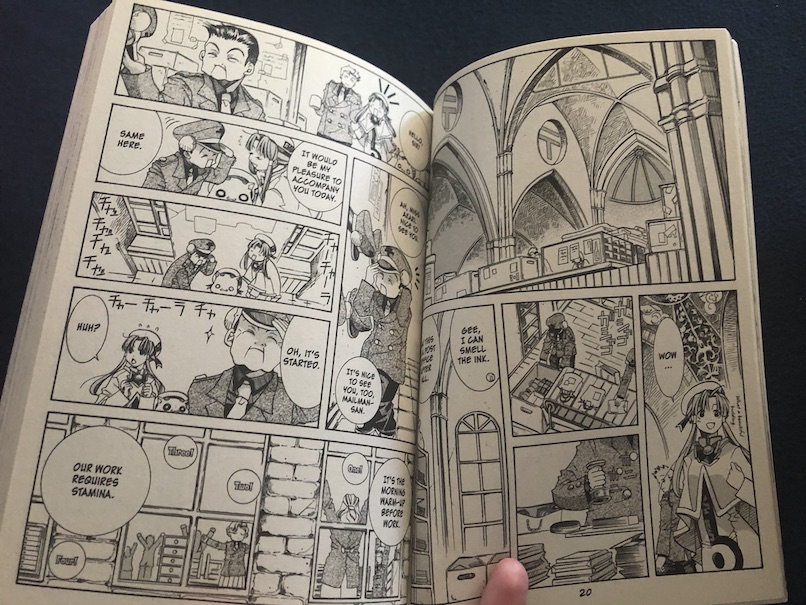
When Akari’s mailman friend has a hole in his gondola, he tries to hire Alicia to help him deliver the mail. However, Alicia is busy, so she allows Akari to help him instead, even though she’s only a trainee.
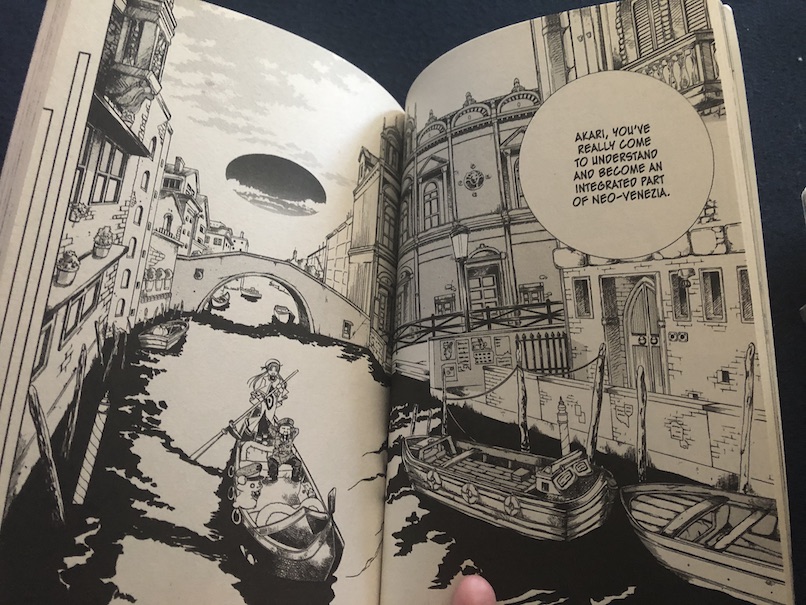
Akari gets to visit the post office and spends the day helping the mailman deliver the mail. During the course of the day, Akari thinks about the number of letters that people in Neo Venezia send and wonders why they send physical letters instead of e-mail. The mailman explains to her that physical letters feel different from e-mail, and Akari understands.
People in Neo Venezia like the feel of doing things the old-fashioned way, often because the old-fashioned ways have more of a personal touch. The mailman tells Akari that she has really become a part of Neo Venezia.
Canzone
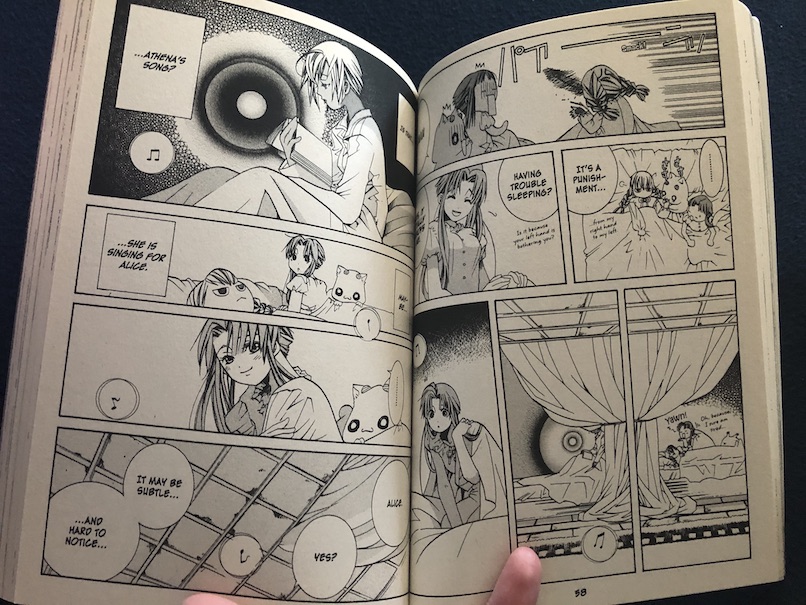
Alice’s mentor, Athena, is also one of the three greatest Undines on Aqua, the Three Water Fairies, like Akari’s and Aika’s mentors. However, Alice has little patience for her because she is clumsy outside of a gondola. Alice hates clumsiness and weakness, even punishing her own left hand for not being as strong as her right.
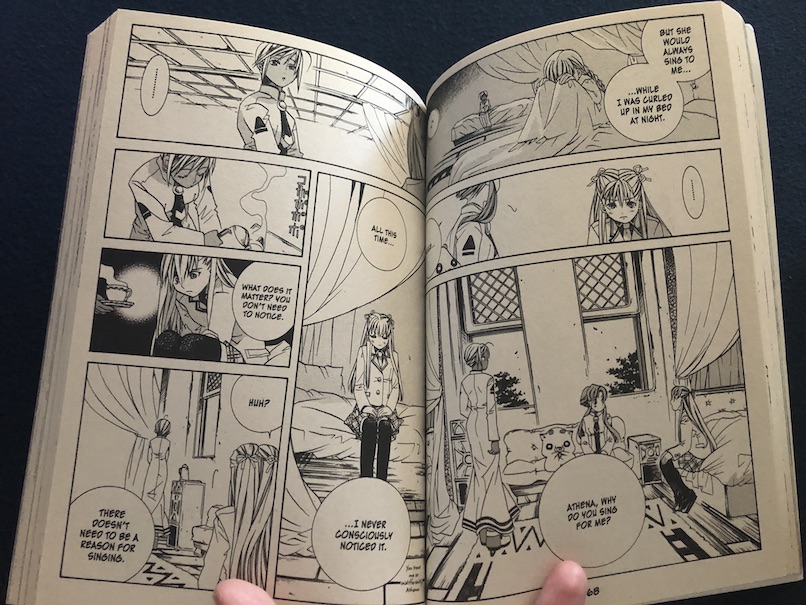
Akari is concerned about Alice when she sees what she’s doing to her left hand, and she has a sleepover with Alice to learn more about what’s happening with her. That’s when she meets Athena for the first time, although she had earlier seen her in her gondola, singing an enchanting canzone. Athena’s singing ability is one of the reasons why she is so famous as an Undine.
Akari observes the little things that Athena does for Alice, like singing to her at night, and points out to Alice that her left hand helps her more than she realizes.
Alice doesn’t believe it at first, but the next day, she begins to notice that Akari is right. While Alice eats with her right hand, her left hand holds her bowl. When she writes with her right hand, her left hand is holding the page. Her left hand isn’t inactive or useless; it’s been providing support that allows the right hand to do its job.
This revelation also causes Alice to see her mentor in a different light. Like her left hand, clumsy Athena has also been giving Alice quiet support that Alice often fails to notice. Alice reflects on how Athena’s singing comforted her when she first arrived at Orange Company and was homesick. Alice asks Athena why she sings to her, and Athena tells her that she’s just singing as she pleases, that she doesn’t need a reason to sing, that songs don’t really need to be noticed or thanked, and that she should just let the song do its work. However, Alice gains a new sense of gratitude toward her mentor and begins to treat her much better.
The Night of the Meteor Shower
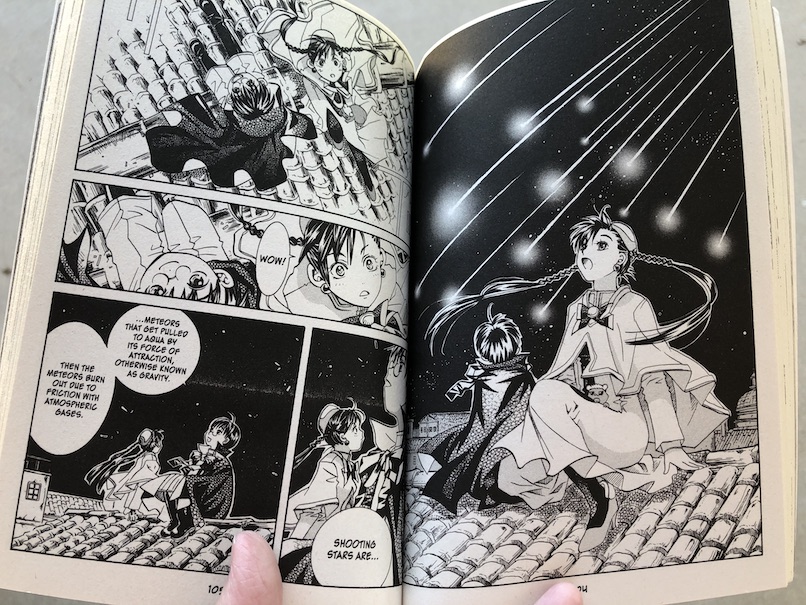
Akari and her friends find out that there is going to be a meteor shower, and Aika suggests that they invite Al the Gnome to watch it with them.
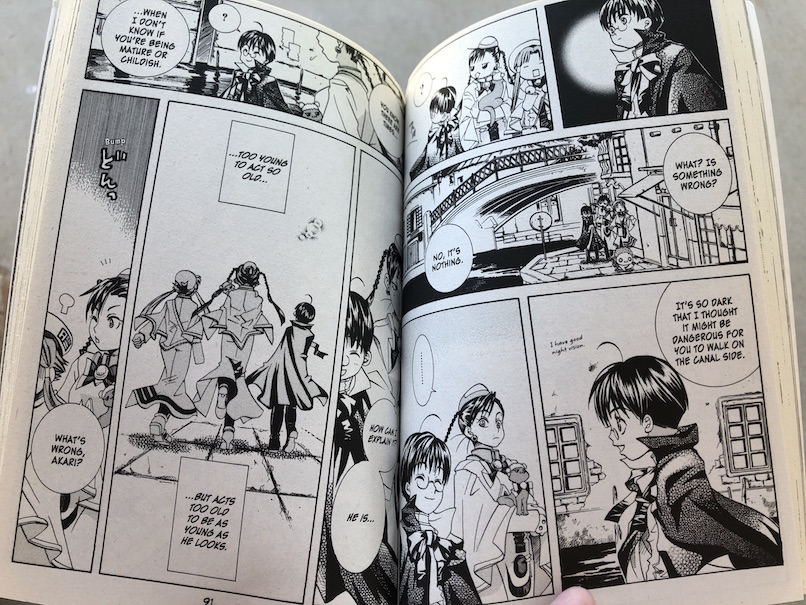
Of all the boys the girls know, Aika likes Al the best. Al isn’t temperamental like Akatsuki or spacey like Woody. Aika is kind of fascinated by how he looks younger than they are even though he’s older and also talks like an old man or an old-fashioned gentleman.
Plus, after living in the underground city, Al has really good night vision, which is helpful as the girls search for a good place to view the meteor shower, away from the lights and crowds of the public square.
Aika finally suggests that they go up on the roof of one of the Himeya Company buildings, which has an excellent view.
Akari explores the rooftops a little on her own, leaving Aika and Al alone together. When Al, whose work as a Gnome is managing the gravity of Aqua, talks to Aika about gravity and attraction and how the gravity of Aqua pulls, the meteors in, she understands a little more about the attraction she feels for Al.
Margherita
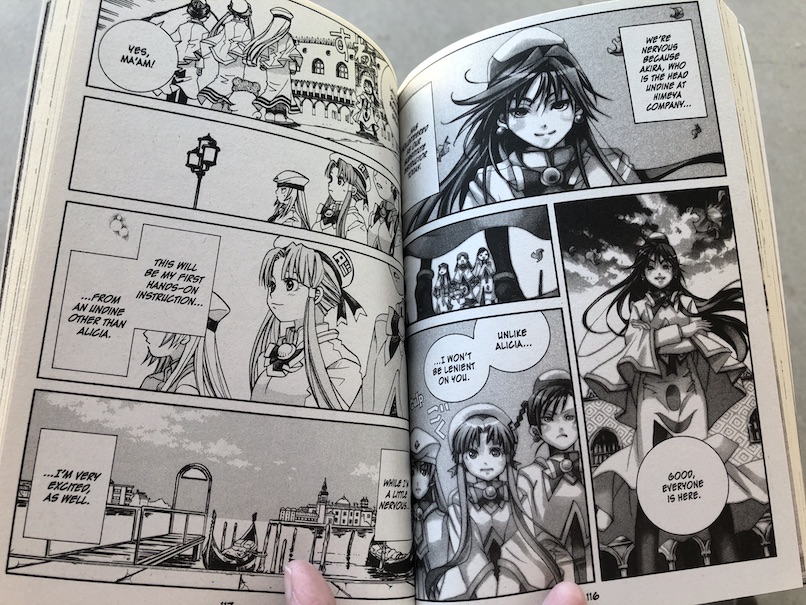
Aika’s mentor, Akira, is tough, but she genuinely cares about her students. After a day of training in which many things go wrong, she finds a way to show the trainees how much she appreciates their hard work.
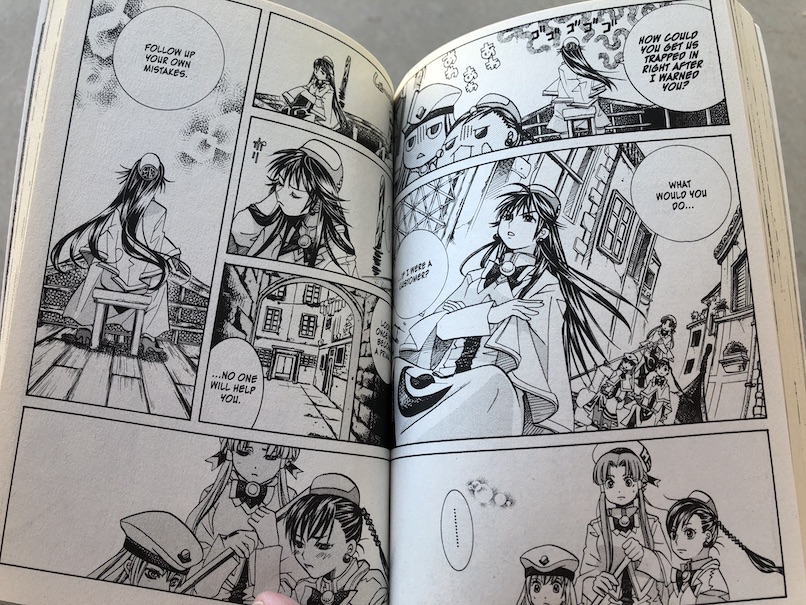
Akira has Aika, Akari, and Alice show her how they would handle a real customer, from helping them into the gondola to giving them a pleasant tour with interesting information. However, she is critical of the way they do things and particularly, some of the safety regulations they forget, like speed limits, not warning other approaching boats of their presence, and allowing themselves to be stuck when high tide comes and makes it impossible for them to pass beneath certain bridges.
Akira says that the reason why she’s being tough is that, when the girls become full Undines, they will be completely on their own in their boats with their customers, with no one else to help them. When there’s a problem or when they make a mistake, it will be their job to fix the situation themselves with their own skill and ingenuity.
When they become stuck on a section of canal because of the rising tide, Akira challenges them to find a way to solve the problem themselves. They find a side waterway that’s been closed off, and take the gondola through that way.
Akira rewards the trainees by taking them to a pizza parlor for a Margherita pizza. (Named for a queen, it’s topped with tomatoes, basil, and olive oil.) The trainees ask her why she didn’t punish them for making a serious mistake in their practice, and she tells them that there would be no point in punishing them because they realized what they did wrong and made an effort to improve, learning from their experience.
I quibble a bit with the teaching method just telling the students to find a way to fix the problem themselves without guidance. It kind of works here because Aika and Akari are now journeyman Undines and have had basic training and experience of the waterways of Neo Venezia to call on, but you can’t do this sort of thing with real beginners who haven’t had that grounding. I’ve had teachers who have tried, and I know the frustration of having them expecting me to call on a grounding I hadn’t received. When I was a kid, I felt terrible about those situations, like I was an idiot, but as an adult, who has since had gaps in my early education filled, I’ve come to realize that the fault wasn’t with me but with the teachers who had not taught me what to do but still expected me to somehow already know. I couldn’t figure out what to do because I didn’t know enough about what I could do yet. You can’t progress well in your education or training for anything without having someone explain the basics to give you the right grounding to build on. You can’t do algebra without knowing your basic operations. You can’t understand how to cook from memory or improvise a dish without first learning how to follow basic recipes. Akira’s approach to letting the students figure out the solution to a problem themselves calls attention to what the girls already know and encourages them to use it, but when that doesn’t work in real life, when you just don’t know what to do at all, it’s time to take a step back and reacquaint yourselves with the basics. You can figure out what to do if you know what’s possible to do, but I’d like to point out that if you don’t know what’s possible, you need some help and guidance to learn.
Shadow Chasing
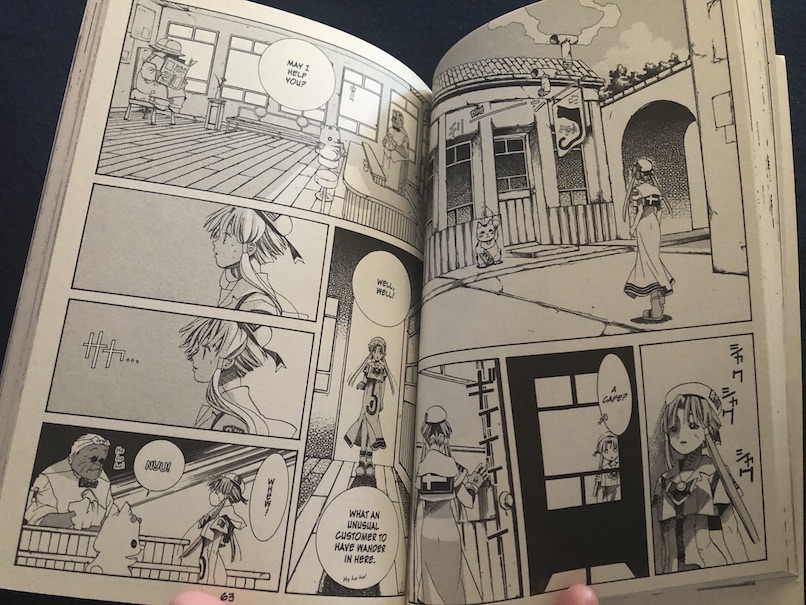
Akari never minds waiting for people because there are always interesting things and people to watch. One day, when Alicia has to attend a Gondola Association meeting at a famous cafe, Akari says that she and President Aria will just wait for her instead of heading home.
Akari drinks lattes and watches the people going by, just enjoying the ambiance of the square.
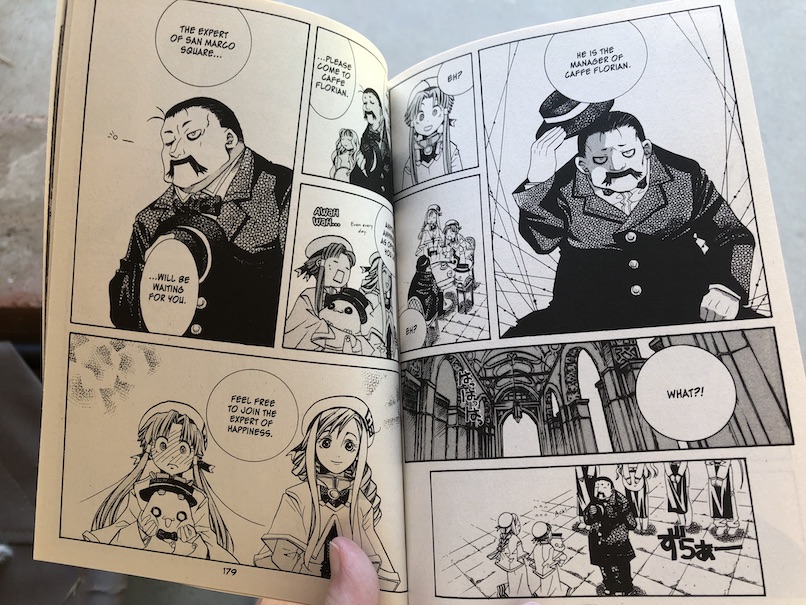
There is a man there who seems familiar to Akari, and the two of them begin talking to each other about people watching in the square. The man introduces Akari to the custom of “shadow chasing”, where the restaurant employees move the cafe’s tables into the shade as the shadows move.
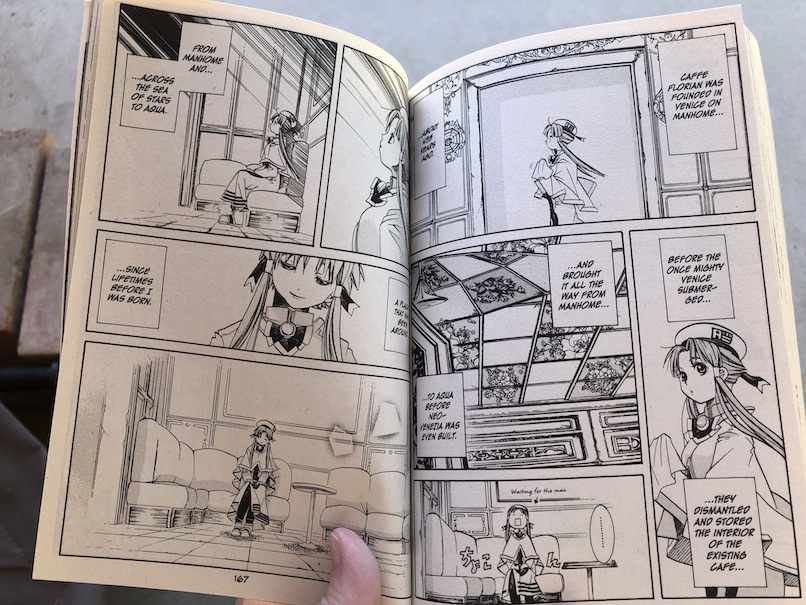
Akari reflects on the history of the cafe, Caffe Florian, which she says is actually the same cafe that once stood in the original Venice (which, in Akari’s time, is now submerged beneath the ocean), having been dismantled and moved years ago.
It turns out that her new friend is actually the manager of the cafe.
Aria Volume 4 by Kozue Amano, 2004, English Translation 2008.
This is the fourth volume of the second part of a fascinating manga series that combines sci-fi, fantasy, and slice of life. The series takes place about 300 years in the future, when Mars has been terraformed and renamed Aqua (because of all the water on its surface). The human colonies on Aqua are designed to resemble old-fashioned cities on Earth (called Manhome here). The people of Aqua prefer a much slower pace of life than people on Manhome, and aspects of life on Aqua more closely resemble Earth’s past.
The series is divided into two parts. The first two books are the Aqua volumes and introduce Akari Mizunashi, the main character, a young girl who came to Aqua to learn to become a gondolier in the city of Neo Venezia (which resembles Venice). Female gondoliers, called Undines, give tours of the city, giving Akari plenty of time to admire the beauty of her new home and meet interesting people. The two Aqua books are the prequel to the main series, Aria. Aqua covers Akari’s arrival on the planet, her introduction to life on Aqua, and the beginning of her training. The main Aria series show Akari’s continuing training, her progression to becoming a full Undine, her evolving relationships with her friends, and as always, her delight in learning more about her new home and admiring its beauty.
The series has received some criticism for being slow and lacking danger and adventure, but that is not really the point of the series. The main purpose is to show people how to appreciate the small pleasures of life. The sci-fi and fantasy elements (the spaceships, advanced environmental controls, intelligent Martian cats, and even the occasional appearances of the legendary Cait Sith) are mainly background to the stories about the magic of friendship and simple pleasures. Each volume contains a few short stories about Akari and her friends and the little adventures they have on a daily basis and the life lessons they learn. It’s a great series for relaxing when you’re stressed out.
The stories included in this volume are:
Neverland
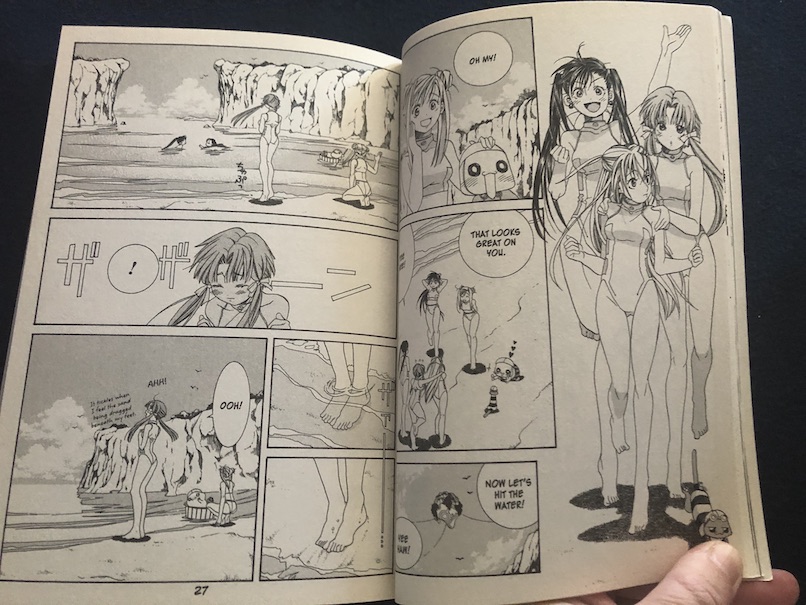
Alicia and Akira arrange a special, surprise trip to the beach for the trainees, a happy day that reminds Akari of Neverland. It starts out with an invitation for each of the trainees that supposedly comes from Peter Pan, inviting them to Neverland, but it turns out to be a fun day at a beach that President Aria found.
Akira wanted the day to be a day of training, but Alicia convinced her that a day of rest and relaxation would benefit the trainees more. The girls put on their swimsuits and enjoy a day of swimming.
Akari thinks that the beach and their day there really is like Neverland, and Alicia realizes that it is because of the way that Akari looks at things. Akari’s strength is the ability to enjoy the simple pleasures in life for what they are, finding the magic in daily life.
This story emphasizes the theme of the series, which is that the most important thing is to choose to be happy.
Traveling Water
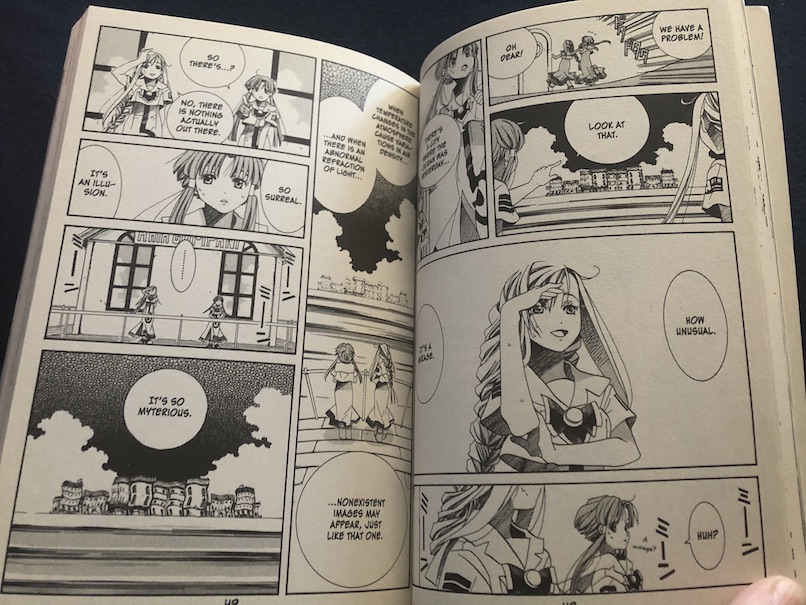
Summer on Aqua is very hot, and Akari experiences her first mirages. People on Aqua sometimes call them “traveling water” because they can look like water that you can never reach. (I grew up in Arizona, and I grew up seeing that. On a straight road, the heat waves will look like distant water, waving and reflecting the scenery, but they appear to dry up or move further away as you go toward them.)
On a very hot day, Akari sets out to buy a night light chime and, oddly, seems to find herself all alone, except for President Aria. She follows President Aria, hoping that he will lead her to a place where she can cool off.
Akari finds herself at a mysterious cafe, which is nice and cool. The server gives her and President Aria ice cold milk, and Akari feels better, but the cafe is no ordinary cafe.
It turns out that the cafe is a secret hangout for cats and their king, Cait Sith. Humans do not ordinarily find their way there. They give Akari a special night light chime and urge her to go on her way …
Unless it was all just another mirage.
I love this story for its “was it all a dream” theme and for the cat-shaped chime that helps confirm that it all really happened. I also like the idea/warning that the server offers to Akari, that maybe it’s a good thing not to completely catch up to a mirage. Akari is sometimes a special guest of the magical characters that inhabit their world, going to places and seeing things that others don’t, but she can’t stay among them because her life is in the human world, and she has to let the fantasy elements slip away to return to her ordinary life that is a little less ordinary for the experiences she’s had.
Flying Fish in the Sky
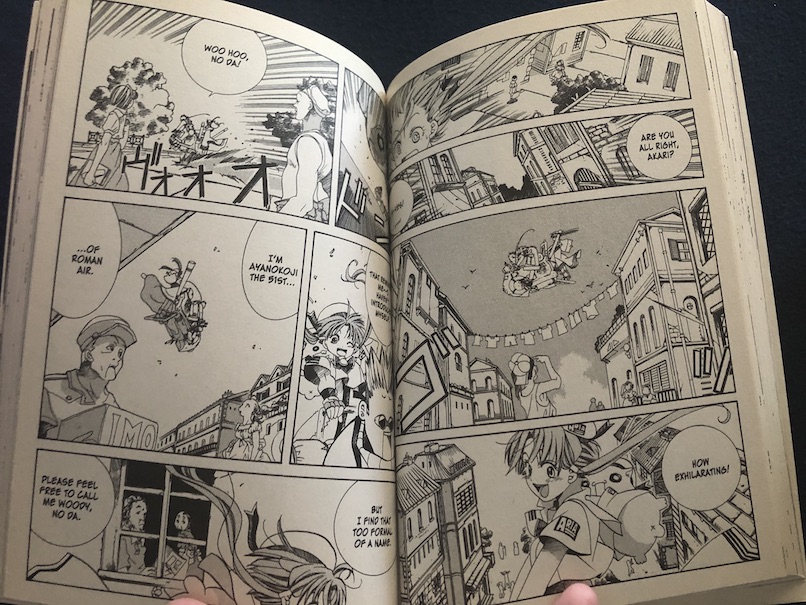
Akari notices that some of the professions on Aqua relate to the four elements: water, fire, earth, and air. The Undines represent water because they spend their time rowing their gondolas, the Salamanders represent fire because they control the heat levels in the atmosphere to control the weather, and the Gnomes represent earth because they work underground to control gravity. The fourth element-based profession is Sylph, which represents air. They are flying deliverymen.
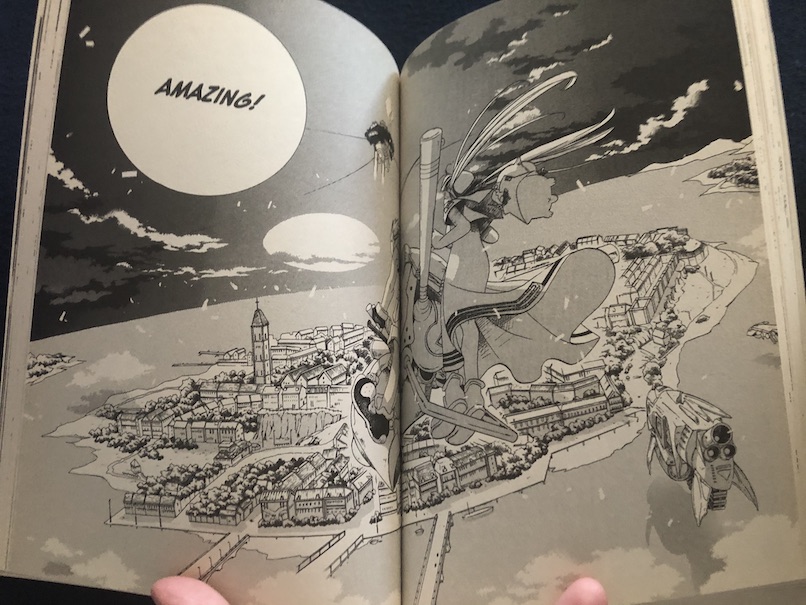
Akari helps a sylph called Woody, a flying deliveryman with a poor sense of direction, after he falls off his flying bike and loses the map he depends on in order to make his deliveries. It’s kind of a scary ride, but it’s also exciting, and Akari gets a bird’s-eye view of her city.
Woody also appears in later stories.
The Legendary Major Fairy
The trainees go to meet the founder of Aria Company, who is considered the Legendary Major Fairy, the grandmother of the younger Undines. She now lives in the countryside, and as the girls help her with some chores and enjoy other activities, Aika keeps looking for hidden tests of their skills or lessons slipped into the activities.
When hidden tests and lessons don’t seem to be in these activities, and the activities just are what they appear to be, Aika gets impatient and worries that maybe the older woman thinks that they’re hopeless and not worth teaching. She asks the Legendary Fairy, who asks them to call her “Grandma”, directly for some advice about being a great Undine, and what she tells them is both simple and yet something that is easy for people to forget.
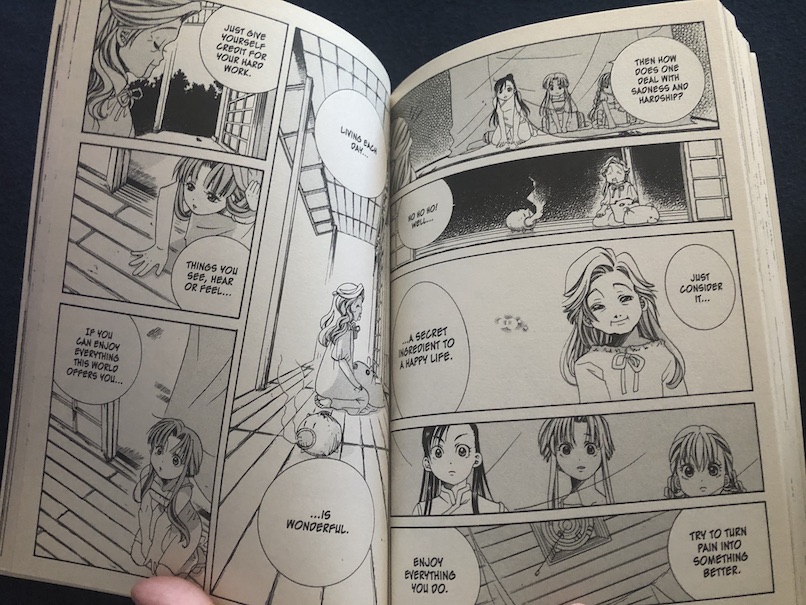
Grandma’s advice is another repetition of the themes of the entire Aria series, but it’s worth repeating. She tells the girls to enjoy themselves in everything they do (the activities she gave them earlier were for them to enjoy, nothing more), remember that the world and life itself is full of things to enjoy, give yourself credit for your hard work, and when you encounter pain and sadness, try to turn it into something better.
The Redentore
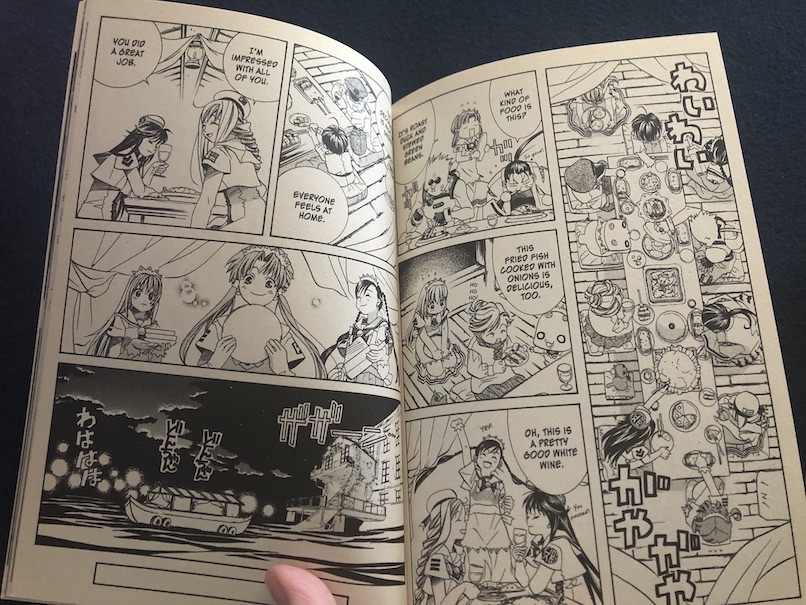
The Undines celebrate Rendentore, a special festival of thanksgiving, with a party on a boat for all of their friends, organized by the trainees. In keeping with the tradition, the trainees invite special guests and use the opportunity to improve their hostess and entertaining skills, designing invitations and planning the meal and entertainment.
The party is a success, and one of the best parts is that the girls have brought together a group of people who otherwise would not have spent time together, except they are tied together by their roles in the lives of the girls.









































 Jestress's Forgotten Books and Stories