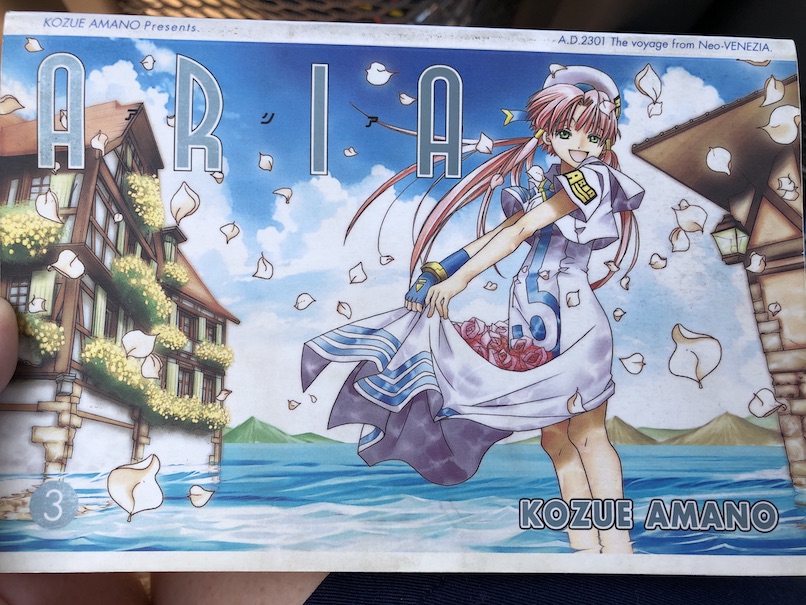
Aria Volume 3

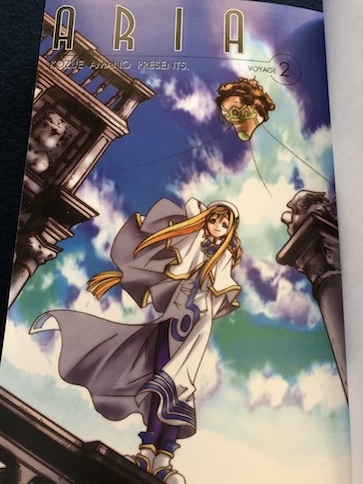
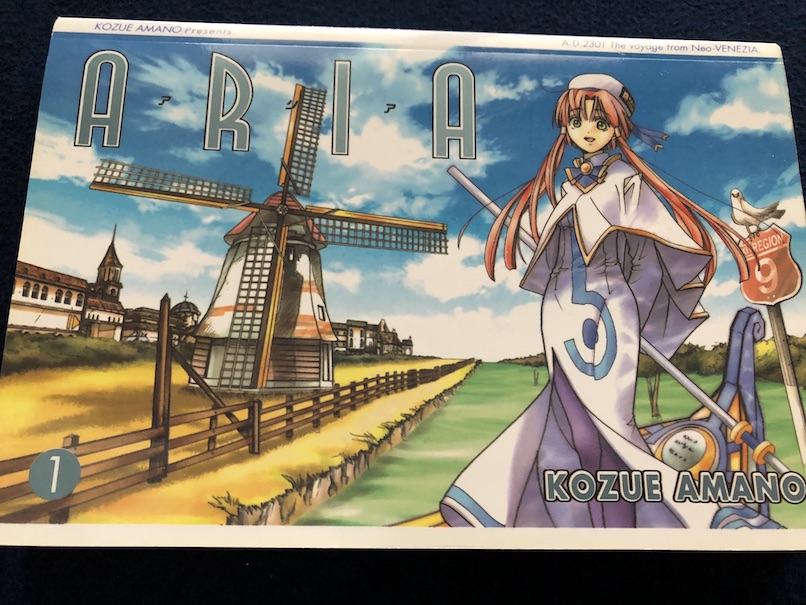
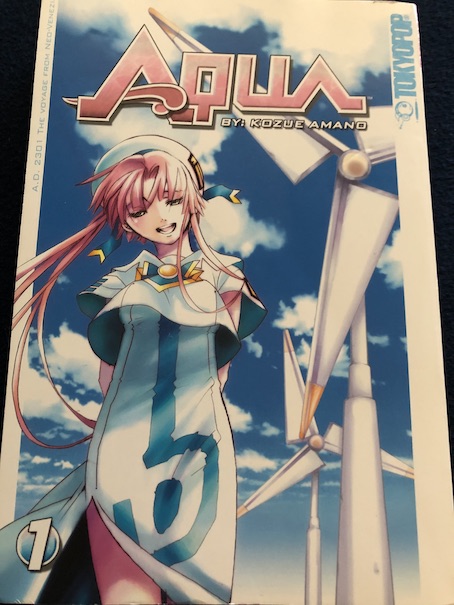
Aria Volume 3 by Kozue Amano, 2003, English Translation 2004.

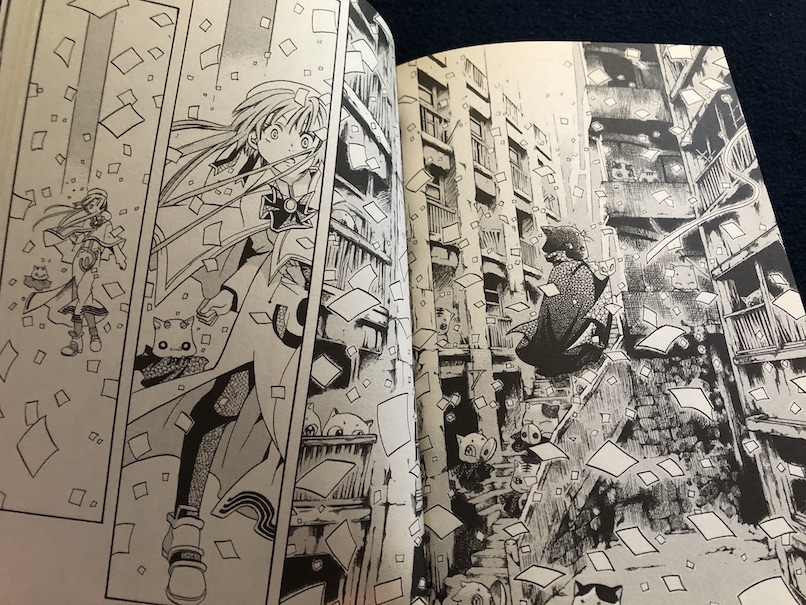
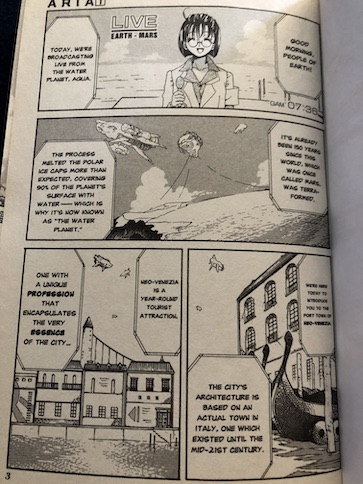
This is the third volume of the second part of a fascinating manga series that combines sci-fi, fantasy, and slice of life. The series takes place about 300 years in the future, when Mars has been terraformed and renamed Aqua (because of all the water on its surface). The human colonies on Aqua are designed to resemble old-fashioned cities on Earth (called Manhome here). The people of Aqua prefer a much slower pace of life than people on Manhome, and aspects of life on Aqua more closely resemble Earth’s past.

The series is divided into two parts. The first two books are the Aqua volumes and introduce Akari Mizunashi, the main character, a young girl who came to Aqua to learn to become a gondolier in the city of Neo Venezia (which resembles Venice). Female gondoliers, called Undines, give tours of the city, giving Akari plenty of time to admire the beauty of her new home and meet interesting people. The two Aqua books are the prequel to the main series, Aria. Aqua covers Akari’s arrival on the planet, her introduction to life on Aqua, and the beginning of her training. The main Aria series show Akari’s continuing training, her progression to becoming a full Undine, her evolving relationships with her friends, and as always, her delight in learning more about her new home and admiring its beauty.

The series has received some criticism for being slow and lacking danger and adventure, but that is not really the point of the series. The main purpose is to show people how to appreciate the small pleasures of life. The sci-fi and fantasy elements (the spaceships, advanced environmental controls, intelligent Martian cats, and even the occasional appearances of the legendary Cait Sith) are mainly background to the stories about the magic of friendship and simple pleasures. Each volume contains a few short stories about Akari and her friends and the little adventures they have on a daily basis and the life lessons they learn. It’s a great series for relaxing when you’re stressed out.

The stories included in this volume are:

First Gale of Spring

It’s been a full year (full Martian year, which is equal to two Earth years) since Akari moved to Aqua and began her Undine training, and she’s happy that it’s spring again! While Akari and Aika are practicing their rowing one day, they meet another trainee Undine, Alice.
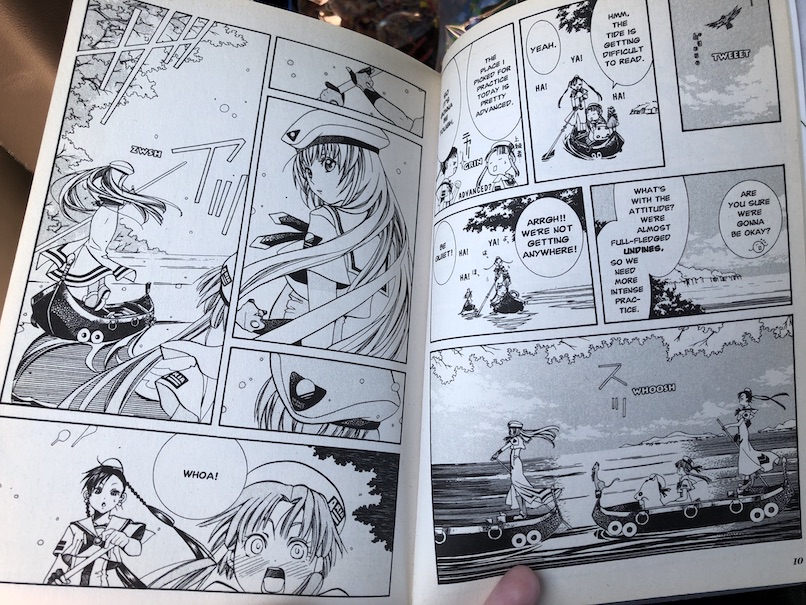
Alice is a young prodigy, only 14. Even though she is rather young and still in school, she’s really good at handling a gondola. However, Aika takes an instant dislike to her, partly because she belongs to Orange Company, a rival of Aika’s gondola company, Himeya. Akari tries to be friendly to Alice and tries to invite her to join them for lunch, but Alice is rude and unfriendly to them.

Aika thinks that Alice has an uppity attitude and is disrespectful to them even though they’re higher level trainees than she is. (There is some mild swearing in this part of the story. Most of the Aria series doesn’t have any swearing at all.) To prove her point and put Alice in her place, Aika decides to challenge Alice to a race.

Part of the reason why Alice is so prickly and unfriendly is that she thinks that people look down on her for being young and because they’re jealous of her skills , but she doesn’t realize how her abrasive attitude affects the people around her and their perceptions of her.
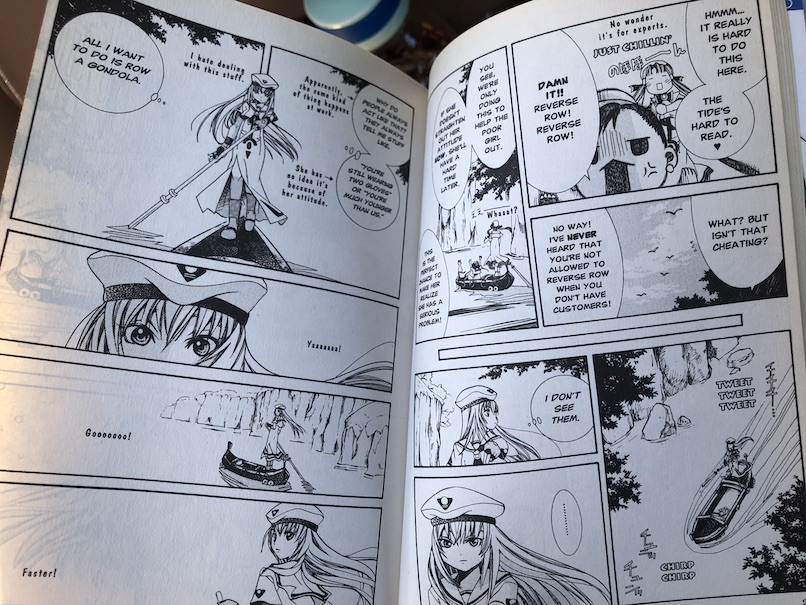
Aika has Akari row their gondola in the race, partly so she can use her secret ability to row a gondola backwards really fast, but Akari has her own ideas of how the race will end. Akari is still thinking of the beauty of spring, and even though she makes sure that her gondola will come in second by stopping to pick flowers (the fact that they had time to pick an entire boatload of flowers indicates just how much of a lead they had), she uses them to remind the other girls

Alice actually appeared in one of the prequel books to the Aria series, Aqua Volume 2, as the friend who went with Akari to visit Aika when Aika had a cold. It was the only Aqua story she was in, and this story in the third volume of the Aria series is the true introduction to her character.

Under the Cherry Blossoms in Full Bloom

Alicia and Akari decide to go on a picnic to enjoy the beauty of nature in spring. Alicia has a special place in mind for a picnic, but the two of them get lost on the way. Although Alicia remembers that getting to her special spot involves following some old train tracks, when they split off in different directions, she can’t remember which way to go.
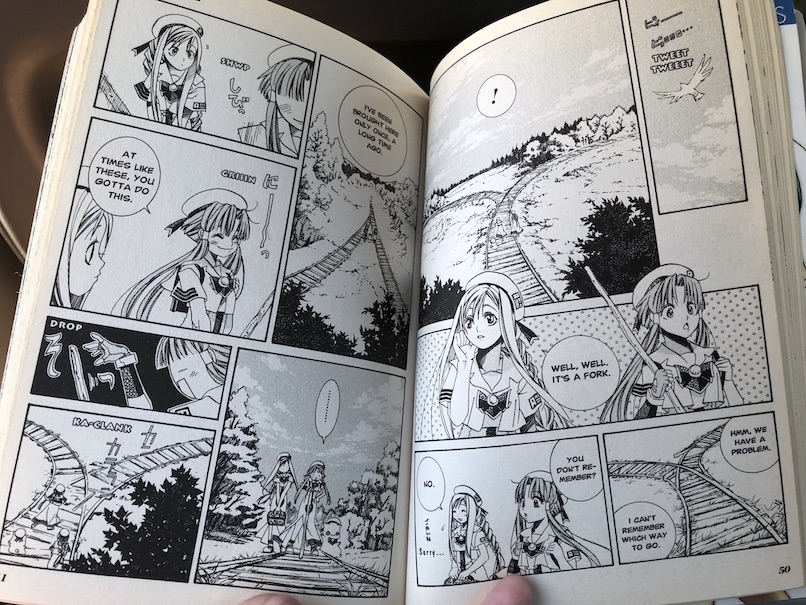
Akari picks a random direction. It turns out that the direction she picks doesn’t take them to Alicia’s special place, but they find something else interesting: an abandoned train car underneath a cherry tree in full bloom.

The girls explore the train car and find that part of the roof is missing. They lie in the train car and enjoy the cherry blossoms raining down on them. Akari apologizes to Alicia for not finding her special place, but Alicia says that’s fine because this place is nice, too. She says that sometimes, you have to get a little lost to find something new.

Town Treasure

Akari, Aika, and Alice find a message in an old gondola that they borrow from the gondola repairman while Aria Company’s gondolas are being service. The message is in a small box in a hidden compartment of the gondola, and it turns out to be the first clue in a treasure hunt with a special surprise at the end.

Curious to find the treasure, the girls follow the clues through Neo Venezia, and their search leads them to take a second look at places they pass by all the time with little notice and takes them to lesser-known parts of the city that even Aika and Alice, who were born there, haven’t seen.
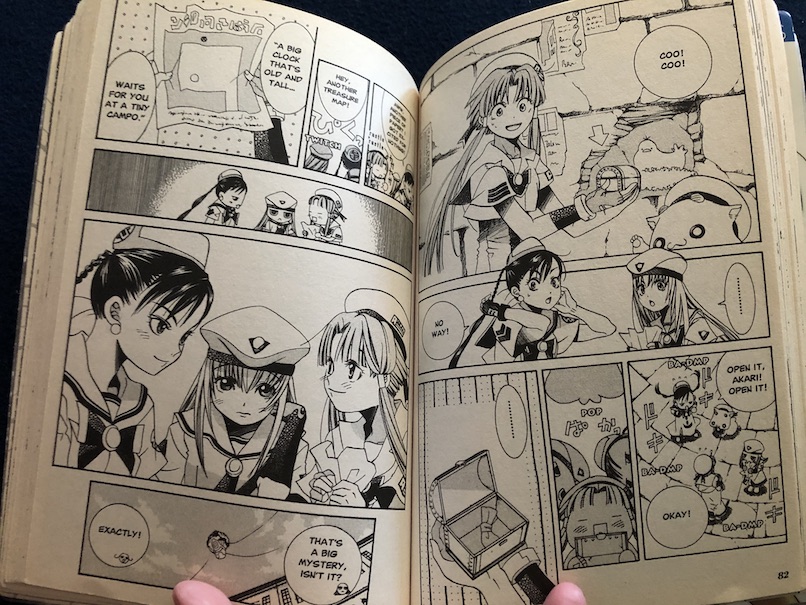
The treasure hunt finally ends on an often over-looked stairway that actually provides an excellent view of Neo Venezia, and the treasure they find there is the one that made Akari enjoy the treasure hunt from the very beginning.
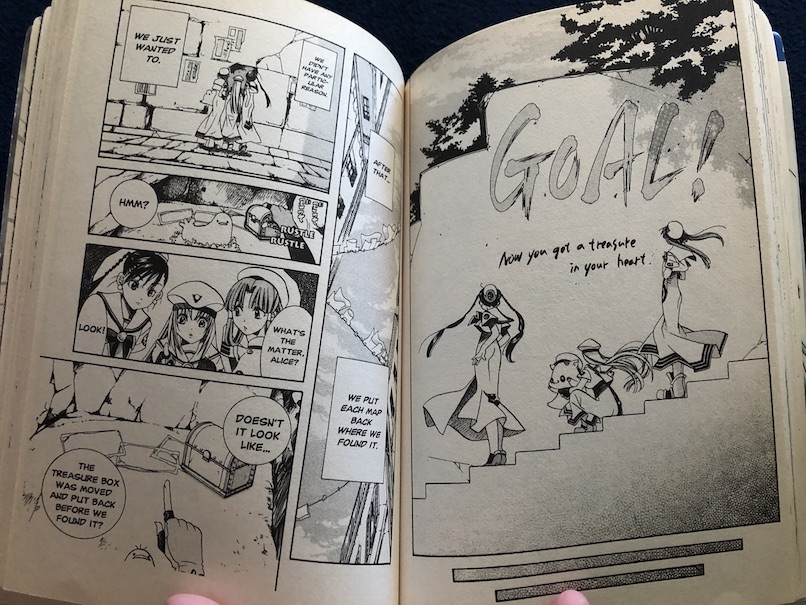
The girls decide to put all the clues back where they found them, and to their surprise, they notice that there are marks that indicate that many other people have done the same.

Three Water Fairies

Akari and Aika are training under two of the Three Water Fairies, the best-known Undines on Aqua. However, Aika’s mentor, Akira, is much more strict than Alicia. One day, Aika gets fed up with Akira’s strictness and decides to run away and train under Alicia.

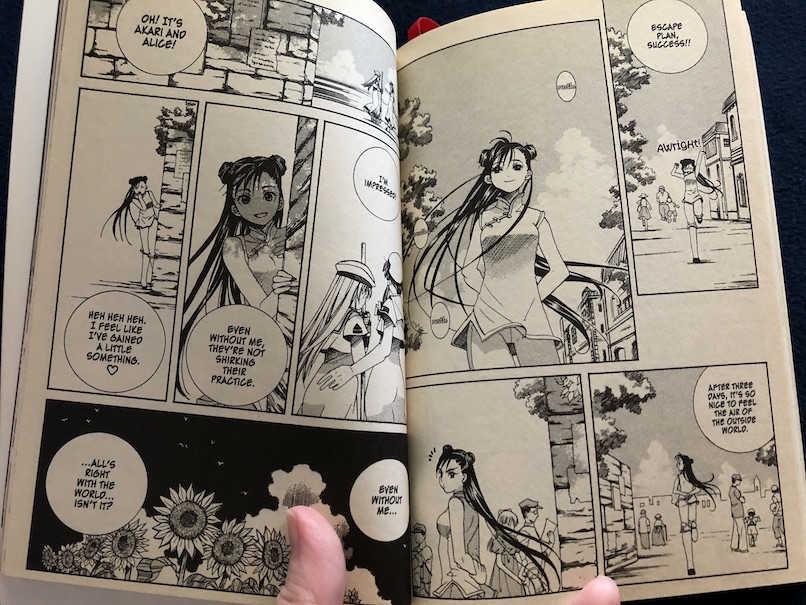
When Akira shows up to reclaim her wayward trainee, Akari learns more about Alicia, Akira, and especially about Aika. Akira was seen briefly in Aqua Volume 2, when Aika snuck out of her room to go buy some pudding, and she was the person Aika was trying to avoid because she was the one making her rest from her cold. However, Akira wasn’t actually introduced until this book, like Alice. This story reveals that Alicia and Akira were friends as trainees, like Akari and Aika, and have had a bit of a rivalry, being considered among the three best Undines, but they haven’t seen each other much in recent years.

Aika had reveals that the reason why she admires Alicia so much is that Alicia was nice to her when she was a child. One day, when she was upset about something, Alicia found her and gave her a ride in her gondola and cheered her up by trying different hairstyles with her hair. This experience is what made Aika want so badly to become an Undine herself. However, Aika could not train under Alicia at Aria Company because her parents actually own Himeya Company, something that Aika has never told Akari before. Aika’s family expects her to work her way up through the ranks as an Undine and eventually take over Himeya Company.

To settle the matter of Aika’s future training, Akira proposes a contest, a race between Aika and Akari, to determine whether Aika will become Alicia’s student or return to Himeya Company with Akira. As Alicia guesses, the “race” between their trainees gives Aika an opportunity to return to Himeya without sacrificing her dignity. It also gives both Akira and Aika an opportunity to consider how they really feel about each other and how much they appreciate each other.

While Akira and Alicia talk about Aika and how she’s both similar to and different from her mentor, Akari and Aika aren’t really having a race. Instead, they talk about how Aika feels about Akira.
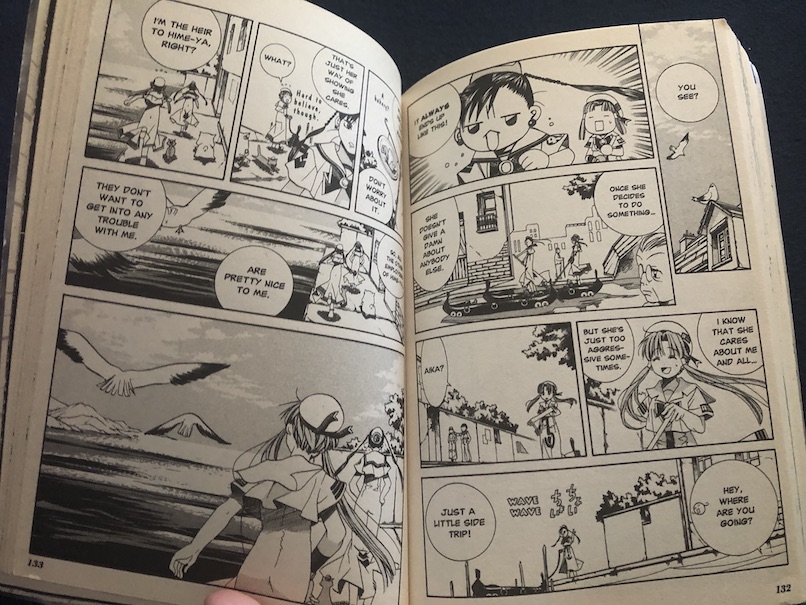
Aika says that her position as the future heir of Himeya Company doesn’t matter much to her because she just wants to be an Undine, like Alicia, but she admits that people at Himeya treat her differently from the other trainees because they know who she is. They are extra nice to her and try to avoid getting on her bad side because they want to be friends with the boss’s daughter, who will be their future boss someday. Aika admits that, strict as Akira is, she’s also the one who’s the most honest with her, correcting her when she needs it and not worrying about making her angry. Aika realizes that she needs that honesty in her life and that Akira’s training is helping her. At Aika’s insistance, the girls end their “race” and go buy some walnut pastries for Akira, which Aika offers to her as an apology before returning to Himeya with her. Akari realizes the the bond between Aika and Akira is stronger than either of them wants to admit, and she hopes that, someday, she’ll have a bond that strong with Alicia.

This story is important for explaining more of the backstory of the characters and how they relate to each other. There is a running theme in these stories of having characters whose names begin with the letter ‘A’. In most cases, I don’t mind because the names are usually different enough that it doesn’t matter, but Akira and Akari are rather close.

Festa del Boccolo

Festa del Boccolo is the time when men give red roses to the women they love. Akatsuki has had a crush on Alicia for a long time, and he enlists Akari’s help to give her a boatful of roses to impress her. He needs her help because the town is flooded during high tide again, as it is every year during late spring.
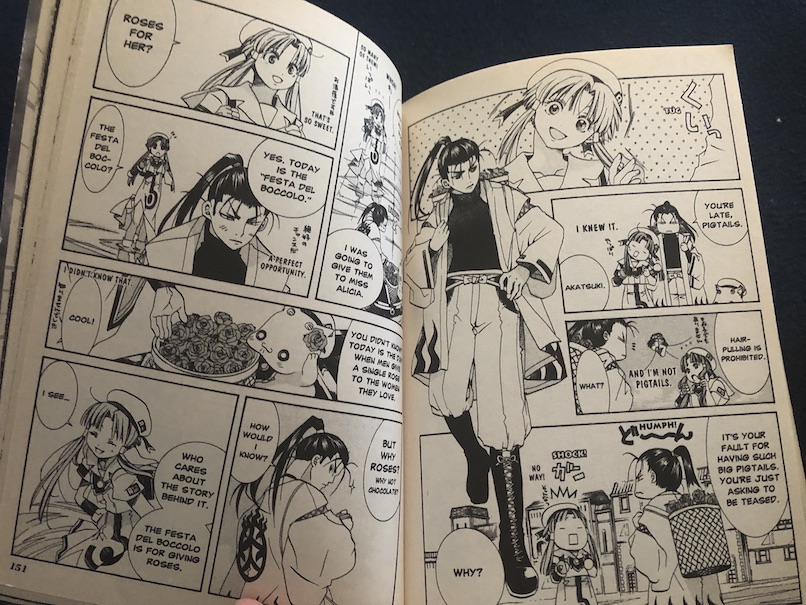
Unfortunately, his elaborate gesture doesn’t go as planned because Alicia has already received many other roses from other people, and she assumes that Akatsuki has bought all of his roses for Akari.

Akatsuki accidentally spills the roses in the water, while trying to get Alicia’s attention. He thinks that he’s completely screwed everything up, but Akari points out that his gesture wasn’t futile because, like the roses floating on the water, his love for Alicia spreads out around him and touches everyone, and one day, Alicia is bound to notice. Akatsuki gives Akari a single rose to thank her for her help, and the two of them enjoy a walk together through the flooded city.

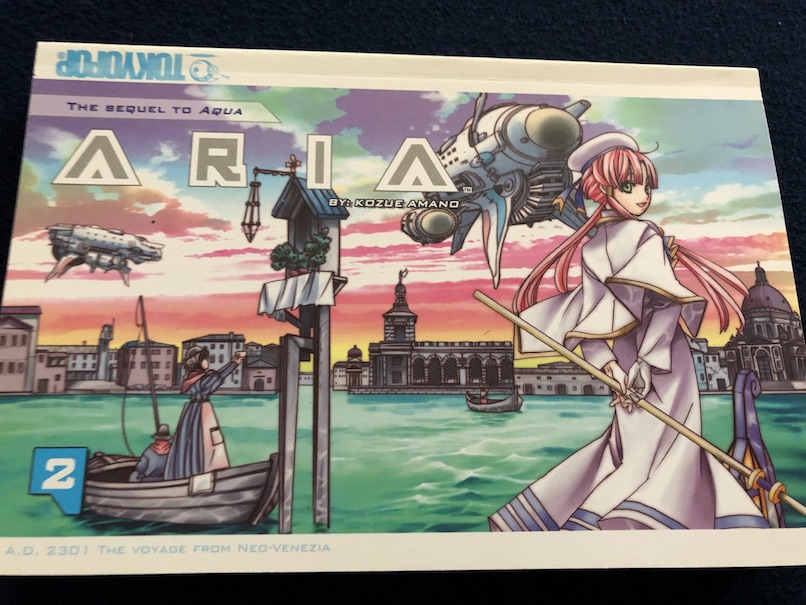
Aria Volume 2

Aria Volume 2 by Kozue Amano, 2003, English Translation 2008.

The is the second volume of the second part of a fascinating manga series that combines sci-fi, fantasy, and slice of life. The series takes place about 300 years in the future, when Mars has been terraformed and renamed Aqua (because of all the water on its surface). The human colonies on Aqua are designed to resemble old-fashioned cities on Earth (called Manhome here). The people of Aqua prefer a much slower pace of life than people on Manhome, and aspects of life on Aqua more closely resemble Earth’s past.

The series is divided into two parts. The first two books are the Aqua volumes and introduce Akari Mizunashi, the main character, a young girl who came to Aqua to learn to become a gondolier in the city of Neo Venezia (which resembles Venice). Female gondoliers, called Undines, give tours of the city, giving Akari plenty of time to admire the beauty of her new home and meet interesting people. The two Aqua books are the prequel to the main series, Aria. Aqua covers Akari’s arrival on the planet, her introduction to life on Aqua, and the beginning of her training. The main Aria series show Akari’s continuing training, her progression to becoming a full Undine, her evolving relationships with her friends, and as always, her delight in learning more about her new home and admiring its beauty.

In the second volume of the Aria series, winter comes to Neo Venezia, and Akari experiences the delights of the changing season and the celebration of a New Year as well as continuing to learn more about her new home.

The series has received some criticism for being slow and lacking danger and adventure, but that is not really the point of the series. The main purpose is to show people how to appreciate the small pleasures of life. The sci-fi and fantasy elements (the spaceships, advanced environmental controls, intelligent Martian cats, and even the occasional appearances of the legendary Cait Sith) are mainly background to the stories about the magic of friendship and simple pleasures. Each volume contains a few short stories about Akari and her friends and the little adventures they have on a daily basis and the life lessons they learn. It’s a great series for relaxing when you’re stressed out.

The stories included in this volume are:

Snow Bug

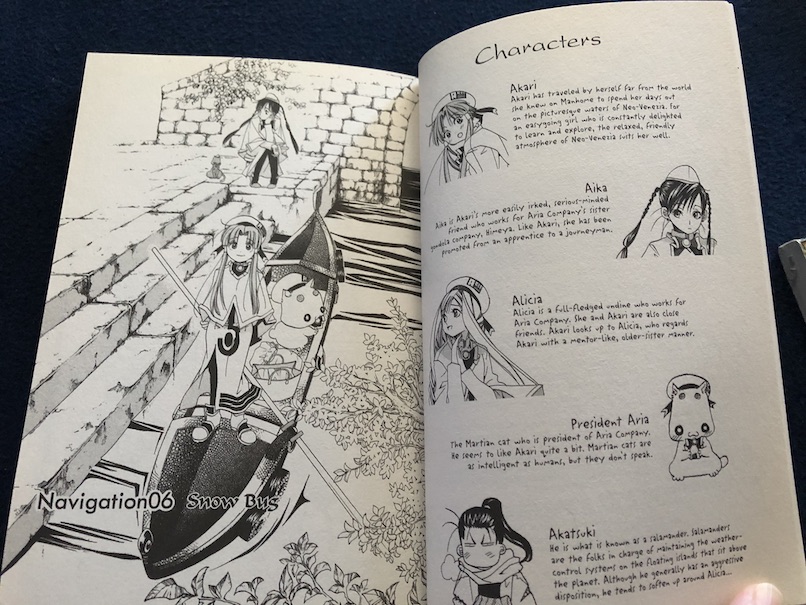
Snow Bugs (a kind of fluffy aphid) appear on Aqua at the onset of winter. They are larger than Earth aphids, and they look like cute little puff balls with eyes.

Akari makes friends with one of them when she and Alicia go out to gather some firewood, and she brings her Snow Bug friend home with her for awhile.

However, the Snow Bugs appear at this time of year because they are migrating to their winter home, and as snow comes to Neo Venezia, Akari has to accept that her little friend must move on with the other Snow Bugs as it gets colder. Fortunately, Snow Bugs have long life spans, so Akari can count on seeing her little friend again next winter.

Utopia

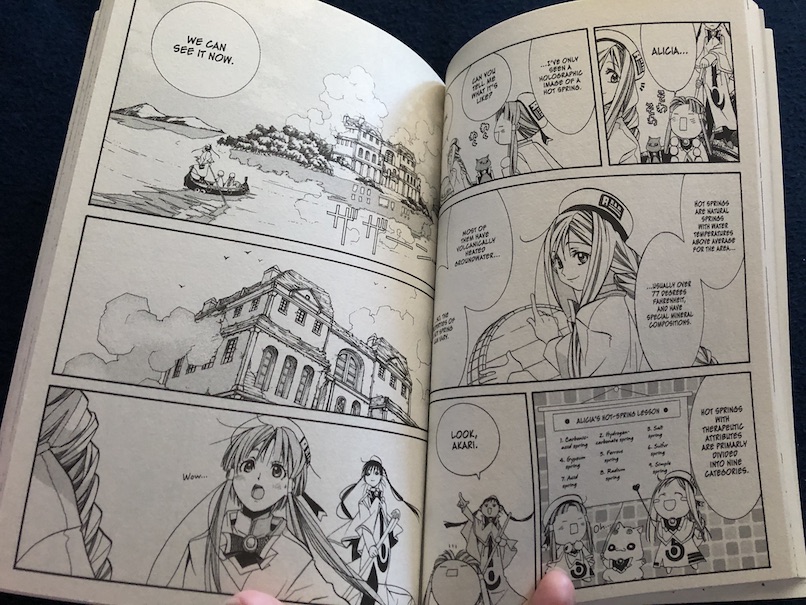
Akari has trouble adjusting to the winter in Neo Venezia because it’s much colder than the winters she is accustomed to on Earth. Aika suggests visiting a hot spring, which Akari has never done before because people on Earth are more technological and not so much into the beauties of nature. Alicia takes Akari and Aika to visit a very special hot spring where the baths are built into a magnificent old mansion.

The mansion has been there for years, and parts of it are now crumbling with disuse, but the hot water from the spring beneath it is now allowed to flow through the lower floors of the old mansion, giving it a mysterious atmosphere, yet it’s still a very relaxing hot bath.

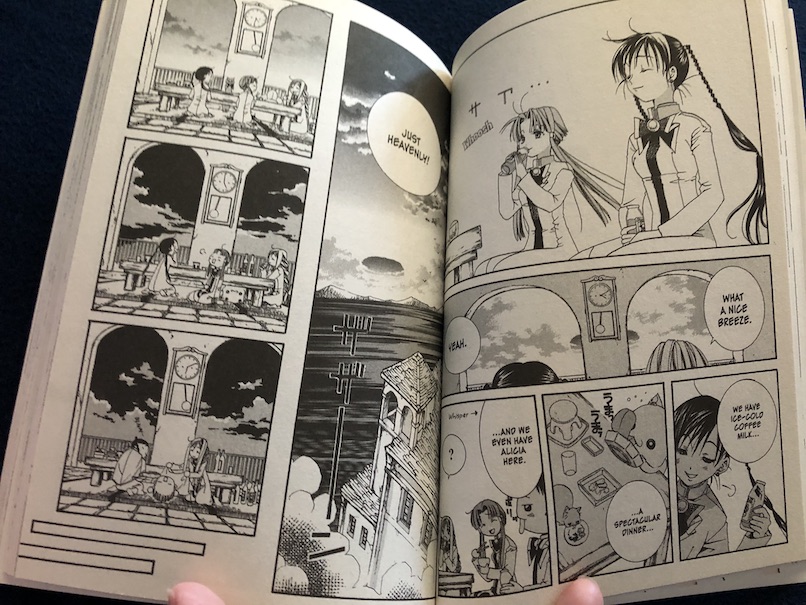
The girls indulge themselves in the baths and have dinner on one of the upper floors with a grand view of the ocean. (Alicia is older than the other girls and a legal adult, so she drinks alcohol. She lets the teenage trainees try a small amount to see what it’s like, but mostly, the younger girls have iced coffee milk.)

After the younger girls have a nap, they go back in the baths, and Alicia shows them a special part of the hot springs. Akari feels a little guilty for taking the day off and indulging themselves, but Alicia says that a break now and then is good.

This is one of my favorite stories in the Aria books because I just like the idea of a mansion being turned into a giant hot spring bath, with water flowing through it. The crumbling bits look a little dangerous to me, but it’s fun to imagine what the rest of the house might be like.

A Day in the Life of the President

President Aria may be an intelligent Martian cat, but he is still a cute kitty. He does cute kitty things, like climbing into bags and boxes, worrying about Akari’s hair dryer, and fighting with a hair brush. It even says that he doesn’t like baths, although he didn’t mind going to the hot spring in the previous story.

Martian cats are supposed to be as intelligent as humans, and it’s established in the series that President Aria and other cats have their own community with Cait Sith, the king of the cats, sneaking off sometimes to meet with each other, but President Aria also does things that people would expect from ordinary pet cats, and it’s not clear why. Then again, it might not matter. The Aria stories are mostly atmospheric and about emotions, so not everything has to be completely explained.

Voices of the Stars

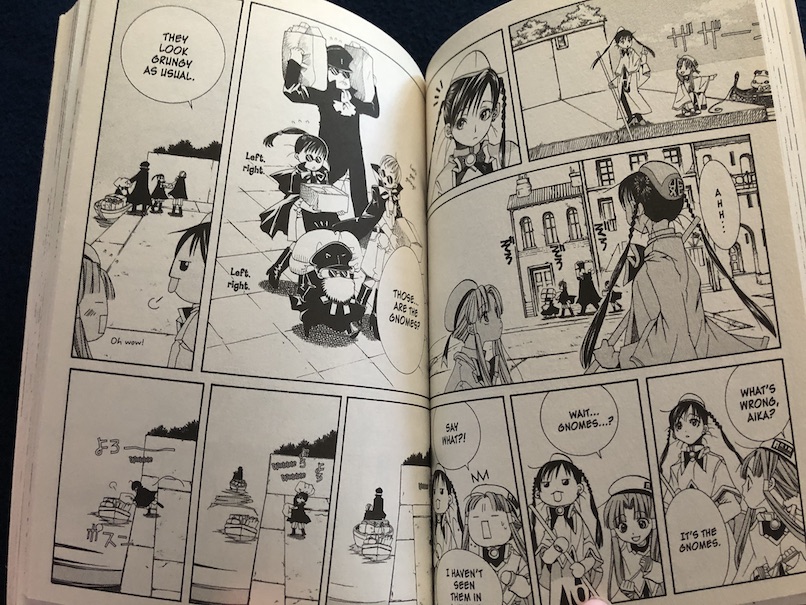
Akari learns about the Gnomes, a group of people who control the gravity on Aqua. Alicia tells her about the gnomes one day when she explains why the gravity on Aqua seems to be the same as on Earth even though its natural gravity would be much less strong. The Gnomes live in their own community underground and only come up to the surface from time to time to go shopping.

One day, Akari and Aika see a group of Gnomes shopping. They help one of them, who is having trouble loading his supplies into his boat. Akari offers to take him home in her gondola, and he accepts, taking her and Aika to see where the Gnomes live underground.

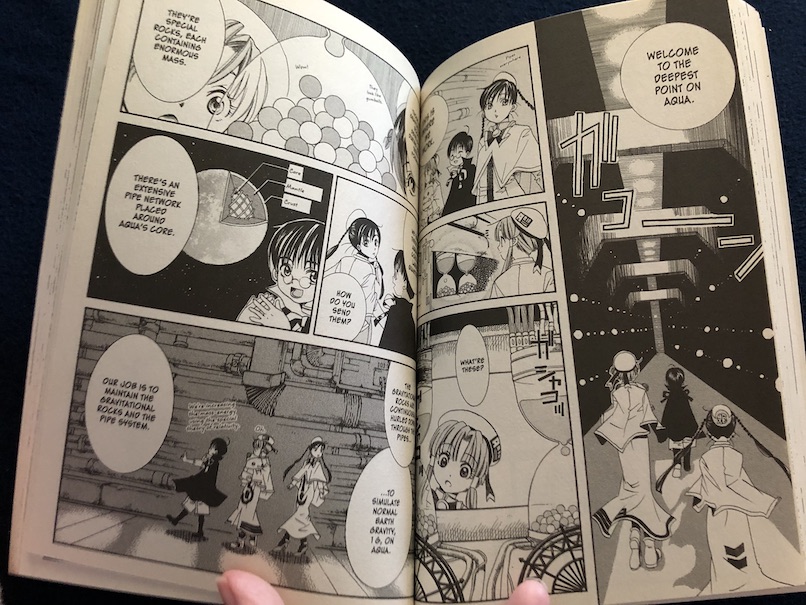
The Gnome, Al, is a trainee Gnome, just a few years older than Akari and Aika, although he is short and looks younger and, oddly, speaks like an older, old-fashioned man. He explains to the girls how the Gnomes control the gravity on Aqua by conducting special high-mass gravitational rocks through a network of pipes surrounding Aqua’s core. As always, the science and technology on Aqua are borderline magical.

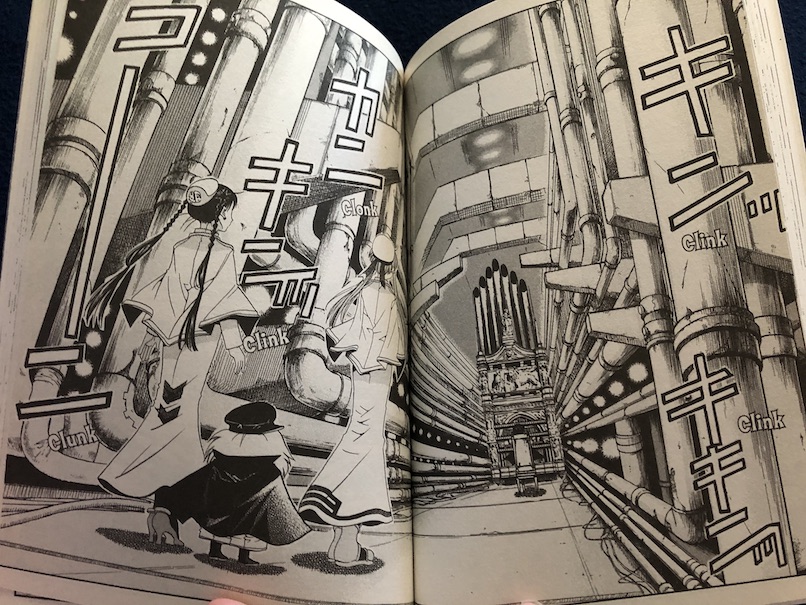
Al shows them where he works, and the machinery that controls the sending of rocks through the pipes is like a large pipe organ, making beautiful musical sounds as it works. Al becomes a recurring character in the Aria stories.

Auguri Di Buon Anno

Akari celebrates New Year’s Eve with her friends. It’s interesting how they compare Japanese New Year’s traditions with ones from Venice, from the types of food eaten during the holiday to the way that Japanese people traditionally consider New Year’s Eve a family holiday, while Akari’s friends consider it a holiday to spend with friends in public. Alicia explains to Akari that one of the traditions of Neo Venezia is similar to a traditional Italian custom of throwing out old things on New Year’s Eve as a way of throwing off bad memories from the previous year.

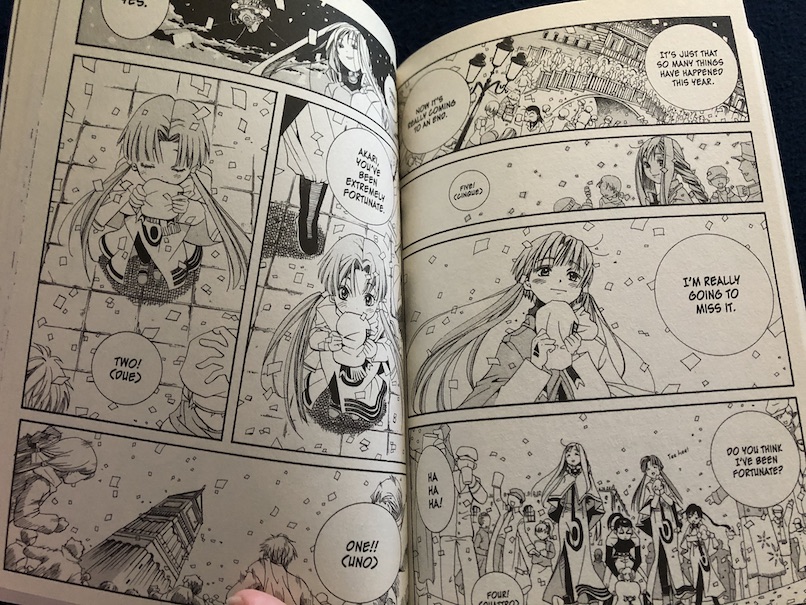
Akari and Alicia join their other friends in the public square on New Year’s Eve, and Akari reflects on how much her life has changed during the last year, since she came to Aqua. During that time, she’s had many new experiences and made many new friends, and she’s grateful for everything that’s happened and all of the good memories she’s had.

Akari and her friends stay out all night and see the sun rise on the first day of the new year.

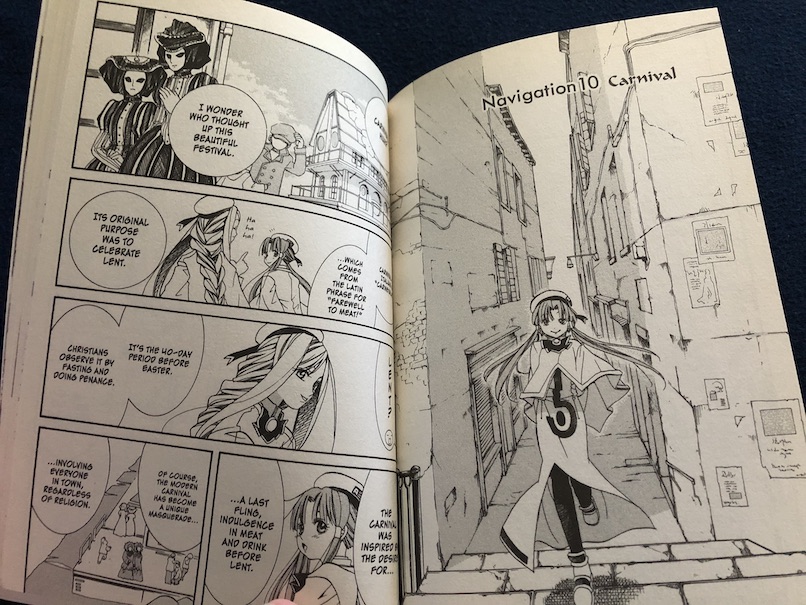
Carnival

Akari is introduced to the traditions and wonders of a Venice Carnival! Alicia explains the origins of the tradition to her.

However, Akari becomes intrigued by mysterious figure dressed as Casanova. Rumor has it that the same person has played the role of Casanova for 100 years, but no one knows who it is.

Aika and Akari try to follow a member of Casanova’s entourage to see if they can find out who Casanova really is. The two girls get separated, but Akari meets up with Casanova, and he invites her to join his entourage to parade through the crowd.

In the end, Akari does get a look at Casanova without his mask, and it’s a magical end to Carnival!

Aria Volume 1

Aria Volume 1 by Kozue Amano, 2002, English Translation 2004.

The is the first volume of the second part of a fascinating manga series that combines sci-fi, fantasy, and slice of life. The series takes place about 300 years in the future, when Mars has been terraformed and renamed Aqua (because of all the water on its surface). The human colonies on Aqua are designed to resemble old-fashioned cities on Earth (called Manhome here). The people of Aqua prefer a much slower pace of life than people on Manhome, and aspects of life on Aqua more closely resemble Earth’s past.

The series is divided into two parts. The first two books are the Aqua volumes and introduce Akari Mizunashi, the main character, a young girl who came to Aqua to learn to become a gondolier in the city of Neo Venezia (which resembles Venice). Female gondoliers, called Undines, give tours of the city, giving Akari plenty of time to admire the beauty of her new home and meet interesting people. The two Aqua books are the prequel to the main series, Aria. Aqua covers Akari’s arrival on the planet, her introduction to life on Aqua, and the beginning of her training. The main Aria series show Akari’s continuing training, her progression to becoming a full Undine, her evolving relationships with her friends, and as always, her delight in learning more about her new home and admiring its beauty.

The series has received some criticism for being slow and lacking danger and adventure, but that is not really the point of the series. The main purpose is to show people how to appreciate the small pleasures of life. The sci-fi and fantasy elements (the spaceships, advanced environmental controls, intelligent Martian cats, and even the occasional appearances of the legendary Cait Sith) are mainly background to the stories about the magic of friendship and simple pleasures. Each volume contains a few short stories about Akari and her friends and the little adventures they have on a daily basis and the life lessons they learn. It’s a great series for relaxing when you’re stressed out.

The stories included in this volume are:

Neo-Venezia

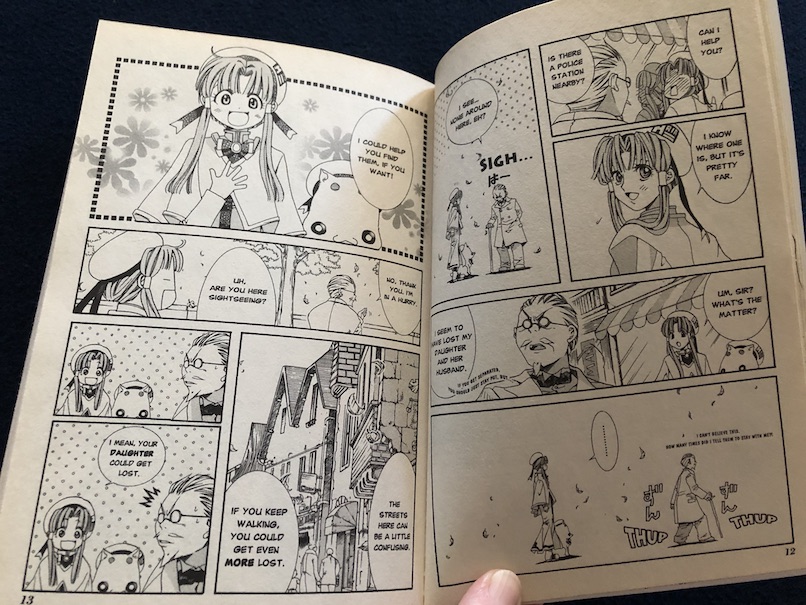
As autumn comes to Neo Venezia, Akari encounters a grumpy old man, a visitor from Earth, who has gotten separated from his daughter and lost in the city. He is frustrated with the confusing and inconvenient nature of Neo Venezia.

Akari says that she can help him find his daughter and gives him a tour of the city, showing him the beauty of the city and changes his mood with the help of some baked potatoes and green tea. A slower pace of life and appreciation for the little pleasures has benefits.

Drydocking

It’s time for the gondolas to be cleaned, so they are moved onto dry land. Akari and her friend, Aika are in charge of the cleaning, but it is Akari who makes it fun.

The Bridge of Sighs

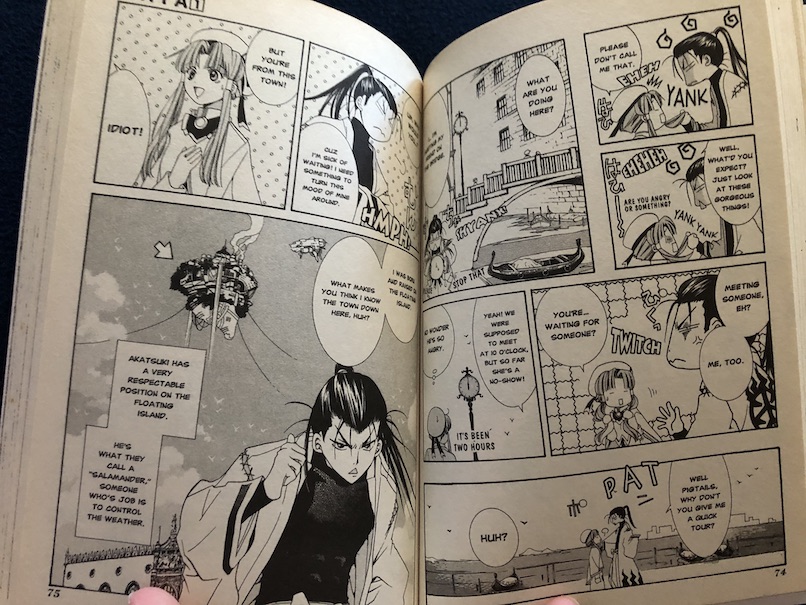
Like the original Venice, Neo-Venezia also has a “Bridge of Sighs.” Akari goes there one day to meet Aika and finds her friend, Akatsuki, waiting for someone. Akatsuki is impatient while he is waiting, so he convinces Akari to give him a short tour to pass the time. Akari tells him about the original Bridge of Sighs and how she thinks the name is still appropriate but for a different reason.

The original Bridge of Sighs, as Akari explains, was between an old courthouse and a prison, and the prisoners were said to sigh as they crossed the bridge because they were being led away to be incarcerated. However, Akari sighs because she likes living in the beautiful city of Neo-Venezia and feels like she’s lucky to be there. Her sigh is a sigh of contentment.

When the person Akatsuki is waiting for shows up, it turns out to be his older brother, who also appears in later stories.

Sun Shower

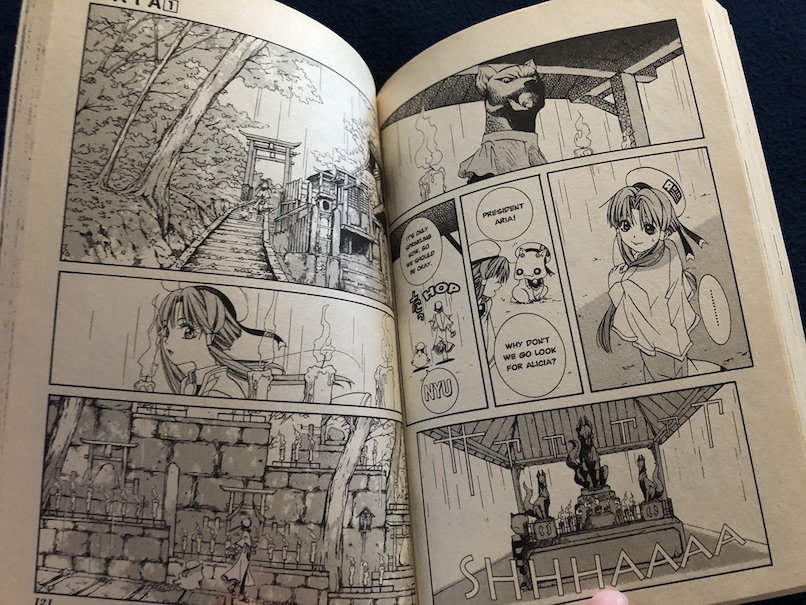
Although Akari lives in Neo-Venezia, which is designed to look like Venice, there are other parts of Aqua designed to look like different parts of Earth. Alicia takes Akari to an area much like Japan to see the changing autumn leaves and get some inarizushi.

They see a shrine on the island, and the woman at the sushi shop tells them a Japanese legend about the fox’s wedding, giving them a warning that the Inari fox might spirit them away to another world.

While admiring the red autumn leaves, Akari finds herself separated from Alicia, and she witnesses a strange wedding procession. When she seems to be invited to join it, she thinks quickly and gives the procession her inarizushi instead.

The story explains that a Japanese term for a sun shower (when it rains while the sun is still shining) is “the fox’s wedding.” Sun showers happen quite often when it rains where I live in Arizona, and I now think of this when I see one. I also know where to get some inarizushi. The Aria stories are good for making me want different types of food, whether it’s inarizushi or baked potatoes and green tea or pudding (from a previous book).

Vogare Longa

This story is based on a real gondola race that takes place in Venice.

Akari and Aika are told about the Vogare Longa gondola race, which all of the gondoliers, including the trainees, will participate in. Aika is determined to make a good showing in the race because there’s a rumor that it is used to judge trainees, but Akari gets caught up in the beauty of the day.

In the end, Akari admits to herself that she never forgot what Aika said about the race being used to judge trainees, but she just didn’t want to hurry because she was enjoying herself, and that’s the way she feels about her training in general. Akari wants to become a full Undine, but she wants to do it at her own pace and enjoy herself along the way.

It turns out to be just as well because the rumor about the race being used to judge trainees was only a rumor.

Aqua Volume 2

Aqua Volume 2 by Kozue Amano, 2003, English Translation 2008.

The is the second volume a fascinating manga series that combines sci-fi, fantasy, and slice of life. The series takes place about 300 years in the future, when Mars has been terraformed and renamed Aqua (because of all the water on its surface). The human colonies on Aqua are designed to resemble old-fashioned cities on Earth (called Manhome here). The people of Aqua prefer a much slower pace of life than people on Manhome, and aspects of life on Aqua more closely resemble Earth’s past.

In the previous volume, a young girl, Akari Mizunashi, came to Aqua to learn to become a gondolier in the city of Neo Venezia (which resembles Venice). Female gondoliers, called Undines, give tours of the city, giving Akari plenty of time to admire the beauty of her new home and meet interesting people.

The two Aqua books are the prequel to the main series, Aria. Aqua covers Akari’s arrival on the planet, her introduction to life on Aqua, and the beginning of her training. The series has received some criticism for being slow and lacking danger and adventure, but that is not really the point of the series. The main purpose is to show people how to appreciate the small pleasures of life. The sci-fi and fantasy elements (the spaceships, advanced environmental controls, intelligent Martian cats, and even the occasional appearances of the legendary Cait Sith) are mainly background to the stories about the magic of friendship and simple pleasures. Each volume contains a few short stories about Akari and her friends and the little adventures they have on a daily basis and the life lessons they learn. It’s a great series for relaxing when you’re stressed out.

The stories included in this volume are:

My First Customer

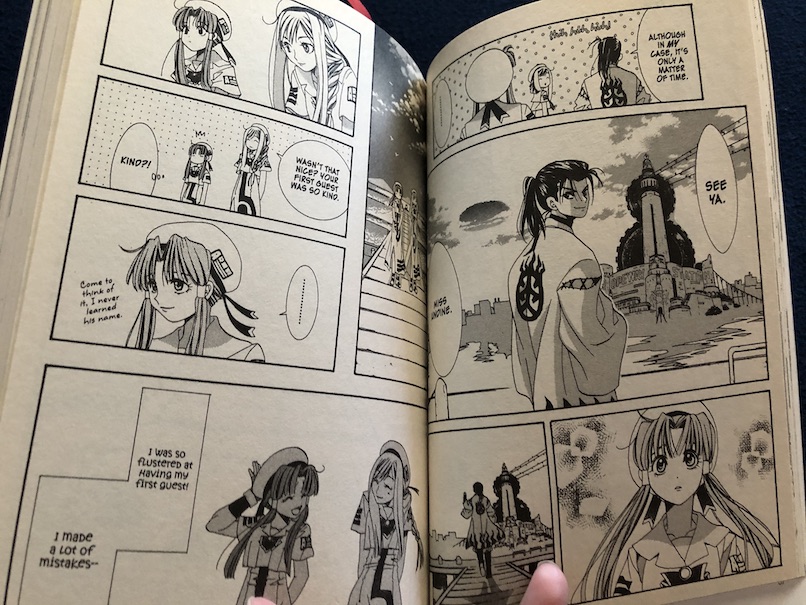
Akari gives her first customer a ride in her gondola. Although she makes mistakes, it is still a memorable experience, and she makes a new friend. Her ability to row a boat very fast backward even comes in handy!

It’s good to read the books and stories in this series in order because characters reappear. Akari’s first customer is Akatsuki, who is a trainee “Salamander” who lives on the floating island of Ukijima above Neo Venezia, which is reached by cable cars. Because Akatsuki spends most of his time on Ukijima, he tends to get lost when he comes into town. He becomes an important character who makes regular appearances through the books. There’s a story later in this book that explains more about his job.

It’s Hard Being President

President Aria feels useless because he can’t help with the spring cleaning. He decides that he isn’t a good president to Aria Company and tries to run away from home but learns that there is nowhere else where he is happy and that his friends still love him.


Night-light Bells

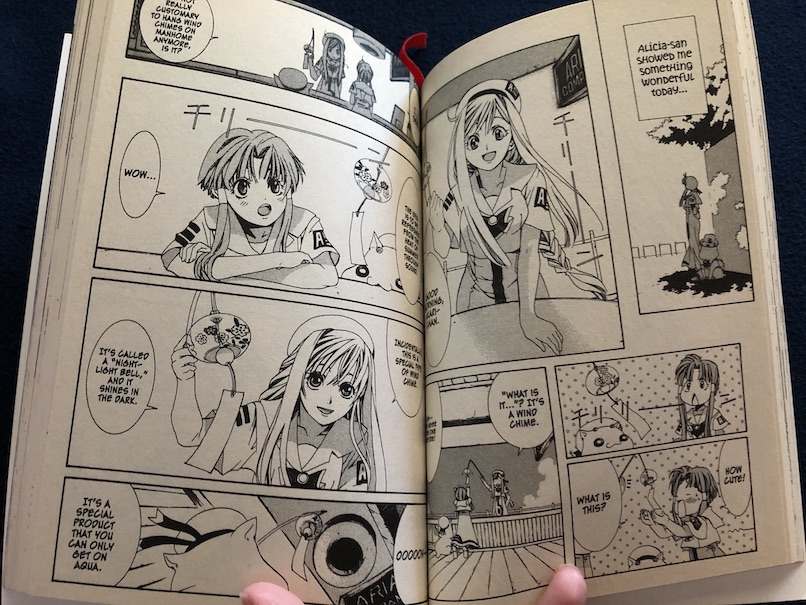
In the summer, people in Neo Venezia buy special night-light bells, chimes that glow in the dark.

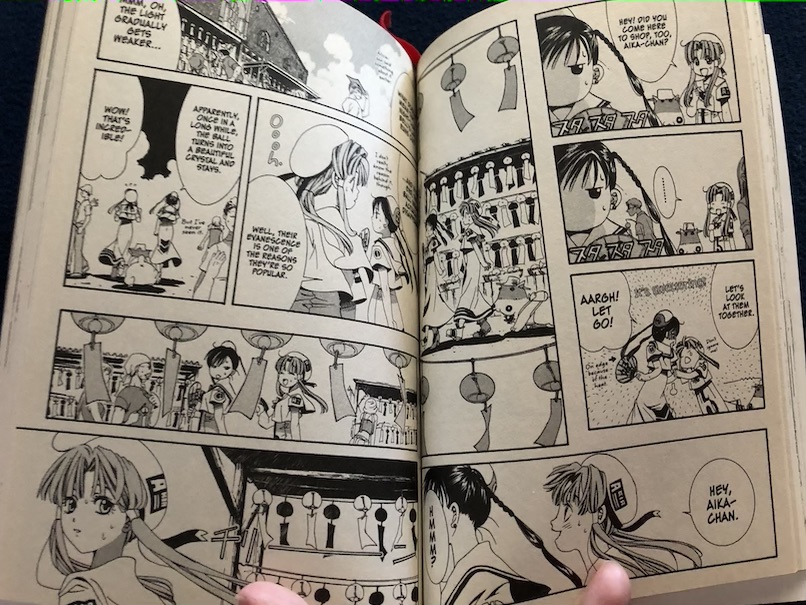
These bells do not last forever because the glowing center eventually falls out, but sometimes they leave something special behind besides happy summer memories, a tiny crystal.

Akari goes to a night light bell festival and gets a night light bell of her own. The night light bells are a cheery part of summer, and when it’s time for them to expire, the people of Neo Venezia have a special ritual to return the glowing centers to the water when they fall out. However, Akari is lucky and gets one of the bells that has a tiny crystal when the center falls out.

I like this story because I think that the idea of having glow-in-the-dark wind chimes is really charming.

Enter the Hero!

President Aria dreams of being a super hero, like the hero of his favorite television show.

His attempts to be an ally of justice aren’t very successful until he discovers that even doing something small can make a big difference, returning a lost toy to a grateful child.


Fireworks

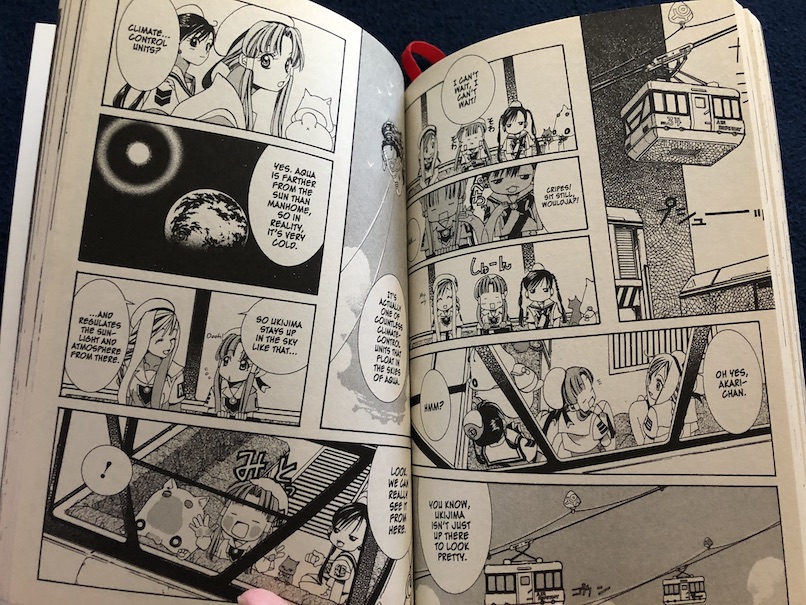
Akari and her friends visit the floating island of Ukijima where her friend, Akatsuki, is learning to be a Salamander. Salamanders help control Aqua’s climate. Because Ukijima is anchored above Neo Venezia, they have to use a cable car to get there, and Akari thinks that the view is amazing, like she’s flying when she’s there.

Akari and her friends have dinner wtih Akatsuki, and he shows them around and explains more about how Ukijima works and what his job as a Salamander involves. Neo Venezia experiences different seasons and different types of weather, but the Salamanders help to regulate it and keep it safe for the residents by controlling the amount of heat released into the atmosphere. The processes behind some of the technology on Aqua sound almost magical.

There are many amazing things on Ukijima, but Akari is most entranced by her first fireworks show. Even though Akari has never seen fireworks before, she finds herself connecting with the nostalgia surrounding them, which she realizes is a feeling that surrounds everything on Aqua and in Neo Venezia because the style of living is more old-fashioned than on Earth/Manhome.


Colds and Pudding

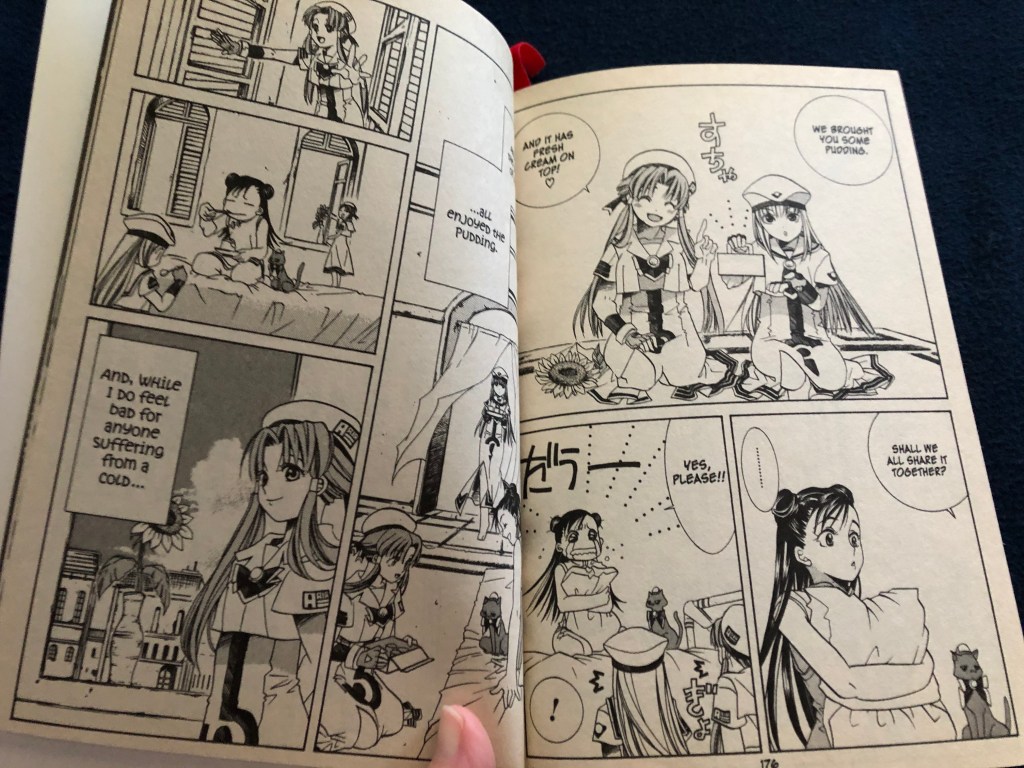
Akari and another friend, Alice (who you don’t really get to meet until the Aria series begins – she’s another trainee Undine), go to visit Aika, who is sick with a cold. They find her upset and learn how a simple trip to get some pudding led to a disturbing epiphany for her.

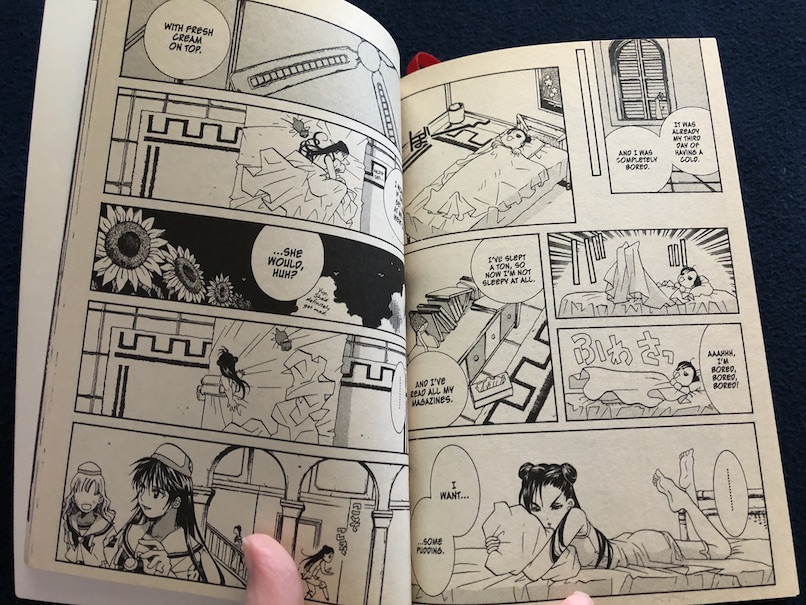
Aika was bored, hungry, and tired of staying in her room, so she decided to sneak out to get some pudding.

While she was walking through the streets, enjoying her freedom without anyone knowing she that she was gone, she caught sight of Akari and Alice practicing their rowing. At first, Aika is amused that she can spy on them without them noticing her, but then, she gets a strange feeling, realizing that, under normal circumstances, she would be practicing with them, but she can’t be with them now.

It feels eerie to her to see people going on with their day without her, as if she didn’t exist or that her absence doesn’t matter. Aika gets so spooked by the feeling that she runs home and goes back to bed, crying.

However, Aika’s friends do miss her and are thinking about her while she’s sick, and they know exactly what she needs. Trust your friends to help you feel better (and bring you pudding) when you need it!

This is the story that convinced me to learn how to make pudding from scratch one day when I was sick at home. You don’t have to go out and get creepy feelings when you know how to make pudding yourself! Pudding is an easy dessert to make; it just takes awhile to thicken on the stove.

Aqua Volume 1

Aqua Volume 1 by Kozue Amano, 2003, English Edition 2007.

I debated at first about whether or not I wanted to include any Japanese manga or light novels in this blog. When I was in high school and college, I knew a lot of people who were really into anime and manga, and I know that there are teens who still are, and my overview of children’s literature in different decades wouldn’t be complete if I didn’t mention that. However, the variety is pretty extensive, some of the series run very long, and it’s impossible to just skip around in some series because the story-telling is very linear, and I didn’t want them to take over the blog. Also, I tend to like the less popular ones, so I’d be bound to get some grumbling from manga fans about why I chose these when there are so many others that are more exciting or more iconic. Notice that I didn’t say “better.” “Better” is subjective, and I like what I like. I decided to go ahead and make an exception in this case because this is one of my favorite manga series and because I think this is something that people could really use right now. The stories are very calming, and they’re good to read during stressful times.

This book is the first volume of a series. I don’t have them all because they haven’t all been published in English yet, but know how it ends, and it’s a really good series with a happy ending. If you’re not familiar with manga, they’re basically graphic novels from Japan. I can’t read Japanese, so I rely on the English translations. However, manga like this typically follow the Japanese format of reading from right to left instead of left to right, like in English, so the books open and the pages flow in the opposite direction. When you look at the panels on a page, remember to look at them in right to left order.

The Aqua and Aria series is unusual because it combines elements of science fiction and fantasy, but most of the stories themselves aren’t really either science fiction or fantasy. That’s just the setting for the stories. The stories themselves are more slice-of-life, about daily events or small adventures in the lives of the characters and sometimes lessons they learn from them. There is a lot of emphasis on slowing down and enjoying the simple pleasures in life.

The series takes place in the future, when Mars has been terraformed and renamed Aqua (because of all the water on its surface). The human colonies on Aqua are designed to resemble cities on Earth (called Manhome here). The people of Aqua prefer a much slower pace of life than people on Manhome, and aspects of life on Aqua more closely resemble Earth’s past.

A young girl, Akari Mizunashi, comes to Aqua to learn to become a gondolier in the city of Neo Venezia, which resembles Venice. Female gondoliers, called Undines, give tours of the city, giving Akari plenty of time to admire the beauty of her new home and meet interesting people.

There are two parts to this series, called Aqua and Aria. The two Aqua books are the prequel to the main series, Aria. Aqua is only two volumes long, and it covers Akari’s arrival on the planet, her introduction to life on Aqua, and the people who will be her friends. In the Aria books, Akari progresses in her training as an Undine. All of the books in both series contain several short stories.

This book, the first one in the Aqua series, focuses on Akari’s arrival on Aqua and her friendship with Aika, the first fellow Undine trainee she meets.

The stories included in this first volume are:

The Water Planet

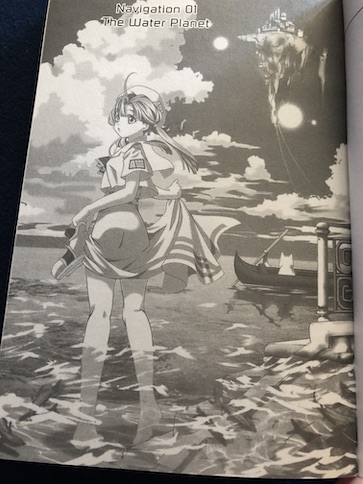
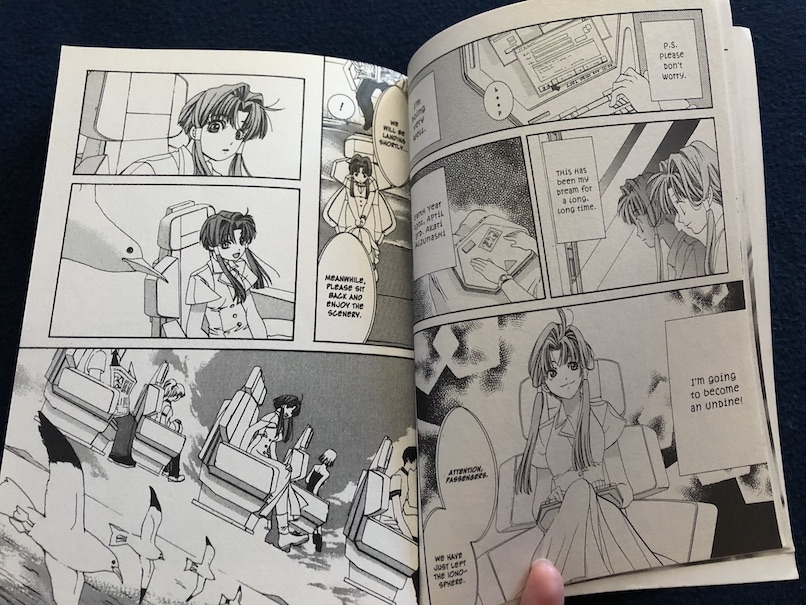
The series begins with Akari Mizunashi on the shuttle carrying her from Manhome to Aqua. She is typing a message to someone on her computer, but there is nothing to indicate who she is writing to. This is a running theme throughout the series, but the identity of Akari’s pen pal isn’t revealed until the very end of the series, and it wouldn’t make sense if I told you who it is right now. Akari explains a little about the history of Mars/Aqua, and how the melting of Mars’s polar ice caps during the terraforming of Mars 150 years earlier has turned it into a water planet, earning it the name Aqua. Currently, the year is 2301.

One of the nice things about the Aqua/Aria series is the imagery. As Akari’s shuttle arrives at Mars/Aqua, the walls of the shuttle turn transparent, so the travelers can feel like they’re flying in with the seagulls.

On Earth/Manhome, Akari lived in Tokyo, Japan. The modern cities of Manhome are very tidy and convenient, with people able to work and shop from home. Still, Akari has felt like something is missing from her life in all the convenience and tidiness. In Neo Venezia on Aqua, people rely on boats constantly to help them get around town, which is inconvenient, but Akari finds it calming and peaceful, which is why she wants to become an Undine, one of the female gondoliers who act as tour guides and help travelers to navigate Neo Venezia. Overall, life on Aqua and in Neo Venezia has a much slower pace than that on Manhome.

Akari arrives on Aqua and meets a friendly mailman and the only two employees of the gondola company she will work for: her mentor, Alicia, and the company’s president, a Martian cat named Aria. All gondola companies on Aqua have a Martian cat as their mascot/president. Alicia explains that Martian cats are as intelligent as humans, even though they can’t talk, but in many ways, President Aria still acts like a very large kitty.

The Guide on the Water

Akari wakes up on her first morning at the gondola company Aria, and she meets Aika, who is a trainee at Himeya, another gondola company. She catches sight of Aika hanging around, watching Alicia, and Aika witnesses Akari’s first time practicing in a gondola under Alicia’s watch.

Akari is embarrassed to learn that when she practiced rowing on Manhome, she was doing it backwards, standing in the front of the boat, which would block the view of her passengers. Because Akari practiced the wrong way on Manhome, she can row very fast the wrong way, but is clumsier when she tries to row the correct way.

However, Aika tells Akari that Alicia is the best of the Undines, and Akari is reassured that under Alicia’s guidance, she will do better. Aika hero-worships Alicia (for reasons that are explained further in later books), and she agrees to become Akari’s friend partly so that she can see more of Alicia. Aika and Akari become best friends through the course of the books, sharing their training and adventures.

The City Submerged

Akari wakes up one morning and is shocked to find that the lower floor of Aria company has flooded, but Alicia explains to her that this is a natural phenomenon in Neo Venezia in Spring.

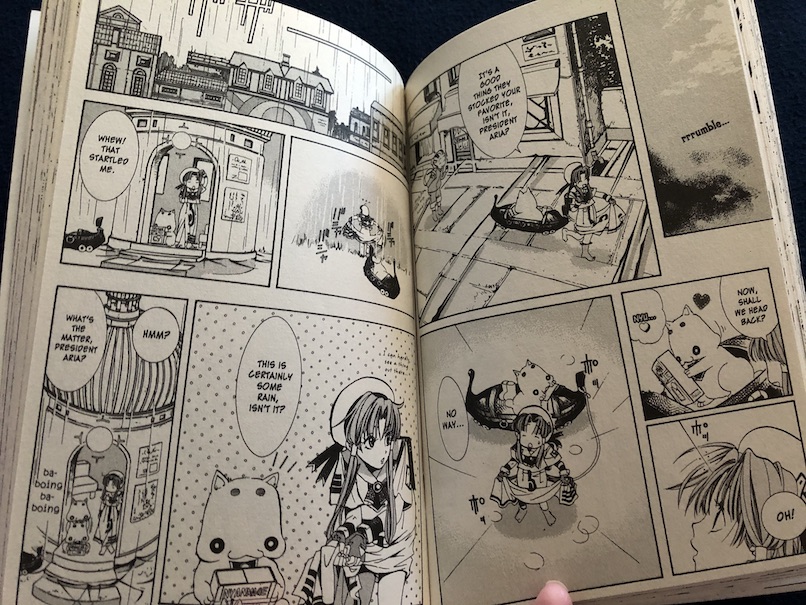
Much of the city is flooded during this high tide, causing many of the businesses in town to close temporarily and making it unsafe to go out in gondolas. However, when President Aria needs more of his favorite food, Akari decides to venture into the city on foot.

On the way home, Akari and Aria are stranded when it starts to rain and travel become more dangerous, but Aika sees them and invites them to spend the night at Himeya Company with her. Himeya Company is a much larger gondola company than Aria Company, with many more employees living there.

Aika and Akari have a sleepover in Aika’s room, and Aika asks Akari who she’s always writing to, but Akari tells her that it’s a secret. When the rain stops, Akari admires the view of the water by moonlight. (There are two moons in the sky because this is Mars.)

The Kingdom of Cats

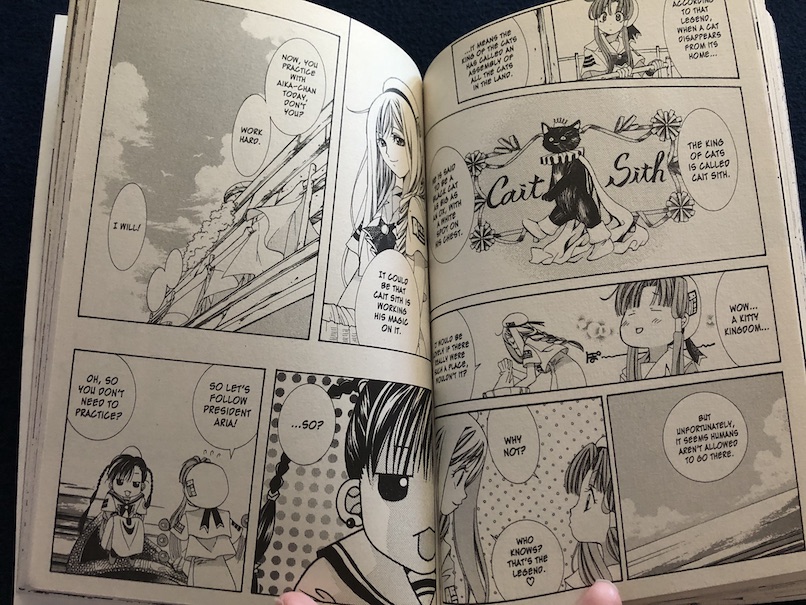
President Aria sometimes ventures off alone, and Alicia tells Akari the story of Cait Sith and the mythical kingdom of cats.

When Akari and Aika practice their rowing together, Akari convinces Aika to help her follow President Aira to see if there’s any truth to Alicia’s story perhaps get a look at the kitty kingdom ruled by the legendary king of the cats, Cait Sith.

However, the trip is stranger than they bargained for. The girls find themselves on a strange waterway through apparently abandoned buildings, going around in circles until President Aria points the way out. Akari only gets a glimpse of the cats before they leave.

The Hill of Hope

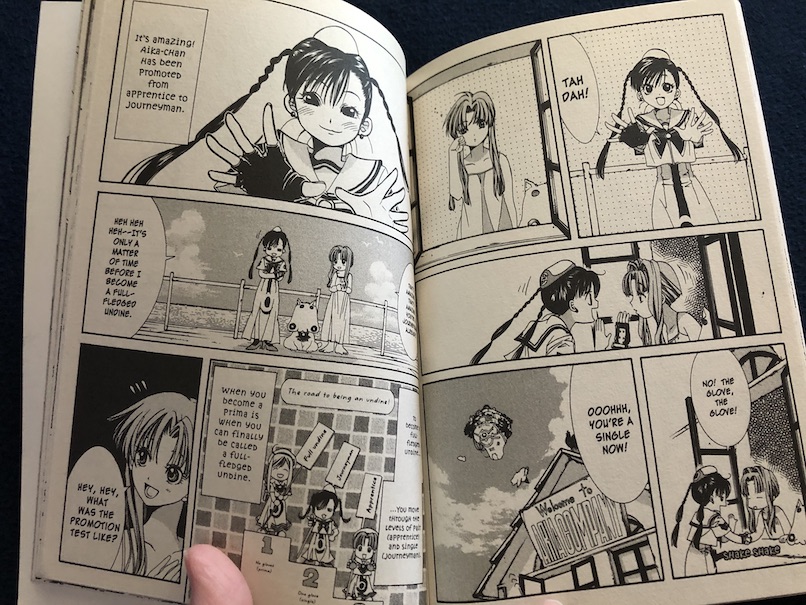
Aika shows up at Aria company one morning to brag about how she has been promoted to single (the next step up in gondola training, as shown by the gloves that the girls wear – as the trainee Undines learn the techniques to row their boats more skillfully, they get fewer callouses and need their gloves less, removing them one at a time as they are promoted to new levels).

Akari tries to ask Aika what the promotion test is like, but Aika refuses to tell her. The Undines traditionally keep the test a secret from their trainees until they pass the test. When Alicia hears about Aika’s promotion, she decides to take Akari on a special picnic, giving her the opportunity to prove her skills and introducing her to the concept of aquatic elevators, or canal locks. There is a special surprise for Akari at the end of the journey.

The Most Wonderful Doll in the World

The Most Wonderful Doll in the World by Phyllis McGinley, 1950.

Dulcy is a little girl who is rarely satisfied by anything. She has a big imagination, and is always wishing for something better than what she has. Dulcy has an impressive collection of dolls, but even though she loves all of her dolls, she can’t help but think sometimes that some of them would look better with a different hair color or with different clothes or with some other small detail changed. No matter how good something is, it’s never completely perfect.

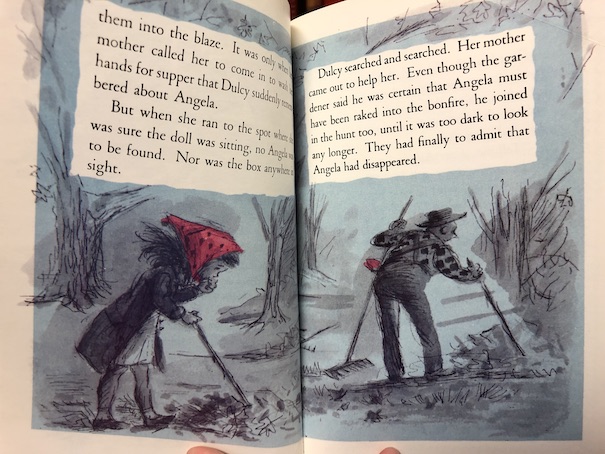
Then, one day, an elderly friend, Mrs. Primrose, gives Dulcy a doll named Angela. Dulcy likes Angela, although her immediate thought is that Angela would be even better if she had dark hair instead of blonde, finding a tiny fault as she always does. But, by accident, Dulcy loses Angela on the way home. She sets Angela’s box down when goes to help rake leaves into a bonfire, and when she goes to retrieve her, she can’t find her.

Once Angela is gone, Dulcy’s attitude changes. Dulcy is upset about the loss of Angela, realizing that Angela really was a precious and special doll. Her mother offers to get a replacement doll that looks like Angela, but Dulcy can’t imagine that any doll would be as special as Angela. As Dulcy describes the doll to her mother, she says that Angela was blonde with a blue dress and pinafore and eyes that could open and close. Those aren’t terribly unusual qualities for a doll, but Dulcy also adds that Angela had shoes with heels and could say “Mama” and “Papa” and sing Rockabye Baby. Those are more unusual, and Dulcy’s mother agrees that she probably won’t be able to find a doll that does all that.

However, readers soon begin to notice that Angela becomes increasingly wonderful each time that Dulcy describes her. When her father offers to buy her another doll, Dulcy adds that Angela could also walk and wave her hand. Dulcy tells her teacher about Angela’s little purse and gloves. She tells her friend Margery about Angela’s raincoat and umbrella.

The more Dulcy thinks about and talks about her wonderful doll, the less satisfied she is with her other dolls. None of them can compare to the amazing Angela! When her Aunt Tabitha gives her a skating doll, suddenly the missing Angela acquires the ability to skate as well. No doll that Dulcy has or ever could have could compare to the missing Angela!

Other children at school are fascinated by Dulcy’s descriptions of Angela and all of the marvelous things Angela had and Angela could do, which get more and more wonderful every time Dulcy tells the story. Then, people start getting tired of hearing about Angela. Dulcy’s friends don’t like hearing that their dolls aren’t as good as Angela, and people stop giving Dulcy dolls as presents because she always says that they’re not as good as Angela.

Then, one day, when Dulcy is playing with a new girl in the neighborhood, they find the box with the missing Angela. When Dulcy sees how the real Angela compares to the one that she dreamed about and imagined when she was lost, Dulcy comes to a greater understanding of the power of her imagination and the need to appreciate things being just the way they are.

Dulcy doesn’t completely give up imagining things and dreaming of perfection, but she does learn that part of growing up is remembering the difference between what she imagines and what is real. She realizes that when she was moping about the doll she didn’t have, she kept herself from having fun with the dolls she did have and discouraged people from giving her other nice dolls. Dulcy saves all the of the amazing qualities that she dreamed of for Angela and gives them to an imaginary doll called Veronica. Dulcy keeps Veronica as her perfect doll in her imagination, and she knows that Veronica is imaginary. As long as she can have her imaginary doll to be as amazing and perfect as she wants, she can be happy with her other dolls being just the way they are, and they make her happy, too.

The book is a Caldecott Medal winner. It is available to borrow for free online through Internet Archive.

Blueberries for Sal

Blueberries for Sal by Robert McCloskey, 1948.

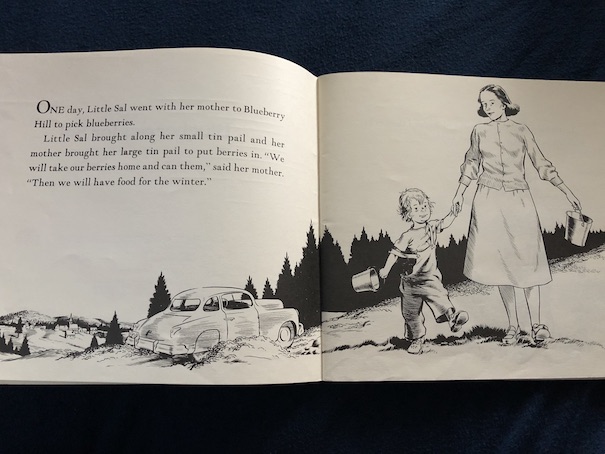
Sal is a little girl whose mother takes her to pick blueberries one day. The mother wants to can the blueberries for winter.

Sal gives in to temptation and eats the blueberries as she picks them.

Meanwhile, a mother bear and her baby come to eat blueberries.

Both Sal and the Little Bear lose sight of their mothers, and when they go looking for them, Sal accidentally finds the mother bear, and the little bear accidentally finds Sal’s mother.

Eventually, the mother bear realizes that Sal is following her when she hears the blueberries plunking into Sal’s pail. Sal’s mother realizes that a small bear is following her when he eats blueberries out of her pail.

Fortunately, nothing bad happens. The mothers just look around for their respective children and figure out where they are by the sounds they make. Then, the mother bear leaves with her baby, and Sal and her mother take their blueberries home.

At first, I was worried about Sal being with the mother bear and how Sal’s mother would react to the mother bear when she saw it, but the two mothers never meet in the story, and the children are fine.

The book is a Caldecott Honor Book. It is available to borrow for free online through Internet Archive (multiple copies).

Clifford Goes to Hollywood

Clifford

Clifford Goes to Hollywood by Norman Bridwell, 1980.

Clifford the big, red dog gets an offer to be in a movie. He passes a screen test where he has to act out different emotions, and he gets the part in the movie, so he has to go to Hollywood to accept the role, while Emily Elizabeth and her parents stay behind.

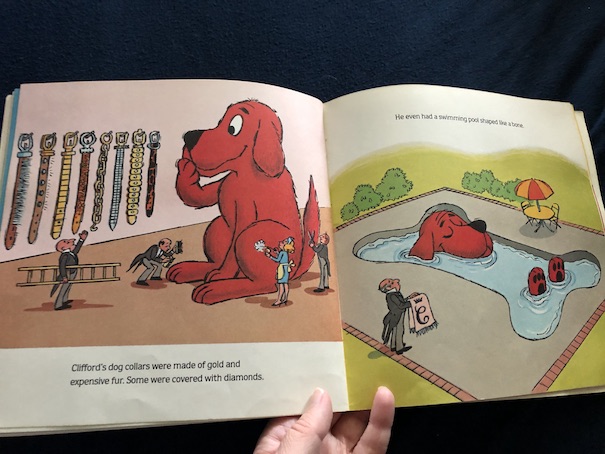
In Hollywood, Clifford is given a big, fancy doghouse and all sorts of fancy collars to wear.

However, Clifford quickly gets overwhelmed by all of the fans who mob him.

He misses Emily Elizabeth, so he runs back home to be with her.

The idea of someone going to Hollywood and missing friends back home is kind of cliche. Actually, I think the best part of the book was the screen test, where Clifford has to show different emotions. There are many books that demonstrate different types of emotions to kids, and I thought that was a nice addition to this book. The part where they show all the fancy collars that Clifford has to choose from was nice, too, because kids like to make choices, and this page is an opportunity for kids to decide which of the collars they like best.

The book is available to borrow for free online through Internet Archive.

Clifford's Family

Clifford

Clifford’s Family by Norman Bridwell, 1984.

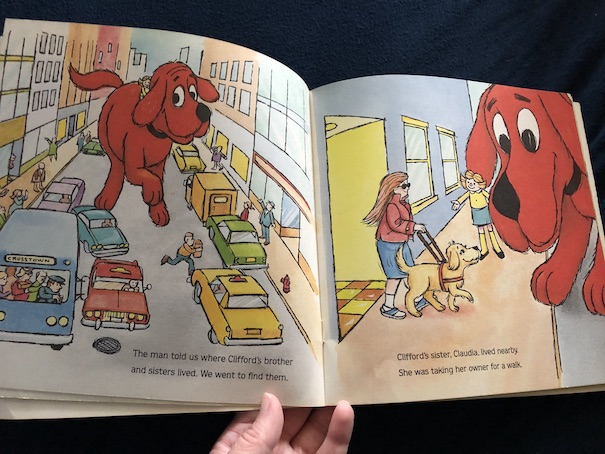
Emily Elizabeth and her enormous dog, Clifford, were both born in a big city, although they live in a smaller town now. They decide to go back to the city and visit Clifford’s mother, who is still there.

Clifford’s brothers and sisters all live with different people now, so they decide to visit them, too. Clifford’s sister, Claudia, has become a seeing-eye dog.

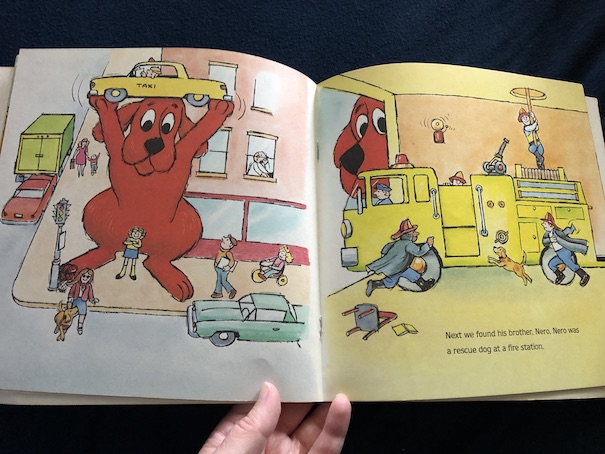
His brother, Nero, is now a fire rescue dog.

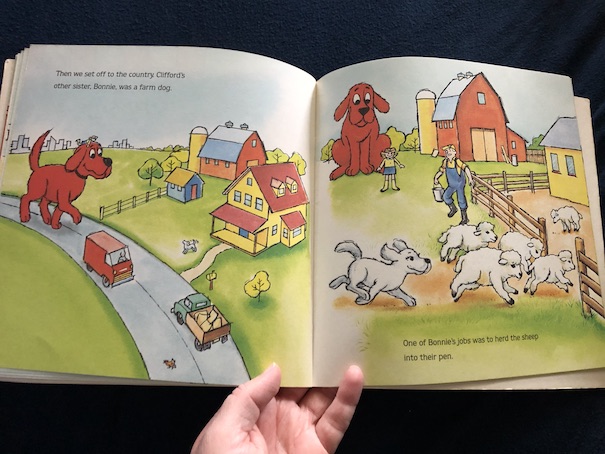
Clifford’s other sister, Bonnie, lives on a farm and herds sheep.

Clifford’s father doesn’t live with his mother. He lives in a house in another town with a lot of children, and he loves playing with them.

Clifford wishes that his family could live together, but he understands that every member of his family has other people who also need them.

I thought that this book did a good job of pointing out some of the jobs that dogs do, like seeing-eye dog, rescue dog, and herding dog. Clifford and his parents are all companions animals, like most pet dogs, but his siblings all have specific jobs to do for their owners.

The book is available to borrow for free online through Internet Archive.

Clifford the Big Red Dog

Clifford

Clifford the Big Red Dog by Norman Bridwell, 1963.

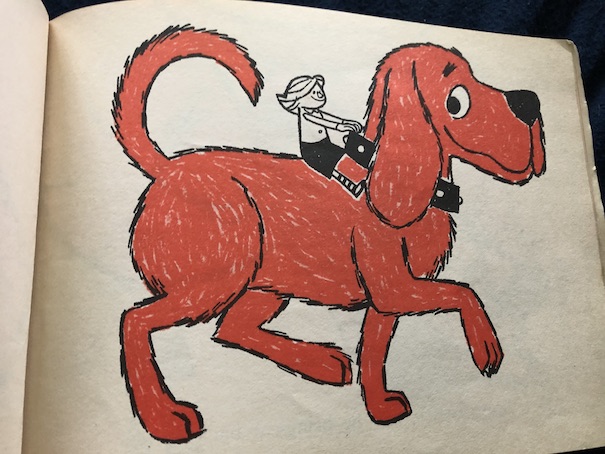
Emily Elizabeth introduces readers to her big, red dog, Clifford. Clifford isn’t just big; he’s humongous.

Like other kids, Emily Elizabeth likes to play with her dog, but playing even the usual games of fetch have unpredictable results because of Clifford’s size. When they play hide-and-seek, there aren’t many places where Clifford can hide, and even then, he’s not too difficult to find.

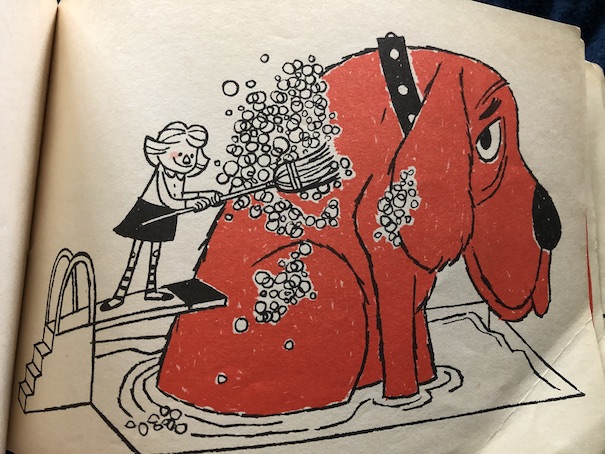
He also requires a lot of food and special accommodations because of his size. His baths aren’t like those of normal-sized dogs.

Clifford’s doggy bag habits, like chasing cars, can be even more unpredictable. Other dogs might chase cars, but Clifford has a real chance of actually catching them.

However, there are good sides to having a big dog. For one thing, bullies never bother Emily Emily Elizabeth.

Emily Elizabeth loves Clifford and wouldn’t trade him for any other dog.

The book is available to borrow for free online through Internet Archive. The edition that I have is the older edition of the book, but there is also a newer edition with full color pictures.