
The Courage of Sarah Noble by Alice Dalgliesh, 1954.
 In 1707, a man living in Massachusetts named John Noble bought some land in Connecticut which had recently been purchased from a tribe of Indians (Native Americans) living nearby. He planned to move his family there and start a new homestead, but with his children so young and the baby somewhat sickly, it was decided that he would travel to the new land ahead of his family and start building a new house there. The only family member to accompany him was his eight-year-old daughter, Sarah, who came along to cook for him. Before they leave home, Sarah’s mother tells her to “Keep up your courage,” something which Sarah repeats to herself from time to time.
 On the way to their new property, Sarah and her father have to camp out in the wilderness, although they do manage to stay one night with a family called Robinson. The Robinson boys tease Sarah, saying that where she’s going, the Indians will probably chop off her head and eat her or do other horrible things. Their sister tells Sarah not to worry because her brothers just like to tease. Sarah’s father and Mistress Robinson also reassure her that the Indians in the area are friendly and that they sold their land knowing that new people would come there.
The Robinsons make Sarah uncomfortable. Sarah later says to her father that there doesn’t seem to be love in the Robinson house. Her father agrees with the observation and says that the Robinsons should learn to watch their words and teach their children to do the same, adding “there are people in this world who do not help others along the way, Sarah, while there are those who do. In our home all will be treated with kindness-always, Sarah. The Indians, too, and they will not harm us.” Although the Robinsons allowed the Nobles to stay the night in their house, they didn’t exactly make them feel welcome, and both of them realize that the things the boys were saying and their rough manner were clues to the Robinsons’ real attitudes and the kinds of things the parents talk about when no one else is around.
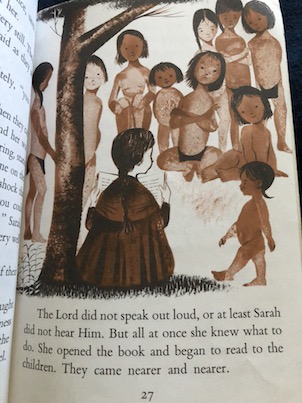 When Sarah and her father reach the land that is to be their new home, they take refuge in a hollow place in a hillside, and John begins building their new house. However, Sarah is still very nervous and lonely. Then, while Sarah sits, reading the Bible, some curious Indian children from the nearby tribe come to see her. She reads a Bible story aloud to them, and they listen, but she when she finishes the story, she can tell that they didn’t understand what she was saying. Sarah can’t understand them, either, when they try to talk to her. She gets impatient and snaps at them for not knowing English, and they run away from her. Sarah is sorry about that because she realizes that she shouldn’t have been so irritable, and even if they couldn’t talk to each other, it was still nice to have people around.
Fortunately, the Indian children come back to see her again, and they become friends. She tries to teach them English, but they don’t make much progress at first. Even without being able to talk to each other, though, they can still do things like picking berries together.
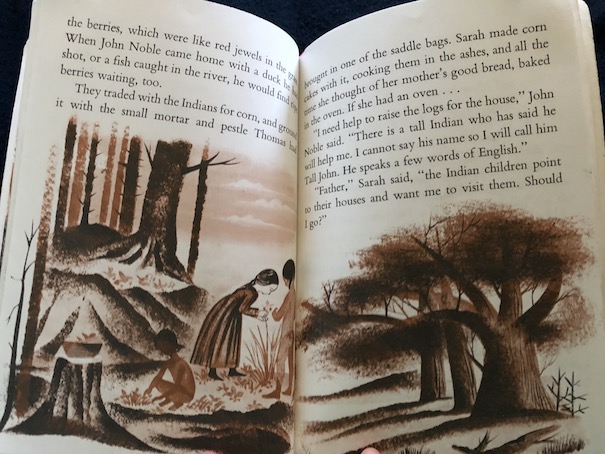
Sarah’s father also becomes friends with an Indian he nicknames “Tall John” because he can’t figure out how to pronounce his real name. John and Tall John trade with each other, and John allows Sarah to visit Tall John’s home to play with his children.
When John finishes building the house and it is time for him to go and fetch the rest of their family, he decides that it would be better for Sarah not to make the long journey again, so he leaves her in the care of Tall John and his family.

At first, Sarah is a little worried about living with the Indians. Being friends and visiting during the day is one thing, but what would it be like to actually live with them? Although Sarah likes her Indian friends, it’s obvious that the stories that she’s heard all her life about “savage” Indians bother her, and she still has some prejudices and misconceptions to overcome. There are also the worries that often accompany children who are staying with someone other than their parents: what if something bad happens, her father never comes back, and she never sees her family again? Sarah worries that, even though the tribe that lives nearby is nice, there are other Indians who aren’t, and some of them might attack while her father is away.
Fortunately, things go well during Sarah’s time with the Indians. She finds some of their habits strange, and she notices that Tall John’s children (nicknamed “Small John” and “Mary”) find some of her habits strange, like the clothes she wears and the way she prays at night. Tall John’s family gives Sarah some deerskin clothing, like they wear, and some moccasins, which she finds surprisingly comfortable. There is a scare about a possible attack, but that passes without incident, and Sarah ends up enjoying her time with her Indian friends, playing games and participating in chores with them. Tall John and his wife treat Sarah like one of their own children.
When it’s time for her to rejoin her family, Sarah changes back to her old clothes, but they no longer seem as comfortable to her, and she decides to keep wearing the moccasins. A little of her Indian friends has rubbed off on her, and she is a different person because of her experiences. Sarah’s mother expresses some concern about her daughter having lived with “savages” (her word), but Sarah is quick to defend them, saying that they aren’t savages and that they’re friends. Her father agrees that Tall John and his family are good people who took good care of Sarah.
This book is a Newbery Honor Book. It is currently available online through Internet Archive (multiple copies).
My Reaction
Throughout the story, various characters have obvious prejudices about American Indians, and the language used isn’t what we would use today (ex. “Indians” instead of “Native Americans” and nobody says “squaw” anymore (or shouldn’t – white people used to think it simply meant “woman” but it has other connotations as well, better to just say “woman” when that’s what you mean)), but these are fitting with the time period when the story takes place. The overall attitude of the story, especially Sarah’s evolving attitudes toward her new Native American friends, is good. Sarah begins by being frightened because of all of the scary things people have told her about Indians, but once she begins spending time with them and living among them, she sees that the things she heard before weren’t true, and she values their friendship. The parts where characters behave in prejudiced or condescending ways are uncomfortable, but you can’t have a story about improvement without someone behaving or thinking wrongly in the first place. At least, that was my interpretation. I understand that there are others who are more concerned. At the end of the story, Sarah’s mother doesn’t seem convinced about the Indians, but I like to think that experience may change her as it did Sarah. I think Sarah’s mother represents where Sarah came from but not where she ends up. I think it’s important to explain to children the historical context of the story and put the emphasis on Sarah’s changing opinions. Sarah’s experiences help her to see the truth about her new neighbors.
The author’s note in the beginning of the book explains that the story of Sarah Noble is based on the life of the real Sarah Noble, who did accompany her father to the family’s new homestead when the community of New Milford was forming in order to cook for him while he built the family’s new house. The real Sarah did live with the nearby tribe of Native Americans for a time, although the author of the story had to invent some of the details of her stay. It also says that the real Sarah maintained a friendship with the Indian the book refers to as “Tall John.” The real Sarah become a school teacher as an adult, as the Sarah in the story said that she wanted. She also married and had children.


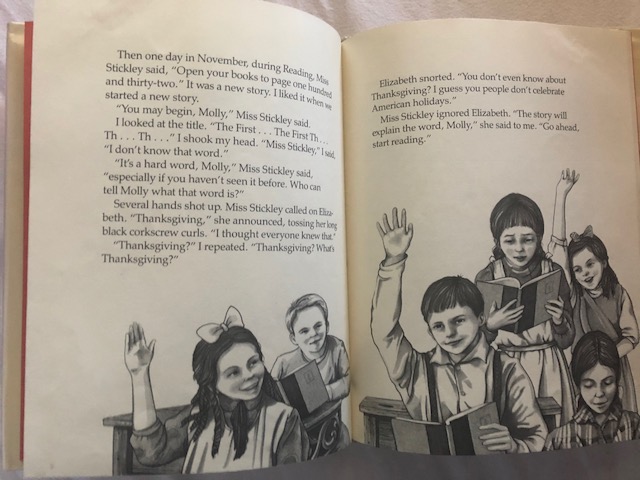


 The Dreadful Future of Blossom Culp by Richard Peck, 1983.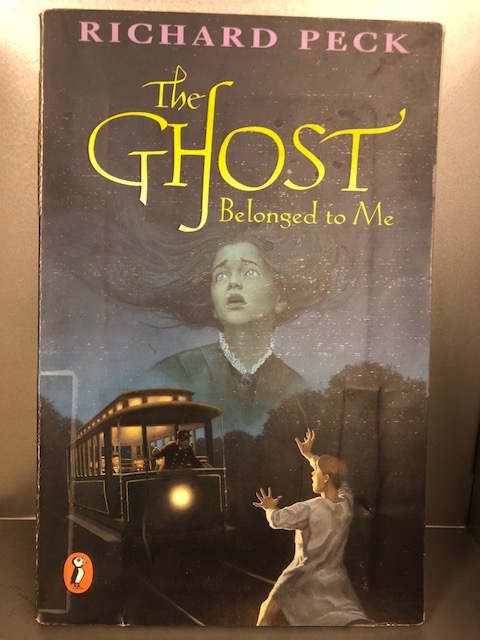





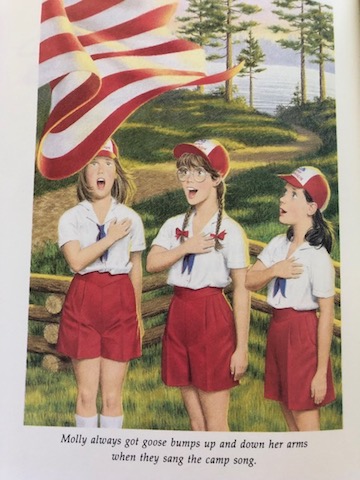 Molly and her friends, Linda and Susan, are attending Camp Gowonagin over the summer. They love summer camp because there are so many fun things to do, like nature hikes, archery, arts and crafts, and campfire sing alongs. The only thing Molly doesn’t like is swimming underwater, although she’s embarrassed to admit it. Susan has trouble with canoeing because she doesn’t know how to keep her canoe moving straight. Other than that, all three girls have fun at camp and as their time at camp is coming to an end, they think about how much they’ll miss it.
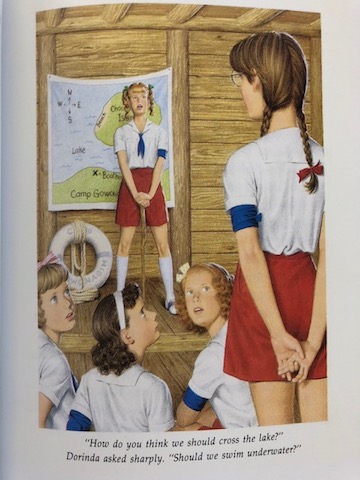 Molly and Susan end up on the Blue Team, while Linda is assigned to the Red Team. Molly and Susan aren’t really looking forward to the Color War because their team captain will be Dorinda, a bossy, competitive girl who likes to act like she’s the general of an army and this camp game is a real war. Molly is uneasy about what Dorinda will order them to do, afraid that it might involve the thing she dreads most, swimming underwater. The only comfort Molly takes is what her father told her before he went away to war, that being scared is okay because it gives a person a chance to be brave.
 Of course, Dorinda’s plan doesn’t work out as she thought. The Red Team’s scout spots them right away and takes most of the Blue Team prisoner. Only Molly and Susan are left free because Susan accidentally overturned their canoe on the way to the island. After they manage to get back into their canoe and bail it out, they try to approach the beach, but Linda spots them and signals to the rest of the Red Team. Molly and Susan have no choice but to return to camp to avoid capture.
 Molly and Susan (and the rest of the Blue Team, once they’re free) manage to snatch victory from the jaws of defeat, but they worry that perhaps their friendship with Linda is ruined because of the trick they play on her. Fortunately, Linda decides to take it in the spirit of the game and shows sympathy for the girls when it turns out that their victory plan ends with the entire Blue Team getting poison ivy.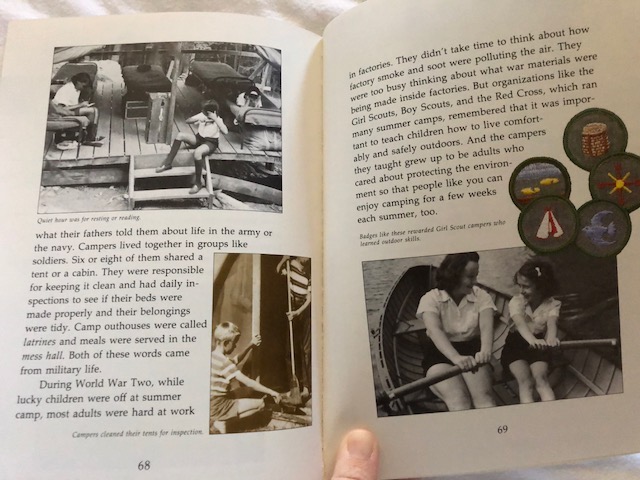

 In 1944, everyone is concerned with finding ways to help the war effort. In Molly’s third grade class at school, her teacher announces that their class is invited to participate in the Lend-a-Hand contest. The class will be divided in half, and each half will compete against the other to find the best way to help the war effort. The class decides to make the contest boys against girls, and Molly immediately starts trying to figure out a spectacular idea that will impress everyone. Unfortunately, one of the other girls says that the girls in class should knit socks for soldiers, and the teacher accepts that as the goal for the girls’ team, before Molly can say anything.
 Molly is appalled at the idea of knitting socks. It’s partly that she had wanted to be the one to come up with the best idea, and it’s also partly because she has tried knitting before, and she knows that socks are difficult, time-consuming projects, especially for beginning knitters. Molly is sure that the other girls are going to find it too difficult and that, in the end, they’ll have nothing to show for their project. Her friend Susan doesn’t think that the project sounds so bad, but Linda also dreads the idea of knitting because she’s not very good at it. Talking it over in their secret hideout in the storage area of Molly’s garage, the three girls decide that they’ll work on a secret project by themselves, something that will save the day when the other girls’ project falls through.
 The other girls are certainly a lot more comfortable, knitting inside. However, as Molly predicted, they are finding their project harder than they thought it would be. None of them has completed an entire sock yet; all they really have are the square shapes at the top of the sock, and they’re getting discouraged. That’s when Molly gets a better idea: why not take the squares they’ve made and turn them into a blanket? Simple squares are much easier to make than socks, they can make a lot of them quickly with everyone helping, and the girls who can’t knit well can sew the squares together. A blanket is still a good war effort project because Molly’s father has told her that the hospital where he works is always in need of blankets for the wounded soldiers. With this new idea, the other girls become much more excited, and they make more progress.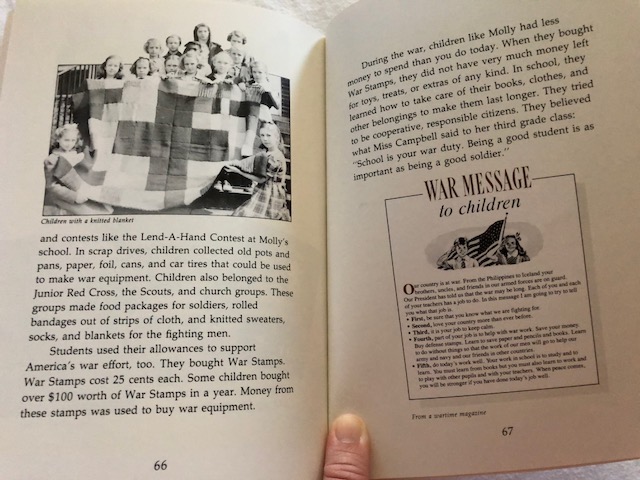

 Molly McIntire misses her father, who is a doctor stationed in England during World War II. Things haven’t been the same in her family since he left. Treats are more rare because of the sugar rationing, and she now has to eat yucky vegetables from her family’s victory garden all the time, under the watchful eyes of the family’s housekeeper. Her mother, while generally understanding, is frequently occupied with her work with the Red Cross. Molly’s older sister, Jill, tries to act grown-up, and Molly thinks that her brothers are pests, especially Ricky, who is fond of teasing. However, when Molly and her friends tease Ricky about his crush on a friend of Jill’s, it touches off a war of practical jokes in their house.
 Halloween is coming, and she wants to come up with great costume ideas for herself and her two best friends, Linda and Susan. Her first thought is that she’d like to be Cinderella, but her friends are understandably reluctant to be the “ugly” stepsisters, and Molly has to admit that she wouldn’t really like that role, either. Also, Molly doesn’t have a fancy dress, and her mother is too busy to make one and also doesn’t think that they should waste rationed cloth on costumes. Instead, she suggests that the girls make grass skirts out of paper and go as hula dancers. The girls like the idea, but Halloween doesn’t go as planned.
 Because he laughed at the girls, saying that he could see their underwear after he sprayed them with water and ruined their skirts, the girls decide to play a trick that will give Ricky his just desserts. The next time that Jill’s friend comes to visit, the girls arrange to have Jill and her friend standing underneath Ricky’s bedroom window when they start throwing all of his underwear out the window, right in front of Ricky. Ricky screams at the girls that “this is war!” just as their mother arrives home.


 Jestress's Forgotten Books and Stories