I Hate English

HateEnglish

I Hate English! by Ellen Levine, 1989.

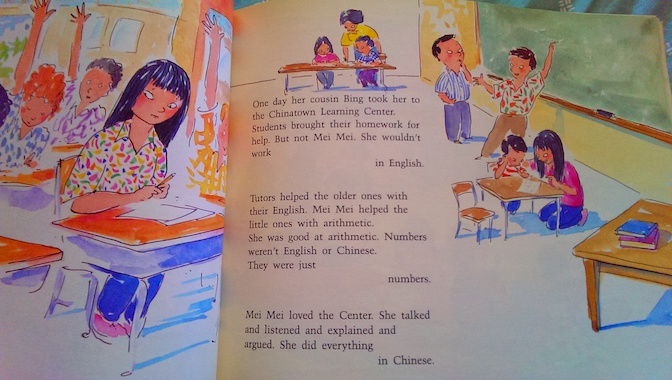
When Mei Mei’s family moves from Hong Kong to New York, she finds herself forced to go to a school where no one else speaks Chinese.  She is expected to learn English and to read, write, and speak in English, and she hates it!  To her, English is a very strange language, and the writing system is nothing like Chinese.  For a time, Mei Mei refuses to speak in English, even when she understands what is being said around her, because she hates it so much.

HateEnglishArrival

The only part of New York that Mei Mei really likes is Chinatown and the Chinatown Learning Center.  Mei Mei likes it because she is surrounded by people speaking Chinese. There, she can relax and be herself because people there understand her.

HateEnglishLearningCenter

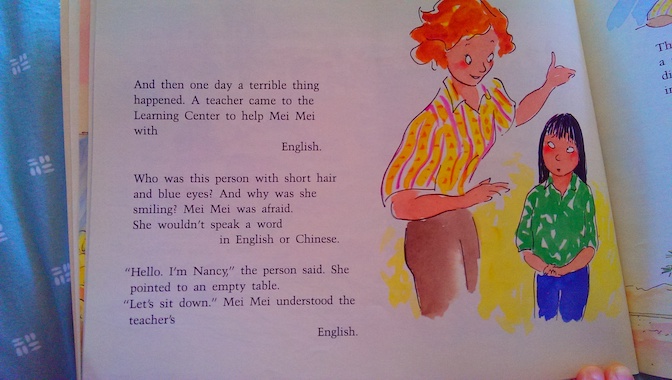
However, Mei Mei’s refusal to speak English isn’t helping her at school or anywhere else.  It’s keeping her from speaking to anyone outside of Chinatown, and it can’t continue.  When an English teacher, Nancy, comes to the Learning Center to help Mei Mei with her English, she resists learning at first.  She feels like she’ll lose her Chinese and part of her identity if she uses English.

HateEnglishNancy

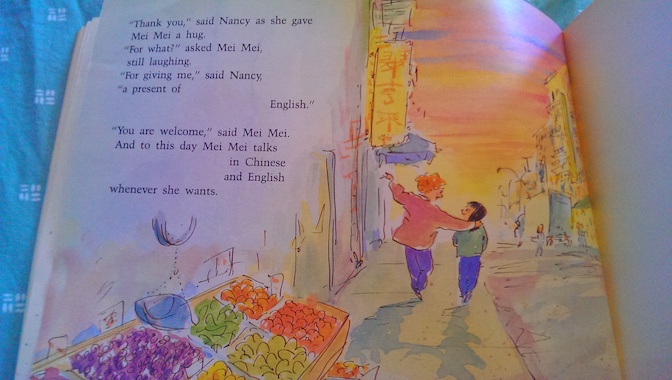
At first, Mei Mei’s worries about speaking English intensify with Nancy’s lessons.  It disturbs her how English has words that would be difficult or impossible to translate into Chinese and English words seem to be coming more easily to her, even when she doesn’t really want to speak the language.  Nancy explains to Mei Mei that English is necessary for her because she will need it to talk to many people in America, and there are many people who also want to talk to Mei Mei and be her friend, including Nancy.  It’s only when Nancy overwhelms her by constantly talking in English and Mei Mei becomes desperate to talk about herself and be understood in English that Mei Mei realizes that speaking a new language doesn’t mean losing her identity.  It’s just another way of expressing herself, and she can go back and forth between the two any time she wants.

HateEnglishNancyTalking
HateEnglishMeiMei

Mei Mei’s feelings of strangeness in her new home and the difficulties of learning a new language are relatable.  The hardest part of the experience for Mei Mei is feeling like she might be giving up a part of her past, her culture, and herself by switching from Chinese to English.  But, refusing to speak English puts Mei Mei in the position of being someone who can only listen, never talk, limiting her ability to be understood and to make friends.  In the end, she comes to realize that speaking a new language is not a matter of giving up anything, just adding to what she knows and making herself understood in a new way.  It’s the beginning of expanding her horizons and building relationships with new people.

HateEnglishFriends

My favorite part as a kid was the part where Mei Mei and her friends went to the beach and cooked shellfish that they found.  It was interesting to me because I never lived near a beach when I was young.  The lifeguard at the beach tells Mei Mei and her friends that they can’t eat the shellfish, and they realize that he thinks that because he doesn’t know how to cook them.  I never did either and still don’t, but I liked hearing about it.

The book is currently available online through Internet Archive.

Under Copp’s Hill

UnderCoppsHill

Under Copp’s Hill by Katherine Ayres, 2000.

This book is part of the American Girl History Mysteries series.

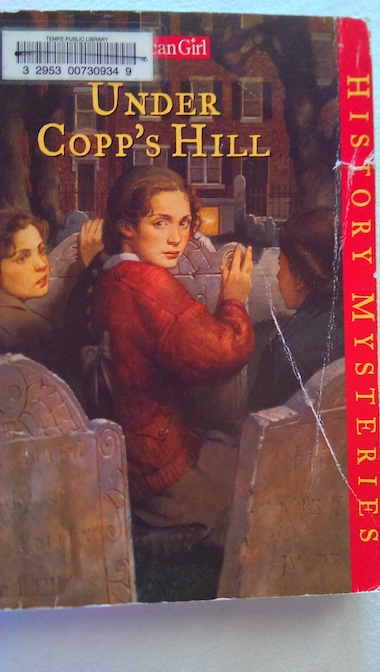
The year is 1908, and eleven-year-old Innocenza Moretti lives with her relatives in Boston.  They are immigrants from Italy.  Innie, as her family calls her, is an orphan.  According to the story that her grandmother told her, she was the only one of her parents’ children to survive infancy, her siblings being born prematurely and dying shortly after birth.  Innie’s mother was so grateful that Innie survived that she promised her to the Holy Mother at her baptism.  Then, Innie’s parents died in a fire in their tenement building when she was about two years old.  Innie and her grandmother, Nonna, survived the fire only because little Innie had started crying in the night, and she took her outside to walk her around so that she wouldn’t wake her parents.  Because of that experience, Nonna is deathly afraid of fire and also has become convinced that the Holy Mother must have spared Innie (as well as herself).  She thinks that Innie is destined to become a nun and has continued to promise her to the Holy Mother in prayer, repeating the promise regularly.  Although Nonna thinks that the miracles surrounding Innie’s life are signs of a future life in the Church for Innie, her grandmother’s promises in prayer terrify Innie.

Innie feels trapped by her grandmother’s expectations for her, expectations that the rest of her family don’t even know about.  She doesn’t want to be a nun, but her grandmother is sure that she will be.  Because of her fears that her grandmother may force her to become a nun when she grows up, Innie is never on her best behavior.  She thinks that if she gets a reputation as a trouble-maker, the Church will decide that she is unsuited for a religious life.  Unfortunately, Innie’s long-practiced habit of ignoring rules and her problem child reputation lead her to be suspected of something worse than just minor misbehaving.

Innie’s family owns a boardinghouse where they provide food and lodging for young immigrant men.  Innie and Nonna live on the ground floor, and Innie’s aunt, uncle, and cousins live above them.  Innie spends a lot of time with her cousins, especially Teresa, who is about her age.  Her older cousin, Carmela, persuades both Teresa and Innie to join a library club at a new settlement house with her.  The settlement house helps girls and young women from immigrant families by teaching them work skills and aspects of American culture that they can use as they become American citizens in exchange for some of the work that the girls do on behalf of the settlement house.  Carmela has taken a new job as a pottery painter there and tells her parents that it will be good for Teresa and Innie to go there as well because they will receive help with their schoolwork and they will also have classes to teach them skills like sewing, knitting, and pottery, that they can use to make money later.  However, the real attraction of the club for the girls is that they get to listen to music, have dancing lessons, read books, and socialize with other girls about their age.  The prospect of sewing classes isn’t appealing for Innie, but she loves books and looks forward to borrowing some from the settlement house library.

At the settlement house, Innie meets a variety of girls from other immigrant families, not just Italian ones.  In particular, Innie makes friends with a girl named Matela, who is a Jewish girl from Russia.  As the girls talk about a recent, large fire in town, Matela talks about the czar’s soldiers burning things back in Russia and how she misses her grandfather, who is still there.  Innie understands Matela’s feelings because she knows what it’s like to miss someone.  She doesn’t really remember her parents, but she feels the lack of them in her life.  Teresa also becomes friends with Matela, but the three girls agree to keep their friendship secret because each of their families prefers them to associate with girls from backgrounds similar to their own.  Innie’s uncle wants the girls to spend time with other Italians, and Matela admits that her father prefers her to spend time with other Jewish girls.  The adults don’t really understand the cultural mix at the settlement house.

However, from the very first day that the girls begin going to events at the house, strange things start happening.  Things disappear or are oddly moved about.  Food disappears.  A silver teapot belonging to the ladies who run the settlement house is stolen.  Then, someone steals some pottery and a shawl.

To Innie’s horror, she ends up becoming the prime suspect for the thefts because she was caught snooping in an area of the house where she didn’t belong and because she accidentally broke one of the pieces of pottery that the others girls made and tried to sweep it up without telling anyone.  When she and her friends snoop around and try to find the missing objects, Innie discovers one of the missing pottery pieces.  However, instead of being happy for the clue, the ladies who run the house just think that Innie must have broken more of the pottery and tried to cover it up, like she did before, by hiding the rest of the set.  After all, if she was doing some things she shouldn’t have been doing, it’s plausible that she could be a thief, too.

If Innie is going to remain a member of the library club (and continue to have access to books that she can read), she’s going to have to prove her innocence.  In fact, proving her innocence may also be important for Carmela, who is supposed to have a citizenship hearing soon.  If Innie’s bad reputation causes problems for her at work, she may lose her job and be denied American citizenship!

Matela thinks that the thief could be a ghost from the nearby Copp’s Hill graveyard, but Innie is sure that it must be a human being.  There are secrets at the settlement house that even the ladies who run it are unaware of and someone who desperately needs help and can’t ask for it.

Teresa and Matela continue to help Innie, and in the process, Innie confesses to Matela her fears about becoming a nun.  It is Matela who helps Innie to find the solution to her problem, urging her to step outside of the small community of Italian immigrants that her family clings to and to seek advice from a priest in the Irish area of the city.  As a priest, he has the knowledge that Innie needs to understand her faith, and because he doesn’t know Innie’s family personally, he has the objectivity to help Innie to see her grandmother’s promise in a new light and to understand that her future destiny is still in her own hands.  No one can speak for another person or make important promises on their behalf.  A religious vocation is a serious decision that only a mature adult can make for herself, or not make, as the case may be.  The priest tells her that, as young as she is, Innie should focus on learning to be a good person, and then she will see what direction life leads her.  With that knowledge, of course, Innie realizes that she will have to put more effort into behaving herself, but it’s a relief to her to realize that she doesn’t need to purposely misbehave in order to control her life.

Eventually, Innie’s aunt also learns about the grandmother’s promise and Innie’s worries and reassures her that, although her grandmother can be an intimidating woman with what she wants, Innie’s family loves her and that she shouldn’t be afraid to come to them with her questions and concerns. Innie has thought of herself as parentless, at the mercy of her grandmother’s wishes and expectations, but her aunt says that she loves Innie like she does her own daughters and that Innie is as much a part of their family as they are.  If Innie has problems, her aunt will be there for her, helping her find whatever answers she needs.

There is also a subplot about how girls in immigrant families (at least, in ones like Innie’s family) aren’t as highly-regarded as boys.  When the family is discussing important matters, Innie often tries to comment on what she thinks, but her grandmother keeps telling her to be quiet because it isn’t a girl’s place to comment on business that men should handle and her male cousins sneer at her because they don’t think she knows anything.  However, when Innie’s uncle is worried about the legal papers he has to sign in order to open his new grocery business because his English still isn’t good enough to understand them, Innie points out that Carmela’s English is the best of the family because of all the books she had to read and the paperwork she had to complete when she was applying for citizenship and that she would be the best person to study the paperwork.  At first, her grandmother makes her try to be quiet and her male cousins laugh, but Carmela speaks up and says that she can help her father, if he wants her to, and her father agrees, on the condition that she act as translator and adviser and let him make the final decisions about the business.  Carmela is happy because the arrangement allows her to use her skills without taking her away from the pottery painting that she loves.  The point of this part of the story is about acknowledging the talents that people possess and not disregarding them because they are outside of the usual roles and expectations.  It fits in with the subplot about the grandmother’s expectations for Innie’s future, which are not really in keeping with either her talents or character.  The young people in the story are growing up under different circumstances than their parents, and they will have to learn to find their own way in life, using the abilities they have and the education they can find.

In the back of the book, there is a section with historical information about Boston in 1908.  The fire that happens around the time that the story takes place was a real event.  The settlement house with its library club was also real, and the ladies who run the settlement house, Miss Brown and Miss Guerrier, were also real people.  The book explains more about what life was like for immigrant families like Innie’s and about what the future held for girls like her.  Many of the girls who attended the library clubs later became librarians and teachers themselves, which may be Innie’s eventual destiny when she grows up.  The book also mentions that the area of Boston where Innie’s family lived still has many Italian restaurants and groceries that were started by immigrant families like Innie’s, so we can imagine that the grocery store that Innie’s uncle wants to open will be successful.

The book is currently available online through Internet Archive.

Lyddie

Lyddie

Lyddie by Katherine Paterson, 1991.

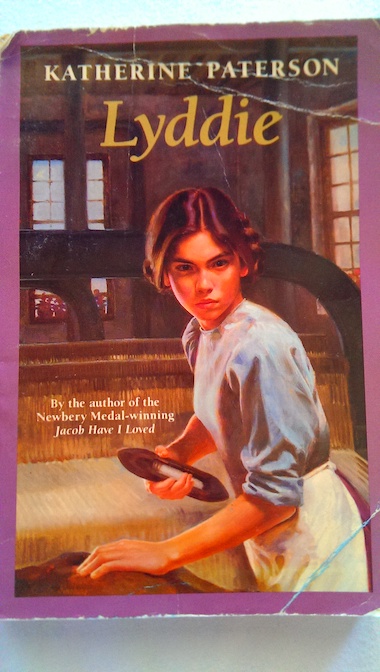
The year is 1843. Thirteen-year-old Lyddie’s father left home to go West and seek his fortune, and he hasn’t been heard of since. Lyddie helps her mother to take care of their farm in Vermont and the younger children, but they are very poor, and her mother has given up hope of their father returning home. The children’s aunt and uncle, Clarissa and Judah live nearby, but they are of little help, full of fire-and-brimstone talk. Lyddie and her brother Charlie, who is ten, more often turn to their Quaker neighbors, the Stevenses, for help. They are kinder than their aunt and uncle, although their mother disapproves of them for being abolitionists and, in her mind, heathens. Lyddie and Charlie are just grateful for their help. Because of their mother’s depression at the loss of their father, she pays little attention to the things that her children do to keep the farm going and the family together.

However, when a bear enters their house and eats the oatmeal that Lyddie was preparing, their mother, primed by Clarissa’s and Judah’s talk of signs of the end times and such, goes into a panic and sure that the world is going to end. Lyddie and Charlie let her go with their younger sisters to stay with Aunt Clarissa and Uncle Judah while they continue managing the farm as best they can. However, even though their mother sees that the world doesn’t end, she decides that she’s going to hire Lyddie out as a maid at the Cutlers’ tavern and Charlie to work at the mill because the family has too many debts and they will have to rent out their fields and animals.

Luke Stevens, the youngest of the Stevens sons, although much older than Lyddie and Charlie, gives them a ride to their new homes and employment at the mill and the tavern and promises to keep an eye on their house while they’re away. Lyddie is lonely and unhappy working at the tavern, badly missing the family farm and her siblings, especially Charlie. Then, one day, a woman visiting the tavern mentions that she’s one of the factory girls from Lowell, Massachusetts. The woman tells Lyddie that she seems like a good worker and that she could earn a good wage in the factories herself. At first, Lyddie doesn’t believe what the woman says that girls can earn there.

When Lyddie is allowed a brief visit home to her family’s farm, she discovers that Luke Stevens has been allowing a runaway slave to hide there. Lyddie isn’t sure what she thinks of it at first. Ezekial, the fugitive, frightens her because she has never met a black man before, and she knows that if she were to turn him in, there would be a handsome reward that could solve her family’s money problems. However, Ezekial seems to understand the situation that her family is in without her father. Although Lyddie and Charlie are not technically slaves, they have become a kind of indentured servant because of their family’s debts. Ezekial is a father himself, hoping to send for his family when he has found a safe place for them. Lyddie still wonders if her own father is alive, perhaps hoping to send for his family when he can. Having come to a better understanding of Ezekial, she knows that she can’t turn him in, even for the reward money.

Her talks with Ezekial make Lyddie understand that working in the tavern won’t solve her problems, though. As a maid there, she basically works all day for her room and board and has nothing else to show for it. Mrs. Cutler just sends a little money to her mother now and then and even then, she doesn’t always bother, and her mother is in little position to insist on proper wages, making Lyddie little better than a slave. Mrs. Cutler cares nothing about Lyddie or her family’s welfare, just trying to get as much labor out of her for as little as she can. Lyddie finally makes up her mind to seek factory employment in Lowell, Massachusetts, seeing it as her only chance to earn some real wages.

Life in Lowell turns out not to be as glamorous as the woman she met at the tavern made it sound, although the wages are definitely better. The company that owns the fiber mill where Lyddie gets a job has all sorts of rules and regulations for the girls who work there, even ones that intrude on their personal lives outside of work. Anxious to give the impression that all of their workers are of good moral disposition, they insist that the girls attend church on Sundays. Lyddie never had the money to pay pew fees back home, so she is unaccustomed to going to church, but finds that other girls in her position tend to go to Methodist churches, where there are no pew fees, saving their precious wages. Lyddie, who never had much time for schooling when she and her brother were trying to keep the farm going, has trouble understanding all of the terms of the employment contract that she signs but signs it anyway. Her employment turns out to be an education that changes Lyddie’s life, although not in all the ways that she had hoped.

Like Mrs. Cutler, the bosses at the factory have little real care for their workers, trying to get as much work out of them as they can for the least amount of pay they have to give them. The work is hard and the hours are long, but Lyddie keeps at it because the pay is the best she’s ever had and she is starting to save up for her family’s future. The poor working conditions contribute to health problems among the girls, and some of them petition for better working hours, but Lyddie is reluctant to do so because girls who are dismissed “dishonorably” from the factory are blacklisted all over town, and she fears not only risking the loss of her job but the potential to find a new one.

Through her interactions with the other girls and young women at the factory, Lyddie also develops into a young woman. She had previously wished that she’d been born a boy instead because a boy would have a better chance of running her family’s farm, but she comes to realize that there are opportunities out in the world for young women who are willing and able to go out and seek them. In Lowell, Lyddie gets a taste for literature through the books that her friend Betsy reads to her and acquires more lady-like behavior by watching the lady-like Amelia. Neither of them plan on working at the factory forever, and their ambitions, to get married or continue their education, cause Lyddie to consider what she really wants for her own future. Through the difficulties she encounters and everything she learns while facing them, Lyddie really becomes her own woman.

In the end, Lyddie is unable to save her family’s farm and reunite their family there. Her mother dies, and her father’s whereabouts are still unknown, so her uncle sells the farm to pay the debts. However, Charlie and her younger sister Rachel are provided for, the Stevenses decide that they will purchase the farm themselves, and Lyddie becomes reconciled to the loss of the farm through her new vision of the future. She is unfairly discharged from the factory after she catches an overseer molesting another girl and stops him because he blackens her name in retaliation. But, by then, Lyddie has acquired some money and new confidence in herself, and she begins making other plans for her future, which may include both further education and the possibility of marriage. One thing that she knows for certain is that, whatever she does with her life, she wants to move forward as her own, independent person.

The book is currently available online through Internet Archive (multiple copies).

The Traitor’s Gate

TraitorsGate

The Traitor’s Gate by Avi, 2007.

The story is set in London, in 1849. Fourteen-year-old John Huffam lives with his parents and sister and their servant, Brigit and attends a school taught by a former military man who acts like he is still in the army and teaches them little beyond discipline and what army life would be like.

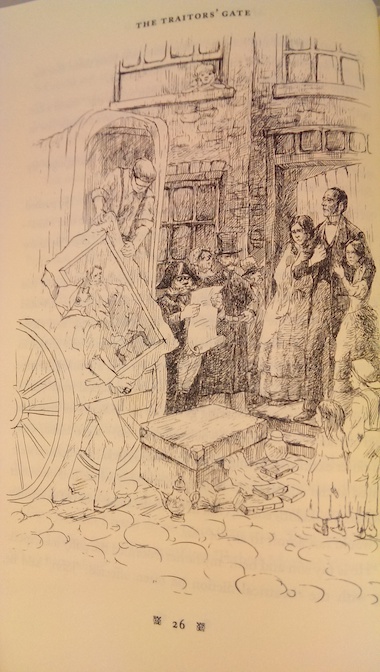
Then, one day, John is called home suddenly because of a family emergency. His family has fallen on hard times, and his father is in debt, so the family’s belongings are being confiscated. His father is summoned to appear in court, and if he cannot find the money to pay his debt, he will have to go to debtors’ prison. John’s father is shocked because he doesn’t actually owe any money to the man who is trying to call in the debt, Finnegan O’Doul.

TraitorsGateConfiscation

In spite of this, John and the rest of the Huffam family must spend the night in the bailiff’s sponging house, the Halfmoon Inn. There, John’s father again promises John that there is no debt between himself and Mr. O’Doul. He even says that he doesn’t really know O’Doul, although John doubts him. It seems like his father has had dealings of some kind with the man that he wants to keep secret.

John’s father, Wesley Huffam, was originally from a fairly well-off family, but all the family’s money ended up going to a great-aunt instead of to him (possibly because it became obvious to his relatives that he had little skill at handling money in the first place). John’s father is resentful toward the great-aunt, Euphemia Huffam, for inheriting when he thinks that, as a man, he should have been first in line for the family’s money. However, with this enormous (although possibly false) debt hanging over his head, he may be forced to appeal to Great-Aunt Euphemia for help. He persuades John to go and visit Great-Aunt Euphemia on his behalf, since he is not allowed to leave the sponging house for now and the past quarrels between him and his aunt would make it unlikely that his aunt would want to see him. John is beginning to realize that there are pieces of his father’s life and their family’s past that have been kept from him, and he doesn’t like the idea that his father has been deceiving him, but with their family in such a desperate situation, he agrees to visit Great-Aunt Euphemia.

TraitorsGateSary

The bailiff, John’s mother, and Brigid all agree that John is going to have to be instrumental in solving their family’s problems. Of all the people in his family, he is the most practical, in spite of his young age. His father is an impractical man, stuck in a vision of his family’s former glory (and his aunt’s current money, which he does not share in) that doesn’t fit their current circumstances. John’s mother thinks that her husband’s job as a clerk for the Naval Ordinance Office doesn’t provide enough money for the family to live on, even though he earns more than twice what typical London tradesmen of the time do. The real problem is that the family doesn’t live within its means (it is eventually revealed that Wesley Huffam has been withholding money from his family that he uses for gambling), and John’s father’s snobbish attitude because he thinks of his family as being more grand than the commoners around them alienates people who might otherwise be friends and help them. John knows that he’s young, and he’s not completely sure what he can do to help his family, but he knows that there is no other option but to try. In the process, he learns quite a lot about life, himself, the people in his family, and the wider issues in the world around him, including some political intrigue that hits uncomfortably close to home.

Great-Aunt Euphemia agrees to see John when he comes to her house, but their first meeting doesn’t go very well. Great-Aunt Euphemia is ill (or says she is), and she bluntly tells John that his father was always bad with money. She is not at all surprised that he is in debt and needs her help. John gets upset at the bad things that Euphemia tells him about his father, and she gets angry when John tells her the amount of the debt. At first, John is sure that she will refuse to help them completely, but Euphemia tells him not to assume anything but that he should come back the next day.  Her eventual contribution to helping John’s family in their troubles comes in the form of a job for John.

TraitorsGateRookery

As John moves around the city, he gets the feeling that he is being followed, and he is. One of the people following him turns out to be Inspector Copperfield (or so he calls himself) from Scotland Yard. When John confronts him, the inspector seems to have a pretty good idea of the difficulty that his family is in and what John himself has been doing. John asks him why he cares, and the inspector says that John’s father is suspected of a crime and that John had better learn more about what his father has been doing and share that information with him. John doesn’t believe that his father could be a criminal, but the accusation is worrying because he knows that his father is hiding something (his gambling addiction isn’t the only secret he has).

The other person following John is a young girl in ragged clothes. The girl, who calls herself Sary the Sneak, approaches John herself, freely admitting that she’s been following him. In spite of her young age, Sarah (or Sary, as she is frequently called) lives on her own and must support herself because her mother is dead and her father was transported to Australia. People don’t often notice a young girl on the street, so sometimes people will pay her to follow someone and provide information about them. The reason why she tells John about it is because she isn’t above playing both sides of the street; sometimes, she gets the people she’s been following to pay her to provide them with information about the people who hired her to spy on them. She considers it even-handed. However, John has no money to pay her for information and finds her spying distasteful, so he doesn’t want to take her up on the offer at first.

However, John does a little spying of his own when his father sneaks away from the Halfmoon Inn, which he is not supposed to do. He follows his father to a pub called the Red Lion, where he witnesses his father gambling with money that he had claimed not to have. More than that, he sees his father arguing with a man who turns out to be O’Doul, another gambler. To John’s surprise, his teacher also shows up and seems to know O’Doul. When John later confronts his father with what he saw at the Red Lion, all his father will say is that he is carrying a fortune around in his head. Later, John overhears the bailiff speaking with someone else, an Inspector Ratchet from Scotland, saying that it appears that Wesley Huffam may be a traitor involved with spies and that the Inspector Copperfield who spoke to John earlier was an imposter, probably also a spy.

Could it be true? Is John’s father really a traitor, selling naval secrets from his job? If so, who can John trust?  Conspirators seem to be around every corner, and John has the feeling that the people who are closest to him may be the biggest threats.

The book is currently available online through Internet Archive.

Pippi Longstocking

PippiLongstocking

Pippi Longstocking by Astrid Lindgren, 1950.

Pippi Longstocking is an iconic figure in children’s literature, a little red-haired girl with amazing strength (she can lift a horse all by herself) and a quick wit, who can “always come out on top” in any situation and is frequently doing exciting and hilarious things without adult supervision. The books in her series were originally from Sweden, with the first one written in 1945, but I’m reading a later English translation.

In the first book, she comes to live by herself in a house, which she calls Villa Villekulla, in a small town in Sweden when her father, a ship’s captain, is washed overboard at sea.  Although others fear that he is dead, Pippi thinks it more likely that he was washed up on an island of cannibals, where he will soon be making himself their king.  (Of course, Pippi turns out to be right, but that’s getting ahead of the story.) Her mother died when she was a baby, so Pippi now lives all by herself, except for her pet monkey and horse. She pays for the things she needs with money from the suitcase of gold coins that her father left for her and spends her time doing just as she pleases.

Tommy and Annika, the children who live next door to Ville Villekulla, are perfectly ordinary, basically obedient children, who live normal lives with their parents. When Pippi moves in next door, their lives get a lot more exciting. The first time they meet her, she’s walking backward down the street. When they ask her why she’s doing that, she says that everyone walks that way in Egypt. Tommy and Annika quickly realize that she’s making that up, and Pippi admits it, but she’s such an interesting person that they accept her invitation to join her for breakfast. They’re amazed when they find out that Pippi has no parents, only a monkey and a horse living with her, and are entertained by the tall tales that she tells.

When they go back to see her the next day, Pippi tells them that she’s a “thing-finder” and invites them to come and look for things with her. Basically, Pippi is a kind of scavenger, looking for valuable things, things that might be useful, or (which is more likely) just any old random junk that she might happen across. Pippi does find some random junk, although she makes sure that Tommy and Annika find better things (probably by hiding them herself).

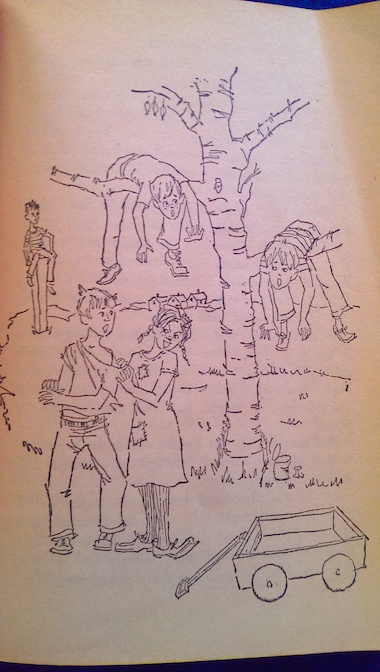
Then, the children see a group of bullies beating up another boy and decide to intervene. The meanest of the bullies, Bengt, starts picking on Pippi, but picking on a girl with super strength isn’t the wisest move. She picks him up easily and drapes him over a tree branch. Then, she takes care of his friends, too.

Word quickly spreads through town about this strange girl. Some of the adults become concerned that such a young girl seems to be living on her own. A couple of policemen come to the Ville Villekulla one day to take Pippi to a children’s home, but she saucily tells them that she already has a children’s home because she’s a child and she’s at home. Then, she tricks them into playing a bizarre game of tag that ends with them being stuck on the roof of the house. The policemen decide that perhaps Pippi can take care of herself after all and give up.

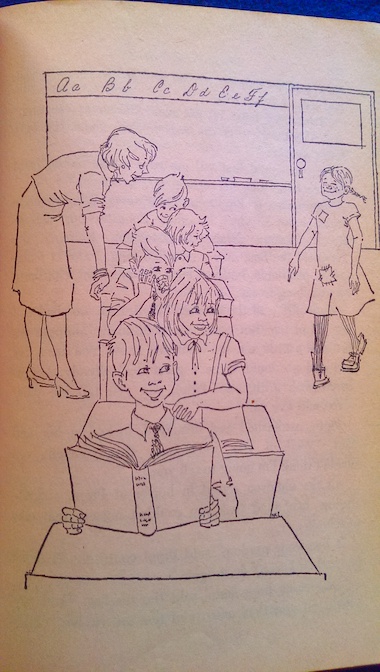
Tommy and Annika try to persuade Pippi to come to school with them, but that doesn’t work out, either. Pippi, completely unfamiliar with the routine of school, thinks that the teacher is weirdly obsessed with numbers because she keeps demanding that her students give her the answers to math problems that Pippi thinks she should be able to solve on her own. The teacher concludes that school may not be for Pippi, at least not at this point in her life.

Tommy and Annika delight in the wild things that Pippi does, like facing off with a bull while they’re on a picnic, accepting a challenge to fight a strongman at the circus, and throwing a party with a couple of burglars.  When they invite Pippi to their mother’s coffee party, and their mother’s friends begin talking about their servants and how hard it is to find good help, Pippi (having already devastated the buffet of desserts and made a mess in general) jumps in with a series of tall tales about a servant that her grandparents had, interrupting everyone else.  Tommy and Annika’s mother finally decides that she’s had enough and sends Pippi away.  Pippi does leave, but still continuing the story about the servant on the way out, yelling out the punchline from down the street.

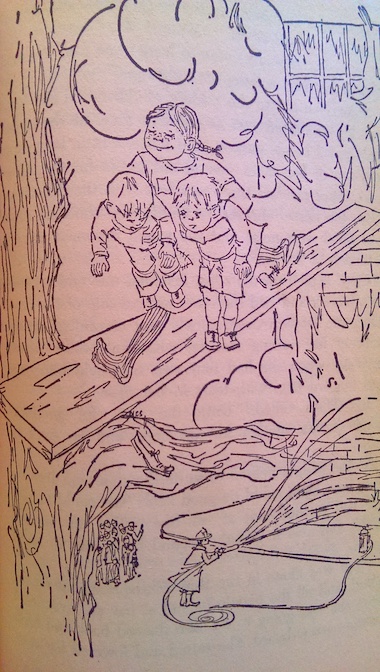
However, Pippi becomes a local hero when she saves some children from a fire after the fireman decide that they can’t reach them themselves.

The book is available to borrow and read for free online through Internet Archive.

My Reaction

I have to admit that, as a character, Pippi sometimes annoys me with her obvious lies and some of the stuff she does. She openly admits that she lies after telling some of her tall tales, but it’s the parts where she admonishes her listeners not to be so gullible that get to me. You can tell that her listeners aren’t really fooled at all; they’re just trying to be polite by not calling her a liar directly, and then she insults them for it. Maybe it’s Pippi who’s really the gullible one, thinking that she’s fooling people when she isn’t really. 

Admittedly, Pippi’s wild stories are sometimes amusing.  I liked the one where she claimed that the reason why other people don’t believe in ghosts is that all of the ghosts in the world live in her attic and play nine-pins with their heads.  When Tommy and Annika go up there to see them, there aren’t any, of course, and Pippi says that they must be away at a conference for ghosts and goblins.

I just don’t like it that Pippi seems to be deliberately trying to make people look dumb when she’s the one saying all the stupid stuff and it’s really obvious that people know it. I also don’t like the part where she makes such a mess at the coffee party because she seems to be trying to be a messy pain on purpose.  She insists that it’s just because she doesn’t know how to behave, but I get the sense that it’s just an excuse and that Pippi just likes to pretend to be more ignorant than she is, pushing limits just because she likes to and because she usually gets away with it.  I didn’t think it was very funny.  But, Tommy and Annika seem to just appreciate Pippi’s imagination, enjoying Pippi’s antics, which bring excitement and chaos to a world controlled by sensible adults, which can be boring to kids, and accepting Pippi’s stories for the tall tales they are, playing along with her.

Pippi herself is really a tall tale, with her super strength, her father the cannibal king, and her ability to turn pretty much any situation her to advantage.  Part of her ability to “come out on top” is due to her super strength and part of it is that Pippi approaches situations from the attitude that she’s already won and isn’t answerable to anyone but herself.  This approach doesn’t always work in real life (I can’t recommend trying it on any of your teachers, or worse still, your boss – not everyone is easily impressed, especially the people who pay your salary), and nobody in real life has Pippi’s super strength to back it up. The adults in the story frequently let Pippi win because they decide that fighting with her just isn’t worth it. (Admittedly, that does happen in real life, too. I’ve seen teachers and other people give in to people who are just too much of a pain to argue with because they’re too impatient or find the argument too exhausting.)  Kids delight in Pippi’s ability to get the better of the adults, who usually have all the control, and in Pippi’s freedom to do what she wants in all situations.

One thing that might surprise American children reading this story is that the children in the story drink coffee. Tommy and Annika say that they are usually only allowed to drink it at parties, although Pippi has it more often. It isn’t very common for American children to drink coffee in general because it’s usually considered more of an adult’s drink and because of concerns about the effects of too much caffeine on young children. Children in Scandinavia tend to drink coffee at a younger age than kids in the United States.

Imogene’s Antlers

ImogenesAntlers

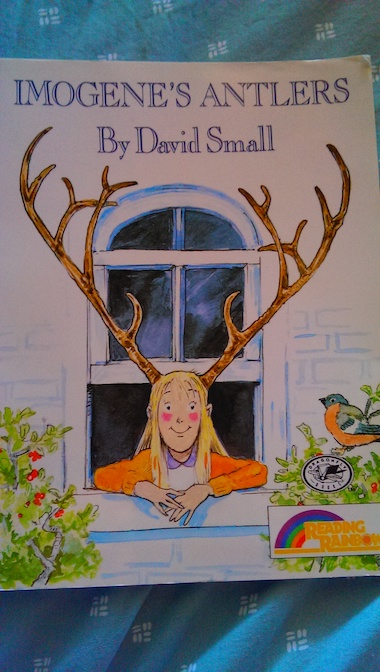
Imogene’s Antlers by David Small, 1985.

One day, a young girl named Imogene wakes up to find that she has sprouted antlers during the night. It comes as a shock to the rest of her family, and she finds that it’s very difficult to do things with large antlers sticking out of her head.

No one seems to know why Imogene has sprouted antlers or what to do about them. Imogene’s mother faints just about every time she looks at her daughter, and her attempt to help Imogene hide them with a specially-designed hat is pure disaster. Imogene’s brother, Norman, thinks that Imogene might be a rare kind of elk now.

However, Imogene still has a lovely day as the family maid uses her as a rack to dry towels and the cook decks out her antlers with donuts to feed the birds.  She even puts candles on her antlers as an elaborate candelabra while she practices her piano lesson.

ImogenesAntlersDonuts

Still, it’s a most bizarre day, and her family is relieved when the antlers are gone the following morning.  But, Imogene’s adventures may only be just beginning.

The book never offers an explanation for why Imogene grew antlers or why she now has a peacock tail, but it doesn’t really matter. This is just one of those books that’s fun to read because it’s silly. While Imogene’s mother panics over her daughter’s condition and tries to hide it under a ridiculously big hat at one point, readers don’t have to worry about the long-term implications of Imogene’s antlers (or any other animal transformations) because she just enjoys them for what they are. The peacock feathers may not have as many practical uses as the antlers did, but one can imagine that Imogene will make the most of them while she has them.  I loved this book when I was a kid!

This book was featured on Reading Rainbow.  It is currently available online through Internet Archive.
Mirette on the High Wire

Mirette

Mirette on the High Wire by Emily Arnold McCully, 1992.

About 100 years ago (the book says, so it’s around the 1890s), a young girl named Mirette and her widowed mother run a boardinghouse in Paris. Most of the people who live there are actors and performers of various kinds.

MiretteBoardinghouse

One day, a strange, quiet man named Bellini comes to stay at the boardinghouse. Most of the time, Bellini prefers to keep to himself, but then Mirette catches him walking on the rope they are using for clothesline in the courtyard of the house. It turns out that Bellini is a tightrope walker. Mirette begs him to teach her how to do it, but he refuses.

MIretteRequest

Not to be daunted, Mirette begins experimenting with tightrope walking herself. After repeated falls, Mirette eventually learns to balance on the rope. When she shows Bellini that she can walk the length of the rope, he is impressed with her perseverance and teaches her more things to develop her skills. However, he becomes very upset when she boasts that she will never fall again.

MirettePractice

Mirette learns that Bellini was a world-famous tightrope walker until a friend of his was killed in a fall, and he lost his nerve. She talks to Bellini about it, and he says that he doesn’t know how to get over being afraid. Seeing Mirette’s disappointment and worry, however, gives Bellini the courage to try once again.

MiretteBellini

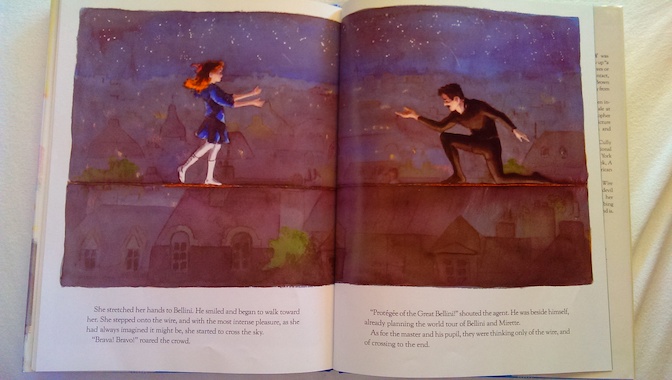
After talking with a performing agent staying at the boardinghouse, Bellini arranges a performance where he will walk a tightrope over a Paris street. When Mirette sees him hesitating at the beginning of the performance, she joins him on the wire, bolstering his courage and realizing her own dreams of becoming a real tightrope walker.

MiretteBelliniTightrope

There are other books in a series about Mirette and Bellini, where they perform tightrope acts and have adventures around the world, but I think that the first book is really the best.  The pictures are beautiful, done in an impressionistic style.

This book is a Caldecott Award winner.  It is currently available online through Internet Archive.
Pocahontas

Pocahontas

Pocahontas by Jan Gleiter and Kathleen Thompson, 1985.

The story about the life of the young Native American woman known as Pocahontas (“Pocahontas” was really a nickname, which the book mentions, although it doesn’t say that her original name was Matoaka) has been told many times in many forms, but this particular book is somewhat sentimental for me because it was the first one I ever read about her when I was a kid. It’s part of a series about famous and legendary figures in history and myth. Pocahontas was a real, historical person, but aspects of her life have taken on the characteristics of legend (as well as providing material for a Disney movie, although the Disney movie takes liberties with the real life of Matoaka/Pocahontas and the movie was not based on this particular rendition of her story).

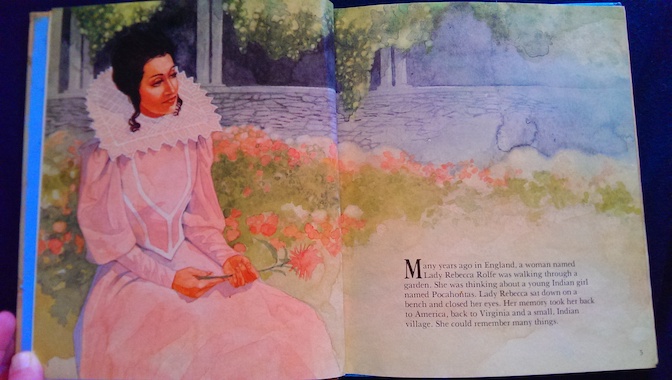
When this particular book begins, Pocahontas is a grown, married woman going by the name of Lady Rebecca Rolfe. While living in England, she reflects back on her life and youth, remembering when she first met Europeans.

PocahontasEngland

When she was ten years old, she heard her father, Powhatan (who was the chief of their tribe) and other men talking about the white men. Although Pocahontas hears that the white people had betrayed her people’s trust and even killed some of them, she is curious to get a look at them.

PocahontasSettlerChildren

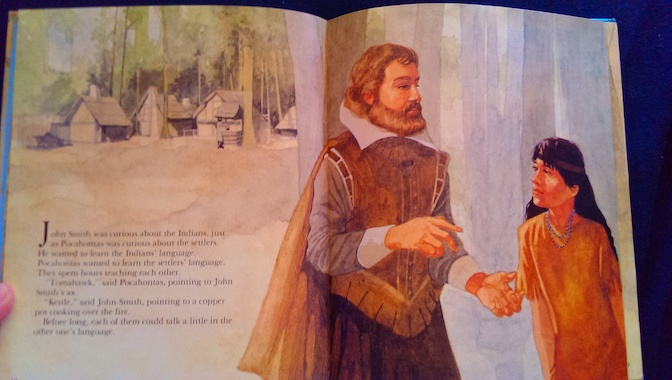
She ends up meeting with a group of boys from Jamestown and playing with them. She begins making friends with people in Jamestown and visiting them from time to time. A man named John Smith becomes curious about the girl and her people and gets Pocahontas to teach him some of her language.  (The book is more accurate than the Disney version here, showing that there is a significant age difference between Pocahontas and John Smith, with Pocahontas being a child at their first meeting.)

PocahontasJohnSmith

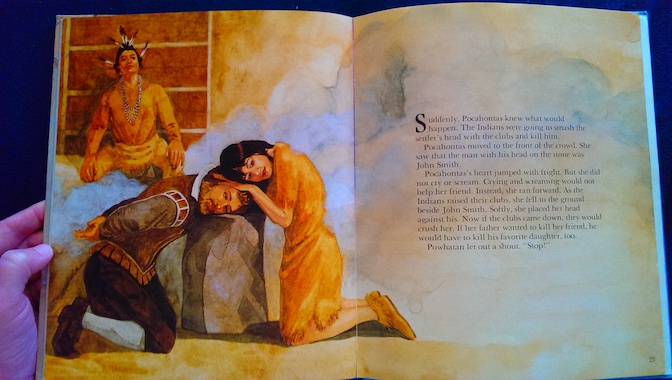
Then, one day, there is a feast in Pocahontas’s village, and some of the men of the tribe bring a white man who was caught trespassing in their territory. Pocahontas recognizes the white man as John Smith and, upon realizing that he is about to be executed, intervenes to save his life. (This is one of the most famous parts of the story of Pocahontas’s life, although the exact circumstances surrounding the real-life incident are a little confusing and may have actually been part of a more complex ritual that John Smith didn’t fully understand at the time, not an actual attempt at execution, if the event actually happened at all. This book offers a simplified version of the incident, supposing that John Smith’s life was in real danger, as he described it in his account of what happened.)

PocahontasExecutionAttempt

In the end, the settlers at Jamestown kidnap Pocahontas in the hope that Powhatan would end hostilities with them, using her as a bargaining chip.  (The book says that her father wasn’t too worried because he knew that the settlers were her friends and would treat her well, but I find this part of the book pretty worrying myself, reading it as an adult.  I’m pretty sure that is not how a parent would react to a missing child in real life.  I guess that the book is trying to keep the tone light for children, but it just sounds weird.) Pocahontas remains among the settlers, living according to their lifestyle and taking the name Rebecca. Eventually, she meets a man named John Rolfe and marries him. The two of them have a son together. With her new family, she travels to England and tries to help the people there to understand her people.  (The book says this in a very optimistic way, calling her visit a “success”, although in real life, this visit was largely a propaganda move on the part of the Virginia Company of London. On the other hand, she was, evidently, very well-received in England, if something of a social curiosity.)

PocahontasWedding

The story in the book ends here, with her still in England, thinking back on her life and her reasons for being there. Part of me wishes that it had explained a little more about Pocahontas’s earlier life and some other facts behind her story. Sadly, part of the reason why they might have been reluctant to tell the rest of the story to children was that the real Pocahontas didn’t live very long after the point where the story ends.  As she was preparing to return to Virginia from England, she became very ill and died.  Her exact age at the time of her death is unknown, but she was probably about 21 years old.  Her son, Thomas Rolfe, was very young at the time she died, but they do still have living descendants today.

Overall, I’d say that this is one of those stories that becomes more interesting when you’re older and realize the full depth of it.  This picture book is a very simplified version of the story, meant for kids, but when I was young, it did inspire me to learn more about Pocahontas.  There any many missing details of Matoaka/Pocahontas/Rebecca Rolfe’s life because of the limited records of it, but what is known is fascinating.  It’s sad because she died so young, but that the story of her life lived on in so many imaginations after her death is profound.  Different people, both when she was alive and after her death, tried to use her for their own purposes, but her legend still continues, out-living them all.  I’ve never seen the Disney Pocahontas movies, and I don’t really want to.  I already know how the story ends.

The book is currently available online through Internet Archive.

The Haunting of Cabin 13

Cabin13The Haunting of Cabin 13 by Kristi D. Holl, 1987.

Thirteen-year-old Laurie is looking forward to her family’s vacation. They’ve rented a cabin for a week, Cabin 13, by the lake at Backbone State Park (It’s a real state park in Iowa. Link repaired 10-19-22.), and her friend Jenny is staying there with them. Laurie’s mother isn’t looking forward to the trip. She hates dirt and bugs and doesn’t like the cabin when they arrive. As everyone starts unpacking, Laurie looks around the cabin and finds a note that warns them to leave because the cabin is haunted. Supposedly, it was written by the ghost herself. The note is signed “Eleanor.” Laurie’s mother thinks that they should leave right away, but Laurie and the rest of the family persuade her that it’s just a joke. At first, Laurie’s sure that’s all it is.

Then, the park ranger tells the family that the other families who have tried to stay in that cabin this summer also found similar notes. It might be just a prank, but it might not. He also tells them that a girl named Eleanor, the same age as Laurie and Jenny, drowned there the summer before, and strange things have been seen there since, like lights around the lake. Laurie’s brother, Ricky, thinks it sounds cool that they’re staying in a haunted cabin by a haunted lake. Like others, Laurie thinks that the notes are the product of a prankster, but what would be the point behind it?

The girls meet a pair of brothers who are staying nearby, Kevin and Matt. When they tell them about the note, Matt is eager to investigate. Jenny enjoys flirting with boys, and she’s mostly interested in flirting with good-looking, athletic Kevin. Matt is in a wheelchair, so Jenny doesn’t pay much attention to him. She just makes an awkward comment about cripples being able to contribute to society that makes everyone feel uncomfortable. Although Laurie knows that Jenny’s comment was inappropriately personal and callous, Laurie also underrates Matt’s ability to help with their note mystery at first, and she’s shy about talking to him because she’s often shy around boys. However, needing someone to confide her thoughts in when Jenny isn’t interested, Laurie talks to Matt about her theories about the mysterious notes. Matt turns out to be easy to talk to, helping Laurie get over her nervousness about talking to boys.

At first, Laurie tells Matt that she thinks that the prankster is trying to drive people away from Cabin 13 because something important is hidden there. However, as she starts asking questions about Eleanor, she learns that the notes haven’t just been directed at Cabin 13. Staff at the park have also received notes from “Eleanor.” Laurie also sees a figure in black sneaking around the park, who she is sure is not a ghost.

It isn’t long before Laurie receives more notes from “Eleanor,” hinting that she might be in danger, and she and Jenny see the mysterious lights that people have been talking about. Then, when the children are out in a canoe together, it develops a leak and sinks. Matt panics because his legs are paralyzed, and he can’t swim, but Laurie saves him with the help of some people in another boat.

Was that accident just an accident, or could it have something to do with Eleanor’s “accident” last year? There are plenty of suspects who might have reasons for playing ghost and stirring up trouble at the lake. Matt’s father blames the park ranger for the accident that paralyzed Matt. At a previous visit to the lake, Matt was crossing a road with his father and brother and was struck by a speeding car. Matt father says it wouldn’t have happened if the roads had been policed properly. Laurie realizes that he might have a motive for revenge. Then again, some people have been coming to the lake, drawn by the ghost stories and hoping to see the mysterious lights. Could the ghost be a publicity stunt to drum up business?

The book is available to borrow and read for free online through Internet Archive.

My Reaction and Spoilers

When Laurie discovers that Eleanor’s half sister has come to the lake to investigate Eleanor’s death herself, she thinks that she has the mystery solved, but she’s only half right. It’s true that Eleanor’s sister has been responsible for some of the things happening at the lake, but not all of them.  She explains to the kids that Eleanor loved mystery stories and was always playing detective games, but she thinks that perhaps the game got too real for Eleanor the summer that she died.  There is something sinister going on at the lake, something that Eleanor also realized before her death, and there is more to Eleanor’s death than most people know.

At the end of the book, Matt gets a chance to be a hero and stop the bad guy from escaping, using his wheelchair to his advantage because a person on wheels can sometimes move faster than a person on foot.  Even before that, Laurie had gained an appreciation for Matt and his sensible thinking, realizing that a person who is impaired in one way can still have great abilities in other areas of life.  She also comes to think of Matt as being brave for coming back to the site of the accident that made him a paraplegic.  Matt says that he had to come in order to prove to himself that there was nothing inherently bad about the  place and to stop the nightmares he was having about his accident.  Matt and Eleanor’s sister both make Laurie realize that everyone has something difficult or frightening that they have to deal with in their lives; it’s just that some people’s problems are more obvious than others.  Everyone can see what Matt’s dealing with at first glance because he’s in a wheelchair, but no one knew about the pain and fear that Eleanor’s sister was carrying around with her until she admitted it.

I consider this story a pseudo-ghost story because the obvious parts of the haunting were caused by living people, for reasons of their own.  However, Laurie seems to feel that Eleanor’s spirit was there with them, waiting to see the mystery of her death solved.  It’s left open to interpretation, but if Eleanor was there, it was only seen in the odd feelings that Laurie had from time to time, not in any more obvious or physical way.

Something that confused me a little in the book is that, at one point, Jenny tells someone that Laurie already has a reputation for being an amateur detective, having discovered that Jenny herself had been kidnapped when the authorities thought that she had run away from home. Jenny gives full details of the time when she was kidnapped, including who kidnapped her and why and how Laurie figured out where she was. When I read that section of the story, I thought at first that the author was talking about a previous book that she had written with these two characters, but I had trouble figuring out which it was, if any.

Interesting fact: some of the children in the story are named after the author’s own children.

Katy Comes Next

KatyComesNext

Katy Comes Next by Laura Bannon, 1959.

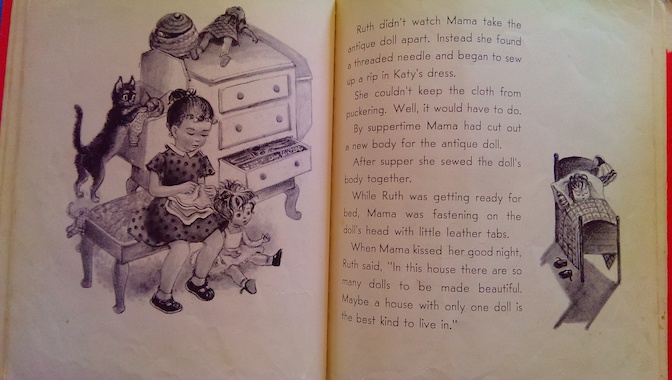
Ruth is little girl whose parents own a doll hospital. She has always been proud and fascinated by how her parents can make old or damaged dolls beautiful again.

KatyComesNextDollShop

However, Ruth’s own beloved doll, Katy, is in need of repair herself. As her parents rush around repairing dolls for their customers, they keep assuring her that Katy’s turn will come next.

KatyComesNextRuthsFather

After being put off repeatedly, Ruth starts to think that poor Katy will never get the attention that she needs.

KatyComesNextRuthMending

When Ruth’s parents realize how discouraged she is, they decide to take a day off for Katy to come first.

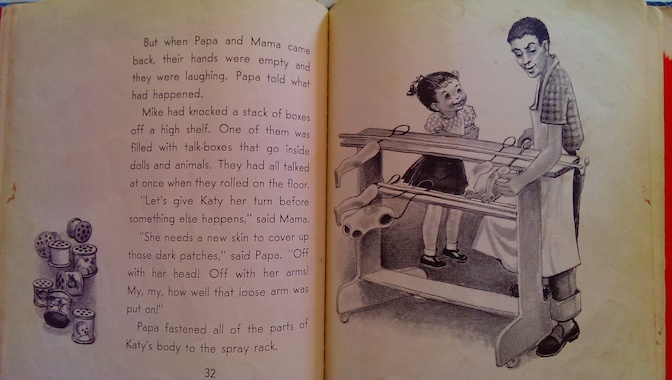
KatyComesNextFatherPaintSpray

This was one of absolute favorites when I was little!  The pictures alternate between black and white and color and show the process that Ruth’s parents go through to repair Katy, repaint her body and features, and give her new hair and eyes.

KatyComesNextWigs
KatyComesNextClothesTrunk

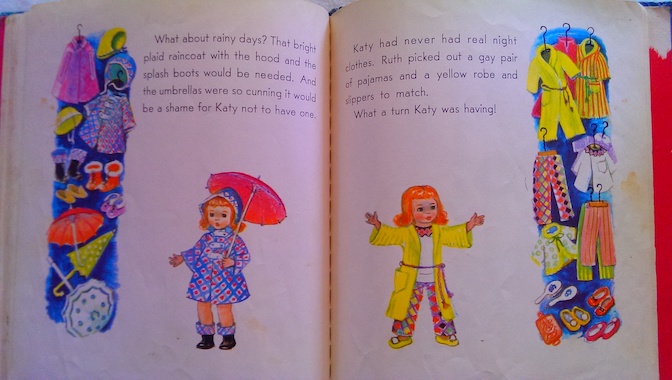
Ruth also gets to pick out an entirely new wardrobe for Katy. I was always fascinated with the description of how Ruth’s parents fixed the doll, and I enjoyed imagining the doll clothes that I would have selected from the ones they showed in the pictures.  Making the choices is half the fun!

KatyComesNextDresses
KatyComesNextPajamas

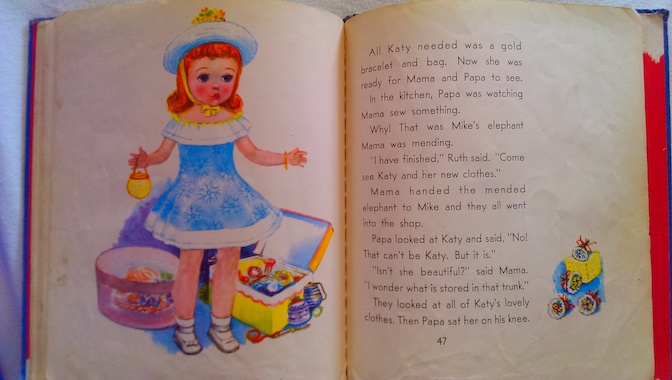
When Katy is finally finished, she looks beautiful, and Ruth is happy!  This is one of the many out of print children’s books that I wish would come back into print!

KatyComesNextPartyDress