Imogene’s Antlers

ImogenesAntlers

Imogene’s Antlers by David Small, 1985.

One day, a young girl named Imogene wakes up to find that she has sprouted antlers during the night. It comes as a shock to the rest of her family, and she finds that it’s very difficult to do things with large antlers sticking out of her head.

No one seems to know why Imogene has sprouted antlers or what to do about them. Imogene’s mother faints just about every time she looks at her daughter, and her attempt to help Imogene hide them with a specially-designed hat is pure disaster. Imogene’s brother, Norman, thinks that Imogene might be a rare kind of elk now.

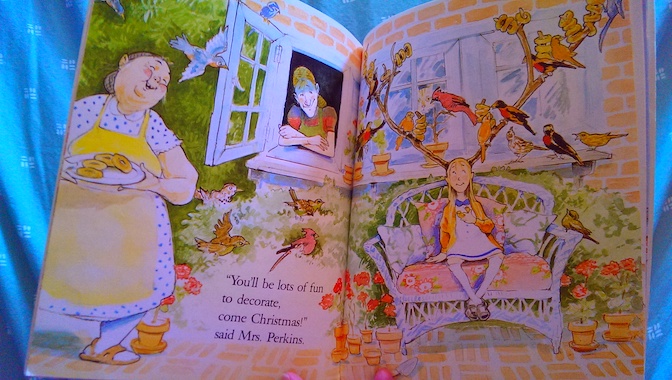
However, Imogene still has a lovely day as the family maid uses her as a rack to dry towels and the cook decks out her antlers with donuts to feed the birds.  She even puts candles on her antlers as an elaborate candelabra while she practices her piano lesson.

ImogenesAntlersDonuts

Still, it’s a most bizarre day, and her family is relieved when the antlers are gone the following morning.  But, Imogene’s adventures may only be just beginning.

The book never offers an explanation for why Imogene grew antlers or why she now has a peacock tail, but it doesn’t really matter. This is just one of those books that’s fun to read because it’s silly. While Imogene’s mother panics over her daughter’s condition and tries to hide it under a ridiculously big hat at one point, readers don’t have to worry about the long-term implications of Imogene’s antlers (or any other animal transformations) because she just enjoys them for what they are. The peacock feathers may not have as many practical uses as the antlers did, but one can imagine that Imogene will make the most of them while she has them.  I loved this book when I was a kid!

This book was featured on Reading Rainbow.  It is currently available online through Internet Archive.

Mirette on the High Wire

Mirette

Mirette on the High Wire by Emily Arnold McCully, 1992.

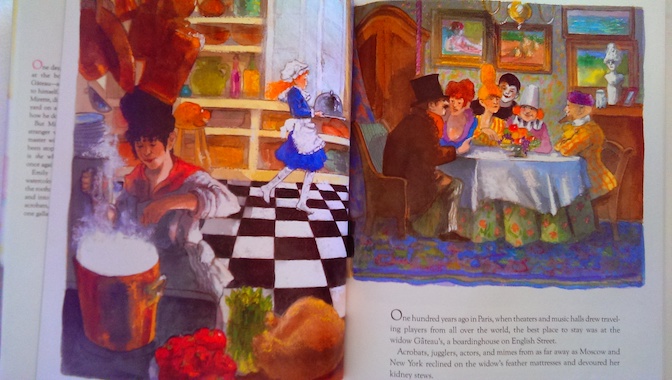
About 100 years ago (the book says, so it’s around the 1890s), a young girl named Mirette and her widowed mother run a boardinghouse in Paris. Most of the people who live there are actors and performers of various kinds.

MiretteBoardinghouse

One day, a strange, quiet man named Bellini comes to stay at the boardinghouse. Most of the time, Bellini prefers to keep to himself, but then Mirette catches him walking on the rope they are using for clothesline in the courtyard of the house. It turns out that Bellini is a tightrope walker. Mirette begs him to teach her how to do it, but he refuses.

MIretteRequest

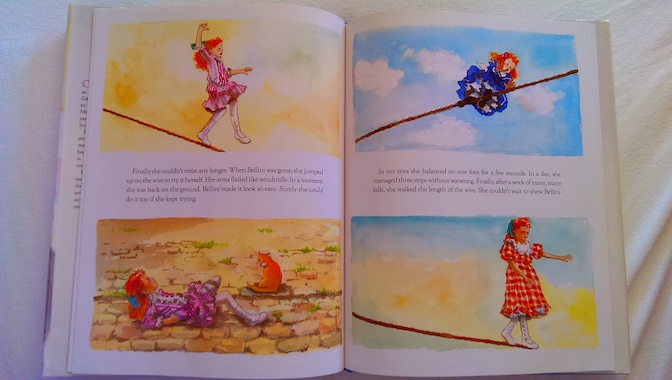
Not to be daunted, Mirette begins experimenting with tightrope walking herself. After repeated falls, Mirette eventually learns to balance on the rope. When she shows Bellini that she can walk the length of the rope, he is impressed with her perseverance and teaches her more things to develop her skills. However, he becomes very upset when she boasts that she will never fall again.

MirettePractice

Mirette learns that Bellini was a world-famous tightrope walker until a friend of his was killed in a fall, and he lost his nerve. She talks to Bellini about it, and he says that he doesn’t know how to get over being afraid. Seeing Mirette’s disappointment and worry, however, gives Bellini the courage to try once again.

MiretteBellini

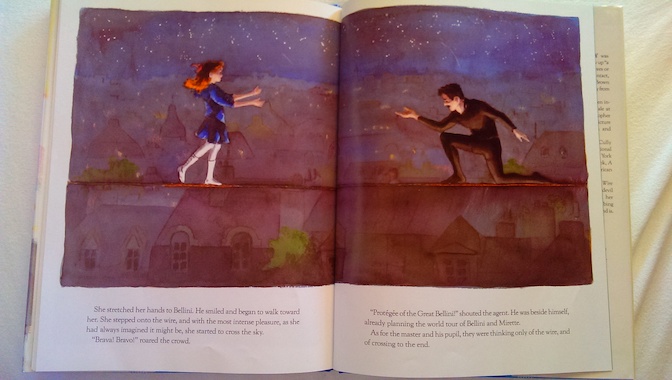
After talking with a performing agent staying at the boardinghouse, Bellini arranges a performance where he will walk a tightrope over a Paris street. When Mirette sees him hesitating at the beginning of the performance, she joins him on the wire, bolstering his courage and realizing her own dreams of becoming a real tightrope walker.

MiretteBelliniTightrope

There are other books in a series about Mirette and Bellini, where they perform tightrope acts and have adventures around the world, but I think that the first book is really the best.  The pictures are beautiful, done in an impressionistic style.

This book is a Caldecott Award winner.  It is currently available online through Internet Archive.

Pocahontas

Pocahontas

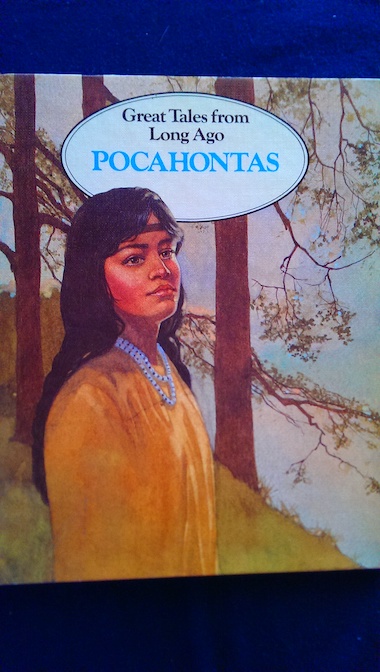
Pocahontas by Jan Gleiter and Kathleen Thompson, 1985.

The story about the life of the young Native American woman known as Pocahontas (“Pocahontas” was really a nickname, which the book mentions, although it doesn’t say that her original name was Matoaka) has been told many times in many forms, but this particular book is somewhat sentimental for me because it was the first one I ever read about her when I was a kid. It’s part of a series about famous and legendary figures in history and myth. Pocahontas was a real, historical person, but aspects of her life have taken on the characteristics of legend (as well as providing material for a Disney movie, although the Disney movie takes liberties with the real life of Matoaka/Pocahontas and the movie was not based on this particular rendition of her story).

When this particular book begins, Pocahontas is a grown, married woman going by the name of Lady Rebecca Rolfe. While living in England, she reflects back on her life and youth, remembering when she first met Europeans.

PocahontasEngland

When she was ten years old, she heard her father, Powhatan (who was the chief of their tribe) and other men talking about the white men. Although Pocahontas hears that the white people had betrayed her people’s trust and even killed some of them, she is curious to get a look at them.

PocahontasSettlerChildren

She ends up meeting with a group of boys from Jamestown and playing with them. She begins making friends with people in Jamestown and visiting them from time to time. A man named John Smith becomes curious about the girl and her people and gets Pocahontas to teach him some of her language.  (The book is more accurate than the Disney version here, showing that there is a significant age difference between Pocahontas and John Smith, with Pocahontas being a child at their first meeting.)

PocahontasJohnSmith

Then, one day, there is a feast in Pocahontas’s village, and some of the men of the tribe bring a white man who was caught trespassing in their territory. Pocahontas recognizes the white man as John Smith and, upon realizing that he is about to be executed, intervenes to save his life. (This is one of the most famous parts of the story of Pocahontas’s life, although the exact circumstances surrounding the real-life incident are a little confusing and may have actually been part of a more complex ritual that John Smith didn’t fully understand at the time, not an actual attempt at execution, if the event actually happened at all. This book offers a simplified version of the incident, supposing that John Smith’s life was in real danger, as he described it in his account of what happened.)
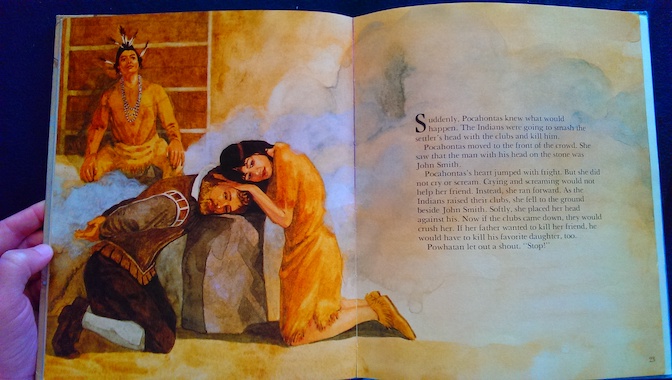
PocahontasExecutionAttempt

In the end, the settlers at Jamestown kidnap Pocahontas in the hope that Powhatan would end hostilities with them, using her as a bargaining chip.  (The book says that her father wasn’t too worried because he knew that the settlers were her friends and would treat her well, but I find this part of the book pretty worrying myself, reading it as an adult.  I’m pretty sure that is not how a parent would react to a missing child in real life.  I guess that the book is trying to keep the tone light for children, but it just sounds weird.) Pocahontas remains among the settlers, living according to their lifestyle and taking the name Rebecca. Eventually, she meets a man named John Rolfe and marries him. The two of them have a son together. With her new family, she travels to England and tries to help the people there to understand her people.  (The book says this in a very optimistic way, calling her visit a “success”, although in real life, this visit was largely a propaganda move on the part of the Virginia Company of London. On the other hand, she was, evidently, very well-received in England, if something of a social curiosity.)

PocahontasWedding

The story in the book ends here, with her still in England, thinking back on her life and her reasons for being there. Part of me wishes that it had explained a little more about Pocahontas’s earlier life and some other facts behind her story. Sadly, part of the reason why they might have been reluctant to tell the rest of the story to children was that the real Pocahontas didn’t live very long after the point where the story ends.  As she was preparing to return to Virginia from England, she became very ill and died.  Her exact age at the time of her death is unknown, but she was probably about 21 years old.  Her son, Thomas Rolfe, was very young at the time she died, but they do still have living descendants today.

Overall, I’d say that this is one of those stories that becomes more interesting when you’re older and realize the full depth of it.  This picture book is a very simplified version of the story, meant for kids, but when I was young, it did inspire me to learn more about Pocahontas.  There any many missing details of Matoaka/Pocahontas/Rebecca Rolfe’s life because of the limited records of it, but what is known is fascinating.  It’s sad because she died so young, but that the story of her life lived on in so many imaginations after her death is profound.  Different people, both when she was alive and after her death, tried to use her for their own purposes, but her legend still continues, out-living them all.  I’ve never seen the Disney Pocahontas movies, and I don’t really want to.  I already know how the story ends.

The book is currently available online through Internet Archive.

The Haunting of Cabin 13

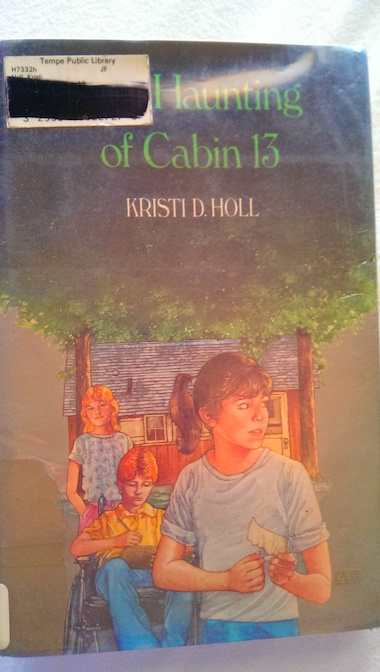
Cabin13The Haunting of Cabin 13 by Kristi D. Holl, 1987.

Thirteen-year-old Laurie is looking forward to her family’s vacation. They’ve rented a cabin for a week, Cabin 13, by the lake at Backbone State Park (It’s a real state park in Iowa. Link repaired 10-19-22.), and her friend Jenny is staying there with them. Laurie’s mother isn’t looking forward to the trip. She hates dirt and bugs and doesn’t like the cabin when they arrive. As everyone starts unpacking, Laurie looks around the cabin and finds a note that warns them to leave because the cabin is haunted. Supposedly, it was written by the ghost herself. The note is signed “Eleanor.” Laurie’s mother thinks that they should leave right away, but Laurie and the rest of the family persuade her that it’s just a joke. At first, Laurie’s sure that’s all it is.

Then, the park ranger tells the family that the other families who have tried to stay in that cabin this summer also found similar notes. It might be just a prank, but it might not. He also tells them that a girl named Eleanor, the same age as Laurie and Jenny, drowned there the summer before, and strange things have been seen there since, like lights around the lake. Laurie’s brother, Ricky, thinks it sounds cool that they’re staying in a haunted cabin by a haunted lake. Like others, Laurie thinks that the notes are the product of a prankster, but what would be the point behind it?

The girls meet a pair of brothers who are staying nearby, Kevin and Matt. When they tell them about the note, Matt is eager to investigate. Jenny enjoys flirting with boys, and she’s mostly interested in flirting with good-looking, athletic Kevin. Matt is in a wheelchair, so Jenny doesn’t pay much attention to him. She just makes an awkward comment about cripples being able to contribute to society that makes everyone feel uncomfortable. Although Laurie knows that Jenny’s comment was inappropriately personal and callous, Laurie also underrates Matt’s ability to help with their note mystery at first, and she’s shy about talking to him because she’s often shy around boys. However, needing someone to confide her thoughts in when Jenny isn’t interested, Laurie talks to Matt about her theories about the mysterious notes. Matt turns out to be easy to talk to, helping Laurie get over her nervousness about talking to boys.

At first, Laurie tells Matt that she thinks that the prankster is trying to drive people away from Cabin 13 because something important is hidden there. However, as she starts asking questions about Eleanor, she learns that the notes haven’t just been directed at Cabin 13. Staff at the park have also received notes from “Eleanor.” Laurie also sees a figure in black sneaking around the park, who she is sure is not a ghost.

It isn’t long before Laurie receives more notes from “Eleanor,” hinting that she might be in danger, and she and Jenny see the mysterious lights that people have been talking about. Then, when the children are out in a canoe together, it develops a leak and sinks. Matt panics because his legs are paralyzed, and he can’t swim, but Laurie saves him with the help of some people in another boat.

Was that accident just an accident, or could it have something to do with Eleanor’s “accident” last year? There are plenty of suspects who might have reasons for playing ghost and stirring up trouble at the lake. Matt’s father blames the park ranger for the accident that paralyzed Matt. At a previous visit to the lake, Matt was crossing a road with his father and brother and was struck by a speeding car. Matt father says it wouldn’t have happened if the roads had been policed properly. Laurie realizes that he might have a motive for revenge. Then again, some people have been coming to the lake, drawn by the ghost stories and hoping to see the mysterious lights. Could the ghost be a publicity stunt to drum up business?

The book is available to borrow and read for free online through Internet Archive.
My Reaction and Spoilers

When Laurie discovers that Eleanor’s half sister has come to the lake to investigate Eleanor’s death herself, she thinks that she has the mystery solved, but she’s only half right. It’s true that Eleanor’s sister has been responsible for some of the things happening at the lake, but not all of them.  She explains to the kids that Eleanor loved mystery stories and was always playing detective games, but she thinks that perhaps the game got too real for Eleanor the summer that she died.  There is something sinister going on at the lake, something that Eleanor also realized before her death, and there is more to Eleanor’s death than most people know.

At the end of the book, Matt gets a chance to be a hero and stop the bad guy from escaping, using his wheelchair to his advantage because a person on wheels can sometimes move faster than a person on foot.  Even before that, Laurie had gained an appreciation for Matt and his sensible thinking, realizing that a person who is impaired in one way can still have great abilities in other areas of life.  She also comes to think of Matt as being brave for coming back to the site of the accident that made him a paraplegic.  Matt says that he had to come in order to prove to himself that there was nothing inherently bad about the  place and to stop the nightmares he was having about his accident.  Matt and Eleanor’s sister both make Laurie realize that everyone has something difficult or frightening that they have to deal with in their lives; it’s just that some people’s problems are more obvious than others.  Everyone can see what Matt’s dealing with at first glance because he’s in a wheelchair, but no one knew about the pain and fear that Eleanor’s sister was carrying around with her until she admitted it.

I consider this story a pseudo-ghost story because the obvious parts of the haunting were caused by living people, for reasons of their own.  However, Laurie seems to feel that Eleanor’s spirit was there with them, waiting to see the mystery of her death solved.  It’s left open to interpretation, but if Eleanor was there, it was only seen in the odd feelings that Laurie had from time to time, not in any more obvious or physical way.

Something that confused me a little in the book is that, at one point, Jenny tells someone that Laurie already has a reputation for being an amateur detective, having discovered that Jenny herself had been kidnapped when the authorities thought that she had run away from home. Jenny gives full details of the time when she was kidnapped, including who kidnapped her and why and how Laurie figured out where she was. When I read that section of the story, I thought at first that the author was talking about a previous book that she had written with these two characters, but I had trouble figuring out which it was, if any.

Interesting fact: some of the children in the story are named after the author’s own children.

Katy Comes Next

KatyComesNext

Katy Comes Next by Laura Bannon, 1959.

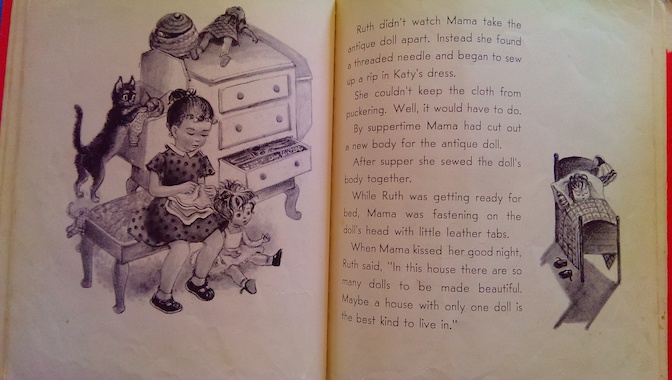
Ruth is little girl whose parents own a doll hospital. She has always been proud and fascinated by how her parents can make old or damaged dolls beautiful again.

KatyComesNextDollShop

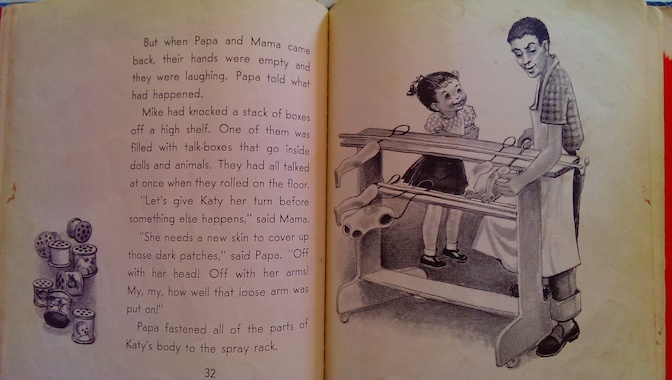
However, Ruth’s own beloved doll, Katy, is in need of repair herself. As her parents rush around repairing dolls for their customers, they keep assuring her that Katy’s turn will come next.

KatyComesNextRuthsFather

After being put off repeatedly, Ruth starts to think that poor Katy will never get the attention that she needs.

KatyComesNextRuthMending

When Ruth’s parents realize how discouraged she is, they decide to take a day off for Katy to come first.

KatyComesNextFatherPaintSpray

This was one of absolute favorites when I was little!  The pictures alternate between black and white and color and show the process that Ruth’s parents go through to repair Katy, repaint her body and features, and give her new hair and eyes.

KatyComesNextWigs
KatyComesNextClothesTrunk

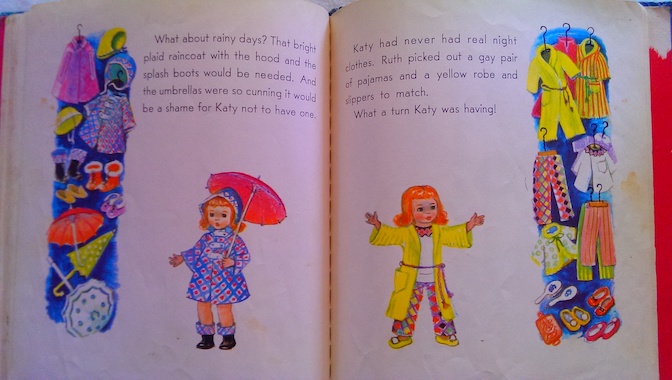
Ruth also gets to pick out an entirely new wardrobe for Katy. I was always fascinated with the description of how Ruth’s parents fixed the doll, and I enjoyed imagining the doll clothes that I would have selected from the ones they showed in the pictures.  Making the choices is half the fun!

KatyComesNextDresses
KatyComesNextPajamas

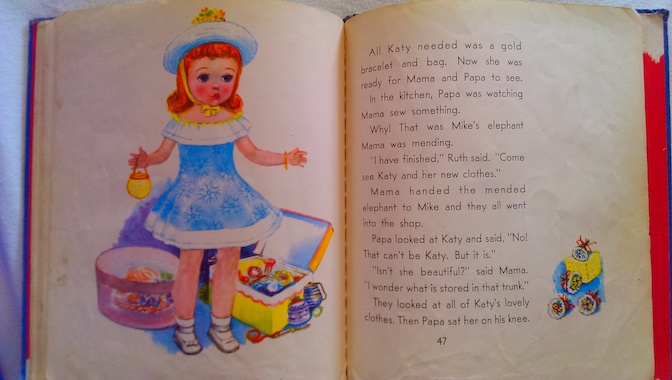
When Katy is finally finished, she looks beautiful, and Ruth is happy!  This is one of the many out of print children’s books that I wish would come back into print!

KatyComesNextPartyDress

The Princess of the Fillmore Street School

Olivia Sharp, Agent for Secrets

OSPrincess

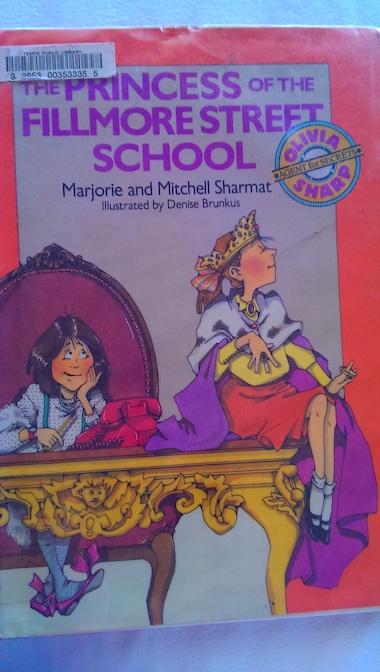
The Princess of the Fillmore Street School by Marjorie Weinman Sharmat and Mitchell Sharmat, 1989.

Desiree, who has always been a bit prissy, tells Olivia that she has decided that she wants to be princess of their school. She plans to prove that she is a perfect princess by trying to make all the other kids perfect. She is getting on everyone’s nerves, telling them to stand up straight or that their hair needs to be fixed.

When the others ask Olivia to help, she suggests to Desiree that she concentrate on making improvements to the school itself, but even that causes problems. Eventually, things get to the point where the school’s principal asks for Olivia’s help. Can anything stop the princess of Fillmore Street School before she drives everyone crazy?

Olivia’s solution is partly pointing out to Desiree the effect that she’s having on other people and partly explaining that a school which is already governed by a principal doesn’t also need a princess.  Then, she finds a way to help Desiree to feel like a princess even though she can’t be one.

The Pizza Monster

Olivia Sharp, Agent for Secrets

OSPizzaMonster

The Pizza Monster by Marjorie Weinman Sharmat and Mitchell Sharmat, 1989.

Olivia lives in a penthouse in San Francisco with her chauffer, Willie, and her housekeeper, Mrs. Fridgeflake. Her wealthy parents live there, too, but they are often traveling and are rarely home. When her best friend, Taffy, moves away, Olivia is lonely. She buys herself a pet owl named Hoot, but that still doesn’t completely help.  She needs something to help keep herself busy. Olivia realizes that she is good at keeping secrets and at helping people with their problems, so she decides to busy herself running a service to help people with their secret problems. She has a bunch of flyers made and hangs them up around town saying that she is an agent for secrets and will help people.

A boy named Duncan, who Olivia knows from school, asks her to help him with his friend, Desiree. He says that they were together at the pizza parlor when she suddenly got angry and walked out.  He doesn’t know what made her angry, but he asks Olivia to help him find out and fix their relationship.

Olivia’s attempts to help are a matter of trial and error. At first, Olivia thinks that Desiree was merely offended that Duncan gave her the smallest slice of pizza. She suggests that Duncan buy her another whole pizza, but that doesn’t work. Even Olivia’s idea to buy her a lot of different kinds of pizza doesn’t work. Eventually, Olivia talks to Desiree herself and learns that there is another reason why she is angry with Duncan.

It turns out that the problem doesn’t have anything to do with pizza but with Duncan himself.  He’s always full of doom and gloom and criticism for everything.  What Duncan needs is an attitude adjustment.  He doesn’t realize that his pessimism and negativity makes it difficult for others to be around him.  Olivia encourages him to be more positive and to develop his sense of humor.  Once his attitude improves, so does his relationship with Desiree.

Nate the Great

NateGreat

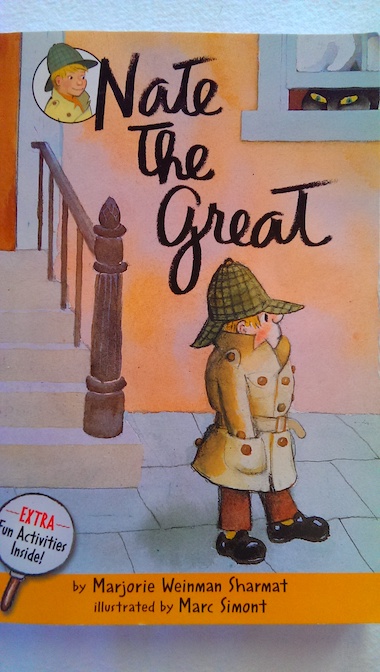
Nate the Great by Marjorie Weinman Sharmat, 1972.

Nate is eating his favorite breakfast, pancakes, when his friend Annie calls him from her house down the street, asking for his help in finding a lost picture. When Nate arrives at Annie’s house, she says that she painted a picture of her dog, Fang, and then left it on her desk to dry, but it disappeared.

NateGreatBreakfast

After establishing that Annie’s house has no trapdoors or secret passages, Nate declares that this will be a very dull case. But, of course, he investigates anyway.

NateGreatAnnie

Nate searches Annie’s room, and not finding the picture, asks Annie who else knew about it. Annie says that she showed it to Fang, her little brother Harry, and her friend Rosamond.

NateGreatYellow

Determining that Fang didn’t bury the picture of himself and that Rosamond is only interested in cats, that just leaves Harry. But, if Harry took Annie’s picture, why did he take it and what did he do with it?

NateGreatHarry

My Reaction

This is a fun mystery for young children, one of the first mysteries that I read as a kid. The pictures in the book have clues, and it helps if kids know how to combine colors to create new ones (hint).

Later editions of the book also have a section of activities in the back. Most of them have to do with art and color, and there is also a recipe for pancakes.

Coffin on a Case

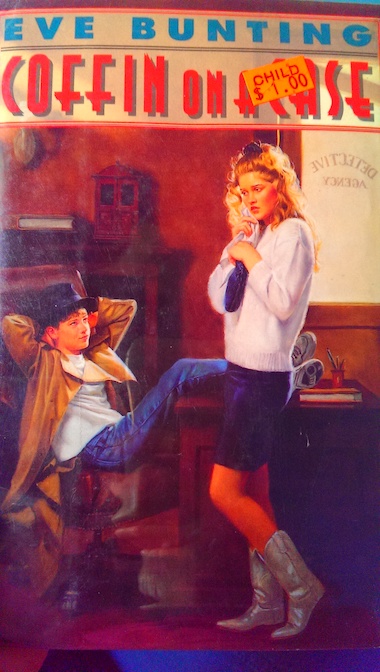
CoffinCaseCoffin on a Case by Eve Bunting, 1992.
Twelve-year-old Henry Coffin’s father is a private investigator, and Henry hopes to be one himself someday.  He’s learned a lot by watching his father in action.  One day, a sixteen-year-old girl, Lily, comes to the office and asks for help in finding her missing mother.  Lily found her mother’s car in their driveway with groceries still in it, and her mother is nowhere to be found.  She doesn’t want to go to the police because she once called the police about her mother being missing only to discover that there was a mix-up and that her mother had tried to leave her a note that she hadn’t seen.  Lily has double-checked this time to make sure that there was definitely no note from her mother and none of her mother’s friends have heard from her, but she worries that the police would think that she’s being paranoid, so she decided to consult a private investigator instead.

Henry’s father is concerned about the disappearance of Lily’s mother, but he’s unable to take the case because he has to go out of town.  He tries to refer Lily to another investigator or a friend of his who is with the police, but Lily just storms out of the office.  Henry wishes that he could take the case for his father.  His own mother abandoned him and his father when Henry was just a baby, so disappearing mothers are of great concern to him.  Later, when Lily gets in touch with him, Henry agrees to help her without telling either his father or Mrs. Sypes, the housekeeper who has looked after him since his mother left.

At first, there doesn’t seem to be much to go on.  Lily’s mother makes wooden storks that she sells as lawn decorations to people who have recently had a baby.  She was going to sell a couple before going to pick up the groceries, but Lily says that there is an extra one missing.  Somewhere between the grocery store and home, Lily’s mother made an unexpected stop . . . and there are signs that someone other than Lily’s mother drove the car to Lily’s house.  But, who was it, and what happened to Lily’s mother?

The answers to these puzzles put Henry on the trail of some dangerous thieves who would do just about anything to cover up their crime.

The book is available to borrow and read for free online through Internet Archive (multiple copies).

My Reaction

Henry shows excellent deductive reasoning as he analyzes the clues and reconstructs Lily’s mother’s trail to learn what happened to her. Both Henry and his father are inspired by the fictional character, Sam Spade, and Henry makes frequent references to him in the story, thinking what Sam Spade would say or do in certain situations.

Throughout the book, Henry also considers his own mother’s disappearance years ago.  Her abandonment of her family was her own choice, not an abduction, which makes her situation different from what happened to Lily’s mother.  Henry has no real memory of his mother, which pains him somewhat.  He sometimes dreams that she’ll return home one day for a happy ending, like in the movies, but he also realizes that’s really just a daydream.  When Lily’s mother is finally rescued, Henry and Lily continue being friends, and Henry also considers whether a relationship would be possible between his father and Lily’s mother.  It’s a nice idea, but Henry also thinks that isn’t likely, and he’s okay with that.

Jennie’s Hat

JenniesHat

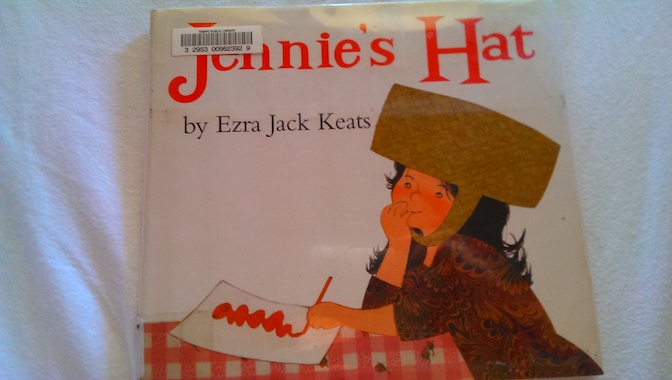
Jennie’s Hat by Ezra Jack Keats, 1966.

When Jennie’s aunt tells her that she’s going to send her a new hat as a present, Jennie is excited.  She imagines that her new hat is going to be big and fancy and covered with flowers.  However, when the hat arrives, it’s just a very plain, ordinary hat with a single ribbon.

JenniesHatGift

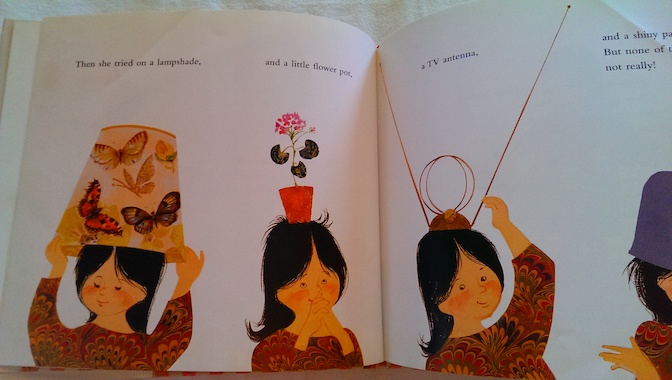
Even though her mother thinks the new hat is nice, Jennie wishes for something fancier, more unusual.  She tries on various other things, like a basket, a lampshade, and a pot to see how they would be as hats.  Of course, none of them really work.

JenniesHatExperiments

Jennie has a habit of feeding the birds, and while she’s coming home after feeding them one day, she wishes out loud that her hat could be fancier.

JenniesHatFeedingBirds

Her bird friends, hearing her wish, decide to help her.  The next day, as she is leaving church, they bring her the things she’s been wishing for so that she can have the hat of her dreams!

JenniesHatChurch

The best part of the story is Jennie’s friendship with the birds and how they repay her for feeding them.  The pictures of all the amazing things they give her for her hat are fun, too!

JenniesHatDecoration

I also liked the unusual artwork style.  Jennie’s clothes are often a cutout of a patterned piece of paper, while the rest of her body is drawn in.