Mailing May

MailingMay

Mailing May by Michael O. Tunnell, 1997.

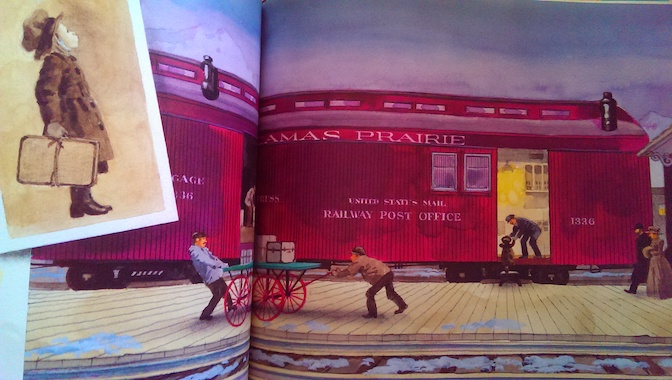
Four-year-old Charlotte May lives in a small town in Idaho in 1914. May, as her family calls her, wants to visit her grandmother in another town, but travel during this time is difficult and expensive. With a lack of roads that are easy to travel, the only comfortable way to get to May’s grandmother’s town is by train. Unfortunately, May’s family can’t afford to buy a train ticket for her.

MailingMayParents

May wants so badly to go see her grandmother that she even asks at the local general store if the owner can hire her, but he doesn’t have any work that a little girl could do.  Then, May’s mother’s cousin helps the family to find a more affordable alternative. If May can’t travel as a passenger, is it possible for her to travel as . . . mail?

MailingMayPostOffice

It turns out that the rate for mailing a live package the size of May is much cheaper than the fee for a passenger ticket.  Because May’s mother’s cousin works in the mail car on the train, he could take responsibility for her during the trip.  So, with a label on her clothes, declaring her to be “baby chicks” and the proper postage stuck to her jacket, May undertakes the journey to her unsuspecting grandmother’s house.

MailingMayTrain
MailingMayMailCar

This story was based on a real incident. In fact, May wasn’t the only child to be sent through the mail when their parents couldn’t afford to send them as passengers. I also like the book for its glimpse at travel and mail services over 100 years ago.

The book is available to borrow and read for free online through Internet Archive.

MailingMayGrandmother

The Happy Valley Mystery

Trixie Belden

TBHappyValley

#9 The Happy Valley Mystery by Kathryn Kenny, 1962.

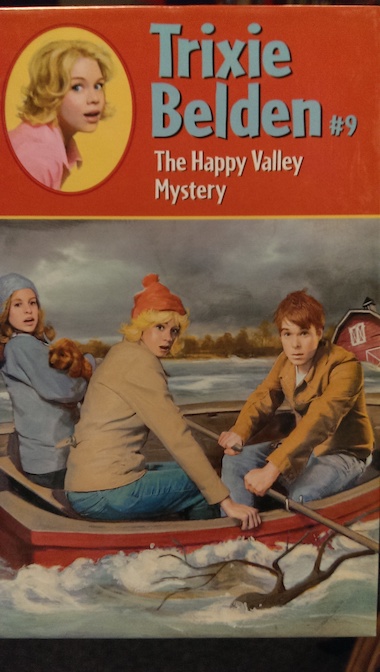
Trixie’s uncle, Andrew Belden, after hearing about the mysteries that the kids have solved, invites them all to spend a week on his sheep farm in Iowa. He won’t be there because he has to take a trip to Scotland, but the Gormans, who are taking care of the sheep, could use their help. Someone has been stealing sheep from the farm, and no one seems able to figure out who it is or how the sheep keep disappearing.

Although Andrew Belden mainly wants the kids to relax, have fun, and learn a little about taking care of sheep, Trixie just can’t resist the challenge to save her uncle’s sheep.  In this book, Trixie is teased a lot for her detective ambitions, and she embarrasses herself a couple of times by suspecting the wrong people. Part of the trouble comes from the fact that she doesn’t know the people in the area and who can legally be the area of her uncle’s farm.

There is a harrowing scene where Trixie and her friends are caught in a flood.  This book also develops the relationship between Jim and Trixie more.  For awhile, each of them is jealous because they think that the other likes someone else.  At the end, Jim gives Trixie a bracelet with his name on it as a sign that they are now boyfriend and girlfriend.

The book is currently available online through Internet Archive.

The Black Jacket Mystery

Trixie Belden

TBBlackJacket

#8 The Black Jacket Mystery by Kathryn Kenny, 1961.

Trixie and the other Bob-Whites are concerned about their pen pals in Mexico because an earthquake has damaged their town. To help them rebuild their school library, the Bob-Whites decide to hold a benefit carnival to collect books.

While they are planning the carnival, Trixie becomes worried about Regan, who is in charge of Mr. Wheeler’s stable. She overhears him speaking to her mother about a problem, asking her advice, but saying that he doesn’t want the kids to know. Although Trixie doesn’t want to pry to into Regan’s business, she can’t help but worry about him and wonder what he doesn’t want them to know.

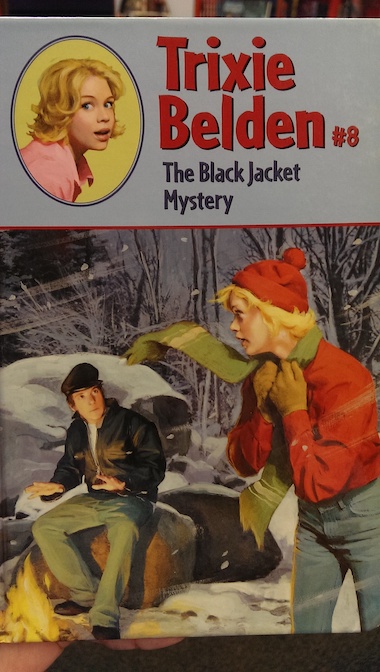
Then, a boy called Dan Mangan comes to live with Mr. Maypenny. Dan wears a black jacket and looks like a member of some kind of street gang. At school, he brags about brushes with the law. The Bob-Whites try to be friendly with him, but something about Dan gets on Trixie’s nerves.

When someone sells Honey’s missing watch at Mr. Lytell’s store, people begin to suspect that Dan may be a thief. But, soon, Trixie and the others start to suspect that someone else may be hiding out in the woods.

The book is currently available online through Internet Archive.

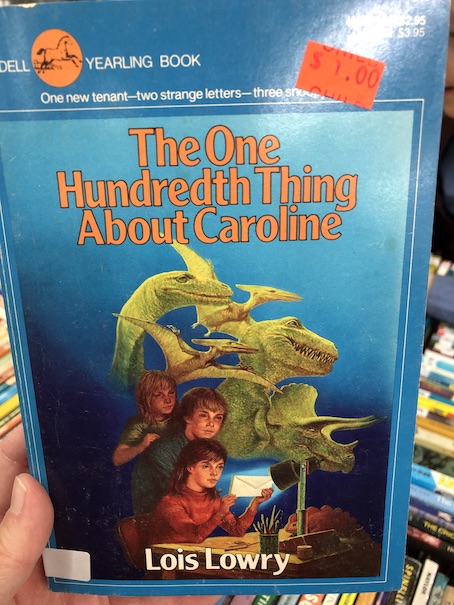
The One Hundredth Thing About Caroline

The One Hundredth Thing About Caroline

The One Hundredth Thing About Caroline by Lois Lowry, 1983.

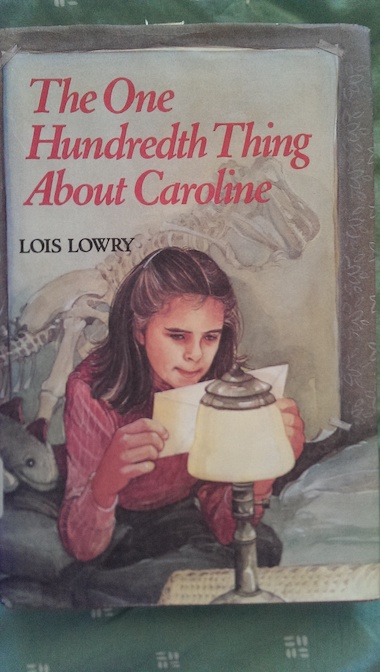
Eleven-year-old Caroline Tate knows that she wants to be a paleontologist when she grows up, but she is also fascinated with her friend Stacy’s dream of becoming a great investigative reporter. For fun, the two girls begin investigating the people who live in their respective apartment buildings.

Caroline’s investigation focuses on the mysterious Frederick Fiske, who lives on the fifth floor of her building. In a wastebasket, she finds a letter written to him by a man she’s never heard of telling him to “eliminate the kids.” Also in the wastebasket, there is an overdue notice for Fiske from the library, and the book is about poisons. From this evidence, Caroline comes to believe that the strange Mr. Fiske is planning to murder some children.

The situation becomes worse when Mr. Fiske begins dating her divorced mother, and Caroline fears that the children Mr. Fiske is planning to murder are her and her brother, J.P.. Can Caroline, J.P., and Stacy prove that Mr. Fiske is a cold-blooded murderer before his relationship with the Caroline’s mother can go any further and before he succeeds in poisoning them?

The book is available to borrow and read for free online through Internet Archive.

My Reaction and Spoilers:

It’s a bit of a spoiler, but this is one of those stories where the mystery is largely based on a series of misunderstandings. The book is a comedy mystery.  Mr. Fiske isn’t really a murderer, although he has done some things which make the children suspicious.  It’s a humorous story, and the kids’ antics as they try to further their investigation and collect “evidence” against Mr. Fiske are hilarious.  Along the way, the kids end up helping Mr. Fiske with a problem he’s been having, and the kids realize that they’ve made a mistake about him and his intentions.  Whether Mr. Fiske learns of their suspicions about him or not is left to the imagination, although something at the very end of the story may bring everything out into the open.

The title of the book comes from a joke between Caroline and her mother.  Caroline’s mother is always talking about the things she loves about Caroline, giving them different numbers.

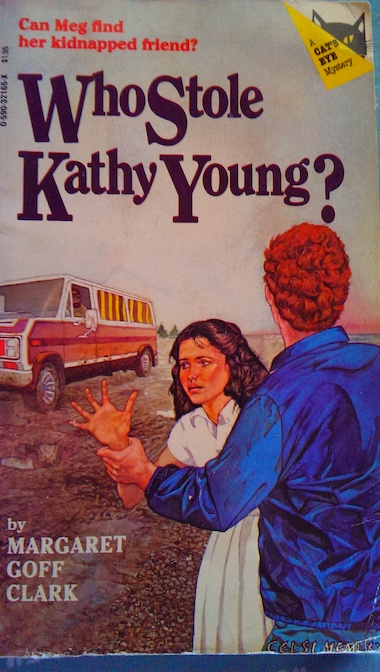
Who Stole Kathy Young?

KathyYoungWho Stole Kathy Young? by Margaret Goff Clark, 1980.

Kathy Young has had her share of problems.  Her mother died a year and a half ago, and now, her father has a housekeeper with a sour personality.  A couple of months after her mother’s death, Kathy was seriously ill, and her illness caused her to lose most of her hearing.  She now depends on a hearing aid and her improving lip-reading and sign language abilities.

This summer, Kathy’s best friend, Meg, is staying with her while her parents are on a trip to Switzerland.  Meg was of great help to Kathy when she was trying to adjust to her hearing loss, practicing sign language with her during her special lessons.  Kathy’s dream is to become an artist, but Meg now wants to be a teacher for the deaf, like the teacher who taught Kathy.  Kathy is still very unsure of her abilities to cope with her deafness.  She had the opportunity to attend a special art workshop over the summer but passed it up because she was worried about whether she would be able to communicate with and understand her teacher and the other students, and she knew Meg couldn’t attend to help her.

Kathy has been enjoying Meg’s summer visit, but the girls have noticed something odd.  It seems like a couple of strangers, a man and a woman, have been hanging around everywhere they go.  Meg is worried about it, but Kathy doesn’t want to worry her father.  She thinks that they’re probably tourists, like the housekeeper said.  They nickname the strangers Heron and Toad because of their appearances.

One day, Kathy is kidnapped!  Some men in a van stop to ask her directions and when she tries to explain where they have to go, they pull her inside and drug her!  Meg witnesses the kidnapping, but is standing too far away to help Kathy.

When Kathy wakes up from being drugged, she finds herself on a boat.  Her abductors have cut her hair and changed her shirt to disguise her from anyone who might spot her.  They’ve also taken her hearing aid, hoping to render her helpless and keep her from finding out their plans because she can’t hear them.  However, Kathy isn’t as helpless as they think.  She can still read lips, and she can still think.

Kathy learns to rely on herself and her own wits as she tries to gather as much information as she can about her kidnappers and to figure out how she can save herself.  Through this experience, she develops more self-confidence, realizing that she can do more and handle more than she had thought was possible.

While Kathy is struggling in captivity and her father is dealing with the police and the ransom demand, her friend Meg is trying desperately to find her.  The story alternates viewpoints between the two girls as Meg aids the investigation into Kathy’s disappearance and puts together clues that Kathy leaves for her as her abductors move her from place to place.  The mastermind behind the kidnapping plot is closer to home than they think.

The book is available to borrow and read for free online through Internet Archive.

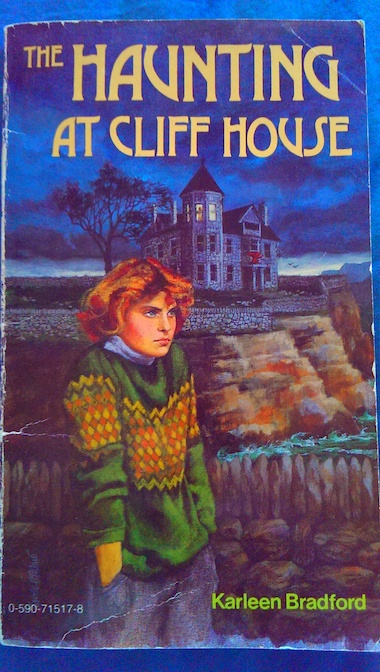
The Haunting at Cliff House

HauntingCliffHouseThe Haunting at Cliff House by Karleen Bradford, 1985.

This is a relatively short chapter book, but suspenseful, thoughtful, and well-written.

When her father inherits an old house in Wales from a distant relative, Alison, a young teenager, finds out that he plans for the two of them to spend the summer there.  Alison’s father is a university professor and is writing a book, and he thinks that the house in Wales sounds like a great place for him to get some writing done while he and Alison have a look at his new inheritance.  Alison isn’t enthusiastic about the trip, but she and her father are very close, especially because she lost her mother at a very young age.  Besides, the only place she could stay in Canada would be with her grandmother, and her grandmother didn’t seem enthusiastic about having her.

From the moment they arrive at the old house, called Pen-y-Craig or Cliff House by the locals, Alison has a bad feeling about it.  It stands on a lonely cliff by a small town.  The carved dragon over the door gives her the creeps, and there is something disturbing about a particular room in the house.  Sometimes, she can almost hear a voice calling out to her, and she has visions of another girl, about her age.  At first, she tries to tell herself that it’s all her imagination, but it soon becomes obvious that it’s not.

Some of the local people know that the house has an unhappy history, and Alison eventually learns that the great-aunt that her father inherited it from even refused to live there during her last years because it disturbed her too much.  A little more examination of the room that had disturbed her helps Alison discover the reason why.  After having a vision of a young girl hiding something behind a brick in the fireplace of one of the bedrooms, Alison searches the spot and finds a diary dating from 1810, written by a girl named Bronwen, who was the same age as Alison.  Like Alison, Bronwen was brought to the house by her widowed father and was unhappy about it, but those aren’t the only parallels between Bronwen’s life and Alison’s.

Alison becomes uncomfortable with her father’s new friendship with a Welsh neighbor, Meiriona.  Alison likes Meiriona’s younger brother, Gareth, but when it looks like her father’s friendship with Meiriona is turning into romance, Alison becomes jealous and fears changes in her close relationship with her father, a situation that mirrors Bronwen’s life when her father falls in love with her governess, Catrin.  Although Meiriona tries to be nice to Alison, Alison can’t bring herself to like her, and she argues with her father about it.

The only person who seems to understand her feelings at all is Gareth, and Alison confides her worries in him, both about Meiriona and about Bronwen, whose spirit keeps calling out to Alison to help her, although Alison doesn’t know how.  She struggles to read through the diary, whose pages are not all legible anymore because they’re damaged with age, to learn what happened to Bronwen and what Bronwen wants her to do now.  Gareth tries to reassure Alison that her father’s relationship with Meiriona will not be as bad as Alison thinks.  He thinks that the relationship would be good for both Alison’s father and Meiriona because they are both lonely, and he doesn’t think that Alison should worry about losing her father because he’s not worried about losing his sister, even if she goes to Canada to study and spend more time with Alison’s father.  At first, Alison isn’t comforted by these reassurances.  However, Gareth agrees that the matter of the ghost is serious, and he can feel her presence as well. Gareth warns Alison to be cautious about the ghost but to try to help if she can and to call out to him if she’s ever in danger.  Alison would really rather just go home to Canada, run away from her father and Meiriona, and forget the whole thing about Bronwen, but history seems to be repeating itself, and Bronwen’s voice calls out to her insistently for help that only Alison can give.

It’s a bit of a spoiler, telling you this, but although Alison at first thinks that the diary ends with Bronwen killing herself in despair, thinking that her father only loved Catrin and not her and that there was nothing left for her to live for, the truth is that Bronwen’s suicide attempt didn’t succeed and that she made another mistake that she wants Alison to help her to change.  Bronwen attempted to kill herself by going to a cave by the sea during a terrible storm, planning to allow herself to drown, but when the water started rising, she became too frightened and decided to leave by a secret entrance to the cave.  Not knowing that Bronwen was safe, Catrin attempted to save her and drowned in the cave herself.  As Bronwen was climbing to safety, she heard Catrin calling for her but was too frightened of the storm and angry at Catrin to go back for her.  Although Bronwen lived on after the incident, she could never get rid of her guilt at Catrin’s death, realizing that, even in the middle of her resentment toward Catrin, Catrin loved her more than she knew, even to the point of giving up her own life while attempting to save hers.

Now, the anniversary of Catrin’s death is approaching, and so is a storm very much like the one that killed her.  At the top of the cliff by the cave, Alison finds her time merging with Bronwen’s, and she will only have one chance to help Bronwen make the right decision the second time around.  Helping Bronwen to prevent the worst mistake of her life and to make a better choice also helps Alison to reconsider her own choices and future.  Just as Bronwen misjudged Catrin, Alison may have also misjudged Meiriona. Instead of losing her father or being forced to accept a poor substitute for her mother, Alison may be gaining a kind of sister who will love her more than she realizes.

The Root Cellar

RootCellarThe Root Cellar by Janet Lunn, 1981.

Rose Larkin is an orphan, living with her grandmother, a stern businesswoman.  Her grandmother travels frequently on business, so from the time Rose came to her when she was three years old, she just took Rose with her wherever she traveled, tutoring her in school subjects in the evening after work.  Rose’s early life is largely one of travel to strange places and isolation.  When her grandmother is working, Rose is pretty much left to her own devices, often either reading alone in their hotel rooms or exploring strange cities by herself.  Not going to school, she has no friends her own age and doesn’t really know how to behave around other children or live as part of a normal family.

When her grandmother dies suddenly of a heart attack in Paris when Rose is twelve years old, her remaining relatives have to decide what to do with her.  She temporarily stays with aunts who are into fashion and high living before goes to live with another aunt and uncle and their boys on an old farm.  Aunt Nan (Rose’s father’s sister) and her husband are better suited to caring for Rose and can give her a more settled family life, but Rose’s other relatives don’t seem to think much of Aunt Nan, who is an author of children’s books.  Rose has heard that Aunt Nan has no sense and that the family has just moved to a shabby little farm house in Canada.  Rose is prepared not to be happy there, on a dumpy little farm, miles from anywhere, with a bunch of strange people.

Her new life gets off to a bad start when there is no one to meet her at the house when she arrives.  As she waits for her aunt and uncle to return, a strange old woman appears who seems to know her.  She calls herself Mrs. Morrisay and acts like she belongs to the house.  But, when Rose’s relatives arrive home, Mrs. Morrisay suddenly disappears, and none of them seem to know anything about her.  Later, Rose sees a girl making a bed upstairs, but her relatives just laugh when Rose asks them about the maid, which is who Rose thought the girl was.  There is no maid in this house, and Rose is the only girl.  To Rose’s annoyance, her relatives think she imagined the whole thing.

Actually, life in her aunt and uncle’s house in the country isn’t as bad as her other aunt has lead her to believe, but becoming part of their household isn’t easy because Rose is used to a very different kind of life.  The house is definitely old and in bad need of repair, and her relatives are noisy and disorganized, at least more so than Rose is accustomed to.  Rose isn’t used to the chaotic life of a family with a lot of children, and Aunt Nan has another on the way.  Also, tourists who are fans of Aunt Nan’s books sometimes stop by the house, and Rose doesn’t like dealing with their scrutiny and questions.  Sam, one of the older boys in the family, seems to resent Rose’s presence in the house, and Rose overhears him saying a lot of bad things about her to her aunt, calling her snobby and criticizing her appearance.  Rose takes his attitude as further evidence that she doesn’t really belong in their house and that she’ll never fit in.  If they think badly of her, why should she think any better of them?

Rose also becomes increasingly aware that there is something not quite normal about her relatives’ house, especially the old root cellar, and the people she saw on her first day in the house are part of it.  Sam thought that he might have seen a ghost in the house one day, an old woman, and Rose recognizes his description as that of the Mrs. Morrisay she saw on her first day there.  She sees Mrs. Morrisay in her bedroom later, suddenly walking through a wall.  Rose thinks Mrs. Morrisay is a ghost, but Mrs. Morrisay tells her that she’s not dead, just “shifting” through time and that she wants Rose to stay in the house and help restore it to its former glory.  Rose doesn’t know why or how she can possibly help Mrs. Morrisay.

Rose learns that her aunt’s house was once an old farm house that belonged to the Morrisay family, and there is still an old root cellar on the property, a relic from the time when people had to store certain kinds of food underground to keep them cool and prevent them from spoiling.  One day, Rose goes down into the root cellar and meets a mysterious girl dressed in old-fashioned clothes, the same girl she saw earlier, making beds.  Although Rose and the other girl don’t realize it immediately, Rose has gone back in time.  The girl was someone who lived on the farm in the past, during the 1800s.

Rose and the girl in the past, Susan Anderson, become friends, and Rose is grateful for another girl to talk to.  Susan is an orphan herself, living with the Morrisay family as a servant girl.  She and Will Morrisay, old Mrs. Morrisay’s son, are friends, and both of them are sympathetic to Rose when she tells them about her new life with her relatives and the problems she has. Rose finds herself wishing that she could stay in the past with them forever.  However, once they realize that Rose is traveling through time when she goes in the root cellar, they also discover that it isn’t reliable about exactly when Rose will reappear in the past.  Although at first there are only days between Rose’s visits from her perspective, months or years pass in her friends’ lives between her visits.  They eventually manage to solve this problem through a friendship pact where they exchange favorite objects.  It’s at a good time, too, because soon Rose’s friends need her help as much as Rose needs them.

After a terrible fight with her relatives in which her aunt slips and falls and Rose worries that her aunt and the baby might die, Rose runs away to the root cellar and goes to see her friends, discovering that in their time, Will has gone away to fight in the American Civil War alongside his favorite cousin and has not returned.  It’s been awhile since Susan has heard from him, and she fears the worst.  Rose suggests that they go to look for Will at his last known location, but it’s a difficult, perilous journey. At first, they’re not sure whether they’ll find Will alive or not.

When they finally find Will, he is a changed man from the war, and Rose and Susan have to help him to remember who he really is and where he really belongs.  In helping Will to remember where he comes from, his life before the war, and how much Susan needs him, Rose comes to realize some important things about herself and where she really belongs.

The book is available to borrow and read for free online through Internet Archive.

My Reaction and Spoilers

As difficult as the choice is, Rose realizes that she must return to her own time, face the consequences of her earlier actions, and do what she can to become a real member of her new family.  After she returns home and the root cellar is destroyed in a storm, it seems as though she might never see her friends from the past again, but friendship can transcend many boundaries, including time.

I didn’t realize this the first time I read the book, but it’s actually part of a loose trilogy.  I say loose because none of the main characters from each story appear in the others (except, perhaps, for one who is in both the second and third books), which also take place in different time periods.  What binds the stories together is the location where the stories take place and also some distant family relations, particularly focusing on the Anderson and Morrisay families.

It is something of a spoiler, but it seems that the time travel in this story may not be so much a matter of the house being special or magical, but because Susan is special.  It is revealed in one of the other books, Shadow in Hawthorn Bay, that her grandmother was psychic.  Will and Susan briefly refer to Susan’s grandmother and her stories about ghosts when talking to Rose.  Susan seems to have little control, especially later in life, over her ability to shift through time, but it may be her special attachment to the Morrisay house and her need for Rose’s friendship and help that makes Rose’s time travel possible.  It’s never explicitly stated that Susan inherited her abilities from her grandmother, but I think that it is implied during the course of the books.

Hester the Jester

HesterJester

Hester the Jester by Ben Shecter, 1977.

This cute picture book takes place in a Medieval kingdom.  Little Hester’s father is the court jester.  Then, Hester decides that she wants to be a jester, too.  At first, Hester’s parents tell her that she can’t because she’s a girl.  (If you’re thinking that you know where this story is headed, wait.)

One day, the king is so sad that Hester’s father can’t cheer him up, no matter what he does.  When Hester starts putting on her jester act for her father and makes him happy, he decides to go ahead and have her perform for the king.  Hester does cheer the king up, but that isn’t the end of the story.

Hester tells the king that she has discovered that she doesn’t like being a jester after all because it makes her feel too silly.  So, the king, now in a much better mood, asks her what she would like to do instead.

This starts a sequence where the king allows Hester to try out various roles and see if she likes them.  She tells him that she wants to be a knight because knights are important, but she ends up not liking that when she learns that knights have to go into battle.  Then, Hester decides that being a king is even more important, so the king decides to let her try it.  But, Hester isn’t good at giving other people wise advice, as the king does.

HesterJesterKnight

In the end, when Hester’s mother is sad and doesn’t know what to do now that her daughter has become a king, Hester decides that what she most wants to do is to go home and be her little girl again.

In a way, this book seems like two little stories in one.  First, there’s Hester proving that she can be a jester even though she’s a girl, and then, there’s Hester trying to decide what she really wants to be the most, now that the king is letting her try anything she wants.  What she decides that she wants most is to be herself and go home.

So, is this little book anti-feminist, saying that girls are better off just forgetting about the other stuff they might want and staying girls?  I don’t think so.  Basically, this is just a silly little story about a little girl, one too young to have a profession of any kind, who is allowed to see the realities behind some of the things she’s been wanting to try.  Some parts, she likes, and some she doesn’t.  But, she’s too young and inexperienced for all of them (and some, she will never want to try again because she’s learned that they’re not what she really wants after all), so she’s just going to be what she is: a little girl with plenty of time to grow up, who needs her mother and whose mother needs her.  All throughout the book, Hester speaks her mind about what she wants and is honest about the things she doesn’t like, admitting when she changes her mind.  As for what might happen when Hester grows up and finds something else she might want to do . . . who knows?  By then, she may be willing to try new things again.  But, she knows what she wants for now and has a little better idea of some things that she won’t want in the future.
The book is currently available online through Internet Archive.

The Surprise Doll

SurpriseDoll

The Surprise Doll by Morrell Gipson, 1949.

Mary is a little girl who lives by the sea. Her father is the captain of a ship, and he travels to different countries all over the world. Sometimes, he brings presents for Mary from his voyages. So far, he has brought six dolls for her:

SurpriseDollTeresaSusan – from England, with rosy cheeks

Sonya – from Russia, with a cute turn-up nose

Teresa – from Italy, with brown eyes

Lang Po – from China, with raised eyebrows

Katrinka – from Holland, with blonde hair

Marie – from France, with a smile that brightens her whole face

Mary loves her dolls, but she realizes that if she had a seventh doll, she would have a doll for each day of the week. She asks her father if he will bring her another, but he says that she already has enough dolls.

When her father refuses her request, Mary pays a visit to the local dollmaker. She takes along her six dolls and explains to the dollmaker why she wants one more. After studying Mary and her dolls, the dollmaker agrees to make one for her as long as she’s willing to leave her other dolls with him for a week. At the end of the week, Mary returns to collect her new doll and receives a surprise!

SurpriseDollDollmaker

The “surprise” isn’t much of a surprise to the readers because the “surprise doll” is shown on the cover of the book, but it’s a cute story about how people around the world have many things in common. What the dollmaker notices about Mary and her dolls is that Mary shares certain qualities with each doll, the ones listed in the dolls’ descriptions above. So, he makes a doll for Mary that looks just like her by using her other dolls and their shared features as models. Her new doll, Mary Jane, is an American doll, but she has features in common with Mary’s other dolls from around the world, just like children in America can share qualities with children in other places. It’s a soft message about diversity and finding common ground.

SurpriseDollSeventhDoll

Felicity’s Surprise

American Girls

FelicityChristmas

Felicity’s Surprise by Valerie Tripp, 1991.

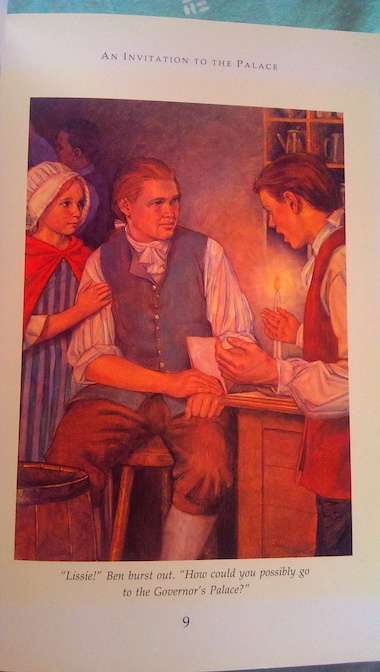
FelicityChristmasBenProtestThis is part of the Felicity, An American Girl series.

Christmas is coming, and Felicity is excited. She and Miss Manderly’s other students, Elizabeth Cole and her older sister, Annabelle, have all been invited to the Christmas party at the Governor’s palace! Miss Manderly is a friend of the dancing master who has been giving the governor’s children dancing lessons, so she was able to get invitations for her students. There will be a special dance lesson for all the children who come. With food, music, and dancing at the party, Felicity and Elizabeth are looking forward to dressing up like grown-up ladies going to a ball.

However, Ben, her father’s apprentice is against the idea of Felicity going because the Governor sides with the King and the Loyalists against the Patriots. He can’t understand why Felicity would want to attend a party with people who have treated the colonists so badly and have even boycotted her father’s store because he refuses to sell the taxed tea. However, Felicity’s father understands that the invitation was meant kindly and that it would be a special event for Felicity, so he tells her that she can go if she likes. Christmas should be a time for peace and enjoyment.

FelicityChristmasMotherIllAt Miss Manderly’s the girls start having dancing lessons, and Felicity wishes for a new gown, like the one on the elegant doll at the milliner’s shop. Since Felicity is usually not very interested in clothes, her mother decides to grant her wish.

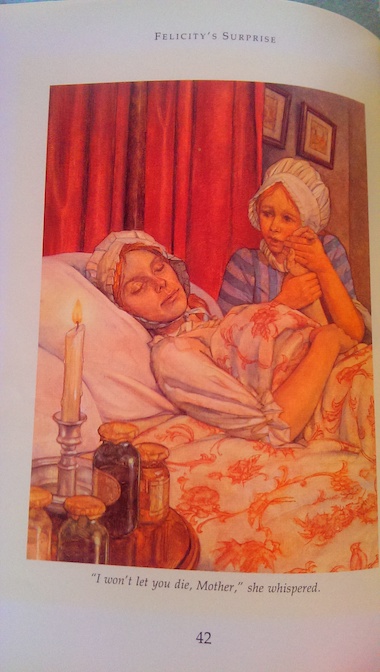
When Felicity’s mother falls ill, not only do Felicity’s Christmas dreams seem dashed, but she worries about whether her mother will recover from her illness. Everything that Felicity was concerned about before, the dress, the dancing, the party, all suddenly seems unimportant and silly in the face of something more serious. However, miracles come to those who work for them, and Felicity receives some unexpected help from friends.

There is a section in the back with historical information about how Christmas was celebrated in Colonial America.

The book is currently available online through Internet Archive.