Five Go to Demon’s Rocks

Famous Five

Five Go to Demon’s Rocks by Enid Blyton, 1961.

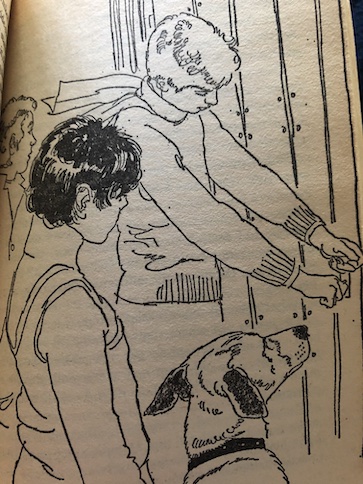
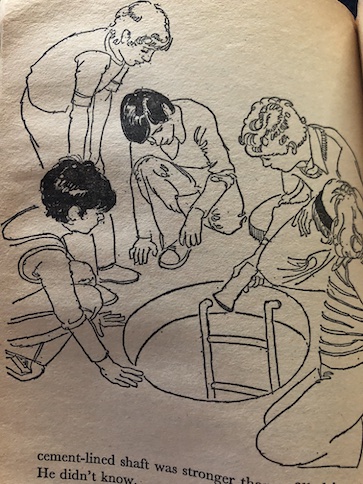
Uncle Quentin and Aunt Fanny are expecting their daughter George and her three cousins and dog to come for a visit because their parents are going away on a cruise when Uncle Quentin hears from a friend of his, a professor, who also wants to come for a visit to discuss his latest invention.  Aunt Fanny says that they won’t be able to accommodate the children and the professor at the same time, and Uncle Quentin had better tell the professor not to come. However, Professor Haling is already on his way, and he’s bringing his son with him.  The children have also already left home, so there’s nothing for them to do but try to accommodate their guests as well as they can.

It’s not going to be an easy visit.  Uncle Quentin and Professor Haling both want quiet to discuss their work, but the professor’s nine-year-old son, Tinker, is obsessed with cars and keeps making noises to imitate them.  Tinker has also brought his pet monkey, Mischief, with him.  At first, Mischief and George’s dog, Timmy, don’t get along with each other.  The animals eventually make peace with each other, but Uncle Quentin and Professor Haling decide that they can’t put up with the children’s noise.  Uncle Quentin insists that Aunt Fanny send the children away somewhere so they can continue their important work. 

Aunt Fanny doesn’t like it that such important men, who are admittedly working on things that will help people, don’t seem as interested in making their families happy, and George points out the hypocrisy that Uncle Quentin can’t stand their noise when he often slams doors that interrupt her studies and that he wants to push her out of the home where she lives, too.  Aunt Fanny says that part of the problem is that George and her father are too much alike, but the noise issue and overcrowding in the house are still problems that have to be solved.

The children ask if they can go camping, but Aunt Fanny says that it’s too cold for that.  Tinker suggests that they could all go to his lighthouse. They ask him what he means by “his” lighthouse, and Tinker happily explains that he owns a lighthouse. Actually, his father bought it when he was working on an important project and wanted a quiet place to stay where he wouldn’t be interrupted by phone calls or visitors or other distractions. When his project was finished, he no longer cared about the lighthouse, but Tinker love it, so his father gave him the key and told him that it could be his lighthouse now. The other children are amazed at the idea of a private lighthouse, and they agree to go there. Aunt Fanny agrees to let them go, and they begin planning for the trip. It’s at a place called Demon’s Rocks.

On the way to the lighthouse, their taxi driver, who was born at Demon’s Rocks tells them a little about the history and legends of the place. He says that it’s called Demon’s Rocks because there are formidable rocks there that people say could only have been placed by demons. The old lighthouse was meant to steer ships away from the rocks, but one time, some wreckers captured the lighthouse keeper and turned off the light to intentionally wreck a ship so they could raid the wreck for its cargo. The driver says that his great-grandfather still lives in the area, and if they ask him, he can tell them more stories about the place and maybe show them the cave where the wreckers used to hide out.

When the children meet the taxi driver’s great-grandfather, Jeremiah, he is an eccentric old man, but he likes children and even knows how to get along with Mischief the monkey. The children ask him about the wreckers, and he tells them the story about how One-Ear Bill and his wreckers put out the light in the lighthouse and used a lamp to misdirect a ship to make it crash. Jeremiah says he witnessed what they did and reported them, sending One-Ear Bill to prison. But, he says that One-Ear Bill didn’t care that much about going to prison because he hid the treasure that he took from the wrecked ship and expected to be rich when he got out. However, he died in prison, and nobody ever found the hidden treasure. The relatives of the other wreckers have tried to find it, but nobody has ever succeeded. The children are fascinated by the story and ask Jeremiah if he will show them the wreckers’ cave, and he agrees to show them sometime.

A local shopkeeper says that there is a kind of rivalry between Jeremiah and the descendants of the wreckers because the wreckers’ descendants make a marginal living by giving paid tours of the wreckers’ cave. The children don’t really expect that there’s still a treasure hidden in or around the cave. They think that, probably, someone found the treasure years ago and didn’t tell anyone or that the treasure might have been in some insecure spot and got washed out to sea.

However, strange things soon start happening. Someone steals the key to the lighthouse when Tinker leaves it in the lock and some other things from the lighthouse. The local police discover one of the wreckers’ descendants, Jacob, stole the things from the lighthouse, and the children get them back, but they can’t find the key on Jacob.

Then, when Jeremiah gives the children a tour of the cave, Mischief gets lost and finds a gold coin. The children aren’t sure where Mischief found the coin or if there are any others, but they begin to think that maybe the treasure is still in the cave after all. They also begin to consider that there may be a tunnel that leads from the lighthouse to the cave. However, someone else seems to have the same idea, and they’re trying to stop the children from finding the treasure before they do!

My Reaction

Part of the concept of the Famous Five series is that the children are very independent and have adventures that are unsupervised by adults. Children like stories about independent kids, but as an adult, I’m still struck by the family relationships the children have. I’ve noticed that the adults in Enid Blyton’s stories often have personal issues or dysfunctional relationships.

The reason why the children are having their independent adventure in this story is that the children’s fathers are too absorbed in their work and bothered by the presence of the children, so they just want them out of the house. Although George likes having adventures with her cousins, she does feel a little resentful that her father is basically pushing her and the others out of the house. I particularly noticed the part where Aunt Fanny reflects that important men who are working on things that will help people, don’t seem as interested in making their families happy. Uncle Quentin seems oblivious about the effect he has on his family, and when the children are getting ready to go to the lighthouse, he seems confused about where they are going, apparently having even forgotten that they were going anywhere. I keep getting the feeling that part of the reason why the children are so independent is that the adults in their family aren’t particularly nurturing and don’t make their home lives very pleasant.

Tinker’s home life isn’t terribly happy, either. His father is very permissive, letting him have a pet monkey and even giving him the lighthouse, but he also seems pretty oblivious to the things Tinker does. The other children find out that Tinker’s mother died giving birth to him, and with his father so utterly absorbed in his work, Tinker hasn’t had much supervision or guidance in how to behave, which is why he’s so wild. Tinker’s father takes him places and lets him have things or do things that other children can’t, but he doesn’t seem to get much personal attention or affection from his father. At one point, the other children are sending post cards home, and Tinker says there’s no point in sending one to his father because he won’t read it. That says a lot, and the other children feel sorry for him.

What I’m saying is, while I like the adventure and would have loved that sense of freedom as a kid, as an adult, I recognize that behind the children’s independence in many of the stories are some unresolved family issues and self-absorbed adults. The adults don’t worry as much about the children as most parents would, not only because they trust them on their own, but because they seem too absorbed in their own issues to think that much about what the children are doing and what could happen to them. The children go to boarding school much of the time, but their parents don’t seem too eager to spend time with them and bond as a family during their breaks, content to let them go off by themselves so they can get back to what they were doing. This also seems to be the case in other series by Blyton, like the Adventure series, which starts off with a pair of siblings going to stay with an aunt and uncle who seem to have a dysfunctional marriage and a pair of orphans who live with a strict uncle who seems to see them as a nuisance. Since the kids are fictional and the children’s circumstances are only there to set up their adventures, it’s not that big of an issue to enjoying the adventure, but yet, as an adult, these things do jump out at me.

The Grey King

The Dark is Rising Sequence

The Grey King by Susan Cooper, 1975.

This is the fourth book in The Dark is Rising Sequence, and it picks up not long after the previous book ends.

Will Stanton has been very ill with hepatitis, and the doctor ask advised his parents to send him somewhere to rest for a while and recover his strength. In the previous book, his sister Mary had gone to stay with relatives in Wales after she had the mumps, so his parents agree to send him there. Even after he recovers, Will has a nagging feeling that he’s forgotten something very important. What he’s forgotten are the clues that he and his friends discovered at the end of the previous book, but little by little, they come back to him.

Will calls his relatives Aunt Gem and Uncle David, but really, they’re distant cousins. On his way to stay with them on their farm, Will sees a mountain that locals call “the Grey King”, which begins bringing back Will’s memory of the clues to the next item of power that he and his friends are supposed to find. An encounter with a strange dog with silvery eyes brings back the rest of Will’s memory, reminding him that he is the youngest of the Old Ones and it is his mission to find a magical harp in Wales.

The owner of the dog is an albino boy named Bran, who surprisingly knows the clues that Will had been struggling to remember. Bran reveals that Merriman visited him before Will arrived, told him to keep an eye out for Will and help him, and taught him the first part of the clue rhyme as a show that he can be trusted. The boys talk about what the clues in the rhyme mean. Will is supposed to find the harp on “the Day of the Dead”, which Will thinks means Halloween and which is coming soon, but he’s confused because the rhyme also refers to the end of the year. Bran says that Halloween might have once been regarded as the time of the New Year (which is true, and I discussed it in the History section of my Halloween Ideas site), and the two of them discuss some old traditions and superstitions about Halloween.

On Halloween, Bran and Will go into the mountains, and Will’s knowledge and abilities are tested before they are given the harp. Yet, Will is not the one to play it because he doesn’t know how. Bran is the harper. He also seems to have a strange connection to one of the lords who guarded the harp in the mountains. On the way down, the boys have a frightening encounter with a fox who has been killing sheep in the area, but weirdly, nobody else else can see the fox but the boys. A disagreeable farmer shoots poor Bran’s brave dog because he thinks that the dog is the one killing the sheep, and Bran is inconsolable. (I hate books where the dog dies.)

However, their work is not yet done. Will has to use what he’s learned from Bran about playing the harp to wake the Sleepers, who will aid the Light in the upcoming battle against the Dark. Bran also comes to learn his true identity and that of his mother. Although he is not one of the Old Ones, Bran is special and will play a pivotal role in the battle between Light and Dark.

The book is a Newbery Medal winner. It is available to borrow and read for free online through Internet Archive (multiple copies).

My Reaction and Spoilers

Even though this book is the Newbery Medal winner in the series, I didn’t like it as well as the earlier books. It’s partly because the dog Cafall dies, and I always hate books where the dog dies. I love dogs, and also, I realize that it’s often a cheap way to give readers and emotional wrench, to kill off a beloved animal. Also, I missed the familiar characters from the earlier books. The Drew children are not in this story, and even Merriman doesn’t play much of a role. For most of the story, Will is alone, although he does make an important friend in Bran, whose past is more mysterious than most people know.

Although, Cafall also represents one of the innocent sacrifices in the name of the battle between good and evil. Bran is angry at Cafall’s death and says that neither he nor his dog were part of Will’s battle or quest, and it wasn’t fair for them to be dragged into it or for Cafall to be killed. He’s partly right, although he is actually much closer to the center of this battle than he knows. Another character in the book talks to Will about the apparent callousness of the Light for those who end up being sacrificed in the struggle. Will’s answer is that some things cannot be helped. They might want to protect everyone and make things work out well for everyone, but circumstances don’t always make it possible, and there are times when trying to save someone or make someone happy could cause something else to happen that would be worse for everyone. I’m not completely satisfied with that explanation because, in this particular instance, I don’t see why this sacrifice was necessary and I feel like it could have been avoided, like I felt that another tragedy in The Dark is Rising could have been avoided. I suppose the principle that avoiding one sort of bad thing could lead to something worse could be true, but I just don’t feel it in these stories.

I was more convinced and intrigued by the concept of people who aid the dark without knowing that they’re doing it. In the previous book in the series, the author addressed the idea of neutral parties in the struggle between good and evil, but this book introduces the idea of ignorant or deluded people who do bad things without realizing. In the story, they aren’t regarded as true agents of the Dark because they haven’t consciously joined the Dark side and don’t even know that there’s any Light/Dark struggle happening around them, but they are doing what the Dark wants them to do and hurting people and the cause of the Light either because they are being tricked and manipulated into doing it or because they have some other motive that allows them to do bad things because they don’t care as much about the concept of good and evil as much as accomplishing their own goal.

In this case, the unwitting helper of the dark is the farmer who shot Bran’s dog. He genuinely did think that the dog was killing his sheep, so he thought that he was just protecting his property by killing the dog. That could be seen as a good motive gone astray, but when Bran’s real history is revealed, it is also revealed that the farmer also has darker motives for his bad behavior that he has been trying to keep hidden. It’s not just about protecting his sheep but also his resentment against Bran and Bran’s father, so he enjoyed hurting them by killing their dog. The farmer’s resentment goes back to when Bran’s mother, Guinevere, brought him out of the past to be raised by his adoptive father in the 20th century. Bran’s real father is King Arthur, but by the time Bran was born, Guinevere had already betrayed Arthur and feared that he would reject his son because of what she did. She wanted Bran to grow up in a safe place, away from his parents’ struggles. At her request, Merlin (which is Merriman Lyon’s real identity), brought her forward in time to the 20th century to find a new home for Bran. Bran’s adoptive father is a good man, and Guinevere knew that her son would be safe with him. He loved her in return and wanted her to stay and marry him, but Guinevere knew she couldn’t stay, so she left secretly, leaving Bran behind. Her departure might have been hastened because the farmer was jealous of Bran’s adoptive father for having Guinevere. Although he didn’t know Guinevere’s true identity, she was a beautiful woman, and the farmer wanted her for himself. He apparently tried to attack her or maybe even force himself on her, and he was fought off by Bran’s adoptive father and a friend of his. Although the farmer is a married man, he still harbors possessive feelings about Bran’s absent mother and resentment toward the men who stopped him from taking her. By extension, he also resents Bran. In the end, he is driven mad by his obsessions and his manipulation by the forces of the Dark.

Over Sea, Under Stone

The Dark is Rising Sequence

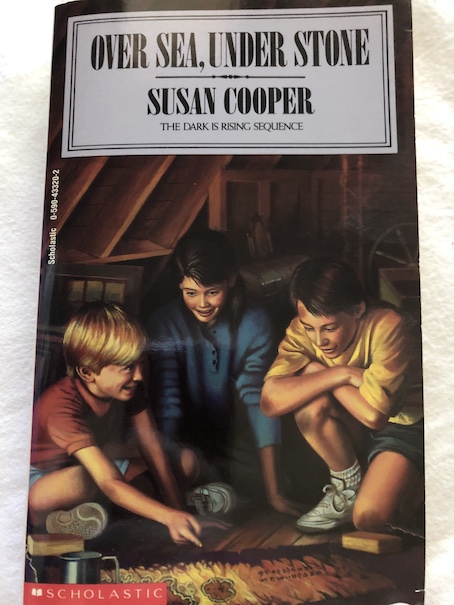
Over Sea, Under Stone by Susan Cooper, 1965.

The Drew family is spending the summer in Cornwall with their Great-Uncle Merry. Professor Merriman “Merry” Lyon isn’t really a relative, but a very old family friend who teaches at a university and has a somewhat mysterious past. Of the three Drew children – Simon, Jane, and Barney – Barney is the one most looking forward to their time in Cornwall because he loves Arthurian stories, and he is fascinated by Cornwall’s connections with King Arthur. Simon is more interested in watching boats.

One day, while the children are bored because it’s raining, they start playing at being explorers inside the house where they’re staying and discover a secret passage to a hidden room. There, they find an old manuscript that seems to be some kind of treasure map! It seems like parts are written in Latin, but even Simon, who has studied Latin in school, can’t read it all. At first, they wonder if they should tell their parents about it, but they decide not to, at least not right away, because their parents would probably tell them not to touch it because it doesn’t belong to them. They feel like they just have to figure out what it means and what it might lead to.

The family makes the acquaintance of a yacht owner, Mr. Withers, and his sister, and the two of them invite the whole family to go for a ride on their yacht. Mrs. Drew is an artist and wants to spend the day painting, so she declines, and so does Jane. Jane says that she’s afraid of getting seasick, but really, the Witherses give her an uneasy feeling. Jane feels like there’s something that’s not right about them, and it’s strange that Miss Withers asks them if they’ve found any secret passages in the house just after they actually found one. None of the children confide anything in Miss Withers. Mr. Withers seems oddly interested in the books in the house.

The next day, while her father and brothers go out on the yacht with the Witherses, Jane studies the manuscript and tries to figure out what it means. When she also finds an old guidebook to the area in an old trunk, she realizes that the map on the manuscript shows the area where they are staying, but there’s something strange about the coastline. The coastline on the old map is a slightly different shape. Jane wonders if one of the two maps could be wrong or if the coastline has changed somehow over the years because the manuscript looks very old.

Since the guidebook was written by the local vicar, Jane decides to go see him and ask him about the coastline and whether it’s changed over the years. She takes along the guidebook but not the manuscript. However, the vicar she meets says he’s the new vicar, not the old one who wrote the book. She talks to him about the book and the coastline anyway, but he gives her a bad feeling, similar to the one that the Witherses give her. The vicar discounts the idea of the coastline changing, and he asks Jane uncomfortable questions about the books in the house, pressing her for answers that she doesn’t have and doesn’t want to give him.

When the boys come back from the yacht, and Jane tells them about the guidebook and the vicar, Simon is irritated that Jane tried to investigate the manuscript without them, and he doesn’t think she should have talked to the vicar. Jane says that she didn’t tell the vicar about the manuscript, only the guidebook, and Barney says that what Jane learned is important.

The next morning, they wake up to find that the house has been ransacked. Books have been tossed all over in the middle of the night by someone who was clearly hunting for something. The children are sure that their mysterious intruder was searching for the manuscript, which is safe because Jane had it hidden in her bed. But, who was it? Was it the vicar or the Witherses? All of them seemed interested in old books and manuscripts, and they all seem suspicious. What is the real significance of the manuscript anyway?

Still not wanting to tell their parents or the police who were called to investigate the break-in, the children confide in Great-Uncle Merry about the manuscript and their suspicions. Uncle Merry knows more about the manuscript than the children know, and he tells them about a lost grail, a copy of the original Holy Grail, inscribed with the true story of King Arthur and about an ancient struggle between good and evil, a struggle that the children have now joined.

The book is available to borrow and read for free online through Internet Archive (multiple copies). The book was once adapted as a tv mini-series, but apparently, no copies of it survive.

My Reaction and Spoilers

This book is the first in a series about the struggle between good and evil, known as the Light and the Dark, and all of the other books in the series also draw on Arthurian legends. Merry and the children appear in other books, although not always together. Merry (the children sometimes call him Gumerry, which is short for Great-Uncle Merry) isn’t quite what he appears to be, which is how he knows things that other adults don’t know. There are hints in this book about Merry’s real identity, but it isn’t explained in this book, although Barney has a feeling that his name is a clue.

When Merry explains about the battle between good and evil, he says that the struggle has been going on for ages, and neither side ever completely wins or completely loses. It’s like that in this story, too. At first, I wasn’t completely sure whether they would actually find the grail or if it would turn out to be a MacGuffin, only existing to drive the action without it being really important whether it was actually found or not. The heroes do actually find and successfully retrieve the grail, but they also lose the manuscripts they’ve found before they can completely study them. It’s a victory, but not a total victory, and the villains are still around and may reappear in the future. This story ends in a way that indicates that this could have been a standalone book, which it might have been originally, before the author decided to continue the series, but the ending is also open, making the continuation of the series natural.

There are references to old folklore traditions throughout the story. I’ve never seen The Wicker Man, but I saw a comment on a YouTube video where someone compares a public festival from this story to a scene in The Wicker Man, so there may be the implication that this is a more ancient form of celebration with more significance than the modern characters think. In fact, old traditions and folklore from the British Isles also appear in various forms throughout the series, and there are references to pagan beliefs.

I didn’t like the part where the kids were pretending to be explorers, and they were talking about acting out one of those scenes with “rude natives” (Simon’s words, and even he has to admit that he doesn’t quite know what it means when Barney asks him, although he’s aware that it’s a different sort of “rude” from the word meaning “impolite”) who want to make them gods and encountering cannibals. That type of scene always annoys me in books, and I’m sure that they’re referencing some of the vintage books I’ve read where that happens or ones very much like them. It’s really my only complaint about this story. Fortunately, that part doesn’t last very long because the kids find the manuscript and get on with the fantasy story.

The Midnight Folk

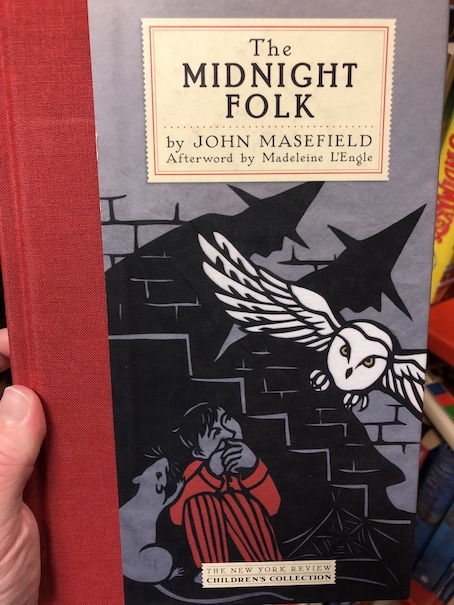
The Midnight Folk by John Masefield, 1927.

Kay Harker is an orphan, the ward of Sir Theopompus, usually in the care of his governess, Miss Sylvia Daisy. One day, Sir Theopompus asks Kay if he has any idea what he wants to do when he grows up. Kay says that he likes the idea of being a jockey, but Sir Theopompus says that he could be a sea captain, like his great-grandfather. According to the stories about him, Kay’s great-grandfather sailed around the world and stole a treasure from the priests of Santa Barbara worth about a million pounds (British money). The stories differ about what happened to the treasure, though. In some versions, his crew mutinied and took the treasure for themselves, but other stories say that he brought the treasure home with him and hid it somewhere in his family home, the home where Kay now lives.

Sir Theopompus asks Kay if he’s ever come across the treasure, but Kay says he hasn’t. Sir Theopompus suggests that if Kay finds the treasure, the two them could split it between them. Kay says that wouldn’t be fair, if he had to do all the work of finding it by himself, and also the treasure is stolen property, so it would rightly belong to the priests of Santa Barbara. Still, Sir Theopompus encourages Kay to search for the treasure. Kay doesn’t believe that the treasure is really in the house or that his great-grandfather would be a thief, and he doesn’t think it’s fair to tell such stories about him when he isn’t there to defend himself. His governess tells him that he has been impertinent and sends him to bed early.

Kay is later woken by someone calling to him to open the door, and he sees a door in his room that he has never noticed before. The voice he hears belongs to the black cat called Nibbins, who tells Kay to come with him and not make any noise. Most of the house is asleep, and Nibbins refers to the ones who are awake as the “midnight folk.” He leads Kay down a secret passage that was once used by smugglers.

There, Kay learns that his old toys were his “guards.” He doesn’t know where his old toys are because his governess packed them away when she came, saying that they would just remind him of the past. Nibbins says that his old toys had stumbled onto a clue about the hidden treasure and went in search of it. They didn’t think it would take them long to find it, but he hasn’t heard from them since. Kay sadly fears that his old toys may actually be dead. (A horrifying thought.)

Then, there’s an even more shocking revelation. Nibbins shows him that there are spy hole where Kay can see what’s happening in various rooms in the house, and in the dining room, he witnesses a meeting of witches! Nibbins shows Kay where the witches keep their brooms, and they take a couple of the brooms on a ride to the woods, where Nibbins introduces Kay to a poacher called Bitem. They witness the witches having a bonfire and a magical ritual at Wicked Hill. Nibbins says that he used to be a witches’ cat and helped with rituals like that. Sometimes, he still feels the call of magic.

The leader of the magical group is a wizard called Abner Brown, and they overhear him saying to the witches that they are going to hunt for the Harker Treasure. Abner has learned that the treasure is not actually in the Harker house, but it’s somewhere close by. Abner reveals previously-unknown details of the treasure’s history, including the fact that his own grandfather had once been in possession of it and hid it until someone called Benito Trigger found it. Abner has found evidence that his grandfather tracked down Trigger and confronted him in this very area and that Trigger may have killed him. Abner believes that the treasure is still hidden somewhere near to where his grandfather died. Nibbins leads Kay back to his bedroom through another secret passage before anyone discovers that he is gone.

Kay knows that what he witnessed the night before wasn’t a dream because, in the morning, he sees the remains of the leftover goose that the witches were eating the night before, picked to the bones. The servants think that the cats got at the goose and ate the leftovers, but Kay knows better.

Then, the portrait of Kay’s great-grandfather comes to life, and his great-grandfather invites Kay into the portrait, showing him the house as it was in the past. His great-grandfather denies having stolen the treasure years ago, but he says that it was entrusted to him and that he lost it. He was in Santa Barbara when the territory was breaking away from Spain, and the archbishop gave him the treasure to guard from the revolutionaries. However, his crew did mutiny and turn pirate. The crew took the treasure, and they abandoned Kay’s great-grandfather ashore, far from any European colony. For a time, he says that he was a slave of a tribe of Indians (Native Americans), but he eventually escaped and made it home to England. He heard that his old ship may have sunk, but he doesn’t know for sure. Even he doesn’t know where the treasure is now, thinking that it must have either sunk with the ship or been scattered by the crew. It’s always bothered him that he was unable to fulfill his promise to keep the treasure safe. He wants Kay to learn what happened to the treasure and, if possible, restore it to its rightful owners.

Through Kay’s midnight adventures and the ghosts of the past stirred up by the magic of the witches, Kay begins to learn the full sequence of events that led to the treasure being lost, and eventually, what happened to it. Along the way, Kay also makes the startling discovery that his governess is actually one of the witches!

The book is available to borrow and read for free online through Internet Archive (multiple copies).

My Reaction and Spoilers

There were some parts of the story that I found difficult to follow because the story kind of jumps around, people start talking about things as if we should already know about them, and some things that Kay encounters are not fully explained. Many of them seem like dream sequences or imaginings, except they have lasting consequences. Then, there are times when people go into lengthy explanations that seem to meander, and there are people who go by multiple names. For awhile, Kay almost seems to forget about seeking his great-grandfather’s treasure and starts looking for the treasure of an old highwayman instead, and there is a strange interlude with King Arthur and his knights.

Still, this story is a children’s classic, and it’s almost like a collection of all the features that are found in classic children’s literature: an orphan, talking animals, witches, pirates, ghosts, mermaids, a highwayman, King Arthur and his knights, hidden treasure, etc.

For awhile, I thought that the story might end with the implication that much of it was in Kay’s imagination. Kay is a lonely boy who doesn’t see his guardian very often and lives with a strict governess and no other children for company. I thought maybe he was spinning dreams or imagined stories to explain other events happening around him. I spent part of the story working out how a child might interpret a strict governess who took away his old toys as a witch, and I thought maybe she was in a romantic relationships with Abner Brown, which would be why Kay would see him as a wizard. Then, maybe these young people had parties in the house with their friends after Kay was put to bed, so he imagined that they were having witches’ meetings. They could also be hunting for the legendary treasure, so all the parts related to treasure-hunting could be true. However, the book implies that the magical parts of the story are real. Even the magical things Kay experiences have real world consequences, which help both him and readers to realize that what he has seen has really happened.

I thought that the story became a little more cohesive after Kay makes the discovery that his governess is actually one of the witches. He eventually learns the full truth of what happened to the treasure years ago and meets up with his old toys/guards, who are still alive and have been seeking the treasure the entire time. Kay’s toys/guards bring the treasure from its hiding place to a secret hiding place in Kay’s room and help him to alert the proper authorities and restore the treasure to its rightful owner. Kay’s governess is arrested when she and her friends are caught trespassing in pursuit of the treasure and in possession of smuggled goods. The governess is released when Abner Brown pays the fines for their activities, but she leaves the area instead of returning to Kay. Kay’s home life changes for the better because a friend of his mother comes to live with him and look after him.

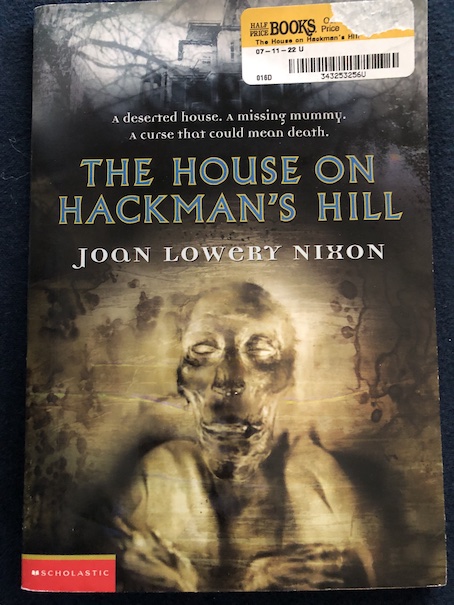
The House on Hackman’s Hill

House on Hackman's Hill cover

The House on Hackman’s Hill by Joan Lowery Nixon, 1985.

This creepy book is interesting partly because it is told in two parts. About half the story is a flashback that explains the history of the house and the mummy inside it, and the rest continues in the present day.

The very beginning of the story is in the present, starting with a pair of cousins. While they are visiting their grandparents, Jeff tells his cousin Debbie that he’s found out about an old, abandoned house nearby that supposedly contains a hidden mummy and that there’s a reward for anybody who finds it. Debbie doesn’t believe him at first, but he says that he heard all about it from their grandparents’ neighbor, Mr. Karsten. Jeff persuades Debbie to come with him to check out the old house. Debbie comes and takes pictures of it because she’s interested in entering a photo contest.

The place looks really creepy, and they have the odd feeling like somebody is watching them, even though the house is supposed to be empty. Debbie says that they should ask their grandparents what they know about the old house. At first, the grandparents don’t want to talk about it. They just say that it’s an old house and not very interesting. Debbie asks them directly about the mummy, and they say that there are a lot of rumors about the old place, but they don’t really believe them. The kids decide to talk to old Mr. Karsten again. Mr. Karsten says that he knows all about the old house on Hackman’s Hill because he lived there for awhile when he was young, back in 1911.

Paul Karsten’s Story

Paul Karsten’s mother was a secretary, and she went to work for Dr. Hackman, the former owner of the house, after the death of her husband. Dr. Hackman was a strange man with changeable moods. He was pleasant enough to Mrs. Karsten, but he hated children and didn’t really like having her son Paul in his house. Dr. Hackman was a history professor, specializing in Egyptology. He was approaching retirement, and he wanted to devote himself to his papers and his collection of Egyptian artifacts. Mrs. Karsten’s job was to help him catalog his collection, and Dr. Hackman offered such a good salary, Mrs. Karsten couldn’t refuse. The mummy was delivered the same day that Paul and his mother moved into the house.

Paul was given a room in the tower of the house, and while he thought that it had a great view at first, he got nervous when he noticed how the tower room was situated on the edge of a cliff. One of Dr. Hackman’s servants, Jules, makes a comment about how Paul should be careful because they don’t want “another accident”, refusing to say more about whatever “accident” occurred there before. Paul was uncomfortable with the house and with Dr. Hackman. He tells his mother that the house frightens him and that he wants to leave, but his mother reassures him that the place only looks strange because of the Egyptian artifacts. Paul found the artifacts he once saw at a museum exhibit frightening and he’s particularly disturbed by a statue that Dr. Hackman has of a man with an animal head, but his mother says that’s just a statue of an Egyptian god.

Paul had notice earlier that a long box had been delivered to the house, and he gives into temptation and tries to look inside. However, he is stopped by Jules. Jules and his wife Anna warn Paul that this house isn’t very good for children and that Dr. Hackman doesn’t like people nosing around or messing with any of part his collection. At dinner, Paul admits to Dr. Hackman that he tried to look in the box and apologizes for his curiosity. Dr. Hackman accepts the apology, and before Paul goes to bed that evening, Dr. Hackman shows him the mummy case that was in the box. Paul asks him if it’s real, and Dr. Hackman says it is. Paul says that he heard that it’s illegal to take real mummies out of Egypt, but Dr. Hackman says that there are ways, if you’re willing to pay for it, and he was. Dr. Hackman says that his eventual goal is to turn his house into a museum of Egyptian artifacts so that scholars will come there to study them and read his papers, and he will be famous. He also says that he knows how to protect himself from the mummy’s curse. The talk of curses scares Paul, but Dr. Hackman says that nothing has ever happened to him personally because of any tomb curses … implying that something might have happened to someone else.

When Paul tells his mother that Dr. Hackman has a real mummy, she is worried and upset. She doesn’t like the idea of people obtaining artifacts through unethical or illegal means, although she knows that the laws are poorly enforced. Mrs. Karsten doesn’t believe in superstitious curses, but soon, strange things begin to happen. While putting away his things in his room, Paul discovers a strange, triangular piece of gold metal with some kind of design on it. When he goes up to bed, he feels like someone is there in the room, although he can’t find anyone. During the night, he wakes up, sees that one of his windows is open, and feels an odd urge to walk toward it, but fortunately, his mother comes to check on him and stops him. Paul and his mother both realize that they were woken by the sound of a cry in the night. His mother supposes that it was some kind of night bird, but Paul knows that it was probably something to do with the curse.

Paul insists that Jules and Anna tell him about the accident that took place in his room. They say that they weren’t working for Dr. Hackman when it happened, but they know that the person who fell from the tower room was a guest of Dr. Hackman’s, he was from Egypt, he died when he fell, and his body was shipped back home. At first, Paul thinks that the gold piece he found probably belonged to the Egyptian guest, but that’s not quite it.

Dr. Hackman gives Paul the job of polishing some of his statues, knowing that they bother him. It amuses Dr. Hackman as a mean joke. However, Paul’s fear of them fades while working with them because he begins to appreciate their artistry. Dr. Hackman is surprised that Paul is able to see that and not just be afraid of the statues. Paul asks him about the statue of the man with the animal head, and he explains that it’s a statue of Anubis, the god of the dead, and scares Paul again by saying that Anubis is the one responsible for the curses on tombs. He says that Anubis’s head is a jackal head and that jackals hunt at night and have a bark like a cry. This confirms to Paul that the curse was responsible for the cry he and his mother heard.

Paul eventually comes to realize that the strange gold piece attracts the mummy and the mummy’s curse, which is why Dr. Hackman knows that he’s in no danger. Dr. Hackman put it in the tower room to make sure that the mummy’s wrath would only come to whoever was in that room … and that’s why he made sure that Paul was given that room, too. To protect himself and his mother, Paul knows that he has to get rid of that gold piece.

Mr. Karsten finishes his story by explaining to Jeff and Debbie where he hid the gold piece and how Dr. Hackman disappeared, apparently a victim of the curse. Nobody ever discovered what happened to Dr. Hackman, and the mummy disappeared that same night, but a museum has offered a reward for anybody who finds the mummy. Mr. Karsten says that various people have tried to stay in the house and find the mummy, but nobody has succeeded. Everyone has been frightened off after just a single night in the house.

Jeff doesn’t believe in curses, and Debbie agrees to accompany him into the old house to find the mummy and claim the reward.

Return to the Present

The rest of the story is about Jeff and Debbie’s adventures with the house on Hackman’s Hill. Jeff says that he thinks all the spooky curse stuff was just put on by Dr. Hackman, who was a mean old man having a joke by scaring a kid with all that talk of curses. Dr. Hackman was definitely a mean old man who enjoyed scaring young Paul Karsten, but questions still remain. How much of what Paul experienced was really real, and what happened to Dr. Hackman? If the curse was just something he made up, why did he scream the night he disappeared, and where did he go?

Jeff’s idea is that all the creepy stuff happened at night, so the best time to go look for the mummy would be during the day. (That’s actually pretty sensible. Why go to a supposedly haunted house during the night if you don’t have to?) The kids make a plan and put together a collection of useful supplies and food for their mummy hunt. They decide to go while their grandmother is busy watching her favorite soap opera and their grandfather is in town, arranging some sort of surprise for them.

When they enter the house, they discover that everything is still inside. All of the furniture and Egyptian artifacts are like Mr. Karsten described them. Debbie has an instant camera that with takes pictures that develop themselves. (No brand name mentioned, but basically, a Polaroid instant camera or something very similar. Those were popular when I was a kid in the 1980s and into the early 1990s, especially for families and amateur photographers. They’re not as popular now with the popularity of smart phones and digital photography, but they’re still around. Although police photographers now use digital cameras, instant cameras have been used in accident and crime scene photography because they produce quick results, the photos last for a long time, and because they develop immediately after being taken, they can’t be digitally altered. What I’m saying is that Debbie has made a good choice for recording their adventures and any evidence that they uncover, and it pays off almost immediately.) When Debbie takes a picture of the statues that Mr. Karsten told them about, she notices something frightening right away: the Anubis statue doesn’t show up in photographs.

Jeff discounts the photographic evidence because Debbie’s hand shook, and the picture is somewhat blurred. However, the kids start hearing noises in the house. Then, Debbie notices that a bad snow storm is approaching. She wants to leave the house immediately, but Jeff realizes that they can’t because they’d never make it back to their grandparents’ house by the time the storm hit. Night approaches, and the kids are about to see just how true Mr. Karsten’s story was. The kids are trapped in the house by the snow storm, but they’re not there alone.

The book is available to borrow and read for free online through Internet Archive (multiple copies).

My Reaction and Spoilers

I thought that this was a fun, creepy story. The creepiness is tempered somewhat in the first half of this story because it’s told in the form of a flashback. We know during the first part of the story that Paul survives his ordeals and lives to old age because he’s telling the story of what happened when he was young to Jeff and Debbie as an old man. When Jeff and Debbie go into the house themselves, it’s less certain what’s going to happen.

There are points in the story after Jeff and Debbie enter the house where it seems uncertain how much of what Paul Karsten experienced was supernatural and how much might have been due to the machinations of Dr. Hackman, who seems to have been a very disturbed man by himself. They soon discover that the house has secret passages that could allow Dr. Hackman to move around the house unseen and create some strange phenomena himself to scare or harm people in the house. There was a point where I thought perhaps everything would turn out to be part of some elaborate plot by Dr. Hackman or someone else, but (spoiler) there is real supernatural phenomena happening.

Before the end of the book, Jeff and Debbie discover both where the mummy is hidden and where Dr. Hackman hid the mummy’s golden eyes, which Anubis has been searching for all this time. They also learn what really happened to Dr. Hackman all those years ago. He apparently did become the victim of the curse that he had tried to evade by inflicting it on others. When the story ends, it seems that the curse is ended permanently, although Jeff and Debbie do manage to get some things out of the experience.

I liked how, even though the story does turn out to be supernatural, the author introduced the idea that it might not be because that element of uncertainty kept the suspense going for longer and introduced some interesting possibilities for readers to consider. It also made it a little more plausible that the kids would be willing to enter the house because they could believe that the house itself was harmless without Dr. Hackman there to continue his plots.

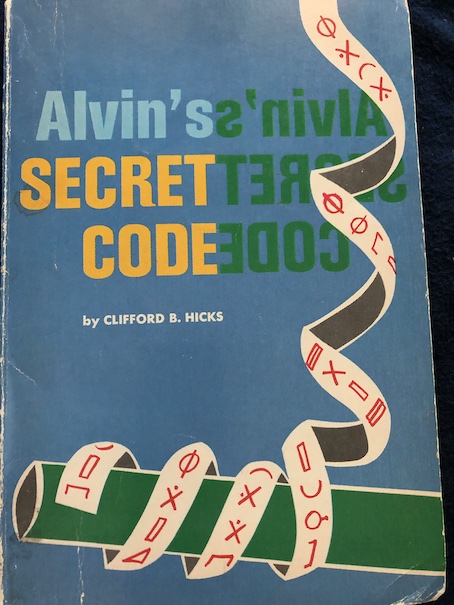
Alvin’s Secret Code

Alvin’s Secret Code by Clifford B. Hicks, 1963.

This book is part of the Alvin Fernald series.

Alvin has been reading a book about spies, and now, he and his best friend, Shoie (a nickname, his real name is Wilfred Shoemaker), are playing at being spies. One day, as the boys are walking home from school, Shoie stops to pick up another bottle top for his collection, and he finds a scrap of paper with a strange message on it. The words in the message don’t make any sense, and it looks like it’s some kind of secret code.

When Alvin gets home, his mother insists that he clean his room before he does anything else. Shoie helps him, and Alvin’s little sister, Daphne, insists that she wants to help, too, because she wants to see what the boys are doing. Daphne is fascinated by the things her older brother does and always wants to be included. When Daphne finds out that they’re being spies and have found a secret message, she also insists that she wants to be a spy and look at the message with them. They let her see the message, but they insist that she can’t be a spy because it’s dangerous and “work for men.” (That attitude comes up in mid-20th century kids’ books, especially ones for boys. I’d just like to point out here that, while dealing with spies would actually be dangerous, too dangerous for a young kid like Daphne, the fact is that both Alvin and Shoie are only twelve years old, so technically, they don’t count as “men”, either.) At first, the kids think maybe the message is meant for a secret Russian spy ring targeting the nearby defense plant. (This book was written during the Cold War, so that would be one of the first possibilities they would consider.)

Alvin comes to the conclusion that they need to investigate Mr. Pinkney, a relative newcomer to their town, because they found the message near his house, the message mentions an oak, and there’s one growing nearby. Alvin also thinks that they might need some help to break the code in the message, so he suggests that they visit Mr. Link, a WWII veteran who was also a spy during the war. He’s now an invalid who has a housekeeper who takes care of him, but he could still advise them about what to do with the mysterious message. Although the boys tell her that she can’t be involved with what they’re doing, Daphne still tags along with them when they go to see Mr. Link.

When the kids ask Mr. Link about his time as a secret agent during the war, he calls spying a “dirty, dirty business” but “something that must be done”, saying that he’s glad that it’s all over now. However, he’s perfectly willing to talk about secret codes and ciphers. Mr. Link has even written a couple of books on the subject. This story is a nice introduction to codes and ciphers for kids because it explains some of the terms and how codes and ciphers work. As Mr. Link points out, much of what people think of as secret codes are actually ciphers. The difference is that ciphers are actually secret alphabets that can be used to compose messages. When Mr. Link asks them if they’re trying to compose a cipher themselves, the kids tell him about the secret message and their suspicions that there could be a spy in their town.

Mr. Link doesn’t reject the possibility that there could be a spy in the area, but he tells them that they’re wrong to suspect Mr. Pinkney of being a spy because Mr. Pinkney is a friend of his, and he knows him very well. For a moment, Alvin wonders if they should suspect Mr. Link too, but Mr. Link anticipates the thought and says that he can prove that he’s trustworthy by telling them more about Mr. Pinkney and breaking the code for them. Mr. Link explains that Mr. Pinkney was lonely when he first came to town, and that’s how the two men started playing chess together regularly. Mr. Pinkney owns a factory that makes electronic devices, like transistor radios and intercoms, and one day, he told Mr. Link that he had a problem with his business. He suspected a business spy of trying to intercept his messages to his product distributors in Europe, and he needed a way to make his messages more secure. Naturally, Mr. Link suggested using a code, and he recognizes the coded message the kids found as one that Herman Pinkney sent to his distributors. Mr. Link shows the kids how each word in the strange message stands for another word or concept. Only someone who knew what the code words were supposed to mean would be able to read it.

Alvin is a bit embarrassed about jumping to the wrong conclusion, and Mr. Link says that he’s learned a couple of important lessons from this experience. First, you shouldn’t jump to conclusions about people if you don’t know them very well, and second, people who are full of tricks and deception are easily confused when they encounter straightforward honesty. In other words, while Alvin was spinning imaginative spy tales in his head, he overlooked the possibility that there could be a more innocent explanation. Alvin is still embarrassed, but he takes the lessons to heart, and Mr. Link tells them more about codes, how they have been used in history, and how codes are around them all the time, every day.

I liked Mr. Link’s explanations about how codes aren’t just for spies. He says that codes are used for all kinds of communications where only certain people are meant to read and understand messages. He explains about the product codes on things that the kids buy and wear everyday, showing them how to read the size codes on their shoes. Codes can indicate where and when products were made, and we still use product codes for that purpose in the 21st century. I used to work in a textbook store, and we used the codes on textbooks to tell which edition of a book students needed or whether a student needed just the textbook or if they needed books that came bundled with other, supplemental materials. Mr. Link says that ordinary people can sometimes figure out what product codes mean by studying them and looking for patterns that they recognize, like dates or sizes.

Since this book was written in the 1960s, they don’t talk about computers or the Internet, but that’s a major use of codes in the 21st century, and anybody can study and learn computer coding. Computer programming involves “coding” because, like with the other codes that Mr. Link describes, programming languages are also codes, using certain words and symbols to represent concepts that not everybody needs to read in order to use a computer, but which the computer can interpret so it knows what the programmer and user want it to do. Communications and transactions over the Internet also involve cryptography to protect the users’ information, using algorithms to convert a sender’s plaintext message to ciphertext to conceal its true meaning from any third party who might try to read the message and then back into plaintext so the intended recipient can read it. Codes really are around us all the time, even when we’re not fully aware of them or paying close attention to them.

The kids are fascinated by Mr. Link’s stories about how codes were used in history and the unusual methods people used to send secret messages, like writing them on someone’s head and then letting their hair grow out and cover it. He also shows them scytales, round pieces of wood that can be used for reading secret messages. The message would be written on a long strip in what appears to be jumbled letters. The message only makes sense when the strip is wrapped around the scytale so that the letters will align in the proper order to be read. That’s what’s shown on the cover of this book, although the picture also shows a message written with code symbols.

It’s all fun and games until a woman named Alicia Fenwick shows up in town with a puzzle that puts the kids’ abilities to the test. She comes to see Alvin’s father in his professional capacity with the police, looking for a man named J. A. Smith. Miss Fenwick explains an incident that happened to her family during the Civil War. The Fenwicks used to own a Southern plantation with slaves. (Daphne says that she doesn’t like the part of the story about the slaves, and Miss Fenwick says she doesn’t either although her great-great grandfather was apparently kind to his … which is what they all say, isn’t it? More about that in my reaction section below.) During the Civil War, her great-great grandfather was an old man. All the young men went away to fight in the war, but he stayed at home. When there were rumors of marauding bandits, he got worried that the plantation with would be a prime target for them with all the young men gone. He enlisted the help of a former slave he had freed before but who was still a friend to help him hide the Fenwick family’s valuables. They put everything they could into a chest and buried it. Unfortunately, when the bandits came, they forced the former slave, Adam Moses, to reveal the location of the chest by threatening to kill his young son. After they dug up the chest, they took Mr. Moses prisoner and forced him to help them take the chest with them further north. Eventually, Mr. Moses escaped from the bandits after they tried to kill him, and he wrote a letter to the Fenwicks saying that he was now in Indiana and that the bandits had forced him to help them rebury the chest. He said that he would try to retrieve the chest and return home with it, but sadly, he was later found murdered close to Riverton, the town where the children now live, probably killed by the same bandits who took the chest. However, the leader of the bandits was also killed shortly after that, so they never enjoyed their ill-gotten gains. The treasure chest was never recovered. The story was passed down in the Fenwick family for generations as an unsolved mystery until recently, when Miss Fenwick received a letter from J. A. Smith asking her for any information she might have about about the treasure. She told this person about the letter from Mr. Moses but didn’t hear from him again, so she’s trying to trace J. A. Smith and find out what he knows about the treasure.

Sergeant Fernald, Alvin’s father, says that there are people in town with the last name of Smith but nobody who has the initials “J. A.”. However, the kids say that Miss Fenwick’s story might explain some of the stories told by local kids about an area outside of town called Treasure Bluffs. Rumor has it that there was a treasure buried there years ago, although nobody knows exactly why or where. The kids start to think that the story really points to the location of the Fenwick treasure, but the bluffs cover a lot of territory, and before they can really search for the treasure, they have to find a way to narrow down the search area.

The kids’ new lessons in code-breaking pay off when they spot a man at the local library using the code books that Mr. Link donated. The strange man is trying to break a message that will reveal the secret hiding place of the Fenwick treasure. Can Alvin and his friends figure out who the man is and break the code themselves before he does?

The book ends with a section explaining more about codes and ciphers. One of the codes they explain is the pigpen cipher, which is a popular one for children and appears in other children’s books. This book says that it was used in the Civil War, which is true, but it’s actually older than that.

The book is available to borrow and read for free online through Internet Archive.

My Reaction and Spoilers

There are some elements in this story about boys thinking that they’re more capable than girls, like in the way that Alvin and Shoie talk to Alvin’s little sister, but Alvin also acknowledge, to his irritation, that sometimes Daphne thinks even faster than he does. When Mr. Link is explaining the size codes on the children’s shoes, 8-year-old Daphne actually catches on a little faster than 12-year-old Alvin and comes up with the answer to a problem Mr. Link poses before Alvin’s “Magnificent Brain” does. I liked that touch of imperfection on Alvin’s part and the acknowledgement of Daphne’s abilities, which help thwart any overconfidence or arrogance that Alvin might have about his “Magnificent Brain.”

I appreciated that, although Alvin is clever, he’s not a complete genius, and he is noticeably fallible. He’s not good at everything, like some heroes of children’s books. He is terrible at spelling, and when he tries to write that he’s a cryptographer, he spells it “criptogruffer,” which doesn’t inspire professional confidence. Daphne knows the correct spelling and spells it aloud for him, much to Alvin’s embarrassment and annoyance. Alvin is still pretty clever, and he breaks the final code that reveals the hiding place of the treasure, but it is nice that he’s not unbelievably perfect.

The final code in the book is easy enough that anybody could actually break it with minimal effort. I spotted it pretty quickly because there’s something that I always do with secret messages in books, and it often pays off. (There are one or two things in the Harry Potter books that this works on as well.) I’m not going to spoil it here, although I’ll give you a hint: When I was a kid, I read and liked a book about Leonardo Da Vinci.

I genuinely enjoyed the parts of the story about codes, which run through most of the book. Mr. Link is full of helpful information, and the section at the back of the book with more information about codes is a nice introduction to some basic types of codes. As I said above, I like the practical applications of the lessons, showing kids how they can read parts of product codes, if they understand what to look for. That’s a useful skill, and you can use similar techniques to interpret the expiration dates on food products when they’re only stamped with a code instead of an explicit date.

Like Daphne, I also didn’t like the part of the story about slaves. This book was written during the Civil Rights Movement, which makes its takes on the Civil War, slaves, and race interesting. The author wants to tell a story that bears on the Civil War, so he has to address this is some fashion, and he tries to get pass the uncomfortable issue of families owning slaves as quickly as he can to get to the adventure part of the story.

The Civil War and its associated legends of battles, ghosts, secret passages, hiding places, hidden treasures, and secret messages are staples of American children’s literature. It’s completely understandable because the Civil War was a major event that shaped life and history in the US, it was a traumatic event whose impact is still felt even into the 21st century, and it gave rise to many stories and legends that have further helped shape our culture. The idea of treasures hidden during the war and later forgotten is a popular trope and so are coded messages that point to secrets from the past. I’ve seen these tropes used in other children’s stories, like The Secret of the Strawbridge Place, The House of Dies Drear, and Mystery of the Secret Dolls, and they’re always fun. However, stories with a Civil War backstory can sometimes feel a little uncomfortable because they’re almost impossible to tell without involving slavery in some way because slavery was at the heart of the war.

When Daphne says that she doesn’t like hearing about slavery and owning slaves, they deal with the issue quickly, with Miss Fenwick saying she doesn’t like it, either, and adding that her great-great grandfather was apparently nice about it, and then continuing with the story. As I said above, yeah, right, that’s what they all say. In stories (and sometimes real life), when there are characters whose families owned slaves and plantations, they almost always add the idea that, while slavery was bad and horrible and slaves were mistreated elsewhere, this particular family was special and treated their slaves with kindness, and it was almost like they were one big, happy family. Yeah, right. To be honest, I probably would have accepted that as a kid and let it pass. As an adult, I’m not letting it pass without at least a few pokes in the side as it goes.

The idea of the grateful slave or ex-slave who loves the family he served has been a trope since the anti-Tom literature of the 1850s. I can’t swear that no slave never felt any kind of affection for members of the family that owned them because human nature is varied and unpredictable, surprising relationships can spring up, and if all else fails, Stockholm Syndrome also exists, so I suppose it could happen, but at the same time, I just don’t buy that whole “slavery is bad, but my family is kind, and our slaves loved us” type of narrative. Even if a given slave-owning family was “above average” in treatment of slaves, that doesn’t mean that they were “good” so much as “less bad” among a group of people perpetrating something bad. The “average” in this situation is so bad that there’s quite a lot above that level that still wouldn’t qualify as good, whether the descendants of slave owners believe those old school textbooks promoted by the United Daughters of the Confederacy (some of which were still in use during the Civil Rights Movement – children are shaped by the things they read and the people who gave them those books, and history is not written by the “winners” but by the people who write) or have really thought this through all the way or not. (You don’t have to take my word for it. You can hear about it from people who actually were slaves.) I suppose I can suspend my disbelief about this fictional family for the sake of this kids’ story, which is mostly about secret codes and a treasure hunt and spends little time on racial issues, but I’d just like to point out that I definitely do have a sense of disbelief about this that requires suspension.

Of course, I can see why the author had to include it. In order for us to be invested in the treasure hunt and care about the Fenwick family getting their fortune back, we have to believe that they’re great people, sort of removed or distanced from the responsibility for choosing to own slaves (“in those days, it was accepted throughout the South” is the only explanation we’re given), who were as kind to their slaves as possible, so kind that at least one loved them so much that he gave his life attempting to recover the family fortune, and that they will now use the treasure for some beneficial purpose. (We are told that the family now operates an orphanage, which badly needs money, although we’re also told that one of their former charges has since become a US Senator, so you’d think he could help raise some.) If we didn’t like this family at all, we might see the fortune that came from their plantation as the ill-gotten goods of exploiting someone else’s labor, its loss as poetic justice, and the profit from its recovery as probably something that should either go toward the slaves who did the work on the plantation or maybe some public cause, like a museum or something.

We are told that Adam Moses’s son survived the experience with the bandits, escaped from them when his father was captured, and was adopted by another family, but we are not told anything further about his descendants. While I was reading the book, I halfway wondered if a descendant of the Moses family would surface with some important clue to the situation and get some acknowledgement, but that doesn’t happen. Instead, there’s a person who’s related to one of the bandits, who thinks that he has a right to the treasure because his ancestor stole it from someone else. The characters in the story scoff at that logic, but when I consider the full context of the situation, it makes me think.

Secret of the Samurai Sword

Secret of the Samurai Sword by Phyllis A. Whitney, 1958.

Before I explain the plot of this book, I’d like to point out some of the aspects of the book that make it interesting. The story takes place in Japan following World War II. The book wasn’t just written in the 1950s but set during that time (no exact year given, but the characters refer to the war as being “more than ten years ago”, putting it contemporary to the time when the book was written and published), and the war and its aftermath are important to the plot of the story. Although the main characters are American tourists, readers also get to hear the thoughts and feelings of people living in Japan after the war. The author, Phyllis A. Whitney actually born in Japan in 1903 because her father worked for an export business in Yokohama, and she spent much of her early life living in and traveling through Asia. Her parents gave her the middle name of Ayame, which means “Iris” in Japanese, although she had no Japanese ancestry. Her parents were originally from the United States, but the family did not return to the United States until Phyllis was 15 years old, following her father’s death in 1918. That means that Phyllis Whitney was very familiar with what Japan was like before both of the World Wars as well as after. She lived a very long life, passing away at age 104 in 2008, and she saw many major world events and changes through her life. I was interested in hearing how she viewed the effect of the World Wars, especially WWII, on Japan and its culture in this book. In the back of this book, there is a section where the author explains some of the background of her life and this story and her inspiration for writing it.

Celia and Stephen Bronson are American teenagers who are spending the summer in Japan with their grandmother, who is a travel writer, not long after the end of World War II. Celia and Stephen are really just getting to know their grandmother, whom they have not seen since they were very young (they don’t explain much about why, except that she travels a great deal) and don’t really remember, and she is getting to know them. Stephen’s passion in life is photography, and Celia likes to draw, although she doesn’t consider herself to be very good. Stephen is the older sibling, and he’s lively and outgoing, often doing the talking for Celia as well as himself because she’s quieter and less confident. Celia often hesitates to voice her opinions in Stephen’s presence because he jumps on her for things she says and shuts her down when she speaks. (Yeah, I’ve been there before, kiddo.) Stephen is often brash and insensitive, bluntly referring to his sister as “beautiful but dumb” right to her face and in public when she accidentally leaves one of their bags with some of his camera equipment behind at the hotel where they were staying in Tokyo. Celia is embarrassed at her mistake because she knows that sometimes her mind wanders and she doesn’t focus properly. Celia is a daydreamer. She feels bad that she does silly things sometimes, but she had hoped that this trip to Japan might help her and Stephen to be closer, more like they used to be when they were younger, before Stephen started getting so impatient and disapproving with her. However, Stephen’s about to get a little disapproval of his own. (And more from me later.) Stephen gets a rebuke from his grandmother for using the word “Japs” in the conversation because they are guests in Japan, and she won’t have him using “discourteous terms” for the people there. The kids’ grandmother says she’ll just write a note to the hotel, telling them where to forward the forgotten bag, and it’s not a big deal.

The kids and their grandmother, whom they call Gran, are not staying in Tokyo but renting a house in Kyoto. Gran knows her way around because she has been to Japan before, multiple times, and she can speak a little Japanese. Everything is new to Celia and Stephen, even the train trip to Kyoto, where their grandmother introduces them to the bento boxed lunches they can buy at the train station, which come beautifully wrapped with included chopsticks, and little clay teapots with green tea. (I love stories that include little pieces of cultural information like this. When they finish with their lunch boxes and pots of tea, they wrap them up and put them under the train seats to be collected by staff later.)

While they’re having lunch on the train, the kids’ grandmother tells them a little about the house she’s rented. It’s a very old house, and a Japanese family used to live there, but after WWII, the Occupation Army used it for a time and updated some parts of the house, so it’s an odd mixture of Japanese and Western style now. (Gran says that the house now includes a “real bathroom.” Here, I think what she’s really talking about are the toilets, not the baths. Americans don’t make a distinction between rooms for baths and rooms for toilets because our houses usually have both in the same room. In Japan, like in Britain, that’s not always the case. What I’m not sure about is whether she’s saying that the house didn’t originally have indoor plumbing because it was really old or if she’s just saying that the army changed the traditional squat toilets for western style ones. Either way, I think she’s trying to say that they can expect western style toilets, similar to what they have at home.) She also tells her grandchildren that the house is supposed to be haunted by a ghost in the garden. She thinks the prospect of a ghost sounds exciting and will make a nice addition to the book she’s writing. However, Stephen says that he doesn’t believe in ghosts. Celia hesitates to voice much of an opinion because she doesn’t want Stephen to jump all over her verbally again. Gran tells Stephen that people in Japan look at things like ghosts and spirits differently from people in the United States hints that he should keep more of an open mind.

The three of them discuss the bombings of Japan during WWII, and Gran explains that Kyoto wasn’t bombed, like Tokyo and Yokohama were. It’s a very historic city because it used to be the capital of Japan, and Gran is happy that the historic shrines and temples of the city survived the war. Celia admires the beautiful countryside and thinks about drawing it later. Although she said earlier that she would be happier if someone else saw the ghost instead of her, Celia thinks that an elegant Japanese lady ghost pining for a lost love in her garden would make a very romantic image. However, the ghost isn’t an elegant lady. It’s the ghost of a samurai, pierced with arrows, and he’s looking for his lost sword.

When they finally reach Kyoto, Celia is surprised by how modern it looks and how many people are wearing American style clothes instead of kimonos. Finding the house is a bit tricky because the houses don’t always have house numbers and not all of the streets have names. (This is true, although there is a system behind the lack of names and irregular numbering.) People stare at the Bronsons because they’re blond and stand out from everyone else as foreigners. At the house, they meet the maid, Tani, and the cook, Setsuko. Gran explains to the kids how they need to change their shoes when they enter the house and how the bedding in the bedrooms is folded and put away during the day. (Again, I really like the little pieces of information about daily life and culture.) Celia admires the garden of the house, but she notices a strange lump of concrete that seems oddly out of place. It turns out to be a bomb shelter, left over from the war. The door to the shelter is locked, so for much of the book, the characters are unable to look inside.

Then, Celia spots a Japanese girl from a nearby house watching her. She tries to say hello, but an elderly man discourages the girl from talking to Celia. However, a boy named Hiro stops by because he’s been studying English in school and would like to practice by talking to them. Hiro isn’t bad, but his pronunciation is off, partly because of the r/l sound that’s practically cliche in fiction. (The r/l confusion in Asians who speak English is based in reality, not just fiction. Many Asian languages, including Japanese have a sound that’s about halfway between ‘r’ and ‘l’, which causes confusion to English speakers, who are accustomed to those sounds being completely separate from each other. This is one of those books that spells things people say how they’re pronounced in order to convey accent, which I tend to find annoying. The way Hiro’s speech is conveyed seems to be pretty accurate for a beginning speaker of English who is accustomed to Japanese, including his mispronunciation of “baseball” as “beso-boru.” I’m not really fond of books that over-emphasize accents in writing because there are a lot of really corny jokes in old movies based on the r/l sound confusion, and they tend to overdo it and try to carry the jokes too far, but I’ll go easier on this particular book because it’s important to the story that Hiro is learning English pronunciation. I also appreciate that there are some Japanese words and phrases and their translations in the book, which is educational.) Stephen, always the rude one, picks on Hiro’s pronunciation while he’s visiting, and when he leaves, he calls him an “oddball.” Gran disapproves of Stephen’s attitude and tells him that Hiro might teach him “a few things.” Stephen does become friends with Hiro and some of Hiro’s friends, and Celia admires Stephen’s ability to make friends easily, but it occurs to me that might not be entirely due to Stephen’s friend-making abilities because his new friends also need the ability to tolerate him. (Mean people can be sociable and attract others because they’re self-confident, but rudeness is also trying, especially when you’re around it for long periods. Also, I’m pretty sure that Hiro doesn’t know what Stephen said about him behind his back.)

Celia tries to ask Tani about the ghost in the garden, but all Tani will tell her is that only her cat sees the ghost. Later that night, Celia wakes up and hears the sound of someone wearing wooden clogs walking around outside and music being played on a stringed instrument. Celia is too comfortable and too tired to get up, so she doesn’t see the ghost that night, but she believes that’s what she heard.

When Celia and Stephen are allowed to do some exploring on their own, Celia meets the Japanese girl she saw before and learns that she’s actually American, too. Sumiko Sato’s parents were born in Japan, but she was born in San Francisco and only arrived in Japan the month before to stay with her grandfather. Sumiko doesn’t think of herself as being Japanese, although she speaks the language. Her grandfather, Gentaro Sato, is a famous artist, but he is also an old-fashioned man who doesn’t like Americans, partly because of the destruction from the war. Sumiko is Hiro’s cousin, and Sumiko is a little angry that her grandfather allowed Hiro to go talk to the Americans the other day to practice his English but wouldn’t allow her to go when she’s really an American who speaks fluent English. She says that it’s part of her grandfather’s old-fashioned attitudes and because Hiro is a boy. Apparently, boys are allowed more freedom than girls in Japan. Since she and her mother came to Japan after her father died, Gentaro has been trying to teach his granddaughter to be a proper Japanese girl, but Sumiko is used to living as an American and hates it that her grandfather wants to mold her into being something else. She also says that the other girls in the area don’t accept her because they know that she’s an American who doesn’t fit in. Sumiko doesn’t even care for her grandfather’s traditional style of art, which only has nature themes and no people. She likes the pictures Celia draws with people in them. She wishes that they’d stayed in San Francisco because she really wants to go to the university in Berkeley, where Celia and her brother live, but her mother missed Japan, and Sumiko is only 14, the same age as Celia, too young to stay in the US by herself. Celia sympathizes with how Sumiko seems caught between two cultures, but she’s grateful that Sumiko is there because she could really use a friend this summer. Really, both of them could use a friend who speaks their language, in more ways than one. Celia asks Sumiko if she knows anything about the ghost that’s supposed to haunt their house. Sumiko says that her grandfather has seen it, but she refuses to believe in it until she sees it herself.

Celia’s first knowledge of the lore of the samurai who is supposed to haunt their garden comes when she and her grandmother are looking at prints of Gentaro Sato’s work in a shop. The shop owner also has a painting by Gentaro Sato that he did in his youth, when he did paint pictures of humans. The picture is of an ancestor of the Sato family, a samurai who died bravely in battle. It’s a frightening image but a powerful one. Later, when they see Sumiko at a shopping center with her younger cousins, and they ask her about the samurai painting. Sumiko says that people in her family talk about the painting, but she’s never actually seen it herself because her grandfather gave it away years ago, although the family wishes that he hadn’t. Gentaro said that he just couldn’t bear to have it in the house anymore. After the war ended badly for Japan and his eldest son (Hiro’s father, not Sumiko’s) died, Gentaro was greatly depressed. It turns out that Hiro’s father didn’t just die but committed suicide along with his commanding officer at the end of the war because they felt like the defeat of Japan was a personal dishonor for them as soldiers. At least, Hiro’s father’s captain felt that way, and Hiro’s father killed himself out of loyalty to him. (Japanese soldiers in real were known to have killed themselves in various ways at the end of the war. Some committed suicide as individuals and some in large groups, and some in last-ditch battles. Even civilians killed themselves and even family members for fear of how they might be treated by an occupying American army. The war’s deaths didn’t end with the war itself.) That means that Hiro’s father’s death was a direct result of the defeat of Japan. The Sato family said that, after that, Gentaro sat and stared at the samurai painting for days until, one day, he couldn’t stand to see it anymore. Now, he doesn’t even like talking about it. During an English language practice session with the Bronson family, Hiro further explains that, while Gentaro hadn’t wanted Japan to enter the war in the first place, he was even more shocked when Japan lost because he always thought that the gods favored Japan and wouldn’t allow the country to be defeated. The defeat shook his confidence in everything he thought he knew and believed in.

Even though it’s been more than ten years since the war ended, the memory of the losses and destruction of the war is still strong, and Gentaro still struggles with his feelings about it. He gave up drawing and painting people and samurai for his nature drawings because he wanted to get as far from the themes of war as possible. All of this ties directly with the house the Bronsons have rented because the Sato family originally owned the house. They were forced to sell it to the Occupation Army because they badly needed money after the war, and they moved to a smaller house nearby, just another loss from the war for Gentaro to mourn. When Celia and Sumiko take doll-making lessons together, their teacher, Mrs. Nomura, who has known the Sato family for a long time, tells them things that even Sumiko hasn’t heard from her family. Apparently, before Hiro’s father killed himself, he hid the sword that his samurai ancestors kept for generations because he didn’t want the occupation forces to find it. (It was a valid concern. Although Sumiko points out that American soldiers wouldn’t take the sword to use against Japan as her grandfather initially feared because most Americans, even soldiers, don’t know how to fight with swords, some US soldiers were known to take weapons and other objects they found as “souvenirs” or war booty.) Gentaro originally told his son to destroy the sword to keep it out of enemy hands, but no one knows whether he did or not. However, metal swords are very difficult to destroy, so people think he might have just hidden it somewhere.

The ghost that haunts the house and garden is the samurai from Gentaro’s painting, even including the arrows piercing his body. Celia does eventually see him, even noting that he doesn’t have his sword with him, like he did in the painting. Strangely, Gentaro actually seems happy whenever he sees the ghost. He thinks the ghost is trying to tell him something, although he worries because he can’t figure out what the ghost wants and thinks that he might not be able to provide it. Why does the ghost appear in the garden at night? Or, perhaps a better question, why would someone want to make it seem like a ghostly samurai is haunting the garden? Is someone really trying to send a message to Gentaro? And, what did Hiro’s father really do with the sword years ago?

My Reaction

The Mystery

I’ve read other books by this same author, so I know that she wrote mysteries, not ghost stories. I knew from the beginning that the ghost wasn’t really a ghost. I was pretty sure, for about half the book that I knew who the “ghost” was going to be because there was one really obvious place for the “ghost” to get his costume, but I wasn’t completely sure, and I also couldn’t figure out the motive. The missing sword is at the center of the mystery, but I wasn’t sure why someone would play ghost to find it. I mean, the ghost act does allow someone to enter the garden without permission without being recognized, but when Celia and Stephen see the ghost, the ghost doesn’t really seem to be actively searching for anything. The “ghost” seemed to be meant to be seen by other people, but I couldn’t figure out why or what that was supposed to accomplish.

As it turns out, I was only partially right with my first theory. I was right about where the costume came from, but not who was wearing it. I had rejected one of the characters as a possibility because this person was accounted for during one of the ghost sightings, but this person had a little help to establish an alibi. The ghost stunt wasn’t meant to upset Gentaro but to help him to let go of the past by staging a conclusion to a family tragedy in order to help Gentaro to regard the situation as resolved. The “ghost” had a final act to the drama in mind when Celia’s investigation interfered, but it all turns out for the best because Celia realizes where the missing sword must be. In the end, they don’t tell Gentaro the whole truth because the “ghost” deception would upset him, but when they return the sword to him, he is able to believe that the spirit of the samurai is now at rest. The sword was not destroyed, but Hiro’s father did manage to break the blade in half in order to render it unusable to anyone who might find it. Gentaro regards the broken blade as a fitting metaphor for the end of the war and, hopefully, the beginning of a more peaceful future.

The mystery is good, and the nighttime sightings of the ghost are fun and creepy, but much of the emphasis in this story is on the characters, their relationships with each other, and the history and culture of Japan.

Japanese Culture

I’m not an expert on Japanese culture, although I know a little about Japanese history. The author of this book actually lived in Japan during her youth, and she later returned to visit, so this is a subject near and dear to her heart. The book is full of explanations of daily life and culture in Japan, more than I even mentioned above. The characters visit some famous landmarks and collect stamps in their stamp books to mark places they’ve been. I also enjoyed the scene where Celia watches Gentaro as he pays his respects to a local shrine. The rituals Gentaro observes at the shrine resemble the ones described in this video for the benefit of tourists visiting Japan. The kids also visit a Japanese movie studio with their friends because Hiro and Sumiko’s uncle is an actor, and Hiro gets a part as an extra in a movie. The book ends around the time of some Japanese festivals that honor the dead, which is fitting.

The books seems pretty accurate on history and culture, but I can’t vouch for everything the author says, both because I haven’t lived in Japan myself and because the book takes place more than 60 years ago, so some things may have changed since then. Sumiko makes some comments about Japanese family life and family dynamics during the course of the story, and I don’t know if all of them still apply or if some of them even really applied to families other than Sumiko’s. There’s probably at least some basis for what she says about how girls are treated differently from boys and how discipline of young children works, but I’m just not sure to what extent Sumiko’s experiences reflect real life because family dynamics can be personal among families. There may be some general trends in these areas, but actual results may vary or change with time.

If you’d like to see some street scenes of Tokyo during the 1910s, when the author lived in Japan as a girl, for an idea of how Japan looked to her at the time, I recommend this video (colorized and with ambient sound added because it was originally silent). There are also videos that show Japan in the 1950s (with added music) and part of a documentary about family life in Japan during the early 1960s (which discusses how Japanese culture and clothing became more Westernized after the war) to give you an idea of what the author might have seen on her return visit to Japan and how Japan might have looked to the characters in the book. Again, these are just brief glimpses, and actual results may vary in real life, but I did like that the 1960s documentary shows what a Japanese house of the era looks like because that’s important to this story. It also shows scenes from a children’s art class, which is also appropriate to the story. This video from 1962 shows scenes in Kyoto and Nara which include a print shop and a temple, which are also places the characters in the story visit. For a look at modern 21st century life in Japan, I recommend the YouTube channels Life Where I’m From and japan-guide.com, which are in English and designed to be educational for visitors to Japan. In particular, the Life Where I’m From channel includes this video, which shows and explains old townhouses in Kyoto, which can help you further understand the types of homes in the story.

The War

Since the book takes place during the 1950s, the focus is on the end of World War II and what happened immediately after. If you want to know more about how the war started (a lot of it had to do with resources as well as the state of international affairs following WWI), how Japan entered the war, what led up to the attack on Pearl Harbor, and how the US became involved, I can suggest the videos I’ve linked in this sentence for some brief explanations with historical footage. I particularly like the ending to the CrashCourse video that briefly explains WWII, where the host talks about the aftermath of the war and the development of nuclear weapons, explaining that, “the opportunity of studying history is the opportunity to experience empathy. Now, of course, we’re never going to know what it’s like to be someone else, to have your life saved or taken by decisions made by the Allied command. Studying history and making genuine attempts at empathy helps us to grapple with the complexity of the world, not as we wish it were, but as we find it.” I think this fictional mystery story captures some of that sentiment. What happened at the end of the war wasn’t happy. It was good that the war was over, but Japan was in a bad state, and its people were in a bad situation. The characters in this story have to acknowledge that and come to terms with it, and empathy is one of the tools they use to do it.

It helps to remember that the original audience for this book was American children about the age of the child characters in the story, who were probably too young to remember the war themselves and were dependent on their elders to tell them what happened. The book was meant to explain some of the Japanese perspective and encourage empathy. The author notes in the back of the book that she consulted with some Japanese friends about the aspects of Japanese culture included in the book. It’s worth pointing out that Americans and Japanese have different memories of the war because, while both countries experienced trauma from it, the parts that caused each country the worst trauma were different. For Americans of the time, the beginning of the war and Pearl Harbor were the most traumatic parts, and for the Japanese, the end of the war, the atomic bombs, and the suffering that came immediately after the end of the war were the most traumatic. All of those events were part of the war, and they were all bad, but some parts were worse for some people than others, and that influenced how they all felt afterward. It’s worth keeping that in mind because it explains how different characters in the story feel and how they approach the subject and also what the author is trying to point out to the American children reading the book.

Because this book was intended for a young audience, probably kids in their tweens (pre-teens) or early teens, it doesn’t go into gory detail about all of the horrors of war, but there’s enough here to give a realistic impression of genuine suffering. For example, we know that Hiro’s father committed suicide with his commanding officer after the war, but the book doesn’t explain the method he used to do that. It’s left to the imagination. (Hiro’s father didn’t use his family’s sword for that or it would have been found with his body, but that’s all we really know.) Readers are invited to empathize with the characters about what they’ve endured as well as what they’re continuing to go through. Celia empathizes with Gentaro when she learns what he and his family suffered because of the war, although she still thinks that it’s a little unreasonable for him to still hate all Americans because he now has a granddaughter who counts as an American by birth and upbringing and Celia’s family wants to be friends. Celia follows her grandmother’s attitude that the war ended more than ten years ago, and it’s time to move on and build a new future. Of course, that’s easier to say when you’re not the one whose life was shattered and completely changed by the war. Gentaro has had some time to work through some of his feelings about what’s happened, but the damage done to his family is serious and lasting, and the truth is that nothing will ever be the same for them again. The characters have to acknowledge and accept some of the grim realities of the past before they can move on.

I was surprised that the book never mentioned Japanese internment camps in the US during WWII because I would have expected that to have an effect on Sumiko and her attitudes about being an American, but I suppose we’re meant to assume that her family wasn’t among those sent to the camps. Of course, this is more than ten years after the war, and since Sumiko is fourteen, she was probably very young during the war and wouldn’t have much of a memory of that time.

I’ve talked somewhat about how Sato’s family was affected by the war and their thoughts about it, but there’s much more detail about that in the book. The book doesn’t shy away from talking about the atomic bombs dropped on Japan. The characters in the story don’t visit Hiroshima in the book, but at one point, the subject comes up when Celia and Hiro have an honest talk about what the missing sword means to the Sato family. Hiro describes the museum and monument at Hiroshima to explain how his family feels about the nature of war. The sword is no longer a symbol of war to them but his family’s connection to the past and their ancestors. Gentaro wants it back because he thinks the ghost is his samurai ancestor, searching for the sword because it’s lost, and he gets upset because he can’t return the sword to this spirit. (That’s not what’s happening, but that’s what Gentaro thinks at first.) Celia is moved to tears at what Hiro tells her about Hiroshima and how both Americans and Japanese go there to mourn and pay their respects and there is “no resentment left against those who had dropped the bomb.” (I’m not sure that there is “no resentment” at all because people like Gentaro are still struggling with their feelings, and that’s completely understandable, but the story is focusing on how people were coming to terms with what happened in a form of sad acceptance.) Hiro quotes the words on the monument, “Sleep undisturbed, for we shall not repeat this error,”, adding “Japan makes error. America makes error. But these words do not mean to apologize for wrong. By ‘we’ monument means mankind. It is man who must never make error again.” It’s a broad statement against war itself, and this is the sort of sentiment the author is encouraging the readers to have, reflecting on what war does to people, even just ordinary families, letting them feel for others, and consider what they really want for the future.

The bright side is that, although there were dark times in the recent past and everything has changed for the Sato family, not every change has to be a bad one. With the help of the young people in the story, Gentaro begins to see that there is new life and hope for the future. Even though they don’t speak the same language and have to communicate through a translator, Gentaro bonds with Celia over their shared love of art and the beauty of nature. Celia is quiet, shy, and observant, very unlike the loud and rough Americans Gentaro has seen before (including her brother). Gentaro begins to realize that not all Americans are alike, and some can be kindred spirits. Similarly, not all Japanese girls are really alike, and Sumiko is just a different kind of Japanese girl. Gentaro realizes that he has to take people as he finds them, even his own complex and seemingly incongruous granddaughter. Sumiko has some soul-searching of her own to do before she and her grandfather finally have a heart-to-heart talk, but their interactions with the American family put their relationship into a new light. Gentaro’s life isn’t what he once thought it would be, but this is the life he has now, and not all of it is bad. Sumiko isn’t the granddaughter he would have expected, but she’s also one he has, and she’s not bad, either. Gentaro also realizes that Celia has some good qualities that she could use to be a good influence on his granddaughter, especially her ability to see the beauty in things around her and communicate it to other people. Celia is very perceptive, and Gentaro recognizes it. Although Sumiko has been resisting traditional Japanese culture because it’s unfamiliar and uncomfortable to her and she thinks that even the people in her own family don’t like her, she begins to appreciate the beauty of traditional Japanese arts through Celia’s appreciation for them. Celia also helps her to see a different side of her family. Because Celia can bond with Gentaro over their shared love of art, Sumiko realizes that she also values her grandfather and admires his art and begins to bond with him by learning how to show her interest and appreciation. When Gentaro draws a picture for Celia, Sumiko tells her that he’s never drawn a picture for her, so Celia tells Sumiko to ask her grandfather for a picture so he’ll know that she wants one and will value what he gives her. Gentaro’s appreciation for Celia also helps her to resolve some problems in her own life.

The story works on a small scale, focusing on one American family and their interactions with a Japanese family and seeing how they can help each other and find some common ground. However, you might be wondering what was going on in the bigger picture at this time. As the author explains in the section in the back where she talks about her own travels in Japan, there were American tourists going to Japan and seeing and doing things very much like what the characters in the book do. Americans could safely visit Japan in the 1950s and receive hospitality, although the war was still in everyone’s mind, and there were lingering feelings about it. The fact that, when the book takes place, more than ten years have passed since the end of the war helps. The children in the story were either very young when it was still happening or weren’t born at all, so they don’t remember the war themselves the way their parents and grandparents do. Also, there are two other factors that are worth addressing here although they aren’t fully addressed in the book.

The first is that, in the face of the devastation of the war and the hardships that came after, many people developed a kind of stoicism, a sense that that situation simply “couldn’t be helped” because it was all just a part of the nature of war and that the best thing to do was to try to go on with life as best they could afterward, rebuilding their cities and their lives. They didn’t like what happened (to put it mildly), but they accepted circumstances for what they were. There was still plenty to justifiably complain about, but the focus shifted to doing something about building the future, which is empowering. This mindset also helped people in Japan to shift the blame for the results of the war away from the soldiers who engaged in it and onto the concept of war itself, a sentiment that is reflected in the story. As Hiro puts it when he’s describing the monument at Hiroshima to Celia, “But no more enemy. Only war is enemy. Enemy of all people.”

The second factor is that the US learned something from the end of WWI. Part of the reason why WWII happened was that Germany was left in a bad state with a crippled economy after the end of WWI and a lot of resentment for those who had left it in that condition, those who blamed Germany for the entire war. As WWII came to an end, the US didn’t want to leave Japan in a similar condition, setting up further suffering and resentment that might erupt in revenge later, and they also hoped to shift the cultural focus of Japan away from some of the imperialistic and nationalistic feelings that helped fuel Japan’s involvement in the war. (Gentaro and his son’s despair at Japan’s loss of the war was partly based on what they had always believed about their government and leadership and what victory and loss would mean, and that’s an example of the sort of thinking that the US wanted to discourage during the rebuilding process, to redirect attention from the war and defeat mindsets. In real life, there were more complicated and controversial factors, of course, relating to political and economic structures, but this is the sort of reference to mindsets that enters this particular story. They’re pointing out that the defeat of Japan in the war doesn’t really mean what Gentaro and his son originally thought it meant for Japan’s future and even the future of the Sato family.) So the US government made it their business to contribute to the rebuilding of Japan, starting almost immediately after the end of the war. Being an occupied country after a war is never a great thing, and there was an admitted element of self-interest in the efforts the US made (fighting Japan once was a horrible nightmare, so they were ready to do things that would make that less likely to occur a second time, plus Japan also proved helpful in providing bases for US troops as the Korean War started) and perhaps a lingering sense of guilt over the use of atomic weapons, but the ability and willingness to take some responsibility and back it up with both work and money is worth something.

The book takes a rather optimistic view of the US occupation of Japan after the war, probably more than it really deserves. For example, Gran and Stephen both discount the possibility that US soldiers would take anything that didn’t belong to them as souvenirs, but they were known to do that in real life. They don’t even touch on some of the darker the subjects, like rape and prostitution, because this is a book for kids, but those were realities as well. In real life, post-war recovery was a long, hard effort with a lot of problems and mistrust along the way, but as time went on, the efforts helped because the people involved were willing to continue putting in the work even though it was difficult, people didn’t do everything right, and things weren’t always working well. So, the US did cause immense destruction to Japan but the fact that they stayed to become rebuilders after the war probably made a big difference in the long term relationship between the two countries. The US couldn’t bring back the dead, but in the end, they did do something to help the living. By the time the American Occupation ended in 1952, just seven years after the end of the war, Japan was on a much better footing, economically sound enough to begin operating independently again, albeit with some continuing military restrictions.

Tourists to Japan helped bring in additional sources of business and revenue, and when tourists were genuinely interested in the history and culture of Japan, as the characters in the story are, they made pleasant visitors. Probably, these positive interactions helped smooth over some of the bad and bitter feelings from the war and dissolve some prejudices on both sides. Real life is complex and messy, but the book emphasizes these types of positive interactions and the feelings of understanding they can produce. The author showed her young readers that not all Japanese are scary soldiers, like the ones who attacked Pearl Harbor; some are artists who create beautiful things and love nature, like Gentaro, and some are kids, like Sumiko and Hiro, who are much like the kids who originally read this book and can be friends. Also, if Americans can go to places like Hiroshima and face the past, showing real feelings like sorrow and remorse, and they can also appreciate the good parts of Japanese culture with respect and genuine interest, maybe they’re not so bad and scary, either. This is the way the author wants her readers to behave and to look at other people.

Gradually, the US and Japan developed a sense of mutual respect, which improved over time. It can’t be said that it’s a completely perfect relationship because nothing on Earth ever is completely perfect, but it’s a very good relationship in modern times, especially considering what it started from. (Actually, way before WWII and the atomic bombs, the first interactions that the US had with Japan in the 19th century were also pretty rocky, such as when Matthew Perry sailed there in 1853 and told isolationist Japan that they had better open up for trade or he would open fire. That’s one way to make a first impression.) The improvement came largely because the people involved cared enough to work for the improvement. The way things happened wasn’t always good, and sometimes, it was about as bad as it could get, but people took what they had and made it better, and that’s what makes a relationship worth something.

Theme of Respect

Speaking of relationships that are based on mutual respect (and even more about those that aren’t), I found the character of Stephen in the story really annoying, and if you’ve read other reviews of mine where I complain about characters like him, you can probably guess why. He is rude and inconsiderate and occasionally downright nasty. One of Stephen’s functions in the story is to be an example of ways not to behave, and that means that readers have to watch him do things that are annoying and cringe-inducing. The other way he functions is to provide a reason for Celia to want to prove her intelligence in spite of his criticism that she’s “dumb.” He’s kind of a negative force, moving the situation forward, not because he does much to help it, but because Celia wants to prove that she’s not as dumb as he thinks she is and earn his respect. I understand the points the author wants to make with Stephen, but putting up with him along the way isn’t fun. What I have to say about Stephen largely about the issue of respect, which is a theme that runs through the book.

To begin with, although Stephen is outgoing, and that helps him to make friends with some of the Japanese boys, including Hiro, but Stephen really isn’t a very respectful visitor in Japan. He starts off the trip using the word “Japs” freely on the train until his grandmother stops him. He laughs at Hiro and calls him an “oddball” behind his back for the way he speaks when Hiro knows more English than Stephen does Japanese. When they visit a temple, Stephen openly laughs at one of the worshipers because he thinks something the man does looks silly. Stephen is the kind of American tourist who gives other tourists a bad name, embarrassing us all. Perhaps I might feel differently if he was ten or twelve or younger, but he’s fifteen years old. That’s one year away from driving and three years away from college and registering for the draft, even back then. The older someone is, the worse it is when they act that way, like they don’t have a clue. When you’re in high school, you’re old enough not to behave like a little kid who doesn’t know that he’s supposed to sit still and not to use potty words in church. When they first start talking about going to the temple, Stephen gives Celia a funny look like he’s thinking, “that if he took her along she’d do something foolish so that he’d be sorry she was there,” but Stephen is the one who does offensive things. He’s worse than Celia’s occasional accidental clumsiness because he’s mean. I partly blame his parents and grandmother for that. He’s got this entitlement attitude, like everyone else has to think of him first and like he can do anything he wants while he jumps all over his sister for every little thing, and I think it’s because his parents issue corrections to Celia that they just don’t with him, no matter what he does. He thinks that he’s great and can do no wrong.

Stephen’s grandmother does correct him sometimes. When he laughs at the man at the temple, she says, “Don’t forget that the things we do seem every bit as funny to the Japanese, but they are at least polite enough not to laugh in our faces.” That’s a large part of Stephen’s problem – his sneering contempt for other people that he thinks is funny and his complete inability to figure out how others feel even when they actively tell him. Basically, Stephen is an arrogant brat. He doesn’t know how to have genuine respect for others and appreciate things they do, or at least, he’s quick to show disrespect because he thinks it’s cool and funny. His behavior forces other people to exercise more self control because he won’t control himself. Worse, while the grandmother has an honest talk with both Celia and Sumiko about their problems, she seems to have a “boys will be boys” attitude about Stephen and doesn’t tell him much. From what Celia says, it sounds like her parents are the same way. Yeah, I’m sure that boys are boys, but that’s only to the point where they’re legally men. While we’re at it, adults are adults, and I’d like to see a bit more adulting going on here from the people who are supposed to raising Stephen. Gran lets the kids roam around town and famous sites by themselves, and I wouldn’t feel comfortable doing that if I didn’t have confidence that they could be trusted to behave themselves unsupervised. If I were in charge of these kids, and I knew that I had a boy like Stephen, I’d prime him for certain situations, telling him ahead of time, in no uncertain terms, what I expect and what’s going to happen if he doesn’t follow through, but if Gran ever has a serious talk with Stephen beyond a mild rebuke a couple of times, we don’t see it. No preemptive talks or warnings like the kind I would have gotten as a kid. I also wish the grandmother had had an honest talk with Stephen about the way he treats his sister.

Celia’s feelings about her brother are a major part of her character and the conflicts she feels in the story. When she was little, she admired her older brother because it seemed like he knew so much and could do everything so well, and she felt like she wasn’t as good. She still admires him, but having respect for Stephen hasn’t caused Stephen to have any respect for her in return. This is the source of the problems between them. As the story continues, Celia still wants his respect, but she gets more and more fed up with her brother’s attitude and disrespect for her, picking at every little thing she does or likes or thinks or says and insisting on calling her “beautiful but dumb,” even when things that happen aren’t her fault and she apologizes anyway to placate him. Her self-esteem is a little low because of the way he picks at her and repeatedly calls her dumb, but at the same she realizes that she isn’t really dumb and that there are things that she actually understands certain things better than he does. He belittles painting as a skill to his sister, knowing that it’s something she likes to do, because photographs are more accurate at capturing what a subject really looks like, not appreciating the talent that it takes to make a painting and convey a feeling through it. Stephen doesn’t have a clue about anyone’s feelings. When Celia gets fed up with him for his rudeness to her when a picture she was trying to take for him is messed up because she was accidentally startled by a car horn, he can’t understand why Celia is irritated with his rudeness because, as far as he’s concerned, he’s the only one who’s entitled to have feelings. “Why should you be mad? You’re the one who spoiled the picture for me.” Yeah, and you’re the one who spoiled the day for her because you’re rude, self-centered, and inconsiderate, Stephen, and you’ve been that way for this whole trip. Maybe look in the mirror once in awhile and listen to yourself talk.

Gran sees Stephen’s arrogance, negativity, and disrespect. At one point, she suggests that the children take a class in something and learn a skill in Japan that they wouldn’t be able to learn at home. Stephen becomes interested in learning judo, and Gran suggests that Celia learn to make a doll after they admire some in a shop. When she sees Stephen shaking his head over the doll-making, Gran tells him, “Never mind. We’ll be polite and not tell you what we girls think of judo.” It’s a reminder that Stephen doesn’t have to like everything, but he should be polite enough to allow others to like what they like and not ruin things for them just to make himself feel bigger and better. Gran characterizes Stephen more as being thoughtless and teasing than intentionally mean toward his sister, but I don’t think that’s quite accurate. Calling someone “dumb” repeatedly, even when you can tell it’s making them mad, isn’t affectionate teasing; that’s just a direct insult. I’m not fond of any kind of teasing in general, but thoughtless but affectionate teasing would be more like someone joking around and giving someone a cutesy but embarrassing nickname, like calling a short person “munchkin” or something. When you’re just nitpicking someone to death and calling them dumb, you’re just nitpicking them to death and calling them dumb. It’s much more straightforward. Actually, I’m personally creeped out by the “beautiful but dumb” comments Stephen keeps making. Referencing his sister’s attractiveness while simultaneously telling her that she isn’t worth anything is a really weird thing for a brother to do. It’s not only really harmful to her self esteem, because Celia semi-believes what Stephen keeps telling her (and Gran openly acknowledges that), but it’s also pretty gross when you begin to think about what he’s really saying, implying that she’s a girl who’s “only good for one thing” and doesn’t need to be respected. I doubt that Stephen really means it that way, but I think he’s such a dang arrogant idiot that he hasn’t got a clue what he really means about anything. He has contempt for other people, so I have contempt for him.

Gran sees all of this as a phase that Stephen will get over someday. She says that he’s not thinking about Celia’s feelings because he’s too busy thinking about other things right now, but deep down, he really realizes that she’s a good sister. I don’t see it that way. I don’t think people just magically grow out of anything and that they need to have things spelled out for them because most people aren’t good at guessing why something they’re doing is bothering someone. I wish that Gran had told Celia that she can turn down things that Stephen asks her to do if he’s not appreciative of her efforts. Trying to help him is a thankless chore that exposes her to ridicule, and I don’t think anyone should be obligated to put up with that. Tell him, “If you want something done right, do it yourself!” Then, stand back and watch Stephen take some responsibility for himself. When someone’s taking you for granted, one of the best ways to stop it is to say “no” to them once in a while, and that’s a life skill that can help Celia in other ways as well. Respect is a taught skill, and Stephen’s not being taught. His grandmother speaks up when he says something culturally offensive but never tries to put a stop to his disrespectful treatment of his sister, even when he does it right in front of his grandmother. Gran is completely and totally aware of the situation, and she does nothing because Stephen is a boy and he’s at that “teasing” age, and that really bothers me. At the end of the story, when Stephen finally tells Celia that she’s smart for figuring out the mystery and Celia is surprised that he gave her any credit for what she did, Gran just says, “What a funny one you are. Don’t you know that he has always thought you were plenty smart? But he’d feel foolish showing it. Boys are like that.” Why no, Celia didn’t realize that Stephen had anything nice to say because he usually doesn’t, and if it’s so embarrassing for him to say that Celia is “smart”, he could just say nothing at all or at least cut out the creepy “beautiful but dumb” stuff. Celia isn’t “funny”; Stephen is weird and inappropriate. That’s not okay, Gran. It’s not okay at all, and I have a song for you. Someone should point out to Stephen how he sounds to other people and enforce some behavior standards. Gran also needs to have a second think or three because I don’t like the lessons she’s teaching Celia. I don’t care if Stephen is happy about getting some discipline or not because, when you’re responsible for a child, you have to do what’s best and teach them what they need to know. You can’t always be the boys’ best friend, and Gran also has a responsibility to Celia and needs to make sure that she knows how to speak up for the respect she deserves and not let someone put her down and push her around. We all teach other people how to treat us, and Stephen needs fewer allowances and more very direct lessons about respect of the sort that Gran gives to Sumiko.

I thought it was interesting that each of the grandparents in the story helps the other’s granddaughter. Gentaro helps Celia by pointing out her strengths – her eye for detail as an artist and perceptiveness of feelings, which she uses in solving the mystery and improving her self-esteem. Gran helps Sumiko by pointing out that some of her problems are rooted in her own behavior. Sumiko explains that she really envies Celia because she’s blonde and pretty and nobody would ever question whether she was a “real” American or not. Sumiko is under a terrible pressure because she is caught between cultures. Stephen refers to her as “neither fish nor fowl“, indicating a person who doesn’t seem to belong anywhere or in any particular category, and Gran tells him that’s not right – Sumiko is both American and Japanese at once, equally part of two groups at the same time, and that’s more difficult. Sumiko says that people might chuckle a little when Celia and the other Americans make a mistake, but it’s a tolerant kind of amusement because they’re obvious foreigners who aren’t expected to know better. It’s different with Sumiko because of her Japanese ancestry and family. She looks Japanese, so people expect her to already know all of the cultural rules in Japan, but she doesn’t because she didn’t live there until recently, and there are things no one has told her yet. People get impatient with Sumiko and expect her to know things that no one has explained to her, like teachers who test on material that wasn’t covered in class. (I told you that preemptive warnings are a good idea. They clear up a lot of misunderstandings.) People can be condescending when Sumiko doesn’t know the answers and does the wrong thing. This attitude isn’t endearing Sumiko to life and people in Japan. From her perspective, it’s like she’s expected to constantly please people who are both impossible to please and who don’t seem to appreciate her efforts or care about her feelings. Sumiko wants to give up trying and just go back to America. It’s a situation that somewhat mirrors Celia’s situation with Stephen, trying to please someone who apparently won’t be pleased, but while the brother and sister issues are based in Stephen’s thoughtlessness and disrespect and Celia’s lack of self-confidence, Sumiko feels more like her troubles are an inherent problem with who she is because of who her family is and where she was born and raised. Gran understands the awkwardness and tells Sumiko that there’s nothing wrong with who she is, but there is something wrong with her behavior – the same thing that I wish she had said to Stephen.

Gran points out to Sumiko that her own attitude is part of the problem. She hasn’t really been trying to bond with her Japanese relatives, and she actually shows them some of the condescension that she says they show her. When Sumiko begins ridiculing her grandfather for being superstitious during the Bon Festival (which seems somewhat like Dia de Los Muertos, where people pay respects to the dead and families believe that deceased loved ones return for a visit), talking to his dead sons as if they had really returned, Gran points out that Americans actually have a similar belief that those who love us never really leave us. Gran herself still speaks to her deceased husband about things that are happening in her life and sometimes feels like he answers her because she knew him so well that she can imagine what he would say to her. What Gentaro is doing isn’t really so different, and Gran can understand that because she is in a similar phase of her life as a grandparent and has similar feelings. Sumiko feels like she can’t talk to or connect with her family because they don’t understand her. Only her father seemed to, and he’s gone. However, Gran tells her that she can still talk to her father, and if she’s honest with herself, she can probably imagine what he would tell her in return.

Gran also tells Sumiko that she has known other Japanese people who were born in the United States (“nisei” as they call them), and being born in American doesn’t mean that she can’t also be Japanese. The difference between her and the other nisei that Gran has known is that Sumiko is fighting against the very things that would lead to her acceptance. From the beginning, Sumiko has thought that everyone is judging her harshly because of where she was born and how American she is, and she says that everyone thinks that she’s really stuck up, but Gran points out to her that it’s partly because she behaves that way. Sumiko was so sure that everyone would reject her that she’s been trying hard to reject every piece of Japanese culture and family heritage that her family has been trying to share with her. She ridicules things they tell her as silly or “superstitious.” When she goes to buy some flowers and accidentally buys the type that people put on graves because she doesn’t know better, her family has her start to take flower arranging lessons so she can learn something about it, but she hates the hates the lessons. Sumiko won’t accept anything from her family, yet she complains that they won’t accept her. Gran says that she has the ability to change that by changing her attitude. If she wants other people to drop their prejudices, she’s going to have to drop some of hers, too. Gran also references the Civil Rights Movement, which had started by the time this story takes place, and how American society is trying to rid itself of some past prejudices, so learning some tolerance and acceptance is a very American thing for Sumiko to do. Sumiko admits that she never thought of the situation like that. Sumiko takes Gran’s advice to heart, and she has a talk with her grandfather about how she really feels. Sumiko is surprised that he listens to her when she talks to him, but Gentaro really does love his granddaughter and cares about how she feels. The two of them come to an understanding, and Sumiko decides that she can do some things to try to meet her grandfather halfway. Although she still prefers Western-style clothes, Sumiko decides that she can wear kimonos now and then to please her grandfather and try to learn what he has to teach her about her family and culture. It’s about respect, and when Sumiko and her grandfather show that they respect each other and each other’s feelings, their relationship improves. So, why is it that Stephen is so special that he can’t be told that because he’s a boy being a boy?

The Mansion of Secrets

Kay Tracey

The Mansion of Secrets by Frances K. Judd, 1951, 1980.

Kay’s cousin, Bill, is relieved when he finds a buyer for the old Greeley mansion. The former owner, Manuel Greeley, was an elderly man who passed away without leaving a will. As a lawyer, Bill was put in charge of trying to find the nearest Greeley relative as heir, who turned out to be a distant nephew of Manuel’s. The nephew isn’t interested in keeping the house for himself because he’s an airplane pilot and spends most of his time traveling, so he asked Bill to sell it on his behalf. It’s not a particularly desirable property because it’s a few miles outside of town and rather isolated. There’s also a local rumor that the place is haunted and that there’s a treasure hidden somewhere on the property, earning it the nickname “Mansion of Secrets.” The man who says he wants to buy the mansion, Clarence Cody, is from another state, Wyoming, and he doesn’t care about the isolated nature of the house because he wants to turn the place into a resort and riding school. The mansion would be an idea location because it already has stables and pastures on the property.

Kay is still fascinated by the stories of ghosts and treasure she’s heard about the house and asks Bill if she and some friends could take a look around the place before he completes the sale. She’s always wondered what it was like inside, and she thinks this might be her last chance to find out. Bill decides that the request is harmless enough, lends her the key to the house, and tells Kay that she and her friends can go out to the property and take down the “For Sale” sign for him. He doesn’t expect that Kay and her friends are really going to find any ghosts or treasure.

However, when Kay and her friends go out to the old mansion, they spot a strange woman on the property. This strange woman uses some tools to pry up one of the boards of the stairway and seems to find something hidden under the step, but she becomes frightened and runs away when she realizes that Kay and her friends are there. When the girls try to run after her, she gets away from them.

Then, a man shows up and introduces himself as Peter Greeley, Manuel’s grandnephew. He says that he just came to take some of the pictures from the walls of the house. The girls ask him if the stories about treasure in the house are true, but Peter says he doesn’t think so. He admits that he’s searched the house himself to see if he could find anything, but he never has, so he thinks that it’s just a story.

The girls investigate the steps where the mysterious woman was searching and discover another step with something hidden inside. The papers they find turn out to be blueprints of the house, and there are several spots marked with red ‘X’s and labeled “IMPORTANT.” Two of the ‘X’s represent the step where the woman was searching and the step where the girls found the blueprints, so the girls figure out that the other ‘X’s are also secret hiding places. The girls decide to try checking another one to see what they find, and they discover a hidden panel that holds diamond jewelry! The girls realize that they need to tell Bill and Peter immediately because this treasure and anything else hidden in the house legally belong to Peter, and he should claim it before moving forward with selling the house.

When they show the diamond jewelry to Bill, he takes it to the bank for safe keeping, and he goes out to the house with the girls to check out the other hiding places marked on the blueprints. They split up to search different spots, and Kay’s friends discover some antique Bibles that are valuable collectors’ items. Kay decides to consult the blueprints again, but someone stole them while everyone was looking at the Bible! Realizing that the thief could be hiding somewhere in the house, Bill decides to search, but the thief knocks him down and runs away. They don’t know who it was except that it was a man wearing a mask. Bill decides that the only thing to do is to call Peter Greeley and arrange for someone to guard the house.

They don’t know who either the man or the woman sneaking around the house are, but somehow, both of them seem to know something about what Manuel Greeley was hiding in his house and even where some of it was hidden. With Clarence Cody pressing to finalize the sale of the property, Bill, Kay, and their friends try to find the other stashes of hidden treasures in the house before anyone else can steal them.

The book is available to borrow and read for free online through Internet Archive. That copy is one of the older versions, where Kay’s friend “Wendy” is still called “Wilma”, and her nemesis at school is called “Ethel” instead of “Chris.” Those names changed in later printings of the stories. It also shows the girls with their true hair colors on the cover, something which most other books in the series don’t do. Kay is supposed to have brown hair, Betty is blonde, and Wendy/Wilma has dark hair (I think they usually just say “dark”, implying dark brown or black hair).

My Reaction and Spoilers

Spooky old houses with secret hiding places and hidden rooms are classics in children’s literature, and it’s fun in this book to see them find various kinds of valuable objects hidden in this house by its eccentric former owner. I have to admit that the hidden room of animal trophies was more creepy for me than it was for the characters in the story. I’m an animal lover, and I would not be happy to find myself in a room with deceased animals staring at me reproachfully from the walls. The last thing on my mind at that point would be figuring out how much they were worth. It’s also a bit coincidental that one of Manuel’s “treasures” turns out to be a valuable jar of ambergris, a key ingredient in perfumes, when Kay accidentally broke a jar of the stuff on a class trip to a perfume factory.

Of course, Kay breaking the jar wasn’t actually her fault but that of her school nemesis, who bumped into her on purpose and made her drop it. Kay is one of those characters who seems a little too perfect at everything she does, and even her missteps are often someone else’s fault. I don’t hate Kay, but I have to admit that I’d prefer her being a little more realistic as a human character. Minor klutziness that wasn’t someone else’s fault wouldn’t be a bad characteristic for her to have. There is only one minor flaw that I’ve seen in Kay, which is occasional impatience. Her impatience is only very minor and never enough to seriously interfere with her investigations, but it does appear in this book, toward the end.

Even though they mention rumors of the house being haunted early in the story, there was never a point where the characters really thought that there were ghosts in the house or had to come to the realization that strange things happening were caused by humans instead of ghosts. They knew right from the beginning that there were real humans lurking around the house, looking for hidden treasures. Between the two people initially caught sneaking around the old house, looking for things, the man is more sinister than the woman, and he becomes the repeat visitor. It turns out that the woman used to work for Manuel Greeley and she was searching under one of the steps because Manuel told her to do that if her wages weren’t completely paid by the time he died. When Kay learns the reason why she was searching in the house, her situation is easily resolved.

In many Kay Tracey books, the mystery is less about who the villains are than where they’re hiding and how to catch them. What I mean is that the Kay Tracey mysteries are generally not the kind of mystery book where you have maybe five or six main suspects for committing a crime and the story is about figuring out which of them did it. Instead, the villains and criminals are typically people Kay and her friends have never met or seen before in their lives. In this case, they figure out that they’ve seen the man sneaking around the old mansion before in advertisements because his main career is being a model. It doesn’t take too long to find out his name (at least his professional name) by tracing the advertisements back to an agency, but tracking him down is harder. They eventually catch him when he returns to the mansion but the more mysterious part is how he knew about the mansion’s treasures and the secret hiding places marked on the blueprints. Kay eventually realizes that the man doesn’t have a connection to old Manuel Greeley but to the architect who designed his house. In a rare display of imperfection, Kay almost misses the key clue to the relationship because she gets impatient with the woman who is telling her about the architect and his family.

The Hidden Treasure of Glaston

The Hidden Treasure of Glaston by Eleanore M. Jewett, 1946.

The year is 1171.  Twelve-year-old Hugh, a somewhat frail boy with a lame leg, arrives at the abbey of Glastonbury with his father on a stormy night.  Hugh’s father is a knight, and in his conversation with Abbot Robert on their arrival, he makes it known that, although he loves his son, he is disappointed in the boy’s frail condition because he can never be a fighter, like a knight’s son should be.  The abbot rebukes him, saying that there is more to life than war and that he, himself, is also of noble blood.  The knight apologizes, and says that, although it is not really the life that he would wish for his son, he asks that the abbey take him in and educate him.  Although the knight (who refuses to give his name, only his son’s first name) says that he cannot explain his circumstances, the abbot senses that the knight is in trouble and is fleeing the area, perhaps the country of England entirely. 

It is true that the knight is in trouble, and he is fleeing.  Since Hugh’s health is delicate, his father cannot take him along in his flight.  Realizing that the abbey will provide him with a safer life, Hugh’s father wants to see him settled there before he leaves and gives the abbey a handsome gift of expensive, well-crafted books as payment for his son’s education.  The abbot is thrilled by the gift, although he says that they would have accepted Hugh even without it.  Then, the knight leaves, and the monks begin helping Hugh to get settled in the abbey.

Hugh is upset at his father’s leaving and the upheaval to the life he has always known, although he knows that it is for the best because of his family’s circumstances.  Although the story doesn’t explicitly say it at first, Hugh’s father is one of the knights who killed Thomas Becket, believing that by doing so, they were following the king’s wishes. Hugh’s father did not actually kill Beckett himself, but he did help to hold back the crowd that tried to save Beckett while others struck the blows, so he shares in the guilt of the group.  Although Hugh loves his father, he knows that his father is an impulsive hothead.  Now, because of the murder, Hugh’s father is a hunted man. By extension, every member of his household is also considered a criminal.  Their family home was burned by an angry mob, their supporters have fled, and there is no way that Hugh’s father can stay in England.  However, the prospect of life at the abbey, even under these bleak circumstances, has some appeal for Hugh.

Hugh has felt his father’s disappointment in him for a long time because his leg has been bad since he was small, and he was never able to participate in the rough training in the martial arts that a knight should have.  Even though part of Hugh wishes that he could be tough and strong and become the prestigious and admired knight that his father wishes he could be, deep down, Hugh knows that it isn’t really his nature and that his damaged leg would make it impossible.  Hugh really prefers the reading lessons he had with his mother’s clerk before his mother died.  His father always scorned book learning because he thought that it was unmanly, something only for weak people, and Hugh’s weakness troubles him.  Hugh’s father thinks that the real business of men is war, fighting, and being tough.  However, at the abbey, there are plenty of men who spend their lives loving books, reading, art, music, and peace, and no one looks on them scornfully.  For the first time in Hugh’s life, he has the chance to live as he really wants to, doing something that he loves where the weakness of his bad leg won’t interfere. 

The abbot is pleased that Hugh has been taught to read and arranges for him to be trained as a scribe under the supervision of Brother John.  Hugh enjoys his training, although parts are a little dull and repetitive.  Hugh confides something of his troubles in Brother John, who listens to the boy with patience and understanding.  Although he does not initially know what Hugh’s father has done, Hugh tells his about the burning of his family’s home, how they struggled to save the books that they have now gifted to the abbey, and how there were more in their library that they were unable to save.  Hugh tells Brother John how much he hates the people who burned their home and how much he hates the king, who caused the whole problem in the first place. His father would never have done what he did if the king hadn’t said what he said about Thomas Becket, leading his knights to believe that they were obeying an order from their king.  Brother John warns Hugh not to say too much about hating the king because that is too close to treason and tells him that, even though he has justification for hating those who destroyed his home, he will not find comfort in harboring hate in his heart.  He also says that not all that Hugh has lost is gone forever.  People who have left Hugh’s life, like his father, may return, and there are also many other people and things to love in the world that will fill Hugh’s life.  Brother John urges Hugh to forget the past and enjoy what he has now.  When Hugh says how he loves books but also wishes that he was able to go adventuring, Brother John says that adventures have a way of finding people, even when they do not go looking for them.

One day, when Brother John sends Hugh out to fish for eels, Hugh meets another boy who also belongs to the abbey, Dickon.  Dickon is an oblate.  He is the son of a poor man who gave him to the abbey when he was still an infant because he was spared from the plague and wanted to give thanks to God for it.  Dickon really wishes that he could go adventuring, like Hugh sometimes wishes, although he doesn’t really mind life at the abbey.  Because Dickon is not good at reading or singing, he helps with the animals on the abbey’s farm.  Although he is sometimes treated strictly and punished physically, he also has a fair amount of freedom on the farm, sometimes sneaking off to go hunting or fishing.  He also goes hunting for holy relics.  Dickon tells Hugh about the saints who have lived or stayed at the abbey and how the place is now known for miracles.  He is sure that the miracles of Glaston will help heal Hugh’s leg, and he offers to take him hunting for holy relics.  Hugh wants to be friends with Dickon, but at first, Dickon is offended that Hugh will not tell him what his last name is.  Dickon soon realizes the reason for Hugh’s secrecy when a servant from Hugh’s home, Jacques, comes to the abbey to seek sanctuary from an angry mob that knows of his association with Hugh’s father.

The abbot grants Jacques temporary sanctuary but tells him that he should leave the country soon.  When Dickon witnesses Jacques’s explanation of why the mob was after him, comes to understand his connection to Hugh.  Although the mob does not know that Hugh is actually connected to Jacques, Dickon spots the connection and tells Hugh that he forgives his earlier secrecy.  Dickon even helps Jacques to leave the abbey the next day, in secret.

Now that Dickon knows Hugh’s secret, he lets Hugh in on his secrets and the secrets of the abbey itself.  He shows Hugh a secret tunnel that he has discovered.  There is an underground chamber between the abbey and the sea where more parchments and some other precious objects are hidden.  Dickon doesn’t know the significance of all of the objects, although there appear to be holy relics among them.  Dickon’s theory was that monks in the past created this room and tunnel to store their most precious treasures and get them away to safety in case the abbey was attacked and raided.  At some point, part of the tunnel must have collapsed, blocking the part of the tunnel leading to the abbey.  The boys are frightened away when they hear the ringing of a bell and can’t tell where it’s coming from.  Could there have been someone in a part of the tunnel that is now blocked off from the part where they entered?

Since Hugh is sworn to secrecy concerning Dickon’s discovery, he can’t ask Brother John about it directly, but he gets the chance to learn a little more when Brother John asks him to help clean some old parchments so they can reuse them.  Most of them are just old accounting sheets for the abbey that they no longer need.  Brother John said that they were stored in an old room under the abbey.  Hugh asks Brother John about the room and whether there are other such storage rooms underground.  Brother John says that there are rumors about a hidden chamber somewhere between the abbey and the sea where they used to store important objects for safety, but as far as he knows, no living person knows where it is or even if it still exists.  Hugh asks Brother John about treasures, but as far as Brother John is concerned, the real treasures of the abbey are spiritual.  However, when Hugh notices some strange writing on one of the parchment pieces that doesn’t look like accounting reports and calls it to Brother John’s attention, Brother John becomes very excited and orders him to stop cleaning the parchments so that he can check for more of the same writing.  Among the other scrap parchments, they have found pieces that refer to Joseph of Arimathea, who provided the tomb for Jesus after his crucifixion.  According to legend, Joseph of Arimathea also took possession of the Holy Grail, the cup that Jesus used at the Last Supper, which was supposed to have special powers, and that he left the Middle East and brought the Holy Grail to Glaston, where it still remains hidden. This story is connected to the legends of King Arthur, who also supposedly sought the Holy Grail. The parchments may contain clues to the truth of the story and where the Holy Grail may be hidden.

This story combines history and legend as Hugh and Dickon unravel the mysteries of Glastonbury and change their lives and destinies forever.  Although Hugh and Dickon both talk about how exciting it would be to travel and go on adventures, between them, Hugh is the one whose father would most want and expect his son to follow him on adventures and Dickon is the one who is promised to the abbey.  However, Hugh loves the life of the abbey and serious study, and Dickon is a healthy boy who is often restless.  Their friendship and shared adventures at the abbey help both Dickon and Hugh to realize more about who they are, the kind of men they want to be, and where they belong. Wherever their lives lead them from this point, they will always be brothers. 

There are notes in the back of the book about the historical basis for the story. In the book, the monks find the tomb of King Arthur and Guinevere. Although the story in the book is fictional, the real life monks of Glastonbury also claimed to find the tomb of King Arthur. The bones they claimed to find were lost when the abbey was destroyed later on the orders of Henry VIII, but this documentary (link repaired 2-27-23) explains more about the legends and history of King Arthur. The part about Glastonbury is near the end.

The Mystery of the Backdoor Bundle

Three Cousins Detective Club

#28 The Mystery of the Backdoor Bundle by Elspeth Campbell Murphy, 2000.

Sarah-Jane’s mother owns a decorating business, but recently she and her business partner have started repairing dolls because he has discovered that he has a talent for it. One day, while the Sarah-Jane and her cousins, Timothy and Titus, are sitting in the kitchen, someone knocks on the door and leaves a basket with a doll inside it. There is a note with the doll that says, “Please help me!”

When the kids show it to Sarah-Jane’s mother and her business partner, the partner says that the doll is an antique. The question is why anyone would simply abandon the doll with a note asking for help. The only clues they have are some footprints, a button, and a scrap of paper outside with logo of a blue kangaroo.

The doll is hiding a secret, and it’s up to the cousins to learn what it is and to help someone who cannot ask for help directly. This person has done something that they can’t admit to doing, but they’re trying to do the right thing and need some help to make it right.

The theme of the story is Psalm 147:3, “[The Lord] heals the brokenhearted and binds up their wounds.”